Category: Science

And human madness!

Reality will intrude whatever we believe.

Fitting in very neatly with yesterday’s post And human wisdom?, on Tuesday evening Jean and I sat down after dinner and watched a documentary film that was available on the website Top Documentary Films. It was called Our Rising Oceans and was introduced, thus:

In the opening moments of Our Rising Oceans we learn that global catastrophe lies beneath the awe-inspiring pale blue skies and ghostly white icescapes of West Antarctica. The scientific data regarding the effects of climate change on the ongoing process of glacial melting is overwhelming. Yet according to the many subjects featured in the film, a staggering percentage of the public remains doubtful, and our politicians and other policy influencers remain hesitant to act due to ill-informed skepticism and corporate interests.

In response to those naysayers, VICE founder and host Shane Smith ventures to the epicenter of the crisis to discover firsthand the science by which these changes are being observed, and the dire consequences of inaction.

Antarctica is starting to melt,” warns expert glaciologist Dr. Eric Rignot. Over the past twenty years, Dr. Rignot has analyzed reams of carefully procured data, and his discoveries indicate a rapidly deteriorating environment which could forever alter the fate of mankind. Here, in the midst of the Antarctic plains, wind is circulating at an unprecedented rate and pushing warm waters underneath the massive sheets of ice. This dynamic effectively melts these sheets from the bottom up, and has a profoundly distressing impact on rising sea levels.

Over the course of the film, Dr. Rignot is joined by a host of additional scientists who dedicate their lives to bearing witness to these calamitous changes, and pursuing solutions against the opposition of politicized stagnation. But even in the absence of this opposition, the disastrous effects of climate change may be too far gone to rectify. Dr. Rignot contends that even the strictest emission regulations cannot reverse the tides of a redefining global landscape. Others testify that additional environmental protection policies may slow the process, but will by no means guarantee the sustainability of future generations.

But even the slivers of hope which do exist seem impossible to realize given the gridlock of governmental leadership within the United States, as its representatives remain sharply divided on the mere existence of climate change. “I think it’s almost like denying gravity now,” says Vice President Joe Biden in an interview which closes the film. Our Rising Oceans paints a powerful portrait of a planet on the brink of ruin, and the political dysfunction which continues to push it over the edge.

Now in that opening paragraph I deliberately used the expression “was available” because when I came to check that the video, a YouTube video, was available, I received a “This video is private.” message.

So all I can do is to offer you the link to the Top Documentary Film page for Our Rising Oceans and hope that you are able to freely watch the full documentary. The link is here.

The documentary was scary and only confirmed the truth of what Jean and I instinctively felt – that unless those who lead and comprise all the governments of the free world react to the truth of where this planet is heading, and react soon, then the next great extinction is guaranteed. The first great extinction that is man-made!

If for whatever reason the video is unavailable to you then, at least, do watch the trailer.

For if we, as in humanity, turn a blind eye to this then reality will have a way of reminding us of what science already knows: significant sea-level rises are guaranteed.

Here’s a recent item from the Washington Post.

A hundred years from now, humans may remember 2014 as the year that we first learned that we may have irreversibly destabilized the great ice sheet of West Antarctica, and thus set in motion more than 10 feet of sea level rise.

Meanwhile, 2015 could be the year of the double whammy — when we learned the same about one gigantic glacier of East Antarctica, which could set in motion roughly the same amount all over again. Northern Hemisphere residents and Americans in particular should take note — when the bottom of the world loses vast amounts of ice, those of us living closer to its top get more sea level rise than the rest of the planet, thanks to the law of gravity.

The findings about East Antarctica emerge from a new paper just out in Nature Geoscience by an international team of scientists representing the United States, Britain, France and Australia. They flew a number of research flights over the Totten Glacier of East Antarctica — the fastest-thinning sector of the world’s largest ice sheet — and took a variety of measurements to try to figure out the reasons behind its retreat. And the news wasn’t good: It appears that Totten, too, is losing ice because warm ocean water is getting underneath it.

Read the full piece here.

Welcome to the new world!

Storm surge on a Louisiana highway shows the affects of rising sea levels. (Credit: NOAA)

Once again, I’m going to be predictable in saying that our dogs wouldn’t be as half as mad as to deny the truth of what man is doing to our planet!

And human wisdom?

No other planet to move to!

The title of today’s post picks up the theme of yesterday’s post Dog Wisdom, that incorporated a wonderful essay from Mark Rostenko about the wisdom of dogs.

The words in the sub-heading came to me because, unlike wild dog packs, we do not have the luxury of our ‘alpha female’ deciding her pack’s territory is no longer viable and they needed to move on.

All of which serves as an introduction to a recent essay from Martin Lack over on the blog Lack of Environment. Martin is well qualified to write on such matters as climate as he has been a Fellow of the Geological Society (FGS) since 1992 and a Chartered Geologist (CGeol) since 1998.  His essay was published on the 15th March and is called Merchants of Doubt need to do the math.

ooOOoo

A feature-length documentary, based on the content of the Merchants of Doubt book by Naomi Oreskes and Erik Conway, went on general release at movie theatres in the USA this weekend.

As Desmogbog.com points out, it has already attracted the attention of an odd mixture of ideologically-motivated deniers of the reality of anthropogenic climate disruption.

I say “odd” because, as per the above link, those who prefer to see climate science as a conspiracy to raise taxes (and install worldwide Communist government via the United Nations, etc.) include both longstanding disputers of inconvenient science like Fred Singer (who questions whether the movie is defamatory) and self-confessed non-experts like James Delingpole.

Both of the above would have done well to watch a recent BBC Four (television) programme – Climate Change by Numbers. In contrast to just about every other programme about climate change that you might have seen, this one is presented by three mathematicians. A 30-second trailer is inserted below but, if you have not seen the full 74-minute programme (opens in a new window), I really would recommend it.

http://www.youtube.com/watch?v=k2nyUAGezg4

The programme focuses on three numbers:
— 0.85 Celsius – the rise in average global surface temperatures since the 1880s.
— 95% – the certainty of the scientific community that this is primarily human-caused.
— 1 trillion tonnes – humanity’s carbon budget to avoid 0.85 increasing to 2 Celsius.

Along the way, the programme highlights the early work of Svante Arrhenius – who determined that a halving of atmospheric CO2 could cause a 4 Celsius drop in temperature (and therefore that a doubling of CO2 will cause a 4 Celsius rise).

With regard to the accuracy of computer models, the programme highlights the way in which this has been proven by their ability to predict the cooling effects of large volcanic eruptions.

With regard to our carbon budget, the programme highlights the fact that humanity has already burnt 0.5 trillion tonnes and, unless radical changes are made to global trends, will burn the remaining 0.5 trillion tonnes within 30 years. It also points out that, as ongoing events might well suggest, even 2 Celsius could have severe and pervasive impacts (as the IPCC described them last year).

All very inconvenient for libertarians everywhere, I guess.

See also:

https://lackofenvironment.wordpress.com/2013/11/19/greedy-lying-bar-stewards-guilty-of-crimes-against-humanity/

https://lackofenvironment.wordpress.com/2013/10/11/a-summary-of-the-climate-departure-research-of-mora-et-al/

ooOOoo

NB: The link that Martin offers to the full programme is a version on YouTube that is chock-full of adverts; seemingly inserted every ten minutes or so.  Unfortunately, other YouTube videos of the same BBC programme also seem to have too many adverts.

Please don’t let that put you off watching a critically important message. Plus, as you watch the video, do stick under your hat the following note from Martin.

Thanks, Paul. There is one thing you might care to add (which I forgot to mention), which is this:

The final third of the programme includes a discussion of ‘extreme value analysis’ (EVA), which Wikipedia helpfully describes as “a branch of statistics… [that] seeks to assess… the probability of events that are more extreme than any previously observed“. Flood defences like the Woolwich Barrier on the Thames estuary were designed using EVA. However, crucially, EVA assumes that average parameter values do not change over time. Therefore, given that climate change invalidates this assumption, it is now accepted that London will need greater protection from flooding in the future. Athough not explicit in my original post, this was why I included a link to the ‘Climate Departure’ reseach of Mora et al., which estimates the regional variation in the date by which future climates will have departed from what has hitherto been considered normal.

So here is that full BBC Documentary.

http://www.youtube.com/watch?v=3zqkPmM_hj4

Now where’s that spare planet!

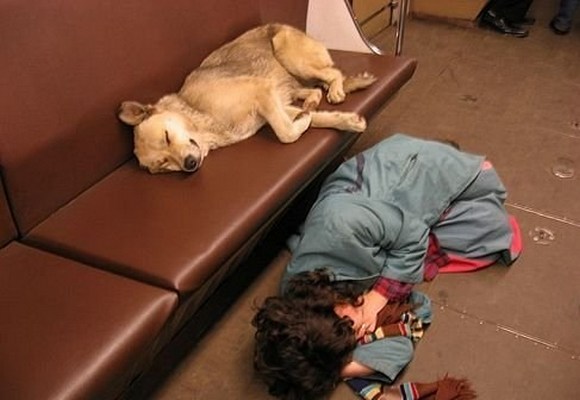
Learning sleep from our dogs!

Lack of sleep can have a role in obesity and diabetes.

Hazel asleep on the living-room couch at 2pm yesterday.

The sub-heading is taken from an item on the BBC News website that I read yesterday morning. (I’m republishing it in full so that readers are fully informed.)

Lack of sleep can have role in obesity and diabetes, study says

By James Gallagher, Health editor, BBC News website, San Diego

If you need a lie-in at weekends to make up for lack of sleep in the week, you may be at risk of obesity and type 2 diabetes, a study suggests.

The sleeping habits of 522 people found those losing sleep on weekdays were more likely to develop the conditions.

The findings, shown at the Endocrine Society‘s annual meeting, suggested increasing sleep could help patients.

Experts said the findings were interesting and called for the idea to be tested in large trials.

Studies have already shown that shift work can rapidly put healthy people into a pre-diabetic state.

The action of throwing the body clock out of sync is thought to disrupt the natural rhythm of hormones in the body, leading to a host of health problems.

But the pressures of work and social lives mean many people cut their sleep during the week and catch up at the weekend. Researchers are investigating whether there is a health impact.

Widespread

The study, by a team at the University of Bristol in the UK and Weill Cornell Medical College in Qatar, assessed “sleep debt” – a measure of the difference in the nightly hours asleep on weekdays and at the weekend.

“We found that as little as 30 minutes a day sleep debt can have significant effects on obesity and insulin resistance,” said Prof Shahrad Taheri from Weill Cornell.

He added: “Sleep loss is widespread in modern society, but only in the last decade have we realised its metabolic consequences.

“Our findings suggest that avoiding sleep debt could have positive benefits for waistlines and metabolism and that incorporating sleep into lifestyle interventions for weight loss and diabetes might improve their success.”

The study was funded by the UK’s Department of Health, where 10% of healthcare budgets are already spent on treating diabetes.

The disease can lead to blindness, increase the risk of heart attacks and strokes, as well as damaging nerves and blood vessels – dramatically increasing the risk of a foot needing to be amputated.

What the researchers do not know is the impact of improving people’s sleep so they get more on a weeknight and do not need a weekend lie-in.

Dr Denise Robertson, a senior lecturer from the University of Surrey, commented: “This work is interesting and consistent with prospective data found in healthy individuals without type 2 diabetes.

“However, before this association between sleep length, obesity and metabolic status can be used in terms of public health we need the next tier of evidence.

“To date there have been no randomised controlled trials where sleep debt is addressed and a metabolic benefit is observed. However, the potential for such interventions to impact on health is great.”

So while it might be regarded as a little ‘tongue-in-cheek’ to say that we need to learn to sleep more effectively from dogs, the BBC item suggests that it’s not as silly as one might think.

Lilly, to the rear of Paloma, sleeping soundly yesterday afternoon.

In the photograph above of Lilly and Paloma, both Mexican feral dogs rescued by Jean many years ago, sleep and a gentle life have allowed Lilly to achieve the grand old age of 17! In human terms that would be the equivalent of 136-years-old!

The Secret Life of Dogs.

Dogs watch us all the time and read our body language like a sixth sense.

A fascinating, and inspiring, insight into our favourite animal companion.

Published on Jan 26, 2014

Check out BBC Earth on BBC online
Dogs watch us all the time and read our body language like a sixth sense. They also smell our bodies for changes.

Max smelt cancer in Maureen before any medical scans could pick it up. Dogs do this naturally and can be trained to pick up on tiny volatile chemicals given off by cancerous tumors. They can even be taught to alert diabetics to low blood sugar levels.

Then read this, courtesy of the EarthSky Blog.

This dog can smell cancer

This is Frankie, a German shepherd mix. He can sniff out thyroid cancer in patients’ urine samples with 88% accuracy, according to a new study.

Image via The Endocrine Society.

A trained scent dog accurately identified whether patients’ urine samples had thyroid cancer or were benign (noncancerous) 88 percent of the time, according to a new study by researchers at University of Arkansas for Medical Sciences (UAMS). The results were presented March 6 at the Endocrine Society’s annual meeting in San Diego.

Approximately 62,450 new cases of thyroid cancer will be diagnosed in the US this year, and around 1,950 Americans will die from the disease.

Techniques used to diagnose thyroid cancer include fine-needle aspiration biopsy, which involves the patient having a thin needle inserted into the thyroid gland in the neck to obtain a tissue sample. Donald Bodenner, MD, PhD chief of endocrine oncology at UAMS is the study’s senior investigator. Bodenner said:

Scent-trained canines could be used by physicians to detect the presence of thyroid cancer at an early stage and to avoid surgery when unwarranted.

Study-coauthor Arny Ferrando previously “imprinted,” or scent-trained, a rescued male German Shepherd-mix named Frankie to recognize the smell of cancer in thyroid tissue. Ferrando, who noted that dogs have at least 10 times more smell receptors than humans, said:

Frankie is the first dog trained to differentiate benign thyroid disease from thyroid cancer by smelling a person’s urine.

German shepherd mix Frankie, a formerly stray dog rescued in Little Rock, Arkansas, was trained to diagnosis thyroid cancer through scent imprinting. Image credit: AM Hinson/BBC

In this study, 34 patients gave a urine sample before they went on to have a biopsy of suspicious thyroid nodules and surgery. The surgical pathology result was diagnosed as cancer in 15 patients and benign thyroid disease in 19. These urine samples were presented one at a time to Frankie to sniff. Frankie had been trained to alert to a cancer sample by lying down, and turning away from a benign sample to alert the absence of cancer.

The dog’s alert matched the surgical pathology diagnosis in 30 of the 34 study samples, the investigators reported.

Bottom line: A new study by University of Arkansas for Medical Sciences (UAMS) researchers presented March 6, 2015 at the Endocrine Society’s annual meeting in San Diego described Frankie, a trained scent dog that accurately identified whether patients’ urine samples had thyroid cancer or were benign 88 percent of the time.

Read more from the Endocrine Society

What incredible animals they are.

Welcome to the asylum!

Michael Klare offers convincing proof that the world is mad!

Once again, serendipity has stepped in and provided me with today’s post.

What do I mean?

Well yesterday, I republished in full a recent essay from George Monbiot.  He demonstrated that when it comes to “fiddling while Rome burns” the United Nations takes some beating. This is in the context of 23 years of UN gatherings to control the levels of CO2 in our planet’s atmosphere without attempting, in the slightest, to control the production of coal, oil and gas.  Take this excerpt as an example of our madness.

You cannot solve a problem without naming it. The absence of official recognition of the role of fossil fuel production in causing climate change – blitheringly obvious as it is – permits governments to pursue directly contradictory policies. While almost all governments claim to support the aim of preventing more than 2°C of global warming, they also seek to “maximise economic recovery” of their fossil fuel reserves. (Then they cross their fingers, walk three times widdershins around the office and pray that no one burns it). But few governments go as far as the UK has gone.

In the Infrastructure Act that received royal assent last month, maximising the economic recovery of petroleum from the UK’s continental shelf became a statutory duty. Future governments are now legally bound to squeeze every possible drop out of the ground.

The idea came from a government review conducted by Sir Ian Wood, the billionaire owner of an inherited company – the Wood Group – that provides services to the oil and gas industry. While Sir Ian says his recommendations “received overwhelming industry support”, his team interviewed no one outside either the oil business or government. It contains no sign that I can detect of any feedback from environment groups or scientists.

Then serendipitously, yesterday morning up pops an essay from Michael Klare published on Tom Dispatch that continues to underline the absence, the global absence, of any form of smart thinking.  It is republished today with the kind permission of Tom Engelhardt.

ooOOoo

Tomgram: Michael Klare, Is Big Oil Finally Entering a Climate Change World?

Posted by Michael Klare at 8:00am, March 12, 2015.
Follow TomDispatch on Twitter @TomDispatch.

Welcome to the asylum! I’m talking, of course, about this country, or rather the world Big Oil spent big bucks creating.You know, the one in which the obvious — climate change — is doubted and denied, and in which the new Republican Congress is actively opposed to doing anything about it. Just the other day, for instance, Senate Majority Leader Mitch McConnell wrote a column in his home state paper, the Lexington Herald-Leader, adopting the old Nancy Reagan slogan “just say no” to climate change. The senator from Coalville, smarting over the Obama administration’s attempts to reduce carbon emissions from coal-fired power plants, is urging state governors to simply ignore the Environmental Protection Agency’s proposed “landmark limits” on those plants — to hell with the law and to hell, above all, with climate change. But it’s probably no news to you that the inmates are now running the asylum.

Just weeks ago, an example of Big Energy’s largess when it comes to sowing doubt about climate change surfaced. A rare scientific researcher, Wei-Hock Soon, who has published work denying the reality of climate change — the warming of the planet, he claims, is a result of “variations in the sun’s energy” — turned out to have received $1.2 million from various fossil fuel outfits, according to recently released documents; nor did he bother to disclose such support to any of the publications using his work. “The documents,” reported the New York Times, “show that Dr. Soon, in correspondence with his corporate funders, described many of his scientific papers as ‘deliverables’ that he completed in exchange for their money. He used the same term to describe testimony he prepared for Congress.”

There’s nothing new in this. Big Energy (like Big Tobacco before it) has for years been using a tiny cadre of scientists to sow uncertainty about the reality of climate change. Naomi Oreskes and Erik Conway wrote a now-classic investigative book, Merchants of Doubt, about just how the fossil fuel companies pulled this off, creating a public sense of doubt where a scientific one didn’t exist. Now, the book has been made into a striking documentary film, which has just opened nationally. Someday, perhaps, all of this will enter a court of law where those who knowingly perpetrated fraud on the American and global publics and in the process threatened humanity with a disaster of potentially apocalyptic proportions will get their just desserts. On that distant day when those who ran the planet into the ground for corporate profits have to pay for their criminal acts, Merchants of Doubt will undoubtedly be exhibit one for the prosecution.

In the meantime, TomDispatch regular Michael Klare continues his invaluable chronicling at this site of the depredations of Big Oil on this fragile planet of ours. Tom

Big Oil’s Broken Business Model

The Real Story Behind the Oil Price Collapse
By Michael T. Klare

Many reasons have been provided for the dramatic plunge in the price of oil to about $60 per barrel (nearly half of what it was a year ago): slowing demand due to global economic stagnation; overproduction at shale fields in the United States; the decision of the Saudis and other Middle Eastern OPEC producers to maintain output at current levels (presumably to punish higher-cost producers in the U.S. and elsewhere); and the increased value of the dollar relative to other currencies. There is, however, one reason that’s not being discussed, and yet it could be the most important of all: the complete collapse of Big Oil’s production-maximizing business model.

Until last fall, when the price decline gathered momentum, the oil giants were operating at full throttle, pumping out more petroleum every day. They did so, of course, in part to profit from the high prices. For most of the previous six years, Brent crude, the international benchmark for crude oil, had been selling at $100 or higher. But Big Oil was also operating according to a business model that assumed an ever-increasing demand for its products, however costly they might be to produce and refine. This meant that no fossil fuel reserves, no potential source of supply — no matter how remote or hard to reach, how far offshore or deeply buried, how encased in rock — was deemed untouchable in the mad scramble to increase output and profits.

In recent years, this output-maximizing strategy had, in turn, generated historic wealth for the giant oil companies. Exxon, the largest U.S.-based oil firm, earned an eye-popping $32.6 billion in 2013 alone, more than any other American company except for Apple. Chevron, the second biggest oil firm, posted earnings of $21.4 billion that same year. State-owned companies like Saudi Aramco and Russia’s Rosneft also reaped mammoth profits.

How things have changed in a matter of mere months. With demand stagnant and excess production the story of the moment, the very strategy that had generated record-breaking profits has suddenly become hopelessly dysfunctional.

To fully appreciate the nature of the energy industry’s predicament, it’s necessary to go back a decade to 2005, when the production-maximizing strategy was first adopted. At that time, Big Oil faced a critical juncture. On the one hand, many existing oil fields were being depleted at a torrid pace, leading experts to predict an imminent “peak” in global oil production, followed by an irreversible decline; on the other, rapid economic growth in China, India, and other developing nations was pushing demand for fossil fuels into the stratosphere. In those same years, concern over climate change was also beginning to gather momentum, threatening the future of Big Oil and generating pressures to invest in alternative forms of energy.

A “Brave New World” of Tough Oil

No one better captured that moment than David O’Reilly, the chairman and CEO of Chevron. “Our industry is at a strategic inflection point, a unique place in our history,” he told a gathering of oil executives that February. “The most visible element of this new equation,” he explained in what some observers dubbed his “Brave New World” address, “is that relative to demand, oil is no longer in plentiful supply.” Even though China was sucking up oil, coal, and natural gas supplies at a staggering rate, he had a message for that country and the world: “The era of easy access to energy is over.”

To prosper in such an environment, O’Reilly explained, the oil industry would have to adopt a new strategy. It would have to look beyond the easy-to-reach sources that had powered it in the past and make massive investments in the extraction of what the industry calls “unconventional oil” and what I labeled at the time “tough oil”: resources located far offshore, in the threatening environments of the far north, in politically dangerous places like Iraq, or in unyielding rock formations like shale. “Increasingly,” O’Reilly insisted, “future supplies will have to be found in ultradeep water and other remote areas, development projects that will ultimately require new technology and trillions of dollars of investment in new infrastructure.”

klarepbk2012For top industry officials like O’Reilly, it seemed evident that Big Oil had no choice in the matter. It would have to invest those needed trillions in tough-oil projects or lose ground to other sources of energy, drying up its stream of profits. True, the cost of extracting unconventional oil would be much greater than from easier-to-reach conventional reserves (not to mention more environmentally hazardous), but that would be the world’s problem, not theirs. “Collectively, we are stepping up to this challenge,” O’Reilly declared. “The industry is making significant investments to build additional capacity for future production.”

On this basis, Chevron, Exxon, Royal Dutch Shell, and other major firms indeed invested enormous amounts of money and resources in a growing unconventional oil and gas race, an extraordinary saga I described in my book The Race for What’s Left. Some, including Chevron and Shell, started drilling in the deep waters of the Gulf of Mexico; others, including Exxon, commenced operations in the Arctic and eastern Siberia. Virtually every one of them began exploiting U.S. shale reserves via hydro-fracking.

Only one top executive questioned this drill-baby-drill approach: John Browne, then the chief executive of BP. Claiming that the science of climate change had become too convincing to deny, Browne argued that Big Energy would have to look “beyond petroleum” and put major resources into alternative sources of supply. “Climate change is an issue which raises fundamental questions about the relationship between companies and society as a whole, and between one generation and the next,” he had declared as early as 2002. For BP, he indicated, that meant developing wind power, solar power, and biofuels.

Browne, however, was eased out of BP in 2007 just as Big Oil’s output-maximizing business model was taking off, and his successor, Tony Hayward, quickly abandoned the “beyond petroleum” approach. “Some may question whether so much of the [world’s energy] growth needs to come from fossil fuels,” he said in 2009. “But here it is vital that we face up to the harsh reality [of energy availability].” Despite the growing emphasis on renewables, “we still foresee 80% of energy coming from fossil fuels in 2030.”

Under Hayward’s leadership, BP largely discontinued its research into alternative forms of energy and reaffirmed its commitment to the production of oil and gas, the tougher the better. Following in the footsteps of other giant firms, BP hustled into the Arctic, the deep water of the Gulf of Mexico, and Canadian tar sands, a particularly carbon-dirty and messy-to-produce form of energy. In its drive to become the leading producer in the Gulf, BP rushed the exploration of a deep offshore field it called Macondo, triggering the Deepwater Horizon blow-out of April 2010 and the devastating oil spill of monumental proportions that followed.

Over the Cliff

By the end of the first decade of this century, Big Oil was united in its embrace of its new production-maximizing, drill-baby-drill approach. It made the necessary investments, perfected new technology for extracting tough oil, and did indeed triumph over the decline of existing, “easy oil” deposits. In those years, it managed to ramp up production in remarkable ways, bringing ever more hard-to-reach oil reservoirs online.

According to the Energy Information Administration (EIA) of the U.S. Department of Energy, world oil production rose from 85.1 million barrels per day in 2005 to 92.9 million in 2014, despite the continuing decline of many legacy fields in North America and the Middle East. Claiming that industry investments in new drilling technologies had vanquished the specter of oil scarcity, BP’s latest CEO, Bob Dudley, assured the world only a year ago that Big Oil was going places and the only thing that had “peaked” was “the theory of peak oil.”

That, of course, was just before oil prices took their leap off the cliff, bringing instantly into question the wisdom of continuing to pump out record levels of petroleum. The production-maximizing strategy crafted by O’Reilly and his fellow CEOs rested on three fundamental assumptions: that, year after year, demand would keep climbing; that such rising demand would ensure prices high enough to justify costly investments in unconventional oil; and that concern over climate change would in no significant way alter the equation. Today, none of these assumptions holds true.

Demand will continue to rise — that’s undeniable, given expected growth in world income and population — but not at the pace to which Big Oil has become accustomed. Consider this: in 2005, when many of the major investments in unconventional oil were getting under way, the EIA projected that global oil demand would reach 103.2 million barrels per day in 2015; now, it’s lowered that figure for this year to only 93.1 million barrels. Those 10 million “lost” barrels per day in expected consumption may not seem like a lot, given the total figure, but keep in mind that Big Oil’s multibillion-dollar investments in tough energy were predicated on all that added demand materializing, thereby generating the kind of high prices needed to offset the increasing costs of extraction. With so much anticipated demand vanishing, however, prices were bound to collapse.

Current indications suggest that consumption will continue to fall short of expectations in the years to come. In an assessment of future trends released last month, the EIA reported that, thanks to deteriorating global economic conditions, many countries will experience either a slower rate of growth or an actual reduction in consumption. While still inching up, Chinese consumption, for instance, is expected to grow by only 0.3 million barrels per day this year and next — a far cry from the 0.5 million barrel increase it posted in 2011 and 2012 and its one million barrel increase in 2010. In Europe and Japan, meanwhile, consumption is actually expected to fall over the next two years.

And this slowdown in demand is likely to persist well beyond 2016, suggests the International Energy Agency (IEA), an arm of the Organization for Economic Cooperation and Development (the club of rich industrialized nations). While lower gasoline prices may spur increased consumption in the United States and a few other nations, it predicted, most countries will experience no such lift and so “the recent price decline is expected to have only a marginal impact on global demand growth for the remainder of the decade.”

This being the case, the IEA believes that oil prices will only average about $55 per barrel in 2015 and not reach $73 again until 2020. Such figures fall far below what would be needed to justify continued investment in and exploitation of tough-oil options like Canadian tar sands, Arctic oil, and many shale projects. Indeed, the financial press is now full of reports on stalled or cancelled mega-energy projects. Shell, for example, announced in January that it had abandoned plans for a $6.5 billion petrochemical plant in Qatar, citing “the current economic climate prevailing in the energy industry.” At the same time, Chevron shelved its plan to drill in the Arctic waters of the Beaufort Sea, while Norway’s Statoil turned its back on drilling in Greenland.

There is, as well, another factor that threatens the wellbeing of Big Oil: climate change can no longer be discounted in any future energy business model. The pressures to deal with a phenomenon that could quite literally destroy human civilization are growing. Although Big Oil has spent massive amounts of money over the years in a campaign to raise doubts about the science of climate change, more and more people globally are starting to worry about its effects — extreme weather patterns, extreme storms, extreme drought, rising sea levels, and the like — and demanding that governments take action to reduce the magnitude of the threat.

Europe has already adopted plans to lower carbon emissions by 20% from 1990 levels by 2020 and to achieve even greater reductions in the following decades. China, while still increasing its reliance on fossil fuels, has at least finally pledged to cap the growth of its carbon emissions by 2030 and to increase renewable energy sources to 20% of total energy use by then. In the United States, increasingly stringent automobile fuel-efficiency standards will require that cars sold in 2025 achieve an average of 54.5 miles per gallon, reducing U.S. oil demand by 2.2 million barrels per day. (Of course, the Republican-controlled Congress — heavily subsidized by Big Oil — will do everything it can to eradicate curbs on fossil fuel consumption.)

Still, however inadequate the response to the dangers of climate change thus far, the issue is on the energy map and its influence on policy globally can only increase. Whether Big Oil is ready to admit it or not, alternative energy is now on the planetary agenda and there’s no turning back from that. “It is a different world than it was the last time we saw an oil-price plunge,” said IEA executive director Maria van der Hoeven in February, referring to the 2008 economic meltdown. “Emerging economies, notably China, have entered less oil-intensive stages of development… On top of this, concerns about climate change are influencing energy policies [and so] renewables are increasingly pervasive.”

The oil industry is, of course, hoping that the current price plunge will soon reverse itself and that its now-crumbling maximizing-output model will make a comeback along with $100-per-barrel price levels. But these hopes for the return of “normality” are likely energy pipe dreams. As van der Hoeven suggests, the world has changed in significant ways, in the process obliterating the very foundations on which Big Oil’s production-maximizing strategy rested. The oil giants will either have to adapt to new circumstances, while scaling back their operations, or face takeover challenges from more nimble and aggressive firms.

Michael T. Klare, a TomDispatch regular, is a professor of peace and world security studies at Hampshire College and the author, most recently, of The Race for What’s Left. A documentary movie version of his book Blood and Oil is available from the Media Education Foundation.

Follow TomDispatch on Twitter and join us on Facebook. Check out the newest Dispatch Book, Rebecca Solnit’s Men Explain Things to Me, and Tom Engelhardt’s latest book, Shadow Government: Surveillance, Secret Wars, and a Global Security State in a Single-Superpower World.

Copyright 2015 Michael T. Klare

ooOOoo

Both yesterday’s essay from George Monbiot and Michael Klare’s essay above are not quick reads.  But reading them thoroughly is rewarding because it underlines the degree to which the lives of millions of hard-working citizens comes to naught when big money, power and politics are involved.

Smart thinking – something else to learn from our dogs?

Because some of the things we humans do are insanely stupid!

Here’s a picture of Oliver taken yesterday afternoon.

Becoming a dear, smart dog. (And those eyes!)

A few days ago, I was sitting in our living room on one of our settees (more or less where Oliver was sitting when the photograph above was taken) with my knees up against a low coffee table; the table separates our two settees.

On the settee to my left lay Cleo and on the floor across my feet slept Hazel.

It was clear that Oliver wanted to join me on the settee but couldn’t work out if there was room.  I shifted about two feet to my left leaving an Oliver-sized gap to my right. However, Oliver couldn’t come past my knees, from left to right as it were, because of Hazel. He very quickly worked out to run around behind the settee and jump up into the space I had newly created to my right.

Don’t worry if I lost you!

The point I am making is that Oliver, who has grown into the most delightful young adult dog, with a gorgeous temperament, demonstrates daily a keen intelligence and a nose for working things out quickly.

All of which is a preamble for me wondering if among the list of qualities that we humans should learn from dogs we should add intelligence.

For there’s been a few items around the ‘blogosphere’ that have highlighted how silly we can be.

Take this item that recently was featured on Grist.

Walmart’s new green product label is the most misleading yet.

A giant, 150-foot roll of bubble wrap may not be your idea of an environmentally friendly product, but over at Walmart.com this one-pound ball of plastic now boasts a special “Sustainability Leaders” badge. It’s one of more than 3,000 products tagged with this new green label, which Walmart executives unveiled last week, together with a web portal where shoppers can find these items.

Dozens of news accounts hailed the giant retailer’s move as a significant step toward clearing up the confusion and misleading information that often greet consumers trying to make ecologically responsible choices. “The world’s largest retailer took a major and important step toward helping all of us shop more smartly,” declared corporate sustainability consultant Andrew Winston in Harvard Business Review. Triple Pundit concurred: “It’s about to get a lot easier for Walmart.com shoppers to make the responsible choice.”

Actually, a green-minded online shopper is likely to find Walmart’s new badge confusing, murky, and downright misleading. I searched the bubble wrap’s product page high and low for its secret sauce, the invisible feature that makes it a smarter choice amid the many seemingly less harmful packing options available, but found no explanation.

It turns out that the key to this mystery lies in a remarkable disclaimer tucked into the middle of the home page of Walmart’s sustainability shopping portal: “The Sustainability Leaders badge does not make representations about the environmental or social impact of an individual product.” (my emphasis)

You can read the full item here, and you should! It’s unbelievably stupid, apart from being highly misleading, to my mind because when the word gets around it will damage the trust that all retailers need from their customers. And don’t even bring up the notion of integrity!

Then over on George Monbiot’s blogsite, there is a recent essay about the UN and progress on climate change. Here’s how it starts (and I’m republishing it in full tomorrow):

Applauding Themselves to Death

If you visit the website of the UN body that oversees the world’s climate negotiations, you will find dozens of pictures, taken across 20 years, of people clapping. These photos should be of interest to anthropologists and psychologists. For they show hundreds of intelligent, educated, well-paid and elegantly-dressed people wasting their lives.

The celebratory nature of the images testifies to the world of make-believe these people inhabit. They are surrounded by objectives, principles, commitments, instruments and protocols, which create a reassuring phantasm of progress while the ship on which they travel slowly founders. Leafing through these photos, I imagine I can almost hear what the delegates are saying through their expensive dentistry. “Darling you’ve re-arranged the deckchairs beautifully. It’s a breakthrough! We’ll have to invent a mechanism for holding them in place, as the deck has developed a bit of a tilt, but we’ll do that at the next conference.”

Humans have the potential to be incredibly smart thinkers, and down the ages there have been many such thinkers.

But!

Over on the Patrice Ayme blogsite there have been a couple of recent essays that highlight examples of both stupid thinking and the rewards that flow from smart thinking. In one essay, Added Value in the XXI Century, Patrice writes:

SUPERIORITY OF THE WEST?

Why did the West become so superior? Or China, for that matter?

Technology. Superior technology. Coming from superior thinking. Both the Greeks and the Chinese had colossal contempt for barbarians. (In both cases it went so far that the Greeks lost everything, and the Chinese came very close to annihilation).

Around the year 1000 CE, the Vietnamese (it seems) invented new cultivars of rice, which could produce an entire crop, twice a year. The population of East Asia exploded accordingly.

A bit earlier, the Franks had invented new cultivars of beans. The Frankish Tenth Century was full of beans. Beans are nutritious, with high protein.

Homo is scientific and technological. Thus, two million years ago, pelt covered (tech!) Homo Ergaster lived in Georgia’s Little Caucasus, a pretty cold place in winter. And the population was highly varied genetically (showing tech and travel already dominated).

A GREATER OBSESSION WITH FREEDOM MADE THE WEST SUPERIOR:

Here is the very latest. Flour was found in England, in archeological layers as old as 10,000 years before present. It was pure flour: there were no husks associated. The milling had been done, far away. How far? Well the cultivation of wheat spread to Western Europe millennia later. The flour had been traded, and brought over thousands of miles. Most certainly by boat. Celtic civilization, which would rise 5,000 years later, was expert at oceanic travel.

What’s the broad picture? Not just that prehistoric Englishmen loved their flat bread, no doubt a delicacy. Advanced technology has permeated Europe for much longer than is still understood now by most historians. Remember that the iceman who died in a glacier, 5,000 years ago, was not just tattooed, and had fetched in the lowlands a bow made of special wood. More telling: he carried antibiotics.

Then in a subsequent essay, What Is It To Think Correctly?, Patrice opens, thus:

What Is It To Think Correctly?

Some say that correct thinking has to do with avoiding “logical fallacies”. That is, of course, silly. Imagine a pilot in a plane. Suppose she avoids all logical fallacies. Where does the plane go? Nowhere. Thinking correctly is more than avoiding logical “fallacies”.

One needs more than logic, to proceed: one needs e-motion, or motivation (both express the fact that they are whatever gets people to get into action; the semantics recognizes that logic without emotion goes nowhere).

There is another, related, fallacy in thinking that correct thinking is all about avoiding “logical fallacies”.

I don’t have the answers to the conundrum of stupid thinking a la Walmart and the United Nations (not an exclusive list; by far) but I do believe that the only way for humanity to overcome what looks like a very dangerous era ahead is through smarter thinking!

Oh, nearly forgot.

Oliver will be happy to run classes on smart thinking!

Nowhere to hide now!

Have a dog or two in the house? Hide your feelings then!

I have previously remarked on how quickly our dogs pick up on key words and phrases spoken by either Jean or me.  In my case, long before I met Jean when I was living in Devon with Pharaoh, I quickly learnt that voicing the word ‘walk’ caused an eruption of interest from his nibs. Then I foiled his intelligence by spelling the word out: w-a-l-k.  That lasted all of a fortnight (or two weeks in American speak) before Pharaoh knitted the letters into that walk word.

Here in Oregon our living-room/bedroom group of dogs (Pharaoh, Hazel, Cleo, Sweeney and Oliver) pick up on so many human comments, sayings, and behaviours that at times it feels as though Jean and I need to go somewhere private in order to discuss anything that affects our lovely dogs.

All of which is a preamble to a fascinating article recently seen on the Smithsonian Magazine website.

Our furry friends might be able to infer our mood based on our facial expressions - just like human buddies do. (Photo: JLPH/cultura/Corbis

Our furry friends might be able to infer our mood based on our facial expressions – just like human buddies do. (Photo: JLPH/cultura/Corbis)

Dogs Can Tell Whether You’re Making a Happy or Mad Face

For the first time, science shows that a non-human animal can recognize the emotional state of another species

By Rachel Nuwer
smithsonian.com
February 12, 2015

Facial expressions are a key asset in our arsenal of communication methods. Without saying a word, we can alert those around us to our emotional state—ranging from elation to sorrow—simply by flexing a few muscles. Such expressions have evolved to help us connect with one another, avoid danger and work together.

Fellow humans, however, are not the only ones potentially tuning in to the information our expressions convey. According to the results of a study published today in Current Biology, dogs have hacked this silent method of communication, at least enough to distinguish between angry and happy facial expressions.

Dogs and humans share a tight evolutionary bond, which is why veterinarian researchers from the University of Vienna decided to focus on these two species for their study. Dogs are already known to be whizzes at reading us. For instance, they can discriminate between familiar and unfamiliar faces even if just part of the face is shown in a photograph. Whether they actually recognize emotions, however, had not been conclusively investigated before.

It would be wrong to republish the full article without permission but I do want to share another photograph from the article and the closing paragraphs.

aa
A canine research subject differentiates between angry and happy eyes. Photo: Anjuli Barber, Messerli Research Institute

Before the authors delve into the greater animal kingdom, though, they plan to further explore their canine findings. Experiments with puppies could lend insight into whether facial expression recognition is something dogs learn over their lives or if it’s something more innate. And trials with wolves could indicate whether human breeders bestowed emotion recognition in their canine companions via artificial selection, or whether that trait was something dogs’ ancient relatives developed on their own simply by living in the vicinity of humans.

While the initial controlled laboratory findings don’t prove that your dog is watching your every facial move for clues about how you are feeling, they do open up the possibility that dogs are even more empathetic best friends than we thought.

Many of you who have dogs in your lives will intuitively know this to be true. But having the scientific underpinning is wonderful confirmation of that truth.

I’m sure I am not alone in having a dog come up to me and lick the tears off my face.

What incredible loving and trusting relationships we have with our dogs.

To underline my last sentence, on a whim I just took the following photograph of Hazel who very rarely isn’t by my side.

Picture taken at 10:35 yesterday morning in my 'home office' when I had finished writing today's post.
Picture taken at 10:35 yesterday morning in my ‘home office’ when I had just finished writing today’s post.

There’s a bit of a smell!

The incredible power of the nose of a dog.

Young Oliver had an upset tummy during the night resulting in the bedroom carpet needing a little ‘sorting out’ after midnight. Thus I was very grateful that a human’s sense of smell is very much inferior to that of the dog!

Oliver sleeping in front of the wood-stove yesterday morning.

I couldn’t escape the irony that today’s post was inspired by an email from friend Dan Gomez. His email included the link to an article on the Brain Links website. It was called How a Dog Actually “Sees” the World Through Smell. Here’s how the article opened:

“The world of scents is at least as rich as the world of sight.”

Even though smell is the most direct of our senses and the 23,040 breaths we take daily drag in a universe of information — from the danger alert of a burning odor to the sweet nostalgia of an emotionally memorable scent — our olfactory powers are not even mediocre compared to a dog’s. The moist, spongy canine nose is merely the gateway into a remarkable master-machine which can detect smells in concentrations one hundred-millionth of what we humans require to smell something, and then transmute them into immensely dimensional and useful information about the world. So magnificent is the dog’s olfactory brawn — including the ability to sniff out skin, breast, bladder, and lung cancers with an astounding degree of accuracy and to literally smell fear — that to our primitive human perception it appears like nothing short of magic.

The article also included this short TED Talk but I have taken the liberty of including the paragraph that preceded the YouTube video.

How that neurobiological magic happens is what cognitive scientist Alexandra Horowitz — who heads the Dog Cognition Lab at Barnard College but has also produced a canon of invaluable insight on how we humans construct our impressions of reality — explains in this short animation from TED-Ed, based on her illuminating book Inside of a Dog: What Dogs See, Smell, and Know (public library):

Do go across and read the full article.

Mind you, referring back to our overnight doggy incident, I did find one paragraph slightly at odds with my personal views on the subject. It was this one:

We humans tend not to spend a lot of time thinking about smelling. Smells are minor blips in our sensory day compared to the reams of visual information that we take in and obsess over in every moment.

I’m here to tell you that at 1am yesterday morning, my sense of smell was anything other than a minor blip!

OK, before I close, I just want to alert all you dear readers to the fact that from later today until early March my son, Alex, is visiting us.  His plans are to find somewhere in Oregon to enjoy some skiing but the very mild Winter so far may put a spanner in those works.

For obvious and natural reasons, writing posts for Learning from Dogs will not be a daily high priority. So if you read a number of posts previously published in earlier times you will understand why. Thank you.

Animal healing

The power of our beautiful creatures to heal us.

Yet again, another example of a post almost writing itself.

Let me explain.

Yesterday, I published a post about being sensitive to the world around us.

Then this morning there was a new post from Sue Dreamwalker under the title of Fear of the Future. It was uncharacteristically downbeat for Sue.

Now most who follow me know I try to bring a positive touch within my posts… Yet to be quite honest with you all I am really struggling right now to lift myself from the doldrums of my own thoughts.

The key to conquering our fears lies in awareness. When we identify the irrational thoughts that frighten us and replace them with positive affirming ones.

Argh… all easier said than done..

You would think with my inner Knowing, and my Spiritual mind I should be the last person to take a nose dive into that Pit of depression.. Especially when I dredged its depth before and vowed that I had been there done that and worn the T-shirt and I refuse to wear it again.

I could blame it on my Fall which left me feeling bruised with aching, muscles which are still healing.. And I could blame it on grief as I lost a very beloved Aunt last week. I could blame my fatigue on me deciding to move a whole wall of books out the spare bedroom with wrists still recovering from the sprains of the fall.. And I could blame it on the weather being cold and miserable.. I could even blame it on the state of the world, or the Planets .. I have a whole host of excuses I could fall back upon to justify why I am feeling tired and jaded..

Many left comments including me. I spoke of the reward of hugging a dog. My words included:

I don’t have answers other than to feel what you are feeling. All I hang onto when I spend too much time thinking of my own mortality is that the answer, the answer to the moment, is to bury one’s face into the warm, soft fur of a dog. They seem to sense my need at these times. (And that isn’t meant to sound like me devaluing the love and affection that I receive from Jean!)

In other words, that contact with the warm dog holds me in the present and before long the reinforcement of living that present, loving moment puts the unknown future into perspective.

Another comment was left by blogger Rajagopal that included this wonderful tale:

The only thing that I have seen working in my life is to keep living, as much as possible, in the present. There is nothing to fear, either of the now or of the future.

In this context, wish to leave you with the story of the pregnant deer; in a forest, a pregnant deer is about to give birth. She finds a remote field near a strong-flowing river, that looks like a safe place, as she starts going into labour. At the same moment, dark clouds gather in the sky and streaks of lightning sets off a forest fire. The deer looks to her left and sees an approaching hunter with arrow pointed at her. To her right, the deer spots a hungry lion speeding towards her. What can the pregnant deer do? She is in labour! What will happen? Will the deer survive? Will she give birth to the fawn and will it survive? Or will everything be burnt by the forest fire? Or will she perish to the hunter’s arrow? Or does a horrible end await her at the hands of the hungry lion? Constrained by the fire on one side, the flowing river on the other and boxed in by her natural predators, the deer is apparently left with no option. What does she do? Well, she focuses on delivering and giving birth to a new life.

The sequence of events that follows is the Lightning strikes and blinds the hunter, who releases the arrow which zips past the deer and strikes the hungry lion. It starts to rain heavily and the forest fire is slowly doused by rain water. The deer gives birth to a healthy fawn….In our life too there are moments when we are confronted with negative thoughts and possibilities on all sides, so powerful as to overwhelm us. May be we can learn from the deer. The priority of the deer at that given moment was to give birth as safely as possible.

The rest was not in her hands and any change in her focus would have most likely impeded giving birth to the fawn. In the midst of the severest storm, we just have to maintain presence of mind and do what is in our control…the Cosmic power will take care of the rest…best wishes… Raj.

Finally, there was a recent new follower of this place. Her name is Emma and she writes the blog The Muse in the Mirror. Emma was kind enough to grant me permission to republish a post from last December about the healing power of Llamas. Enjoy!

ooOOoo

Llama Loving; The healing power of Llamas

emma1It’s official; I LOVE llamas. There, I said it, put out there for the world to know! I love their gentle, sensitive nature, friendly disposition and most of all their goofy, giggle-worthy expressions, which never fail to bring a smile to my face! Concerned that my llama loving status was bordering on obsession, I was beginning to question whether my love for these comical camelids was founded on anything other than sheer amusement! Thankfully as I researched further my findings confirmed that these beautiful animals are much more than a pretty (funny) face!!!

Llama Therapy

emma2
Llama Marisco visits patients at Bellingham Health and Rehabilitation Center in Washington, USA. © Jen Osborne Photography

I squealed in delight when Colours Magazine published the story about The Delta Society, a non-profit organization that licenses animals for therapy

Holly Barto hugs a therapy llama at Bellingham Health and Rehabilitation Center, USA © Jen Osborne Photography

in USA. The adorable photo’s lay testament to the happiness that llama’s bring to residents at Bellingham Health and Rehabilitation Center in Washington, USA. Llama Marisco (pictured above), and Llama N.H. Flight of the Eagle (pictured right) are trained therapists, who spread comfort and joy as they stop at each bed to kiss the patients or have a hug. Resident Holly Barto remarked that…

It was heaven. Just emotionally – to be able to touch an animal and hold an animal close.

Another example of the profound healing benefits of llama’s can be seen in this adorable video below showing Rojo the therapy llama and Napoleon the therapy alpaca from Mtn Peaks Therapy Llamas & Alpacas, in Vancouver, WA USA. A non-profit corporation, which offers therapy teams to visit hospitals and schools in the area. The expressions on people’s faces are heart warming to say the least!

Who knew such fluffed-up, carrot munching mammals could bring so much joy.

Laughter is the best medicine.

emma4
Llama Dave is disgruntled by the fact I was munching in on his dinner!

If I am having an off day, the first thing I reach for is a funny llama picture. Better still, a visit to the local llama park soon blasts my bad moon into infinity and beyond! A good giggle-fest at the Ashdown Forest Llama park, in East Sussex, dissolves the blues and confirms that laughter really is the best medicine! (See my picture gallery below to see me with some of the residents of the Ashdown Forest Llama park!).

There’s a very good reason behind the saying Laughter is the best medicine. Research suggests that people feel less pain after a good laugh, because it causes the body to release chemicals that act as a natural painkiller. ‘Professor Robin Dunbar of Oxford University, who led the research, believes that uncontrollable laughter releases chemicals called endorphins into the body which, as well as generating mild euphoria, also dull pain.’ (BBC)

It is common knowledge that animals in general make us happier and brighten our spirits. A growing body of scientific research now suggests that interacting with animals can make us not only happier, but healthier too. That helps explain the increasing use of animals for therapeutic purposes in hospitals, hospices, nursing homes, schools, jails and mental institutions.

The use of pets in medical settings actually dates back more than 150 years, says Aubrey Fine, a clinical psychologist and professor at California State Polytechnic University. Fine who has written several books on the human-animal bond says:

One could even look at Florence Nightingale recognizing that animals provided a level of social support in the institutional care of the mentally ill,”

So there you have it, next time you’re feeling blue, you know what to do! Head on out to your nearest llama park to insight those warm fuzzy feelings from a fluffy four legged llama! Check out my favourite selection of Llama and Alpaca pics below, guaranteed to bring a smile to any face!!

emma5

ooOOoo

Note: That last photograph above is only one of a wonderful collection of Llama photographs that Emma included in her blog post. Do drop across there and admire all the wonderful pictures.

The incredible healing power of hugging an animal.

Sensitivity to the world around us.

The more we give up, the more we ‘own’.

It is a very common, understandable trait of us humans to put our own lives first.  I mean that much more in the psychological sense than in the sense of our daily activities although what we think and feel, inevitably, influences how we behave. One of the fabulous qualities of our dogs is that they are so much more sensitive to the world around them than to their own internal thoughts and feelings. Right from the early years of having Pharaoh in my life I was aware that he ‘read’ my emotions easily and soon became an instinctive ‘friend’, especially when I was troubled.

Years later, all of the dogs love it when Jean and I are in happy, positive places and you can see how our human states of mind link so directly to the mood of our dogs.

All of which is my introduction to an essay recently read over on the Big Think blogsite. Specifically, one about living empathically. The essay is called: Let’s Make 2015 “The Year of Living Empathetically” and here are the opening paragraphs:

Let’s Make 2015 “The Year of Living Empathetically”

by JOAN COLE DUFFELL

I began the new year on a very positive – and inspiring – note after reading Eric Liu’s latest commentary on “Radical Empathy”.

The founder and CEO of Citizen University, Liu shows us that laying aside our egos – our need to be in the right – in favor of standing in the shoes of others, is key to addressing so many of the problems that we (once again) confronted in 2014.

This insight – without question – is a wake-up call to our country as 2015 unfolds.

That’s why I think we should resolve to make 2015 “The Year of Living Empathetically.”

We need to make the practice of empathy our New Year’s exercise regimen, our social-emotional diet for the next 365 days.

  • Let’s practice empathy at home, with our spouses and kids.
  • Let’s practice empathy in the workplace, as we give and receive feedback, and credit others’ contributions generously.
  • Let’s practice empathy in the classroom, especially when kids are struggling and need our support.
  • Let’s practice empathy in public service, as we encounter people who look different from us, and whose lives matter every bit as much as our own.
  • Let’s practice empathy as we encounter people on the street, who may be less fortunate, and are just as human.
  • Let’s practice empathy when resolving conflict, whether interpersonally or on a global-political level.
  • And let’s practice empathy in local and state governments, and in the halls of Congress, so that we might truly listen in order to solve real problems

If all this sounds like a tall order – you’re right; it is.

As Brene Brown, a research professor at the University of Houston Graduate College of Social Work, points out, empathy is a challenging personal choice that requires us to become vulnerable in an effort to connect with another person.

It is not a long essay, so do drop across to here and finish reading it.

As is the way of ideas, serendipity is always actively working ‘under the hood’.

Why do I say that?

Because as soon as I was clear about what I wanted to offer you for today, in to my ‘in-box’ came the latest TED Talk. A talk from Ben Ambridge entitled: 10 myths about psychology: Debunked. It so resonated with today’s theme and is offered below.

http://www.youtube.com/watch?v=ce31WjiVcY0

Published on Feb 4, 2015
How much of what you think about your brain is actually wrong? In this whistlestop tour of dis-proved science, Ben Ambridge walks through 10 popular ideas about psychology that have been proven wrong — and uncovers a few surprising truths about how our brains really work.

Ben Ambridge is the author of “Psy-Q,” a sparkling book debunking what we think we know about psychology.

Why you should listen?

Ben Ambridge is a senior lecturer in psychology at the University of Liverpool, where he researches children’s language development. He is the author of Psy-Q, which introduces readers to some of the major findings in psychology via interactive puzzles, games, quizzes and tests.

He also writes great newsy stories connecting psychology to current events. His article “Why Can’t We Talk to the Animals?” was shortlisted for the 2012 Guardian-Wellcome Science Writing Prize. Psy-Q is his first book for a general audience.

Dr. Ben Ambridge with his book: Psy xxx
Dr. Ben Ambridge with his book: Psy-Q.

If you want to learn more about the good Professor, here is his webpage on the University of Liverpool‘s website. And here is Ben Ambridge’s personal webpage that lists many, if not all, of his publications.

I honestly can’t find a better picture to close today’s post about sensitivity and empathy than this one below:

Empathy for another in its most beautiful shape.