Yesterday was heading to be a very hot day in Merlin, Oregon with top temperatures forecasted to be around the mid-90’s, or 34-36 deg. C in ‘new money’. The light westerly wind must have been generating some up currents, aided and abetted by the rising hot air, for there were a number of black ravens soaring in a thermal. Watching the birds circle and climb in the thermal current without needing to flap their wings took me back too many years.
It took me back to a June day in 1981 where I experienced my first glider flight (sailplane in American speak) at the Rattlesden Gliding Club in Suffolk, East Anglia. I’m delighted to see that the Club is still an active one, as their website confirms. Although I subsequently went on to gain my private pilot’s licence (PPL) there are still times when I miss the magic, the pure magic, of gaining altitude in a glider in a beautiful thermal.
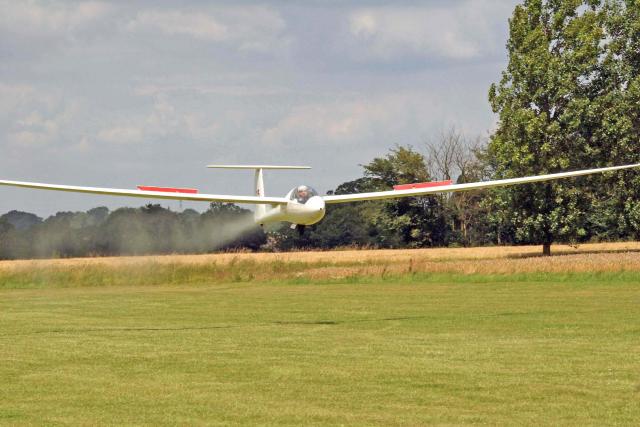
Modern fibreglass glider coming into land at Rattlesden G.C.
So what prompted this flood of flying nostalgia!! An item that was published on the BBC website earlier in the year.
ooOOoo
Fly like a bird: The V formation finally explained
By Victoria Gill, Science reporter, BBC News
The mystery of why so many birds fly in a V formation may have been solved.
Scientists from the Royal Veterinary College fitted data loggers to a flock of rare birds that were being trained to migrate by following a microlight. This revealed that the birds flew in the optimal position – gaining lift from the bird in front by remaining close to its wingtip.
A previous experiment in pelicans was the first real clue to the energy-saving purpose of V formations. It revealed that birds’ heart rates went down when they were flying together in V.
But this latest study tracked and monitored the flight of every bird in the flock – recording its position, speed and heading as well as every wing flap.
This was possible thanks to a unique conservation project by the Waldarappteam in Austria, which has raised flocks of northern bald ibises and trained them to migrate behind a microlight.
The aim of this unusual project is to bring the northern bald ibis back to Europe; the birds were wiped out by hunting, so the team is retraining the birds to navigate a migration route that has now been lost.
Fitting tiny data loggers to these critically endangered ibises showed that the birds often changed position and altered the timing of their wing beats to give them an aerodynamic advantage.
Lead researcher Dr Steven Portugal explained: “They’re seemingly very aware of where the other birds are in the flock and they put themselves in the best possible position.”
This makes the most of upward-moving air generated by the bird in front. This so-called “upwash” is created as a bird flies forward; whether it is gliding or flapping, it pushes air downward beneath its wings.
“Downwash is bad,” explained Dr Portugal. “Birds don’t want to be in another bird’s downwash as it’s pushing them down.” But as the air squeezes around the outside of the wings, it creates upwash at the wingtips.
“This can give a bit of a free ride for the bird that’s following,” said Dr Portugal. “So the other bird wants to put its own wingtip in the upwash from the bird in front.”
The other really surprising result, the researchers said, was that the birds also “timed their wing beats perfectly to match the good air off the bird in front”.
“Each bird [kept] its wingtip in the upwash throughout the flap cycle,” Dr Portugal explained.
oooo
In a sidebar to that BBC article there is this explanation about Flapping and Flying:
As a bird’s wings move through the air, they are held at a slight angle, which deflects the air downward. This deflection means the air flows faster over the wing than underneath, causing air pressure to build up beneath the wings, while the pressure above the wings is reduced. It is this difference in pressure that produces lift.
Flapping creates an additional forward and upward force known as thrust, which counteracts the weight and the “drag” of air resistance. The downstroke of the flap is also called the “power stroke”, as it provides the majority of the thrust. During this, the wing is angled downwards even more steeply.
You can imagine this stroke as a very brief downward dive through the air – it momentarily uses the animal’s own weight in order to move forward. But because the wings continue to generate lift, the creature remains airborne. In each upstroke, the wing is slightly folded inwards to reduce resistance.
ooOOoo
The BBC piece also included this wonderful short video:
This piece has nothing to do with dogs unless one extends the mindset to the magic of the complete natural world.
UPDATE
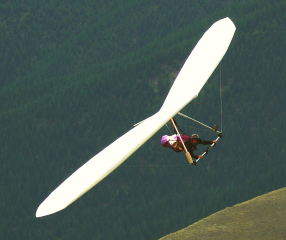
This is a photograph of George Ball hang-gliding – see his reply below.
(I’m conscious that many recent posts have been more of me republishing stuff than being creative on my own account. Blame it on ‘the book’: my first edit is now complete and the next stage is sending the manuscript out to those who have volunteered to proof-read the book.)
I saw this article on Mother Nature Network and it struck me immediately as being full of common-sense and well worth sharing with you.
ooOOoo
How to build the perfect backyard for dogs
Learn which plants are hardy, which are poisonous, and how to create a beautiful but functional layout.
Designing your garden with your dog in mind will prevent an infinite number of headaches down the road. (Photo: upixa/Shutterstock)
A dog and a healthy, beautiful backyard don’t often go hand in hand. The amount of wear and tear a dog throws at a garden can leave it in tatters. But it doesn’t have to be this way! With a bit of planning and a careful selection of plants able to hold up to whatever dogs spray at them, your backyard can be both a haven for humans and a paradise for your pups.
Here are helpful strategies for planning out a yard and a list of plants to use or to avoid.
7 tips for dog-friendly garden design
Build raised beds for the more sensitive plants or for any fruits and vegetables you may want to grow. Add in some fencing or netting around the boxes to protect them if your dog is still tempted to hop up and snoop around in them.
Build a dog-friendly path around the yard. This will guide your dog through the garden and minimize the detours into the flowerbeds. You may want to start by watching where your dog goes on his own, and creating the path along that route. That way you aren’t trying to train your dog to go somewhere he doesn’t normally want to go, and you aren’t frustrated when your dog goes where he wants to anyway.
Providing pathways for your dogs will show them where they’re allowed to run and will help keep them out of more sensitive areas of the garden. (Photo: Julius Elias/Shutterstock)
Discourage digging through design. If your dog sometimes digs holes, you can help keep your garden beds safe by making them raised beds. However, if your dog is a relentless digger and no part of the yard is safe, then consider building an area where your dog can do anything he’d like within that space, including dig. This could be a fenced area that has a sand box, where the outlet of digging is welcomed.
Create a designated area for bathroom breaks. This will of course require training your dog to use it, but the time and effort spent in training will counter any time and money spent in replacing dead plants.
Provide places to sun. Many dogs love to sunbathe and might pick the sunniest spot in the middle of your favorite bed of flowers. Avoid a dog selecting his own area by providing one for him instead. A small deck, or a few paving stones in a pretty design, or even an area with bark chips will be a welcoming place for your dog to lie down, out of the way of the plants.
Create shaded areas to keep your pet comfortable. Yards are the perfect place to hang out in the sun, but on hot days it can feel pretty miserable without relief with a little shade. Plant trees or tall shrubs where your dog can enjoy a cool break from playing in the sun.
If you have a water feature, make sure the water is drinkable and free of chemicals.
Safe and hardy plants for dogs
After figuring out a few design elements to make your yard a place where both dogs and humans can feel comfortable, it’s time to review your plant selection. There are a fair number of plants that are resistant to dog urine. By placing these plants in the areas your dog frequents, you can reduce how much replanting you need to do as well as keep your yard looking fresh and healthy.
Many herbs are not only safe but also healthy for dogs. But you’ll still want to protect them from your dog by growing them in a raised bed or pots. (Photo: Jamie Hooper/Shutterstock)
Luckily, the herbs you likely want to have in your kitchen garden are also healthy for dogs. If you like cooking with these savory staples, you’ll be happy to know they’re more than welcome in your dog-friendly garden! The five best options include:
Basil — antioxidant, antiviral and antimicrobial properties
Oregano — helps digestive problems including diarrhea and gas
Parsley — a source of flavonoids, antioxidants and vitamins
Peppermint — soothes upset stomachs, reduces gas and nausea, and helps with travel sickness
Rosemary — high in iron, calcium and Vitamin B6
Groundcovers are a great alternative to a grassy lawn. Many varieties can withstand abuse from dogs better than any grasses. Great options include:
Carpet bugle
Elfin thyme
Kinnikinick
Miniature stonecrop
Silver carpet
Snow in summer
Winter creeper
Another staple for a dog-friendly yard are urine-resistant plants. Here are a few suggestions:
Bears breech
Burkwood osmanthus
Doublefile viburnum
Feather reed grass
Holly fern
Japanese spindle tree
Mexican sage
New Zealand flax
Redtwig dogwood
Snowball viburnum
Spider plants
Sword fern
Plants poisonous to dogs
Even if they look pretty, there are quite a few plants you should avoid having in your yard because ingesting them can mean illness or death for your pet. It doesn’t mean you can’t have these plants around; it just means you’ll want to plant them in areas your dog can’t access, such as fenced-off portions of the yard or in hanging baskets out of reach. University of California, Davis put together a list of the 12 plants that cause the most visits to their vet hospital. They include:
Aloe vera
All species of amaryllis
Anemone
Asparagus fern
Chrysanthemums
Cycads (including Sago palm and cardboard palm)
Cyclamen
Daffodil
Jade plants
Lilies
Lily of the valley
Philodendrons
The ASPCA provides a full list of plants toxic to dogs. Reviewing this list before planting will help prevent trips to the vet in the future.
Be sure to double check if the plants you’re adding to your garden are toxic to dogs. While some dogs stay out of the plants, others may munch on anything they feel like, which could lead to a trip to the vet’s office. (Photo: Dora Zett/Shutterstock)
Other things your dog could, but shouldn’t eat
Which mulch you select could be important to your dog’s health. Cocoa mulch, made of cocoa bean shells, is a by-product of chocolate production and can be toxic. Most dogs aren’t going to eat mulch and if they do, they probably wouldn’t eat enough to cause a problem. However, if you have a dog that seems to dine on anything and everything, you may want to consider using something like shredded pine instead.
Much like eating mulch, ingesting large amounts of fertilizer can be unhealthy or even life-threatening for your pet. Be sure to use all-natural fertilizers, follow the directions and make sure that your pet isn’t allowed into the fertilized area within the suggested waiting period after application.
Compost piles are a great addition to any garden but depending on what you’re tossing in them, they can also pose problems for pets. Coffee grinds, moldy food and certain types of fruit and vegetables are toxic to dogs. In addition, fungal toxins can grow within the compost piles that can cause problems for your pet’s health and overall immunity if consumed. It’s a good idea to keep your compost in a bin that is off limits to your dog.
It is also a smart idea to ditch the chemical herbicides and pesticides. Not only are they terrible for the environment but they can also have disastrous effects on pets, including causing cancer.
ooOOoo
This is so brimful of good advice that it deserves to be shared as widely as possible.
At the end of 2013, I published a post under the title of We must rewild. The core of that post was an essay from Patrice Aymes called Rewilding Us. Here’s a small extract from that essay:
In Africa, there are about 500,000 elephants. 25,000 to 30,000 are killed, a year, to send the ivory to east Asia (China, Vietnam). So African elephants may disappear. This is beyond tragic, it’s irreplaceable. Elephants understand people’s gestures, without any learning (they apparently learn to use trunk gestures among themselves). One is talking about extremely intelligent animals here. (In contrast, chimpanzees have great difficulties understanding human gestures.)
My post also included this photograph of young Cleo, just five months old, showing that her innate skills of being in the wild were alive and well, despite thousands of years of dogs being domesticated animals. Ergo, humans could manage just as well.
Photograph taken 25th April, 2012.
Last Friday, George Monbiot published an essay in The Guardian newspaper that stays with the theme of loving the wild. It is republished here with Mr. Monbiot’s very kind permission.
ooOOoo
Falling in Love Again
17th July 2015
Rebuilding our relationship with the natural world can re-animate our own lives, as well as the ecosystem.
When the robin was voted the UK’s national bird last month, we chose to celebrate half of a broken relationship. The robin is to the wild boar what the oxpecker is to the Cape buffalo: it has evolved to catch the worms and insects exposed by their grubbing. But boar are mostly absent from the UK, so its survival often depends on finding the next best thing: human gardeners. This is why the robin is so tame in this country. As far as the bird is concerned, you and I are just fake pigs.
We are surrounded by such broken relationships, truncated natural processes, cauterised ecologies. In Britain we lack almost all large keystone species: ecological engineers that drive the fascinating dynamics which allow other lifeforms to flourish. Boar, beavers, lynx, wolves, whales, large sharks, pelicans, sturgeon: all used to be abundant here, all, but for a few small populations or rare visitors, are missing.
The living systems that conservationists seek to protect in some parts of this country are a parody of the natural world, kept, through intensive management, in suspended animation, like a collection in a museum. An ecosystem is not just a place. It is also a process.
I believe their diminished state also restricts the scope of human life. We head for the hills to escape the order and control that sometimes seem to crush the breath out of us. When we get there, we discover that the same forces prevail. Even our national parks are little better than wet deserts.
Our seas were once among the richest on earth. A few centuries ago, you could have watched fin whales and sperm whales hammering the herring within sight of the shore. Shoals of bluefin tuna thundered up the North Sea. Reefs of oysters and other sessile animals covered the seabed, over which giant cod, skate and halibut cruised. But today, industrial fishing rips up the living fabric of all but 0.01% of our territorial waters. To walk or dive in rich environments we must go abroad.
Though not, I hope, for long. On Wednesday, a new organisation, Rewilding Britain, was launched. (It was inspired by my book Feral and I helped to found it, but I don’t have a position there). Its aim is to try to catalyse the mass restoration of the living world, bring trees back to bare hills, allow reefs to form once more on the seabed and to return to these shores the magnificent, entrancing animals of which we have so long been deprived. Above all it seeks to enhance and enrich the lives of the people of this nation. I hope that it might help to change the face of Britain.
Already, local projects hint at what could be achieved. In the southern uplands of Scotland, the Borders Forest Trust has bought 3000 hectares of bare mountainside and planted hundreds of thousands of native trees. The community of Arran seabed trust in the Firth of Clyde managed, after 13 years of campaigning, to persuade the government to exclude trawlers and scallop dredgers from one square mile of seabed. The result, in this tiny reserve, is an explosion of lobsters, crabs, scallops and fish. It’s now trying to extend the project to a larger area.
In Sussex, the Knepp Castle estate gave up its unprofitable wheat farming, released a few cattle and pigs and let natural processes take over. Now it hosts some of Britain’s highest populations of nightingales, purple emperor butterflies and turtle doves. Partly through ecotourism and accommodation and selling high-grade meat, it has become profitable. In south London, the Wandle Trust has turned a mangled and polluted urban river back into a beautiful chalkstream, supporting kingfishers and wild trout. Wonderful as these projects are, until now they have lacked a national voice. Britain remains in a state of extreme depletion.
Some people argue that we should not seek to re-establish missing species until we’ve protected existing wildlife. But nothing better protects our ecosystems than keystone species. Beaver dams provide habitats for fish, invertebrates, amphibians and waterbirds. In Ireland, resurgent pine martens appear to have pushed back the grey squirrel, allowing red squirrels to recolonise. One study suggests that our woodland ecology cannot recover unless half the country’s deer are culled every year. Lynx could do it for nothing. Functional ecosystems, in which dynamic living processes prevail once more, are likely to be more resistant to climate change than stagnant collections in virtual glass cases.
Over the past two years, there has been a surge of enthusiasm for change. A poll in Scotland found that 60% support the reintroduction of beavers, with only 5% opposed. 91% of respondents to a survey by the Lynx UK Trust supported a trial reintroduction. Researchers at the University of Cumbria digitally altered photographs of Borrowdale in the Lake District, adding or subtracting trees. 69% of the people who saw them favoured the images with extra trees. A video extracted from my TED talk, about the relationship between wolves and other wildlife, has been watched 18 million times.
But the interests of local people must never be overruled. Rewilding must take place only with active consent. Already, landowners are coming forward, proposing to rewild their own property. Community groups, such as Cambrian Wildwood in mid-Wales, are seeking to buy and restore surrounding land. What rewilding offers is a new set of options in places where traditional industries can no longer keep communities alive, where schools and shops and chapels and pubs are closing and young people are leaving the land to find work elsewhere.
In the hills of southern Norway, the return of trees has been accompanied by a diversification and enrichment of the local economy. There, the small income from farming is supplemented with eco-tourism, forest products, rough hunting, fishing, outdoor education, skiing and hiking. The governments of Britain now claim to be willing to pay for the protection of soils and watersheds. These are likely to be more resilient sources of income than the current farm subsidy system upon which all hill farming in this country depends, whose gross injustice – transferring vast sums from the poor to the rich simply for owning land – is as unsustainable politically as it is ecologically.
Perhaps most importantly, rewilding offers hope. It offers the hope of recovery, of the enhancement of wonder and enchantment and delight in a world that often seems crushingly bleak. My involvement with rewilding, to my own amazement, has made me much happier and more optimistic than I was before. I feel an almost evangelical sense of excitement about the prospects for change. I want other people to be able to experience it too.
In 2009, the rewilding pioneers Trees for Life released some wild boar into an enclosure at Dundreggan, in the Scottish Highlands. Within twenty minutes, robins came down from the trees and started following them. Their ecological memory was intact. When I’ve accompanied children from deprived London boroughs to the woods and rockpools for the first time in their lives, I have seen something similar: an immediate, instinctive re-engagement, the restoration of a broken ecological relationship. Once we have richer wild places to explore, we won’t need much prompting to discover their enchantments.
In the copy of George Monbiot’s essay that was published on his blogsite there were 25 links to other materials. I feel very bad that I just didn’t have the time to copy across all those links so my strong recommendation is that if you enjoyed reading this here then you go across to the essay on his blogsite and check out all the additional material available to you. My only exception was to insert the link to the organisation Rewilding Britain that was referred to in the sixth paragraph.
Do animals feel pain in the way that we humans do?
Last week, shortly after Paloma had been let out for a ‘call of nature’, she emitted the most terrible of screams. No other dog had gone near her and there was no immediate explanation for the heart-rending cry.
While this was not the first time that Paloma had suddenly cried out for no apparent reason this was by far the worst cry that Paloma had made so Jean and I thought that an immediate visit to our local vet practice was sensible, that being Lincoln Road Veterinary Clinic. We were seen by Dr. Goodbrod and he came to the conclusion that she had a spinal disc problem: Paloma is thirteen years old.
Paloma, December 29th 2011
All of which serves as a relevant introduction to a recent essay over on The Conversationblogsite. The essay was written by Professor Andrea Nolan, who became Principal and Vice-Chancellor of Edinburgh Napier University in July 2013. (Andrea graduated as a veterinary surgeon from Trinity College Dublin, Ireland.) Her essay is called Do animals feel pain like we do? and is republished here within the terms of The Conversation blogsite.
ooOOoo
Do animals feel pain like we do?
July 7, 2015 6.35am EDT
Not hard to read. Eddy Van 3000, CC BY-SA
Pain is a complex experience involving sensory and emotional components: it is not just about how it feels, but also how it makes you feel. And it is these unpleasant feelings that cause the suffering we humans associate with pain.
The science of suffering is well documented in the book of the same name by Patrick Wall. We know that animals certainly feel physical pain, but what is less clear is whether this emotional suffering that we feel can be said to be true of animals. And if it is, how we go about measuring it.
As a subjective emotion, pain can be experienced even in the absence of physical tissue damage, and the level of feeling can be modified by other emotions including fear, memory and stress. Pain also has different dimensions – it is often described in terms of intensity but it also has “character”, for example the pain of a pin-prick is very different from that of a toothache, a slipped disc or labour pain. Nearly all of us have experienced pain in our lives, but for each person, the experience is uniquely individual.
To understand or appreciate others’ pain we mostly rely on what they report. But there are many who either cannot communicate their pain verbally, babies for example, or effectively, like those with dementia or learning disabilities. In these situations, others must use a range of factors to judge the presence of pain and its impact on the individual.
Pain is not all bad – it serves a protective function, to keep us away from further danger, to help us heal, for example by stopping us from putting weight on a sprained ankle. But if it isn’t managed effectively it can have a major negative impact on our lives inducing fear, anger, anxiety or depression – all emotions which may in turn exacerbate it. And chronic pain is a major concern to millions of individuals and to our societies around the world.
Pain in animals
The nature of pain is perhaps even more complex in animals. How pain is sensed and the physical processes behind this are remarkably similar and well conserved across mammals and humans. There are also many similarities in pain behaviours across the species, for example they may stop socialising with people and/or other animals, they may eat less, they may vocalise more and their heart rate may rise. The capacity of animals to suffer as sentient creatures is well established and enshrined in law in many countries, however we don’t understand well how they actually experience pain.
Some aspects of the experience and expression of pain are not likely to be the same as in humans. First, animals cannot verbally communicate their pain. Dogs may yelp and you may notice behaviour change but what about your pet rabbit, cat, tortoise or horse? Animals rely on human observers to recognise pain and to evaluate its severity and impact. Without the ability to understand soothing words that explain that following surgery to repair a bone fracture, their pain will be managed (hopefully) and will subside, animals may also suffer more when in pain than we do.
Loud and clear. William Heron, CC BY-SA
The debate around animals’ capacity to experience pain and suffer raged in the 20th century, but as we developed a greater understanding of pain, and studied its impact on the aspects of animal life that we could measure, we veterinary surgeons, along with many behavioural and animal scientists, recognised the significant impact of untreated pain, and we now believe this experience causes them to suffer.
Similarly many studies in a range of domestic animals have indicated that animals who have had surgery but not had adequate pain relief demonstrate behaviours reflective of pain which are alleviated when they are treated with analgesics such as morphine.
We also know that it is not just our dogs and cats that can suffer pain – there is an equally strong evidence base for the presence and negative impact of pain in sheep, cattle, pigs and horses among other species. But recognising pain in these different species is part of the complexity associated with animal pain. Managing it in animals that we rear for food and those that we keep as companions is equally challenging.
Behavioural disturbances have long been recognised as potential indicators of the presence of pain in animals. However it is important to recognise that each species manifests its own sometimes unique pain-related behaviours or behavioural disturbances in different ways, often rooted in the evolutionary process, so prey species, for example, are less likely to “advertise” an increased vulnerability to predators. Dogs may become aggressive, or quiet, or may stop socialising with “their” humans and other dogs. Sheep, on the other hand, may appear largely the same when casually observed.
Some expressions of pain however may be conserved. A recent paper suggested commonality in some features of facial expression during acute pain experiences in several animal species and humans.
These findings and much other work are being incorporated into tools to evaluate animal pain, because in the words of Lord Kelvin, the great Glaswegian scientist behind the Kelvin temperature scale, said: “When you cannot measure it, when you cannot express it in number … you have scarcely, in your thoughts, advanced to the stage of science, whatever the matter may be”.
So in order to treat and manage pain effectively we must measure it.
And there is a huge demand for these tools. The Glasgow Composite Pain Scale, a simple tool to measure acute pain in dogs and first published in 2007, has been translated into six languages. It is used in veterinary practices to measure pain to treat it effectively. It has also been used to evaluate the effectiveness of new analgesic drugs that are being developed by animal health companies. Tools to measure the impact of chronic pain, such as osteoarthritis, on the quality of life of dogs are now available and are a significant advance in managing chronic conditions.
There is now a global effort to raise awareness of pain in animals. Recently the World Small Animal Veterinary Association launched the Global Pain Council and published a treatise for vets and animal keepers worldwide to promote pain recognition, measurement and treatment. Dogs may be man’s best friend, but for all those who work with, care for and enjoy the company of animals, understanding how their pain feels is essential to improving the quality of their lives.
ooOOoo
Back to Paloma. Dr. Goodbrod prescribed muscle relaxers and a mild pain killer.
Dear, sweet Paloma. Found by Jean on a Mexican street in Guaymas in 2005 with her eight puppies. Jean found homes for all the eight puppies in the USA and adopted Paloma because she was very wild.
Dogs and humans go back even further than previously thought.
Humans and dogs were constant companions well before our ancestors settled in villages and started growing crops 10,000 years ago …
I have no doubt that thousands of dog owners all around the world must be enthralled by the way that dogs relate to us and, in turn, how we humans relate to dogs. More than once a day, one of our dogs will do something that has me and Jean marvelling at their way of living so close to us.
Then when one starts to reflect on how long dogs and humans have been together, perhaps it could be seen as the direct result of that length of relationship.
Now there’s nothing new in me writing this, after all the home page of Learning from Dogs states:
Yet they have been part of man’s world for an unimaginable time, at least 30,000 years. That makes the domesticated dog the longest animal companion to man, by far!
Back in May the website Livescience published an article that revealed more about the length of our relationship with dogs. This is how it opened:
Ancient Wolf DNA Could Solve Dog Origin Mystery
by Becky Oskin, Senior Writer
Humans and dogs were constant companions well before our ancestors settled in villages and started growing crops 10,000 years ago, a new study suggests.
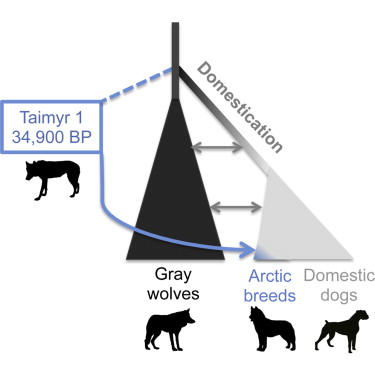
Genetic evidence from an ancient wolf bone discovered lying on the tundra in Siberia’s Taimyr Peninsula reveals that wolves and dogs split from their common ancestor at least 27,000 years ago. “Although separation isn’t the same as domestication, this opens up the possibility that domestication occurred much earlier than we thought before,” said lead study author Pontus Skoglund, who studies ancient DNA at Harvard Medical School and the Broad Institute in Massachusetts. Previously, scientists had pegged the wolf-dog split at no earlier than 16,000 years ago.
The Livescience article referred to results that were published in the journal Current Biology on May 21st this year. One needs a subscription to read the full report but here is their summary:
The origin of domestic dogs is poorly understood [ 1–15 ], with suggested evidence of dog-like features in fossils that predate the Last Glacial Maximum [ 6, 9, 10, 14, 16 ] conflicting with genetic estimates of a more recent divergence between dogs and worldwide wolf populations [ 13, 15, 17–19 ]. Here, we present a draft genome sequence from a 35,000-year-old wolf from the Taimyr Peninsula in northern Siberia. We find that this individual belonged to a population that diverged from the common ancestor of present-day wolves and dogs very close in time to the appearance of the domestic dog lineage. We use the directly dated ancient wolf genome to recalibrate the molecular timescale of wolves and dogs and find that the mutation rate is substantially slower than assumed by most previous studies, suggesting that the ancestors of dogs were separated from present-day wolves before the Last Glacial Maximum. We also find evidence of introgression from the archaic Taimyr wolf lineage into present-day dog breeds from northeast Siberia and Greenland, contributing between 1.4% and 27.3% of their ancestry. This demonstrates that the ancestry of present-day dogs is derived from multiple regional wolf populations.
That summary page also includes the following Graphical Abstract:
I don’t have permission to republish the Livescience article in full but would like to offer the closing paragraphs of this fascinating report.
“It is a very well-done paper,” Perry [George Perry, an expert in ancient DNA at Pennsylvania State University] told Live Science. “This topic is a critical one for our understanding of human evolution and human-environment interactions in the Paleolithic. Partnership with early dogs may have facilitated more efficient hunting strategies.”
If dogs first befriended hunter-gatherers, rather than farmers, then perhaps the animals helped with hunting or keeping other carnivores away. For instance, an author of a new book claims humans and dogs teamed up to drive Neanderthals to extinction. Skoglund also suggested the Siberian husky followed nomads across the Bering Land Bridge, picking up wolf DNA along the way.
“It might have been beneficial for them to absorb genes that were adapted to this high Arctic environment,” Skoglund said.
This is the first wolf genome from the Pleistocene, and more ancient DNA from prehistoric fossils could provide further insights into the relationship between wolves, dogs and humans, the researchers said.
Yes, our dogs have been part of man’s world for an unimaginable time – and Jean and I, as with tens of thousands of others, can’t imagine a world without dogs.
The way a dog focuses on the immediate task holds a very important lesson for us.
It’s a safe bet to claim that any dog owner has, from time to time, envied the way a dog so perfectly lives in the present. Then let’s not even go to the comparison between dogs and humans when it comes to relaxing!
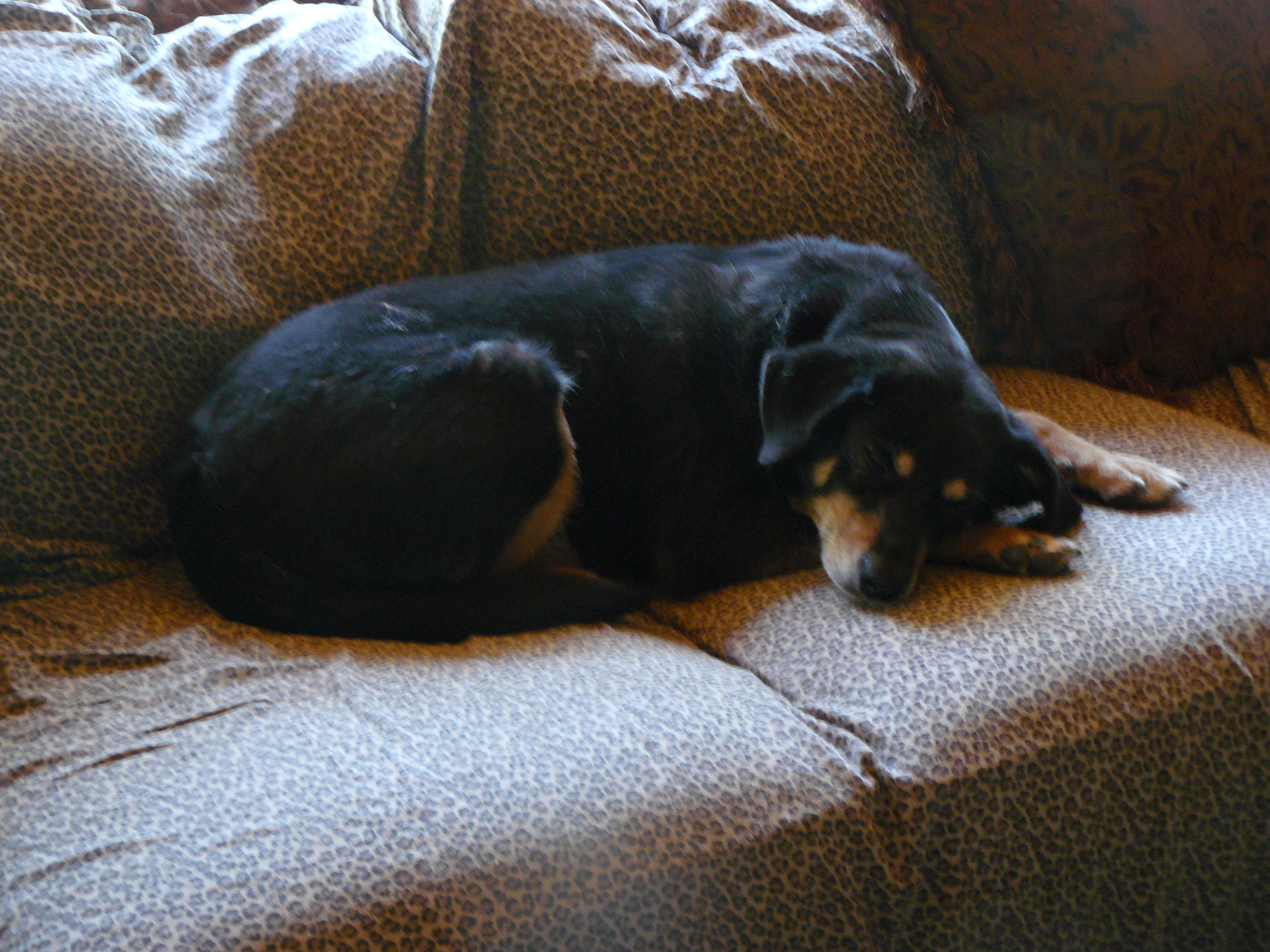
Hazel taking a mid-morning break on Tuesday.
These opening thoughts were prompted by a recent article that was published on The Conversation. The article criticised, rightly in my opinion, the madness (my word) of how many of us live these days, and with particular respect to ‘multi-tasking’. It’s a sobering reminder of the value of letting go and is republished here within the terms of essays published on The Conversation.
ooOOoo
The value of unplugging in the Age of Distraction
July 7, 2015 4.59am EDT
Author: John Rennie Short – Professor, School of Public Policy at University of Maryland, Baltimore County.
Small device, but very demanding. aciej_ie/flickr, CC BY-NC-ND
A common experience: you are walking down the street and someone is walking in the opposite direction toward you. You see him but he does not see you. He is texting or looking at his cellphone. He is distracted, trying to do two things at the same time, walking and communicating.
There is also the telltale recognition of a car driver on a phone; she’s driving either too slowly or too fast for the surrounding conditions, only partly connected to what is going on around her. Connected to someone else in another place, she is not present in the here and now.
These types of occurrences are now common enough that we can label our time as the age of distraction.
A dangerous condition
The age of distraction is dangerous. A recent report by the National Safety Council showed that walking while texting increases the risk of accidents. More than 11,000 people were injured last year while walking and talking on their phones.
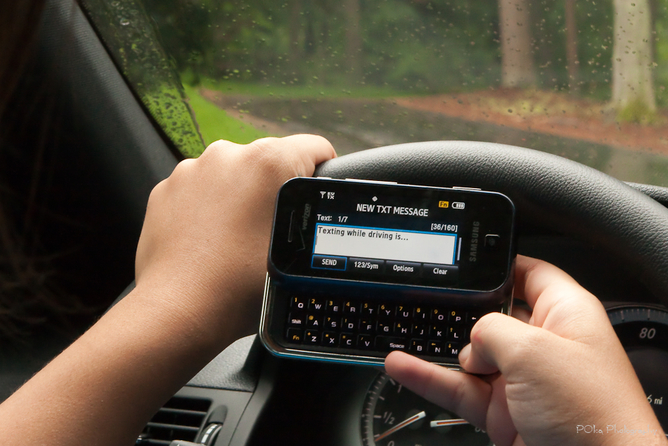
Really bad idea: texting while driving. Paul Oka/flickr, CC BY-NC
Even more dangerous is the distracted car driver. Distracted drivers have more fluctuating speed, change lanes fewer times than is necessary and in general make driving for everyone less safe and less efficient.
Texting while driving resulted in 16,000 additional road fatalities from 2001 to 2007. More than 21% of vehicle accidents are now attributable to drivers talking on cellphones and another 5% were text messaging.
Cognitive impairment
Multitasking relatively complex functions, such as operating handheld devices to communicate while walking or driving, is not so much an efficient use of our time as a suboptimal use of our skills.
We are more efficient users of information when we concentrate on one task at a time. When we try to do more than one thing, we suffer from inattention blindness, which is failing to recognize other things, such as people walking toward us or other road users.
Digital devices, which are proliferating in our lives, encourage multitasking, but does this really help our performance? Thomas Hawk/flickr, CC BY-NC-SA
Multitaskers do worse on standard tests of pattern recognition and memory recall. In a now classic study, researchers at Stanford University found that multitaskers were less efficient because they were more susceptible to using irrelevant information and drawing on inappropriate memories.
Multitasking may not be all that good for you either. A 2010 survey of over 2,000 8- to 12-year-old girls in the US and Canada found that media multitasking was associated with negative social indicators, while face-to-face contact was associated with more positive social indicators such as social success, feelings of normalcy and hours of sleep (vital for young people).
Although the causal mechanism has yet to be fully understood – that is, what causes what – the conclusion is that media multitasking is not a source of happiness.
Distraction-seeking creatures?
There are a number of reasons behind this growing distraction.
One often-cited reason is the pressure of time. There is less time to accomplish all that we need to do. Multitasking then is the result of the pressure to do more things in the same limited time. But numerous studies point to the discretionary use of time among the more affluent, and especially more affluent men. The crunch of time varies by gender and class. And, paradoxically, it is less of an objective constraint for those who often articulate it most.
Although the time crunch is a reality, especially for many women and lower-income groups, the age of distraction is not simply a result of a time crunch. It may also reflect another form of being. We need to reconsider what it means to be human, not as continuous thought-bearing and task-completing beings but as distraction-seeking creatures that want to escape the bonds of the here-and-nowness with the constant allure of someone and somewhere else.
Media theorist Douglas Rushkoff asserts that our sense of time has been warped into a frenzied present tense of what he calls “digiphrenia,” the social media-created effect of being in multiple places and more than one self all at once.
There is also something sadder at work. The constant messaging, emailing and cellphoning, especially in public places, may be less about communicating with the people on the other end as about signaling to those around that you are so busy or so important, so connected, that you exist in more than just the here and now, clearly a diminished state of just being.
There’s greater status in being highly connected and constantly communicating. This may explain why many people speak so loudly on their cellphones in public places.
Reactions
The age of distraction is so recent we have yet to fully grasp it. Sometimes art is a good mediator of the very new.
A video art installation by Siebren Verstag is entitled Neither There nor There. It consists of two screens. On one side a man sits looking at his phone; slowly his form loosens as pixels move to the adjacent screen and back again. The man’s form moves from screen to screen, in two places at one time but not fully in either.
One study that looked at the effect of banning cellphones in schools found that student achievement improved when cellphones were banned, with the greatest improvements accruing to lower-achieving students, who gained the equivalent of an additional hour of learning a week.
On many college campuses, faculty now have a closed-laptop policy after finding students would use their open laptops to skim their emails, surf the web and distract their neighbors. This was confirmed by studies that showed that students with open laptops learned less and could recall less than students with their laptops closed.
We are witnessing a cultural shift occurring with the banning of devices, cellphone usage being curtailed in certain public places and policies banning texting while driving. This is reactive. We also need a new proactive civic etiquette so that the distracted walker, driver and talker have to navigate new codes of public behaviors.
Many coffee stores in Australia, for example, do not allow people to order at the counter when they are on the cellphone, more golf clubs are banning the use of cellphones while on the course and it is illegal in 38 states in the US for novice drivers to use a cellphone while driving.
There is also the personal decision available to us all, one foreshadowed by writer and social critic Siegfried Kracauer, who lived from 1889 to 1966. In a newspaper article on the impact of modernity, first published in 1924, he complained of the constant stimulation, the advertising and the mass media that all conspired to create a “permanent receptivity” that prefigures our own predicament in a world of constant texting, messaging and cellphones.
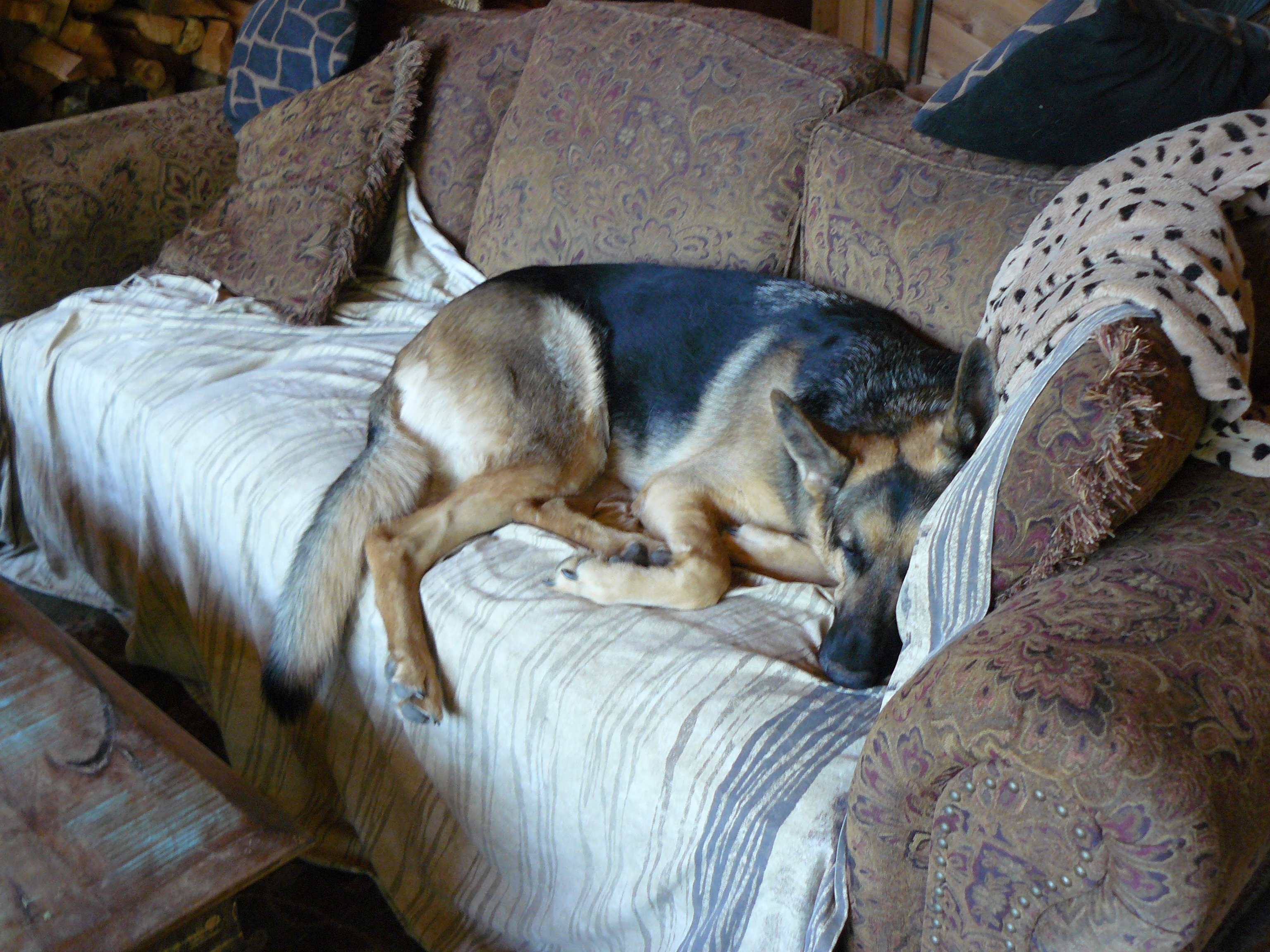
One response, argued Kracauer, is to surrender yourself to the sofa and do nothing, in order to achieve a “kind of bliss that is almost unearthly.”
One radical response is to unplug and disconnect, live in the moment and concentrate on doing one important thing at a time. Try it for an hour, then for a day. You can even call your friends to tell them about your success – just not while walking or driving, or working on your computer screen or speaking loudly in a public place.
ooOOoo
Oh, did someone mention unplugging and disconnecting?
Regular readers will know that I subscribe to the blog Naked Capitalism masterminded by Yves Smith. Some time ago, there was a link on NK to a story about how a tiny Chihuahua dog rescued some missing girls. It seemed like a good opportunity to take a closer look at this most magical aspect of a dog’s qualities.
First to that story.
I saw it on the Care2 website, from which I quote the following:
A 3-year-old chihuahua named Bell is an unexpected hero after finding three young girls who became lost for hours in the woods in Newnan, Georgia, on Monday.
CBS Atlanta reports that, on Monday, 8-year-old Carlie and 5-year-old Lacey Parga went for a walk with their dog Lucy down a cul-de-sac on trails near their neighborhood.
What started as a casual stroll became an unintended, and at times frightening, experience. As Carlie tells CBS, ‘”We tried to find our way out of the woods. We kept following paths and stuff and we got lost.” Indeed, they became scared that they were only to get more and more lost.
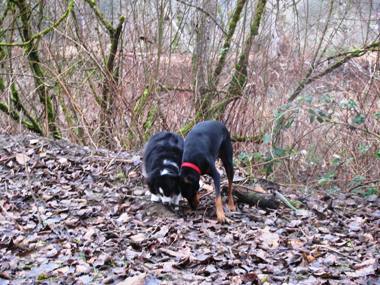
Carlie’s father, David Parga, noted that it wasn’t characteristic of them to wander off and, after searching for them but not hearing them respond, he contacted police and firefighters. Neighbors joined them including Carvin Young who thought to take Bell, who plays with the girls every day and knew their scent. Bell was able to lead searchers to the girls.
The full story on the Care2 website is here and on the CBS website here.
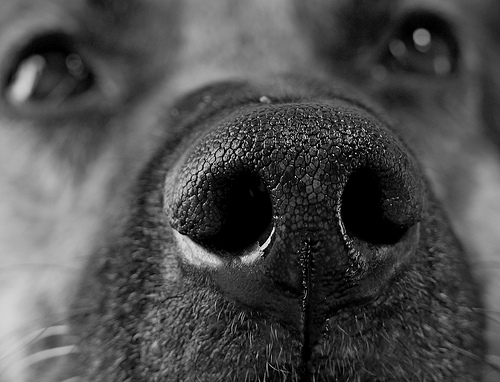
So what is it about the nose of the dog? A dog has more than 220 million olfactory receptors in its nose, while humans have only five million, making dogs’ sense of smell a thousand times greater. Frankly, trying to get one’s intellect around precisely what having a sense of smell one thousand times greater than a human means is tough! So on to another story.
17 Dogs, 3 Generations, 70 Years. There’s one constant… …the family dog.
After moving to Wellesley, Massachusetts for an anchor job with a major television sports network, Kevin began taking his German Shepherd, Beverly, for walks in the surrounding neighborhoods. They developed a route that included historic Atwood Street. Beverly kept veering toward one house in particular that had also caught Kevin’s eye previously, thinking it looked familiar but not knowing the reason.
After talking to a close family relative who had also once lived in Wellesley, Kevin was shocked to discover that the memorable house had once been a childhood home to his father, Bob Walsh, before WWII. After digging through old family photos that had been tucked away for years, Kevin uncovered a picture of his father as a toddler with his family on the house’s front porch, complete with their first family dog, Dee Dee.
Kevin’s father had been writing short stories about all of their family dogs through the years, but never knew about the photo. Its discovery was the pivotal moment that offered proof that the Walsh family’s journey with dogs had come back to the exact place where it started.
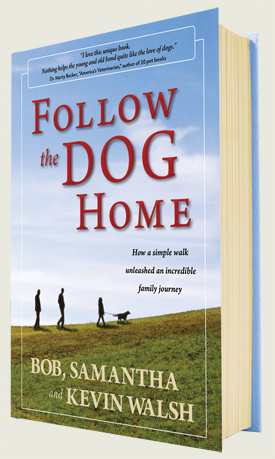
They’ve turned this story, along with other dog tales, into a book called Follow the Dog Home: How a Simple Walk Unleashed an Incredible Family Journey.
Dog’s nose leads family to back long lost old home, site unseen. German Shepherd, Beverly, is chronicled on WCVB TV’s news magazine show Chronicle. 70 years later, the family goes back “home” for stunning reunion and photograph.
A colleague back in England was speaking to me recently about a series on BBC Television about forensics. The series is called Catching History’s Criminals: The Forensics Story.
Apparently, the third in the series Instruments of Murder (For UK readers the link is here.) included fire being used as a criminal act. That episode featured a dog named Gunner who was a fire forensics dog. To the surprise of both Jean and me, while we were very aware of the sniffer dogs used by the police in many countries, neither of us had previously been aware that dogs were used, at times, in the determination of the cause of fire.
Now listen to Nikki Harvey of Hertfordshire Fire and Rescue Service in this YouTube video:
Published on Jul 23, 2013
Trained from a puppy by his partner in crime and handler, Nikki Harvey, Reqs (pronounced Rex) qualified as Hertfordshire Fire and Rescue Service’s new fire investigation dog in April this year. At a special event on Monday (22 July) Reqs launched his Twitter account and demonstrated his skills at Longfield Training Centre, Stevenage.
The 22-month-old black Labrador is taking over responsibility for helping to investigate the cause of fires in Hertfordshire and surrounding counties. His predecessor, seven year old CC, will work alongside Reqs until he retires.
Richard Thake, Cabinet Member for Community Safety and Planning said: “The work that Reqs does is critical in assisting the Hertfordshire Fire and Rescue Service team and it plays an integral part in community fire safety. Reqs is exceptionally valuable and receives the same high degree of training that we afford all frontline fire personnel.”
From six months old Reqs was trained to sniff out traces of ignitable liquids such as petrol, white spirit and lighter fluid which can remain present even after the most severe fire. Fire investigation officers use Reqs to assist them in determining the cause and origin of fires – whether deliberate or accidental. At the event he proudly gave a demonstration of sniffing out accelerants in a house and a car, as well as riding on an Arial Ladder Platform (ALP) that reaches up to seven floors, can be used as a water tower to extinguish large fires, and forms a safe platform for working at height.
Hertfordshire’s Chief Fire Officer Roy Wilsher said: “Reqs helps out on serious and non-serious cases and knowing what starts a fire helps us enormously in getting important fire safety messages out to the public. We want to prevent fires and keep people safe and now that Reqs is on Twitter his followers will learn a lot of useful tips to prevent accidental fires.
“I use Twitter myself (@HertsFireChief) and social networking is a great way to spread our safety messages across Hertfordshire.”
Fire investigation dogs are used for their speed and accuracy and are proving very successful in their work. Reqs and CC have assisted in many high profile incidents including suicides, fatal fires, arson attacks and murder investigations.
Reqs’ handler, Nikki Harvey said: “We’ve been training together for nearly two years now, which has given us the opportunity to get to know each other and build up trust which is essential. Ongoing training is now part of Reqs’ daily routine and it’s important that he always enjoys the ‘game’. I’m really looking forward to putting Reqs’ new skills to use.”
Reqs is the third fire investigation dog for Hertfordshire Fire and Rescue Service and is sponsored by Hatfield based company Computacenter UK Ltd, who also sponsor CC and his predecessor Browza. Clare Rafferty, Head of Corporate Events, Computacenter (UK) Ltd said: “The Fire investigation dog is a valuable asset to the Fire and Rescue Service and we are yet again delighted to extend that sponsorship to Reqs who is very worthy of stepping into CC’s shoes.”
And to demonstrate that these wonderful dogs undertake these roles both sides of the “pond”, here is a video from Denver, Colorado:
Published on Feb 23, 2015
Victoria travels to Denver, Colorado to check in on experienced arson investigator Jerry Means and his third arson dog, Riley. Jerry shows Victoria how he continues to train Riley, visits his office at the Colorado Bureau of Investigation, and takes her to a burn building to demonstrate live fire and extended training for Riley. Part 1 of 2
All of which seems like a great nudge for me to republish a post from Learning from Dogs from September, 2012 that explained a little more about the incredible power of the dog’s nose! See you tomorrow.
The effect of familiarity on dog–human interactions.
Introduction
You will remember that a couple of weeks ago, Professor Marc Bekoff generously gave me permission to publish his essay Butts and Noses: Secrets and Lessons from Dog Parks. The essence of the essay being that dog parks are gold mines of information about the behavior of dogs and humans. (Post published by Marc Bekoff Ph.D. on May 16, 2015 in Animal Emotions.)
The good Professor then went on to say that I was free to republish any of his essays so long as the usual accreditations and links were provided. So yesterday, I started going through the many html links in his essay, that essay may be read here, looking for posts that would interest readers of Learning from Dogs.
Dogs and their human companions: The effect of familiarity on dog–human interactions
Andrea Kerepesi (a), Antal Dóka (a), Ádám Miklósi (b)
(a) Department of Ethology, Eötvös Loránd University, Hungary
(b) MTA-ELTE Comparative Ethology Research Group, Budapest, Hungary
It’s a very interesting piece of research. I’m going to include the Abstract in today’s post and recommend if anyone wants to read the full article that they do so here.
So here is the Abstract.
ABSTRACT
There are few quantitative examinations of the extent to which dogs discriminate between familiar and unfamiliar persons. In our study we have investigated whether dogs show differential behaviour towards humans of different degrees of familiarity (owner, familiar person, unfamiliar person). Dogs and humans were observed in eight test situations: (1) Three-way strange situation test, (2) Calling in from food, (3) Obedience test, (4) Walking away, (5) Threatening approach, (6) Playful interaction, (7) Food inhibition test and (8) Manipulation of the dog’s body.
Dogs distinguished between the owner and the two other test partners in those tests which involved separation from the owner (Test 1, 4), were aversive for the dog (Test 5) or involved playing interac- tion (Test 6). Our results revealed that the owner cannot be replaced by a familiar person in situations provoking elevated anxiety and fear.
In contrasts, dogs did not discriminate between the owner and the familiar person in those tests that were based on obedient behaviour or behaviour towards an assertive person (Tests 2, 3, 7 and 8). Dogs’ former training experience reduced the difference between their behaviour towards the owner and the familiar person in situations requiring obedience but it did not mask it totally. The dogs’ behaviour towards each of the humans participating in the tests was consistent all over the test series.
In summary, dogs discriminated between their owner and the unfamiliar person and always preferred the owner to the unfamiliar person. However, the discrimination between the owner and the familiar person is context-specific.
This article is part of a Special Issue entitled: Canine Behavior.





 Learning from Dogs