Category: Poetry

Anam cara

Love as seen through the Celtic spiritual belief of bonding souls.

Who hasn’t lifted their eyes to the skies above and become lost in themselves?  Whether the drama of a turbulent daytime sky or the deep mystery of an endless, clear night, sky?  Doesn’t matter who we are or where we have or haven’t been in our lives, experiencing that shift from ‘reality’ to a place of souls is familiar to all.

Right at the front of Richard Bach’s lovestory book The Bridge Across Forever, there’s this quotation from E.E. Cummings:

 – how fortunate are you and I, whose home

is timelessness: we who have wandered down

from fragrant mountains of eternal now

to frolic in such mysteries as birth

and death a day (or maybe even less)

Then on page 9, Richard Bach writes as part of his introduction:

We think, sometimes, there’s not a dragon left. Not one brave knight, not a single princess gliding through secret forests, enchanting deer and butterflies with her smile.

We think sometimes that ours is an age past frontiers, past adventures.  Destiny, it’s way over the horizon; glowing shadows galloped past long ago, and gone.

What a pleasure to be wrong.  Princesses, knights, enchantments and dragons, mystery and adventure …. not only are they here-and-now, they’re all that ever lived on earth!

Our century, they’ve changed clothes, of course.  Dragons wear government-costumes, today, and failure-suits and disaster-outfits.  Society’s demons screech, whirl down on us should we lift our eyes from the ground, dare we turn right at corners we’ve been told to turn left.  So crafty have appearances become that princesses and knights can be hidden from each other, can be hidden from themselves.

Yet masters of reality still meet us in dreams to tell us that we’ve never lost the shield we need against dragons, that blue fire voltage arcs through us now to change our world as we wish.  Intuition whispers true: We’re not dust, we’re magic!

Copyright (1984) Richard Bach.

Richard Bach’s hugely popular lovestory is widely summarised, thus:

‘Did you ever feel that you were missing someone you had never met?’.

Haunted by the ghost of the wise, mystical, lovely lady who lives just around the corner in time, Richard Bach begins his quest to find her, to learn of love and immortality not in the here-after, but in the here and now. Yet caught in storms of wealth and success, disaster and betrayal, he abandons the search, and the walls he builds for protection become his prison. Then he meets the one brilliant and beautiful woman who can set him free, and with her begins a transforming journey, a magical discovery of love and joy.

Just pause and listen. Hear your intuition whispering to you: You are not dust, you are magic!

oooOOOooo

Now let’s turn to another author: John O’Donohue.  WikiPedia has an entry that starts:

John O’Donohue (1 January 1956 – 4 January 2008) was an Irish poet, author, priest, and Hegelian philosopher. He was a native Irish speaker, and as an author is best known for popularizing Celtic spirituality.

His death in January 2008 just a few days past his 52nd birthday was a huge and tragic loss.  Not just to his family and all who knew him, but to all those in the world who dream the spiritual bonding with another person.

anamcara
John O’Donohue’s book is no better appreciated than by hugging the meaning of that Celtic phrase anam cara, assuming you aren’t a Celtic speaker!  A quick web search finds an explanation typically like this:

In the Celtic Spiritual tradition, it is believed that the soul radiates all about the physical body.  What some refer to as an aura. When you connect and become completely open and trusting with another person, your two souls begin to flow together. The forming of that deep bond is described as having found your anam cara or soul friend.

Your anam cara always accepts you as you truly are, holding you in beauty and light. Inevitably, to appreciate this relationship, you must first recognize your own inner light and beauty. This is not always easy to do! The Celts believed that forming an anam cara friendship would help you awaken to your own inner light and beauty, as a pathway to experiencing the joys of others.

According to John O’Donahue, an accomplished Irish poet, philosopher and Catholic priest, “…You are joined in an ancient and eternal union with humanity that cuts across all barriers of time, convention, philosophy and definition. When you are blessed with an anam cara, the Irish believe, you have arrived at that most sacred place: home.

Do you sense how the writings of Richard Bach and John O’Donohue are two hues from the same rainbow?

Take a few minutes and explore the John O’Donohue website that has much to remember about this wonderful man.  Embrace such profound insights on the universal themes of friendship, solitude, love, and death as:

  • Light is generous
  • The human heart is never completely born
  • Love as ancient recognition
  • The body is the angel of the soul
  • Solitude is luminous
  • Beauty likes neglected places
  • The passionate heart never ages
  • To be natural is to be holy
  • Silence is the sister of the divine
  • Death as an invitation to freedom

I’m going to offer two videos.  They are both of John O’Donohue.  One is 51 minutes and one is 5 minutes.  Do watch them both but if for whatever reason you cannot do that, then please watch the shorter one.


Now read this quotation from the book.

Your beloved and your friends were once strangers. Somehow at a particular time, they came from the distance toward your life. Their arrival seemed so accidental and contingent. Now your life is unimaginable without them. Similarly, your identity and vision are composed of a certain constellation of ideas and feelings that surfaced from the depths of the distance within you. To lose these now would be to lose yourself.

and recognising this post is day three of writing about love, here’s another quotation:

If you send out goodness from yourself, or if you share that which is happy or good within you, it will all come back to you multiplied ten thousand times. In the kingdom of love there is no competition; there is no possessiveness or control. The more love you give away, the more love you will have.

oooOOOooo

Are Jean and I touched by the spirit of anam cara?  Leave you, dear reader, to judge that.  In fact, leave you with the sign that is on our front gate!

P1130347

Feelings across the universe

If you can’t feel it, you can’t write it!

This saying was offered in a creative writing class that Jean and I attended when we were living in Payson, Arizona.  It came to me spontaneously as I started today’s post.  Because feeling what is going on around us is the only way to write it, to share it, to bring it to the attention of all.

These are tough times for so many that love the world around us and having the odd weep is a perfectly rational, and healthy, thing to happen.

So as you listen to the following just feel it. And if a tear comes to your eye … embrace it.

Hopefully, you listened to the full seven minutes before reading on!  Because to end the post at this point would be to leave out some great connections.

The first being that the inspiration for today’s post came from Peter Sinclair’s blog Climate Denial Crock of the Week, to which I subscribe.  The post was called Music Break: Across the Universe:

Put this on in the background and let it creep up on you.

Elizabeth Shepherd performs Live-to-Air with Michael Occipinti’s Shine On: The Universe of John Lennon
Toronto, June 1, 2012 CBC Radio

UPDATE: by popular demand, the original below.

Secondly, a quick dip into WikiPedia reveals that the song was recorded by the Beatles in February 1968 at the famous Abbey Road studios and released on the 12th December, 1969. It was written by John Lennon, and credited to Lennon–McCartney.

abbey road studios
Abbey Road Studios, 3 Abbey Road, St. John’s Wood, London

Thirdly, that Wikipedia reference includes the background to the composition of the song, some of which I will share here:

One night in 1967, the phrase “words are flowing out like endless rain into a paper cup” came to Lennon after hearing his ex-wife Cynthia, according to Lennon, “going on and on about something.” Later, after “she’d gone to sleep—and I kept hearing these words over and over, flowing like an endless stream,” Lennon went downstairs and turned it into a song. He began to write the rest of the lyrics and when he was done, he went to bed and forgot about them.

I was lying next to my first wife in bed, you know, and I was irritated, and I was thinking. She must have been going on and on about something and she’d gone to sleep and I kept hearing these words over and over, flowing like an endless stream. I went downstairs and it turned into a sort of cosmic song rather than an irritated song, rather than a “Why are you always mouthing off at me?”[1]… [The words] were purely inspirational and were given to me as boom!. I don’t own it you know; it came through like that.[2]

The flavour of the song was heavily influenced by Lennon’s and the Beatles’ interest in Transcendental Meditation in late 1967 – early 1968, when the song was composed. Based on this he added the mantra “Jai guru deva om” (Sanskrit: जय गुरुदेव ) to the piece, which became the link to the chorus. The Sanskrit phrase is a sentence fragment whose words could have many meanings. Literally it approximates as “glory to the shining remover of darkness,”[3] and can be paraphrased as “Victory to God divine”, “Hail to the divine guru”, or the phrase commonly invoked by the late Maharishi Mahesh Yogi in referring to his spiritual teacher “All Glory to Guru Dev.”[4]

Finally the lyrics.

“Across The Universe”

Words are flowing out like endless rain into a paper cup
They slither wildly as they slip away across the universe
Pools of sorrow, waves of joy are drifting through my open mind
Possessing and caressing me
Jai Guru Deva OM

Nothing’s gonna change my world

Images of broken light which dance before me like a million eyes
They call me on and on across the universe
Thoughts meander like a restless wind inside a letter box
They tumble blindly as they make their way across the universe
Jai Guru Deva OM

Nothing’s gonna change my world

Sounds of laughter shades of live are ringing through my open ears
Inciting and inviting me
Limitless undying love which shines around me like a million suns
It calls me on and on, across the universe
Jai Guru Deva OM

Nothing’s gonna change my world

Jai Guru Deva
Jai Guru Deva
Jai Guru Deva
Jai Guru Deva
Jai Guru Deva [fade out]

Footnote

The title of the song was given a new dimension when NASA beamed the song into space.

“On 4 February 2008, at 00:00 UTC, NASA transmitted the Interstellar Message “Across the Universe” in the direction of the star Polaris, 431 light years from Earth. The transmission was made using a 70m antenna in the Deep Space Network’s Madrid Deep Space Communication Complex, located outside of Madrid, Spain. It was done with an “X band” transmitter, radiating into the antenna at 18 kW. This was done to celebrate the 40th anniversary of the song’s recording, the 45th anniversary of the Deep Space Network (DSN), and the 50th anniversary of NASA. The idea was hatched by Beatles historian Martin Lewis, who encouraged all Beatles fans to play the track as it was beamed to the distant star. The event marked the first time a song had ever been intentionally transmitted into deep space, and was approved by McCartney, Yoko Ono, and Apple Corps.”

Thus those feelings so beautifully expressed in the song will be echoing around the universe for time immemorial. Now that is a legacy!

Spring is sprung!

Spring is sprung, the grass is ris.
I wonders where the birdies is.
They say the bird is on the wing.
But that’s absurd?
I always thought the wing was on the bird.

Ah, that feels better!

I was drawn to this wonderful piece of doggerel because it is exactly the sort of humour that dear friend Richard and I have been silly with for 40 years.

The relevance of that is that Richard and his lovely lady Jules have arrived in North America and are coming to stay with us in Oregon for a few days, arriving Saturday. Naturally, we are scurrying around getting the house tidy!  So what with that and wanting to enjoy their company for the next week I shall be posting either light-hearted items or repostings from elsewhere.

Richard is no stranger to Learning from Dogs because like others who take pity on me publishing a daily post, he has sent me material for LfD.  For example, there was Understanding Europe last September, the Euro according to Blackadder and English, as she is spoken, both April this year.

Also last September, Richard sent me the following.  It was published last year but it deserves another airing!

oooOOOooo

An elderly man is stopped by the police around 2 a.m. and is asked where he is going at this time of night.

He replies, “I’m on my way to a lecture about alcohol abuse and the effects it has on the human body, as well as smoking and staying out late.

The police officer asks, “Oh really! Who’s giving that lecture at this time of night?

My wife.

oooOOOooo

Future uncertainties!

Prediction is very difficult, especially if it’s about the future. Niels Bohr

I love this saying from Mr. Bohr and often repeat it, albeit at times with my own twist to it.  I was reminded of this uncertainty of the future from some comments to a recent post over at Lack of Environment.  The particular post was called Can technology save us? and was a reflection of Martin Lack, the blog’s author, watching a recent BBC Horizon special called Tomorrow’s World.  (There’s the YouTube of the broadcast at the end of this post.) Martin opened his post by saying:

I happened to stumble across a BBC TV Horizon special, entitled ‘Tomorrow’s World’ last Thursday.  It begins with a fascinating review of humankind’s history of – and propensity for – invention. It also explains some truly fascinating – and inspiring – developments in the spheres of space exploration, nanotechnology, biotechnology, and power generation.

In the introduction, the programme presenter and narrator Liz Bronnin explains how, after 100’s of thousands of years of technological stagnation, the fast-moving world of technological innovation is very definitely a modern invention.

Then a little later Martin goes on to say:

After about 32 minutes, Bronnin introduces the power of the Internet to promote innovation – crowd-sourcing research funding and the concept of open-source technology – the complete abrogation of intellectual copyright… It is a fundamental challenge to globalised Capitalism; but it may well be the solution to many of our problems…

However, to me, the final third of the programme is by far the most fascinating… It looks at the challenges of finding a replacement for fossil fuels. It provides a very clear message that this is a technological challenge driven by the reality of physics – not by ideology.

But, overall, Martin lets us know his perspective with his final paragraphs:

Re-engineering nature for our benefit will, without doubt, be very very useful. However, I still think the optimism of the comment at the very end of the programme “…I never worry about the future of the human race, because I think we are totally capable of solving problems…” is very unwise. This is because anthropogenic climate disruption is a problem that is getting harder to solve the longer we fail to address it effectively.

Bronnin concludes by saying that, “it is an exciting time to be alive…” However, I remain very nervous. This is because, as Professor Peter Styles of Keele University – a strong supporter of the hydraulic fracturing industry – recently acknowledged, it will be impossible for carbon capture and storage to remove enough CO2 from the atmosphere to prevent very significant changes to our climate. This is because of the collective hypnosis that deludes most people into seeing perpetual economic growth as the solution to all our problems.

In short, I am certain that technology alone cannot save us. In order to avoid the ecological catastrophe that all but the most ideologically-prejudiced and wilfully-blind can see developing all around us… we need to modify our behaviour: This primarily means that we need to acknowledge the injustice of a “use it up and wear it out” mentality and, as individuals, all learn to use an awful lot less energy.

Climate change “sceptics” have picked a fight with history and science – primarily with the concept of Entropy – and they will lose. The only question that remains is this: Are we going to let them put us all in (what xraymike79 recently called) ‘the dustbin of failed evolutionary experiments’.

Now Jean and I also watched the Horizon special and, to be perfectly frank, found it both uplifting and inspiring.  It seemed a great counter to the overwhelming volume of commentary these days along the lines of ‘The end of the world is nigh!‘ some of that coming from yours truly! That’s not to make light of the huge hurdles ahead.

But it was a couple of comments on Martin’s post from Patrice Ayme that got me thinking.  Here’s the exchange that went between Patrice and Martin following on from a comment from Thomas Foster.

Considering that it is technology which has enabled us to “conquer” nature and thus the degradation of the environment which is a consequence of that it seems most unlikely to this writer that the cause will also bring about a cure. Thomas Foster

—–

The genus Homo has been technological for 5 million years. Give or take two million. Homo is the cure for life. Patrice Ayme

—-

If we Homo Sapiens have been technological for 5 million years, we have spent most of that time being very unsuccessful; and have spent the rest being far too successful. Is there no scope for just living in harmony with our environment (as opposed to being at war with it)? Martin Lack

—-

Hominids have been masters of the environment for at least three million years. By a million years ago, only Homo was left (but for places like Flores). Dozens of megafauna species got annihilated. Homo’s technology has extended to the entire Earth for at least a million years. The Earth itself was turned into a tool. A tool we are not at war with, but that we use. Patrice Ayme

—-

A utilitarian attitude to Nature is one that does not recognise its inherent value (i.e. which it would have even if we did not exist). Seeing ourselves as superior to Nature rather than as part of it has resulted in our not living in harmony with it. This is, by definition, equivalent to being at war with Nature. QED. Refer: Nature is not your enemyMartin Lack

—-

Call it what you want, Martin. Man manipulates nature, and that nature one calls nature has not been “natural” for more than a million years. Except if one views man as part of nature! Patrice Ayme

Patrice is a very clear thinker even if, at times, pretty hard-hitting.  But this exchange confirmed in my mind that clearly looking out to the future must always be hard.  Most certainly in this period of mankind’s evolution predicting the future is especially difficult.  Hence my contribution to Martin’s post:

Jean and I watched the Horizon special a couple of evenings ago. To be honest, I’m not entirely sure what my overall thoughts are in response to your post, Martin. What does come to mind is that old saying, “Never underestimate the power of unintended consequences.

So it may be that we are at a particular point in time, or more likely an era, where seeing clearly into the future is challenging.

The one aspect of modern life that is a game-changer is what we are doing now. Sharing ideas and thoughts across a far-flung net. Not only as the Horizon programme illustrated but as ordinary people trying to make sense of the world.

These are incredibly uncertain times.  Undoubtedly not the first in man’s long history as an historian will explain (cue to Alex!).   But to all of us alive today, these are the most uncertain times we have ever experienced!

No wonder so many of us feel lost at times in today’s world.

Here’s that BBC Horizon, courtesy of YouTube.

I will close with this thought from one masterly ‘wordsmith’, William Wordsworth.

“Life is divided into three terms – that which was, which is, and which will be. Let us learn from the past to profit by the present, and from the present, to live better in the future.”

Making sense of life?

“I accept chaos, I’m not sure whether it accepts me.”  Bob Dylan.

Lost and Confused Signpost

Started this week with an essay from John Hurlburt. Likewise, finishing with these thoughts from John.

Are We Confused?

Egotistically, the objective is self.
Financially, the objective is profit.
Corporately, the objective is control.

Biologically, the objective is growth.
Physically, the objective is change.
Morally, the objective is equality.

Psychologically, the objective is integrity.
Philosophically, the objective is truth.
Scientifically, the objective is fact.

Intellectually, the objective is reason.
Emotionally, the objective is balance.
Spiritually, the objective is Unity.

an old lamplighter

A smile for ‘Boxing Day’.

Sent to me a few weeks ago by Bob Derham.

(The younger ones won’t make any sense of this at all!)

bottle-of-pills-and-bottle

A Poem for the Mature

A row of bottles on my shelf
Caused me to analyze myself.

One yellow pill I have to pop
Goes to my heart so it won’t stop.

A little white one that I take
Goes to my hands so they won’t shake.

The blue ones that I use a lot
Tell me I’m happy when I’m not.

The purple pill goes to my brain
And tells me that I have no pain.

The capsules tell me not to wheeze
Or cough or choke or even sneeze.

The red ones, smallest of them all
Go to my blood so I won’t fall.

The orange ones, very big and bright
Prevent my leg cramps in the night.

Such an array of brilliant pills
Helping to cure all kinds of ills.

But what I’d really like to know

Is what tells each one where to go!

House of cards.

A more philosophical view of recent years.

I admit to being too free with my silly clichés including, “I can predict anything unless it involves the future!”  So now that millions of informed people have the benefit of “20:20 hindsight“, why is it years since the banking crisis first erupted and we are still without a root and branch overhaul of the governance of the industry?

Did you see Per Kurowski’s interview with a leading regulator on Learning from Dogs yesterday?  Aren’t we so slow to learn!

Anyway, I waffle on!  Let me get to the point of today’s post.

Back on the 1st September, there was a post called Understanding Europe. One of the resulting commentators was Pendantry who is author of a blog called Wibble.  He included a link to a poem that he wrote on the 28th February, 2009!  The fact that the poem is still so relevant (and when we see what’s happening in Europe perhaps even more relevant now!) is truly shocking.  I wanted to republish it which I do with the kind permission of Pendantry.  Here it is.

oooOOOooo

House of cards

When the inevitable strikes,
when the house falls down,
do you patch up the walls,
fix the holes in the roof,
shore it all up,
splash it with paint?

No.

You learn from the mistakes.
You start from scratch.
You call in the architects.
You rebuild the foundations.
You use new materials;
replace wattle and daub
with a sounder design.

Unless:

Because you’re lost outside the box,
and your mates demand
to regain their riches (and, now!):
You set up the same as before,
perhaps with a few bells and whistles
(spun to persuade that they’ll work).

And… in the end, we’ll believe
that your clothing is not invisible.

“Who is more foolish?
The fool, or the fool who follows him?”

oooOOOooo

Written over three years and five months ago. Shame on us all!

What is love?

How the relationship that we have with domesticated animals taught us the meaning of love.

This exploration into the most fundamental emotion of all, love, was stimulated by me just finishing Pat Shipman’s book The Animal Connection.  Sturdy followers of Learning from Dogs (what a hardy lot you are!) will recall that about 5 weeks ago I wrote a post entitled The Woof at the Door which included an essay from Pat, republished with her permission, that set out how “Dogs may have been man’s best friend for thousands of years longer than we realized“.

The following day, I wrote a further piece introducing the book and then commenced reading it myself.  Please go there and read about the praise that the book has received.

What I want to do is to take a personal journey through love.  I should add immediately that I have no specialist or professional background with regard to ‘love’ just, like millions of others, a collection of experiences that have tapped me on the shoulder these last 67 years.

I would imagine that there are almost as many ideas about the meaning of love as there are people on this planet.  Dictionary.com produces this in answer to the search on the word ‘love’.

love

[luhv]  noun, verb, loved, lov·ing.
noun

  1. a profoundly tender, passionate affection for another person.
  2. a feeling of warm personal attachment or deep affection, as for a parent, child, or friend.
  3. sexual passion or desire.
  4. a person toward whom love is felt; beloved person;sweetheart.
  5. (used in direct address as a term of endearment, affection,or the like): Would you like to see a movie, love?

But, I don’t know about you, those definitions leave something missing for me.  Here’s my take on what love is, and it’s only by having so many dogs in my life that I have found this clarity of thought.

Love is trust, love is pure openness, love is knowing that you offer yourself without any barriers.  Think how you dream of giving yourself outwardly in the total surrender of love.  Reflect on that surrender that you experience when deeply connecting, nay loving, with your dog.

Here’s how Pat Shipman expressed it in her book:

Clearly, part of the basis of our intimacy with tame or domesticated animals involves physical contact.  People who work with animals touch them.  It doesn’t matter if you are a horse breeder, a farmer raising pigs, a pet owner, a zoo keeper, or a veterinarian, we touch them, stroke them, hug them.  Many of us kiss our animals and many allow them to sleep with us.  We touch animals because this is a crucial aspect of the nonverbal communication that we have evolved over millennia.  We touch animals because it raises our oxytocin levels – and the animal’s oxytocin levels.  We touch animals because we and they enjoy it. (p.274)

Pat soon after writes,

From the first stone tool to the origin of language and the most recent living tools, our involvement with animals has directed our course.

Thus it is not beyond reason to presume that tens of thousands of years of physical and emotional closeness between humans and their animals have developed the emotion of love in us humans, so eloquently expressed in art and life.

There’s another aspect of what we may have learned from dogs.  In Alexandra Horowitz’s book Inside of a Dog, she writes of the way that dogs look at us,

Having been folded into the world of humans, dogs no longer needed some of the skills that they would to survive on their own.  As we’ll see, what dogs lack in physical skills, they make up for in people skills.

AND THEN OUR EYES MET ….

There is one final, seemingly minor difference between the two species.  This one small behavioral variation between wolves and dogs has remarkable consequences.  The difference is this: dogs look at our eyes.

Dogs make eye contact and look to us for information – about the location of food, about our emotions, about what is happening.  Wolves avoid eye contact.  In both species, eye contact can be a threat: to stare is to assert authority.  So too is it with humans.  In one of my undergraduate psychology classes, I have my students do a simple field experiment wherein they try to make and hold eye contact with everyone they pass on campus.  Both they and those on the receiving end of their stares behave remarkably consistently: everyone can’t wait to break eye contact.  It’s stressful for the students, a great number of whom suddenly claim to be shy: they report their hearts begin to race and they start sweating when simply holding someone’s gaze for a few seconds.  They concoct elaborate stories on the spot to explain why someone looked away, or held their gaze for a half second longer.  For the most part, their staring is met with deflected gazes from those they eyeball.

Then a few sentences later, Alexandra continues to write,

Dogs look, too.  Though they have inherited some aversion to staring too long at eyes, dogs seem to be predisposed to inspect our faces for information, for reassurance, for guidance.  Not only is this pleasing to us – there is a certain satisfaction in gazing deep into a dog’s eyes gazing back at you – it is also perfectly suited to getting along with humans. (pps 45-46)

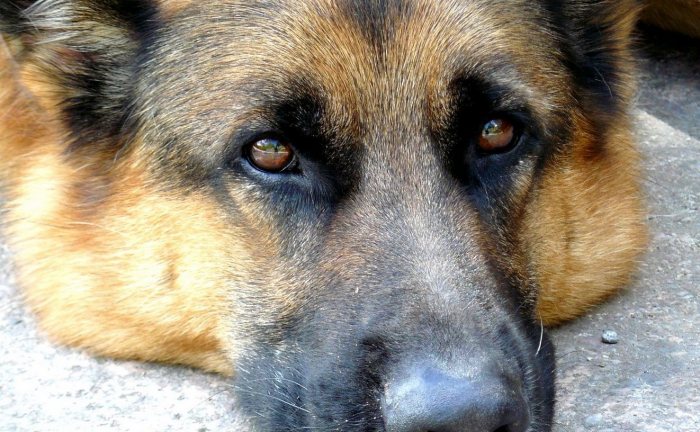
No apologies for now inserting the photograph of Pharaoh that adorns the Welcome page of Learning from Dogs.  Underlines what Alexandra wrote above in spades.

Now that is a gaze!

OK, time to start bringing this to a close.

The Toronto Star ran a great review of Pat Shipman’s book from which I will just take this snippet,

“But understanding animals and empathizing with them also triggered other changes in humanity’s evolution, Shipman said.

All those things allow people to live with people. Once people have domesticated animals, they start to live in stable groups. They have fields, crops and more permanent dwellings.”

In other words, we can see that living with animals took us from nomadic hunter-gatherers to living with other people in stable groups; the birth of farming.  It is my contention that the evolution of communities and the resulting more stable relationships elevated love leading to love becoming a higher order emotion than just associated with the ‘grunt’ of reproduction.

I started by saying that it was Pat Shipman’s book that stimulated me to wander through my own consciousness and realise that when I bury my face in the side of one of the dogs, say on the bed, it resonates with the most ancient memories in my human consciousness.  Indeed, I am of no doubt that my openness and emotional surrender to that dog enables me to be a better, as in more loving, person for Jean.

So let me close this essay by asking you to return here and read the guest post tomorrow from author Eleanore MacDonald, where Eleanore writes of the loss of their dog Djuna.  You will read the most precious and heart-rending words about love.  Thank you.

Dogs and life

A lovely guest Post from author Dianne Gray.

Introduction

Dianne was unaware when she contacted me that her timing was exquisite!  Why?  Because it had recently crossed my mind that many readers must wonder why a blog with the name of Learning from Dogs so infrequently had articles about dogs!  Hopefully both the Welcome page and my piece on Dogs and integrity make it clear that it is the qualities of dogs, the examples they set to mankind, that inspire these writings.  As I say in Dogs and integrity,

Dogs:

  • are integrous ( a score of 210) according to Dr David Hawkins
  • don’t cheat or lie
  • don’t have hidden agendas
  • are loyal and faithful
  • forgive
  • love unconditionally
  • value and cherish the ‘present’ in a way that humans can only dream of achieving
  • are, by eons of time, a more successful species than man.

So it is a double pleasure to offer Dianne’s guest post today because it reminds us, so clearly, that the qualities of dogs are something very real for mankind.

Dianne Gray

Dianne is a writer.  As she explains on her blog site,

I live in Australia, have a sensitive-new-age Rottweiler called Kitty and a German Shepherd (in desperate need for The Dog Whisperer) called Sabre.

I’ve had interesting jobs, including working in a crocodile farm in Far North Queensland.

My web page can be found at http://www.diannegray.au.com/

The story

Sabre enjoying some Winter sun.

Sabre came into our lives in November 2004. He was seven weeks old. We were lucky enough to get Sabre from Bob Knight, a German shepherd breeder in Canberra, Australia. For those of you who don’t live in Australia you wouldn’t know that Bob was tragically shot and killed in 2010 while driving his truck through Sydney – the innocent victim of a gang war taking place several blocks away, he was hit by a stray bullet.

Bob was very passionate about his dogs and would interview those who were interested in buying one of the litter. If he didn’t think you were capable of managing a German shepherd he would not sell you one. He also ensured that each and every one of his puppies were brought back to him weekly (if possible) for free puppy training. So for over twelve months we (and the others who had bought one of the litter) met at the lake to take our dogs for a walk and training.

We live in the inner city and have an enormous yard so Sabre loved playing catch and patrolling the borders of our property. We live adjacent to a laneway and had some trouble with junkies shooting up near our fence and threatening to kill him if he barked at them. When he was two years old he became very ill very suddenly (it was Good Friday and near impossible to find a vet). We took him to the out-of-hours vet in the city who just looked at him and ($A800 later) told us not to feed him for the rest of the weekend.

By Saturday morning he could hardly move. We called Bob who told us about a woman called Jan who would be available to see him who lived in a nearby town. She was a country vet and looked after horses and cattle – so we loaded him in the car. This was the best move we ever made because, as it turned out, Jan would save his life a couple of times. When Jan saw him she couldn’t believe another vet would tell us not to feed him. “You don’t feed animals, they die,” she said. She gave us some horse paste (I still don’t know to this day what it was) and told us to put some in his mouth every hour. She said to try and give him his favourite food as often as possible and to call her every hour and tell her if he had eaten anything. She said he had the classic symptoms of having ingested a common bait (I’m not revealing what it was publically) and if we couldn’t get him to eat within four hours we had to bring him straight back to her. Basically he was starving to death.

We put the paste in his mouth as often as possible and tried to tempt him with cheese (his favourite) for three hours. Finally, he took a small mouthful of cheese and we celebrated like it was Christmas! We took him back to Jan for the next three days and he got stronger and stronger and within a week was back to his old playful self.

Twelve months later he began to walk with his head to one side and then he’d shake it and basically seemed very uncomfortable. We took him back to Jan who looked in his ear to find he had a chronic ear infection. She gave him antibiotics and cleaned his ear, but weeks passed and it just didn’t want to budge. We took him back to Jan every weekend and she would clean his ear (he wouldn’t let us touch it) and give him a penicillin injection. I surfed the net trying to find out what I could do to get rid of this damn infection – we were trying everything possible and it still wouldn’t budge. Then I read somewhere that yoghurt in a dog’s diet can be good for this kind of thing. I added yoghurt to his diet and within a week he was looking better. We still had him back to Jan’s every weekend for a few months and I still put yoghurt in his diet!

Six months later he started to change and became obnoxious and aggressive with us. We thought it may have had something to do with the ear infection so we took him back to Jan. She laid him on his back and felt his testies. He was kind of shocked and so were we, but she had definitely done the right thing because at this stage he had testicular cancer in both testies. She operated and found that the cancer was at the advanced stage. She was pretty sure she had got it all, but told us the signs to watch for over the next few months. She put him on ‘girly hormones’ as she called them and he was on those for about twelve months – and what a pleasure he became. He was behaving himself and not cranky or aggressive like before the operation. He was a different boy! If you have a male dog that is not de-sexed and he becomes even the slightest bit aggressive, I strongly suggest you have him checked for testicular cancer!

Because we’d had so much trouble with the junkies I decided to get cameras around the outside of the house. It was such a novelty at first – I’d come home from work and check the cameras to see what had happened during the day, but then I noticed something really sad.  Sabre would say goodbye to me at the gate every morning and then just sit there ALL DAY waiting for me to come home. It was heartbreaking, I’d never realised until this time how lonely he was. I’d watch the tape on X30 and it reminded me of one of those television advertisements where someone stands still while everything around them speeds past. So hubby and I decided it was time for another dog. This is where Kitty comes into the picture. From the moment Sabre saw her he absolutely loved her and she loved him. She is obsessed with his tail and when we go anywhere she grips onto his tail and follows him.

First meeting Sabre and Kitty.

Sometimes when they’re playing in the yard she grabs his tail and runs past him so fast he ends up running sideways! Kitty has had her fair share of problems as well. She was spade (by a vet other than Jan because she doesn’t have the capacity or equipment to spade female pups) and three months later she went on heat! I took her back to the other vet and he had only removed one ovary. So she had to be spade again, the poor darling. Meanwhile, Sabre must have had enough male hormones left in him to want to mount her every five minutes. So what I did was rub eucalyptus oil on Kitty’s back and this was enough to keep him away (the smell made him sneeze). Now we find Kitty has arthritis (she’s only fifteen months old) so we’re back to see Jan every other weekend for treatment. We’re kind of like a family now!

Sabre and Kitty today.

Kitty and Sabre are a wonderful pair and now when I watch the cameras when I get home from work all I can see is the two of them playing all day long. It’s a wonderful life!

oooOOOooo

So back to me!  Couple of items to close this lovely story from Dianne.

Firstly, a photograph of these caring owners:

John and Dianne Gray.

Secondly, Dianne’s Blog ‘Dianne Gray – Writing and loving life! is full of reflective pieces, as one might imagine.  This one caught my eye and seemed perfect to close today’s Post.

The Last Unicorn

So true –

“Writing has nothing to do with publishing. Nothing. People get totally confused about that. You write because you have to – you write because you can’t not write. The rest is show-business. I can’t state that too strongly. Just write – worry about the rest of it later, if you worry at all. What matters is what happens to you while you’re writing the story, the poem, the play. The rest is show-business.” — Peter S. Beagle

A very full moon

Biggest full moon of 2012 occurs today!*

There are a number of news stories about this extra-special full moon but I’ve chosen to republish some of what appeared on the Mother Nature Network website.

In terms of the timing of this full moon, rather than give you times for various places around the world, as this website does, I will simply offer the UTC/GMT time:

Sunday 6th May 2012 at 03:35:06 am

If you want to covert that to your local time wherever you are on this beautiful planet The World Time Server is as good a website as any.

BIGGER THAN YOUR AVERAGE MOON: Skywatcher Tim McCord of Entiat, Washington caught this amazing view of the March 19, 2011 supermoon. (Photo: Tim McCord)

Skywatchers take note: The biggest full moon of the year is due to arrive this weekend.  And because this month’s full moon coincides with the moon’s perigee — its closest approach to Earth — it will also be the year’s biggest.

The moon will swing in 221,802 miles (356,955 kilometers) from our planet, offering skywatchers a spectacular view of an extra-big, extra-bright moon, nicknamed a supermoon.

And not only does the moon’s perigee coincide with full moon this month, but this perigee will be the nearest to Earth of any this year, as the distance of the moon’s close approach varies by about 3 percent, according to meteorologist Joe Rao, SPACE.com’s skywatching columnist. This happens because the moon’s orbit is not perfectly circular.

The full Moon will be up to 14% larger and 30% brighter than others during the year. The reason for this phenomenon is that the Moon becomes full on its closest approach to Earth on May 5, 2012, also known as the perigee full Moon.

So enjoy this most beautiful sight if you are somewhere on this planet where the moon will be visible at night.  And double-check the time and the day so you don’t miss it!  Finally, let me close by ‘spoiling’ my many readers in Arizona, and to serve as a good reminder for yours truly by saying that anyone on US Mountain Standard Time will see this moon at:

Saturday, 5th May 2012 at 20:35:06

Aim for the moon. If you miss, you may hit a star.” W. Clement Stone.