Category: Poetry

What is love?

How the relationship that we have with domesticated animals taught us the meaning of love.

This exploration into the most fundamental emotion of all, love, was stimulated by me just finishing Pat Shipman’s book The Animal Connection.  Sturdy followers of Learning from Dogs (what a hardy lot you are!) will recall that about 5 weeks ago I wrote a post entitled The Woof at the Door which included an essay from Pat, republished with her permission, that set out how “Dogs may have been man’s best friend for thousands of years longer than we realized“.

The following day, I wrote a further piece introducing the book and then commenced reading it myself.  Please go there and read about the praise that the book has received.

What I want to do is to take a personal journey through love.  I should add immediately that I have no specialist or professional background with regard to ‘love’ just, like millions of others, a collection of experiences that have tapped me on the shoulder these last 67 years.

I would imagine that there are almost as many ideas about the meaning of love as there are people on this planet.  Dictionary.com produces this in answer to the search on the word ‘love’.

love

[luhv]  noun, verb, loved, lov·ing.
noun

  1. a profoundly tender, passionate affection for another person.
  2. a feeling of warm personal attachment or deep affection, as for a parent, child, or friend.
  3. sexual passion or desire.
  4. a person toward whom love is felt; beloved person;sweetheart.
  5. (used in direct address as a term of endearment, affection,or the like): Would you like to see a movie, love?

But, I don’t know about you, those definitions leave something missing for me.  Here’s my take on what love is, and it’s only by having so many dogs in my life that I have found this clarity of thought.

Love is trust, love is pure openness, love is knowing that you offer yourself without any barriers.  Think how you dream of giving yourself outwardly in the total surrender of love.  Reflect on that surrender that you experience when deeply connecting, nay loving, with your dog.

Here’s how Pat Shipman expressed it in her book:

Clearly, part of the basis of our intimacy with tame or domesticated animals involves physical contact.  People who work with animals touch them.  It doesn’t matter if you are a horse breeder, a farmer raising pigs, a pet owner, a zoo keeper, or a veterinarian, we touch them, stroke them, hug them.  Many of us kiss our animals and many allow them to sleep with us.  We touch animals because this is a crucial aspect of the nonverbal communication that we have evolved over millennia.  We touch animals because it raises our oxytocin levels – and the animal’s oxytocin levels.  We touch animals because we and they enjoy it. (p.274)

Pat soon after writes,

From the first stone tool to the origin of language and the most recent living tools, our involvement with animals has directed our course.

Thus it is not beyond reason to presume that tens of thousands of years of physical and emotional closeness between humans and their animals have developed the emotion of love in us humans, so eloquently expressed in art and life.

There’s another aspect of what we may have learned from dogs.  In Alexandra Horowitz’s book Inside of a Dog, she writes of the way that dogs look at us,

Having been folded into the world of humans, dogs no longer needed some of the skills that they would to survive on their own.  As we’ll see, what dogs lack in physical skills, they make up for in people skills.

AND THEN OUR EYES MET ….

There is one final, seemingly minor difference between the two species.  This one small behavioral variation between wolves and dogs has remarkable consequences.  The difference is this: dogs look at our eyes.

Dogs make eye contact and look to us for information – about the location of food, about our emotions, about what is happening.  Wolves avoid eye contact.  In both species, eye contact can be a threat: to stare is to assert authority.  So too is it with humans.  In one of my undergraduate psychology classes, I have my students do a simple field experiment wherein they try to make and hold eye contact with everyone they pass on campus.  Both they and those on the receiving end of their stares behave remarkably consistently: everyone can’t wait to break eye contact.  It’s stressful for the students, a great number of whom suddenly claim to be shy: they report their hearts begin to race and they start sweating when simply holding someone’s gaze for a few seconds.  They concoct elaborate stories on the spot to explain why someone looked away, or held their gaze for a half second longer.  For the most part, their staring is met with deflected gazes from those they eyeball.

Then a few sentences later, Alexandra continues to write,

Dogs look, too.  Though they have inherited some aversion to staring too long at eyes, dogs seem to be predisposed to inspect our faces for information, for reassurance, for guidance.  Not only is this pleasing to us – there is a certain satisfaction in gazing deep into a dog’s eyes gazing back at you – it is also perfectly suited to getting along with humans. (pps 45-46)

No apologies for now inserting the photograph of Pharaoh that adorns the Welcome page of Learning from Dogs.  Underlines what Alexandra wrote above in spades.
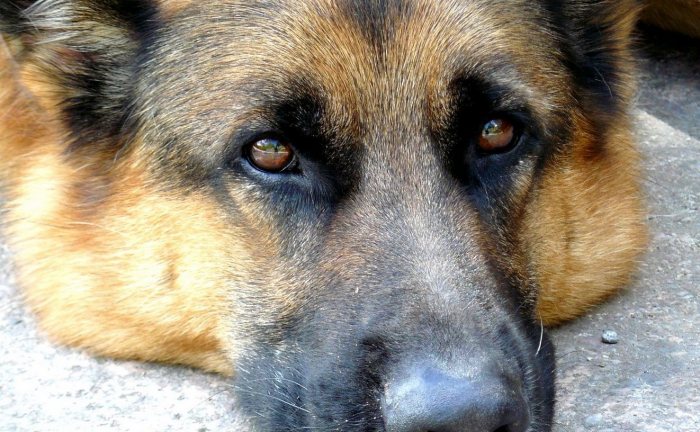
Now that is a gaze!

OK, time to start bringing this to a close.

The Toronto Star ran a great review of Pat Shipman’s book from which I will just take this snippet,

“But understanding animals and empathizing with them also triggered other changes in humanity’s evolution, Shipman said.

All those things allow people to live with people. Once people have domesticated animals, they start to live in stable groups. They have fields, crops and more permanent dwellings.”

In other words, we can see that living with animals took us from nomadic hunter-gatherers to living with other people in stable groups; the birth of farming.  It is my contention that the evolution of communities and the resulting more stable relationships elevated love leading to love becoming a higher order emotion than just associated with the ‘grunt’ of reproduction.

I started by saying that it was Pat Shipman’s book that stimulated me to wander through my own consciousness and realise that when I bury my face in the side of one of the dogs, say on the bed, it resonates with the most ancient memories in my human consciousness.  Indeed, I am of no doubt that my openness and emotional surrender to that dog enables me to be a better, as in more loving, person for Jean.

So let me close this essay by asking you to return here and read the guest post tomorrow from author Eleanore MacDonald, where Eleanore writes of the loss of their dog Djuna.  You will read the most precious and heart-rending words about love.  Thank you.

Dogs and life

A lovely guest Post from author Dianne Gray.

Introduction

Dianne was unaware when she contacted me that her timing was exquisite!  Why?  Because it had recently crossed my mind that many readers must wonder why a blog with the name of Learning from Dogs so infrequently had articles about dogs!  Hopefully both the Welcome page and my piece on Dogs and integrity make it clear that it is the qualities of dogs, the examples they set to mankind, that inspire these writings.  As I say in Dogs and integrity,

Dogs:

  • are integrous ( a score of 210) according to Dr David Hawkins
  • don’t cheat or lie
  • don’t have hidden agendas
  • are loyal and faithful
  • forgive
  • love unconditionally
  • value and cherish the ‘present’ in a way that humans can only dream of achieving
  • are, by eons of time, a more successful species than man.

So it is a double pleasure to offer Dianne’s guest post today because it reminds us, so clearly, that the qualities of dogs are something very real for mankind.

Dianne Gray

Dianne is a writer.  As she explains on her blog site,

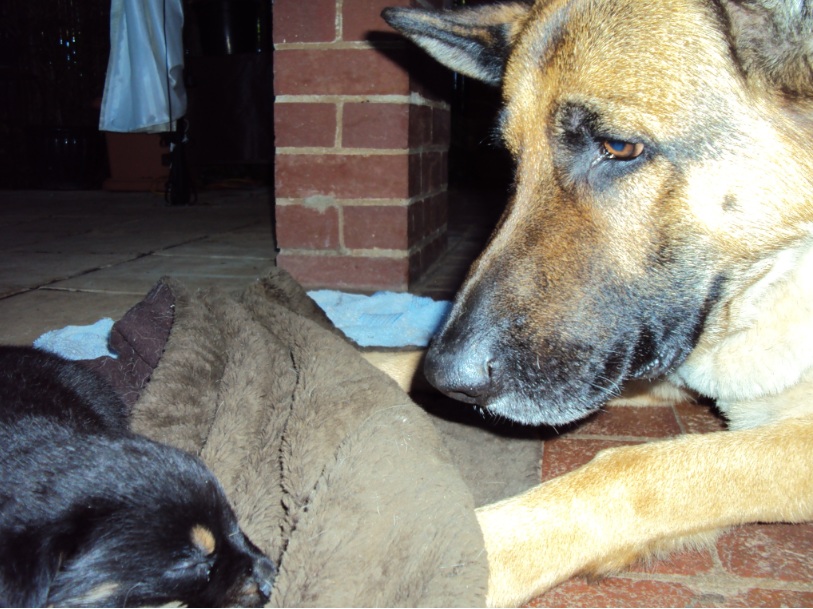
I live in Australia, have a sensitive-new-age Rottweiler called Kitty and a German Shepherd (in desperate need for The Dog Whisperer) called Sabre.

I’ve had interesting jobs, including working in a crocodile farm in Far North Queensland.

My web page can be found at http://www.diannegray.au.com/

The story

Sabre enjoying some Winter sun.

Sabre came into our lives in November 2004. He was seven weeks old. We were lucky enough to get Sabre from Bob Knight, a German shepherd breeder in Canberra, Australia. For those of you who don’t live in Australia you wouldn’t know that Bob was tragically shot and killed in 2010 while driving his truck through Sydney – the innocent victim of a gang war taking place several blocks away, he was hit by a stray bullet.

Bob was very passionate about his dogs and would interview those who were interested in buying one of the litter. If he didn’t think you were capable of managing a German shepherd he would not sell you one. He also ensured that each and every one of his puppies were brought back to him weekly (if possible) for free puppy training. So for over twelve months we (and the others who had bought one of the litter) met at the lake to take our dogs for a walk and training.

We live in the inner city and have an enormous yard so Sabre loved playing catch and patrolling the borders of our property. We live adjacent to a laneway and had some trouble with junkies shooting up near our fence and threatening to kill him if he barked at them. When he was two years old he became very ill very suddenly (it was Good Friday and near impossible to find a vet). We took him to the out-of-hours vet in the city who just looked at him and ($A800 later) told us not to feed him for the rest of the weekend.

By Saturday morning he could hardly move. We called Bob who told us about a woman called Jan who would be available to see him who lived in a nearby town. She was a country vet and looked after horses and cattle – so we loaded him in the car. This was the best move we ever made because, as it turned out, Jan would save his life a couple of times. When Jan saw him she couldn’t believe another vet would tell us not to feed him. “You don’t feed animals, they die,” she said. She gave us some horse paste (I still don’t know to this day what it was) and told us to put some in his mouth every hour. She said to try and give him his favourite food as often as possible and to call her every hour and tell her if he had eaten anything. She said he had the classic symptoms of having ingested a common bait (I’m not revealing what it was publically) and if we couldn’t get him to eat within four hours we had to bring him straight back to her. Basically he was starving to death.

We put the paste in his mouth as often as possible and tried to tempt him with cheese (his favourite) for three hours. Finally, he took a small mouthful of cheese and we celebrated like it was Christmas! We took him back to Jan for the next three days and he got stronger and stronger and within a week was back to his old playful self.

Twelve months later he began to walk with his head to one side and then he’d shake it and basically seemed very uncomfortable. We took him back to Jan who looked in his ear to find he had a chronic ear infection. She gave him antibiotics and cleaned his ear, but weeks passed and it just didn’t want to budge. We took him back to Jan every weekend and she would clean his ear (he wouldn’t let us touch it) and give him a penicillin injection. I surfed the net trying to find out what I could do to get rid of this damn infection – we were trying everything possible and it still wouldn’t budge. Then I read somewhere that yoghurt in a dog’s diet can be good for this kind of thing. I added yoghurt to his diet and within a week he was looking better. We still had him back to Jan’s every weekend for a few months and I still put yoghurt in his diet!

Six months later he started to change and became obnoxious and aggressive with us. We thought it may have had something to do with the ear infection so we took him back to Jan. She laid him on his back and felt his testies. He was kind of shocked and so were we, but she had definitely done the right thing because at this stage he had testicular cancer in both testies. She operated and found that the cancer was at the advanced stage. She was pretty sure she had got it all, but told us the signs to watch for over the next few months. She put him on ‘girly hormones’ as she called them and he was on those for about twelve months – and what a pleasure he became. He was behaving himself and not cranky or aggressive like before the operation. He was a different boy! If you have a male dog that is not de-sexed and he becomes even the slightest bit aggressive, I strongly suggest you have him checked for testicular cancer!

Because we’d had so much trouble with the junkies I decided to get cameras around the outside of the house. It was such a novelty at first – I’d come home from work and check the cameras to see what had happened during the day, but then I noticed something really sad.  Sabre would say goodbye to me at the gate every morning and then just sit there ALL DAY waiting for me to come home. It was heartbreaking, I’d never realised until this time how lonely he was. I’d watch the tape on X30 and it reminded me of one of those television advertisements where someone stands still while everything around them speeds past. So hubby and I decided it was time for another dog. This is where Kitty comes into the picture. From the moment Sabre saw her he absolutely loved her and she loved him. She is obsessed with his tail and when we go anywhere she grips onto his tail and follows him.

First meeting Sabre and Kitty.

Sometimes when they’re playing in the yard she grabs his tail and runs past him so fast he ends up running sideways! Kitty has had her fair share of problems as well. She was spade (by a vet other than Jan because she doesn’t have the capacity or equipment to spade female pups) and three months later she went on heat! I took her back to the other vet and he had only removed one ovary. So she had to be spade again, the poor darling. Meanwhile, Sabre must have had enough male hormones left in him to want to mount her every five minutes. So what I did was rub eucalyptus oil on Kitty’s back and this was enough to keep him away (the smell made him sneeze). Now we find Kitty has arthritis (she’s only fifteen months old) so we’re back to see Jan every other weekend for treatment. We’re kind of like a family now!

Sabre and Kitty today.

Kitty and Sabre are a wonderful pair and now when I watch the cameras when I get home from work all I can see is the two of them playing all day long. It’s a wonderful life!

oooOOOooo

So back to me!  Couple of items to close this lovely story from Dianne.

Firstly, a photograph of these caring owners:

John and Dianne Gray.

Secondly, Dianne’s Blog ‘Dianne Gray – Writing and loving life! is full of reflective pieces, as one might imagine.  This one caught my eye and seemed perfect to close today’s Post.

The Last Unicorn

So true –

“Writing has nothing to do with publishing. Nothing. People get totally confused about that. You write because you have to – you write because you can’t not write. The rest is show-business. I can’t state that too strongly. Just write – worry about the rest of it later, if you worry at all. What matters is what happens to you while you’re writing the story, the poem, the play. The rest is show-business.” — Peter S. Beagle

A very full moon

Biggest full moon of 2012 occurs today!*

There are a number of news stories about this extra-special full moon but I’ve chosen to republish some of what appeared on the Mother Nature Network website.

In terms of the timing of this full moon, rather than give you times for various places around the world, as this website does, I will simply offer the UTC/GMT time:

Sunday 6th May 2012 at 03:35:06 am

If you want to covert that to your local time wherever you are on this beautiful planet The World Time Server is as good a website as any.

BIGGER THAN YOUR AVERAGE MOON: Skywatcher Tim McCord of Entiat, Washington caught this amazing view of the March 19, 2011 supermoon. (Photo: Tim McCord)

Skywatchers take note: The biggest full moon of the year is due to arrive this weekend.  And because this month’s full moon coincides with the moon’s perigee — its closest approach to Earth — it will also be the year’s biggest.

The moon will swing in 221,802 miles (356,955 kilometers) from our planet, offering skywatchers a spectacular view of an extra-big, extra-bright moon, nicknamed a supermoon.

And not only does the moon’s perigee coincide with full moon this month, but this perigee will be the nearest to Earth of any this year, as the distance of the moon’s close approach varies by about 3 percent, according to meteorologist Joe Rao, SPACE.com’s skywatching columnist. This happens because the moon’s orbit is not perfectly circular.

The full Moon will be up to 14% larger and 30% brighter than others during the year. The reason for this phenomenon is that the Moon becomes full on its closest approach to Earth on May 5, 2012, also known as the perigee full Moon.

So enjoy this most beautiful sight if you are somewhere on this planet where the moon will be visible at night.  And double-check the time and the day so you don’t miss it!  Finally, let me close by ‘spoiling’ my many readers in Arizona, and to serve as a good reminder for yours truly by saying that anyone on US Mountain Standard Time will see this moon at:

Saturday, 5th May 2012 at 20:35:06

“Aim for the moon. If you miss, you may hit a star.” W. Clement Stone.

I am your dog!

A story about the bond between a dog and a human.

Introduction

I was clearing my desk yesterday (yet again) and came across an article that I wrote in 2007.  It’s a message of love; the love of a dog for a human.  But before going to that article, look at the photo below.  It’s a wonderful example of the joy of having Pharaoh in my life.  It was taken in July 2006 at the airfield in Devon, SW England, where a group of us shared a Piper Super Cub, about which I wrote in Learning from Dogs in August 2009.

If you think Pharaoh is smiling, I’m not going to argue with you.  First time in the Cub, first time strapped in to the rear seat, everything utterly strange and Pharaoh is clearly more joyful than the pilot!

Happiness is sharing life with your dog!

Anyway, to the article.  I wrote it in September, 2007, based on something that was sent to me from an unknown author, and modified to reflect the special relationship that I had, and still have, with my then four-year-old German Shepherd, Pharaoh.

I am your dog and have something I would love to whisper in your ear.

I am your dog and have something I would love to whisper in your ear.

I know that you humans lead busy lives. Some have to work, some have children to raise, some have to do this alone.  It always seems like you are running here and there, often much too fast, often never noticing the truly grand things in life.

Look down at me now. See the way my dark brown eyes look at yours.

You smile at me.  I see love in your eyes.  What do you see in mine?  Do you see a spirit? A soul inside, who loves you as no other could in the world? A spirit that would forgive all trespasses of prior wrongdoing for just a simple moment of your time?

That is all I ask. To slow down, if even for a few minutes, and be with me.

So many times, you have been saddened by others of my kind, passing on.  Sometimes we die young and oh so quickly, so suddenly it wrenches your heart out of your throat.  Sometimes, we age so slowly before your eyes that you may not even seem to know until the very end, when we look at you with grizzled muzzles and cataract-clouded eyes.  Still the love is always there, even when we must take that last long sleep dreaming of running free in a distant, open land.

I may not be here tomorrow.  I may not be here next week.  Someday you will shed the water from your eyes, that humans have when grief fills their souls, and you will mourn the loss of just ‘one more day’ with me.  Because I love you so, this future sorrow even now touches my spirit and grieves me. I read you in so many ways that you cannot even start to contemplate.

We have now together.  So come and sit next to me here on the floor and look deep into my eyes. Do you see how if you look deeply at me we can talk, you and I, heart to heart. Come not to me as my owner but as a living soul.  Stroke my fur and let us look deep into the other’s eyes and talk with our hearts.

I may tell you something about the fun of working the scents in the woods where you and I go.  Or I may tell you something profound about myself or how we dogs see life in general.  I know you decided to have me in your life because you wanted a soul to share things with.  I know how much you have cared for me and always stood up for me even when others have been against me.  I know how hard you have worked to help me to be the teacher that I was born to be.  That gift from you has been very precious to me.  I know too that you have been through troubled times and I have been there to guard you, to protect you, to be there for you always.

I am very different to you but here I am.  I am a dog but just as alive as you.

I feel emotion.  I feel physical senses.  I can revel in the differences of our spirits and souls. I do not think of you as a dog on two feet; I know what you are. You are human, in all of your quirkiness, and I love you still.

So come sit with me on the floor. Enter my world and let time slow down if only for a few minutes.  Look deep into my eyes and whisper in my ears. Speak with your heart and I will know your true self.

We may not have tomorrow but we do have now.

Postscript.

Just three months after writing the above, on December 17th, 2007, I flew in to Hemosillo Airport in Mexico to spend Christmas with Suzann, sister of dear friend Dan Gomez, and her husband Don down in the coastal town of San Carlos.  That’s when I met Jean, leading to me and Jean falling in love.  Jean then came to England and I came back to Mexico in June, 2008.  In September, 2008 Pharaoh and I left England permanently and travelled out to San Carlos to be with Jean and her dogs.  In February, 2010, Jean and I, Pharaoh and twelve other dogs, and six cats all moved to Payson, Arizona.

In November, 2010 Jean and I were married.  So the miracle for me and Pharaoh is that when I wrote that piece back in 2007 this most beautiful future was yet to unfold.    I never miss a day when I don’t, “… come sit with me on the floor. Enter my world and let time slow down if only for a few minutes.  Look deep into my eyes and whisper in my ears. Speak with your heart and I will know your true self.”  Now not just with Pharaoh but with Hazel, Dhalia, Sweeny, Casey, Loopy, Lilly, Ruby, and all the other beautiful dog souls.

Jean and me, Yecora, Sonora, Mexico. June 2008

Isn’t anyone going to find me?

The most beautiful story of a dog rescue.

It’s been a while since Sue of Dreamwalker’s Sanctuary and I started following each other’s Blogs and from time to time Sue sends me an email with something for Learning from Dogs.  On the 20th March, I published a guest post from Sue called the Winds of Change.  If you didn’t read her wonderful poem then do go there and read it.

Anyway, just a couple of days ago Sue sent me an email with a link to a YouTube video.  Put aside a few minutes and be entranced.

So you have just watched the video.  How do you feel?  I bet that your feelings are not a million miles from the realisation that, like Fiona the dog, being ‘lost‘ is an uncomfortable, unsettling but necessary step along the journey of being ‘found‘.  As I wrote in the concluding part of my story Night messages, “The message from the night, as clear as the rays of this new day’s sun, the message to pass to all those he loved. If you don’t get lost, there’s a chance you may never be found.”

When the bond between a human and a dog is expressed as deep love, as it so often is, we relearn the most important lesson of all creation.  That mankind’s only hope for the future comes from the pool of love.

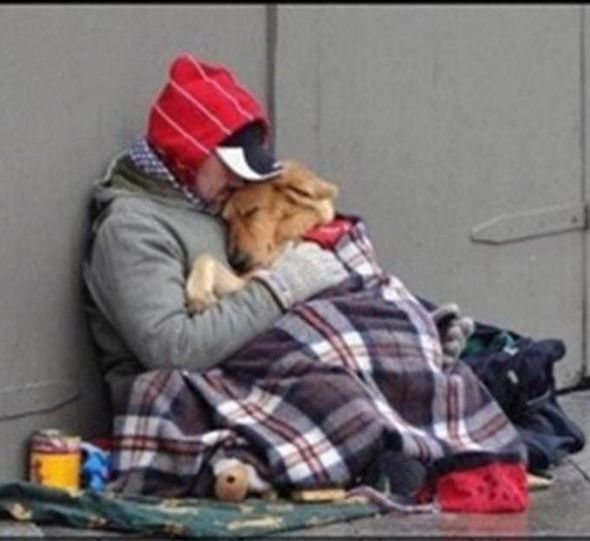
No better portrayed than by the photograph below that I presented in a Post on the 17th March, Change out of Hope.

The power of love.

“The one absolutely unselfish friend that man can have in this selfish world, the one that never deserts him, the one that never proves ungrateful or treacherous, is his dog.“ Samuel Coleridge

Winds of Change

A guest post from Sue Dreamwalker.

Introduction

Sue has been a wonderful supporter of Learning from Dogs for which I am very grateful.  Sue is the author of the blog, Dreamwalker’s Sanctuary and I do recommend that you pop across there and read her wonderful Posts.  Recently, I read a beautiful poem that Sue had written and not only did she give me permission to republish that Post but also offered the following introduction.  Thank you, Sue.  The rest is all Sue!

First my thanks go to Paul who continues to awaken our knowledge to the Earth and our environment and whose posts are in-depth and informative posts on subjects which we should all be immersed in.

For Planet Earth is our Home and she is dying.  And we Humans are still in a slumber as to the destruction we have inflicted upon her.

Our Native American Brothers knew long ago that we have to balance nature and we should only take that which we need.. But we have used Greed as our cutting tools and we as a species have become out of balance with nature and ourselves.

Paul has kindly asked if he could re-blog my poem .  This poem speaks of those changes we all feel is happening within our world.  I firmly believe like the Native Americans that we are united in Consciousness and that extends to our Earth Mother. We are linked together As One.

…oooOOOooo…

The Winds Of Change

The Winds of Change.

The Winds of Change flow across our land

Sweeping us up like the grains of sand

Twisting us round to look in the mirror

Cutting us deep to make us consider…

~

Our past which holds so many stains

As Ego rules in a world full of pain

The winds of Change are here to uplift

It’s time for Humanity to embrace all her gifts

~

But before we fly along with the wind

Mankind is reaping all his sown sins

The Anger, the Hatred, the Greed and his Pride

Will no longer have any places to hide

~

For the Winds of Change a tornado will swirl

As into the Abyss the Material will hurl

A river so deep into Oceans will run

With all tears cried from when time first begun

~

A cleansing of hearts as each soul will cry

As the Winds of Change blows into our eyes

Eyes that will open as we come awake

And Mankind will realise he can no longer take

~

The road of discovery can often be hard

A lonely walk as the Winds they bombard

It strips us bare to reveal our true souls

In a journey we’ve walked from Millennia of old

~

And as our tears fall they wash us all clean

Of the lies of the Past and all that has been

The Winds of Change it whistles in our Hearts

Get ready to fly – for we’re soon to depart.

~~~

Many things are happening around our world right now, and for many we are all going through some personal changes.. Change is always hard, and painful, for we resist it as we cling onto that which is familiar. But without Change we do not grow, or progress..

Some of those Changes which are taking place around our Earth are bringing with it tears..

Tears we weep help cleanse our inner-most souls as we wash ourselves from within and we release our emotions.

So, too, our Earth Mother is getting ready for Change… her Winds too are blowing a warning, as she is releasing her tears as she lets them spill as rain..

Too long has she held them within…

We are One with Mother Nature… Watch her, as she is stirring..

Be Ready..

She is Changing, and as she does we will feel her shake, as her body sobs.

By sending out your love,

By loving your selves we are helping each other over these Changes..

We are helping Unite ourselves and Mother Earth once again in Harmony

~~~~

A tree knows how to bend in the wind, or it breaks and falls..

Water finds its path as it flows into ALL to find its own level

So too we must go within that flow and follow our hearts

We need to be that Oneness,

We need to stop hurting one another,

We need to breath in that Light of Love

And Share it in Unity of Oneness

This is the Time of Change

Let the Winds blow

Love into your

Hearts

 Native American Indian Quote

“You must teach your children that the ground beneath their feet is the ashes of your grandfathers.
So that they will respect the land, tell your children that the earth is rich with the lives of our kin.
Teach your children what we have taught our children, that the earth is our mother.
Whatever befalls the earth befalls the sons of the earth.
If men spit upon the ground, they spit upon themselves.”
~ Unknown ~

© Sue Dreamwalker – 2012 All rights reserved.

Change out of hope.

Making a difference is the only way forward!

Don’t worry, this is not going to be some chest-banging Post!  I leave those for Monday to Friday. 😉  No, I just wanted to offer a couple of examples of the power of goodness and how making a positive difference is no more than wanting it.  As Perfect Stranger commented last Tuesday, “A single candle may light a thousand others and they in turn many thousands more” – Buddha

The first example is about how a group of upstanding citizens rescue a school of dolphins that became stuck on a beach in Brazil.

The second example comes from closer to home.  Ginger I. is a Board Member of the Humane Society of Central Arizona and is based at Payson.  Jean has been a volunteer at the Society’s Thrift Store for some time and has got to know Ginger well.

Ginger recently emailed me this; it has already done the rounds of the WWW, and quite rightly so.  It reminds me of the book Dogs Never Lie About Love, written by Jeffrey Masson, from which comes the following,

This ambiguity, which includes a certain ambivalence as well, has been memorialized in our speech, in our sayings, and in our tributes to and about dogs. Sir John Davies, in his epigram In Cineam (written in 1594), observed:

Thou sayest thou art as weary as a dog,
As angry, sick, and hungry as a dog,
As dull and melancholy as a dog,
As lazy, sleepy, idle as a dog.
But why dost thou compare thee to a dog?
In that for which all men despise a dog,
I will compare thee better to a dog.
Thou art as fair and comely as a dog,
Thou art as true and honest as a dog,
Thou art as kind and liberal as a dog,
Thou art as wise and valiant as a dog.

Ever since Madame Roland said in the eighteenth century “Plus je vois les hommes, plus j’admire les chiens” (The more I see of men, the more I admire dogs), generally what has been written about dogs tends to be positive. Sometimes it is even wonderful, as in William James’s statement “Marvelous as may be the power of my dog to understand my moods, deathless as is his affection and fidelity, his mental state is as unsolved a mystery to me as it was to my remotest ancestor.” Or it may be delicious, like Ambrose Bierce’s definition in his Devil’s Dictionary, “Dog, n. A kind of additional or subsidiary Deity designed to catch the overflow and surplus of the world’s worship.” Samuel Coleridge, in Table-Talk (May 2, 1830), was one of the first to note that “the best friend a man has in the world may turn against him and become his enemy. His son or daughter … may prove ungrateful. Those who are nearest and dearest to him … may become traitors to their faith…. The one absolutely unselfish friend that man can have in this selfish world, the one that never deserts him, the one that never proves ungrateful or treacherous, is his dog.”

Just read that last sentence again from Samual Coleridge as you look at the photograph below, “The one absolutely unselfish friend that man can have in this selfish world, the one that never deserts him, the one that never proves ungrateful or treacherous, is his dog.”


I must go down to the sea again, spelt H2CO3!

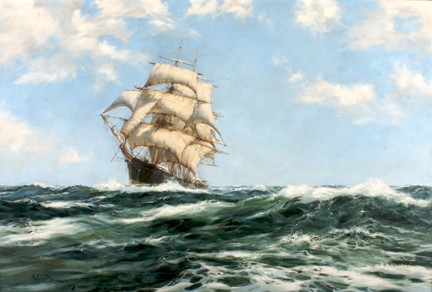
Starting to feel like a long way from John Masefield’s poem Sea Fever.

The call of the sea.

One of my all-time favourite poems.

I must go down to the seas again, to the lonely sea and the sky,
And all I ask is a tall ship and a star to steer her by,
And the wheel’s kick and the wind’s song and the white sail’s shaking,
And a grey mist on the sea’s face, and a grey dawn breaking.

I must go down to the seas again, for the call of the running tide
Is a wild call and a clear call that may not be denied;
And all I ask is a windy day with the white clouds flying,
And the flung spray and the blown spume, and the sea-gulls crying.

I must go down to the seas again, to the vagrant gypsy life,
To the gull’s way and the whale’s way, where the wind’s like a whetted knife;
And all I ask is a merry yarn from a laughing fellow-rover,
And quiet sleep and a sweet dream when the long trick’s over.

Why do I start this piece with that poem?

Well, read this,

Carbonic acid is a weak acid that is created when carbon dioxide (CO2) is dissolved in water (H2O), resulting in the chemical formula H2CO3. When the acid dissociates, or gives up a hydrogen ion, the resulting molecule is called a bicarbonate ion. Carbonic acid appears frequently in the natural world. It can be found in sodas, champagne, and blood. The acid even appears in rain.

But like so many things in nature, it’s all about balance.

A week ago, the 2nd March, Patrice Ayme gave me permission to reproduce an essay of his The collapse of the biosphere.  In that essay he wrote,

Besides, it’s not all about “climate change”. Half of the CO2 is presently dissolving in the oceans, so a rise of two degrees Celsius means extremely acid oceans (CO2 turns into carbonic acid after it reacts with water). At the present rate of acidification, marine life will dissolve big time by 2100. That’s how a lot of the oxygen is produced, by photosynthesizing unicellular animals, with acid sensitive skeletons. Atmospheric poisoning deniers do not want just to warm us up.

On that same day of March 2nd, Yves Smith of Naked Capitalism published an item that reinforced what Patrice wrote.  Yves very kindly gave me permission to republish her Post in full, as follows:

Current Rate of Ocean Acidification Worst in 300 Million Years

Science has published a troubling but not entirely surprising article on the fact that the oceans are acidifying at the fastest rate in 300 million years. Actually, it could be the fastest rate over an even longer time period, but we can only go back with any degree of accuracy for 300 million years

We first wrote about this issue in early 2007, and this section, which quoted Stormy from Angry Bear, will help bring readers up to speed:

….there are side effects to our love affair with CO2 that are not often mentioned. In fact, whether the earth cools or warms is absolutely irrelevant to these effects. I repeat: Absolutely irrelevant.

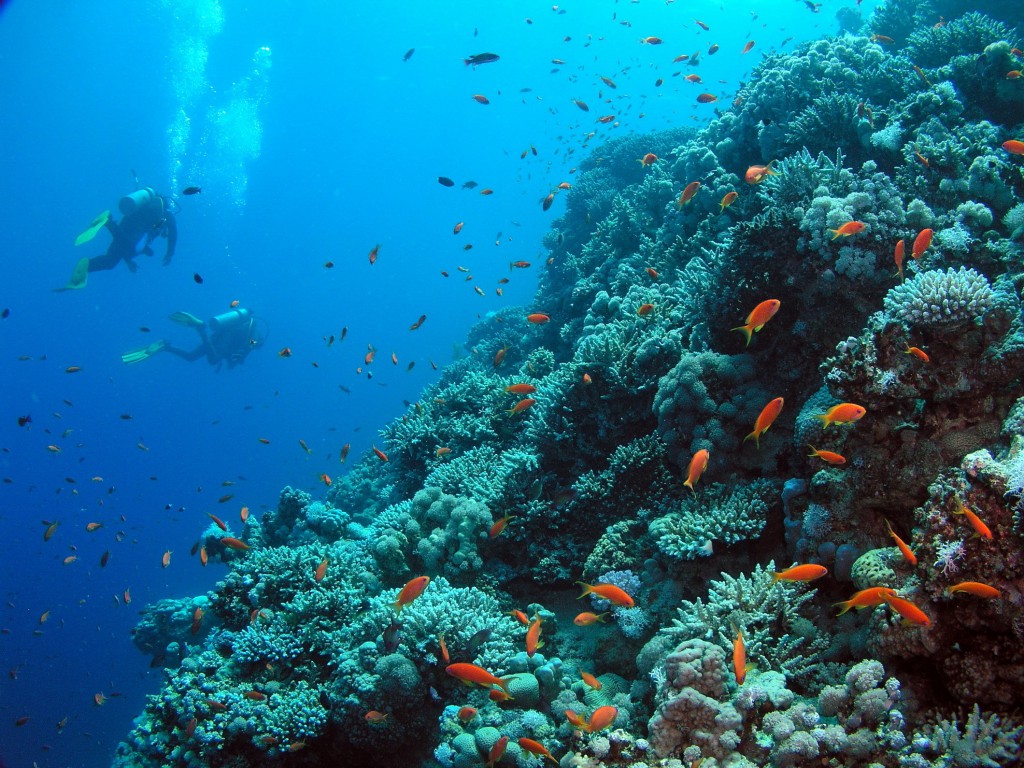
One of the most startling effects is the acidification of the oceans. Since 1750, the oceans have become increasingly acidic. In the oceans, CO2 forms carbonic acid, a serious threat to the base of the food chain, especially on shellfish of all sizes. Carbonic acid dissolves calcium carbonate, an essential component of any life form with an exoskeleton. In short, all life forms with an exoskeleton are threatened: shell fish, an important part of the food chain for many fish; coral reefs, the habitat of many species of fish….

The formation of carbonic acid does not depend upon temperature. Whether the oceans warm or cool is irrelevant. Of concern only is the amount of CO2 that enters the oceans.

Fast forward to today. Consider the scope of the paper in Science, per a very good discussion in ars technica:

A new paper in Science examines the geologic record for context relating to ocean acidification…The research group (twenty-one scientists from nearly as many different universities) reviewed the evidence from past known or suspected intervals of ocean acidification…They find that the current rate of ocean acidification puts us on a track that, if continued, would likely be unprecedented in last 300 million years.

There is an important driver of this process that this overview mentions only in passing further on, and it’s useful to have it in mind when you review the discussion of the historical record:ocean acidification depends primarily on the rate of atmospheric CO2 increases, not the absolute concentration. Look at how attenuated the rate of past CO2 changes was in the past versus the speed now:

The first period the researchers looked at was the end of the last ice age, starting around 18,000 years ago. Over a period of about 6,000 years, atmospheric CO2 levels increased by 30 percent, a change of roughly 75 ppm. (For reference, atmospheric CO2 has gone up by about the same amount over the past 50 years.) Over that 6,000 year time period, surface ocean pH dropped by approximately 0.15 units. That comes out to about 0.002 units per century. Our current rate is over 0.1 units per century—two orders of magnitude greater, which lines up well with a model estimate we covered recently.

The last deglaciation did not trigger a mass extinction, but it did cause changes in some species…

During the Pliocene warm period, about 3 million years ago, atmospheric CO2 was about the same as today, but pH was only 0.06 to 0.11 units lower than preindustrial conditions. This is because the event played out over 320,000 years or so. We see species migration in the fossil record in response to the warming planet, but not ill effects on calcifiers…

Next, the researchers turned their focus to the Paleocene-Eocene Thermal Maximum (or PETM), which occurred 56 million years ago. Global temperature increased about 6°C over 20,000 years due to an abrupt release of carbon to the atmosphere (though this was not as abrupt as current emissions). The PETM saw the largest extinction of deep-sea foraminifera of the last 75 million years, and was one of the four biggest coral reef disasters of the last 300 million years…

The group also examined the several mass extinctions that defined the Mesozoic—the age of dinosaurs. The boundary between the Triassic and Jurassic included a large increase in atmospheric CO2 (adding as much as 1,300 to 2,400 ppm) over a relatively short period of time, perhaps just 20,000 years. The authors write, “A calcification crisis amongst hypercalcifying taxa is inferred for this period, with reefs and scleractinian corals experiencing a near-total collapse.” Again, though, it’s unclear how much of the catastrophe can be blamed on acidification rather than warming.

Finally, we come the big one—The Great Dying. The Permian-Triassic mass extinction (about 252 million years ago) wiped out around 96 percent of marine species. Still, the rate of CO2 released to the atmosphere that drove the dangerous climate change was 10-100 times slower than current emissions…

In the end, the researchers conclude that the PETM, Triassic-Jurassic boundary, and Permian-Triassic boundary are the closest analogs to the modern day, at least as far as acidification is concerned. Due to the poor ocean chemistry data for the latter two, the PETM is the best event for us to compare current conditions. It’s still not perfect—the rate of CO2 increase was slower than today…

The authors conclude, “[T]he current rate of (mainly fossil fuel) CO2 release stands out as capable of driving a combination and magnitude of ocean geochemical changes potentially unparalleled in at least the last ~300 [million years] of Earth history, raising the possibility that we are entering an unknown territory of marine ecosystem change.”

Translation: “We’re probably fucked, but the data is so far outside of historical parameters, we can’t say anything with a high degree of certainty.”

Worth protecting, worth saving, worth caring about!

Mr Carter’s amazing photo.

A poetic response from reader Marcia G.

This is in response to the item that I republished last Thursday, originally on Nakib’s blogsite, Freedom to Survive.  Do visit it.  Marcia in response sent in the following poem.

The Onlooker

He stood across the street and sadly saw
The little match girl standing in the rain;
She looked as if she didn’t have a prayer.
He wondered why there wasn’t yet a law
To spare her from unnecessary pain,
And how could people just walk by her there?

He raised his head toward Heav’n in awe and fear
And let the raindrops hit his youthful face,
While speaking toward the softly weeping sky,
“Dear God, why haven’t you done something here?
“I have the faith that You’re nearby some place,
“But there’s no sign that you’ve been helping; why?”

Then God replied, “I have…it’s nothing new;
“For such a purpose I created you.”

Thank you, Marcia.

When I see how this new, virtual world connects us across the world with so many others that know what is truly important, I do have hope for the future.

To take your breath away!

Dancing like you have never, ever seen it before!

Unless you are one of the several million that have watched a couple of versions on YouTube.

Anyway, the YouTube link was sent to me by Katie S.

Watch and be overwhelmed.

Duo MainTenanT

Composed by Nicolas Besnard (former guest hand to hand of Cirque du Soleil “Zumanity” 2005-2009) and Shenea Booth (formerly of Duo Realis and two time Sport Acrobatic World Champion).

————

Nicolas Besnard developed his art at National Circus School and at the University of Dance of Montreal. In 2005, Nicolas was invited to be a guest act in the sexiest production of Cirque du Soleil in Las Vegas – Zumanity where he performed over 2000 times in four years.

He has performed all around the globe and has appeared in many different TV shows: Le Plus Grand Cabaret du Monde, Benissimo, …

He also won the Silver Medal in Paris at the most recognized Circus Festival in the world – 31st Festival Mondial du Cirque de Demain and made it to the finals of French Got Talent.

Shenea Booth is a former two time World Champion in Acrobatic Gymnastics, and is a recent USA Gymnastics Hall of Fame Inductee.  In 2004 she retired from the competitive arena and evolved into a world renowned artist, creating a groundbreaking genre of entertainment as an acrobatic duo.

As an entertainer, Shenea has made special appearances on Dancing With The Stars, So You Think You Can Dance, Cirque Du Soliel premier special events, NBC’s Ice Skating and Gymnastics Spectacular, and was a finalist on Americas Got Talent.

Today, Shenea and Nicolas have come together to combine their unique and original artistic knowledge of acrobatic dance and create a breathtaking master piece.