Yesterday, around 10am something got into my main desktop computer and practically brought it to a halt. Of course, it had been months since I had done a backup and there were dozens and dozens of documents at risk, including a fair chunk of a novel that I have under-way! An hour later, I had managed to backup my documents yet the PC was still pretty crippled. Felt like an utter waste of a day!
Luckily the old laptop that we use to watch movies was fine, and that is what I am using to prepare this Post.
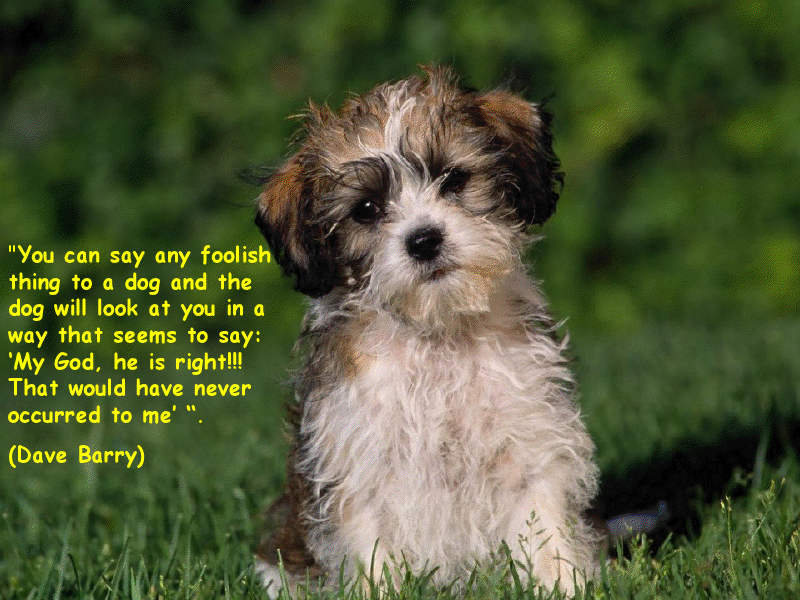
So, by way of making me and hopefully many of you as well, feel so grateful for the way that dogs just let it all flow by, here are a few wonderful dog pictures, sent to me courtesy of Rich and Katie S.
Holding a rose for all humanity!
and what about this this fine dog!
The epitome of loyalty and unconditional love!
Try avoiding this pair of eyes!
Not many would disagree with W.W.
Don’t know about you, but I’m already feeling better!
Some of man's best listeners!
The unavoidable truth!
Oh, how so true!
OK, plenty more where these came from, to be held in reserve for other challenging days! Thank you Rich and Katie.
But aren’t we so lucky to have these animals in our lives! God bless them!
Powerful prose, stunning pictures and an insight into the last 1.8 billion years of our planet.
The Payson Roundup is the local newspaper for Payson. To be frank, most weeks it’s a fairly quick read. That’s not a reflection of the quality of the newspaper, just an acknowledgement that Payson is a small American city some 80 miles NE of Phoenix up in the high desert. Indeed, the Roundup has a good record of winning awards.
However on the 6th January, there was a stunning article about the Grand Canyon, less than 4 hours driving from Payson. It was written by Pete Aleshire, a Staff Reporter with the Roundup. I can vouch for Pete’s literary skills as he teaches the creative writing course at the local college that Jean and I attended last term (semester) and will be restarting tomorrow.
I am very grateful to the Payson Roundup for their permission to republish this wonderful work. So here it is.
Woe and beauty on an ancient edge
by Pete Aleshire
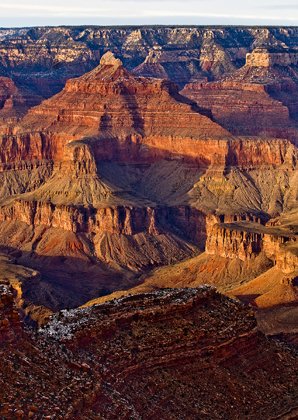
This view of the canyon reveals the layers of limestones and sandstones that testify to vanished seas and deserts. Note the strong, narrow white layer of Coconino Sandstone near the top, composed of 260-million year-old sand dunes. Also note in the center of the photo the 500-foot-tall cliff of Redwall Limestone formed on a seabottom 300-400 million years ago. Photo Tom Brossart/Roundup
I took a step — a long step — a million years step. Then I stopped, turned and faced north. Perched on the jagged edge of my life, I looked down deep into the shadowed layers of lost worlds — terrible deaths, fractured continents, vanished seas, mass extinctions.
Taking a breath, I took another step — a long step — another million years.
Curiously, I felt better — my troubles for the moment shrunk to no more than a ledge of Tapeats Sandstone in the wall of the Grand Canyon opposite. A layer of fossilized beach sand laid down 570 million years ago, the Tapeats Sandstone lies atop a mystery of missing stone — dubbed the “Great Unconformity.”
I studied that light, crumbling layer of sandstone in the canyon wall just across the way, knowing that all the great, riotous thrust of life that took us from pond scum to troubled writers has taken place since the lapping waves of a vanished sea left that layer of crumbling gray stone on a barren beach.
Perched on the wind-tormented branch of a twisted juniper nearby, a glossy black raven croaked at me.
“Nevermore,” he gurgled in my mind’s ear.
“You raise a good point,” I said to the raven and the wind that rose up out of the canyon’s 1.8-billion-year gash of time. I let loose a breath, a sigh, a puff of steam — frail and fleeting as life in the shadow of so much time. It should have depressed me, to stand so mite-like on the edge of such immensity. All I had dreamed or hoped or failed to do would not amount to a swirl of dust on this crumbling edge. I ought to have felt insignificant. Instead, I felt obscurely better.
So I took another step. A long step — a million years.
They had not built the Trail Through Time along the edge of the Grand Canyon between the El Tovar and Yaqui Point the last time I lingered on this edge. Now, it offers the most exciting crash course in geology I’ve ever encountered, although I’ve sought after rocks and unconformities all my life — and have even written geology books for confused people.
The 1.2-mile-long trail presents sliced and polished rocks representing almost all of the 24 major rock layers laid bare in the canyon wall from the 240-million-year-old limestone, siltstone, gypsum and chert layers of the Kaibab Formation to the 1.8-billion-year-old Vishnu Schist in the canyon bottom, among the oldest exposed rock’s on the planet’s surface.
Each step along the 1.2-mile path represents a million years, starting in the present and ending up at the 1.8-billion-year-old start of everything.
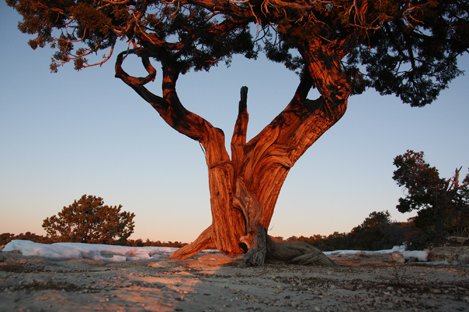
The Grand Canyon reveals a 1.8-billion year glimpse into Earth’s past from views like these along the 1.2-mile-long Trail of Time, with displays of rocks from each of the two dozen rock layers in the mile-deep canyon. A juniper catches the last light. Photo by Pete Aleshire
The Grand Canyon represents the most vividly revealed slice of Earth’s history anywhere on the planet. That makes the canyon one of the few places a person can grasp both the astonishing violence and the tormented timescale of the planet that sustains us all. This unique cross-section of time comes as a result of the relatively level uplift of the Colorado Plateau in the past 5 million to 8 million years. In most places, such a vast uplift would jumble the buried rock layers. But much of the 130,000 square miles of the Colorado Plateau rose at the rate your fingernails grow without deforming the miles-deep layers of sandstones, limestones and shales laid down on the bottoms of long-vanished seas and deserts.
As the Colorado Plateau rose, the northern edge crumpled into the Rocky Mountains. The southern edge dropped away along a 200-mile-long chain of 1,500-foot cliffs — which north of Payson forms the Mogollon Rim. Oak Creek cut back into that rising edge of the plateau to uncover the striking red rock formations of Sedona.
The Colorado River did the same thing, but on a grand scale. Many geologists believe the Colorado River originally ran north into a vast, interior sea. But as the Colorado Plateau rose, another river that ran south cut backward until it captured the north-flowing ancestral Colorado River, reversing the flow so that it now ran south into the Gulf of California.
This capture some 6 million years ago began the process of carving out the Grand Canyon. As the plateau rose, the flood-prone Colorado River cut down through it, like pressing a log up against a chain saw. Meanwhile, the steep tributaries widened the canyon by carrying those soft layers of sedimentary rock down to the main stem of the Colorado.
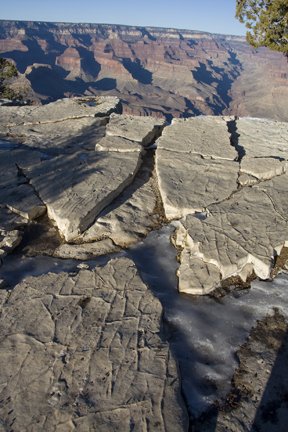
A layer of 230-million year old Kaibab Limestone caps the rim. The Grand Canyon reveals a 1.8-billion year glimpse into Earth’s past from views like these along the 1.2-mile-long Trail of Time, with displays of rocks from each of the two dozen rock layers in the mile-deep canyon. Photo by Pete Aleshire
That process started at about the time the genetic evidence suggests humans, chimps and gorillas last shared a common ancestor and continues to this day.
As a result of this vast uplift, the relatively young Colorado River has revealed in the walls of the Grand Canyon the long buried history of the Earth going back nearly halfway to its creation. That encompassed the entire period in which life progressed from single celled organisms in the ocean to its present, dazzling complexity.
The meander down that Trail Through Time reveals much of that history, preserved in the rock layers and the fossils they contain. Of course, erosion has already removed more than 200 million years of that history, so that the youngest rocks on the rim of the canyon are older than the dinosaurs.
A few dominant layers stand out.
Near the top, the fossilized desert sand dunes of the light Coconino Sandstone bear witness to a vast desert that covered the Southwest some 260 million years ago. At that time, what would become North America was part of a “supercontinent” that gathered almost all the dry land on the planet into a single mass.
In the middle of the canyon, lies the great, blood-red wall of Redwall Limestone, formed on the bottom of a shallow sea between 300 million and 400 million years ago. Today, the fused layers of microscopic skeletons of ancient sea creatures forms a sheer 500-foot-tall band of cliffs that pose the greatest single barrier to reaching the canyon bottom from the rim. All of the trails to the bottom must pass through fault lines in the Redwall Limestone, stained red by iron oxides leaching out of the layers above.
Farther down, the easily eroded Bright Angel Shale forms the shelf above the 1,800-foot-deep inner gorge. Shales form on shallow sea bottoms, compared to the deeper marine environments that create limestones. Most of the trails in the canyon run along its wide shelf. Formed 530 million years ago, the Bright Angel Shale represents the era when trilobites ruled the world.
Just below the Bright Angel Shale lies the Great Unconformity, where erosion in the inconceivably distant past removed 1.2 billion years worth of rock. This records another period of uplift, when erosion carried off layers of rock many times higher than Mt. Everest.
Below that unconformity, the story continues — down through a dozen more layers in the inner gorge, each one mounted alongside the trail and polished smooth. The Grand Canyon Supergroup spans the period between 570 million and 1.2 billion years ago, again recording the meanderings of the continents and the ebb and flow of oceans, as the planet breathes in, breathes out.
After another, smaller unconformity, the river finally reveals the inconceivably ancient Vishnu Schist and Zoraster Granite. The schists started as sandstone, limestone and shale, before they were buried, reheated and fused into this dense, primordial rock. The Zoraster Granite ooze up from the molten depths of the Earth, forming veins revealed finally by the relentlessly downcutting river.
I could not see the metamorphosed Vishnu Schist from my perch atop the rim, but I have seen it on raft trips in the dark heart of the canyon where it has been fluted and carved and sandblasted by eons of floods.
Finally I stood stock still, my breath coming still in moist, warm, puffs as the planet spun so that the dust of the atmosphere gave the sun’s long light a warm red glow, reflected off the ancient worlds across the way.
My raven friend — or one of his kin — flew past with an audible whoosh of his wings, then banked to consider the possibilities. He croaked, that guttural warble that only ravens dare.
Odds are, he noted my proximity to the edge and so paused to ponder my potential as carrion.
But I prefer to think that he felt our shared pulse of life and caught the updraft of my yearning.
In either case, he settled on the branch of a weirdly stunted ponderosa pine nearby and we shared the sunset.
The shadows rose up out of the canyon, swallowing continents and oceans.
I kept my gaze on the glow of the Redwall Limestone until the shadow took it, then shifted to the luminous yellow of the Coconino Sandstone.
For I came to the canyon full of woe holding my life in my fingernails, my heart in the shadows. But now my troubles seemed fleeting, the world full of marvels, my life aglow like that desert turned to sandstone in the last light of day.
My breath came in a puff, transparent but warm in the still, cold air.
“Nevermore,” quoth the raven, “nevermore.”
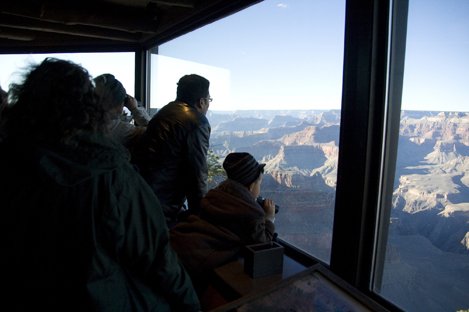
Visitors study the colorful layers of the Grand Canyon from the observation window in the geology museum at Yaqui Point. Photo by Pete Aleshire
oooOOOooo
Such beautiful words. Any additional thoughts from yours truly are utterly superfluous.
This was emailed to me a couple of weeks ago. Have no background information as to where the photograph was taken and, indeed, what type of bird it is! But, nonetheless, just a beautiful reminder of the wonderfully, precious planet that we all, and I mean all, live on.
Neil K. from South Devon sent me these, a little too late to put in my NY Post that came out yesterday. But they were too good to leave to next week-end so here they are. First Berlin.
Beginning with a countdown on a giant hourglass and a greeting from an “Android,” LG’s huge presentation took viewers on a thrilling 3D ride that included — among other things — whales, ice skaters, giant octopi and steaming jungles.
My rather slow response to my Versatile Blogger award!
Last Friday morning, the 16th, I turned on my PC to discover that lovely Kathryn Johnston of 4amWriter had nominated Learning from Dogs for the Versatile Blogger Award. I was blown away especially as since then the connections I have made with other writers have been wonderful.
However, a more prompt acknowledgement on LfD seems to have escaped me until today. I quickly learnt that there is a proper protocol associated with the response to the award.
Thank the award-giver and link back to them in your post.
Share 7 things about yourself.
Pass this award along to 15 blogs you enjoy reading.
Contact your chosen bloggers to let them know about the award.
So here goes!
Award logo
So first, a very big thank you to Kathryn of 4amWriter for including me in her list. As she said on her post, “This title says it all! If you love dogs, this is a must-visit!” That’s generous of Kathryn. Dogs are a very powerful reminder of an uncomplicated way to live, as described on the Home Page. The Vision behind the Blog is:
Our children require a world that understands the importance of faith, integrity and honesty
Learning from Dogs will serve as a reminder of the values of life and the power of unconditional love – as so many, many dogs prove each and every day
Constantly trying to get to the truth …
The power of greater self-awareness and faith …
Seven things about me!
H’mm, what to say.
Born in London 6 months before the end of WWII,
Been a business-to-business salesman most of my life,
Started my own business in 1978 and remained in ‘self-employment’ until quite recently,
Lived on my own boat, based in Larnaca, Cyprus, for 5 years,
A keen glider pilot for many years at Rattlesden Gliding Club in Suffolk, later a private pilot,
Always wanted to write,
And, finally, happier than I have ever been being married to Jean, having met in Mexico in 2007, moving out there with Pharaoh, my GSD, in 2008 and subsequently arriving in Payson, Arizona in 2010 with 11 dogs and 6 cats!
So here are the 16 Blogs (I use that description loosely) that I wish to pass this award to:
Yves Smith of Naked Capitalism. How Yves finds the time to produce the huge volume of articles and website links every day is beyond me.
James Kwak and Simon Johnson of Baseline Scenario. James and Simon were, for me, an early source of openness about the key issues affecting the global economy that slammed into our collective faces in 2008.
Patrice Ayme of the Blog of his own name. Patrice’s sub-heading on his Blog reads, “Intelligence at the core of humanism.” Again, a prolific writer with a huge intellect that he puts to wonderful use. Just pick anything that he has written to see that proved in spades.
Bill McKibben of 350.org. The headline on the website says, “We’re building a global movement to solve the climate crisis.” Say no more!
Michelle of Dog Kisses’s blog. Wonderful blog – just go there and enjoy it.
Sue of Sue Dreamwalker. Again, just a wonderful Blog – do please visit.
Vlatko, the owner of Top Documentary Films. We do not subscribe to any television channels at home so Vlatko’s resource is so valuable for us. Huge selection of free documentary films to watch.
Deanna Raeke and Andrea Rosebrock of the Blog For The Love of a Dog. Very active in fighting all corners on behalf of man’s oldest companion.
Rob Hopkins and his team at Transition Network. Rob is one of the leading voices for changing to a sustainable relationship with this planet. He is based in Totnes, Devon, my local town for many years when I lived in the village of Harberton. His books on Transition are masterpieces.
Victoria Brown, Daniel Honan and team at Big Think. As their headline says, “A forum where top experts explore the big ideas and core skills defining the 21st century.” Fabulous resource.
All the Directors and team at Sustainable Arizona. As is described on their site, Sustainable Arizona is about, “Our nonprofit organization is made up of volunteers and professionals committed to making sustainable development possible. We accomplish this by encouraging businesses that add true value to our communities while preserving the environment.“
Anthony Watts of Watt’s Up With That. With over 9,000 followers and over 98 million viewers this very reasonably can be regarded as the world’s most viewed climate website. Anthony’s 3 million monthly visitors puts my 40,000 into perspective!
The whole team at the US-based National Wildlife Federation. Their Mission: As America’s largest conservation organization, National Wildlife Federation works with more than 4 million members, partners and supporters in communities across the country to inspire Americans to protect wildlife for our children’s future!
Peter Russell of Spirit of Now. Peter writes on his Blogsite, “There are many observations I make in daily life—some profound, some mundane—mostly concerning the natural world around, or the nature of the inner world of mind. Some incline us to wonder and awe. Others make us think, and question our assumptions.” Never before have we needed so much to think about the way we think!
Nakibul Hoq, blogging from Bangladesh in the city of Dhaka under the Blog name of Freedom to Survive.
I shall be passing on the ‘award’ to all bloggers today.
Let me close again by saying such a big thank you to Kathryn of 4amWriter and, from that, how quickly I came across Limebird Writers who, I know, will be a great source of support as I face 2012 and ‘the novel’!
Last Friday I published a Post under the title of The power of truth. Just 5 minutes long, the YouTube video was powerful, starkly so. I wrote at the end of that article, “The principal source for the footage was Yann Arthus-Bertrand’s incredible film HOME.”
Jean and I watched Yann Arthus-Bertrand’s film last Friday night and to say that we were moved would be pitiful compared to the emotional impact it really had. Take a look at the film trailer; it’s a little over 3 1/2 minutes long. (But please don’t use that as a substitute for watching the full film, see below!)
Home is a 2009 documentary by Yann Arthus-Bertrand. The film is entirely composed of aerial shots of various places around Earth. It shows the diversity of life on Earth and how humanity is threatening the ecological balance of the planet. The movie was released simultaneously on June 5th in cinemas all over the world, on DVD and on YouTube. Released on the same date in 50 countries is a world record for any film release in history. The film is 100% free, and no profits will be made from its release or future showings.
I wasn’t going to add anything other than a brief introduction to the main film. However, an article in The Economist The World in 2012 caught my eye and seemed especially relevant to promoting the message carried by the film. Sheryl Sandberg, chief operating officer of Facebook, wrote about the power of social media and how it would be even more evident in 2012. This is the paragraph that caught my eye,
Expressing our authentic identity will become even more pervasive in the coming year. Profiles will no longer be outlines, but detailed self-portraits of who we really are, including the books we read, the music we listen to, the distances we run, the places we travel, the causes we support, the videos of cats we laugh at, our likes and our links. And, yes, this shift to authenticity will take getting used to and will elicit cries about lost privacy. But people will increasingly recognise the benefits of such expression. Because the strength of social media is that it empowers individuals to amplify and broadcast their voices. The truer that voice, the louder it will sound and the farther it will reach.
That last sentence jumped out at me, “The truer that voice, the louder it will sound and the farther it will reach.” Mull on that as you watch the film and, please, please, please if you support the need to return to a harmonious relationship with the planet spread the word as far and wide as you can.
Please promise yourself to sit down quietly and watch it uninterrupted. And if you feel so minded to add comments to this Post please do – would be delighted to have your feedback.
We are living in exceptional times. Scientists tell us that we have 10 years to change the way we live, avert the depletion of natural resources and the catastrophic evolution of the Earth’s climate.
The stakes are high for us and our children. Everyone should take part in the effort, and HOME has been conceived to take a message of mobilization out to every human being.
For this purpose, HOME needs to be free. A patron, the PPR Group, made this possible. EuropaCorp, the distributor, also pledged not to make any profit because Home is a non-profit film.
HOME has been made for you : share it! And act for the planet.
A truly remarkable example of the level of film animation being produced.
The second item that came to me from Bob D. (yesterday’s is here) has clearly done the rounds; the YouTube video has been watched nearly 7 million times! But if you haven’t seen this short film, just over 6 minutes long, then do watch it. It shows just how close to reality film animation has become! The story behind the film is from here, reproduced below.
Pigeon: Impossible is the tale of Walter, a rookie secret agent faced with a problem seldom covered in basic training: what to do when a curious pigeon gets trapped inside your multi-million dollar, government-issued nuclear briefcase.
The film took nearly 5 years to complete and is the first attempt at animation by writer/director Lucas Martell: “When the project started, it was mostly an excuse to learn 3D animation, but by the end of the project I had spent so much time reworking and polishing the story that I just wanted people to laugh.”
The end-result is a hilarious 6-minute romp through the streets of Washington D.C. as our hero fights to save himself, and the world from the chaos reigned down by a hungry pigeon. Breathtaking visuals and a sweeping soundtrack showcase the work of nearly one-hundred talented artists and musicians, and the film stands as a testament to what can be accomplished by a team of dedicated volunteers working for the love of their craft.
Personally, I think that last sentence is still an understatement. Just watch this – and be amazed.
Three things cannot be long hidden: the sun, the moon, and the truth.
The above is a quote attributed to the Buddha. It is perfect as an introduction to today’s piece.
When I sat down at my PC yesterday afternoon I was planning to finish off a Post about the BBC’s fabulous Frozen Planet TV series. But a check of my email changed all that. Because there was an email from Merci O., someone in Payson that Jean and I know well. Merci had sent me an email with a link to the following YouYube video.
Watch and be moved.
This is a non-commercial attempt to highlight the fact that world leaders, irresponsible corporates and mindless ‘consumers’ are combining to destroy life on earth. It is dedicated to all who died fighting for the planet and those whose lives are on the line today. The cut was put together by Vivek Chauhan, a young film maker, together with naturalists working with the Sanctuary Asia network (www.sanctuaryasia.com).
Content credit: The principal source for the footage was Yann Arthus-Bertrand’s incredible film HOME http://www.homethemovie.org/. The music was by Armand Amar. Thank you too Greenpeace and http://timescapes.org/