A beautiful story of dog loyalty – to another dog, to another blind dog.
I first received this lovely story last Sunday from Dan G., dear friend of over 30 years. As is my want, did some research to discover the source of the story. It appeared on the website of Ross Parry Agency on the 22nd October, 2011 (note the pics are copyright rossparry.co.uk) But I have taken the liberty of reproducing the story as it appeared in the UK Daily Mail online site, on the same date. Enjoy.
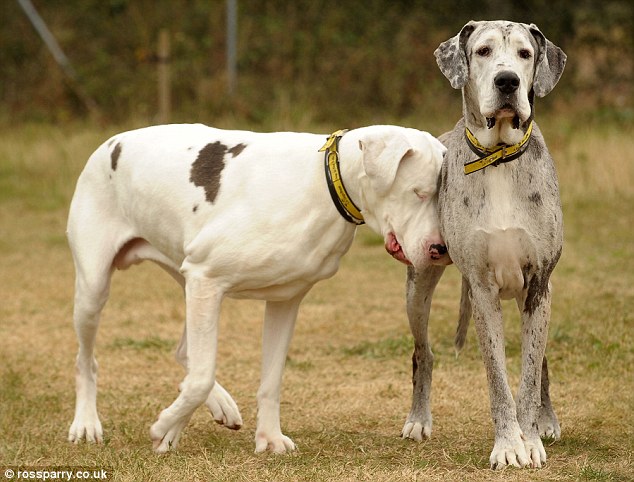
Meet the blind Great Dane in need of a home (but you’ll need to make space for HER huge guide dog)
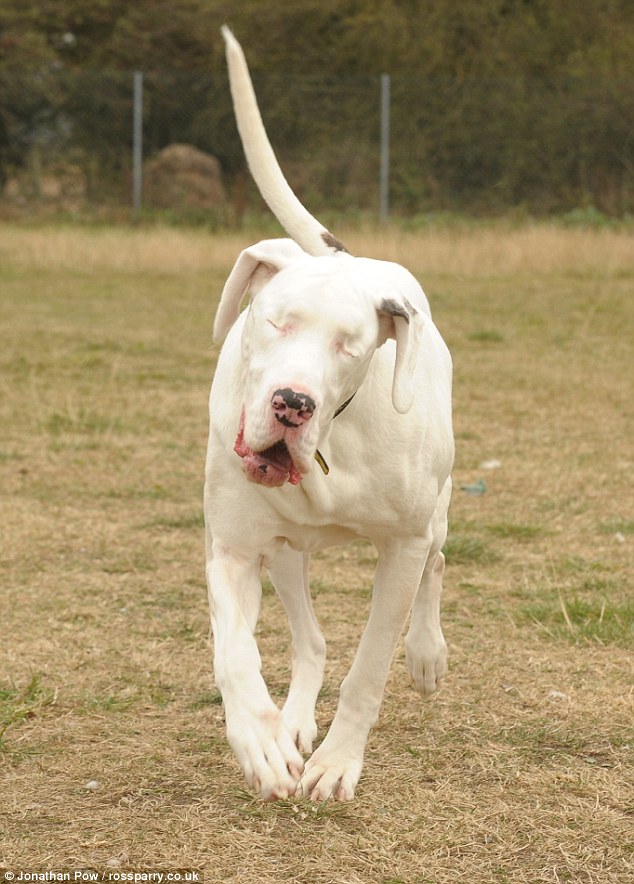
When illness forced vets to remove Great Dane Lily’s eyes, the prospects of a fulfilling life didn’t look good.
But then no one had reckoned on her pal Maddison stepping in to turn guide dog.
The pair have been inseparable for years but now find themselves looking for a new home because their owner could no longer cope.
The catch for anyone interested is that the Great Danes come as a package. They have been waiting at the Dogs Trust re-homing centre in Shrewsbury since July.
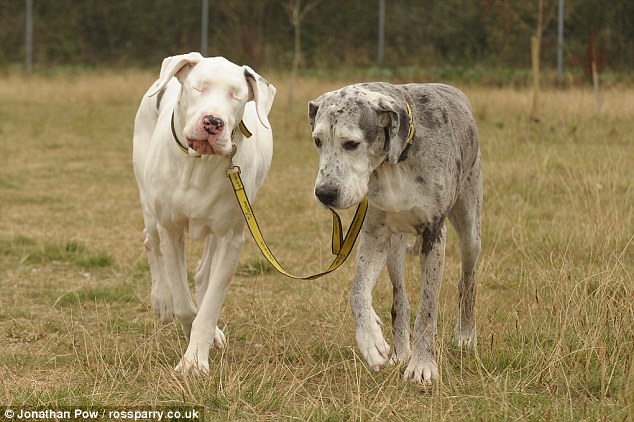
Homeless: Blind Great Dane Lily and her kind-hearted canine carer MaddisonForever friends: Lily, left, being guided while walking with Maddison right. The pair have been inseparable since Lily lost her sight
Manager Louise Campbell said: ‘Maddison is Lily’s guide dog. If they are out and about, for the majority of the time Maddison will lead and Lily will walk nearly touching her so she knows where to go. It’s lovely to watch. Maddison is always looking out for her.’
Lily, six, was barely a puppy when she was struck down by a condition that caused her eyelashes to grown into her eyeballs, damaging them beyond repair.
It was after this traumatic event that her relationship with seven-year-old Maddison developed as she took her under her wing.
The best buddies lived together until their owners decided they couldn’t look after them any more.
Miss Campbell said: ‘With her lack of sight, Lily’s other senses have heightened so although we don’t split them up often she can tell if Maddison is nearby.
‘They curl up together to go to sleep and they are very vocal with each other.
‘We haven’t analysed their different barks but if Lily wants to go forward and Maddison is in her way, the bark will have a different pitch.
‘They are very close to one another and enjoy each other’s company‘.
Playful: Lily's lack of sight has heightened her other senses so she can often tell if Maddison is nearby without the pair touching
Miss Campbell said that Lily does all the things normal dogs do and if you saw her from a distance you wouldn’t realise she had anything wrong with her eyes.
She added: ‘They are really happy with life, the glass is always half full with these two.
‘They have been with us for a considerable amount of time but they are quite happy and go about their daily routine – they are very affectionate.’
She believes the dogs’ size and advancing years, as well as the fact they have to come in a pair, may have put off potential owners and she warned that anyone contemplating taking the dogs in should look at their lifestyle and think of the responsibility involved.
‘They are not gigantic when you see them outside. These are two lovely big girls who deserve to live out the rest of their lives together in comfort‘, she said.
Dogs Trust cares for around 16,000 stray and abandoned dogs every year through a network of 17 re-homing centres.
The Great Dane is seeking an owner who would be willing to give both her and best friend Maddison a new home
Back to me. Must say that it was just fortuitous that Dan’s email came in to me a little while after I posted yesterday’s article by Robert Holden, The Gift of Happiness. Indeed, shortly after I had written, “Perhaps the art of happiness is yet another thing we can learn from dogs!”
Anyone in the UK who wants to contact the Dogs Trust click here.
Big thank you to Dennis L. for forwarding this video
Will say no more – just watch
And if that gives you a buzz, then you might want to read a Post that I published on the 30th July Free as a Bird reproduced in full below,
The wonderful combination of paragliding and flying with hawks.
Thanks to Dan Gomez for passing me a short video about this amazing activity. It was a matter of moments to find out the background. But first a picture.
Copyright Scott Mason
There’s a full description of the history of parahawking, as it is called, on WikiPedia.
Parahawking is a unique activity combining paragliding with elements of falconry. Birds of prey are trained to fly with paragliders, guiding them to thermals for in-flight rewards and performing aerobatic maneouvres.
Parahawking was developed by British falconer Scott Mason in 2001. Mason began a round-the-world trip in Pokhara, Nepal, where many birds of prey – such as the griffon vulture, steppe eagle andblack kite – can be found. While taking a tandem paragliding flight with British paraglider Adam Hill, he had the opportunity to see raptors in flight, and realized that combining the sport of paragliding with his skills as a falconer could offer others the same experience. He has been based in Pokhara ever since, training and flying birds during the dry season between September and March.
The team started by training two black kites, but have since added an Egyptian vulture and a Mountain hawk-eagle to the team. Only rescued birds are used – none of the birds has been taken from the wild.
There’s an interesting website for those that want to take a closer including more details about Scott Mason and his team here.
A timely video from the International Space Station (ISS)
Little did I realise when I posted yesterday’s item that a couple of subsequent actions would make today’s article easy to write (trust me it isn’t always this easy!).
Mike T., a flying buddy from my old days in England, sent me this link to a 5-minute video made up of a series of films shot from the ISS. DO WATCH THE VIDEO IN FULL SCREEN MODE!
The details of how the film was taken and much more interesting information is at the very end of this article.
Then Martin Lack who writes the blog, Lack of Environment, submitted a comment with a link to a piece that he had written on the 19th August that I would like to re-publish in full.
Why are we still waiting for the EU to act?
What can we learn from the fact that the EU has still not stopped buying over 90% of Syria’s oil exports? If nothing else, it tells me that we need fossil fuel too much!
But I think the problem of wrong priorities goes much deeper than that… This is because the Limits to Growth argument (which underlies my concern over AGW) is, even though the protestor-in-the-street may not realise it, the root cause of all the problems we are now seeing in Afghanistan, Bahrain, Cairo, Damascus etc., etc… right through to Zimbabwe: Treating the symptoms of food shortages or corruption (or whatever they may be) will not succeed unless we address the root cause, which is the inevitable consequences of perpetual growth in consumption of resources and/or waste production on a finite planet [see E.F. Schumacher’s Small is Beautiful (1973)].
This 5 minute videomakes sobering viewing, but it also perfectly summarises everything I have learnt in the last 12 months; and all I have posted on my oldMyTelegraph blog in the last 5 months!
It may not be rocket science, but can we reach Escape Velocity?
This stuff is not rocket science, but it is very unwelcome news to people with a vested interest in the continuance of “business as usual”. Unfortunately, we literally cannot go on the way we are; something has got to change…
Extract of paper presented by Dr Myles Allen at 4 Degrees and Beyond Conference (2009)
So a big thank you to Mike T. and Martin Lack for a number of lessons:
how clever man is in terms of space technology besides much more
the beauty of our planet – it’s all we have to live on
the amount of electric light that shines into outer space, as seen by the ISS.
how much of that lighting might be generated by coal and oil!
if we don’t learn to live in harmony, as in sustainably, with this planet of ours, the implications are going to be very serious.
Finally, as mentioned earlier the details of that video on Vimeo.
Time lapse sequences of photographs taken with a 4K-camera by Ron Garan fragileoasis.org/bloggernauts/Astro_Ron and the crew of expedition 28 & 29 onboard the International Space Station from August to October, 2011. All credit goes to them, who to my knowledge shot these pictures at an altitude of around 350 km. I intend to upload a FullHD-version presently.
HD, refurbished, smoothed, retimed, denoised, deflickered, cut, etc. All in all I tried to keep the looks of the material as original as possible, avoided adjusting the colors and the like, since in my opinion the original footage itself already has an almost surreal and aestethical visual nature.
Music: Jan Jelinek | Do Dekor, faitiche back2001 w+p by Jan Jelinek, published by Betke Edition janjelinek.com | faitiche.de
Image Courtesy of the Image Science & Analysis Laboratory, NASA Johnson Space Center, The Gateway to Astronaut Photography of Earth eol.jsc.nasa.gov
1. Aurora Borealis Pass over the United States at Night
2. Aurora Borealis and eastern United States at Night
3. Aurora Australis from Madagascar to southwest of Australia
4. Aurora Australis south of Australia
5. Northwest coast of United States to Central South America at Night
6. Aurora Australis from the Southern to the Northern Pacific Ocean
7. Halfway around the World
8. Night Pass over Central Africa and the Middle East
9. Evening Pass over the Sahara Desert and the Middle East
10. Pass over Canada and Central United States at Night
11. Pass over Southern California to Hudson Bay
12. Islands in the Philippine Sea at Night
13. Pass over Eastern Asia to Philippine Sea and Guam
14. Views of the Mideast at Night
15. Night Pass over Mediterranean Sea
16. Aurora Borealis and the United States at Night
17. Aurora Australis over Indian Ocean
18. Eastern Europe to Southeastern Asia at Night
I am indebted to Merci O. who regularly comments on Learning from Dogs for sending me the first film, see below. In my efforts to find a YouTube link (there didn’t appear to be one) I came across the second film. Both are good for the soul.
So click here to watch the first film. The film is comprised of a series of slides melded together with a beautiful music track. Do watch and listen.
Then here is the YouTube video, Morcheeba’s Enjoy The Ride.
Have a peaceful day wherever you are in the world.
“It would be fitting, I think, if among the last manmade tracks on earth would be found the huge footprints of the great brown bear.” Earl Fleming (American naturalist, 1958)
This particular item was brought to my attention by John and Janet Z., but I note it is widely distributed across the Web. So without any more ado, just watch these wonderful pictures of a bear put together with some great backing music. Just a couple of minutes long, it will deliver one of those ‘feel-good’ moments.
oo00OOO00oo
“When a pine needle falls in the forest, the eagle sees it;
This is how I introduced the first set of pictures on the 22nd October.
Regular readers will have seen that Cynthia S. has contributed some lovely items to Learning from Dogs. To be honest, if it wasn’t for the support of so many readers and the contributions that regularly come to my in-box, I would have long ago stopped writing. Anyway, a couple of weeks back Cynthia forwarded an email to me that had a series of the most beautiful nature photographs. So I’m going to reserve showing these over a number of week-end days to serve as a very restful and peace-inspiring alternative to the crazy world that most of us ‘enjoy’ during the working week.
Here’s the first four pictures of those fabulous pictures,
“Be who you are and say what you feel….
Because those that matter…
don’t mind…
And those that mind… don’t
matter.”
A light distraction to the serious article yesterday!
My son mentioned the other day that a rather unusual property is for sale in North Devon, SW England. What’s unusual about it? Well the picture below answers that question!
Hartland Point Lighthouse
Not a bad view, is it! The lighthouse, or rather ex-lighthouse, depending in which direction one is looking, has the start of the Bristol Channel off to the right, or the Atlantic Ocean directly ahead with the Island of Newfoundland being the next stop Westwards.
The island seen on the horizon in the picture is Lundy Island, a granite outcrop, three and a half miles long and half a mile wide. As an aside, I can recall a fly-in to Lundy many years ago. Went there in the Piper Super Cub and the landing and take-off were ‘interesting’.
Back to Hartland Point Lighthouse. Thanks to WikiPedia, we learn that,
Hartland Point Lighthouse is a Grade II listed building at Hartland Point Devon, England. The point marks the western limit (on the English side) of the Bristol Channel Atlantic Ocean continuing to the west.
Built in 1874 by Mr. Yerward of Wales under the direction of Sir James Douglass, the tower is 18 metres (59 ft) tall with the lamp being 37 metres (121 ft) above mean sea level. The light can be seen up to 25 miles (40 km) away from the coast. It is protected by a 30 metres (98 ft) long sea wall which was built in 1925 to prevent erosion of the rocks on which it stands.
It was blessed by Frederick Temple, Bishop of Exeter, who later became Archbishop of Canterbury, and the light was lit for the first time by Lady Stuckley of Hartland Abbey during the opening ceremony on July 1, 1874.
The tower was automated in 1984 and is now controlled from Trinity House Operations Centre at Harwich in Essex. Prior to automation the lighthouse was built with accommodation for four keepers and their families. The keepers’ dwellings have since been demolished to make room for a helipad to be constructed. This was necessary due to the precarious nature of the access road which is liable to frequent rock falls and landslips. Vehicular access is now very difficult and the gates tend to remain locked. The large concrete structures immediately to the south of the lighthouse were to provide the keepers with fresh water.
In the 2010 Aids to Navigation Review, by Trinity House, they proposed to discontinue the Hartland Point Lighthouse Station on grounds that the rocks that it sits on is eroding away.
So if you are looking for that really special room with a view, this could be it! The agency selling the Lighthouse are Smithsgore and the details, including a guide price of £500,000, may be found here.
Regular readers will have seen that Cynthia S. has contributed some lovely items to Learning from Dogs. To be honest, if it wasn’t for the support of so many readers and the contributions that regularly come to my in-box, I would have long ago stopped writing. Anyway, a couple of weeks back Cynthia forwarded an email to me that had a series of the most beautiful nature photographs. So I’m going to reserve showing these over a number of week-end days to serve as a very restful and peace-inspiring alternative to the crazy world that most of us ‘enjoy’ during the working week.
Here’s the first four pictures of those fabulous pictures,
“Be who you are and say what you feel….
Because those that matter…
don’t mind…
And those that mind… don’t
matter.”