“It came to me that every time I lose a dog, they take a piece of my heart with them…. And every new dog who comes into my life, gifts me with a piece of their heart. If I live long enough, all the components of my heart will be dog … and maybe I will become as generous and loving as they are.“
In memory of my elder sister, Corinne Grace Joiner, nee Handover, who died peacefully in her sleep at 7am yesterday, UK time.
The following video was sent to me a few days ago by John Hurlburt before me hearing the sad news of my sister’s graceful release from extreme dementia. The video seemed a most fitting tribute to Corinne who was a loving friend to me for well over 60 years.
Published on May 5, 2012
Video by Scott Mckinley Productions, Produced for Rocky Mountain Elk Foundation for Ad campaign. Licensed music by Kenny G.. This short video won Best of Category at the International Wildlife Film Festival in Missoula Montana! The majority was shot on location in Yellowstone National Park, Grand Teton National Park and The National Elk Refuge in Jackson Hole, Wyoming.
The point at which the sun reaches its farthest point north of the equator is the Summer Solstice, well it is for the Northern Hemisphere. This occurs annually on June 20 or June 21, depending on your time zone.
Here in Southern Oregon, the moment of the Summer Solstice will be 22:04 Pacific Daylight Time (PDT) on the evening of June 20th and at 05:04 GMT/UTC on June 21 2013 in the United Kingdom.
A quick web ‘look-up’ finds that the word solstice is from the Latin solstitium, from sol (sun) and stitium (to stop), reflecting the fact that the Sun appears to stop at this time, albeit momentarily.
At the ancient stone circle of Stonehenge in Southern England, the prehistoric monument that took Neolithic builders an estimated 1,500 years to erect, for many years the Druids have celebrated the Solstice and, undoubtedly, will be doing so again.
AMESBURY, UNITED KINGDOM – JUNE 21: A man stands on top of Stonehenge as the sun rises over Salisbury Plain on June 21, 2006 in Amesbury, England. Police estimated around 17,000 people travelled to watch the sun rise over the 5,000 year old stone circle to start the longest day of the year. (Photo by Daniel Berehulak/Getty Images)
Like thousands of others I have been supporting the efforts to ensure that the US Government did not proceed with the proposal to remove wolves from endangered species protection.
Wolves are the animals that enabled early man to ‘progress’ from hunter-gatherer to the life of farming, and thence to our modern world. As I write elsewhere on Learning from Dogs,
There is no hard evidence about when dogs and man came together but dogs were certainly around when man developed speech and set out from Africa, about 50,000 years ago.
So it utterly breaks my heart to republish a recent post on The Sand County, Jeremy Nathan Marks wonderful and evocative blog. Here it is, republished with Jeremy’s kind permission.
oooOOOooo
I used to believe
As some of you may have heard, late last week the Obama Administration officially delisted gray wolves from endangered species protection. This means that 40 years of wolf recovery efforts have come to an end. Wolves only occupy a tiny fraction of their former habitat and with anti-wolf governments occupying the state houses in the few places that still have wolf populations, states like Montana, Wyoming, Idaho and Wisconsin, it is hard to imagine that wolves have a bright future in the lower 48 states.
I am deeply, profoundly saddened by this decision. I have learned over time how wolves -like so many other species- just don’t register on the list of national concerns and priorities. A great many people oppose the delisting, in fact one gets the impression that the effort to remove these protections has consistently been guided by political pressures and a political agenda and not by a true commitment to a sustainable and enduring wolf recovery. I know that I am hardly alone in registering my disappointment and voice of protest.
I cannot let this sad milestone pass without acknowledging it here on this blog. If you do not like wolves -if you feel hatred or resentment towards them or are pleased at what has recently transpired, I respectfully request that you refrain from sharing your feelings here. I seldom offer any “directives” like this, but if you are a reader of this blog then you know how strongly I feel about this issue. I am sharing these thoughts because I want to not only draw attention to what has happened, but also because I feel the need to mourn it. I tremble at the thought of a United States -or a North America- without wolves. Defenders of the administration and the Department of Interior’s position will say that the United States Government is committed to protecting wolves and ensuring their future but I am afraid I see things quite differently. This is not a partisan political issue: Democratic and Republican administrations alike are behind this stance towards wolves.
I would like to share a poem which I feel is very incomplete and does not begin to adequately draw upon the well of feelings, concerns and thoughts I have on this subject. But I would be remiss I think if I did not mark what has just happened.
I used to believe
I used to believe that one day
I might live carefully, cooperatively
beside the wolves
I would go to them but respect their
space; wait for their return and tend
my garden with local mind, open my windows
When they moved off I would wait
and make a space; I would lock my guns
in bolted cabinets to honor and not to intrude
I used to believe that there was a chance
of this because there were others who saw
in wolves the same uncertainties and histories
And we, a new community, would redraw
the map, eradicate “the frontier” and perhaps
expunge that word altogether from our plans
It is ironic really how a word, a concept,
one invisible line can have more tendrils
and seeds than a weed, more pups than a pack.
–Jeremy Nathan Marks
oooOOOooo
The Center for Biological Diversity has been incredibly active in fighting for the continued protection of the wolf. The Press Release about the loss of protection is here. Do read it and do everything you can to help. PLEASE!
Let me share some of my special feelings about wolves.
Luna, the wild wolf, with Tim and Tim’s dog; taken in 2006.
Then in February this year, I wrote about Oregon and the wolf. The following picture was in that Post.
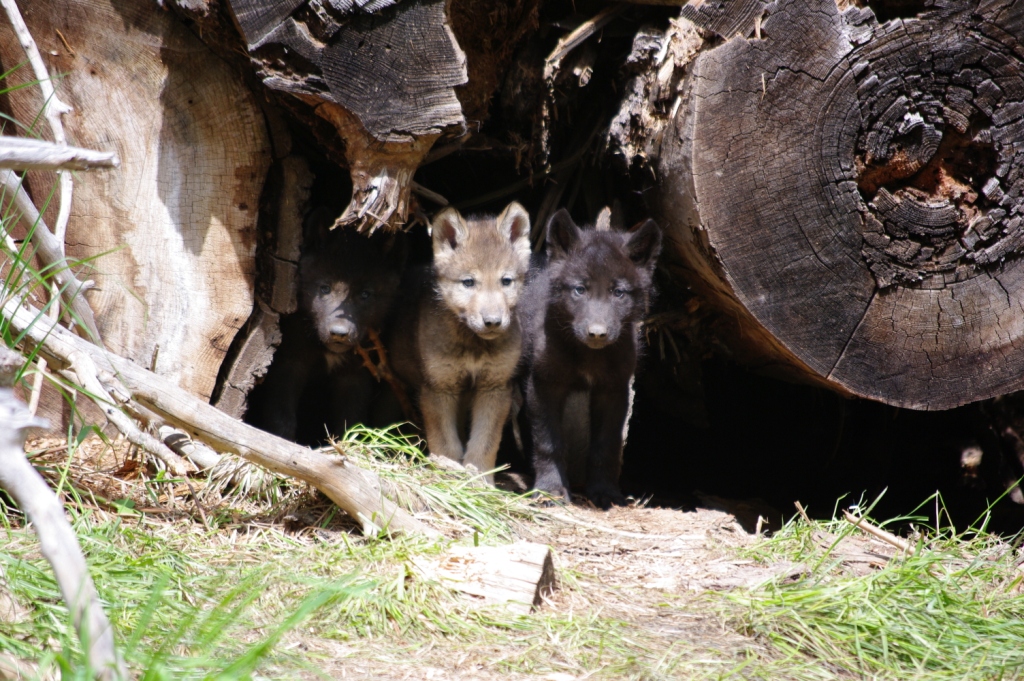
These wolf pups born to the Wenaha Pack in 2012 helped get recovery back on track. But their future remains tenuous (photo courtesy ODFW)
Please now listen to this:
So you can see that I have written frequently about wolves; indeed just a few days ago did so and included this photograph.
Wolf greets man.
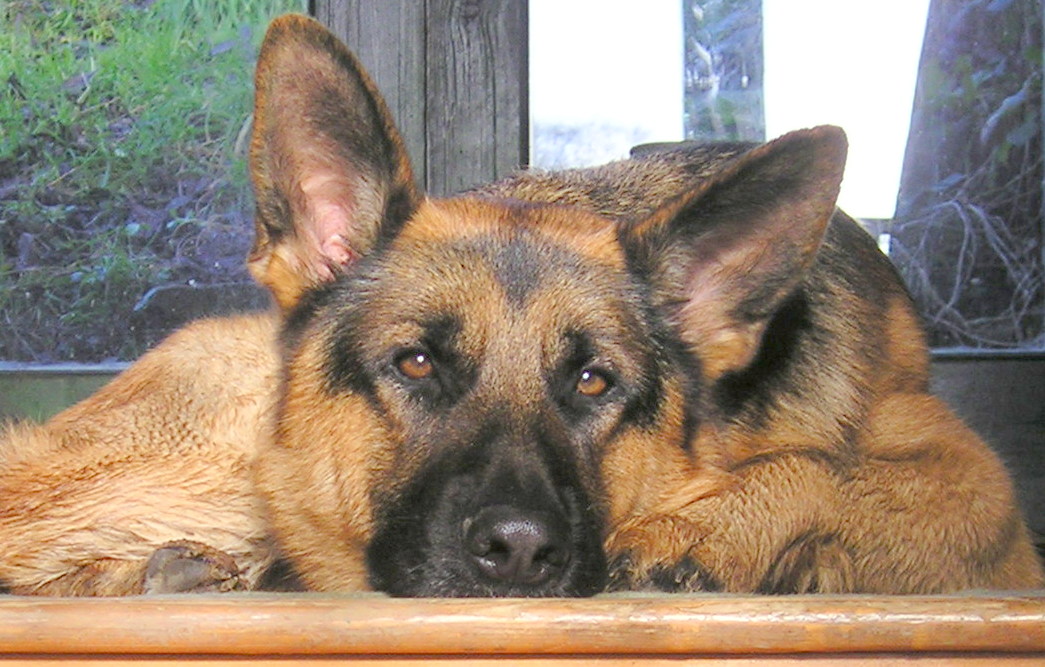
Now just look at those eyes of the Grey Wolf above and compare them to the eyes of the German Shepherd dog below and tell me that wolves aren’t as close to man as dogs.
Finally, feel free to share this post as far and wide as you can. Learning from Dogs is published under a Creative Commons License. This link covers how to share my material.
Please do something to help these ancient animals who, more than any other creature, helped put mankind ‘on the map’.
Dan sent me an email with a link to a most astounding video. But before we get to that, just take a look at these images. Here are the first three from the set of eight.
Eight breathtaking images of baby stars
1. Beautiful newborns
In a universe of fantastic images, a newborn star is a mystical masterpiece. Cradled within the dusty arms of a nebula, a baby star seems to blink its way to a new life. The lifespan of a star is a series of sequences. A star may spend most of its life in a “main sequence phase” where nuclear fusion of hydrogen into helium is happening in its core. But before this happens, it lives as a protostar, or baby star.
Thanks to NASA’s advanced infrared space telescopes such as Hubble and Spitzer, we are able to view these star births as never before. Pictured here are newborn stars peeking out “from beneath their natal blanket of dust” in the Rho Ophiuchi dark cloud as seen by the Spitzer Space Telescope. (Text: Katherine Butler)
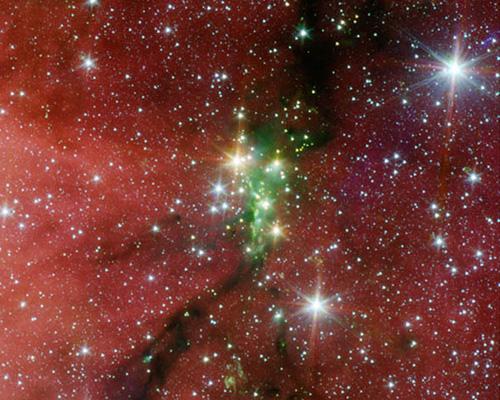
2. Young stars in Serpens
Here the Spitzer Space Telescope reveals the Serpens South star cluster, in which 50 or so young stars exist. They are seen as the “green, yellow, and orange-tinted specks sitting atop the black dust lane.” A supernova or galaxy collision can cause a star to form when huge clouds of hydrogen and helium collapse under mutual gravity. As the cloud collapses, it heats up and starts to spin. Since protostars are covered in dust, they can be seen only through infrared telescopes like Hubble and Spitzer. As Universe Today writes, “After about 100,000 years or so, the protostar stops growing and the disk of material surrounding it is destroyed by radiation.” Then this star, now called a T Tauri or pre-main sequence star, is visible from Earth.
3. Bubbly little star
We are used to images of babies blowing bubbles, and it looks like the infants of the cosmos do the same. This image, taken by the Spitzer Space Telescope, shows the HH 46/47 baby star blowing bubbles into space via powerful jets of gas. Located about 1,140 light-years from Earth, HH 46/47 is the bright white star at the middle of the image. Two bubbles reach out in opposite directions and are formed when the jets collide with the dust and gas surrounding the star. As Universe Today reports, “Astronomers think that young stars accumulate material by gravitationally pulling in gas and dust. This process ends when the star gets large enough to create these jets. Any further material is just blown away into space.”
Go and view the remaining five stunning images here.
Now to what was sent by Dan.
Check out this mind-bending video that talks about the “Hubble Ultra Deep Field” image captured by NASA astronomers nearly a decade ago — a photograph that some call “the most important image ever taken.”
It all started back in 1996 when a group of astronomers pointed the Hubble Space Telescope at an empty patch in the sky close to the Big Dipper in hopes of seeing something, anything. At the time, it was considered to be a risky move, given that demand for use of the telescope was so high. What if the experiment yielded no results? What if nothing but an empty image was the final result?
After ten full days of exposing the telescope’s CCD camera sensor to this seemingly vacuous patch of sky, a breathtaking image was produced. Over three thousand galaxies appeared in one image — some as dots, others as spirals. It was a visual reminder of just how big our universe really is. The photo is called the “Hubble Deep Field“:
In 2004, astronomers pointed Hubble near constellation Orion and opened the shutter for a whopping 11 days. Using sensitive detectors and specialized filters, the telescope was able to capture an image with over 10,000 galaxies. This image became known as the “Hubble Ultra Deep Field.”
Scientists later used redshift calculations of the galaxies to turn the photograph into a “fly-thru” view of the photo:
It didn’t end there. Last year, NASA scientists created the Hubble Extreme Deep Field, which has an equivalent exposure time to 23 days and features. It’s the “deepest image of the sky ever obtained” that reveals “the faintest and most distant galaxies ever seen”:
And just think: scientists created these photos by pointing their mega-camera at a tiny speck of the night sky that appears to be completely devoid of visible stars!
oooOOOooo
“… a tiny speck of the night sky that appears to be completely devoid of visible stars!”
Dan said in his email, “Are we really here? What are the chances?”
You really have to wonder! Incredibly long odds. Both to us being here and to us being the only conscious, intelligent species in the universe.
Years ago if I was ever to own a dog, it had to be one breed and one breed only: a German Shepherd Dog.
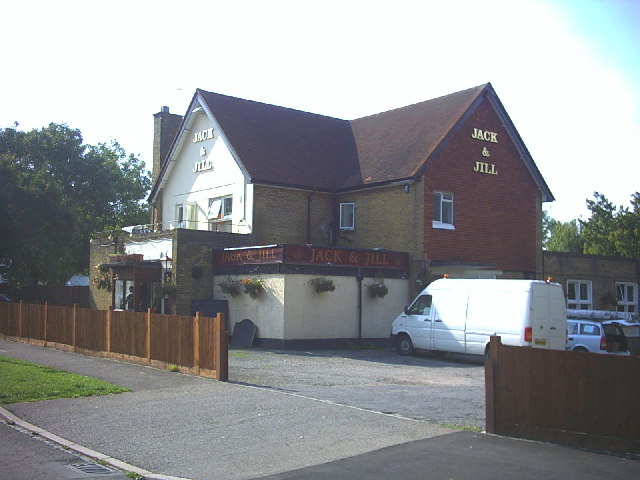
The reason for this was that back in 1955 my father and mother looked after a German Shepherd dog called Boy. Boy belonged to a lovely couple, Maurice and Marie Davies. They were in the process of taking over a new Public House (Pub); the Jack & Jill in Coulsdon, Surrey. My father had been the architect of the Jack & Jill.
Jack & Jill, Longlands Avenue, Coulsdon, Surrey
As publicans have a tough time taking holidays, it was agreed that the move from their old pub to the Jack & Jill represented a brilliant opportunity to have that vacation. My parents offered to look after Boy for the 6 weeks that Maurice and Marie were going to be away.
Boy was the most gentle loveable dog one could imagine and I quickly became devoted to him; I was 11 years old at the time. So when years later it seemed the right time to have a dog, there was no question about the breed. Boy’s memory lived on all those years, and, as this post reveals, still does!
Pharaoh was born June 3rd, 2003 at Jutone Kennels up at Bovey Tracy, Devon, on the edge of Dartmoor. As the home page of the Jutone website pronounces,
The Kennel was established in 1964 and it has always been the aim to breed the best German Shepherd Dogs for type and temperament. To this end the very finest German bloodlines are used to continue a modern breeding programme.
and elsewhere on that website one learns:
Jutone was established by Tony Trant who was joined by Sandra Tucker in 1976. Sandra continues to run Jutone since Tony passed away in 2004. Both Tony and Sandra qualified as Championship Show judges and Sandra continues to judge regularly. Sandra is the Secretary and a Life Member of the German Shepherd Dog Club of Devon.
Tony Trant
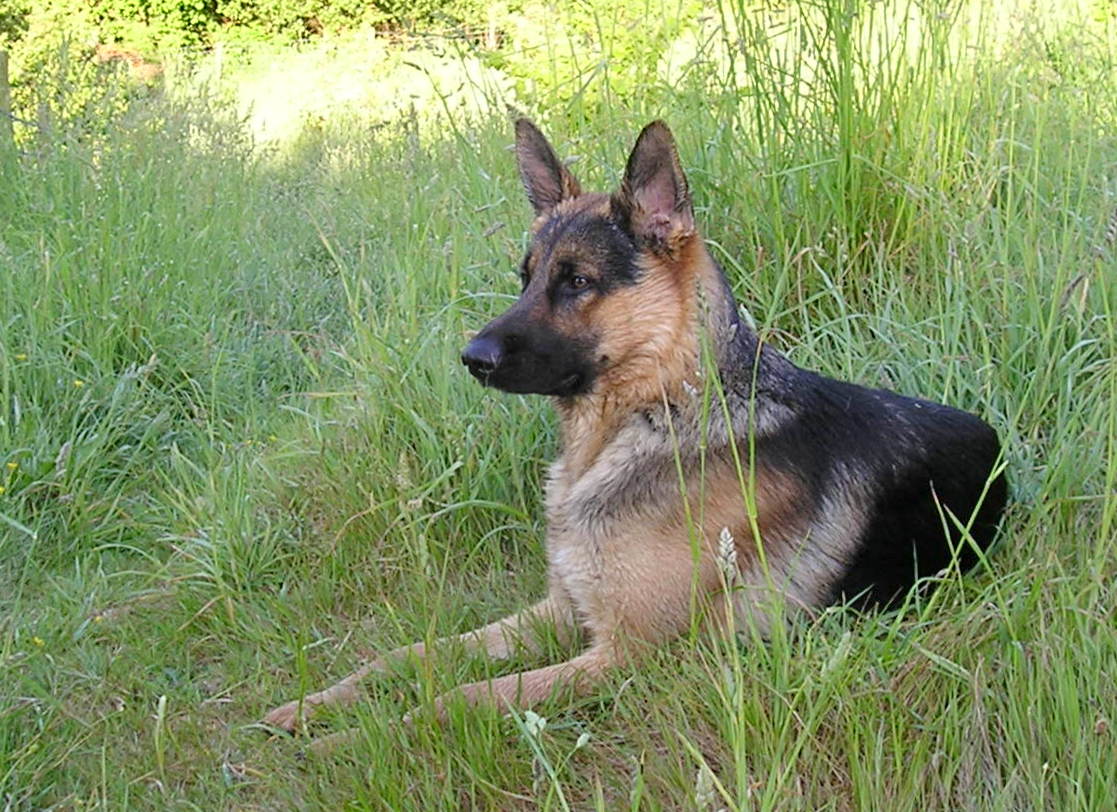
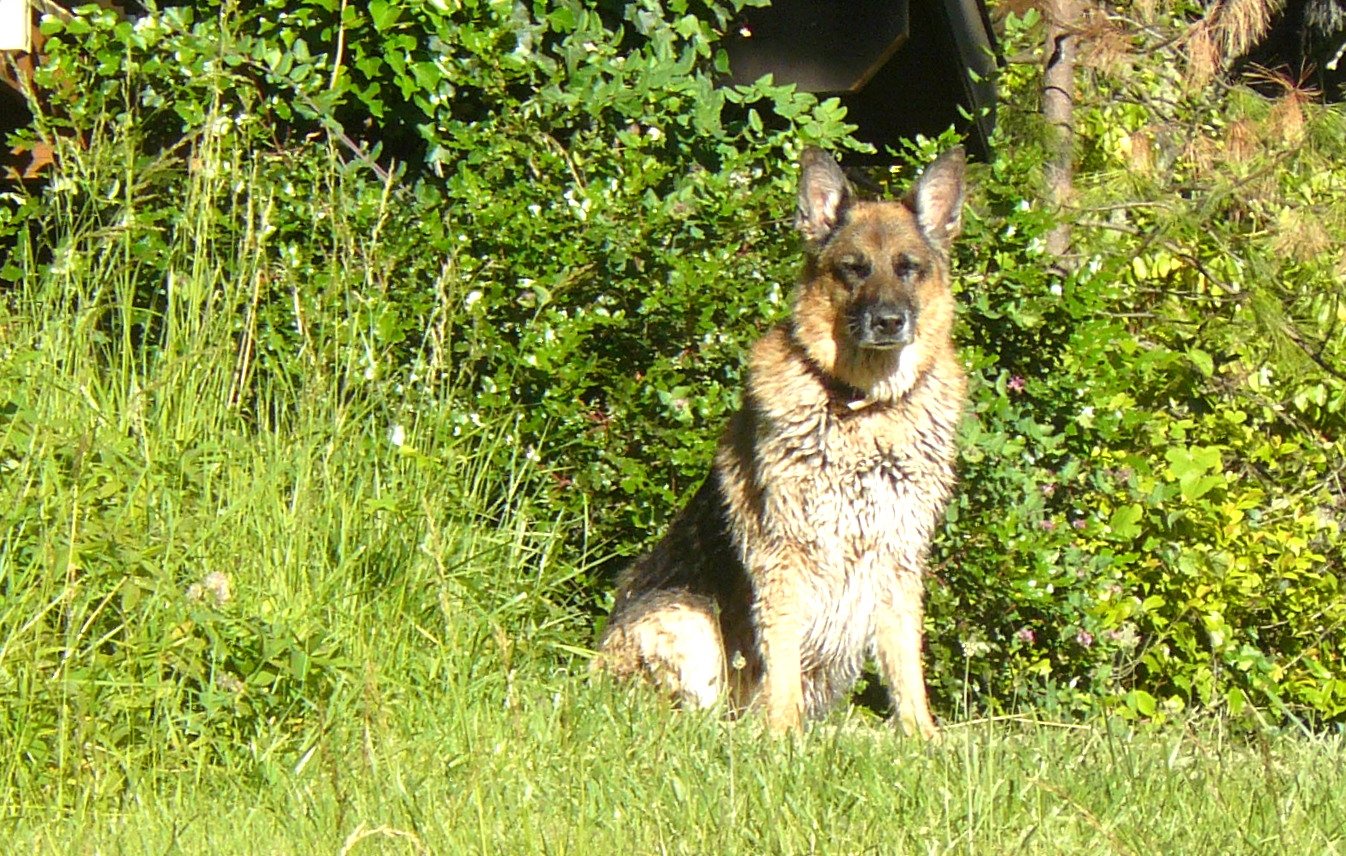
Turning to Pharaoh, here are a few more pictures over the years.
Pharaoh, nine months old.
oooOOOooo
One year old: June 3rd 2004.
The next picture of Pharaoh requires a little background information.
For many years I was a private pilot and in later days had the pleasure, the huge pleasure, of flying a Piper Super Cub, a group-owned aircraft based at Watchford Farm in South Devon. The aircraft, a Piper PA-18-135 Super Cub, was originally supplied to the Dutch Air Force in 1954 and was permitted by the British CAA to carry her original military markings including her Dutch military registration, R-151, although there was a British registration, G-BIYR, ‘underneath’ the Dutch R-151. (I wrote more fully about the history of the aircraft on Learning from Dogsback in August 2009.)
Piper Cub R151
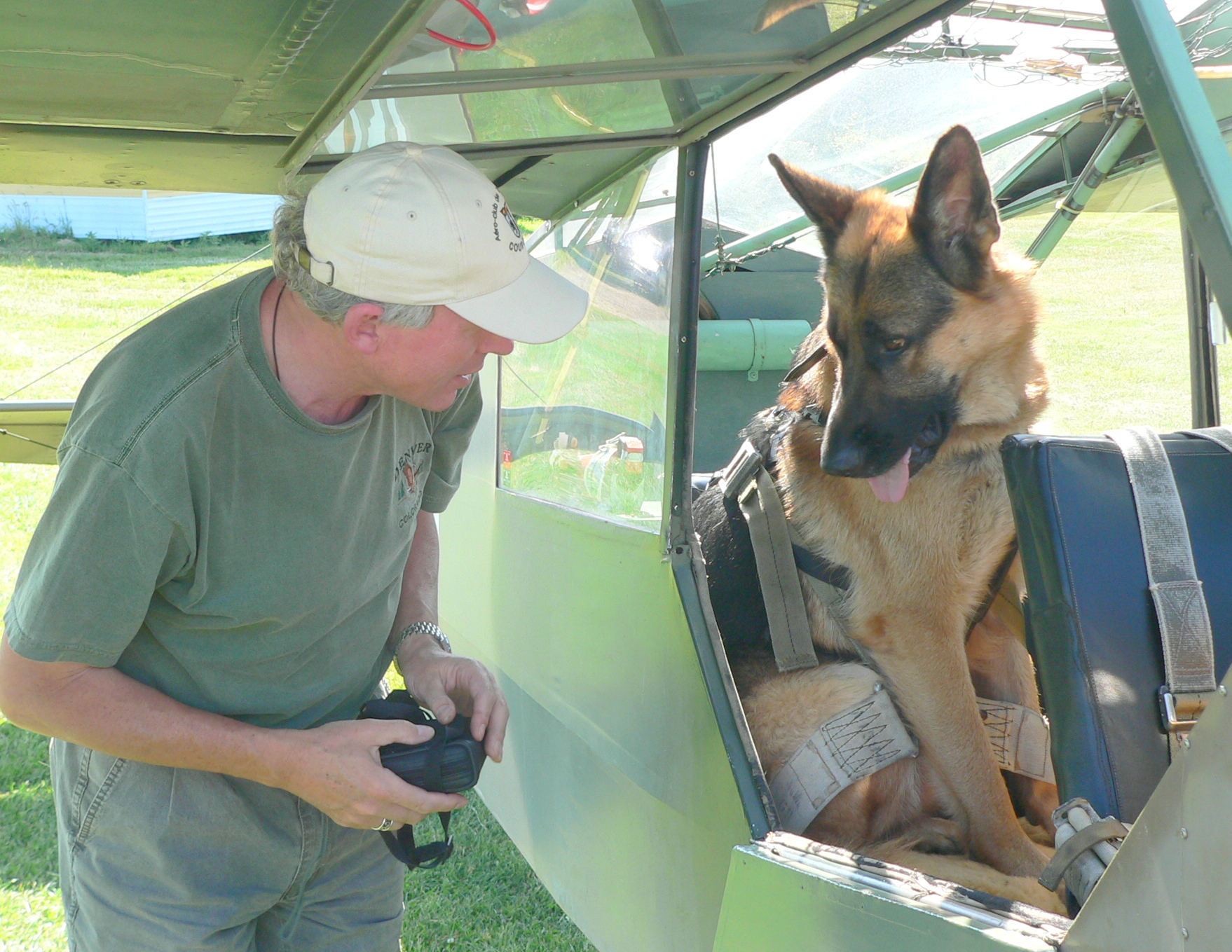
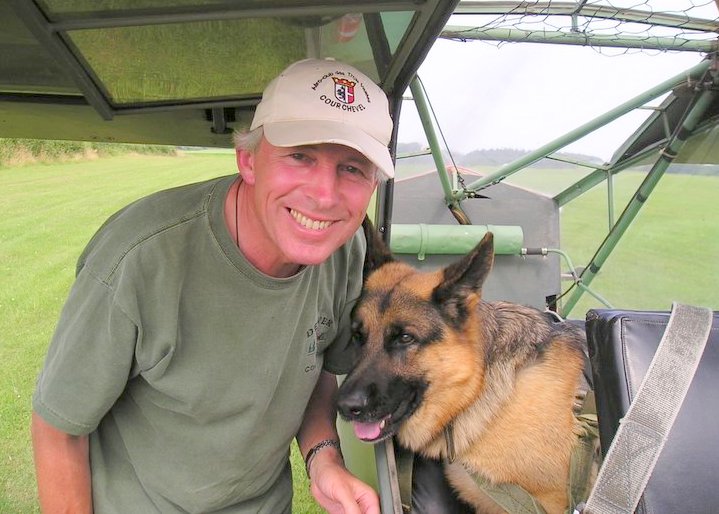
Anyway, every time I went to the airfield with Pharaoh he always tried to climb into the cockpit. So one day, I decided to see if he would sit in the rear seat and be strapped in. Absolutely no problem with that!
Come on Dad, let’s get this thing off the ground!
My idea had been to fly a gentle circuit in the aircraft. First I did some taxying around the large grass airfield that is Watchford to see how Pharaoh reacted. He was perfectly behaved.
Then I thought long and hard about taking Pharaoh for a flight. In the Cub there is no autopilot so if Pharaoh struggled or worse it would have been almost impossible to fly the aircraft and cope with Pharaoh. So, in the end, I abandoned taking him for a flight. The chances are that it would have been fine. But if something had gone wrong, the outcome just didn’t bear thinking about.
So we ended up motoring for 30 minutes all around the airfield which, as the next picture shows, met with doggie approval. The date was July 2006.
That was fun!
What a dear dog he has been over all the years and, thankfully, still is!
As if to reinforce the fabulous dog he still is, yesterday it was almost as though he knew he had to show how youthful he still was.
Because, when I took his group of dogs out around 7.30am armed with my camera, Pharaoh was brimming over with energy.
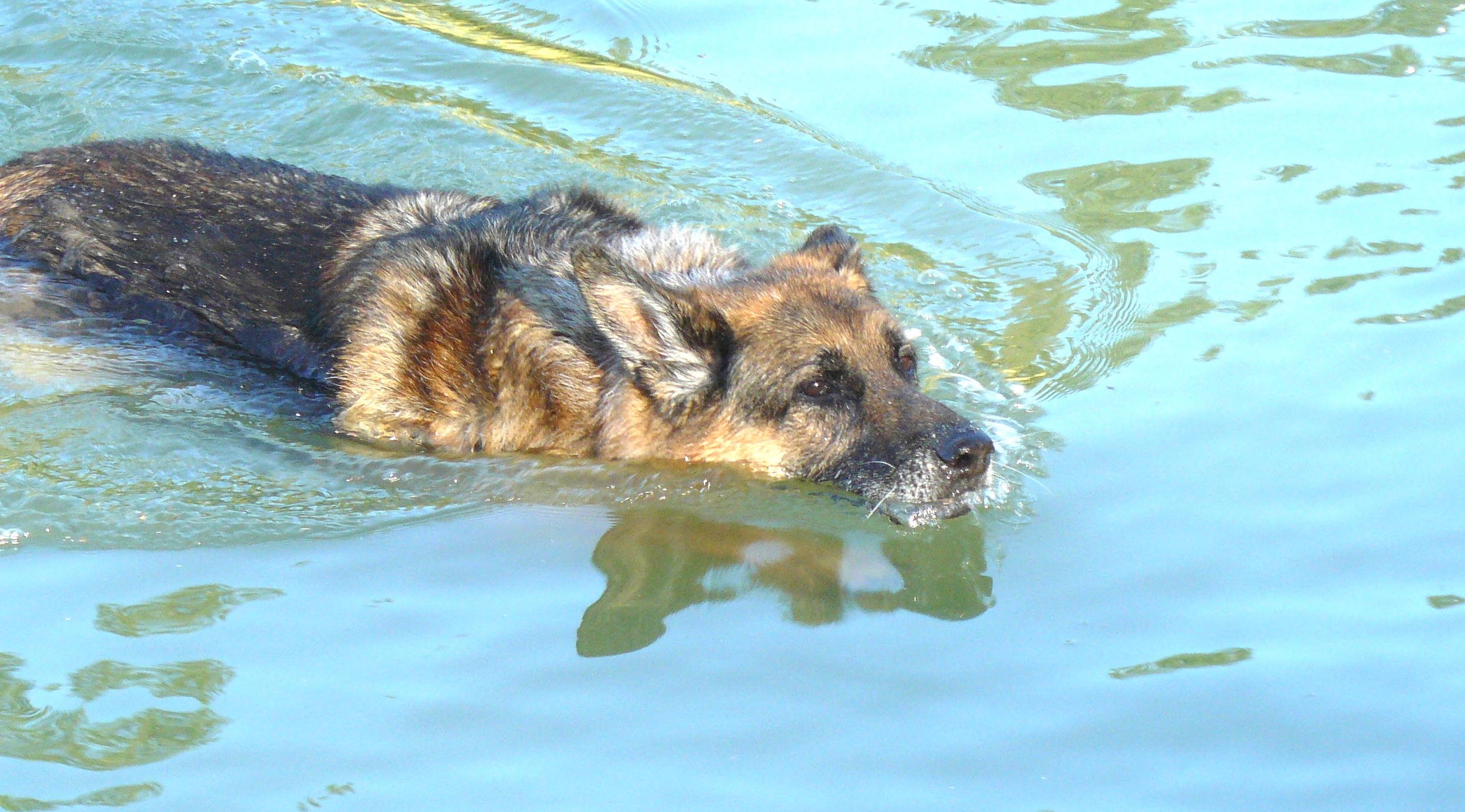
First up was a swim in the pond.
Ah, an early birthday dip! Bliss!
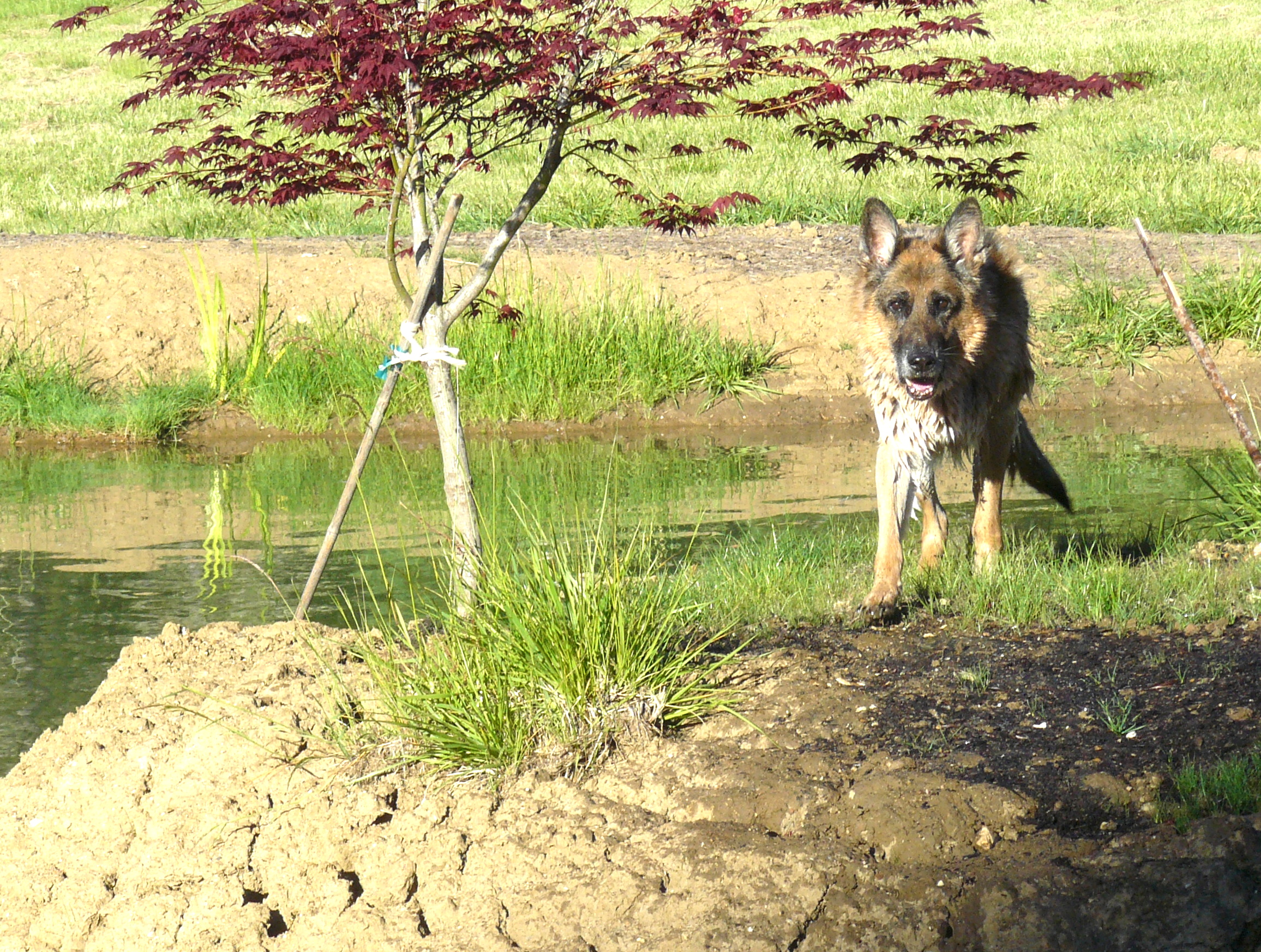
Then in a way he has not done before, Pharaoh wanted to play ‘King of my Island’, which is in the middle of the pond.
Halt! Who goes there!
ooo
This is my island! So there!
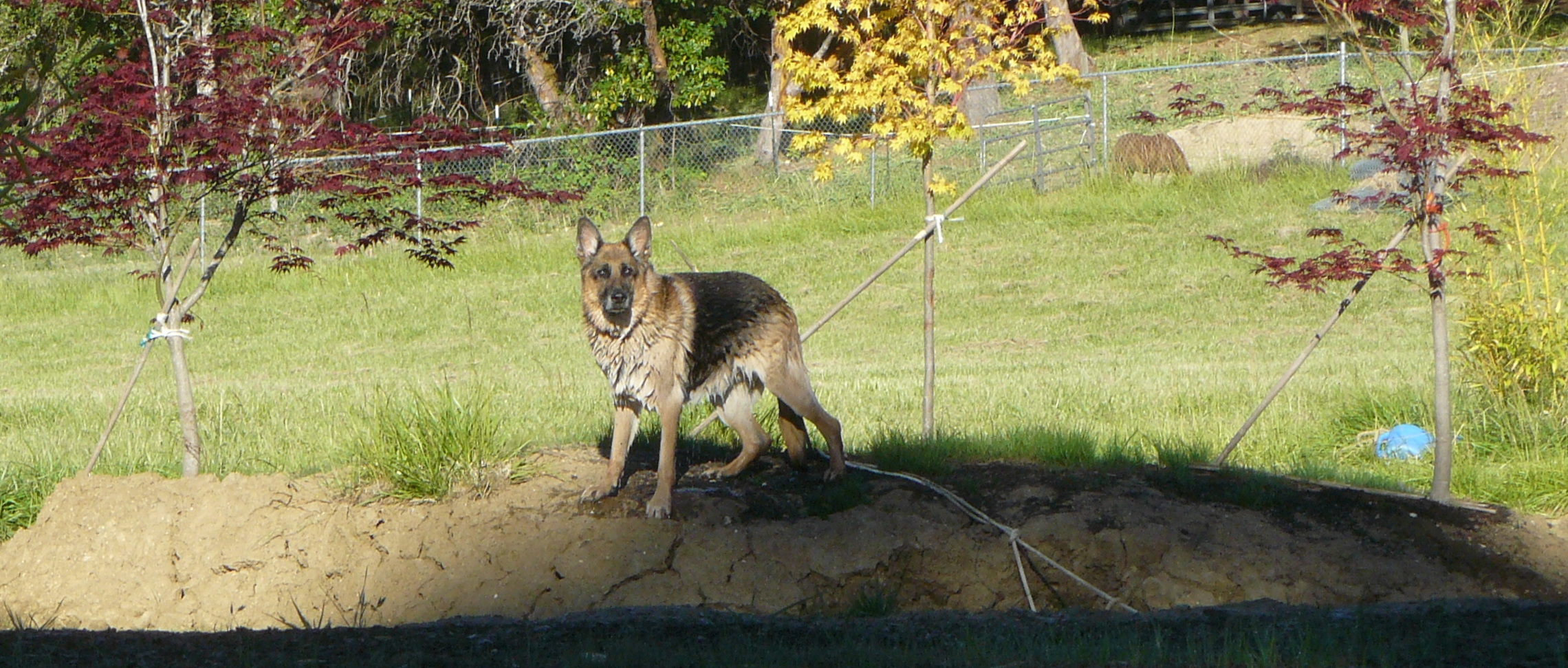
Then a while later, when back on dry land, so to speak, it was time to dry off in the morning sunshine.
Actually, this isn’t a bad life!
Long may he have an enjoyable and comfortable life.
Yes, Pharaoh was born back on June 3rd 2003. So today, in human years he is 10. In the old traditional ‘dog years is seven times times human years‘ he would be 70. But according to a recent item on BBC News there is a more accurate way of calculating dog years.
Longevity secrets of readers’ pets who lived past 100 ‘dog years’
Thanks to our dog age calculator, people have been reassessing the age of their furry friends.
It put a new spin on the old saying that the age of dogs could be better understood by multiplying the number of years since their birth by seven.
You can read more here. That dog age calculator is here.
Dog years: The calculator
Working out your dog’s true age used to be a case of simply multiplying it by seven. But it’s more complicated than that, and here’s a handy calculator to do it for you.
Dogs age at varying speeds at different stages of their lives
With that in mind, we’ve built a calculator for you to work out your dog’s true age – its age in “dog years”.
Alternatively, you can find out how old you would be if you were a dog. You can choose to be a labrador, a spaniel, a whippet, or any one of 20 breeds.
The calculator uses these multipliers for the first two years of a dog’s life:
12.5 for small dogs
10.5 for medium-sized dogs
9 for large dogs
Then, for the third and subsequent years of the dog’s life, each human year has to be multiplied by between 4.3 and 13.4 years, depending on the breed:
Small: Dachshund (Miniature) 4.32, Border Terrier 4.47, Lhasa Apso 4.49, Shih Tzu 4.78, Whippet Medium 5.30, Chihuahua 4.87, West Highland White Terrier 4.96, Beagle 5.20, Miniature Schnauzer 5.46, Spaniel (Cocker) 5.55, Cavalier King Charles 5.77, Pug 5.95, French Bulldog 7.65
The calculator does not work for cross breeds, sadly, but on average these live 1.22 years longer than pure breeds, according to Dan O’Neill (from Petts Wood in London…) who is researching the subject for a PhD at the Royal Veterinary College.
Nor does the calculator work for cats. What we can say is that the average life expectancy of a cat is 12.1 years, which equates to 64 human years.
Guidelines issued by the American Association of Feline Practitioners say that cats reach 10 human years in their first six months and are approximately 24 at the age of two years. After this their age increases by four “cat years” every year.
So dear Pharaoh is the equivalent of an 80-year-old human! The breed has an average life expectancy of 9.73 years. (Source: BBC calculations on data from UK Kennel Club and US Veterinary Medical Database.)
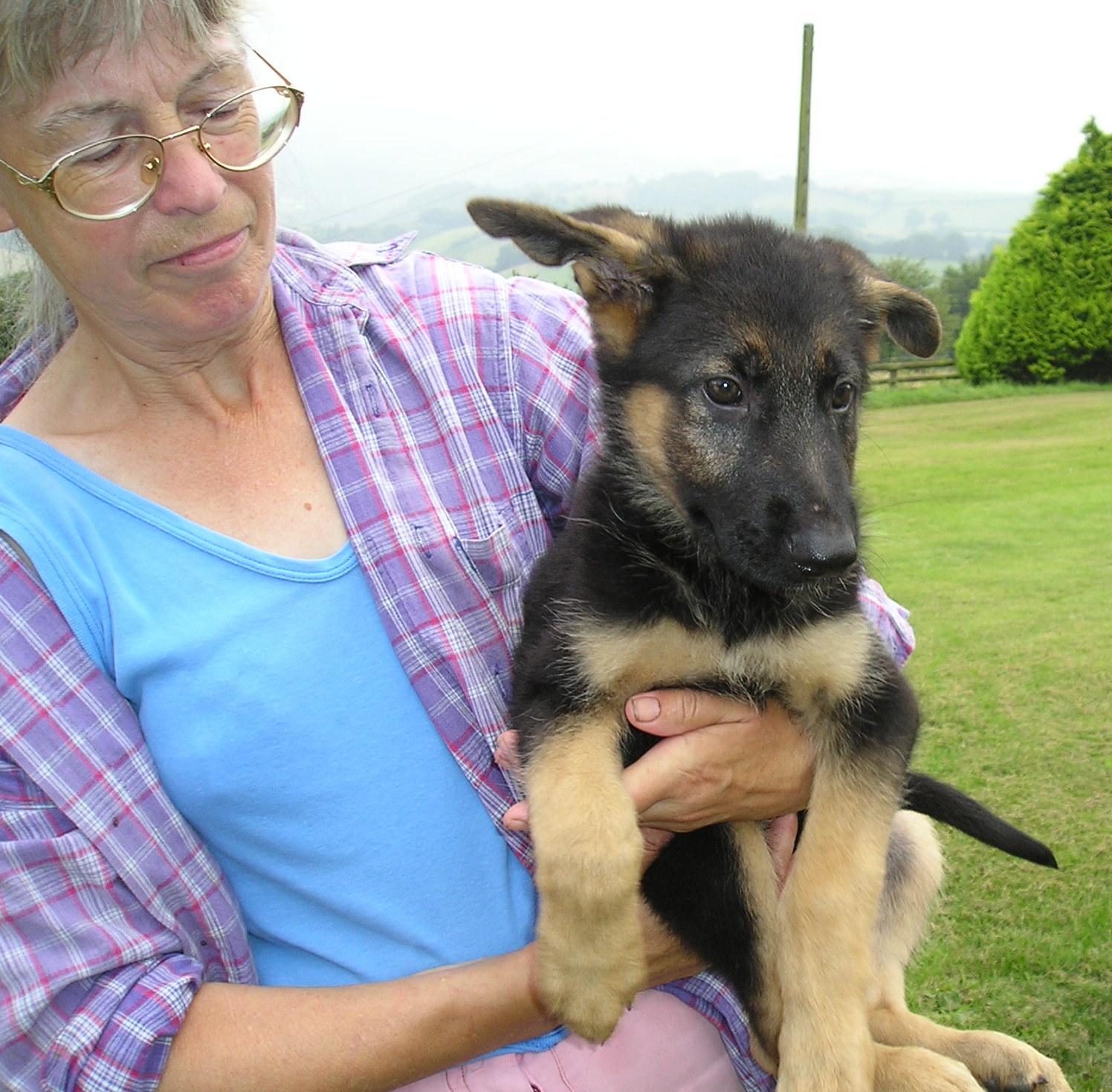
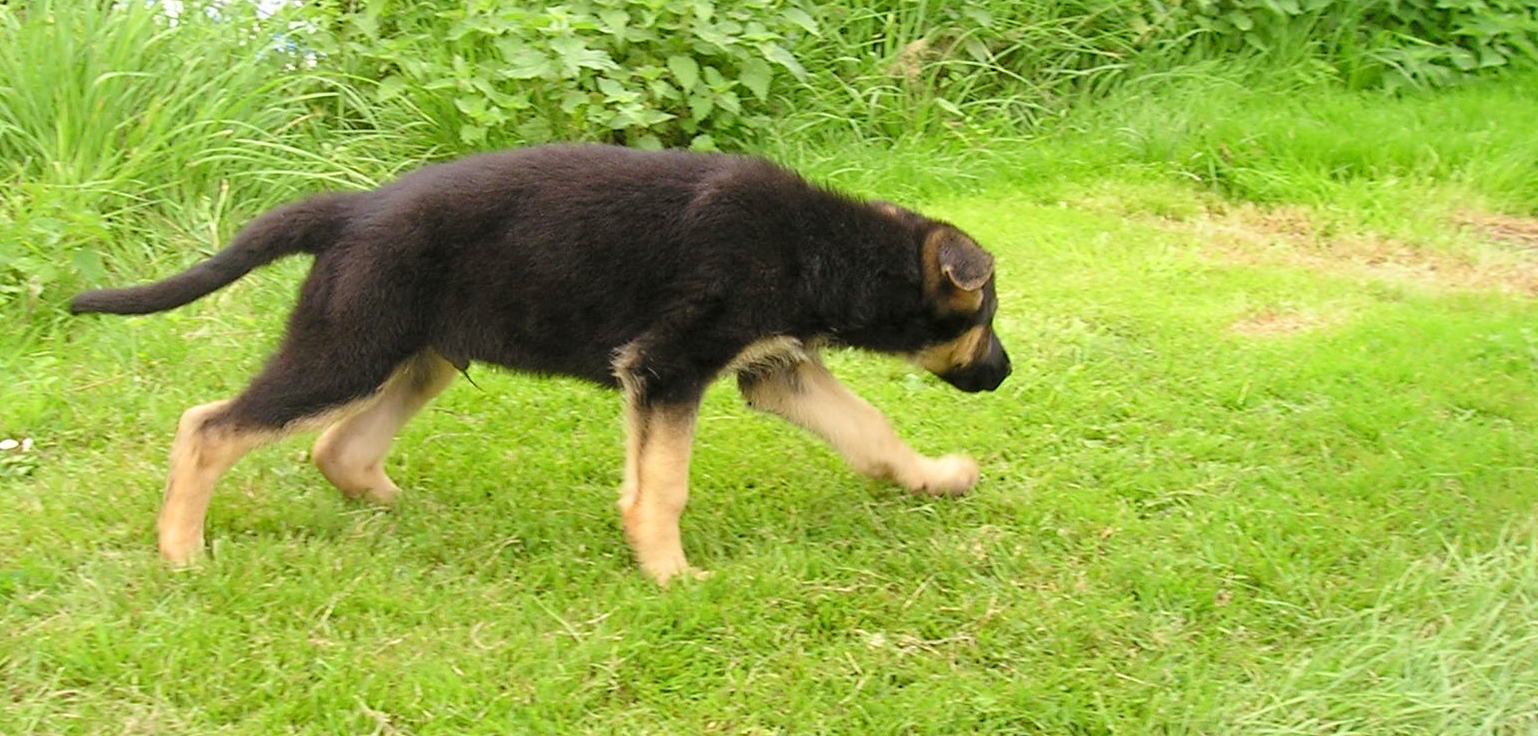
Going to leave you for today with three photographs of Pharaoh taken the day I first saw Pharaoh as a puppy, back on the 12th August 2003. The woman holding Pharaoh is Sandra Tucker who runs Jutone Kennels in Devon, England., where Pharaoh was born 10 years ago this day!
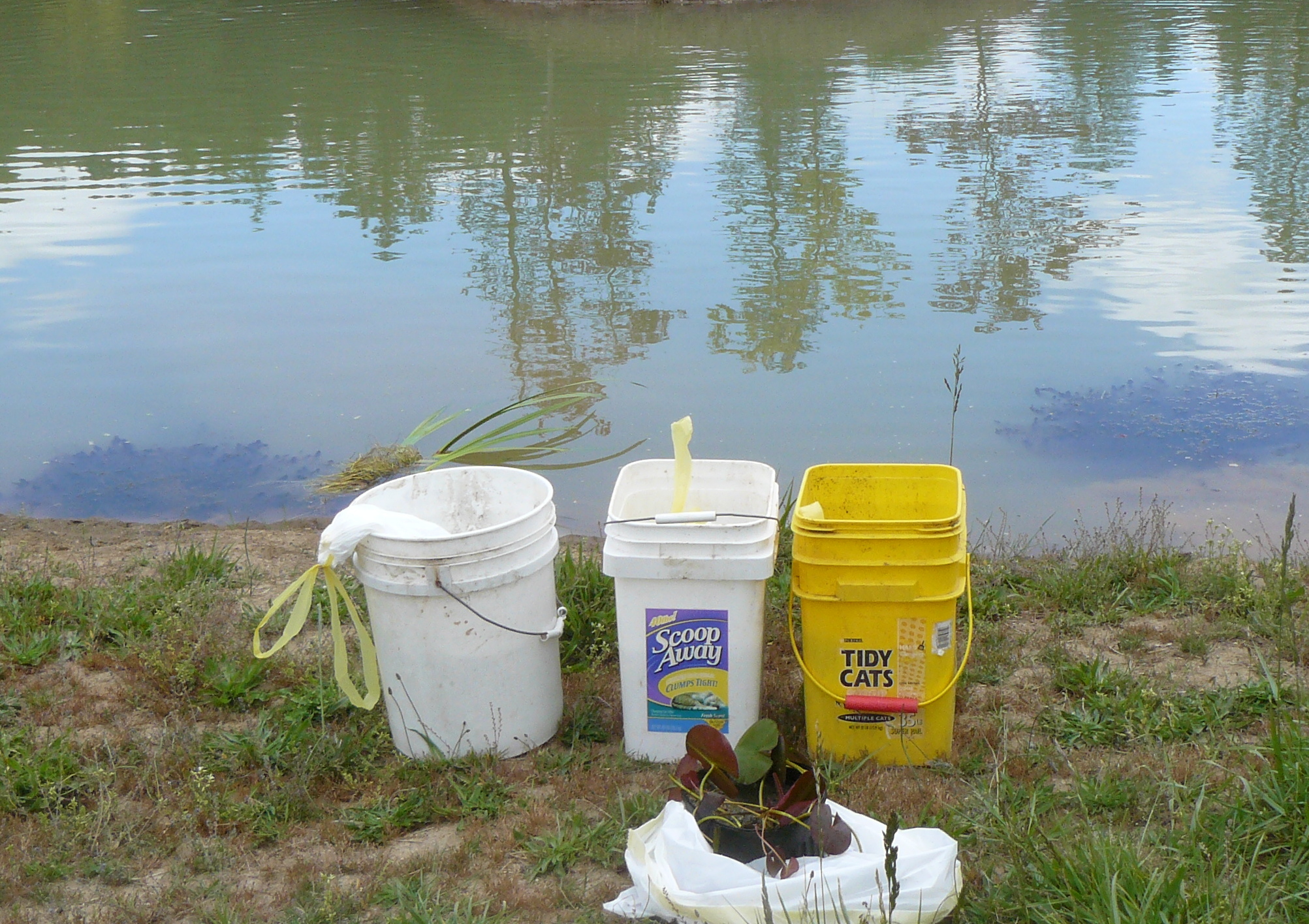
Our pond has settled to the point where Jean thought it would be good to get some fish. So off to a pond and fish supplies store in Grants Pass to seek advice. We settled on some Koi and a water lily plant.
Koi and water lily ready for the launch.
We were advised to acclimatise the fish in terms of water temperature by slowly mixing pond water into the bags containing each fish.
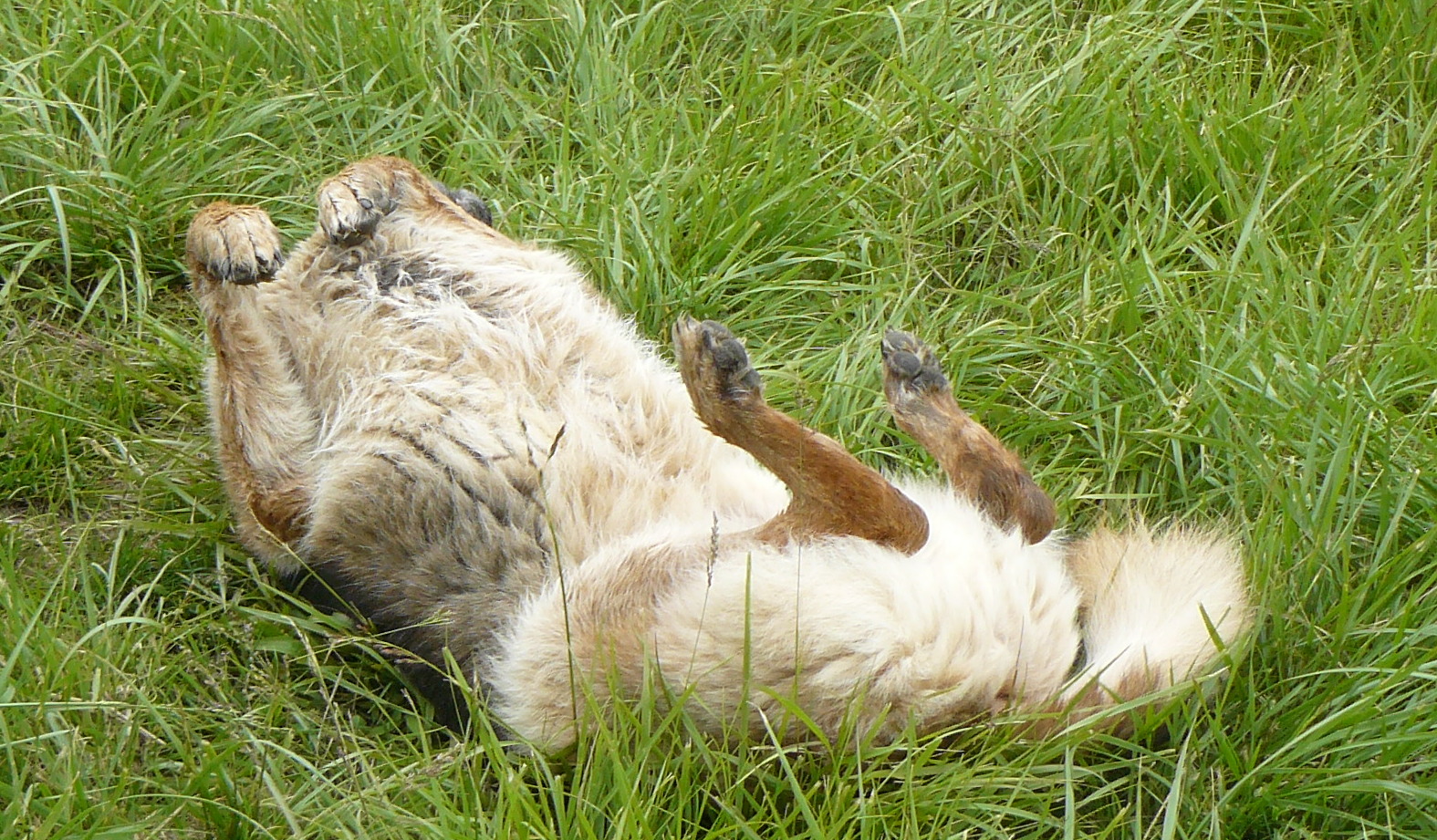
Meanwhile, Pharaoh took advantage of clean, green grass to give his back a bit of a rubdown.
Ah, that feels so much better!
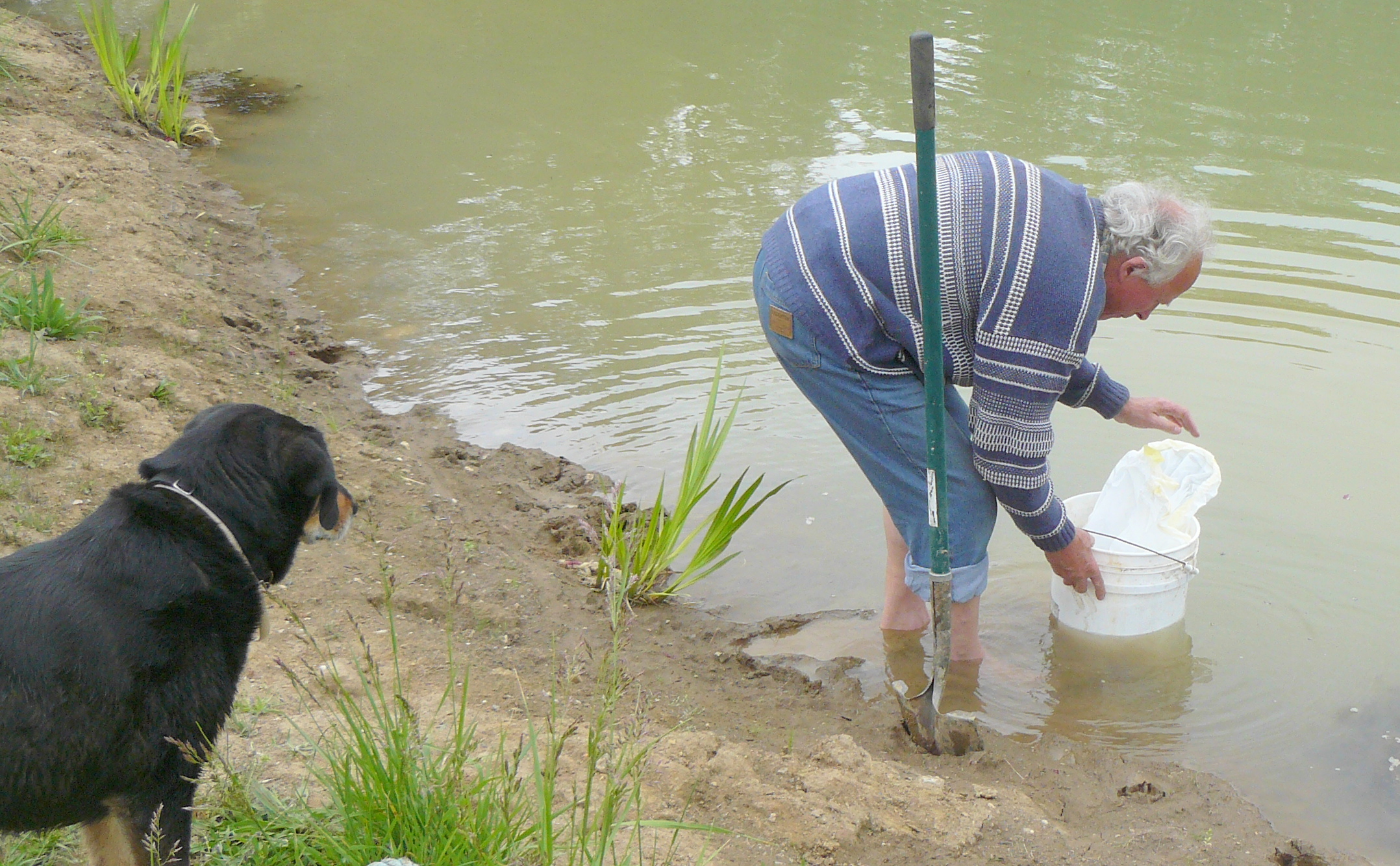
And Hazel pondered what ‘Dad’ was up to.
Not seen this happen before?
But eventually it was time for the three Koi to slip away into the depths of their new home.
Wonder if I’ll ever find my two mates?
The twenty-three?
Nine dogs, five cats, four chickens, two miniature horses and three Koi!















 Learning from Dogs