I am not saying anything new but just reiterating what has been said before: 2020 is going to go down as the year from hell! And I don’t think that is too strong a word!
Part of it are the news stories that sweep the world: Covid-19; Brexit; Climate change; up until yesterday what was President Trump going to do in his last few weeks; etc; etc.
Also part of it is the way that news and more news and, yes, more news is flashed around the globe. Most of it bad news as we all know that bad news sells!
Finally, part of it is the new world of social media especially messaging on a smartphone. President Trump isn’t the only one to communicate greatly via Twitter.
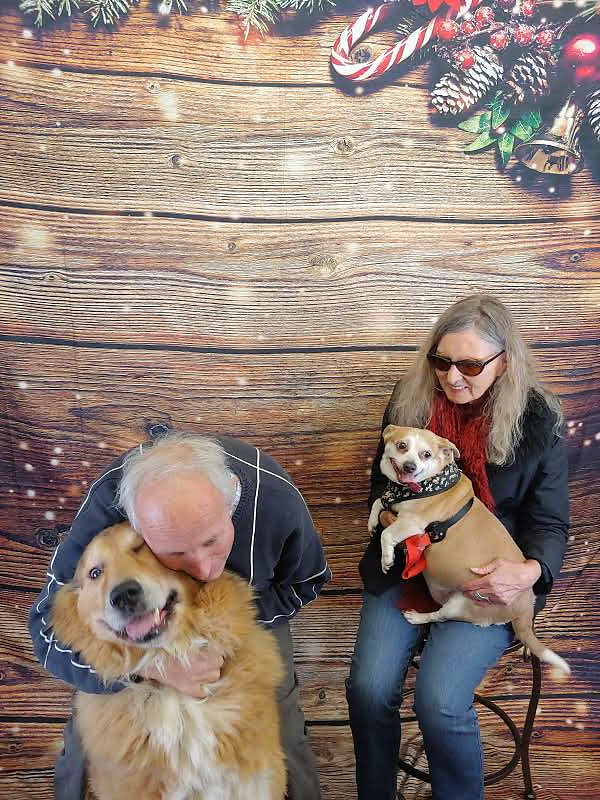
Now, speaking personally, I couldn’t have got through this year without Jeannie and our dogs.
Pure bliss!
But, nevertheless, something has changed and Mark Satta has written an article that tries to explain things.
ooOOoo
Three reasons for information exhaustion – and what to do about it
By Mark Satta, Assistant Professor of Philosophy, Wayne State University.
November 18th, 2020
An endless flow of information is coming at us constantly: It might be an article a friend shared on Facebook with a sensational headline or wrong information about the spread of the coronavirus. It could even be a call from a relative wanting to talk about a political issue.
All this information may leave many of us feeling as though we have no energy to engage.
As a philosopher who studies knowledge-sharing practices, I call this experience “epistemic exhaustion.” The term “epistemic” comes from the Greek word episteme, often translated as “knowledge.” So epistemic exhaustion is more of a knowledge-related exhaustion.
It is not knowledge itself that tires out many of us. Rather, it is the process of trying to gain or share knowledge under challenging circumstances.
Currently, there are at least three common sources that, from my perspective, are leading to such exhaustion. But there are also ways to deal with them.
1. Uncertainty
For many, this year has been full of uncertainty. In particular, the coronavirus pandemic has generated uncertainty about health, about best practices and about the future.
Experiencing uncertainty can stress most of us out. People tend to prefer the planned and the predictable. Figures from 17th-century French philosopher René Descartes to 20th-century Austrian philosopher Ludwig Wittgenstein have recognized the significance of having certainty in our lives.
With information so readily available, people may be checking news sites or social media in hopes of finding answers. But often, people are instead greeted with more reminders of uncertainty.
As Trump supporters denounce the 2020 election results, feelings of uncertainty can come up for others. Karla Ann Cote/NurPhoto via Getty Images
Many writers have discussed the negative effects of polarization, such as how it can damage democracy. But discussions about the harms of polarization often overlook the toll polarization takes on our ability to gain and share knowledge.
Second, polarization can lead to competing narratives because in a deeply polarized society, as studies show, we can lose common ground and tend to have less agreement.
For those inclined to take the views of others seriously, this can create additional cognitive work. And when the issues are heated or sensitive, this can create additional stress and emotional burdens, such as sadness over damaged friendships or anger over partisan rhetoric.
As chess grandmaster Garry Kasparov put it: “The point of modern propaganda isn’t only to misinform or push an agenda. It is to exhaust your critical thinking, to annihilate truth.”
Misinformation is often exhausting by design. For example, a video that went viral, “Plandemic,” featured a large number of false claims about COVID-19 in rapid succession. This flooding of misinformation in rapid succession, a tactic known as a Gish gallop, makes it challenging and time-consuming for fact checkers to refute the many falsehoods following one after another.
What to do?
With all this uncertainty, polarization and misinformation, feeling tired is understandable. But there are things one can do.
The American Psychological Association suggests coping with uncertainty through activities like limiting news consumption and focusing on things in one’s control. Another option is to work on becoming more comfortable with uncertainty through practices such as meditation and the cultivation of mindfulness.
To deal with polarization, consider communicating with the goal of creating empathetic understanding rather than “winning.” Philosopher Michael Hannon describes empathetic understanding as “the ability to take up another person’s perspective.”
As for limiting the spread of misinformation: Share only those news stories that you’ve read and verified. And you can prioritize outlets that meet high ethical journalistic or fact-checking standards.
These solutions are limited and imperfect, but that’s all right. Part of resisting epistemic exhaustion is learning to live with the limited and imperfect. No one has time to vet all the headlines, correct all the misinformation or gain all the relevant knowledge. To deny this is to set oneself up for exhaustion.
ooOOoo
That last section, What to do?, is full of really sensible advice. In fact, the American Psychological Association has an article at the moment that appears to be freely available called Healing the political divide.
I intend to read it.
It finishes up saying:
Scientists must strive to share their research as broadly as possible. And they don’t have to do it alone. Organizations like More in Common work to conduct research and communicate findings to audiences where it can have the greatest impact.
Advocacy is essential as well. Other countries that have made strides in addressing the political divide relied heavily on government-led reconciliation efforts. The Truth and Reconciliation Commission, for example, in South Africa, has been fundamental in addressing disparities and conflict around Apartheid.
Were the United States to consider similar, government-backed efforts, psychologists must be part of the call to do so. And the behavioral expertise of the field would be central to success.
“The collective mental health of the nation is at risk,” says Moghaddam. “Just as we should rely on epidemiological science to tell us when there is a vaccine ready for mass use, we have to rely on psychological science to guide us through these mental health issues.”
And following an election that, for many, has felt like the most polarized of a lifetime, this piece seems critical. “ This is what our profession is all about,” says Moghaddam.
Good advice especially if you can take time off just losing oneself in nature.
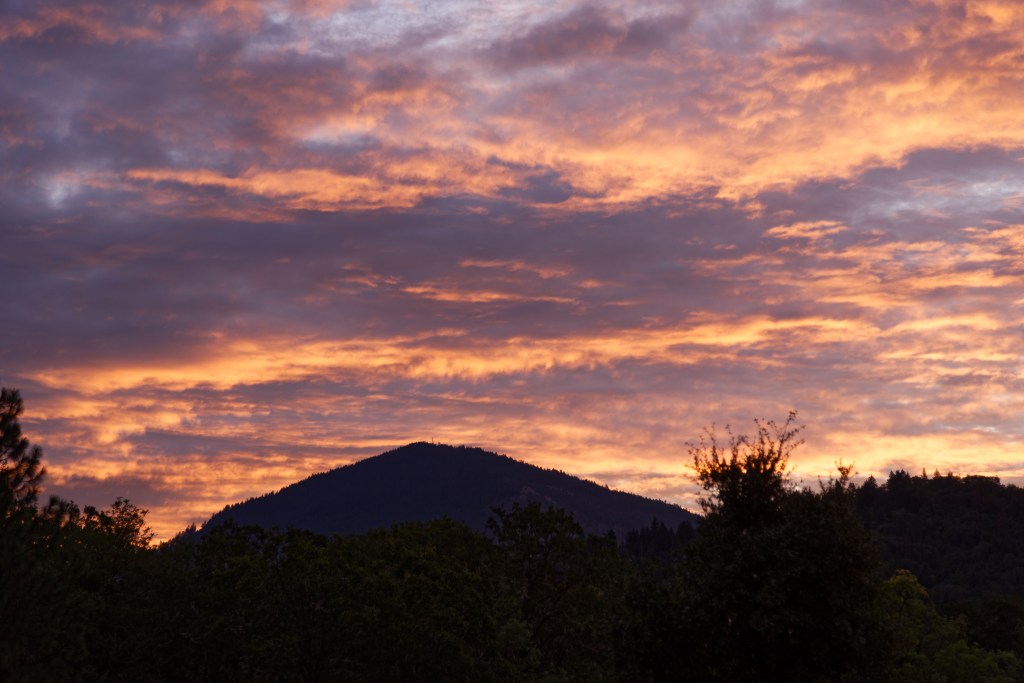
Dawn behind nearby Mt. Sexton. Taken from our deck on the 21st August, 2019.
Now again this has nothing to do with dogs and I would be the first person to say that there are still some people out there who are not convinced that global warming is a major result of human activity.. But none other than the Union of Concerned Scientists are persuaded that humans are the major cause. See their website here. (From which the following is taken.)
Every single year since 1977 has been warmer than the 20th century average, with 16 of the 17 warmest years on record occurring since 2001, and 2016 being the warmest year on recorded history. A study from 2016 found that without the emissions from burning coal and oil, there is very little likelihood that 13 out of the 15 warmest years on record would all have happened.
And further on in the article, this:
Scientists agree that today’s warming is primarily caused by humans putting too much carbon in the atmosphere, like when we choose to extract and burn coal, oil, and gas, or cut down and burn forests.
Today’s carbon dioxide levels haven’t been seen in at least the last 800,000 years. Data assembled from Antarctic ice core samples and modern atmospheric observations.
So on to the film.
My son, Alex, sent me the following email on the 7th October.
Hi Dad
This is a really interesting film about climate change in the west coast mountains, USA. A bit skiing related but a good watch !
Lots of love
Alex
Included in the email was a link to the film available on YouTube.
The film is just under one hour in length and a great film to watch as well as having a clear, fundamental message: All of us must act in whatever ways we can if our children and grandchildren are to have a future. Indeed, do you believe you have another twenty or more years to live? Then include yourself as well.
ooOOoo
About The Film
Professional snowboarder and mountaineer Jeremy Jones has an intimate relationship with the outdoors. It’s his escape, his identity, and his legacy. But over the course of his 45 years in the mountains, he’s seen many things change: more extreme weather, fewer snow days, and economic strain on mountain towns.
Motivated by an urge to protect the places he loves, Jeremy sets out on a physical and philosophical journey to find common ground with fellow outdoor people across diverse political backgrounds. He learns their hopes and fears while walking a mile in their shoes on the mountain and in the snow.
With intimacy and emotion set against breathtaking backdrops, Purple Mountains navigates America’s divide with a refreshing perspective: even though we may disagree about climate policy, our shared values can unite us.
Maybe because years ago he gave me blanket permission to republish his essays. Maybe because he and I are more or less the same age. Maybe because in my more quieter, introspective moments I wonder where the hell we are going. And Tom seems to agree.
Have a read of this.
ooOOoo
Tomgram: Engelhardt, The Unexpected Past, the Unknown Future
[Note for TomDispatch Readers:Even in this terrible moment, TD does its best to continue offering an alternate view of this increasingly strange planet of ours. And I can only do so because of the ongoing support of readers. (I just wish I could actually thank each of you individually!) If you have the urge to continue to lend a hand in keeping TomDispatch afloat, then do check out our donation page. For a donation of $100 ($125 if you live outside the U.S.), I usually offer a signed, personalized book from one of a number of TD authors listed on that page and you can certainly ask, but no guarantees in this pandemic moment. Still, you really do make all the difference and I can’t thank you enough for that! Tom]
It Could Have Been Different
My World and (Unfortunately) Welcome to It
By Tom Engelhardt
Let me be blunt. This wasn’t the world I imagined for my denouement. Not faintly. Of course, I can’t claim I ever really imagined such a place. Who, in their youth, considers their death and the world that might accompany it, the one you might leave behind for younger generations? I’m 76 now. True, if I were lucky (or perhaps unlucky), I could live another 20 years and see yet a newer world born. But for the moment at least, it seems logical enough to consider this pandemic nightmare of a place as the country of my old age, the one that I and my generation (including a guy named Donald J. Trump) will pass on to our children and grandchildren.
Back in 2001, after the 9/11 attacks, I knew it was going to be bad. I felt it deep in my gut almost immediately and, because of that, stumbled into creating TomDispatch.com, the website I still run. But did I ever think it would be this bad? Not a chance.
I focused back then on what already looked to me like a nightmarish American imperial adventure to come, the response to the 9/11 attacks that the administration of President George W. Bush quickly launched under the rubric of “the Global War on Terror.” And that name (though the word “global” would soon be dropped for the more anodyne “war on terror”) would prove anything but inaccurate. After all, in those first post-9/11 moments, the top officials of that administration were thinking as globally as possible when it came to war. At the damaged Pentagon, Secretary of Defense Donald Rumsfeld almost immediately turned to an aide and told him, “Go massive — sweep it all up, things related and not.” From then on, the emphasis would always be on the more the merrier.
Bush’s top officials were eager to take out not just Osama bin Laden’s al-Qaeda, whose 19 mostly Saudi hijackers had indeed attacked this country in the most provocative manner possible (at a cost of only $400,000-$500,000), but the Taliban, too, which then controlled much of Afghanistan. And an invasion of that country was seen as but the initial step in a larger, deeply desired project reportedly meant to target more than 60 countries! Above all, George W. Bush and his top officials dreamed of taking down Iraqi autocrat Saddam Hussein, occupying his oil-rich land, and making the United States, already the unipolar power of the twenty-first century, the overseer of the Greater Middle East and, in the end, perhaps even of a global Pax Americana. Such was the oil-fueled imperial dreamscape of George W. Bush, Dick Cheney, Donald Rumsfeld, and crew (including that charmer and now bestselling anti-Trump author John Bolton).
Who Woulda Guessed?
In the years that followed, I would post endless TomDispatch pieces, often by ex-military men, focused on the ongoing nightmare of our country’s soon-to-become forever wars (without a “pax” in sight) and the dangers such spreading conflicts posed to our world and even to us. Still, did I imagine those wars coming home in quite this way? Police forces in American cities and towns thoroughly militarized right down to bayonets, MRAPs, night-vision goggles, and helicopters, thanks to a Pentagon program delivering equipment to police departments nationwide more or less directly off the battlefields of Washington’s never-ending wars? Not for a moment.
Who doesn’t remember those 2014 photos of what looked like an occupying army on the streets of Ferguson, Missouri, after the police killing of a Black teenager and the protests that followed? And keep in mind that, to this day, the Republican Senate and the Trump administration have shown not the slightest desire to rein in that Pentagon program to militarize police departments nationwide. Such equipment (and the mentality that goes with it) showed up strikingly on the streets of American cities and towns during the recent Black Lives Matter protests.
Even in 2014, however, I couldn’t have imagined federal agents by the hundreds, dressed as if for a forever-war battlefield, flooding onto those same streets (at least in cities run by Democratic mayors), ready to treat protesters as if they were indeed al-Qaeda (“VIOLENT ANTIFA ANARCHISTS”), or that it would all be part of an election ploy by a needy president. Not a chance.
Or put another way, a president with his own “goon squad” or “stormtroopers” outfitted to look as if they were shipping out for Afghanistan or Iraq but heading for Portland, Albuquerque, Chicago, Seattle, and other American cities? Give me a break! How un-American could you get? A military surveillance drone overhead in at least one of those cities as if this were someone else’s war zone? Give me a break again. Never in my wildest dreams did I think I’d live to witness anything quite like it or a president — and we’ve had a few doozies — even faintly like the man a minority of deeply disgruntled Americans but a majority of electors put in the White House in 2016 to preside over a failing empire.
How about an American president in the year 2020 as a straightforward, no-punches-pulled racist, the sort of guy a newspaper could compare to former segregationist Alabama governor and presidential candidate George Wallace without even blinking? Admittedly, in itself, presidential racism has hardly been unique to this moment in America, despite Joe Biden’s initial claim to the contrary. That couldn’t be the case in the country in which Woodrow Wilson made D.W. Griffith’s Birth of a Nation, the infamous silent movie in which the Ku Klux Klan rides to the rescue, the first film ever to be shown in the White House; nor the one in which Richard Nixon used his “Southern strategy” — Republican presidential candidate Barry Goldwater had earlier labeled it even more redolently “Operation Dixie” — to appeal to the racist fears of Southern whites and so begin to turn that region from a Democratic stronghold into a Republican bastion; nor in the land where Ronald Reagan launched his election campaign of 1980 with a “states’ rights” speech (then still a code phrase for segregation) near Philadelphia, Mississippi, just miles from the earthen dam where three murdered civil rights workers had been found buried in 1964.
Still, an openly racist president (don’t take that knee!) as an autocrat-in-the-making (or at least in-the-dreaming), one who first descended that Trump Tower escalator in 2015 denouncing Mexican “rapists,” ran for president rabidly on a Muslim ban, and for whom Black lives, including John Lewis’s, have always been immaterial, a president now defending every Confederate monument and military base named after a slave-owning general in sight, while trying to launch a Nixon-style “law and (dis)order” campaign? I mean, who woulda thunk it?
And add to that the once unimaginable: a man without an ounce of empathy in the White House, a figure focused only on himself and his electoral and pecuniary fate (and perhaps those of his billionaire confederates); a man filling his hated “deep state” with congressionally unapproved lackies, flacks, and ass-kissers, many of them previously flacks (aka lobbyists) for major corporations. (Note, by the way, that while The Donald has a distinctly autocratic urge, I don’t describe him as an incipient fascist because, as far as I can see, his sole desire — as in those now-disappeared rallies of his — is to have fans, not lead an actual social movement of any sort. Think of him as Mussolini right down to the look and style with a “base” of cheering MAGA chumps but no urge for an actual fascist movement to lead.)
And who ever imagined that an American president might actually bring up the possibility of delaying an election he fears losing, while denouncing mail-in ballots (“the scandal of our time”) as electoral fraud and doing his damnedest to undermine the Post Office which would deliver them amid an economic downturn that rivals the Great Depression? Who, before this moment, ever imagined that a president might consider refusing to leave the White House even if he did lose his reelection bid? Tell me this doesn’t qualify as something new under the American sun. True, it wasn’t Donald Trump who turned this country’s elections into 1% affairs or made contributions by the staggeringly wealthy and corporations a matter of free speech (thank you, Supreme Court!), but it is Donald Trump who is threatening, in his own unique way, to make elections themselves a thing of the past. And that, believe me, I didn’t count on.
Nor did I conceive of an all-American world of inequality almost beyond imagining. A country in which only the truly wealthy (think tax cuts) and the national security state (think budgets eternally in the stratosphere) are assured of generous funding in the worst of times.
The World to Come?
Oh, and I haven’t even mentioned the pandemic yet, have I? The one that should bring to mind the Black Death of the fourteenth century and the devastating Spanish Flu of a century ago, the one that’s killing Americans in remarkable numbers daily and going wild in this country, aided and abetted in every imaginable way (and some previously unimaginable ones) by the federal government and the president. Who could have dreamed of such a disease running riot, month after month, in the wealthiest, most powerful country on the planet without a national plan for dealing with it? Who could have dreamed of the planet’s most exceptional, indispensable country (as its leaders once loved to call it) being unable to take even the most modest steps to rein in Covid-19, thanks to a president, Republican governors, and Republican congressional representatives who consider science the equivalent of alien DNA? Honestly, who ever imagined such an American world? Think of it not as The Decameron, that fourteenth century tale of 10 people in flight from a pandemic, but the Trumpcameron or perhaps simply Trumpmageddon.
And keep in mind, when assessing this world I’m going to leave behind to those I hold near and dear, that Covid-19 is hardly the worst of it. Behind that pandemic, possibly even linked to it in complex ways, is something so much worse. Yes, the coronavirus and the president’s response to it may seem like the worst of all news as American deaths crest 160,000 with no end in sight, but it isn’t. Not faintly on a planet that’s being heated to the boiling point and whose most powerful country is now run by a crew of pyromaniacs.
It’s hard even to fully conceptualize climate change since it operates on a time scale that’s anything but human. Still, one way to think of it is as a slow-burn planetary version of the atomic bombings of Hiroshima and Nagasaki. And by the way, if you’ll excuse a brief digression, in these years, our president and his men have been intent on ripping up every Cold War nuclear pact in sight, while the tensions between two nuclear-armed powers, the U.S. and China, only intensify and Washington invests staggering sums in “modernizing” its nuclear arsenal. (I mean, how exactly do you “modernize” the already-achieved ability to put an almost instant end to the world as we’ve known it?)
But to return to climate change, remember that 2020 is already threatening to be the warmest year in recorded history, while the five hottest years so far occurred from 2015 to 2019. That should tell you something, no?
The never-ending release of greenhouse gases into the atmosphere has been transforming this planet in ways that have now become obvious. My own hometown, New York City, for instance, has officially become part of the humid subtropical climate zone and that’s only a beginning. Everywhere temperatures are rising. They hit 100 degrees this June in, of all places, Siberia. (The Arctic is warming at twice the rate of much of the rest of the planet.) Sea ice is melting fast, while floods and mega-droughts intensify and forests burn in a previously unknown fashion.
And as a recent heat wave across the Middle East — Baghdad hit a record 125 degrees — showed, it’s only going to get hotter. Much hotter and, given how humanity has handled the latest pandemic, how will it handle the chaos that goes with rising sea levels drowning coastlines but also affecting inland populations, ever fiercer storms, and flooding (in recent weeks, the summer monsoon has, for instance, put one third of Bangladesh underwater), not to speak of the migration of refugees from the hardest-hit areas? The answer is likely to be: not well.
And I could go on, but you get the point. This is not the world I either imagined or would ever have dreamed of leaving to those far younger than me. That the men (and they are largely men) who are essentially promoting the pandemicizing and over-heating of this planet will be the greatest criminals in history matters little.
Let’s just hope that, when it comes to creating a better world out of such a god-awful mess, the generations that follow us prove better at it than mine did. If I were a religious man, those would be my prayers.
And here’s my odd hope. As should be obvious from this piece, the recent past, when still the future, was surprisingly unimaginable. There’s no reason to believe that the future — the coming decades — will prove any easier to imagine. No matter the bad news of this moment, who knows what our world might really look like 20 years from now? I only hope, for the sake of my children and grandchildren, that it surprises us all.
This is such a powerful essay written from the heart of a good man.
I, too, wonder and worry about the next twenty years. Indeed, there are the stirrings of a book in my head. How that younger generation are reacting to the present and, more importantly, how they will react and respond to the next few years?
I’m 75 and really hope to live for quite a few more years. Jean is just a few years younger.
But much more importantly I have a son, Alex, who is 49, and a daughter, Maija, who is 48, and a grandson, Morten, of my daughter and her husband, who is 9.
I am not a great Facebook user, more for the benefit of my blog than anything else.
But I couldn’t help seeing an entry from Kim Spann. This is what she wrote:
Today I lost one of the greatest dogs I’ve ever known. My constant companion, protector and friend. I will miss her always but am blessed to have had her in my life for 8 years.
Well over two hundred people clicked ‘Like’ and when I was writing this post (about 2.30 pm on the 5th) there were 179 comments; all of them wonderful.
I, in turn, offered to write a small tribute, and it now follows.
ooOOoo
A tribute
Dogs are special. Special beyond words.
They have been with us humans for thousands of years. They have played with us. They have stayed by our side. They have rescued us. And much more.
They do not live long enough but even in their death do we share precious times and precious memories.
So … goodbye you darling creature. I love you!
oooo
oooo
oooo
As Kim said: “My constant companion, protector and friend.”
I wrote in my post of the 23rd: “In fact tomorrow I shall republish a post I wrote in 2015 about the origins of the dog!”
Well tomorrow wasn’t possible with the sad news of the loss of our cat.
But it is today! It was originally published on the 13th July, 2015 – my how 5 years have sped by!
So here it is again. I suspect many of you have not read it!
ooOOoo
The Origins of the Dog.
Dogs and humans go back even further than previously thought.
Humans and dogs were constant companions well before our ancestors settled in villages and started growing crops 10,000 years ago …
I have no doubt that thousands of dog owners all around the world must be enthralled by the way that dogs relate to us and, in turn, how we humans relate to dogs. More than once a day, one of our dogs will do something that has me and Jean marvelling at their way of living so close to us.
Then when one starts to reflect on how long dogs and humans have been together, perhaps it could be seen as the direct result of that length of relationship.
Now there’s nothing new in me writing this, after all the home page of Learning from Dogs states:
Yet they have been part of man’s world for an unimaginable time, at least 30,000 years. That makes the domesticated dog the longest animal companion to man, by far!
Back in May the website Livescience published an article that revealed more about the length of our relationship with dogs. This is how it opened:
Ancient Wolf DNA Could Solve Dog Origin Mystery
by Becky Oskin, Senior Writer
Humans and dogs were constant companions well before our ancestors settled in villages and started growing crops 10,000 years ago, a new study suggests.
Genetic evidence from an ancient wolf bone discovered lying on the tundra in Siberia’s Taimyr Peninsula reveals that wolves and dogs split from their common ancestor at least 27,000 years ago. “Although separation isn’t the same as domestication, this opens up the possibility that domestication occurred much earlier than we thought before,” said lead study author Pontus Skoglund, who studies ancient DNA at Harvard Medical School and the Broad Institute in Massachusetts. Previously, scientists had pegged the wolf-dog split at no earlier than 16,000 years ago.
The Livescience article referred to results that were published in the journal Current Biology on May 21st this year. One needs a subscription to read the full report but here is their summary:
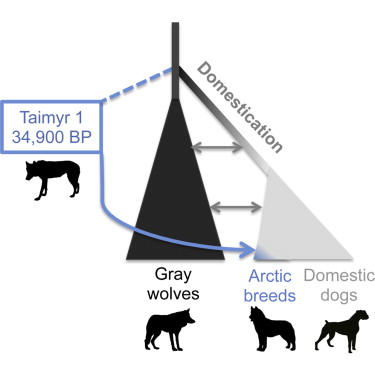
The origin of domestic dogs is poorly understood [ 1–15 ], with suggested evidence of dog-like features in fossils that predate the Last Glacial Maximum [ 6, 9, 10, 14, 16 ] conflicting with genetic estimates of a more recent divergence between dogs and worldwide wolf populations [ 13, 15, 17–19 ]. Here, we present a draft genome sequence from a 35,000-year-old wolf from the Taimyr Peninsula in northern Siberia. We find that this individual belonged to a population that diverged from the common ancestor of present-day wolves and dogs very close in time to the appearance of the domestic dog lineage. We use the directly dated ancient wolf genome to recalibrate the molecular timescale of wolves and dogs and find that the mutation rate is substantially slower than assumed by most previous studies, suggesting that the ancestors of dogs were separated from present-day wolves before the Last Glacial Maximum. We also find evidence of introgression from the archaic Taimyr wolf lineage into present-day dog breeds from northeast Siberia and Greenland, contributing between 1.4% and 27.3% of their ancestry. This demonstrates that the ancestry of present-day dogs is derived from multiple regional wolf populations.
That summary page also includes the following Graphical Abstract:
I don’t have permission to republish the Livescience article in full but would like to offer the closing paragraphs of this fascinating report.
“It is a very well-done paper,” Perry [George Perry, an expert in ancient DNA at Pennsylvania State University] told Live Science. “This topic is a critical one for our understanding of human evolution and human-environment interactions in the Paleolithic. Partnership with early dogs may have facilitated more efficient hunting strategies.”
If dogs first befriended hunter-gatherers, rather than farmers, then perhaps the animals helped with hunting or keeping other carnivores away. For instance, an author of a new book claims humans and dogs teamed up to drive Neanderthals to extinction. Skoglund also suggested the Siberian husky followed nomads across the Bering Land Bridge, picking up wolf DNA along the way.
“It might have been beneficial for them to absorb genes that were adapted to this high Arctic environment,” Skoglund said.
This is the first wolf genome from the Pleistocene, and more ancient DNA from prehistoric fossils could provide further insights into the relationship between wolves, dogs and humans, the researchers said.
Yes, our dogs have been part of man’s world for an unimaginable time – and Jean and I, as with tens of thousands of others, can’t imagine a world without dogs.
ooOOoo
They are our supreme companions. They don’t judge. They don’t lie. They are …. well let me repeat what I wrote right at the beginning of the blog.
Dogs are part of the Canidae, a family including wolves, coyotes and foxes, thought to have evolved 60 million years ago. There is no hard evidence about when dogs and man came together but dogs were certainly around when man developed speech and set out from Africa, about 50,000 years ago. See an interesting article by Dr. George Johnson.
Because of this closeness between dogs and man, we (as in man!) have the ability to observe the way they live. Now I’m sure that scientists would cringe with the idea that the way that a dog lives his life sets an example for us humans, well cringe in the scientific sense. But man seems to be at one of those defining stages in mankind’s evolution where the forces bearing down on the species homo sapiens have the potential to cause very great harm. If the example of dogs can provide a beacon of hope, an incentive to change at a deep cultural level, then the quicker we ‘get the message’, the better it will be.
The great thing about going away is the home-coming!
I’m speaking of coming back to one’s dogs. This theme of coming home to your dogs was prompted by something I read the other day on The Dodo newsletter. It was an article … well you read it rather than me explain it.
ooOOoo
Dogs Are So Excited When Mom Finally Comes Home From 8-Month Deployment
Photo Credit: Taryn Dennison
Bauer first met his mom when he was just a puppy, and ever since then they’ve been basically attached at the hip. Bauer follows his mom everywhere she goes and loves hanging out with her no matter what they’re doing.
“Bauer isn’t your typical husky, he doesn’t bark and he rarely howls,” Taryn Dennison, Bauer’s mom, told The Dodo. “He loves sleeping and when he’s awake he’s right next to you trying to get all the cuddles and pets he can or to get you to throw his toys.”
When Dennison found out she was going to be deployed, she knew it was going to be hard to leave Bauer behind. He stayed with her roommate and her roommate’s dog, Macie, and was cared for and loved so well, but everyone could tell that he missed his mom so much.
Photo Credit: Taryn Dennison
“Bauer didn’t understand why I was gone,” Dennison said. “I FaceTimed him a few times and he would run around my house trying to find me and then later he would end up laying down and falling asleep in front of my door.”
Finally, after eight long months apart, Dennison arrived home…and as soon as she walked in the door, Bauer completely lost it.
He was overwhelmed with joy and so thrilled that his mom was finally home, and couldn’t stop licking her and jumping all over her.
“I honestly thought he was going to pee on me because he was so excited,” Dennison said.
Photo Credit: Taryn Dennison
Even Macie was excited, especially when she saw how happy Bauer was, and both dogs jumped around Dennison as she sat on the floor with them. After so much time apart, she was so happy to finally be home with Bauer and the rest of her loved ones.
“Since I got home he’s been attached to my hip,” Dennison said. “I can’t even get up to go to the kitchen or the bathroom without him being right next to me. I wouldn’t change it for the world!”
Bauer missed his mom so much, but now that she’s home, he’s making sure he doesn’t take a single minute of being with her for granted.
ooOOoo
To keep up the theme for a little longer, here is a YouTube video of dogs and their returning owners.
I hope you enjoyed it.
Finally, Jean and I just need to go the shops in Grants Pass, about 20 minutes away, and when we return home, perhaps 1 or 2 hours later, we are greeted by all our dogs in a similar fashion. The vast majority of dogs offer unconditional, unbridled love! 😍
This, again, is not about our beloved animals; in other words, this is not about our dogs.
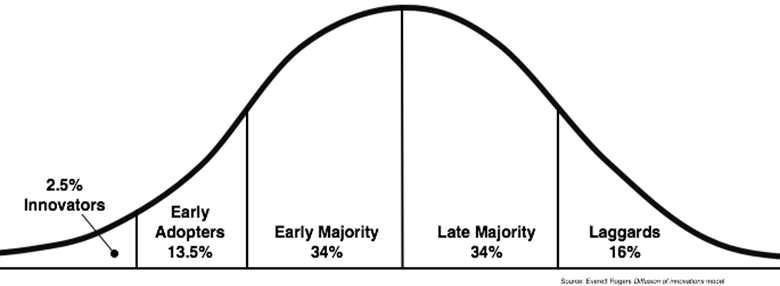
But it is about something of supreme importance: The role of innovation. That’s innovation in all aspects of our human lives. Think of it as a process of innovation.
There was the Diffusion of Innovation (DOI) Theory developed by E.M. Rogers in 1962. There is a comprehensive explanation of DOI here, from where I take the following diagram, but before explaining, from that same site, the meanings behind the definitions, I would like to emphasize one important point: “It works better with adoption of behaviors rather than cessation or prevention of behaviors.“.
So here is that diagram:
Here are the meanings of those terms (my emboldening):
Adoption of a new idea, behavior, or product (i.e., “innovation”) does not happen simultaneously in a social system; rather it is a process whereby some people are more apt to adopt the innovation than others.
Researchers have found that people who adopt an innovation early have different characteristics than people who adopt an innovation later. When promoting an innovation to a target population, it is important to understand the characteristics of the target population that will help or hinder adoption of the innovation.
There are five established adopter categories, and while the majority of the general population tends to fall in the middle categories, it is still necessary to understand the characteristics of the target population. When promoting an innovation, there are different strategies used to appeal to the different adopter categories.
Innovators – These are people who want to be the first to try the innovation. They are venturesome and interested in new ideas. These people are very willing to take risks, and are often the first to develop new ideas. Very little, if anything, needs to be done to appeal to this population.
Early Adopters – These are people who represent opinion leaders. They enjoy leadership roles, and embrace change opportunities. They are already aware of the need to change and so are very comfortable adopting new ideas. Strategies to appeal to this population include how-to manuals and information sheets on implementation. They do not need information to convince them to change.
Early Majority – These people are rarely leaders, but they do adopt new ideas before the average person. That said, they typically need to see evidence that the innovation works before they are willing to adopt it. Strategies to appeal to this population include success stories and evidence of the innovation’s effectiveness.
Late Majority – These people are skeptical of change, and will only adopt an innovation after it has been tried by the majority. Strategies to appeal to this population include information on how many other people have tried the innovation and have adopted it successfully.
Laggards – These people are bound by tradition and very conservative. They are very skeptical of change and are the hardest group to bring on board. Strategies to appeal to this population include statistics, fear appeals, and pressure from people in the other adopter groups.
Now there’s a TED Talk that I hadn’t seen, and yet nearly 51 million people had! It came to me as an email from TED and yesterday, while we were sitting up in bed early in the morning, I watched it. It ‘spoke’ to me and I felt that I just had to share it with you.
Because so many of the problems that face our society today are global issues and if humans are to have a future on this planet then we need great leaders who will inspire us.
Now watch the following video, it’s just over 18 minutes long, but it says it all.
In fact, I am ‘stealing’ the whole of Colin’s post, albeit with his permission, because recently he posted on his blog Wibble a poem written by Linda Ellis that is perfect. Indeed, it is more than perfect, it is a unique view of our lifetimes: yours; mine, everyone’s.
I learnt about ‘living your dash’ from Robby Robin’s Journey. ‘The dash’ is the one that goes between your dates of birth and death. Mine, for instance, is in “1960-” (because I’m not dead yet). Jane Fritz says:
This expression was popularized by Linda Ellis’s poem
The Dash; it provides a powerful metaphor for your life and helps us think about how our own dashes might be evaluated.
I went googling for the poem. It wasn’t hard to find it. However, reproducing it is subject to licence… which I applied for and was kindly granted. So here it is:
~~~~~~~~
The Dash
by Linda Ellis
I read of a man who stood to speak at the funeral of a friend.
He referred to the dates on the tombstone from the beginning… to the end.
He noted that first came the date of birth and spoke of the following date with tears, but he said what mattered most of all was the dash between those years.
For that dash represents all the time they spent alive on earth
and now only those who loved them know what that little line is worth.
For it matters not, how much we own, the cars… the house… the cash.
What matters is how we live and love and how we spend our dash.
So think about this long and hard; are there things you’d like to change?
For you never know how much time is left that still can be rearranged.
To be less quick to anger and show appreciation more
and love the people in our lives like we’ve never loved before.
If we treat each other with respect and more often wear a smile…
remembering that this special dash might only last a little while.
So when your eulogy is being read, with your life’s actions to rehash,
would you be proud of the things they say about how you lived your dash?
Maybe it is because I am in my mid-seventies. Maybe it is because I have never thought of it before; as in the dash! Maybe it is because I am looking for something that is beautifully clear; an antidote to the complicated world we appear to be living in.
I can’t fathom it out but that doesn’t matter in the slightest.
It is a very beautiful, inspiring poem that gets to the heart of living!
I follow Colin’s blog Wibble. It ranges across a myriad of thoughts and beliefs and it’s a good follow.
On June 9th, Colin published a post regarding The wolves within, a beautiful legend from the Cherokees. Colin readily and promptly gave me permission to share it with you.
The content isn’t mine, but of course it’s fine by me, Paul. You’re too polite by half! 😀
Here it is.
ooOOoo
The wolves within: a Cherokee legend
Posted on June 9, 2020
An old grandfather said to his grandson, who came to him with anger at a friend who had done him an injustice, “Let me tell you a story.
“I too, at times, have felt a great hate for those that have taken so much, with no sorrow for what they do.
“But hate wears you down, and does not hurt your enemy. It is like taking poison and wishing your enemy would die. I have struggled with these feelings many times.” He continued, “It is as if there are two wolves inside me. One is good and does no harm. He lives in harmony with all around him, and does not take offense when no offense was intended. He will only fight when it is right to do so, and in the right way.
“But the other wolf, ah! He is full of anger. The littlest thing will set him into a fit of temper. He fights everyone, all the time, for no reason. He cannot think because his anger and hate are so great. It is helpless anger, for his anger will change nothing.
“Sometimes, it is hard to live with these two wolves inside me, for both of them try to dominate my spirit.”
The boy looked intently into his grandfather’s eyes and asked, “Which one wins, grandfather?”
The grandfather smiled and quietly said, “The one I feed.”



 About The Film






 I learnt about ‘living your dash’ from
 Learning from Dogs