Category: Philosophy

Hope via Openness

Don Tapscott presents what might just be humanity’s salvation.

Millions of us, of all ages, are linked together in this new ‘wired’ world.  For old crusties such as myself, it’s all too easy to recall the days when the mention of the word ‘chip’ immediately brought to mind fried fish!  But we struggled into this new world and now can’t imagine how it was in those earlier days – anyone want to buy my old quill pen? 😉

There are huge benefits to this wonderful networked world and most days I read something on a website here or a blog there that opens my mind in unfathomable ways.  Not only that, but the number of friends, new and old, who co-operate with my attempts to show how integrity is the only way forward is humbling.

Thus it was that an old friend of many years, Lee C., sent me a link to a recent TED talk that revealed in just 17 minutes a message of hope for all of us.  It reminded me that our younger generation have their own knowledge, their own aspirations, their own fears and dreams.

Without more ado, watch it now!

The recent generations have been bathed in connecting technology from birth, says futurist Don Tapscott, and as a result the world is transforming into one that is far more open and transparent. In this inspiring talk, he lists the four core principles that show how this open world can be a far better place.

And weren’t those flocks of starlings just breathtaking?

Lee also sent me this:

Don Tapscott’s recent TED talk ends with footage of starlings in vast numbers which is referred to as a ‘murmuration’. I watched it just two nights or so ago. Tonight I went outside for a breath of fresh air (ok a call of nature) and this is part of what I saw. So pleased to have had my mobile phone in my shirt pocket.

Finally, I hadn’t come across Don Tapscott before but thanks again to this amazing world of shared information, a quick Google search finds Don’s own website here.

Letting go; a dog lesson.

Some of us think holding on makes us strong; but sometimes it is letting go. Hermann Hesse

Nuneaton in Warwickshire is a town about 100 miles North-West of London.  It’s firmly in that part of England known as the Midlands, encircled by such places as Birmingham, Coventry, Rugby and Leicester.  It is also the home of the Nuneaton & Warwickshire Wildlife Sanctuary  So what, you might ask?

Watch this!

On the Wildlife Sanctuary’s website, there is the story of Jasmine,

Jasmine was a rescue dog who lived at the sanctuary until her passing in 2011. She was no ordinary rescue dog, she was the most amazing greyhound in the world!

She was only a young pup when she was locked in a shed and abandoned. When she was discovered by the police many days later she was emaciated, mange ridden and terrified. She was taken to the RSPCA quarters in Coventry where Geoff just happened to be visiting several weeks later. They were introduced and as they say ‘the rest is history’. She came to live with Geoff at the sanctuary. Each day her confidence grew and her personality flourished. But the most amazing thing was yet to come….

It turned out Jasmine was a natural ‘Mother hen’. One day a young fox cub was brought in to the sanctuary. She had been tied to railings and left to die. She was very small and weak and the outlook wasn’t bright. That was until Jasmine sauntered over to the fox cub’s basket and started to lick her. Geoff was immediately concerned, followed by bemusement, followed by amazement as he saw before his eyes the fox responding to Jasmine’s touch. He quickly realised that Jasmine was acting in the same way the fox cub’s mother would have done in the wild!

Over the next few days Jasmine continued to ‘mother’ the fox cub who Geoff had named Roxy. Roxy grew strong and grew up. She lives at the sanctuary with Jasmine who is mum and best friend all rolled into one.

Jasmine was truly one of a kind. She mothered many of the sanctuary’s residents back to health including Bramble the roe deer, Humbug the badger and two of the other sanctuary dogs, just to mention a few.

Sadly Jasmine passed away in 2011. She is greatly missed by all at the sanctuary.

So what’s Geoff’s story?  That is beautifully explained here,

In February 2001, an injured swan was taken to a veterinary clinic in Warwickshire. The swan was injured, but needed only a week of rest before it was able to be released back into the wild. However, there was nowhere in the area for the swan to rest and receive care, so it was put to sleep. This was when Geoff decided to set up the sanctuary.

Geoff had worked as a security guard for many years but was injured at work and forced to retire. He used his savings to transform his garden into a haven for wildlife and has never looked back.

Geoff, all the caring people in the world salute you!

As of 2011, the Sanctuary has been open for ten years, and has had 6,500 birds and 4,250 animals.

The Sanctuary relies on the work of our dedicated team of volunteers; who accompany us on fundraising events, talks, and shows to help raise money for the Sanctuary.

So let me close by thanking Suzann for sending me the video link to this beautiful story.  And do make a note to look in on Learning from Dogs next Saturday to marvel at yet another example of the way dogs (and Geoff!) throw off their pasts and rejoice in the present.

In the end these things matter most:

How well did you love?

How fully did you love?

How deeply did you learn to let go?

The Buddha

Magic and the Machine

Living in an American Age of Techno-Wonder and Unreason

Introductory note from yours truly!

It’s becoming a regular item in the agenda of Learning from Dogs to republish essays that appear on Tom Engelhardt’s blog, Tom Dispatch.  But as the following was, in turn, a republication by Tom of a very interesting essay by Lewis Lapham, I took the precaution of asking Mr. Lapham’s office for permission to republish.  It showed the standing in which Tom is held by the very prompt reply from Michelle Legro, Associate Editor of Lapham’s Quarterly who confirmed, “If you have permission from Tom Englehart to republish the piece, than it is fine with us.

So it’s more than important that today I include Tom’s plea that headed up Lewis Lapham’s article, as follows,

[Note for TomDispatch readers: The 30,000 of you who get email notices whenever a new piece is posted, as well as the tens of thousands who bookmark TD or read its pieces reposted elsewhere, can support this site by encouraging new readers to sign on. TomDispatch spreads mainly thanks to word of mouth, a formidable force in the online world. For those of you already hooked, I urge you to lend the site a little more of that word-of-mouth power. I hope you’ll consider putting together a modest list of friends, colleagues, relatives, or, for that matter, people you like to argue with who might benefit from getting TomDispatch regularly. Urge them to go to the “subscribe” window to the right of the main screen, put in their e-mail addresses, hit “submit,” answer the confirmation letter that will quickly arrive in email boxes (or, fair warning, spam folders), and join the TD crew. Many thanks in advance for your efforts. They do matter! Tom] 

So please do subscribe to Tom’s deeply interesting blog.  The home page is here and the ‘subscribe’ window is slightly down on the right-hand side of the ‘home’ page.  You will not be disappointed.

OK, now on to Nick Turse’s introduction to Lewis Lapham’s article.

It is said, Lewis Lapham tells us, that Abbot John Trithemius of Sponheim, a fifteenth-century scholar and mage, devised a set of incantations to carry “messages instantaneously… through the agency of the stars and planets who rule time.”  In 1962, Lapham adds, Bell Labs “converted the thought into Telstar, the communications satellite relaying data, from earth to heaven and back to earth, in less than six-tenths of a second.”  Magic had become science.  Today, the Pentagon is picking up the centuries old gauntlet, asking the brightest minds in academe — through its far-out research arm, the Defense Advanced Research Projects Agency or DARPA — to come up with a means for a 20-something-kid-cum-lieutenant or perhaps the military’s much-lauded “strategic corporal” to be wired into unprecedented amounts of information beamed down from the heavens above.

At some level, even the language of DARPA’s solicitation for its SeeMe program seems to conjure up the visions that danced in Trithemius’s head.  Its goal, we are told, “is to provide useful on-demand imagery information directly to the lowest echelon warfighter in the field from a very low cost satellite constellation launched on a schedule that conforms to DoD [Department of Defense] operational tempos.”  Those heavenly-sounding constellations are, however, tempered by the reality of what the Pentagon is really after.

Yesterday’s future of high-tech satellites that would allow our thoughts to slip “the surly bonds of Earth,” while connecting the far reaches of the planet and linking minds globally in ways even Trithemius couldn’t imagine, is now being exchanged for a low-bid, low-rent system of military satellites.  These will be capable of allowing a kid just out of high school to more efficiently target a kid who probably never went to high school — all courtesy of a well-educated university scientist who never bothered to think of the implications of his tenure-producing, tax-payer-funded research.  This can’t be what Trithemius had in mind.  And yet, that’s where we’re at.

If the Pentagon has its way, SeeMe will eventually fill the skies with cheap, disposable “satellites at very low altitudes, networked to existing fielded communications systems and handheld platforms.”   So much for the “the high untrespassed sanctity of space.”  But let Lewis Lapham explore further the borderlands of science and magic that have somehow been fused into the very center of our lives.   The famed former editor of Harper’s Magazine now edits Lapham’s Quarterly, which, four times a year, brilliantly unites some of the most provocative and original voices in history around a single topic. (You can subscribe to it by clicking here.) TomDispatch thanks the editors of that journal for allowing us to offer an exclusive online first look at Lapham’s elegant history of unreason in this techno-age of ours. Nick Turse

oooOOOooo

Magic and the Machine
Living in an American Age of Techno-Wonder and Unreason
By Lewis H. Lapham

[A longer version of this essay appears in “Magic Shows,” the Summer 2012 issue of Lapham’s Quarterlyand is posted at TomDispatch.com with the kind permission of that magazine.]

As between the natural and the supernatural, I’ve never been much good at drawing firm distinctions. I know myself to be orbiting the sun at the speed of 65,000 miles per hour, but I can’t shake free of the impression shared by Pope Urban VIII, who in 1633 informed Galileo that the earth doesn’t move. So also the desk over which I bend to write, seemingly a solid mass of wood but in point of fact a restless flux of atoms bubbling in a cauldron equivalent to the one attended by the witches in Macbeth.

Nor do I separate the reality from the virtual reality when conversing with the airy spirits in a cell phone, or while gazing into the wizard’s mirror of a television screen. What once was sorcery maybe now is science, but the wonders technological of which I find myself in full possession, among them indoor plumbing and electric light, I incline to regard as demonstrations magical.

This inclination apparently is what constitutes a proof of being human, a faculty like the possession of language that distinguishes man from insect, guinea hen, and ape. In the beginning was the word, and with it the powers of enchantment. I take my cue from Christopher Marlowe’s tragical drama Doctor Faustus because his dreams of  “profit and delight,/Of power, of honor, of omnipotence,” are the stuff that America is made of, as was both the consequence to be expected and the consummation devoutly to be wished when America was formed in the alembic of the Elizabethan imagination. Marlowe was present at the creation, as were William Shakespeare, the navigators Martin Frobisher and Francis Drake, and the Lord Chancellor Francis Bacon envisioning a utopian New Atlantis on the coast of Virginia.

It was an age that delighted in the experiment with miracles, fiction emerging into fact on the far shores of the world’s oceans, fact eliding into fiction in the Globe Theatre on an embankment of the Thames. London toward the end of the sixteenth century served as the clearinghouse for the currencies of the new learning that during the prior 150 years had been gathering weight and value under the imprints of the Italian Renaissance and the Protestant Reformation in Germany. The Elizabethans had in hand the writings of Niccolò Machiavelli and Martin Luther as well as those of Ovid and Lucretius, maps drawn by Gerardus Mercator and Martin Waldseemüller, the observations of Nicolaus Copernicus, Johannes Kepler, Giordano Bruno, and Paracelsus.

The medieval world was dying an uneasy death, but magic remained an option, a direction, and a technology not yet rendered obsolete. Robert Burton, author ofThe Anatomy of Melancholy, found the air “not so full of flies in summer as it is at all times of invisible devils.” To the Puritan dissenters contemplating a departure to a new and better world the devils were all too visible in a land that “aboundeth with murders, slaughters, incests, adulteries, whoredom, drunkenness, oppression, and pride.”

Think Tanks of the Sixteenth and Twentieth Centuries

In both the skilled and unskilled mind, astronomy and astrology were still inseparable, as were chemistry and alchemy, and so it is no surprise to find Marlowe within the orbit of inquisitive “intelligencers” centered on the wealth and patronage of Henry Percy, “the Wizard Earl” of Northumberland, who attracted to his estate in Sussex the presence of Dr. John Dee, physician to Queen Elizabeth blessed with crystal showstones occupied by angels, as well as that of Walter Raleigh, court poet and venture capitalist outfitting a voyage to Guiana to retrieve the riches of El Dorado.

The earl had amassed a library of nearly 2,000 books and equipped a laboratory for his resident magi, chief among them Thomas Hariot, as an astronomer known for his improvement of the telescope (the “optic tube”), and as a mathematician for his compilation of logarithmic tables. As well versed in the science of the occult as he was practiced in the study of geography, Hariot appears in Charles Nicholl’s book The Reckoning as a likely model for Marlowe’s Faustus.

During the same month last spring in which I was reading Nicholl’s account of the Elizabethan think tank assembled by the Wizard Earl, I came across its twentieth-century analog in Jon Gertner’s The Idea Factory: Bell Labs and the Great Age of American Innovation. As in the sixteenth century, so again in the twentieth: a gathering of forces both natural and supernatural in search of something new under the sun.

The American Telephone and Telegraph Company undertook to research and develop the evolving means of telecommunication, and to that end it established an “institute of creative technology” on a 225-acre campus in Murray Hill, New Jersey, by 1942 recruiting nearly 9,000 magi of various description (engineers and chemists, metallurgists, and physicists) set to the task of turning sand into light, the light into gold.

All present were encouraged to learn and borrow from one another, to invent literally fantastic new materials to fit the trajectories of fanciful new hypotheses. Together with the manufacture of the laser and the transistor, the labs derived from Boolean algebra the binary code that allows computers to speak to themselves of more things in heaven and earth than were dreamed of in the philosophies of either Hamlet or Horatio.

Gertner attributes the epistemological shape-shifting to the mathematician Claude Shannon, who intuited the moving of “written and spoken exchanges ever deeper into the realm of ciphers, symbols, and electronically enhanced puzzles of representation” — i.e., toward the “lines, circles, scenes, letters, and characters” that Faustus most desired. The correspondence is exact, as is the one to be drawn from John Crowley’s essay, “A Well Without a Bottom,” that recalls the powers of the Abbot Trithemius of Sponheim, a fifteenth-century mage who devised a set of incantations “carrying messages instantaneously… through the agency of the stars and planets who rule time.” Bell Labs in 1962 converted the thought into Telstar, the communications satellite relaying data, from earth to heaven and back to earth, in less than six-tenths of a second.

Between the 1940s and the 1980s, Bell Labs produced so many wonders both military and civilian (the DEW line and the Nike missile as well as the first cellular phone) that AT&T’s senior management was hard put to correct the news media’s tendency to regard the Murray Hill estate as “a house of magic.” The scientists in residence took pains to discount the notion of rabbits being pulled from hats, insisting that the work in hand followed from a patient sequence of trial and error rather than from the silk-hatted magician Eisenheim’s summoning with cape and wand the illusions of “The Magic Kettle” and “The Mysterious Orange Tree” to theater stages in nineteenth-century Paris, London, and Berlin.

The disavowals fell on stony ground. Time passed; the wonders didn’t cease, and by 1973 Arthur C. Clarke, the science-fiction writer believed by his admirers to be the twentieth-century avatar of Shakespeare’s Prospero, had confirmed the truth apparent to both Ariel and Caliban: “Any sufficiently advanced technology is indistinguishable from magic.”

As chairman of the British Interplanetary Society during the 1950s, Clarke had postulated stationing a communications satellite 22,300 miles above the equator in what is now recognized by the International Astronomical Union as “The Clarke Orbit,” and in 1968 he had co-written the film script for 2001: A Space Odyssey. The opening sequence — during which an ape heaves into thin air a prehistoric bone that becomes a spaceship drifting among the stars — encompasses the spirit of an age that maybe once was Elizabethan but lately has come to be seen as a prefiguration of our own.

The New World’s Magical Beginnings (and Endings)

New philosophies call all in doubt, the more so as the accelerating rates of technological advance — celestial, terrestrial, and subliminal — overrun the frontiers between science, magic, and religion. The inventors of America’s liberties, their sensibilities born of the Enlightenment, understood the new world in America as an experiment with the volatile substance of freedom. Most of them were close students of the natural sciences: Thomas Paine an engineer, Benjamin Rush a physician and chemist, Roger Sherman an astronomer, Thomas Jefferson an architect and agronomist.

Intent upon enlarging the frame of human happiness and possibility, they pursued the joy of discovery in as many spheres of reference as could be crowded onto the shelves of a Philadelphia library or a Boston philosophical society. J. Hector St. John de Crèvecoeur, colonist arriving from France in 1755, writes in his Letters from an American Farmer to express gratitude for the spirit in which Benjamin Franklin’s invention of the lightning rod — “by what magic I know not” — was both given and received: “Would you believe that the great electrical discoveries of Mr. Franklin have not only preserved our barns and our houses from the fire of heaven but have even taught our wives to multiply their chickens?”

A similar approach to the uses of learning informed Jefferson’s best hopes for the new nation’s colleges and schools, and for the better part of the last two centuries it has underwritten the making of America into what the historian Henry Steele Commager named “the empire of reason.” An empire that astonishes the world with the magnificence of its scientific research laboratories, but one never safe from frequent uprisings in the rebel provinces of unreason.

Like England in the late sixteenth century, America in the early twenty-first has in hand a vast store of new learning, much of it seemingly miraculous — the lines and letters that weave the physics and the metaphysics into strands of DNA, Einstein’s equations, Planck’s constant and the Schwarzschild radius, the cloned sheep and artificial heart. America’s scientists come away from Stockholm nearly every year with a well-wrought wreath of Nobel prizes, and no week goes by without the unveiling of a new medical device or weapons system.

The record also suggests that the advancement of our new and marvelous knowledge has been accompanied by a broad and popular retreat into the wilderness of smoke and mirrors. The fear of new wonders technological — nuclear, biochemical, and genetic — gives rise to what John Donne presumably would have recognized as the uneasy reawakening of a medieval belief in magic.

We find our new Atlantis within the heavenly books of necromancy inscribed on walls of silicon and glass, the streaming data on an iPad or a television screen lending itself more readily to the traffic in spells and incantation than to the distribution of reasoned argument.  The less that can be seen and understood of the genies escaping from their bottles at Goldman Sachs and MIT, the more headlong the rush into the various forms of wishful thinking that increasingly have become the stuff of which we make our politics and social networking, our news and entertainment, our foreign policy and gross domestic product.

How else to classify the Bush administration’s invasion of Iraq if not as an attempt at alchemy? At both the beginning and end of the effort to transform the whole of the Islamic Middle East into a democratic republic like the one pictured in the ads inviting tourists to Colonial Williamsburg, the White House and the Pentagon issued press releases in the voice of the evil angel counseling Faustus, “Be thou on earth as Jove is in the sky,/Lord and commander of these elements.”

Charles Krauthammer, neoconservative newspaper columnist and leading soloist in the jingo chorus of the self-glorifying news media, amplified the commandment for the readers of Time magazine in March 2001, pride going before the fall six months later of the World Trade Center: “America is in a position to reshape norms, alter expectations, and create new realities. How? By unapologetic and implacable demonstrations of will.”

So again four years later, after it had become apparent that Saddam Hussein’s weapons of mass destruction were made of the same stuff as Eisenheim’s projection of “The Vanishing Lady.” The trick had been seen for what it was, but Defense Secretary Donald Rumsfeld emerged from the cloud of deluded expectation, unapologetic and implacable, out of which he had spoken to the groundlings at a NATO press conference in 2002: “The message is that there are no ‘knowns.’ There are things we know that we know. There are known unknowns… but there are also unknown unknowns… The absence of evidence is not evidence of absence.”

“Perform What Desperate Enterprise I Will”

The Rumsfeldian message accounts not only for what was intended as a demonstration magical in Iraq, but also for the Obama administration’s current purpose in Afghanistan, which is to decorate a wilderness of tribal warfare with the potted plant of a civilized and law-abiding government that doesn’t exist. Choosing to believe in what isn’t there accords with the practice adopted on Wall Street that brought forth the collapse of the country’s real-estate and financial markets in 2008.

The magnitude of the losses measured the extent to which America assigns to the fiction of its currency the supernatural powers of a substance manufactured by a compensation committee of sixteenth-century alchemists. The debacle was not without precedent.  Thomas Paine remarked on the uses of paper money (“horrid to see, and hurtful to recollect”) that made a mess of America’s finances during its War of Independence, “It is like putting an apparition in place of a man; it vanishes with looking at, and nothing remains but the air.”

Paine regarded the “emissions” of paper money as toxic, fouling the air with the diseases (vanity, covetousness, and pride) certain to destroy the morals of the country as well as its experiment with freedom. A report entitled “Scientific Integrity in Policy Making,” issued in February 2004 by the Union of Concerned Scientists, advanced Paine’s argument against what it diagnosed as the willed ignorance infecting the organism of the Bush administration.

Signed by more than 60 of the country’s most accomplished scientists honored for their work in many disciplines (molecular biology, superconductivity, particle physics, zoology), the report bore witness to their experience when called upon to present a federal agency or congressional committee with scientific data bearing on a question of the public health and welfare. Time and again in the 40-page report, the respondents mention the refusal on the part of their examiners to listen to, much less accept, any answers that didn’t fit with the administration’s prepaid and prerecorded political agenda.

Whether in regard to the lifespan of a bacteria or the trajectory of a cruise missile, ideological certainty overruled the objections raised by counsel on behalf of logic and deductive reasoning. On topics as various as climate change, military intelligence, and the course of the Missouri River, the reincarnations of Pope Urban VIII reaffirmed their conviction that if the science didn’t prove what it had been told to prove, then the science had been tampered with by Satan.

The report spoke to the disavowal of the principle on which the country was founded, but it didn’t attract much notice in the press or slow down the retreat into the provinces of unreason. The eight years that have passed since its publication have brought with them not only the illusion of “The Magic Kettle” on Wall Street, but also the election of President Barack Obama in the belief that he would enter the White House as the embodiment of Merlin or Christ.

To the extent that more people become more frightened of a future that calls all into doubt, they exchange the force of their own thought for the power they impute to supernatural machines. To wage the war against terror the Pentagon sends forth drones, robots, and surveillance cameras, hard-wired as were the spirits under the command of Faustus, “to fetch me what I please,/Resolve me of all ambiguities,/Perform what desperate enterprise I will.”

Wall Street clerks subcontract the placing of $100 billion bets to the judgment of computer databanks that stand as silent as the stones on Easter Island, while calculating at the speed of light the rates of exchange between the known unknowns and the unknown unknowns.  By way of projecting a federal budget deficit into both the near and distant future, the season’s presidential candidates float cloud-capped towers of imaginary numbers destined to leave not a rack behind.

The American body politic meanwhile dissolves into impoverished constituencies of one, stripped of “profit and delight” in the realm of fact, but still sovereign in the land of make-believe. Every once and future king is possessed of a screen like the enchanted mirror that Lady Galadriel shows to Frodo Baggins in the garden at Caras Galadhon; the lost and wounded self adrift in a sea of troubles but equipped with the remote control that once was Prospero’s; blessed, as was the tragical Doctor Faustus, with instant access to the dreams “of power, of honor, of omnipotence.”

Lewis H. Lapham is editor of Lapham’s Quarterly. Formerly editor of Harper’s Magazine, he is the author of numerous books, including Money and Class in AmericaTheater of WarGag Rule, and, most recently, Pretensions to Empire. The New York Times has likened him to H.L. Mencken; Vanity Fair has suggested a strong resemblance to Mark Twain; and Tom Wolfe has compared him to Montaigne. This essay, shortened for TomDispatch, introduces “Magic Shows,” the Summer 2012 issue of Lapham’s Quarterly.

Follow TomDispatch on Twitter @TomDispatch, join us on Facebook, and check out the latest TD book, Terminator Planet: The First History of Drone Warfare, 2001-2050.

Copyright 2012 Lewis Lapham

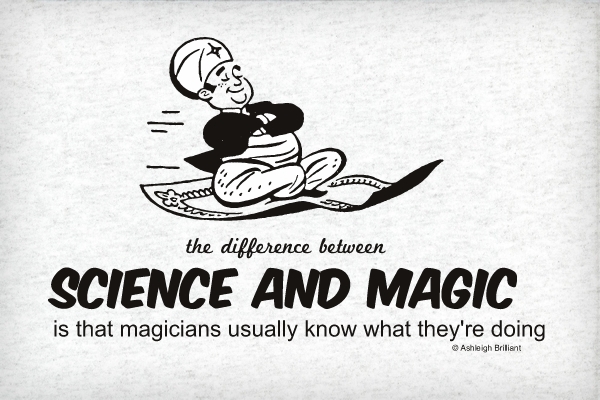
I haven’t a clue as to how to close this post after that – so I will just fade away ……. and leave you with this rather tongue-in-cheek cartoon.

The art of relaxation

Yesterday’s article reminds me of something fundamental!

In Patricia’s guest post of yesterday, she wrote about Chloe, her dog,

Chloe was born knowing. She knows about joy. She knows about living a life in balance. She knows about forgiveness, trust, exuberance, a passion for learning and the power of a good nap.

I was speaking with Jon Lavin a few days ago about the effect of anxiety on memory.  Jon confirmed that as we get older even low levels of anxiety can play games with our mental focus.  He described what many of us know – of walking into a room, for instance, and suddenly realising that you didn’t have a clue as to why you had come into the room!  In a very real sense anxiety is the body’s manifestation of fear.

Jon went on to say that practicing ‘letting go’ for a couple of 10-minute sessions a day is wonderfully therapeutic for the mind.  In fact, when Jon was a guest author for Learning from Dogs he touched on the subject of fear in a post almost two years ago to the day; Dealing with the fear of the known.  Indeed, I’m going to reproduce that article in full – here it is,

Jon Lavin

Can we ever conquer fear?

In a recent article I discussed the fear of the unknown, linked to the down-turn, redundancies, etc.

Per Kurowski, a great supporter of this Blog, posed the following question. “Great advice… but how do we remove the fear of what is known?”  A simple, and slightly flippant answer would be, “Develop a different relationship with it.”

What I’m saying is that when we are facing the known, and I’m assuming that it’s something unpleasant, our choices are limited. It’s going to happen, so the only thing we can do is change the way we view it.

This brings us back full circle to developing a different relationship with it. Let’s take the word, ‘fear’.

All fear is an illusion, walk right through“. I heard Dr David Hawkins say on a CD. Granted, a great trick if you can do it!

Here’s another description of fear: Fear = False Evidence Appearing Real

Fear is generally future-based. We tend to use the past as a learning reference to inform us of what to be afraid of in the future. So human beings live their lives trying to predict and prepare for the future, limited by their past experiences.

Unfortunately, the only way to work with fear of the known is to live in the present!

Our whole society is geared up to look into the future. We are forever worrying about or planning something for the future.

To begin focussing on the present, try this.

Simply, to start off, become aware of the breath and sensations in the body. This will slowly start to remind us to be present, or embodied, in our own body. Problems, fear and spiral thinking, often at 3 or 4 in the morning, are generated in the mind. Thoughts occur randomly, although we call them, “Our thoughts“, and refer to, “Our mind“.

By dropping out of the thought processes into the awareness of our breath and our body, the noise stops, even if only for a moment.  Here’s the rub: So very few people in the world will have even the slightest inkling what these words mean!

If more of us got used to coming out of the mind before making an important decision, and simply sat with the question for a while, the answer would probably present itself.

This will probably raise more questions than it answers but that’s not a bad thing.

By Jon Lavin

Difficult to add anything to that very sound advice save to try it out yourself, and if you own a dog or have one as a friend, just look much more closely at how he or she behaves and remember why this blog is called what it is!  Or as Trish wrote,

Chloe was born knowing. She knows about joy. She knows about living a life in balance. She knows about forgiveness, trust, exuberance, a passion for learning and the power of a good nap.

Ah, the power of a good nap!

Puppy Cleo enjoying a good nap!

What the dog knew!

A guest post from Patricia Iles.

Regular readers will know that one of my joys of this blog writing game is the wonderful connections that are made across this funny old virtual world.  Trish Iles is one of those wonderful connections.

In fact, Trish is based at our local insurance firm, Crabdree Insurance, right here in Payson but until we ‘chit-chatted’ about writing a guest post for Learning from Dogs I had no idea there is much more to this lady.

To underline that, anyone who has their own blog called Contemplating Happiness will inevitably generate some curiosity.  That curiosity increases as one learns more about Trish and discovers that she is a published author.

Anyway, that’s enough from me, here is Trish Iles writing What the dog knew!

oooOOOooo

The wisdom of Chloe

I was pondering the eternal question: why does two weeks of relaxing vacation seem like so much more time than two weeks of working like my pants are on fire, here at my desk? My sweet husband and I talked about it a little bit, but came to no definitive answer. I chatted with friends about it. No insights. Google had no opinion, either.

Chloe came to us from a rescue organization. I think sometimes about what her experiences have been in her young life. She started out as an abandoned puppy on a reservation in New Mexico and was soon in the pound where she was on the euthanasia list. A kind woman rescued her and took care of her until she found us: just when Chloe was becoming at home with the rescue lady, she was uprooted again and sent home with two new people. What must she have been thinking?

Chloe didn’t close her heart to us, though. She watched for a few days. When she decided we weren’t going to make dinner out of her and that she was really staying with us, she threw her whole being into becoming one of the family. She let herself trust us.

I’m not sure I would have had the courage to trust a new set of people again. I’m doubly not sure that I give a rat’s patootie what those new people thought of or wanted from me. Chloe was willing not only to trust us, but to love us. She forgave us immediately for ripping her from the home she knew, and she adopted us right back.

Chloe was born knowing. She knows about joy. She knows about living a life in balance. She knows about forgiveness, trust, exuberance, a passion for learning and the power of a good nap. I think that when I grow up, I want to be just like her.

oooOOOooo

Don’t know about you dear reader but I just loved that story from Patricia.  Deep messages about what we can learn from our wonderful canine friends.

Indeed, I’m going to stay with the theme with tomorrow’s Post.

Welcome Doctor Barkman!

A delightful contribution from a guest author.

Dear readers, from time to time I am approached by other authors who have flattered me by asking if I would like to publish their Blog posts from time to time.  So I have been doubly flattered by having two authors contact me in the last week.

So to the first.  It is with great pleasure that I welcome Jane Brackman, Ph.D., author of the blog Doctor Barkman Speaks who will, from time to time, republish her posts on Learning from Dogs. I have no doubt that you will enjoy her scientific expertise regarding dogs

So today, please enjoy …

oooOOOooo

HOW DOGS THINK – NEW SCIENCE LOOKS INSIDE THEIR MINDS WITH MRI IMAGING

Canine illustrator Robert Dickey assigned thoughts and feeling to his Boston Terrier based on the dogs’s expressions. Here he illustrates contentment, sympathy and misery.  (Dogs from Life, Page & Co., 1920)
**
Are you gonna eat that? Are you gonna eat that?  I’ll eat it.”
Is this what dogs think?  Or do they experience more complex thoughts?  Apparently science is getting pretty close to figuring it out. If not exactly WHAT they’re thinking, then where in the brain the thoughts are coming from.  Since brains are pretty much the same across mammal species, if researchers identify which parts of the the brain light up, based on what humans have said, they can guess what the dogs’ thoughts are, too.

A couple of smart guys, Gregory Berns and Andrew Brooks of Emory University, watching a military dog assist Navy Seals as they overran the Osama Bin Laden compound, got a brilliant idea.  If you can teach dogs to jump out of helicopters, surely dogs could be trained to enjoy themselves inside an fMRI machine while scientists calculate what the dogs are thinking by scanning their brains.

The researchers, who are dog-lovers, explained, “We want to understand the dog-human relationship, from the dog’s perspective.  From the outset, we wanted to ensure the safety and comfort of the dogs.  We wanted them to be unrestrained and go into the scanner willingly.

So they recruited a professional dog trainer, Mark Spivak, and two companion dogs, a Feist Terrier named Callie and a Border Collie named McKenzie.  The team said that both dogs were trained over several months to walk into an fMRI scanner and hold completely still while researchers measured their brain activity.

In the photo below Callie wears ear protection as she 
prepares to enter the scanner.  The research team 
includes, from left, Andrew Brooks, Gregory Berns and Mark Spivak.  
(Credit: Photo by Bryan Meltz)

This is what the researchers wrote in the journal article that was published in PLOS last week:

Because of dogs’ prolonged evolution with humans, many of the canine cognitive skills are thought to represent a selection of traits that make dogs particularly sensitive to human cues. But how does the dog mind actually work? To develop a methodology to answer this question, we trained two dogs to remain motionless for the duration required to collect quality fMRI images by using positive reinforcement without sedation or physical restraints. The task was designed to determine which brain circuits differentially respond to human hand signals denoting the presence or absence of a food reward.

Eventually they hope to answer the more profound questions we all ask:  Do dogs have empathy? Do they know when we are happy or sad?  How much language do they really understand?”  (And here’s one from me- When they pee on the carpet and we don’t find it until the next day, when we scold them do they know why we are scolding them?)

Do dogs feel guilt?
You can read a brief summary of the project here:  What is Your Dog Thinking? Brain Scans Unleash Canine Secrets.

Or read the entire scholarly article here:

Berns, Gregory, Brooks, Andrew and Spivak, Mark, Functional MRI in Awake Unrestrained Dogs (April 27, 2012). 

Jane Brackman, Ph. D.

oooOOOooo

Well, I don’t know about you but I found this a most fascinating article.  All of us who live around dogs, both physically and emotionally, sense the closeness, may I use the word ‘magic’, of the relationships.

Take a look at the photograph below.  Until I left the UK in 2008, a few of us owned a lovely old Piper Super Cub.  It was a joy to fly.  I used frequently to take Pharaoh to the grass airfield, Watchford Farm, up on the Devon moors.  One day he showed such interest in the aircraft that I lifted him up to the passenger’s seat, strapped him in and taxied all over the grass airfield.  This picture shows something that is difficult to explain otherwise – Pharaoh’s real joy at sharing the adventure.  Of course, I didn’t fly with him, that would have been a step too far, but we did taxi almost up to take-off speed.  Dr. Barkman, what do you make of that?

Watchford Farm, Devon, July 2006.


Ernest Callenbach’s last words.

A moving, insightful postscript to the life of the late Ernest Callenbach.

This is a continuation of the republication of a recent TomDispatch Tomgram.  As I explained in Part One published yesterday I have been a follower of Tom Dispatch for some time and frequently find the essays most interesting.  However, reading the words of Ernest Callenbach touched me in many ways, some of which are still evolving.  Callenbach was clearly a man who many years ago not only foresaw how our world was heading but via his writings was able to articulate the solutions.  Today, as the video at the end of the Post so clearly exemplifies, those solutions are spot on.

The other point that strikes me is that in leaving this ‘message’ on his computer asking for it to be released after his death, Callenbach isn’t trying to prove anything.  We are reading the words of a person who feels so strongly about the fate of mankind that he wants those words to be his epitaph for ever more.  Trust me.  When you read the words below you will be as touched as I was, indeed still continue to be.  It is a rare privilege to republish them.

Ernest ‘Chick’ Callenbach

Epistle to the Ecotopians 

By Ernest Callenbach[This document was found on the computer of Ecotopia author Ernest Callenbach (1929-2012) after his death.]

To all brothers and sisters who hold the dream in their hearts of a future world in which humans and all other beings live in harmony and mutual support — a world of sustainability, stability, and confidence. A world something like the one I described, so long ago, in Ecotopia and Ecotopia Emerging.

As I survey my life, which is coming near its end, I want to set down a few thoughts that might be useful to those coming after. It will soon be time for me to give back to Gaia the nutrients that I have used during a long, busy, and happy life. I am not bitter or resentful at the approaching end; I have been one of the extraordinarily lucky ones. So it behooves me here to gather together some thoughts and attitudes that may prove useful in the dark times we are facing: a century or more of exceedingly difficult times.

How will those who survive manage it? What can we teach our friends, our children, our communities? Although we may not be capable of changing history, how can we equip ourselves to survive it?I contemplate these questions in the full consciousness of my own mortality. Being offered an actual number of likely months to live, even though the estimate is uncertain, mightily focuses the mind. On personal things, of course, on loved ones and even loved things, but also on the Big Picture.

But let us begin with last things first, for a change. The analysis will come later, for those who wish it.

Hope. Children exude hope, even under the most terrible conditions, and that must inspire us as our conditions get worse. Hopeful patients recover better. Hopeful test candidates score better. Hopeful builders construct better buildings. Hopeful parents produce secure and resilient children. In groups, an atmosphere of hope is essential to shared successful effort: “Yes, we can!” is not an empty slogan, but a mantra for people who intend to do something together — whether it is rescuing victims of hurricanes, rebuilding flood-damaged buildings on higher ground, helping wounded people through first aid, or inventing new social structures (perhaps one in which only people are “persons,” not corporations). We cannot know what threats we will face. But ingenuity against adversity is one of our species’ built-in resources. We cope, and faith in our coping capacity is perhaps our biggest resource of all.

Mutual support. The people who do best at basic survival tasks (we know this experimentally, as well as intuitively) are cooperative, good at teamwork, often altruistic, mindful of the common good. In drastic emergencies like hurricanes or earthquakes, people surprise us by their sacrifices — of food, of shelter, even sometimes of life itself. Those who survive social or economic collapse, or wars, or pandemics, or starvation, will be those who manage scarce resources fairly; hoarders and dominators win only in the short run, and end up dead, exiled, or friendless. So, in every way we can we need to help each other, and our children, learn to be cooperative rather than competitive; to be helpful rather than hurtful; to look out for the communities of which we are a part, and on which we ultimately depend.

Practical skills. With the movement into cities of the U.S. population, and much of the rest of the world’s people, we have had a massive de-skilling in how to do practical tasks. When I was a boy in the country, all of us knew how to build a tree house, or construct a small hut, or raise chickens, or grow beans, or screw pipes together to deliver water. It was a sexist world, of course, so when some of my chums in eighth grade said we wanted to learn girls’ “home ec” skills like making bread or boiling eggs, the teachers were shocked, but we got to do it. There was widespread competence in fixing things — impossible with most modern contrivances, of course, but still reasonable for the basic tools of survival: pots and pans, bicycles, quilts, tents, storage boxes.

We all need to learn, or relearn, how we would keep the rudiments of life going if there were no paid specialists around, or means to pay them. Every child should learn elementary carpentry, from layout and sawing to driving nails. Everybody should know how to chop wood safely, and build a fire. Everybody should know what to do if dangers appear from fire, flood, electric wires down, and the like. Taking care of each other is one practical step at a time, most of them requiring help from at least one other person; survival is a team sport.

Organize. Much of the American ideology, our shared and usually unspoken assumptions, is hyper-individualistic. We like to imagine that heroes are solitary, have super powers, and glory in violence, and that if our work lives and business lives seem tamer, underneath they are still struggles red in blood and claw. We have sought solitude on the prairies, as cowboys on the range, in our dependence on media (rather than real people), and even in our cars, armored cabins of solitude. We have an uneasy and doubting attitude about government, as if we all reserve the right to be outlaws. But of course human society, like ecological webs, is a complex dance of mutual support and restraint, and if we are lucky it operates by laws openly arrived at and approved by the populace.

If the teetering structure of corporate domination, with its monetary control of Congress and our other institutions, should collapse of its own greed, and the government be unable to rescue it, we will have to reorganize a government that suits the people. We will have to know how to organize groups, how to compromise with other groups, how to argue in public for our positions. It turns out that “brainstorming,” a totally noncritical process in which people just throw out ideas wildly, doesn’t produce workable ideas. In particular, it doesn’t work as well as groups in which ideas are proposed, critiqued, improved, debated. But like any group process, this must be protected from domination by powerful people and also over-talkative people. When the group recognizes its group power, it can limit these distortions. Thinking together is enormously creative; it has huge survival value.

Learn to live with contradictions. These are dark times, these are bright times. We are implacably making the planet less habitable. Every time a new oil field is discovered, the press cheers: “Hooray, there is more fuel for the self-destroying machines!” We are turning more land into deserts and parking lots. We are wiping out innumerable species that are not only wondrous and beautiful, but might be useful to us. We are multiplying to the point where our needs and our wastes outweigh the capacities of the biosphere to produce and absorb them. And yet, despite the bloody headlines and the rocketing military budgets, we are also, unbelievably, killing fewer of each other proportionately than in earlier centuries. We have mobilized enormous global intelligence and mutual curiosity, through the Internet and outside it. We have even evolved, spottily, a global understanding that democracy is better than tyranny, that love and tolerance are better than hate, that hope is better than rage and despair, that we are prone, especially in catastrophes, to be astonishingly helpful and cooperative.

We may even have begun to share an understanding that while the dark times may continue for generations, in time new growth and regeneration will begin. In the biological process called “succession,” a desolate, disturbed area is gradually, by a predictable sequence of returning plants, restored to ecological continuity and durability. When old institutions and habits break down or consume themselves, new experimental shoots begin to appear, and people explore and test and share new and better ways to survive together.

It is never easy or simple. But already we see, under the crumbling surface of the conventional world, promising developments: new ways of organizing economic activity (cooperatives, worker-owned companies, nonprofits, trusts), new ways of using low-impact technology to capture solar energy, to sequester carbon dioxide, new ways of building compact, congenial cities that are low (or even self-sufficient) in energy use, low in waste production, high in recycling of almost everything. A vision of sustainability that sometimes shockingly resembles Ecotopia is tremulously coming into existence at the hands of people who never heard of the book.

___________________

Now in principle, the Big Picture seems simple enough, though devilishly complex in the details. We live in the declining years of what is still the biggest economy in the world, where a looter elite has fastened itself upon the decaying carcass of the empire. It is intent on speedily and relentlessly extracting the maximum wealth from that carcass, impoverishing our former working middle class. But this maggot class does not invest its profits here. By law and by stock-market pressures, corporations must seek their highest possible profits, no matter the social or national consequences — which means moving capital and resources abroad, wherever profit potential is larger. As Karl Marx darkly remarked, “Capital has no country,” and in the conditions of globalization his meaning has come clear.

The looter elite systematically exports jobs, skills, knowledge, technology, retaining at home chiefly financial manipulation expertise: highly profitable, but not of actual productive value. Through “productivity gains” and speedups, it extracts maximum profit from domestic employees; then, firing the surplus, it claims surprise that the great mass of people lack purchasing power to buy up what the economy can still produce (or import).

Here again Marx had a telling phrase: “Crisis of under-consumption.” When you maximize unemployment and depress wages, people have to cut back. When they cut back, businesses they formerly supported have to shrink or fail, adding their own employees to the ranks of the jobless, and depressing wages still further. End result: something like Mexico, where a small, filthy rich plutocracy rules over an impoverished mass of desperate, uneducated, and hopeless people.

Barring unprecedented revolutionary pressures, this is the actual future we face in the United States, too. As we know from history, such societies can stand a long time, supported by police and military control, manipulation of media, surveillance and dirty tricks of all kinds. It seems likely that a few parts of the world (Germany, with its worker-council variant of capitalism, New Zealand with its relative equality, Japan with its social solidarity, and some others) will remain fairly democratic.

The U.S., which has a long history of violent plutocratic rule unknown to the textbook-fed, will stand out as the best-armed Third World country, its population ill-fed, ill-housed, ill-educated, ill-cared for in health, and increasingly poverty-stricken: even Social Security may be whittled down, impoverishing tens of millions of the elderly.

As empires decline, their leaders become increasingly incompetent — petulant, ignorant, gifted only with PR skills of posturing and spinning, and prone to the appointment of loyal idiots to important government positions. Comedy thrives; indeed writers are hardly needed to invent outrageous events.

We live, then, in a dark time here on our tiny precious planet. Ecological devastation, political and economic collapse, irreconcilable ideological and religious conflict, poverty, famine: the end of the overshoot of cheap-oil-based consumer capitalist expansionism.

If you don’t know where you’ve been, you have small chance of understanding where you might be headed. So let me offer a capsule history for those who, like most of us, got little help from textbook history.

At 82, my life has included a surprisingly substantial slice of American history. In the century or so up until my boyhood in Appalachian central Pennsylvania, the vast majority of Americans subsisted as farmers on the land. Most, like people elsewhere in the world, were poor, barely literate, ill-informed, short-lived.  Millions had been slaves. Meanwhile in the cities, vast immigrant armies were mobilized by ruthless and often violent “robber baron” capitalists to build vast industries that made things: steel, railroads, ships, cars, skyscrapers.

Then, when I was in grade school, came World War II. America built the greatest armaments industry the world had ever seen, and when the war ended with most other industrial countries in ruins, we had a run of unprecedented productivity and prosperity. Thanks to strong unions and a sympathetic government, this prosperity was widely shared: a huge working middle class evolved — tens of millions of people could afford (on one wage) a modest house, a car, perhaps sending a child to college. This era peaked around 1973, when wages stagnated, the Vietnam War took a terrible toll in blood and money, and the country began sliding rightward.

In the next epoch, which we are still in and which may be our last as a great nation, capitalists who grew rich and powerful by making things gave way to a new breed: financiers who grasped that you could make even more money by manipulating money. (And by persuading Congress to subsidize them — the system should have been called Subsidism, not Capitalism.) They had no concern for the productivity of the nation or the welfare of its people; with religious fervor, they believed in maximizing profit as the absolute economic goal. They recognized that, by capturing the government through the election finance system and removing government regulation, they could turn the financial system into a giant casino.

Little by little, they hollowed the country out, until it was helplessly dependent on other nations for almost all its necessities. We had to import significant steel components from China or Japan. We came to pay for our oil imports by exporting food (i.e., our soil). Our media and our educational system withered. Our wars became chronic and endless and stupefyingly expensive. Our diets became suicidal, and our medical system faltered; life expectancies began to fall.

And so we have returned, in a sort of terrible circle, to something like my boyhood years, when President Roosevelt spoke in anger of “one third of a nation ill-housed, ill-fed, ill-clothed.” A large and militant contingent of white, mostly elderly, Anglo-Saxon, Protestant right wingers, mortally threatened by their impending minority status and pretending to be liberty-lovers, desperately seek to return us still further back.

Americans like to think of ours as an exceptional country, immune through geographical isolation and some kind of special virtue to the tides of history. Through the distorted lens of our corporate media, we possess only a distorted view of what the country is really like now. In the next decades, we shall see whether we indeed possess the intelligence, the strength, and the mutual courage to break through to another positive era.

No futurist can foresee the possibilities. As empires decay, their civilian leaderships become increasingly crazed, corrupt, and incompetent, and often the military (which is after all a parasite of the whole nation, and has no independent financial base like the looter class) takes over. Another possible scenario is that if the theocratic red center of the country prevails in Washington, the relatively progressive and prosperous coastal areas will secede in self-defense.

Ecotopia is a novel, and secession was its dominant metaphor: how would a relatively rational part of the country save itself ecologically if it was on its own? AsEcotopia Emerging puts it, Ecotopia aspired to be a beacon for the rest of the world. And so it may prove, in the very, very long run, because the general outlines of Ecotopia are those of any possible future sustainable society.

The “ecology in one country” argument was an echo of an actual early Soviet argument, as to whether “socialism in one country” was possible. In both cases, it now seems to me, the answer must be no. We are now fatally interconnected, in climate change, ocean impoverishment, agricultural soil loss, etc., etc., etc. International consumer capitalism is a self-destroying machine, and as long as it remains the dominant social form, we are headed for catastrophe; indeed, like rafters first entering the “tongue” of a great rapid, we are already embarked on it.

When disasters strike and institutions falter, as at the end of empires, it does not mean that the buildings all fall down and everybody dies. Life goes on, and in particular, the remaining people fashion new institutions that they hope will better ensure their survival.

So I look to a long-term process of “succession,” as the biological concept has it, where “disturbances” kill off an ecosystem, but little by little new plants colonize the devastated area, prepare the soil for larger and more complex plants (and the other beings who depend on them), and finally the process achieves a flourishing, resilient, complex state — not necessarily what was there before, but durable and richly productive. In a similar way, experiments under way now, all over the world, are exploring how sustainability can in fact be achieved locally. Technically, socially, economically — since it is quite true, as ecologists know, that everything is connected to everything else, and you can never just do one thing by itself.

Since I wrote Ecotopia, I have become less confident of humans’ political ability to act on commonsense, shared values. Our era has become one of spectacular polarization, with folly multiplying on every hand. That is the way empires crumble: they are taken over by looter elites, who sooner or later cause collapse. But then new games become possible, and with luck Ecotopia might be among them.

Humans tend to try to manage things: land, structures, even rivers. We spend enormous amounts of time, energy, and treasure in imposing our will on nature, on preexisting or inherited structures, dreaming of permanent solutions, monuments to our ambitions and dreams. But in periods of slack, decline, or collapse, our abilities no longer suffice for all this management. We have to let things go.

All things “go” somewhere: they evolve, with or without us, into new forms. So as the decades pass, we should try not always to futilely fight these transformations. As the Japanese know, there is much unnoticed beauty in wabi-sabi — the old, the worn, the tumble-down, those things beginning their transformation into something else. We can embrace this process of devolution: embellish it when strength avails, learn to love it.

There is beauty in weathered and unpainted wood, in orchards overgrown, even in abandoned cars being incorporated into the earth. Let us learn, like the Forest Service sometimes does, to put unwise or unneeded roads “to bed,” help a little in the healing of the natural contours, the re-vegetation by native plants. Let us embrace decay, for it is the source of all new life and growth.

Ernest Callenbach, author of the classic environmental novel Ecotopiaamong other works, founded and edited the internationally known journal Film Quarterly.  He died at 83 on April 16th, leaving behind this document on his computer.

Copyright Ernest Callenbach 2012

The above video is 56 minutes long.  It consists of Ernest Callenbach and Harvey Wasserman chatting together in front of a camera.  But please don’t let that put you off watching it.  The video is deeply fascinating.  In it Ernest Callenbach (ECOTOPIA, 1975) and Harvey Wasserman (SOLARTOPIA, 2007) discuss the role of the visionary novelist in opening public discourse to ‘outside the box’ possibilities. They look at the many elements of Callenbach’s Ecotopian vision that have actually come into being (and some that haven’t yet) and explore the catalytic power of realistic hope to shape the present and the future. They agree the time has come to democratically enlarge our vision of sustainable society from local, national and regional spheres to the planetary context.

For more information here are their websites: www.ErnestCallenbach.com and www.Solartopia.org

Finally, I was delighted to come across a review recently written in The New York Times that is recommended to you.  Here’s how NYT author Mark Bittman closed that review:

Callenbach, who grew up in central Pennsylvania and lived to be 83, led a life as “American” — whatever that means — as any of us. The messages I take from him are these: hope is necessary, organizing is imperative, and a government by and for the vast majority of the people must not be considered impossible.

Hope is so necessary.

TomDispatch and Ernest Callenbach

A remarkable insight into our present world and hopes for the future.

As many of you dear readers will know, I am incredibly fond of the essays that Tom Engelhardt of TomDispatch fame publishes on a regular basis.  Indeed, it was just a week ago that I published a Tomgram from Bill McKibben.  Had it not been for Tom querying if I had read his Ernest Callenbach last-words piece I might have missed what, for me, has been one of the most profound ‘mind-stretching’ reads for a very long time.

I pondered for most of a morning as to whether to publish Tom’s essay in one piece, as Tom presented it, or to break it down into two.  Our much shorter attention-spans as a result of the world we now live in worked against it being two parts.  But I also wanted to include other materials that give an insight into the late Ernest Callenbach so, in the end, this TomDispatch is republished as two pieces.  I trust that works for you.

So without further ado, here is Tom’s introduction to the last words of Ernest Callenbach.

Tomgram: Ernest Callenbach, Last Words to an America in Decline

Thirty-five years later, it was still on my bookshelf in a little section on utopias (as well it should have been, being a modern classic).  A friend had written his name inside the cover and even dated it: August 1976, the month I returned to New York City from years of R&R on the West Coast.  Whether I borrowed it and never returned it or he gave it to me neither of us now remembers, but Ecotopia, the visionary novel 25 publishers rejected before Ernest Callenbach published it himself in 1975, was still there ready to be read again a lifetime later.

Callenbach once called that book “my bet with the future,” and in publishing terms it would prove a pure winner.  To date it has sold nearly a million copies and been translated into many languages.  On second look, it proved to be a book not only ahead of its time but (sadly) of ours as well.  For me, it was a unique rereading experience, in part because every page of that original edition came off in my hands as I turned it.  How appropriate to finish Ecotopia with a loose-leaf pile of paper in a New York City where paper can now be recycled and so returned to the elements.

Callenbach would have appreciated that.  After all, his novel, about how Washington, Oregon, and Northern California seceded from the union in 1979 in the midst of a terrible economic crisis, creating an environmentally sound, stable-state, eco-sustainable country, hasn’t stumbled at all.  It’s we who have stumbled.  His vision of a land that banned the internal combustion engine and the car culture that went with it, turned in oil for solar power (and other inventive forms of alternative energy), recycled everything, grew its food locally and cleanly, and in the process created clean skies, rivers, and forests (as well as a host of new relationships, political, social, and sexual) remains amazingly lively, and somehow almost imaginable — an approximation, that is, of the country we don’t have but should or even could have.

Callenbach’s imagination was prodigious.  Back in 1975, he conjured up something like C-SPAN and something like the cell phone, among many ingenious inventions on the page.  Ecotopia remains a thoroughly winning book and a remarkable feat of the imagination, even if, in the present American context, the author also dreamed of certain things that do now seem painfully utopian, like a society with relative income equality.

“Chick” — as he was known, thanks, it turns out, to the chickens his father raised in Appalachian central Pennsylvania in his childhood — was, like me, an editor all his life.  He founded the prestigious magazine Film Quarterly in 1958.  In the late 1970s, I worked with him and his wife, Christine Leefeldt, on a book of theirs, The Art of Friendship.  He also wrote a successor volume to Ecotopia (even if billed as a prequel), Ecotopia Emerging.  And as he points out in his last piece, today’s [tomorrow’s, Ed.] TomDispatch post, he, too, has now been recycled.  He died of cancer on April 16th at the age of 83.

Just days later, his long-time literary agent Richard Kahlenberg wrote me that Chick had left a final document on his computer, something he had been preparing in the months before he knew he would die, and asked if TomDispatch would run it.  Indeed, we would.  It’s not often that you hear words almost literally from beyond the grave — and eloquent ones at that, calling on all Ecotopians, converted or prospective, to consider the dark times ahead.  Losing Chick’s voice and his presence is saddening.  His words remain, however, as do his books, as does the possibility of some version of the better world he once imagined for us all. Tom

Let’s find out a bit more about ‘Chick’ ahead of his words tomorrow.

This is the Wikipedia entry from which I quote:

Born April 3, 1929 in Williamsport, Pennsylvania, he attended the University of Chicago, where he was drawn into the then ‘new wave’ of serious attention to film as an art form. After six months in Paris at the Sorbonne, watching four films a day, he returned to Chicago and earned a Master’s degree in English and Communications.

Callenbach then moved to California. From 1955 to 1991, he was on the staff of the University of California Press (Berkeley). A general copywriter for a number of years, he edited the Press’s Film Quarterly from 1958 until 1991. He also occasionally taught film courses at U.C. and at San Francisco State University.

For many years Callenbach edited the Natural History Guides at the U.C. Press. He began to take environmental issues and their connections to human value systems, social patterns, and lifestyles just as seriously as he had taken film. He was heavily influenced by Edward Abbey. He is therefore known as an author of green books, namely as author of the ecological utopias Ecotopia (1975) and Ecotopia Emerging (1981). (While his novel popularized the term “ecotopia,” it was actually coined by the ethnographer E. L. Anderson.)

In terms of concepts of human involvement with the ecology, as well as some of the economic and social concepts, the Ecotopia books are related to what is known as the sustainability movement. Callenbach’s Ecotopian concept is not “Luddite” — he does not reject high technology, but rather his fictional society shows a conscious selectivity about technology. As an example, with its emphasis on personal rather than impersonal interaction, Callenbach’s Ecotopian society anticipates the development and liberal usage of videoconferencing.

Indeed, for all his involvement with print publications, Callenbach remained quite interested in visual media. Aspects of his book Ecotopia in some ways anticipated “reality TV” — which emerged into recognition, and was given a label as a genre, 20 or more years later — because in the story the daily life of the legislature and some of that of the judicial courts is televised in this fictional society, and televised debates (including technical debates concerning ecological problems) met a need and desire among citizens.

Callenbach has been a part of the circle of West Coast technologists, architects, social thinkers, and scientists which has included such luminaries as Ursula K. Le GuinStarhawk (Miriam Simos), Sim Van der RynPeter CalthorpeStewart BrandKevin KellyJ. Baldwin, and John Todd. As with a number of these others, he has been a speaker, discussion panellist, and essayist.

Here is Chick’s website which is worth a careful peruse including his biographical details and some of his talks.

Finally, there are a number of good videos featuring Ernest Callenbach’s visionary ideas and one of his longer ones will be included tomorrow.

To close today’s Post let me leave you with this.

THE TEN COMMANDMENTS OF MOTHER EARTH
by Ernest Callenbach

I. Thou shall love and honor the Earth for it blesses thy life and governs thy survival.
II. Thou shall keep each day sacred to the Earth and celebrate the turning of its seasons.
III. Thou shall not hold thyself above other living things nor drive them to extinction.
IV. Thou shall give thanks for thy food, to the creatures and plants that nourish thee.
V. Thou shall educate thy offspring for multitudes of people are a blessing unto the Earth when we live in harmony.
VI. Thou shall not kill, nor waste Earth’s riches upon weapons of war.
VII. Thou shall not pursue profit at the Earth’s expense but strive to restore its damaged majesty.
VIII. Thou shall not hide from thyself or others the consequences of thy actions upon the Earth.
IX. Thou shall not steal from future generations by impoverishing or poisoning the Earth.
X. Thou shall consume material goods in moderation so all may share the Earth’s bounty.

Music: Marcome, “All Alone”
http://www.marcome.com

The power of touch

Some of life’s lessons are easy to learn – once we have been taught!

Readers be warned!  This is one of my more subjective posts written in the hope that many will ‘connect’ with the emotions expressed.

Learning touch from Casey

I want to explore the power of touch.

Not just in a direct manner such as a hug or an arm around the shoulder but also the way that love can reach out and ‘touch’ us from afar.  I’m going to do that by recounting something that Jean and I have experienced over the last couple of weeks.  Here we go!

A while after we had moved to Payson in February, 2010 both Jean and I noticed that I was getting forgetful. Initially we thought it was just a characteristic of the vestibular migraine that I was diagnosed with in 2009 but eventually it seemed a good idea to have a local doctor here in Payson check me out.  That examination took place last April 24th., a little over two weeks ago.  The doctor dropped a huge bombshell in our laps by saying that she thought that I was exhibiting signs of early-onset Alzheimer’s Disease!

To say that I was shocked was an understatement.  Jean was beside herself with worry as her late American husband, who had died in 2005, had suffered badly from Alzheimer’s Disease for his last two years.  We had 48-hours of wall-to-wall worry!

A few days later, I was getting very angry at the lack of gentleness in the way that the doctor had spoken to me.  Jean had the brilliant idea of contacting a retired doctor friend.  His response was loud and clear; he advised me to get a second opinion and continued by recommending a neurologist that he knew well.  That appointment was held this last Tuesday, May 8th, down in Phoenix.

The neurologist asked me many questions, including such verbal tests as how many animals can you name in a minute, spell the word ‘world’ backwards, deduct 7 from 95 (and then keep deducting 7 from the resultant answer!!), and then undertook a physical examination including co-ordination skills, blood flow in the neck and other relevant aspects.

All of which lead him to the conclusion that I was not showing any signs of dementia.  My forgetfulness was normal for someone of my age (67 last birthday) especially taking into account all the life changes of the past few years.

Then the neurologist went on to warn me about anxiety.  He said it was a ‘killer’ of healthy bodies and healthy minds, especially as we got older.  So my anxiety over my sister’s dementia, my half-sister living in Devon, England, whom I am very close to, is now badly affected by vascular dementia and got me thinking I might be following in her path, and my anxiety over thinking my life now was ‘too good to be true’, was getting in the way of me being a relaxed, ‘go with the flow’ individual.

Thus a couple of extremely stressful and worrying weeks came to a most wonderful conclusion; an outcome that couldn’t have been better.  The degree of emotional and psychological disruption that Jean and I have been through was not however without some major lessons being learnt.

Being scared – I’ve always taken for granted that I would have good health throughout my life, aided and abetted by the fact that I have never been admitted to hospital and have avoided serious illnesses.  The first doctor’s so-called diagnosis was one giant slap-in-the-face especially realising that the future in store could be a steady decline in my cognitive skills.

For the first time in my life I was truly scared and last Monday, the day before the visit to the neurologist, I broke down in Jean’s arms saying how scared I was.  Revealing such vulnerability was not easy for me but being held by Jean under those circumstances was deep and pure bliss.  As the saying goes, ‘If one doesn’t run the risk of being lost, then one can never be found.’

Love and friendship – The number of people that came up to Jean and me, gave us big hugs and said that they would be thinking of us during our trip down to Phoenix last Tuesday was indescribably beautiful.  So many showed such a depth of feeling for what Jean and I were going through.  Many others from distant places sent encouraging emails or telephoned.  It all amounted to preventing us from feeling alone and reinforced our determination that whatever the medical outcome, we would find a way of handling it.

The power of the mind – my brother-in-law, in a recent telephone call, said that once the mind latches on to an idea, it does everything it can to reinforce that idea, however illogical it may be.  Thus over the last couple of weeks, every time I dropped something, or forgot where I had put my glasses, or wasn’t clear which day of the week it was, and on and on, I used that as ‘proof’ that I was rapidly losing my mind.  It should serve as a strong warning that we can literally think ourselves into a crisis!

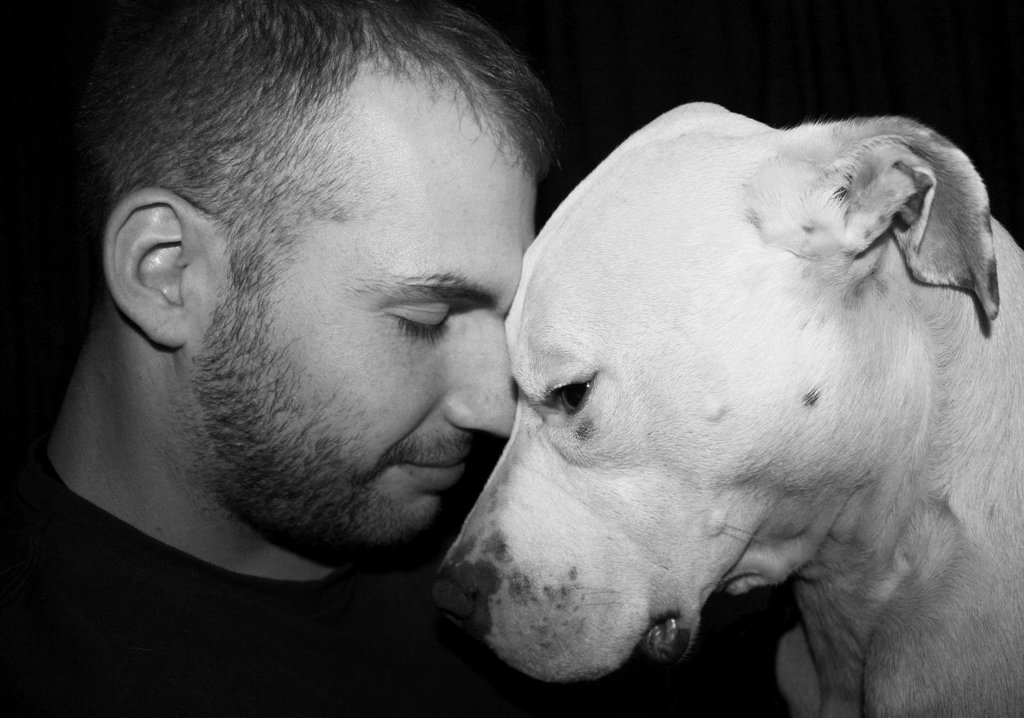
The love between a dog and a human – hugging a dog when one is feeling emotionally vulnerable is beyond measure.  Dogs always sense when we humans are feeling fragile and they offer their uncomplicated hearts to us without any condition or need for return.  That selfless love is an inspiring example of what we all need to learn to give one another.

Touch and social intimacy – we have so much to learn from dogs when it comes to touch and social intimacy.   We are all needy for touch.

Which leads me providentially to a recent item from Terry Hershey.  Terry came to Payson in March, 2011 and he was a most inspirational speaker.  I have followed him ever since.

Last Monday’s Sabbath Moment included the following story, republished with Terry’s kind permission – the story is all about touch!

Caroline was very sad. Caroline was only six years old and her father had just died. In fact, her father had been assassinated.

Sitting in the back of big black limousine, Caroline Kennedy didn’t quite know what to do with her sadness. On the seat next to her sat her nanny, Maud Shaw, and next to Maud, Caroline’s younger brother John.

Through the windshield Caroline could see her mother, Jackie, and her uncles, Robert and Ted, walking in front of the limousine as it slowly made it’s way down the Boulevard to St. Matthew’s Cathedral.  Looking out of her side of the car, Caroline recognized the friendly face of Secret Service agent, Robert Foster. She liked and trusted Robert Foster.

Not knowing what to do with her sadness, and on impulse, she rolled down the window and stuck out her six-year old hand. Agent Foster had a choice to make. Secret Service agents are not allowed to have their hands occupied, needing to be ready for any emergency. But Robert Foster didn’t even think twice. He held Caroline’s hand tightly the entire way to the cathedral.

Later, Agent Foster said it was all he could do to “fight back his own tears of sadness, for little Caroline Kennedy.” When asked about his kindness, he seemed surprised, “All I did was hold a hand,” he answered.

Terry then goes on to say,

We all know sadness. Life breaks for each one of us in different ways and in different places. And sometimes the sadness seems too much to carry.

It requires courage to roll down the window, to connect or ask or invite. For whatever reason, there is a knee-jerk need to deny any sadness, or dismiss it, or apologize for it. “I’m sorry,” people will say, wiping away their tears, as if their sadness is a violation of some tenet of propriety. Heaven forbid if any humanity is exposed.

So sometimes I am afraid to ask. Not sometimes; most times. I don’t want to appear weak. Asking for help is a hard pill to swallow.

I spent Saturday in Clearwater, Florida, with a group talking about intimacy and communication. (Yes, it is easier to talk about than to practice.)  Here’s what I told the group.

If we don’t bring it with us, we’re not going to find it there.  Which means intimacy–trust, vulnerability, authenticity, honesty–begins here.

With me. With this me.

I was raised in a religious environment that taught me to eradicate my messiness (to quash my sadness or grief or untidiness).

I now believe differently. I now know that we find and express acceptance, love and grace (the place where we can be fully human), in our messy, imperfect, and fully thorny selves. In other words: We can embrace this life–without any need to photoshop it.

To be human is to be vulnerable.  I am capable of being wounded and cut and sad… which also means that I am capable of being kind and generous and present.

In such moments of heartache, I can have the courage to ask for a hand to hold.

In such moments of heartache, I can have the courage to hold a hand the needs to be held.

Robert Foster didn’t think twice about holding a hand that needed to be held. And he wasn’t posturing or amassing heavenly brownie points. He was doing what needed to be done.

Here’s the deal: we don’t need more remedies or advice. We need more touch. We become more human when we touch. Why? Because when we touch, we are seen.  And when we are seen, we recognize that our value is not tied solely to our sorrow.

And we, you and I, will find no better lesson to learn from our beautiful canine friends, than this lesson of touch.

The loving touch of a dog.

Know your brain? Possibly not.

“Exact knowledge is the enemy of vitalism.” Francis Crick.

On the face of it, I’m going to write about two totally disparate aspects of the brain.  Or are they?

I subscribe to Naked Capitalism and one of my favourite aspects of Yves’s daily email presentation are the Links.  They cover an incredibly broad range of news items.

So it was perhaps a week ago or thereabouts that one of those links was to an item in the British newspaper, The Daily Mail.  Here’s how the article started,

Power really does corrupt as scientists claim it’s as addictive as cocaine

More than a hundred years after noted historian Baron John Acton coined the phrase ‘power tends to corrupt, and absolute power corrupts absolutely’ scientists claim the saying is biologically true.

The feeling of power has been found to have a similar effect on the brain to cocaine by increasing the levels of testosterone and its by-product 3-androstanediol in both men and women.

This in turn leads to raised levels of dopamine, the brain’s reward system called the nucleus accumbens, which can be very addictive.

Across in the English paper The Daily Telegraph, Dr Ian Robertson writes on this subject and says,

Unfettered power has almost identical effects, but in the light of yesterday’s Leveson Inquiry interchanges in London, there seems to be less chance of British government ministers becoming addicted to power. Why? Because, as it appears from the emails released by James Murdoch yesterday, they appeared to be submissive to the all-powerful Murdoch empire, hugely dependent on the support of this organization for their jobs and status, who could swing hundreds of thousands of votes for or against them.

Submissiveness and dominance have their effects on the same reward circuits of the brain as power and cocaine. Baboons low down in the dominance hierarchy have lower levels of dopamine in key brain areas, but if they get ‘promoted’ to a higher position, then dopamine rises accordingly. This makes them more aggressive and sexually active, and in humans similar changes happen when people are given power. What’s more, power also makes people smarter, because dopamine improves the functioning of the brain’s frontal lobes. Conversely, demotion in a hierarchy decreases dopamine levels, increases stress and reduces cognitive function.

OK, moving on.  On April 29th., there was an article on the Big Think website with the intriguing title of You Are Not Your Brain! 

What’s the Big Idea?

“Contemporary research on consciousness in neuroscience rests on unquestioned but highly questionable foundations. Human nature is no less mysterious now than it was a hundred years ago,” writes philosopher Alva Noë in his book Out of Our Heads.

It’s a bold assertion in an age when fMRI has enabled us to see images of the brain functioning in real time, and when many prominent public intellectuals (Stephen Hawking, Eric Kandel) have argued, either implicitly or vociferously, in favor of reductionism. The “brain-as-calculating machine” analogy assumes that human thought, personality, memory, and emotion are located somewhere in the gray matter protected by the skull. In other words, you — at least, the waking you who gets out of bed in the morning — are your brain.

But you’re not, says Noë. Just as love does not live inside the heart, consciousness is not contained in a finite space — it’s something that arises, something that occurs: a verb rather than a noun. And since the publication of Francis Crick’s influential The Astonishing Hypothesis: The Scientific Search for the Soul, scientists have been looking for it in all the wrong places.

That’s enough of me republishing the article – if it grabs your interest, do go and read it in full here.

And here’s Francis Crick with an extract from his DVD on the Scientific Search for the Soul

NOTE: This is an excerpt from the two-part, 60-minute DVD.
http://www.thinkingallowed.com/2fcrick.html

A noted scientist discusses free will, consciousness, attention and memory and their relationship to the human nervous system. In a wide ranging discussion, Crick points out that the hypothesis that the brain is the seat of consciousness has not yet been proven.

Francis Crick, Ph.D., received the Nobel Prize in 1962 for the discovery of DNA’s central role in the process of genetic reproduction. He is author of Life Itself, What Mad Pursuit and The Astonishing Hypothesis.

“Chance is the only source of true novelty.” Francis Crick