Category: Philosophy

Common sense!

Some people seem to have a knack for saying it how it should be!

My sub-heading, above, applies to many people right across the world.  But the reason that this was triggered in my mind for today’s post, was a recent item on Christine’s excellent Blog, 350 or bust.  Read more about that Blog here.  I subscribe to that Blog.

A couple of days ago, there was an article with the title of Live Long And Prosper, Already.  It started thus,

Gene Roddenberry, the creator of the amazingly popular Star Trek series, was a man ahead of his time. Here is one of the things he  had to say about humanity and our problems (with one editorial comment from me!):

“I believe in humanity. We are an incredible species. We’re still just a child creature, and we’re still being nasty to each other [Stephen Harper: are you listening?].  And all children go through those phases. We’re moving into adolescence now. When we grow up, man, we’re going to be something!”

But what caught my eye were these comments to the Post.

The first one from a Mickey Haist that read,

It’s a nice goal, but would clenching our teeth and willing progress be of any effect? After all, children don’t spontaneously mature – they’re raised.

Have to say that I was left unsure by what Mr. Haist was trying to convey.  But not so Christine!  This was the first of her two replies,

No teeth clenching allowed! Robert Kennedy once said “Each time a person stands up for an ideal, or acts to improve the lot of others, or strikes out against injustice, he or she sends forth a tiny ripple of hope. And crossing each other from a million different centers of energy and daring, those ripples build a current that can sweep down the mightiest walls of oppression and resistance.”

It’s not about everyone doing everything, it’s about each of us doing what we can. Not taking action because the problem is too big is not the answer.

And her second reply,

And Mickey – if the challenge of climate change/ocean acidification/biodiversity loss that we are facing as a species (taking the rest of the natural world with us) doesn’t make us mature, then nothing will.  But I believe it will – as Paul Gilding says, humans are slow but not stupid!

Paul Gilding’s excellent website is always a great read, by the way.

But do reread those words of Robert Kennedy, they are powerfully inspiring.

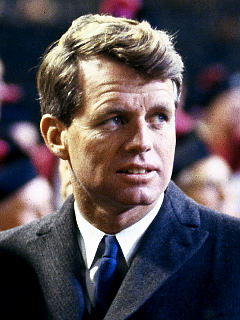
Robert Kennedy

Each time a person stands up for an ideal, or acts to improve the lot of others, or strikes out against injustice, he or she sends forth a tiny ripple of hope. And crossing each other from a million different centers of energy and daring, those ripples build a current that can sweep down the mightiest walls of oppression and resistance.

Despite the fact that these words were said in response when South Africans suffered the tyranny of apartheid, the words are, perhaps, even more relevant today.  Mankind has to combine the many ‘ripples of hope’ and build that current that will sweep away the crazy selfishness that is preventing us from living in harmony with this beautiful planet for hundreds of years ahead.

Thanks Christine.

Dogs and the mathematics of calculus.

A remarkable story about two very clever men and an equally clever dog!

Five days ago, I received an email from a Richard Hake quite out of the blue!  This is what it said,

Dear Paul Handover,

I’m taking the liberty of cc’ing this to Tim Pennings since he may be interested in your blog “Learning from Dogs.”
As founding author of the great blog “Learning from Dogs”, I thought you might be interested in the work of Tim Pennings.
Paraphrasing from the Hope College website:

*~*~*~*~*~*~*~*~*~*~*~*~*~*~*~*~*~*~*~*~*~*
Tim Pennings is a professor of mathematics at Hope College and owner of a famous Welsh Corgi dog, Elvis, who knows calculus. He has given over a hundred talks – including several speaking tours – based on his papers “Do Dogs Know Calculus?” [Pennings (2003)] and “Do Dogs Know Bifurcations?” [Minton & Pennings (2007)]. Articles about Elvis are easily found on Google and Youtube. For example:
1. “A Dog, a Ball, and Calculus” Ivars Peterson’s MathTrek,
2. “Calculating Dogs” Ivars Peterson’s MathTrek ,
3. “Dog Plays Fetch With Calculus” YouTube (see below)
4. “Elvis The Calculus Dog at Roanoke College” Vime0 Videos.
*~*~*~*~*~*~*~*~*~*~*~*~*~*~*~*~*~*~*~*~*~*

Regards,

Richard Hake, Emeritus Professor of Physics, Indiana University
Honorary Member, Curmudgeon Lodge of Deventer, The Netherlands
President, PEdants for Definitive Academic References which Recognize the Invention of the Internet (PEDARRII)

Well what fun!

Let me start with that YouTube video mentioned above:

Tim Pennings of Hope College in Madison, Wisconsin takes a look at the mathematics his dog Elvis uses to play fetch.

And here are a number of wonderful pictures of Elvis from which comes this one:

Elvis: Professor Tim Pennings' dog.

More may be learnt about Tim Pennings from here, from which I quote:

I am a professor of mathematics at Hope College. My areas of research and writing include dynamical systems (the shadowing property in particular), mathematical modeling, and the infinite. I have directed the Mathematics REU Site since 1995 and have mentored research students almost every year since 1990. A complete list of published papers, talks, and other professional activity is included in my vitae.

My interest in infinity stems from my intrigue with the rich stuff that lies in the confluence of mathematics, physics, philosophy, and theology. My paper, “Infinity and the Absolute: Insights into Our World, Our Faith, and Ourselves” is the backbone of my senior seminar course, Pondering the Big Questions. Several other math-theology papers, published in Perspectives include “A Life Lesson from Calculus” and “Haggai, Mathematical Dynamics, and the Nature of Good and Evil”.

I have a famous Welsh Corgi dog, Elvis, who knows calculus. Here are some pictures of us. We have given over a hundred talks – including several speaking tours – based on our papers “Do Dogs Know Calculus?” and “Do Dogs Know Bifurcations?” (written with Roland Minton) both published in the The College Mathematics Journal of the MAA. Articles about Elvis are easily found on Google and Youtube.

Finally, the author of the email, Richard Hake, is no slouch!  Here’s Richard’s Blog Hake’sEdStuff and information on his academic background.

Thanks, Richard, for getting in touch!

Being at sea!

A discovery of some writing from the past triggers memories.

Way back on the 15th November, 2009, I wrote a post about single-handed sailing and how it caused me much disquiet.  Rather than just leave you with a link to that reflection, I’m going to include the post again, below.  The reason is that a few days ago, in looking through some of my earlier writings in conjunction with a writing group that Jean and I belong to, I came across a piece that I wrote following a solo voyage from Larnaca in Cyprus, west along the Mediterranean Sea and then out over the Atlantic from Gibraltar to Horta on the  island of Faial in the Azores.  That last leg was a little over 1,100 nautical miles (1,300 land miles) and took me eight days.

So first here’s that earlier post from 2009.

A personal reflection on this rather strange way of travelling!

The recent Post about young Jessica Watson sailing alone around the world raised a few comments but also reminded me of my own experiences of solo sailing.

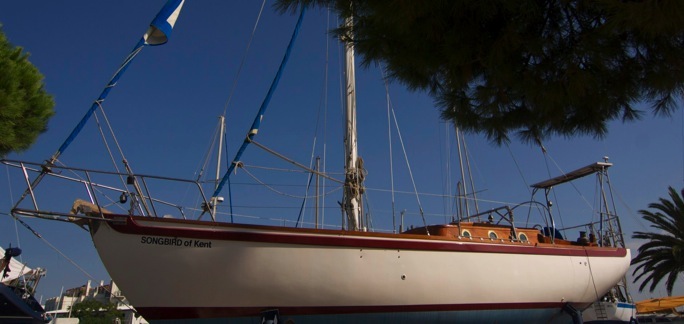
Some years ago, having successfully sold my own IT company, I warmed to the idea of being a full-time yachtie! A second-hand Tradewind 33 was discovered on the Island of Corfu.  (Now here’s a surprise!  I was just browsing the web looking for a picture of a Tradewind and came across my old yacht currently up for sale.  Her name is Songbird of Kent! Picture below.)

Songbird of Kent
Tradewind 33 - Songbird of Kent

Anyway, the deal was done and having sold my house in England I flew out to Corfu to collect Songbird of Kent. Inevitably it was a number of months before the boat was ready to head out into the Mediterranean but in early Spring 1988 it was time to explore the long coastlines of Greece and Turkey.

After a fantastic summer cruising from one idyllic anchorage to another mostly with friends or family on board, it was time to find a winter haven.  Many recommended Larnaca Marina in Cyprus.  Thus it was late in the summer of 1988 that I said goodbye to friends and set out on my own to cross from Antalya in Turkey to Cyprus and along the South coast of Cyprus to Larnaca, on the SE side of the island.

That sea crossing, a little over 200 nautical miles, was to become a regular solo experience at the start and end of each summer season. Impossible to do in a single day thus it always included a night at sea and rarely, if things didn’t go well with the weather, a couple of nights. I hated it! Maybe it was the sudden transition from coastal sailing to a deep water crossing, often going from having friends on board to being alone, but whatever it was I never enjoyed my time on my own and knew that long-distance solo sailing was never going to be my scene.

Anyway, I ended up spending several very happy winters in Larnaca.

One time, there was news of a Frenchman who had come into Larnaca on his way home to France having nearly completed a circumnavigation of the world. He was on his own!

I was astounded to hear how someone could do this and made a point of calling round to his berth. The boat was a beautiful, solid steel yacht, the very epitome of a craft that could challenge the oceans. The owner’s name was Pierre (it would be!). Pierre invited me aboard and we went down to his saloon to drink a hot coffee – real French coffee!

Inevitably the conversation turned to the challenges of sailing alone. Pierre said that the big cargo ships at sea moved quickly relative to the speed of a yacht so at night he set an alarm for every 15 minutes. That was the time that a ship could go from being hull down over the horizon to being close enough to be a hazard. Thus while at sea Pierre got up briefly every 15 minutes during the night to avoid being run down! It sounded totally exhausting.

Then Pierre asked me about the sailing I had done and whether I had sailed on my own. I declared my trivial journeys back and forth from Cyprus to Turkey and revealed that being on my own made me very, very unhappy. Pierre was surprised to hear that as he admitted that being at sea alone was one of the most tranquil and peaceful experiences ever. Pierre asked how long these solo journeys took. I replied, two or three days.

Ah!”, he said, “That is the problem.” “I, too, hate the three days. It is always a period where you adjust and it is terrible.

My friend, you must find a way to be alone for more than three days. You will see that it is very different.

It was some years before that opportunity came about but, in the end, I did undertake a solo journey of 8 days. Pierre was right. The first three days were hell, the rest were heaven!

Thank you, Songbird of Kent, you gave me some fabulous memories!

at sea

By Paul Handover

Now on to my writings about being out at sea alone on a small yacht.

Being at Sea

Going to sea in a small vessel is a profound experience.

In harbour we build up a reliance on things external. We have no need to worry if there is insufficient food on board, we can plug into the dockside power supply, sleep through the night undisturbed and we can wander off and enjoy the company of others if the boat feels a little claustrophobic.

Then slowly, imperceptibly, but with huge force, arrives the need to move on.  The realisation that our cosy life connected to the busy, bustling and self-obsessed world of shoreside is not fulfilling our search for adventure and for the truths that lay over the horizon.  It is time to leave.

The act of casting off is always exciting as it heralds a new adventure. But it also carries feelings of loss and apprehension as one lets go of the bonds of a previous certainty.  The first few hours are filled with the workload of getting one’s craft shipshape and battened down for the unknown seas. Then gradually comes the realisation that the land is now less the dominating visual feature than the vastness of the seascape that is ahead.  But with the land in sight, albeit a distant horizon behind one, you can still sense the life you are leaving.

Now all that surrounds you is the sea.  You are now truly disconnected from the land.  It is often at this point that despondency and uncertainty play with your mind; after all this new life is still very unfamiliar compared to the warmth of that island home that still resonates in your heart. Time to remind yourself of why you wanted to take this voyage.

A small boat is very fragile.  Just a centimetre of hull separating you from the unimaginable depths of the ocean beneath your keel. Not until the end of your voyage, when you draw your boat up, metaphorically on to that beach, will you ever stop feeling how close fate is, how it rides on your shoulder night and day. That, of course, is why we go to sea. It is the place where we taste life, where we savour each moment of the present because the future seems too bound up in the mystery, the uncertainty of the ocean. You are in charge of your tiny craft. Your survival depends on how you manage your small ship, how you navigate these seas, how you read the weather ahead and avoid the storms.

Soon your life on the ocean becomes everything to you. You have time to reflect on so much that is left behind. The distance seems to dissolve all the nuisances, bring into focus all the things that are important to you. There is no certainty with the ocean apart from the knowledge that you are very small and very, very vulnerable and yet, in a sense, also so strong.

In the end, we have to break away from our insecurities and our emotional dependencies on external people and situations because, without that, we are never able to command our own life and the destiny that flows from that captaincy.  There is a real strength in knowing ourselves as we would know our own boat.  If we really know every spar, sail, rope and fitting, if we have real understanding of the strengths and weaknesses of our small vessel then we are able to know when to breast the waves or when to turn and run before the storm.  We are secure that our small craft will protect us day and night.

Thus self-knowledge gives us the same freedom to manage our lives, to know when to fight and when to turn away.  And just as after every long voyage the boat will need hours of careful maintenance so our own souls need regular love and caring from our spiritual keeper.

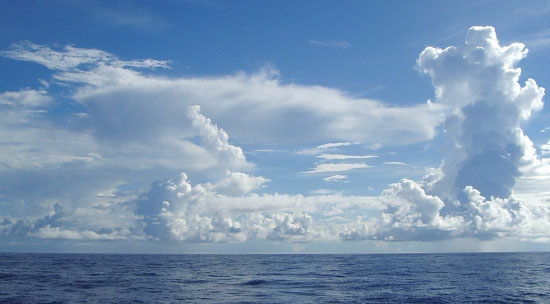
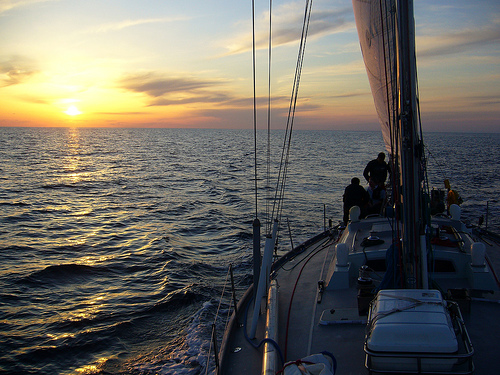
The setting sun ahead of a night on the ocean.

Copyright © 2008 Paul Handover

The unconscious

A Biological Basis for the Unconscious? Surely not?

Ten days ago or thereabouts, I saw a piece on Big Think about the unconscious.  The title of the piece was as the sub-heading: A Biological Basis for the Unconscious?  I was intrigued, to say the least, and wanted to write about that on Learning from Dogs.

The article started thus:

What’s the Big Idea?

Eric Richard Kandel

Today, the question of how people make decisions is an animated and essential one, capturing the attention of everyone from neuroscientists to lawyers to artists. In 1956, there was one person in all of New York known for his work on the brain: Harry Grundfest. An aspiring psychiatrist who was born in Austria in the 1930’s, Eric Kandel took an elective in brain science during medical school and found himself studying alongside Grudfest at Columbia University.

“What is it you want to study?” Grundfest asked Kandel. “I want to know where the id, the ego, and the super-ego are located in the brain,” Kandel replied. Grundfest looked at him as if he was crazy. “I haven’t got the foggiest notion whether these constructs exist,” he said. “But the way to approach the brain is to study it one cell at a time. Why don’t you study how the cells work?”

Now it would be improper to republish the whole article, not having permission to so do, and I thoroughly recommend you going to the article here and reading it completely from the Big Think website.

But there are a number of interesting videos on YouTube and the one I have selected is a great example of Kandel’s power of mind.  As the short description of the video reveals, “A Conversation With Nobel Laureate Eric Kandel, Who Continues to Look Forward at 80.”

Happiness = Ten minus five or thereabouts!

Brilliant mathematics without the need for a calculator!

Thanks to the bottomless resources of the Internet, I could quickly find a relevant quote or two to open up today’s Post.  Rene Descartes (1596-1650) was reputed to have said, “Perfect numbers like perfect men are very rare.

Sorry, couldn’t resist that!  It wasn’t the quote relevant to this essay but it was too good to miss.  (Descartes was also the person who coined the phrase: I think therefore I am!)

 The quote that I thought was relevant was this one from Descartes, “With me everything turns into mathematics.”  Well until I read something recently on the Big Think website I would have been certain that the emotions, such as happiness, were well beyond reach of the logical power of mathematics.  I was wrong!

Big Think recently reported on a new book from Mr. Chip Conley called Emotional Equations where he …….,

….. argues (against Einstein, as it happens), that everything that counts can and ought to be counted. A hotelier by trade, he says that GDP and the bottom line are blunt instruments for measuring the health of a society or a business. After the dot.com crash of 2001, and a visit to the Buddhist nation of Bhutan, which has a “Gross National Happiness” index, Conley and his team decided to create indices for measuring the well-being of their employees and customers.

And a paragraph later continues,

In Emotional Equations, Conley takes the mathematics of human happiness a step further, creating simple formulas like anxiety = uncertainty x powerlessness, which, when used systematically, he says, can give individuals and organizations a concrete method for addressing the human needs that drive them.

The description of the book on the Amazon website is thus,

Mr Chip Conley

Using brilliantly simple math that illuminates universal emotional truths, Emotional Equations crystallizes some of life’s toughest challenges into manageable facets that readers can see clearly—and bits they can control. Popular motivational speaker and bestselling author Chip Conley has created an exciting, new, immediately accessible visual lexicon for mastering the age of uncertainty. Making mathematics out of emotions may seem a counterintuitive idea, but it’s an inspiring and incredibly effective one in Chip Conley’s hands. When Conley, dynamic author of the bestselling Peak, suffered a series of tragedies, he began using what he came to call “Emotional Equations” (like Joy = Love – Fear) to help him focus on the variables in life that he could deal with, rather than ruminating on the unchangeable constants he couldn’t, like the bad economy, death, and taxes. Now this award-winning entrepreneur shares his amazing new self-help paradigm with the rest of us. Emotional Equations offers an immediately understandable means of identifying the elements in our lives that we can change, those we can’t, and how they interact to create the emotions that define us and can help or hurt our progress through life. Equations like “Despair = Suffering – Meaning” and “Happiness = Wanting What You Have/Having What You Want” (Which Chip presented at the prestigious TED conference) have been reviewed for mathematical and psychological accuracy by experts. Conley shows how to solve them through life examples and stories of inspiring people and role models who have worked them through in their own lives. In these turbulent times, when so many are trying to become “superhuman” to deal with our own and the world’s problems, Emotional Equations arms readers with effective formulas for becoming super human beings.

So it all seems not quite so daft as one might initially guess.  Indeed, settle down for twenty minutes and watch Chip eloquently explain his ideas captured at that TED Conference referred to above.

There’s also an audio conversation with Mr. Conley that you can download free from here.

Finally, let me close with yet another quote from Rene Descartes, “It is not enough to have a good mind. The main thing is to use it well.” Amen to that!

Isn’t anyone going to find me?

The most beautiful story of a dog rescue.

It’s been a while since Sue of Dreamwalker’s Sanctuary and I started following each other’s Blogs and from time to time Sue sends me an email with something for Learning from Dogs.  On the 20th March, I published a guest post from Sue called the Winds of Change.  If you didn’t read her wonderful poem then do go there and read it.

Anyway, just a couple of days ago Sue sent me an email with a link to a YouTube video.  Put aside a few minutes and be entranced.

So you have just watched the video.  How do you feel?  I bet that your feelings are not a million miles from the realisation that, like Fiona the dog, being ‘lost‘ is an uncomfortable, unsettling but necessary step along the journey of being ‘found‘.  As I wrote in the concluding part of my story Night messages, “The message from the night, as clear as the rays of this new day’s sun, the message to pass to all those he loved. If you don’t get lost, there’s a chance you may never be found.”

When the bond between a human and a dog is expressed as deep love, as it so often is, we relearn the most important lesson of all creation.  That mankind’s only hope for the future comes from the pool of love.

No better portrayed than by the photograph below that I presented in a Post on the 17th March, Change out of Hope.

The power of love.

The one absolutely unselfish friend that man can have in this selfish world, the one that never deserts him, the one that never proves ungrateful or treacherous, is his dog.“ Samuel Coleridge

Optimistically unrealistic!

A reflection of our unconscious minds – and the potential perils ahead.

Last Monday, March 12th, the BBC aired a programme under their excellent Horizon science series.  This programme was entitled, Out of Control?  Here’s how the programme was introduced,

We all like to think we are in control of our lives – of what we feel and what we think. But scientists are now discovering this is often simply an illusion.

Surprising experiments are revealing that what you think you do and what you actually do can be very different. Your unconscious mind is often calling the shots, influencing the decisions you make, from what you eat to who you fall in love with. If you think you are really in control of your life, you may have to think again.

The whole 60 minute programme was fascinating right from the start when Professor Nobre introduced the secret world of our unconscious mind.  Professor Anna Nobre heads The Brain & Cognition Laboratory, a cognitive neuroscience research group at the Department of Experimental Psychology in the University of Oxford.

For starters, how much of your mind do you think is your conscious mind as opposed to your unconscious mind?  Watch this clip and be amazed!

“Are you in control of your unconscious, or is it in control of you?”

So let me link how our mind works to something more relevant today than possibly any other aspect of life.

I’m thinking of the fundamental question that bothers me and, perhaps millions of others.  That question being: “Why, with the overwhelming scientific evidence that man is critically threatening the planet’s biosphere upon which we all depend, is there not an equally overwhelming global commitment for change to a sustainable way of life?

Take, for example, this compelling story.

Last Saturday the BBC News website published a report by Richard Black, the BBC’s Environment correspondent, that opened thus,

An eminent UK engineer is suggesting building cloud-whitening towers in the Faroe Islands as a “technical fix” for warming across the Arctic.

Scientists told UK MPs this week that the possibility of a major methane release triggered by melting Arctic ice constitutes a “planetary emergency“. [my emboldening]

The Arctic could be sea-ice free each September within a few years.

and later goes into this detail (do please read it all, it’s only a few minutes of quiet reading),

On melting ice

The area of Arctic Ocean covered by ice each summer has declined significantly over the last few decades as air and sea temperatures have risen.

For each of the last four years, the September minimum has seen about two-thirds of the average cover for the years 1979-2000, which is used a baseline. The extent covered at other times of the year has also been shrinking.

What more concerns some scientists is the falling volume of ice.

Analysis from the University of Washington, in Seattle, using ice thickness data from submarines and satellites, suggests that Septembers could be ice-free within just a few years.

Data for September suggests the Arctic Ocean could be free of sea ice in a few years

“In 2007, the water [off northern Siberia] warmed up to about 5C (41F) in summer, and this extends down to the sea bed, melting the offshore permafrost,” said Peter Wadhams, professor of ocean physics at Cambridge University.

Among the issues this raises is whether the ice-free conditions will quicken release of methane currently trapped in the sea bed, especially in the shallow waters along the northern coast of Siberia, Canada and Alaska.

Methane is a much more potent greenhouse gas than carbon dioxide, though it does not last as long in the atmosphere.

Several teams of scientists trying to measure how much methane is actually being released have reported seeing vast bubbles coming up through the water – although analysing how much this matters is complicated by the absence of similar measurements from previous decades.

Nevertheless, Prof Wadhams told MPs, the release could be expected to get stronger over time.  “With ‘business-as-usual’ greenhouse gas emissions, we might have warming of 9-10C in the Arctic.  That will cement in place the ice-free nature of the Arctic Ocean – it will release methane from offshore, and a lot of the methane on land as well.”

This would – in turn – exacerbate warming, across the Arctic and the rest of the world.

Abrupt methane releases from frozen regions may have played a major role in two events, 55 and 251 million years ago, that extinguished much of the life then on Earth.

Meteorologist Lord (Julian) Hunt, who chaired the meeting of the All Party Parliamentary Group on Climate Change, clarified that an abrupt methane release from the current warming was not inevitable, describing that as “an issue for scientific debate”.

But he also said that some in the scientific community had been reluctant to discuss the possibility.

“There is quite a lot of suppression and non-discussion of issues that are difficult, and one of those is in fact methane,” he said, recalling a reluctance on the part of at least one senior scientists involved in the Arctic Climate Impact Assessment to discuss the impact that a methane release might have.

Reams of other factual evidence shows that mankind may have only a few years left to stop the planet going into a runaway condition that would then extinguish much of the life on Earth!

So what’s stopping us?

Dr. Sharot

Well back to that Horizon programme.  In the programme, Dr. Tali Sharot of University College London explains how we are all optimists despite the risks.  I.e. our unconscious mind deliberately prevents negative information from affecting our conscious mind, our conscious judgment.

In an experiment, an individual is asked to guess the likelihood of a whole range of outcomes, 80 in all.  Ergo, you see a gentleman guessing the likelihood of cancer as 18%, of a bone fracture as 10%, of Alzheimer’s as 2%, and so on.

In some cases he guessed a pessimistic probability, in others an optimistic probability.  After each guess he was shown the correct probability.  E.g. cancer 30% vs his estimate of 18%, for a bone fracture 34% vs his guess of 10%, and the risk in reality of Alzheimer’s is 10% versus his instinct of just 2%.   I’ve just quoted his optimistic guesses, in many questions his guess was a pessimistic view, i.e. he guessed a higher likelihood than the statistical reality.

Then he was asked all 80 questions again, having seen the accurate probability compared to his intuitive guess.

So here’s the fascinating outcome.

Where his instinct was a negative guess versus the statistical probability then he adjusted his mind and was able to quote a more accurate figure the second time around.  But where the reality was more pessimistic than his first guess, then that adjusted knowledge wasn’t retained.  In other words, our beliefs only change when we can adjust to a more positive view of the future.

I just hope I have made that clear.  Readers may like to view an article written by Dr. Sharot published in TIME Magazine in May, 2011, called The Optimism Bias or read the introduction to a lecture given in Seattle in June, 2011;  “A sunny outlook doesn’t just make you a more pleasant companion: Tali Sharot argues that optimism is a tool for survival and happiness that gets us through hard times—even an economic recession. Sharot, author of The Optimism Bias, uncovers myths about optimism, illuminates the ways it can affect our lives, examines why optimism is necessary for us to function, and illustrates how the human brain is extremely adept at turning lead into gold.

A summary of a publication, Sharot, T. (2011). The optimism bias. Curr Biol 21(23), R941-R945, reads,

The ability to anticipate is a hallmark of cognition. Inferences about what will occur in the future are critical to decision making, enabling us to prepare our actions so as to avoid harm and gain reward. Given the importance of these future projections, one might expect the brain to possess accurate, unbiased foresight. Humans, however, exhibit a pervasive and surprising bias: when it comes to predicting what will happen to us tomorrow, next week, or fifty years from now, we overestimate the likelihood of positive events, and underestimate the likelihood of negative events. For example, we underrate our chances of getting divorced, being in a car accident, or suffering from cancer. We also expect to live longer than objective measures would warrant, overestimate our success in the job market, and believe that our children will be especially talented. This phenomenon is known as the optimism bias, and it is one of the most consistent, prevalent, and robust biases documented in psychology and behavioral economics.

More fascinating information can be found at the Affective Brain Lab.

So here’s the crunch!

Our bias towards an optimistic future is a “tool for survival and happiness that gets us through hard times.”  But if that ancient bias is preventing mankind from recognising just how close we may be to some form of ‘tipping point’ then this tool for survival may be our undoing.

But if on the other hand, we now unite in changing our ways, first by community then by town then by country our future is incredibly optimistic.

 “A single candle may light a thousand others and they in turn many thousands more” – Buddha

The mystery of nature.

Spellbinding!

English starling

Ginger I. who works at the Payson branch of the Humane Society of Central Arizona recently sent me the following video on the magic of a flock of starlings.  It’s … well, you watch it and fill in the rest of the sentence; I ran out of words.

A short film that follows the journey of two girls in a canoe on the River Shannon and how they stumble across one of nature’s greatest phenomenons; a murmuration of starlings.

A murmuration is a…

/merr’meuh ray”sheuhn/, n.

1. an act or instance of murmuring.

2. a flock of starlings.

Ginger also included the following in her email,

A mystery of nature:

No one knows why they do it. Yet each fall, thousands of starlings dance in the twilight above England and Scotland. The birds gather in shape-shifting flocks called murmurations, having migrated in the millions from Russia and Scandinavia to escape winter’s frigid bite.

Scientists aren’t sure how they do it, either. The starlings’ murmurations are manifestations of swarm intelligence, which in different contexts is practised by schools of fish, swarms of bees and colonies of ants. As far as I am aware, even complex algorithmic models haven’t yet explained the starlings’ aerobatics, which rely on the tiny birds’ quicksilver reaction time of under 100 milliseconds to avoid aerial collisions—and predators—in the giant flock.

Despite their tour de force in the dusky sky, starlings have declined significantly in the UK in recent years, perhaps because of a decline in suitable nesting sites. The birds still roost in several of Britain’s rural pastures, however, settling down to sleep (and chatter) after their evening ballet.

Two young ladies were out for a late afternoon canoe ride and fortunately one of them remembered to bring her video camera. What they saw was a wonderful murmuration display, caught in the short video above. Watch the variation of colour and intensity of the patterns that the birds make in close proximity to one other.

I also quickly found a second video on YouTube that seemed worthy of including in this Post.

This astonishing sequence was filmed by wild life cameraman and travel journalist Dylan Winter who is currently sailing around the UK in an 18 foot boat. You can follow his journey and see more of his work at www.keepturningleft.co.uk.

Now I know that as I get older I seem to be turning into an emotional mess!  But a very happy mess!  I mention this because both films had me in tears.  Why?  Not really sure.  But I sense that when one looks at such beauty, such real pure magical beauty, and then reflects on the stupidity, greed and shortsightedness of mankind the contrast is almost too much to handle!

Mr Carter’s amazing photo.

A poetic response from reader Marcia G.

This is in response to the item that I republished last Thursday, originally on Nakib’s blogsite, Freedom to Survive.  Do visit it.  Marcia in response sent in the following poem.

The Onlooker

He stood across the street and sadly saw
The little match girl standing in the rain;
She looked as if she didn’t have a prayer.
He wondered why there wasn’t yet a law
To spare her from unnecessary pain,
And how could people just walk by her there?

He raised his head toward Heav’n in awe and fear
And let the raindrops hit his youthful face,
While speaking toward the softly weeping sky,
“Dear God, why haven’t you done something here?
“I have the faith that You’re nearby some place,
“But there’s no sign that you’ve been helping; why?”

Then God replied, “I have…it’s nothing new;
“For such a purpose I created you.”

Thank you, Marcia.

When I see how this new, virtual world connects us across the world with so many others that know what is truly important, I do have hope for the future.

Words of wisdom

Leaning on a recent item from Terry Hershey

As many of you will appreciate, this has been a bit of a week.  It started last Sunday with my contribution to the national ‘preach-in’ for the health of our planet, and ended with the sad loss of Phoebe.  I normally post something light-hearted or trivial for the week-end but seem to be in a more reflective mood just now (Friday).

For some time I have subscribed to the weekly spiritual offering from Terry Hershey and am going to republish a story that came out from Terry Hershey on the 13th.

Letting go and walking

February 13, 2012

Some of us think holding on makes us strong, but sometimes it is letting go. Herman Hesse.

Uncertainty is the only certainty there is, and knowing how to live with insecurity is the only security. John Allen Paulos

When you let go of trying to get more of what you don’t really need, it frees up oceans of energy to make a difference with what you have. Lynne Twist

And now the story,

There is a Tibetan story about an earnest young man seeking enlightenment. (Earnest people must think this quite unfair–since they play a central role in most parables and stories about enlightenment.)

A famous sage passes through the man’s village. The man asks the sage to teach him the art of meditation. The sage agrees. He tells the man, “Withdraw from the world. Mediate every day in the specific way I will teach you. Do not waver and you will attain enlightenment.”

The earnest man follows the sage’s instructions to the letter. Time passes–and no enlightenment. Two years, five, ten, twenty pass.

It happens that the sage once again passes through the man’s village. The man seeks him out, grumbling that despite his best intentions and devotion and diligent efforts, he does not achieve enlightenment. “Why?”

The sage asks, “What type of meditation did I teach you?
The man tells him.

The sage says, “Oh, what a terrible mistake I made! That is not the right meditation for you. You should have done another kind altogether. Too bad, for now it is too late.”

Disconsolate, the man returns to his cave. Staking his life on the sage’s instructions, and now believing he is without hope, the man abandons all his wishes and efforts and need to control his road to enlightenment. He does not know what to do. So, he does what knows best: he begins meditating. And in a short while, much to his astonishment, his confusion begins to dissolve, and his inner world comes to life. A weight falls away and he feels lighter, and regenerated. When he walks out of the cave, the sky is bluer, the snow capped mountains whiter, and the world around him more vivid.

There is no doubt that all too often, our efforts–to succeed or achieve or attain–get in the way of our living. It brings to mind my favorite Robert Capon quote, “We live life like ill-taught piano students. So inculcated with the flub that will get us in dutch, we don’t hear the music, we only play the right notes.”

I understand. I was weaned on a spirituality that predicated itself on artifice. In other words, the importance is placed upon appearance, rather that just being. (It was vital to “look spiritual.” Which begs the question, “What do spiritual people look like?” As a boy, I always thought the “spiritual people” looked as if some part of their clothing was a size too small.)

What is it we are holding on to–so rigid, so firm, white-knuckled in our determination?  At some point, we’ve got to breathe.  Just breathe.  Without realizing it (and after the sage’s disheartening news), the man in the story “let go.”

He let go of the need to see life as a problem to be solved.
He let go of the need to have the correct answers (or experiences) for his “enlightenment.”
He let go of the need to see his spiritual life in terms of a formula.
He let go of the restraints that come from public opinion.

Abandon your masterpiece, sink into the real masterpiece.
Leonard Cohen

Without realizing it, he took Leonard Cohen’s advice. He abandoned his “masterpiece”–the perception of what he needed to accomplish, or how he needed to appear, or what he needed to feel–in order to allow himself to sink down into this life, this moment, even with all of its uncertainty and insecurity.

So a big thank you to Terry Hershey for those words of wisdom.