I subscribe to Christine’s blog 350 or bust. As the home page declares, Christine is “a mother, an educator, and a former registered nurse, concerned about climate change.”
Being a follower of Christine’s blog I automatically received an email on Tuesday about her latest post. This is what that email said,
It’s TED Talk Tuesday on 350orbust. Here’s a fascinating TEDx talk by South African trainer and speaker Bruce Muzik whose “passion is having people experience unprecedented freedom and happiness, through being Authentic.“
To be perfectly honest, it didn’t strike me as something that I would watch anytime soon. However, fate decided to intervene!
Because yesterday, Wednesday, I went up to Portland for an interview today to convince the authorities that I was safe to have my US Residency renewed (aka Green Card). So last Tuesday, when I was writing these words, I thought I would just grab something quickly for today’s post. Christine’s TED talk seemed an easy answer.
I started to watch the video and within just a few minutes was overwhelmed with Bruce Muzik’s story. At the 7 minute mark I paused the video and wrote these words. The title of today’s post comes from the video just a moment after the 7 minute point.
While the video is about Bruce confronting his inner fears over his racial prejudices, and is no less moving for doing that, there was another message surfacing in parallel in my consciousness.
As I wrote not so long ago under the title of Going beyond the self, “the human psyche lives in a bubble of delusion.” In the same way that Bruce had to cast aside his delusions and embrace the reality of black people, we have to cast aside our delusions about the way the world is heading. Which is why Christine’s titleHow Our Secrets Steal Our Lives was just perfect.
So without further ado, here is that speech by Bruce Muzik. Twenty minutes of pure, gorgeous inspiration.
There were a great number of ‘Likes’ for John Hurlburt’s writings which were published most recently on the 1st March, Making sense of life? and on the 25th February, Fear versus Faith.
So it is with very great pleasure that I pass the baton for today’s post once more across to John.
oooOOOooo
E Pluribus Unum
We know we’re in trouble when we no longer pay serious attention to the weather, the foundations of our economy are imaginary, our pumps don’t work because our wells are running dry. Then how we distract ourselves and loudly complain more often than we make a honest effort to maintain our balance and understand our inclusive situation.
We know we’re in trouble when we’ve moved into the rut of a manufactured illusion and furnished it, when we consume more than we produce, when equality has become a dirty word, when we believe that more guns reduce gun violence, when contempt of Congress has become a national pastime and when our supreme court has become a corporate political tool.
We know we’re in trouble when we fund both sides of a global oil war and neglect the needs of our war veterans, when we believe that we can adapt to change by standing still, when we’ve taken the culture out of agriculture, when we wage cyber war against our planetary neighbors, when an obsessive focus on money systemically corrupts our world and when democracy has a price tag.
We know we’re in trouble when there is virulent opposition to change, when a corporate backed element of our civilization insists upon obfuscation denial and obstruction, when ignorance has become more common than common sense, when a global religious faith and a major university are fractured by inappropriate physical conduct with children in the name of God and sports respectively, and when our primary purpose appears to be to consume our planet as cost effectively as practicable.
We know we’re in trouble when our rivers run dry, when our food is laced with pesticide residues, when our air is contaminated by fuel and chemical waste products, when living species are becoming extinct from the bottom of the food chain and up at a rapidly increasing rate, when we chose to ignore the realities of our natural condition as transitory inhabitants of a living planet and when we arrogantly choose to believe that we own planet earth either as a species or as individual members of a species.
We know that we’re in trouble when free speech is thought to include an unbalanced right to be aggressively ignorant, intolerant and uncompassionate despite all facts to the contrary, when we no longer believe in simple science and arithmetic and when we concentrate on undoing social issues which have been resolved in our lifetimes rather than honestly facing the confluence of problems we all share.
We know we’re in trouble when our politics are more about posturing than policy, when prisons have become a growth industry, when levels of state secrecy exceed open disclosure, when justice has a price tag, when bigotry is stronger than progress, when education is based upon opinion rather than fact and when one nation under God, with liberty and justice for all, has become a fractured nation with a dysfunctional government.
We know we’re in trouble when our legislatures have been purchased, when faith in our financial system has been willfully damaged, when political leaders engage in childish tantrums to get their way regardless of anything or anyone else, when awareness of moral reality has become meaningless and when we fail to appreciate the depths of a looming abyss. What do we gain by purposefully destabilizing our economy, reopening settled social issues and blatantly risking our inclusive future as a species for a mess of pottage? Who do we think we are?
We know we’re on the right track when nature is more important to us than profit, when open mindedness is stronger than private interests, when media reports facts rather than conjecture and when freedom of speech is not taken to wretched excess as a psychological tool of cultural management employed for the exclusive benefit of an affluent minority.
We know we’re on the right track when our faith in power greater than our species is more significant than short-term profit, when we create equitable employment which benefits our environment, when we repair our crumbling infrastructure, when we make an effort to improve our inclusive quality of life, when war is no longer a first remedy for misunderstanding or disagreement and when we make an effort to reverse our established patterns of self destruction.
We know we’re on the right track when we tax our world stock markets because of our need for revenue based upon the fact that market trades are the only major form of financial transaction that remains untaxed, when we cultivate our cities and towns based on biological needs for clean air, water, food, and energy and when we begin to recognize the massive burden which world population growth places on our planet and take steps to balance our birth rate accordingly.
We know we’re on the right track when we realize that algae based bio-fuel will run every diesel engine in the world without modification, when we realize that our future must be beyond the earth and when we take further steps beyond our garden cradle on a journey of exploration to the stuff of the stars from which our life on earth emerges.
Change is a constant. Today is the tomorrow we dreamed of yesterday. We know we’re growing as a consciously aware life form when our faith is stronger than our fear, when we trust each other to do the next right thing and when the nature of the energy of our spiritual being is more important to us than the immediate comforts of our transitory material being. One day at a time. In God we trust.
I closed yesterday’s post with this quotation from Carl Sagan, “It is far better to grasp the universe as it really is than to persist in delusion, however satisfying and reassuring.“
So easy to write. Nay, a thousand times more easy to trot out than to embrace. Even that word embrace is too warm and fuzzy.
I’m sure that the human psyche lives in a bubble of delusion. Clearly, if the level of delusion is abnormal then we can’t function properly as social animals. Just take a moment or two to muse over the ways that you ‘shelter’ from reality. Trust me I don’t exclude myself.
However, there are times when reality with a capital ‘R’ smacks us in the face. Death of a loved one, unanticipated break-up of one’s marriage are two that come to mind. Undoubtedly, there are others.
In yesterday’s post where I wrote of my experiences from reading Guy McPherson’s book, Walking Away from Empire, I freely admitted the struggle of embracing the truth, the Reality of where we are; ‘we’ as in industrialised man.
Aristotle (384 BC – 322 BC)
Reflect on the relationship that hope has with reality. Aristotle wrote, “Hope is a waking dream” and that comes from over 2,300 years ago!
More recently, the aforementioned Professor wrote of hope:
With respect to the question, I spoke and wrote about hope way back in August 2007, when this website was launched. In that long essay — the bloated, unedited, transcript of a presentation I had delivered a few days earlier — I described hope as follows:
I view hope as the left-brain product of love, analogous to democracy as the product of freedom, or liberty. Notably, Patrick Henry did not say, “Give me democracy or give me death.” Like the rest of the founding fathers, Henry knew that freedom was primary to democracy; without the guiding light of freedom, or liberty, democracy breaks up on the shoals. Love keeps our left brain in check — that’s the message of the world’s religions. But our right-brain love creates the foundation for hope: love for nature, love for our children and grandchildren, love for each other. Without love to light the way, hope breaks up on the shoals.
Staying with Guy McPherson for a tad longer, over on Transition Voice there was an essay from him under the title of Sadly, extinction is no laughing matter.
Picking up on the Carl Sagan quote again (“It is far better to grasp the universe as it really is than to persist in delusion, however satisfying and reassuring.“) McPherson writes:
Many people disagree with Sagan, choosing delusion over reality, believing we can have infinite growth on a finite planet with no consequences for people or other creatures, other life forms, other organisms. The people in this latter group seek hope, and many of them disparage me and my actions for inducing despair.
Finally, though, I’ve concluded that hope is hopeless. As Friedrich Nietzsche pointed out, “Hope is the most evil of evils, because it prolongs man’s torment.”
To put Ed Abbey’s spin on it, “Action is the antidote to despair.” So, even though I no longer think my actions matter for humans, I’ll take action.
A worthy pity party
Near-term human extinction is a difficult pill to swallow, as is economic collapse. But ignoring ugly truths does not make them any less true. Despair is an expected and appropriate response to this information. Recognizing, accepting, and moving beyond despair are important subsequent steps.
But first, let’s despair.
Ed Abbey’s idea that action is the antidote to fear reminds me of a recent essay from Alex Jones over at The Liberated Way. (If you haven’t previously come across Alex’s writings trust me you will be inspired!)
That essay was How to change the world published on the 28th February last. Here’s how it opens:
Changes to self acts as ripples of change to the world.
Throw a rock into a pool it creates ripples, eventually the pool grows still again. Like the pool nature will move to a state of harmony if given the chance.
We all know that humanity and this planet suffer many challenges. Many feel they need to change or improve the world. Those people fail to realise that nature knows where the state of harmony is, and is attempting to get to that state of harmony, therefore one has no need to change or improve the world.
The reason those words jumped off the page at me (OK, screen!) was the key message that letting go of what man feels compelled to do and allowing the natural forces on this planet to reign supreme is the answer. The message that we have to go back to the natural way of doing things. Right back to the harmony that early man had with the planet before farming corrupted our values.
Alex’s essay continues:
The problem with the desire to change the world is it becomes a form of control, attempting to force others to do something they have no desire to do. One of the problems of humanity is control, everyone trying to control each other, self and nature, which ends in conflict where nobody but the strongest wins. The problem with control is choice, liberty and creativity is taken away from those being controlled, and there is no opportunity to gain wisdom from mistakes.
I have spent too many years of my life trying to change or improve the world. I won some battles, I lost others. Worse, I became sometimes no better than those I fought against. Often control made the situation worse. I am reminded of the Greek legend of King Sisyphus who was condemned to roll a boulder up a steep hill only to see it roll down again, an activity he was condemned to repeat for all of eternity. Trying to change or improve the world was my equivalent of King Sisyphus.
The answer is to be a ripple of change to the world by doing our own thing. By changing ourselves, by living our dreams, setting an example, we emanate ripples of change into the world. We transform the world by transforming ourselves. Remember that stone that splashed into the pool? We are the stone, our activities in making ourselves happy, healthy and abundant becomes the ripples of change into the world. We force nobody to do anything, since all our efforts are focused on ourselves, we show by example which others may copy. People will follow our example since they see what we do works.
It is hard to let go, but let go we must. Change is inside rippling outwards.
It’s the old adage about change. It first has to start from within. As I warned in yesterday’s post, “When you read this book brace yourself for what you see staring out of the mirror back at you. There will be no room left for delusion.”
Ironically for a post that carries the title of ‘Going beyond the self” going out of oneself is the only way to see reality, to brush away delusion. From which place one can then allow change from within to occur.
I shall close with a quote from one of my favourite authors Aldous Huxley:
“Experience is not what happens to you; it’s what you do with what happens to you.”
For every one of us there is no escaping change. It’s always been been that way; always will be.
Today, however, there’s an additional unsettling element. I’m speaking of the growing realisation that humanity could be facing the perfect storm. The ultimate storm of runaway climate change and the collapse of our global economy.
Therefore, when one comes across the wind of common-sense it needs to be promoted. My reason for promoting the opening speech by Jennifer Granholm at the TED2013 conference.
Because if we are to find a way of avoiding this storm, we have to do it through innovative ways of thinking and behaving. Each and every one of us deciding to work for a better future. (And see my P.S.)
P.S.
Back in the days of dogs living as coherent packs, one of the key roles of the alpha dog was to decide a change of territory. Then she, because the alpha dog was always a female, would lead the pack to a better place.
So we should learn from our ancient furry friends and take personal responsibility to find a ‘better’ place for ourselves and all our loved ones.
“Fear comes from uncertainty. When we are absolutely certain, whether of our worth or worthlessness, we are almost impervious to fear.”William Congreve, English playwright and poet.
It’s Sunday (i.e. yesterday). I woke around 6am to a cold morning (28 deg F/-2.2 deg C), the result of a clear, moonlit night.
Then as the night sky lightened with the coming dawn, the green, forest-cloaked valleys, visible to the East through the bedroom windows filled with a white, morning mist. In a metaphorical sense that descending mist matched a mood of gloom that was trying to descend on me.
Early morning mist, taken 7:15 am Sunday, 24th Feb.
As I lay back against the headboard of the bed, Jean still sleeping close to me, dogs Cleo, Hazel and Sweeny snoozing on and around me, I pondered on my mood. It came to me that I might be picking up the growing sense of anxiety, of uncertainty, that seems to be ‘in the air’. Me reading too many blog articles about global warming, climate change, et al. Being three-quarters through Professor Guy McPherson’s book Walking Away from Empire: A Personal Journey wasn’t helping either!
Then I recalled a recent conversation with dear friend and colleague from our Payson, AZ. days, John Hurlburt, who said that fear is the absence of faith. That if we trust what will be will be, then we can counter the fear of the unknown and embrace the present day, one day at a time. Living in the now as, you’ve guessed it, that dogs do so supremely well. Something else to learn from dogs!
I made a decision to take a stroll in the forest, emotionally speaking, for this week, so far as Learning from Dogs is concerned. Enjoy the beauty of the world around me and offer a few essays on the meaning of life. No blog posts at all about anything that engenders fear from any quarter!
And if that doesn’t slash the readership figures, I don’t know what will! So there! You have been warned.
So let me start by offering this essay from John. John is one of those rare people who has been through more than his fair share of ‘challenges’ over the years, yet has grown from those experiences.
Here’s John – I’m turning over and going back to sleep!
oooOOOooo
Education, Formation and Transformation
Most Americans remain comfortably complacent despite world economic brinksmanship, the escalating deterioration of our planetary environment and raging world discontent. Although we may be caring and compassionate in our personal lives, we are often reluctant to take any risk of reducing our personal comfort.
Education is a process. A process of learning how to think life through in order to become aware of whom we are, what we are, where we are, and why we exist. Education has always been the human gateway to a better future.
Knowledge does not guarantee wisdom. Education, formation and transformation are an integrated process which includes studying to gain knowledge, making natural connections based on the best information available, and experiencing the higher levels of conscious awareness we recognize as wisdom. The educational process works best when it is open minded, factual and sustained. We learn best when we learn together.
The human wisdom tradition is rich in myth, mysticism, symbols, imagination and creativity. It tells a common story of emergence through centuries of sacred writings stretching back through time to the earliest human cave scratchings roughly 17,000 years ago, and the beauty of the prayers of the Rig-Veda 12,000 years ago which all begin with an homage to the natural energy of the Sun.
We’re conscious components of a living planet. We’re surface dwellers with exposure to universal and planetary energies. Our species is only 200,000 years old. The universe is roughly 13 billion years old. Our planet is deteriorating and we’ve lost our collective moral compass. What can we do to make a local difference?
We only recently learned to hunt woolly mammoths in packs using bows, arrows and spears as tools. A perception of God in relation to our responsibility to each other and creation exists as the foundation of a human wisdom tradition which, relatively speaking, has just began.
In many ways, nothing seems to have changed as we have passed through successive cyclic waves of emergence and contraction. It becomes simultaneously increasingly more complex and exquisitely simple to understand. That is as we begin to realize how our metanexus emerges, contracts and turns inside out without breaking … like a pulse.
The next ten years are more important than the next several thousand years in respect to the choices we make about our biosphere.
There seems to be little doubt that our world problems are steadily increasing. What’s the next right thing to do? It’s time to grow our conscious connection in God. It’s time to share the spring of human wisdom from the ground up. It’s time to develop a world economy which is gentle to the earth.
The Clearing Rests in Song and Shade
The clearing rests in song and shade.
It is a creature made
By old light held in soul and leaf.
By humans joy and grief,
By human work,
Fidelity of sight and stroke,
By rain, by water on
The parent stone.
We join our work to Heaven’s gift,
Our hope to what is left,
That field and woods at last agree
In an economy
Of widest worth.
High Heaven’s Kingdom come on earth,
Imagine Paradise
O dust, arise!
Wendell Berry; 1909
oooOOOooo
“The illiterate of the future will not be the person who cannot read. It will be the person who does not know how to learn.” Alvin Toffler
(Reposted from The Liberated Way with the generous permission of Alex Jones)
Go beyond the appearance and the behaviour to the nature that underpins everything.
The truth of being a cat is relative only to this cat.
Recent events got me thinking about what truth is. I find that nobody has a monopoly on truth, that truth is relative. Take for example the colour red, I see red as red, the bee sees red as black. Truth is the product of self, the bee brain makes red black and my brain red as red; truth in this sense is relative to the beholder of the truth.
God.
Take the example of God, some believe in God, some reject God, some like me sit on the fence as agnostics. Those that believe in God differ on what God is: energy, gravity, a mind, with no mind, in creation, separate from creation. God is one of those ideas that can neither be disproved or proven with any certainty. Truth is relative to the beholder.
Nothing is certain.
Truth then to me is never one conclusion, but can be a diversity of conclusions. Red can be red but can also be black depending on the beholder, thus truth is relative. It is better to say I believe the truth to be, rather than say this is the truth. With the universe composed of visible and hidden variables, always changing and in feedback loops nothing can be claimed with any certainty.
Belief.
Since truth is relative it is better to say that I act and think according to a belief rather than a truth, the same for everyone. When the word belief is mentioned some people choke on it, they believe that the universe is deterministic, that there is only one truth, often the one they believe it to be. It is apparent neither Bee nor I have a monopoly on the truth of what the colour red is, we hold different beliefs of the colour red relative to ourselves.
The hubristic need to monopolise belief.
I see no harm in a world holding a diversity of beliefs. So what if a Native American believes a tree has a spirit, a belief based on animism? Yet to the Christian missionary the Native American is a lost soul to be saved, and to the Atheist the Native American is one to be converted to the progress of modern science. The outsider has this need to force their own beliefs onto the Native American, resulting in widespread suicide, mental illness, drug abuse and alcoholism amongst the people whose belief systems they obliterated. The need of some to westernise Islam or Islam to convert the West sets the scene for a so-called clash of civilisations: violence, hate, fear and anger.
Black swans.
Even in my own empirical and inductive approach to truth, I know I can only draw a probability of truth. I may count 1000 white swans on a lake and conclude the world only has white swans, then one day a black swan appears. I have to be open to the possibility of black swans, which is a position of humility.
Hubris hates diversity of belief.
The individual or group who claims their truth is the only truth is gripped in hubris. Truth is relative, there can be many truths. Hubris follows through to control, the individual or group needs and acts to force their belief upon other people who have a different belief of a truth relative to them. Those inflicted with hubris hate diversity, they only want one truth, that of their own. The horrors of Nazi Germany, or the Crusades or of Vietnam were because a group of people wanted a world based on their own beliefs with all other beliefs eliminated.
Grounding belief like roots of a tree.
A belief should be grounded like a tree has roots that anchors it into the ground, otherwise it moves into fantasy. To ground a belief it is to be tested by asking questions, by looking for observable, experiential or demonstrable evidence of its existence. A belief untested but accepted without question is ignorance, it is opinion.
Follow the common.
When Heraclitus suggests “follow the common”, he means to deal with things based upon their nature: it is common for all ducks to love water; it is common for all energy to flow; it is common for all things to evolve or change through strife. Heraclitus suggests people go beyond appearances and behaviour to the underlying nature of the universe, and in this one grounds belief in the common of reality rather than in the ignorance of opinion.
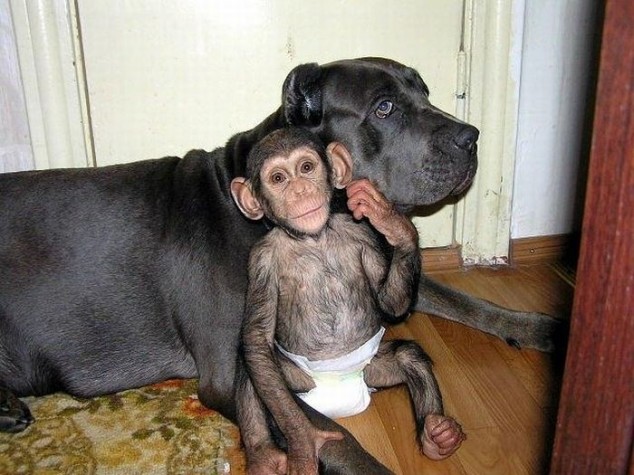
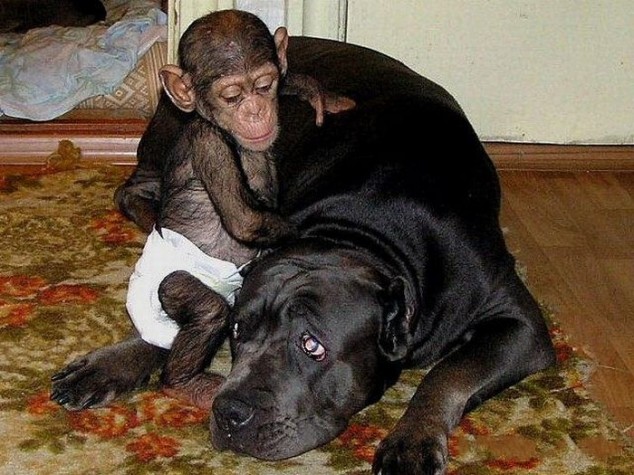
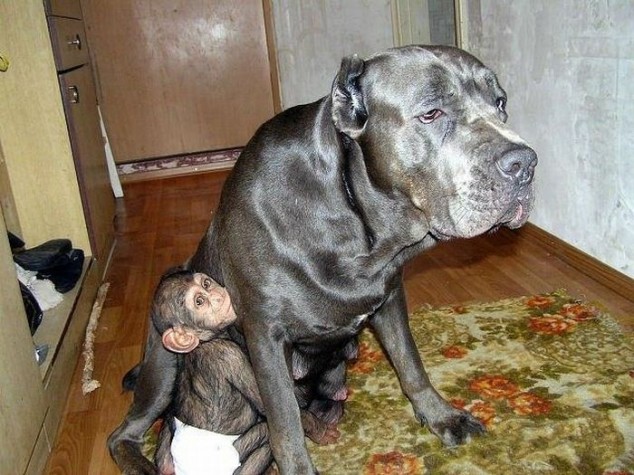
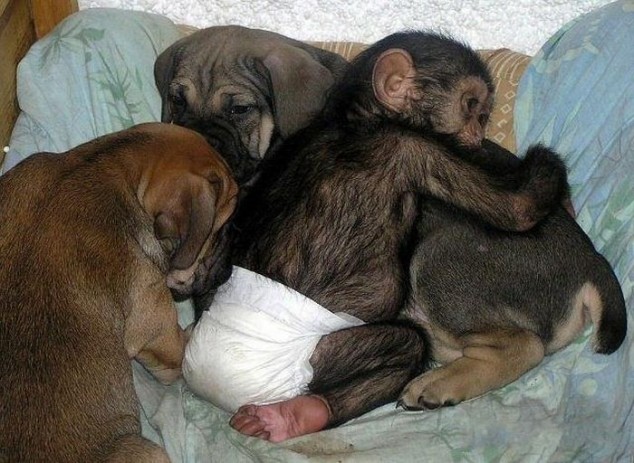
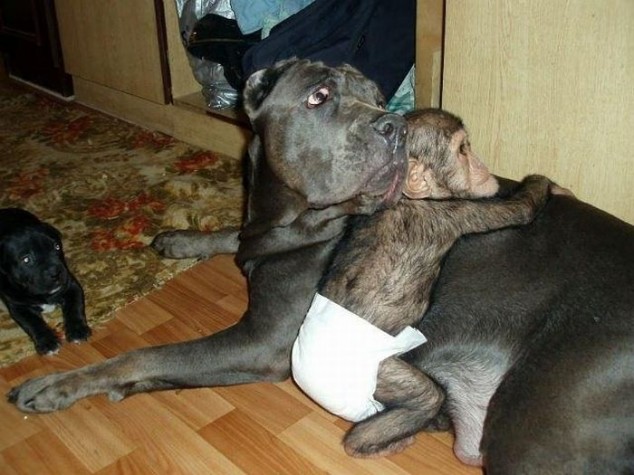
The widely reported story of a dog ‘adopting’ a baby chimpanzee.
(With big thanks to Chris Snuggs for sending me the pictures)
As a quick Google search finds:
Two years ago in a Russian zoo a female chimpanzee for some reason repudiated and abandoned her baby chimpanzee. When one of the employees of the zoo took the little chimpanzee home it never crossed her mind that her dog, a mastiff, would become a mother for the orphaned chimpanzee and treat the baby as her own child.
Judging by the look on her face at times, she is not quite sure why this particular offspring has hands to grab her with!
The unconditional love of a dog.
Fascinating example of the power of upbringing.
What is so wonderful, and amazing, is how ‘mother’ accepts this strange looking and strange smelling creature as it’s own. Think how important smell is to dogs!
Words add nothing to the beauty of this photograph.
You can see the huge difference in body mass between these two. One swipe, one bite and the little chimp would be toast! The dog’s love for the chimp overrides all!
Just beautiful.
Mummy, what’s that on the wall?
Mummy, your feet are so big …. and not at all like mine!
oooOOOooo
Dear Chris, thank you so much for sending me these pictures. It’s a privilege to share them with LfD readers. It reminds us that in this difficult era, with so many challenges facing us, that there’s nothing that can’t be solved with love, compassion and understanding.
My writings of the previous three days have explored the nature of man. The many ways that we struggle to understand so many issues in our lives. In particular the biggest issue of them all since we abandoned the life of the hunter-gatherer. Our very survival.
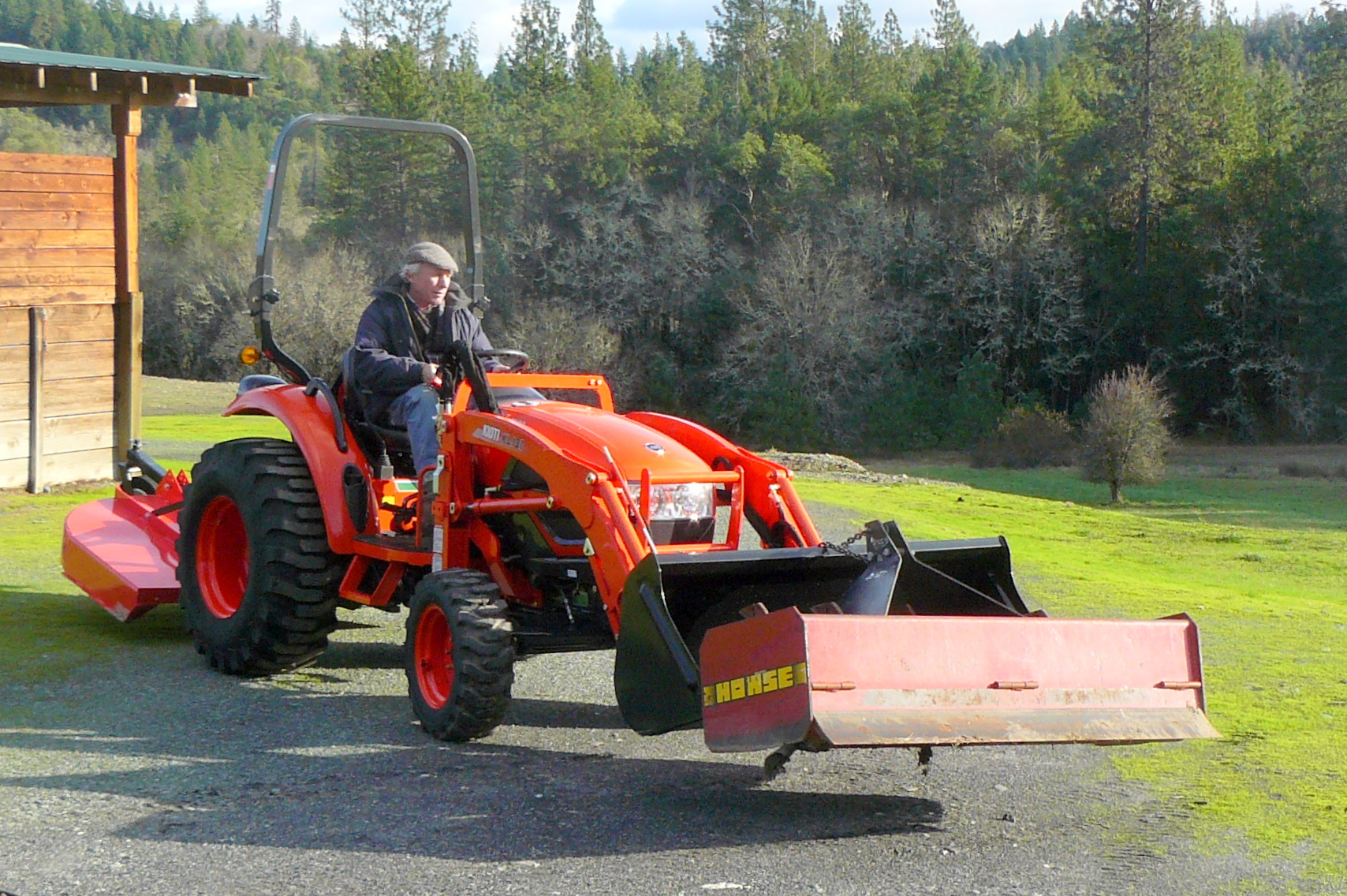
It would be so easy to beat oneself up. To stare in the mirror and despair at all the unfinished ideas that one has about being ‘sustainable’ shortly before jumping on one’s shiny new tractor, yet another symbol of our industrial civilisation. The hypocrisy, the double standards!
New tractor delivered last December.
But the mistake in any attempt at self-awareness is the assumption that you know who you are! Therein lays the problem.!
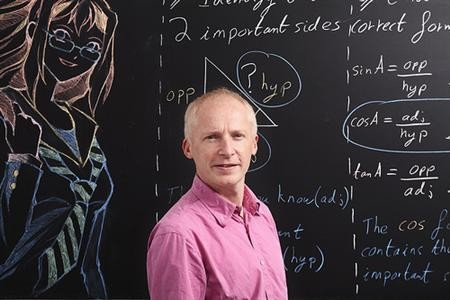
Marcus Peter Francis du Sautoy is a very smart person. This is how WikiPedia describes him.
Prof. Sautoy came to the realisation that the thoughts that make us feel as though we know ourselves are easy to experience. But where do those thoughts come from? Marcus Sautoy acknowledged that they are notoriously difficult to explain.
So, in order to find out where they come from Marcus subjects himself to a series of probing experiments. With the help of a hammer-wielding scientist, Jennifer Aniston and a general anaesthetic, Professor Marcus du Sautoy goes in search of answers to one of science’s greatest mysteries: how do we know who we are? ,
He learns at what age our self-awareness emerges and whether other species share this trait.
Next, he has his mind scrambled by a cutting-edge experiment in anaesthesia. Having survived that ordeal, Marcus is given an out-of-body experience in a bid to locate his true self. And in Hollywood, he learns how celebrities are helping scientists understand the microscopic activities of our brain.
Finally, he takes part in a mind-reading experiment that both helps explain and radically alters his understanding of who he is.
All of this is covered in a fabulously interesting episode from Horizon, the excellent and long-running BBC TV science and philosophy series. Thankfully, it made its way onto YouTube.
It is just under an hour long but I promise you it will capture you from the very first moment.
Enjoy. Even if you end up realising, as I did, what a strange person you are!
As Confucius reportedly wrote: Real knowledge is to know the extent of one’s ignorance.
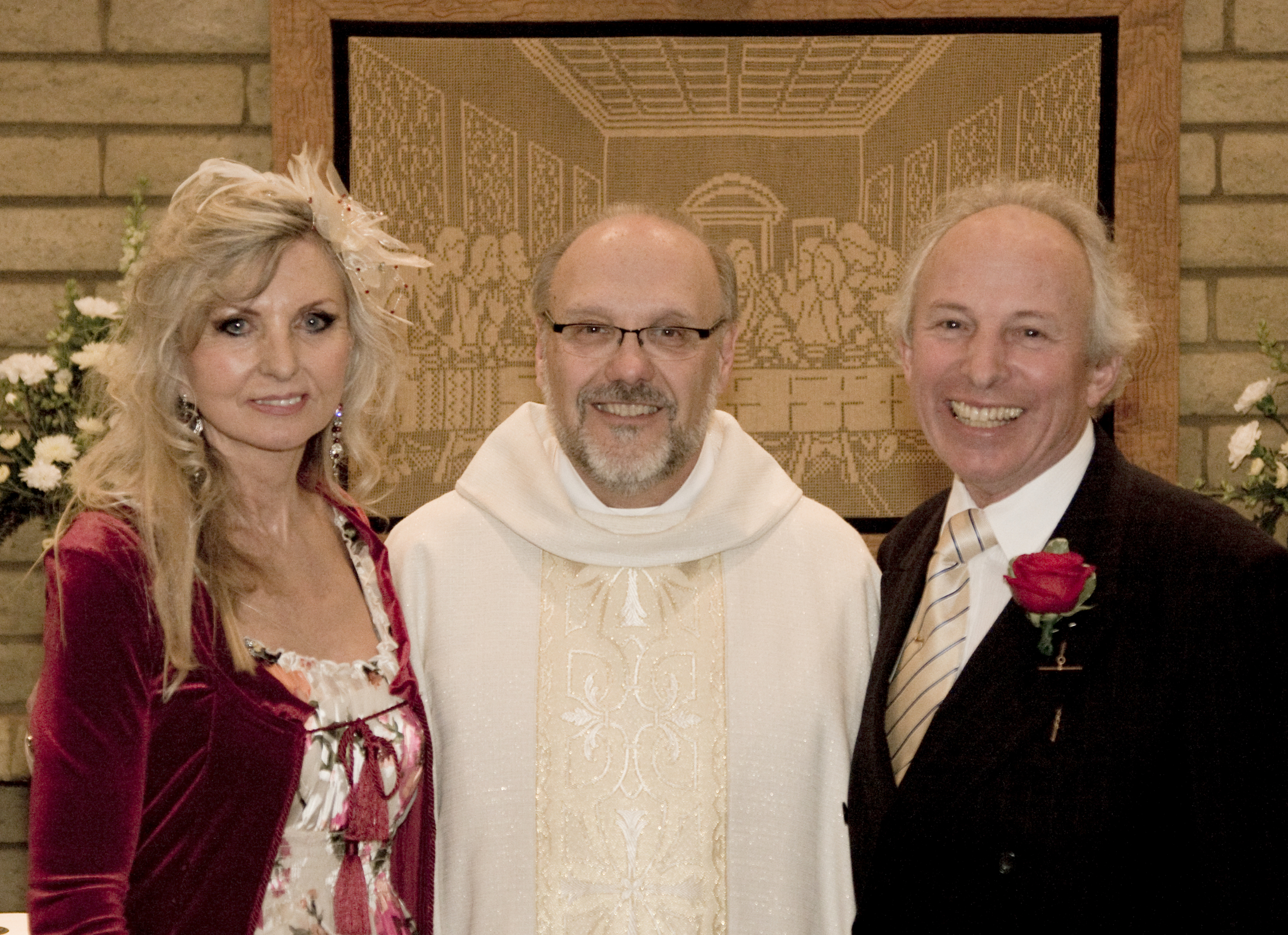
In a way this stunningly beautiful photograph is a reflection of our long relationship. Over the 33 years that we have been friends you and I have enjoyed many calm moments and tried to make sense of this crazy world. Yes, we have often disagreed about many things but never fallen out; not even come close to it. No better illustrated than me wanting you as my Best Man when Jean and I were married November 20th, 2010.
Payson, Arizona, November 20th 2010 Bridesmaid Dianne and Best Man Dan with the happy couple!
Your email to me of the 4th February was a difficult one to embrace; the Controversy Continues one. The last thing I wanted to do was to react impulsively because I knew you would disregard such a thoughtless response. After all, we have known each other’s views on the matter of climate change for a very long time.
Thank goodness I did sit on my hands. It allowed a more reflective part of my aged brain to compose a blog post on Learning from Dogs. The post that came out on the 12th under the title of Doggedly seeking the truth.
But the plain fact of the matter is that I profoundly disagree with the idea, as expressed in your email heading, that there is any controversy over the question of global warming resulting from man’s behaviours. I know from our years of friendship that you are open to all sorts of ideas. Meaning you wouldn’t be closed-minded to the biggest issue facing Homo sapiens andall the species on this planet, the one of anthropogenic global warming (AGW).
So let me offer you some links that make it very clear as to the reality of what is happening to this planet.
Perhaps the reason that so many intelligent people ‘avoid’ the truth of what we are doing to this planet was voiced in a recent comment by Prof. Guy McPherson on Learning from Dogs, “Perhaps Upton Sinclair had it right, years ago: “It is difficult to get a man to understand something, when his salary depends on his not understanding it.”
Even though you and I are well past salary days it doesn’t alter the chilling realisation that comes from embracing the truth of climate change and global warming: The undermining of just about everything that we have embraced over our years. No wonder it’s so much easier to stay within familiar comfort zones! To remain hypocrites as Jean and I do!
Let me close with the words uttered by mother Dellarobia to son Preston in Barbara Kingsolver’s book Flight Behavior: “It won’t ever go back to how it was, Preston.”
“A delusion is something that people believe in despite a total lack of evidence.” Richard Dawkins.
Yesterday, I started down the road of determining how one gets to the truth of a complex issue. I called the post Doggedly seeking the truth. My proposition was effectively saying that just because a person believes in argument ‘a’ or argument ‘b’ that doesn’t of itself make ‘a’ or ‘b’ the truth.
Unwittingly, Martin Lack of the blog Lack of Environment reinforced that point in spades. He wrote in a comment to yesterday’s post:
The deliberate spreading of misinformation is a fundamental part of the industry-led movement to deny the reality of anthropogenic climate disruption. Alex Rawls is just part of this campaign and I therefore do wish that you would consult me before deciding to help publicise and/or lend credence to such nonsense.
Now I have every sympathy for Martin’s outpourings of feelings; his blog is based on the conviction of his own beliefs. A position of integrity.
But taken literally, Martin’s words, “consult me before deciding to help publicise” mean that he wishes to influence what I choose to write. Of course he didn’t mean to convey that.
Back to yesterday’s post. With Dan’s permission, I reproduced the personal email that he sent me with those two articles. Dan isn’t on the payroll of the Koch brothers or blindly following an “industry-led movement to deny the reality of anthropogenic climate disruption“, he is a thinking human who is yet to be convinced that AGW is as rational a process as, say, gravity!
Humans are not fundamentally rational; we are emotional beings who even in this 21st century have little real understanding of what a human being is. (Must be honest and say that this last sentence is a tickler for a mind-opening video on the nature of human consciousness coming out on Friday.)
So if Dan is not convinced about the effects that mankind is having on Planet Earth, then spare a moment to ponder about the millions of others around the world who are far less capable, even if they had the time and inclination, to adopt a rational, open-minded view of the complexity of AGW.
It gets even more convoluted. In Professor McPherson’s video that was presented yesterday, this gets said, “If we act as if it’s too late, then we becomes a self-fulfilling prophesy”. On the face of it, that’s obvious. But on Guy McPherson’s blog Nature Bats Last the video has it’s own post and includes a comment left by Daniel, from which I quote:
Guy,
There are so many insoluble dilemmas concerning industrial civilization, it’s almost impossible for anyone to attempt to propose a “solution”, or attempt to describe the work that now needs to be done, without becoming a hypocrite.
At this stage, hypocrisy is unavoidable. Beyond the point of overshoot, at least in our culture, all that’s required to be a hypocrite, is to be alive.
I have watched your presentation evolve over the last few months, and with this latest one, something struck me as peculiar. You’ve added this line:
“If we act as if it’s too late, then we becomes a self-fulfilling prophesy”.
Basically, implying that we shouldn’t accept that it’s too late. Yes?
The evidence that now exists, has established an immovable catastrophe, which is now, well outside human agency ( aside from the looming boondoggle of geo-engineering). This is what the evidence shows. We have effectively already become a self-fulfilling prophesy. The most dire warnings of the last three decades, have now become prophetic. What are eight non-reversible feedbacks if not a physical manifestation of a self-fulfilling prophesy?
To which Guy replies:
Daniel, you’re asking the same questions many others have been asking lately. I’ll try to respond with my next essay, which I’ll complete and post in a couple days.
Seems to reinforce the message. That we really shouldn’t be surprised at the delusions, games and power interplays going on, especially in the corridors of power, so to speak.
Right! Time for me to show my hand!
I am totally convinced that we humans are responsible for the rising levels of CO2 in the atmosphere and that this accounts for the majority of the abnormal weather events being experienced in so many parts of the planet.
I think I’m right. Therefore I give more weight to the evidence that supports my view that, guess what, reinforces me thinking I’m right.
Is that scientific? Of course not! Science is about producing reproducible outcomes. With, say gravity, that’s a piece of cake.
I’m not a scientist, far from it. Therefore the following statement may be unreliable. That the problem with producing an uncontroversial, hard-wired proof that man is screwing up (you see, I did say that I wasn’t a scientist) our planet is that we don’t have other planets with which to test the thesis. When it surely is an uncontroversial, hard-wired proof it will be too late!
Having said all that, tomorrow I will present the best evidence that I can find to support the notion that Dan’s beliefs are wrong.
Back to Casey and that scent:
Now where’s that scent now? Sweeny, help me! Hang on, let me finish sniffing your bum! Ask Ruby to help, she’s just by the fence.
We can never be as rational as dogs. But maybe if we learnt to live more in the present, as dogs do so well, the world would be a much simpler and sustainable place.
On the road, there’s little possibility to develop a lasting relationship. I throw a Molotov cocktail into the conversation, and then I leave the area.
On the road, I describe how we live at the mud hut. I describe the importance of living for today.[my emphasis]