Category: Philosophy

Being philosophical about philosophy!

Two more examples of deep thinking.

Note: We have a flooring contractor in the house all week and it’s making it a little tricky to spend the couple of hours a day that is my usual pattern for writing posts for LfD.  So apologies if this week’s posts are more dependent on the thoughts of others than is usual.

Alain de Botton
Alain de Botton

Alain de Botton is a familiar face on British television.  WikiPedia’s entry describes him, thus:

Alain de Botton, FRSL (born 20 December 1969) is a Swiss/British writer, philosopher, television presenter and entrepreneur, resident in the United Kingdom. His books and television programmes discuss various contemporary subjects and themes, emphasizing philosophy’s relevance to everyday life.

He has been the presenter of a BBC Six-part series called Philosophy: A Guide To Happiness.  And who wouldn’t be turned on by that!

Luckily, all six episodes are available on YouTube, at this overall link.

But I wanted to share the first episode because despite the title being Socrates on Self-Confidence it really speaks to our lives in this year of 2013.

Moving on.

A recent item on Big Think, again about philosophy, jumped off the page at me. It specifically looked at making our life, as in mental health, easier in these demanding times.  It was by Daniel Dennett and was called The Philosopher’s Self-Help Book. 

Daniel Dennett
Daniel Dennett

oooo

The Philosopher’s Self-Help Book (with Daniel Dennett)

by JASON GOTS

JULY 13, 2013,

While Silicon Valley and Silicon Alley busy themselves making every aspect of our lives more efficient (except, perhaps, for the process of discovering these new technologies, learning them, and integrating them into our lives), Daniel Dennett sits up at Tufts University in  Massachusetts, philosophizing. His latest book, Intuition Pumps and Other Tools for Thinking is an attempt to make transparent some of the tricks of the philosopher’s trade. In an accelerating age, it’s a self-help book designed to slow the reader down and improve our ability to think things through.

The kinds of things Mr. Dennett likes to think about include the nature of consciousness, evolution, and religious belief. But the mind-training his new book offers is applicable to any problem you want to consider thoroughly. In an age of quick fixes and corner-cutting, we’re in constant danger of bad decision making – of overreliance on what cognitive psychologist Daniel Kahneman calls “system 1”, and what most of us call intuition. This rapid decision making channel of the brain is helpful when we are in mortal danger, or pressed for a quick decision within our areas of expertise. But for most decisions, the slower, more deliberate channel (system 2) is much more reliable. What Dennett offers, then, in Intuition Pumps, is a workout for system 2 – a series of thought experiments you can apply to puzzles real and imagined to bulk up the slower, wiser parts of your consciousness.

Some of the tools Dennett offers in the book are more familiar than others. Reductio ad absurdum arguments, for example, in which we test the validity of a claim by taking it to its most outrageous illogical extreme (a: “all living things have a right to liberty.” b: “so let me get this straight – a blade of grass has a right to liberty? What does that even mean?”). But the true delights of the book are the far-out exercises Dennett and his colleagues have dreamed up in the course of their work, such as “Swampman Meets A Cow-Shark”, from Donald Davidson, which begins:

Suppose lightning strikes a dead tree in a swamp; I am standing nearby. My body is reduced to its elements, while entirely by coincidence (and out of different molecules) the tree is turned into my physical replica. My replica, The Swampman, moves exactly as I did; according to its nature it departs the swamp, encounters and seems to recognize my friends, and appears to return their greetings in English.

Walking us through Davidson’s considerations about whether and to what extent the Swampman is anything like Davidson, and related ones about a cow that gives birth to something that looks exactly like a shark (yet has cow DNA in all of its cells), Dennett teaches us a surprising lesson about the utility of wild philosophical speculation.

Cloaked in the breezy, familiar trappings of a self-help book, Intuition Pumps is in actuality a dark mirror of that genre – a field of rabbit holes designed to leave the reader with more questions than answers, and wiser for the long and indirect journey.


Watch for Daniel Dennett’s Tools For Better Thinking – a Big Think Mentor workshop coming soon. 

 oooOOOooo

I’m tempted to put the book on my own reading list.  If you want to drop into the appropriate Amazon page there is an audio link plus the option to read an extract.  Amazon describe the book, as follows:

One of the world’s leading philosophers offers aspiring thinkers his personal trove of mind-stretching thought experiments.

Over a storied career, Daniel C. Dennett has engaged questions about science and the workings of the mind. His answers have combined rigorous argument with strong empirical grounding. And a lot of fun.

Intuition Pumps and Other Tools for Thinking offers seventy-seven of Dennett’s most successful “imagination-extenders and focus-holders” meant to guide you through some of life’s most treacherous subject matter: evolution, meaning, mind, and free will. With patience and wit, Dennett deftly deploys his thinking tools to gain traction on these thorny issues while offering readers insight into how and why each tool was built.

Alongside well-known favorites like Occam’s Razor and reductio ad absurdum lie thrilling descriptions of Dennett’s own creations: Trapped in the Robot Control RoomBeware of the Prime Mammal, and The Wandering Two-Bitser. Ranging across disciplines as diverse as psychology, biology, computer science, and physics, Dennett’s tools embrace in equal measure light-heartedness and accessibility as they welcome uninitiated and seasoned readers alike. As always, his goal remains to teach you how to “think reliably and even gracefully about really hard questions.”

A sweeping work of intellectual seriousness that’s also studded with impish delights, Intuition Pumps offers intrepid thinkers—in all walks of life—delicious opportunities to explore their pet ideas with new powers.

Speaking of ‘pet ideas with new powers’ prompts one to reflect on the amount of time that dogs spend thinking!  As the following picture confirms!

Pharaoh contemplating the meaning of life!

Instinctive behaviours.

We see instinct as common across all species including man, so why is so little known about it.

There was an item seen on the BBC Capital website.  It was an article about intuition:

Trusting your gut: Smart management or a fool’s errand?

by Eric Barton*

Photographer Mindy Véissid woke up one winter morning in 2010 with a simple idea: dogs running in the snow.

“That’s all I had,” she recalled.

The Manhattan resident followed her gut and went across town to Central Park. There, Véissid found three dogs jumping around in a couple of inches of new snow covering the famed park’s Great Lawn. She plopped down in the field and waited. That’s when the dogs headed right for her. She snapped off a shot just before they barrelled over her.

The picture she took that morning, of happy-looking pups charging through a cloud of snow with the New York City skyline behind them, has become one of Véissid’s calling cards, maybe her most recognisable shot. It’s a photo she would have missed if she had not trusted her gut.

“What I realised is that if I follow my heart, if I follow my feelings, I get good photographs,” Véissid said. “We try to control everything in our lives, and sometimes you have to let go.”

It wasn’t long ago that decision-by-intuition would have been regarded as little more than magical thinking or a try at luck. But research has changed that and intuition has been embraced as a key component to business decision making.

There is, however, an inherent danger to it, and blindly following your gut can be worse than ignoring it altogether. For managers, that means learning how to trust your own instincts and encouraging employees to do the same. But it also means learning to recognise when careful planning trumps sudden inspiration.

Perhaps the thing that most changed the way businesses think about inspiration was a 2008 study co-authored by Gerard Hodgkinson, professor at Leeds University Business School in the United Kingdom. Hodgkinson found that intuition can be beneficial in specific circumstances. First, it’s best to rely on a gut feeling when you need to make a quick decision. Second, and this is the important part, trust your intuition only when you have extensive knowledge on the subject. In other words, the best intuition is pulled from a well of deep knowledge and expertise.

“A lot of people think intuition is general purpose, but intuition is actually domain specific,” said Massimo Pigliucci, a philosophy professor at City University of New York, and author of Answers for Aristotle: How Science and Philosophy Can Lead Us to A More Meaningful Life. “Intuition is the result of your subconscious brain picking up on clues and hints and calculating the situation for you, and that’s based solely on experience.”

(The rest of the story may be read here.)

Wrong to republish the whole piece, however I do want to republish the closing paragraphs as they are so relevant to today’s post.

Western cultures began to embrace intuition only recently, Pigliucci said, while research suggests Southeast Asian countries have long given credit to gut feelings being a good guide to decision making. Eastern managers, for instance, are more likely to rely on hunches and give them credit for successes afterward.

After photographer Véissid learned to rely on her gut feelings, she wanted to teach others how to do it. Her class, the Art of Intuitive Photography, teaches the photography basics, but her instruction is more about following hunches.

“You can get a good photograph and it will be technically correct,” she said. “But if you follow your heart, you can take photos that can be wonderful.”

Follow BBC Capital on Twitter @BBC_Capital or follow us and join the conversation about this or any other Capital story on Facebook: BBC Capital on Facebook.

—-

* Eric is a freelance journalist who lives in Fort Lauderdale, Florida. He is formerly a writer and editor at New Times in Fort Lauderdale and The Pitch in Kansas City, Missouri. His work has been featured by  the Florida Center for Investigative Reporting.

To my mind, what Eric Barton has written about is not instinctive.  That is if one believes that instinct is something that is ‘hard-wired’, so to speak, into our psyche at birth, a function of our genetic heritage.

When one reflects on the start of life, ergo for all warm-blooded species that are the result of a successful copulation between the two genders of that species, then one realises that there is little functioning at birth beyond those bodily functions vital to that new life.

But if we mean by instinctive those behaviours that are subconsciously acted out while the mind is engaged on other mental processes, then that’s different.

Read that last opening paragraph again [my emphasis]:

“A lot of people think intuition is general purpose, but intuition is actually domain specific,” said Massimo Pigliucci, a philosophy professor at City University of New York, and author of Answers for Aristotle: How Science and Philosophy Can Lead Us to A More Meaningful Life. “Intuition is the result of your subconscious brain picking up on clues and hints and calculating the situation for you, and that’s based solely on experience.

Think of when we drive a car how much of what we are doing in the ‘hand-eye’ department is being managed by our subconscious brain.  Think about the way we use a language, especially the language of our birth country.  One will immediately recognise that the brain is on auto-pilot.  Yet we were born unable to speak, or to drive a car!

Coincidentally, over at Patrice Ayme’s blog there was a post published yesterday on the same theme.  It was called Instinct is Fast Learning.  Here’s an extract:

INSTINCT IS FAST LEARNING.

SMALL ANIMALS, FAST MINDS.

HOW FORCE BECOMES THE TRUTH OF MAN.

Abstract: “Innate Knowledge” is a stupid idea. The truth is the exact opposite: KNOWLEDGE IS EVERYWHERE, OUT THERE.Knowledge is the opposite of innate. This insight has tremendous consequences on our entire prehension of the world.

(It will not escape the cognoscenti that Socrates, Plato, and Aristotle, were partisans of innateness. And that believing in the superiority of inheritance is a necessary condition for racism, fascism, slavery, and hereditary plutocracy as fairness. That makes the likes of Chomsky and Dawkins self contradictory)

Subjective time slows down in smaller brains.

Fastest Wings, Fastest Brains. Anna Hummingbird California
Fastest Wings, Fastest Brains.  Anna Hummingbird California

Those wings go at 100 Hertz, four time the human perception limit.

Thus time is relative; just as light-clock time slows down in a fast reference frame, or in a heavy gravitational field, neurological timeslows down in a small neurology.

(Interestingly, the deepest reason for the slowing of time… boils down to the same in the Relativity case as in the Neurological one! It’s all about energy.)

A lot of ideas on instinct came from studying insects: insects seem to know all, without having studied anything. However, if insect time flows slowly, insects actually have time to learn.

And that’s rendered easier by having brains adapted to their environment. If they have only a few tricks to learn, and what looks like ten seconds for us is an hour for them, no wonder they learn lots. Thus slow in small explains how “instinct” works.

Hence behaviors one describes as “instinctive” are just fast studies. A lot of the silliness about “genes” is thus dispelled, and the mind comes on top.

It’s an essay that deserves the full reading.  This is how it closes:

Conclusion:

Instinct As Fast Learning solves the nature-nurture problem. It also shows something else, even more important. It shows that the force of nature makes not just the force, but even the very geometry, of our minds.

(The construction of neuromorphology itself being forced by feedback from nature.)

The minds of sentient species, from bees to hummingbirds, are exquisitely tuned to be programmed by the (part of) nature they are made to respond to, all the way to the speed of time they need.

If we kill the environment, we kill out instruction set. The usual reason given to save the environment is that we would not want our descendants to live in a bad world. But what we see now is that a poor world gives poor minds, and that even time may go askew. Another, deeper than ever, reason to be a fanatical ecologist. Nature is not just our temple. Nature is where, and how, time itself is built, one neurological impulse at a time.

***

Patrice Ayme

On Monday, I have a sequel to this post.  It’s an insight into the conscious and unconscious skills that come from flying a glider, or sailplane in American speak!  Plus something that could just possibly be the key to mankind having a long-term sustainable future on this planet: The Power of Thinking.

But back to today.

You will recall that the item from the BBC website opened with photographer Mindy Véissid waking up one winter morning in 2010 with a simple idea: dogs running in the snow.  Too good not to miss for a blog called Learning from Dogs.

Mindy’s website is here and do go across there and browse.  You will quickly discover, for example:

we teach small sized group and private digital photography classes and workshops in fun locations throughout nyc, focusing on how to use your camera, how intuition can help guide you to images, and compositional improvement

So having given Mindy that small, but well-deserved, plug, I don’t feel too bad closing today with Mindy’s picture of those dogs running in the snow.

Picture by Mindy Veissid Photography

A return to integrity

Can we mend our broken ways? Just possibly.

Yesterday’s long rant was the outcome of me promising ‘a debate’ with Patrice Ayme.  Succinctly, I had disagreed with a comment from Patrice where he had written: “Force is the truth of man. Everything else is delusion, even the vegetarian style.” and wanted to respond within the space of a post rather than the more restrictive comment.

For my disagreement with Patrice had been essentially about his statement, ‘Force is the truth of man‘.  I don’t recall a war in the last 50 years that has been a force for good.

But then it was Alex’s comment, see below, that stopped me short.  For I realised that I was confusing ‘force’ with ‘war’ and that was probably a big mistake on my behalf.  Of course, I’m writing this without the benefit of knowing better what Patrice meant in his comment! Blogging, as powerful a media as it is, does not provide for immediate interaction!

Nevertheless, Alex’s comment yesterday was powerfully inspirational.  Because so many of us (and I include me in that ‘us’) all too often behave as though we are a species utterly divorced from Nature.

I closed yesterday’s post with these words;

So what to do?  Because I am fundamentally at odds with the sentiment expressed by Patrice Ayme; “Force is the truth of man. Everything else is delusion, even the vegetarian style.

The answer takes us to tomorrow’s post, A return to integrity.

And, yes, it does mention dogs!  Rather a lot as it happens!

Dogs are the one species that man has lived with longer than any other species.  So when we refer to the qualities of the dog it is simply because we are so familiar with them.  In no way does that exclude the numerous other species that bond with man and share the same wonderful qualities.

Qualities so easily seen: Love, Honesty, Loyalty, Trust, Openness, Faithfulness, Forgiveness and Affection. Together they are Integrity.

Of course dogs will kill a rabbit, for example, as readily as a cat will kill a mouse.  In this respect force is the truth of Nature.

The only way for species man to survive on this planet is for every element of man’s existence on this planet to be rethought of in terms of the natural order.  Read the comment left by Alex in yesterday’s post:

Hi Paul, what you highlight are examples of disconnection between humanity with nature and each other. I have on my own blog highlighted a concept of Ubuntu – “I am because we are” – which is only possible when the self realises they are part of an inter-connected network of life. Your example of islands of fragmented forest where disconnected wildlife are dying out is how it is with disconnected humanity, we are doomed to destruction because we are cut off from the life-giving connection to nature.

All the problems you highlight are symptoms of the disease of disconnection, until there is reconnection to nature none of these symptoms can be successfully addressed.

War is an integral part of nature, when people seek to dismiss this then they add to the disconnection from nature. I was stung in the face by a drunken wasp a few days ago, this is how it is with nature, it is beautiful but also brutal. Peace and balance are illusions, life is in a becoming because of unbalance and strife. I advocate harmony, like a downhill skier we do not seek to control our surroundings, but instead act in harmony by moving around the obstacles such as rock and tree.

Disconnection can be as large as destroying whole forests by ignorant energy policies to those idiots who kicked a puffball to pieces before I could harvest it, or the new owners of my former home who have taken a chainsaw to all the trees and bushes in the garden. People who are disconnected do not consider how their actions impact nature or people contrary to the philosophy of Ubuntu.

I am because we are!” Each and every one of us is where we are today, for good or ill, because of what we are: part of Nature.  It’s so incredibly obvious – we are a natural species – yet who reading this wouldn’t admit at times to behaving “as though we are a species utterly divorced from Nature.”

Millions of us have pets and animals that we love.  Yet we still miss the key truth of our pets.  That we are a part of Nature, subject to Natural order, just as much as our pets are.  We have so much to learn from our animals.

Take this rather sad story but, nonetheless, a formidable story of the integrity of one species for another.  Watch the video.

oooo

Take this rather happier story about the integrity of one species for another. Watch the video.

oooo

Thus when we see the extraordinary benefits that arise from love and trust, from loyalty and faithfulness, and much more, why oh why is so much of our society fundamentally broken?

As John Hurlburt wrote in a recent email, it is because, “we are spiritual bankrupt. We spend too much of our time thinking about ourselves and what we want and too little of our time thinking about other people and what we all need.”  John went on to add that this spiritual bankruptcy had preceded our moral and economical bankruptcy. He pointed out that the solution to our moral and financial problems, as well as our salvation as individuals and as a species, is spiritual. “We simply need to love the Nature of God, the earth and each other regardless of what we may believe God to be.”

Now whether you are a religious soul, or a heathen, or somewhere in the middle, it matters not.  For if we continue to defy Nature and the natural laws of this planet we are going to be dust before the end of this century.  Again in John’s powerful words:

Denying climate change is a death wish.

Nature always wins in the long run.

Nature is balanced. Are we?

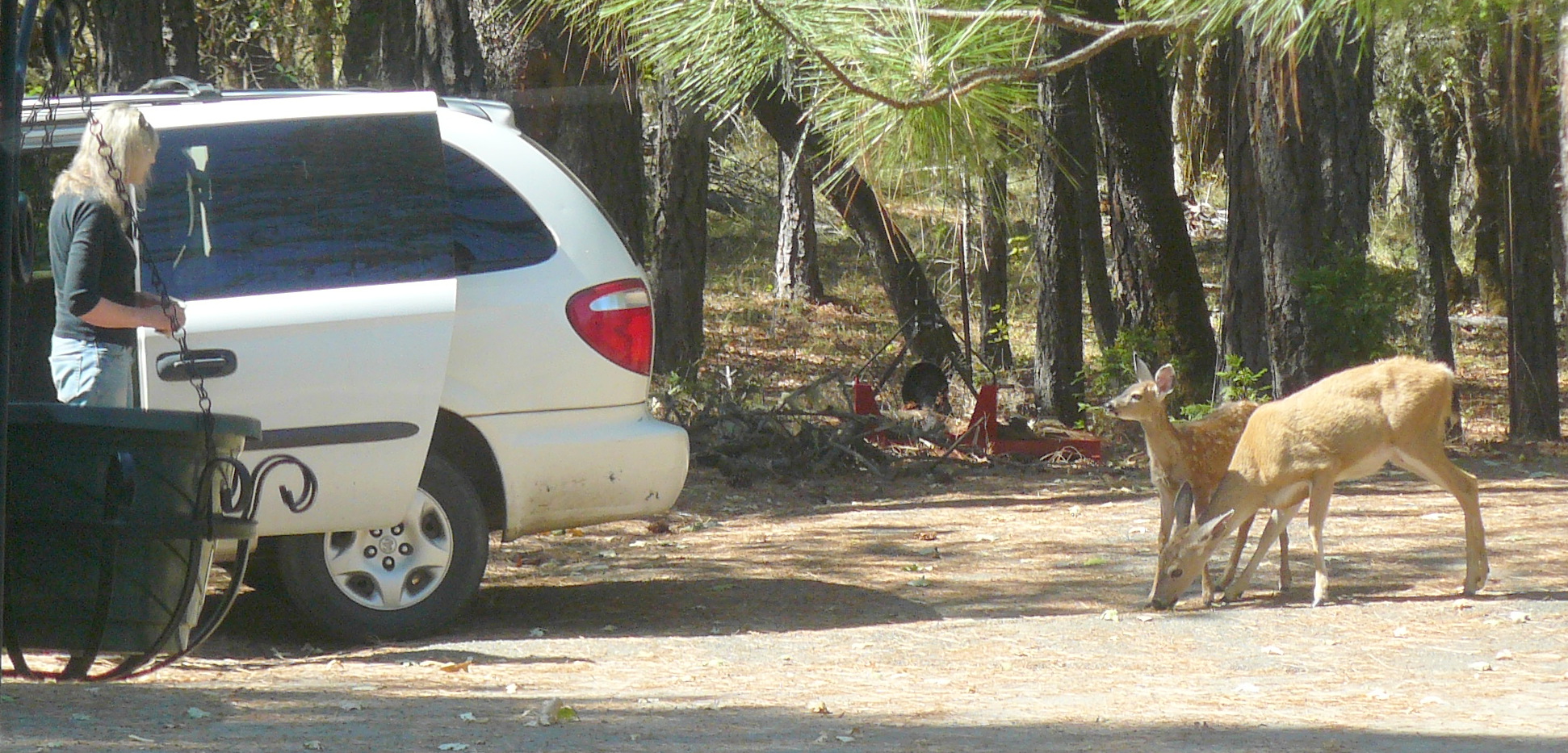
As if to endorse the great examples that Nature offers us in terms of the benefits of love and trust, take a look at these three recent photographs from here in Oregon.

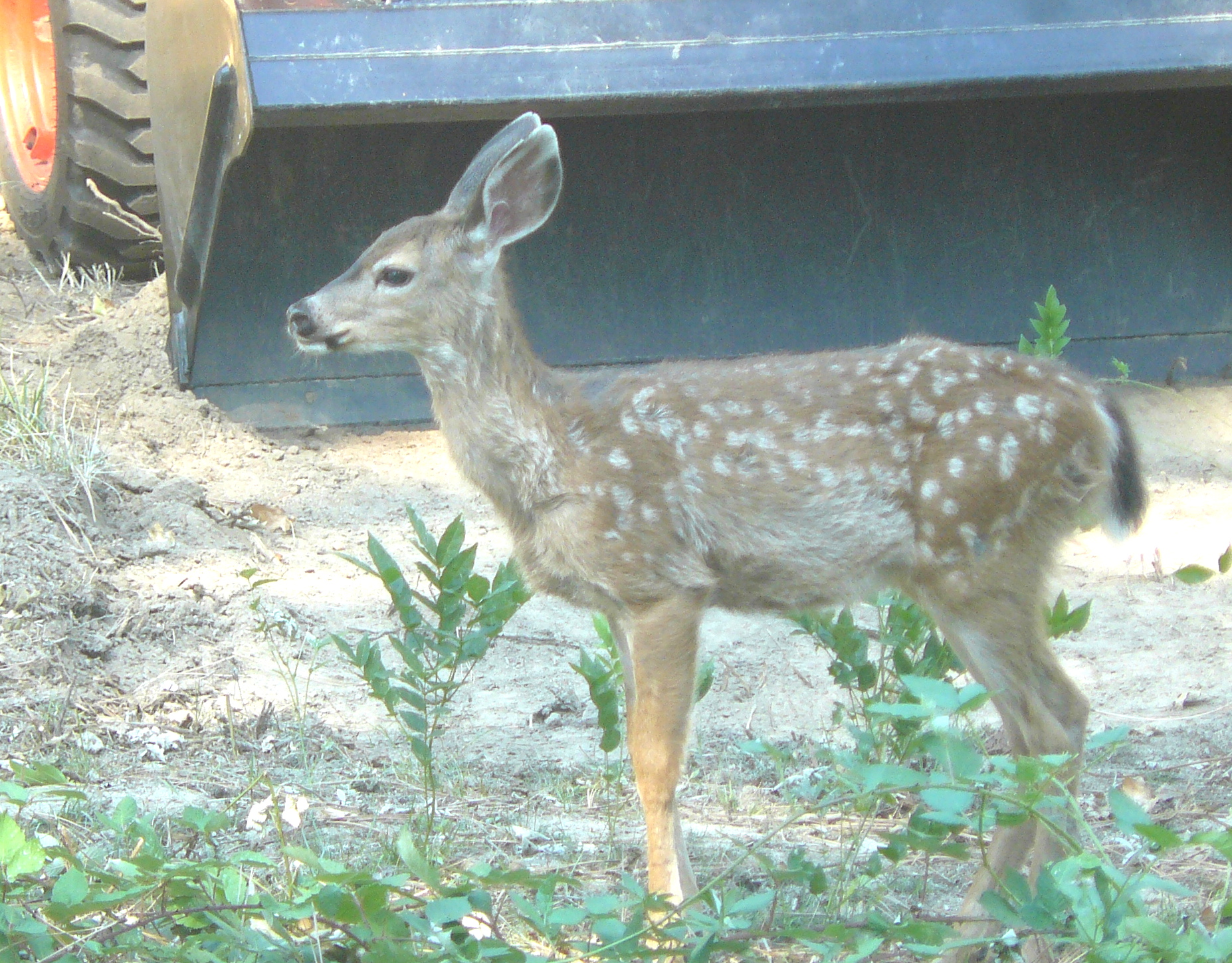
A young timid deer responding to me sitting quietly on the ground.
A young timid deer showing her trust of me as I sat quietly on the ground less than 30 feet away.

oooo

A mother and her fawn trusting Jean's love for them, and getting a good feed!
A mother and her fawn trusting Jean’s love for them, and getting a good feed!

oooo

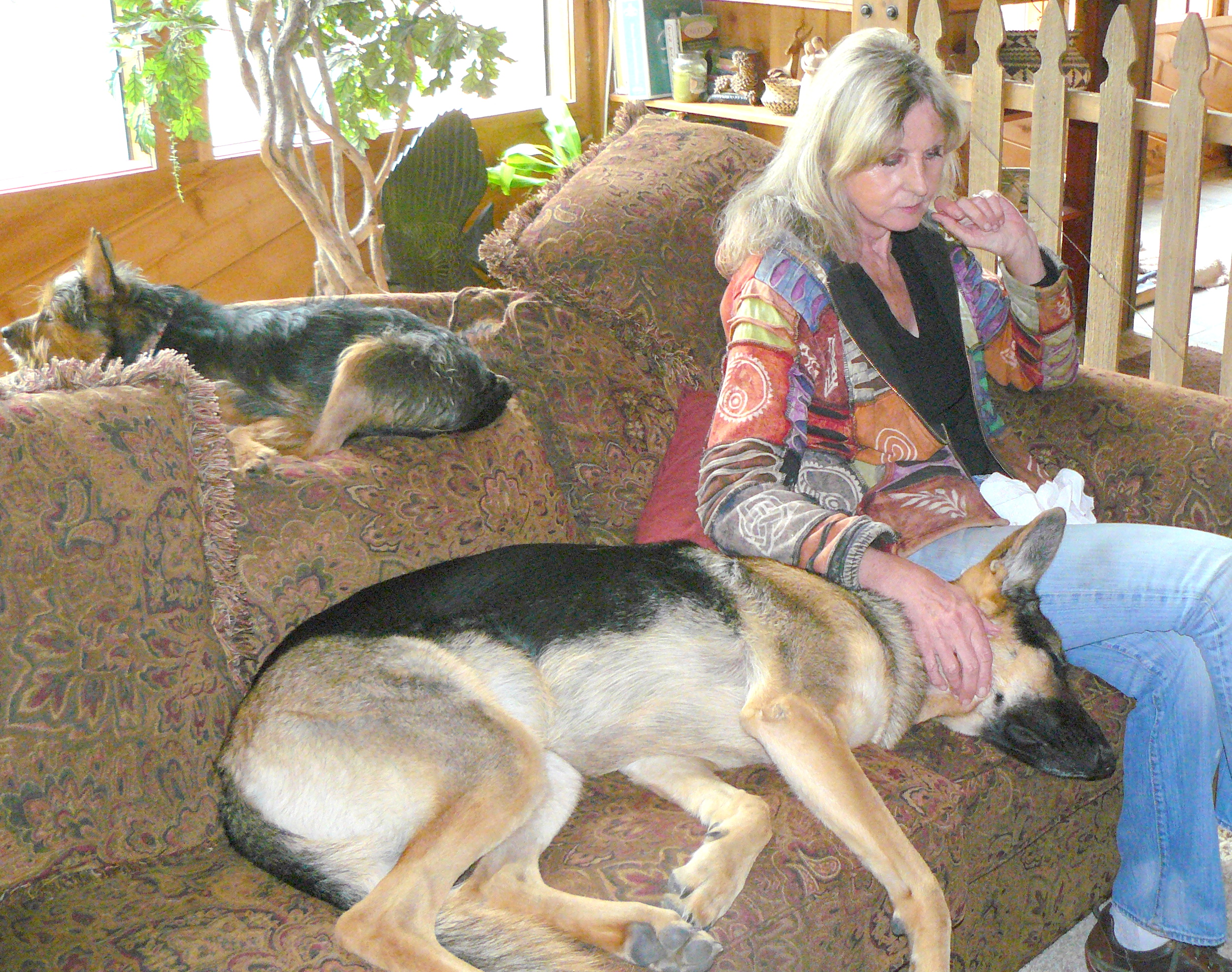
Sweeny, on back of settee, and Cleo in peace and comfort.
Little Sweeny and Cleo converting trust to peace and happiness.  (Not to mention Jean!)

Now these are not photographs to ‘ooh’ and ‘ah’ over, these are reminders that kindness, generosity, selflessness and trust are part of Nature.  All the great virtues and values of man do not come from a vacuum, they come to us via Nature.

We have been blessed by an evolution that has allowed mankind to achieve remarkable things.  Even to the point of leaving the confines of our planet and setting foot on the Moon and sending probes from out of our Solar System.  There’s a sense, a distinctly tangible sense, that man has conquered all; that we have broken the link from being part of Nature; from being of Nature.

And now Mother Earth is reminding all of her species, every single one of them including species man, that everything is bound by her Natural Laws.

Does this mean that man has to revert to some form of pre-civilised stone-age era?  Of course not!  Progress can be as much within the Natural order than in competition with it, as it has been in recent times.  In fact, Professor Pat Shipman explains our progress is benefited by being part of that Natural order.  Here’s how Amazon describe her book, The Animal Connection.

The Animal Connection: A New Perspective on What Makes Us Human

A bold, illuminating new take on the love of animals that drove human evolution.

Why do humans all over the world take in and nurture other animals? This behavior might seem maladaptive—after all, every mouthful given to another species is one that you cannot eat—but in this heartening new study, acclaimed anthropologist Pat Shipman reveals that our propensity to domesticate and care for other animals is in fact among our species’ greatest strengths. For the last 2.6 million years, Shipman explains, humans who coexisted with animals enjoyed definite adaptive and cultural advantages. To illustrate this point, Shipman gives us a tour of the milestones in human civilization-from agriculture to art and even language—and describes how we reached each stage through our unique relationship with other animals. The Animal Connection reaffirms our love of animals as something both innate and distinctly human, revealing that the process of domestication not only changed animals but had a resounding impact on us as well.

It’s a powerful read and greatly recommended.  Here’s an extract from the book [page 274, my emphasis]:

Clearly, part of the basis of our intimacy with tame or domesticated animals involves physical contact.  People who work with animals touch them.  It doesn’t matter if you are a horse breeder, a farmer raising pigs, a pet owner, a zoo keeper, or a veterinarian, we touch them, stroke them, hug them.  Many of us kiss our animals and many allow them to sleep with us.  We touch animals because this is a crucial aspect of the nonverbal communication that we have evolved over millennia.  We touch animals because it raises our oxytocin levels – and the animal’s oxytocin levels.  We touch animals because we and they enjoy it.

From the first stone tool to the origin of language and the most recent living tools, our involvement with animals has directed our course.

So to round this off.  These last two posts came from my need to debate with Patrice the statement that “Force is the truth of man.”  If Patrice’s meaning was that the truth of man is subject to the force of Nature, then I agree one-hundred percent.

For the time for man to recognise that the force of Nature is “the truth of man” is running out.

Each of us, whoever you are, for the sake of your children and for all of the children in the world, embrace today the qualities, the values of Nature.

Love, Honesty, Loyalty, Trust, Openness, Faithfulness, Forgiveness, Affection.

(Unknown author)

If you can resist treating a rich friend better than a poor friend,

If you can face the world without lies and deceit,

If you can say honestly that deep in your heart you have no prejudice against creed, colour, religion or politics,

Then, my friend, you are almost as good as your dog.

Let us learn from dogs.

Let us return to integrity.

Meditating.

A guest post from Sue Dreamwalker.

Last Monday, the post on Learning from Dogs was called Growing old!!

The essence of that post was to report on the following:

That’s why a recent item on the BBC News website jumped off the page at me.  It was an article called: Health kick ‘reverses cell ageing’ written by Michelle Roberts, Health editor, BBC News online.  Here is how the article opened:

Going on a health kick reverses ageing at the cellular level, researchers say.

The University of California team says it has found the first evidence a strict regime of exercise, diet and meditation can have such an effect.

But experts say although the study in Lancet Oncology is intriguing, it is too early to draw any firm conclusions.

The study looked at just 35 men with prostate cancer. Those who changed their lifestyle had demonstrably younger cells in genetic terms.

The full article should be read, by the way, because it covers much more than this opening paragraph.

Anyway, one of the comments to that post was left by Sue, of Sue Dreamwalker, Here is what she wrote:

Great information and learning to Meditate even for a few minutes helps heal and relax.. Dogs have it right…. No stress!

I wrote a complete exercise I used a lot both for myself and within my circle I used to run… Hope you enjoy as you take your roots down into the earth after bringing in the Light….
you can find it here http://wp.me/p16xW7-37

Namaste! :-)

I then asked Sue if I could republish her guidance on meditation as a guest post.  Sue kindly agreed.  Here it is.

oooOOOooo

A Meditation For My Friends

by Sue Dreamwalker

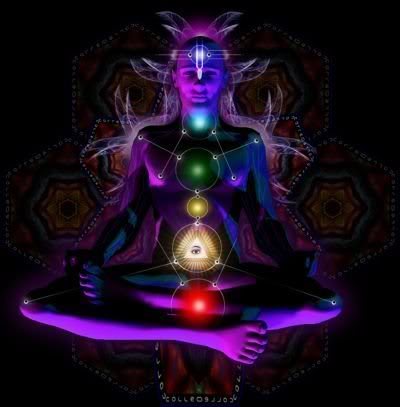
Meditation-1

Meditation.

Some Friends have been asking about Meditation and relaxation techniques, so I have put you a very simple little meditation here for starters.

You can buy books on meditation and read different techniques until your eyes pop out of your head, and you can find plenty about meditation on web sites too.  I always say there is no right or wrong way to Meditate. To meditate means finding that quiet place within your own mind, finding that peace and space to be at one with yourself.

When people say empty your mind, this is near enough impossible, as you will always have a train of thought that will pop in at times. So this is why we use the Breath.

The breath is used to bring your concentration back, so focusing on your breath may be one way in which you can stop the hum-drum of your thoughts that chatter away inside your head.

First you need to ensure you’re not going to be disturbed, so switch of the phone, find a comfortable chair, in a quiet room, and relax.  If you lie down you may find that you drift asleep, that’s ok also for that shows you have relaxed.  But preferably sit upright with your feet slightly apart and have them touching the ground. Take deep breaths breathing in and out through the nose, and close your eyes.

This is one of the meditations I do regularly.  It may seem long to read, but once you have it in your mind it will only take you 10 minutes to do. Read it through a couple of times until you have it clear in your mind, and then have a go.

meditation

Relax and take some nice deep breaths  breathing deeply and evenly, try to breath in to the count of five, hold for a few seconds and then breath out long and slow, Feel your breath rise from your solar plexus your stomach and feel your diaphragm rise and fall.

Do this for a few minutes until you feel comfortable with breathing this way. (Many of us do not breathe deep enough, so this may at first feel uncomfortable, but try not to force it, just try to get your breath into a natural rhythm).

One your breath is comfortable I want you to imagine a beautiful White light coming down in a column from up above  your head.  Almost like a search light in a darkened room.

As you breath in, I want you to breathe in this light. Imagine that it is flowing down inside your head through your crown, and it passes behind your eyes, relaxing your eyes. It then passes down over your throat, relaxing your throat.

You feel this Light which has healing properties cascading across your shoulders, relaxing your shoulders, taking all the burdens of the day with it.  You now see and feel this warm Light travel down your arms into your forearms relaxing your muscles as it goes, now it’s travelling into your finger tips, and your arms now feel heavy and relaxed.

You see the Light now travel through from your throat, down into your heart centre, feel the beat of your heart, and see the light now filling your heart and as it beats see the light dispersing throughout your veins into your whole being,

See the light travelling into your stomach relaxing your stomach muscles, down your thighs relaxing your thighs into your calves, relaxing your calves, and see the light now going into your feet relaxing your toes and feet.

And all the while you are breathing deeply and evenly, relaxing more and more.

meditation-2

Now you are relaxed and are full of healing light, I want you to now see that light coming out of the soles of your feet, as if they were roots from a tree. See these roots going down from your feet into Mother Earth, going down through the rocks, twisting and turning as they go deeper and deeper, and as they travel deeper so too you are feeling more and more relaxed.

You now see an underground cavern, with an underground pool, your roots of light emerge in the ceiling of this cavern, and illuminate it like the lights of a chandelier.

And as the light illuminates the Cavern you now see you are stood in a beautiful Crystal Cavern, The Light reflects the many luminous rainbow colours from the hundreds of giant crystals.. See the rainbow of pastel colours dance around the cavern reflection on the underground pool.

Now you can choose any colour you see, for whatever colour you choose this colour will intuitively be the right healing colour for your needs at this moment in time.

So once you see the colour you are attracted to, allow your roots to wrap themselves around that crystal, and as you breathe deeply in, see now that your roots have now turned into hollow straws, for you will now be able to breathe up that colour through your roots and as you do so, retract your roots back up through Mother Earth, breathe that  colour into your feet, feel the warmth of the healing.

Now draw it back up through your calves, up through your thighs, into your solar plexus. Breathing deeply and evenly. Feel the warmth of healing relax and heal all your worries and anxieties, breath it up into your lungs, into your heart, down your arms and into your fingers, see how relaxed and refreshed you now feel, see this colour cleansing your entire being taking with it all the debris that you have collected, all the negative thoughts, flushing you clean.

See this colour now rise and come up through your throat, see it helping you release all the words you have spoken in haste, and all the words you hold back, see them all now flow up past your eyes, helping you see that you are a Being of Light and whole and free, see that colour now rise out through the top of your head, see it cascading out into the Universe Like a fountain, and as it does so see it explode into a thousand stars, taking all your problems and negative debris with it, and know that God and the Universe will disperse this energy as it sees fit,

Give thanks to Mother Earth for her healing energy, and see the top of your head close and seal in your new vibration, and feel yourself glowing from within,

Slowly bring your awareness back to yourself sat in the chair, and open your eyes.

Sit for a moment or two and take a sip of water.

Know that you can go to your crystal cavern at any time for healing.


Soulfly

Hope you relax and Enjoy.

Dreamwalker x

oooOOOooo

And if you want any encouragement to find that deep, peaceful place, then just breath in this picture of young Cleo letting the world go by!

OLYMPUS DIGITAL CAMERA

Rethinking privacy?

Is the need for privacy a by-product of large society?

The other day, thanks to Naked Capitalism‘s regular set of web-links, I became aware of the website Popular Resistance.  To be exact, Naked Capitalism had linked to an article entitled, “New Intel Chips Contain Back-Door Processor, Hackable Even When Computer is Turned Off.

Regular readers of this place may well recall my decision to ditch Windows OS and buy a new Apple Mac Mini articulated in a post earlier in the month, Closing my Windows.  Here’s a brief extract from that post.

Muttering about this to friends who know a lot more about computing than I raised my awareness that the privacy and security of one’s computer was no longer to be assumed.  Then just recently, I read online,

A Special Surveillance Chip

According to leaked internal documents from the German Federal Office for Security in Information Technology (BSI) that Die Zeit obtained, IT experts figured out that Windows 8, the touch-screen enabled, super-duper, but sales-challenged Microsoft operating system is outright dangerous for data security. It allows Microsoft to control the computer remotely through a built-in backdoor. Keys to that backdoor are likely accessible to the NSA – and in an unintended ironic twist, perhaps even to the Chinese.

Then a few paragraphs later:

It would be easy for Microsoft or chip manufacturers to pass the backdoor keys to the NSA and allow it to control those computers. NO, Microsoft would never do that, we protest. Alas, Microsoft, as we have learned from the constant flow of revelations, informs the US government of security holes in its products well before it issues fixes so that government agencies can take advantage of the holes and get what they’re looking for.

Now I’m using Windows 7 so imagine my angst when I then read:

Another document claims that Windows 8 with TPM 2.0 is “already” no longer usable. But Windows 7 can “be operated safely until 2020.” After that other solutions would have to be found for the IT systems of the Administration.

That did it for me – time to move on from Windows.

OK, on to today’s thought.  The Popular Resistance article explained:

New Intel-Based PC’s Permanently Hackable

So you think no one can access your data because your computer is turned off. Heck it’s more than turned off, you even took the main hard drive out, and only the backup disk is inside. There is no operating system installed at all. So you KNOW you are safe.

Frank from across the street is an alternative operating systems hobbyist, and he has tons of computers. He has Free BSD on a couple, his own compilation of Linux on another, a Mac for the wife, and even has Solaris on yet another. Frank knows systems security, so he cannot be hacked . . . or so he thinks.

The government does not like Frank much, because they LOVE to look at everything. Privacy is a crime don’t you know, and it looks like Frank’s luck with privacy is about to run out.

The new Intel Core vPro processors contain a new remote access feature which allows 100 percent remote access to a PC 100 percent of the time, even if the computer is turned off. Core vPro processors contain a second physical processor embedded within the main processor which has it’s own operating system embedded on the chip itself. As long as the power supply is available and and in working condition, it can be woken up by the Core vPro processor, which runs on the system’s phantom power and is able to quietly turn individual hardware components on and access anything on them.

The author of the article, Jim Stone, later describing:

Accessing any PC anywhere, no matter what operating system is installed, even if it is physically disconnected from the internet. You see, Core vPro processors work in conjunction with Intel’s new Anti Theft 3.0, which put 3g connectivity into every Intel CPU after the Sandy Bridge version of the I3/5/7 processors. Users do not get to know about that 3g connection, but it IS there.

(The full article may be read here.)

Naturally, I huffed and puffed as I read the article.  However, later on came the thought that maybe this is a great journey of ‘ever-diminishing-returns’, as in this journey of ‘us’ versus ‘The State’.  A journey that misses something very fundamental.

This is what I mean.

I’m proposing that the drive for privacy is an inevitable by-product of the country that we live in being seeing as one huge society.  That in that huge society, we can only maintain our own unique individuality through a degree of privacy.  Otherwise, we are nothing more than an irrelevant tiny part in the big scheme of things.

But if one reflects on how smaller societies function; from local communities down to families, then that need for privacy is greatly reduced.  Because in those smaller communities, we are seen as an individual with all the associated hues of our own individual personality.  We get to know others, and those others get to know us, as individuals – that’s how communities function.  Then a much more important value comes into play; that of trust.  It’s my impression that we only properly engage with those that we trust.  Again, how communities function!

I continued to play with these thoughts.  Even putting the issue of privacy to one side, the range of benefits that flow from our local communities is over-whelming.  All the big issues facing humanity today can only be dealt with effectively at the local level;  the community level.

Coincidentally, echoed in an email from long-standing friend, Dan Gomez, in connection with a completely different topic.  He said:

Federal government is primarily for defense. Most other government can be pushed to local politicians.

…..

People need to be free and think free.  They need to hope. In too many countries around the world, there is little hope for a better life. People need to learn to be accountable and solve their own problems, first at local levels.

So, perhaps, worrying about our privacy and the increasing invasion of that privacy misses the point.

Because if in the next few years, a couple of decades at most, we do not adopt the core principles of a caring, sharing world; the lessening of a greedy, materialistic, me-me-me world, then I fear greatly for not only all of humanity but for the very future of the planet as an oasis of life circling a rather insignificant star in a very lonely cosmos.

So park privacy to one side.  See it as a symptom of these broken ‘focus-on-self’ times and look forward to a new caring, sharing world made up of countless conscious and mindful societies.  Embracing the values of animal societies, even to embrace the most successful species of animal ever; the dog. (As measured from the perspective of the dog’s association with man.)  Not only far back into ancient history but right now in these strange and troubling times. Embracing what millions of dog lovers across the world experience every day; the integrity of the dog.

Local societies and local communities are the only social structures where integrity makes sense, and can be seen to make sense.  Where the values of that society bring people together.  Where these qualities that we see in our dogs are mutually reinforcing.  I’m speaking of unconditional love, loyalty, stillness, play, openness, faithfulness, valuing the present, forgiveness, happiness, meditation, and sensitivity; all in that wrapper of integrity.

Think about it!  Do you ever see a dog worrying about privacy!

funny-dog-cat-photo-with-captions-08-could-we-have-a-little-privacy-please

Passionate involvement!

This is beginning to look like a theme!

Regular followers will be aware that both Monday’s post, The growth of empathy, and Tuesday’s post, Questions without answers, had a common theme. That of “the rising consciousness of all the millions of ordinary people just trying to leave the world in a better place”, as I wrote on Monday, in contrast, even stark contrast, with the blindness, for want of a stronger term, of those charged with governing our societies.

Around 12:45 on Monday I received a note that there was another follower of Learning from Dogs. Here is that note:

dcardiff just started following you at http://learningfromdogs.com. They will receive an email every time you publish a post. Congratulations.

You might want to go see what they’re up to! Perhaps you will like their blog as much as they liked yours!

Like many other bloggers I try and go to whatever blog site that follower has and leave a ‘thank you’ message.

So off I went to Gotta Find a Home.  The blogsite is by Dennis Cardiff and the sub-title of the blog is The plight of the homeless.

Here’s how Dennis introduces his blog:

Throughout the past few years I have come to know many people, now friends, who for various reasons are, or were, homeless. Antonio, slept on a park bench and was beaten, had his teeth kicked out, for no other reason than his choice to sleep outdoors. He is a small, gentle man who has a phobia about enclosed spaces.

Craig, slept on the sidewalk in the freezing cold. I see him every morning and am never sure if, when I lift the corner of his sleeping bag, I will find him dead or alive. Sometimes, he confided, he would prefer never to awake.

Joy is a friend who fell on hard times. She slept behind a dumpster in back of Starbucks. I have seen her with blackened eyes, bruised legs, cracked ribs, cut and swollen lips. I usually see her sitting on the sidewalk ‘panning’ for change.

I can’t do much for these people except to show them love, compassion, an ear to listen, perhaps a breakfast sandwich and a coffee. I would like to do more. To know them is to love them. What has been seen cannot be unseen. I have started to write an account of their daily lives. I intend to turn this into a book and have it published. That is my goal.

I am writing articles and biographies of Joy and other street people. They have been informed that they don’t have to use their real names, that any profits would go back to the homeless and that it could be a vehicle to say whatever they want to the population at large.

Not only does that stir one’s heart and conscience but more so the fact that there are 6,069 followers of Dennis’s blog.

Please, please go along to Gotta Find A Home and embrace what wonderful people like Dennis and countless others are doing in this world. Go and read how the blogsite came about:

My lungs ached, as frost hung in the bitterly cold December morning air, making breathing difficult. I trudged in the falling snow toward Place Bell where I work, in the city’s gray, concrete, office tower canyon. I dodged other pedestrians, also trying to get to work on time, I noticed a woman seated cross-legged on the sidewalk with her back against the wall of the library. A snow-covered Buddha wrapped in a sleeping bag, shivering in the below freezing temperature. I guessed her to be in her forties. Everything about her seemed round. She had the most angelic face, sparkling blue eyes and a beautiful smile. A cap was upturned in front of her. I thought,There but for the grace of God go I. Her smile and blue eyes haunted me all day.

In the past I’ve been unemployed, my wife and I were unable to pay our mortgage and other bills, we went through bankruptcy, lost our house, my truck. Being in my fifties, my prospects looked dim. It could have been me, on the sidewalk, in her place.

I’ve been told not to give money to pan handlers because they’ll just spend it on booze. I thought to myself, What should I do, if anything? What would you do? I asked for advice from a friend who has worked with homeless people. She said, “The woman is probably hungry. Why don’t you ask her if she’d like a breakfast sandwich and maybe a coffee?”

That sounded reasonable, so the next day I asked, “Are you hungry? Would you like some breakfast, perhaps a coffee?”

“That would be nice,” she replied.

When I brought her a sandwich and coffee she said to me, “Thank you so much, sir. You’re so kind. Bless you.” I truly felt blessed.

This has become a morning routine for the past two and a half years. The woman (I’ll call Joy) and I have become friends. Often I’ll sit with her on the sidewalk. We sometimes meet her companions in the park. They have become my closest friends. I think of them as angels. My life has become much richer for the experience.

Reflect on how when you see a homeless person with so little, how so often they have a dog.

The power of love.
The power of love.

To close, let me tell you more about the photograph.  I saw it on the blogsite Erick’s Odyssey in the following post.

This is how a real man treats his best friend

A friend of mine posted this photo on their Facebook wall. Like most people when they first see it, I was overwhelmed with several emotions.

First of all, I felt a swell of compassion for these two. I don’t even know them, but I was immediately concerned with their wellbeing. I wanted them to be warm and fed, and protected.

Secondly, I was touched with the apparent love and friendship shared by the two, even though they are not even of the same species. I thought, “They may have nothing, but they have each other, so they have everything.” I don’t know by what circumstance this man and this dog came to be together, living on the streets, but I think it is a reflection of the callousness of our society.

Whatever the reason they are homeless, they are an opportunity for us, those who have the necessities of life in abundance, to show kindness and compassion. Remember this the next time you drive by a similar scene in your warm car. Remember that if you were in their shoes, you would want, or even if you would be too ashamed to ‘want,’ you would ‘need’ someone to help you.

Our apathy is what makes us truly destitute.

Yet another example of the power of this new world of interconnectedness and how, ultimately, those connections between all those millions who care will bring about a new caring era!

Don’t frighten the horses!

The paramount importance of change coming from a positive vision.

Yesterday’s post, In the name of progress, was primarily a review of the documentary film Surviving Progress.  As was made clear in that post, the film was a very tough view.  Recall that I wrote:

The blunt truth is that the film is scary beyond belief.  Like watching a giant wave about to engulf you, or a snake about to strike; nothing to do but be transfixed; to be mesmerized by these last few moments of your life.

I also mentioned that I had started to read the Transition Primer from Transition US.  The primer is a guide to becoming a Transition Town.  The first page of that document starts:

Something remarkable is happening …

All cross the country and around the world citizens in every locale are banding together to reinvent their communities. They are boldly looking at climate change, resource depletion and the economic crises and purposefully unleashing the collective genius of their communities to address these issues.

They are not waiting for government and they are not acting alone. Instead they are building connections in their community; they are reaching out to others and spurring each other into actions that are bold, poignant and exhilarating. Together they are creating a momentum, a groundswell, an empowered and active community movement. These groups are building their future by vision, by design and by intention.

Official Transition Initiatives (TIs) range in size from the TI in the Los Angeles basin with a population of 13 million to the TI in Micanopy, Florida that boasts a population of 653.

Well that’s all fine and dandy but doesn’t ‘smack me in the face’!  But this does from Page 8 of that Primer.

The Guiding Principles of Transition 

1. Positive Visioning

We can only create what we can first vision

  • If we can’t imagine a positive future we won’t be able to create it.
  • A positive message helps people engage with the challenges of these times.
  • Change is happening – our choice is between a future we want and one which happens to us.
  • Transition Initiatives are based on a dedication to the creation of tangible, clearly expressed and practical visions of the community in question beyond its present-day dependence on fossil fuels.
  • Our primary focus is not campaigning against things, but rather on positive, empowering possibilities and opportunities.
  • The generation of new stories and a new narrative are central to this visioning work.

“If we can’t imagine a positive future we won’t be able to create it.”

With so much going on that has the potential to upset, to undermine, and to disturb, this guiding principle of transition should be extended to be a guiding principle of life.

517715084_11c50b598b
Far better than a stampede!

In the name of progress!

Or might that be in the name of insanity?

John Hurlburt is a frequent contributor to Learning from Dogs, as a quick search through the blog will reveal.

A few days ago, John sent Jean and me a film to watch.  It was the documentary Surviving Progress.  We watched it on Monday evening.  Here’s more on the film and related information.

survivingprogresssplash3

Here’s the trailer.

Published on Apr 6, 2012

Surviving Progress Trailer (Documentary 2012).

Directed by Mathieu Roy, Surviving Progress documentary film is based on the best selling book A Short History of Progress. From Executive Producer Martin Scorsese, this provocative documentary explores the concept of progress in our modern world, guiding us through a sweeping but detailed survey of the major “progress traps” facing our civilization in the arenas of technology, economics, consumption, and the environment….

Like all films these days, there is an associated website, from which one can read the synopsis, as follows:

“Every time history repeats itself the price goes up.”

Surviving Progress presents the story of human advancement as awe-inspiring and double-edged. It reveals the grave risk of running the 21st century’s software — our know-how — on the ancient hardware of our primate brain which hasn’t been upgraded in 50,000 years. With rich imagery and immersive soundtrack, filmmakers Mathieu Roy and Harold Crooks launch us on a journey to contemplate our evolution from cave-dwellers to space explorers.

Ronald Wright, whose best-seller, “A Short History Of Progress” inspired this film, reveals how civilizations are repeatedly destroyed by “progress traps” — alluring technologies serve immediate needs, but ransom the future. With intersecting stories from a Chinese car-driving club, a Wall Street insider who exposes an out-of-control, environmentally rapacious financial elite, and eco-cops defending a scorched Amazon, the film lays stark evidence before us. In the past, we could use up a region’s resources and move on. But if today’s global civilization collapses from over-consumption, that’s it. We have no back-up planet.

Surviving Progress brings us thinkers who have probed our primate past, our brains, and our societies. Some amplify Wright’s urgent warning, while others have faith that the very progress which has put us in jeopardy is also the key to our salvation. Cosmologist Stephen Hawking looks to homes on other planets. Biologist Craig Venter, whose team decoded the human genome, designs synthetic organisms he hopes will create artificial food and fuel for all.

Distinguished Professor of Environment Vaclav Smil counters that five billion “have-nots” aspire to our affluent lifestyle and, without limits on the energy and resource-consumption of the “haves”, we face certain catastrophe. Others — including primatologist Jane Goodall, author Margaret Atwood, and activists from the Congo, Canada, and USA — place their hope in our ingenuity and moral evolution.

Surviving Progress leaves us with a challenge: To prove that making apes smarter was not an evolutionary dead-end.

WikiPedia adds:

Surviving Progress is a 2011 Canadian documentary film loosely based on A Short History of Progress, a book and a 2004 Massey Lecture series by Ronald Wright about societal collapse. The film was produced by Daniel LouisDenise Robert, and Gerry Flahive and written/directed by Mathieu Roy and Harold Crooks.

So now to reactions to the film.

To say that it was compelling watching is both correct and, yet, emotionally disconnected.

The blunt truth is that the film is scary beyond belief.  Like watching a giant wave about to engulf you, or a snake about to strike; nothing to do but be transfixed; to be mesmerized by these last few moments of your life.

Because a reasonable conclusion to the weight of evidence put forward by the film is that the time left to pull back from the certainty of the end of life on Planet Earth is minuscule. By that I mean we are speaking of a decade, perhaps two at most.  Ninety-nine percent of the people reading this, living in your neighborhood, or your region, or your country will suffer the terrible consequences of the impending end of this planet as a home for life.

Unless?

Unless there is most incredible awakening of global consciousness in the next two or three years.  Unless the free world, from the highest in those lands to the vast masses of decent, working people, say, “Enough is enough.”

Unless every level of society, from local and national Governments, from Universities, from Churches, from employers both large and small, recognize that this time it’s different.  This is about to become a global crisis.

I taken the following from the Amazon page for Ronald Wright’s book A Short History of Progress, that inspired the film:

From Neanderthal man to the Sumerians to the Roman Empire, A Short History of Progress dissects the cyclical nature of humanity’s development and demise, the 10,000-year old experiment that we’ve unleashed but have yet to control. It is Wright’s contention that only by understanding and ultimately breaking from the patterns of progress and disaster that humanity has repeated around the world since the Stone Age can we avoid the onset of a new Dark Age.

the 10,000-year old experiment that we’ve unleashed but have yet to control.

So let’s seek some solace.  Back to John Hurlburt who in a post in July, Maybe home is found in our quietness, offered this:

Evening Meditation

Our world is increasingly spiritually, morally, mentally, physically and economically bankrupt. Many people would like to change the world one way or another. Most don’t really know why. Some folks simply don’t care. The idea is to leave life a bit better than we found it when we were born.

The fact is we’re all intrinsically sacred in a universe we didn’t create. We tend to prioritize illusion and delusion above reality. Playing God is a precursor of evil.  A supreme faith in Money is self contradictory and ultimately fatal. Arrogance compounds the problem.

We connect in unified awareness through serene meditation. We experience harmony within an emerging celestial symphony. Answers flow from the inside out as we surrender to the eternal energy flow.

Be still and know…

an old lamplighter

I was going to close with a quotation from that most famous of Brits, Winston Churchill.  The one that goes:  “To improve is to change; to be perfect is to change often.”

But after I had put the post ‘to bed’, so to speak, I started to read the Transition Primer from Transition US.  It was such a positive message that I decided to write about Transition tomorrow. Then there was a quote in the Primer that just had to be the one to close today’s post.

“Never doubt that a small group of thoughtful, committed citizens can change the world.  Indeed, it is the only thing that ever has.”

Margaret Mead.

Ever noticed how quickly a dog returns to wagging its tail!

Just one in trillions!

The immensity of the universe and what it means for Planet Earth.

Jean and I have been watching the astounding BBC Series Wonders of Life presented by Professor Brian Cox.  Here’s the BBC trailer:

and there are more clips from the programmes on the relevant part of the BBC website.  There is so much about the series that is breath-taking.  So much that reminds one of what a beautiful and fragile planet we live on.  Quite rightly, the series received great reviews.  Here, for example, is a little of what the UK Daily Telegraph newspaper wrote:

Wonders of Life, BBC Two, review

Sarah Crompton reviews the first episode of Brian Cox’s latest series, Wonders of Life (BBC Two).

By 

10:00PM GMT 27 Jan 2013

When it comes to presenting styles, Professor Brian Cox is hard to keep still. There isn’t a beach he won’t feel compelled to stroll on, a mountain he won’t climb, or a river he won’t jump into. And what does he carry in that bag?

Once you got beyond these irritating stylistic tropes, however, Wonders of Life (BBC Two) was Cox at his absolute best, using his natural enthusiasm to communicate complicated ideas in very simple ways. He decided, for example, to show us his own DNA by spitting in a test tube – and missed.

“A physicist doing an experiment,” he giggled, with unforced charm. But when he actually succeeded, those little strands of white that you suddenly see brought everything he subsequently said to life.

He was brilliant at explaining his thesis, which was actually about the second law of thermodynamics, so not that much of a doddle to grasp. If I’ve got it right, what Cox thinks is that life itself may have been the inevitable consequence of the laws of physics and can be explained in the same terms as we explain “the falling of the rain and the shining of the stars”.

Sarah rounds off her review, thus:

The programme’s sophisticated use of graphics, and Cox’s patient repetition of his conclusions, all added to the sensation that this is a series that is actually going to tell you something. For the BBC to unveil both this and The Story of Music over a single weekend reveals a pretty impressive commitment to public service broadcasting. Long may it last.

One of the clear messages that comes from the program is the fact that our universe and the formation of life are intimately connected.  That the ‘big bang’ some 3.2 billion years ago, the huge interstellar gas clouds, the formation of the carbon atom and the subsequent long-chained molecules, the collapse of those gas clouds to form suns and planets, the start of life, evolution through natural selection to ever more complex life forms, and on and on and on were and are inevitable.  The science is clear. There is nothing mystical about it.

Yes, of course, anyone with half-an-ounce of sensitivity will be in awe of it all; the power and beauty of nature and of the natural world.

But here’s the rub.

As another BBC television programme explained, the universe is bigger than beyond imagination.  That was from the BBC Horizon broadcast of August, 2012: How Big is the Universe?  Here’s the trailer for that programme.

Stay with me a little longer!  Just look at the following image.

The Andromeda galaxy.

This image of the Andromeda galaxy, taken in infrared and X-ray, consists of over a trillion stars.

The detailed Spitzer Space Telescope view above features infrared light from dust (red) and old stars (blue) in Andromeda, a massive spiral galaxy a mere 2.5 million light-years away. In fact, with over twice the diameter of our own Milky Way, Andromeda is the largest nearby galaxy. Andromeda’s population of bright young stars define its sweeping spiral arms in visible light images, but here the infrared view clearly follows the lumpy dust lanes heated by the young stars as they wind even closer to the galaxy’s core. Constructed to explore Andromeda’s infrared brightness and stellar populations, the full mosaic image is composed of about 3,000 individual frames. Two smaller companion galaxies, NGC 205 (below) and M32 (above) are also included in the combined fields. The data confirm that Andromeda (aka M31) houses around 1 trillion stars, compared to 4 hundred billion for the Milky Way.

Please stay with me for a few more minutes.  Keeping the Andromeda galaxy in mind, now read this:

March 29, 2013

An ‘Infinity of Dwarfs’ –A Visible Universe of 7 Trillion Dwarf Galaxies

ESA astronomers say that for every ten far galaxies observed, a hundred go undetected.

Astronomers estimate that there are between 100 billion and 200 billion galaxies in the known universe. A single galaxy such as the Milky Way contain upwards of 200 billion normal stars. About 75 percent of all stars in the Milky Way are less than half as massive as our Sun. In the universe at large, the majority of galaxies are classified as dwarfs, each with less than a few hundred million stars. The image above is a computer simulation of a colliding dwarf galaxy triggering the formation of the Milky Ways spiral arms.

The largest project ever undertaken to map out the Universe in three dimensions using ESO telescopes has reached the halfway stage. An international team of astronomers has used the VIMOS instrument on the ESO Very Large Telescope to measure the distances to 55,000 galaxies as part of the VIPERS survey (VIMOS Public Extragalactic Redshift Survey). This has already allowed them to create a remarkable three-dimensional view of how galaxies were distributed in space in the younger Universe.This reveals the complex web of the large-scale structure of the Universe in great detail. The light of each galaxy is spread out into its component colours within VIMOS. Follow up analysis then allows astronomers to work out how fast the galaxy appears to move away from us — its redshift. This in turn reveals its distance and, when combined with its position on the sky, its location in the Universe.

Wow!

Millions of galaxies, trillions of suns, inconceivable numbers of planets.

Please pause and let the numbers sink in.

Now back to that Wonders of Life BBC series, during which Professor Brian Cox, said, “that it is inconceivable that there isn’t life elsewhere, that life is not present on countless other planets circling countless other suns …“.

In other words, if mankind is so intent on ‘fouling our nest’ on this most beautiful of planets, so what!

In the bigger scheme of things, it matters not.  Find that tough?  Then go and hug a dog and enjoy the moment.  For tomorrow may never come.

Looking at stress from a different perspective

Who doesn’t get stressed out!  Maybe not such an issue?

I have in my bookshelf a book called The Anxiety Epidemic.  On the back cover it explains this:

The Pain & Stress Center was founded in 1979, but the dream started long before that.  The goal is to help individuals realize their true potential and to support and conduct research in the areas of man’s greatest needs – natural alternatives.

I had seen the book in a second-hand bookshop and paid $1.99 for it!

Clearly I have some interest in the topic and like many others around me know that certain situations cause me stress.

Thus when recently there was a TED talk on the topic of ‘How to make stress your friend’ it seemed like a worthwhile thing to watch.  I was not wrong!

Published on Sep 4, 2013

Stress. It makes your heart pound, your breathing quicken and your forehead sweat. But while stress has been made into a public health enemy, new research suggests that stress may only be bad for you if you believe that to be the case. Psychologist Kelly McGonigal urges us to see stress as a positive, and introduces us to an unsung mechanism for stress reduction: reaching out to others.

It was an easy matter to find Kelly McGonigal’s website and discover a mine of advice and other good stuff.  For example, this:

Watch: How to Think Like a Psychologist

My fall 2011 Stanford University course “How to Think Like a Psychologist” is now available as a series of free, downloadable videos through iTunes university.

In this fun course, I invited my favorite psychology and neuroscience researchers at Stanford to talk about their work and what it means for everyday life and real-world problems. Each class starts with a 45-min lecture by the guest speaker, followed by about 30 minutes of Q&A from myself and course participants. I had a great time grilling these amazing scientists about everything from politics to education, parenting, shopping, and the scientific process. You’ll even hear a few personal stories they’ve never shared in public before!

Then there was this:

Learn: Mindfulness of Breathing.

I’m frequently asked questions about how to get started meditating, what is the best meditation for beginners, what is the best meditation for reducing stress (or training willpower, or cultivating self-compassion, or developing focus, etc.). Below is my favorite meditation for all these intentions.

You can listen to (or download) a version of these instructions and a 15-min guided practice here.

Mindfulness of Breathing

The intention of this practice is to turn your attention to the breath, notice when the mind wanders, and bring your attention back to the breath.

This meditation cultivates self-awareness, mindfulness, and the ability to make conscious choices about what you are doing. It also is good practice in not following every impulse or habit.

There are a few different ways to focus on the breath; choose the one that feels right to you.

There’s more to read here.

Of course, I couldn’t sign off without offering yet another thing to learn from dogs- relaxation.

Cleo dealing with stress!

So have a great week ahead: With or without stress!