The paramount importance of change coming from a positive vision.
Yesterday’s post, In the name of progress, was primarily a review of the documentary film Surviving Progress. As was made clear in that post, the film was a very tough view. Recall that I wrote:
The blunt truth is that the film is scary beyond belief. Like watching a giant wave about to engulf you, or a snake about to strike; nothing to do but be transfixed; to be mesmerized by these last few moments of your life.
I also mentioned that I had started to read the Transition Primerfrom Transition US. The primer is a guide to becoming a Transition Town. The first page of that document starts:
Something remarkable is happening …
All cross the country and around the world citizens in every locale are banding together to reinvent their communities. They are boldly looking at climate change, resource depletion and the economic crises and purposefully unleashing the collective genius of their communities to address these issues.
They are not waiting for government and they are not acting alone. Instead they are building connections in their community; they are reaching out to others and spurring each other into actions that are bold, poignant and exhilarating. Together they are creating a momentum, a groundswell, an empowered and active community movement. These groups are building their future by vision, by design and by intention.
Official Transition Initiatives (TIs) range in size from the TI in the Los Angeles basin with a population of 13 million to the TI in Micanopy, Florida that boasts a population of 653.
Well that’s all fine and dandy but doesn’t ‘smack me in the face’! But this does from Page 8 of that Primer.
The Guiding Principles of Transition
1. Positive Visioning
We can only create what we can first vision
If we can’t imagine a positive future we won’t be able to create it.
A positive message helps people engage with the challenges of these times.
Change is happening – our choice is between a future we want and one which happens to us.
Transition Initiatives are based on a dedication to the creation of tangible, clearly expressed and practical visions of the community in question beyond its present-day dependence on fossil fuels.
Our primary focus is not campaigning against things, but rather on positive, empowering possibilities and opportunities.
The generation of new stories and a new narrative are central to this visioning work.
“If we can’t imagine a positive future we won’t be able to create it.”
With so much going on that has the potential to upset, to undermine, and to disturb, this guiding principle of transition should be extended to be a guiding principle of life.
John Hurlburt is a frequent contributor to Learning from Dogs, as a quick search through the blog will reveal.
A few days ago, John sent Jean and me a film to watch. It was the documentary Surviving Progress. We watched it on Monday evening. Here’s more on the film and related information.
Here’s the trailer.
Published on Apr 6, 2012
Surviving Progress Trailer (Documentary 2012).
Directed by Mathieu Roy, Surviving Progress documentary film is based on the best selling book A Short History of Progress. From Executive Producer Martin Scorsese, this provocative documentary explores the concept of progress in our modern world, guiding us through a sweeping but detailed survey of the major “progress traps” facing our civilization in the arenas of technology, economics, consumption, and the environment….
“Every time history repeats itself the price goes up.”
Surviving Progress presents the story of human advancement as awe-inspiring and double-edged. It reveals the grave risk of running the 21st century’s software — our know-how — on the ancient hardware of our primate brain which hasn’t been upgraded in 50,000 years. With rich imagery and immersive soundtrack, filmmakers Mathieu Roy and Harold Crooks launch us on a journey to contemplate our evolution from cave-dwellers to space explorers.
Ronald Wright, whose best-seller, “A Short History Of Progress” inspired this film, reveals how civilizations are repeatedly destroyed by “progress traps” — alluring technologies serve immediate needs, but ransom the future. With intersecting stories from a Chinese car-driving club, a Wall Street insider who exposes an out-of-control, environmentally rapacious financial elite, and eco-cops defending a scorched Amazon, the film lays stark evidence before us. In the past, we could use up a region’s resources and move on. But if today’s global civilization collapses from over-consumption, that’s it. We have no back-up planet.
Surviving Progress brings us thinkers who have probed our primate past, our brains, and our societies. Some amplify Wright’s urgent warning, while others have faith that the very progress which has put us in jeopardy is also the key to our salvation. Cosmologist Stephen Hawking looks to homes on other planets. Biologist Craig Venter, whose team decoded the human genome, designs synthetic organisms he hopes will create artificial food and fuel for all.
Distinguished Professor of Environment Vaclav Smil counters that five billion “have-nots” aspire to our affluent lifestyle and, without limits on the energy and resource-consumption of the “haves”, we face certain catastrophe. Others — including primatologist Jane Goodall, author Margaret Atwood, and activists from the Congo, Canada, and USA — place their hope in our ingenuity and moral evolution.
Surviving Progress leaves us with a challenge: To prove that making apes smarter was not an evolutionary dead-end.
To say that it was compelling watching is both correct and, yet, emotionally disconnected.
The blunt truth is that the film is scary beyond belief. Like watching a giant wave about to engulf you, or a snake about to strike; nothing to do but be transfixed; to be mesmerized by these last few moments of your life.
Because a reasonable conclusion to the weight of evidence put forward by the film is that the time left to pull back from the certainty of the end of life on Planet Earth is minuscule. By that I mean we are speaking of a decade, perhaps two at most. Ninety-nine percent of the people reading this, living in your neighborhood, or your region, or your country will suffer the terrible consequences of the impending end of this planet as a home for life.
Unless?
Unless there is most incredible awakening of global consciousness in the next two or three years. Unless the free world, from the highest in those lands to the vast masses of decent, working people, say, “Enough is enough.”
Unless every level of society, from local and national Governments, from Universities, from Churches, from employers both large and small, recognize that this time it’s different. This is about to become a global crisis.
I taken the following from the Amazon page for Ronald Wright’s book A Short History of Progress, that inspired the film:
From Neanderthal man to the Sumerians to the Roman Empire, A Short History of Progress dissects the cyclical nature of humanity’s development and demise, the 10,000-year old experiment that we’ve unleashed but have yet to control. It is Wright’s contention that only by understanding and ultimately breaking from the patterns of progress and disaster that humanity has repeated around the world since the Stone Age can we avoid the onset of a new Dark Age.
“the 10,000-year old experiment that we’ve unleashed but have yet to control.”
Our world is increasingly spiritually, morally, mentally, physically and economically bankrupt. Many people would like to change the world one way or another. Most don’t really know why. Some folks simply don’t care. The idea is to leave life a bit better than we found it when we were born.
The fact is we’re all intrinsically sacred in a universe we didn’t create. We tend to prioritize illusion and delusion above reality. Playing God is a precursor of evil. A supreme faith in Money is self contradictory and ultimately fatal. Arrogance compounds the problem.
We connect in unified awareness through serene meditation. We experience harmony within an emerging celestial symphony. Answers flow from the inside out as we surrender to the eternal energy flow.
Be still and know…
an old lamplighter
I was going to close with a quotation from that most famous of Brits, Winston Churchill. The one that goes: “To improve is to change; to be perfect is to change often.”
But after I had put the post ‘to bed’, so to speak, I started to read the Transition Primer from Transition US. It was such a positive message that I decided to write about Transition tomorrow. Then there was a quote in the Primer that just had to be the one to close today’s post.
“Never doubt that a small group of thoughtful, committed citizens can change the world. Indeed, it is the only thing that ever has.”
Margaret Mead.
Ever noticed how quickly a dog returns to wagging its tail!
The immensity of the universe and what it means for Planet Earth.
Jean and I have been watching the astounding BBC Series Wonders of Life presented by Professor Brian Cox. Here’s the BBC trailer:
and there are more clips from the programmes on the relevant part of the BBC website. There is so much about the series that is breath-taking. So much that reminds one of what a beautiful and fragile planet we live on. Quite rightly, the series received great reviews. Here, for example, is a little of what the UK Daily Telegraph newspaper wrote:
Wonders of Life, BBC Two, review
Sarah Crompton reviews the first episode of Brian Cox’s latest series, Wonders of Life (BBC Two).
When it comes to presenting styles, Professor Brian Cox is hard to keep still. There isn’t a beach he won’t feel compelled to stroll on, a mountain he won’t climb, or a river he won’t jump into. And what does he carry in that bag?
Once you got beyond these irritating stylistic tropes, however, Wonders of Life (BBC Two) was Cox at his absolute best, using his natural enthusiasm to communicate complicated ideas in very simple ways. He decided, for example, to show us his own DNA by spitting in a test tube – and missed.
“A physicist doing an experiment,” he giggled, with unforced charm. But when he actually succeeded, those little strands of white that you suddenly see brought everything he subsequently said to life.
He was brilliant at explaining his thesis, which was actually about the second law of thermodynamics, so not that much of a doddle to grasp. If I’ve got it right, what Cox thinks is that life itself may have been the inevitable consequence of the laws of physics and can be explained in the same terms as we explain “the falling of the rain and the shining of the stars”.
Sarah rounds off her review, thus:
The programme’s sophisticated use of graphics, and Cox’s patient repetition of his conclusions, all added to the sensation that this is a series that is actually going to tell you something. For the BBC to unveil both this and The Story of Music over a single weekend reveals a pretty impressive commitment to public service broadcasting. Long may it last.
One of the clear messages that comes from the program is the fact that our universe and the formation of life are intimately connected. That the ‘big bang’ some 3.2 billion years ago, the huge interstellar gas clouds, the formation of the carbon atom and the subsequent long-chained molecules, the collapse of those gas clouds to form suns and planets, the start of life, evolution through natural selection to ever more complex life forms, and on and on and on were and are inevitable. The science is clear. There is nothing mystical about it.
Yes, of course, anyone with half-an-ounce of sensitivity will be in awe of it all; the power and beauty of nature and of the natural world.
But here’s the rub.
As another BBC television programme explained, the universe is bigger than beyond imagination. That was from the BBC Horizon broadcast of August, 2012: How Big is the Universe? Here’s the trailer for that programme.
Stay with me a little longer! Just look at the following image.
The Andromeda galaxy.
This image of the Andromeda galaxy, taken in infrared and X-ray, consists of over a trillion stars.
The detailed Spitzer Space Telescope view above features infrared light from dust (red) and old stars (blue) in Andromeda, a massive spiral galaxy a mere 2.5 million light-years away. In fact, with over twice the diameter of our own Milky Way, Andromeda is the largest nearby galaxy. Andromeda’s population of bright young stars define its sweeping spiral arms in visible light images, but here the infrared view clearly follows the lumpy dust lanes heated by the young stars as they wind even closer to the galaxy’s core. Constructed to explore Andromeda’s infrared brightness and stellar populations, the full mosaic image is composed of about 3,000 individual frames. Two smaller companion galaxies, NGC 205 (below) and M32 (above) are also included in the combined fields. The data confirm that Andromeda (aka M31) houses around 1 trillion stars, compared to 4 hundred billion for the Milky Way.
Please stay with me for a few more minutes. Keeping the Andromeda galaxy in mind, now read this:
ESA astronomers say that for every ten far galaxies observed, a hundred go undetected.
Astronomers estimate that there are between 100 billion and 200 billion galaxies in the known universe. A single galaxy such as the Milky Way contain upwards of 200 billion normal stars. About 75 percent of all stars in the Milky Way are less than half as massive as our Sun. In the universe at large, the majority of galaxies are classified as dwarfs, each with less than a few hundred million stars. The image above is a computer simulation of a colliding dwarf galaxy triggering the formation of the Milky Ways spiral arms.
The largest project ever undertaken to map out the Universe in three dimensions using ESO telescopes has reached the halfway stage. An international team of astronomers has used the VIMOS instrument on the ESO Very Large Telescope to measure the distances to 55,000 galaxies as part of the VIPERS survey (VIMOS Public Extragalactic Redshift Survey). This has already allowed them to create a remarkable three-dimensional view of how galaxies were distributed in space in the younger Universe.This reveals the complex web of the large-scale structure of the Universe in great detail. The light of each galaxy is spread out into its component colours within VIMOS. Follow up analysis then allows astronomers to work out how fast the galaxy appears to move away from us — its redshift. This in turn reveals its distance and, when combined with its position on the sky, its location in the Universe.
Wow!
Millions of galaxies, trillions of suns, inconceivable numbers of planets.
Please pause and let the numbers sink in.
Now back to that Wonders of Life BBC series, during which Professor Brian Cox, said, “that it is inconceivable that there isn’t life elsewhere, that life is not present on countless other planets circling countless other suns …“.
In other words, if mankind is so intent on ‘fouling our nest’ on this most beautiful of planets, so what!
In the bigger scheme of things, it matters not. Find that tough? Then go and hug a dog and enjoy the moment. For tomorrow may never come.
Who doesn’t get stressed out! Maybe not such an issue?
I have in my bookshelf a book called The Anxiety Epidemic. On the back cover it explains this:
The Pain & Stress Center was founded in 1979, but the dream started long before that. The goal is to help individuals realize their true potential and to support and conduct research in the areas of man’s greatest needs – natural alternatives.
I had seen the book in a second-hand bookshop and paid $1.99 for it!
Clearly I have some interest in the topic and like many others around me know that certain situations cause me stress.
Thus when recently there was a TED talk on the topic of ‘How to make stress your friend’ it seemed like a worthwhile thing to watch. I was not wrong!
Published on Sep 4, 2013
Stress. It makes your heart pound, your breathing quicken and your forehead sweat. But while stress has been made into a public health enemy, new research suggests that stress may only be bad for you if you believe that to be the case. Psychologist Kelly McGonigal urges us to see stress as a positive, and introduces us to an unsung mechanism for stress reduction: reaching out to others.
It was an easy matter to find Kelly McGonigal’s website and discover a mine of advice and other good stuff. For example, this:
In this fun course, I invited my favorite psychology and neuroscience researchers at Stanford to talk about their work and what it means for everyday life and real-world problems. Each class starts with a 45-min lecture by the guest speaker, followed by about 30 minutes of Q&A from myself and course participants. I had a great time grilling these amazing scientists about everything from politics to education, parenting, shopping, and the scientific process. You’ll even hear a few personal stories they’ve never shared in public before!
I’m frequently asked questions about how to get started meditating, what is the best meditation for beginners, what is the best meditation for reducing stress (or training willpower, or cultivating self-compassion, or developing focus, etc.). Below is my favorite meditation for all these intentions.
The intention of this practice is to turn your attention to the breath, notice when the mind wanders, and bring your attention back to the breath.
This meditation cultivates self-awareness, mindfulness, and the ability to make conscious choices about what you are doing. It also is good practice in not following every impulse or habit.
There are a few different ways to focus on the breath; choose the one that feels right to you.
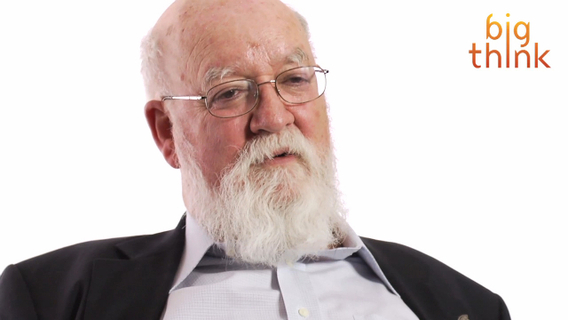
Philosopher Daniel Dennett offers a kind of self-help book for deep thinkers.
Those of you that are regular followers of Learning from Dogs know that I tend to offer posts for the week-end that are light-hearted. Certainly that’s easier for me, if you pardon me from saying, and hopefully a change for you, dear reader.
Well today’s offering is not exactly heavy but it is, nonetheless, not a typical Saturday topic.
However, trust you find it engaging.
Of the many blogs and websites that I follow, I enjoy the regular mental stimulation that flows from the blog Big Think. Recently there was a piece from Daniel Dennett that tickled my interest and I wanted to share it here.
While Silicon Valley and Silicon Alley busy themselves making every aspect of our lives more efficient (except, perhaps, for the process of discovering these new technologies, learning them, and integrating them into our lives), Daniel Dennett sits up at Tufts University in Massachusetts, philosophizing. His latest book, Intuition Pumps and Other Tools for Thinking is an attempt to make transparent some of the tricks of the philosopher’s trade. In an accelerating age, it’s a self-help book designed to slow the reader down and improve our ability to think things through.
The kinds of things Mr. Dennett likes to think about include the nature of consciousness, evolution, and religious belief. But the mind-training his new book offers is applicable to any problem you want to consider thoroughly. In an age of quick fixes and corner-cutting, we’re in constant danger of bad decision making – of overreliance on what cognitive psychologist Daniel Kahneman calls “system 1”, and what most of us call intuition. This rapid decision making channel of the brain is helpful when we are in mortal danger, or pressed for a quick decision within our areas of expertise. But for most decisions, the slower, more deliberate channel (system 2) is much more reliable. What Dennett offers, then, in Intuition Pumps, is a workout for system 2 – a series of thought experiments you can apply to puzzles real and imagined to bulk up the slower, wiser parts of your consciousness.
Some of the tools Dennett offers in the book are more familiar than others. Reductio ad absurdum arguments, for example, in which we test the validity of a claim by taking it to its most outrageous illogical extreme (a: “all living things have a right to liberty.” b: “so let me get this straight – a blade of grass has a right to liberty? What does that even mean?”). But the true delights of the book are the far-out exercises Dennett and his colleagues have dreamed up in the course of their work, such as “Swampman Meets A Cow-Shark”, from Donald Davidson, which begins:
Suppose lightning strikes a dead tree in a swamp; I am standing nearby. My body is reduced to its elements, while entirely by coincidence (and out of different molecules) the tree is turned into my physical replica. My replica, The Swampman, moves exactly as I did; according to its nature it departs the swamp, encounters and seems to recognize my friends, and appears to return their greetings in English.
Walking us through Davidson’s considerations about whether and to what extent the Swampman is anything like Davidson, and related ones about a cow that gives birth to something that looks exactly like a shark (yet has cow DNA in all of its cells), Dennett teaches us a surprising lesson about the utility of wild philosophical speculation.
Cloaked in the breezy, familiar trappings of a self-help book, Intuition Pumps is in actuality a dark mirror of that genre – a field of rabbit holes designed to leave the reader with more questions than answers, and wiser for the long and indirect journey.
Watch for Daniel Dennett’s Tools For Better Thinking – a Big Think Mentor workshop coming soon.
oooOOOooo
Don’t know about you but Daniel Dennett’s book looks like one that deserves reading. If you feel the same way the book is called Intuition Pumps And Other Tools for Thinking and here’s the link to Amazon.
Jon Lavin reflects on the Four Noble Truths of Buddhism.
Last week, I republished a number of Jon’s posts from way back and was delighted at how many of you enjoyed his writings. Jon and his family are taking a well-earned vacation which clearly includes reading posts on Learning from Dogs: Poor soul! This was made clear from an email Jon sent me yesterday afternoon.
Jon had read the essay from George Monbiot that was published three days ago under my post title of Dichlorodiphenyltrichloroethane (DDT) all over again? So hopefully, this introduction puts Jon’s email into proper context. The subject title of Jon’s email was DDT 2.0.
oooOOOooo
Hi Paul!
Hope you guys are well on your lovely farm! We’re in sunny Falmouth for the week staying in our Ben’s student flat slowly working our way through his food supplies.
In my current chilled state, I read your reproduced article and I got to thinking; so you might pick out the odd bit of coherence in these ramblings!
I am reminded of David Hawkins’ ‘Scale of Human Consciousness’. If 80 percent of us are below the level of Integrity, and therefore truth, and the average level of integrity in business is below this level, it is no wonder that money comes before the greater good. Think of the banking crisis as a good example.
I guess we move forward at the speed of the slowest. We certainly seem to learn through the pain and suffering of our own making. I can understand now why this world is perfect for our development and advancement. We are exposed to every opportunity to better ourselves and not everyone has enough of what it takes to hit the mark. We just have to keep going until we get it, even if this means pain and suffering.
The Four Noble Truths of Buddhism talk about suffering and how we create it.The First Noble Truth states that life is suffering. The 2nd Noble Truth talks about our craving for things: money, possessions, etc.; cravings that create suffering. The Third Noble Truth talks of a cure and a way out of hopelessness and suffering and finally, the Fourth Noble Truth gives guidance on walking the path out of suffering.
So, although your article is awful, it is to be expected that we keep being attracted to these sorts of schemes and are attracted to money. We have to learn through pain and suffering until we get it right.
People frequently ask, “What can I do to help?”. Unfortunately or fortunately, there is a way out! The best way to help is to work on ourselves! Sounds a bit silly but by working and developing ourselves we raise the overall level of human consciousness. This means that when companies and individuals attempt to do things that are not integrous, there is less likelihood of them being successful.
Heady stuff really and I wouldn’t describe myself as Buddhist but I have to admit there seems to be some truth in this.
I hope some of this makes sense.
Warm wishes,
Jon.
oooOOOooo
Well, of course it makes sense; perfect sense! Reminds me of the old adage that one cannot truly help another without first helping oneself.
Thus what I read in Jon’s words is that by living a life of integrity we help bring up the overall level of human consciousness, right across our planet. Let me stay with that for a moment longer. Jon mentioned David Hawkins’ ‘Scale of Human Consciousness’. It was included in a post in January 2012 The evolution of the domestic dog but to save you going there, here it is again:
Map of Consciousness, copyright Dr. David Hawkins
One might argue that the column headed ‘LEVEL’ is a pseudonym for ‘Behaviour’. In other words, those behaviours from Courage and up represent integrity.
So when Jon writes, “The best way to help is to work on ourselves!“, what he is saying that by consciously abandoning levels below 200 we open ourselves to being a force for good beyond ourselves. Just run your eye down the emotions from Ineffable to Affirmation and reflect on how others that offer those emotions affect us in such a positive and inspiring way. Indeed, no better than reflecting on how a dog makes us feel when offering unconditional love!
Of course it’s not easy! Nothing great ever is. There is so much around us that we can hate (score 150), so much to create anxiety (score 100), and so many examples of despair (score 50).
But remember the beginning of integrity is 200.
Which is why trust (score 250) and optimism (score 310) and forgiveness (score 350) and especially love (score 500) are truly the tools of healing our planet.
You can start right now by hugging a dog (dogs score 210!).
Love and Trust – Grandson Morten hugging Dhalia.
Thank you, Jon.
Some content on this page was disabled on August 23, 2017 as a result of a DMCA takedown notice from Susan Hawkins. You can learn more about the DMCA here:
My posts from Monday and yesterday about the plight of our bees must to many, frequently me as well, engender a level of hopelessness as to where we, as in the peoples of this planet, are heading. Too many times the news is discouraging; to say the least.
But hold on for just a moment! Here’s a quotation from this week’s Sabbath Moment from Terry Hershey:
Tears have a purpose.
they are what we carry of the ocean, and
perhaps we must become sea,
give ourselves to it,
if we are to be transformed.
Linda Hogan
What this says to me is that feelings of sadness, of grief, even of despair are an essential part of the process of ‘letting go’; of being able to heal oneself. Just as dogs and many other animals know when to crawl away and recuperate in some peaceful and quiet place, so too must we humans counter our feelings of pain and anguish with healing.
So with that all in mind, I’m delighted, and very grateful, to Sue of Dreamwalker’s Sanctuary for permission to repost her item on Sound Healing, published last Friday.
Have you ever wondered why we so enjoy Music? Why various styles seem to either lift our mood or sooth our spirits? Or some grate on our nerve endings?
Sound Healing comes in various forms. I have received healing from various sources: Crystal Singing Bowls, Tuning Forks and the Mighty Gongs. The Gong Bath in particular shifted something within my being as I physically felt something leave my aura to be replaced with a new found peace within.
Sound Healing isn’t new and if you research back to ancient times many ceremonies were done through sound.
I know in the 90s when I was going through my own major self-healing after listening to some tapes by Deepak Chopra called Magical Mind Magical Body in which he speaks about our vowel sounds. I remember driving to work, and on occasion still do, chanting out Very Loudly the vowel sounds in a chant, each vowel holds its own frequency. Chanting brings an awareness of our own voice, as we express outwards our feelings, and there are some interesting theories as how certain frequencies are powerfully connected to our body. This includes the frequency of 528hz,referred to as ancient solfeggio frequencies which has been researched for its proposed ability to heal and resonate with human DNA. I did my own research on the net, and came across this site and post ( Forgotten in Time: The Ancient Solfeggio Frequencies )
Interestingly too the author of that post went on to explain how Deepak Chopra was a big inspiration and listened to the same tapes I did where Deepak Chopra explained saying: “Quantum physics has found that there is no empty space in the human cell, but it is a teeming, electro-magnetic field of possibility or potential.” This made me smile as synchronicity seemed to be playing a role.
Within that same article the author went on to say how music makes waves which produces shapes and patterns and quoted a passage from a book by the first to make that connection, a German scientist, Ernst Chladni who in 1787 detailed his findings in his book “Discoveries Concerning the Theory of Music.” These patterns and figures are called Chladni figures with each note having a corresponding pattern or vibration.
My drum, as I painted it.
My own tool is the Drum and if we look back through time we see how the Drum beat has been used not only in rituals but also within our military as we march to its beat! The Drum is very powerful and many join Drumming circles. You, too, can find out how to call Healing from within a Drumming Circle from an article in the magazine Sacred Hoop of 2003 called Healing Power of the Drum Circle
Side view of my drum.
Sound Healing works, because we are all vibration, we all resonate with our own frequencies. For those wishing to learn more the links are below and of course there are many many articles covering this subject on the ‘web’.
For those who have not much time I will leave you with this one note of vibration from a Singing bowl. If you go to the YouTube site you will find more about this One note and how it heals.
…
… and for those who have 5 minutes to spare this Om Meditation.
Chakra’s are energy centers in your body. There are 7 major Chakra’s. Each Chakra governs specific issues and lessons.By aligning the chakra system you can heal your mental, emotional, spiritual & physical bodies.
7th Chakra= Crown Chakra
Color: Purple
Location: top of head
Element: Superether
Musical note/ sound: B/ silence
Glands/ Organs: Pineal gland, cerebral cortex, central nervous system, right eye
Purpose: vitalizes upper brain, unification with higher self. Being open to source, accepting our own Divinity, Beauty, healing, Inspiration. Perception beyond space & time, perceives “miracles”.
When Harmonious: Idealism, selfless service, One with divine, spiritual will, unity.
When Disrupted: lack of inspiration, confusion, depression, alienation, hesitation to serve, senility, crisis of faith.
Second: Aum Meditation
Working with Aums will resonate into all objects around you, effectively re-writing all undesirable environmental energy programming. Like a springboard of positivity. Use it to launch your spiritual work to new heights. This is just a small sample of the full meditation.
This is not a single topic blog. But the last few days have brought such a wealth of marvellous stuff that I couldn’t resist this final, for the time being, post on the benefits of slowing down, of taking a break – meditation, in other words.
First, and I wish I could remember from whence it came, I found this essay by Bertrand Russell In Praise of Idleness It’s a wonderful piece of writing from one of the great masters of the art. Take this extract from just the first paragraph, (and the photo insertion is from me!):
Bertrand Russell (18 May 1872 – 2 February 1970)
I think that there is far too much work done in the world, that immense harm is caused by the belief that work is virtuous, and that what needs to be preached in modern industrial countries is quite different from what always has been preached. Everyone knows the story of the traveler in Naples who saw twelve beggars lying in the sun (it was before the days of Mussolini), and offered a lira to the laziest of them. Eleven of them jumped up to claim it, so he gave it to the twelfth. This traveler was on the right lines. But in countries which do not enjoy Mediterranean sunshine idleness is more difficult, and a great public propaganda will be required to inaugurate it. I hope that, after reading the following pages, the leaders of the YMCA will start a campaign to induce good young men to do nothing. If so, I shall not have lived in vain.
Then from out of the Transition Network stables came this interview by Rob Hopkins with Sophy Banks on the Power of Not Doing Stuff. Just going to pick out a couple of exchanges that really struck me.
Sophy, I’m sure you get asked the question lots of times, but how would you describe Inner Transition ? What’s Inner Transition for you?
I gave a talk about Inner Transition in Canada just recently, and someone said “what I want from the talk is, what’s the most succinct story? What’s the E=mc² of Inner Transition?” The way that I’m talking about that at the moment is to say the absolute core of Inner Transition is that in our groups, within ourselves, in our relationships, in what we’re doing in our communities, how can we be creating a culture that supports us to be in a state of feeling resourced, feeling empowered, feeling seen and appreciated? With the understanding that when we have those kind of external conditions, we find ourselves in a state where we’re the most open to new ideas, the most open to connection, the most able to build relationships with people who are different from us.
That’s the core of it, to understand that internally we can be in different inner states, we can be in a state where we feel stressed and closed and driven or whatever, or we can be in a state where we’re open and creative and learning and available. That’s one way of framing Inner Transition, how do we keep recreating that?
Part of it, I think, is when we’re all in that state of being open and creative and connected with each other and with ourselves, we make the best decisions. We’re able to take the longest and the widest view, we’re able to see the consequences of what we do, so there’s also something which has really been resonating for me. That’s not only the process we need for Transition, that’s the end-state we want to get to. Part of what’s not working in our culture is that lots of the people with a lot of power who are making really key decisions are in a state of constant stress and pressure and having to make very narrow decisions, decisions based on very narrow viewpoints.
oooo
One of the expressions you’ve been using increasingly over the last couple of years is “healthy human culture” and this idea that that’s ultimately the aim of Transition, to enable that and to create that. What does that mean? Can you define “healthy human culture”?
This is where my enquiry took me. I got really interested in seeing polarities and dualities – people have been doing that for centuries – about our culture and calling it dualistic. I came across Riane Eisler’s work. She talks about basically two kinds of human culture. One is based on partnership and one is based on domination. I got really interested in that and the question what if that’s true? It’s a big proposition.
If that’s true, what’s underneath that and what is it about what goes on inside us that we’re constructed, the way we’ve evolved, that causes that to be so, that there are these two stable states? I feel like I’ve been looking at lots of different territories, I’m really interested in trauma and how that affects us in the creation of the unconscious that comes through trauma.
This whole thing about how we create unintended consequences. The idea that anybody could have sat down and designed the consequences that we’re living with is inconceivable. However dysfunctional people were and however much they’re interested in wealth or power or anything, I just don’t believe that anybody intended it to be like this. How do we get this as a by-product of something that’s natural and…just who we are, who we’ve evolved to be.
So for me, the question around “healthy human culture” is one of the inner. What’s the inner state of a culture that creates partnership, learns to live within its resources, that’s oriented towards joyful, pleasurable existence, that has a belief about ourselves as humans that we’re trustworthy and generous and want good things for the future, good things for our children. What I see very very strongly: in a lot of the depth work that I’ve done, what I see is when you peel away a lot of the damage, what you find is a profound and I could say universal. In my experience (I haven’t worked with the psychopaths and the most damaged people) but that sense that if we’re healed and whole what we want is to love each other and do good in the world.
Then there’s another state we could be in, which comes back to your first question, where we feel under-resourced, disempowered, under attack. There’s not enough and I’m taught that other people are selfish, violent and greedy so I need to fight for what I can get. In order to have status I’ve got to have stuff, I’ve got to prove myself. With that goes a whole lot of very difficult feelings.
I’m very interested in that idea, that in unhealthy culture we have a whole lot of unmanageable feelings centred around shame and not being good enough that we then disown – I can’t deal with that in myself, I’ll put it on to you, I’ll find somebody else to have that experience and then I’ll watch it in them and feel OK about myself. It’s really interesting to look at cultures of domination and colonialism and capitalism and power-over as being driven by the need to not feel stuff myself, but grab enough power so that I can do it to somebody else.
The whole driver for those things is a psychological state of splitting and projection. When I bring that back to me and what culture I create in my relationships and my groups, you see it out in those big systems in the world but it’s also a very precise way of understanding and discerning what culture do I make in this room with these people, around splitting and projection or unity.
That’s quite a big answer! The short answer is “healthy human culture” is that one where we reel resourced, empowered, connected, appreciated and safe. Those seem to be the 5 things. If we have those, we are in that state of openness and availability and connection and learning and receptivity and then taking good action instead of action that creates a problem somewhere else in the system.
It really is a fascinating and thought-provoking interview. Go and read it in full, or better still, find somewhere to sit and relax, close your eyes and listen to it.
Moving on.
There was an article in Nature about the Brain: Neuroscience: Idle minds – Neuroscientists are trying to work out why the brain does so much when it seems to be doing nothing at all.
For volunteers, a brain-scanning experiment can be pretty demanding. Researchers generally ask participants to do something — solve mathematics problems, search a scene for faces or think about their favoured political leaders — while their brains are being imaged.
But over the past few years, some researchers have been adding a bit of down time to their study protocols. While subjects are still lying in the functional magnetic resonance imaging (fMRI) scanners, the researchers ask them to try to empty their minds. The aim is to find out what happens when the brain simply idles. And the answer is: quite a lot.
Again, a very important read so do go across and read it in full. Because, you will come to this:
Zen and the art of network maintenance
Raichle favours the idea that activity in the resting state helps the brain to stay organized. The connections between neurons are continually shifting as people age and learn, but humans maintain a sense of self throughout the upheaval. Spontaneous activity might play a part in maintaining that continuity. “Connections between neurons turn over in minutes, hours, days and weeks,” says Raichle. “The structure of the brain will be different tomorrow but we will still remember who we are.”
Or perhaps the activity is part of the reshaping process, tweaking connections while we idle. Several teams have reported changes in resting connectivity after language and memory tasks and motor learning. Chris Miall, a behavioural brain scientist at the University of Birmingham, UK, and his colleagues have shown that spontaneous activity at rest can be perturbed by what has just happened. The team scanned volunteers at rest, and then asked them to learn a task involving using a joystick to track a moving target. When the participants were scanned at rest again, the team could see the effects of motor learning in the resting networks. That study, and subsequent work along the same lines, suggests that “the brain is not only thinking about supper coming up, but it’s also processing the recent past and converting some of that into long-term memories”, says Miall. The network changes are specific to the tasks performed.
So, hopefully, anyone who has read this post and who would like to slow down, to practise the art of doing nothing, will be eager to learn how. Well, keep reading!
There are lots and lots of ways to meditate. But our concern is not to find a perfect form of meditation — it’s to form the daily habit of meditation. And so our method will be as simple as possible.
1. Commit to just 2 minutes a day. Start simply if you want the habit to stick. You can do it for 5 minutes if you feel good about it, but all you’re committing to is 2 minutes each day.
2. Pick a time and trigger. Not an exact time of day, but a general time, like morning when you wake up, or during your lunch hour. The trigger should be something you already do regularly, like drink your first cup of coffee, brush your teeth, have lunch, or arrive home from work.
3. Find a quiet spot. Sometimes early morning is best, before others in your house might be awake and making lots of noise. Others might find a spot in a park or on the beach or some other soothing setting. It really doesn’t matter where — as long as you can sit without being bothered for a few minutes. A few people walking by your park bench is fine.
4. Sit comfortably. Don’t fuss too much about how you sit, what you wear, what you sit on, etc. I personally like to sit on a pillow on the floor, with my back leaning against a wall, because I’m very inflexible. Others who can sit cross-legged comfortably might do that instead. Still others can sit on a chair or couch if sitting on the floor is uncomfortable. Zen practitioners often use a zafu, a round cushion filled with kapok or buckwheat. Don’t go out and buy one if you don’t already have one. Any cushion or pillow will do, and some people can sit on a bare floor comfortably.
5. Start with just 2 minutes. This is really important. Most people will think they can meditate for 15-30 minutes, and they can. But this is not a test of how strong you are at staying in meditation — we are trying to form a longer-lasting habit. And to do that, we want to start with just a two minutes. You’ll find it much easier to start this way, and forming a habit with a small start like this is a method much more likely to succeed. You can expand to 5-7 minutes if you can do it for 7 straight days, then 10 minutes if you can do it for 14 straight days, then 15 minutes if you can stick to it for 21 straight days, and 20 if you can do a full month.
6. Focus on your breath. As you breathe in, follow your breath in through your nostrils, then into your throat, then into your lungs and belly. Sit straight, keep your eyes open but looking at the ground and with a soft focus. If you want to close your eyes, that’s fine. As you breathe out, follow your breath out back into the world. If it helps, count … one breath in, two breath out, three breath in, four breath out … when you get to 10, start over. If you lose track, start over. If you find your mind wandering (and you will), just pay attention to your mind wandering, then bring it gently back to your breath. Repeat this process for the few minutes you meditate. You won’t be very good at it at first, most likely, but you’ll get better with practice.
And that’s it. It’s a very simple practice, but you want to do it for 2 minutes, every day, after the same trigger each day. Do this for a month and you’ll have a daily meditation habit.
Now to the close.
Beautifully rendered thanks to Terry Hershey. For on his website there is this:
When I pause, I put myself in a new or different environment. When I pause, I create spaces–or sanctuaries–in which renewal can be born. When I pause, I allow my soul to savor, relish, value, honor, welcome, see, celebrate, wonder, and to experience grace.
John Hurlburt writing as ‘an old lamplighter‘ has been a regular contributor to Learning from Dogs. Indeed, just last Friday in my rather introspective post, Maybe home is found in our quietness, I included John’s beautiful Evening Meditation. The day before that post, John sent me the following (the picture below is my contribution to John’s essay!) It’s a reflection on both the absurdity of modern times and the simplicity of the answers.
oooOOOOoo
Our interconnected world.
Bird Seed!
In return for a local pet store patronage, today’s cost savings included free bird seed. Meanwhile, our economic system squanders our common wealth.
The agendas of rich and powerful people who don’t want anything to change are reflected by FAUX News. What we have on our hands is an absurd interpretation of reality, which is made up as they go along. Politics has become a game of “Can You Top This”; with no limits. There’s a question about our collective level of sanity.
Our shared crisis mounts as our demographic increases and our natural resources are depleted accordingly. The fact is that we’re beyond the carbon limits the atmosphere requires to maintain the inclusive well-being of life on earth. And we’re damaging the surface layer of the planet that sustains us all in the process.
The answers are simple and natural. Here are five quick examples and a conclusion of sorts.
1. Diesel fuels run the majority of the world’s heavy machinery. Switching from carbon-based diesel fuels to natural bio-fuels, as per the original design by Rudolf Diesel, would have a profound effect on carbon pollution as well as fostering green innovation and industry. No modification of any on-line diesel engines would be required. As a matter of fact, they’d probably run more efficiently.
Solution: Economic advantage of using bio-fuels.
2. Re-establishing human rights may be best accomplished through increased awareness of our fragile unity as a species. The openness, honesty and integrity of Creation lights the way each day and lends serenity to our reflections.
Solution: Accept that deliberate human war and related destruction of the earth is empty, has no future, and is contrary to the purpose of human life.
Incidentally, when we put a natural floor under the global economy we’ll save our collective bacon in the process. Transitioning military forces to support green economic development opportunities might be a possibility if we decide to take life seriously enough to make a real difference.
3. Re-establishing a realistic base for a global economy that’s swollen 25 times beyond any material planetary resource foundation may best be accomplished by transitioning to green industries that benefit our planet, nations, communities and the sanctity of life in general. A modification to our technically driven financial system is needed.
Solution: Isaac Asimov; “I Robot” (the laws of robotics)
4. Re-establishing common law with inclusive equality and justice may be best accomplished by an in-depth examination of personal beliefs values, motives and actions in terms of respect for whatever Higher Power we may believe there to Be, compassion for Creation and the realization that we’re all living in and on the same life boat.
Solution: Education, formation and transformation based upon the facts of reality that we know in our present state of development and the far greater Reality which transcends our being and our current understanding based upon reason alone.
For example, Einstein’s General and Special Theories of Relativity tell us that we are in the process of turning inside out without breaking. A phrase that comes to mind is “transrational reality”. When we step beyond “self” we see the world through new eyes.
5. Agreeing on an equitably interactive and enforceable world-wide corporate, government, labor, and service organization wage scale may best be accomplished by listening to the voices of economic reason which tell us that money is only a symbol.
Rationale: Everything fits together. Change is constant. Life needs to adapt to survive. In Unity there is strength. At our best, we care for the earth and each other.
Inclusive solution: Surrender to Reality. The global system is broken, Resources are limited. It’s time to wake up. It’s time to change. A sustainable and growing green economy benefits everyone on earth.
Bottom Line
Love lights the way
Faith is stronger than fear
Hope springs Eternal
Our truths, our home, our serenity; all flow from stillness.
Soon silence will have passed into legend. Man has turned his back on silence. Day after day he invents machines and devices that increase noise and distract humanity from the essence of life, contemplation, meditation.
As is often the way, a number of disparate items came together for today’s post in a way of lovely connectivity.
A few weeks ago when meeting our local doctor for the first time since we moved to Oregon, I had grumbled about bouts of terrible short-term memory recall and more or less had shrugged my shoulders in resignation that there was nothing one could do: it was just part of getting older, I guessed!
“On the contrary”, responded Dr. Hurd, continuing, “There’s growing evidence that our information-crowded lives: cell phones; email; constant TV; constant news, is pumping too much for our brains to manage.”
Dr. Hurd continued, “Think about it! Our brains have to process every single sensory stimulus. The research is suggesting that our brains are being over-loaded and then the brain just dumps the excess data. If that is the case, and the evidence is pointing in that direction, then try thirty minutes of meditation each day; give your brain a chance to rest.”
So that was the first revelation.
The second was a recent science programme on the BBC under the Horizon series. The programme was called, The Truth About Personality.
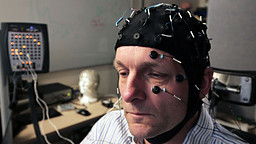
Michael Mosley’s brain being measured.
Michael Mosley explores the latest science about how our personalities are created – and whether they can be changed.
Despite appearances, Mosley is a pessimist who constantly frets about the future. He wants to worry less and become more of an optimist.
He tries out two techniques to change this aspect of his personality – with surprising results.
And he travels to the frontiers of genetics and neuroscience to find out about the forces that shape all our personalities.
Within the programme came the astounding fact that even ten minutes a day meditation can help the brain achieve a more balanced personality (balance in terms of not being overly negative in one’s thoughts).
The third revelation came from Jean and me watching a TED Talk last night. Just 14 minutes long, please watch it – you will be transformed!
Published on Jul 17, 2013
More and more people worldwide are living in countries not considered their own. Writer Pico Iyer — who himself has three or four “origins” — meditates on the meaning of home, the joy of traveling and the serenity of standing still.
Then, just three days ago, John Hurlburt, a long-time supporter and regular contributor to Learning from Dogs, emailed me his reflection on meditation. John quickly gave permission for it to be published here.
oooOOOooo
The stillness of evening.
Evening Meditation
Our world is increasingly spiritually, morally, mentally, physically and economically bankrupt. Many people would like to change the world one way or another. Most don’t really know why. Some folks simply don’t care. The idea is to leave life a bit better than we found it when we were born.
The fact is we’re all intrinsically sacred in a universe we didn’t create. We tend to prioritize illusion and delusion above reality. Playing God is a precursor of evil. A supreme faith in Money is self contradictory and ultimately fatal. Arrogance compounds the problem.
We connect in unified awareness through serene meditation. We experience harmony within an emerging celestial symphony. Answers flow from the inside out as we surrender to the eternal energy flow.
Be still and know…
an old lamplighter
oooOOOooo
Finally, after having a real struggle to find the place, both psychologically and physically, where I could start my own relationship with meditation, on Wednesday afternoon, when walking the quarter-mile up to our mail-box, it struck me as obvious.
Embraced by nature.
This quiet place on our creek where the water trickles down from an old flood irrigation dam. Somewhere to sit under the shade of a tree, somewhere to be still, somewhere as perfect a home as anyone could ever find.
Meditation is the dissolution of thoughts in Eternal awareness or Pure consciousness without objectification, knowing without thinking, merging finitude in infinity.








 Learning from Dogs