Category: Philosophy

Learning from the play of dogs.

A recent newspaper article offers yet more learning from dogs.

I can’t recall how I came across the article but so what!  What I do recall was reading a recent item in The Washington Post and thinking that has to be reported here on Learning from Dogs.

The article, written by David Grimm, was entitled: In dogs’ play, researchers see honesty and deceit, perhaps something like morality. Here’s how it opened:

A shaggy brown terrier approaches a large chocolate Labrador in a city park. When the terrier gets close, he adopts a yogalike pose, crouching on his forepaws and hiking his butt into the air. The Lab gives an excited bark, and soon the two dogs are somersaulting and tugging on each other’s ears. Then the terrier takes off and the Lab gives chase, his tail wagging wildly. When the two meet once more, the whole thing begins again.

Watch a couple of dogs play, and you’ll probably see seemingly random gestures, lots of frenetic activity and a whole lot of energy being expended. But decades of research suggest that beneath this apparently frivolous fun lies a hidden language of honesty and deceit, empathy and perhaps even a humanlike morality.

Now I don’t have permission to reproduce the entire article but will draw your attention to this further piece:

All of this suggests that dogs have a kind of moral code — one long hidden to humans until a cognitive ethologist named Marc Bekoff began to crack it.

A wiry 68-year-old with reddish-gray hair tied back in a long ponytail, Bekoff is a professor emeritus at the University of Colorado at Boulder, where he taught for 32 years. He began studying animal behavior in the early 1970s, spending four years videotaping groups of dogs, wolves and coyotes in large enclosures and slowly playing back the tapes, jotting down every nip, yip and lick. “Twenty minutes of film could take a week to analyze,” he says.

The data revealed insights into how the animals maintained their tight social bonds — by grooming each other, for example. But what changed Bekoff’s life was watching them play. The wolves would chase each other, run, jump and roll over for seemingly no other reason than to have fun.

Few people had studied animal play, but Bekoff was intrigued. “Play is a major expenditure of energy, and it can be dangerous,” he says. “You can twist a shoulder or break a leg, and it can increase your chances of being preyed upon. So why do they do it? It has to feel good.”

Suddenly, Bekoff wasn’t interested just in behavior; he was interested also in emotions and, fundamentally, what was going on inside these animals’ heads.

Marc Bekoff’s name rang a bell with me and, sure enough, I found that previously he was mentioned here.  It was a post called Daisy offers a lesson for all,:

Animal Emotions

Do animals think and feel?
by Marc Bekoff – Professor Emeritus of Ecology and Evolutionary Biology at the University of Colorado, Boulder.

Daisy: The Injured Dog Who Believed She’d Walk Again and Did

Anthrozoology, also called human-animal studies (HAS), is a rapidly growing and expanding interdisciplinary field. A recent and comprehensive review of this wide-ranging discipline can be found in Paul Waldau’s book titled Animal Studies: An IntroductionMany of the essays I write for Psychology Today have something to do with anthrozoology in that they focus on the wide variety of relationships that humans establish with nonhuman animals (animals). Some essays also discuss what we can learn from other animals, including traits such as trust, friendship, forgiveness, love, and hope.

Often, a simple video captures the essence of the deep nature of the incredibly close and enduring bonds we form with other animals and they with us. As a case in point, my recent essay called “A Dog and His Man” showed a dog exuberantly expressing his deep feelings for a human companion he hadn’t seen for six months. Another essay titled “My Dog Always Eats First: Homeless People and Their Animals” dealt with the relationship between homeless people and the animals with whom they share their lives.

Daisy: An unforgettable and inspirational symbol of dedication and hope

I just saw another video called “Daisy – the Little Pup Who Believed” that is well-worth sharing widely with others of all ages. There is no way I can summarize the depth of five-month old Daisy’s resolve to walk again after she was injured or of the devotion of the woman, Jolene, who found her on the side of a road – scared, malnourished, unable to walk or wag her tail, the people who contributed money to help her along, or the wonderful veterinarians and staff at Barrie Veterinary Hospital in Ontario, Canada, who took care of her. You can also read about Daisy’s remarkable and inspirational journey here.

Please take five minutes out of your day to watch this video, read the text, listen to the song that accompanies it, and share it widely. I am sure you will get teary as you watch Daisy go from an injured little ball of fur living in a ditch on the side of a road with a broken spine to learning to walk in water to romping around wildly as if life had been that proverbial pail of cherries from the start.

I’ve watched Daisy’s journey many times and every single time my eyes get watery. Among the many lessons in this wonderful video is “stay strong and never give up”. Clearly dogs and many other animals can truly teach us about traits such as trust, friendshipforgiveness, love, and hope.

Back to that Washington Post article.

Bekoff’s recent work suggests another remarkable canine skill: the ability to know what another animal is thinking — a so-called “theory of mind.”

Dogs seem to display a rudimentary form of this skill during play. He has noticed, for example, that one dog won’t begin trying to play with another dog until he has her attention. To get her to notice, he may nip the other dog or run into her field of view. That, Bekoff says, shows that the one wanting to play knows that she’s not paying attention to him. Though this may seem like a simple skill, it’s incredibly important to our species. Without it, we can have a hard time learning or interacting with the world around us.

So will leave you with this video and return to the theme tomorrow.

Celebrating Who I Am.

The journey towards knowing better who we are.

This may seem like a bit of an ‘odd-ball’ after Celebrating Ben and Ranger on Monday and Celebrating Pharaoh yesterday.  Indeed, when I had in mind those two posts, writing about self-awareness was nowhere on my mental horizon.  Then along came Shakti Ghosal after Monday’s post who left this comment:

Hi Paul,

Just came a visiting and was halted by these glorious photographs. Horses embody such great qualities of trust, grace and power don’t they? What is it that makes them such a great friend of Man, I wonder? Specially when the latter species, as we know it (and we should know!), can choose to behave quite contrary to those Equine qualities above….

Shakti

As Shakti was a new visitor inevitably I went across to his blog site, ESGEE musings, and then to the About page. Where I read, in part,

About Shakti Ghosal

Shakti

Born in New Delhi, India, Shakti Ghosal is an Engineer and Management Post Graduate from IIM, Bangalore. Apart from Management theory, Shakti remains fascinated with diverse areas ranging from World History, Global trends to Human Psychology & Development.

I was intrigued and starting reading some of Shakti’s posts.  That is how I came across The Audacity of Who I am and a day later had been offered permission to republish it.

However, before going on to Shakti’s post let me recap a little from yesterday’s post Celebrating Pharaoh.  This section:

The biggest, single reward of having Pharaoh as my friend goes back a few years.  Back to my Devon days and the time when Jon Lavin and I used to spend hours talking together.  Pharaoh always contentedly asleep in the same room as the two of us. It was Jon who introduced me to Dr. David Hawkins and his Map of Consciousness. It was Jon one day who looking down at the sleeping Pharaoh pointed out that Dr. Hawkins offered evidence that dogs are integrous creatures with a ‘score’ on that Map of between 205 and 210. (Background story is here.)

So this blog, Learning from Dogs, and my attempt to write a book of the same name flow from that awareness of what dogs mean to human consciousness and what Pharaoh means to me.  No, more than that!  From that mix of Jon, Dr. David Hawkins, and experiencing the power of unconditional love from an animal living with me day-in, day-out, came a journey into my self.  Came the self-awareness that allowed me to like who I was, be openly loved by this dog of mine, and be able to love in return.  As is said: “You cannot love another until you love yourself.

I will speak a little more about this but, first, to Shakti’s post.

ooOOoo

The Audacity of Who I am

“High above the noise and fear mongering of critics and cynics softly speaks your true self.”

– Mollie Marti, Psychologist, Lawyer & Coach, USA

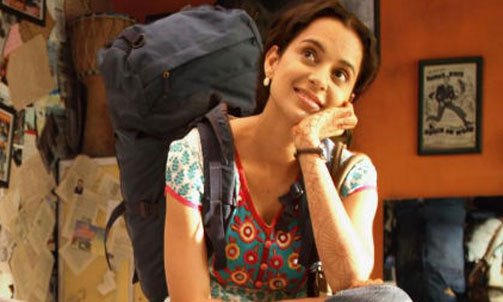
The other day, I watched the Bollywood movie Queen. In it Rani, a girl from Delhi, travels to Europe after being spurned by her fiancé. The movie then goes on to explore Rani’s ‘World view’ as dictated by her Indian middle class values and how that alters, as her biases and prejudices fall away, as she is confronted by radically different value systems and perspectives. A journey of self discovery in surroundings where she is no longer weighed down by others’ expectations and diktats. As she morphs, she confuses and pisses off many people including herself. Rani emerges from this crucible of experience as a more authentic human being. As she chooses to be ‘who she is for herself and for others’, she symbolises courage as well as resistance. Walking out of the theatre, I could not help but acknowledge how Rani’s awareness and acceptance of ‘who she is for herself and for others’ left her more empowered and in control of her destiny.

Kangana Ranaut in Queen

Who I am for myself and for others? How many of us are willing to make this query a daily practice as we loosen the constraints imposed by our world-view, let go of who we believe we should show up as and embrace who we really are?

What is it that makes me avoid being who I am for myself and for others? I can see this stemming from my desperation to be admired, liked and looking good. My life experiences have conditioned me to avoid being straightforward and veer towards being diplomatic if I perceive it is the latter which makes me look good. I have also been guilty of the corporate lie. On occasions I have stretched the truth about my company and its services, hidden what could have been embarrassing. On other occasions I have manipulated situations and people. All this to succeed, be admired, look good.

I muse. Have my efforts to gain admiration and look good empowered me to greater heights? Have I succeeded in engaging in my life from a place of worthiness? I remain increasingly unsure.

So if avoiding ‘who I am for myself and for others’ has not worked for me, how could I embrace it? As I think of this, I begin to see what being who I am for myself and for others could mean for me.

Shakti 2

It would mean the audacity to show up as the ‘imperfect me’ that I am and the willingness to be vulnerable.

It would mean the audacity to let my hair down and allow myself to truly belong with the folks I choose.

It would mean the audacity to be compassionate and loving even when I hold the fear of not being good enough.

It would mean the audacity to be authentic about my own inauthenticities.

Am I committed to being this audacious?

***

“Real isn’t how you are made,’ said the Skin Horse.’ It’s a thing that happens to you. When a child loves you for a long, long time, not just to play with, but REALLY loves you, then you become Real.’

‘Does it hurt?’ asked the Rabbit.

‘Sometimes,’ said the Skin Horse, for he was always truthful. ‘When you are Real you don’t mind being hurt.’

‘Does it happen all at once, like being wound up,’ he asked, ‘or bit by bit?’

‘It doesn’t happen all at once,’ said the Skin Horse. ‘You become. It takes a long time. That’s why it doesn’t happen often to people who break easily, or have sharp edges, or who have to be carefully kept. Generally, by the time you are Real, most of your hair has been loved off, and your eyes drop out and you get loose in the joints and very shabby. But these things don’t matter at all, because once you are Real you can’t be ugly, except to people who don’t understand.”

Excerpt from ‘The Velveteen Rabbit’ by Margery Williams

In Learning….. Shakti Ghosal

ooOOoo

Now Shatki’s post is spot on.  But it assumes one thing.  That is that each of us has sufficient self-awareness “to show up as the ‘imperfect me’”.  Sometimes, as in my case, that ‘imperfect me’ was well-hidden from the self.  Stay with me a little longer.

My father died of cancer in 1956.  Just 5 days before Christmas, 1956.  He was 55 and I had turned 12 just 6 weeks previously. I had completed my first term at the local (Preston Road, Wembley) grammar school.

For many reasons that do not need to be shared here, the effect of my father’s death and my subsequent decline in my school performance, left me with a long-term psychological ‘dysfunction’; namely a feeling that I had been emotionally rejected.  But that feeling was deeply hidden from me.  In fact, that hidden belief remained with me until 2007 when Jon Lavin brought it to the surface. (Jon is a UKCP accredited therapist and NLP Practitioner).

Reflect on that for just a moment.  For the thick end of fifty years, this psychological characteristic remained totally below my consciousness yet, nonetheless, influenced me in very real and tangible ways.

The negative influence was that I was drawn to any woman who offered me love and affection and, therefore, was emotionally unable to understand how good a partner she might or might not be for me. (Jean is my fourth wife!)

The positive influence was that I tried very hard to please others, to avoid their rejection, and had successful careers in selling for IBM UK, starting and building a successful business in the early days of personal computing and, later, when my company was sold in 1986 becoming a freelance journalist and business coach.

So back to Shakti’s essay.

I agree one-hundred-percent with what he says. With the proviso that in certain cases, spending time with a qualified counsellor could be your best investment ever.

How to round this off.

If you have been influenced by any of this then do give yourself time and space to counsel yourself.  Let your inner person reach out in peace to your outer person.

If that inner person suggests you could be a happier, more peaceful person then reach out to someone properly qualified to hold your hand as you open up to your inner feelings.

Which is why loving a dog and being loved in return by that beautiful creature means so much.  For in that private bond that animals offer us lays the truth.

I can do no better than offer this personal reason why being audacious about who you are is the supreme ‘investment’ of all in yourself.

A few months after Jon Lavin brought my fear of emotional rejection to my conscious surface, I met Jean in Mexico, Christmas 2007.  I have never loved a person as I love Jean.  I have never been loved by a person as Jean loves me.

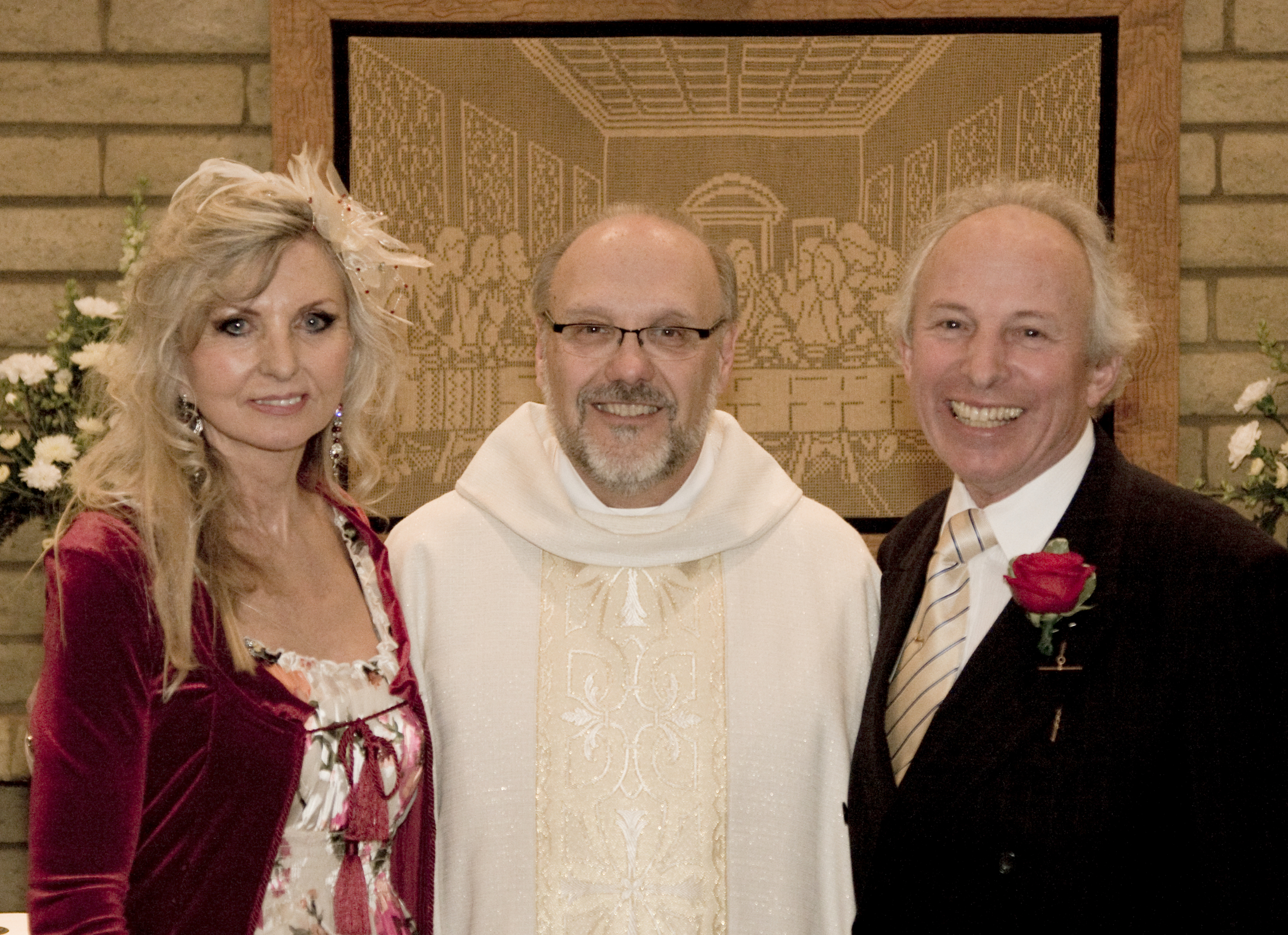
Jean, Father Dan and yours truly. St Paul's Episcopal Church, Payson, AZ. November 20th, 2010.
Jean, Father Dan and yours truly. St Paul’s Episcopal Church, Payson, AZ. November 20th, 2010.

Being at peace with who you are is the most important celebration.

Say no more!

The genuine you!

Do you or I know you or I?

OK, I accept that the sub-heading is slightly provocative but so what!

The fascination in truly knowing who we are is endless!

Back in January of this year, I penned an essay under the title of 20:20 self-awareness.  Here’s a snippet from that post:

The single biggest problem in communication is the illusion that it has taken place.” George Bernard Shaw is reputed to have once said!

Today’s essay on the challenges of speaking clearly to another, perhaps better described as communicating in a clear and unambiguous fashion, came out of a recent conversation with Jon Lavin, a good friend from my Devon days.  (Jon offers services for business owners and entrepreneurs under his business banner of The People Workshop.)

Jon was explaining that the number one hurdle for businesses that are managing change, and for so many businesses managing change is practically a constant, is having clear communications within the team.

The essence of that, and other posts over the years, is that knowing others, communicating with others, is so much easier when we know ourself well.

Not just relevant to us humans, by the way.  Dogs love knowing us sufficiently well that they can trust and understand our behaviours.

So all of that is an introduction to an article that was recently on the website of London-based Harley Therapy. The article is called How to Be Your Authentic Self. I have taken the liberty of republishing it in full here on Learning from Dogs. (See copyright statement at the end.)

ooOOoo

It’s a little after 6am.

I awoke this morning with the terrible realisation that I didn’t have permission to republish that article and, therefore, have ‘amended’ today’s post and removed the item..

Apologies to my readers.

Paul.

Do animals fall in love?

Opening our minds to a beautiful concept!

One of the better things about my old home country, the United Kingdom, is The Open University.  As Wikipedia explains:

The OU was established in 1969 and the first students enrolled in January 1971. The University administration is based at Walton Hall, Milton Keynes in Buckinghamshire, but has regional centres in each of its thirteen regions around the United Kingdom. It also has offices and regional examination centres in most other European countries. The university awards undergraduate and postgraduate degrees, as well as non-degree qualifications such as diplomas and certificates or continuing education units.

With more than 250,000 students enrolled, including around 32,000 aged under 25 and more than 50,000 overseas students, it is the largest academic institution in the United Kingdom (and one of the largest in Europe) by student number, and qualifies as one of the world’s largest universities.

For reasons that I am unclear about, I subscribe to the OU’s newsletter.  Thus it was that a few weeks ago, this dropped into my ‘in-box’.

Do animals fall in love?

Do romantic relationships exist in the animal kingdom?

Throughout his lifetime, evolutionist and biologist Charles Darwin researched and wrote about how he felt that love can exist within the animal world. Particularly in his papers ‘The Expression of Emotions in Man and Animals’ and ‘Comparison of the Mental Powers of Man and the Lower Animals’, he explored how animals can display supposed ‘human emotions’ like pleasure, pain, happiness and misery. He investigated how animals could seemingly appear to feel ‘down’ when separated from their companions, and seemed to jump for joy and touch one another in a way similar to a human hug when reunited.

Although monogamy and lifelong pair bonds are generally rare in the animal kingdom, some animals seem to thrive on it. Recent research has shown that Gibbons, who were thought to mate for life, have more complicated relationships, with mates occasionally philandering, and even sometimes dumping a mate, suggesting some similarity to human relationships. Swans also form monogamous pair bonds that last for many years, and occassionally for life. Loyalty to their mates has made them a virtually universal symbol of love. But some researchers believe it isn’t as romantic as it first appears, and that they stay together because spending extra time attracting a new mate has the potential to impact on the otherwise reproductive time.

Darwin’s theories have paved the way for further studies. In this free article, Tim Halliday explores natural selection and evolution in the animal world.

Here is that article.

ooOOoo

Natural Selection and Evolution

Tim Halliday explores natural selection and evolution in the animal world

By: Professor Tim Halliday (Department of Life Sciences, The Open University)*

In the Rules of Life series, and its accompanying CD, Aubrey Manning looks at the behaviour of animals and describes many new discoveries about the way that this is beautifully adapted to meet the challenges which animals face in their daily lives. The scientific study of animal behaviour, or ethology, was founded some 50 years ago by Niko Tinbergen and Konrad Lorenz. Their most significant contribution was to bring together the study of natural history with an understanding of evolution by natural selection. Since then, the numerous studies that have been made of animal behaviour have revealed that animals do many things that challenge many of the ideas that people had about natural selection 50 years ago. Natural selection theory has developed enormously since that time, largely as the result of animal behaviour studies, and a number of popular misconceptions about evolution have been revealed to be false as a result.

One such misconception is embodied in the phrase ‘survival of the fittest’, first coined by Herbert Spencer, and often used to encapsulate the way natural selection works. It is misleading, because ‘survival’ is only part of the story. Evolutionary change comes about because some individuals are more successful in reproduction and so pass on their genes to succeeding generations. As a result, the characteristics that make individuals successful in reproduction become more common in the population. It is thus reproduction that is important in evolution, and survival becomes simply a means to that end.

The importance of this point becomes apparent when we appreciate that, for most animals, reproduction is a very costly and sometimes dangerous activity, as illustrated many times in the series. To engage effectively in reproductive activity requires a great deal of energy and other resources that could otherwise be put towards survival. This is apparent in the common observation that animals show a greatly reduced growth rate, or stop growing altogether, when they reach sexual maturity. The resources that they derive from feeding are diverted from growth to reproduction.

A second common misconception is that natural selection acts ‘for the good of the species’. There are numerous examples of animal behaviour that show that this cannot be the case. For example, African lions live in prides, consisting of several females and their cubs, controlled by a group of two or three males. Other mature males are excluded from living in a pride. From time to time, a coalition of excluded males is formed and they attempt to take over a pride, by attacking and driving away the current pride-holders. If they succeed in doing this, their first act is to kill any cubs in the pride that are still being suckled by their mothers. To kill the young of one’s own species cannot benefit the species. The adaptive value of this behaviour for males is that, deprived of the cubs they have been suckling, the females very quickly come on heat and can conceive cubs fathered by the new pride-holders.

This example illustrates another common misconception about evolution, that, when mating, males and females are acting cooperatively. While it is in the interests of both parents that reproduction is successful, the way that that success comes about is not necessarily the same for the two sexes. For male lions, it is of no reproductive benefit to them to guard females that give birth to cubs fathered by other males. Infanticide is of benefit to them because it ensures that cubs born in the pride are their offspring. Infanticide is costly for females because the considerable time and resources that they have put into producing cubs is wasted. There is thus a conflict between the sexes, even though they have to behave cooperatively if either is to reproduce at all.

The interplay of cooperation and conflict is also apparent in the relationship between parents and offspring. For animals that produce more than one young at a time, it is usually to the advantage of the parent to share food more or less equally among its progeny. For each individual progeny, however, it is to its advantage if it receives more food than its siblings. There is thus a great deal of competition among progeny. This takes a bizarre form in the European Fire Salamander, and in a species of shark described in one of the programmes. In these animals, the young develop within the mother and, as they grow, they eat one another until only one, very large young is left. It may be that producing one offspring at a time is a good strategy from the mother’s point of view, or it could be that she would have higher reproductive success if she produced more; it may be, however that she has no choice in the matter.

The key to understanding evolution by natural selection is to think of it, not in terms of an individual’s survival, but in terms of its effectiveness in passing on its genes, what in the series is referred to as ‘genetic accounting’. Natural selection favours those individuals that pass on the most copies of their genes. This enables us to explain many aspects of animal behaviour that are difficult to explain purely in terms of survival. For example, in many species, particularly among birds, certain adult individuals do not breed themselves, but help other adults to do so, for example by feeding their young. In almost all cases, helpers turn out to be close relatives of the parents they are helping and so they are, in an indirect way, helping to spread those genes that they share with their relatives.

* Tim Halliday is professor of biology at The Open University, where he has worked on newts, toads and frogs since 1977.

ooOOoo

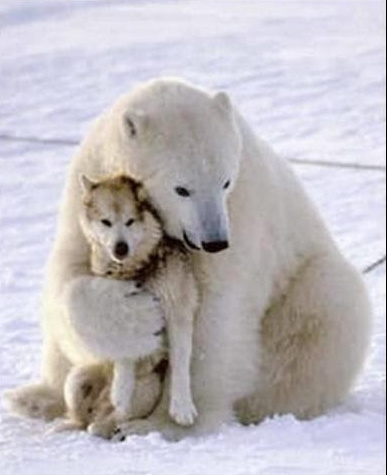
Two photographs that offer my answer to the question: Do animals fall in love?

animallove

oooo

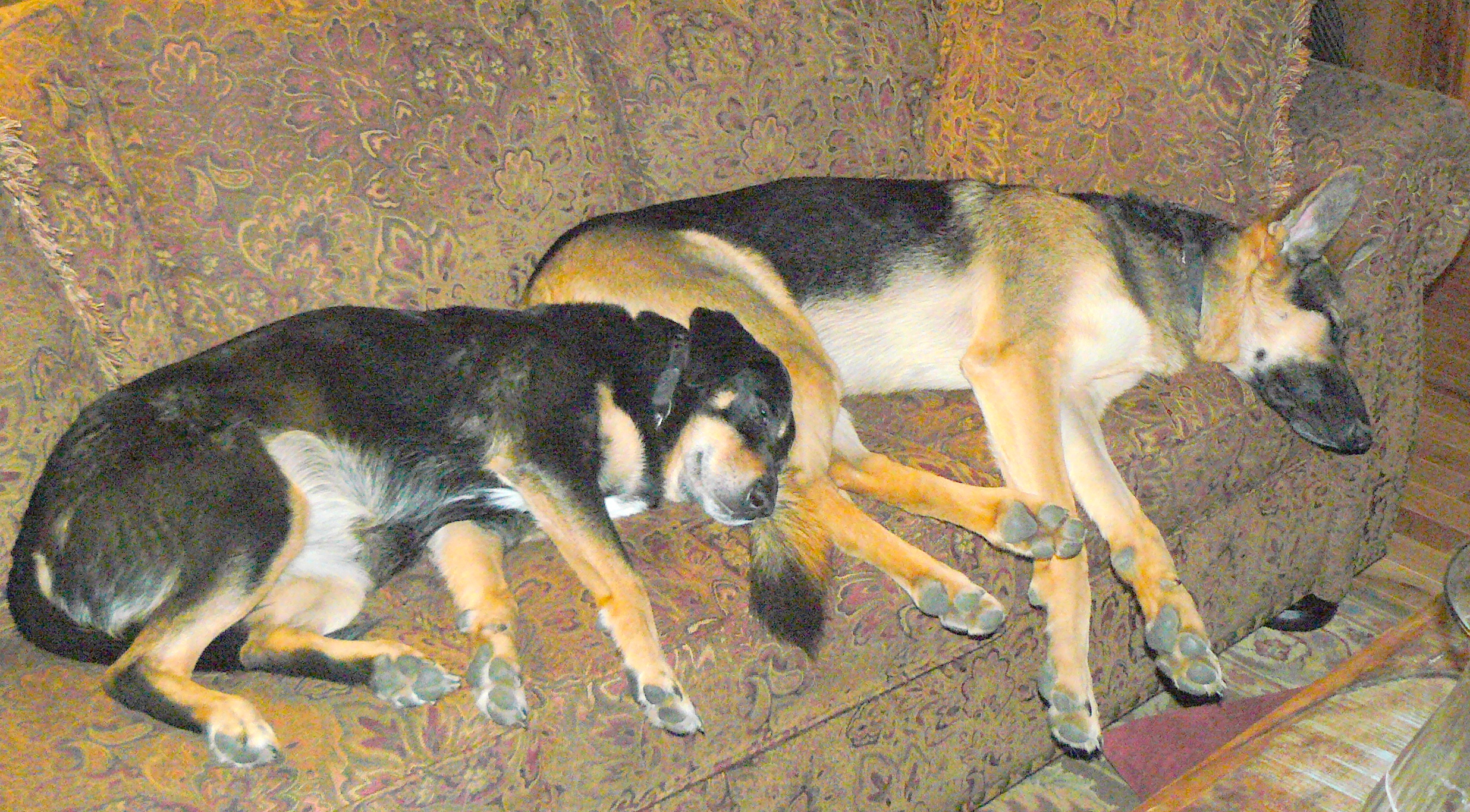
Hazel asleep with her dear friend Cleo. (Hazel to the left.)

Progressing Wisdom – the essay.

What is wisdom?

On May 11th, Patrice Ayme published an essay entitled Science: Progressing Wisdom.  I found it deeply engaging. At the same time, I was frustrated because there was a part of me that wanted to know more about “Patrice”.

For some time, I had known that Patrice Ayme was a nom-de-plume and that his, or her, identity was carefully protected. Still that part of me that wanted to relate to the real person, for want of a better description, still wouldn’t quieten down.  I offered the following comment:

Patrice, you have demonstrated an amazing breadth of knowledge across your many essays. However, I did wonder if you would be happy to declare your educational experience? As in your specialisation at a degree or Doctorate level (I suspect you do hold a PhD!)? Best wishes, Paul

Patrice’s reply, which you are encouraged to read in full, opened, thus:

You are so funny, Paul! You have an Obsession-Compulsion about “qualifications”.

One of my main ideas, idea #956, is that the authority principle is severely abused. People with Philosophiae Doctor have nothing sacred about them. Goebbels had one (in humanities).

Do you think Goebbels’ authority in humanities is to be “declared”? There were even not just PhDs, but Nobel Laureates, who became Nazis, BEFORE Hitler (who had been sent to spy on them).

No doubt Hitler, a simple caporal, and gifted painter (he lived off it), was super-impressed when he met some of the most educated people in the world, and they were Nazis… Full of PhDs.

One should not confuse the message’s content and her bearer.

This site is about learning to think better. That’s why I go back to the basics.

The idea that, say, those with PhDs is Idionomics, are the only ones qualified to speak about idiocy, is, well, idiotic.

Another reader of Patrice’s essay, gmax, said this, in part:

You have to learn to judge knowledge, not just follow oligarchs like a bleating sheep to learn what’s true and what is not.

That really made me sit up and think! For the first time in my life (I’m 70 later this year), I realised that my own ragged educational experience, as offered yesterday, had left in its wake a personal insecurity over my education, and a consequential weakness in evaluating knowledge with me somehow needing to know the identity of anonymous authors. When Patrice wrote, “Please do not hesitate to make it a post, Paul! I was thinking of it myself, but, as it is, right now, I don’t seem to have the time.“, I couldn’t resist.

Here is my essay.

ooOOoo

Wisdom, knowledge and authority.

Abstract: Wisdom requires clarity of knowledge; no more and no less.

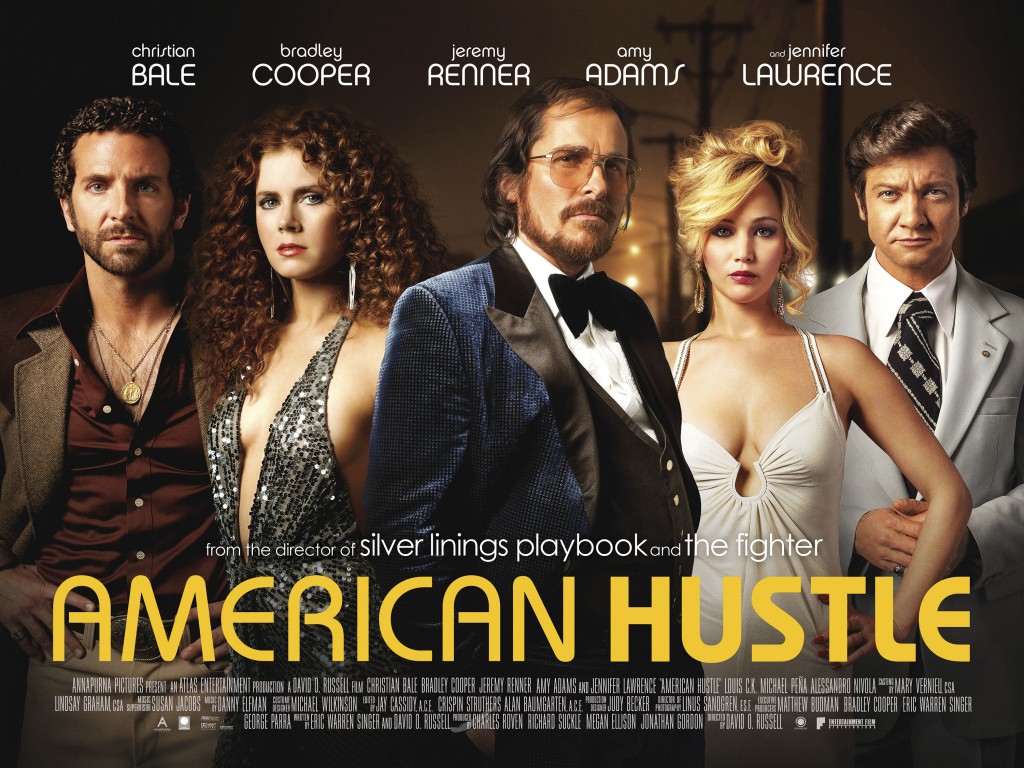
On Tuesday evening, Jean and I rented a movie.  We watched the film American Hustle.

american-hustle-poster
The film tells the story of brilliant con man Irving Rosenfeld, who along with his equally cunning and seductive British partner Sydney Prosser is forced to work for a wild FBI agent Richie DiMaso. DiMaso pushes them into a world of Jersey powerbrokers and mafia that’s as dangerous as it is enchanting. Jeremy Renner is Carmine Polito, the passionate, volatile, New Jersey political operator caught between the con-artists and Feds. Irving’s unpredictable wife Rosalyn could be the one to pull the thread that brings the entire world crashing down.

The film has received rave reviews (here’s a typical one in the Guardian newspaper) and was fun to watch; albeit somewhat confusing for much of the first half. At one point towards the end, the hero of the film, Irving Rosenfeld, reflects that, “People see and hear what they want to believe!“.

Bingo!

That is the challenge about accruing wisdom. How to be analytical and wise in learning new thinking and new ideas. In other words, in acquiring knowledge!

If the subject is simple (well on the surface!) as, for example, the effect of the Earth’s gravitational field then that’s fine and dandy.  It’s easy to become wise to the fact that falling off a tall building is likely to kill you.

But take an extremely complex, and highly current matter, that of Planet Earth’s changing climate, and it is extremely difficult for the average person without a scientific background to determine the truth.  Really, when I use the phrase “to determine the truth” in the context of this essay I should have written ‘to gain knowledge‘.

To illustrate that, my good Californian friend of more than 35 years, Dan Gomez, is highly sceptical about climate change as a product of man’s activities.  Recently, I sent him an email with a link to the NBC News report: American Doomsday: White House Warns of Climate CatastrophesThis was Dan’s email reply:

Think about it, Paul.

1. Consider the source and the timing of these new headlines i.e. the left-thinking Obama regime and current unfavorable political challenges.
2. A deflection from mainline issues confronting us today i.e., jobs, economy, healthcare, upcoming elections, Benghazi and IRS political issues.
3. Major opportunity to raise taxes unilaterally without Congress involved.
4. Major opportunity to redistribute corporate wealth from private sector to public sector.
5. Refocus of competitive, free-market energy sector to controlled renewables managed by a few very wealthy political contributors. A lot of money at stake.
6. Man, is empowered via a political party to “save the world” by changing the Weather. The only problem is, there is no solution, no global will and no participants to make anything significant happen i.e., China, Southeast Asia and another billion people scattered about.
7. Euro Zone and USA have already cut CO2 emissions by over 30% each to no avail. In fact, they say it is getting worse after hundreds of billions of dollars already diverted from private sector to public sector with no results. They are now asking for trillions.
8. Average person is not willing to give up his car, nor spend more for battery power (peel back the onion on the battery manufacturing and recycling industry vis a vis CO2 contributions). Much fewer cars, trains, tractors, jets, etc. to make anything work. Sacrifice begins at home.
9. Cows vent 20 times the CO2 emissions in the form of methane than man-made artifacts.  Just saying….
10. Check out the bacteria challenge facing Man. This will help put priorities in order for you.

As always, follow the money and you’ll get your answers…..

I am unable to respond to Dan in an analytical and precise manner. I am not sufficiently knowledgeable to so do. Having an emotional response is fine – but it does not advance my personal wisdom.

On the 6th May, I posted an item that featured a TED Talk by scientist Gavin Schmidt, a climate scientist no less.  His view is that, “You can’t understand climate change in pieces. It’s the whole, or it’s nothing.”  The TED Talk explains how the big picture of climate change illustrates the endlessly complex interactions of small-scale environmental events.

Just a few days ago, Jean and I had the pleasure of a couple of hours at the home of Leon Hunsaker, renowned meteorologist who has claimed that the 1862 Californian flood could happen again.

Leon Hunsaker has done the math, and he thinks Sacramento isn’t prepared for another series of storms like the ones that hit the state in January 1862.

Leon lives less than 5 minutes from us here in Southern Oregon. I asked him what he thought of climate change and he said that the planet’s atmosphere was like a large chocolate cake and man’s activities were no more than the icing on the cake.

So there you are: a range of opinions about this particular, potentially very important, subject. Although in my own (emotional) mind the weight of evidence is in favour of the argument that man is having a deepening and worsening effect on our planet.

Take, for example, the report issued yesterday about significant melting of Antarctica’s glaciers now unstoppable. (Patrice has just released an informative post on the subject!)

People see and hear what they want to believe!” comes immediately back to mind. Dan wants to believe that the planet is going through normal cycles of change.  I want to believe that mankind can make a difference; for the sake of my children and grandson.

Let me turn to the subject of anonymous authors, my Obsession-Compulsion about qualifications!

I have admitted the flaw in my thinking. Here’s the rationale for my change of opinion.

Just two days ago, Tom Engelhardt published his latest TomDispatch, a guest essay by Glenn Greenwald coinciding with the publication of Greenwald’s new book, No Place to Hide: Edward Snowden, the NSA, and the U.S. Security State. In that essay, Glenn Greenwald says:

On December 1, 2012, I received my first communication from Edward Snowden, although I had no idea at the time that it was from him.

The contact came in the form of an email from someone calling himself Cincinnatus, a reference to Lucius Quinctius Cincinnatus, the Roman farmer who, in the fifth century BC, was appointed dictator of Rome to defend the city against attack. He is most remembered for what he did after vanquishing Rome’s enemies: he immediately and voluntarily gave up political power and returned to farming life. Hailed as a “model of civic virtue,” Cincinnatus has become a symbol of the use of political power in the public interest and the worth of limiting or even relinquishing individual power for the greater good.

The world now knows what Glenn Greenwald (and Laura Poitras, the documentary filmmaker) knew long before.  That Snowden’s anonymity was critically important in the run-up to his knowledge being made widely known.

I was convinced. What is important is not the name and identity of the author of knowledge.  What is important is the knowledge itself. No one would deny Snowden’s right to privacy. Indeed, millions of us would opt for email privacy if we fully realised the ease and extent with which our emails, indeed our communications in general, can be intercepted.

Many know that Patrice is a frequent, outspoken voice about the dangers of plutocracy and the slip-sliding away of democracy in the United States. His, or her, personal safety is the highest need of all. Patrice has a perfect right to privacy.

Which leads on to the final, obvious question. If we do not know the identity of the author of knowledge then how can we be certain that the knowledge is valid?

Answer: Through testing!

Of course!

In the best traditions of research, especially scientific research, testing the validity of a claim is the only certain way of determining the validity of knowledge; of being able to derive wisdom from that knowledge.

Let me give you a clear example.

Commercial aviation is incredibly safe. Many countries operate an equivalent to the UK’s Air Accidents Investigation Branch. That UK AAIB website proclaims:

The purpose of the AAIB is:

To improve aviation safety by determining the causes of air accidents and serious incidents and making safety recommendations intended to prevent recurrence
…It is not to apportion blame or liability.

Keith Conradi, Chief Inspector

Critical to that purpose of improving safety (aka improving knowledge) is looking for trends. Any trends or patterns would be impossible to discover without testing and debate.

Thus what makes aviation safer is no different to what makes all of knowledge reliable: the testing of ideas and of the hypotheses behind those ideas. The identity of the author of those ideas, per se, is irrelevant.

Thus it is clear to me, clear now beyond doubt, that wisdom is the application of knowledge disconnected from the person who is the author of that knowledge. One might see it as a marriage of knowledge and intellect. Nothing more and nothing less!

All aspects of wisdom depend on trust, on the confidence that the knowledge is ‘reliable‘. Reliability gained from debate and testing.

Never forgetting that in the final analysis, as Patrice wrote it:

“Nature is the only authority worth respecting always.”

ooOOoo

In every which way that one can imagine, we have to return to the principles of fairness and balance so beautifully demonstrated to man by the breadth of Nature.  We have to embrace Nature’s wisdom.

In other words, we have to learn from dogs!

It’s all in the eyes!

What makes a dog a dog and a wolf a wolf?

I can’t recall why it was many months ago that I came across the website of Frontiers in Science. But I did and, in particular, I came across a fundamental difference between the two species.  In an article entitled: A simple reason for a big difference: wolves do not look back at humans, but dogs do. I’m going to take a chance, as in not having formal permission to republish it, in reposting it in full here.  Because it means so much to me and other dog lovers!

ooOOoo

A simple reason for a big difference: wolves do not look back at humans, but dogs do.

Adám Miklósi, Enikö Kubinyi, József Topál, Márta Gácsi, Zsófia Virányi and Vilmos Csányi
Department of Ethology, Eötvös University, Budapest, Pázmány P. 1c, 1117, Hungary. miklosa@ludens.elte.hu

The present investigations were undertaken to compare interspecific communicative abilities of dogs and wolves, which were socialized to humans at comparable levels. The first study demonstrated that socialized wolves were able to locate the place of hidden food indicated by the touching and, to some extent, pointing cues provided by the familiar human experimenter, but their performance remained inferior to that of dogs. In the second study, we have found that, after undergoing training to solve a simple manipulation task, dogs that are faced with an insoluble version of the same problem look/gaze at the human, while socialized wolves do not. Based on these observations, we suggest that the key difference between dog and wolf behavior is the dogs’ ability to look at the human’s face. Since looking behavior has an important function in initializing and maintaining communicative interaction in human communication systems, we suppose that by positive feedback processes (both evolutionary and ontogenetically) the readiness of dogs to look at the human face has lead to complex forms of dog-human communication that cannot be achieved in wolves even after extended socialization.

ooOOoo

Actually, that article from the Department of Ethology at Eötvös University in Budapest is just an excuse for me to post three photographs confirming the good scientists results!

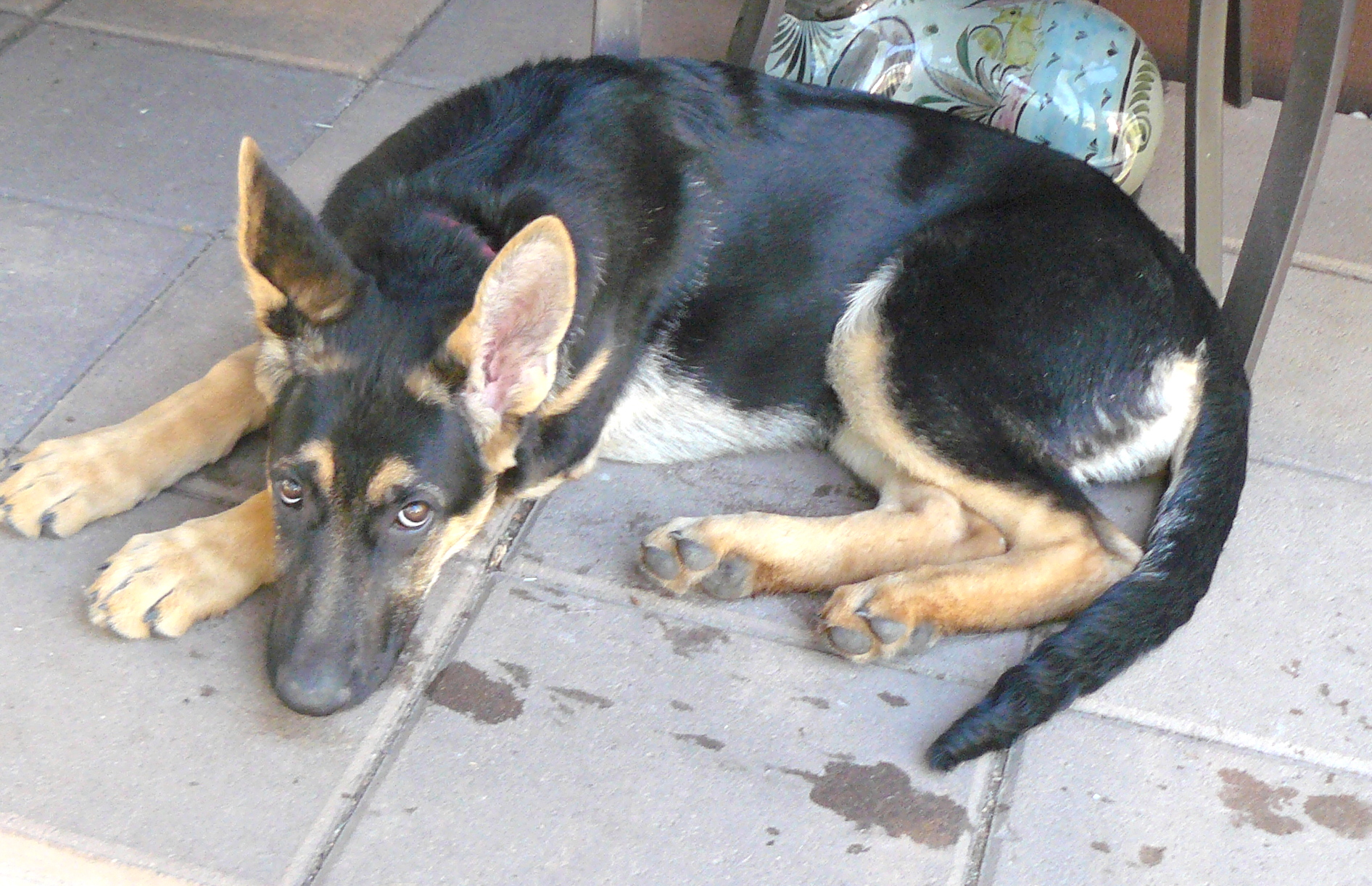
Young Cleo, May 12th, 2012.

oooo

Mr Pharaoh's look from June, 2007.
Mr Pharaoh’s look from June, 2007.

oooo

The second Cleo look from May, 2012.

oooo

There’s no question in my mind that millions of dog lovers across the world know the intimacy that is conveyed in a dog’s eyes!

Creative reflections.

The power of re-finding oneself.

Terry Hershey

If you do a search on Learning from Dogs for Terry Hershey you will find that his name comes up from time to time. Way back in March, 2011, I published a post announcing a visit by Terry to Payson, AZ where Jean and I were then living.  Having had the opportunity to listen to Terry speaking and to meet him in person, I have maintained a subscription to his weekly Sabbath Moment ever since.

Thus it was that last Sunday in came the regular missive from Terry.  They are always good but last Sunday’s was spectacularly good. In response to my request to publish the full Sabbath Moment here on Learning from Dogs, there was a prompt reply to the affirmative.

Thus with no further ado, here is Terry’s Sabbath Moment for May 5th, 2014, in full.

ooOOoo

Artists

May 5, 2014

Hershey moon

It seems that in the spiritual world, we do not really find something until we first lose it, ignore it, miss it, long for it, choose, it, and personally find it again–but now on a new level. Richard Rohr

Mystery is at the heart of creativity. That, and surprise. Julia Cameron

I was born fragile, farther said. I was just born that way. He said I was a nervous baby. Just born like that. David Helfgott

I saw the angel in the marble and carved until I set him free. Michelangelo

oooo

Lorraine Hunt Lieberson began her career as an accomplished viola player. While on tour in Europe (in the late 1980s), her viola was stolen. She could have replaced it. As would be imagined, the theft threw her into a state of feeling lost and uncertain. She stopped playing. After awhile, Lorraine began to work with only instrument she had, her voice.

When asked, Lorraine stresses that her decision to go into singing happened quite naturally. “There were a lot of encouragements along the way, but no individual, earth-shaking event that made me change,” she says. “But, back in 1988, when my viola was stolen, I took that as a sort of omen.” (And although she hasn’t yet replaced her stolen viola, she avows that “the viola is always with me in spirit when I sing.”)

Interestingly, Lorraine is shy about being interviewed; she has no press agent. But when she sings she is known for an ever-widening swath of ardor and awe that she leaves in her wake. An intensity. Her voice–her singing–touches hearts and lives. The irony is that the gift–the artistry–she has given us all, began when life turned left.

Ask any class of kindergarten students, “How many of you are artists?
How many raise their hands? Every single one of them.
Ask fourth graders. Maybe half.
Seventh graders. A handful.
Seniors in high school. Maybe one.
It’s quite the educational system we have created.
We begin with artists, and we slowly wean it out of them.

I do know this: it is easy to lose sight of that artist that resides inside of each one of us. Whether lost or buried or stuck or forgotten or dismissed or ignored… or “stolen.” (Whenever I lead a retreat, Crayolas are mandatory–because it is an unwritten spiritual principle that you cannot learn about life unless you color. It is curious then, how many–otherwise secure adults–will say, “I’m not very good at coloring.” I will say, “Who said anything about being ‘good’ at it?” Our mind has already morphed from play and wonder to mastery and proficiency.)

When we tag or label or describe ourselves, “artist” is seldom used. Where I was raised, artist was a phase you went through (a dream), you know, to grow out of, to, move on to something more useful and sensible–in order to get a real job.

Yes, of course we are all inner artists, but the cynical part of me tells me that it all sounds too much like a mantra meant to be chanted standing in a circle at a “be all you can be” conference. Sure, it all sounds good.

But I’m not sure what it really means.

In the opening scenes of Shine, we first meet the middle-aged David Helfgott (played by acclaimed Australian stage actor Geoffrey Rush), babbling to himself incessantly and wandering in the rain, in a state of transition. Behind him is the isolated existence as a child piano prodigy whose emotional turmoil led to a nervous breakdown, and a series of stays in various mental institutions. Ahead of him is his eventual reconnection with the world around him, guided by both love and his virtuoso talent that has been long abandoned. We witness the awakening of the artist. In the movie (and in real life), David eventually moves toward that which gives life.

So, what is this artist? It is the place in our spirit that births…

creativity,
enchantment,
imagination,
play,
risk
and wonder.

There is no doubt that we hide it. We don’t believe it. Or we judge it as inadequate.

But here’s the deal: The artist in David did not reside only in the talent or prodigy or genius, but in the spontaneity, vitality, innocence, passion and delight. And the artist in Lorraine wasn’t detoured by life’s unkindness.

For me, the tragedy is that (in the name of love) David’s father (Peter) squeezes the artist out of the prodigy. But in truth, it doesn’t always require a pathological “love” to hide or extinguish the light.

In the movie rendition, there is a scene that stops my heart. David and his father are walking home after a competition. David has placed second.
(In his father’s eyes, anything other that first is a failure.) The father is seething, and there is no hiding his disgust. David has lived his entire life absorbing his father’s pathology, doing his very best to make his Daddy happy. The father walks ahead, hurried, his spirit heavy. David follows. On the sidewalk, in chalk, there is a hopscotch pattern.The camera follows from behind, and we see young David unconsciously, intuitively, childlike, hopping and skipping and jumping — the joy and the light (and the artistry) of his childhood still alive.

I don’t want to lose sight of that childlike artistry inside of me. I’m home for a week or so, and the garden is abounding and teeming with life and color and enchantment. The peony buds profligate, the bearded iris blooms beguiling, the columbine exquisite. The branches of the Japanese Maple, heavy with spring rain, deferentially bow. I once asked my analyst why I was in therapy. He told me it would make me a better gardener. Gardening can be strong medicine–an elixir that nurtures and shapes the soul. For that reason, it is a tonic seldom taken straight with no ice. Gardening has way of seeping into your soul, and one day you find yourself, in the words of poet May Sarton, spending the first half hour of the morning “enjoying the air and watching for miracles,” the joy and the light still alive.

oooo

I dip my pen in the blackest ink, because I’m not afraid of falling
into my inkpot. Ralph Waldo Emerson

ooOOoo

Hope you all enjoyed this just as much as I did!

But I can’t close without mentioning something that struck me the very first time I read the essay. It is this.

That list that describes artistry: creativity, enchantment, imagination, play, risk and wonder.  It’s not a million miles from describing the way our younger dogs behave when we take them for a walk around the property most days after lunch.

Dogs playing without a care in the world!

Once again, Terry’s website is here.

Love, trust and faith!

The most important lesson that dogs offer us.

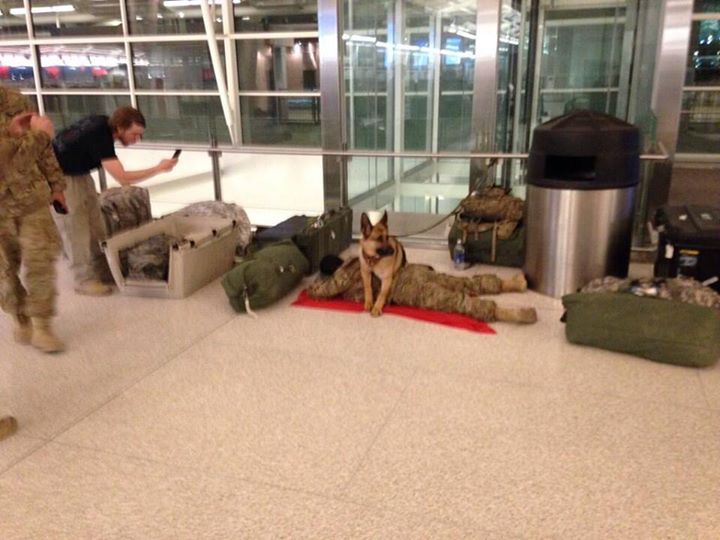
The following photograph was sent to me by Suzann who in turn received it from Joyce.  Thanks to you both.  Included with the photograph is the background to the picture.

Indianapolis International Airport

 “One of our photographers returning to the Indianapolis International Airport took this photo of a soldier getting special guard duty from man’s best friend as she catches a nap in the terminal. About 10 soldiers and two dogs were in a group at the airport tonight. It wasn’t clear if they were coming home or heading out, but we thank them (and the dogs!) for their service!” – WTHR-TV

I’m going to skip the many comments that have been attached to the photograph, however smart and witty they are, and focus on the fundamental lesson that dogs, and many other creatures, offer mankind.  It is this.

Our society only functions in a civilised manner when there is a predominance of trust about us.  When we trust the socio-politico foundations of our society.  When we trust the legal processes.  When we trust that while greed and unfairness are never absent, they are kept well under control.

Having trust in the world around us is an intimate partner to having faith in our world.

At a time when inequality is making frequent headlines and Russia is sabre-rattling over Ukraine let us never lose sight of the primary importance of trust.

For without trust there can be no faith and without trust there can be no love.

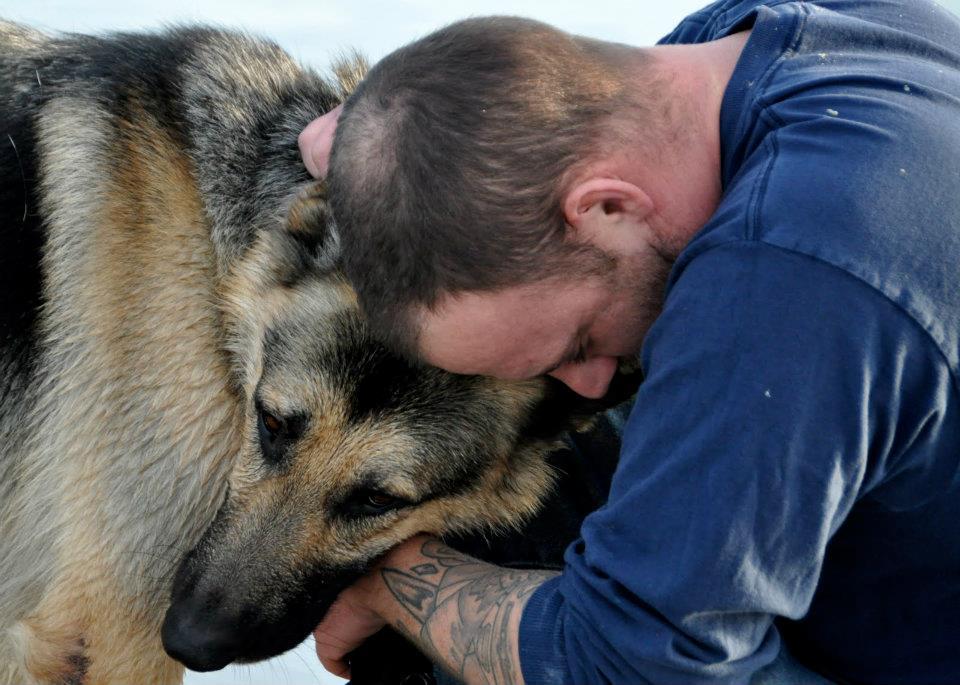
Here’s another photograph of the greatest ‘dog-teacher’ of them all; the German Shepherd dog.

Love, trust and faith.

The Natural order.

Back to the basics of life.

Regular readers of Learning from Dogs will recall that just under a week ago I published an essay under the title of A bedtime story for mankind.  The post centred around an essay from Patrice Ayme.  Patrice’s essay could be summarised as follows: “At the present rate of greenhouse gases emissions, within nine years, massively lethal climate and oceanic changes are guaranteed.

Then just last Sunday, Patrice published a second essay reinforcing that first one.  The subsequent essay was called Ten Years to Catastrophe.  I was minded to republish that but upon reflection thought that there was a better option.  That was to explore the deep, core questions that both of Patrice’s essays raised in my mind and, presumably, must be raised in the minds of countless thousands of others.  Questions along the lines of a comment I submitted to that subsequent post from Patrice.

Do you have an idea, even a sense, of when global leaders, elected Governments, the ‘movers and shakers’ in societies, will truly embrace the global catastrophe that is heading our way?

And a supplementary question: What would be the indicators that Governments were acknowledging the task ahead?

Frankly, they weren’t especially good questions but they were an attempt by me to open up a debate on whether or not this is the “beginning of the end” of life for us humans.  Central to what was going through my mind was the core question of how did it all go wrong?

Welcome to Payson, AZ

On Monday evening, I rang John Hurlburt, a close friend of Jean and me from our Payson, Arizona days and kicked around those questions .  It was a most enlightening conversation.  John is an active founder member of Transition Town Payson and Payson recently welcomed the Great March for Climate Action in their walk from Los Angeles to Washington D.C. (An essay on that event coming soon.)

Anyway, from out of that conversation with John came the idea of a series of essays here on Learning from Dogs about the past, present and future of man’s relationship with Nature.  The aim is to offer an essay on a weekly basis but we’ll see how it goes.  Wherever possible, I will use the essays and posts from other bloggers that reinforce the vision. As always, your feedback in the form of ‘Likes’ or comments will reflect on the value of the essays to you.

After John and I finished the call, he sent me an email with what could be best described as his vision for these essays.  Here is that email [my emphasis].

Integral Vision

Everything fits together. Otherwise, we’d simply be disassociated atoms.

Human beings are a consciously aware component of Nature. We have a DNA-level directive to survive as a species and as individual members of a species …. in that order!

We are consciously aware components of the conscious interaction between energy and matter in a predominently smoothly emerging cyclic universe with departures from time to time into pockets of chaos.

We disconnect from reality when we become self-centered, often during the various stages of our lives. When we are blessed we continue to live and learn.

Issues of ideology, rational thought, economics, politics, religion, history and science become insignificant in comparison to the whelming power of Nature.

Such is life. It comes with the territory. Spirituality, Nature and Science describe the metanexus in which we live.

Maintain an even strain,

an old lamplighter

Ref: Episcopal “Catechism of Creation”

Ideas, feedback and comments, as always, hugely welcomed.

Trust, truth and community, Pt. 3.

How a very ancient concept has modern attributes.

One might be forgiven for thinking that community is an odd bed-fellow with trust and truth.  Many might think that faith would be a more logical third leg, so to speak.

However, I hope to show that in today’s world where trust and truth are beleaguered qualities a rethinking of community is critically vital for the long-term health of mankind.

Community

Can’t resist a third look-up in Roget’s Thesaurus.

community noun

Persons as an organised body: people, public, society.

For me two words jump out from that definition: persons; organised.

The challenge is that the word organised is easily interpreted as an organisation with leaders and followers.  But that’s not how community is regarded in the context of this third essay.

“No man is an island”, John Donne wrote in 1624.

This is a quotation from John Donne (1572-1631). It appears in Devotions upon emergent occasions and seuerall steps in my sicknes – Meditation XVII, 1624:

“All mankind is of one author, and is one volume; when one man dies, one chapter is not torn out of the book, but translated into a better language; and every chapter must be so translated…As therefore the bell that rings to a sermon, calls not upon the preacher only, but upon the congregation to come: so this bell calls us all: but how much more me, who am brought so near the door by this sickness….No man is an island, entire of itself…any man’s death diminishes me, because I am involved in mankind; and therefore never send to know for whom the bell tolls; it tolls for thee.”

Thus for the vast majority of people on the face of this planet, we are linked to others and how we live our lives is fundamentally influenced by those others about us.  In a past life, I lived in the village of Harberton in South Devon.  The population of Harberton was 300 persons.

An E. M. Morison (Totnes) postcard, bearing a 3p stamp, which gives a sending date between Feb 1971 and Sept 1973.

Now I was lucky when I moved into Harberton because my two sisters, Rhona and Corinne, had lived in the area for many years and it was easy for me to be positioned as ‘the brother’.  Nevertheless, the way that the village embraced all newcomers was wonderful and within a very short time one felt a settled member of the community.

Same for Jean and me as relative newcomers to our property just 4 miles from Merlin, Oregon. All of our neighbours have embraced us and helped us understand this new rural life that we have embarked on.  We feel part of the local community.

Yet it doesn’t stop there.

Obviously, I’m a WordPress user!  Learning from Dogs is a WordPress blog!  But were you aware of the size of the WordPress community? (As of now!)

How many posts are being published?

Users produce about 44.5 million new posts and 56.7 million new comments each month.

How many people are reading blogs?

Over 409 million people view more than 14.7 billion pages each month.

Even my funny little blog has 959 followers!

What that figure doesn’t reveal is how many of my followers have offered support, openness and real loving friendship. None better demonstrated than by the comments left by readers when I announced the recent death of Dhalia.

Think of the way that untold numbers of internet users rely on that ‘worldwide web’ for referrals, opinions or knowledge about anything ‘under the sun’.

So while there might be many aspects of our new technological world that create unease, the opportunities for having ‘virtual’ friends to complement our social friends make this era unprecedented.

I would go so far as to say this. That the way that knowledge and information can be shared around the world in no time at all may be our ultimate protection against those who would seek to harm us and this planet.

How to close these essays? Perhaps no better than as follows:

On Wednesday evening we were joined by neighbours, Dordie and Bill.  My post on truth came up in discussion. Bill mentioned that he had read about a person who had spent many years studying the texts of all the world’s major religions.  What had emerged was that across all those great religions there was a common view as to what the long-term health and survival of societies requires.

It is this: the telling of truth and the keeping of promises!