Category: Philosophy

Synchronicity!

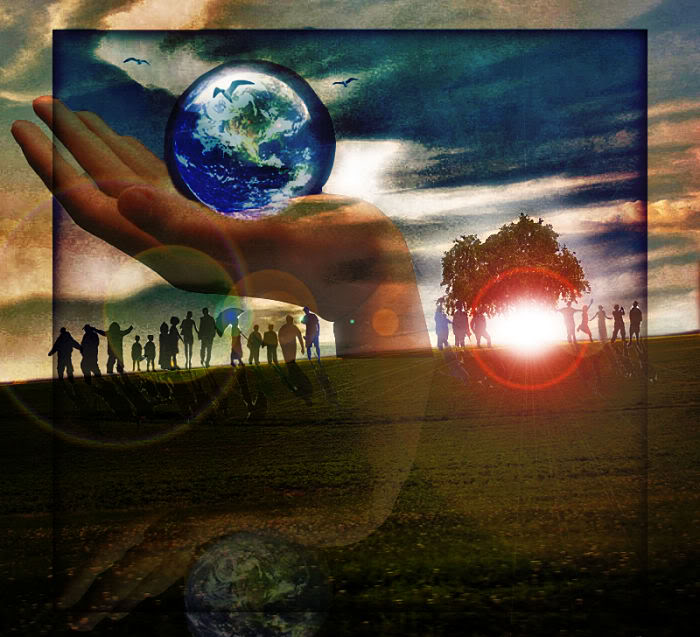
Two very different expressions of hope and sense about the present era of change.

First off, up until yesterday morning at 6am, I had completely different ideas for today’s post.  But sitting up in bed yesterday morning reading my emails, I saw there was an email from Jon Lavin that included a link to this: Hope for the New Year: some thoughts on emergence, evolution, freedom, love and choice, by Bronwen Rees. Dr. Rees describes herself, as:

Bronwen is a UKCP-accredited psychotherapist with nine years experience and a practice in Cambridge, Suffolk and Hungary. She is trained in the Karuna Institute in Devon in core process psychotherapy, which was the first mindfulness-based therapy in the UK. She adds to this her unique understanding of western and eastern spiritual traditions, combined with findings in new science – to find ways of helping individuals align with their true destiny. She runs retreats and workshops and group work at different times of the year.

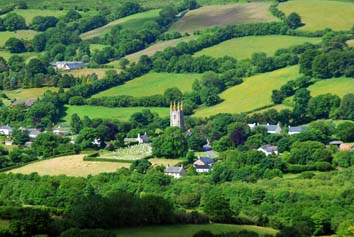
I was vaguely aware of the name. Perhaps unsurprisingly as I was familiar with the work of the Karuna Institute at their beautiful location at Widecombe-in-the-Moor, Dartmoor, Devon, some eighteen miles from where I used to live in Harberton, Devon.

Widecombe-in-the-Moor

Anyway, back to the theme of today’s post. Back to Jon Lavin’s email with the link. This is how that essay from Dr. Rees opened:

by Bronwen Rees on January 1, 2015

In the face of the on-going and now undeniable social, economic, environmental and political crises, there are plenty of seeds of ‘emergence’ that point to a new way forward. These are flowering in the area of sustainability, spirituality, and the reworking of ancient systems of wisdom. They point to a new way of being and relating where, it is implied, one can manifest at will one’s desires.

Whilst there is a distinct truth in much of this, and many examples where this can obviously work (vis the outpouring of new technological companies providing ever more zany products), they are very early developments fostering to individual satisfaction rather than being consciously channeled into the benefits of the collective. The scale of change in terms of consciousness has largely not yet been realized. One of the main reasons for this is the as yet imbalance in the relationship between the collective and the individual, and the lack of a conscious ethical foundation.

I sort of understood the central message but the words were getting in the way.  Take this later paragraph, for instance:

Humanity is at a bifurcation point – a point of irreversible change – where conscious choice determines the future that is created. Neo-Darwinian theorists would argue that this is merely a point of survival, and given the current scientific data about the material conditions – peak oil, energy, economic chaos, severe mental health issues, the conditions would suggest that we are as a species heading for disaster. Balanced between over-population and yet greater and greater individualization with more and more apparent choice – how can the two perspectives be reconciled on this seemingly increasingly small planet?

Indeed, my email reply to Jon, having struggled through the full essay said: “Good day to you, Jon, Yes, what a fascinating essay albeit written in a manner that makes it a very tough read! Nevertheless, I have no doubt that the good Dr. is spot on in her analysis.

The very next item opened in my email inbox was notification of a new post from Sue Dreamwalker: My Dream ∼ Translated I just had to share. Let me, in turn, share Sue’s post with you; with her kind permission, I should add.

ooOOoo

My Dream ∼ Translated I just had to share

Don’t only practice your art, but force your way into its secrets, for it and knowledge can raise men to the divine.” ― Ludwig van Beethoven

On Jan 3rd I had a Dream.. Please click on the music video below so you can get a sense of some of my experience.. .. Sunday I tried to capture some of the images I had in the dream… So I painted.. But I saw Oh so so much more………

In the beginning of the dream.. She was Me.. As I began to sing.. but then I became the observer.. This has to be the best Dream experience ever… .. So I had to share.. I heard the Music… Music like I have never heard upon this earth… the video music is about as close as I can get to that feeling of being exalted to a higher place.. I am still so excited I cannot tell you the Love I felt within this experience.. If this is the beginning of 2015.. Whoooooh… Let it roll……..

My Dream..

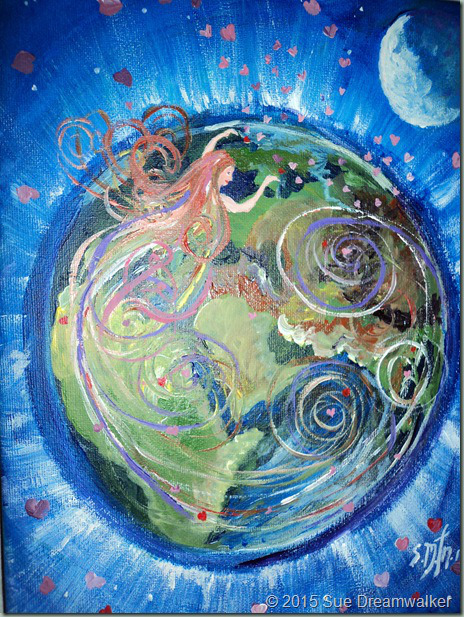
“She stood in a gown that was a rich golden brown. Its fabric shimmered catching the light that reflected from the crystals of natural quartz that sprang up around her. The gown was long and flowing not only did it reach the floor, but it spiralled out around her in a never ending dance as it became one with the sphere of the Earth.

dream-love-song-_thumb
Sue’s painting.


She took a deep breath; here she stood in the centre of the globe called Gaia.

Her hair was so long the wind picked it up to billow out behind her in long tresses. Birds flew in and amongst her strands of hair, Insects and butterflies danced within making it their home.

With breath still poised, she raised her arms like a conductor of an orchestra. She expanded her lungs and she began to Sing…. Her Soprano voice was pure. The moment her voice vibration raised higher the spiral of her gown buried deeper into the Earth. The Grass became part of her gown. Trees sprang forth from the folds of it swaying to her melody of love; Flowers opened their blooms, each petal giving separate notes in a wonderful exotic dance of harmonic ripples.. Love notes rippled like the keys of the piano. The buds on the trees open their leaves their notes sounded deeper like a million cello’s. Birds sang their flute like songs and the butterflies wings danced lighter than bell chimes.

Water trickled into streams, clear and sparking like the strings of the violin.. They swelled in a crescendo in waves that beat the rocks crashing in like kettle drums smashing like symbols into glistening spray..

The Whales joined in her song a mournful lament, while deep in the jungle the elephants gave a low rumble to acknowledge they had heard.. The roar of the Big Cats were heard above the cries of the orangutan’s

As the Thunderous machines of man cut swaths leaving deep scars that screeched like vultures circling over head, to give way to silence………. as they circled over the corpses of everything left dying in its wake..

She paused……………. ready to continue…….. Her arms raised high above her head, she Sang.. her voice becoming a crescendo with the Earth, her breath became the Spiral.. Her Hair became the Wind.. The notes she sang sprang forth from her mouth forming hearts and stars.. Every living creature now joined in her song…

She knew her Song of love was being joined by so many more.. She was ONE with ALL.. She was part of our Earth Mother..”

~~~~

I hope you enjoyed reading about this Dream and I hope you enjoyed listening to the wonderful music of the PianoGuys

See you all very soon…

~Sue~

ooOOoo

In a very strange way, I read the same messages from Dr. Rees and from Sue but presented in such opposite ways: one way so complex and one way to clear. So strongly reinforced by their respective closing words. Here’s Dr. Rees:

Whilst there is real potential for the expansion of consciousness, this does not by any means suggest that this will arise without individual effort and struggle. All the enlightened masters of the past needed to move through this gateway – the difference between then and now is that the conditions are far riper for more individuals to undergo this – and indeed can be seen as a biological necessity for the survival of the human species. Thus as individuals, we cannot avoid this, but what we can do, and indeed as a biological and spiritual imperative, we can support one another and help organize ourselves in dedication of this purpose, in a mutual recognition of each individual uniqueness yet shared destiny.

Here are Sue’s closing words: “She knew her Song of love was being joined by so many more.. She was ONE with ALL.. She was part of our Earth Mother..

However, there is one uniting theme I read from both of them: Hope!

Decisions, decisions, decisions!

How the hard choices actually allow us to define who we are.

Jean and I watched a TED Talk a few evenings ago. The title of the talk was: How to make hard choices.  It was delivered by philosopher Ruth Chang who one discovers from her website:

Ruth Chang
Ruth Chang

I am a philosopher at Rutgers University, New Brunswick. Before arriving at Rutgers, I was a Junior Research Fellow at Balliol College, Oxford where I was completing my dissertation. I’ve also held visiting positions in the philosophy department at the University of California, Los Angeles and the University of Chicago Law School. Before my life as a philosopher, I worked as a law associate on a (pro bono) death penalty case and several (non pro bono) product liability cases. I have a J.D. from Harvard Law School and an A.B. from Dartmouth College.

Now I am not going to pontificate about this talk; all I will say is that it is a) very interesting, and b) highly relevant to millions of us when, from time to time, we are faced with the tough decisions to make.

The video is a little less than 15 minutes long. I’m fairly certain that you will be enchanted by Ruth Chang’s proposition as much as Jean and I were.

Published on Jun 18, 2014

Here’s a talk that could literally change your life. Which career should I pursue? Should I break up — or get married?! Where should I live? Big decisions like these can be agonizingly difficult. But that’s because we think about them the wrong way, says philosopher Ruth Chang. She offers a powerful new framework for shaping who we truly are.


The book! Embracing death

Not forgetting:

And shows us the way to embrace death

I’m sure that the human psyche lives in a bubble of delusion. Not always and not extremely so; of course. Clearly, if the level of delusion were abnormal then we couldn’t function properly as social animals. However, just take a quiet moment of self-reflection to muse over the ways that you ‘shelter’ from reality. In directing that last point to you, dear reader, trust me I don’t exclude myself!

There are times when going beyond the self, going out of oneself, is the only way to see the reality of who we are and the world around us; to be able to brush away our delusions. Perfectly expressed by the author, Aldous Huxley: “Experience is not what happens to you; it’s what you do with what happens to you.” Wise words, indeed!

But these fine expressions representing the peak of common sense have one grinding, searing fault. They do not assume the end of a person’s life. I am speaking of death, of the inevitability of our death! That largely unspoken truth no better expressed than through the words[1] of Sharon Salzberg in her book Faith.

What does it mean to be born in a human body, vulnerable and helpless, then to grow old, get sick and die, whether we like it or not?

Anyone who has lost a loved one knows that it is tough; incredibly tough. It is full of pain and anguish amidst a great churning of emotions, all in a very deep-seated and personal manner. That’s the perspective from the loved ones left behind with more life ahead of them. But if one thinks of it in reverse, turns it on its head, what are our fundamental wishes with respect to those we love; what we would want to leave behind when we die?

Fond memories, naturally, but they wouldn’t be our fundamental wishes. This is what those fundamental wishes would be. That our death does not leave pain and anguish in the hearts and souls of those left behind. That it doesn’t leave a pain that cannot be dealt with in a healthy way. Our wishes would be that those whom we loved and who loved us may embrace their loss and move on.

Anyone who has loved a dog has most likely been intimately involved in the end of that dog’s life. It is, to my mind, the ultimate lesson that dogs offer us: how to be at peace when we die and how to leave that peace blowing through the hearts of all the people who loved us.

Our beloved dogs have much shorter life spans than we do, thus almost everyone who has loved a dog will have had to say goodbye to that gorgeous friend at some point in their lives. Very sadly, perhaps, saying goodbye to more than one loved dog.

I see the most precious of parallels in the tragic death of a loved dog and our own death. The parallel between coping with our grief for the loss of a loved dog and reaching out to our loved ones so that they may cope with their grief at losing us.
In other words, knowing what to expect in emotional terms at the loss of our loved dog is helpful, very much so, to us helping our loved ones when comes our time to die.

There are five stages of mourning[2], of dealing with our grief, when we lose our beloved dog: Denial; Anger; Guilt; Depression and Acceptance.

Compare those stages to the five stages of mourning[3], perhaps of dealing with the knowledge that oneself is dying, or a person is dying who is very emotionally close to us. Those five stages are: Denial and Isolation; Anger; Bargaining; Depression and Acceptance.

The parallels are almost perfect.

Whether it is the impending or actual death of a loved dog, a loved person, or ourselves, the similarities between embracing the loss of the loved dog, or the loved person, are powerfully obvious. So, too, are the many different ways each of us embraces the death of a loved dog or a loved person. Let me expand on this last point.

Namely, that each of us will experience each stage of mourning at varying levels of intensity, for varying lengths of time, and sometimes in a different order. Some of the stages may converge and overlap each other. But however you experience the mourning, it is incredibly important to remember that your feelings are completely normal.

As the website of the American Animal Hospital Association points out, on their webpage entitled Life after Dog[4], “… we almost always outlive our beloved companions. Learning to live with loss is an essential part of life.”

That webpage imploring us to honour our emotions, to honour the memory of our dog, and critically, when a child is involved, to help that child cope with the loss of their loved dog. For all, young and old, helping to ease the pain through learning to cope with the loss. Easing the pain through changing one’s schedule, moving furnishings around to help distance the memory of your dog’s favourite sleeping spots, or creating a memorial in one form or another, even writing a letter (or blog post!) to your dog in which one describes all the feelings you have for your recently departed, loved dog.

I was born in 1944. I am therefore the ‘wrong’ side of seventy years old. I was born an Englishman and, according to life expectancy tables from 2012, a male Englishman’s life expectancy is 79.5 years. I am living happily in the USA and, according to those same tables, a male American’s life expectancy is 77.4 years. My mother is alive and an amazingly fit and healthy ninety-five-year-old, at the time of writing this book. My father died at the age of 56 just 5 days before Christmas in 1956. I do not believe in any form of spiritual life after death.

So take your pick!

All that I do know is that loving our dogs, welcoming all the wonderful qualities that our dogs possess, striving always to live peacefully ‘in the present’, just as our dogs do, and, ultimately, as with our faithful companions, taking that last breath in the knowledge that ours was a beautiful life, is what learning from dogs is all about.

Thank you.

1,059 words. Copyright © 2014 Paul Handover

[1] page 34.
[2] http://dogtime.com/dealing-with-grief-of-loss-aaha.html#
[3] http://psychcentral.com/lib/the-5-stages-of-loss-and-grief/000617
[4] http://www.aahanet.org/blog/petsmatter/post/2014/05/20/929363/Life-after-dog-Support-and-resources-on-pet-loss.aspx

Life is never a rehearsal.

I’ve learned that people will forget what you said, people will forget what you did, but people will never forget how you made them feel.” Maya Angelou

maya-angelou1

In a poignant way, it seems appropriate to feature that quote from Maya Angelou in opening today’s post simply because this wonderful, spiritual woman died earlier on this year; on the 28th May, 2014.

Born in 1928 in St Louis, MO, Maya was, “… an American author, poet, dancer, actress and singer. She published seven autobiographies, three books of essays, and several books of poetry, and was credited with a list of plays, movies, and television shows spanning over 50 years.” (Wikipedia)

In case you are wondering why this post is reflective on life, and the inevitability of death, it is simply because in thirty-minutes time, the last (draft) chapter of ‘the book’ is being published in this place, and I was looking for something to ‘set the tone’, as it were. That last chapter is entitled: And show us the way to embrace death, and the companion to: How the dog offers us a way into our own soul, that was published yesterday.

To be precise, I had in mind two elements in setting the tone. The first being that powerful quotation that is today’s sub-heading and the second being the reposting of a recent item from Val Boyco.

As is the way in this interconnected world of blogging, I hadn’t previously heard of Val Boyco until she signed up to follow my humble scribblings in this place. Naturally, I went across to her blogsite, Find Your Middle Ground, and very quickly signed up to follow her, in return.  That’s how I came to see ‘All Things Change‘; reposted here with Val’s very kind permission.

ooOOoo

All Things Change

ValB

All things arise

Suffer change

And pass away.

This is their nature.

When you know this …

…you become still.

It is easy.

The Ashtavakra Gita

—-

We spend so much time and energy avoiding the way life actually unfolds, and most of the time we are unaware that we are doing this.

We have created these habits over time to avoid facing the uncomfortable feelings that are a part of life.

When we pause and create spaciousness, the resistance begins to dissipate and our inner consciousness grows.

Each time we make space, trust grows.

The more we trust, the more we grow beyond our conditioning and habits and create more space.

With space, life flows freely.

Taking time to connect inwards will not save your life, but may save you from a life of struggle and discontent.

Namaste

ooOOoo

I’m going to close today’s post with a wonderful quote from Sharon Salzberg, taken from her book: Real Happiness: The Power of Meditation. It seems as relevant and as powerful as that opening quote from Maya Angelou.

It is never too late to turn on the light. Your ability to break an unhealthy habit or turn off an old tape doesn’t depend on how long it has been running; a shift in perspective doesn’t depend on how long you’ve held on to the old view.

May we all turn on the lights in ourselves so that we may better leave a light burning in the hearts and minds of others.

For our lives are for real!

The Book! A way into our own soul

To my dear readers.

The final two parts of the book, How the dog offers us a way into our own soul, and, And show us the way to embrace death, are offered today and tomorrow.

I can’t tell you what it has meant to me to have the many ‘Likes’ and comments along the way; just take it from me that it has been enormously inspiring and motivational and part of me can’t believe that the project that started in November 2013 under the NaNoWriMo-2013 umbrella was completed this November just gone, for a draft word count of a little over 104,000 words!

Come the New Year and the real work starts, that of the Big Edit.

So let me close by just saying, once again, thank you!

oooo

Not forgetting:

How the dog offers us a way into our own soul

Happiness resides not in possessions, and not in gold, happiness dwells in the soul.

So wrote the philosopher Democritus. Democritus, born in 460 BCE, although according to some in 490 BCE. He acquired fame with his knowledge of natural phenomena, and preferred a contemplative to an active life, spending much of his life in solitude. The fact that he lived to beyond 100 suggests he lived out what he philosophised about!

Now the last thing I am going to attempt is any rational, or even semi-rational, explanation of the soul; of what it is; of whatever it is. Despite the familiarity of the word, especially within religious circles, the notion of the soul remains an enigma. Indeed, it reminds me of that very clever quotation attributed to the German philosopher, Martin Heidegger: “Making itself intelligible is suicide for philosophy”, that with a little poetic licence might be rewritten: “In making itself intelligible does the soul become soulless.”

Thus having ‘bared my chest’ in terms of failing the test of knowing what a soul is, in any rational manner, I shall, nonetheless, continue to use the word. Simply because there will be sufficient bonding between me writing the word ‘soul’ and those reading the word ‘soul’, for those same readers to sense where I am coming from.

I’m going to stay with this wonderful concept of soul for just a little longer before adding our beautiful dogs into the dream. Staying with it courtesy of the writer; John O’Donohue. John’s name is not one known to the masses. Yet his writings are, without fail, beautifully moving. John’s first book was called Anam Cara: A Book of Celtic Wisdom., Anam Cara means ‘soul friend’ in Gaelic. The following passage, taken from Anam Cara, represents to my mind the most exquisite understanding of the human soul.

The secret heart of time is change and growth. Each new experience which awakens in you adds to your soul and deepens your memory. The person is always a nomad, journeying from threshold to threshold, into ever different experiences. In each new experience, another dimension of the soul unfolds. It is no wonder that from ancient times the human person has been understood as a wanderer. Traditionally, these wanderers traversed foreign territories and unknown places. Yet, Stanislavsky, the Russian dramatist and thinker, wrote: “The longest and most exciting journey is the journey inwards.”

There is a beautiful complexity of growth within the human soul. In order to glimpse this, it is helpful to visualise the mind as a tower of windows. Sadly, many people remain trapped at one window, looking out every day at the same scene in the same way. Real growth is experienced when you draw back from one window, turn and walk around the inner tower of the soul and see all the different windows that await your gaze. Through these different windows, you can see new vistas of possibility, presence and creativity. Complacency, habit and blindness often prevent you from feeling your life. So much depends on the frame of vision – the window through which we look.

Those are so wonderful words from John and a brilliant example of his exquisite creativity of thought. They also offer the most perfect ‘window’ to seeing how the dog offers us a way into our own human soul.
What do I mean by this?
When we have dogs in our lives there are many occasions when there is a link between us and our dog; a link that defies logical explanation. Let me offer some examples.

Let’s start with this one. As a human, that is you and me, out of the blue, with no rhyme or reason, you will surely experience finding your day a bit tough from time to time. The odds are that it doesn’t show to your loved ones and, you are pretty sure, that it is entirely an experience that is well hidden inside one. But you and I know you can’t hide it from your dog. You slump down in a chair and your dog comes over and lays its warm snout across your legs or offers a head for you to scratch. In any one of many familiar ways you have a caressing and loving contact with your dog. And you know, you know beyond doubt, that your dog is attracting the angst away from you.

Or how about the time when you might be standing somewhere in or around the house, trying to think how best to approach a task, and your dog comes up next to you and softly leans against you.

Or that most special of links between us and our dog. I have in mind the times when our dog links ‘eye-to-eye’ with us, when those beautiful, deep unblinking eyes of our dog look so deeply inside of us. Those are the times when you and your dog know, you both sense in a clear, unwritten language, the thousands of years of relationship, the very special relationship, that man and dog have had with each other. That at that moment of held eye contact there is a real, tangible connection between your two souls.
We know beyond doubt that dogs have emotions, that they are full of natural goodness and feelings, and that there is some part of a dog’s inner being that links to us and, in turn, that there is an inner being within us that links us back to our dog.

Let me return to the power of that eye-to-eye bond between us and a dog.

In humans, that part of the brain in which self-awareness is thought to arise is called the ventromedial prefrontal cortex. That just happens to be located behind the eyes. Ergo, we learn[1] to associate the identity of others with our eyes. Then as we mature, our eyes take on more importance because we develop awareness and a better understanding of the social cues that other people convey with their eyes.

Therefore, is it any surprise that dogs, such intuitive creatures that they are, young and old, soon learn to read us humans and the feelings and emotions that we give out via our eyes. There’s a knowing in my mind, albeit an unscientific ‘knowing’, that dogs, too, give out emotions and feelings from their own eyes.

That loving a dog and, in return, being loved by that dog truly does offer us a way into our own souls.

Until one has loved an animal, a part of one’s soul remains un-awakened.
~ Anatole France

1.089 words Copyright © 2014 Paul Handover

[1] Refer Christina Starmans and Paul Bloom of the Mind and Development Lab at Yale University.

The book! Part Five: Stillness

The last quality that I want to write about, as in the last quality that I see in our dogs that we humans should learn, is about stillness. There was a very deliberate reason to make it the last one. But, if you will forgive me, I’m not going to explain why until near the end.

Stillness! The dog is the master of being still. Being still, either from just laying quietly watching the world go by, so to speak, or being still from being fast asleep. The ease at which they can find a space on a settee, a carpeted corner of a room, the covers of a made-up bed, and stretch out and be still, simply beggars belief. Dogs offer us humans the most wonderful quality of stillness that we should all practice. Dogs reveal their wonderful relationship with stillness.

In the August of 2014, TED Talks published a talk by Pico Iyer. Despite the uncommon name, Pico Iyer was not a person I had heard of before. A quick search revealed that he was a British-born essayist and novelist of Indian origin. Apparently, Pico is the author of a number of books on crossing cultures and has been an essayist for Time Magazine since 1986. Pico Iyer’s TED Talk was called: The art of stillness.

It was utterly riveting. In a little over fifteen minutes, Pico’s talk touched on something that so many of us feel, probably even yearn for: the need for space and stillness in our minds. Stillness to offset the increasingly excessive movement and distractions of our modern world. Or to use Pico’s words:”Almost everybody I know has this sense of overdosing on information and getting dizzy living at post-human speeds.

Now Pico has clearly been a great traveller and the list of countries and places he has visited was impressive. From Kyoto to Tibet, from Cuba to North Korea, from Bhutan to Easter Island; a man having grown up both being a part of, and yet apart from, the English, American and Indian cultures. Yet of all the places this man has been to he tops them all with what he discovers in stillness: “… that going nowhere was at least as exciting as going to Tibet or to Cuba.

Here are Pico Iyer’s own words from that TED Talk. Firstly:

And by going nowhere, I mean nothing more intimidating than taking a few minutes out of every day or a few days out of every season, or even, as some people do, a few years out of a life in order to sit still long enough to find out what moves you most, to recall where your truest happiness lies and to remember that sometimes making a living and making a life point in opposite directions.

Then a few moments later, him saying:

And of course, this is what wise beings through the centuries from every tradition have been telling us. It’s an old idea. More than 2,000 years ago, the Stoics were reminding us it’s not our experience that makes our lives, it’s what we do with it.
….
And this has certainly been my experience as a traveler. Twenty-four years ago I took the most mind-bending trip across North Korea. But the trip lasted a few days. What I’ve done with it sitting still, going back to it in my head, trying to understand it, finding a place for it in my thinking, that’s lasted 24 years already and will probably last a lifetime. The trip, in other words, gave me some amazing sights, but it’s only sitting still that allows me to turn those into lasting insights. And I sometimes think that so much of our life takes place inside our heads, in memory or imagination or interpretation or speculation, that if I really want to change my life I might best begin by changing my mind.

Emails, ‘smartphones’, telephone handsets all around the house, television, junk mail on an almost daily basis, advertising in all its many forms, always lists of things to do; and on and on. It’s as if in this modern life, with the so many wonderful ways of doing stuff, connecting, being entertained, and more, that we have forgotten how to do the most basic and fundamental of things: Nothing! It’s as if so many of us have lost sight of the greatest luxury of all: immersing ourselves in that empty space of doing nothing.

Thus it wouldn’t be surprising to learn that more and more people are taking conscious and deliberate measures to open up a space inside their lives. Whether it is something as simple as listening to some music just before they go to sleep, because those that do notice that they sleep much better and wake up much refreshed, or taking technology ‘holidays’ during the week, or attending Yoga classes or enrolling on a course to learn Transcendental Meditation, there is a growing awareness that something in us is crying out for the sense of intimacy and depth that we get from people who take the time and trouble to sit still, to go nowhere.

Even science supports the benefits of slowing down the brain. In an article[1] posted on the Big Think blogsite, author Steven Kottler explains what are called ‘flow states’: “a person in flow obtains the ability to keenly hone their focus on the task at hand so that everything else disappears.

Elaborating in the next paragraph, as follows:

“So our sense of self, our sense of self-consciousness, they vanish. Time dilates which means sometimes it slows down. You get that freeze frame effect familiar to any of you who have seen The Matrix or been in a car crash. Sometimes it speeds up and five hours will pass by in like five minutes. And throughout all aspects of performance, mental and physical, go through the roof.”

The part of our brain known as the prefrontal cortex houses our higher cognitive functions such as our sense of morality, our sense of will, and our sense of self. It is also that part of our brain that calculates time. When we experience flow states or what is technically known as ‘transient hypofrontality’, we lose track of time, lose our grip on assessing the past, present, and future. As Kotler explains it, “we’re plunged into what researchers call the deep now.

Steven Kotler then goes on to say:

“So what causes transient hypofrontality? It was once assumed that flow states are an affliction reserved only for schizophrenics and drug addicts, but in the early 2000s a researcher named Aaron Dietrich realized that transient hypofrontality underpins every altered state — from dreaming to mindfulness to psychedelic trips and everything in between. Sometimes these altered states involve other parts of the brain shutting down. For example, when the dorsolateral prefrontal cortex disconnects, your sense of self-doubt and the brain’s inner critic get silenced. This results in boosted states of confidence and creativity.”

Don’t worry about the technical terms, just go back and re-read those last two sentences, “For example, when the dorsolateral prefrontal cortex disconnects, your sense of self-doubt and the brain’s inner critic get silenced. This results in boosted states of confidence and creativity.”

All from stillness!

Back to Pico Iyer’s talk and his concluding words:

So, in an age of acceleration, nothing can be more exhilarating than going slow. And in an age of distraction, nothing is so luxurious as paying attention. And in an age of constant movement, nothing is so urgent as sitting still. So you can go on your next vacation to Paris or Hawaii, or New Orleans; I bet you’ll have a wonderful time. But, if you want to come back home alive and full of fresh hope, in love with the world, I think you might want to try considering going nowhere. Thank you.

At the start of this chapter, I mentioned that I would leave it until the end to explain why I deliberately made this one on stillness the last one in the series of dog qualities we humans have to learn.

Here’s why. For the fundamental reason that it is only through the stillness of mind, the stillness of mind that we so beautifully experience when we hug our dog, or close our eyes and bury our face in our dog’s warm fur; it is that stillness of mind, that like any profound spiritual experience, that has the power to transform our mind from negative to positive, from disturbed to peaceful, from unhappy to happy.

The power of overcoming negative minds and cultivating constructive thoughts, of experiencing transforming meditations is right next to us in the souls of our dogs.

Sanctuary is where you go to cherish your life. It’s where you practice being present. And it may not be that many steps from where you are, right now.” The Rev. Terry Hershey.

1,523 words. Copyright © 2014 Paul Handover

[1] http://bigthink.com/think-tank/steven-kotler-flow-states

The book! Part Five: Forgiveness.

Dogs offer a multitude of examples of forgiveness that many of us probably don’t see. Well, do not see that quality of forgiveness of dogs in such a clear, specific way. Yet think of dogs that are treated cruelly, often over months or years, and then find a new, loving home. Think of dogs that have spent weeks and months in confinement at the local humane centre. Or more terrible to comprehend are those dogs that have simply been abandoned; just thrown away by a so-called human.

We take it totally for granted, when dogs find that new loving home, that they will adjust quickly and easily. For example, one of the dogs that we have here at home is Casey. He was found in the local dog rescue unit down in Payson, Arizona, when we were living in that part of America. Casey had been confined in the dog rescue unit for coming up to a year, and probably hadn’t found a new home because he was a Pit Bull mix, and looked it. Two weeks before he was due to be ‘put down’, classified as being unadoptable, Jean brought him home.

The speed at which he settled in to his new home including, not too much later, a house move from Payson to Southern Oregon, was just wonderful. Casey never for a moment displayed any cautiousness or nervousness towards Jean and me, or, even more importantly, didn’t reveal any anti-social inclinations towards visitors who came to the house. Casey has a wonderful temperament and is a happy, lively, affectionate dog. Clearly, Casey harbours no grudges from past experiences. His forgiveness of the way his life had been dominated by the actions of humans is flawless.

With Payson in mind, there’s another example of how a dog so quickly puts past experiences behind them and embraces their new life.

For in Payson we knew the author, Trish Iles, who has the blog Contemplating Happiness[1]. Here is a lovely story from Trish, in her own words:

What the dog knew!

I was pondering the eternal question: why does two weeks of relaxing vacation seem like so much more time than two weeks of working like my pants are on fire, here at my desk? My sweet husband and I talked about it a little bit, but came to no definitive answer. I chatted with friends about it. No insights. Google had no opinion, either.

Chloe came to us from a rescue organization. I think sometimes about what her experiences have been in her young life. She started out as an abandoned puppy on a reservation in New Mexico and was soon in the pound where she was on the euthanasia list. A kind woman rescued her and took care of her until she found us: just when Chloe was becoming at home with the rescue lady, she was uprooted again and sent home with two new people. What must she have been thinking?

Chloe didn’t close her heart to us, though. She watched for a few days. When she decided we weren’t going to make dinner out of her and that she was really staying with us, she threw her whole being into becoming one of the family. She let herself trust us.

I’m not sure I would have had the courage to trust a new set of people again. I’m doubly not sure that I give a rat’s patootie what those new people thought of or wanted from me. Chloe was willing not only to trust us, but to love us. She forgave us immediately for ripping her from the home she knew, and she adopted us right back.

Chloe was born knowing. She knows about joy. She knows about living a life in balance. She knows about forgiveness, trust, exuberance, a passion for learning and the power of a good nap. I think that when I grow up, I want to be just like her.

Chloe knows about forgiveness.

Moving on. Much too late to make me realise the inadequacies of my own parenting skills, I learnt an important lesson when training Pharaoh, a German Shepherd, who came into my life as a puppy back in 2003; the first dog I had ever had. What I learnt was that putting more emphasis into praise and reward for getting it right ‘trains’ the dog much more quickly than telling it off. The classic example being scolding a dog for running off when instead there should be lots of hugs and praise for the dog returning home. The scolding simply teaches the dog that returning home isn’t pleasant whereas praise reinforces the belief in the dog that home is the place to be. Summed up by a phrase that I read somewhere: “Catch them in the act of doing right!

Like so many things in life, so very obvious once understood! There is no doubt in my mind that this approach, this philosophy, works with youngsters in just the same positive way.

Let’s focus now on the nature of forgiveness in people; in us humans.

There are, essentially, two options that we can choose to act out when we are hurt by someone. We can hang on to those feelings of anger and resentment, and possibly have thoughts of revenge, or respond with forgiveness. The first leads to wounds of anger, bitterness and resentment. The second leads to healing, to the rewards of peace, hope, gratitude and joy.

H’mm – deciding upon the best option could be tough decision! Apologies, I couldn’t avoid that flippancy!

The powerfully positive outcome from acting with forgiveness is that the act that caused the hurt loses, or is denied, any real emotional force upon one. You quickly put it behind you and focus on other, more positive parts of your life. That’s not to say that a significant act of hurt is forgotten, possibly not so for some time, it’s just that it lessens its grip on us, often significantly so. Indeed, quite often, forgiveness can give birth to feelings of understanding, empathy and compassion for the one who hurt us.

Moreover, forgiveness doesn’t mean that you are blind to, or deny, the other person’s responsibility for causing you to be hurt, nor does it minimise, let alone justify, the wrongness of the act. The person can be forgiven, without excusing the act. Forgiveness brings a kind of peace that helps you and I get on with our lives.

Actually, the benefits of forgiveness are even more tangible than the subjective meaning of peace.

There is real evidence to show that the letting go of grudges and bitterness, of offering forgiveness can lead to:

◦ Healthier relationships
◦ Greater spiritual and psychological well-being
◦ Less anxiety, stress and hostility
◦ Lower blood pressure
◦ Fewer symptoms of depression
◦ Stronger immune system
◦ Improved heart health
◦ Higher self-esteem

Beats a few bottles of pills in spades!

Now, as I read back over those last few sentences it struck me as having the slight tone of a Sunday sermon. That what needs to be added to those stirring ideas is how does one learn to forgive, learn to forgive in a practical manner.

Psychotherapists, and others from similar backgrounds, say that forgiveness is the result of change; or more accurately put, a commitment to a process of change.

To put some flesh on the bones of that last idea, that forgiveness is the commitment to a process of change, what now follows are five recommendations. Resist the temptation to read on without pause, indeed just say to yourself that after you have read each of the five recommendations coming up, you will reflect for sufficient time for your head to embrace the meaning of each recommendation, and still remaining paused, give your heart time to engage with your head. I hope that’s clear.

Bring up in your mind an episode where someone else caused you hurt. It can be a recent episode or one from long ago that still has the potential to hurt you. Dwell on it for a while.

So to the first recommendation: Consider the values of forgiveness to you, not at a theoretical level, but to you in terms of where you are at this point in your life, and by implication, how important those values of forgiveness are to you at this given time.

Stop! Look away from the page! Reflect on what that means. Think it with your head, feel it with your heart.

So to number two: Reflect on the situation, the real facts of what happened, how it came about, how you reacted, and to what degree the situation has affected your life, health and well-being; or has the potential to so do.

Stop! Look away from the page! Reflect on what that means. Think it with your head, feel it with your heart.

Here is the third recommendation: Actively choose to forgive the person who hurt you. Possibly by re-reading this chapter down to this point. Actively chose to forgive that person now!

Stop! Look away from the page! Reflect on what that means. Think it with your head, feel it with your heart.

Number four, the penultimate recommendation: Stop seeing yourself as a victim of the hurtful event. Understand that by continuing to feel victimised, you are unable to release the control and power that the offending person, and/or the situation, has over you.

Stop! Look away from the page! Reflect on what that means. Think it with your head, feel it with your heart.

The final recommendation; number five: As you let go of the pain, of the hurt, of your grudges, your life is now no longer defined by how you have been hurt. Better than that, the letting go opens your heart to finding compassion and understanding for the other person.

Think it with your head, feel it with your heart.

There is no question that forgiveness can be challenging at times, especially if the person who’s hurt you doesn’t admit wrong or doesn’t ever speak of his or her sorrow. But never allow yourself to become stuck. Reflect on the times when you have hurt others and when those others have forgiven you. Share your burden of finding forgiveness, such as writing in a journal, or through pray or guided meditation; even better open up to someone you’ve found to be wise and compassionate, such as a spiritual leader, a mental health provider, or an impartial loved one or friend. Nearly forgot: share your burden with your dog! They are such great listeners!

Never forget that finding forgiveness is a process and even small hurts may need to be forgiven over and over again.

In the vast majority of cases, forgiveness can lead to reconciliation. Especially so when the hurtful event involved someone whose relationship you really value; for example someone emotionally close to you. However, there is one case where reconciliation is impossible. That is the case where the person who hurt you has died. However, even if reconciliation isn’t possible, forgiveness always is.

A quick afterthought tells me that there is a second case where reconciliation is impossible: when the person who hurt you refuses to communicate with you. As they say, it takes two to tango, and you always have the choice to walk away, to move on, to reflect that someone who hurts you and then stands in the way of reconciliation may possibly be better off disconnected from you; temporarily or permanently.

Never forget to respect yourself, to keep an open heart and mind and do what seems best for you in the specific situation.

The final thought for this chapter on forgiveness is not to think that it is about the other person needing to change; that isn’t the point of forgiveness. Forgiveness is about us, how it can change our lives through bringing peace, happiness, and emotional and spiritual healing. It also helps, enormously so, in allowing us to recognise our own faults, our own mistakes, and the times when we have hurt others, so that we can offer our apologies in an open and honest manner.

Forgiveness is one of the many precious qualities that we can learn from dogs.

2,036 words Copyright © 2014 Paul Handover

[1] http://contemplatinghappiness.blogspot.com/p/my-books.html

The book! Part Five: Honesty.

In one very real sense, a chapter about the quality of honesty in dogs is bizarre. Surely, honesty, and dishonesty, are terms that exclusively describe human tendencies. When the term “dishonest” is used to describe a person, most often we are describing an effort by that person to deceive another. It is a description of someone who intentionally is trying to mislead or misinform us.

But in terms of honesty, or dishonesty, what I am about to say probably applies to all animals; I don’t know. Namely, that if there was one animal on Planet Earth that is incapable of guile or deceit, it has to be the dog. There is no doubt in my mind that dogs remain one of the most beautiful gifts nature has bestowed upon us humans.

Now that last bold statement is not to imply that dogs don’t try to manipulate us humans; far from it. Their attempts at manipulation would impress any three-year-old child! But there’s nothing dishonest about a dog trying to manipulate its owner into giving the dog whatever it wants; they are far too obvious in their motives and methods. As I read somewhere, dogs are: “Just scavengers looking for a way to get something with minimal effort.

Thus I think we can take it as a given that dogs are honest; fundamentally so.

OK, dear reader, you have no way of knowing that after writing that last sentence, I sat staring at the screen for a good ten minutes. I didn’t know how to continue the theme. I couldn’t think of anything to add to what every “good person and true” knows, and has known since time immemorial: honesty is a fundamental aspect of being a good person; the enviable of all titles, as George Washington is reputed to have said.

What was exercising my brain was to come at the subject of honesty in a way that offered a compelling reason for being honest; over and above the natural assumption about honesty, that it is so blindingly obvious not to require being spelt out; in a manner of speaking. It struck me that honesty is very different to the majority of the other qualities that we need to learn from dogs.
Different in the sense that the other qualities are open to being embraced as something that may be learnt, with clear rewards from so doing, whereas honesty seems a fundamental, core way of relating to the world around one. Mind you, there was a tiny voice in my head that was nagging away at me that said that honesty may not be so ‘black and white’. For example, the question of ‘white lies’. But, at heart, I was still lost as to how to proceed.

So, I spent another thirty minutes exploring the web looking for clarity; looking for some inspiration. Yet those web searches just ended up confusing me more. About the least confusing item I came across, more or less at random, was a section from an article read[1] on the website The New Atlantis. The full article was entitled: The truth about human nature.

The section that I read, and is reproduced below, seemed to confirm in my mind that honesty; something that, by rights, should be so fundamentally understood, was anything but simple.

Since Nietzsche, the choice of which version of ourselves we identify with has been widely understood as a choice between lying and truth-telling — to ourselves as much as to others. The moral ideal has become authenticity — a particular kind of honesty. Of course, just about any philosophical ideal is grounded in some sort of honesty: the search for Truth requires truth. Yet Aristotle describes honesty as a virtue only of self-presentation — the balance between self-deprecation and boastfulness. And Plato never lists honesty as a virtue at all, and even distinguishes between “true lies” and useful or noble lies. From the modern to the post-modern era, honesty and authenticity shifted to become much of the telos[2] of life, where before they had been but means in our progress toward that end.

Here was me looking for clarity only to find anything but that!

So what to make of all this?

I am going to fall back on the ideas expressed in the chapter on community. Rather on the closing words of that chapter, “… the power of sharing, of living a local community life, may just possibly be the difference between failure and survival of us humans.

There’s a sense of hope in me that we are heading for an era of new localism that will, in and of itself, reinforce a culture of honesty in one’s life. Why such hope? Because there are signs. Such as this one: the growing concern about factory farming, surfacing as increasingly more vibrant local food movements, demonstrating that people are really scrutinising where their food comes from. More than that! There are increasing concerns as to where our medicines are made and the possible side-effects, and a dawning awareness of how we are living on the backs of exploited third world workers (and poorly paid service workers here at home). Possibly all under a global umbrella of awareness that big government is no longer working as it should be; evidenced by falling voter turnout numbers at key elections in the USA and many other countries.

My hope is that this growing ‘honesty’ about the reality of our present world and where it appears to be heading is at the heart, in my opinion, of an expanding local consciousness permeating the hearts and minds of many people, leading them to want to become more “local.”

Should this come about, and I hope that it does in my lifetime, then an honesty of thought and deed will be, nay, has to be, a core attribute of life in a well-functioning local community.

982 words. Copyright © 2014 Paul Handover

[1] http://www.thenewatlantis.com/publications/the-truth-about-human-nature
[2] As in an end or purpose of life

Happiness is a state of BEING..

A wonderful post from Sue Dreamwalker.

A couple of weeks ago, back on the 26th November, Sue published a post over on her blog, Dreamwalker’s Sanctuary, that ‘spoke’ to me in ways beyond words.  For when we turn inside of ourselves, when we try to listen to our own deepest experiences, the word ‘soul’ might not be out of place here, we frequently struggle to translate those feelings, those inner voices, into words.  Words seem far too crude! It’s how a beautiful vision of nature can never be perfectly transferred into a photographic image.

So I won’t blather on! Just let your eyes feast on the following:

ooOOoo

Resurrecting a state of BEing.

I am the Sky

I am the Sea

I am in all you see

I am the Wind

Within your breath

I am with you even in Death

I am the space between your thoughts

And nothing of me should scare you naught

I am in everything you do

And all I do is Love You.

I AM

ME..

I wrote that poem sometime ago now.. and I often find myself still searching for that BEing within.. Below is what I posted about BEing in 2011…

What is this “Being” inside of me? inside of ALL of us.. What is it that drives us, makes us tick.. I often talk to that ‘Being’ don’t you? as I search inside and question and listen for the answers.

We call ourselves Human BE-ings.. but what does that mean? Many I think have forgotten that “Being” within themselves as we search externally to IammeBE that something else.. We get bombarded with being told who we should aspire to ‘Be’ like, who to follow, how to pray, etc etc.. we are told what we should wear, what to eat, what products to buy.. and our BE-ing has got lost, swamped by all the exterior material diversions of being told how to live our lives….

We get disillusioned and search outside of ourselves for the Guru or saviour to come and make our lives more meaningful as we endeavour to find that missing part that makes us whole.. .. We are never satisfied with our lot, some even change their own appearances as they strive to BE this image of a person that to them is not the one who looks back at them through the mirror.

Do we really Look into that Mirror and Do we really SEE?

SD2We are divided in schools, Higher education , Top/Bottom of the class,Class distinction, Grades- Culture and Creeds.. We judge each other,we condemn those who have differing views… We look down on those who appear of lesser means — We Label people and we put limits upon ourselves telling ourselves we are not worthy, for society has made us think in terms of possessions and wealth as status symbols..

We become jealous of those whose lives seemed enriched and full, but as we look closer are they enriched? Are they content with that ‘Being’ within? It seems not, for many too are still searching outside of themselves to find that which makes them Happy.. and all that money and wealth shows that Happiness still cannot be bought…

We think ourselves as separate beings, alone, and yet we are all of us part of the Human Race… We are ALL of us HUMAN BEINGS… Something I think many forget as we race to gather yet more and more material ‘Things’ around our selves thinking they will BE the Key to happiness…

Happiness is a state of BEING..

Happiness is not found in any-‘Thing’ other than Within Ourselves…

When we look at the I AM when we really Seek that Inner BEING when we truly Love ourselves the inner core-self.. when we come to LOVE ourselves and stop trying to BE something that we are seeking to BE… only then will we find our True BEING..

We are all connected within that Family of Light

We are ALL BEINGS OF LIGHT ENERGY within this Human Form.

ALL OF US ARE LIGHT BEINGS COME TO EXPERIENCE

..all of us seeking the same thing and all of us forgetting how to connect to that most basic thing..

ONE’s SELF

TO BE- One’s SELF!

We need look no further to make ourselves feel whole and complete, than to

Look WITHIN our BEING.

For instead of seeking to ‘BE’ this or that, Instead of trying to ‘BE’ Wealthy, Wise, … ,searching to ‘BE’ what ever else you think you need to make you Happy

ALL we have to BE is —LOVE

And to ‘BE’- Happy..

‘BE’ Wise,…

To ‘BE’ ALL of these things.

Remember that there is nothing you need do except

‘BE’ in the ‘Moment’ of ‘NOW!’..

and ‘BE’ the Best you know how to BE.. Right now!..

And start BEING who YOU choose to BE..

Love and Blessings

Dreamwalker

And one more thought to add to BE-responsible for your thoughts and Actions.. And BE -aware that your thoughts contribute to the creation of either positive or negative outcomes in the world..

So BE-prepared for the outcomes..

Blessings

Sue

ooOOoo

Do yourself a favour; a big favour – go and read it all through again!

Sue, many, many thanks for letting me republish this!

The book! Part Five: Sharing

Dogs share so much of themselves in such an easy fashion. Here’s a story that made me laugh.

A man in a casino walks past three men and a dog playing poker.
“Wow!” he says, “That’s a very clever dog!“
“He’s not that clever,” replies one of the other players.
“Every time he gets a good hand he wags his tail!“

This very clever dog playing poker couldn’t hide his happiness and had to wag his tail!

One of the remarkable things that is noticed by those that have a number of dogs in their lives is the very natural way that they share so much. In our own case, we live with nine dogs, seven of whom are ex-rescue dogs. It would be fair to imagine that any dog that had come either straight off the street, a feral dog in other words, or from a dog rescue centre, would have some behavioural issues. To a small extent, this has been noticed by us; that some dogs come to us with a few minor, anti-social issues.

But the way that existing dogs in the home quickly assess and welcome a new dog, how they instinctively know that they are going to fit in, is a model of openness and acceptance. But more on that in the forthcoming chapters on those topics of openness and acceptance. Here, I want to stick specifically to sharing.

Sharing is synonymous with selflessness. One couldn’t openly share much of our life if it wasn’t easy to push to the back of one’s mind, one’s consciousness, our need for self. In more easy terms, our egos. For if our egos are dominant then selfless sharing would be very difficult; some might say impossible.

A dog seems to know with certainty that its best interest lays down the pathway of getting on with other dogs in the family. Inevitably, the boundaries of sharing, from the perspective of the dog, indeed from a philosophical angle of this quality in the dog, are intermingled with all the other qualities previously written about, and many of the qualities coming up in the next few chapters. So we observe how dogs will lick each other, snuggle up and sleep together, play together and share; all the attributes of a trustful, loving community.

That natural sharing sense of a dog links effortlessly with our human need for sharing. I had to look up and remind myself who it was that coined the expression: “No man is an island.” It was the English poet John Dunne[1], by the way. A beautiful, masterful reflection on our human need for sharing.

There are numerous benefits for having a dog, or two, in one’s life but possibly the core benefit is the one of never feeling alone. Think how often one sees a homeless person by the side of the road begging for food, money or for a lift somewhere else, and nearby is their dog. Irrespective of the fact, the certainty, that being homeless is tough, is the added certainty that it is a great deal tougher if there is a dog to feed and look after. My strong sense is that the sharing of the lives of two creatures, man and dog, more than offsets the added challenges of having a dog in your life if you have no permanent home.

No better underlined than by an article seen on the online presence of Flagpole Magazine[2], the “locally owned, independent voice of Athens, Northeast Georgia.”

The article[3] was called: Dogs and Their Homeless Owners Share Love, if not Shelter, and was written by Stephanie Talmadge. It opened:

If you walk down Clayton Street, specifically near the College Avenue intersection, you may have received a furry greeting from a little brown, scraggly pup. Usually a blur, due to near-constant wagging, this tiny dog, Malika, spends many of her days guarding that corner for her owners, David and Dorothy Gardener, who are experiencing temporary homelessness.

Though the Gardeners are homeless, little Malika is far from it. She’s not in the pound, waiting to be adopted or rescued before her time runs out. She’s not running around in the streets or woods, fending for herself.

Stephanie Talmadge then makes an important point towards the end of her piece:

Homeless or not, owning a pet is a huge responsibility, and obviously it can be extremely rewarding, well worth the complications it creates. Plus, a person doesn’t have to be homeless to have financial barriers to providing good care. Plenty of dogs who live in permanent housing are neglected and mistreated daily.

Just because someone’s homeless shouldn’t mean they’re not allowed to have a companion animal,” Athens-Clarke County Animal Control Superintendent Patrick Rives says, “And there may be some good reasons for them to [have one]… There is a psychological impact of having a companion animal, and I wouldn’t want to take that away from someone.”

Around 1870, Senator George C. Vest delivered a powerful and moving eulogy for the dog; delivered to the jury at the Old Courthouse in Warrensburg. It was in response to his dog, Old Drum, being shot the previous year. Here are his words:

The best friend man has in the world may turn against him and become his enemy. His son, or daughter, that he has reared with loving care, may prove ungrateful. Those who are nearest and dearest to us, those whom we trust with our happiness and good name may become traitors to their faith. The money a man has he may lose. It flies away from him, perhaps when he needs it most. A man’s reputation may be sacrificed in a moment of ill-considered action. The people who are prone to fall on their knees when success is with us may be the first to throw the stone of malice when failure settles its cloud upon our head.

The one absolutely unselfish friend that man can have in this selfish world, the one that never deserts him, the one that never proves ungrateful or treacherous, is his dog. A man’s dog stands by him in prosperity and poverty, in health and in sickness. He will sleep on the cold ground when the wintry winds blow and the snow drives fiercely, if only to be near his master’s side. He will kiss the hand that has no food to offer, he will lick the wounds and sores that come in encounters with the roughness of the world. He guards the sleep of his pauper master as if he were a prince.

When all other friends desert, he remains. When riches take wing, and reputation falls to pieces, he is as constant in his love as the sun in its journey through the heavens.

If fortune drives his master forth, an outcast in the world, friendless and homeless, the faithful dog asks no higher privilege than that of accompanying him, to guard him against danger, to fight against his enemies. And when that last scene of all comes, and death takes his master in its embrace and his body is laid away in the cold ground, no matter if all other friends pursue their way, there, by the graveside will the noble dog be found, his head between his paws, his eyes sad, but open in alert watchfulness, faithful and true, even in death.

Now when it comes to us humans learning the quality of sharing from our dogs, there is no shortage of examples of humans engaged in wonderful acts of sharing. In undertaking research, I came across an article in the Houston Chronicle[4] headed: What makes us human? Teaching, learning and sharing.

We wanted to understand how all of these behaviors came about specifically for humans,” said Steven Schapiro, an M.D. Anderson professor at the Bastrop facility. “And we wanted to understand why our closest living relatives can’t do all of the kinds of things we do.”

Professor Schapiro went on to explain: “To address their question the scientists devised a series of puzzles with escalating difficulty, the solving of which would produce rewards – stickers of increasing attractiveness for kids; carrots, apples and then grapes for the monkeys.

Then observing:

During the experiment the researchers observed that the children treated the puzzles as a social exercise, working them together and giving verbal instruction to one another. When successful, they shared the rewards.

In contrast the chimpanzees and capuchins appeared to only see the puzzles as a means to obtain rewards, and worked mostly independently and did not learn from their efforts. They never shared.

Humans, then, have ratcheted up their culture by teaching one another, imitating the successful behaviours of others and altruism.

When successful, they shared the rewards.

Who knows if us humans uniquely having dogs in our lives over thousands of years, way back to the times when we depended on our survival through hunting and gathering, if learning to share the hunting and the gathering with our dogs, embedded within us the sharing of rewards? I would like to think so.

I want to end this chapter by promoting two wonderful modern examples of a culture of sharing. Firstly, I’m referring to the Buy Nothing Project[5] that has as it’s subheading: Random Acts of Kindness All Day Long.

As the ‘About’ page[6] explains:

Buy Nothing. Give Freely. Share Creatively.

The Buy Nothing Project began as an experimental hyper-local gift economy on Bainbridge Island, WA; in just 8 months, it has become a social movement, growing to over 25,000 members in 150 groups, in 4 countries. Our local groups form gift economies that are complementary and parallel to local cash economies; whether people join because they’d like to quickly get rid of things that are cluttering their lives, or simply to save money by getting things for free, they quickly discover that our groups are not just another free recycling platform. A gift economy’s real wealth is the people involved and the web of connections that forms to support them. Time and again, members of our groups find themselves spending more and more time interacting in our groups, finding new ways to give back to the community that has brought humor, entertainment, and yes, free stuff into their lives. The Buy Nothing Project is about setting the scarcity model of our cash economy aside in favor of creatively and collaboratively sharing the abundance around us.

It has become a social movement …. collaboratively sharing the abundance around us.

Secondly, to a completely different example, that of software. Let me explain or, better, let me quote from the home-page of the website Open Source Initiative[7]: “Open source software is software that can be freely used, changed, and shared (in modified or unmodified form) by anyone.” [My emphasis]

Here’s the opening paragraph of an article[8] in Forbes Magazine; written by George Bradt.

Why Open Leadership Has Become Essential

You would not be reading this if open source software did not exist. Without open source standards, the Internet would not exist. This article would not exist. Those of you whose parents met on Match.com would not exist. All of you should be thankful for open source software. Now, as the world has changed, open source software’s principles of openness, transparency and meritocracy have become essential standards for leadership in general.

… principles of openness, transparency and meritocracy have become essential standards for leadership in general.” Not just for leadership but for all of mankind! Sharing seems like the way to go!

If I was a dog, it would be impossible to stop my tail wagging!

1,930 words Copyright © 2014 Paul Handover

[1] It was a famous line from “Meditation XVII,”
[2] http://www.flagpole.com/about-us
[3] http://www.flagpole.com/news/news-features/2014/10/08/dogs-and-their-homeless-owners-share-love-if-not-shelter
[4] http://www.chron.com/news/houston-texas/article/What-makes-us-human-Teaching-learning-and-3375389.php
[5] http://buynothingproject.org
[6] http://buynothingproject.org/about/
[7] http://opensource.org
[8] http://www.forbes.com/sites/georgebradt/2014/11/25/why-open-leadership-has-become-essential/