As I have mentioned in the past and undoubtedly will do so again in the future, one of the most wonderful aspects of this world of blogging is the way that connections are made. Just a few weeks ago, a connection was made between Learning from Dogs and Dog Leader Mysteries. DLM’s byline is: Saving dogs’ lives and dog lovers’ sanity. Dog Leader Mysteries is written by author Deborah Taylor-French.
Anyway, out of the exchanges that have taken place between Deborah and myself, came a reference to a post about animal happiness that was published on Deborah’s blog in October, 2013. It is very interesting and I am delighted to be given permission to share it with you.
ooOOoo
Neuroscience key to animal happiness
“…research in neuroscience has been showing that emotions drive behavior, and my thirty-five years of experience working with animals have shown me that this is true. Emotions come first. You have to go back to the brain to understand animal welfare.”
Animals Make Us Human : Creating the best life for Animals
by Temple Grandin & Catherine Johnson
Water dogs having a blast in Spring Lake Park.
By Deborah Taylor-French
Those of us who live and/or work with animals know…
animals have emotions.
Temple Grandin has made the understanding, care and handling of farm animals her life’s work. I refer to her book Animals Make Us Human because not only has she studied farm animals, but she also loves and lives with pets. In her books, especial this one, she insists that we must understand how animals brains work, how they see, hear and smell every sensory detail in their surroundings.
Animals emotions drive their behavior.
To make a better life for our pets, for domestic and wild animals we must understand the main emotions that drive behavior. This will help us to turn on their positive emotions and avoid turning on FEAR, RAGE and GRIEF.
Example: Rabbits and horses are prey animals.
Never chase either rabbits or horses.
Teach your pet rabbit or horse to come to you.
Always reward them for recognizing their name and coming when called.
When you chase a prey animal, you make him or her fearful of you!
Emotions are the gifts of our ancestors. We have them and so do other animals. We must never forget this. When it comes to animal welfare we can always do better. Most of the time “good welfare” is not “good enough.”
The Emotional Lives of Animals by Marc Bekoff.
Dogs Depend on us for freedom from fear and safety
Never tie up your dog unless it is in your company in a human training session.
A dog needs to feel he can flee to safety.
Be sensitive to your dog’s fear signals and show him you will protect and calm him.
Increase your dogs positive emotions by interesting, but not overstimulating activities.
Always stop training before your dog gets tired.
Dogs are the only animals that live with us inside of their flight zone.
Dogs depend on us for positive and playful lives
When you help increase an animal’s curiosity, you turn on his or her positive emotions of SEEKING and PLAY.
Example: Dogs love to play.
Find a time and place when both you and your dog seem relaxed.
Invite your dog to play by doing a play bow or picking up his favorite toy.
Use an excited and happy tone of voice to call your dog.
Run away.
When your dog chases you, stop.
Wait for your dog to run then chase.
Always stop before your dog seems fearful or overexcited.
Dogs love this game, which dog lovers know dogs play every chance they get.
Trying to make sense of our place in the world – and probably failing!
Yesterday’s post, Making sense of who we are?, was built upon a recent essay from George Monbiot: A Small and Shuffling Life. It is a terrific essay, in the very best tradition of George Monbiot. I really hope you read it in yesterday’s post because today’s introspective jaunt is built on that essay. Two particular paragraphs of his essay really ‘spoke’ to me.
The opening paragraph:
Live free or die: this is the maxim of our age. But the freedoms we celebrate are particular and limited. We fetishise the freedom of business from state control; the freedom not to pay taxes; the freedom to carry guns and speak our minds and worship whom we will. But despite – in some cases because of – this respect for particular freedoms, every day the scope of our lives appears to contract.
Later:
We carry with us the psychological equipment, rich in instinct and emotion, required to navigate that world. But our survival in the modern economy requires the use of few of the mental and physical capacities we possess. Sometimes it feels like a small and shuffling life. Our humdrum, humiliating lives leave us, I believe, ecologically bored.
In that second paragraph I sense something from Mr. Monbiot that is felt by me and Jean and appears to be shared very widely. A sense that something about today’s society is broken. That the last, say fifty years, of increasing living standards, health and prosperity, albeit not universally embraced, have brought us no closer to a golden future. That, as so clearly voiced in the preceding paragraph, “… our survival in the modern economy requires the use of few of the mental and physical capacities we possess.”
My guess is that George Monbiot and Terry Hershey have never met. One might suggest that their backgrounds are as different as two people might be. Take their respective ‘About’ pages on their blogsites. Here are their closing paragraphs.
First, George:
My work is more sedentary than it used to be, so I temper it with plenty of physical activity: sea kayaking, ultimate frisbee, running and some heavy duty gardening: growing my own vegetables and much of my own fruit.
Here are some of the things I love: my family and friends, salt marshes, arguments, chalk streams, Russian literature, kayaking among dolphins, diversity of all kinds, rockpools, heritage apples, woods, fishing, swimming in the sea, gazpacho, ponds and ditches, growing vegetables, insects, pruning, forgotten corners, fossils, goldfinches, etymology, Bill Hicks, ruins, Shakespeare, landscape history, palaeoecology, Gavin and Stacey and Father Ted.
Here are some of the things I try to fight: undemocratic power, corruption, deception of the public, environmental destruction, injustice, inequality and the misallocation of resources, waste, denial, the libertarianism which grants freedom to the powerful at the expense of the powerless, undisclosed interests, complacency.
Here is what I fear: other people’s cowardice.
I still see my life as a slightly unhinged adventure whose perpetuation is something of a mystery. I have no idea where it will take me, and no ambitions other than to keep doing what I do. So far it’s been gripping.
Now, Terry:
I used to ask of myself and others: what have you accomplished? Where are your credentials? What does your job and your bank account say about who you are?
Now, my questions are different: Are there butterflies in your garden? What are the color of loved ones’ eyes, when they are looking at you with hope? And when was the last time your house smelled of paper-white narcissus? Do sunsets make you smile? When was the last time you stood in stocking feet just to stare at the rising moon? Have you ever seen a sunflower bloom? Does the laughter of children do your heart good? At what angle does the sun enter your house?
Do I understand that life is full of complications, obligations and distractions? Yes. I do. My wife and I raise a teenage son. We run two businesses. So, yes, I know a bit about down-to-earth realities.
But this, too, is reality:
I love to watch the hummingbirds dance. I love that my son likes to put on his dancing shoes. I love to join him when we play old-time rock and roll. I love to stretch out on a garden bench on a warm summer day. I love a hot shower and drying with an expensive, oversized cotton towel. I love books, delight in poetry, and find sustenance in writing. I treasure the certainty that grace gives us all many second chances. I value the times I can simplify life by letting go of my need to validate my humanity through productivity. And I love to lose track of time in a garden.
I also know that sharing this with you – offering my practices for pausing, resources for doing less and living more, reflections in my blog —feeds me.
So I invite you, too, to join us — and together we’ll share, remind, and support each other, to “do less, live more.”
Yet, despite the differences in backgrounds, cultures and much more, to me there is a common openness, an honesty shared, and a passion for the truth.
All of which is a very long introduction to this week’s Sabbath Moment from Terry; republished in full.
ooOOoo
Finding sanctuary and grace
January 19, 2015
Today I am sitting in a café (and bar) in Vaison-la-Romaine, in the Provence region of France, nursing my espresso. The old men of the village (actually all of them are about my age) gather. They unload, swap stories, sip pastis, and watch petanque on TV. Some read the newspaper–with stories about Charlie Hebdo and photos of “Somme Nous Charlie“–carrying reminders of hope in our fragile and broken world.
I am glad to be here. Today. In this place. There is an air of familiarity among the men, and comfort in their ritual. I am grateful for reminders and invitations to live well into a place. Not just a physical space, but a tonic and sanctuary to the spirit. The invitation is a permission to settle down. (In the words of Jesus, “to come away and rest awhile.”) A sanctuary is a place that restores us, replenishes us, nourishes us. In this renewal, we are reminded, once again, of what really is important.
I agree that it is easy to sentimentalize. But living into the moment doesn’t smooth the edges of our life. It allows us to pay attention. I like to think that we can name the edges, to welcome and invite them into the sanctuary.
Outside a bicycle club gathers in the village center parking lot, ready for their weekend excursion. Their spirit is eager, their uniform bearing homage to their journey to the top of Mont Ventoux.
Sitting in the café, my thoughts meander, with no agenda or responsibilities to tether them. So I let them wander, a gift to embrace. But my reverie is interrupted with worry … I need a Sabbath Moment. And I don’t have a clue (I tell myself). It’s not easy on vacation. Especially without wi-fi.
I am on my annual trip to Europe with my good friend Bill McNabb to taste wine. He’s a wine writer (and pastor) in the San Francisco area. But mostly, he’s a friend. I’m his aide-de-camp and connoisseur.
We travel to wine regions and are blessed to taste beverages that we cannot afford, but offer us a glimpse of heaven.
Yes I’m biased. But then wine is not a beverage here; it is an experience. Your choice is to savor and take delight.
We visited wineries harvesting grapes from vines 100 years old. These are businesses passed down through the generations, grandfather to father to son (and now thankfully, often to daughter). A world where terroir is king, the personality of the soil. Meaning that this wine is born of a place, a very specific place. Here in the Rhone Valley, I’m honored to be in the company of crafts people. Like being with a great gardener. The men and women I met coddle their vines–they call them trees–lovingly.
Unlike Peter Mayle, I don’t have “A Year in Provence.” I only have a few days. But that’ll do… It is my first visit and I’m sure won’t be my last.
We’re in our gite–a rural rental property in France–we relish the evening light, a layer of bruised purple (pourple) above the slopes in Provence (Cotes du Rhone). Below the hills, vineyards roll through the landscape, the vines–still in winter and pruned–pose as menorah renderings in the dusk light.
Yes, this scene is a tonic. There is something about these moments that carry significance, because they are reminders, and they are sacraments. Partial, yes, but containing the full sustenance of grace.
And I think of the question a friend asks me, “What holds you?”
In other words… What sustains you, and carries you gently through your days?
Ryoken, a Zen master, lived the simplest kind of life in a little hut at the foot of a mountain. One evening a thief visited the hut, only to discover there was nothing in it to steal. Ryoken returned and caught him in the act.
“You may have come a long way to visit me,” he told the disillusioned prowler, “and you should not return empty-handed. Please take my clothes as a gift.”
The thief was bewildered. But he took the clothes and slunk away.
Ryoken sat naked, watching the moon, “Poor fellow,” he mused. “I wish I could have given him this beautiful moon.”
Sometimes I feel like that thief. Standing–in my own home, or in front of an audience, or in a crowd, or all alone–I am looking for something, for whatever ails me or creates a hole or emptiness; but, like that thief, not finding it. “What am I missing?” I ask myself. What am I wanting, yearning for, that I find myself in such a pell-mell-hurry or weighted down… hoping to fix it, or find it, or mend it. So I run and race and call on God, or the sky, or roll the dice with some prayer from my childhood. This will solve it, I tell myself. But the more I push, the more I ask, the more I beseech, the further I move from the center.
Here’s the deal: In my state of distraction, I cannot see that the core of my identity, the place where I stand in this moment (even at times without clarity, or stability, or faith, or answers)… I stand smack dab in the center of an awesome and illogical grace. Smack dab in the center of the sacred present.
If I do have the permission to see that place, I know that I am grounded. I am now able to breathe in and out, and rest in this acceptance.
Last night, above the slopes to the south, a slivered crescent moon rests, the sky a cobalt blue canvas. It is visceral, arresting, piercing. And for whatever reason, reassuring. This snapshot is imprinted, and I know in my heart that it is in some way essential, indispensable. I accept this gift of the moon, even though I don’t yet know why.
I don’t know what to tell you to do, exactly. Only that I too, wish I could give you the gift of that crescent moon.
I know this for certain: when we do not pay tribute, we are like the thief in the Zen story–without even knowing it–and we settle for less. So much less. So it is not just a question of what hold us, but of what holds us back… from being wholehearted, true to our self, fully alive, unafraid of uncertainty, and grateful for the gift of this moment.
Lord knows we look for ways to bottle it and sell it, when I reckon we should just get out of the way.
Our gite sits squarely in a vineyard and a working farm. A perfect setting to replenish. For years I’ve been writing about sanctuary and the need for restoration. And I’m my own worst enemy. There’s not a week that goes by that a Sabbath Moment friend doesn’t remind me to follow my own advice to pause… and let my soul catch up with my body. Gladly, this week I did.
ooOOoo
My penultimate reflection to today’s post is with a short, six-minute video from Professor Dan Gilbert. The video is entitled: The psychology of your future self. I hope you see it as offering a calming perspective to two days of inner psychological ramblings!
Published on Jun 3, 2014
“Human beings are works in progress that mistakenly think they’re finished.” Dan Gilbert shares recent research on a phenomenon he calls the “end of history illusion,” where we somehow imagine that the person we are right now is the person we’ll be for the rest of time. Hint: that’s not the case.
My final reflection is the lesson that dogs teach us; that one about living in the present.
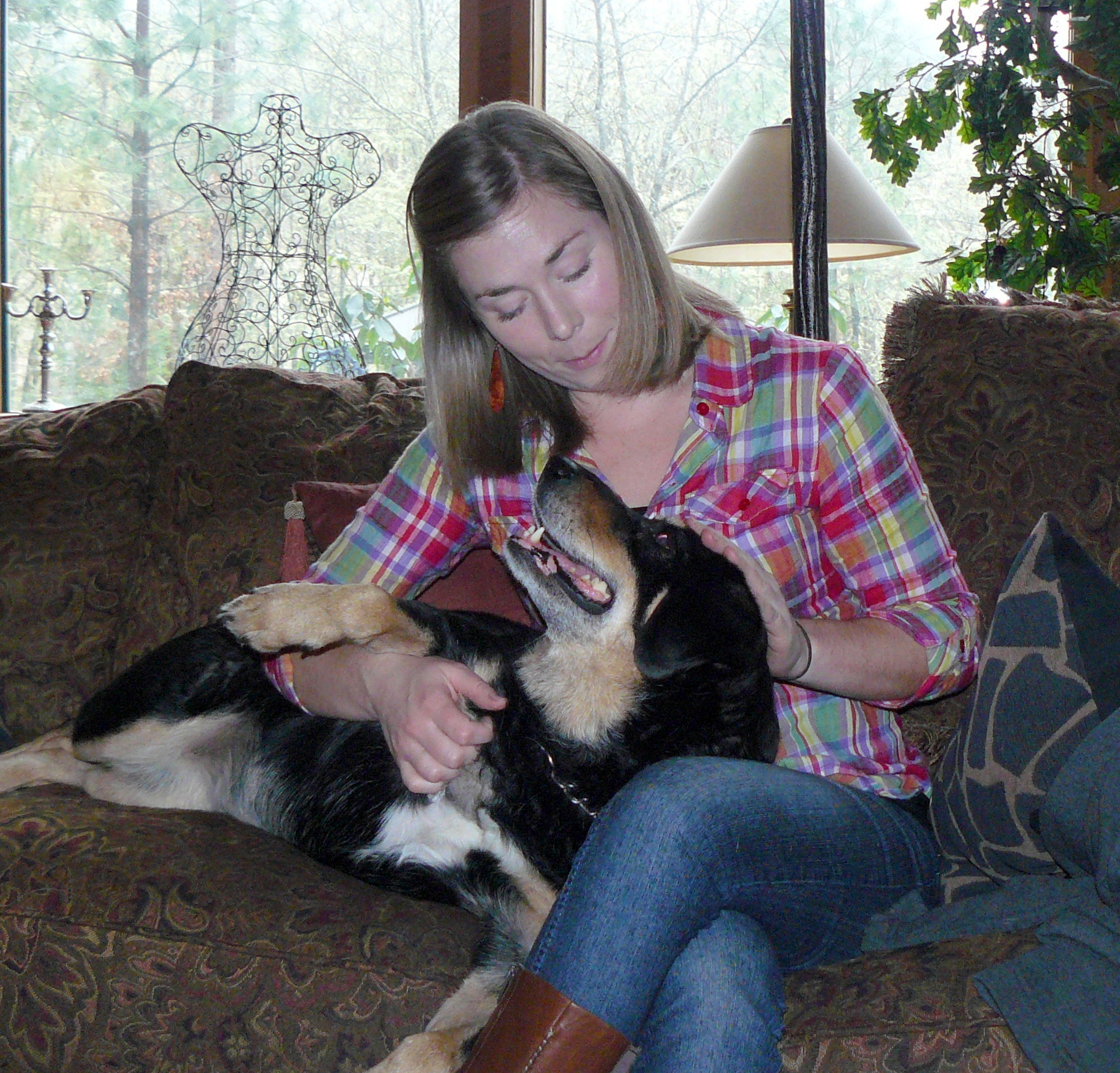
One of the huge differences between humans and our beloved dogs is that dogs live entirely in the present and do not engage in abstract thinking. Indeed, one of the most glorious aspects of owning a dog is being able to lose oneself in those moments of intimacy between yourself and your dog. Here’s a wonderful example of that when Bridget from Oregon Wild visited us recently and enjoyed a moment of bliss with Hazel.
So with that in mind, I am now going to be very un-dog-like and very human by offering an essay that is most abstract in manner. Not my essay, I should hasten to add, but a recent essay from George Monbiot, republished here with his kind permission. Then tomorrow, I want to stay with the abstract theme and include a recent essay from Terry Hershey.
ooOOoo
A Small and Shuffling Life
Why, in this age of freedom, are we so confined? And what can we do to reclaim our lives?
By George Monbiot, published in the New York Times, 19th January 2015
Live free or die: this is the maxim of our age. But the freedoms we celebrate are particular and limited. We fetishise the freedom of business from state control; the freedom not to pay taxes; the freedom to carry guns and speak our minds and worship whom we will. But despite – in some cases because of – this respect for particular freedoms, every day the scope of our lives appears to contract.
Half a century ago, we were promised that rising wealth would mean less work, longer vacations and more choice. But our working hours rise in line with economic growth, and they are now governed by a corporate culture of snooping and quantification, of infantilizing dictats and impossible demands, which smothers autonomy and creativity. Technologies that promised to save time and free us from drudgery (such as email and smartphones) fill our heads with a clatter so persistent it stifles the ability to think.
Public spaces in our cities are reduced to pasteurised piazzas, in which loitering without intent to shop is treated as suspicious. Protest is muted by dozens of constraining laws. Young people, who have no place in this dead-eyed, sanitised landscape, scarcely venture from their bedrooms. Political freedom now means choosing between alternative versions of market fundamentalism.
Even the freedoms we do possess we tend not to exercise. We spend hours every day watching other people doing what we might otherwise be doing: dancing, singing, playing sport, even cooking. We venture outdoors to seek marginally different varieties of stuff we already possess. “Getting and spending, we lay waste our powers / Little we see in Nature that is ours,” wrote William Wordsworth (1), and it is truer today than it was then.
We entertain the illusion that we have chosen our lives. Why, if this is the case, do our apparent choices differ so little from those of other people? Why do we live and work and travel and eat and dress and entertain ourselves in almost identical fashion? It’s no wonder, when we possess and use it so little, that we make a fetish out of freedom.
Perhaps we have forgotten the bitter complaint made by Benjamin Franklin in 1753. “When an Indian Child has been brought up among us, taught our language and habituated to our Customs, yet if he goes to see his relations and make one Indian Ramble with them, there is no perswading him ever to return.”(2) But when European Americans “have been taken prisoners young by the Indians, and lived a while among them, tho’ ransomed by their Friends, and treated with all imaginable tenderness to prevail with them to stay among the English, yet in a Short time they become disgusted with our manner of life … and take the first good Opportunity of escaping again into the Woods, from whence there is no reclaiming them.” In 1785 Hector de Crèvecoeur asked two European refuseniks why they would not come home. “The reasons they gave me would greatly surprise you: the most perfect freedom, the ease of living, the absence of those cares and corroding solicitudes which so often prevail with us.”(3)
We arose in a thrilling, terrible world. The African savannahs on which the first hominims evolved were dominated by sabretooth and false sabretooth cats, giant hyaenas and bear dogs. When human beings arrived in the Americas, 14,000 years ago, they found ground sloths the weight of elephants; a beaver eight feet from nose to tail; armadillos like small cars; giant lions and sabretooths; short-faced bears whose shocking armoury of teeth and claws suggests they drove giant lions and sabretooths off their prey. A bird in Argentina had a wingspan of 26 feet. Fanged salmon nine feet long migrated inland from the Pacific coast.
We carry with us the psychological equipment, rich in instinct and emotion, required to navigate that world. But our survival in the modern economy requires the use of few of the mental and physical capacities we possess. Sometimes it feels like a small and shuffling life. Our humdrum, humiliating lives leave us, I believe, ecologically bored.
At times this sensation has overwhelmed me. It happened in a newly-discovered bone cave in southern England. The walls and floor were encrusted with calcite crystals, that glittered in the torchlight. One of the archaeologists with whom I was exploring it handed me the atlas vertebra of a Bronze Age cow. Then he picked up another bone, this time with both hands: another atlas vertebra, but monstrous. “It’s the same species as the first one. But this is the wild version. The aurochs.” As I turned it over in my hands, feeling its great weight, I experienced what seemed like an electric jolt of recognition. It felt raw, feral, pungent, thrilling. The colour seemed to drain from modern life.
I felt it again when stalking up a tidal channel with a trident, trying to spear flounders. After two hours scanning the sand intently for signs of the fish, I was suddenly transported by the fierce conviction that I had done it a thousand times before. I felt it most keenly when I stumbled across the fresh corpse of a deer in a wood. I hoisted it onto my shoulders. As soon as I felt its warmth on my back, my skin flushed, my hair stood on end and I wanted to roar. Civilisation slid off like a bathrobe. I believe that in these cases I accidentally unlocked a lumber room in the mind, in which vestigial faculties shaped by our evolutionary past are stored. These experiences ignited in me a smouldering longing for a richer and rawer life than the one I lead.
Unless we are prepared to reject civilization altogether and live in the woods, there is no complete answer to this predicament. But I think there is a partial one. Across many rich nations, especially the United States, global competition is causing the abandonment of farming on less fertile land. Rather than trying to tame and hold back the encroaching wilds, I believe we should help to accelerate the process of reclamation, removing redundant roads and fences, helping to re-establish missing species, such as wolves and cougars and bears, building bridges between recovering habitats to create continental-scale wildlife corridors, such as those promoted by the Rewilding Institute(4).
This rewilding of the land permits, if we choose, a partial rewilding of our own lives. It allows us to step into a world that is not ordered and controlled and regulated, to imagine ourselves back into the rawer life from which we came, to discover, perhaps, the ecstasy I experienced when I picked up that deer. We don’t have to give up our washing machines and computers and spectacles and longevity to shed our ecological boredom and recover some measure of the freedom that has been denied to us. Perhaps we do need to remember who we are.
George Monbiot’s book Feral: rewilding the land, the sea and human life is published this month by the University of Chicago Press.
3. J. Hector St. John de Crèvecoeur, 1785. Letters from an American Farmer and Other Essays. Letter 12. Edited by Dennis D. Moore. Harvard University Press.
A few days ago, we had a visit from the Wilderness Campaign Coordinator from Oregon Wild. Bridget, that being her name, took the opportunity of saying ‘hi’ as a consequence of her coming down from Northern Oregon to Ashland. Bridget was giving a presentation in Ashland regarding securing more wilderness areas in Oregon; a very worthy ambition. Jean and I have supported the organisation since we moved up to Oregon.
Anyway, I offered to use Learning from Dogs to support and promote any campaigns from OW that would be of interest to LfD readers. I sorted out some recent posts that would give Bridget and her colleagues an idea of what was published in this place and sent her the links.
One of the links that I forwarded was this post from last October. I just wanted to share it with you all again.
oooo
Embracing the poetry of nature.
The beauty of poetry.
In yesterday’s post, where I wrote about how Jean and I had the wonderful privilege of feeding a wild deer from our hands, I closed it with a p.s. This is what I wrote: “P.S.It is at times like this that we need poetry. So how about it: Sue?Kim? How would you describe in poetry what Jean and I experienced?“
Well, Sue, of Sue Dreamwalker, replied with a link to a poem of hers that she published back in 2012. I will say no more than republish, with permission, Sue’s beautiful words and close with one of the photographs from yesterday.
Perhaps the fundamental reason why I am so hooked on this world of blogging is because there are always wonderful surprises. What do I mean by this?
Yesterday’s post, Sometimes the world seems very strange was a rather bleak affair. I had been affected by, and reported, a couple of items read elsewhere that seemed to me, in a rather dark and miserable way, to highlight what is wrong with our so-called modern society. Perhaps, no more clearly expressed than in my reply to a comment left by Sue Dreamwalker.
Here is what Sue said, and how I replied.
I agree with what Alex has to say… The super rich live in a totally different reality… Have no clues on the real structure of how their wealth is being created often on the backs of the poor. Who are squeezed ever tighter at every conceivable way of extracting more in the form of taxes, both on incomes and on everything else..
Change will come but what frightens you Paul is that when it does come it will come swiftly.. We have seen the social unrest in other nations… What is happening in many countries is the injustices and discriminations which are getting ordinary peoples backs up..
Yes Paul sometimes the world is very Strange.. and also Very Stupid!..
Thank you and wishing you and Jean a lovely week
Sue
oooo
Sue, a wonderful reply from you. Thank you. What I find so strange is this. That here I am, turned 70-years-old, having enjoyed a fabulously interesting life, full of variety and opportunities. That, to some small degree, I believe I have a better, albeit still partial, sense of how we humans tick than, say, 20 years ago. How our lives fundamentally revolve around our relationships, with the most important one being our relationship with ourself and, flowing from that, some understanding of who we are!
Yet, (and you knew there was a ‘yet’ coming, didn’t you!) beyond the very small world of loved ones, family and close friends (and I count blogging friends in that last category) the world around me becomes more strange, more remote, more alien almost on a week-by-week basis.
I was born in the middle of London six months to the day of the end of the Second World War in Europe. Those first six months would have been unrecognisable to the later world I grew up in, and got to know. My fear is that I will spend the last six months of my life in a world that is similarly unrecognisable from the world I thought I knew.
Thank my lucky stars for a wonderful, loving woman in my life and for so many fabulous doggie friends.
Sue, apologies, I went on a tad – nay, a tad and a half!
Fondest love to you and your Hubby.
Paul
I think that makes it pretty clear what my mood was like yesterday morning.
Jean and I were out from 9am until 12:30 pm and it was coming up to 3pm when I sat down in front of my PC. Frankly, I didn’t have a clue as to what to write and still felt pretty miserable about the ‘strange world’.
However, one of the first things that I saw in my ‘in-box’ was the weekly email from the Rev. Terry Hershey. Here is how his email opened up:
Live deeply and deliberately
January 12, 2015
“The purpose of life is to live it, to taste experience to the utmost, to reach out eagerly and without fear for newer and richer experience.” Eleanor Roosevelt
“To be fully alive, fully human, and completely awake is to be continually thrown out of the nest. To live fully is to be always in no-man’s-land, to experience each moment as completely new and fresh. To live is to be willing to die over and over again.” Pema Chodron
“On his right hand Billy tattooed the word love,
and on his left hand was the word fear,
And in which hand he held his fate was never clear.” Bruce Springsteen: “Cautious Man“
“To live is to be willing to die over and over again.” Wow! Did that ‘speak’ to me or what!
Then the very next item in my ‘in-box’ was a note that “Deaf Duke is now following Learning from Dogs“. I try and make it across to every new follower of this blog and thank them for their support. Seems the least I should do.
So it was with ‘Deaf Duke’. But I have to quietly admit that before clicking on the link I found myself wondering just what Deaf Duke was.
Then I went across to their place and was uplifted; hugely so! Because Deaf Duke is the name of a blog that … well in their words ….
About
Deaf Duke is an American Bulldog mix that my boyfriend (Tyler) and I got just after the Fourth of July this year. He was only 6.5 weeks old when we got him so he had some issues to begin with. When he was about 6 months old we decided to take him to a trainer, we thought he was a bad dog because he would never listen to us, we soon found out that he was becoming deaf. He wasn’t a bad dog he just couldn’t hear us. Our lives changed a lot from that moment on. Everyone says that training a deaf dog is no harder than training a dog that can hear, which is true on so many levels but they never talk about how difficult it can be for the owners who are primarily vocal beings. This blog is about the upbringing and stories about Duke and his life.
When we got Duke at 6.5 weeks old he was very under weight. Finding out that he was deaf could explain why he was. Deaf dogs generally don’t wake up for feedings because they cannot hear when the other puppies in the litter are eating. Duke is now a healthy and happy 7 month old boy learning just like his parents are to train him and us.
So thank you Terry, and thank you Duke and your Mum and Dad, for reminding me that life is utterly and whole-heartedly what we make of it!
Bronwen is a UKCP-accredited psychotherapist with nine years experience and a practice in Cambridge, Suffolk and Hungary. She is trained in the Karuna Institute in Devon in core process psychotherapy, which was the first mindfulness-based therapy in the UK. She adds to this her unique understanding of western and eastern spiritual traditions, combined with findings in new science – to find ways of helping individuals align with their true destiny. She runs retreats and workshops and group work at different times of the year.
I was vaguely aware of the name. Perhaps unsurprisingly as I was familiar with the work of the Karuna Institute at their beautiful location at Widecombe-in-the-Moor, Dartmoor, Devon, some eighteen miles from where I used to live in Harberton, Devon.
Widecombe-in-the-Moor
Anyway, back to the theme of today’s post. Back to Jon Lavin’s email with the link. This is how that essay from Dr. Rees opened:
by Bronwen Rees on January 1, 2015
In the face of the on-going and now undeniable social, economic, environmental and political crises, there are plenty of seeds of ‘emergence’ that point to a new way forward. These are flowering in the area of sustainability, spirituality, and the reworking of ancient systems of wisdom. They point to a new way of being and relating where, it is implied, one can manifest at will one’s desires.
Whilst there is a distinct truth in much of this, and many examples where this can obviously work (vis the outpouring of new technological companies providing ever more zany products), they are very early developments fostering to individual satisfaction rather than being consciously channeled into the benefits of the collective. The scale of change in terms of consciousness has largely not yet been realized. One of the main reasons for this is the as yet imbalance in the relationship between the collective and the individual, and the lack of a conscious ethical foundation.
I sort of understood the central message but the words were getting in the way. Take this later paragraph, for instance:
Humanity is at a bifurcation point – a point of irreversible change – where conscious choice determines the future that is created. Neo-Darwinian theorists would argue that this is merely a point of survival, and given the current scientific data about the material conditions – peak oil, energy, economic chaos, severe mental health issues, the conditions would suggest that we are as a species heading for disaster. Balanced between over-population and yet greater and greater individualization with more and more apparent choice – how can the two perspectives be reconciled on this seemingly increasingly small planet?
Indeed, my email reply to Jon, having struggled through the full essay said: “Good day to you, Jon, Yes, what a fascinating essay albeit written in a manner that makes it a very tough read! Nevertheless, I have no doubt that the good Dr. is spot on in her analysis.”
The very next item opened in my email inbox was notification of a new post from Sue Dreamwalker: My Dream ∼ Translated I just had to share. Let me, in turn, share Sue’s post with you; with her kind permission, I should add.
ooOOoo
My Dream ∼ Translated I just had to share
“Don’t only practice your art, but force your way into its secrets, for it and knowledge can raise men to the divine.” ― Ludwig van Beethoven
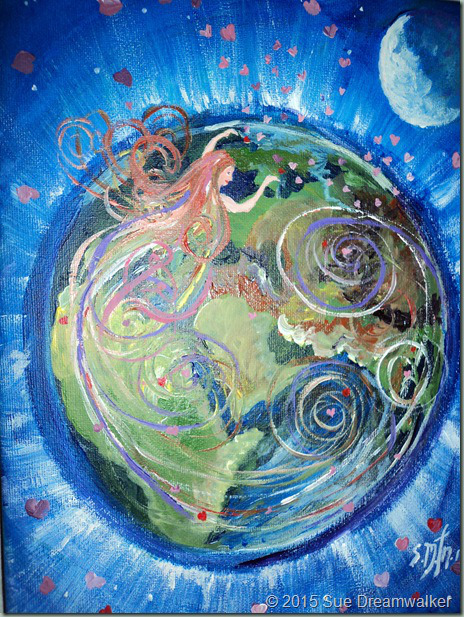
On Jan 3rd I had a Dream.. Please click on the music video below so you can get a sense of some of my experience.. .. Sunday I tried to capture some of the images I had in the dream… So I painted.. But I saw Oh so so much more………
In the beginning of the dream.. She was Me.. As I began to sing.. but then I became the observer.. This has to be the best Dream experience ever… .. So I had to share.. I heard the Music… Music like I have never heard upon this earth… the video music is about as close as I can get to that feeling of being exalted to a higher place.. I am still so excited I cannot tell you the Love I felt within this experience.. If this is the beginning of 2015.. Whoooooh… Let it roll……..
My Dream..
“She stood in a gown that was a rich golden brown. Its fabric shimmered catching the light that reflected from the crystals of natural quartz that sprang up around her. The gown was long and flowing not only did it reach the floor, but it spiralled out around her in a never ending dance as it became one with the sphere of the Earth.
Sue’s painting.
She took a deep breath; here she stood in the centre of the globe called Gaia.
Her hair was so long the wind picked it up to billow out behind her in long tresses. Birds flew in and amongst her strands of hair, Insects and butterflies danced within making it their home.
With breath still poised, she raised her arms like a conductor of an orchestra. She expanded her lungs and she began to Sing…. Her Soprano voice was pure. The moment her voice vibration raised higher the spiral of her gown buried deeper into the Earth. The Grass became part of her gown. Trees sprang forth from the folds of it swaying to her melody of love; Flowers opened their blooms, each petal giving separate notes in a wonderful exotic dance of harmonic ripples.. Love notes rippled like the keys of the piano. The buds on the trees open their leaves their notes sounded deeper like a million cello’s. Birds sang their flute like songs and the butterflies wings danced lighter than bell chimes.
Water trickled into streams, clear and sparking like the strings of the violin.. They swelled in a crescendo in waves that beat the rocks crashing in like kettle drums smashing like symbols into glistening spray..
The Whales joined in her song a mournful lament, while deep in the jungle the elephants gave a low rumble to acknowledge they had heard.. The roar of the Big Cats were heard above the cries of the orangutan’s
As the Thunderous machines of man cut swaths leaving deep scars that screeched like vultures circling over head, to give way to silence………. as they circled over the corpses of everything left dying in its wake..
She paused……………. ready to continue…….. Her arms raised high above her head, she Sang.. her voice becoming a crescendo with the Earth, her breath became the Spiral.. Her Hair became the Wind.. The notes she sang sprang forth from her mouth forming hearts and stars.. Every living creature now joined in her song…
She knew her Song of love was being joined by so many more.. She was ONE with ALL.. She was part of our Earth Mother..”
~~~~
I hope you enjoyed reading about this Dream and I hope you enjoyed listening to the wonderful music of the PianoGuys
See you all very soon…
~Sue~
ooOOoo
In a very strange way, I read the same messages from Dr. Rees and from Sue but presented in such opposite ways: one way so complex and one way to clear. So strongly reinforced by their respective closing words. Here’s Dr. Rees:
Whilst there is real potential for the expansion of consciousness, this does not by any means suggest that this will arise without individual effort and struggle. All the enlightened masters of the past needed to move through this gateway – the difference between then and now is that the conditions are far riper for more individuals to undergo this – and indeed can be seen as a biological necessity for the survival of the human species. Thus as individuals, we cannot avoid this, but what we can do, and indeed as a biological and spiritual imperative, we can support one another and help organize ourselves in dedication of this purpose, in a mutual recognition of each individual uniqueness yet shared destiny.
Here are Sue’s closing words: “She knew her Song of love was being joined by so many more.. She was ONE with ALL.. She was part of our Earth Mother..”
However, there is one uniting theme I read from both of them: Hope!
How the hard choices actually allow us to define who we are.
Jean and I watched a TED Talk a few evenings ago. The title of the talk was: How to make hard choices. It was delivered by philosopher Ruth Chang who one discovers from her website:
Ruth Chang
I am a philosopher at Rutgers University, New Brunswick. Before arriving at Rutgers, I was a Junior Research Fellow at Balliol College, Oxford where I was completing my dissertation. I’ve also held visiting positions in the philosophy department at the University of California, Los Angeles and the University of Chicago Law School. Before my life as a philosopher, I worked as a law associate on a (pro bono) death penalty case and several (non pro bono) product liability cases. I have a J.D. from Harvard Law School and an A.B. from Dartmouth College.
Now I am not going to pontificate about this talk; all I will say is that it is a) very interesting, and b) highly relevant to millions of us when, from time to time, we are faced with the tough decisions to make.
The video is a little less than 15 minutes long. I’m fairly certain that you will be enchanted by Ruth Chang’s proposition as much as Jean and I were.
Published on Jun 18, 2014
Here’s a talk that could literally change your life. Which career should I pursue? Should I break up — or get married?! Where should I live? Big decisions like these can be agonizingly difficult. But that’s because we think about them the wrong way, says philosopher Ruth Chang. She offers a powerful new framework for shaping who we truly are.
I’m sure that the human psyche lives in a bubble of delusion. Not always and not extremely so; of course. Clearly, if the level of delusion were abnormal then we couldn’t function properly as social animals. However, just take a quiet moment of self-reflection to muse over the ways that you ‘shelter’ from reality. In directing that last point to you, dear reader, trust me I don’t exclude myself!
There are times when going beyond the self, going out of oneself, is the only way to see the reality of who we are and the world around us; to be able to brush away our delusions. Perfectly expressed by the author, Aldous Huxley: “Experience is not what happens to you; it’s what you do with what happens to you.” Wise words, indeed!
But these fine expressions representing the peak of common sense have one grinding, searing fault. They do not assume the end of a person’s life. I am speaking of death, of the inevitability of our death! That largely unspoken truth no better expressed than through the words[1] of Sharon Salzberg in her book Faith.
What does it mean to be born in a human body, vulnerable and helpless, then to grow old, get sick and die, whether we like it or not?
Anyone who has lost a loved one knows that it is tough; incredibly tough. It is full of pain and anguish amidst a great churning of emotions, all in a very deep-seated and personal manner. That’s the perspective from the loved ones left behind with more life ahead of them. But if one thinks of it in reverse, turns it on its head, what are our fundamental wishes with respect to those we love; what we would want to leave behind when we die?
Fond memories, naturally, but they wouldn’t be our fundamental wishes. This is what those fundamental wishes would be. That our death does not leave pain and anguish in the hearts and souls of those left behind. That it doesn’t leave a pain that cannot be dealt with in a healthy way. Our wishes would be that those whom we loved and who loved us may embrace their loss and move on.
Anyone who has loved a dog has most likely been intimately involved in the end of that dog’s life. It is, to my mind, the ultimate lesson that dogs offer us: how to be at peace when we die and how to leave that peace blowing through the hearts of all the people who loved us.
Our beloved dogs have much shorter life spans than we do, thus almost everyone who has loved a dog will have had to say goodbye to that gorgeous friend at some point in their lives. Very sadly, perhaps, saying goodbye to more than one loved dog.
I see the most precious of parallels in the tragic death of a loved dog and our own death. The parallel between coping with our grief for the loss of a loved dog and reaching out to our loved ones so that they may cope with their grief at losing us.
In other words, knowing what to expect in emotional terms at the loss of our loved dog is helpful, very much so, to us helping our loved ones when comes our time to die.
There are five stages of mourning[2], of dealing with our grief, when we lose our beloved dog: Denial; Anger; Guilt; Depression and Acceptance.
Compare those stages to the five stages of mourning[3], perhaps of dealing with the knowledge that oneself is dying, or a person is dying who is very emotionally close to us. Those five stages are: Denial and Isolation; Anger; Bargaining; Depression and Acceptance.
The parallels are almost perfect.
Whether it is the impending or actual death of a loved dog, a loved person, or ourselves, the similarities between embracing the loss of the loved dog, or the loved person, are powerfully obvious. So, too, are the many different ways each of us embraces the death of a loved dog or a loved person. Let me expand on this last point.
Namely, that each of us will experience each stage of mourning at varying levels of intensity, for varying lengths of time, and sometimes in a different order. Some of the stages may converge and overlap each other. But however you experience the mourning, it is incredibly important to remember that your feelings are completely normal.
As the website of the American Animal Hospital Association points out, on their webpage entitled Life after Dog[4], “… we almost always outlive our beloved companions. Learning to live with loss is an essential part of life.”
That webpage imploring us to honour our emotions, to honour the memory of our dog, and critically, when a child is involved, to help that child cope with the loss of their loved dog. For all, young and old, helping to ease the pain through learning to cope with the loss. Easing the pain through changing one’s schedule, moving furnishings around to help distance the memory of your dog’s favourite sleeping spots, or creating a memorial in one form or another, even writing a letter (or blog post!) to your dog in which one describes all the feelings you have for your recently departed, loved dog.
I was born in 1944. I am therefore the ‘wrong’ side of seventy years old. I was born an Englishman and, according to life expectancy tables from 2012, a male Englishman’s life expectancy is 79.5 years. I am living happily in the USA and, according to those same tables, a male American’s life expectancy is 77.4 years. My mother is alive and an amazingly fit and healthy ninety-five-year-old, at the time of writing this book. My father died at the age of 56 just 5 days before Christmas in 1956. I do not believe in any form of spiritual life after death.
So take your pick!
All that I do know is that loving our dogs, welcoming all the wonderful qualities that our dogs possess, striving always to live peacefully ‘in the present’, just as our dogs do, and, ultimately, as with our faithful companions, taking that last breath in the knowledge that ours was a beautiful life, is what learning from dogs is all about.
“I’ve learned that people will forget what you said, people will forget what you did, but people will never forget how you made them feel.” Maya Angelou
In a poignant way, it seems appropriate to feature that quote from Maya Angelou in opening today’s post simply because this wonderful, spiritual woman died earlier on this year; on the 28th May, 2014.
Born in 1928 in St Louis, MO, Maya was, “… an American author, poet, dancer, actress and singer. She published seven autobiographies, three books of essays, and several books of poetry, and was credited with a list of plays, movies, and television shows spanning over 50 years.” (Wikipedia)
In case you are wondering why this post is reflective on life, and the inevitability of death, it is simply because in thirty-minutes time, the last (draft) chapter of ‘the book’ is being published in this place, and I was looking for something to ‘set the tone’, as it were. That last chapter is entitled: And show us the way to embrace death, and the companion to: How the dog offers us a way into our own soul, that was published yesterday.
To be precise, I had in mind two elements in setting the tone. The first being that powerful quotation that is today’s sub-heading and the second being the reposting of a recent item from Val Boyco.
As is the way in this interconnected world of blogging, I hadn’t previously heard of Val Boyco until she signed up to follow my humble scribblings in this place. Naturally, I went across to her blogsite, Find Your Middle Ground, and very quickly signed up to follow her, in return. That’s how I came to see ‘All Things Change‘; reposted here with Val’s very kind permission.
ooOOoo
All Things Change
All things arise
Suffer change
And pass away.
This is their nature.
When you know this …
…you become still.
It is easy.
The Ashtavakra Gita
—-
We spend so much time and energy avoiding the way life actually unfolds, and most of the time we are unaware that we are doing this.
We have created these habits over time to avoid facing the uncomfortable feelings that are a part of life.
When we pause and create spaciousness, the resistance begins to dissipate and our inner consciousness grows.
Each time we make space, trust grows.
The more we trust, the more we grow beyond our conditioning and habits and create more space.
With space, life flows freely.
Taking time to connect inwards will not save your life, but may save you from a life of struggle and discontent.
Namaste
ooOOoo
I’m going to close today’s post with a wonderful quote from Sharon Salzberg, taken from her book: Real Happiness: The Power of Meditation. It seems as relevant and as powerful as that opening quote from Maya Angelou.
It is never too late to turn on the light. Your ability to break an unhealthy habit or turn off an old tape doesn’t depend on how long it has been running; a shift in perspective doesn’t depend on how long you’ve held on to the old view.
May we all turn on the lights in ourselves so that we may better leave a light burning in the hearts and minds of others.
The final two parts of the book, How the dog offers us a way into our own soul, and, And show us the way to embrace death, are offered today and tomorrow.
I can’t tell you what it has meant to me to have the many ‘Likes’ and comments along the way; just take it from me that it has been enormously inspiring and motivational and part of me can’t believe that the project that started in November 2013 under the NaNoWriMo-2013 umbrella was completed this November just gone, for a draft word count of a little over 104,000 words!
Come the New Year and the real work starts, that of the Big Edit.
So let me close by just saying, once again, thank you!
oooo
Not forgetting:
How the dog offers us a way into our own soul
“Happiness resides not in possessions, and not in gold, happiness dwells in the soul.”
So wrote the philosopher Democritus. Democritus, born in 460 BCE, although according to some in 490 BCE. He acquired fame with his knowledge of natural phenomena, and preferred a contemplative to an active life, spending much of his life in solitude. The fact that he lived to beyond 100 suggests he lived out what he philosophised about!
Now the last thing I am going to attempt is any rational, or even semi-rational, explanation of the soul; of what it is; of whatever it is. Despite the familiarity of the word, especially within religious circles, the notion of the soul remains an enigma. Indeed, it reminds me of that very clever quotation attributed to the German philosopher, Martin Heidegger: “Making itself intelligible is suicide for philosophy”, that with a little poetic licence might be rewritten: “In making itself intelligible does the soul become soulless.”
Thus having ‘bared my chest’ in terms of failing the test of knowing what a soul is, in any rational manner, I shall, nonetheless, continue to use the word. Simply because there will be sufficient bonding between me writing the word ‘soul’ and those reading the word ‘soul’, for those same readers to sense where I am coming from.
I’m going to stay with this wonderful concept of soul for just a little longer before adding our beautiful dogs into the dream. Staying with it courtesy of the writer; John O’Donohue. John’s name is not one known to the masses. Yet his writings are, without fail, beautifully moving. John’s first book was called Anam Cara: A Book of Celtic Wisdom., Anam Cara means ‘soul friend’ in Gaelic. The following passage, taken from Anam Cara, represents to my mind the most exquisite understanding of the human soul.
The secret heart of time is change and growth. Each new experience which awakens in you adds to your soul and deepens your memory. The person is always a nomad, journeying from threshold to threshold, into ever different experiences. In each new experience, another dimension of the soul unfolds. It is no wonder that from ancient times the human person has been understood as a wanderer. Traditionally, these wanderers traversed foreign territories and unknown places. Yet, Stanislavsky, the Russian dramatist and thinker, wrote: “The longest and most exciting journey is the journey inwards.”
There is a beautiful complexity of growth within the human soul. In order to glimpse this, it is helpful to visualise the mind as a tower of windows. Sadly, many people remain trapped at one window, looking out every day at the same scene in the same way. Real growth is experienced when you draw back from one window, turn and walk around the inner tower of the soul and see all the different windows that await your gaze. Through these different windows, you can see new vistas of possibility, presence and creativity. Complacency, habit and blindness often prevent you from feeling your life. So much depends on the frame of vision – the window through which we look.
Those are so wonderful words from John and a brilliant example of his exquisite creativity of thought. They also offer the most perfect ‘window’ to seeing how the dog offers us a way into our own human soul.
What do I mean by this?
When we have dogs in our lives there are many occasions when there is a link between us and our dog; a link that defies logical explanation. Let me offer some examples.
Let’s start with this one. As a human, that is you and me, out of the blue, with no rhyme or reason, you will surely experience finding your day a bit tough from time to time. The odds are that it doesn’t show to your loved ones and, you are pretty sure, that it is entirely an experience that is well hidden inside one. But you and I know you can’t hide it from your dog. You slump down in a chair and your dog comes over and lays its warm snout across your legs or offers a head for you to scratch. In any one of many familiar ways you have a caressing and loving contact with your dog. And you know, you know beyond doubt, that your dog is attracting the angst away from you.
Or how about the time when you might be standing somewhere in or around the house, trying to think how best to approach a task, and your dog comes up next to you and softly leans against you.
Or that most special of links between us and our dog. I have in mind the times when our dog links ‘eye-to-eye’ with us, when those beautiful, deep unblinking eyes of our dog look so deeply inside of us. Those are the times when you and your dog know, you both sense in a clear, unwritten language, the thousands of years of relationship, the very special relationship, that man and dog have had with each other. That at that moment of held eye contact there is a real, tangible connection between your two souls.
We know beyond doubt that dogs have emotions, that they are full of natural goodness and feelings, and that there is some part of a dog’s inner being that links to us and, in turn, that there is an inner being within us that links us back to our dog.
Let me return to the power of that eye-to-eye bond between us and a dog.
In humans, that part of the brain in which self-awareness is thought to arise is called the ventromedial prefrontal cortex. That just happens to be located behind the eyes. Ergo, we learn[1] to associate the identity of others with our eyes. Then as we mature, our eyes take on more importance because we develop awareness and a better understanding of the social cues that other people convey with their eyes.
Therefore, is it any surprise that dogs, such intuitive creatures that they are, young and old, soon learn to read us humans and the feelings and emotions that we give out via our eyes. There’s a knowing in my mind, albeit an unscientific ‘knowing’, that dogs, too, give out emotions and feelings from their own eyes.
That loving a dog and, in return, being loved by that dog truly does offer us a way into our own souls.
“Until one has loved an animal, a part of one’s soul remains un-awakened.“
~ Anatole France







 Learning from Dogs