One can never have too many examples of love in a life!
These are interesting times. If we took even a small percentage of what we read about or see in the news media to heart we would think that life is hardly worth living for. So stuff the bad news out of sight!
Over 80 percent of the students who attend Los Amigos Elementary School in Rancho Cucamonga, Calif., are from socioeconomically disadvantaged families, but that didn’t stop them from doing everything they could to raise money to save an animal in need.
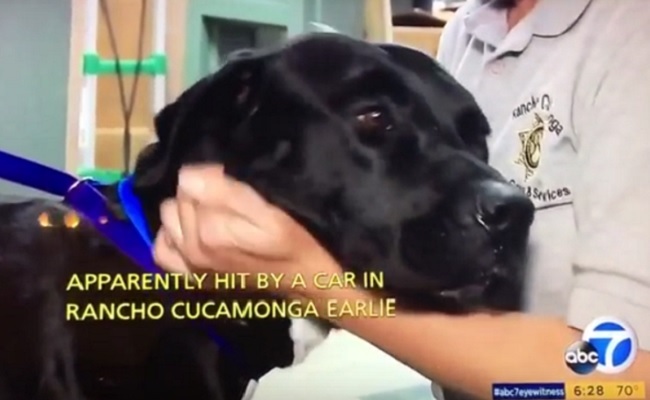
It began in early December, when a school employee found an injured black Lab mix hiding in bushes near the parking lot.
“There’s this really hurt dog,” Vice Principal Sharon Linville heard over a walkie-talkie, according to the Inland Valley Daily Bulletin. “I’m sure this dog is going to die, he’s in so much pain.” She and other employees brought the dog blankets and water, and contacted the Rancho Cucamonga Animal Care and Adoption Center.
The center’s staff veterinarian, Cynthia Servantez, visited the school a few days later to give the students a not-so-good update on the dog they’d named “Black Bart.” He’d been hit by a car and would probably survive, but he needed surgery that would cost about $3,000.
An X-ray had revealed that both of Bart’s hips were dislocated. As Dr. Servantez told the students, Bart’s “puzzle pieces had come undone.”
The schoolchildren immediately took action to help put those pieces back together. The school launched a “Pennies for Paws” campaign to collect spare change for Bart’s surgery.
Every single student made a donation. “They looked through sofa cushions, they gave up their allowance, some of them gave us IOUs,” Linville told KABC. “We have a bunch of Chuck E. Cheese coins that we got.”
One week later, the school gave the animal care center a check in the amount of $471.37.
Servantez told the Daily Bulletin it was the first time ever that anyone had offered to pay for the medical care of an injured stray dog.
The Los Amigos students continued their Pennies for Paws campaign and the momentum continued to build. Yvonne and Art Alvarez, owners of Doggie Couture in Rancho Cucamonga, were so impressed by the students’ efforts that they matched the funds that had been raised.
“We wanted them to know if they do something nice, it can make other people do it and then it becomes something big,” Yvonne Alvarez told the Daily Bulletin.
Several weeks after he’d been discovered at the school, “Who Let the Dogs Out” played over the speakers as Bart returned for a special guest appearance at a Jan. 23 rally in his honor.
Linville announced that the Los Amigos students had surpassed their $3,000 goal – by over $4,200. The extra money would be donated to the animal shelter to help other pets in need.
Veterinarian Victoria Impett, who accompanied Bart, told the schoolchildren to give themselves a pat on the back. Most of them complied. “It might not have seemed like big deal to go home and dig in the couch for a few pennies, but each and every one of you made a huge difference in someone’s life,” she told them.
Bart had no ID tag or microchip, and no one has come forward to claim him. He still needs surgery on his right hip. Once he recovers, he’ll be ready for adoption. “He’s starting to kind of blossom into a fabulous dog,” Impett said.
As Linville told the students, “This has been an incredible journey, and it’s really cool to be kind.”
I was talking about how our brains are mathematical organs at our last Freethinkers meeting in Grants Pass and Marcia from our local group emailed me the following:
Or, more specifically, what Diego meant for Laura Bruzzese. (This will be the second in the series We Shall Not Forget Them.)
ooOOoo
Dog Love In August
August is the start of the dying season. Garden things begin their slow shrink into the earth, the days grow shorter and cooler, lazy ocean- or mint-scented summer days snap into rigid schedules of work and school.
August is also the month that I lost Diego, my first dog. You can get acquainted with Diego here, a post I wrote a few days before he died. But I would like to share a little more now, on the second anniversary of his departure.
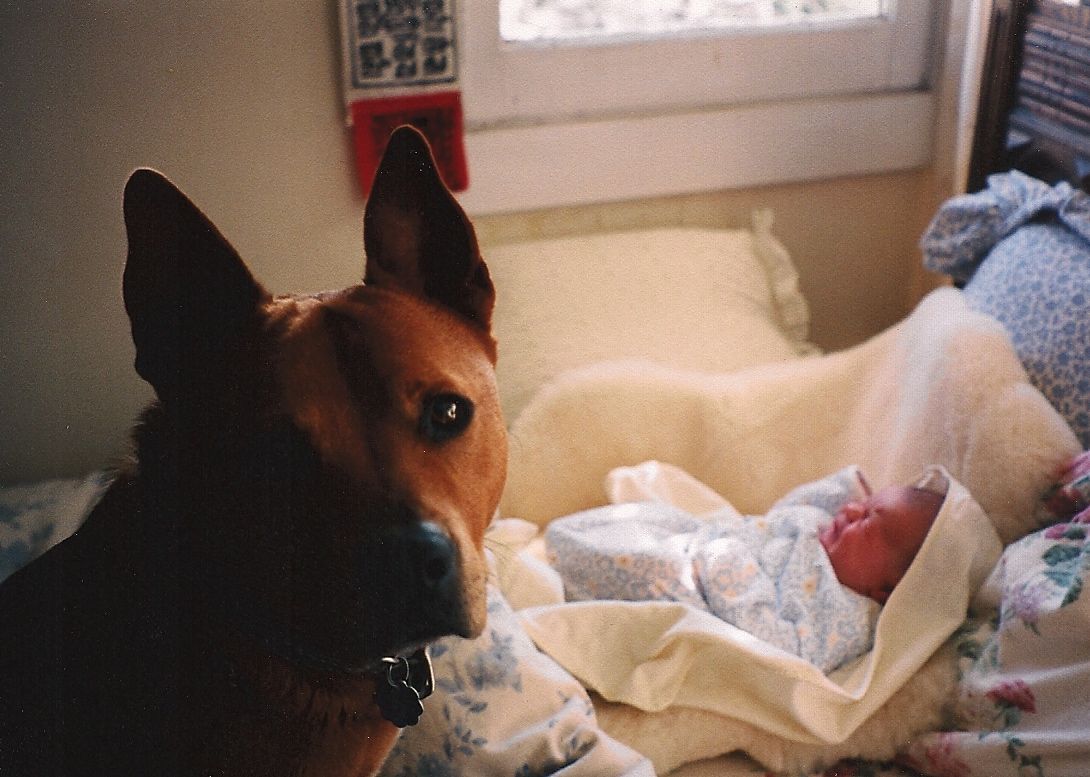
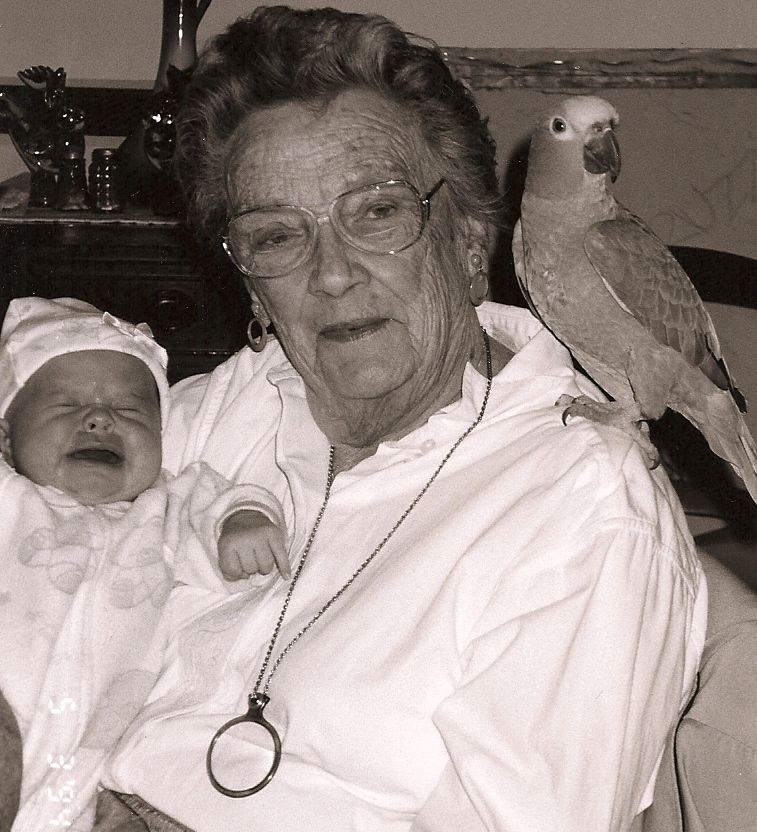
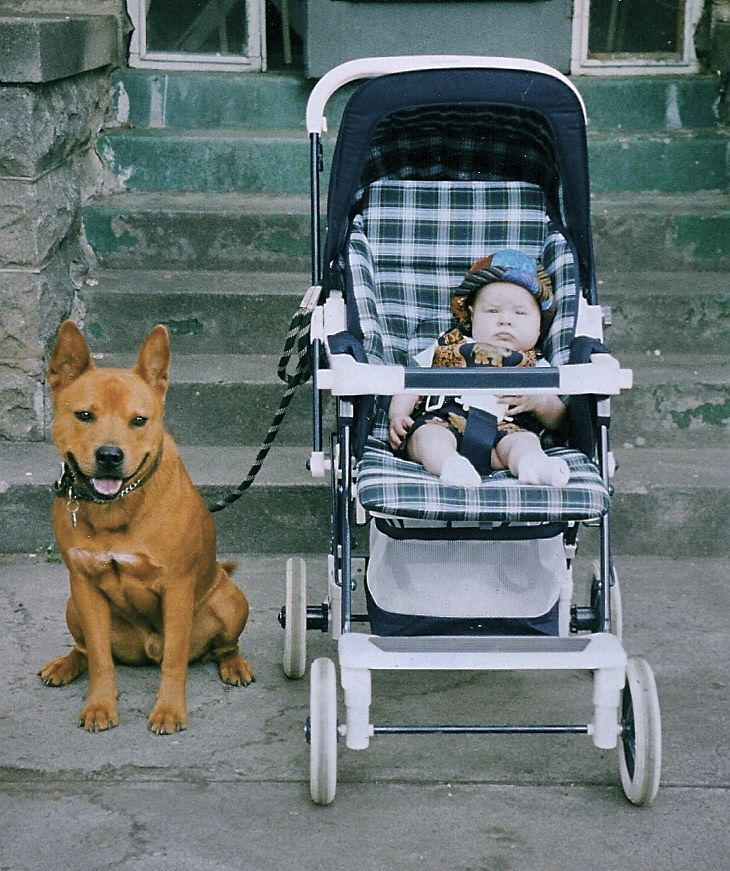
Diego was a poser, in a very literal sense of the word. He loved having his picture taken; in fact, he insisted on it whenever he saw me holding the camera. This picture, for example: it was taken the day I brought my daughter home from the hospital, the day after 21 hours of hard labor produced an eight-and-a-half-pound baby who actually stopped halfway out of my body, looked around, and scowled before resuming her reluctant journey onto the planet. (She was 12, twelve days overdue, FYI all you mothers out there who can surely feel my pain.)
There is something screaming in the bed. Please make it stop before it explodes.
I laid baby Isabella down, stepped back with the camera, looked up, and there he was: Diego, staring. Fifty-eight pounds of solid, unmoving dog. Insisting that I photograph him, too, with this creature that he wasn’t sure if he should guard against or lick. This child who personified the singular emotion of furious for the first nine weeks of her life (if she was not sleeping or eating, she was screaming).
Oh, hi Aunt Rosie. I know you’ve passed on, but I’ll bet you can still hear that screaming baby wherever you are.
When my doula told me that the colic or distemper or petite innards or whatever it was making Isabella so unhappy would resolve itself in about nine weeks, I said oh, that’s nice. But I won’t be alive for nine weeks of this. I’ll be in an asylum acquainting myself with a selection of opiates, or at the bottom of the mighty Rio Grande; so behold, an orphan.
But somehow, I survived. And Diego was part of it.
You see, from the very beginning, it was just us — the two of us, the three of us. I was abandoned by my husband before Isabella was born, a painful time that I don’t often write about.
Within a matter of weeks, the married-and-expecting life I’d known was gone, and I was left to fumble around with the pieces, a wreckage sitting on a pile of broken glass in the dark. The small hours of it were the worst, waking up alone and panicked in the middle of the night wondering how (or if) I would live through the next weeks and years. And Diego was always there, a silent and comforting presence curled at the foot of the bed or coming up to lick my tears if I was crying, which was basically all the time. He was always there.
I have a teenager now and those days seem ancient. While I rebuilt my life, Isabella grew up and Diego grew old. And finally, in his sixteenth year, he began to deteriorate to the point of pain. I knew he wouldn’t be with me much longer and I had already called the vet to ask her how it worked — when do you know it’s time? Do I take him to the office, or do you come to the house? Will he feel anything? I planned to schedule an appointment soon; I hadn’t had to make this decision before and it was a very painful.
On the morning of August 9 before I left for work, I told Diego that we would have to say good-bye soon because his body wasn’t working right anymore. I told him that I loved him and it was okay for him to go. Over and over I told him I loved him.
Less than two hours later, he drowned in the pond.
I think it was his way of avoiding the vet (he hated the clinic), and maybe sparing me that particular pain. I’m not going to say that I wasn’t devastated. But rather than remembering the urgent phone call at work from Isabella, or the vision of him when I got home, or my step-father struggling to carry the terrible weight of him away, I like to imagine Diego simply being received by the fish and toads. Delivered from his pain by warm water, wrapped in a blanket of lilies.
Anyone who has cared for pets perhaps knows that there is one, a special one, who will always occupy the largest piece of real estate in your heart, though others may follow. That was Diego for me.
But now we’re lucky enough to share our lives with another dog, the rascally, neurotic, road trip-loving Velma. I’ll end this post with a short video of her that reminds me of exactly what I love about dogs: their absolute and abundant connection with life, free of judgement, agenda, or desire to be anything other than what they are. That’s what I think of every time I see Velma in her Writhe of Exquisite Happiness. Perfect contentment of being.
ooOOoo
Laura wrote and published this back in August, 2012. But her words, emotions and feelings are those that never age. Indeed, I would add her courageous words.
As I have frequently mentioned, I so enjoy having guest posts being sent to me.
They give you, dear reader, a break from yours truly and so very often they offer a new and interesting perspective on dogs, on us, and on the world.
This week there are three guest posts, in various guises, lined up and, who knows, there may be a couple more heading in.
But to the first of those guest posts.
Well, technically, more of a reposting today than a pure guest post. That reposting is of a most fascinating post published by Patrice Ayme on the 25th. January. It was called WE ARE MATHEMATICS. But there were parts of Patrice’s post that I struggled with so I am offering it to you with a rather long introduction.
I hope you enjoy it.
ooOOoo
Smack!
The sound of an object falling to the floor of the shower, suddenly and without warning, nearly caused me to jump out of my skin.
I was washing my hair and had my eyelids tightly closed lest the shampoo suds got into my eyes. Inadvertently, I had felt my right elbow dislodge something from the top of the small corner shelf that held the bar of soap and the bottle of hair shampoo.
I let the flowing warm shower water rinse the suds from my face, opened my eyes and looked down. The object that had made such a sudden, loud noise was a plastic brush maybe three or four inches long. It had fallen to the wet shower floor some five feet below the corner shelf where the brush normally lived.
As I stared down at the brush, the warm water cascading comfortably down my body, I reflected that in the space of a fraction of a second my mind had computed the distance that the unknown object had fallen and offered me a sense of the speed it must have been traveling when it hit the floor.
Now don’t get me wrong! I didn’t come up with a precise answer to that question of how fast the brush was going but in that moment of thought I sensed both the distance the brush had fallen, five feet; plus or minus, and the effect of gravity in accelerating that brush even over such a small distance. (Later I calculated the brush hit the shower base going at around 10 fps.)
Now it would have never occurred to me that my brain was capable of almost instantaneous calculations, as in mathematical calculations, if I hadn’t read in the previous twenty-four hours a recent essay from Patrice Ayme. An essay that convinced me completely that, in Patrice’s words:
The world is not as astonishingly understandable, as Einstein would have it. Neuronal grid cell studies show that we are the world. Understanding the world is understanding ourselves.
The world is not just written in mathematical language, as Galileo found out. We are made mathematically. We think mathematically, because we are made of math. We are mathematics.
Patrice had opened my eyes, more accurately opened my mind, to something that was then immediately clear to me and will be to you, dear reader: Our brains have an intuitive and instinctive sense of space. Not space in some abstract sense of the term but space in the sense of spatial awareness.
Think how easily, how quickly, you understand distance. Whether it is a measure of distance in your own home or assessing how far away that bird is flying towards and setting down on a high branch of a tall pine tree.
Think how even with our eyes closed we can navigate around a familiar part of our lives. Think how the sailors of ancient times (and trust me not so ancient times) used ‘Dead Reckoning’ (DR) to navigate safely and securely across vast oceans.
Our brains could only do this if they were computing these spatial assessments mathematically.
OK, that’s enough from me. Here’s that essay from Patrice.
ooOOoo
WE ARE MATHEMATICS
Mathematically Built Brain: The Example of Grid Cells, Incarnating Algebraic Geometry.
Understanding how the cognitive functions of the brain arise from its basic physiological components has been the final frontier in logic and rational science for thousands of years. (As I tried to explain yesterday, the superstitious religious fanatics tried their best to bury all of science, and the scientific mindset, the essence of humanity; they nearly succeeded!)
The 2014 Nobel was given to John O’Keefe (a “half”!), the rest jointly to May-Britt Moser and Edvard I. Moser “for their discoveries of cells that constitute a positioning system in the brain.” I will develop here the philosophical viewpoint, which is broader (O’Keefe’s career was steered by the influence of Hebb, the famous psychologist, who got the idea of the outside patterns imprinting the neurocircuitry of the brain).
Here is Hebb: “Let us assume that the persistence or repetition of a reverberatory activity (or “trace”) tends to induce lasting cellular changes that add to its stability.[…] When an axon of cell A is near enough to excite a cell B and repeatedly or persistently takes part in firing it, some growth process or metabolic change takes place in one or both cells such that A’s efficiency, as one of the cells firing B, is increased.”
Well it turns out that evolution has had even more imagination than that. I will even propose Patrice’s Neural Theory, a vast generalization.
Galileo famously said the language of nature was written in mathematics. It turns out that it is much more than that. Our brain is mathematically organized. What Descartes consciously discovered, a coordinate frame in which to set-up calculus, is automatically generated in the brain. This is the meaning of grid cells.
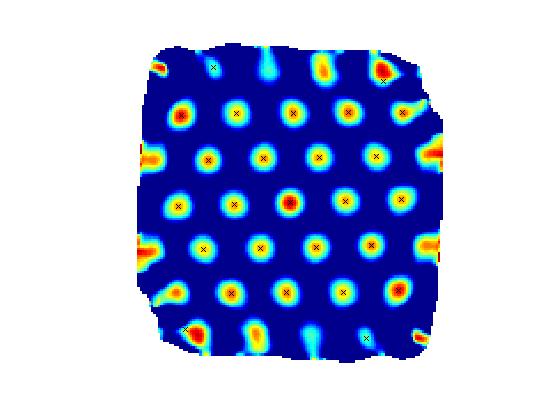
Grid cells are neurons that fire when an animal moving of its own free will traverses a set of small regions (firing fields) which are roughly equal in size and arranged in a periodic triangular array that covers all of the available environment. They were discovered in 2005 by a couple (literally) of Norwegian researchers, the Mosers, and rewarded by the Nobel Prize in 2014 (shared with O’Keefe, from London, who invented the basic experimental technique, and discovered “place cells”)
Once set, navigation can be done in the dark, blinded. Scientists’ discovery that rodents, bats and nonhuman primates have a system in the brain for so-called “dead reckoning navigation”… “Dead reckoning” refers to the ability to navigate without external cues. The term comes from ship navigation. A crew will “take a sighting” via cues such as the stars or landmarks to determine where the ship is on a map. Then, when the ship moves, ‘dead reckons’ to update location on the map paying attention to speed and direction. The Greco-Romans already had such systems, with little paddled wheels counting the distance covered over the sea. It turns out that ‘dead reckoning’ is enabled by the grid cell system, inside the brain.
Recording Of Grid Cells Activity Inside Rat Brain (Jeffery Lab and others.)
“The importance of grid cells lies in the apparently minor detail that the patches of firing (called ‘firing fields’) produced by the cells are evenly spaced. That this makes a pretty pattern is nice, but not so important in itself – what is startling is that the cell somehow ‘knows’ how far (say) 30 cm is – it must do, or it wouldn’t be able to fire in correctly spaced places. This even spacing of firing fields is something that couldn’t possibly have arisen from building up a web of stimulus associations over the life of the animal, because 30 cm (or whatever) isn’t an intrinsic property of most environments, and therefore can’t come through the senses – it must come from inside the rat, through some distance-measuring capability such as counting footsteps, or measuring the speed with which the world flows past the senses. In other words, metric information is inherent in the brain, wired into the grid cells as it were, regardless of its prior experience. This was a surprising and dramatic discovery. Studies of other animals, including humans, have revealed place, head direction and grid cells in these species too, so this seems to be a general (and thus important) phenomenon and not just a strange quirk of the lab rat.”
We should have looked for Plato’s cave. It turned out that this cave has been built, is being built inside our heads all along! This cave is built-in two ways: automatically (grid cells) and as a response to the environment, by.us, from the outside, from the environment, in.
(So it matters what our brain experienced before to mold afterwards what comes in anew from the outside! No experience is a neutral experience!)
That cave is both a topology (what’s near and what’s not, the logic of place), and a basic geometry (the grid and its grid cells). To have a grid built automatically is the equivalent of having a reference frame in mathematics. It makes sense if one wants to make mathematics!
And not just mathematics, but even Infinitesimal Calculus! It is indeed clear that animals such as dogs have a mastery of calculus: experiences have shown this, and anybody with a dog throwing a stick sideways in water will see the dog running along the shore a bit, and then jump in the water, so as to minimize the time to reach the stick, a typical calculus problem. Dogs can do calculus, because they can make algebraic geometry in their brains, having a reference frame made of these grid cells! (If they had no grid cells, they would not be able to do calculus.)
Thus Descartes rediscovered, consciously, something which had been found, evolved and calculated by evolution half a billion years ago (or more!). The reference frame, also known now as the neuronal grid cell system, is basic to all of mechanics, even Poincare’-Lorentz Relativity. (An open question: Quantum Physics uses even more general reference systems, Hilbert spaces; I will therefore predict that the brain has also that sort of organization!)
The world is not as astonishingly understandable, as Einstein would have it. Neuronal grid cell studies show that we are the world. Understanding the world is understanding ourselves.
The world is not just written in mathematical language, as Galileo found out. We are made mathematically. We think mathematically, because we are made of math. We are mathematics.
We are not just looking at shadows in a cave, as Plato would have it. And the cave was not given to us by the gods, as Socrates had it. We are the cave, we, and our personal history, built it.
Any new experience, idea or emotion, taught or experienced, is another brick in that wall of perception and analysis, we better consider it carefully, before indulging in it. Call that the Principle of Mental Precaution But that Principle extends also to what we chose NOT to experience, which can be just as bad, if not worse.
You are not just what you think. You mentally are what you were submitted to, and what you decided to submit to. Fate is written in mathematical patterns, one theorem made out of neurons, their axons, dendrites and supporting glial cells, at a time.
Such theorems are written with the physics of minds, just as sturdy as the physics of stars. Just as hopeful, just as ominous.
Plato thought mathematics were “forms”, out there, outside of the physical world. This is not what science is finding. There are not “forms” out there, and physics, nature, somewhere else. Our minds are literally made of math.
So here is my theory:
“Whatever exists in mathematics exists in the brain. And reciprocally.”
Patrice Ayme’
ooOOoo
I do so hope that this essay from Patrice fires you up as it did me. If it leaves you with questions, then offer them to me as a comment to this post and I will take it upon myself to have Patrice answer them.
Finally, did you pick up on the fact that it isn’t just our human brains that are mathematical organs, it applies to the brains of dogs as well!
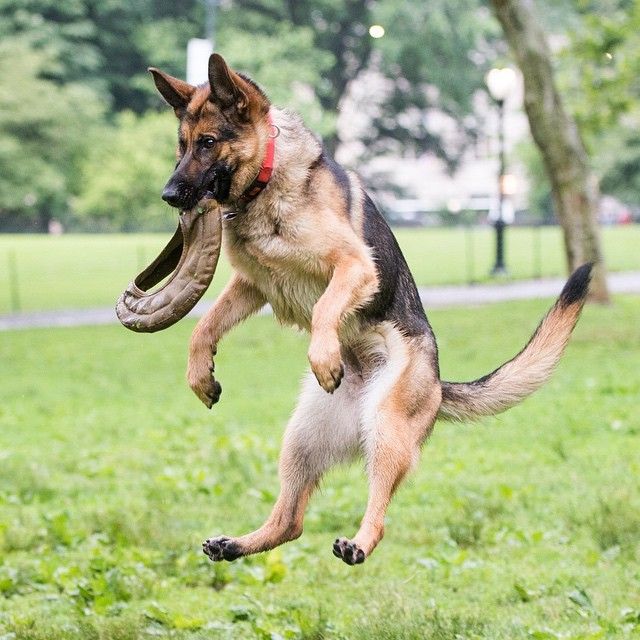
Mathematics in action. (Photo courtesy of Pinterest)
It’s not just the rescuing of people that matters.
Last Thursday, the 26th January, the BBC News website published a short video under the heading of: Italian avalanche survivors tell how they stayed alive.
A couple among the nine survivors of an Italian avalanche that devastated a mountain hotel say they survived nearly 58 hours buried beneath feet of snow by sucking on glass- and mud-filled ice, comforting each other and those nearby, and praying.
Now there’s no way I am belittling that survival; far from it. But 58 hours is a tad under 3 days.
After an avalanche buried central Italy’s luxury Hotel Rigopiano and its guests Wednesday, Jan. 18, rescue workers spent days digging in the snow in a desperate attempt to locate any survivors.
About 120,000 tons of snow, 16 feet deep, slammed into the hotel at 60 miles per hour. It took a while for emergency operators to believe the avalanche had occurred. The first man who called to report it was told that everything was fine at the hotel.
When they finally realized a disaster had in fact happened, first responders had to ski to the hotel, which took 12 hours. It took another day until the roads could be cleared with snowplows so emergency vehicles could finally get through.
Despite these circumstances, 11 survivors, including three children, were somehow able to keep themselves alive for over 40 hours by using their cellphones as flashlights to find water. The children, trapped in a game room, ate packets of Nutella and drank bottled water.
By Monday, rescuers were only pulling bodies from the snow and rubble. Discouraged and depressed, they were ready to give up hope.
The rescuers were told there were three puppies at the hotel. They had no idea where they were until they heard a noise in a boiler room inside what remained of the building. It was the three fluffy, white Abruzzo sheepdog puppies, only six weeks old, who had miraculously managed to survive both the avalanche and being stranded for five days.
“They just started barking very softly,” said Sonia Marini, one of the rescuers. “In fact, it was hard to find them right away because they were hidden. Then we heard this very tiny bark and we saw them from a little hole the firefighters had opened in the wall. We expanded the hole and we pulled them out.”
The puppies, born Dec. 4, had survived in an air pocket by eating snow, Walter Milan, the spokesman for Italy’s elite Alpine rescue squad, told the Daily Beast. They are the offspring of Nuvola (Cloud) and Lupo (Wolf), who lived at the hotel and were popular with guests.
Like their lucky litter, Nuvola and Lupo also survived the avalanche, according to a Facebook post by Martina Rossi, who was a bartender at the hotel.
Lupo e Nuvola, i pastori abruzzesi nati e cresciuti all’Hotel Rigopiano, non so come, sono riusciti a raggiungere la mia contrada, una frazione di Farindola (Villa Cupoli) sani e salvi. Questo non può di certo colmare il vuoto e la distruzione che attraversa un paese in ginocchio ancora speranzoso, nell’attesa soltanto di notizie positive, me in prima persona. Ma questi due bellissimi cagnoloni, rivedendoli, di certo sono riusciti a farmi tornare a battere il cuore, almeno per qualche secondo, riportando la speranza.
The three puppies raised the hopes and spirits of the rescuers. “If the puppies survived, humans could as well,” Milan told the Daily Beast. Firefighter Fabio Jerman agreed. “It’s an important sign of life, which gives us hope,” he said.
Sadly, no one else has been found alive. A week after the disaster, 24 bodies have been found and five people are still missing.
In addition to unusually heavy snowfall, the avalanche may have been caused by a series of earthquakes that struck the area the day before.
Last year, devastating quakes killed more than 300 people in Italy. Another fortunate four-legged survivor, a border collie pulled from the rubble two days after an earthquake struck in late October, is being trained to pay it forward as a rescue dog.
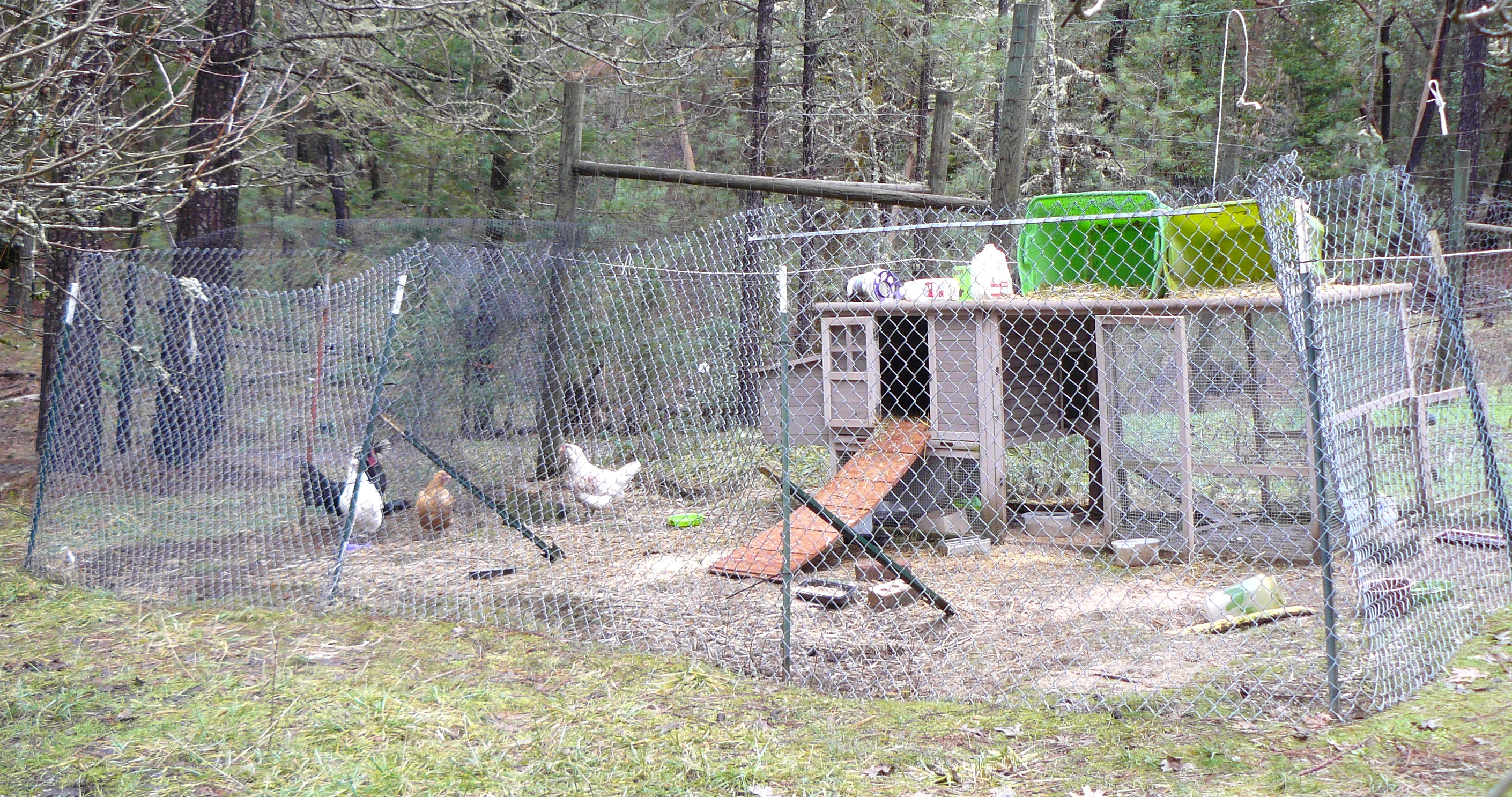
We have a rather run-down ‘home’ for our chickens close to the house. It was run-down before the snow fell and almost brought down the surrounding wire fence.
But, hopefully, this coming Thursday sees a new walk-in run being constructed for our birds so they are better protected.
It’s time we started paying attention to chickens, one of the most misunderstood and ignored species on Earth.
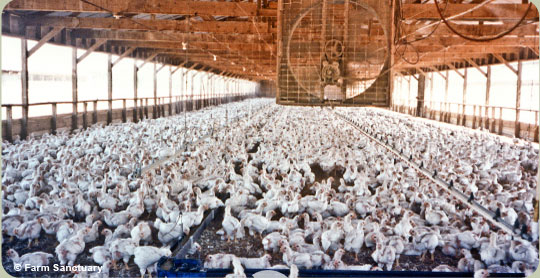
There was a time when chickens were viewed as exotic, fascinating birds. Descendants of exotic Asian jungle fowl, they were revered for their ferocity and intelligence, and domesticated around 8,000 years ago, more for cockfighting than eating. But then, we humans began eating them in ever-larger quantities, until we reached the point where we are now, with 20 billion (mostly white) chickens living in dirty, crowded barns, awaiting slaughter.
Chickens have been a part of human lives for millennia, and yet they are one of the most misunderstood, if not ignored, species on Earth. Lori Marino, an American neuroscientist and animal intelligence researcher, wants to change this. She is intrigued by the fact that chickens are so rarely recognized for their cognitive abilities and frustrated that studies about birds almost always focus on other, less-domesticated species, like crows and parrots.
“Arguably even the scientific community has been influenced by public perceptions of chickens as cognitively simple… This asymmetry in the literature is likely a reflection of, as well as a contributor to, the disconnect scientists and the public have between chickens as commodities and who they actually are as individuals.”
Chickens deserve more attention, and here are some quirky, interesting facts to get you thinking about chickens less as food and more as fascinating co-inhabitants of our world. These come via Marino’s recent paper, “Thinking Chickens,” published online in Animal Cognition in January 2017.
1. Chickens are a sub-species of the red jungle fowl that hails from southeast Asia.
The red jungle fowl (galls gallus) inhabit the edges of fields, scrubland, and groves. Domestication was well established 8,000 years ago, but some records suggest it could have started as much as 58,000 years ago.
2. Domestic chickens are similar to their wild counterparts.
Despite the intense breeding and genetic manipulation of recent years, chickens have not been cognitively or behaviorally affected by domestication. This stands in contrast to dogs and wolves, for example, which have diverged significantly due to domestication. Nor have chickens become less aggressive toward predators through domestication, which is a common outcome; in fact, some chickens are more aggressive even than red jungle fowl.
3. A chicken’s beak is highly sensitive to touch.
The beak, with numerous nerve endings, is used to explore, detect, drink, preen, and defend. This also means that when a bird is de-beaked, as often happens in industrial farming, it experiences great pain, sometimes for months, which changes its behavior. Marino writes, “At the end of the beak is a specialized cluster of highly sensitive mechanoreceptors, called the bill tip organ, which allows chickens to make fine tactile discriminations.”
4. Chickens have finely tuned senses.
They can see long distance and close-up at the same time in different parts of their vision. They can see a broader range of colors than humans. They can hear at low and high frequencies at a variety of pressure levels. They possess well-developed senses of taste and smell. They can orient to magnetic fields, like many other birds.
5. Chickens are surprisingly good at math.
Three-day-old chicks are able to perform basic arithmetic and discriminate quantities, always opting to explore a set of balls with the greater number, even when an object was visibly transferred from one set to another. Five-day-old chicks have been found to track up to five objects.
“When they were presented with two sets of objects of different quantities disappearing behind two screens, they were able to successfully track which screen hid the larger number by apparently performing simple addition and subtraction.”
6. Chickens can exercise self-control.
In an experimental setting, chickens have been given the choice between 2-second delay with 6 seconds of access to food, versus a 6-second delay with 22-seconds of access to food. The hens waited for the longer reward, “demonstrating rational discrimination between different future outcomes while employing self-control to optimize those outcomes.” Self-control usually doesn’t appear in humans until four years of age.
These are just a few of the remarkable discoveries described in Marino’s study, a highly readable, entertaining paper. It’s an important reminder that chickens, arguably the most ubiquitous animals in our world, deserve far more respect than they currently receive. Hopefully this will lead to more people questioning the horrific conditions in which most of them are kept.
It’s easy to fall into the trap of looking for a humourous way to close today’s post. But a more responsible approach would be to repeat the words from the start of the article to serve as a reminder of trying, wherever possible, to think about the food we eat, especially when animals and birds have to be slaughtered to provide us with that food.
…. we reached the point where we are now, with 20 billion (mostly white) chickens living in dirty, crowded barns, awaiting slaughter.
But please don’t leave this page until you have watched the following video.
Published on Dec 3, 2014
After 22 years of raising chickens for Perdue, one brave factory farmer Craig Watts was at his breaking point and did something no one has done before. He invited us, as farm animal welfare advocates, to his farm to film and tell his story. Ask your supermarket for Better Chicken at http://better-chicken.org.
A vet has left behind her home in England to care for Sri Lanka’s street dogs.
Janey Lowes from Barnard Castle, County Durham, has spent the past two years caring for the neglected animals.
There are about three million street dogs on the island – about 60% of puppies born on the street do not survive to adulthood.
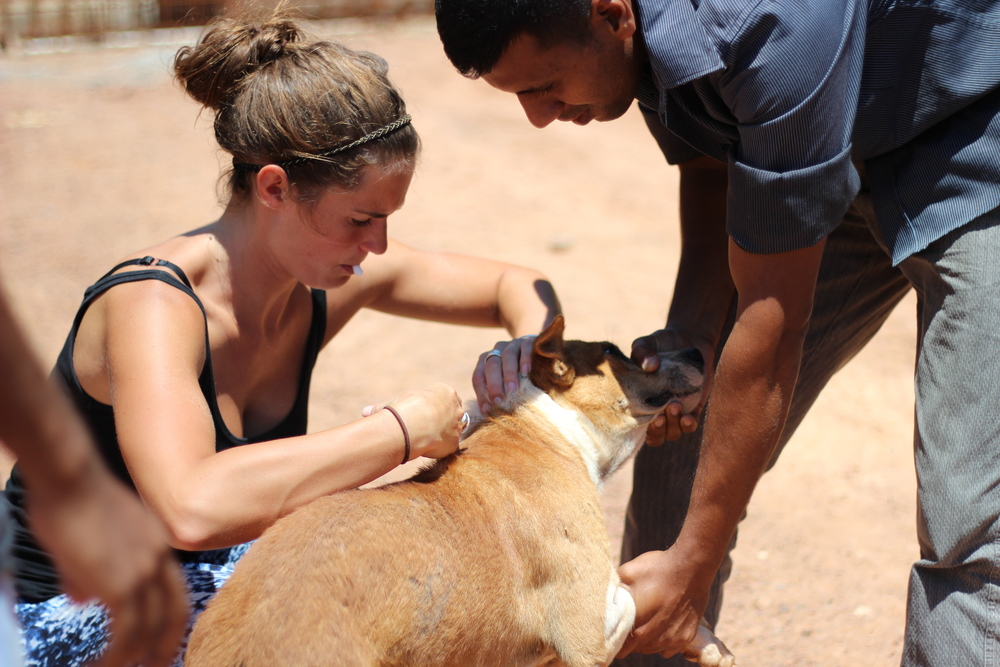
The 28-year-old set up charity WECare Worldwide to raise money to buy the equipment needed to treat the animals and to set up her own clinic in Talalla.
I am pleased that the video clip that was included in the BBC News story has found its way to YouTube.
Inevitably the charity WECare Worldwide has its own website: the home page is here. Then you can read on the charity’s ‘About’ page: (Note: CNVR is the acronym standing for catch-neuter-vaccinate-release.)
CNVR
CNVR is carried out as it is the most humane way to reduce roaming dog populations and reduce the number of unwanted puppies that are dumped on the streets at a very young age. It also allows the females that would inevitably spend their whole lives pregnant to only have to worry about number one when thinking about limited food resources and shelter options, which transforms their lives.
Vaccinating the dog population against Rabies is the most effective way to eliminate the disease in the human population. As an island nation, eradication of Rabies in the near future is a very real possibility and will change the future of both animals and humans here, allowing improved relationships between the two.
CNVR is the backbone of everything we are trying to achieve in Sri Lanka.
But that’s only one part of what they do. Again, as the website sets out:
We focus on 3 main areas here in Sri Lanka.
CNVR (catch-neuter-vaccinate-release)
Treatment of sick and injured animals
Education and training
I shall be making contact with the charity very soon .
Not only to pass on our respect and admiration for what she has accomplished but to see if there are other ways we can help them in what they are doing. I use the word ‘we’ to cover not only Jean and me but also all of you who are close to this blog and who, so frequently, show how much love you have for dogs!
WECare Worldwide will help by providing free veterinary treatment, alongside love, compassion and respectful care of the Ceylon dogs, who make up such a huge part of Sri Lankan heritage and culture, both in the past and the current day.
Then as soon as I started to write today’s post (as of yesterday afternoon) I realised the error in my sub-title. For one might argue that this does have a connection with how our dogs behave as a cohesive group. But I’m going to be ‘an arse’ (‘ass’ in American speak) and ask you to hold out until the end of today’s post to read the ‘doggie’ connection. (Note that today’s post is Part One. Part Two continues tomorrow.)
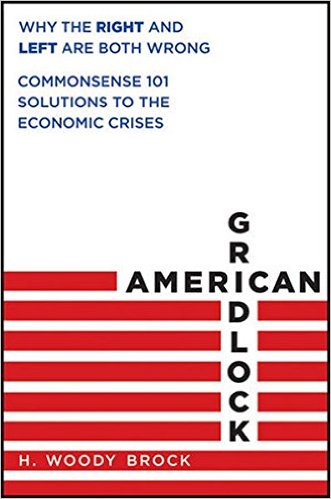
I am in the middle of reading American Gridlock written by H. Woody Brock and published in 2012. Here’s an extract of what the book is about, courtesy of Amazon:
A sensible solution to getting our economy back on track
Pessimism is ubiquitous throughout the Western World as the pressing issues of massive debt, high unemployment, and anemic economic growth divide the populace into warring political camps. Right-and Left-wing ideologues talk past each other, with neither side admitting the other has any good ideas. In American Gridlock, leading economist and political theorist H. Woody Brock bridges the Left/Right divide, illuminating a clear path out of our economic quagmire.
Arguing from first principles and with rigorous logic, Brock demonstrates that the choice before us is not between free market capitalism and a government-driven economy. Rather, the solution to our problems will require enactment of constructive policies that allow “true” capitalism to flourish even as they incorporate social policies that help those who truly need it.
Brock demonstrates how deductive logic (as opposed to ideologically driven data analysis) can transform the way we think about these problems and lead us to new and different solutions that cross the ideological divide. Drawing on new theories such as game theory and the economics of uncertainty that are based upon deductive logic, Brock reveals fresh ideas for tackling issues central to the 2012 U.S, Presidential election and to the nation’s long-run future:
It greatly influenced me and I sat down and wrote an essay. Mainly to clarify my own thinking ahead of a meeting last Saturday of our local Freethinkers Group where the topic was “Ideas for Improving our Democratic Processes”. The “our” being the US democratic process but just as valid for many other countries.
I first set out to see if there was a clear, unambiguous definition of what a democratic society is. Surprise, surprise there isn’t one. Very quickly I came up with three:
The first:
A democracy by definition is government through elected representatives. It is a form of society which favours equal rights, freedom of speech and a fair trial and tolerates the views of minorities. Civics and Citizenship website
The second:
A DEMOCRACY IS a society in which all adults have easily accessible, meaningful, and effective ways:
(a) to participate in the decision-making processes of every organization that makes decisions or takes actions that affect them, and;
(b) to hold other individuals, and those in these organizations who are responsible for making decisions and taking actions, fully accountable if their decisions or actions violate fundamental human rights, or are dishonest, unethical, unfair, secretive, inefficient, unrepresentative, unresponsive or irresponsible;
(c) so that all organizations in the society are citizen-owned, citizen-controlled, and citizen-driven, and all individuals and organizations are held accountable for wrongdoing. Democracy Watch website
And the third:
Better democracy, everywhere.
The Democratic Society (Demsoc) works for more and better democracy, where people and institutions have the desire, opportunity and confidence to participate together.
We work to create opportunities for people to become involved in the decisions that affect their lives and for them to have the skills to do this effectively. We support governments, parliaments and any organisation that wants to involve citizens in decision making to be transparent, open and welcoming of participation. We actively support spaces, places and processes to make this happen. Democratic Society website.
I went on to say in my essay:
Yes, there is some harmony between all three definitions but there are also significant differences in tone and language.
I am sure many of you are familiar with the book by H. Woody Brock American Gridlock. I started reading it a few days ago and cannot now put it down.
For the core message of the book is that we, as in society, must distinguish between inductive and deductive reasoning. Let me use the definitions as found on the Live Science website.
Deductive reasoning
Deductive reasoning is a basic form of valid reasoning. Deductive reasoning, or deduction, starts out with a general statement, or hypothesis, and examines the possibilities to reach a specific, logical conclusion, according to the University of California. The scientific method uses deduction to test hypotheses and theories. “In deductive inference, we hold a theory and based on it we make a prediction of its consequences. That is, we predict what the observations should be if the theory were correct. We go from the general — the theory — to the specific — the observations,” said Dr. Sylvia Wassertheil-Smoller, a researcher and professor emerita at Albert Einstein College of Medicine.
In deductive reasoning, if something is true of a class of things in general, it is also true for all members of that class. For example, “All men are mortal. Harold is a man. Therefore, Harold is mortal.” For deductive reasoning to be sound, the hypothesis must be correct. It is assumed that the premises, “All men are mortal” and “Harold is a man” are true. Therefore, the conclusion is logical and true.
That is, we predict what the observations should be if the theory were correct.”
Let that really work it’s way through your consciousness. It’s an idea that is rooted in the great scientists and philosophers of many thousands of years ago. Think of Euclid, the Greek Socratic philosopher who founded the Megarian school of philosophy. He was a pupil of Socrates in the late 5th century BCE, and was present at his death. (I cheated and looked it up.)
It was Euclid who through Euclidian geometry came to understand the principles of angles and straight lines; as in the shortest distance between two points.
Moving on:
Inductive reasoning
Inductive reasoning is the opposite of deductive reasoning. Inductive reasoning makes broad generalizations from specific observations. “In inductive inference, we go from the specific to the general. We make many observations, discern a pattern, make a generalization, and infer an explanation or a theory,” Wassertheil-Smoller told Live Science. “In science there is a constant interplay between inductive inference (based on observations) and deductive inference (based on theory), until we get closer and closer to the ‘truth,’ which we can only approach but not ascertain with complete certainty.”
Even if all of the premises are true in a statement, inductive reasoning allows for the conclusion to be false. Here’s an example: “Harold is a grandfather. Harold is bald. Therefore, all grandfathers are bald.” The conclusion does not follow logically from the statements.
Inductive reasoning has its place in the scientific method. Scientists use it to form hypotheses and theories. Deductive reasoning allows them to apply the theories to specific situations.
Now for some of you this side trip into reasoning may have seen more like a complete departure. But the point is that, as American Gridlock makes so powerfully: There are two main problems to be solved if this nation is to get back on track. First, win-win policy solutions must be identified for the five real-world problems addressed in Chapters 2 through 6. Second, the Dialogue of the Deaf must come to an end, policy gridlock with it, and these solutions must be implemented. (Pages 7-8)
I closed my essay by setting out the following proposition:
Until we have a clear, universally acknowledged definition of what a democratic society is then it is impossible and utterly futile to debate the various processes including what is the best process for American society.
Is this relevant to the world outside the USA? You bet it is. For better or for worse, what the USA does today the rest of the world does soon thereafter.
And as you will see in Part Two that comes tomorrow democratising the economy is key.
For when we look at the way that dogs, and wolves, operate as a pack in the wild there are only three animals with status:
The alpha female who has first choice of the male dogs for mating purposes and makes the decision, as and when necessary, to move her pack to a new territory,
The beta dog, always a male, whose role is to keep the pack running smoothly as a cohesive group and not letting squabbles get out of hand, and,
The omega dog, that can be of either gender, whose role is to keep the pack happy.
All the other animals in the pack of around fifty are of equal status and work for the benefit of the pack. Now that is something we should learn from dogs!
For both humans and, in consequence, for those dogs close to us.
Effectively, the whole of the New Year has been a tad challenging here in Merlin, OR. For even before the snows arrived early on in January, leading to power outages and frozen pipes, the local weather service was warning of unusually severe storms. Indeed, more than once we have heard locals speaking of this looking like a one-hundred-year-storm.
So it was inevitable that there were some anxious periods. Plus the challenging weather may not be not fully behind us. For this is the current (Sunday 18:00 PST) weather warning:
HYDROLOGIC OUTLOOK
NATIONAL WEATHER SERVICE MEDFORD, OR
134 PM PST SUN JAN 15 2017
…Flood Potential Outlook for main stem river flooding, snow melt flooding, and quick rises on rivers and streams in the following counties…in California…Siskiyou…and in Oregon…Coos… Curry…Douglas…Jackson…Josephine…
A strong atmospheric river event is expected to arrive in Southern Oregon and Northern California by Wednesday. While models have trended towards a faster progression of the front, and therefore lesser rainfall amounts, this event may still produce high snow levels, periods of heavy rain, and significant melting of lower level snow-pack Wednesday and into Thursday. With the extensive snow-pack, saturated soils and high river levels, there is a potential for flooding and rapid rises along main stem rivers and small creeks and streams. Urban areas may also experience high water from blocked culverts and runoff.
Continue to monitor forecasts for any updates as this potentially hazardous situation develops.
Anyone who has a dog (or several) in their lives will know how our anxiety is so quickly picked up by our dogs. Ergo, looking after our dogs, as in keeping them relaxed, is really important.
Now read this article that was published over on the Care2 site. I am republishing here for all you good people.
Does your dog suffer from anxiety? A lot of rescued dogs do, and often we don’t know the exact cause for their nervousness. Abuse, neglect or even a single bad experience before you adopted your dog could cause mild to debilitating anxiety. These natural remedies for dog anxiety have worked wonders for my very anxious dog.
We adopted my dog, Jenna, two years ago. Jenna was three years old when we rescued her, and her story still breaks my heart. Lifeline Animal Project rescued Jenna from an animal hoarder when she was six months old. For those first six months, she lived in a crate 24/7. They didn’t even take her out to pee and poop, they just changed the newspaper or laid new paper down. Jenna lived in Lifeline’s no-kill shelter for two and a half years before she was socialized enough to be adoptable.
Even after those years of care, Jenna was still incredibly fearful when we got her home. For the first 36 hours that we had her, she didn’t pee or poop at all. She basically sat on her bed, shaking. By the end of second day we could get her to eat and use the bathroom, but it took weeks for her to finally trust us.
We’ve had Jenna for two years now, and she is a completely different dog. She is still wary of strangers and has her nervous moments, but she loves to run and play. She’s even warmed up to family and friends who visit us often. Jenna is always going to have a high base level of anxiety, but thanks to the natural remedies I’m going to get into below, she also can relax and behave like a normal dog the vast majority of the time.
Look at this mellow, happy gal!
Natural Remedies for Dog Anxiety
Every dog’s situation is different, so what worked for Jenna may not work for your dog. If one of these natural remedies isn’t doing it for your nervous dog, try another one! This is a laundry list of everything that’s worked and one thing that didn’t work for us but does for too many other dog owners to leave out of the list. Pick and choose natural remedies as you find out what helps with your dog’s anxiety.
1. Obedience Training
I can’t recommend a good trainer enough. Training gives your anxious dog confidence, and a good trainer can help you with commands that are especially important. I’ve been taking Jenna to training on and off the entire time that we’ve had her, and it has been a miracle for us. It took a few months for us to start seeing results, so don’t expect a quick fix from this. The long-term benefits for you and your dog are well worth it.
2. Exercise
Getting exercise with your dog is a bonding experience, and it also helps her work off some of that nervous energy. Jenna and I run 9-15 miles a week together, when I can swing it, and she loves to run more than anything else. We had to stop running towards the end of my pregnancy, and on that first run back, she had a huge puppy grin on the whole time we were out.
Running is just one way to get your dog exercise. You can go for walks, play catch, or play training games like “touch.” Whatever you choose to do, talk to your vet first. Some breeds of dog are great runners, but others (like pugs) can overheat easily and need lower-key exercise.
3. Essential Oils
One fear that Jenna is definitely not over is thunderstorms. She shuts down during storms, which can be rough during spring and summer when it storms frequently here in Atlanta. Essential oils combined with Rescue Remedy (more on that below) have helped her out a lot. Choose a calming scent like lavender, and just put a couple of drops onto the dog’s collar. Putting it on the collar is key, because then your dog can smell the soothing oil but can’t eat it.
4. Rescue Remedy
Rescue Remedy is a blend of flower extracts, and they make blends for pets and for humans. We use the liquid for pets and feed it to her in a lump of peanut butter. (**** See my Footnote below) It calms her down considerably. Though, to be honest, I do wonder if getting her favorite treat (peanut butter) has something to do with it. You can find Rescue Remedy at natural food stores or online.
5. Focus Toys
Redirecting your dog’s attention when she’s feeling anxious can be a big help. You can try using commands that you learned in training class, or you can give your dog a focus toy. There are all varieties of these. You can go with a rawhide bone or one of those puzzle toys that dispenses treats when the dog gets it right. Jenna’s favorite toy is a Nylabone. She’s a 50 pound lab mix, so she tears through a rawhide in minutes. She’s had the same Nylabone for months, and it’s still pretty much intact.
6. Watching Your Tone
When your dog is scared, how do you react? Do you say, “It’s OK, sweetie!” in a higher-pitched voice than usual? This is a normal reaction, but it’s actually not the best one when your dog is scared. If your dog sees you as the alpha in the pack, she’s going to take her cues from you, and that kind of attention rewards your dog’s fear, reinforcing it.
Next time your dog is scared, try to react as if everything is normal. You can put a hand on her back, so she knows that you’re there, but try not to make a big deal out of the situation. Don’t say “It’s OK.” Instead, show her that everything is OK with your body language.
7. Crate Training
We were lucky that Jenna was crate trained when we adopted her. For an anxious dog, the crate can be a “safe place” they can retreat to. When there’s a thunderstorm or our neighbors decide to shoot off fireworks, Jenna often curls up in her crate. Dogs like a small, cozy space. If you’re not into crate training, I’d suggest setting up a dog bed in a quiet corner or even under an end table, so your dog has a cozy place that’s hers where she can go when she is scared.
8. The Thunder Shirt
This is the one natural remedy on this list that has not worked for us at all. Jenna is more afraid of the Thunder Shirt than she is of thunder! We are definitely outliers here, though. Every dog owner I know that has an anxious dog recommends the Thunder Shirt to me when I mention Jenna’s fear of storms. This is a great example of how different natural remedies work for some dogs and not others. The Thunder Shirt is definitely worth a shot! If it doesn’t work for you, you can pass it on to a fellow dog owner or donate it to your local shelter.
ooOOoo
Footnote!
Regarding feeding dogs peanut butter, do not, repeat not, do this until you are sure that the brand of peanut butter you are considering is free of the ingredient xylitol.
I wrote of the dangers of xylitol in a post last December 8th. It is being republished in an hour’s time just to make sure the widest number of readers of this place are aware of the danger.
Anyway, this seemed like a very useful article. Plus there’s another benefit of having one’s loved dogs in a relaxed state. It helps the people around those dogs remain relaxed as well!
Brandy and Jean enjoying mutual relaxation!
Chill out everyone! Both the two-legged and the four-legged ones!
 By: Laura Goldman, February 9, 2017













 Learning from Dogs