Category: People

Dealing with the fear of the Known!

Can we ever conquer fear?

In a recent article I discussed the fear of the unknown, linked to the down-turn, redundancies, etc.

Per Kurowski, a great supporter of this Blog, posed the following question.

Great advice… but how do we remove the fear of what is known?

A simple, and slightly flipant answer would be,

“Develop a different relationship with it.”

What I’m saying is that when we are facing the known, and I’m assuming that it’s something unpleasant, our choices are limited. It’s going to happen, so the only thing we can do is change the way we view it.

This brings us back full circle to developing a different relationship with it.

Let’s take the word, ‘fear’.

“All fear is an illusion, walk right through“. I heard Dr David Hawkins say on a CD. Granted, a great trick if you can do it!

Here’s another description of fear: Fear= False Evidence Appearing Real

Fear is generally future-based. We tend to use the past as a learning reference to inform us of what to be afraid of in the future. So human beings live their lives trying to predict and prepare for the future, limited by their past experiences.

Unfortunately, the only way to work with fear of the known is to live in the present! [Just like dogs! Ed.]

Our whole society is geared up to look into the future. We are forever worrying about or planning something for the future.

To begin focussing on the present, try this.

Simply, to start off, become aware of the breath and sensations in the body. This will slowly start to remind us to be present, or embodied, in our own body.

Fear

Problems, fear and spiral thinking, often at 3 or 4 in the morning, are generated in the mind.

Thoughts occur randomly, although we call them, “Our thoughts”, and refer to, “Our mind”.

By dropping out of the thought processes into awareness of the breath and body, the noise stops, even if only for a moment.

So very few people in the world will have even the slightest inkling what these words mean.

If more of us got used to coming out of the mind before making an important decision, and simply sat with the question for a while, the answer would probably present itself.

This will probably raise more questions than it answers but that’s not a bad thing.

By Jon Lavin

[If you have been affected by this Post and would like to contact Jon, he would be delighted to hear from you. Ed.]
A Way Forward?

Removing the fear of the unknown

I’ve been working with most of my clients recently through painful transformations brought about by the economic downturn.

An interesting metaphor really because since the first wave of uncertainty triggered panic, first noticed in the UK banking system, I have been picking up on that uncertainty that feels like it’s stalking the globe at the moment.

Interestingly, I, too, have been aware of an underlying fear that was difficult either to name or source.

It has been rather like a deep river in that whilst the surface feels slow moving, currents are moving things powerfully below.

So this ‘fear’ has caused a few household changes.

We now are the proud owners of 9 chickens. Our youngest son, Sami, and I have dug up the back lawn and planted vegetables and built a poly-tunnel.

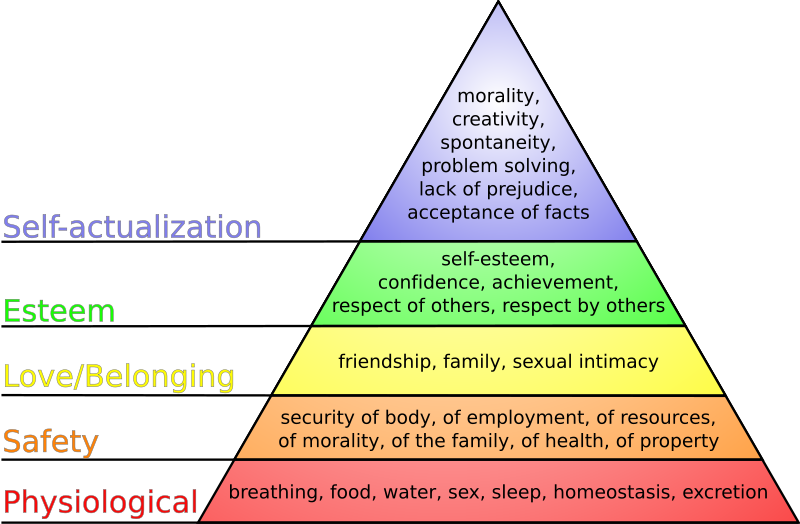
We have also installed a wood burning cooker. Right back down to the base of Maslow’s triangle really!

Maslow’s triangle of needs

These feelings have brought about such change everywhere and I wonder seriously whether we will ever return to what was; indeed would we want to?

I might not have mentioned it in previous blogs but as well as an engineering background, in latter years, I have focused on how interpersonal success in business is linked directly to relationships, integrity and vitally, self-awareness.

To inform this, some 7 years ago, I embarked on an MA in Core Process Psychotherapy, primarily to work on myself so that I could be the best I could be in my relationships, in and out of work.

The point I’m trying to make is that the same panic I notice in many of the companies I work in, and in me, is based on fear of the unknown and on a lack of trust in all its forms.  I’ve deliberately underlined that last phrase because it is so incredibly important.

The truth is that we get more of what we focus on.

So we can choose to focus on the constant news of more difficulties, hardship and redundancies, or we can focus on what is working.

In the workplace this positive focus has been pulling people together across functions and sites and pooling resources and ideas.

A farm evening

When we realise we’re not doing this alone it’s amazing how much lighter a load can feel and how much more inspired we feel.

I also notice how humour begins to flow and what a powerful antidote for doom and gloom that is.

Transformation is never easy but the rewards far exceed the effort put in ten fold.

So what is it going to be? Are we all going to bow down to the god of Doom & Gloom, fear and anxiety, heaping more and more gifts around it, or are we going to start noticing and focusing on the other neglected god – that of relationship, joy, trust, abundance and lightness?

Whatever the future holds for us all a belief in our inherent ability to adapt and change and focus on the greater good rather than fear, anxiety, greed and selfishness is the only sustainable way forward.

By Jon Lavin

[If you have been affected by this Post and would like to contact Jon, he would be delighted to hear from you. Ed.]

Take your hands off the controls

Is that what I heard?

“Take your hands off the controls.”

We were climbing after take off in a Cessna 152, and I was applying significant control inputs to keep the aircraft level. Before the flight, there had been some conversation among other pilots on the ground about there being some turbulence at low level today, and I had just remarked that this seemed to be true.

In response to this gentle instruction, I took one hand off the control column, but continued to concentrate on maintaining the attitude of the aircraft in the bumpy conditions. Then the instruction was repeated, still gently, but with a little more emphasis:

“Take your hands OFF the controls”!

Now, whether one follows instructions like this does depend to some extent on who is issuing them! On this occasion, I was honoured to be flying with the most capable pilot and flying instructor I have ever met, or am ever likely to meet.

As it happens, I was not formally under instruction, being qualified to fly and my “passenger” having lost that privilege on medical grounds. Nevertheless, when flying with other people there is always something to learn and, when flying with someone as experienced and knowledgeable as Dickie Dougan, one is learning all the time! Dickie had a very long flying career during which very many people learnt a tremendous amount from him. Sadly, he passed away in 2007, at the age of 89.

So, in this case, the instruction was being issued by someone for whom I had the utmost respect and trust. Nevertheless, it was contrary to my instincts and seemed to me to be decidedly risky.

Very gingerly, I let go of the controls which, now free from my grasp, moved more violently and over a much wider range than I had been moving them. My instinct was to grab them again, but my trust in the instruction that I’d been given was just sufficient to hold that instinct at bay for a short while.

The aircraft seemed to be rolling more than it had under my control, but it was returning to level flight fairly consistently. It was, at least, stable and seemed to be flying satisfactorily without any input from me (to be accurate, I was continuing to apply some right rudder to compensate for the yaw effects of the single propellor in the climb, but it seemed to me that I was not controlling anything!)

After I had realised that the world was not turning upside down and my level of anxiety lowered slightly, Dickie then said quietly, in his soft Irish tones:

“There you are; you’re working too hard! The aircraft can fly itself!”

Incidents like that teach us something quite profound. The world functions without us.

We are not the centre of the universe!

Background:

This post was inspired by Trey Pennington’s description of his conversation with his daughter about Copernicus, as described in his interview of C.C.Chapman.

Further information about the legendary Dickie Dougan can be found in this document in an obituary for him written by Chris Martin who was the Chief Flying Instructor at Exeter Flying Club during the time that I was trained there.

By John Lewis

Basel

The Basel Committee on Banking Supervision

I suspect that you, like me, know diddly-squat about the Basel Committee.  As the Bank of International Settlements puts it:

The Basel Committee on Banking Supervision provides a forum for regular cooperation on banking supervisory matters. Its objective is to enhance understanding of key supervisory issues and improve the quality of banking supervision worldwide. It seeks to do so by exchanging information on national supervisory issues, approaches and techniques, with a view to promoting common understanding. At times, the Committee uses this common understanding to develop guidelines and supervisory standards in areas where they are considered desirable. In this regard, the Committee is best known for its international standards on capital adequacy; the Core Principles for Effective Banking Supervision; and the Concordat on cross-border banking supervision.

The Committee’s members come from Argentina, Australia, Belgium, Brazil, Canada, China, France, Germany, Hong Kong SAR, India, Indonesia, Italy, Japan, Korea, Luxembourg, Mexico, the Netherlands, Russia, Saudi Arabia, Singapore, South Africa, Spain, Sweden, Switzerland, Turkey, the United Kingdom and the United States. The present Chairman of the Committee is Mr Nout Wellink, President of the Netherlands Bank.

OK, that’s clear then!

Pers Kurowski

Well, according to a good supporter of and Guest contributor to Learning from Dogs, Pers Kurowski, we really ought to know much, much more about this ‘committee’.

Pers has a Blog called Tea with FT (as in the Financial Times) and there is much to read there that helps us understand why we are in so big a mess with the banks.  Here’s his piece from the 4th May.

Basel Committee, why don´t you just shut up!

Sir who do these Basel Committee regulators really think they are bullying us around with an arrogant “the banks should be sensible and realise that it might backfire if they protest too much”? as reported by Brooke Masters, May 4.

They themselves are the ones who thought everything would be fine and dandy if they just had some few credit rating agencies determine default risks and then gave the banks great incentives, by means of different capital requirements, to follow those credit risk opinions. They themselves are the ones who believing in the abundance of safe triple-A rated lending and investments, caused the world to stampede and fall over the subprime mortgages. They themselves should shut up, because rarely has the world seen such a gullible naive and outright stupid bunch of regulators.

Now the banks, in the midst of a crisis, need to build up the equity they do not have precisely because the Basel Committee did not require them to have; precisely when we need the most the banks to lend. The regulators, instead of bullying banks, should busy themselves day and night finding ways for severely capital stretched banks to be able to lend to those small businesses and entrepreneurs who have had to pay the cost of higher capital requirements but who had absolutely nothing to do in generating this crisis.

And just in case, for the record, I am no banker, only a citizen, very upset with the fact that in the 347 pages of the regulations known as Basel II, there is not one single word that describes the purpose of those regulations. Basel Committee why do you not start defining a purpose for what you are doing? Is that too much to ask?

By Paul Handover

Radio Caroline

A real blast from the past!

Recently we rented the film, Pirate Radio, a somewhat ‘true’ story about the days of broadcasting rock and roll from a ship moored just outside British waters.  Here’s the official trailer of the film (somewhat glitzy as is the manner of Hollywood):

Anyone of my sort of vintage living in England during the 1960s will recall the fun and excitement of Radio Caroline, the name of the radio station that started up in 1964.

Here’s a good extract from the WikiPedia entry:

Radio Caroline is an English radio station founded in 1964 by Ronan O’Rahilly, to circumvent the tight hold the record companies had on the broadcast of popular music in the UK. It originally commenced transmissions as an offshore radio station broadcasting from a ship anchored in international waters off the coast of South East England. Originally unlicensed by any government, for the majority of its early life, it was labelled as a pirate radio station.

Radio Caroline

Amazingly, at its peak Radio Caroline had an audience of 23 million listeners.  In a very real way Radio Caroline was another symbol of what became known as the Swinging Sixties, a transformation period for post-war Britain.

Tony Blackburn was just one of many famous disk jockeys who started life out on Radio Caroline, with Tony being the first presenter of the BBC’s Radio 1 station, broadcasting popular music, when it came on air on the 30th September, 1967.

Tony Blackburn, some while ago!

Anyway, if you are nostalgic towards the ‘good’ old days of the sixties, do watch the film.

By Paul Handover

Ticker Guy

Karl Denninger is a hero!

Karl Denninger - Mr Market Ticker

Several times a week, I drop into Karl Denninger’s blog The Market Ticker.  While frequently the articles are too technical for me, it’s still, nonetheless, possible to get the drift of Karl’s messages.

As his overall theme is strongly coincident with my own views on my pension investments, and which have served me proud over the last 10 years, especially the last 2 years, it’s natural that I like what Karl does.

But the point of this Post is to underline just how much time and effort Karl puts in to his work, all of which is free to the world at the click of a mouse.

Are there others who devote equal amounts of time to their Blogs and websites?  Yes, many!  And many of them are also heroes (and heroines!)

Of course, I have no doubt that The Market Ticker is part of Karl’s business strategy but, again, he could choose other ways to make his income without sharing, for free, so many valuable ideas.

Here are a couple of examples to underline my deep respect for this man. (Taken from Market Ticker on the 13th May.)

Read more of this Post

Deepwater Horizon

Transocean Deepwater Horizon Explosion-A Discussion of What Actually Happened?

The trouble with the way that the news is presented and consumed is that major events are delivered in ‘headline’ style and even something as terrible as the oil spill in the Gulf of Mexico is starting to compete with other, more current, news stories.

The other issue with news channels is that it is uncommon to be presented with a real insight into the human scale of massive catastrophes.  Thank goodness for the web!

Drilling Ahead is a website that describes itself as A Social Network of Oil & Gas Professionals. Another website find courtesy of Naked Capitalism.

On Drilling Ahead is a report about the loss of the Deepwater Horizon.  It makes both gripping and chilling reading.  Here’s an extract but it’s much better to read it directly from here:

An Ill-fated Discovery
According to news accounts, at about 10 p.m. CDT last Tuesday, Deepwater Horizon was stable, holding an exact position in calm, dark seas about 45 miles south of the Louisiana coastline. Water depth in the area is 5,000 feet. The vessel manifest listed 126 souls on board.

Deepwater Horizon was finishing work on an exploration well named Macondo, in an area called Mississippi Canyon Block 252. After weeks of drilling, the rig had pushed a bit down over 18,000 feet, into an oil-bearing zone. The Transocean and BP personnel were installing casing in the well. BP was going to seal things up, and then go off and figure out how to produce the oil — another step entirely in the oil biz.

The Macondo Block 252 reservoir may hold as much as 100 million barrels. That’s not as large as other recent oil strikes in the Gulf, but BP management was still pleased. Success is success —
certainly in the risky, deep-water oil environment. The front office of BP Exploration was preparing a press release to announce a “commercial” oil discovery.

This kind of exploration success was par for the course for Deepwater Horizon. A year ago, the vessel set a record at another site in the Gulf, drilling a well just over 35,000 feet and discovering the 3 billion barrel Tiber deposit for BP. SoDeepwater Horizon was a great rig, with a great crew and a superb record. You might even say that is was lucky.

But perhaps some things tempt the Gods. Some actions may invite ill fate. Because suddenly, the wild and wasteful ocean struck with a bolt from the deep.

The Lights Went out;
and Then.
..

Witnesses state that the lights flickered on the Deepwater Horizon. Then a massive thud shook the vessel, followed by another strong vibration. Transocean employee Jim Ingram, a seasoned
offshore worker, told the U.K. Times that he was preparing for bed after working a 12-hour shift. “On the second [thud],” said Mr. Ingram, “we knew something was wrong.” Indeed, something was very wrong.

Within a moment, a gigantic blast of gas, oil and drilling mud roared up through three miles of down-hole pipe and subsea risers. The fluids burst through the rig floor and ripped up into the gigantic draw-works. Something sparked. The hydrocarbons ignited. In a fraction of a second, the drilling deck of the Deepwater Horizon exploded into a fireball. The scene was an utter conflagration.

Unimaginable hell!

And here’s another extract:

Read the rest of this Post

Jessica is Home!

Young Australian, Jessica Watson, is home safe and sound.

(Circumstances required that I had to prepare this Post well ahead of the confirmation that Jessica is back and as it happens, the chances are that when Jessica made it past the Sydney Heads finish line I was onboard a flight from Los Angeles to London.)

05-May-2010

The youngest person to sail around the world solo, non-stop and unassisted, 16 year old Australian Jessica Watson, is expected to complete her historic voyage, arriving back in Sydney to a hero’s welcome on Saturday 15 May.

Jessica left Sydney on 18 October 2009 and has so far overcome every challenge that Mother Nature has thrown at her to achieve her goal.

Jessica needs to cross the finish line at Sydney Heads to officially complete her voyage.  She will then cruise down Sydney Harbour before disembarking at Sydney Opera House.

It is anticipated that Jessica will cross the finish line at approximately 11:30am and arrive at the Sydney Opera House around 12.30pm, the first time she will have set foot on land in almost seven months.

Readers of Learning from Dogs will know that we recognised Jessica’s brave and courageous voyage in a Post published on November 12th, 2009.

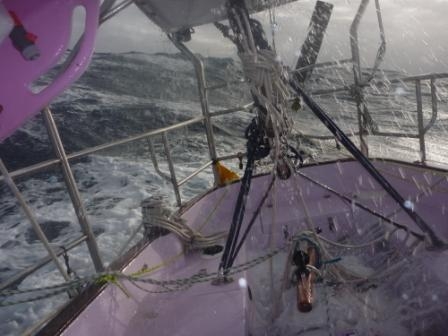
Soon memories such as this:

With the drogue trailing behind Ella's Pink Lady shaking off one wave with the next 10m monster coming up behind!

will be a thing of the past!

Our Post of last November is re-published below.

Read the original Post

Elliot’s schooling – Sir Ken’s view

Sir Ken Robinson’s view

I plan to have my final post on education finished very soon.  However, with my last week of finals and papers at the undergraduate level (which is finally over!) constantly hoarding my time, I have not yet quite been able to truly decide on which side I plan to end up.

My instinct tells me that the costs of the US schooling system far outweigh its benefits, but I feel I must be sure that this is truly a case that can be supported with logic and not simply my own biases coming through.

However, while I continue to ponder, I thought that readers might find this video interesting.  It’s a different take on the nature of institutionalized schooling than is often seen.  It’s on the longer side — approximately 20 minutes long — but I definitely think it is worth a watch for anyone pursuing a clear and well thought-out perspective on education, and it’s actually quite humorous and entertaining.

The video is of a presentation by Sir Ken Robinson, an internationally recognized leader in the development of innovation and human resources.  His thesis statement is as follows:

My contention is that creativity is as important in education as literacy, and we should treat it with the same status.

I hope the Learning From Dogs community enjoys this video.  Upon my return from celebrating my college graduation in Charleston, I plan to present my final finding on whether the costs or the benefits of schooling in the United States outweighs the other.

By Elliot Engstrom

Maybe, just maybe – again!

Day One for the new Prime Minister and his team has been good!

Less than 24 hours ago, I mused that maybe David Cameron and Nick Clegg represented something that the UK badly needs – a real positive change in Governing the country.

Spring shoot 1

Matthew Parris

Matthew Parris is an experienced reporter, columnist and a one-time Conservative Member of Parliament.  Here’s what he said to the BBC a short while ago (at the time of writing this Post).

“I ought to be cynical, I ought to be saying it’s all going to end in tears, but I just sense something good and genuine in the air and it just might work,”

“You almost have a sense of two men staging a coup against the British political system,”

Spring shoot 2

It’s almost unknown for the Governor of the Bank of England to comment on political matters.  The current Governor, Mervyn King, was recorded saying this today.

By Paul Handover