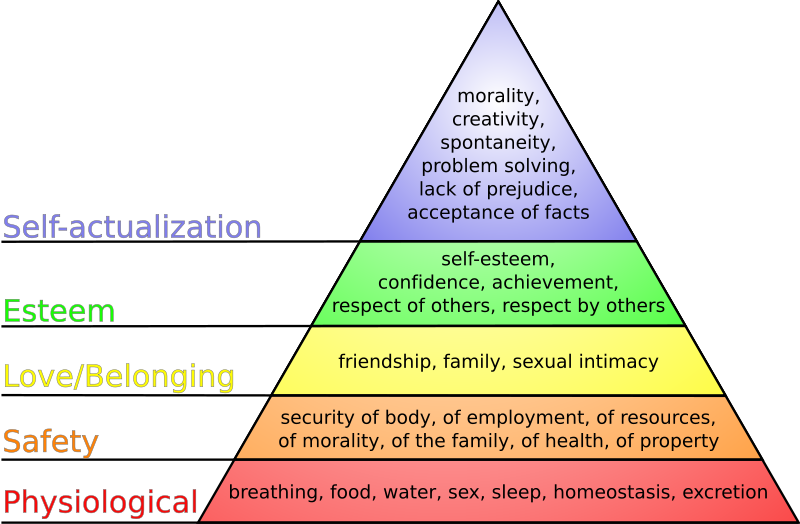
Hardly seems necessary to say this but natural forces are ‘top of the pyramid‘!
As is so often the case, a few outwardly disconnected events offered a deeper picture; well they did for me!
The first was a recently published post by Alex Jones over on his blog The Liberated Way. Alex lives in Colchester, Essex, North-East of London, a place where I ran a business way back in the ’80’s’ and lived not far away in the village of Great Horkesley. Many people, including many Brits are unaware that Colchester, or Camulodunon as the Celtics called it, meaning “the Fortress of Camulos” (Camulos was the Celtic god of war), was the Capitol city in Roman days and that evidence of man’s settlement goes back 3,000 years.
Anyway, back to the thread of today’s post.
That first post from Alex. A post under the title of Catching a fox. Alex has generously given me permission to republish it.
Catching a fox.
After two years of hunting I catch a fox with my camera.
After two years of frustration I finally photograph a fox, which appeared out of nowhere in my garden.
Nature is a shifting tapestry of life, often catching me by surprise with magical manifestations of wildlife that abruptly vanish before I can catch a brief record of its passing through my life. It is a matter of chance that I get lucky with my camera, and I was in luck today.
This morning a fox manifested in my garden. The fox sat looking at me, it had a forlorn look about it, but the fox was content to sit and watch me as it sun bathed in the warmth of a tranquil garden. I had my camera with me, so I made up for two years of frustration by firing off dozens of photographs of my elusive wary model. The fox made my day.
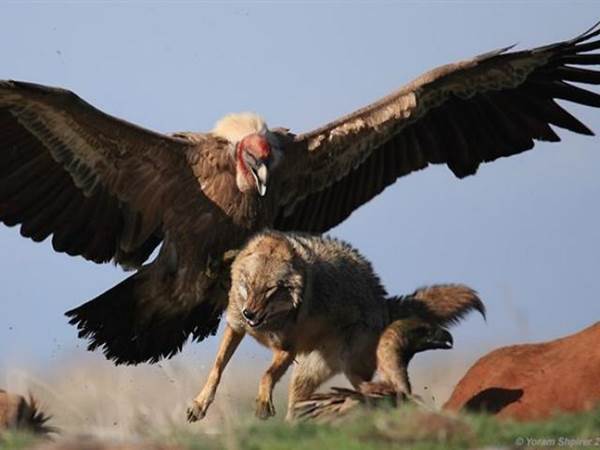
The second event was a chance photograph of a vulture taken two days ago here at home.
Ah, that early morning sun feels good on my back feathers!
oooo
Damn! Thought it was too good to last!
Now I’m sure that readers so far will find these three photographs, of the fox and the vulture, are producing feelings of pleasure; feelings of wonderment about the natural world around us.
That world of nature ‘speaks’ to us. If we are prepared to listen.
It spoke to South-West England in February earlier this year:
Dawlish – Rail emergency workers inspect damaged track along the seafront.
There are signs that Mother Nature will be speaking to us again; fairly soon. From EarthSky:
Warm water in Pacific could spark a monster El Nino in 2014
Scientists are watching a giant mass of sub-surface water in the Pacific. When this water reaches the sea surface, it could set off a powerful El Nino.
The giant red blob in this image is a huge, unusual mass of warm water that currently spans the tropical Pacific Ocean. Eric Holthaus, a meteorologist who writes about weather and climate for Slate, says the volume of water is big enough to cover the United States 300 feet deep. And that’s a lot of warm water, he says. Holthaus also says that, as the sub-surface warm water in the Pacific moves eastward – propelled by anomalous trade winds – it’s getting closer to the ocean’s surface. Once the warm water hits the sea surface, it will begin to interact with the atmosphere. Why? Because Earth’s oceans and atmosphere are always interacting. In this case, the warm water will likely boost temperatures and change weather patterns … and possibly bring on a monster El Nino in 2014. There are signs this is already beginning to happen. Read more at Slate.
If one clicks on the link to that Slate article, one then reads:
By Eric Holthaus
The odds are increasing that an El Niño is in the works for 2014—and recent forecasts show it might be a big one.
As we learned from Chris Farley, El Niños can boost the odds of extreme weather (droughts, typhoons, heat waves) across much of the planet. But the most important thing about El Niño is that it is predictable, sometimes six months to a year in advance.
That’s an incredibly powerful tool, especially if you are one of the billions who live where El Niño tends to hit hardest—Asia and the Americas. If current forecasts stay on track, El Niño might end up being the biggest global weather story of 2014.
The most commonly accepted definition of an El Niño is a persistent warming of the so-called “Niño3.4” region of the tropical Pacific Ocean south of Hawaii, lasting for at least five consecutive three-month “seasons.” A recent reversal in the direction of the Pacific trade winds appears to have kicked off a warming trend during the last month or two. That was enough to prompt U.S. government forecasters to issue an El Niño watch last month.
Forecasters are increasingly confident in a particularly big El Niño this time around because, deep below the Pacific Ocean’s surface, off-the-charts warm water is lurking:
Now I’m not going to post the whole of that article so for that reason strongly recommend you read the rest here. However, I am going to offer a couple more extracts.
Like this:
The warm water just below the ocean’s surface is on par with that of the biggest El Niño ever recorded, in 1997-98. That event caused $35 billion in damages and was blamed for around 23,000 deaths worldwide, according to the University of New South Wales. The 1997-98 El Niño is also the only other time since records begin in 1980 that sub-surface Pacific Ocean water has been this warm in April.
Or like this:
One of the theories put forth by the mainstream scientific community to explain the slow-down since 1998 has been increased storage of warm water in the Pacific Ocean. If that theory is true, and if a major El Niño is indeed in the works, the previously rapid rate of global warming could resume, with dramatic consequences.
As I wrote last fall, the coming El Niño could be enough to make 2014 the hottest year in recorded history, and 2015 could be even warmer than that. The 1997-98 super El Niño was enough to boost global temperatures by nearly a quarter of a degree Celsius. If that scale of warming happens again, the world could approach a 1ºC departure from pre-industrial times as early as next year. As climate scientist James Hansen has warned, that’s around the highest that temperatures have ever been since human civilization began.
Now I’m not trying to be a ‘drama queen’ but there are times when one does wonder what it will take for those who govern us to wake up to the fact that Mother Nature is getting more and more restless.
One might be forgiven for thinking that community is an odd bed-fellow with trust and truth. Many might think that faith would be a more logical third leg, so to speak.
However, I hope to show that in today’s world where trust and truth are beleaguered qualities a rethinking of community is critically vital for the long-term health of mankind.
Community
Can’t resist a third look-up in Roget’s Thesaurus.
community noun
Persons as an organised body: people, public, society.
For me two words jump out from that definition: persons; organised.
The challenge is that the word organised is easily interpreted as an organisation with leaders and followers. But that’s not how community is regarded in the context of this third essay.
“No man is an island”, John Donne wrote in 1624.
This is a quotation from John Donne (1572-1631). It appears in Devotions upon emergent occasions and seuerall steps in my sicknes – Meditation XVII, 1624:
“All mankind is of one author, and is one volume; when one man dies, one chapter is not torn out of the book, but translated into a better language; and every chapter must be so translated…As therefore the bell that rings to a sermon, calls not upon the preacher only, but upon the congregation to come: so this bell calls us all: but how much more me, who am brought so near the door by this sickness….No man is an island, entire of itself…any man’s death diminishes me, because I am involved in mankind; and therefore never send to know for whom the bell tolls; it tolls for thee.”
Thus for the vast majority of people on the face of this planet, we are linked to others and how we live our lives is fundamentally influenced by those others about us. In a past life, I lived in the village of Harberton in South Devon. The population of Harberton was 300 persons.
An E. M. Morison (Totnes) postcard, bearing a 3p stamp, which gives a sending date between Feb 1971 and Sept 1973.
Now I was lucky when I moved into Harberton because my two sisters, Rhona and Corinne, had lived in the area for many years and it was easy for me to be positioned as ‘the brother’. Nevertheless, the way that the village embraced all newcomers was wonderful and within a very short time one felt a settled member of the community.
Same for Jean and me as relative newcomers to our property just 4 miles from Merlin, Oregon. All of our neighbours have embraced us and helped us understand this new rural life that we have embarked on. We feel part of the local community.
Yet it doesn’t stop there.
Obviously, I’m a WordPress user! Learning from Dogs is a WordPress blog! But were you aware of the size of the WordPress community? (As of now!)
How many posts are being published?
Users produce about 44.5 million new posts and 56.7 million new comments each month.
How many people are reading blogs?
Over 409 million people view more than 14.7 billion pages each month.
Even my funny little blog has 959 followers!
What that figure doesn’t reveal is how many of my followers have offered support, openness and real loving friendship. None better demonstrated than by the comments left by readers when I announced the recent death of Dhalia.
Think of the way that untold numbers of internet users rely on that ‘worldwide web’ for referrals, opinions or knowledge about anything ‘under the sun’.
So while there might be many aspects of our new technological world that create unease, the opportunities for having ‘virtual’ friends to complement our social friends make this era unprecedented.
I would go so far as to say this. That the way that knowledge and information can be shared around the world in no time at all may be our ultimate protection against those who would seek to harm us and this planet.
How to close these essays? Perhaps no better than as follows:
On Wednesday evening we were joined by neighbours, Dordie and Bill. My post on truth came up in discussion. Bill mentioned that he had read about a person who had spent many years studying the texts of all the world’s major religions. What had emerged was that across all those great religions there was a common view as to what the long-term health and survival of societies requires.
It is this: the telling of truth and the keeping of promises!
Musings on truth and the corrosive nature of fear.
Yesterday, in Part One, I explored how easy it is to signal to the public that they are not to be trusted. I used the case of PayPal’s changes to their ‘privacy’ policy which, as Wolf Richter wrote, only partially tongue-in-cheek perhaps, made “the NSA, which runs the most expansive spying dragnet in history, is by comparison a group of choirboys.”
Truth
Again, back to Roget’s Thesaurus.
truth noun
1. Correspondence with fact or truth: accuracy, correctness, exactitude, exactness, fidelity, veraciousness, veracity
2. Freedom from deceit or falseness: truthfulness, veracity
So that’s all clear then!
If only it was that easy. So many aspects of our modern lives are exposed to complex issues. None more complex than, of course, the issue of humans having a damaging effect on the planet’s climate. Or if one wants something more esoteric then try the origins of the universe. (So far as the former is concerned, then my personal belief is that mankind is damaging the global climate. But do I have the scientific background to support that belief? No Sir!)
However, one thing that our complex society does offer is the opportunity to spread fear. Indeed, fear pervades popular culture and the media. I picked up that theme from an essay published by David L. Altheide and R. Sam Michalowski of Arizona State University.
Fear pervades popular culture and the news media. Whether used as a noun, verb, adverb, or adjective, an ongoing study finds that the word “fear” pervades news reports across all sections of newspapers, and is shown to move or “travel” from one topic to another. The use of fear and the thematic emphases spawned by entertainment formats are consistent with a “discourse of fear,” or the pervasive communication, symbolic awareness and expectation that danger and risk are a central feature of the effective environment. A qualitative content analysis of a decade of news coverage in The Arizona Republic and several other major American news media (e.g., the Los Angeles Times, and ABC News) reveals that the word “fear” appears more often than it did several years ago, particularly in headlines, where its use has more than doubled. Comparative materials obtained through the Lexis/Nexis information base also reveals that certain themes are associated with a shifting focus of fear over the years (e.g., violence, drugs, AIDS), with the most recent increases associated with reports about children. Analysis suggests that this use of fear is consistent with popular culture oriented to pursuing a “problem frame” and entertainment formats, which also have social implications for social policy and reliance on formal agents of social control.
No passion so effectually robs the mind of all its powers of acting and reasoning as fear. [my italics]
That last sentence offers the words of Edmund Burke, the Irish statesman and author from over 200 years ago. So, perhaps, nothing changes in this regard!
In my old country, the British press love to sell their newspapers on the back of fear. Here are some examples of lurid front pages.
oooo
oooo
However, it doesn’t end there. Fear of the unknown, of forces beyond our control, are behind the incredible number of conspiracy theories, many of them quite famous. WikiPedia lists dozens of them. One that was voiced by friends of ours concerned HAARP, which is an acronym for High Frequency Active Auroral Research Program. It was a perfectly legitimate research programme, one that was unclassified, albeit a program that was shut down in July, 2013.
But that didn’t stop it being regarded by many as deeply suspicious, “Many conspiracy theories surround HAARP. Some theorists believe that it is being used as a weather-controlling device that can trigger catastrophic events, such as floods, hurricanes, etc. Others believe that the government uses HAARP to send mind-controlling radio waves to humans.” Taken from here.
As it happens, this was a programme that I was acquainted with back in my UK days.
OK, time to round this off.
This new, digital world allows the sharing and spreading of information in a manner unimaginable from, say, 25 years ago. It has many positive attributes, as I will touch upon in tomorrow’s post. But it also has the power to spread fear and misinformation. In a world that is becoming more complex and more uncertain year by year, it takes effort by every one of us to stop, think and check on anything that has the potential to upset one.
It takes the power of community to keep us rooted in the stuff of our daily lives, to live calmly and stay in touch with the truth. More on the power of community tomorrow.
Today, and the next two days, I want to offer you three essays under the theme of Trust, truth and community.
As is so often the case, there was a series of outwardly unconnected experiences that seemed, well to my eyes anyway, to speak to a theme. You will have to wait until Friday to judge whether or not you agree with me!
Trust
This first essay was motivated by two disparate events: One very local and one as far removed from being local as one could imagine.
But first, what do we mean by trust? Roget’s Thesaurus defines the word (in part):
trust noun
Absolute certainty in the trustworthiness of another: belief, confidence, dependence, faith, reliance.
You will recall that just over three weeks ago, we welcomed two horses to our pastures; Ranger and Ben. Both horses had previously been treated badly by humans, especially Ben who had been starved and beaten by his ex-owners.
In the early days, Ben was very cautious of any sudden movement by me and would back away from any contact from me other than being offered a food treat.
But in just three weeks, Ben has gone a huge way towards trusting Jean and me.
Taken yesterday afternoon.
oooo
My face is closer than three inches to Ben’s nose.
oooo
Both Ben and Ranger in the background are now very comfortable with Jean and me.
Now, I don’t know about you, but my guess is that if a human had experienced the degree of cruelty from the hands of another person that these horses had, it would take very much longer than three weeks for that human victim to regain the same level of trust that Ben and Ranger now offer. Indeed, many persons would harbour anger and distrust forever.
That was the local example of trust
Now to the ‘non-local’ example of trust. It involves PayPal.
You must read it in full, especially if you are a PayPal user. Thanks to Wolf, I can offer you his opening paragraphs:
I Just Got PayPal’s New Absolutely-No-Privacy-Ever Policy
TUESDAY, APRIL 1, 2014 AT 1:00AM
Sunday, when people had other things to do and weren’t supposed to pay attention, PayPal sent its account holders an innocuous-sounding email with the artfully bland title, “Notice of Policy Updates.” PayPal didn’t want people to read it – lest they come away thinking that the NSA, which runs the most expansive spying dragnet in history, is by comparison a group of choirboys.
The email started with corporate blah-blah-blah on privacy, that PayPal was “constantly” changing things “to give you more of what you want and improve your experience using us.”
Do read the rest of the essay here. Here’s a comment from a reader of Wolf’s essay, republished with Wolf’s permission:
Concerning: I Just Got PayPal’s New Absolutely-No-Privacy-Ever Policy
I will relate an experience I had regarding Pay Pal that I believe has some relevance to your blog on Pay Pal’s privacy policy.
I am a retired old geezer living in NY State. About 4 years ago I looked at Ebay’s bidding process to place a bid on an item I wanted. However I discovered that I could not make such a bid without subscribing to pay pal. I provided pay pal with the information it required and made my bid. My bid was exceeded by other bids and I did not get the item. My credit card was not used at that time and I never used Ebay or pay pal after that.
Because I did not respond to ongoing emails from the 2 companies I believed that I had no further connection to either of them and that my single failed bid was the end of our relationship.
Then about 2-3 years ago I received a couple of emails from Best Buy: one thanking me for opening a new account, and the other thanking me for purchasing an expensive electronic item.
When I opened up that new Best Buy account I discovered that my address was stated to be in California in care of a person named Pham Pham and that the credit card that was used was one that had recently expired although the number was still in use on a subsequently issued card. I checked all my credit cards online and found that the charge was not pending. I also took some other measures to protect myself. Within hours I received another email from Best Buy cancelling the order because payment was not made by my credit card company.
This incident took a strange turn a couple of days later. Initially I had no idea as to the source of the credit information leak. But then 2-3 days afterwards I received an email from Pay Pal requesting an update of the credit card information in my Pay Pal account. Pay Pal’s email request for updated credit information so soon after the online theft attempt may be just a coincidence, but in my mind there is an undisclosed connection. Of course I have not complied with Pay Pay’s requests. To this day no company has informed me that their accounts were hacked and that my credit information was stolen.
If, when you have read Wolf’s report in full, you feel, as I do, that the time has come to cut the relationship with PayPal then go for it. Because only a customer base that is ‘voting with their feet’ will deliver the message.
What is that message?
Simply, if organisations want to be trusted by their customers, those organisations must behave with integrity. Now I am not accusing PayPal of a lack of integrity but it goes beyond that. It goes to operating with a genuine sensitivity for what is correct. PayPal’s privacy policy is anything but that. There are parts of their ‘new’ policy that stink of gross insensitivity to their feelings for their customers. Read it in full courtesy of Wolf Richter
Oh, want to know how to close a PayPal account?
To close your Payflow account:
If your partner is PayPal, VeriSign or CyberCash contact PayPal Merchant support at 1-888-883-9770 or via email at payflow-support@paypal.com. Be sure to include your login ID.
If your partner is with a Payflow partner, reseller, or merchant bank you will need to contact the partner, reseller, or bank directly to close your Payflow account.
For additional information, contact PayPal Merchant support at 1-888-883-9770 or via email at payflow-support@paypal.com.
Note: Once your Payflow account is terminated, you cannot access the PayPal Manager or any account data. If you need access to this data, you will be charged a fee.
If you are trying to close your PayPal account and not a Payflow account do the following:
Log in to your PayPal account.
Click Profile at the top of the page.
Click Close Account in the Account Information column and follow the steps listed.
My PayPal account was closed at 15:10 PDT yesterday.
Perhaps PayPal should take note of how humans witness trust offered by our dear animals!
Yesterday, I posted about the prediction that in four billion years the Milky Way galaxy would collide with the Andromeda galaxy. I called the post Not of immediate concern.
Today, I am writing about something that is of immediate concern. That is if you regard the next couple of decades as ‘immediate’.
The post is prompted by an item that was published on the BBC News website two days ago. It carried the title Climate inaction catastrophic – US
Climate inaction catastrophic – US
By Matt McGrath
Environment correspondent, BBC News, Yokohama, Japan
The costs of inaction on climate change will be “catastrophic”, according to US Secretary of State John Kerry.
Mr Kerry was responding to a major report by the UN which described the impacts of global warming as “severe, pervasive and irreversible”.
He said dramatic and swift action was required to tackle the threats posed by a rapidly changing climate.
Our health, homes, food and safety are all likely to be threatened by rising temperatures, the report says.
Scientists and officials meeting in Japan say the document is the most comprehensive assessment to date of the impacts of climate change on the world.
In a statement, Mr Kerry said: “Unless we act dramatically and quickly, science tells us our climate and our way of life are literally in jeopardy. Denial of the science is malpractice. There are those who say we can’t afford to act. But waiting is truly unaffordable. The costs of inaction are catastrophic.”
Putting to one side the mild irony of a representative of the US Government wringing his hands about what mankind is doing to our climate, the report is valuable and potentially significant.
The report was from the Intergovernmental Panel on Climate Change (IPCC) which is, as their website explains:
The Intergovernmental Panel on Climate Change (IPCC) was established by the United Nations Environmental Programme (UNEP) and the World Meteorological Organization (WMO) in 1988 to assess the scientific, technical and socio-economic information relevant for the understanding of human induced climate change, its potential impacts and options for mitigation and adaptation.
Watch this 5-minute video of Stanford professor Dr. Chris Field, co-chair of that IPCC working group, addressing some of the key questions raised by this latest report. In particular, focus on Dr. Field discussing the potential of the loss of the Greenland ice cap around 3 min 30 seconds.
Back to the BBC report (which you should read in full!). Back to Dr. Chris Field being quoted as saying:
I think the really big breakthrough in this report is the new idea of thinking about managing climate change as a problem in managing risks. Climate change is really important but we have a lot of the tools for dealing effectively with it – we just need to be smart about it.
It would be easy to get into the mindset that humanity is not going to change its ways in time.
But, then again, the pace of growing awareness about what the changes are that we all need to make, and make relatively soon, is dramatic.
Maybe, just maybe, this will turn out alright!
For all the young people in the world, I do so hope!
Milky Way galaxy heading for a collision – in about 4,000,000,000 years!
As with huge numbers of others who come to this blog, the night sky has always been of incredible fascination to me. To reinforce that fact, one of the favourite posts on Learning from Dogs for the last three years has been The night sky above published back on the 27th March, 2011. If you haven’t read it, do pop across and do so as the title is misleading in terms of the post.
As seen on Cosmos … the collision and merger between our Milky Way galaxy and the nearby Andromeda galaxy 4 billion years from now.
The video below illustrates what NASA scientists announced in 2012 – and what the Cosmos TV series featured in 2014 – that the nearby Andromeda galaxy will collide and merge with our Milky Way galaxy 4 billion years from now. The video (from the Hubble Space Telescope news center) is from a series of photo illustrations, showing the predicted merger between our two titan spiral galaxies, as seen in Earth’s sky. Will Earth as a planet survive long enough to see this? A word about that at the end of this post.
The video lost a lot for me by not carrying a commentary. But no problem as one was found that did have a ‘voice-over’. However, the article photographs were stunning. For example:
This series of photo illustrations shows the predicted merger between our Milky Way galaxy and the neighboring Andromeda galaxy. Via NASA; ESA; Z. Levay and R. van der Marel, STScI; T. Hallas, and A. Mellinger
A description of what’s happening in the images above:
First Row, Left: Present day.
First Row, Right: In 2 billion years the disk of the approaching Andromeda galaxy is noticeably larger.
Second Row, Left: In 3.75 billion years Andromeda fills the field of view.
Second Row, Right: In 3.85 billion years the sky is ablaze with new star formation.
Third Row, Left: In 3.9 billion years, star formation continues.
Third Row, Right: In 4 billion years Andromeda is tidally stretched and the Milky Way becomes warped.
Fourth Row, Left: In 5.1 billion years the cores of the Milky Way and Andromeda appear as a pair of bright lobes.
Fourth Row, Right: In 7 billion years the merged galaxies form a huge elliptical galaxy, its bright core dominating the nighttime sky.
The sequence is inspired by dynamical computer modeling of the inevitable future collision between the two galaxies.
Further on in the article one reads:
This illustration shows the collision paths of our Milky Way galaxy and the Andromeda galaxy. The galaxies are moving toward each other under the inexorable pull of gravity between them. Also shown is a smaller galaxy, Triangulum, which may be part of the smashup. Via NASA; ESA; A. Feild and R. van der Marel, STScI.
Will Earth survive long enough to see this merger of galaxies, as depicted in the video above? Earth as a planet might, but life on Earth – probably not. Astronomers say that the luminosity, or intrinsic brightness, of our sun will steadily increase over the next 4 billion years. As the sun’s luminosity increases, the amount of solar radiation reaching the Earth will also increase. It’s possible that – around 4 billion years from now – the increase in the Earth’s surface temperature will cause a runaway greenhouse effect, perhaps similar to that going on now on the planet next door, Venus, whose surface is hot enough to melt lead. No one expects to find life on Venus. Likewise, life on Earth will probably not exist 4 billion years from now. What’s more, our sun is expected to become a red giant star eventually. A probable fate of the Earth is absorption by the sun in about 7.5 billion years, after our sun has entered the red giant phase and expanded to cross Earth’s current orbit.
Anyhow, I mentioned that I found a better video on YouTube than the one included in the original article, and that is now presented.
Rather puts the grunt and grind of daily life into perspective! 😉
In 1968 I emigrated to Australia; to the city of Sydney. It was an easy move in many ways. For before I left I was working in the sales office of British Visqueen Ltd in Stevenage in Hertfordshire. ‘BVL’ were part of Imperial Chemical Industries (ICI).
On Day Three of my new life in Sydney I noticed that ICIANZ (Australia & New Zealand) had their headquarters building on Macquarie Street near North Circular Quay. On impulse I went in and two hours later had been offered a job in the sales office of ICI’s Inorganic Chemicals Division.
From the window of my office I had a stupendous view of the Sydney Harbour Bridge. This is a picture taken the other side of the Bridge looking back at the office complex to the right of the Sydney Opera House; the office block partially obscured by the top curve of the bridge.
Anyway, back to the story.
I was dating a Finnish woman who with her sister and parents had emigrated from Finland some years previously. That woman’s name was Britta and later we were married and then upon returning to England in 1970 we had two children; a son and a daughter. In Australia I didn’t miss England and when back in England I didn’t miss Australia.
I was 26 when we returned to England.
Fast forward forty-four years to now.
This is the view through our bedroom window in the morning when Jean and I awake.
This is another view of the same scene but taken from outside the windows.
When the air is really moist and there are clouds hanging low over the ridge, it’s common to see mist swirling through the trees.
It is a beautiful place to live, for us and for all our animals …. yet …. we don’t feel perfectly settled.
Back to Britta’s parents. After they had been living in Australia for quite a few years, in Brisbane in those days, and all settled with jobs and their own house, they still didn’t feel perfectly settled. So they gave up their jobs, sold the house and transported themselves and their belongings all the way back to Helsinki, Finland.
Only to find that in less than three months that they had made a ghastly mistake and so, yes you know what’s coming, they transported themselves and all their belongings all the way back to Australia; this time settling in Sydney.
OK, to the point of this tale.
In many, many ways this life that Jean and I have here in Oregon is better than anything we have previously experienced.
Yet, there are times when I hear the sirens of Devon calling out to me and for Jean there are times when she hears the sirens of Mexico calling out to her; Jean lived in San Carlos, Mexico for twenty-five years, off and on, with her late American husband, Ben, who died in 2005.
I’m 70 in November this year.
What does it all mean?
When Jean and I were living in Payson, Arizona we were talking one day to a woman who in previous times had been a personal counsellor. She asked how we were settling in. We mentioned that we were not yet settled. The woman went on to say that people over the age of 60 frequently had a much more difficult time adjusting to major moves and changes in their lives than younger persons.
Jean and I wouldn’t rewind our lives for all the tea in China but what, dear reader, do you think?
Anyone out there the ‘wrong’ side of 60 who can relate to this?
The fabulous story of the restoration of a British Navy Supermarine Seafire Mk.XV
From time to time I let on that in the past I was a keen private pilot and before that a glider (sailplane) pilot. My son has been a commercial airline pilot for many years. Inevitably, one gets to know other pilots, a few of whom become firm friends. One such friend is Bob Derham who recently sent me this story about the restoration of a Supermarine Seafire. For anyone interested in classic aircraft, the story of this particular aircraft is fascinating.
Seafire Mk. XV
While WikiPedia has a good description of the type, there’s a fine description of this particular aircraft over at the Salute website, (the photo above came from that website) from which I offer:
Supermarine Seafire Mk. XV
This airplane is one of only four known Seafire Mk. XVs to exist in the world and it may be the only flying Supermarine Seafire Mk. XV in the world. Dr. Wes Strickler’s immaculate Supermarine Seafire Mk. XV (also known as the “hooked Spitfire”) is based in Columbia, MO, was restored by Jim Cooper, and made its first post-restoration flight in 2010. The Supermarine Seafire was a naval version of the Supermarine Spitfire specially adapted for operation from aircraft carriers. The Seafire’s mission was primarily as a short range interceptor. The name Seafire was derived by abbreviating the longer name “Sea Spitfire”.
The Mk XV variant of the Seafire was powered by a Griffon VI (single-stage supercharger, rated at 1,850 hp driving a 10 ft 5 in Rotol propeller. It appeared to be a naval Spitfire F Mk XII but was an amalgamation of a strengthened Seafire III airframe and wings with the wing fuel tanks, retractable tailwheel, larger elevators and broad-chord “pointed” rudder of the Spitfire VIII. The engine cowling was from the Spitfire XII series, being secured with a larger number of fasteners and lacking the acorn shaped blister behind the spinner. A vee-shaped guard forward of the tailwheel prevented arrestor wires getting tangled up with the tailwheel.
One problem which immediately surfaced was the poor deck behavior of this mark, especially on take-off. At full power the slipstream of the propeller, which swung to the left (as opposed to the Merlin, which swung to the right), often forced the Seafire to swing to starboard, even with the rudder hard over on opposite lock. This sometimes led to a collision with the carrier’s island. The undercarriage oleo legs were still the same as the much lighter Merlin engined Spitfires, meaning that the swing was often accompanied by a series of hops. This undercarriage also gave it a propensity of the propeller tips “pecking” the deck during an arrested landing and occasionally bouncing over the arrestor wires and into the crash barrier.
Wing span: 36ft 10in. Max takeoff weight: 7,640 lb. Max speed: 359 mph. Power: 1,850 hp.
This is an example of incredible dedication! Jim Cooper in front of the Seafire.
When you watch the film, Jim Cooper makes it clear that there were others on the restoration project. But the film also makes it clear that without Jim this beautiful aircraft would never have been restored, let alone restored to a flying machine.
Settle back and enjoy!
Uploaded on Aug 18, 2010 by Scott Schaefer
“While Sarah Hill and I were taping the first Central Missouri Honor Flight special in the Ozark Hangar at Columbia Regional Airport in January 2009, I noticed Jim Cooper working on a plane in the corner of the hangar. I love airplanes and this sight piqued my interest.
The corner was enclosed by plastic from floor to ceiling and inside sat a plane, wings folded toward the ceiling and a paint job that left more to be desired. It was the Seafire XV – one of only a handful still in existence. As soon as I saw the plane and learned a few facts about it, I knew I wanted to do a story on it and follow Cooper through the rest of the restoration process.
Cooper had already been working on the Seafire for nearly a year and half by the time we met, but there was still plenty of work that had to be done. I started shooting that night and throughout the next year and half, whenever Cooper would move to a different stage in the restoration, he’d call and I would head to the hangar to shoot video. I didn’t shoot every part of the process, but tried to capture the big ones ?cleaning the plane, painting, revealing the paint job, testing the landing gear, testing the engine and of course the first flight.
After 10 trips to the airport, 130 miles and nearly 6 hours of video, it was time to start the editing process. Once all the video was in the system, I spent 14 hours typing the details from of every sound and interview captured in the video. That log was essential in writing the story. I needed to know exactly what was said in order to organize everything into a story that would hopefully hold people’s interest. After I had a rough script written, I began to edit the video. After about 15 hours in the edit bay tweaking every little audio and video cut? then re-tweaking them? I was finally finished. Nineteen months later. It was a tough job picking the best four minutes from six hours of video, but in the end, I think I accomplished what I set out to do.”
Leave you with another photograph.
One of a kind!
If you wanted to see the aircraft in the air, then it will be at this year’s EAA OSHKOSH. I’ve always wanted to go but never made it! Anyone fancy baby-sitting some dogs and horses around the end of July? 😉
A most fitting guest essay after yesterday. The following is published with the kind permission of the author, Jeremy Nathan Marks. I have done a ‘screen grab’ of the image associated with his blog post so you can experience it as you would see and read it from The Sand County. It seemed perfect as a follow-on to yesterday’s post Life, and mortality.
ooOOoo
The Sand County
“In wildness is the preservation of the world.” -Henry David Thoreau
My Wish for the World
If I could leave behind but one lasting accomplishment from my life it would be to have changed the hearts and minds of all those people who accept or practice cruelty towards animals. Now there are a great many worthy causes in this world which fully deserve the attention of all those who believe in justice, in fairness, and in mercy. But I also know that each of us -perhaps- has a cause that stands above and beyond all of the other noble concerns that we know exist. For me this cause is the humane treatment of animals. And when I say animals I mean ALL animals. Permit me to explain. My wife and I have two dogs. Both are mutts and both were adopted through the Animal Rescue Foundation of Ontario (ARF). I have blogged about ARF before and can only offer the highest praise for the organization. Courtesy of ARF, we have been provided with free dog training classes which have proved to be an invaluable resource in learning about dog behaviour. Better yet, the dog trainer we have worked with has made herself available for our questions outside of class. Whenever we have encountered a behavioural challenge that we have not understood or have been unsure of a proper method of approach, this trainer has been very obliging. Importantly, she believes in positive reinforcement and does not believe in the use of pain, dominance, or stress as a means of conditioning dogs. For my wife and me, this fits in with our moral beliefs and our ethics. Our eldest dog, who just turned one year old, is a 60 lbs. shepherd mix who has a “leash anxiety,” if I may call it that. When we are out on a walk and she sees another dog she becomes quite agitated and will bark loudly and lunge at the other dog. This has puzzled us because our dog loves to play with others and is frequently socialized. We grew increasingly concerned because our use of treats and positive reinforcement was not working. And because our dog is a large shepherd, we both have worried that she might develop a reputation and become a source of fear or suspicion by other people in our neighbourhood. In due course, we contacted our trainer for advice. She suggested that rather than putting our dog in a stressful situation by repeatedly walking her past other dogs (and trying to control her behaviour when she becomes agitated) we should take her out of the situation instead. So, when we see another dog approaching we turn around and walk in a different direction, all the while rewarding our dog with treats and telling her she is a good girl. We have recently started doing so and the improvements are showing. So, let us fast forward to today. . . This afternoon we took both of our dogs on a 20 km hike along the Thames River. The trail is like so many other trails; it forms a narrow path through the woods which makes passing other trail goers challenging at points. If another dog were to come toward us this narrowness would pose something of a challenge because we cannot turn around (and head home). Also, because the trail runs through the woods, there aren’t often places to step aside and let other dogs pass by without our oldest detecting them. Inevitably we encountered another dog. We were approached by a small dog that was off leash (which is posted as unlawful, actually). We heard the dog before we saw it and prepared ourselves for some nervousness on the part of our oldest. When the dog approach some barking ensued and I tried to move our dog, as best I could, off the trail to let the family that was approaching us pass by with their dog. When we informed the family that our dog is uncomfortable around other dogs when she is leashed they did not seem to understand that we wanted them to pass by us quickly. When our eldest became excited one of the women turned to us and said that we should “knee our dog in her side to show her who is dominant.” I was appalled. Some woman, whom I have never met, who knows nothing about our dog or our relationship with our dog, was suggesting we use violence against her to show her who is boss. . . And this is a woman with a dog of her own! My wife later remarked to me, as we were driving home, that she would not feel entitled to the love and affection our dogs offer us if we used violence on them in any way. I thought what she said was beautiful and captured the principle of the matter perfectly. We want our dogs to love us and to trust us. How would we have any right to their love and affection if we were to lead them to believe that -at any moment and for no apparent reason- we might use painful force on them? Dogs do not understand why you use violence against them. They do not reason or understand cause-and-effect the same way that humans do. This is not a fault. It does not mean they are stupid or of lesser value than human beings. It does not mean they deserve to be treated with cruelty or brutality. Dogs experience violence as pain and suffering that is inflicted out of the blue. They are not only unprepared for it, but are often completely defenceless against it. How could we ever defend such an inhumane practice? It troubles me immensely that someone, whom I do not know, could so nonchalantly counsel me to violence against my dog. Her arrogant presumption aside, this was a monstrous act. It was barbaric. Nowhere in polite society would someone get away with counseling violence against a child. . . or against someone who is weaker. Yet violence against animals, even against dogs who supposedly occupy a place closer to human hearts than most other animals, is countenanced and even endorsed. (I won’t even begin to explain why the Dog Whisperer horrifies and saddens me.) If a young child was caught torturing animals we would all raise the alarm. The torture of animals, by a young child, is seen as an early warning sign of severe mental disturbance and has been linked to homicidal tendencies and highly violent behaviour. One of the great villains of American literature, the character Popeye from William Faulkner’s novel Sanctuary is depicted as a torturer of animals in his youth. Now I know that increasingly there are laws on the books in many nations that are designed to prevent cruelty to animals and to prosecute perpetrators. This is a positive development that I certainly applaud. But I would argue that there is something broader, more troubling in our relationship with animals that goes beyond the bounds of this current posting. It is a topic I will return to time and again at this blog. What troubles me is how animals are frequently seen as objects if they are even seen or thought of at all. The damage that our destruction of the forests, deserts, plains, and oceans of this world does to countless species is something that has been well documented. We do this because we are interested in acquiring the resources we feel are vital to ensuring our survival. . . but often it is our comfort or our “way of life” that really is the central reason for our pursuit of these things. There is a deep seated human arrogance which treats animals as inferior forms of life. We see them as less sophisticated because they cannot compete with us for power on this planet. We suffer from what Aldo Leopold called an “Abrahamic view” toward the land. Somewhere biblical “dominion” over nature became domination. This is tragic. And it is not necessary. I was deeply troubled by what I experienced today and it reminded me that if I could leave behind but one lasting accomplishment it would be to somehow awaken a sense of love, of mercy, and a thirst for justice where the animal life on this planet is concerned. Just imagine what realizing that love would really mean. By achieving a love that transcends the will to power, the will to control, and the will to domination our embrace of animals really is, after all, the achievement of that revelatory love that is at the heart of the great religions and the religious spirit. Love for animals is love for justice and mercy. It is reverence for life. And it is peace. I think Henry Beston captures these sentiments beautifully: “Remote from universal nature, and living by complicated artifice, man in civilization surveys the creature through the glass of his knowledge and sees thereby a feather magnified and the whole image in distortion. We patronize them for their incompleteness, for their tragic fate in having taken form so far below ourselves. And therein we err, and greatly err. For the animal shall not be measured by man. In a world older and more complete than ours they move finished and complete, gifted with extensions of the senses we have lost or never attained, living by voices we shall never hear. They are not brethren; they are not underlings; they are other nations, caught with ourselves in the net of life and time, fellow prisoners of the splendour and travail of the earth.” -from The Outermost House, by Henry Beston (quoted from Farley Mowat’s A Whale For The Killing)
ooOOoo
I’m sure you will join me in thanking Jeremy for writing such a beautiful and heart-felt essay.