Category: People

The Natural order – life and death.

Nature imposes herself on us humans in absolute terms.

I do not believe in any form of life after death.  Jean is uncertain.  Many good people do believe in some form of spiritual afterlife.

However, one thing is sure. Our living mind and body will die.

These few words are an introduction to the first essay under the broad title of The Natural order. On the 23rd April I introduced the idea of writing a regular essay “about the past, present and future of man’s relationship with Nature.

Thus it did seem entirely appropriate to ‘kick off’ the essays with reflections about life and death.

Alex Jones of The Liberated Way blog recently wrote a post under the title of ‘The circle of life and death‘.  I am republishing it in full with Alex’s kind permission.

ooOOoo

The circle of life and death

Posted on April 27, 2014 |
Nature reminds me life and death is a circle.

The circle of life and death.

I visit a house, the noise of hungry little birds emanating from a nest hidden in the roof, busy parents flying in and out feeding their brood. Less than a week before summer (1st May) I encounter life all about me, like a vast fountain of creativity, as plant and animal erupt into growth and creation. I feel a sense of joy at the life all about me, like dipping my feet in crystal clear spring waters.

Amongst this carnival of life a reminder that with life there is also death. Helix our cat is an effective hunter, a blue tit is found dead upon the ground. I feel no sadness for the death, it is a natural part of the cycle of nature, my animistic viewpoint is of a small spirit returning to the source, and from then renewing. No anger for Helix, since this is the nature of cats, despite being fed, a cat must follow the primal instinct of its nature to hunt. I carry the dead blue tit to an overgrown spot of trees and grass, here I place the blue tit to decay and thus become part of the life of plant and animal of that place, such is the circle of life and death.

ooOOoo

There can’t be a single person on this planet who does not understand that our human life is finite.

Life span of early man: Until fairly recently, little information existed about how long prehistoric people lived. Too few fossilized human remains made it tough for historians to estimate the demographics of any population. Anthropology professors Rachel Caspari and Sang-Hee Lee chose instead to analyze the relative ages of skeletons found in archeological digs in eastern and southern Africa, Europe, and elsewhere. Comparing the proportion of those who died young, with those who died at an older age, the team concluded that longevity only began to significantly increase (that is, past the age of 30 or so) about 30,000 years ago – quite late in the span of human evolution.

In an article published in 2011 in Scientific American, Caspari calls the shift the “evolution of grandparents”, as it marks the first time in human history that three generations might have co-existed. ( Source: Longevity Throughout History.)

Thus given that living much past the age of thirty years is a relatively recent experience, it baffles me beyond comprehension that we, as in mankind, have become so short-sighted about reinvesting in the one and only natural planet that sustains us.

Beautifully expressed in another wonderful essay from John Hurlburt.

ooOOoo

 Notes on the Human Dilemma

The metanexus of Faith, Nature and Science form an integral vision of the reality in which we exist. We are components of Creation living in an emerging universe. As consciously aware life forms we are each and all responsible to the Nature of God in a steadily emerging universe. Change is both constant and inevitable. Species that don’t adapt, do not survive.

Our human problems are obvious.

The essential growth of human conscious awareness remains questionable.

There is a blatant disregard for Nature. The rate of Natural disasters is increasing everywhere on Earth

Civil unrest is bordering on a second Civil War and is already in that state in many other nations of the world.

Imminent economic collapse remains probable as long our world economy is based on a foundation that has been leveraged at least twenty-five times above any realistic material foundation on Earth.

Are we a moral species?

A steady increase in natural disasters worldwide is inevitable until we change in response to Nature’s warnings or become extinct. The collapse of morality threatens the existence of global civilization.

The virtual extinction of the human race in its present state is all but assured within the next century unless we adapt to the Reality we presently blithely ignore or chose to vilify.

We still have a choice.

Our alternative to what has been euphemistically referred to as “new reality” is the process of education, reformation and transformation on a personal level. The objectives are an obvious need to adapt to constant natural change and create a species renaissance in harmony with the reality of God, Nature and Science.

There is clearly a need for a global economy that is based on our primal need for clean air, clean water, clean food and clean energy. We need to maintain our balance through gratitude for the blessings of the life we share and equal justice for all. We need to remember that we are not in charge of anything except our responsibilities to God, Nature and each other.

Under these simple guidelines, a healthy, growing future remains possible as we prepare to migrate from our home planet and relieve the consumptive consequences of an exponentially growing and ravenous demographic ruled by the artificial symbol of Money.

Sound impossible? Au contraire…

The world is being forced to re-evaluate its economic premises. Here are a few proven solutions to help create a naturally invigorated economy.

We can cut air pollution dramatically overnight by converting commercial diesel engines to far more cost-effective bio-fuels without a single change to the diesel mechanisms.

Bio-diesel distillation plants can filter and recycle the clean water we need to live.

We are capable of growing our own food with recycled organic fertilizers.

We have begun the process of harnessing the limitless clean renewable energy provided by the sun, the wind and hydraulic power.

Electric cars that may be fueled by solar energy are winning world class races.

The list of what we are capable of doing is only limited by our imaginations.

The questions to ask ourselves are:


Are we at the beginning of a new world or at the end of an old world?


Are we a part of the problem or part of a realistic solution?”


What will be the harvest of our lives?”


an old lamplighter


ooOOoo

Having yourself as your best friend.

The power of having a great friendship – with yourself!

Today’s post came as a result of some poems published by Kimberley over at Words4jp’s Blog.  She and I follow each other’s blog and each often stirs the other’s emotions.  There was a sad post published by her on the 23rd April called within.  Part of the comment that I wrote to that post read as follows:

Oh, it pains me to read your post. You are such an open, honest person; well that’s what comes across through your writings. Knowing and loving ourself is the only worthwhile journey of our life. For without being at peace with who we are, we will struggle to be at peace with others.

Kimberley published another post the following day, friend and foe, that again struck me as being sad.  Read it and see if you agree with me.

it is said

to keep one’s friends close

but

to keep one’s enemies closer

SO

could this explain

WHY

when i look in the mirror

i find

i am becoming less of a friend

and

more of an enemy –

to myself

?

After reading both those poems I ‘threatened’ Kimberley that I would write a post on becoming friends with oneself.

Here it is.  Adding immediately that I’m drawing heavily on a conversation that Jon Lavin and I had a few months ago; Jon’s background can be looked up over at The People Workshop. Jon is the professional psychotherapist – I am not!

ooOOoo
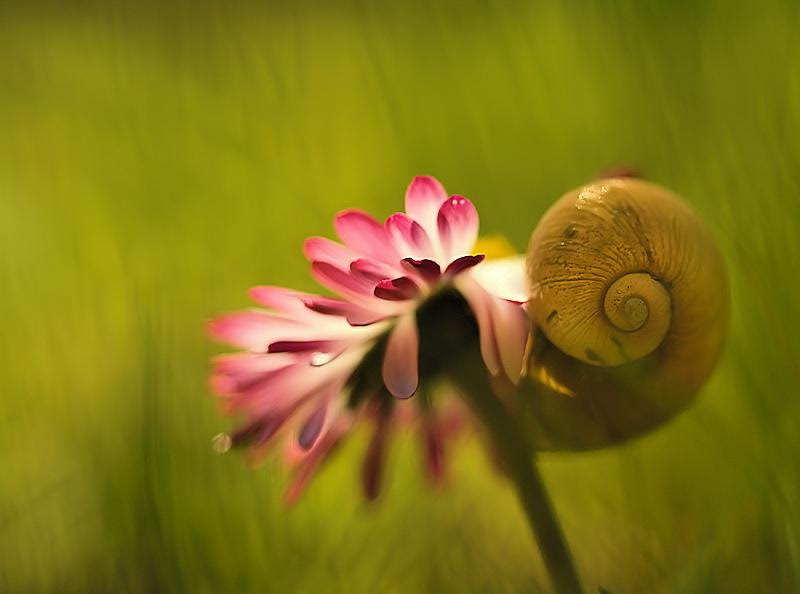
Knowing who we are.

On the 24th January last, I published a post under the title of 20:20 self-awareness.  Included in that post was this:

What we hear and what we say are both modified, frequently unconsciously, by past events, experiences and trauma. That being the case, then it is key, critically so, that we achieve the best possible self-awareness. Because it is only through an understanding of our past that we come to learn of our sensitivities and our associated ‘tender spots’ and their potential for ‘pulling our strings’. Here’s a personal story.

In 1956, when I was 12, I experienced a trauma that was interpreted by my consciousness as emotional rejection. By the age of 14 that sensitivity to rejection had descended into my subconscious. For fifty years, that sensitivity remained hidden yet continued to influence my life in many unseen ways, not all of them negatively by a long measure. In 2007 a period of counselling revealed that hidden emotional rejection; brought it to the surface. It changed beyond imagination how I felt, how I behaved, how I was. Nonetheless, that sensitivity to rejection is still there, albeit now visible. Thus when I hear or experience something that tickles that sensitivity I still react. But because I can now see and feel myself reacting, I can sidestep the emotional strings.

OK, but what does better self-awareness not achieve?  Knowing better who we are delivers no cleansing of our past, no removal of the capacity of that past to cause pain.  Those psychological hooks and impulses are still alive and well!

So what’s the point of knowing better who we are if that greater self-awareness doesn’t remove those hooks and impulses that have the capacity to cause us pain?

The answer to that last question is this.

Greater self-awareness brings about control by the self of the self! We are able to start the slow process of gaining trust in ourselves.  Trust; as in emotional trust. Being able to emotionally trust ourself is a central theme in psychotherapy solutions.

When we trust the emotional person that we are then we have achieved a liking for the person that we are.  Bringing to mind the truism that you cannot like another if you do not like yourself. Like = Love, of course.

So two things to offer to close the post.

WakingTiger

The first is that if you have any suspicion, or know for certain, that you have experienced trauma in your past life, especially in your formative years then the book Waking The Tiger by Peter A. Levine is a valuable resource.  You can learn more about the book including reading the first chapter on the Somatic Experiencing website.

The second is to repeat the short film that was included in the 20:20 self-awareness post.  This is how it was introduced:

The following is a short, twenty-minute, documentary film about fear. Do watch it. The message that we are so profoundly a product of our past is beautifully presented.

Take good care of yourself!

Picture parade forty-one.

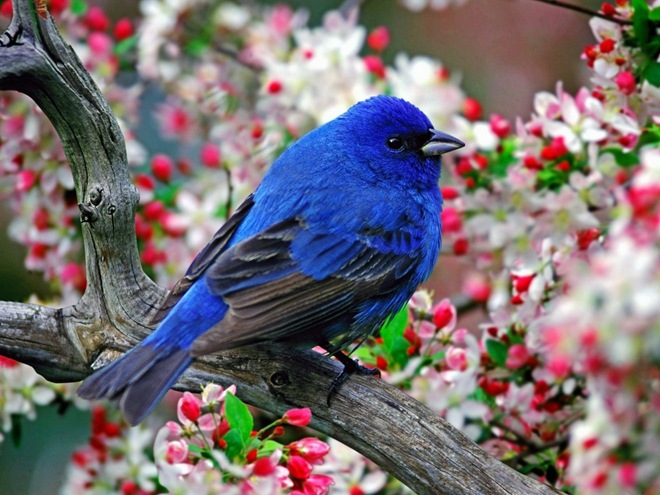
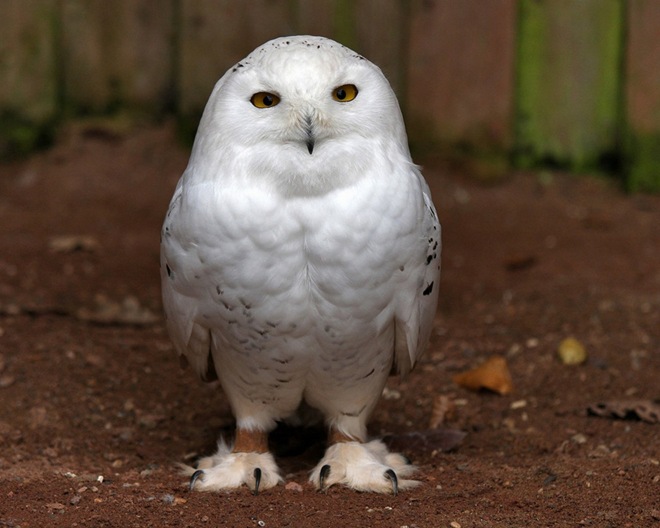
Beautiful bird photographs sent to me by Bob Derham.

Row, row, my bod, gently down the stream.....
Row, row, my bod, gently down the stream…..

oooo

Quick, I need some floss, I think I've got a seed stuck in my beak.
Quick, I need some floss, I think I’ve got a seed stuck in my beak.

oooo

Hey guys, what do you think I am, a houseboat?

oooo

Where is my Prozac, I'm feeling so blue.
Where is my Prozac, I’m feeling so blue.

oooo

So? I'm just not into socks, I like the wind on my ankles.
So? I’m just not into socks, I like the wind on my ankles.

oooo

Landing check list; gear down, check; full flaps, check; runway clear, check; alignment correct, check.

oooo

Man, I wish I could build nests like that!!

oooo

Just keeping an eye on those noisy magpies next door.


More of these fabulous photographs next Sunday.

(Thanks Bob!)

What steps will each one of us take?

Reflections on the Great March through Payson, Arizona.

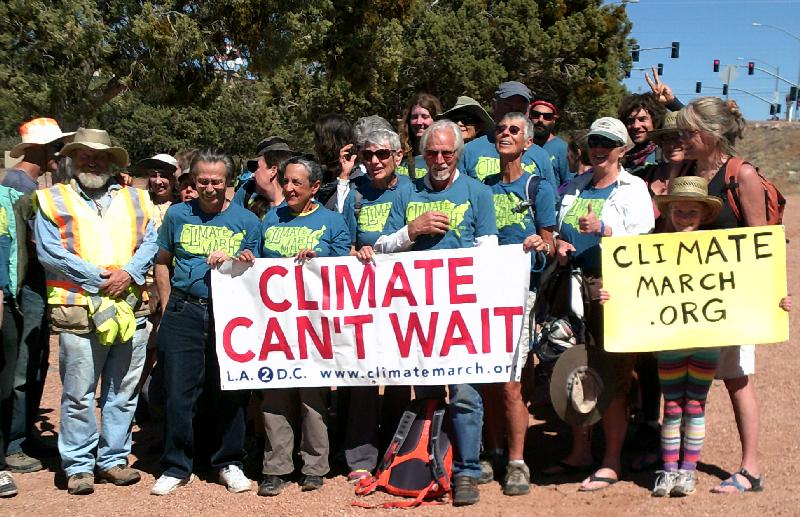
In yesterday’s post The Natural order I referred to Payson recently welcoming the Great March for Climate Action in their walk from Los Angeles to Washington D.C.  I also referred to writing an essay on the event. That now follows, starting with a report from John Hurlburt, one of the organisers.

Thanks for your help for “the Great March for Climate Action”

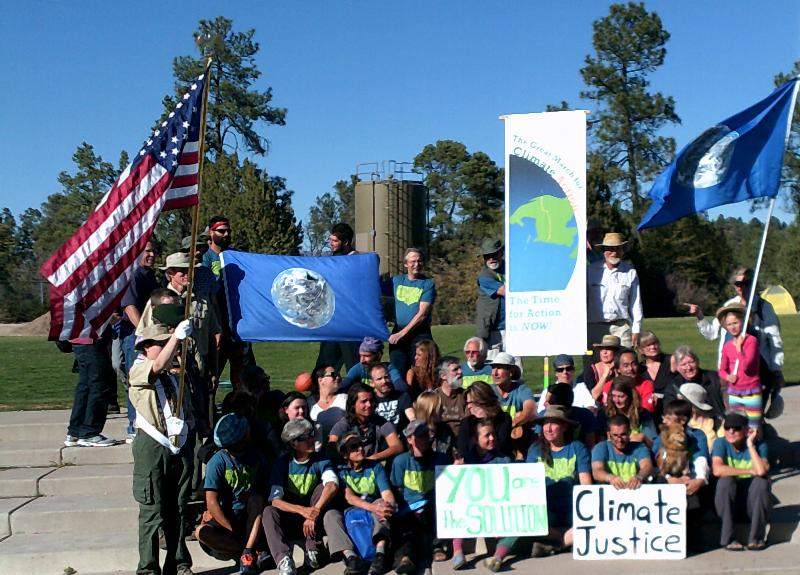
“The Great March for Climate Action” arrived In Payson mid-afternoon on April 14. We had learned that the majority of the marchers are in the “younger” category (under 40), including two girls ages 10 and 12, walking for about a week of the journey with their Mom. But, impressively, quite a few are “AARP-ers”, in their 60’s and 70’s — walking all the way! Most of the group plans to continue on to Washington, D.C., being joined in various sections by hundreds of others! Our efforts aimed at making their brief visit to Payson as friendly and comfortable as possible.

They arrived at the meeting spot by the Event Center, having hiked up from near Rye, about twelve miles with significant elevation gain. Though weary, they were friendly and enthusiastic. Jim Speiser and family had set up their hot-dog cart, and we provided cold water and fresh fruit donated by Safeway — a case of huge premium oranges, and a case of bananas. The Marchers were delighted with the snacks, and extra fruit was given to their “chuck-wagon” for future days.

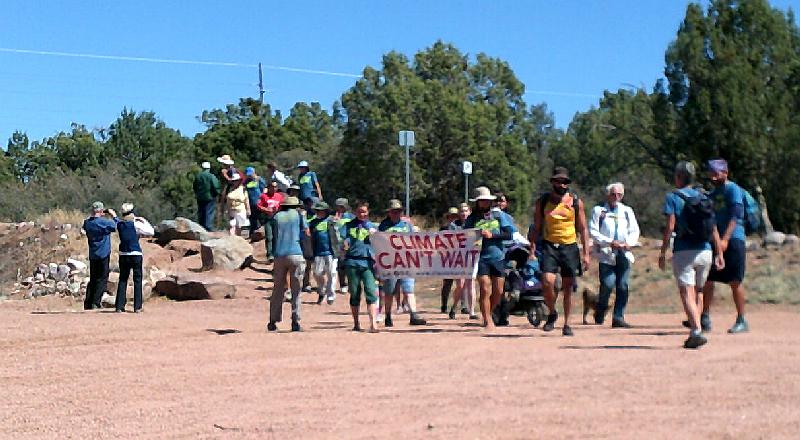
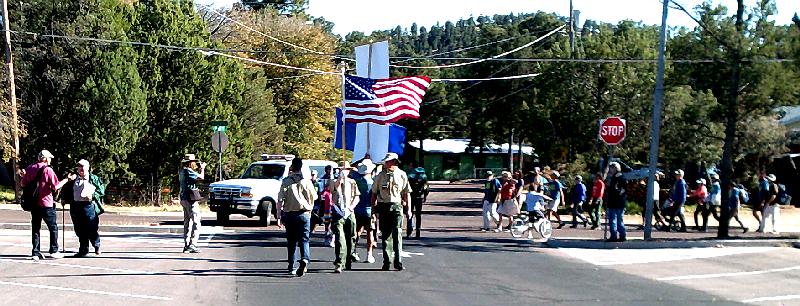
About ten local folk joined the Marchers on the two mile walk to the Payson Christian School, following their beautiful banners and signs. A local Boy Scout Color Guard led the procession and two Payson Police vehicles accompanied the March all the way. People in passing cars waved, smiled, honked and took pictures. Exhilarating and fun! A feature writer/photographer from the Payson Roundup covered the March, both along the route and at the school, where she took group photos and interviewed some of the participants.

Marchers who desired showers/clean laundry were transported to various Payson homes. Some of the group rested in their tents that were clustered on the sports field grass, and others helped with our dining room and kitchen set-up for the dinner. Food from our Payson volunteers began to arrive at five pm and by six the big buffet tables were loaded with delicious hot dishes, sides, snacks, beverages, salad and desserts, and the dining room was packed nearly to overflowing.

The evening opened with a Proclamation of welcome from the Mayor and Town Council, read by Ed Blair, and a prayer. John Hurlbert introduced the evening program that began with a talk about the History of Marches by Ray Spatti. Rob Ingram gave an overview of Payson, its achievements, water and forest issues, and future. Various participants in the March described their adventures, goals and dreams and asked about Payson’s outlook regarding environmental issues. Interacting with these dedicated Marchers was an education, a pleasure and an inspiration, perhaps motivating our Town to step ahead with sustainable solutions. In fact we heard that a young woman from here in Payson is going to join the “Great March”!

Our evening peaked with a delightful music performance by Cinnamon Twist and a sing-along. A number of Marchers were also musicians and they joined in with their instruments, resulting in a spontaneous “jam session” that brought the evening to a grand and joyful conclusion.

We couldn’t have done it without the amazing generosity and assistance from the Payson Christian School and their Staff, and without volunteers like you. Countless Marchers said they were overwhelmed by the friendly reception they received, and it was due to great team-work and local involvement. All the small things you did – offering showers, bringing food, walking with the Marchers, coming to the dinner – added up to a most memorable event. It is through small daily things that we can make a difference in our world — and all of you certainly have.

We can’t thank you enough!

The Organizational group for “The Great March for Climate Action” Payson visit 4-14-14: Ray Spatti, John Hurlburt, Jim Spieser, Dean Gooding and Vee Jeanne.

These were some photographs sent on by John.

TTPMarch1

oooo

TTPMarch2

oooo

TTPMarch3

oooo

TTPMarch4

But it’s no good just thinking how wonderful it was for Payson to be involved, and for the marchers in their nearly 3,000 mile walk from Los Angeles to Washington DC.  Each of us who cares for a sustainable future on Planet Earth must make a difference.  As is now a common plea: “Think globally: Act locally.”

One story that came out from the march through Payson struck me forcibly.  MaryAnne, a good friend of this blog, offered, as did others, laundry and washing facilities to two young marchers.  One of them, a young girl, was so committed to the message behind the march that she had vowed to remain silent from start to finish; the only exception being singing in the evenings.  I was blown away by that commitment.

Read the full details of the event from the Transition Town Payson website.

Will close by offering these two items.

The first is picking up the relevant Editorial headline from the Arizona Republic of the 17th April.

Our View: It’s time to move beyond denial and become part of the solution

The second is asking you to watch this short video.

Published on Jul 15, 2013
Apply to March here: ClimateMarch.org
Like and follow us here: Facebook.com/ClimateMarch

On March 1, 2014, 1,000 climate patriots will set-out from Los Angeles, CA, walking 2,980 miles across America to Washington, DC, inspiring and motivating the general public and elected officials to act now to address the climate crisis. This will be the largest coast-to-coast march in American history.
Credits:

Director, Producer and Chief Editor: Zach Heffernen

Script Writer: Melvin Baker

Studio Manager: Maddie Kain

Voice 1: Ed Fallon
Voice 2: Maddie Kain
Voice 3: Jami Bassman
Voice 4: Zach Heffernen

Editor: Ed Fallon
Editor: Shari Hrdina
Editor: Courtney Kain

The Natural order.

Back to the basics of life.

Regular readers of Learning from Dogs will recall that just under a week ago I published an essay under the title of A bedtime story for mankind.  The post centred around an essay from Patrice Ayme.  Patrice’s essay could be summarised as follows: “At the present rate of greenhouse gases emissions, within nine years, massively lethal climate and oceanic changes are guaranteed.

Then just last Sunday, Patrice published a second essay reinforcing that first one.  The subsequent essay was called Ten Years to Catastrophe.  I was minded to republish that but upon reflection thought that there was a better option.  That was to explore the deep, core questions that both of Patrice’s essays raised in my mind and, presumably, must be raised in the minds of countless thousands of others.  Questions along the lines of a comment I submitted to that subsequent post from Patrice.

Do you have an idea, even a sense, of when global leaders, elected Governments, the ‘movers and shakers’ in societies, will truly embrace the global catastrophe that is heading our way?

And a supplementary question: What would be the indicators that Governments were acknowledging the task ahead?

Frankly, they weren’t especially good questions but they were an attempt by me to open up a debate on whether or not this is the “beginning of the end” of life for us humans.  Central to what was going through my mind was the core question of how did it all go wrong?

Welcome to Payson, AZ

On Monday evening, I rang John Hurlburt, a close friend of Jean and me from our Payson, Arizona days and kicked around those questions .  It was a most enlightening conversation.  John is an active founder member of Transition Town Payson and Payson recently welcomed the Great March for Climate Action in their walk from Los Angeles to Washington D.C. (An essay on that event coming soon.)

Anyway, from out of that conversation with John came the idea of a series of essays here on Learning from Dogs about the past, present and future of man’s relationship with Nature.  The aim is to offer an essay on a weekly basis but we’ll see how it goes.  Wherever possible, I will use the essays and posts from other bloggers that reinforce the vision. As always, your feedback in the form of ‘Likes’ or comments will reflect on the value of the essays to you.

After John and I finished the call, he sent me an email with what could be best described as his vision for these essays.  Here is that email [my emphasis].

Integral Vision

Everything fits together. Otherwise, we’d simply be disassociated atoms.

Human beings are a consciously aware component of Nature. We have a DNA-level directive to survive as a species and as individual members of a species …. in that order!

We are consciously aware components of the conscious interaction between energy and matter in a predominently smoothly emerging cyclic universe with departures from time to time into pockets of chaos.

We disconnect from reality when we become self-centered, often during the various stages of our lives. When we are blessed we continue to live and learn.

Issues of ideology, rational thought, economics, politics, religion, history and science become insignificant in comparison to the whelming power of Nature.

Such is life. It comes with the territory. Spirituality, Nature and Science describe the metanexus in which we live.

Maintain an even strain,

an old lamplighter

Ref: Episcopal “Catechism of Creation”

Ideas, feedback and comments, as always, hugely welcomed.

For those of us embracing our senior years!

Even millions of ‘juniors’ would struggle to match this!

On the basis that today, the Monday after Easter Sunday, is a holiday in many countries, it seemed very apt to keep the theme relaxed.

The following video was sent to me by our neighbours, Dordie and Bill, with the comment, “Paul and Jean, This is incredible….you must watch this on the big screen!

However, big screen or not, this video will have you gasping with admiration.

The Britain’s Got Talent website can be found here.

Picture parade forty.

A very suitable set of pictures for today; Easter Sunday.

Thanks to Bob Derham for sending them to me.

ES1

oooo

ES2

oooo

ES3

oooo

ES4

oooo

ES5

oooo

ES6

oooo

ES7

oooo

ES8

oooo

ES9

oooo

ES10

oooo

ES11

oooo

ES12

oooo

ES13

oooo

ES16

oooo

ES17

oooo

ES18

oooo

ES19

oooo

ES20

oooo

ES21

oooo

ES22

oooo

ES23

oooo

ES24

oooo

ES25

oooo

ES26

oooo

ES27

oooo

ES28

oooo

ES29

oooo

ES30

oooo

ES31

oooo

ES32

oooo

ES33

oooo

ES34

oooo

ES35

From Jean and me and all our animals, our Easter wishes for peace to you all.

Saturday smile!

Drawing seven perpendicular lines. Can’t be that difficult?

(Note: will be especially enjoyed by those who have been exposed to too many hours of ‘management speak’!)

A bedtime story for mankind.

The latest IPCC report is more than dry science; it’s our future!

Regular readers of Learning from Dogs will be aware that yesterday I published a post called A bedtime story for Jimmy.  It was prompted by learning of an eight-year-old who was offered the opportunity of shooting a wild turkey early last Saturday morning.  The penultimate paragraph read as follows:

If we care for nature then we care for the health of our lands, for our forests and for our seas. We are careful with how we live our lives. If we care for nature then as we live our lives we do our best to leave things better for those that come after us.

Little did I know when writing my post that on the same day of publication would be a chilling post from Patrice Ayme; a post that Patrice has generously given me permission to republish in full.

Indeed, little did I know that when I composed my preface to Jimmy’s story and included these words:

However, this eight-year-old lad is facing a future that demands that he and all his generation accept that embracing nature, totally and whole-heartedly, is their only hope of not being the last generation of humans on this beautiful planet.

That less than twenty-four hours later Patrice’s perspective on the latest IPCC report made that sentence of mine far from hyperbole!  Here is that essay from Patrice.

ooOOoo
Terminal Greenhouse Crisis.

A CRASH TECH PROGRAM IS NEEDED, & HAS TO INVOLVE HYDROGEN.

At the present rate of greenhouse gases emissions, within nine years, massively lethal climate and oceanic changes are guaranteed.

Such is the conclusion one can draw from the Inter Governmental Panel On Climate Change of the UN (the IPCC, with its top 300 climate scientists from all over the world). About 78% of the emissions have to do with heating, cooking, and basic, necessary industrial activities, such as making cement.

They are not elective.

As Bad As An Asteroid?

Notes: CO2 FOLU = CO2 emissions from Forestry and Other Land Use. F-gases = Fluorinated gases covered under the Kyoto Protocol. At the right side of the figure: Emissions of each greenhouse gas with associated error bars (90% confidence interval).

Only a crash program of construction of several hundreds of new technology nuclear fission plants, an all-out renewable energy program, with massive solar plants all over the American South and the (similar latitude) Sahara desert, plus a massive hydrogen economy to store the wind and solar energy could allow us to mitigate the massive lethal change incoming.

In other words, it is already too late to avoid the massive lethal change.

What’s the problem? Simple mathematics. It’s evaluated that human activities in the last century or so released 515 billion tons of greenhouse gases. The IPCC and the best experts believe that 800 to 1,000 billion tons of such gases would bring a rise of global temperatures of two degrees Celsius.

At the present rate, that’s nine years to reach the upper reaches: one trillion tons of GHG.

Most of the temperature rise will be in the polar regions, melting those, and inducing worldwide climate catastrophe, especially if emissions of polar methane turn apocalyptic. The polar regions are the Achilles heel of the Earth’s present biosphere. By striking there mostly, enormous changes can be brought to bear, as they would destroy the Earth’s air conditioning and oceanic circulation.

In 2014, trade winds in the Pacific had four times the energy they usually have, creating abnormally intense ocean upwelling off the west coast of North America, thus a high pressure ridge (thus a drought there), causing a world wide oscillation of the jet stream that dragged cold polar air down the east coast of the USA, before rebounding as continual storms and rain on the west coast of Europe, and so forth.

Nobody can say the weather was normal: precipitation in England beat all records, dating 250 years, whereas most of California experienced extreme drought.

At this point, warm water is piling down to 500 meters depth in the western Pacific in what looks like a preparation for a massive El Nino, similar to the one in 1997-98. If this happens, global temperature records will be smashed next year.

Massively lethal means death to the world as we know it, by a thousand cuts. It means cuts to democracy, privacy, life span, food intake. Some of these are already in plain sight: the Ukraine war is already a war about gas, no less an authority as dictator Putin says so.

Tom Friedman in “Go Ahead, Vladimir, Make My Day.” takes the situation lightly. “SO the latest news is that President Vladimir Putin of Russia has threatened to turn off gas supplies to Ukraine if Kiev doesn’t pay its overdue bill, and, by the way, Ukraine’s pipelines are the transit route for 15 percent of gas consumption for Europe. If I’m actually rooting for Putin to go ahead and shut off the gas, does that make me a bad guy?

Because that is what I’m rooting for, and I’d be happy to subsidize Ukraine through the pain. Because such an oil shock, though disruptive in the short run, could have the same long-term impact as the 1973 Arab oil embargo — only more so. That 1973 embargo led to the first auto mileage standards in America and propelled the solar, wind and energy efficiency industries. A Putin embargo today would be even more valuable because it would happen at a time when the solar, wind, natural gas and energy efficiency industries are all poised to take off and scale. So Vladimir, do us all a favor, get crazy, shut off the oil and gas to Ukraine and, even better, to all of Europe. Embargo! You’ll have a great day, and the rest of the planet will have a great century.”

It’s not so simple. The investments needed are massive, and all the massive investments so far have to do with fracking… Which is, ecologically speaking, a disaster. 3% methane leakage makes fracking worse than burning coal. And this leakage is apparently happening.

Unbelievably, some of the countries with coal beds got the bright idea to burn the coal underground. Australia, about the worst emitter of CO2 per capita, experimented with that. It had to be stopped, because some particularly toxic gases (such as toluene) were coming out, not just the CH4 and CO the apprentice sorcerers were looking for.

Carbon Capture and Storage does not exist (but for very special cases in half a dozen special locations, worldwide, not the thousands of locales needed). And CSS will not exist (profitably).

What technology exist that could be developed (but is not yet)? Not just Thorium reactors. The hydrogen economy is a low key, and indispensable economy. Water can be broken by electricity from wind and sun, and then energy can be stored, under the form of hydrogen. Nothing else can do it: batteries are unable to store energy efficiently (and there is not enough Lithium to make trillions of Lithium batteries).

The hydrogen technology pretty much exist, including for efficient storage under safe form (one thick plate of a material that cannot be set aflame can store 600 liters of hydrogen).

Another advantage of storing hydrogen is that oxygen would be released. Although it may seem absurd to worry about this, too much acidity in the ocean (from absorption of CO2) could lead to phytoplankton die-off, and the removal of half of oxygen production.

In this increasingly weird world, that’s where we are at.

Oh, by the way, how to stop Putin? Europe should tell the dictator he can keep his gaz. Now. As good an occasion to start defending the planet, and not just against fascism.

Patrice Aymé

ooOOoo

I can’t add anything at a scientific level to what Patrice has written.  But I can offer this.  Each and every one of us needs to make sure the message is spread as far and wide as possible (you are free to share and republish this post) and then do something, however small it may seem, to make a difference. And do it now!

For the sake of all the Jimmys in the world – and all the turkeys!

A bedtime story for Jimmy.

Inspired by hearing a young boy shoot a wild turkey early on Saturday morning.

Preface

Because we have horses, friends living close to us called to warn that early on Saturday morning, a young lad, accompanied by his father, would be experiencing what it was like to shoot a wild turkey at close range.  The turkeys are easy targets; almost pets.

So it was that around 6:30am last Saturday morning that a single shot rang out and we knew that a turkey had been killed. Now in fairness to American history it’s not that long ago that the early settlers relied on hunting to survive.  The first permanent European settlement in Oregon wasn’t until 1811. Thus hunting may be something close to the American’s heart; so to speak.  However, this eight-year-old lad is facing a future that demands that he and all his generation accept that embracing nature, totally and whole-heartedly, is their only hope of not being the last generation of humans on this beautiful planet.

Jean and I thought the following was an appropriate way of expressing our feelings.

ooOOoo

Dear Jimmy,

What was it like to point your gun at that turkey and pull the trigger?  What did you feel as you saw the bullet hit and the turkey fall to the ground?

Now I wasn’t there with you, of course, but I could imagine the thrill and excitement that you would have felt. Not many young lads of your age get to handle a gun and shoot a turkey.

But Jimmy, what we feel as an eight-year-old is a very poor indicator for what we feel when we are much older.  Possibly the only exception is love, which is a golden feeling at any age.

So, if you will forgive this sixty-nine-year old from reading an eight-year-old a very short bedtime story, I will get started.

The world, this enormous world, must seem infinitely huge to you.  Even if you stand on the shoulders of your Dad, your eyes ten feet above the ground, the horizon is just four miles away.  You could run to that horizon in less than an hour.  However, to run all the way around the world at that same speed would take you, dear Jimmy, nearly two hundred and sixty days of running; running twenty-four hours a day!  It’s a very big planet!

Look at this wonderful picture of our planet.  Have you ever seen anything more beautiful!

Planet Earth 1


It must seem to you that there is nothing an eight-year-old could do to harm this planet we all live on.

That’s true! There is nothing you could do to harm the planet.

However, when you get older and reach the point where you have a job, drive a car, fly to places on an aeroplane, heat your house and a million other things that we grown-ups do, then all of us together, all the millions of people living on this green planet can hurt it.

Indeed, Jimmy, you may have already heard of things like climate change and global warming being spoken about on the television.  All of the people living on this planet are hurting it.  And the people who are really going to see how we humans are hurting the planet, and how the planet is changing, are all the people who, like you Jimmy, are not yet even finished school.

So what does shooting a wild turkey have to do with caring for your planet throughout the many years ahead for you?

If we care for nature then we care for the health of our lands, for our forests and for our seas. We are careful with how we live our lives.  If we care for nature then as we live our lives we do our best to leave things better for those that come after us.

Jimmy, sleep well my young man. Wake knowing the death of that turkey was not in vain.  Wake with love in your heart. Love for every living creature.

Only love for all creatures will offer all creatures a future.

ooOOoo

Written and offered with peace.