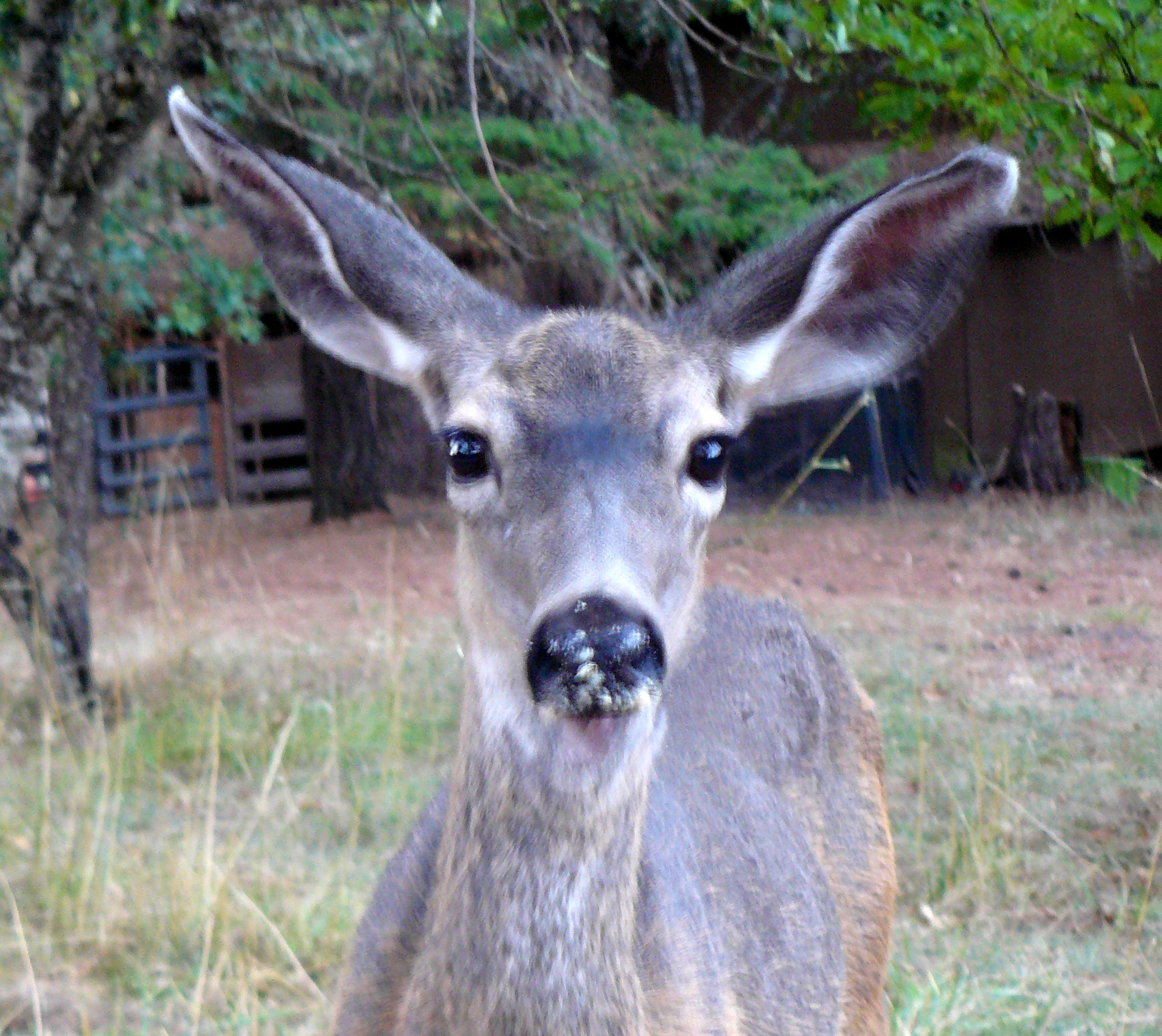
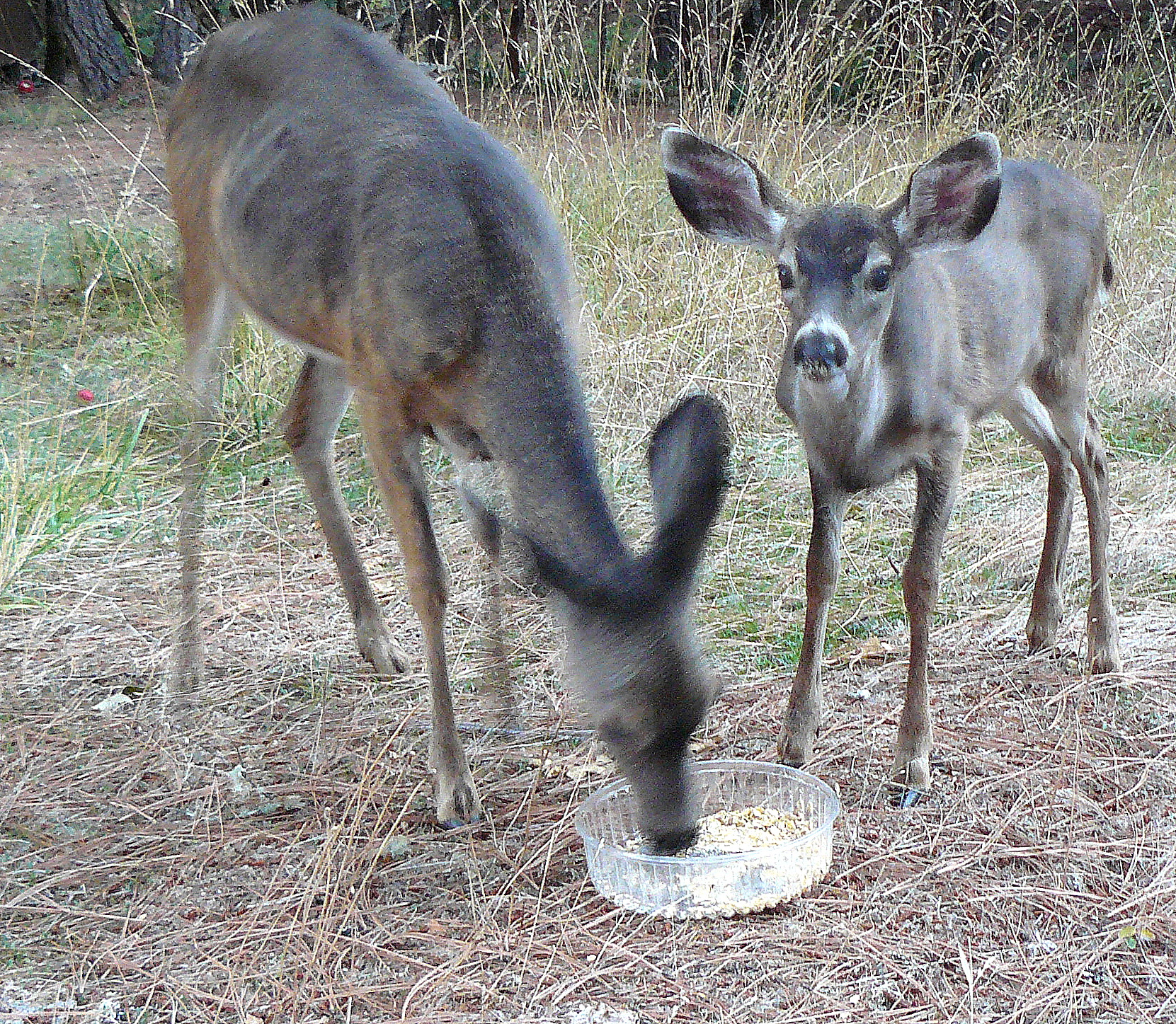
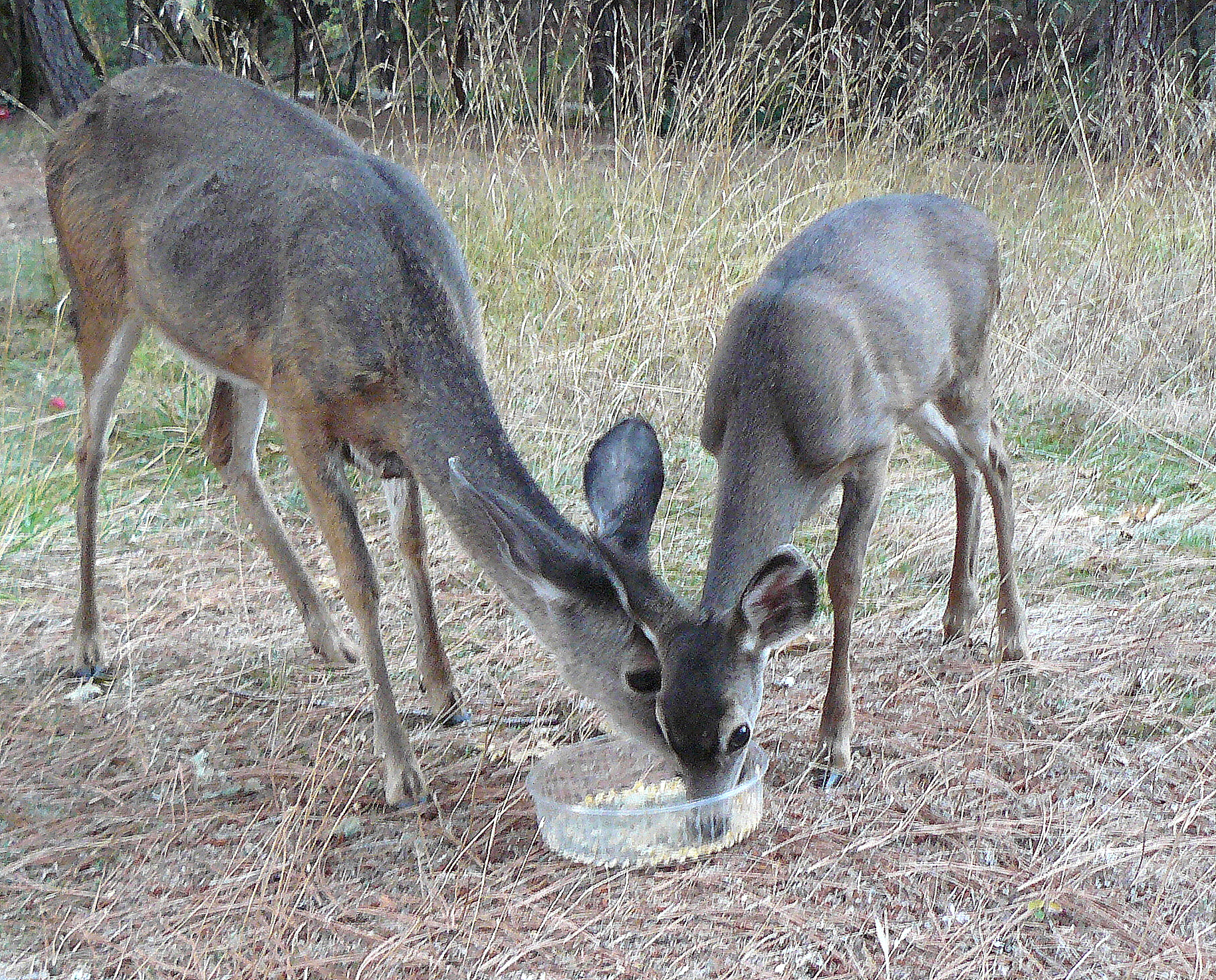
A connection with a wild animal doesn’t get better than this.
You may wonder, dear reader, how I “square the circle” in terms of a post title, Utterly beyond words, and then reaching out to you with the use of words! My answer to that legitimate question is that if I reflected for the rest of my life, I couldn’t verbalise adequately the feelings (but note p.s. at the end of the post) that went through me, and through Jean, when a mother deer and her young fawn, crossed the boundary between their wild, animal world and our human world.
This is what happened.
Last Sunday afternoon, around 4pm, I was pottering around the area of fruit trees just above our stables. We were fully aware that deer were coming in to our property to eat fallen apples as many times we had caught a glimpse of them through a window.
Anyway, on this particular afternoon outside by the stables, I noticed a deer eating some fallen apples and, somehow, picked up the idea that this gorgeous, wild animal was not stressed-out by me standing there looking at her from some twenty feet away.
After a few minutes of just watching, I quietly went across to the garage where we keep a bag of cob, or cracked corn, that we use to feed the deer during tough winter times. I collected a small amount in a round plastic tray and went back into the orchard area and sat with my back against the trunk of an old oak tree, spread my legs apart and placed the tray with the cob in between my knees.
The mother deer was still hunting around for fallen apples but within a couple of minutes looked across at me, clearly smelling the cob.
Slowly but steadily the beautiful creature came towards me and, miracle of miracles, trusted me sufficiently to eat from the tray. Her head was well within arm’s reach of me!
I was totally mesmerised by this beautiful, fragile, wild animal, head down, eating cob less than three feet from my face! I had the urge to touch her.
Slowly, I reached forward and took a small handful of the cob from the tray and with my other hand pulled the tray to one side. My hand with the cob was fully outstretched; my heart was whispering to the deer that I would never, ever harm her.
Softly, gently the deer reached towards me and nibbled the cob from my left hand.
Later on, when I relayed this incredible event to Jean, I said that if it was at all possible we must try and take a photograph of a wild deer feeding from our hands.
Moving on to Monday afternoon, camera ready if necessary, we kept an eye out for the return of the deer. There was no sign of her. Looked as though it wasn’t going to happen.
Then just before 7pm, I looked up from my desk and there, just outside the window, was the deer. But even better, this time the mother was accompanied by her young fawn.
I grabbed the camera and quickly told Jean to meet me outside with a refill of cob in the same plastic tray. We both sat down on the flat concrete cover of the septic tank; me with the camera, Jean with the tray of cob.
Over to the photographs! The daylight was fading fast and I was hand-holding the camera, thus these are not the sharpest of pictures. But so what!
The mother deer not even startled by the sound of the camera shutter!
oooo
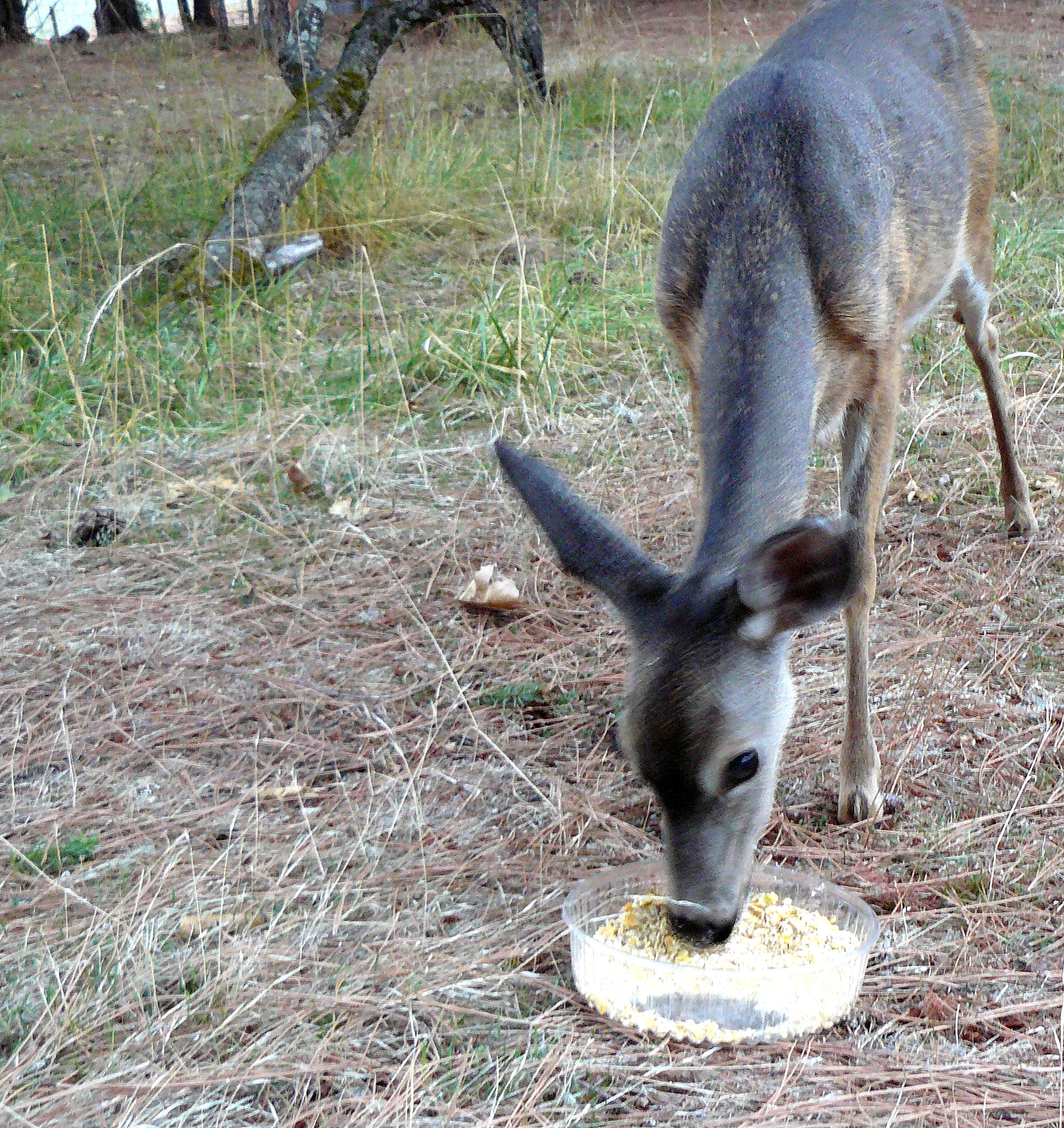
Mother deer reaches down to feed; the tray is about three feet in front of Jean and me.
oooo
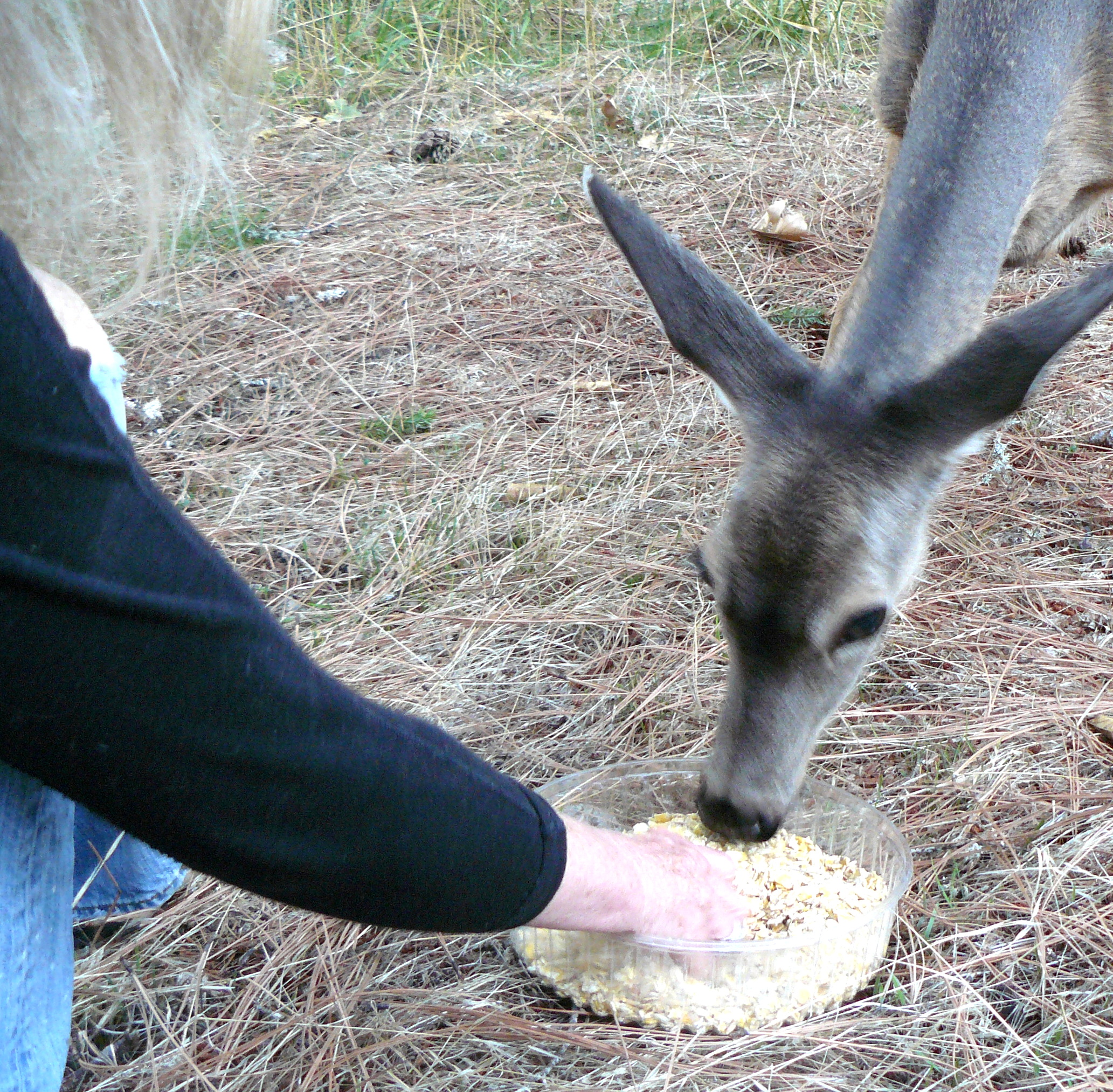
Jean reaches forward and gently draws the tray closer to us. Mother deer continues to feed.
oooo
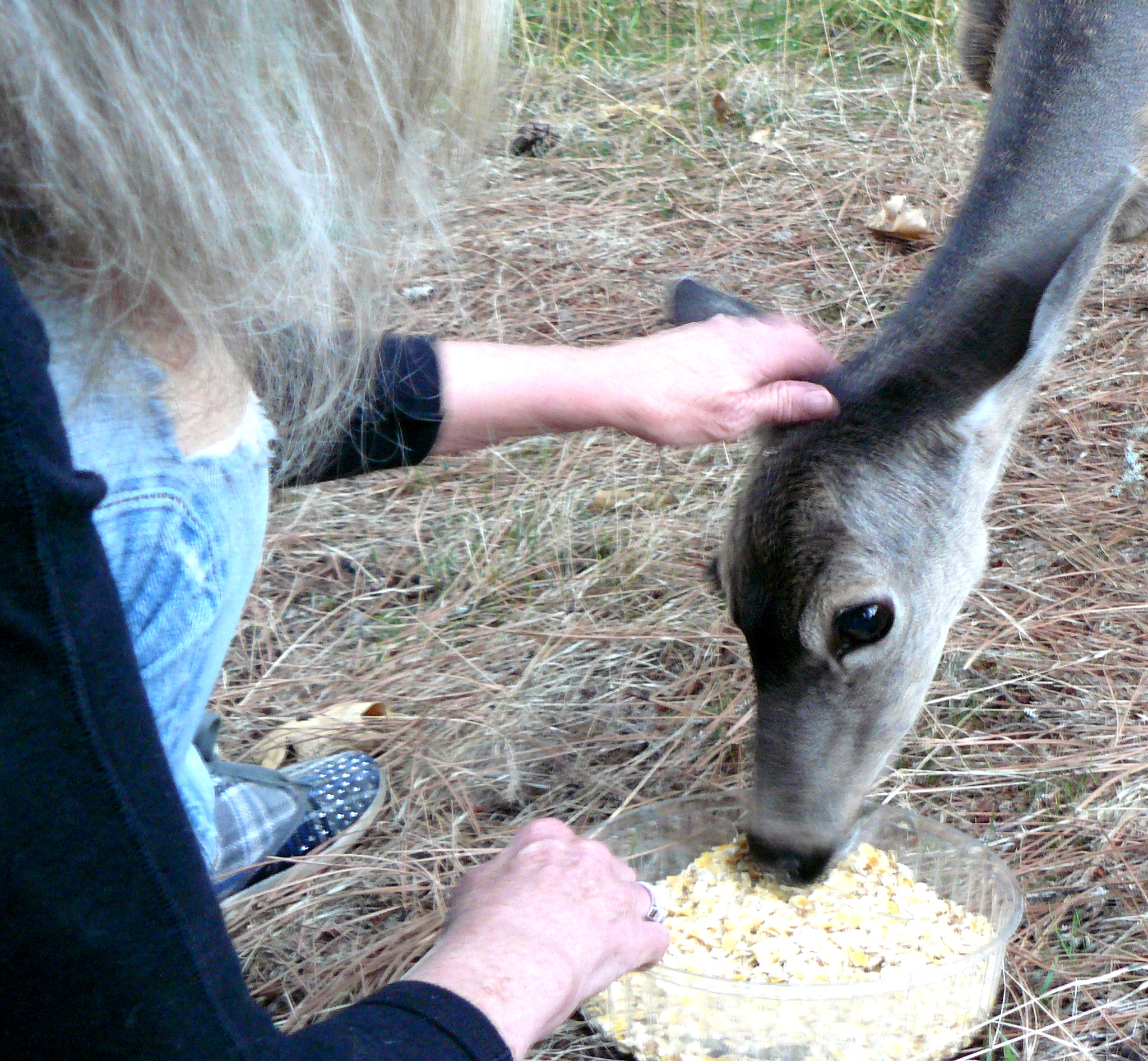
Then, unbelievably, the wild deer continues feeding as Jean fondles the deer’s head and neck.
oooo
The trust between the deer and Jean then enabled the deer to feed from Jean’s hand.
oooo
There was a rustle in the leaves some twenty feet away and we saw the fawn watching her mother feeding on the cob. Jean pushed the tray away, just by a few feet, and the fawn came right up to her mother.
oooo
The culmination of the most magical of experiences: mother deer and her fawn eating together some three feet in front of us.
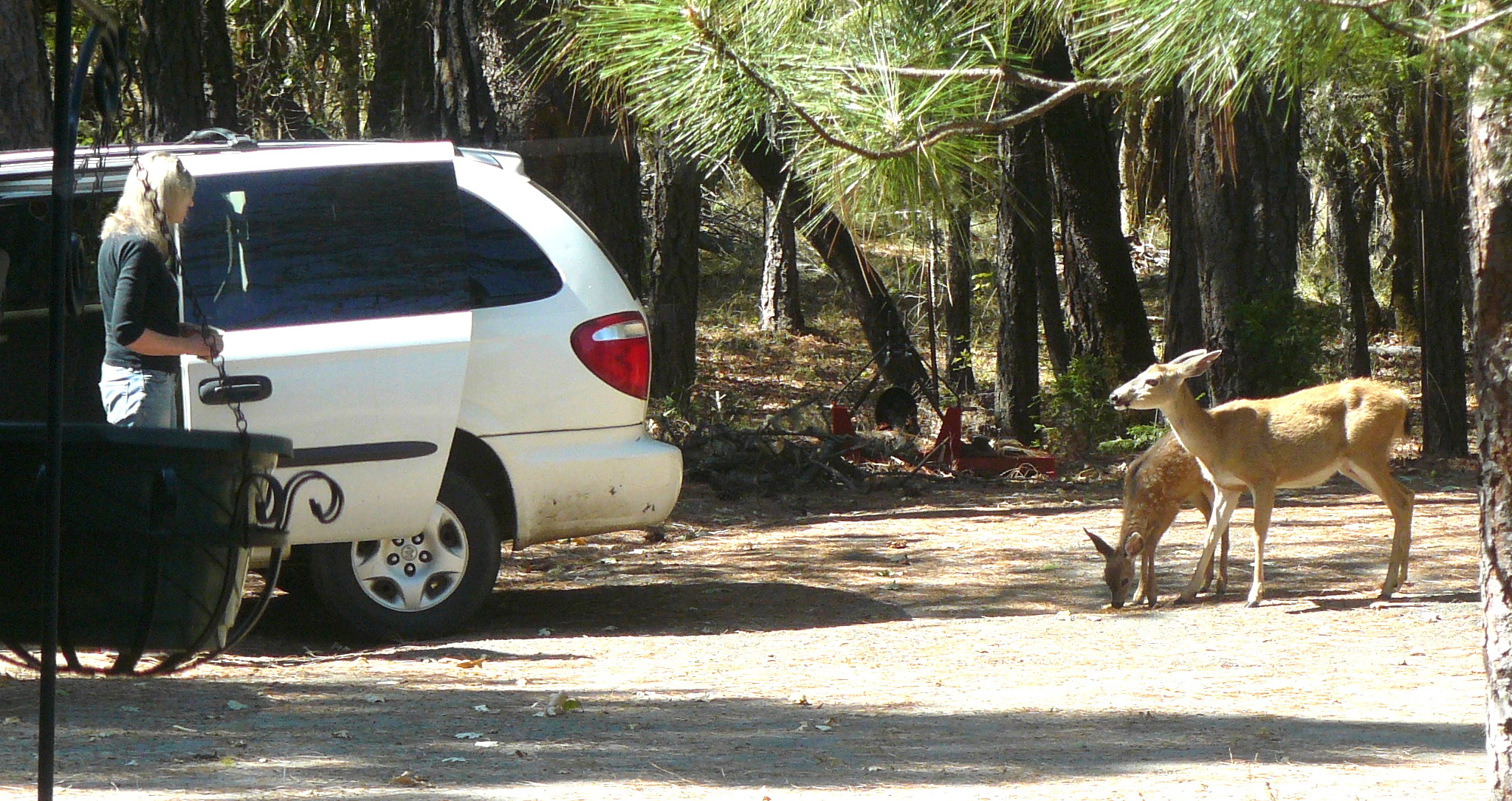
When I published my post Space for Nature a little over a week ago, a post that included a photograph of two deer some thirty feet from Jean’s car, never in my wildest dreams could I have imagined what took place last Tuesday afternoon.
Words truly do seem inadequate.
P.S. It is at times like this that we need poetry. So how about it: Sue?Kim? How would you describe in poetry what Jean and I experienced?
The wonderful BBC science programme, BBC Horizon, recently showed a fascinating programme entitled: Is your Brain Male or Female? The programme is introduced on the Horizon website:
Dr. Mosley and Prof. Roberts.
Dr Michael Mosley and Professor Alice Roberts investigate if male and female brains really are wired differently.
New research suggests that the connections in men and women’s brains follow different patterns, patterns which may explain typical forms of male and female behaviour. But are these patterns innate, or are they shaped by the world around us?
Using a team of human lab rats and a troop of barbary monkeys, Michael and Alice test the science and challenge old stereotypes. They ask whether this new scientific research will benefit both men and women – or whether it could drive the sexes even further apart.
Now I haven’t a clue as to how long this fascinating programme will remain on YouTube, but if you aren’t in the UK or don’t have access to the BBC iPlayer then don’t hesitate to watch it now.
Essentially, science shows that the ‘hard-wired’ differences are minute and the vast bulk of the preferences between the genders, trucks versus dolls, for example, is subtle conditioning from parents and the wider world; for instance, advertisements.
One thing that did jump ‘off the page’ at me was the evidence supporting how malleable or plastic is the brain. In other words, we are never too old to learn.
As if to reinforce that aspect of the flexibility of our brain, just yesterday morning I read an item on the BBC News website about memory.
As someone whose memory is a long way from where it used to be, this item really caught my attention:
Are there ways to stop yourself losing your memory? The latest brain research suggests there’s hope for the forgetful…
Memory loss has to be one of our biggest fears. Names, words, facts and faces – nothing is spared.
As the latest video from the Head Squeeze team describes above, mental deterioration was once thought to be an inevitable consequence of ageing, thanks to the steady erosion of our brain matter: we lose about 0.5% of our brain volume every year. The hippocampus – the region responsible for memory and learning – was thought to weather particularly badly; by the time we are 90, many of us have lost around a third of its grey matter.
Fortunately, recent research has shown that the brain is not concrete, but certain regions can adapt and grow. In 2000, a study of London taxi drivers, for instance, showed that the 4-year training of London’s 25,000 streets showed a remarkable growth in the hippocampus compared to bus drivers who early learnt a fixed number of routes. The scientists think that, by memorising the maps of London, the brain had built many more of the “synaptic connections” that allow the brain cells to communicate with each other. In other words, it may be possible to train the brain to compensate for some of the neural decline that accompanies our expanding waistlines and receding hairlines.
Challenging your brain could be one way of preserving your recollections – though the value of commercial brain training apps is debatable; some experiments seem to show that while people may become a whizz at the games on their screen, the improvements fail to transfer to daily life. But other, more traditional activities – like learning a musical instrument or a second language – do seem to have some protective benefits, at least on short-term recall. Ideally, it is probably best to keep your brain active throughout your life, well before you begin to approach your dotage.
Exercise and a healthy diet are also thought to offer some protection against dementia. As can an active social life – since regular contact with other people is also thought to excite our neurons and preserve our synapses. Ensuring that you regularly get a good night’s sleep helps too.
Of course, nothing can guarantee health and vitality in old age. But these few simple measures might give you the best possible chances of preserving your wits against the ravages of time.
For more videos subscribe to the Head Squeeze channel on YouTube. This video is part of a series produced in partnership with the European Union’s Hello Brain project, which aims to provide easy-to-understand information about the brain and brain health.
If you would like to comment on this video or anything else you have seen on Future, head over to our Facebook page or message us on Twitter.
So it’s clear now.
All I need to do is to learn a new language while in between my training to be the oldest trainee cabbie in London and applying for second violin position at the Royal Philharmonic Orchestra and I’ll never forget anything else in my life.
Oh, anyone seen where I left my car keys?
Or perhaps, harking back to the opening question of the differences between our sexes, I should be closing, thus:
In last week’s picture parade I mentioned that today would be the final set of glorious pictures, courtesy of Su Reeves.
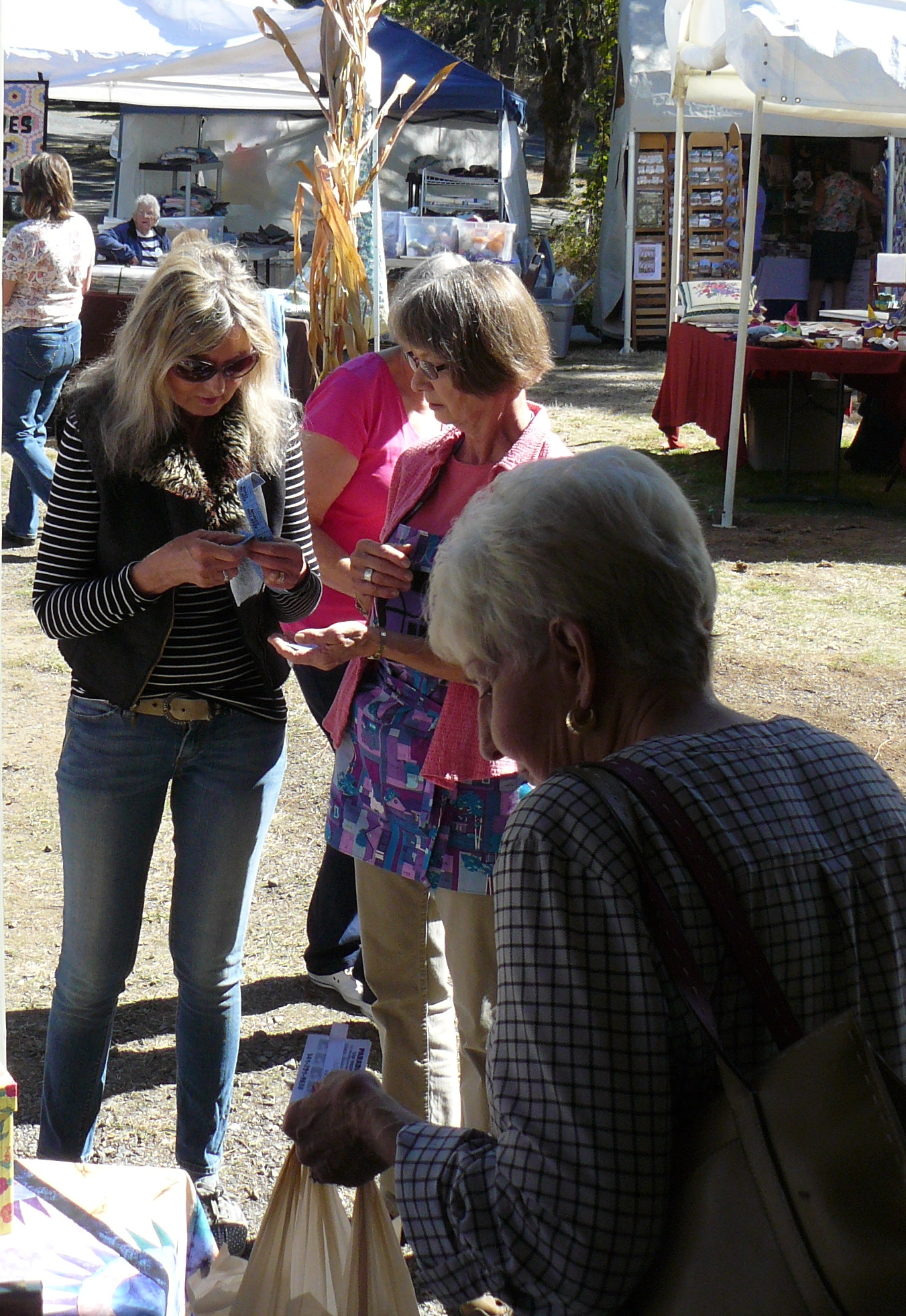
But that was before I realised that Jean and I would be popping in to our local old school house on Friday to enjoy a couple of hours admiring the quilting work on show at this year’s Hugo Ladies Club Quilt Show.
The theme of community has never been far from the pages of this blog and despite the provincial nature of this gathering I wanted to share a selection of photographs with you for today’s picture parade.
oooo
The front entrance of what was once the school in Hugo.
oooo
oooo
Now that’s what I call a school bell!
oooo
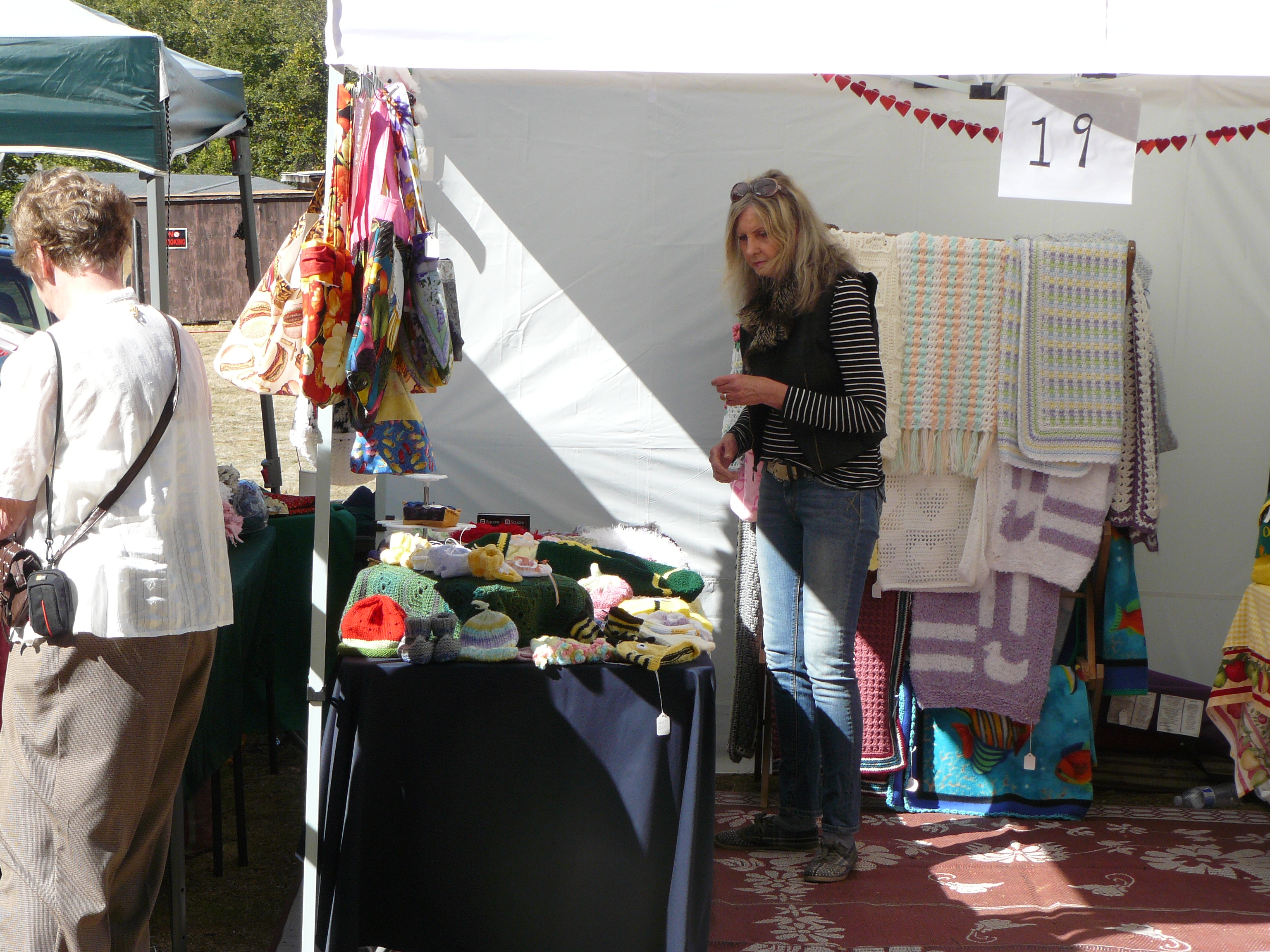
An amazing array and range of items.
oooo
oooo
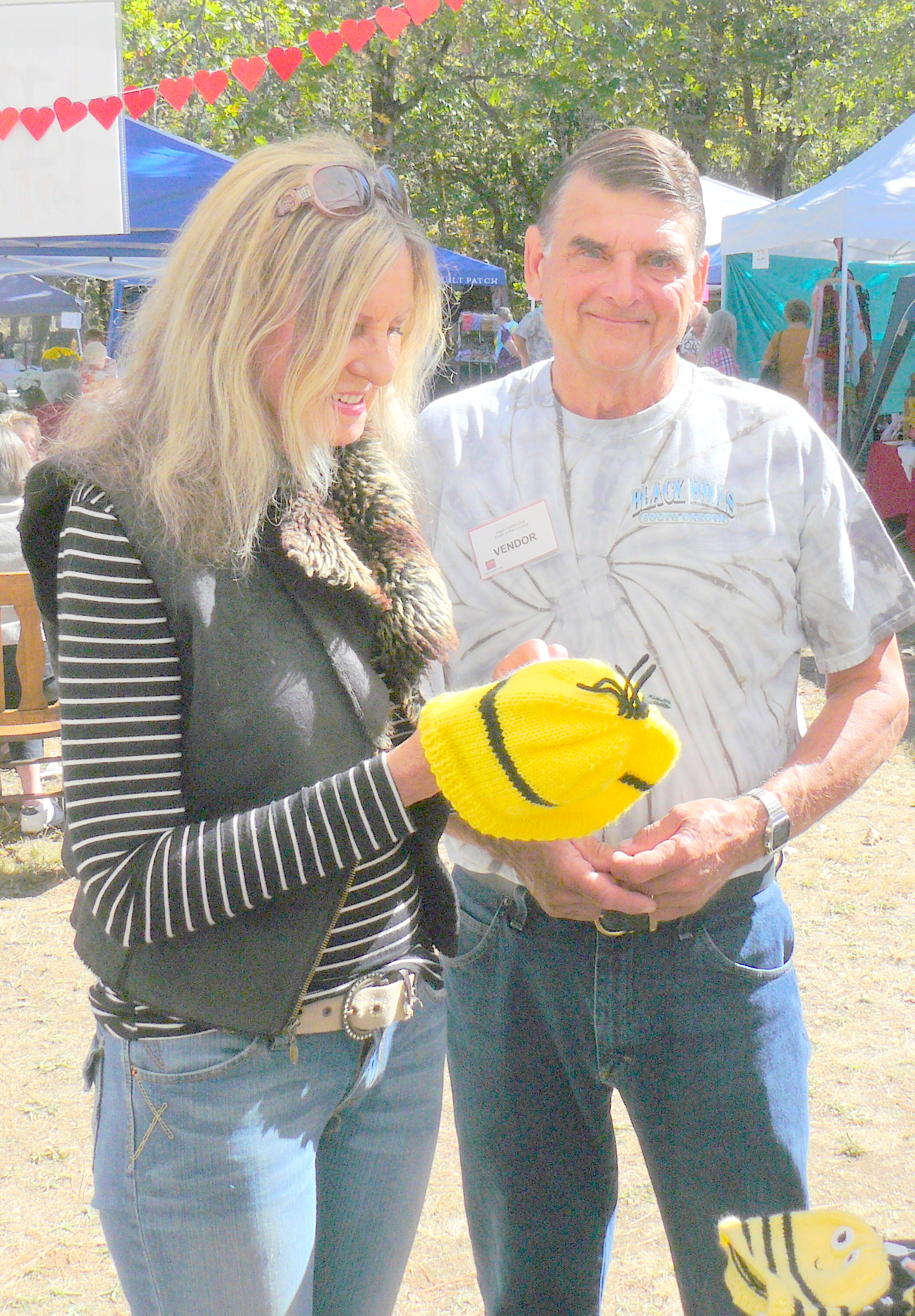
Irresistible to Mrs H.!
oooo
Including a rather fun woollen hat for grandson Morten back in England.
oooo
oooo
Jean chatting to neighbour Janell who is also a keen quilter; as are so many North American women.
oooo
One of Janell’s exhibits at the show.
oooo
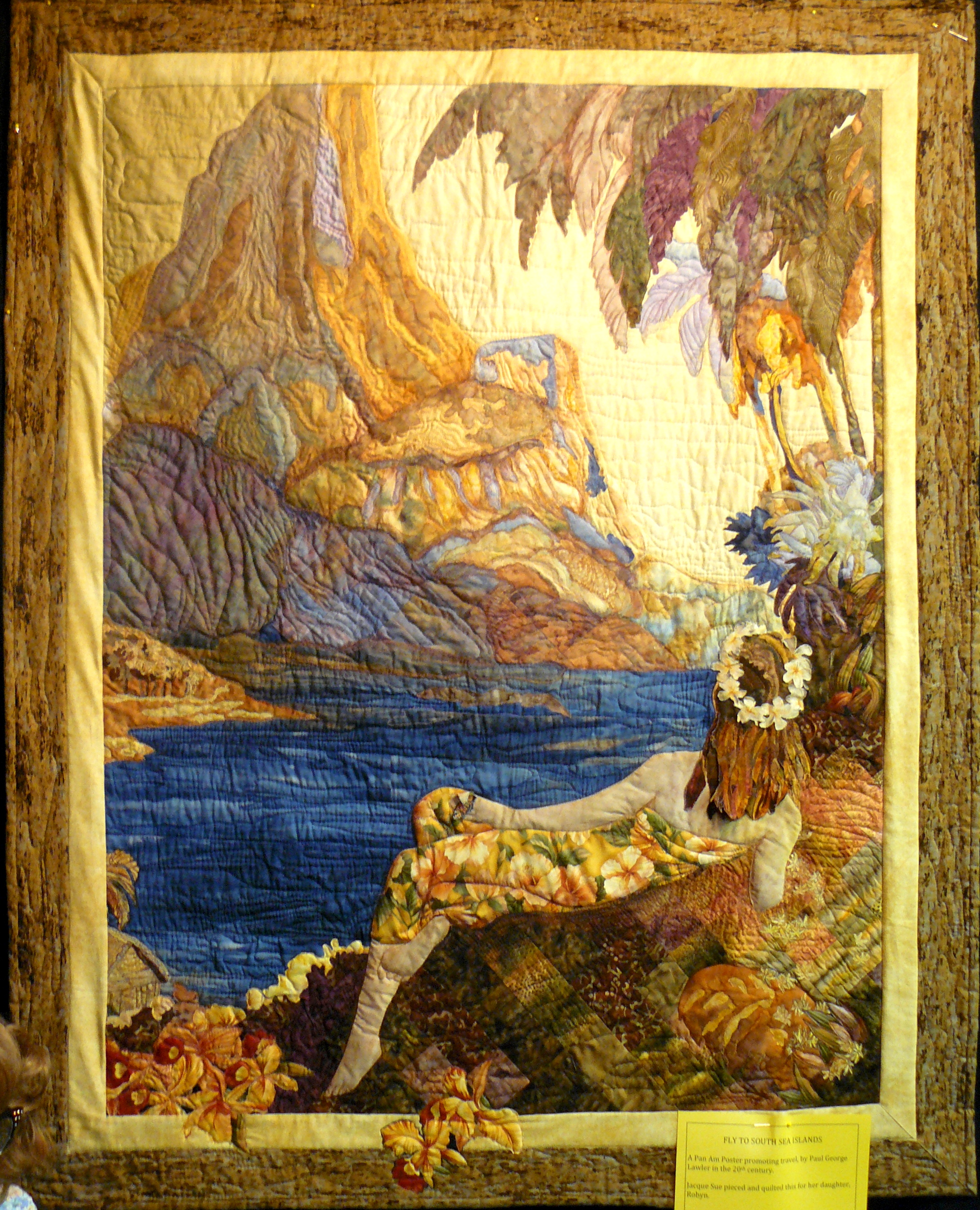
Established quilters are also featured at the show. Here’s a magnificent example from Jacque Sue Harvey.
oooo
oooo
Another quilt from Jacque.
oooo
Final example of Jacque’s work.
Puts the phrase “needle and thread” into a whole new world of meaning!
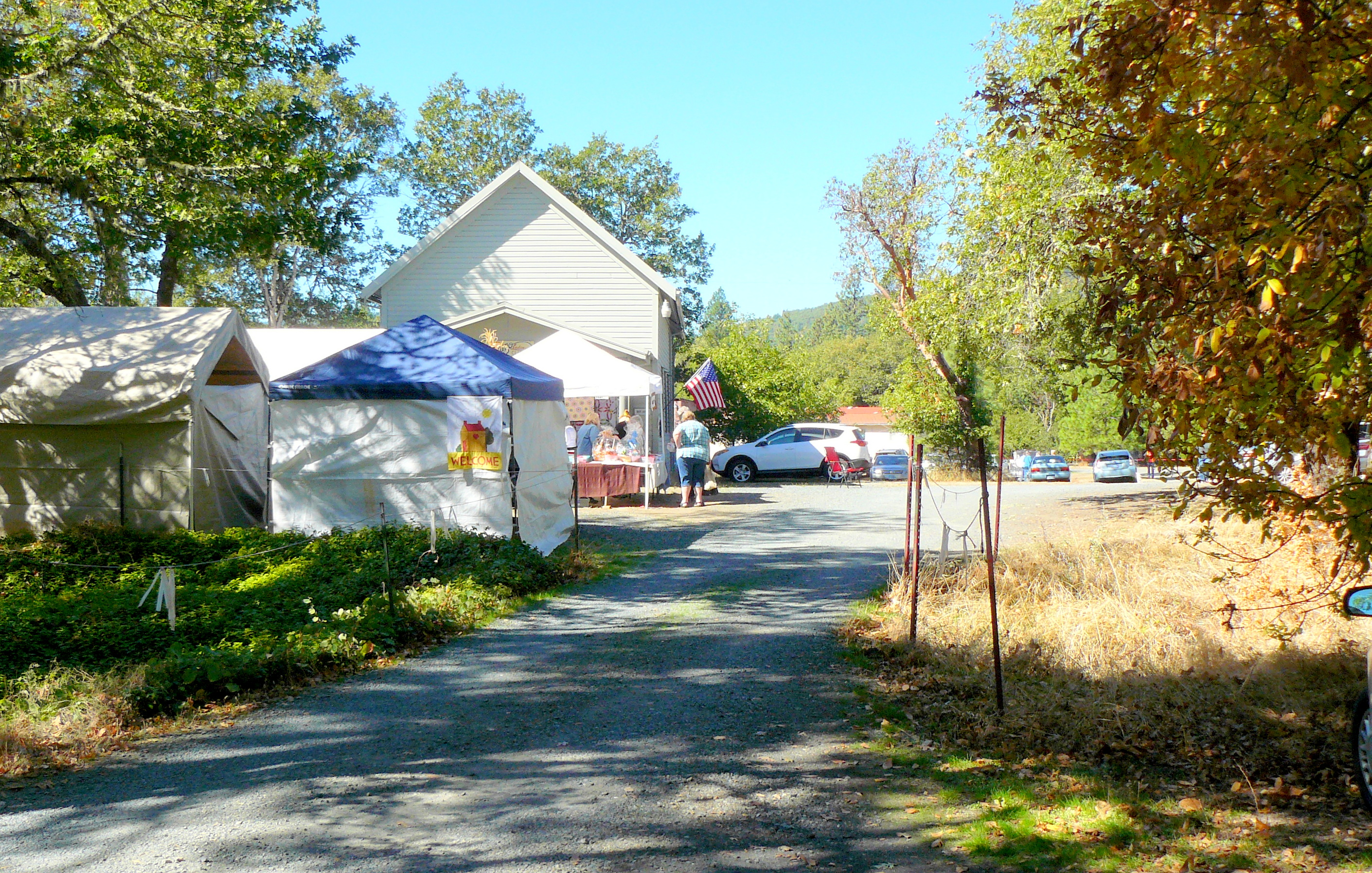
One last look as we drove away!
Maybe I’m becoming a soppy old fool but a couple of hours wandering around this event, just five minutes from where we live, made me feel, strongly so, that Jean and I and all our animals really do belong here!
Australian artist Andy Thomas specializes in creating ‘audio life forms’: beautiful abstract shapes that react to sounds. In this animated short, he visualizes two recorded bird sounds from the archives of the Netherlands Institute for Sound and Vision in Hilversum.
I was blown away when I came across that video. Then a quick search found this place, from where one reads:
Australian multimedia artist Andy Thomas makes bird songs dance with 3D animations. It’s the latest in his line of “audio life forms.”
Using 3D visualization software and other programs, Thomas breaks down photos of insects, orchids, and birds into their composite parts. He then reassembles the images in a sort of collage and builds trippy animations that react, based on rules he’s set, to sound – in this case, archival bird song.
The resulting multimedia visualizations are stunning. They also suggest what you might see if you stood in the forest listening to the birds, while tripping on acid. The psychedelic feel is enhanced by the constant shape-shifting of the form, which in turn encourages you to be hyper-aware of the full range of tweets and trills.
Thomas has been painting and drawing since he was a child. In 1997 he began exploring the realm of digital art, and in recent years started experimenting with “creating a visual fusion between Nature and Technology.” But he also describes this work a bit moralistically “corrupting nature with technology.”
It was then a moment to go across to Andy’s website; which I strongly encourage you to do – the pictures are stunning: trust me! Just try yesterday’s Insect Friday photograph!
Another of Andy’s wonderful images.
Golly, there are some very clever people out there!
We all need a reminder of the many good things happening in our world!
It’s common knowledge that homo sapiens is wired to react to the threat of danger in a rapid manner. But while the danger of a bear or a lion jumping on us from out of the trees is much diminished in the 21st century, our fear-response circuits are still alive and active. One of the fundamental reasons why so much of the media ‘sells’ stories via alarmist headlines.
Thus it was a real delight to come across a magazine with the simple, yet powerful, brand name of YES!
Cover of the current issue of YES!
Even better than coming across YES! was receiving a complimentary subscription for Jean and me! (Thanks John H!) Jean and I took to the magazine immediately. Not only because of an active blog but also because of their support for sharing their content. I quote:
Reprints & Reposts
We want you to pass along the work of YES! Magazine. All we ask is that you follow these easy steps:
Text
For all material designated Creative Commons (cc):
(as used herein, material means the text of the articles, and does not mean titles, images, or illustrations)
Use the same byline information that we have placed at the end of the article. For reposts, keep links intact.
Material is free except for commercial use.
Do not alter, change, or add to the material.
Please notify us that you are reprinting by sending an email to reprints [at] yesmagazine.org.
We have adopted Creative Commons licensing beginning with our issue #44. We readily grant reprint permission for earlier copyrighted material, upon request. Just ask us at reprints [at] yesmagazine.org. We occasionally reprint or excerpt material that is copyrighted by others, and this material is NOT included in the Creative Commons license.
The Buy Nothing Project began as an experimental hyper-local gift economy on Bainbridge Island, WA; in just 8 months, it has become a social movement, growing to over 25,000 members in 150 groups, in 4 countries. Our local groups form gift economies that are complementary and parallel to local cash economies; whether people join because they’d like to quickly get rid of things that are cluttering their lives, or simply to save money by getting things for free, they quickly discover that our groups are not just another free recycling platform. A gift economy’s real wealth is the people involved and the web of connections that forms to support them. Time and again, members of our groups find themselves spending more and more time interacting in our groups, finding new ways to give back to the community that has brought humor, entertainment, and yes, free stuff into their lives. The Buy Nothing Project is about setting the scarcity model of our cash economy aside in favor of creatively and collaboratively sharing the abundance around us.
How does the Buy Nothing Project work? Using the free platform provided by Facebook Groups, Buy Nothing Project members can easily participate with their local group. Our rules are simple: “Post anything you’d like to give away, lend, or share amongst neighbors. Ask for anything you’d like to receive for free or borrow. Keep it legal. Keep it civil. No buying or selling, no trades or bartering, we’re strictly a gift economy.” The transparency of Facebook groups’ design allows our members to see mutual friends they share with relative strangers, and to build trust based on real-life connections visible through personal profile information. This trust allows groups to grow quickly and encourages people to both give freely and ask for what they need; everything from toilet paper roll springs to rides home from the doctor; burial sites for beloved pets to freshly-baked bread and casseroles have been given freely; our members share things mundane and meaningful in equal measure, and throughout it all connect with each other by means of the shared personal stories and chatting encouraged by the platform. We rely on our co-founders’ daily guidance and direction for the development of our nascent culture, assisted by a team of volunteer local administrators who have on-the-ground knowledge of their communities.
Why the Buy Nothing Project? The Buy Nothing Project is brought to you by the creators of Trash Backwards (www.trashbackwards.com,) an app that helps you with the last of the 3 Rs, “Reusing” and “Recycling” the everyday things in your life. The Buy Nothing Project addresses the first of the 3 R’s, “Reduce” as well as the lesser-known Rs “Refuse” and “Rethink.” Participating in a local Buy Nothing Project group allows individuals and communities to reduce their own dependence on single-use and virgin materials by extending the life of existing items through gifting and sharing between group members. Rethinking consumption and refusing to buy new in favor of asking for an item from a neighbor may make an impact on the amount of goods manufactured in the first place, which in turn may put a dent in the overproduction of unnecessary goods that end up in our landfills, watersheds, and our seas. It most certainly creates connections between people who see each other in real life, not just online, leading to more robust communities that are better prepared to tackle both hard times and good by giving freely. The Trash Backwards app, blog articles, and Buy Nothing Project groups are diverting more materials from our landfills and oceans than we can possibly quantify as hundreds of items are rehomed each day.
The Buy Nothing Project Strengthens Communities.
Our Statistics:
With over 25,000 members and growing every day, we have a captive audience in each of our groups. Most members visit the group pages several times a day and many literally spend hours there, commenting, reading posts, while posting their own gifts and wants.
Our Trash Backwards blog, app, and the Buy Nothing Project website garner over 50,000 unique visitors per month. With 7,000 followers on Pinterest and 3,775 “likes” on our Facebook Pages, we have enough sway to bring significant traffic to our sites whenever we upload news or new blog posts.
Funding:
With funding to staff our core project, PR, legal help, design, and developers, the Buy Nothing movement will grow quickly, spreading the joys of gift economy giving and receiving. The world is ready for this experimental model of sharing our possessions and talents to help others, but the endeavor needs its basic operational costs covered to foster the movement even further.
Isn’t that a fabulous idea!
I’m determined to start a local group here in Merlin, Oregon.
My final item of good news, that I’m sure many others read about, was:
A declaration announced as part of a UN summit on climate change being held in New York also pledges to halve the rate of deforestation by the end of this decade and to restore hundreds of millions of acres of degraded land.
The Guardian newspaper released the news, as follows:
UN climate summit pledges to halt the loss of natural forests by 2030
New York declaration on forests could cut carbon emissions equivalent of taking all the world’s cars off the road
PEKANBARU, SUMATRA, INDONESIA – JULY 11: A forest activist inspects land clearing and drainage of peat natural forest located on the concession of PT RAPP (Riau Andalan Pulp and Paper), a subsidiary of APRIL group which is being developed for a pulp and paper plantation at Pulau Padang, Kepulauan Meranti district on July 11, 2014 in Riau province, Sumatra, Indonesia. The Nature Climate Change journal has reported that Indonesia lost 840,000 hectares of natural forest in 2012 compared to 460,000 hectares in Brazil despite their forest being a quarter of the size of the Amazon rainforest. According to Greenpeace, the destruction of forests is driven by the expansion of palm oil and pulp & paper has increased the greenhouse gas emissions, pushing animals such as sumatran tigers to the brink of extinction, and local communities to lose their source of life. (Photo by Ulet Ifansasti/Getty Images)
Governments, multinational companies and campaigners are pledging to halt the loss of the world’s natural forests by 2030.
A declaration announced as part of a UN summit on climate change being held in New York also pledges to halve the rate of deforestation by the end of this decade and to restore hundreds of millions of acres of degraded land.
Backers of the New York declaration on forests claim their efforts could save between 4.5bn and 8.8bn tonnes of carbon emissions per year by 2030 – the equivalent of taking all the world’s cars off the road.
The UK, Germany and Norway have pledged to enter into up to 20 programmes over the next couple of years to pay countries for reducing their deforestation, which could be worth more than £700m.
Companies such as Kellogg’s, Marks & Spencer, Barclays, Nestle, the palm oil giant Cargill, Asia Pulp and Paper and charities including the RSPB, WWF and the International Union for Conservation of Nature (IUCN) have signed the declaration.
The declaration’s supporters say ending the loss of the world’s natural forests will be an important part of limiting global temperature rises to 2C, beyond which the worst impacts of climate change are expected to be felt.
It comes after analysis suggests that land use change such as deforestation accounts for around 8% of the world’s carbon emissions, with carbon dioxide released when trees are felled and burned to free up land for agriculture or development.
“Forests represent one of the largest, most cost-effective climate solutions available today,” the declaration says.
“Action to conserve, sustainably manage and restore forests can contribute to economic growth, poverty alleviation, rule of law, food security, climate resilience and biodiversity conservation.”
Signatories to the declaration are committing to a number of steps to halt forest loss, including backing a private sector goal of eliminating deforestation from producing agricultural products such as palm oil, soy, paper and beef by no later than 2020.
They are also seeking to support alternatives to deforestation which is caused by subsistence farming and the need for wood fuel for energy and reward countries that reduce forest emissions.
Cargill promises to stop chopping down rainforests. This is huge.
By Nathanael Johnson
Everything I’ve been reading about the U.N. Climate Summit had been making me pretty gloomy, until I read about the New York Declaration on Forests.
The first notice was a press release from the Rainforest Action Network informing me that Cargill, the agribusiness giant, had pledged “to protect forests in all of Cargill’s agricultural supply chains and to endorse the New York Declaration on Forests.” Cargill has a big handprint — they have soy silos in Brazil and palm oil plants in Malaysia. So as of now, if you want to carve a farm out of the jungle, you’re going to get the cold shoulder from a company that is a prime connector to world markets.
And this isn’t limited to hot-button crops like soy and oil palm. Here’s what Cargill’s CEO Dave MacLennan said at the U.N.: “We understand that this sort of commitment cannot be limited to just select commodities or supply chains,” said MacLennan. “That’s why Cargill will take practical measures to protect forests across our agricultural supply chains around the world.”
It’s not just Cargill. Kellogg’s, Unilever, Nestle, Asia Pulp and Paper, General Mills, Danone, Walmart, McDonalds, and many other corporations have committed to the New York Declaration on Forests. But, here’s why Cargill is interesting: It’s making a concrete pledge, while the actual declaration is pretty mushy at this point. The declaration calls for ending forest loss by 2030. And, to quote a U.N. brief: “It also calls for restoring forests and croplands of an area larger than India. Meeting these goals would cut between 4.5 and 8.8 billion tons of carbon pollution every year — about as much as the current emissions of the United States.” Or about as much as taking all the cars in the world off the roads — that’s another comparison I’ve seen. The details are supposed to be hammered out in time for the 2015 convention in Paris.
So as much as you, I and hundreds of thousands of others get battered with ‘gloom and doom’ stories every single day, we do need to balance that out from time-to-time with the good things around us. Also every single day.
“Honesty is the first chapter in the book of wisdom.”
Thus spoke Thomas Jefferson who died nearly 200 years ago (April 13th, 1743 – July 4th, 1826).
But some essays that have passed my eyes in the last few days have profoundly disturbed me. Because they illustrate, well to me anyway, the parlous state of wisdom in today’s world. Or better put, the parlous state of truth and integrity in today’s world.
The first essay was the latest one from Tom Engelhardt over at TomDispatch. Normally I republish TomDispatch essays in full, with permission I hasten to add, because they seem such a fine commentary of where we are as a ‘modern’ society. I used the word ‘we’ in the context of a global ‘we’.
But the latest essay was so disheartening that I couldn’t bring myself to republish it in full. Plus, if I am to be brutally honest (in line with the theme of today’s blog post!) I didn’t want to ‘make waves’ as a non-US citizen albeit a valid US resident (Green Card holder). I want to live freely and openly in the USA for the rest of my natural days!
Then in the last twenty-four hours up popped the latest essay from George Monbiot and I was struck by the harmony, the terrible harmony, between Tom and George.
See if you agree with me.
Tom Engelhardt published on Tuesday a TomGram about American Intelligence. It was called Failure Is Success – How American Intelligence Works in the Twenty-First Century.
Here’s a flavour of Tom’s essay.
What are the odds? You put about $68 billion annually into a maze of 17 major intelligence outfits. You build them glorious headquarters. You create a global surveillance state for the ages. You listen in on your citizenry and gather their communications in staggering quantities. Your employees even morph into avatars and enter video-game landscapes, lest any Americans betray a penchant for evil deeds while in entertainment mode. You collect information on visits to porn sites just in case, one day, blackmail might be useful. You pass around naked photos of them just for… well, the salacious hell of it. Your employees even use aspects of the system you’ve created to stalk former lovers and, within your arcane world, that act of “spycraft” gains its own name: LOVEINT.
You listen in on foreign leaders and politicians across the planet. You bring on board hundreds of thousands of crony corporate employees, creating the sinews of an intelligence-corporate complex of the first order. You break into the “backdoors” of the data centers of major Internet outfits to collect user accounts. You create new outfits within outfits, including an ever-expanding secret military and intelligence crew embedded inside the military itself (and not counted among those 17 agencies). Your leaders lie to Congress and the American people without, as far as we can tell, a flicker of self-doubt. Your acts are subject to secret courts, which only hear your versions of events and regularly rubberstamp them — and whose judgments and substantial body of lawmaking are far too secret for Americans to know about.
Then a few paragraphs later, Tom holds up his mirror:
Whatever the case, while taxpayer dollars flowed into your coffers, no one considered it a problem that the country lacked 17 overlapping outfits bent on preventing approximately 400,000 deaths by firearms in the same years; nor 17 interlocked agencies dedicated to safety on our roads, where more than 450,000 Americans have died since 9/11. (An American, it has been calculated, is 1,904 times more likely to die in a car accident than in a terrorist attack.) Almost all the money and effort have instead been focused on the microscopic number of terrorist plots — some spurred on by FBI plants — that have occurred on American soil in that period. On the conviction that Americans must be shielded from them above all else and on the fear that 9/11 bred in this country, you’ve built an intelligence structure unlike any other on the planet when it comes to size, reach, and labyrinthine complexity.
It’s quite an achievement, especially when you consider its one downside: it has a terrible record of getting anything right in a timely way. Never have so many had access to so much information about our world and yet been so unprepared for whatever happens in it.
Tough words indeed!
But it gets worse.
Let’s focus for a moment, however, on a case where more is known. I’m thinking of the development that only recently riveted the Obama administration and sent it tumbling into America’s third Iraq war, causing literal hysteria in Washington. Since June, the most successful terror group in history has emerged full blown in Syria and Iraq, amid a surge in jihadi recruitment across the Greater Middle East and Africa. The Islamic State (IS), an offshoot of al-Qaeda in Iraq, which sprang to life during the U.S. occupation of that country, has set up a mini-state, a “caliphate,” in the heart of the Middle East. Part of the territory it captured was, of course, in the very country the U.S. garrisoned and occupied for eight years, in which it had assumedly developed countless sources of information and recruited agents of all sorts. And yet, by all accounts, when IS’s militants suddenly swept across northern Iraq, the CIA in particular found itself high and dry.
The IC seems not to have predicted the group’s rapid growth or spread; nor, though there was at least some prior knowledge of the decline of the Iraqi army, did anyone imagine that such an American created, trained, and armed force would so summarily collapse. Unforeseen was the way its officers would desert their troops who would, in turn, shed their uniforms and flee Iraq’s major northern cities, abandoning all their American equipment to Islamic State militants.
Nor could the intelligence community even settle on a basic figure for how many of those militants there were. In fact, in part because IS assiduously uses couriers for its messaging instead of cell phones and emails, until a chance arrest of a key militant in June, the CIA and the rest of the IC evidently knew next to nothing about the group or its leadership, had no serious assessment of its strength and goals, nor any expectation that it would sweep through and take most of Sunni Iraq. And that should be passing strange. After all, it now turns out that much of the future leadership of IS had spent time together in the U.S. military’s Camp Bucca prison just years earlier.
All you have to do is follow the surprised comments of various top administration officials, including the president, as ISIS made its mark and declared its caliphate, to grasp just how ill-prepared 17 agencies and $68 billion can leave you when your world turns upside down.
Leaving Tom to offer the following sorry conclusions:
Clearly, having a labyrinth of 17 overlapping, paramilitarized, deeply secretive agencies doing versions of the same thing is the definition of counterproductive madness. Not surprisingly, the one thing the U.S. intelligence community has resembled in these years is the U.S. military, which since 9/11 has failed to win a war or accomplish more or less anything it set out to do.
On the other hand, all of the above assumes that the purpose of the IC is primarily to produce successful “intelligence” that leaves the White House a step ahead of the rest of the world. What if, however, it’s actually a system organized on the basis of failure? What if any work-product disaster is for the IC another kind of win.
Perhaps it’s worth thinking of those overlapping agencies as a fiendishly clever Rube Goldberg-style machine organized around the principle that failure is the greatest success of all. After all, in the system as it presently exists, every failure of intelligence is just another indication that more security, more secrecy, more surveillance, more spies, more drones are needed; only when you fail, that is, do you get more money for further expansion.
Keep in mind that the twenty-first-century version of intelligence began amid a catastrophic failure: much crucial information about the 9/11 hijackers and hijackings was ignored or simply lost in the labyrinth. That failure, of course, led to one of the great intelligence expansions, or even explosions, in history. (And mind you, no figure in authority in the national security world was axed, demoted, or penalized in any way for 9/11 and a number of them were later given awards and promoted.) However they may fail, when it comes to their budgets, their power, their reach, their secrecy, their careers, and their staying power, they have succeeded impressively.
You could, of course, say that the world is simply a hard place to know and the future, with its eternal surprises, is one territory that no country, no military, no set of intelligence agencies can occupy, no matter how much they invest in doing so. An inability to predict the lay of tomorrow’s land may, in a way, be par for the course. If so, however, remind me: Why exactly are we supporting 17 versions of intelligence gathering to the tune of at least $68 billion a year?
So over to George Monbiot. Yesterday, he published an essay in the UK’s Guardian newspaper entitled: Bomb Everyone. I am going to republish this in full, with the kind permission of George.
ooOOoo
Bomb Everyone
Humanitarian arguments, if consistently applied, could be used to flatten the entire Middle East
By George Monbiot, published in the Guardian 1st October 2014
Let’s bomb the Muslim world – all of it – to save the lives of its people. Surely this is the only consistent moral course? Why stop at blowing up Islamic State, when the Syrian government has murdered and tortured so many? This, after all, was last year’s moral imperative. What’s changed?
How about blasting the Shia militias in Iraq? One of them selected 40 people from the streets of Baghdad in June and murdered them for being Sunnis(1). Another massacred 68 people at a mosque in August(2). They now talk openly of “cleansing” and “erasure”(3), once Islamic State has been defeated. As a senior Shia politician warns, “we are in the process of creating Shia al-Qaida radical groups equal in their radicalisation to the Sunni Qaida.”(4)
What humanitarian principle instructs you to stop there? In Gaza this year, 2,100 Palestinians were massacred: including people taking shelter in schools and hospitals. Surely these atrocities demand an air war against Israel? And what’s the moral basis for refusing to liquidate Iran? Mohsen Amir-Aslani was hanged there last week for making “innovations in the religion” (suggesting that the story of Jonah in the Qu’ran was symbolic rather than literal)(5). Surely that should inspire humanitarian action from above? Pakistan is crying out for friendly bombs: an elderly British man, Mohammed Asghar, who suffers from paranoid schizophrenia, is, like other blasphemers, awaiting execution there after claiming to be a holy prophet(6). One of his prison guards has already shot him in the back.
Is there not an urgent duty to blow up Saudi Arabia? It has beheaded 59 people so far this year, for offences that include adultery, sorcery and witchcraft(7). It has long presented a far greater threat to the west than Isis now poses. In 2009 Hillary Clinton warned in a secret memo that “Saudi Arabia remains a critical financial support base for al-Qa’ida, the Taliban … and other terrorist groups.”(8) In July, the former head of MI6, Sir Richard Dearlove, revealed that Prince Bandar bin Sultan, until recently the head of Saudi intelligence, told him: “The time is not far off in the Middle East, Richard, when it will be literally ‘God help the Shia’. More than a billion Sunnis have simply had enough of them.”(9) Saudi support for extreme Sunni militias in Syria during Bandar’s tenure is widely blamed for the rapid rise of Isis(10,11). Why take out the subsidiary and spare the headquarters?
The humanitarian arguments aired in parliament last week(12), if consistently applied, could be used to flatten the entire Middle East and West Asia. By this means you could end all human suffering, liberating the people of these regions from the vale of tears in which they live.
Perhaps this is the plan: Barack Obama has now bombed seven largely-Muslim countries(13), in each case citing a moral imperative. The result, as you can see in Libya, Iraq, Pakistan, Afghanistan,Yemen, Somalia and Syria, has been the eradication of jihadi groups, of conflict, chaos, murder, oppression and torture. Evil has been driven from the face of the earth by the destroying angels of the west.
Now we have a new target, and a new reason to dispense mercy from the sky, with similar prospects of success. Yes, the agenda and practices of Isis are disgusting. It murders and tortures, terrorises and threatens. As Obama says, it is a “network of death”(14). But it’s one of many networks of death. Worse still, a western crusade appears to be exactly what it wants(15).
Already Obama’s bombings have brought Isis and Jabhat al-Nusra, a rival militia affiliated to Al Qaeda, together(16). More than 6,000 fighters have joined Isis since the bombardment began(17). They dangled the heads of their victims in front of the cameras as bait for war planes. And our governments were stupid enough to take it.
And if the bombing succeeds? If – and it’s a big if – it manages to tilt the balance against Isis, what then? Then we’ll start hearing once more about Shia death squads and the moral imperative to destroy them too – and any civilians who happen to get in the way. The targets change; the policy doesn’t. Never mind the question, the answer is bombs. In the name of peace and the preservation of life, our governments wage perpetual war.
While the bombs fall, our states befriend and defend other networks of death. The US government still refuses – despite Obama’s promise – to release the 28 redacted pages from the Joint Congressional Inquiry into 9/11, which document Saudi Arabian complicity in the attack on America(18). In the UK, in 2004 the Serious Fraud Office began investigating allegations of massive bribes paid by the British weapons company BAE to Saudi ministers and middlemen. Just as the crucial evidence was about to be released, Tony Blair intervened to stop the investigation(19). The biggest alleged beneficiary was Prince Bandar, mentioned above. The Serious Fraud Office was investigating a claim that, with the approval of the British government, he received £1bn in secret payments from BAE(20).
And still it goes on. Last week’s Private Eye, drawing on a dossier of recordings and emails, alleges that a British company has paid £300m in bribes to facilitate weapons sales to the Saudi National Guard(21). When a whistleblower in the company reported these payments to the British ministry of defence, instead of taking action it alerted his bosses. He had to flee the country to avoid being thrown into a Saudi jail. Smirking, lying, two-faced bastards – this scarcely begins to touch it.
There are no good solutions that military intervention by the UK or the US can engineer. There are political solutions in which our governments could play a minor role: supporting the development of effective states that don’t rely on murder and militias, building civic institutions that don’t depend on terror, helping to create safe passage and aid for people at risk. Oh, and ceasing to protect and sponsor and arm selected networks of death. Whenever our armed forces have bombed or invaded Muslims nations, they have made life worse for those who live there. The regions in which our governments have intervened most are those which suffer most from terrorism and war. That is neither coincidental nor surprising.
Yet our politicians affect to learn nothing. Insisting that more killing will magically resolve deep-rooted conflicts, they scatter bombs like fairy dust.
21. Richard Brooks and Andrew Bousfield, 19th September 2014. Shady Arabia and the Desert Fix. Private Eye.
ooOOoo
Two journalists reporting from two very different countries separated by thousands of miles.
Yet together they illustrate the very low regard for truth, for truth and integrity I should add, held by two major western Governments. That old saying of never underestimate the power of unintended consequences is hammering inside my head.
What very strange times we live in just now.
The sooner the concepts of truth and integrity are adopted by those with the power, money and influence, the sooner this world will turn away from what looks eminently like future self-destruction.
Let’s turn to dogs for some examples of beautiful ways of living.
Recognising the incredible contribution made to the world of modern communications.
This blog runs using software called WordPress. The WordPress community is vast. “Over 409 million people view more than 15.8 billion pages each month. Users produce about 43.7 million new posts and 58.8 million new comments each month.” Millions and millions of websites run under WordPress.
No mistake it is a community in every sense of the word. I feel fortunate and humbled to have made so many friends across the ‘bloggersphere’ despite not having met a single person face-to-face. I just can’t imagine a life without my circle of followers and without me, in turn, following so many other bloggers.
Thus it seems entirely appropriate to publish in full a news item sent to all WordPress bloggers in the last twenty-four hours.
ooOOoo
Engaged, Inspired, and Ready to Build a Better Web
One week every year, the entire Automattic staff gets together to connect, work, and laugh. And then, of course, we blog about it! Could you be blogging about your experience with us in 2015?
Automattic is a distributed company — we all work from wherever we are. Right now, “where we are” is 197 cities around the world: New Orleans, USA. Montevideo, Uruguay. Tokyo, Japan. Vilnius, Lithuania.
Once a year, we get together somewhere in the world to meet, work alongside, learn from, and laugh with one another in an exhilarating, exhausting week called the Grand Meetup. This year, 277 Automatticians descended on Park City, Utah, for seven days in mid-September.
Chris Hardie @ChrisHardie
I flew across the country to spend time in a mountain lodge with a bunch of strangers I met on the Internet. And they are wonderful.
We introduced ourselves to new colleagues, reconnected with coworkers we haven’t seen since last year, and worked on ways to make WordPress.com even better. And of course, lots of us blogged about the experience, in words and images.
We were blown away by the brilliance and generosity of our colleagues…
I’m grateful to have met so many Automatticians from around the world who brought such kindness, curiosity, patience, fierce intelligence, creativity and humor to the time we had together. I’m grateful to have learned about their hobbies, families, personal journeys, quirks, pet peeves, amazing skills, unmitigated geekiness, and brilliant senses of humor.
– VIP Wrangler Chris Hardie
We marveled at the range of conversations we had, from the sublime to the absurd…
Here are some of the things I talked about this week:
Scottish independence
Taylor Swift
Goats
Sexism
My children
Other people’s children
Infertility
Tattoos
Swing dancing
Whiskey
Javascript
Waffles (lack thereof)
VideoPress
Houston
Leadership
Fake morning talkshows
Mario Kart
Happiness Engineer Zandy Ring
We soaked in the natural beauty of Utah…
Early morning takeoff, by yours truly.
And some of us got up close and personal with the wide Utah sky…
Happiness Engineer Jeremey DuVall realizes he’s just jumped out of an airplane.
We learned from one another, and had fun doing it…
I learned how to analyze data in Python with Carly, and went skydiving with Prasath. After discussing common security vulnerabilities with Anne, Cami and I plotted a podcast about absolutely nothing, and recorded part of our first episode…
If you asked me four years ago if I thought it were possible to enjoy working, I’d be dubious. If you asked me whether one could ever genuinely love and respect all their coworkers, I’d hesitate.
Over the past four years, the people of Automattic have demonstrated to me that it’s possible to do work you love with people you love. It’s not common — not yet — but it’s possible.
– VaultPress Eclectic Happiffier Chris Rudzki
We burned the midnight oil…
We worked, we played, we ate, we drank, we slept very little. We tried to make the world a better place, and if you think that’s me being dramatic you don’t know the people I have the honor of working with.
On the final day, Automattic founder Matt Mullenweg led us in a toast that summed up the reason we’re all here…
I’m really grateful that I get to work with the people I do, and on the problems that we work on together. It’s far from easy, in fact each year brings new challenges and I make mistakes as often as not, but it is worthwhile and incredibly fulfilling. A few hours ago I gave a closing toast and teared up looking around the room. So many folks that give their passion and dedicate themselves to jobs both large and small, visible and unseen, to help make the web a better place.
– WordPress co-founder and Automattic CEO Matt Mullenweg
And when the week was over, heading home was bittersweet…
This morning was filled with so many hugs (and maybe a tear or two). I told myself that I was looking forward to returning home. To my own bed (although the sleep I got in the silence of the Park City night was the best I may have ever experienced). To regular exercise and home cooking. To the routine of my everyday life. And I was looking forward to that. And even though I knew I would miss my colleagues (it’s happened every time I return from a trip), the weight of the fog of sadness still surprises me when it descends.
I read their blogs. I like their Facebook posts. I retweet their Tweets. And I miss them.
– Happiness (w)Rangler Lori McLeese
If you think you might want to work with this motley crew and join us in 2015’s mayhem…
… we’re hiring. (And yes, you’ll get to make up your own job title, too.)
ooOOoo
Seriously, if you think there is any way you can contribute to the success of WordPress, then do go across to this page – from where I note the following employee benefits:
BENEFITS
Open vacation policy (no set number of days per year). We encourage our employees to take the time they need to take vacation, develop interests, and spend time with friends and family.
Health, dental, & vision insurance for US and Canadian employees, their spouses or domestic partners, and children.
401(k) plan and match for US employees and RRSP matching plan for Canadian employees.
We cover all costs of company travel.
We happily provide or reimburse hardware and software you’ll need, as well as books or conferences that promote continued learning.
Home office setup stipend, and co-working office allowance.
I was mulling over the fact that tomorrow sees the start of October and, inevitably, pondering what sort of winter we are in for. At the same time, I was reflecting on how beautiful this last month has been. Wonderful ‘easy-on-the-body’ temperatures, an inch or more of much-needed rain, wonderful Autumn colours; all being shared for the last ten days with our guests: Reggie and Chris.
I was unsure what to write about to reflect my thoughts and was then saved by the September Digest from Transition Culture back in the old country. I started to read it and immediately wanted to share it with you; dear reader.
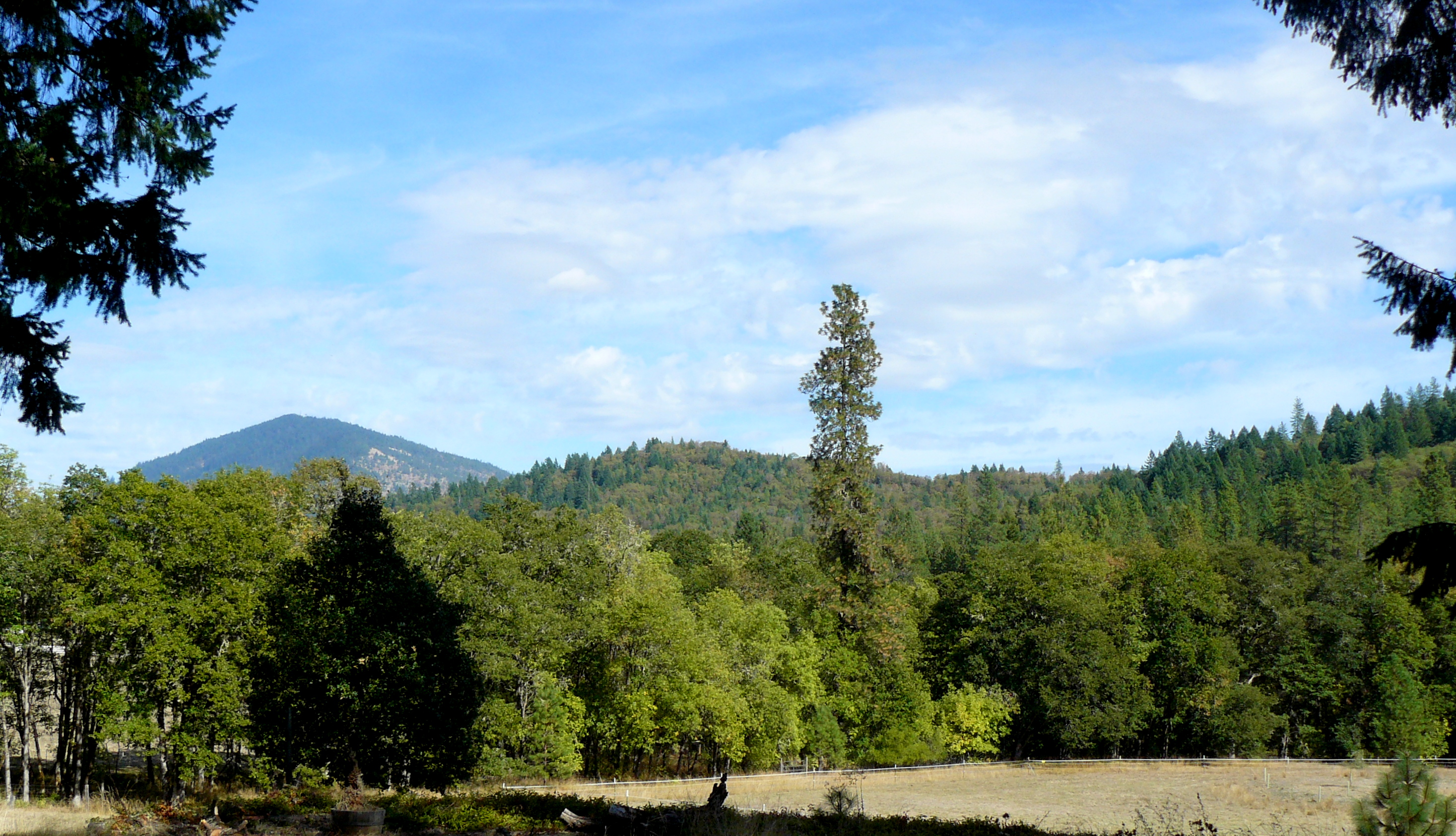
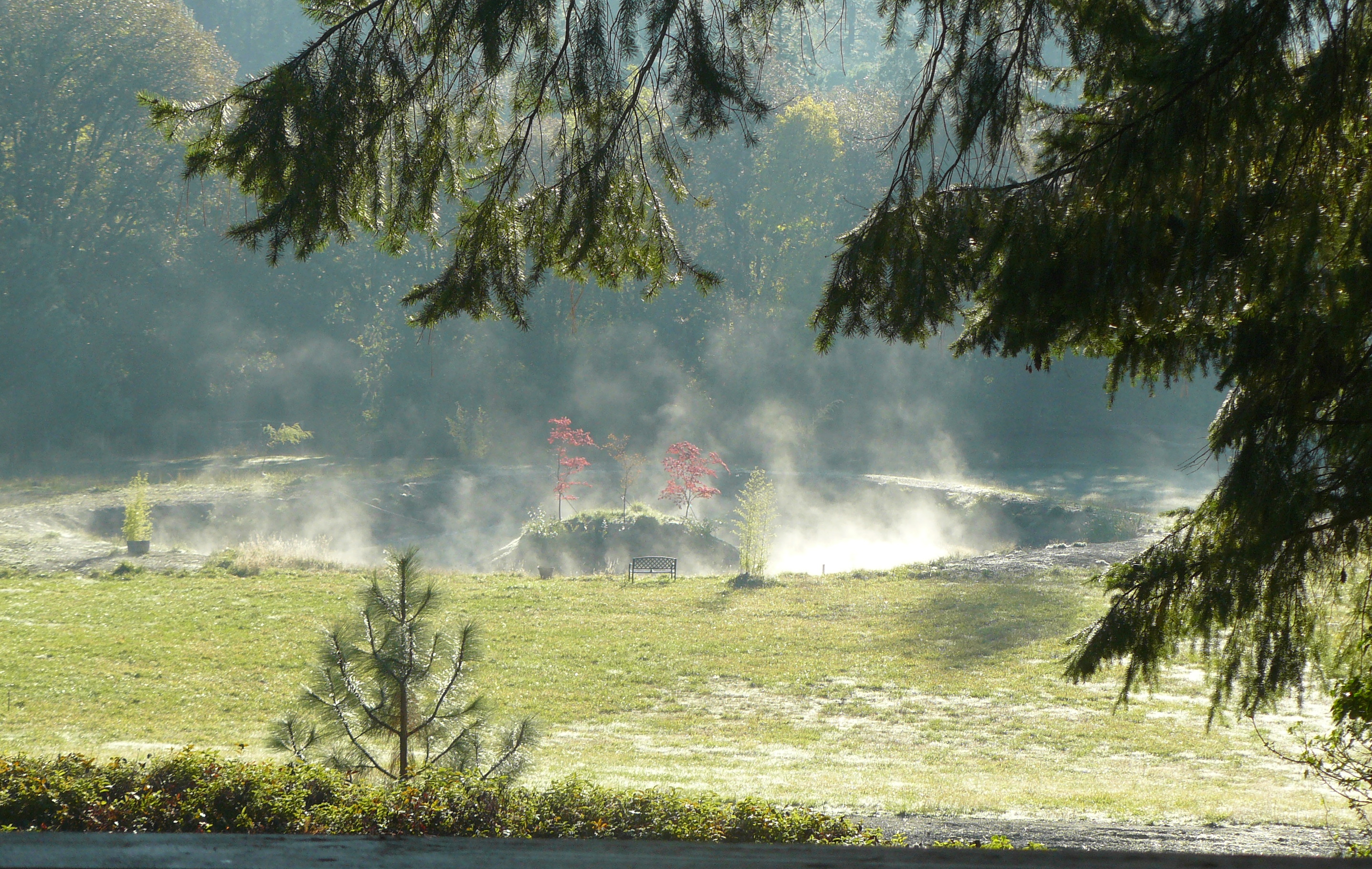
First, to set the tone, here is a photograph taken just before I sat down to write today’s post.
Space for Nature – all around us!
ooOOoo
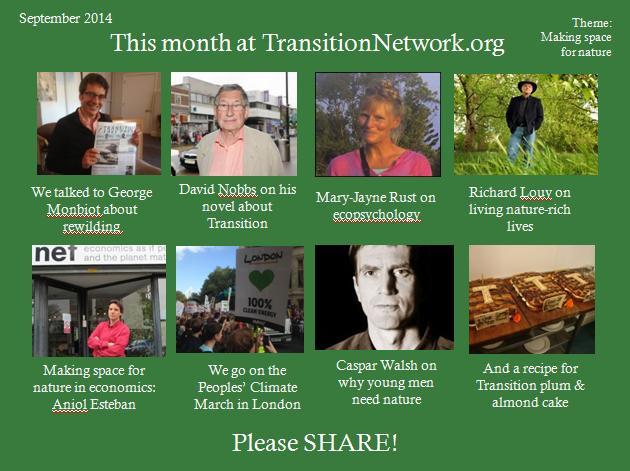
Transitioners’ Digest (September 2014)
This month we have been exploring the theme of “Making Space for Nature” from a wide range of different angles. We started with an editorial piece which argued that one of the key things that nature can bring our work doing Transition is a sense of wonder. Something to do with glowworms apparently. We grabbed George Monbiot before he went on stage and talked about his book Feral and the concept of rewilding.
Writer and founder of the charity Write to Freedom, Caspar Walsh, talked about the vital role nature can play in the healing of young men. “She, it, whatever it is”, he told us, “works on them and softens them up so I don’t have to do all the work”. Ecopsychologist Mary-Jayne Rust talked about the impacts being separated from nature can have on us, and the benefits we get from making space for it. “When was the last time you heard of an activist going on a pilgrimage for eight months?” she asked.
Isabel Carlisle introduced us to Community Charters, and the potential they have for making space for nature at the community scale. Richard Louv, author of Last Child in the Woods, and of the theory of Nature Deficit Disorder, talked to us via Skype. “If we’re not careful”, he told us, “environmentalists and others who care about the future of nature will carry nature in their briefcases, not in their hearts”. Mike Jones, who builds natural play spaces for kids, talked about the need to make space for “the primodial nature of kids”.
Aniol Esteban of New Economics Foundation reflected on why we need to make space for nature in economics. He told us:
Nature contributes to our mental health. It delivers mental health benefits and physical health benefits. It delivers a wide range of societal benefits. It contributes to our education. It can help reduce levels of crime. It can help urban regeneration. There is a huge range of areas and ways in which nature contributes to our wellbeing – individual wellbeing and collective wellbeing.
David Nobbs
Hayley Spann, one of the participants in One Year in Transition, reflected on “what nature taught me”. We had a review of the first mainstream novel about Transition, The Second Life of Sally Mottram by David Nobbs (see right). We also talked to the author about where the idea came from, and what makes a good story. We had a recipe for “Transition Plum and Almond Cake”. Mark Watson reflected on the importance of ‘Making Space for Flowers’, and the many ways in which his Transition initiatives, Sustainable Bungay, create opportunities for people to encounter and benefit from nature.
Rob Hopkins reflected on how different our approach to managing water and drought would be if we took forests as the model on which we based it. He also responded to a critique of Transition by Ted Trainer and explored why the language we use to talk about this stuff really matters. He also went on the Peoples’ Climate March in London and reflected on how that was.
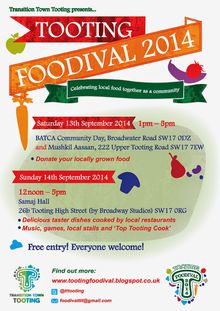
We heard from Transition initiatives about their experience of making space for nature in what they do. Hilary Jennings of Transition Town Tooting talked about the Tooting Foodival. Chris Bird wrote about the Transition Homes initiative in Totnes. Cara Naden discussed the many ways in which Transition Langport make space for nature. “I believe we all have an inherent bond with nature”, she wrote. “It makes us feel happy and healthy and makes us feel we are doing something positive and worthwhile for the benefit of wildlife, each other and ourselves”.
A very rich and thought-provoking month we hope you’ll agree. Our theme for October will be Transition and development. We hope you enjoy that too.
ooOOoo
(Note: there were many links in the original digest so do please check there as well.)
Can’t resist a couple more pictures from home to underline how we feel so strongly about having space for nature.
oooo
A misty October morning from a year ago.
oooo
This is what making space is all about!
Let’s all have a great month of October embracing the natural world around us howsoever it can be done.
The event was the 2014 US Sand Sculpting Challenge and 3D Art Exposition held recently in San Diego, California.
In any case, I wasn’t going to reblog the whole article because it’s much, much better if you go and read about the talented artists directly. Artists who produced this:
and this:
not overlooking this:
or this:
No, you absolutely have to drop into this place and read about these most talented artists.
Now how far is it to the nearest beach? …..
Must start practising …. wonder how long it would take me to build this:
I guess that it would be difficult to find a greater change in topic than going from America’s relationship with war to the secret of happiness! But that’s what’s on offer today!
I don’t want to brag, but while I was on sabbatical I discovered the secret to happiness.
The crazy thing is, it was lying right there in the open. It’s been revealed dozens, hundreds of times over the course of human history. It’s revealed every day in ordinary human affairs, if you’re paying attention.
What is it? Let’s ask George Vaillant.
Vaillant is a Harvard psychologist who has been working for over 40 years on the Grant Study, one of the longest-running longitudinal studies in scientific history. It began tracking a set of 268 (white, physically and mentally healthy) men when they were sophomores at Harvard in 1939 and has been tracking them ever since, for 75 years, with exhaustive regular physical and psychological tests. It has followed them as they’ve grown, gone to war, married, divorced, worked, been fired, gotten sick, found God, and so on. (The ups and downs of the study’s history are recounted in this classic Atlantic piece, one of my favorite magazine stories ever.)
Vaillant has spent most of his adult life analyzing the data from the study, attempting to determine which factors most reliably correlate with well-being. He’s probably studied happiness longer, and in greater depth, than any other single human being. So what is it, George Vaillant? What’s the secret to a happy life?
“That the only thing that really matters in life are your relationships to other people.”
Wow. That’s pretty straightforward. But can you boil it down just a little more?
“Happiness is love. Full stop.”
All right then! There you have it. The secret to happiness, revealed. It’s love.
If you want to break it down a little more, there’s plenty of social science research on it. We live longer, healthier, happier lives when we are at the center of overlapping social networks, when we have a devoted life partner, close family and friends (and pets), extensive “weak ties” with acquaintances and colleagues, peer and professional networks that value our skills, and a sense of autonomy balanced with a sense of involvement in something larger than ourselves. We are happiest when we have a place in the world, when we love and are loved, when we make the most of our gifts.
This is all obvious, of course, and has been said a million times. But that’s the point. People want there to be a what of happiness, a secret, an epiphany that once you learn it changes you forever. But the what of happiness is banal. It’s been confirmed by research. It’s in a kajillion self-help books. It’s cliché.
The what of happiness is not the hard part. The how is the hard part. As a million deathbed testimonials have taught us, when we look back on our lives, we won’t wish we’d worked harder, maintained Inbox Zero, finished those reports on deadline, gotten more promotions, owned a nicer car. We’ll wish we’d spent more time appreciating the ones we love and who love us, that we’d done more meaningful work, that we’d traveled more and had more memorable experiences.
We all know this. But it is no easy matter to translate that knowledge into action. Why? Vaillant is insightful about that, too, as The Atlantic explains:
Vaillant [says] positive emotions make us more vulnerable than negative ones. One reason is that they’re future-oriented. Fear and sadness have immediate payoffs—protecting us from attack or attracting resources at times of distress. Gratitude and joy, over time, will yield better health and deeper connections—but in the short term actually put us at risk. That’s because, while negative emotions tend to be insulating, positive emotions expose us to the common elements of rejection and heartbreak.
Gratitude and joy are emotions we can muster when we don’t feel threatened, when our lizard brain calms and our prefrontal cortex takes over. But it’s very difficult when our egos feel under siege. Relationships are more meaningful the more we open and extend ourselves (and are reciprocated), but our degree of openness is also our degree of vulnerability. Often we close off, deciding, consciously or not, that it’s not worth the risk of getting hurt; our lizard-brain fear overpowers us.
We cannot control this dynamic entirely. As the Atlantic piece explains, researchers believe that about 50 percent of our happiness is determined by our internal “set point,” which is shaped by genetics and early childhood and mostly fixed in place. About 10 percent is determined by circumstances. But that other 40 percent comes from how we react to circumstances, and over that we do have some control.
We can learn to detach from fear and anger, to let them go, to take deep breaths, return our focus to the present, and choose positive emotions. That, as I wrote yesterday, is what mindfulness is all about. It’s what the entire discipline of positive psychology (which counts Vaillant as a founding father) is about: strengthening the prefrontal cortex so that it’s more able to override instinctual fear and anger. The more inclement the circumstances we face, the more we need it. That’s why mindfulness training is catching on in low-income communities, the military, and elderly care.
So when people ask, as they have many times in the last week, “What did you learn over your break?” … the honest answer is, nothing. I already knew the what of happiness, just as you already know it. The break was about more consciously practicing the how, and on that score I’m afraid I have no grand epiphanies, only a few baby steps down a road I’ll be walking all my life.
ooOOoo
The original Grist article was headed with a picture of a group of happy dogs and it seemed almost an automatic response from me to close today’s post with a picture of happy dogs here in Oregon. But rather obvious, don’t you think!
Instead, I’m going to use a photograph of me being ‘loved’ by Ben so soon after he came to us in April; Ben being one of the two horses (Ben and Ranger) to come here that were rescued by Darla Clark, as explained here.
Now going to offer my own reflection on happiness.
Animals that are comfortable being around us readily display unconditional affection to humans. All that these dogs, cats, horses, and others, require is trust in us. The knowledge that we are there to care for them, to comfort them, to cuddle them, to love them for the majority of the interactions between the person and the creature. That doesn’t rule out chastisement, far from it, just that it comes from a heartfelt desire to care for the animal.
I now have a life surrounded by loving animals. It has been that way since I started living with Jean back in 2008. Yes, I had had Pharaoh in my life since 2003. Still have him; the precious animal. But the one-on-one bond that existed between Pharaoh and me hadn’t previously opened my heart in the way that all 14 dogs and 5 cats did that were living with Jean when I joined her.
The unconditional love shown by those animals in my life for the last six years has profoundly affected me. We are now ‘down’ to 9 dogs and 4 cats plus we have the 4 horses (2 rescue quarter-horses and 2 miniature horses). Still there are very few moments in the whole of my day, either day or night, where I am not in the company of, or in contact with, an animal that offers me unconditional love.
Recall earlier in the David Roberts article: “We are happiest when we have a place in the world, when we love and are loved, when we make the most of our gifts.“
Of course, I have ‘off’ days!
But down to my core, I know that being loved by Jean and all the animals and returning that love provides me with a deep happiness unimaginable prior to 2008.
“It is better to have a heart that makes love than a mind that makes sense.” Robert Keck