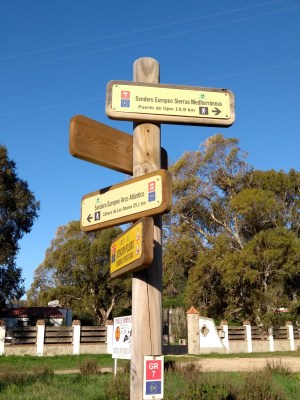
Once more I will keep my introduction very short. Except to say that the original was here.
It’s turning into a fabulous walk!
ooOOoo
Day 6: Castillo de Castellar to Jimena de la Frontera 22k
By Tom and Chica, 18th January, 2020
Written by Tom’s wife.
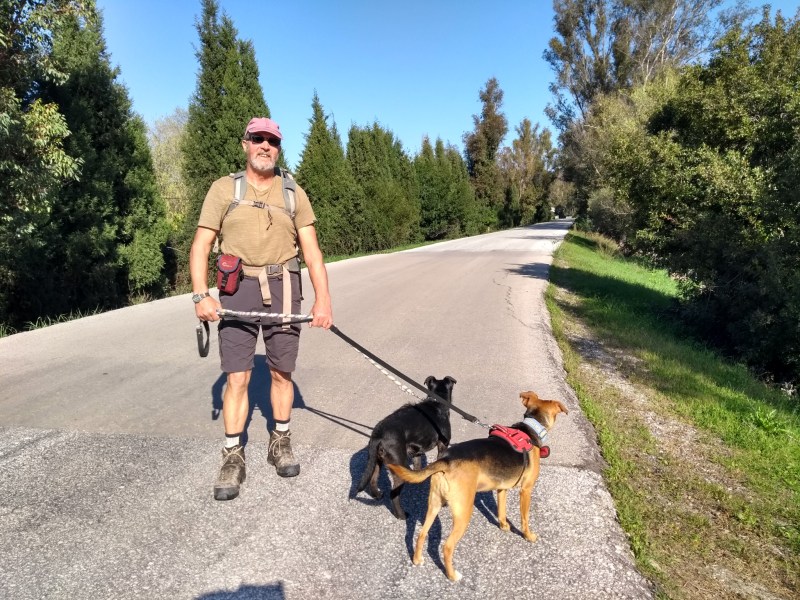
Today was the longest walk so far and didn’t actually start until late as we decided to shift base. By the time we had the caravan installed on a site in Jimena de la Frontera and I’d driven Tom and Chica back to Castillar it was 2pm. Chica was obviously refreshed after her day off and keen to go. Castillar again looked amazing and it was great to know the start is downhill on a tarmac path through more lovely woodland.
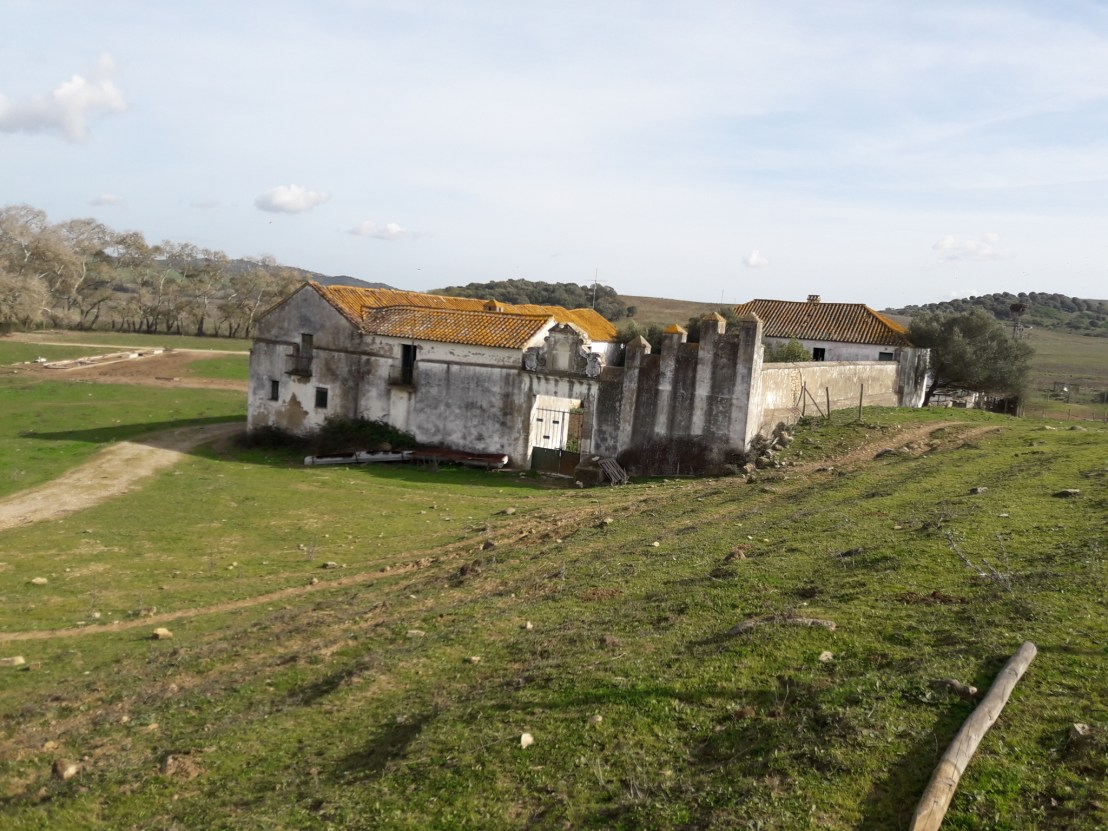
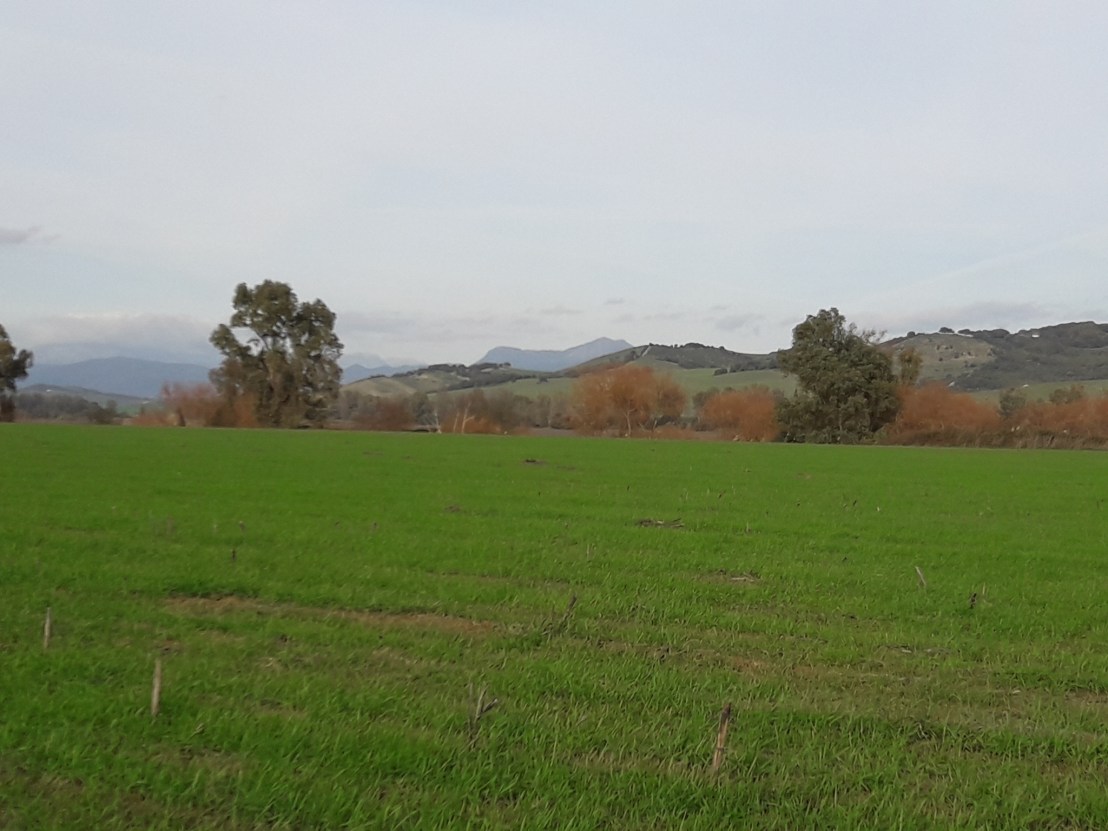
As it levelled out, the tarmac gave way to a gravel track through scrub and grazing land occupied mainly by local brown retinto beef cattle. A huge old farmhouse had seen better days and seemed unoccupied, at least by humans. The scenery changed again as they entered the first cultivated area they had come across since the start. No idea what the crop is though.
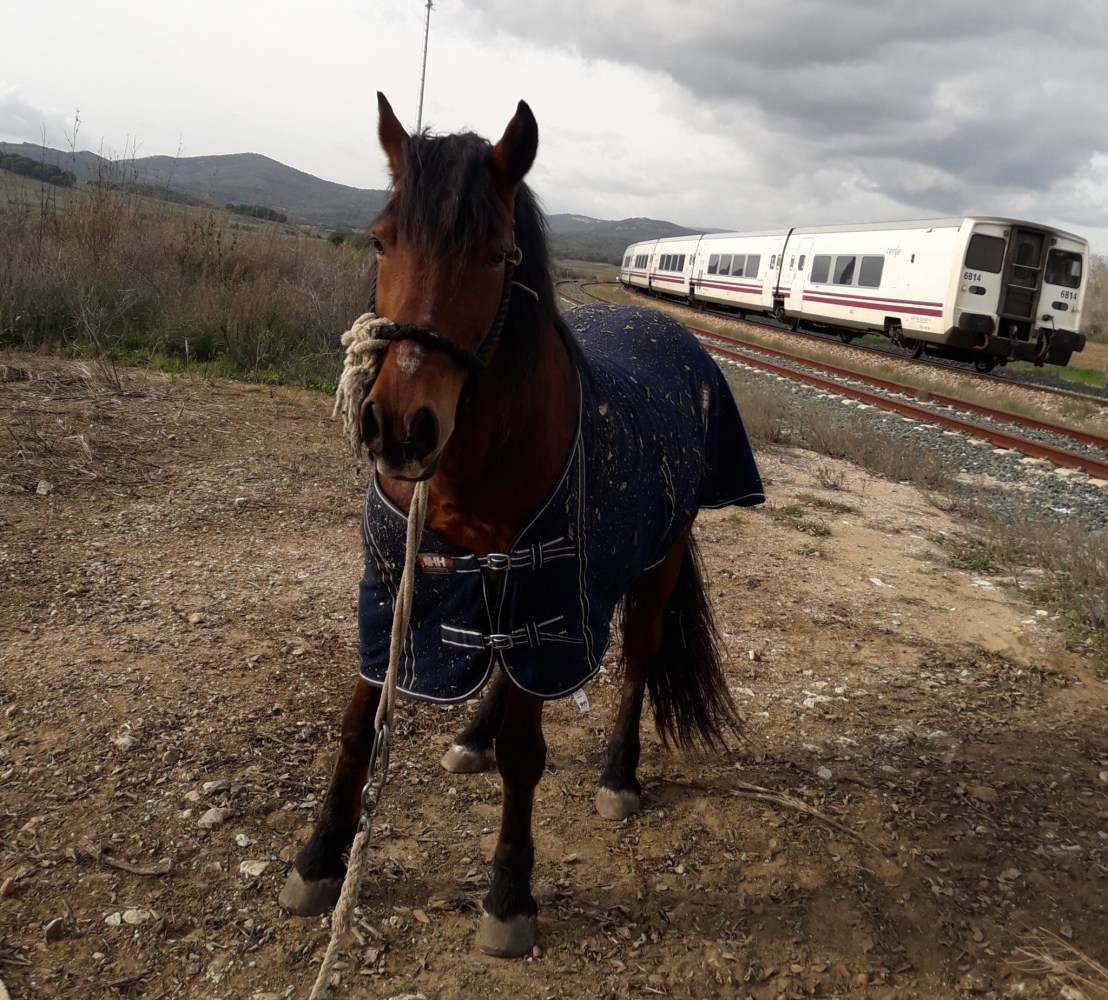
The route met up with the railway track and would stay with it all the way to Jimena. There was a pony grazing here. Despite having a rug and being quite friendly, the white hairs on its nose indicate it has been put in a seraton – a noseband with spikes that dig into the soft flesh of the muzzle. These are still used a lot in Spain. Nearby there was a donkey that was hobbled – which is now illegal. Equines get a rough deal here sometimes.
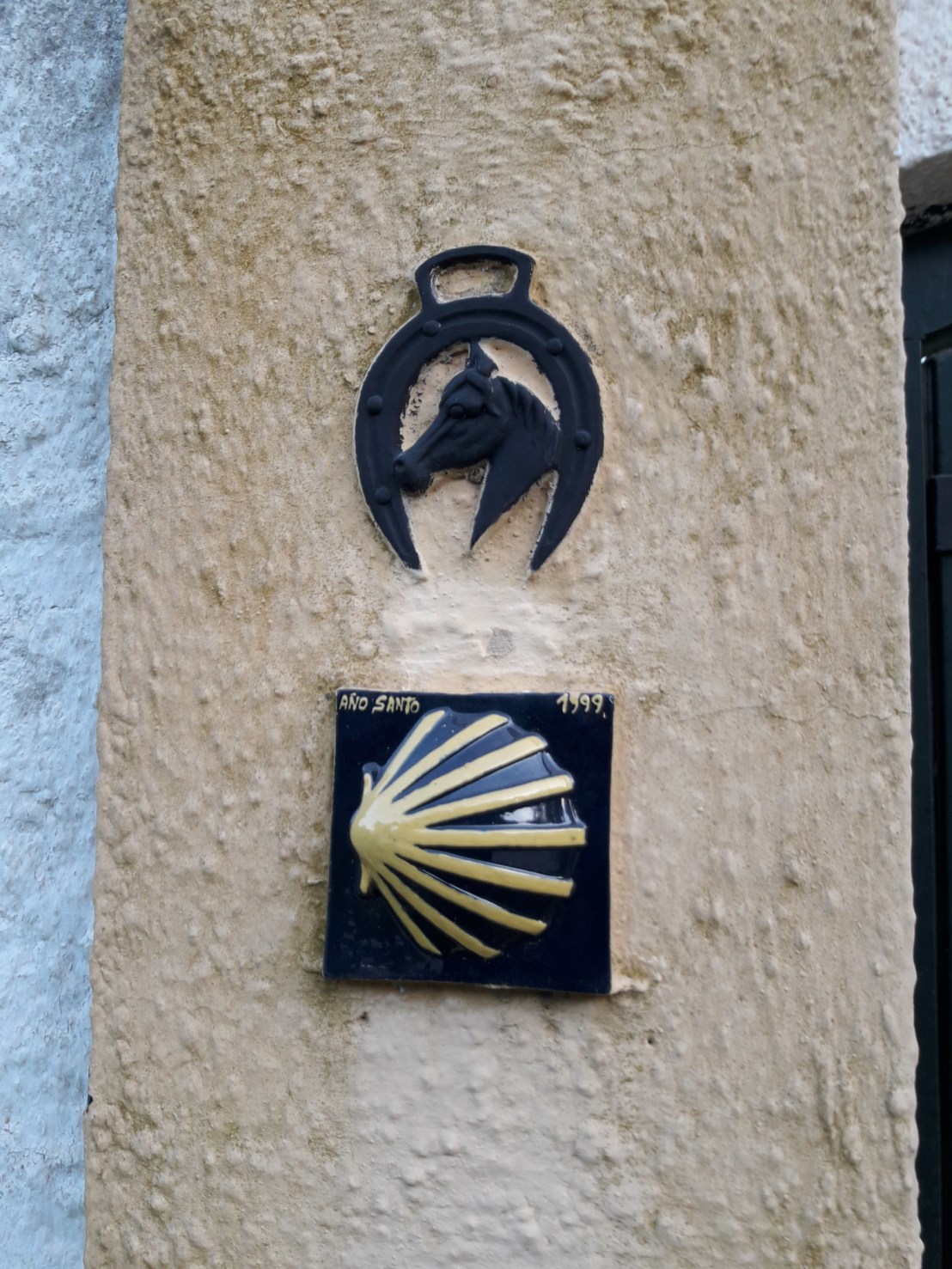
A grand entrance
There were a few dwellings as they approached Jimena – one with a very impressive gate. The shell motif is associated with St James and is a common one on caminos (pilgrim trails) although more usually found on the famous Santiago de Compostela in northern Spain.
The light was fading fast and the last hour or so was done in virtual darkness with Jimena castle luminations acting as beacon to the weary traveller.
ooOOoo
Wonderful. And what a lovely job of writing it all up.
I am minded to start today’s post with that reflection because quite simply it was the way to introduce my republication of Wibble’s post.
The article is about Dexter and is just lovely. It is called Older or wiser.
Enjoy!
ooOOoo
Older or wiser
By Dexter, February 19th, 2020
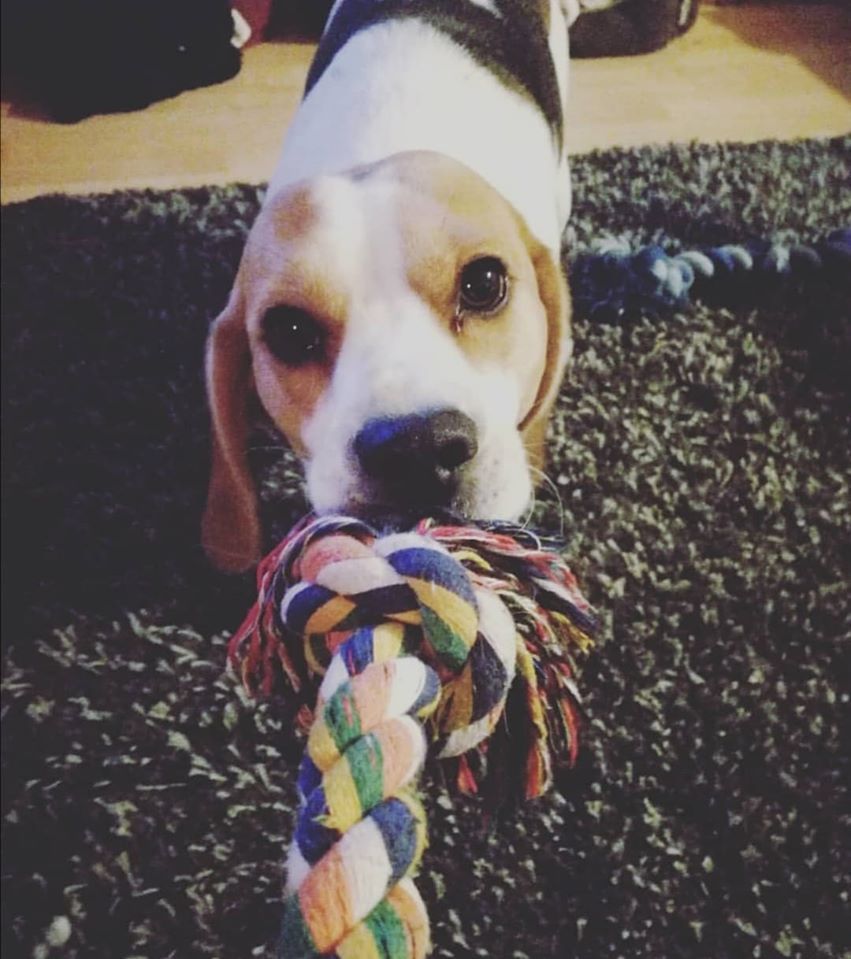
I’m sitting here and the rain is drizzling down the window. It’s February, its windy, we’ve had two winter storms in quick succession and they are digging up the road outside my house. Do they not know I am trying to sleep. Even more surprising but equally as joyous, Lenny isn’t trying to bite me. Now if you have read some of my recent blogs, you will know I have been somewhat contemplative. If you are hoping for shenanigans in this article, then I fear you will again be somewhat disappointed. Earlier today I was wondering to myself about becoming older and, apparently, wiser.
Being older is a bit obvious really. I have more grey hair, I eat my dinner more slowly and I don’t need to walk as far as I used to. I’ve even missed scenting rabbits and squirrels according to assorted parents I have been attached to when these alleged missed sightings have taken place. I can still play bitey face with Lenny, and give him what for, but I tend to duck out of said prolonged snout jousting after a short time. Being beagles we are docile chaps and even when we are in full cry with sofa covers flying around, furniture being rearranged and rugs being ruffled, we manage to stop for a breather on fairly regular occasions. Sometimes it takes a parent stepping in between us to remind the warring parties that its time for a break but, on the whole, we tend to cease and desist quite readily. I am then happy to retire to one of my six or so beds to snooze. However Lenny seems to have a little extra bounce in his paws although I think that is because he is around eighteen months old and I am, allegedly, going to be ten next birthday. No one truly knows how old I am due to me being a rescue but the wise money is on nearly ten now. I am happy for him to run around a little longer, chew what remains of one of my toys and then fall asleep on the sofa. Usually this is interspersed with trying to bite me but again, being docile, I try and fend him off without sending clear signals that I just want to rest.
Older?
As for being wiser, I don’t really know what that entails. If it means that I have seen things, been places and done stuff, then yes I am wiser. If it means that having done said activities, I have learned from the experiences, then not necessarily. For example I have been on the tube and train to London quite a few times, however I still want to investigate what those wonderful smells are down on the track. Thank goodness for a lead and attached human apparently. Another example, is that I have lived here for seven Christmases and, despite the jolly red faced man delivering me many wonderful things but nothing closely resembling a pizza tasting gift, it is wrapping paper I am still fascinated by. I can’t eat it, I know I can’t, but does it stop me from trying? Of course not. Many winters have I seen here, many dirty puddles have I walked through in a Moses style and many times have I been told “Dex, no, ugh good grief you look like the Creature from the Black Lagoon”. Does it stop me stomping through puddles in the most triumphal fashion? No, of course not. I have stopped chasing pigeons in the garden and that’s not because I am banned from the garden. Far from it, for I merely allow my protege to chase them for me. Young whipper-snapper legs are faster than these old bones of mine. I have stopped chewing my toys to a misshapen soggy jumble of fabric, with an accompanying scene of death and destruction wrought across the rugs. Again I leave the dental lobotomisation of toys to Lenny, as he seems to have picked up the baton fairly quickly and extremely proficiently.
Wiser?
If growing older and wiser means seeing things, going places, enjoying the view, smelling more flowers and generally knowing that I should take my time to appreciate and immerse myself in all the things I rushed to see previously, then I am older and wiser. I still have adventures, I still walk and pull on the lead, stick my head down rabbit holes and try to climb the banks along the lanes and byways I explore. I still look in awe at the beauty of the countryside I visit, gaze at the buildings and people in the city. But I let it sink in now, I actually look at what is in front of me and then usually fall asleep soon after, twitching and dreaming. I am trying to pass on my perceived wisdom to Lenny. He is often too busy bouncing around, trying to sniff everything, meet every fur and being a very lovable pest in as quick a time as possible. I see much in Lenny that I had in my youth and this gives me a warm feeling. I hope I can help him to understand that, at some point, he will sit and watch the world go by, with a peace and calmness that I seem to be achieving more often.
Who knows, maybe that is the secret to being older and wiser.
ooOOoo
Just read that last paragraph again. Especially the first sentence: “If growing older and wiser means seeing things, going places, enjoying the view, smelling more flowers and generally knowing that I should take my time to appreciate and immerse myself in all the things I rushed to see previously, then I am older and wiser.”
In my opinion dogs do this so much better than we humans. Yet another lesson to be learned from dogs!
Because both for dogs and their human friends, it’s only a matter of time!
Seeing parts of Spain that the tourists rarely see.
Again, I’ll keep my introduction really short. After all you came here to read of Tom and Chica’s walk along GR7.
ooOOoo
Day 5: Castillo de Castellar (new town) to Castillo de Castellar (old town and castle) 14k
By Tom & Chica, 17th January, 2020
Written by Tom’s wife
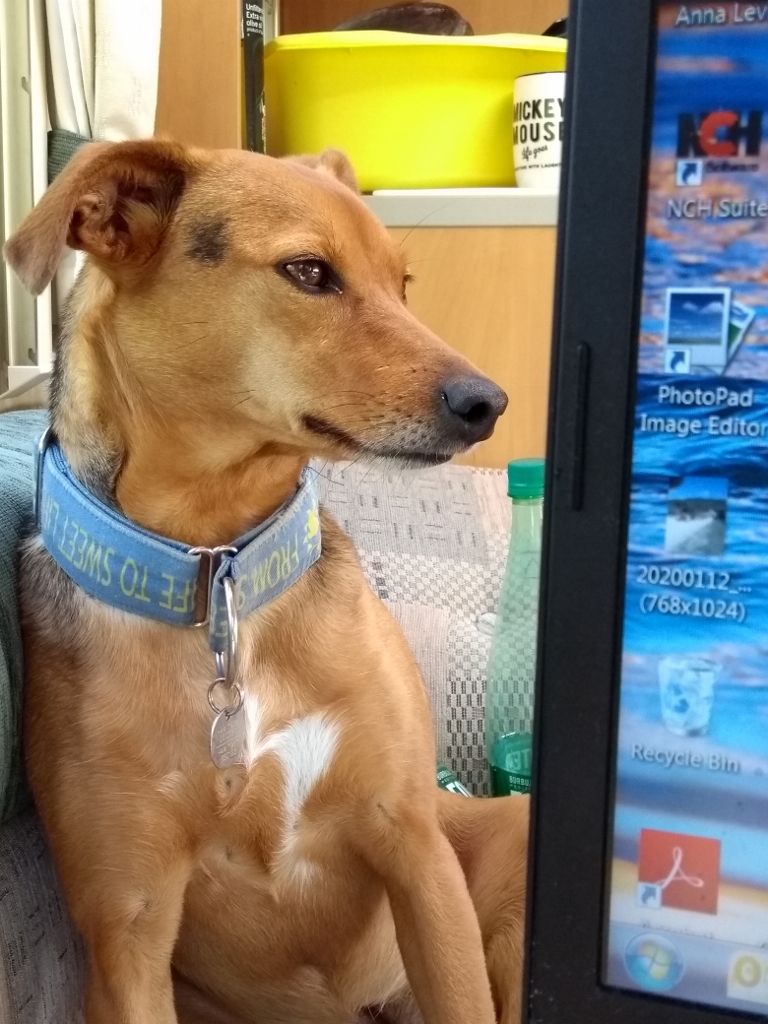
After his adventure yesterday, Merlin was up early this morning bounding around shouting ” Me! Me! Me!” Chica opened one eye (she’s not good in the morning) and made it clear that she was happy for him to deputise for her today. She had a lie-in while Tom and Merlin headed back up to Castillar and as you can see, later she helped me deal with her social media fans!
Day 6 started as day 5 ended, by the road. This proved less hazardous than the next section which was on a track by the main road along which groups of lycra-clad cyclists flew in both directions. It was with relief that T & C were able to turn onto a lovely quiet road that wound through the oak forest towards the castillo (castle) high on a rocky outcrop ahead.
Inviting pathsInviting paths
After a few kilometres, a very inviting track appeared to the right of the road and despite the marker not being for the GR7, Tom couldn’t resist, wanting to be off tarmac for a while. A bit further on, a post bearing the red and white stripes of the GR routes was a welcome sight and the path through the wood was cool and easy on the feet (all six).
A short cut.Yay, A cold beer after a steep climb.
The path eventually came back out onto the road and the castle could now be seen high above. As it started to climb, the road also started to wind so Tom thought he’d try and cut off the corners. But we all know that cutting corners rarely works and sure enough, he soon had to retrace his steps. Eventually, a cobbled path did appear but it proved a steep slog. Plucky little Merlin who’d been trotting along happily up until now started to flag. His tail had been vertical all the way but now began to droop a little. Both were very pleased to see the bar at the top.
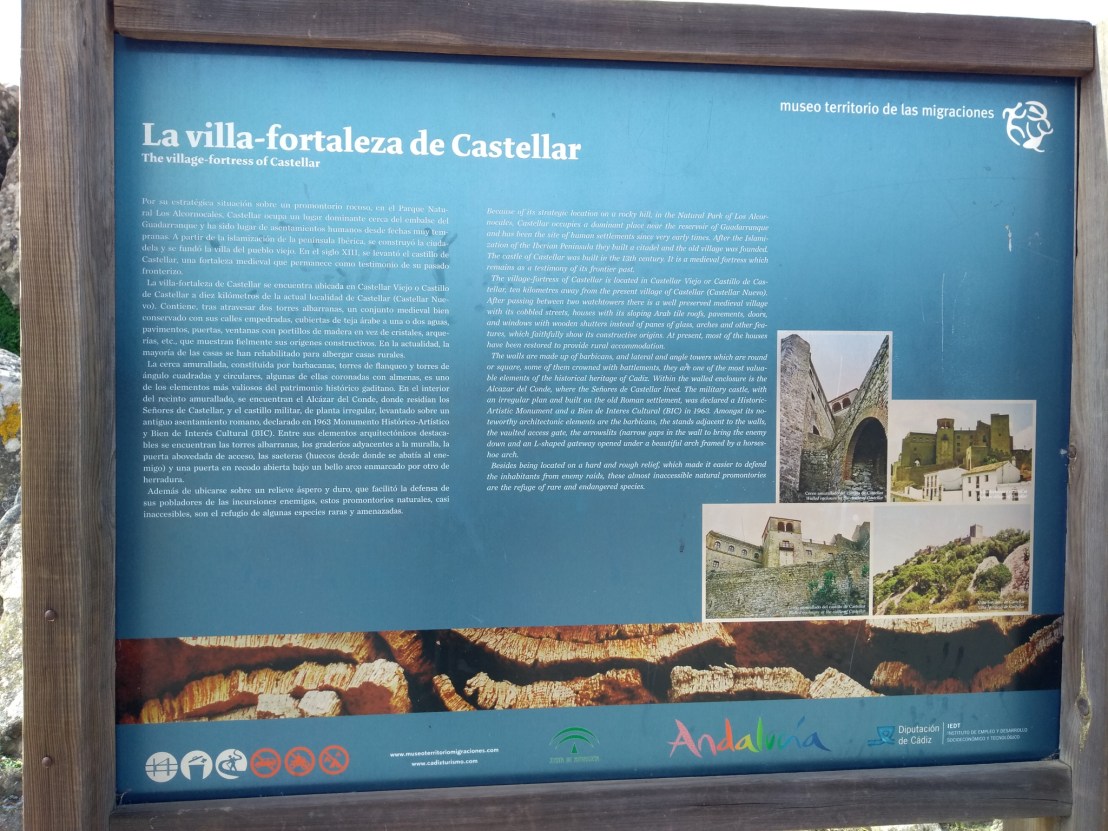
The castleInformation sign.
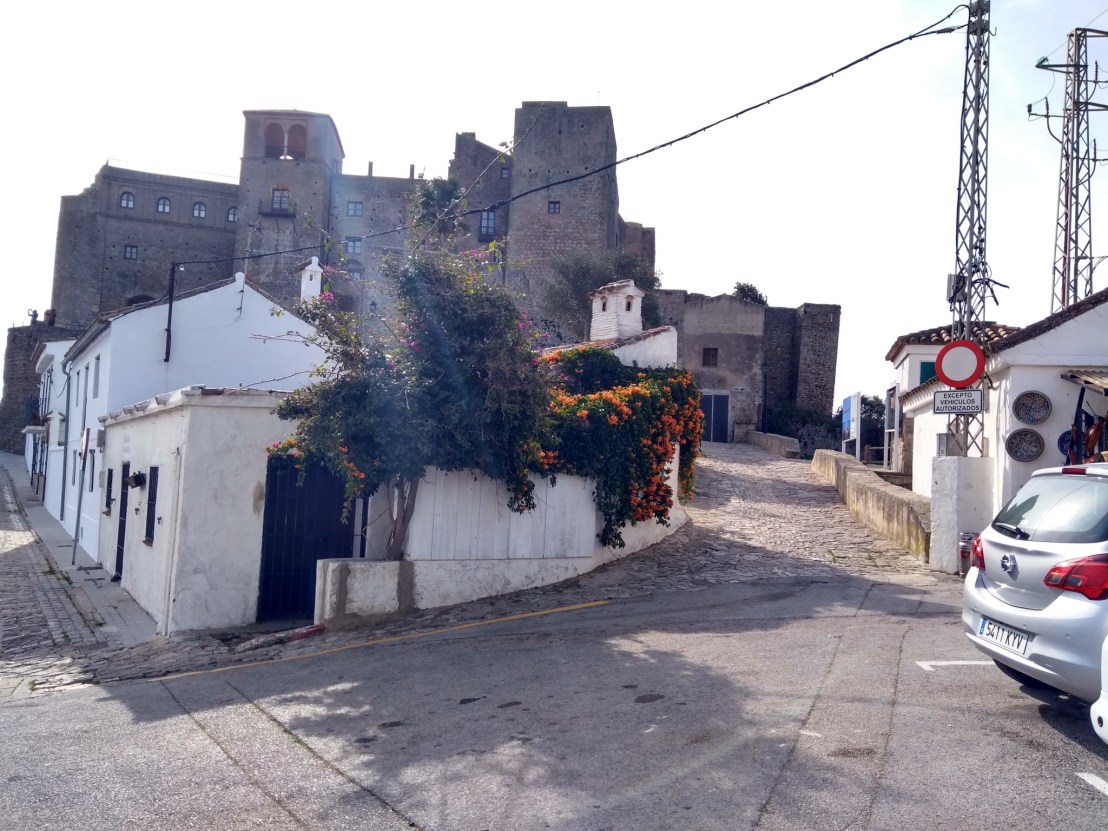
It is beautiful spot with wonderful views and the history of the village goes back to the Bronze Age. The prehistoric presence is still evident in the many caves around the area, where enthusiasts can see the wonderful cave drawings. It played an important role in the wars between the Spanish and the Muslims. In such an advantageous strategic position, many cultures wanted to control this strong vantage point.
In the 1960s the new town, where we started today, was built 7 km away in a more convenient location next to the road and the train station. This new model Andalucian town was inaugurated in 1971.
Two years later the Rumasa Group acquired the old village and in 1983 the Spanish government expropriated Castellar and declared it an ‘Historical and Artistic Monument’. By this time, the place was in a state of neglect and the Town Hall invested the equivalent of around £100,000 to restore the old castle and village.
If you ever find yourself in this part of Spain, we strongly recommend a visit.
ooOOoo
I can’t do any better than to repeat what I said after the last:
Keep it going, Tom. For the description of your walk is very engaging. To be honest, it is Tom’s wife, Gilliwolfe, who deserves as much credit. For without her then we would not be reveling in Tom’s walk.
Last Friday saw the thirtieth anniversary of Carl Sagan’s iconic photograph, or rather NASA’s photograph, of Planet Earth. Carl persuaded NASA to turn Voyager 1, as it left the Solar System, and take the photo. It became famous almost instantly and became known as the pale blue dot.
Pale Blue Dot: A Vision of the Human Future in Space is a 1994 book by Carl Sagan. It is the sequel to Cosmos and was inspired by the famous 1990 Pale Blue Dot photograph, for which Sagan provides a poignant description. In this book, Sagan mixes philosophy about the human place in the universe with a description of the current knowledge about the Solar System. He also details a human vision for the future.
This updated version of the iconic “Pale Blue Dot” image taken by the Voyager 1 spacecraft uses modern image-processing software and techniques to revisit the well-known Voyager view while attempting to respect the original data and intent of those who planned the images. Credits: NASA/JPL-Caltech
For the 30th anniversary of one of the most iconic views from the Voyager mission, NASA’s Jet Propulsion Laboratory in Pasadena, California, is publishing a new version of the image known as the “Pale Blue Dot.”
The updated image uses modern image-processing software and techniques while respecting the intent of those who planned the image. Like the original, the new color view shows Planet Earth as a single, bright blue pixel in the vastness of space. Rays of sunlight scattered within the camera optics stretch across the scene, one of which happens to have intersected dramatically with Earth.
The view was obtained on Feb. 14, 1990, just minutes before Voyager 1’s cameras were intentionally powered off to conserve power and because the probe — along with its sibling, Voyager 2 — would not make close flybys of any other objects during their lifetimes. Shutting down instruments and other systems on the two Voyager spacecraft has been a gradual and ongoing process that has helped enable their longevity.
This simulated view, made using NASA’s Eyes on the Solar System app, approximates Voyager 1’s perspective when it took its final series of images known as the “Family Portrait of the Solar System,” including the “Pale Blue Dot” image. Move the slider to the left to see the location of each image. (You have to go here to see the full image. Ed.) Credits: NASA/JPL-Caltech
This celebrated Voyager 1 view was part of a series of 60 images designed to produce what the mission called the “Family Portrait of the Solar System.” This sequence of camera-pointing commands returned images of six of the solar system’s planets, as well as the Sun. The Pale Blue Dot view was created using the color images Voyager took of Earth.
The popular name of this view is traced to the title of the 1994 book by Voyager imaging scientist Carl Sagan, who originated the idea of using Voyager’s cameras to image the distant Earth and played a critical role in enabling the family portrait images to be taken.
Additional information about the Pale Blue Dot image is available at:
The Voyager spacecraft were built by JPL, which continues to operate both. JPL is a division of Caltech in Pasadena. The Voyager missions are a part of the NASA Heliophysics System Observatory, sponsored by the Heliophysics Division of the Science Mission Directorate in Washington. For more information about the Voyager spacecraft, visit:
Voyager 1 is now nearly 14 billion miles from Planet Earth and still going strong. It has a plutonium battery that will last for eighty years. A one-way radio signal from Earth takes about twenty hours to reach the probe.
And now for something different but still to do with space.
When she finally made it home, her beloved pup, LBD (Little Brown Dog), couldn’t contain her excitement.
Koch shared a video on Twitter of the moment she walked through her front door and LBD pounced to shower her with kisses.
“Not sure who was more excited,” she captioned the video. “Glad she remembers me after a year!”
“We call her LBD, little brown dog, she’s from the Humane Society and she couldn’t be sweeter,” Koch told Insider on a phone call with reporters from the Johnson Space Centre.
“And yes, she was very excited, I was very excited, I’m not sure who was more excited! … You know it’s just a symbol of coming back to the people and places that you love, to see your favourite animal.”
Now I can’t disappear without acknowledging the fantastic work of Carl Sagan.
And I can’t do better than republish the first bit of a wonderful piece on Carl put out by Wikipedia.
Carl Edward Sagan (/ˈseɪɡən/; November 9, 1934 – December 20, 1996) was an American astronomer, cosmologist, astrophysicist, astrobiologist, author, science popularizer, and science communicator in astronomy and other natural sciences. He is best known as a science popularizer and communicator. His best known scientific contribution is research on extraterrestrial life, including experimental demonstration of the production of amino acids from basic chemicals by radiation. Sagan assembled the first physical messages sent into space: the Pioneer plaque and the Voyager Golden Record, universal messages that could potentially be understood by any extraterrestrial intelligence that might find them. Sagan argued the now accepted hypothesis that the high surface temperatures of Venus can be attributed to and calculated using the greenhouse effect.[
He died far too young in my opinion!
But not without leaving a tremendous legacy – The Pale Blue Dot.
In complete contrast to yesterday, this morning there was a clear blue sky – a truly glorious day. We all set off together for the first mile or two but when I turned to go, Merlin dug his paws in and and absolutely refused to come with me. So he carried on with Tom and Chica while Arthur and I returned to the car.
Mules
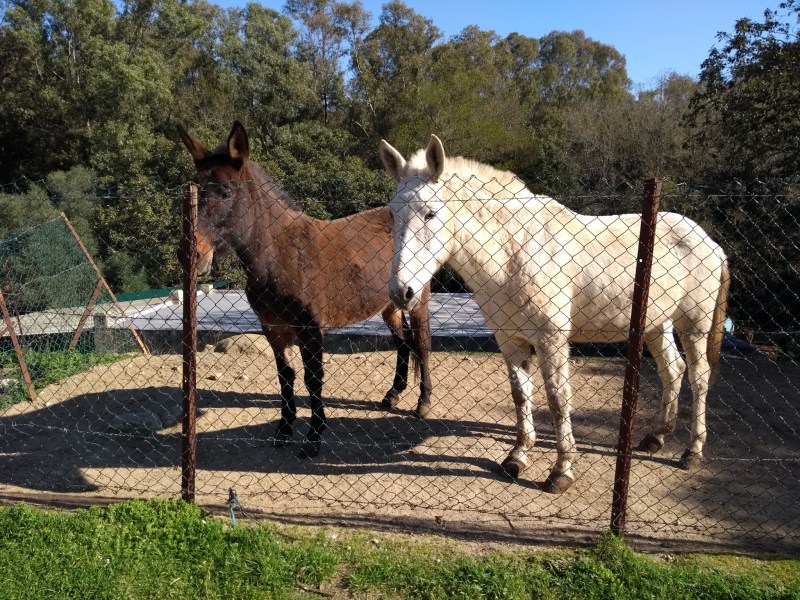
Mules are still used in Spain both as personal transport and as pack animals. Here in the forest, they haul wood and cork. These two look in good condition and don’t have any of the white patches or scarring that indicates poor loading or ill-fitting harness that is often seen. Happily, it is now illegal to hobble equines (ie chain the front feet together to severely restrict movement). This is a very recent change and six years ago when we first came to this area it was a common sight. To restrict the movement of a prey animal that naturally depends on flight for survival is very cruel, in my view, so it’s good to see it dying out.
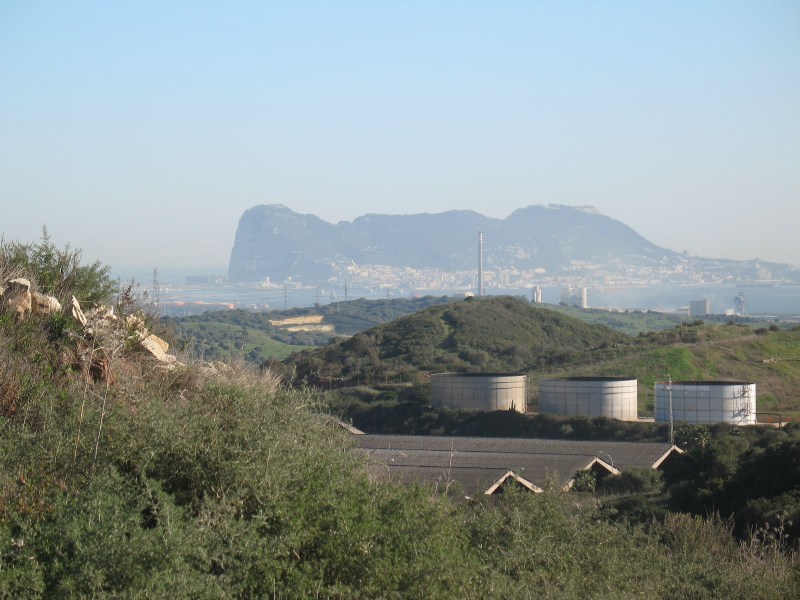
View across Algeciras to Gibraltar
Today’s route wound gently uphill past an army camp until, at the high point, there was a fantastic view across the top of Algeciras, the main port, to the rock of Gibraltar. After that it continued to through pasture and cork oaks until the enormous rubbish dump made its presence felt well before it was visible in what appeared to be a disused quarry.
Eventually, the path came out on the road, which though not very busy was less pleasant to walk on and all three members of the party were quite happy to be picked up after 15k in very warm weather.
ooOOoo
Keep it going, Tom. For the description of your walk is very engaging. To be honest, it is Tom’s wife, Gilliwolfe, who deserves as much credit. For without her then we would not be reveling in Tom’s walk.
I made a mental note to republish this wonderful story more often than hitherto.
Certainly, if I am do the story justice, and I do want to do that, then a couple of republications a week is needed.
So we are at Day Three.
ooOOoo
Day 3: Embalse de Almodovar to Los Barrios 20k
By Tom and Chica, 15th January, 2020
Written by Tom’s wife.
Silent sentinels
This was the first cold and cloudy morning we’ve had since we arrived in Tarifa – a bit of a shock! The lack of wind, which is a rarity here, meant that all the wind turbines were motionless – like silent sentinels guarding the the hills.
Silly Billy!
oooo
Back on the stony track.
oooo
Don’t run them over!
We reached the start point (What Three Words location: dashes.outlived. plums) at around 10.15. Frustratingly, the route is barred by an electronic gate and notices warn that vehicles are prohibited, although google maps shows it as a through route. This wasn’t a problem this morning but made for a long drive for the pick up later.
After yesterday’s day off both dog and man keen to get going and set a brisk pace to keep warm. The lizards referred to in the sign weren’t in evidence – it was definitely too cold. The same very stony track caused less problems for Tom today with medium rather than light weight boots. The route climbed steadily to a high open valley to Puerto de Ojen giving views of the Sierra del Nino to the north. There used to be a bar here offering refreshment to walkers but sadly only a rather angry little dog and a donkey there now but a brief lunch break was taken anyway.
Puerta de Ojen
oooo
Paths of the prisoners.
This sign on the right (Ed. the last one above.) was a little further down the road. A brief translation tells us that, as a result of the Spanish civil war, prisons were overflowing so Franco decided to create disciplinary battalions, an organized group of political prisoners to perform forced labour. After the outbreak of WWII, he launched the Fortification Plan on the northern shore of the Strait of Gibraltar, with the aim of fortifying and defending the area from possible attacks from the coast. To do this, he built a network of roads in this coastal area of southern Spain from Conil to the Guadiaro River and the path of the prisoners is part of this network of roads built by disciplinary battalion number 22 that was located between Venta de Ojén and Cerro del Rayo from 1940 to 1943.
Rustic bread oven
oooo
Further along they came cross this old bread oven that is currently being restored. Tom is a builder specialising in stone work so was able to determine that it was a good example of modern stonework. He was unable to fully translate the sign but it said that bread was a very important part of the diet and this was oven was a vital resource used by many people.
All in all, an interesting and reasonably easy route. The weather had improved as the day went on and it reached 18 deg but after 20k both Tom and Chica were quite happy to see the car, I think.
Pooped!
ooOOoo
I am so grateful for being given permission by Tom’s wife to republish this amazing journey along the GR7 path.
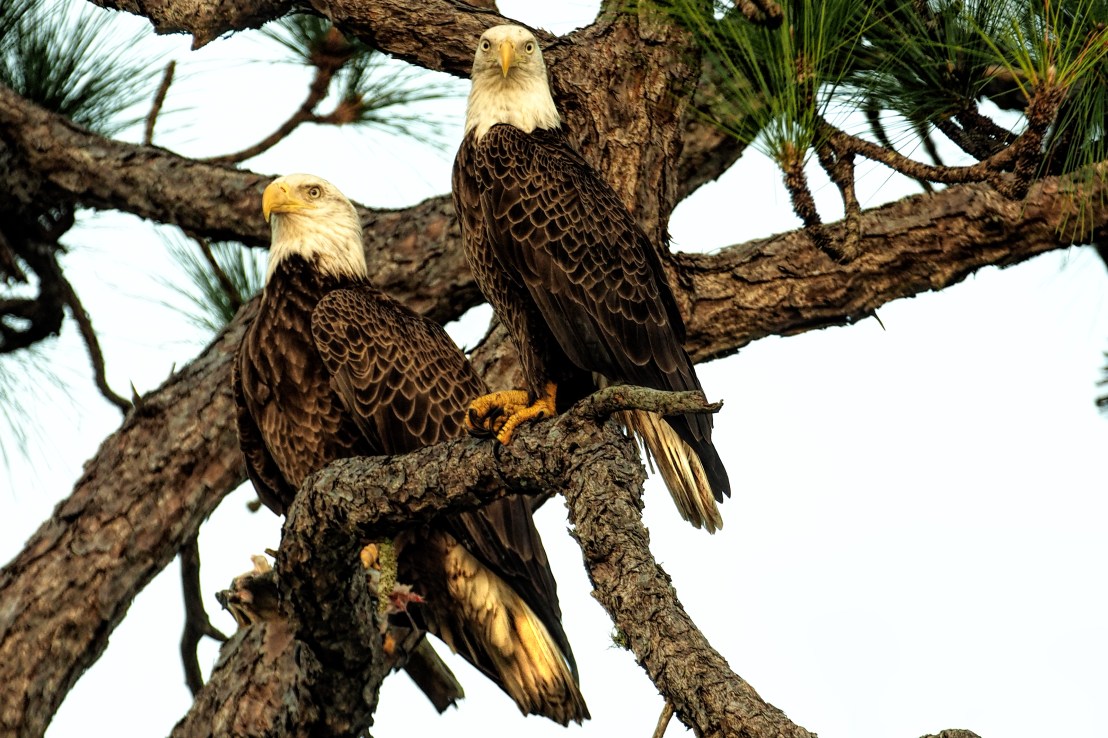
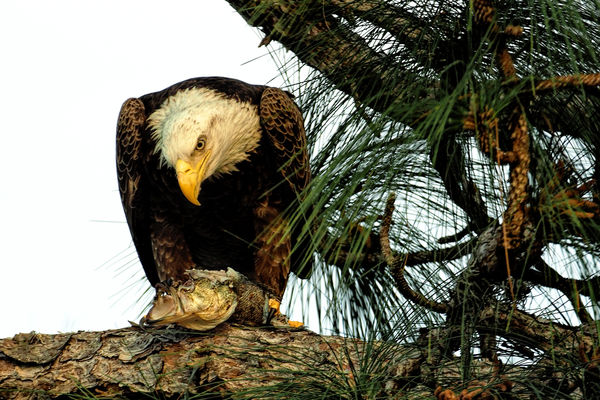
I took Lili (my faithful photo dog buddy) for her usual evening walk up in the back of my house by the golf course. Fortunately, that is where the eagles hang out.
They have been pretty boring, albeit, beautiful.
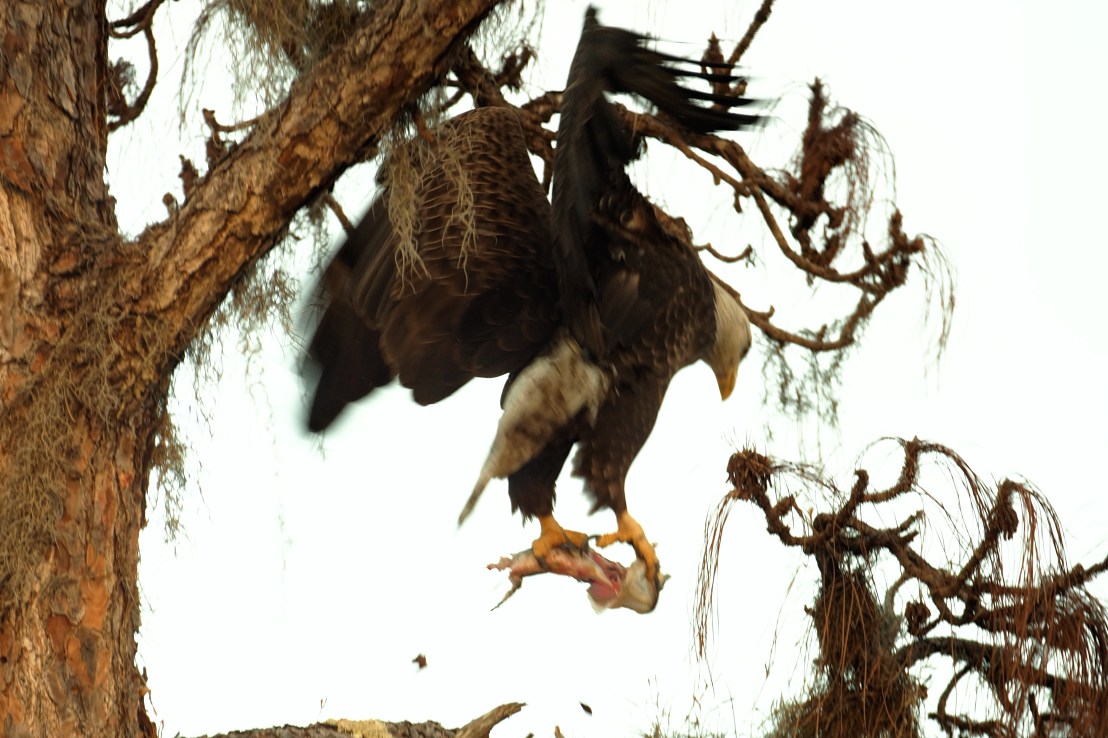
Tonight they had a very large bass that they were sharing.
I took a bunch of pictures and we went for our walk.
They don’t pay much attention to Lili and I any more which is cool. On our way back to the car, we had to pass under the tree they were now in.
I took a few more pictures, and as we passed under the tree, they dropped the fish and it landed about 3ft from our feet.
Lili is off leash.
I told her to stay and lie down, she did and we both stood still.
The big female flew down and walked over to get it. Looked at us, and took it back up into the tree and continued eating. It was soooooo exciting!!!
Val included some photographs.
I sent Val a private message asking if I could republish her story. Val said ‘Yes’. But even better than that Val included a short video and some additional news. In that Lili was found by a dumpster four years ago. Then Lili was just 5 weeks old. Since then “I have been taking her everywhere with me since.”
Val went on to say:
As soon as it gets dusky, I keep Lili on a leash too for the same reasons.
She is pretty big, 80# but I don’t trust the eagles.
Who knows what they would/can do?
Here are those photographs.
OLYMPUS DIGITAL CAMERA
oooo
oooo
OLYMPUS DIGITAL CAMERA
oooo
oooo
And one of Lili!
And there’s a short video but I don’t have time today to turn it into a YouTube.
It is now ten days since I last reported on Tom and Chica’s great walk; so much for my couple of postings a week!
But they continue to walk the GR7 path in Spain and I will continue to republish their posts of this great trip.
So now, so far as republishing goes, we are up to Day Two.
ooOOoo
Day 2: La Pena to Embalse de Almodovar 16k
By Tom and Chica, 13th January, 2020
Written by Tom’s wife.
Human breakfast!
All walking days will start with the full monty for Tom. He is a very practiced breakfast chef so I leave him to it. It did seems to take a while this morning so I think we may have to start getting up a bit earlier. For this week, at least, I will be dropping him off and picking him up so he doesn’t have to carry the full pack with the tent etc, giving him time to get some fitness back first after the flu virus.
The start
So it was 10am before we got to the start at La Pena (What Three Words location: crafted.indecisive.barbecued.) and already a really glorious day; full sun and a gentle breeze. The route wound up into the hills giving wonderful views back down to the sea and across to the Moroccan coast. The path continued on a variety of surfaces, some tarmac, some sand and some stony tracks. The latter proved a bit uncomfortable and Tom now thinks that his more sturdy boots might be better, despite being a bit heavier. He has metal rods in both his feet, the result of a climbing accident about twenty years ago. So it’s extra important that his feet are well supported.
Goats on the moveVery spiny cactus with fruit – name anyone?
The landscape was quite rocky with olive and other hardy shrubs and trees, and lots of cacti too. Not much wildlife spotted but plenty of goats with their melodic bells. The route ended at a large lake on a inaccessible track so they walked back to the road where we met, conveniently close to a bar for a much appreciated cold beer (for Tom)and long drink of water (for Chica).
Meanwhile, back at the campsite, there was a minor crisis as a neighbour discovered a number of processionary caterpillars. These are nasty critters with highly irritant hairs that can cause a painful rash in humans but are even more dangerous for dogs. As the name suggests, the caterpillars form a chain when they move and, of course, most dogs want to investigate but if they ingest the hairs it can cause real problems. The nests can easily be spotted as dense webs on the tips of pine branches. The site maintenance staff were very prompt in coming along to remove the nests but we will remain vigilant. It was probably a bit daft to choose a plot under the pines and it’s a lesson learned for the future. One of many to come, no doubt.
ooOOoo
This is such an amazing trip. Words hardly express my admiration for what Tom.