This has been very widely reported but nevertheless it’s a great story about the devotion of dogs to humans, and in return, the way that so many people recognised the need for help for the badly injured dog.
Readers will recall that the dog, Kabang, suffered massive injuries back in December 2011 when she jumped into the path of a motorcycle, stopping it from running over her owner’s daughter and niece in Zamboanga, a city in the Southern Philippines.
Here’s a video that was published back in October last year that explores the circumstances of the dog’s actions and the public’s response.
“A dog who became an international cause celebre after her snout was sliced off saving two young girls in the Philippines was examined by veterinarians Thursday at UC Davis, a milestone event in a remarkable humanitarian effort to help a canine heroine.
The mixed-breed dog, named Kabang, became an unlikely star in the Philippines after she reportedly threw herself into the path of a speeding motorcycle just as it was about to hit two young girls crossing a roadway in Zamboanga City.
The lunge, by all accounts, saved the lives of the daughter and niece of Kabang’s owner, but cost the dog her snout and upper jaw, which was sheared off when she got tangled in the motorcycle’s spokes. The gruesome injury puts her in grave danger of developing an infection. At minimum, the gaping wound must be closed, a delicate procedure that is beyond the capability of veterinarians in the Philippines.”* Would you prolong your dog’s life even if it were that costly? Ana Kasparian, John Iadarola, and Jayar Jackson break it down.
DAVIS (CBS13) – Kabang, the Philippine dog that suffered a severely injured snout and upper-jaw while saving two girls from being hit by a motorcycle, has been released from the hospital.
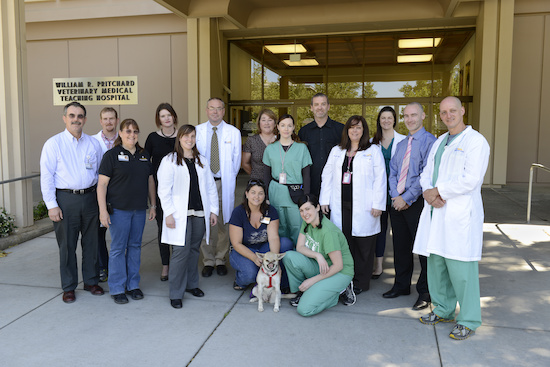
The dog was brought to the veterinary medicine teaching hospital at UC Davis in October 2012 to be treated for the injury that left her with a gaping wound where her snout had been. But veterinarians found she had heartworm disease and a type of infectious cancer. A team of UC Davis veterinarians specializing in oncology; infectious diseases; dental, oral and soft-tissue surgery; internal medicine; and outpatient care was assembled to treat Kabang, according to the UC Davis News Service.
“We were able to treat all of the complications that arose with the best specialists available,” Verstraete said Professor Frank Verstraete, chief of the hospital’s dentistry and oral surgery service.
That post celebrated the arrival into the Handover household of three Koi.
However, since that day the three Koi have not been seen; not even a tremor on the surface of the water. We doubt that they have survived.
Jean found a rather fancy bird cage in a secondhand store the other day and a couple of days ago the cage became home to Mr. Blu and Mr. Green, a pair of Parakeets, or Budgerigars in English speak. I know many feel uncomfortable about having birds in cages but as the store assistant pointed out, these birds had been breed in captivity and wouldn’t survive a moment if released.
Mr. Green and Mr. Blu!
I have not a single jot of doubt that Jeannie will love them as she loves all our animals – with total devotion.
This second offering from Dan is very different to yesterday’s deep space theme.
Yesterday, I published an item sent in by Dan that included a video of an area of deep space photographed by the Hubble Space Telescope. Do take a look if you missed it yesterday – it is truly astounding.
Today, something from Dan that is altogether much more pragmatic, albeit very funny. Enjoy!
Years ago if I was ever to own a dog, it had to be one breed and one breed only: a German Shepherd Dog.
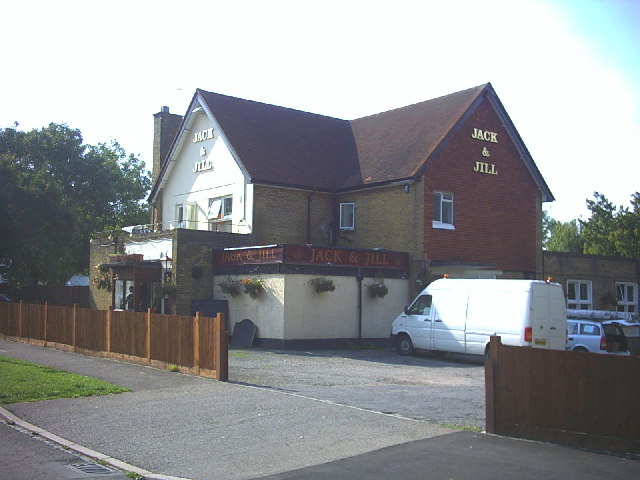
The reason for this was that back in 1955 my father and mother looked after a German Shepherd dog called Boy. Boy belonged to a lovely couple, Maurice and Marie Davies. They were in the process of taking over a new Public House (Pub); the Jack & Jill in Coulsdon, Surrey. My father had been the architect of the Jack & Jill.
Jack & Jill, Longlands Avenue, Coulsdon, Surrey
As publicans have a tough time taking holidays, it was agreed that the move from their old pub to the Jack & Jill represented a brilliant opportunity to have that vacation. My parents offered to look after Boy for the 6 weeks that Maurice and Marie were going to be away.
Boy was the most gentle loveable dog one could imagine and I quickly became devoted to him; I was 11 years old at the time. So when years later it seemed the right time to have a dog, there was no question about the breed. Boy’s memory lived on all those years, and, as this post reveals, still does!
Pharaoh was born June 3rd, 2003 at Jutone Kennels up at Bovey Tracy, Devon, on the edge of Dartmoor. As the home page of the Jutone website pronounces,
The Kennel was established in 1964 and it has always been the aim to breed the best German Shepherd Dogs for type and temperament. To this end the very finest German bloodlines are used to continue a modern breeding programme.
and elsewhere on that website one learns:
Jutone was established by Tony Trant who was joined by Sandra Tucker in 1976. Sandra continues to run Jutone since Tony passed away in 2004. Both Tony and Sandra qualified as Championship Show judges and Sandra continues to judge regularly. Sandra is the Secretary and a Life Member of the German Shepherd Dog Club of Devon.
Tony Trant
Turning to Pharaoh, here are a few more pictures over the years.
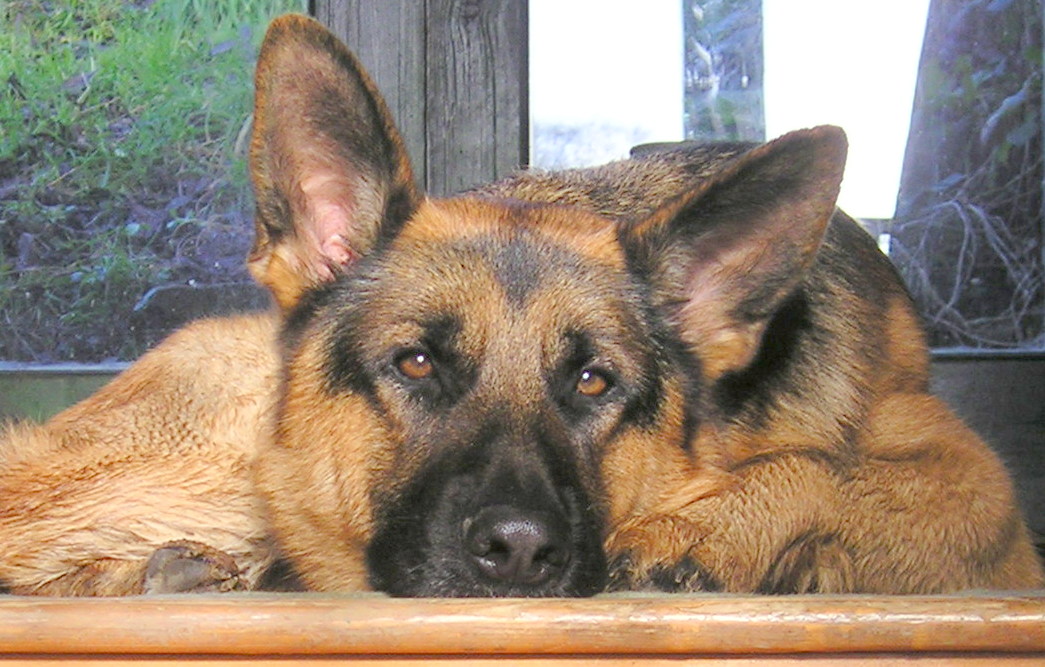
Pharaoh, nine months old.
oooOOOooo
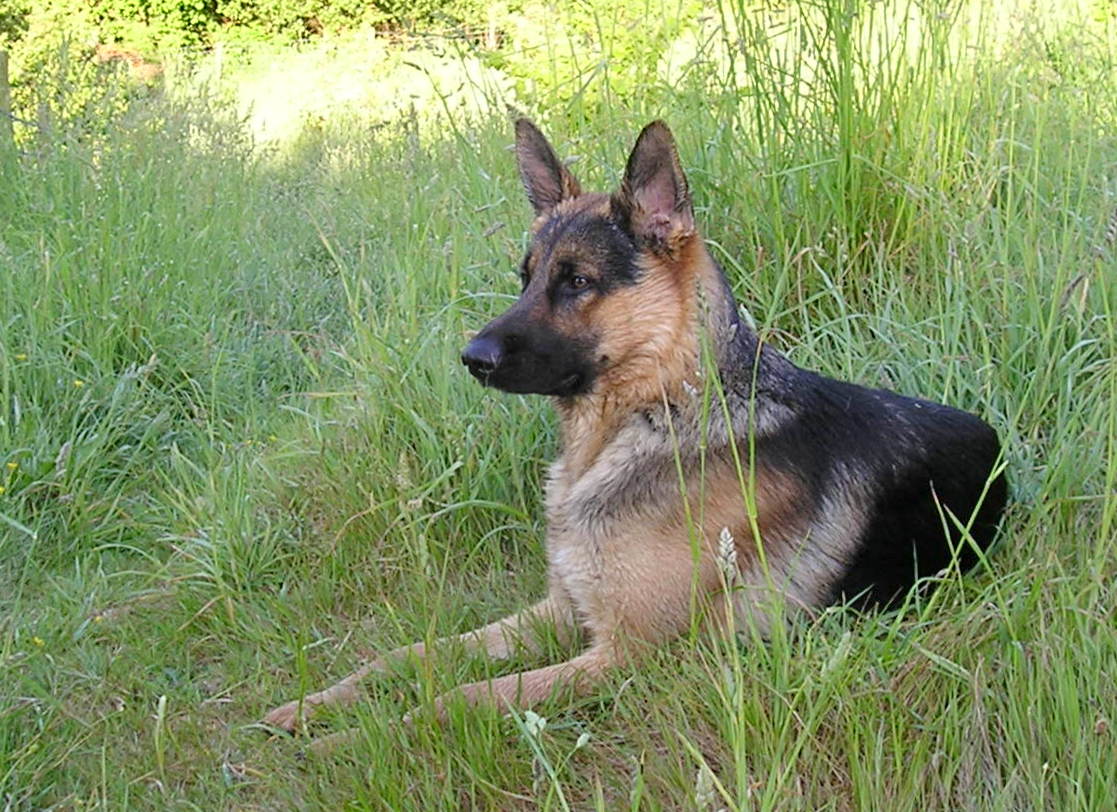
One year old: June 3rd 2004.
The next picture of Pharaoh requires a little background information.
For many years I was a private pilot and in later days had the pleasure, the huge pleasure, of flying a Piper Super Cub, a group-owned aircraft based at Watchford Farm in South Devon. The aircraft, a Piper PA-18-135 Super Cub, was originally supplied to the Dutch Air Force in 1954 and was permitted by the British CAA to carry her original military markings including her Dutch military registration, R-151, although there was a British registration, G-BIYR, ‘underneath’ the Dutch R-151. (I wrote more fully about the history of the aircraft on Learning from Dogsback in August 2009.)
Piper Cub R151
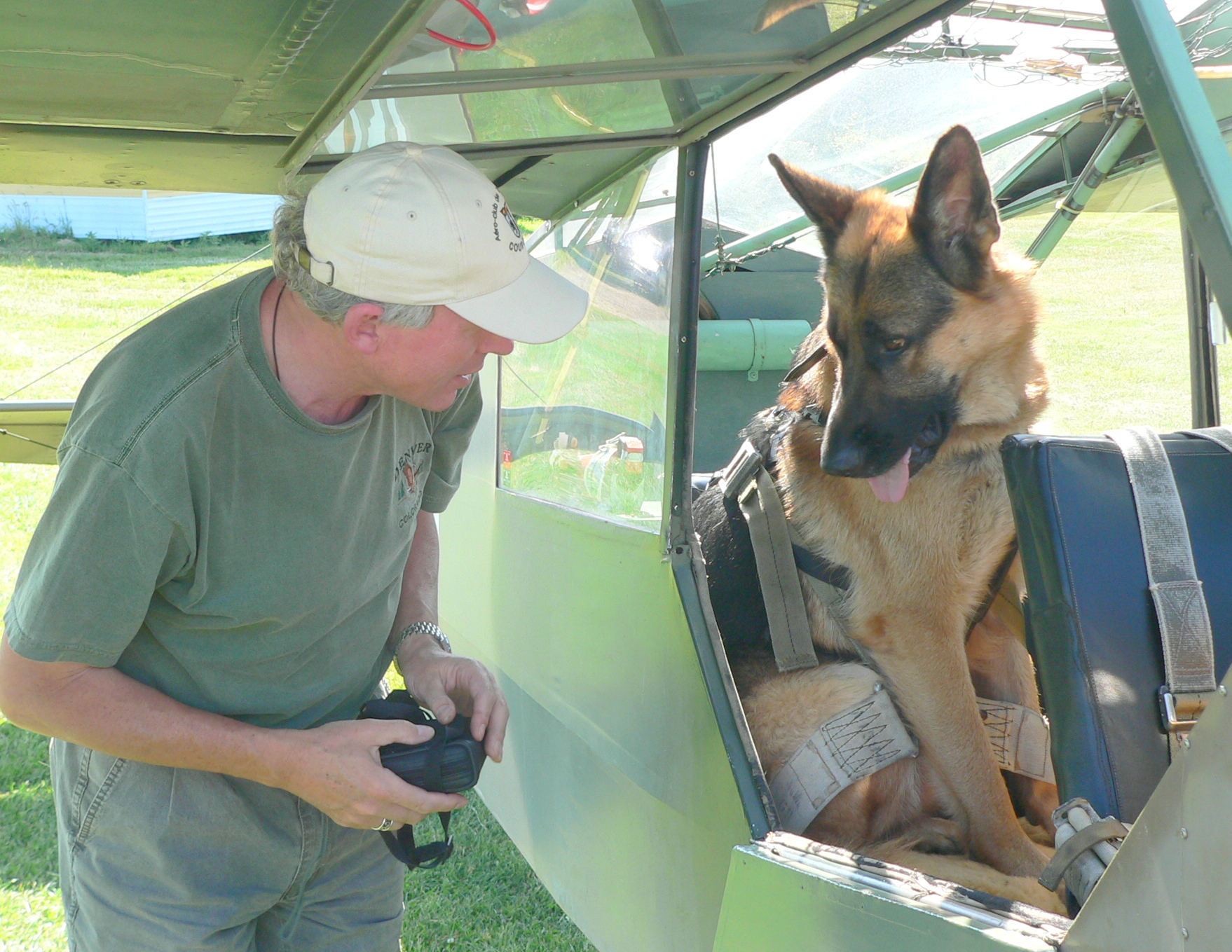
Anyway, every time I went to the airfield with Pharaoh he always tried to climb into the cockpit. So one day, I decided to see if he would sit in the rear seat and be strapped in. Absolutely no problem with that!
Come on Dad, let’s get this thing off the ground!
My idea had been to fly a gentle circuit in the aircraft. First I did some taxying around the large grass airfield that is Watchford to see how Pharaoh reacted. He was perfectly behaved.
Then I thought long and hard about taking Pharaoh for a flight. In the Cub there is no autopilot so if Pharaoh struggled or worse it would have been almost impossible to fly the aircraft and cope with Pharaoh. So, in the end, I abandoned taking him for a flight. The chances are that it would have been fine. But if something had gone wrong, the outcome just didn’t bear thinking about.
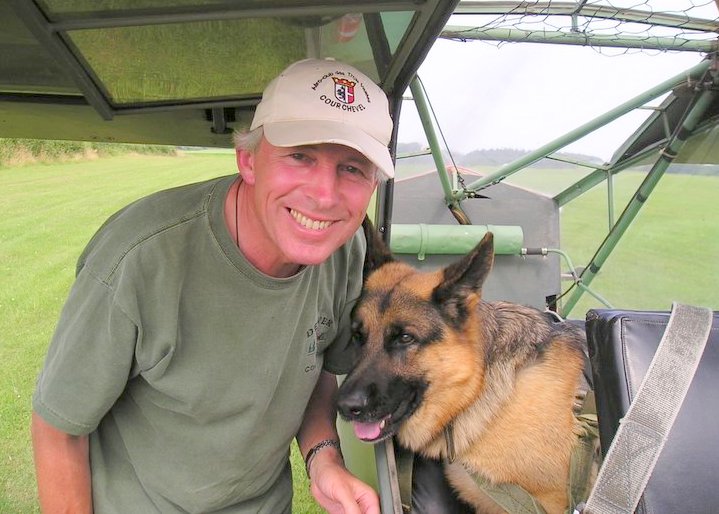
So we ended up motoring for 30 minutes all around the airfield which, as the next picture shows, met with doggie approval. The date was July 2006.
That was fun!
What a dear dog he has been over all the years and, thankfully, still is!
As if to reinforce the fabulous dog he still is, yesterday it was almost as though he knew he had to show how youthful he still was.
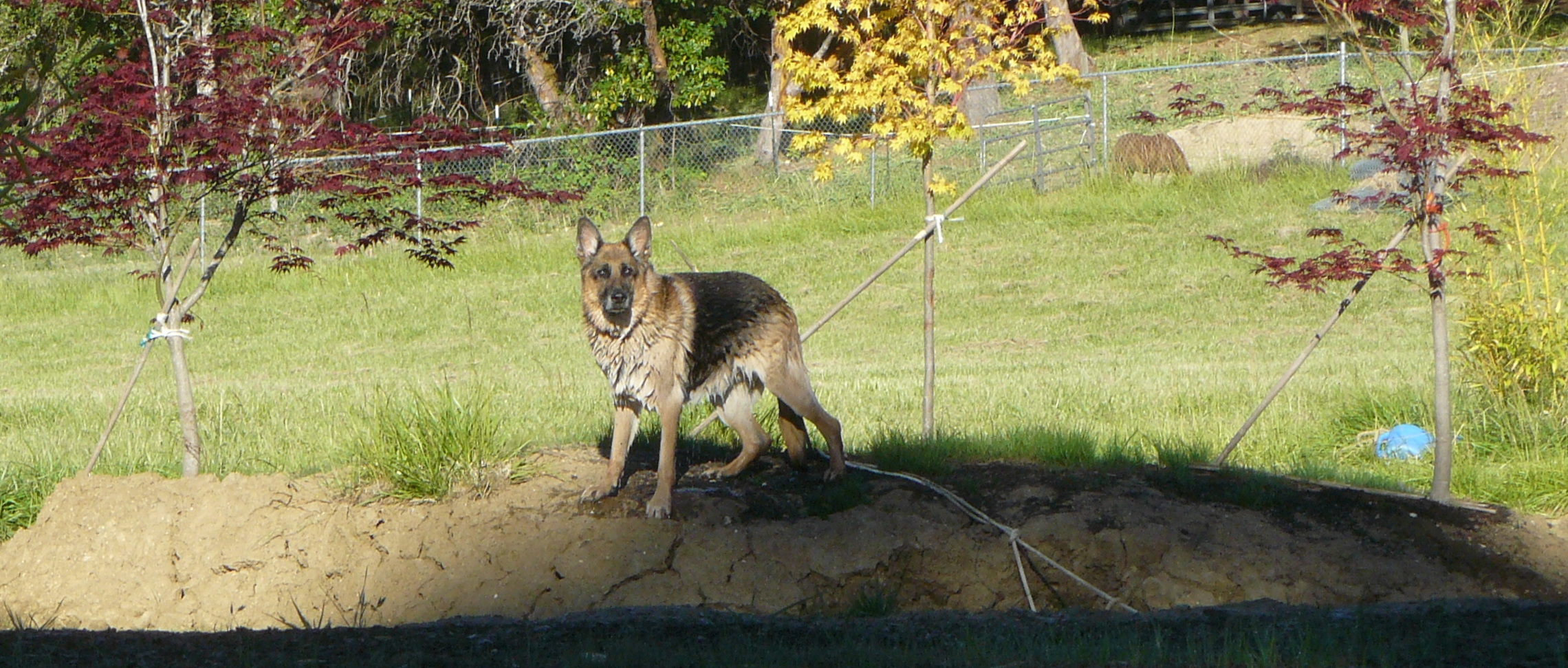
Because, when I took his group of dogs out around 7.30am armed with my camera, Pharaoh was brimming over with energy.
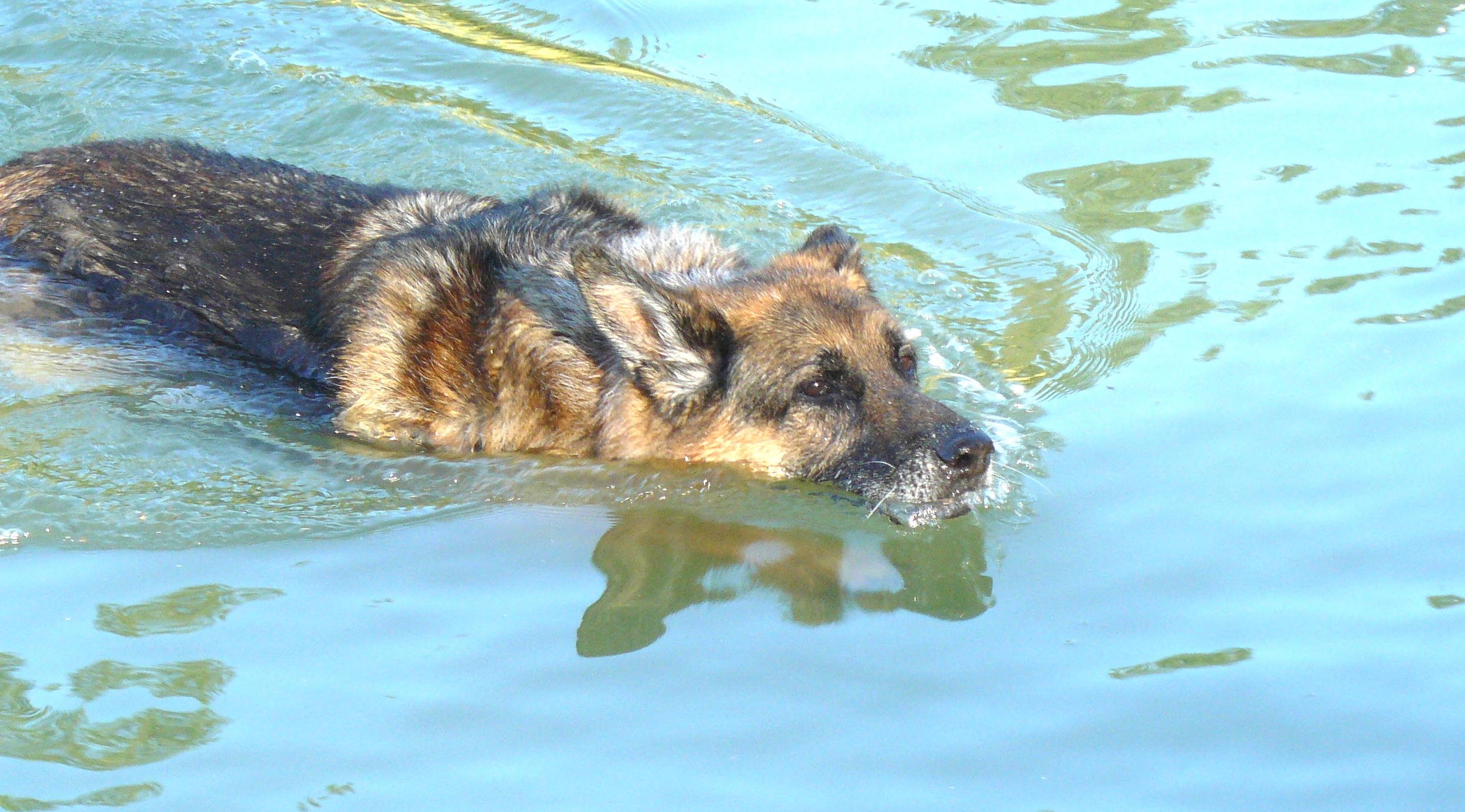
First up was a swim in the pond.
Ah, an early birthday dip! Bliss!
Then in a way he has not done before, Pharaoh wanted to play ‘King of my Island’, which is in the middle of the pond.
Halt! Who goes there!
ooo
This is my island! So there!
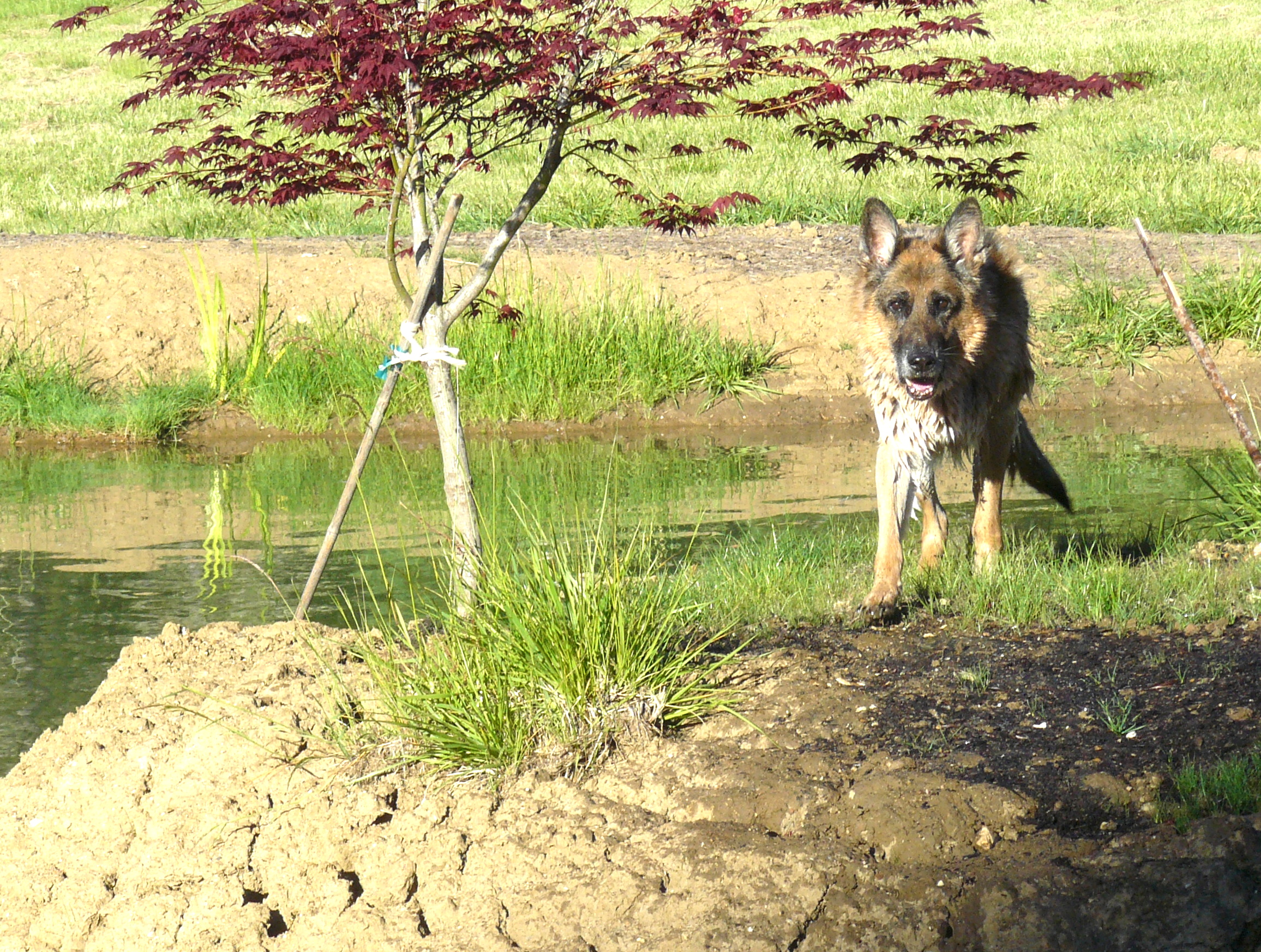
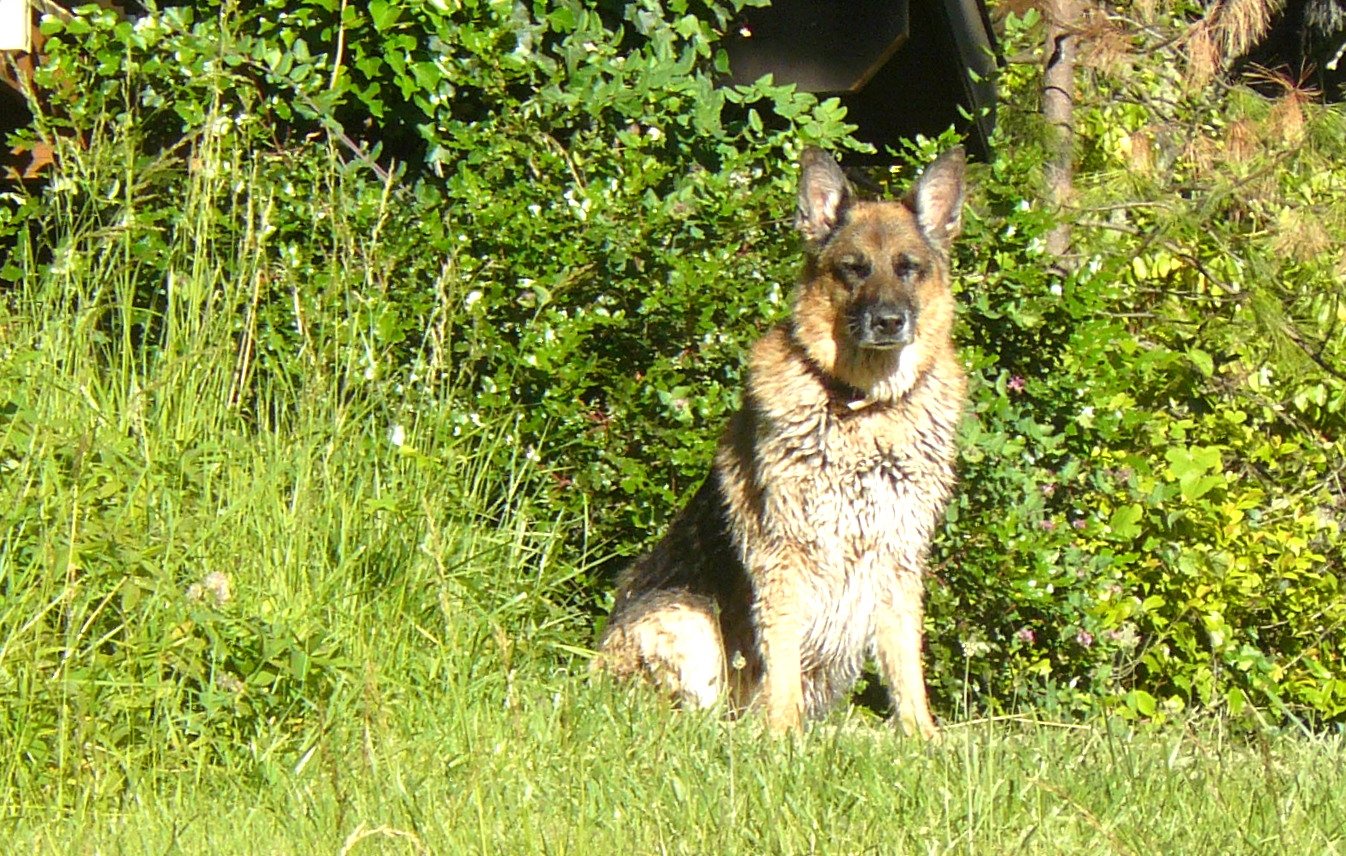
Then a while later, when back on dry land, so to speak, it was time to dry off in the morning sunshine.
Actually, this isn’t a bad life!
Long may he have an enjoyable and comfortable life.
Yes, Pharaoh was born back on June 3rd 2003. So today, in human years he is 10. In the old traditional ‘dog years is seven times times human years‘ he would be 70. But according to a recent item on BBC News there is a more accurate way of calculating dog years.
Longevity secrets of readers’ pets who lived past 100 ‘dog years’
Thanks to our dog age calculator, people have been reassessing the age of their furry friends.
It put a new spin on the old saying that the age of dogs could be better understood by multiplying the number of years since their birth by seven.
You can read more here. That dog age calculator is here.
Dog years: The calculator
Working out your dog’s true age used to be a case of simply multiplying it by seven. But it’s more complicated than that, and here’s a handy calculator to do it for you.
Dogs age at varying speeds at different stages of their lives
With that in mind, we’ve built a calculator for you to work out your dog’s true age – its age in “dog years”.
Alternatively, you can find out how old you would be if you were a dog. You can choose to be a labrador, a spaniel, a whippet, or any one of 20 breeds.
The calculator uses these multipliers for the first two years of a dog’s life:
12.5 for small dogs
10.5 for medium-sized dogs
9 for large dogs
Then, for the third and subsequent years of the dog’s life, each human year has to be multiplied by between 4.3 and 13.4 years, depending on the breed:
Small: Dachshund (Miniature) 4.32, Border Terrier 4.47, Lhasa Apso 4.49, Shih Tzu 4.78, Whippet Medium 5.30, Chihuahua 4.87, West Highland White Terrier 4.96, Beagle 5.20, Miniature Schnauzer 5.46, Spaniel (Cocker) 5.55, Cavalier King Charles 5.77, Pug 5.95, French Bulldog 7.65
The calculator does not work for cross breeds, sadly, but on average these live 1.22 years longer than pure breeds, according to Dan O’Neill (from Petts Wood in London…) who is researching the subject for a PhD at the Royal Veterinary College.
Nor does the calculator work for cats. What we can say is that the average life expectancy of a cat is 12.1 years, which equates to 64 human years.
Guidelines issued by the American Association of Feline Practitioners say that cats reach 10 human years in their first six months and are approximately 24 at the age of two years. After this their age increases by four “cat years” every year.
So dear Pharaoh is the equivalent of an 80-year-old human! The breed has an average life expectancy of 9.73 years. (Source: BBC calculations on data from UK Kennel Club and US Veterinary Medical Database.)
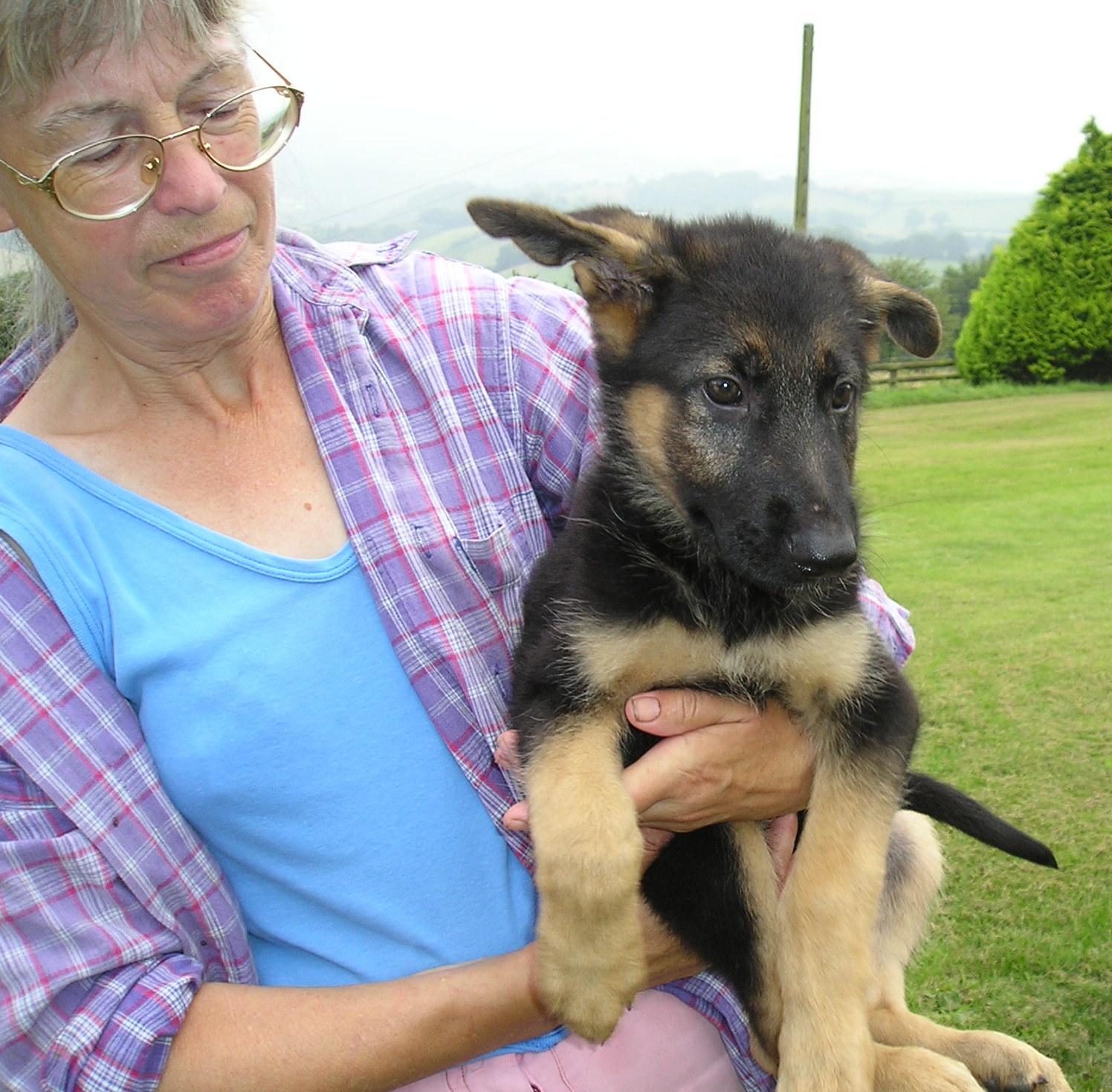
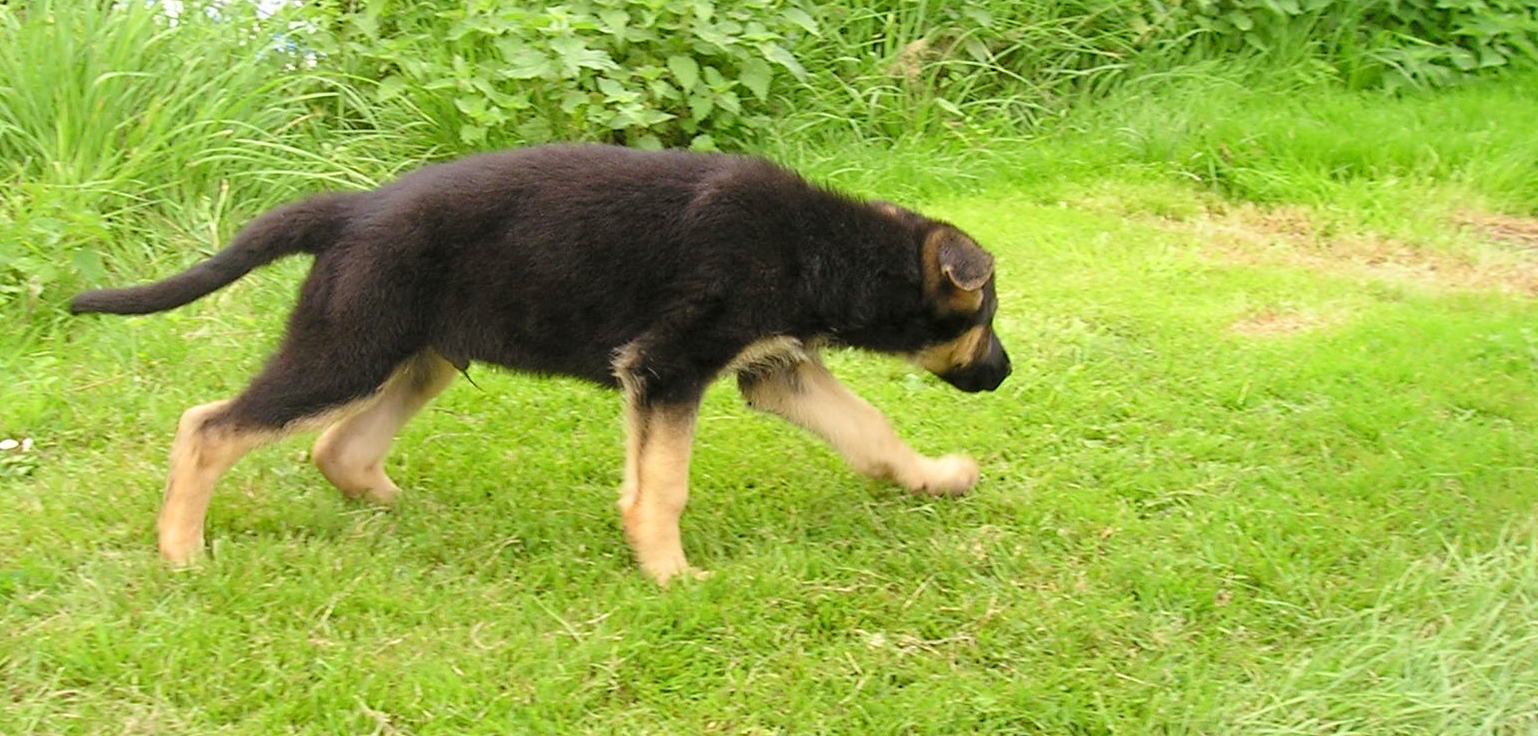
Going to leave you for today with three photographs of Pharaoh taken the day I first saw Pharaoh as a puppy, back on the 12th August 2003. The woman holding Pharaoh is Sandra Tucker who runs Jutone Kennels in Devon, England., where Pharaoh was born 10 years ago this day!
Yesterday, I explored love across the species; back to that first encounter between wolf and early man.
Today, I want to revisit what we mean when we use the word ‘love‘ and feel the emotion. I say revisit because it’s not the first time I have dipped my toes into this particular pool. Last August, I wrote a piece What is love? It opened thus:
How the relationship that we have with domesticated animals taught us the meaning of love.
This exploration into the most fundamental emotion of all, love, was stimulated by me just finishing Pat Shipman’s book The Animal Connection. Sturdy followers of Learning from Dogs (what a hardy lot you are!) will recall that about 5 weeks ago I wrote a post entitled The Woof at the Door which included an essay from Pat, republished with her permission, that set out how “Dogs may have been man’s best friend for thousands of years longer than we realized“.
The following day, I wrote a further piece introducing the book and then commenced reading it myself. Please go there and read about the praise that the book has received.
What I want to do is to take a personal journey through love. I should add immediately that I have no specialist or professional background with regard to ‘love’ just, like millions of others, a collection of experiences that have tapped me on the shoulder these last 67 years.
The challenge for us humans is that while we instinctively understand what emotions represent: love, fear, anger, joy, grief, sadness, happiness, et al, we really have no way of knowing precisely what another person is feeling and how that feeling compares to our own awareness and experience of that emotion.
Stay with me as I explore how others offer a meaning of love.
As it happens, this week’s Sabbath Moment from Terry Hershey was much about love.
If you judge people you have not time to love them. Mother Teresa
Where there is great love there are always miracles. Willa Cather
Someday, after we have mastered the winds, the waves, the tides, and gravity, we shall harness… the energies of love. Then for the second time in the history of the world man will have discovered fire. Pierre Teilhard de Chardin
Then some further reflections:
Here’s my take: Life is complicated and at times, very, very challenging. And sometimes, overwhelming. Bad things can happen to good people. Decisions can be thorny and disconcerting. However. Even in the midst … where there is great love, there are always miracles.
and
Here’s the deal:
Love is not always where I predict it will be.
Love can grow and blossom even in the face of striving and anguish.
If we judge we cannot love. Just because I see something one way, doesn’t mean that I am right and you are wrong.
When we do love, we are present. When we are present, there is always a thread. The good news is that we are in this together. One day you may be that thread for me. And one day, I may be that thread for you.
Powerful words! Words that will have many nodding. Yet still nothing absolute that offers a definition of love that would be universally understood. Because there can be no universal definition. That is the magic of all emotions – they defy the ‘science of life’. So let’s just treasure that magic.
Last night I wrote this poem, its been a while since I posted one, so as my pen flew across the page I was inspired with these words.. Maybe due to the recent Solar flares, but my ears have been ringing ever louder as the energies have intensified.. The Silence space within is a place to reflect and absorb the peacefulness of Oneness with the Universe…. A place I often go, where we can just close our eyes to the constant noise as the Planet cries with yet more pain… Meditation helps centre our minds. If you would like to follow a meditation I often do… You can find it Here on a post I did back in 2008 .
Silence booms in an explosion of sound
Splintering static high pitched and loud
Morse Coded downloads in intermittent bursts
The Cosmos is talking-Do you hear its verse?
~~
I escape to the mountains and I run to the sea
But its chatter surrounds me as I long to be free
I hear cries of children, laments from the old
Each on a journey their stories to be told
~~
The Elephants and Dolphin their cries go unheard
Yet I hear their low rumbles and clicks how absurd
Each voice in the matrix – every thought in the mix
A Planet in Crisis – will it ever be fixed?
~~
So I turn down the volume as I shut the outer door
As I meditate inward finding higher-self law
Here I seek Peace in the stillness I find
The Key to the Cosmos we turn in the mind
~~
All things are great and all things are small
The Mind gives them power and shall overcome all
The Universal Plan- I am part and unique
Each one is searching to fit the pieces they seek
~~
And the answer is simple- but we make is so hard
With the choices we choose as we shuffle life’s cards
How to close it for today? Frankly, I’m not sure. So I’m going to ‘cheat’. By which I mean republish something else from last August. A guest essay about the loss of love. Because it seems to me that one way (the only way?) to experience what love truly means is when we lose it. As Eleanore MacDonald describes below in the most heart-rending and beautiful fashion.
oooOOOooo
one of the seven great dogs
“Until one has loved an animal, a part of one’s soul remains unawakened.” Anatole France
Djuna Cupcake, my heart of hearts, photo by Breelyn MacDonald
A great squall came upon us here on our farmlet a week ago. I saw it first from a distance, in that dawning of the morning when Djuna usually announced the coming day with his gentle, breathy ‘woooof’, his polite plea to join us on the bed. Mysteriously disturbing, it surely was a sign of things to come, but we didn’t know how dangerous it really was until it was upon us.
And when it was suddenly there, a Great Joy was sucked from our world and an overwhelming sadness took its place … a raging stillness, hot and stifling, no breath, no heartbeat.
My springs of Joy are dry … (a sentiment stolen in part from that great old song, Long Time Traveler)
Djuna Cupcake was one of the Seven Great Dogs. If you’ve seen the film ‘Dean Spanley’, you will know what I mean. If you have loved and been loved by a dog of pure heart … one who was a great teacher of presence, of patience, one who was the dispenser of unconditional love and the blessings of an incomparable joy … one who was a great listener, guardian, and the embodiment of Buddha, Coyote, the Goddesses Eleos and Kuan Yin all in one soft coated body … one who was your loving shadow because he or she felt that it was their job to see you safe at all times … you will know what I mean.
He died quite suddenly. Like that squall, his death came with no warning and for days after Paul and I were sucked deep into that great black hole of grief. The dread attacked us at every turn, where we would always see him but now only a glaring emptiness stood. I felt as though my heart and soul had a raw, oozing, gaping, searingly painful wound where he had been torn away from me. Stolen. We cried a lot.
Some people will never understand. I try to feel compassion for them, rather than issuing the big ‘EFF YOU”, but I am only human. What is this BS about a ‘three day’ rule? What? Because he was ‘just a dog’ we should be over it all in 3 days? Djuna was surely a better person than most Humans and I will never stop missing him. I feel so deeply sorry for those people who have overlooked having such grace and beauty bless their lives –– the companionship of a great dog (or cat or horse, or human person) –– so that, when the monumental end comes and they’ve come through the great fires of sorrow, and have been washed by the flush of a million tears, they come through to the other side where they are able to see the remarkable love, joys and lessons they’d been gifted by that companionship. I can only hope now to ‘be’ the person Djuna thought me to be.
3 days and 3 more and 3 million more and even then more just won’t do it.
Paul and I were with Djuna on our bedroom floor when he died. I lay with him next to my heart, whispering love, my arm draped over his neck … and as he was leaving us, I saw him standing just beyond Paul. Alert, ears akimbo, head cocked, eyes bright, a wad of socks in mouth, standing in his particularly great exuberance, as he did each morning when the time for chores presented itself – “Come on! It’s time to go! Get with it you silly humans! There’s work to be done, there’s a barn to clean and a day to sniff, there’s delight to be found!” And then he left.
My ‘joyometer’, my daily dispenser of mirth, and my constant reminder of the importance of presence, has gone missing – his lessons of ‘Be Here Now’ measured in doses of ’Oh, sense the beauty in the music of the wind!’, ‘Let’s just run in circles and laugh’, ‘I love, love, love you!’ … gone. It is wholly up to me now to remember to stay in each moment, to just be a nice person, cry whenever I must, to laugh as much as possible and dance for the sheer joy of it. And when the cacophony of the deafening silence has quieted and the colors of sorrow have muted and gone transparent and I’ve had some time to let the Aegean clean up those bloodied wounds in my heart and soul, there will be room again here for another one of the Seven Great Dogs. And the cycles will continue on.
Almost every evening Djuna and I took an evening stroll down our quiet lane. I loved watching him dance his great joy, nose to the ground scenting all of the news of the day or nose to the sky, sensing what was coming on the breeze. On our walks I watched the seasons change, the rising of the full moon, the greening of the new spring and the evening skies, like snowflakes, no one ever alike … I watched the Canadian geese come and go, the Red Tail hawks courting in the air above me, and let the build up of my day fall away as I tread softly with my gentle friend. It took me several days after Djuna’s death for me to realize that here was yet again another gift he had left for me in his wake, and one I should continue to enjoy. The sky was black to the West, we’d had heavy winds and rain all day, but when there was a break I set off on ‘our’ walk. Wrapped tightly in sadness and hardly breathing with the missing of him, I shuffled along about a 1/2 mile and turned for home before the rains started up and the chill wind began to blow, fierce again, from the south. That wind battered and bashed me until it freed the tears from my eyes, and the freezing rain lashed my face until I grew numb. As though suddenly realizing I was about to drown, I surfaced, taking in great gulps of air as though I’d not been breathing for several days, and began to climb free of the suffocating bonds of my sadness.
Part of our family
My Djuna, my Cupcake … My Heart of Hearts who knew my soul, my every thought; great lover of Paul and I, and of Breelyn; great lover of his mare and his pony, of socks and his furry toys and his GWBush chew doll; great lover of his evening walkies and of riding in the car, and feeding the birds; great lover of sofa naps and sleeping in late with us on the bed and chasing BALL and rolling on the grass and of eating horse poop; bountiful bestower of stealthy kisses; joyful jokester, Greek scholar (he knew about 15 words and understood several phrases spoken to him in Greek; something we did only after he’d begun to understand words and phrases *spelled out* in English! ‘Car’, ‘dinner?’, ‘play with the ball?’, ‘feed the birds’, water, pony, get the goat, etc!); Djuna, beloved Honorary Cat, our timekeeper, our guardian angel, our boss, our playfully dignified friend (thanks for that Marija) and family member, and one of the Seven Great Dogs – we will love and miss you forever.
But now – there’s work to be done, there’s a barn to clean and a new day to sniff, there’s delight to be found!
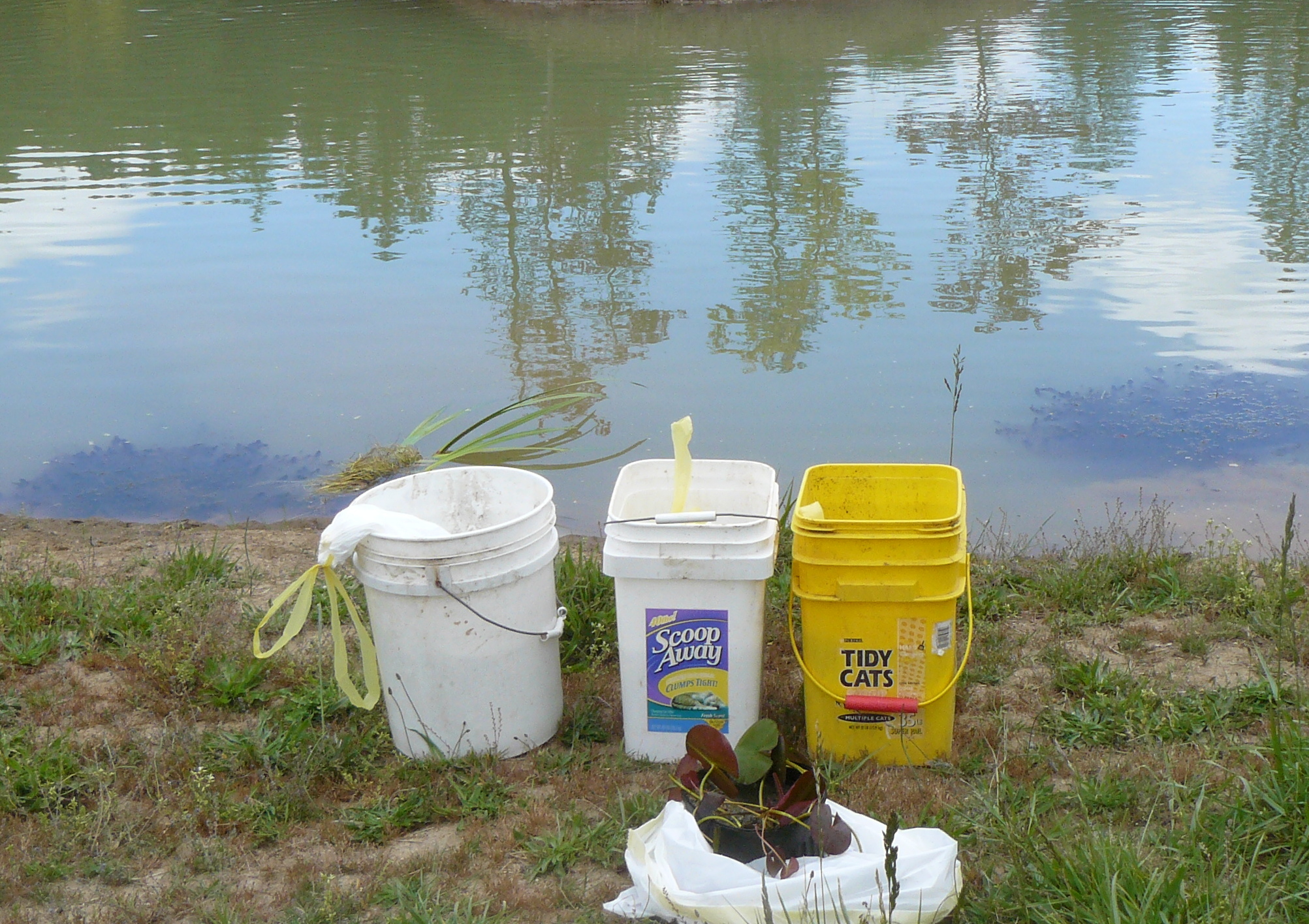
Our pond has settled to the point where Jean thought it would be good to get some fish. So off to a pond and fish supplies store in Grants Pass to seek advice. We settled on some Koi and a water lily plant.
Koi and water lily ready for the launch.
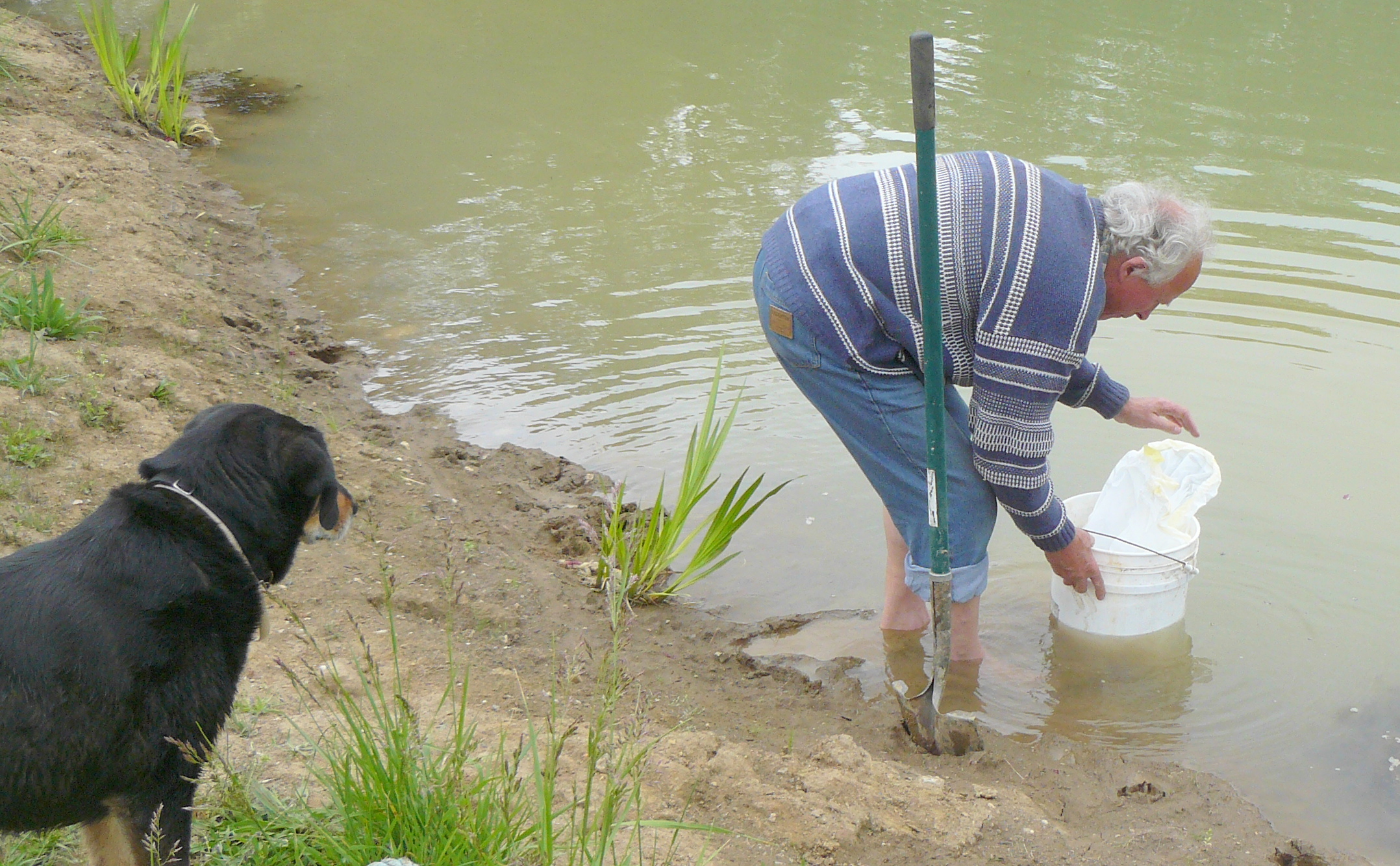
We were advised to acclimatise the fish in terms of water temperature by slowly mixing pond water into the bags containing each fish.
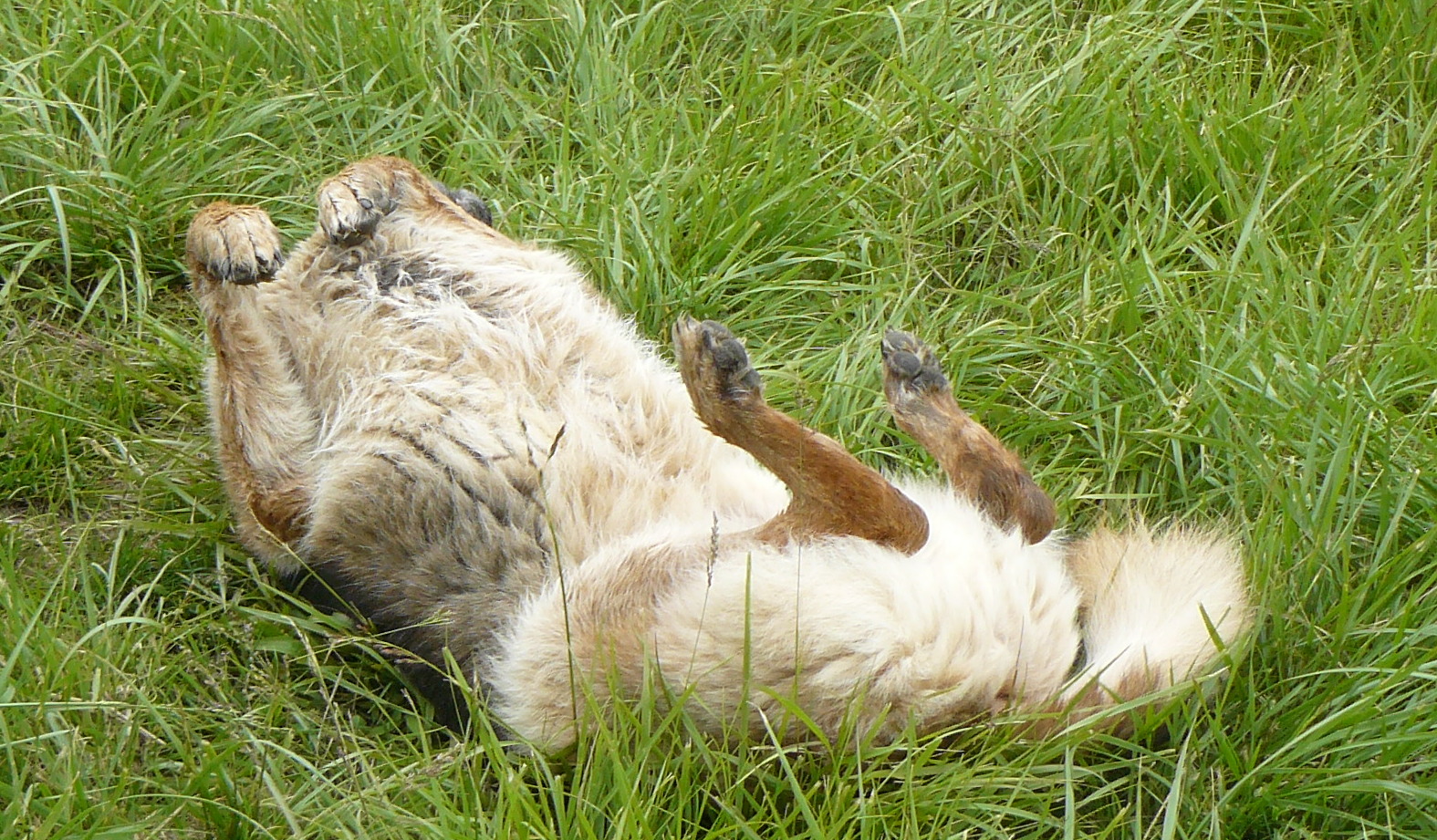
Meanwhile, Pharaoh took advantage of clean, green grass to give his back a bit of a rubdown.
Ah, that feels so much better!
And Hazel pondered what ‘Dad’ was up to.
Not seen this happen before?
But eventually it was time for the three Koi to slip away into the depths of their new home.
Wonder if I’ll ever find my two mates?
The twenty-three?
Nine dogs, five cats, four chickens, two miniature horses and three Koi!
A few days ago, dear friend Dan Gomez sent me a link to an article in the March/April edition of Maui Magazine (must admit not heard of it before).
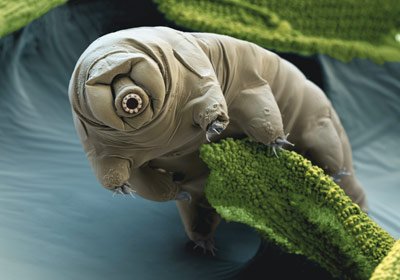
It was a story written by Shannon Wianecki under the title of ‘Eight Tiny Steps for Tardigrades‘. Here’s how it opened;
Eight Tiny Steps for Tardigrades
It might sound like a fairy tale, but it’s fact: Haleakala National Park is home to a troupe of tiny bears. But don’t bother searching for these wee creatures. Tardigrades, better known as water bears, are miniscule, ranging from 50 to 1,200 microns. Which means a couple of water bears could fit into the period ending this sentence.
Water bears are so named for their appearance and form of locomotion. Like microscopic grizzlies, they pad along on eight stumpy legs, brandishing claws and short snouts. Another name — moss piglet — refers to the animal’s most common habitat. Tardigrades are aquatic, but to creatures of their size, suitable swimming holes include the moisture clinging to mosses, or the capillary water between grains of sand. They are found all over the globe: in the arctic, desert, deep sea, and — most of all — in Hawai‘i.
Now if I blow the dust off my aged brain, I recall that a micron is a millionth of a metre (or meter in American speak). Whatever the spelling, that is small.
So even if this little creature can be up to 1,200 microns ‘big’ that would still only be 1.2 thousandths of a metre.
The article is well-worth reading in full. However, I will take the small liberty of republishing the final paragraph;
In 2007, water bears joined astronauts in space to see how they handled cosmic rays. Exposed for ten days to the vacuum of space, without oxygen, water, or heat, and zapped by intense solar radiation, water bears became the first animals to survive in space.
Back on Earth, the mini-cosmonauts continued to breed successfully. Investigating the molecular makeup of these amazing creatures may show humans how to survive future space explorations.
Now without wishing to be too basic, I would love to have this question answered: How does something that small breed? Indeed, how could they ever find each other?
So if you are a pet owner and a bit worried about the costs of feeding and looking after your beloved animal, don’t worry! There’s something else in town a little bit smaller!