Category: Musings

Change, as far as the eye can see.

Of the matters of man for the coming year.

Like countless others, when we look back 12 months and recall what we thought 2012 had in store, we now realise that we didn’t have a clue!  As the silly expression goes, “I can predict anything except those things that involve the future!

So repeating the process is stupid; I have no doubt that 2013 will be brim full of surprises.  At all levels: personal, local, national and global.  But ….. (You knew there was a ‘but’ coming, didn’t you!)

But a conversation that I had with Peter McCarthy on the 27th December resonated with me to such a degree that I felt the urge to pen some thoughts.  I worked with Peter some years ago at Clevedon Hall, we shared an interest in flying a TB20 and both of us studied for our CAA Instrument Rating.  We became good friends.

Clevedon Hall, Somerset, England.
Clevedon Hall, Somerset, England

So come with me today for a stroll around the grounds of change, possibly an epochal period of change.

Let’s start with what may be the biggest catalyst of change heading our way – our broken political system.

Christine of 350orbust fame published this yesterday.

it-is-not-a-just-society-quote

The view that many western societies are a very long way from being fair is growing.  If you want to dig a little deeper into the appalling statistics of the USA, for example, dip into a recent essay written by Charles Hugh Smith that appeared on Chris Martenson’s Peak Prosperity blog.

It’s a long essay packed full of powerful facts and statistics.  Try this one:

6.  The assets that generate unearned income are highly concentrated, and as a result so is the unearned income.  The top 1% owns twice as much stock-market wealth as the bottom 90%.  This income-producing wealth enables the top 1% to act as a financial aristocracy, buying influence and favors from equivalently concentrated political Elites.

stock market wealth

Let me go to Charles’ conclusion:

What few dare admit, much less state publicly, is that the Constitutional limits on the financial Aristocracy and the Tyranny of the Majority have failed.  This guarantees a future Constitutional crisis as each political class – the financial Aristocracy, the top 24% who pay most of the taxes, the dwindling middle class and the bottom 50% who depend on Federal transfers – will battle for control as the Status Quo collapses under the weight of its unsustainable promises.

H’mmm!

Back to the conversation with Peter.  He felt that there was a massive failure of the democratic process in the UK, and by implication in the USA.

Peter continued by saying that many elected politicians, especially at the level of local politics,  weren’t smart people.  Smart, innovative, entrepreneurial people chose not to go into politics.  Those that were elected had too much power and too many vested interests for the good of the societies that they were meant to represent.  In the USA the involvement of private money in politics is nothing short of corruption of the highest order; my personal opinion, no less and no more.

In moderation, Churchill’s saying comes to mind. “It has been said that democracy is the worst form of government except all the others that have been tried.

Let’s move on.

No-one can deny that in so many areas of our lives, the degree of change seems unprecedented.  Whether we are speaking of the huge social changes at work, enormous technological changes, such as the way that we communicate with each other, medical practises, and on and on.  Then add in the consequences of the change in the Earth’s climate, whether or not one sees this as the outcome of man’s activities and …. well, you get the idea!

Here’s a lovely perspective from Alex Jones who writes the blog, The Liberated Way.  Just a few days ago, Alex wrote this:

As hard and gloomy as some of my blog posts on the future of humanity have been, I thought it time to offer good news as to where we are heading.  I shall call this the global realignment.  Few will disagree that the current activities and ideas of humanity in relation to the environment are unsustainable and point to our self-destruction.  History also shows that whenever a crisis occurs traumatic events and the ideas of new thinkers causes a paradigm shift in attitudes and thinking.

Contrary to the fantasy of many people, there will be no celestial champion on a white horse riding forward to save humanity from itself.  The change will come from a series of traumatic events and individual thinkers which will plant the seeds of change, which will ripple forward as a tsunami of changes of ideas and attitudes on a global scale.

So much change.  So much uncertainty.  Such a feeling of being lost in unfamiliar lands.

Or have we been here before?

Have you heard of the Kondratieff Wave?

The Kondratieff Wave (Kondratiev Wave or K-wave) theory is proposing the existence of the extra-long, 50+ years long cycles of growth in the modern market (capitalist) economy. The theory was proposed in 1920s by Russian economist Nikolai Kondratiev.

Wikipedia has a good summary available here.  A Google search will find much more material, such as this chart:

kwave

The Wikipedia entry has a simpler diagram, see below, that shows the four stages of each cycle.

Kondratieff_Wave.svg

So how to draw this to a close?

In a sense, in a very real sense, there isn’t a close.  The future has always been uncertain and as history shows change is the only constant.

Peter concluded that a better society was ahead and hoped that he would live sufficiently long to witness it.  That gets my vote!

Happy New Year to you.

Thank you for taking an interest in Learning from Dogs.

Half empty, or half full?

Life has a habit of reflecting our own perceptions back to us.

Dear friend, Bob Derham, can always be counted on to forward something amusing or inspirational.  The Boxing Day smile was an example of the former.  Today is an example of the latter.

oooOOOooo

woman carrying water 2

An elderly Chinese woman had two large pots, each hung on the ends of a pole which she carried across her neck.

One of the pots had a crack in it while the other pot was perfect and always delivered a full portion of water.

At the end of the long walks from the stream to the house, the cracked pot arrived only half full.

For a full two years this went on daily, with the woman bringing home only one and a half pots of water.

Of course, the perfect pot was proud of its accomplishments.

But the poor cracked pot was ashamed of its own imperfection, and miserable that it could only do half of what it had been made to do.

After two years of what it perceived to be bitter failure, it spoke to the woman one day by the stream.

‘I am ashamed of myself, because this crack in my side causes water to leak out all the way back to your house.’

The old woman smiled, ‘Did you notice that there are flowers on your side of the path, but not on the other pot’s side?’

”That’s because I have always known about your flaw, so I planted flower seeds on your side of the path, and every day while we walk back, you water them.’

For two years I have been able to pick these beautiful flowers to decorate the table.

Without you being just the way you are, there would not be this beauty to grace the house.’

Each of us has our own unique flaw.  But it’s the cracks and flaws we each have that make our lives together so very interesting and rewarding. You’ve just got to take each person for what they are and look for the good in them.

So, to all of my cracked pot friends, have a great day and remember to smell the flowers on your side of the path!

oooOOOooo

Nothing more one can add to that.  Well, sorry, there is one thing I can add.  That is that dogs love us with all our flaws and quirkiness.

Mirror on my behaviours.

Another fascinating aspect of how we learn from our dogs.

The last week has been challenging, to say the least.

P1120158

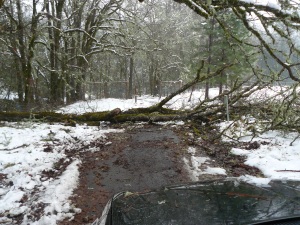
The biggest winter storm in ages hit this part of Southern Oregon last Thursday, the 20th.  That day we lost our power to the home around 6.30 pm.  We only had it restored around 4pm last Sunday, the 23rd.  That meant no access to our well, no cooker, no heating in the house and … well you get the picture.

P1120160

The wet snow, some 9 inches or so, brought down trees across the property including one that blocked our driveway.

So where’s this leading?

Just that there have been times when I have been irritable to the extreme.  My normal patience with the dogs has been lacking from time to time.  Moments when I have pushed a dog away from me, or shouted at another when the barking was getting to me.

The dogs have been so forgiving, so tolerant of my irritability.  I was able to reflect in my quieter moments about my behaviours.  Able to see how well or otherwise I coped.  The dogs offered a mirror to me.  Allowing me a gently chastisement that getting angry with the world around me was my problem.  It was me that was ‘choosing’ my actions and behaviours.

The dogs also chose to respond to me.  Here’s how Hazel responded.

P1120183

Here’s how Dhalia responded.

P1120189

Finally, here’s how that grand old man Pharaoh responded.

P1120193

All of them offering me the message: chill out, Paul!

Be that change!

A most beautiful message from Paul Chefurka This republication of a recent item on The Permaculture Research Institute website comes with the written permission of their editor, for which I am very grateful.  Nothing from me will add to this very personal essay, so with no more ado here it is.

oooOOOooo

Enough!

Society — by Paul Chefurka December 20, 2012

Meditation_on_rock

Whenever I contemplate the spectacular mischief that we humans have wreaked on our world, I am compelled to ask how this could have possibly happened. The despoilment of our planet seems to be the exact opposite of how I would expect a thinking, feeling, caring creature to treat their home. What could have driven us to this, and what perverse qualities could have allowed us to ignore the consequences of our actions for so very long?

At first blush, our problems seem decidedly physical. Dangerous gases drift in the air; acidity rises slowly in the ocean as the fish disappear from its depths; garbage and detritus of all kinds fouls the land where lush forests and grasslands once ruled. All these disturbances point back to human actions.

The proximate causes of this planet-wide distress include economics, politics, and personal and corporate greed – all facilitated by a technological cleverness that rests on a bed of dispassionate science.

I have spent over 50 years of my life trying in vain to understand our environmental problems as purely physical problems. When I viewed them in those terms, the fact that such problems even existed in a rational, scientific culture seemed nonsensical. However, when I recently began to understand them as consequences of a rupture in the human spirit they finally began to make sense to me. Yes, they are compounded by political and economic forces, but in my view even politics and economics are simply consequences of the same qualities of the human psyche.

Since the dawn of consciousness, human societies have been driven by a complex web of factors with their roots embedded deep in our evolved human nature. Power relationships and hierarchies, kinship and xenophobia, selfishness and altruism, competition and cooperation, curiosity and apathy, and countless other polarities mingle together to form the infinite variety of human dynamics.

Underneath it all, though, lurks our self-awareness. Human self-awareness is the root of our sense of separation from the natural world, and from each other for that matter. It’s the crowning paradox of the human condition – at once both our greatest glory and our fatal flaw. It is behind the dualism – the perceptual split into subject and object – that gave us science. It’s the source of our ability to see others as “different yet the same”, giving us the power to act altruistically. It’s also behind the sense of self and other that has allowed us to assume dominion over all we survey, whether animal, vegetable, mineral or human. Our sense of separation is the rupture of the human spirit that has allowed our current predicament to develop.

If this is the case, then no physical, political or economic remediation will heal the wound. The solution to our predicament is not – cannot be – material, political, economic, or simply philosophical. If a “solution” exists at all, it’s orthogonal to all those domains. Only by healing our belief in our separateness will we be able to finally and fully restore our balance with Nature.

When I began to view the situation like this, I was finally able to see that there are in fact solutions, where none had previously been visible. These new solutions don’t attack the predicament directly as a series of material, political, economic or technological problems. Instead, they seek to effect change from the center, by encouraging people to mature into an inter-connected adulthood and assume personal responsibility for their actions.

This approach follows Gandhi’s dictum, “Be the change you wish to see in the world.

The mischievous idea of science and technology as a post-modern “religion of salvation” with Ray Kurzweil’s transhuman singularity playing the role of the Rapture and an economist making a cameo appearance as the Devil (think infinite growth on a finite planet…) resonates very strongly with me.

But to be a little more precise, it’s not exactly science that has failed us. We have been undone by a toxic stew of classical economics, technological cleverness, love of progress, an attitude of Manifest Destiny and an unwillingness to accept any limits on our growth.

Technology lets us use scientific discoveries to satisfy human desires of all kinds. When we harness scientific knowledge to human ends, the outcomes we choose to implement are based on our wishes. If our wish is dominion over nature, we will use scientific principles to invent technology like mining machinery, continental energy grids, factory farming and the automobile.

Of course, each of those inventions is presented within our cultural narrative as an obvious, irrefutable boon. One of the points of having a cultural narrative is to put a positive spin on human activity. The spin is always in line with the narrative – or more precisely, in line with the wishes of those who create and sustain the narrative. The fact that these inventions, the technological expressions of science, have a subtext of dominion over nature is carefully camouflaged, and the idea that this might possibly be a bad idea is thoroughly discouraged.

None of this would have been so damaging if people didn’t have such a natural ability to delude themselves into believing that whatever they wish for hard enough is possible. It’s kind of like clapping for Tinkerbell. “The future is always going to be better than the past,” and “My kids will have better jobs, bigger houses and faster cars than I did,” are examples of such magical thinking at its finest.

Those two kinds of wishing – the wish to improve the human condition and the wish to see the human milieu keep growing forever – are not inherently different. I see them more as two points on a continuum. On one end is simple desire; on the other end is unreasonable desire. They are distinguished less by any intrinsic difference than by the attitude and realism of the one doing the wishing.

It can be very difficult to tell when the reasonable morphs into the unreasonable.”I wish to own a small piece of land” becomes “I wish to own an entire island” which inflates into “I wish to claim a continent for my King” and eventually becomes “I wish to rule the world.” The underlying desire is the same; it’s just the scale and reasonableness of the wish that changes.

Whether or not a wish is realistic or deluded depends very much on the one doing the wishing. There are people who wish for our (and by extension, their own) material wealth to continue growing forever. There is no shortage of economists who will tell them that such a strange thing is possible. Are the dreamers deluded? Are the economists deluded? What laws of nature would need to be violated for such a delusion to become reality? How is the worship of the Charging Bull of Wall Street materially different from worshiping the Golden Calf of the Bible, when both imply a violation of the laws of nature?

The world changes only when enough people have made a choice to change themselves. At what point will we each say, “Enough!” and choose a different path? Is anything keeping you from making that choice right now?

As you finish reading this article I invite you to say it quietly to yourself.

Enough!

If you listen closely with your heart, you may be able to hear the life that shares our planet say, “Thank you.

oooOOOooo

You can read more of Paul Chefurka’s writings on the PRI website here. Do, also, visit Paul’s website here.  You will not be disappointed.

Finally, let me do two things before closing.

The first is to highlight a sentence towards the end of this beautiful essay. This one. “The world changes only when enough people have made a choice to change themselves.

The second is to highlight on Paul’s website his Public Domain Notice statement: Any article on this web site may be reproduced by anyone, in whole or in part , in any manner and for any purpose whatsoever, with no restrictions.

Spread the word about you, me and all of us being the change the world needs – and needs now.  Thank you.

The end of the world?

Maybe not from a Mayan perspective but, nevertheless, who knows!

For some time now I have subscribed to the online magazine Big Think.  Daniel Honan, Managing Editor, has contrived to bring together a group of very interesting authors from a wide range of disciplines, presenting a weekly collection of thought-provoking articles.  Despite the volume of emails that seems to assault my in-box each day, it’s very rare for me not to browse the weekly digest from Big Think.

Thus it was that early on the 13th (last Thursday) I read a wonderful item written by Steven V. Mazie, Associate Professor of Political Studies at Bard High School Early College-Manhattan.

A quick telephone call to Dan Honan produced an immediate ‘yes’ to my request for permission to republish the Steven Mazie piece here on Learning from Dogs so settle back and enjoy.

oooOOOooo

Googling the Apocalypse: the Web as Epistemological Vortex

Steven Mazie on December 11, 2012, 2:12 PM

Let’s say you’re just now tuning in to reports that the world will end on December 21 when the Mayan calendar resets to zero. Maybe you’re one of the 35 million Americans who fear it will really happen. Maybe the prospect of solar storms, rogue planets and devastating floods is a welcome distraction from more pedestrian anxieties of everyday life. Or maybe you’re just curious how such a ridiculous idea could persuade “panicked” Russians to buy up all the “matches, kerosene, sugar and candles” in town or spur a Chinese man to spend his life savings building an ark to keep him afloat after the catastrophe.

Where do you turn to learn more? To the epistemic umbrella of the 21st century, of course, and here is what Google will show you.

SM1

Do you consult the first hit, billed as the “official website for 122112 information”? Do you settle for the detailed account in the Wikipedia entry, listed second? Or do you flick down to the third, an earnest attempt by NASA to explain “Why the World Won’t End”?

If you go with the first site, you will find a bizarre, colorful bazaar of information, perspectives and advice on the approaching doomsday. There is enough to keep you occupied here for a while: a list of celebrities who believe the hype (finding Mel Gibson on the list isn’t much of a surprise, but Janeane Garofolo? really?), an article listing “37 Things You Should Start Hoarding Now” and one remarkable video summarizing the various ways the world might end and calling on world leaders to tell the “TRUTH” about the devastation awaiting us:

The video is a study in epistemic manipulation. Narrated by a man with a severe British accent, the presentation claims — three times — “we just don’t know what to believe anymore” about “the most anticipated date of our time.” Implying that the media, corporate advertisers, the “government-sponsored scientists” at NASA and “even highly respected major religious organizations” are all either mistaken or willfully fooling us, the video appeals to our “gut instincts that something is wrong — something just doesn’t feel right.” It’s a miracle Stephen Colbert hasn’t picked this up yet. “In the eyes of many,” the video announces with no substantiation, “the prophecies of doom have been written.”

The sad hilarity of NASA’s attempt to calm everyone down takes the form of a staid FAQ. There are no bells and whistles, videos, garish colors or flashing links. Just sober, somewhat condescending, straightforward claims: “Our planet has been getting along just fine for more than 4 billion years, and credible scientists worldwide know of no threat associated with 2012.”

The problem is that credible science often fails to convince the masses. It cannot budge the majority of Americans who continue to deny the reality of evolution. It cannot convince more than 41 percent of Americans that the activities of human beings play a role in global warming. It’s no wonder, then, that so many people worldwide are keeping doomsday supply companies in business, buying up freeze-dried food rations and personal bunkers rather than Christmas presents, or that sites like December212012.com are profiting from these advertisers.

It’s dispiriting to witness the mass delusion of a tenth of humanity. You have to feel sorry for the Chinese ark-builder who will be left penniless on December 22, and you have to empathize with the people who are contemplating killing their pets or committing suicide to avoid the doomsday devastation.

But this unsettling phenomenon is a symptom of a universal human quandary: how to know whom to trust about things we can’t see or don’t understand. In a section on the rationality of belief in his delicious book Cunning (2006), political and legal theorist Don Herzog offers this:

What you believe depends on who you believe. And who you believe depends on what you believe. Your beliefs, your knowledge, your experience, your assignments of what I’ll call epistemic authority, that is, who or what sources are trustworthy on what issues: all are caught up in each other…Whether it’s rational for you to believe something depends on how it fits in with what you already believe, not least about the credibility of those reporting it.

The best argument against the doomsday believers may come on December 22, when, with any luck, most of us will still be around. But as my fellow blogger David Ropeik explained recently, and as Herzog’s analysis indicates, the next epistemological doomsday is just around the corner.

Follow Steven Mazie on Twitter: @stevenmazie

oooOOOooo

My judgment is that I should leave this post as it is.  As a slightly tongue-in-cheek review of this much heralded prediction.

But I can’t.

I’m going to follow Steve’s article with this (thanks Christine):

More footage from Chasing Ice,  an astonishing clip of the largest iceberg calving ever recorded. Arctic sea ice levels this summer hit a record low; according to the U.S. National Snow & Ice Data Centre in September, more than 600,000 square kilometres more ice had melted in 2012 than was ever recorded by satellites before. We are indeed melting our children’s future, and apparently many of us are too busy to hold our governments to account for their lack of action.

If we don’t change our ways on this beautiful planet pretty damn soon, then my guess is that we are headed for a massive depopulation and a return to a much more primitive lifestyle, a future that will be brutally obvious by 2020.

What is relevant, to a degree unprecedented in the history of humanity, is how the peoples of this planet respond NOW!

Historic times indeed.

co2Nov12

Just very grateful.

Yet another aspect of what we learn from dogs.

This is Hazel.

Hazel

As I write these words, Hazel is laying down on the carpet just next to me.  She was dumped on the street outside Jean’s Mexican house back in early 2010.  Hazel was still in milk and probably had had her puppies taken from her and sold for a few pesos.  Who knows!

But her gratitude for being rescued by Jean is boundless.  Most nights she sleeps on our bed, curled up tightly behind my back.  Her love for her world here in Oregon is beautiful and pure.  As they say, dogs do not lie about love.

So what’s this leading up to?

Simply setting the scene for a wonderful TED video by Louie Schwartzberg, first seen by me on Christine’s blog 350 or bust.

Watch and be grateful for all the beautiful things in the world.

louieschwartzberg

Louie Schwartzberg is an award-winning cinematographer, director, and producer whose notable career spans more than three decades providing breathtaking imagery for feature films, television shows, documentaries and commercials.

This piece includes his short film on Gratitude and Happiness. Brother David Steindl-Rast’s spoken words, Gary Malkin’s musical compositions and Louie’s cinematography make this a stunningly beautiful piece, reminding us of the precious gift of life, and the beauty all around us.

As a visual artist, Louie has created some of the most iconic and memorable film moments of our time. He is an innovator in the world of time-lapse, nature, aerial and “slice-of-life” photography – the only cinematographer in the world who has literally been shooting 24 hours a day, 7 days a week continuously for more than 30 years.

Louie was recognized as one of the top 70 Cinematographers for the On Film Kodak Salute Series. He is a member of the Directors Guild of America and the Academy of Motion Pictures Arts and Sciences.

Louie is credited by many with pioneering the contemporary stock footage industry by founding Energy Film Library, a global company with a network of 12 foreign offices, which was acquired by Getty Images in 1997. Motion picture clients of his cinematic artistry include Sex in the City, The Bourne Ultimatum, Die Hard 4, Syriana, Crash, Men in Black and classics such as American Beauty, Koyaanisqatsi and E.T. among others.

Louie went on to found BlackLight Films, a creative production company specializing in producing original theatrical feature, large format films, HD and TV programming.

In 2004, BlackLight Films completed production of the theatrical feature film, America’s Heart &Soul, distributed theatrically by Walt Disney Pictures. In 2006, BlackLight Films completed a series of HD shorts, Louie Films, for the launch of Buena Vista Home Entertainment’s Blu-Ray DVD releases. In 2007, the company produced a 1-hour special, Chasing the Light, which aired nationally on PBS.

Past projects include the 35mm film Seasons of the Vine for Disney’s California Adventure Theme Park and a 26-half hour series, America!, for The Hallmark Channel.

Louie has won two Clio Awards for Best Environmental Broadcast Spot, an Emmy nomination for Best Cinematography for the Discovery Channel Special, Oceans of Air, and the Heartland Film Festival’s Truly Moving Picture Award for Walt Disney Pictures’ feature film release America’s Heart & Soul.

Louie completed production on a feature length nature documentary, Wings of Life, to be theatrically released worldwide, under Walt Disney Pictures’ new production banner, Disneynature. The film was released in France (March 2011) under the title Pollen and won the Roscar Award for Best Cinematography at the 2011 Wild Talk Africa Film Festival.

Louie spoke at the TED 2011 conference in Long Beach, CA and has been a regular presenter at the annual Bioneers Conference in San Francisco. Currently, Louie is in production with National Geographic to produce Hidden Worlds, a 3D Imax film.

To underline the gratitude that I have to be here surrounded by such beautiful countryside, let me close with this picture recently taken from our bedroom window.

Deer

We are what we eat.

A thought-provoking presentation on the role of food in our society.

The last time I used this title for a post was back on July 20th.  However, the topic then was very different to today’s theme.  Then I wrote about how the genetic modification of our food represents as big a danger to the long-term survival  of man as does the damage to our biosphere.

So this comes as a very pleasant contrast.  I am indebted to Yves Smith’s blog Naked Capitalism for drawing this presentation to my attention. As was written in that NK post,

This is a super presentation by Ray Patel for Michael Pollan’s class at Berkeley, Edible Education 103. The presentation and the question period together come to about an hour.  Ray Patel follows after Michael Pollan handles administrative stuff and then does an introduction.

There are plenty of charts, but I really enjoy the anecdote on Northern Malawi at minute 43:54 — too long for me to transcribe, so I’ll quote Patel’s closing line:

What makes it really sail is not just the democracy, but the joy which comes through people cooking together as equals and eating together as equals.

Bon apetit!

Published on Dec 7, 2012
Raj Patel is an award-winning writer, activist, and academic. He has degrees from the University of Oxford, the London School of Economics, and Cornell University, has worked for the World Bank and WTO, and protested against them around the world.

He’s currently a visiting scholar at UC Berkeley’s Center for African Studies, an Honorary Research Fellow at the School of Development Studies at the University of KwaZulu-Natal, and a fellow at The Institute for Food and Development Policy, also known as Food First. He is currently an IATP Food and Community Fellow.

He has testified about the causes of the global food crisis to the U.S. House Financial Services Committee and is an Advisor to the United Nations Special Rapporteur on the Right to Food. In addition to numerous scholarly publications, he regularly writes for The Guardian, and has contributed to the LA Times, NYTimes.com, The San Francisco Chronicle, The Mail on Sunday, and The Observer. His first book was Stuffed and Starved: The Hidden Battle for the World Food System and his latest, The Value of Nothing, is a New York Times best-seller.

raj_patel

Raj Patel’s website is a great reference so do spend a little time wandering through the material.  For example, this item jumped off the page for me.

What I Did This Summer

By Raj on 08/11/2012

The good folk at Canada’s Globe & Mail asked me to write a piece called “What I Did This Summer.” Never having written one before, I thought I’d channel my inner 12 year old.

Cuzco, Peru: This summer I started to write a book and film a documentary with my hero. His name is Steve James. He filmed ‘Hoop Dreams’ which was about basketball and hope and disappointment and race and inequality and America. Our film is called “Generation Food”. It is about how we will eat in the future.

So I went to Japan. People used to live long lives in Okinawa because of the traditional diet. Lots of people lived until 100. Now grandparents are burying their children. They don’t eat as they used to. When the Americans came with their military base, they brought fast food for the GIs. Everybody eats it now. I visited farmers who plant crops on US bases. They did it so often that the Americans gave up and just let them do it. I ate goat sashimi because it would have been rude not to.

Won’t reproduce it in full as I haven’t sought permission.  So do go here to read it.  But I just can’t resist offering you Raj Patel’s closing words.

I have learned that: People are kind. Everyone has contradictions. Raw goat tastes funny, but it’s not as bad as Cuban food. The world is more beautiful than I imagined. There is more hope for the future of food than I dared to believe, against impossible odds. And it comes from unlikely places.

And after the summer, I was never the same again.

What a lovely sentiment to end on.

Forty ways of using the can.

Ah, maybe that’s why it’s called WD40!

Grateful to Neil Kelly back in Devon, SW England, for sending me this list of 40 things you can do with WD40.

wd40

1. Protects silver from tarnishing

2. Removes road tar and grime from cars

3. Cleans and lubricates guitar strings

4. Gives floors that ‘just-waxed’ sheen without making them Slippery

5. Keeps flies off cows

6. Restores and cleans chalkboards

7. Removes lipstick stains

8. Loosens stubborn zippers

9. Untangles jewellery chains

10. Removes stains from stainless steel sinks

11. Removes dirt and grime from the barbecue grill

12. Keeps ceramic/terra-cotta garden pots from oxidizing

13. Removes tomato stains from clothing

14. Keeps glass (and plastic)shower doors free of water spots

15. Camouflages scratches in ceramic and marble floors

16. Keeps scissors working smoothly

17. Lubricates noisy door hinges on vehicles and doors in homes

18. It removes black scuff marks from the kitchen floor! Use WD-40 for
Those nasty tar and scuff marks on flooring. It doesn’t seem to harm the
Finish and you won’t have to scrub nearly as hard to get them off. Just
Remember to open some windows if you have a lot of marks

19. Bug guts will eat away the finish on your car if not removed quickly!
Use WD-40!

20. Gives a children’s playground slide a shine for a super fast slide

21.Lubricates gear shift and mower deck lever for ease of handling on
Riding mowers

22. Rids kids rocking chairs and swings of squeaky noises

23. Lubricates tracks in sticking home windows and makes them easier to open

24. Spraying an umbrella stem makes it easier to open and close

25. Restores and cleans padded leather dashboards in vehicles, as well as
Vinyl bumpers

26. Restores and cleans roof racks on vehicles

27. Lubricates and stops squeaks in electric fans

28. Lubricates wheel sprockets on tricycles, wagons, and bicycles for easy
Handling

29. Lubricates fan belts on washers and dryers and keeps them running
Smoothly

30. Keeps rust from forming on saws and saw blades, and other tools

31. Removes splattered grease on stove

32. Keeps bathroom mirror from fogging

33. Lubricates prosthetic limbs

34. Keeps pigeons off the balcony (they hate the smell)

35. WD-40 attracts fish. Spray a little on live bait or lures and you
Will be catching the big one in no time. Also, it’s a lot cheaper than
The chemical attractants that are made for just that purpose. Keep in
Mind though, using some chemical laced baits or lures for fishing are not
Allowed in some states

36. Removes all traces of duct tape

37. Folks even spray it on their arms, hands, and knees to relieve
Arthritis pain

38. Florida ‘s favorite use is: ‘cleans and removes love bugs from grills
And bumpers

39. The favorite use in the state of New York , WD-40 protects the Statue
of Liberty from the elements

40. Use it for fire ant bites. It takes the sting away immediately and
stops the itch

There you are.  You always wanted to know that, didn’t you!

Utter madness!

The very strange ways of man!

I am incredibly grateful to be living in the USA as a legal resident.  The circumstances that lead to Jeannie and me living here in Merlin, Southern Oregon are the stuff of dreams.  Which is why writings on Learning from Dogs that could be seen as critical of a US administration leave me rather uncomfortable.

However, a recent news item on the BBC website struck me as so utterly incongruous that I couldn’t resist today’s post.  As is said, “I can resist anything except temptation!”  Here’s that item.

US Congress bans word ‘lunatic’ in federal legislation

6 December 2012

"Lunatic" is derived from the Latin word for moon, and the belief that it could affect mental health
“Lunatic” is derived from the Latin word for moon, and the belief that it could affect mental health

The sharply divided US Congress has been able to agree on one thing at least – that the word “lunatic” should be banned.

The House of Representatives voted 398-1 on Wednesday to strike the term from all federal legislation, after the Senate did the same in May.

The measure is designed to remove language that has become outdated or demeaning from the US code.

The bill will now go to President Barack Obama for his signature.

Senator Kent Conrad, one of the sponsors of the measure, said: “Federal law should reflect the 21st Century understanding of mental illness and disease, and that the continued use of this pejorative term has no place in the US code.”

The only “no” vote came from Texas congressman Louie Gohmert, who said it was madness for lawmakers to waste time on such a measure when more high-profile issues loomed, such as the federal debt.

“Not only should we not eliminate the word ‘lunatic’ from federal law when the most pressing issue of the day is saving our country from bankruptcy,” said Rep Gohmert in a statement.

“We should use the word to describe the people who want to continue with business as usual in Washington.”

Now don’t get me wrong.  In and of itself that measure is fabulous removing, as it does, any official labeling of those with mental health problems.

However, surely the following demonstrates that madness is still alive and well.

LAW PROHIBITS UNFAIR EU TAXATION OF U.S. AVIATION

November 27, 2012

Washington, DC – The President today signed into law a measure to stop the United States’ participation in a costly European Union (EU) scheme to impose an emissions tax on American and other nations’ aircraft operators and air carriers. Transportation and Infrastructure Committee Chairman John L. Mica (R-FL) and Aviation Subcommittee Chairman Tom Petri (R-WI) were among the primary sponsors of the bipartisan companion bill in the House of Representatives.

In 2011, Mica first led a Congressional delegation to the European Union to convey opposition to the EU’s plan. Mica also led a subsequent delegation to Montreal to meet with International Civil Aviation Organization (ICAO) leaders, representatives of the EU, and other officials regarding U.S. opposition to the ETS. The original “European Union Emissions Trading Scheme Prohibition Act of 2011,” authored by Mica, Petri, and other House leaders, overwhelmingly passed the House on October 24, 2011.

John Mica was quoted as saying “The law signed today is a clear signal that the United States will not accept the EU’s go-it-alone attempt to impose emissions taxes on other nations for activities far outside the EU’s own borders. This European emissions trading scheme is an unlawful infringement upon U.S. sovereignty, and the sovereignty of numerous other nations.

Now I don’t know the rights and wrongs of this but one thing is clear to me.  If trying to reduce carbon emissions represents ‘unlawful infringement upon U.S. sovereignty‘ then don’t even ponder on the infringement that not trying to reduce emissions would risk!

Which neatly leads to the Yale forum on Climate Change & The Media that recently reported,

Forget About That 2-Degree Future

SAN FRANCISCO, CA, Dec. 5, 2012 — Renowned British climate scientist Sir Robert Watson pulled few punches today during a talk about the warmer world humans will face in coming decades.

Watson, who was IPCC chair from 1997 to 2002, all but dismissed the possibility of keeping the rise in average global temperatures to 2 degrees Celsius above pre-industrial levels — a temperature rise that corresponds to an atmospheric concentration of CO2 of 450 parts per million. It now stands at about 390 ppm.

“Fundamentally, we are not on a path toward a 2 degree world,” Watson told a packed hall at Moscone Center for a talk entitled: “A World Where the Atmospheric Concentration of Carbon Dioxide Exceeds 450 ppm.”

If the international community wanted a world in which the rise in average global temperatures this century peaked at 2 degrees C above pre-Industrial levels, CO2 emissions in the developed world should have peaked in 2010, Watson said. Globally, they would need to peak by 2014.

Instead, CO2 emissions in 2010 were up 5.9 percent relative to 2009 — and that was in the midst of an economic downturn for most industrialized countries. Total carbon emissions as well as carbon intensity (often described as the amount of CO2 emitted per unit of a nation’s GDP) have gone up.

“It’s totally clear we’re changing the composition of the atmosphere …” [but] “politicians have not listened to the scientific message,” Watson said. [my emphasis]

Average global temperatures could rise 2 to 7 degrees C by the end of the century, driving a litany of environmental changes, Watson said. Already, the climate of the 2020s and 2030s is locked in, or as Watson put it, “pre-ordained.” “Therefore, we must adapt,” he said.

You can read the full report here.

As Isaac Newton is recorded as saying: “I can calculate the motion of heavenly bodies, but not the madness of people.

The dirt beneath our feet.

A film about dirt that opens eyes!

dirt-splsh

I have mentioned the website of the Permaculture Research Institute of Australia before.  It’s a fabulous resource for many aspects of moving towards a more sustainable lifestyle, and not just for Australians.

A few days ago, their regular posting included a link to this:

Dirt: The Movie

DIRT! The Movie — directed and produced by Bill Benenson and Gene Rosow — takes you inside the wonders of the soil. It tells the story of Earth’s most valuable and underappreciated source of fertility — from its miraculous beginning to its crippling degradation. The opening scenes of the film dive into the wonderment of the soil. Made from the same elements as the stars, plants and animals, and us, “dirt is very much alive.” Though, in modern industrial pursuits and clamor for both profit and natural resources, our human connection to and respect for soil has been disrupted. “Drought, climate change, even war are all directly related to the way we are treating dirt.”

DIRT! the Movie — narrated by Jaime Lee Curtis — brings to life the environmental, economic, social and political impact that the soil has. It shares the stories of experts from all over the world who study and are able to harness the beauty and power of a respectful and mutually beneficial relationship with soil.

DIRT! the Movie is simply a movie about dirt. The real change lies in our notion of what dirt is. The movie teaches us: “When humans arrived 2 million years ago, everything changed for dirt. And from that moment on, the fate of dirt and humans has been intimately linked.” But more than the film and the lessons that it teaches, DIRT the Movie is a call to action.

Here’s the trailer to the film.

And here’s the movie’s website.

The link to the film on the PRI Australia’s website is here: Dirt: The Movie.

So plan on sitting down somewhere and enjoying a full-length film about dirt.  It will hold you spellbound.

To nurture a garden is to feed not just on the body, but the soul.  Alfred Austin