Category: Musings

The Keystone XL protest event.

A guest post from Tom Engelhardt.

As regular followers of this blog know, Tom Engelhardt of Tom Dispatch fame has very kindly given permission for essays on Tom Dispatch to be republished on Learning from Dogs.  I try to be circumspect about which essays I do republish.

I’m away from my desk for the next two days which seemed like a great reason to republish this reflection from Tom on the Keystone XL protest event held in Washington D.C last February 17th.

oooOOOooo

Tomgram: Engelhardt, Climate Change as History’s Deal-Breaker

Where Is Everybody?
Why It’s So Tough to Get Your Head Around Climate Change 
By Tom Engelhardt

Two Sundays ago, I traveled to the nation’s capital to attend what was billed as “the largest climate rally in history” and I haven’t been able to get the experience — or a question that haunted me — out of my mind.  Where was everybody?

First, though, the obvious weather irony: climate change didn’t exactly come out in support of that rally. In the midst of the warmest years and some of the warmest winters on record, the demonstration, which focused on stopping the Keystone XL Pipeline — it will bring tar-sands oil, some of the “dirtiest,” carbon-richest energy available from Alberta, Canada, to the U.S. Gulf Coast — was the coldest I’ve ever attended. I thought I’d lose a few fingers and toes while listening to the hour-plus of speakers, including Senator Sheldon Whitehouse from Rhode Island, who were theoretically warming the crowd up for its march around the (other) White House.

And I also experienced a moment of deep disappointment. When I arrived early at the spot in front of the Washington Monument on the National Mall where we were to assemble, my heart sank.  It looked like only a few thousand protestors were gathering for what had been billed as a monster event.  I had taken it for granted that I would be adding one small, aging body (and voice) to a vast crowd at a propitious moment to pressure Barack Obama to become the climate-change president he hasn’t been.  After all, he has a decision to make that’s his alone: whether or not to allow that pipeline to be built.  Nixing it would help keep a potentially significant contributor to climate change, those Albertan tar sands, in the ground.  In other words, I hoped to play my tiny part in preserving a half-decent future for this planet, my children, and my new grandson.

Sixty environmental and other organizations were backing the demonstration, including the Sierra Club with its hundreds of thousands of members.  Given what was potentially at stake, it never crossed my mind that the turnout wouldn’t be substantial.  In fact, on that frigid day, lots of demonstrators did turn up.  Evidently, they knew the dirty little secret of such events: that much talk would precede a modest amount of walking and inventive slogan shouting.  So they arrived — poured in actually — late, and in real numbers.

In the end, the organizers estimated attendance at somewhere in the 35,00050,000 range.  Media reports varied between the usual “thousands,” generically used to describe (or, if you’re in a conspiratorial frame of mind, minimize) any demonstration, and tens of thousands.  I have no way of estimating myself, but certainly the crowd was, in the end, sizeable, as well as young, enthusiastic, and loud.  It made itself heard passing the White House. Not that President Obama was there to hear anything.  He was then on a golf course in the Florida warmth teeing up with “a pair of Texans who are key oil, gas, and pipeline players.” That seemed to catch another kind of climate-change reality of our moment and strongly hinted at the strength of the forces any such movement is up against.  In the meantime, Keystone builder TransCanada was ominously completing the already green-lighted first half of the Texas-Oklahoma leg of its prospective future pipeline.

In the end, I felt genuine satisfaction at having been there, but given what was at stake, givenFrankenstorm Sandy, the devastating Midwestern drought and record southwestern fires of 2012, the Snowmageddon winter storm that had recently dropped 40 inches of the white stuff on Hamden, Connecticut, the blistering spring and summer of 2012, the fast-melting Arctic sea ice, and the fact that last year broke all heat records for the continental United States, given the build-up of billion-dollar weather disasters in recent years, and the growing emphasis on “extreme weather” events on the national TV news, shouldn’t hundreds of thousands have been there?  After all, I’ve been inantiwar demonstrations in which at least that many marched and in 1982, I found myself in my hometown in a crowd of a million demonstrating against the possibility of a world-ending nuclear war.  Is climate change a less important issue?

“There Is No Planet B”

While protesting that Sunday, I noted one slogan on a number of hand-made signs that struck me as the most pointed (and poignant) of the march: “There is no planet B.”  It seemed to sum up what was potentially at stake: a planet to live reasonably comfortably on.  You really can’t get much more basic than that, which is why hundreds of thousands, perhaps millions, should have been out in the streets demanding that our leaders begin to attend to climate change before it’s quite literally too late.

After all, to my mind, climate change, global warming, extreme weather — call it what you will — is the obvious deal-breaker in human, if not planetary, history.  Everything but nuclear catastrophe pales by comparison, no matter the disaster: 9/11, 70,000 dead in Syria, failed wars, the grimmest of dictatorships, movements of hope that don’t deliver — all of that’s familiar history.  Those are the sorts of situations where you can try again, differently, or future generations can and maybe do far better.  All of it involves human beings who need to be dealt with or human structures that need to be changed.  While any of them may be the definition of “the worst of times,” they are also thedefinition of hope.

Nature and the weather are another matter (even if it’s humanity that, by burning of fossil fuels atincreasingly staggering rates, has created its own Frankenstein’s monster out of the natural world).  Climate change is clearly something new in our experience.  Even in its relatively early but visibly intensifying stages, it threatens to be the singular event in human history, because unlike every other disaster we can imagine (except a full-scale nuclear war or, as has happened in the planet’s past, a large meteorite or asteroid impact), it alone will alter the basis for life on this planet.

Raise the planet’s temperature by three to six degrees Celsius, as various well-respected scientific types and groups are now suggesting might happen by century’s end (and possibly throw in some more heat thanks to the melting of the permafrost in the north), and if you live in a city on a coastline, you’d better watch out.  And that only begins to suggest the problems humanity will face.

The world, at best, will be a distinctly poorer, less comfortable place for us (and from there the scenarios only get uglier).

Don’t misunderstand me.  I’m no scientist.  I doubt I’d even be considered scientifically literate (though I try).  But the scientific consensus on the subject of climate change seems striking enough to me, and what’s happening around us is no less striking as a confirmation that our world is changing — and remarkably quickly at that.   Whether you read about melting glaciers, the melting Greenland ice shield, melting Arctic waters, melting permafrostacidifying oceans, intensifying storms, greater desertification, wilder wild fires, or so many other allied subjects, doesn’t it always seem that the rates of bad news are on the rise and the word “record” is usually lurking somewhere in the vicinity?

So I continue to wonder, given our situation on this planet, given our future and that of our children and grandchildren, where is everybody?

Can You Organize Against the Apocalypse?

Don’t for a second think that I have some magic answer to that question. Still, as it’s been on my mind, here’s an attempt to lay out at least some of the possible factors, micro to macro, that might have limited the size of that crowd two Sundays ago and perhaps might tend to limit the size of any climate-change crowd, as well as the mobilizing possibilities that lie in the disaster awaiting us.

Outreach: Yes, there were at least 60 groups involved, but how much outreach was there really?  Many people I know hadn’t heard a thing about the event.  And while climate change has been on the human agenda for a while now, a real movement to deal with what’s happening to us is in its absolute infancy.  There is so much outreach and so much education that still needs to be done.

The slowness of movements: It’s easy to forget how long it can take for movements of change to grow, for their messages to cohere, penetrate, and begin to make sense or seem meaningful to large numbers of people in terms of their everyday lives.  Despite its obvious long-term destructive power, for many reasons (see below) climate change might prove a particularly difficult issue to link to our everyday lives in ways that mobilize rather than demobilize us.  On a similarly difficult issue, the nuclear movement, it took literally decades to grow to that million-person march, and even early anti-Vietnam War protests were smaller than the recent Keystone demo.

Politics: Attitudes toward climate change have largely polarized along left-right lines, so that the issue seems politically ghettoized at the moment (though there was a time when Republicans of some stature were concerned about the subject).  To my mind, it’s part of the insanity of our moment that the preservation of our planet as we have known it, which should be the great conservative issue of our era, is now pure poison on the right.  Even American paleo-conservatives, who are willing to make common cause on American war policy with left anti-imperial types, won’t touch it with a 10-foot pole.  When this begins to change, you’ll know something of significance is happening.

Enemies: Here’s a factor it’s easy to ignore, but no one should.  Giant energy companies and energy-connected right-wing billionaires have for years now been funneling staggering amounts of money into a network of right-wing think tanks and websites dedicated to creating doubts about climate change and promoting climate denial.  In the latest revelation about the well-financed climate-denial movement, the British Guardian reports that between 2002 and 2010, $120 million dollars was shuttled, “using a secretive funding route,” into “more than 100 groups casting doubt about the science behind climate change.” It all came from conservative billionaires (and not just the Koch brothers) who were guaranteed total anonymity. And it “helped build a vast network of think tanks and activist groups working to a single purpose: to redefine climate change from neutral scientific fact to a highly polarizing ‘wedge issue’ for hardcore conservatives.”  The funders of this “movement” and their minions should, of course, be disqualified on the spot.  They are almost all identified with and profit from the very fossil fuels that climate-change scientists say are heating up the planet.  But they — and a few outlier scientific types they’ve scrounged up — provide the “balance,” the “two sides,” that the mainstream media adores.  And they play upon the arcane nature of Science itself to intimidate the rest of us.

Science: When you have a bad boss, or your country is ruled by a dictator, or your bank cheats you, it’s within your everyday experience.  You have some body of personal knowledge to draw on to understand the situation.  You are personally offended.  But Science?  For most of us, the very word is intimidating.  It means what we didn’t understand in school and gave up understanding long ago.  To grasp climate change means teaching yourself Science with no professors in sight.  Filling the knowledge bank you don’t have on your own.  It’s daunting.  Oh yes, the Ice-Albedo feedback loop.  Sure thing.  If the boss, the bank, the dictator takes your home, you get it.  If Superstorm Sandy turns your home into rubble, what you get is an argument.  What you need is an education to know just what role “climate change” might have played in making that storm worse, or whether it played any role at all.  Similarly, you need an education to grasp the dangers of those tar sands from Canada.  It can be overwhelming.  Doubts are continually raised (see “enemies”), the natural variability of the weather makes climate change easier to dismiss, and sometimes, when Science takes the lead, it’s easier just to duck.

Nature: Science is bad enough; now, throw in Nature.  How many of us still live on farms?  How many of us still live in “the wilderness”?  Isn’t Nature what we catch on the Discovery Channel?  Isn’t it what we pay a lot of money to drop in on briefly and ogle while on vacation?  In our everyday lives, most of us are, in some way, no longer a part of this natural world of “ours” — not at least until drought strikes your region, or that “record wildfire” approaches your community, or that bear/coyote/skunk/puma stumbles into your (urban or suburban) neck of the woods.  Connecting with Nature, no less imagining the changing natural state of a planet going haywire (along with the likelihood of mass, climate-changed induced extinctions) is again not exactly an easy thing to do; it’s not what comes “naturally” to us.

Blame: Any movement needs a target.  But this isn’t the Arab Spring.  Climate change is not Hosni Mubarak.  This isn’t the Occupy moment.  Climate change is not simply “Wall Street” or the 1%.  It’s not simply the Obama administration, a polarized Congress filled with energy-company-supported climate ignorers and deniers, or the Chinese leadership that’s exploiting coal for all its worth, or the Canadian government that abandoned the Kyoto treaty and supports that tar-sands pipelineor the U.S. Chamber of Commerce, which has put its money where its mouth is in American electoral politics when it comes to climate change.  Yes, the giant energy companies, which are making historic profits off our burning planet, couldn’t be worse news or more culpable.  The oil billionaires are a disaster, and so on.  Still, targets are almost too plentiful and confusing.  There are indeed villains, but so many of them!  And what, after all, about the rest of us who lend a hand in burning fossil fuels as if there were no tomorrow?  What about our consumer way of life to which all of us are, to one degree or another, addicted, and which has been a model for the rest of the world.  Who then is the enemy?  What exactly is to be done?  In other words, there is anamorphousness to who’s aiding and abetting climate change that can make the targeting on which any movement thrives difficult.

The future:  In the environmental movement, there is some serious discussion about why it’s so hard for climate change to gain traction among the public (and in the media).  It’s sometimes said that the culprit is our brains, which weren’t set up, in an evolutionary sense, to deal with a problem that won’t deliver its full whammy for perhaps close to a century or more.  Actually, I wonder about this.  I would argue, based on the historical record, that our brains are well enough equipped to face distant futures and their problems.  In fact, I think it’s a reasonable proposition that if you can’t imagine the future, if you can’t imagine building something not just for yourself but for your children or the children of others and of future generations, then you probably can’t build a movement at all.  All movements, even those intent on preserving the past, are in some sense future-oriented.

The apocalypse: Here’s the thing, though.  It’s difficult to organize for or even against a future that you can’t imagine yourself and those children and future generations in.  The thought of world-ending events may simply close down our operative imaginations.  The end of the world may be popular in fiction, but in everyday life, I suspect, the apocalypse is the version of the future that it’s hardest to mobilize around.  If the prospect is that it’s already hopeless, that the suffering is going to be largely down the line, that we’re all going down anyway, and the planet will simply be destroyed, well, why bother?  Why not focus on what matters to you now and forget the rest?  This is wheredenial, the almost involuntary turning away from unpalatable futures that seem beyond our power or ability to alter, comes into play.  If the future is essentially over before it begins, then better to ignore it and go about your still palatable enough daily life.

Putting Your Money on Climate Change

Add all these factors (and others I’ve probably ignored) together and perhaps it’s a miracle that so many people turned out in Washington two weekends ago.  As we’ve already learned in this nuclear age of ours, it’s quite possible for a grid of exterminationism, a sense of hopelessness about the distant future, to descend upon us almost unnoticed.  That grid in no way stops you from thinking about your own life in the present, or even about the immediate future, about, say, getting married, having a child, making a living, but it’s crippling when it comes to mobilizing for a different future.

I’ve always believed that some of the vaunted organizing power and energy of the famed Sixties came from the fact that, in 1963, the superpowers achieved an agreement on the testing of nuclear weapons that sent them underground and more or less out of consciousness.  The last end-of-the-world films of that era appeared in 1964, just as bomb-shelter and civil defense programs were heading for the graveyard. By 1969, the National Committee for a SANE Nuclear Policy had even eliminated “nuclear” from its own name.  Without necessarily being aware of it, many (especially among the young), I suspect, felt their energies liberated from a paralyzing sense of doom.  You no longer had to think about scenarios in which the two Cold War superpowers would destroy the planet.  It made almost anything seem possible. For a brief period before the Reagan presidency raised such fears again, you could look to the future with a sense of hope, which was exhilarating.

Can there be any doubt that, to steal a phrase from that era, the personal is indeed political?  On the other hand, the apocalypse, particularly an apocalypse that features Science and Nature in its starring roles, seems anything but personal or stoppable — unless you’re a farmer and a pipeline filled with a particularly nasty version of oil runs right through your nearest aquifer.  The real issue here is how to make climate change personal in a way that doesn’t simply cause us to shut down.

One of the cleverer approaches to climate change has been that of Bill McKibben, the man who organized 350.org.  In a determined fashion, he’s been breaking the overwhelming nature of climate change down into some of its component parts that can be grasped, focused on, and organized around.  Stopping the Keystone XL pipeline and encouraging students to lobby to make their schools divest from big fossil fuel companies are examples of his approach.

More generally, climate change is, in fact, becoming more personal by the year.  In the “extreme weather,” which so regularly leads the TV news, its effects are coming closer to us all.  Increasing numbers of us know, in our hearts, that it’s the real deal.  And no, it doesn’t have to be the apocalypse either.  The planet itself, of course, will survive and, given a few hundred thousand or even a few million years, will recover and once again be a thriving place of some unknown sort.  As for humanity, we’re a clever enough species.  Sooner or later, we will undoubtedly figure out how to survive as well, but the questions are: How many of us?  On what terms?  In what kind of degraded state?  And what can we do soon to mitigate climate change’s worst future effects?

Perhaps a modern, post-religious version of seventeenth-century French philosopher Blaise Pascal’s famous bet is what’s needed.  He argued that it was in the interest of those who remained in doubt about God to place a wager on His existence.  As he pointed out, with such a bet, if you win, you win everything; if you lose, you lose nothing.

Something somewhat analogous might be said of climate change.  Perhaps it’s time to put your wager on the reality of climate change, on its paramount importance to us and our children and our children’s children, and to bet as well that your efforts (and those of others) will in the end make enough of a difference.  Then, if you win, humanity wins everything; if you lose, well, there will be hell to pay.

Tom Engelhardt, co-founder of the American Empire Project and author of The United States of Fear as well as a history of the Cold War, The End of Victory Culture, runs the Nation Institute’s TomDispatch.com. His latest book, co-authored with Nick Turse, is Terminator Planet: The First History of Drone Warfare, 2001-2050.

Follow TomDispatch on Twitter and join us on Facebook. Check out the newest Dispatch book, Nick Turse’s The Changing Face of Empire: Special Ops, Drones, Proxy Fighters, Secret Bases, and Cyberwarfare.

Copyright 2013 Tom Engelhardt

E Pluribus Unum

From Many, One.

There were a great number of ‘Likes’ for John Hurlburt’s writings which were published most recently on the 1st March, Making sense of life? and on the 25th February, Fear versus Faith.

So it is with very great pleasure that I pass the baton for today’s post once more across to John.

oooOOOooo

E Pluribus Unum

We know we’re in trouble when we no longer pay serious attention to the weather, the foundations of our economy are imaginary, our pumps don’t work because our wells are running dry.  Then how we distract ourselves and loudly complain more often than we make a honest effort to maintain our balance and understand our inclusive situation.

We know we’re in trouble when we’ve moved into the rut of a manufactured illusion and furnished it, when we consume more than we produce, when equality has become a dirty word, when we believe that more guns reduce gun violence, when contempt of Congress has become a national pastime and when our supreme court has become a corporate political tool.

We know we’re in trouble when we fund both sides of a global oil war and neglect the needs of our war veterans, when we believe that we can adapt to change by standing still, when we’ve taken the culture out of agriculture, when we wage cyber war against our planetary neighbors, when an obsessive focus on money systemically corrupts our world and when democracy has a price tag.

We know we’re in trouble when there is virulent opposition to change, when a corporate backed element of our civilization insists upon obfuscation denial and obstruction, when ignorance has become more common than common sense, when a global religious faith and a major university are fractured by inappropriate physical conduct with children in the name of God and sports respectively, and when our primary purpose appears to be to consume our planet as cost effectively as practicable.

We know we’re in trouble when our rivers run dry, when our food is laced with pesticide residues, when our air is contaminated by fuel and chemical waste products, when living species are becoming extinct from the bottom of the food chain and up at a rapidly increasing rate, when we chose to ignore the realities of our natural condition as transitory inhabitants of a living planet and when we arrogantly choose to believe that we own planet earth either as a species or as individual members of a species.

We know that we’re in trouble when free speech is thought to include an unbalanced right to be aggressively ignorant, intolerant and uncompassionate despite all facts to the contrary, when we no longer believe in simple science and arithmetic and when we concentrate on undoing social issues which have been resolved in our lifetimes rather than honestly facing the confluence of problems we all share.

We know we’re in trouble when our politics are more about posturing than policy, when prisons have become a growth industry, when levels of state secrecy exceed open disclosure, when justice has a price tag, when bigotry is stronger than progress, when education is based upon opinion rather than fact and when one nation under God, with liberty and justice for all, has become a fractured nation with a dysfunctional government.

We know we’re in trouble when our legislatures have been purchased, when faith in our financial system has been willfully damaged, when political leaders engage in childish tantrums to get their way regardless of anything or anyone else, when awareness of moral reality has become meaningless and when we fail to appreciate the depths of a looming abyss. What do we gain by purposefully destabilizing our economy, reopening settled social issues and blatantly risking our inclusive future as a species for a mess of pottage?  Who do we think we are?

We know we’re on the right track when nature is more important to us than profit, when open mindedness is stronger than private interests, when media reports facts rather than conjecture and when freedom of speech is not taken to wretched excess as a psychological tool of cultural management employed for the exclusive benefit of an affluent minority.

We know we’re on the right track when our faith in power greater than our species is more significant than short-term profit, when we create equitable employment which benefits our environment, when we repair our crumbling infrastructure, when we make an effort to improve our inclusive quality of life, when war is no longer a first remedy for misunderstanding or disagreement and when we make an effort to reverse our established patterns of self destruction.

We know we’re on the right track when we tax our world stock markets because of our need for revenue based upon the fact that market trades are the only major form of financial transaction that remains untaxed, when we cultivate our cities and towns based on biological needs for clean air, water, food, and energy and when we begin to recognize the massive burden which world population growth places on our planet and take steps to balance our birth rate accordingly.

We know we’re on the right track when we realize that algae based bio-fuel will run every diesel engine in the world without modification, when we realize that our future must be beyond the earth and when we take further steps beyond our garden cradle on a journey of exploration to the stuff of the stars from which our life on earth emerges.

Change is a constant. Today is the tomorrow we dreamed of yesterday. We know we’re growing as a consciously aware life form when our faith is stronger than our fear, when we trust each other to do the next right thing and when the nature of the energy of our spiritual being is more important to us than the immediate comforts of our transitory material being. One day at a time. In God we trust.

Happy trails,

an old lamplighter

Love in the Present Tense

And now for something completely different!

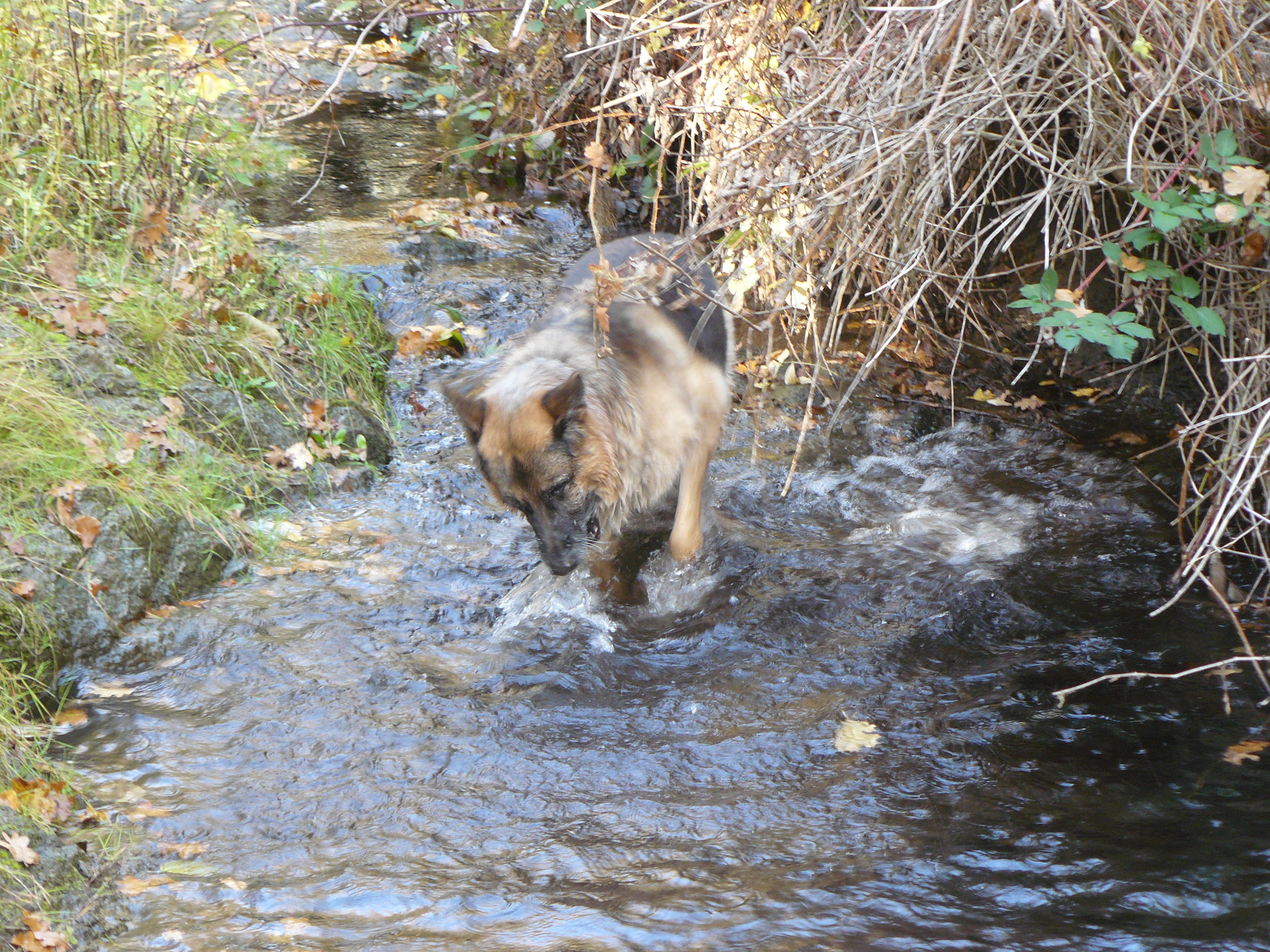
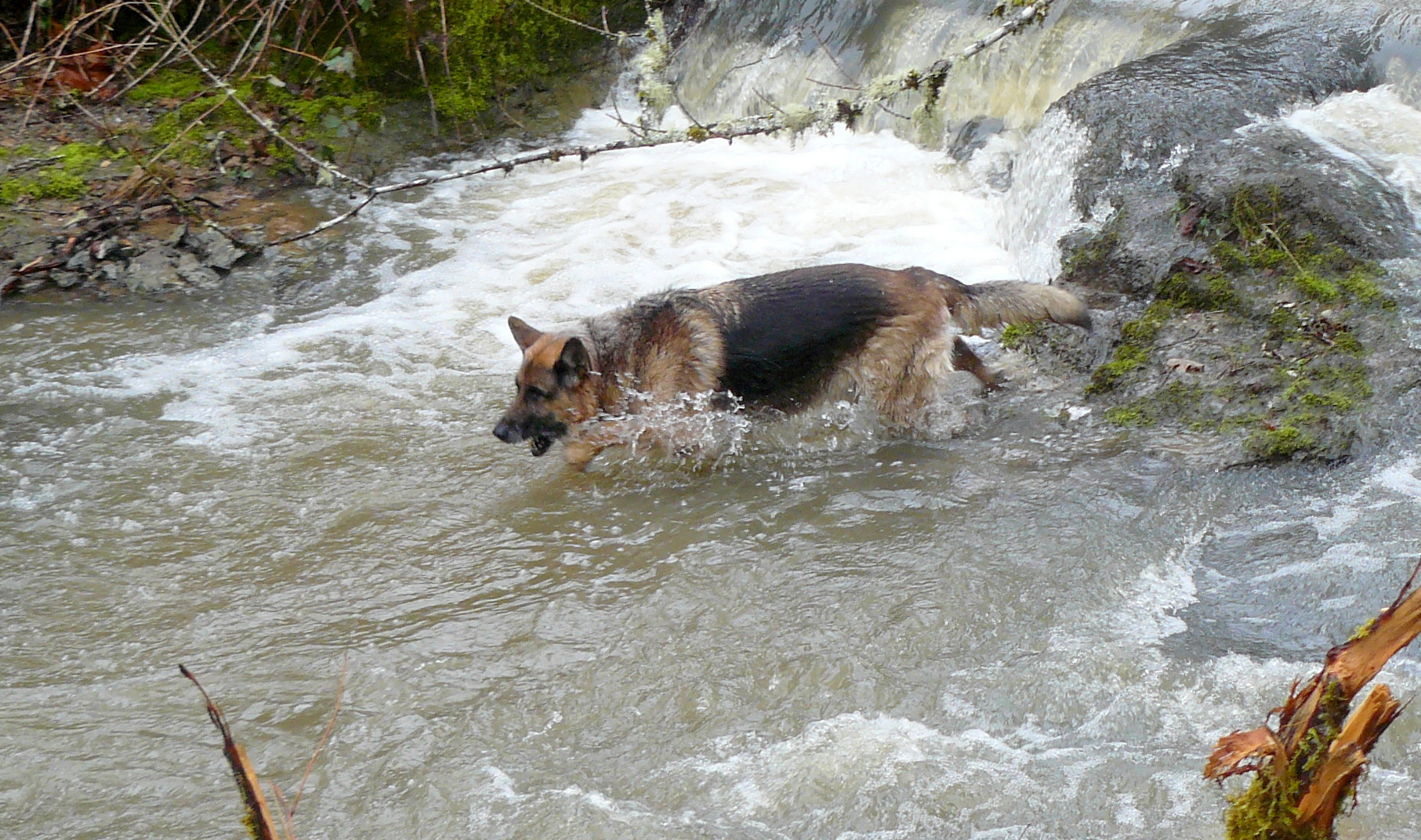
Sweeny playing in our creek.

Jean and I were looking for something to watch on Wednesday evening and, as is our want, took a browse through the latest films on Top Documentary Films.

There was an intriguing title under the recently added list – People in Motion.

This was how the film was described.

We were hunters and foragers. The frontier was everywhere. We were bounded only by the earth, the ocean and the sky.

Today we go about our business, unencumbered by the frontier. Society guides us, it gives us permission to drive on roads, to stop at red lights, and go on green.

But something is not right.

It often feels as if something is missing. As if the life society has allowed isn’t quite enough.  We spend so much time planning for the future it seems we’re forgetting how to live in the moment. How to feel deep and profound satisfaction with life.

It was this feeling that led us to watch people in cities, trying to understand what drives them. They typically did the same three things: walk, sit and shop.

People in Motion is a film showcasing the potential people have to move through time and space. The film is shot in true slow motion edited using a composite technique which illustrates stretches of time in an instant.

Now before you watch the film, and I really hope you do, just reflect on our closest animal companion; dogs.  As is stated on the home page of Learning from Dogs,

Dogs live in the present – they just are!  Dogs make the best of each moment uncluttered by the sorts of complex fears and feelings that we humans have.

One of the many wonderful ways that dogs enjoy the present is through play.

Rain had raised the flow of water in our creek and earlier on that Wednesday we had given the dogs a run in the rain.  Of course, they went immediately to the creek to play in the rushing waters.  The top picture shows Sweeny doing just that, Pharaoh equally having fun as below.

The simple joy of playing in the water.

Play is so important for humans as well as dogs.

Now watch the film and be amazed – the music is pretty cool as well.

Published on Dec 31, 2012

Music by…
* Lindsey Stirling:
** songs: Crystallize, Transcendence

* Niklas Aman:
** songs: Stirred Up, Momentum, Up A Storm

* Michael Marantz:
** song: Earth – The Pale Blue Dot

Directed by: Cedric Dahl
Produced by: Bennett Hoffman
Staring: Paul Whitecotton, Brian Orosco, David Agajanian, Lonnie Tisdale, Jacob Siel

Finally, after you have watched the film you will enjoy this interview with film director Cedric Dahl.  But watch the film first!!

Going beyond the self.

Further reflections on reality and delusion.

I closed yesterday’s post with this quotation from Carl Sagan, “It is far better to grasp the universe as it really is than to persist in delusion, however satisfying and reassuring.

So easy to write.  Nay, a thousand times more easy to trot out than to embrace.  Even that word embrace is too warm and fuzzy.

I’m sure that the human psyche lives in a bubble of delusion.  Clearly, if the level of delusion is abnormal then we can’t function properly as social animals.  Just take a moment or two to muse over the ways that you ‘shelter’ from reality.  Trust me I don’t exclude myself.

However, there are times when reality with a capital ‘R’ smacks us in the face.  Death of a loved one, unanticipated break-up of one’s marriage are two that come to mind.  Undoubtedly, there are others.

In yesterday’s post where I wrote of my experiences from reading Guy McPherson’s book, Walking Away from Empire, I freely admitted the struggle of embracing the truth, the Reality of where we are; ‘we’ as in industrialised man.

Aristotle
Aristotle (384 BC – 322 BC)

Reflect on the relationship that hope has with reality.  Aristotle wrote, “Hope is a waking dream” and that comes from over 2,300 years ago!

More recently, the aforementioned Professor wrote of hope:

With respect to the question, I spoke and wrote about hope way back in August 2007, when this website was launched. In that long essay — the bloated, unedited, transcript of a presentation I had delivered a few days earlier — I described hope as follows:

I view hope as the left-brain product of love, analogous to democracy as the product of freedom, or liberty. Notably, Patrick Henry did not say, “Give me democracy or give me death.” Like the rest of the founding fathers, Henry knew that freedom was primary to democracy; without the guiding light of freedom, or liberty, democracy breaks up on the shoals. Love keeps our left brain in check — that’s the message of the world’s religions. But our right-brain love creates the foundation for hope: love for nature, love for our children and grandchildren, love for each other. Without love to light the way, hope breaks up on the shoals.

Staying with Guy McPherson for a tad longer, over on Transition Voice there was an essay from him under the title of Sadly, extinction is no laughing matter.

Picking up on the Carl Sagan quote again (“It is far better to grasp the universe as it really is than to persist in delusion, however satisfying and reassuring.“) McPherson writes:

Many people disagree with Sagan, choosing delusion over reality, believing we can have infinite growth on a finite planet with no consequences for people or other creatures, other life forms, other organisms. The people in this latter group seek hope, and many of them disparage me and my actions for inducing despair.

Finally, though, I’ve concluded that hope is hopeless. As Friedrich Nietzsche pointed out, “Hope is the most evil of evils, because it prolongs man’s torment.”

To put Ed Abbey’s spin on it, “Action is the antidote to despair.” So, even though I no longer think my actions matter for humans, I’ll take action.

A worthy pity party

Near-term human extinction is a difficult pill to swallow, as is economic collapse. But ignoring ugly truths does not make them any less true. Despair is an expected and appropriate response to this information. Recognizing, accepting, and moving beyond despair are important subsequent steps.

But first, let’s despair.

Ed Abbey’s idea that action is the antidote to fear reminds me of a recent essay from Alex Jones over at The Liberated Way.  (If you haven’t previously come across Alex’s writings trust me you will be inspired!)

That essay was How to change the world published on the 28th February last.  Here’s how it opens:

Changes to self acts as ripples of change to the world.

Throw a rock into a pool it creates ripples, eventually the pool grows still again.  Like the pool nature will move to a state of harmony if given the chance.

We all know that humanity and this planet suffer many challenges.  Many feel they need to change or improve the world.  Those people fail to realise that nature knows where the state of harmony is, and is attempting to get to that state of harmony, therefore one has no need to change or improve the world.

The reason those words jumped off the page at me (OK, screen!) was the key message that letting go of what man feels compelled to do and allowing the natural forces on this planet to reign supreme is the answer.  The message that we have to go back to the natural way of doing things.  Right back to the harmony that early man had with the planet before farming corrupted our values.

Alex’s essay continues:

The problem with the desire to change the world is it becomes a form of control, attempting to force others to do something they have no desire to do. One of the problems of humanity is control, everyone trying to control each other, self and nature, which ends in conflict where nobody but the strongest wins. The problem with control is choice, liberty and creativity is taken away from those being controlled, and there is no opportunity to gain wisdom from mistakes.

I have spent too many years of my life trying to change or improve the world. I won some battles, I lost others. Worse, I became sometimes no better than those I fought against. Often control made the situation worse. I am reminded of the Greek legend of King Sisyphus who was condemned to roll a boulder up a steep hill only to see it roll down again, an activity he was condemned to repeat for all of eternity. Trying to change or improve the world was my equivalent of King Sisyphus.

The answer is to be a ripple of change to the world by doing our own thing. By changing ourselves, by living our dreams, setting an example, we emanate ripples of change into the world. We transform the world by transforming ourselves. Remember that stone that splashed into the pool? We are the stone, our activities in making ourselves happy, healthy and abundant becomes the ripples of change into the world. We force nobody to do anything, since all our efforts are focused on ourselves, we show by example which others may copy. People will follow our example since they see what we do works.

It is hard to let go, but let go we must. Change is inside rippling outwards.

It’s the old adage about change.  It first has to start from within.  As I warned in yesterday’s post, “When you read this book brace yourself for what you see staring out of the mirror back at you. There will be no room left for delusion.

Ironically for a post that carries the title of ‘Going beyond the self” going out of oneself is the only way to see reality, to brush away delusion.  From which place one can then allow change from within to occur.

I shall close with a quote from one of my favourite authors Aldous Huxley:

“Experience is not what happens to you; it’s what you do with what happens to you.”

letgo1

Making sense of life?

“I accept chaos, I’m not sure whether it accepts me.”  Bob Dylan.

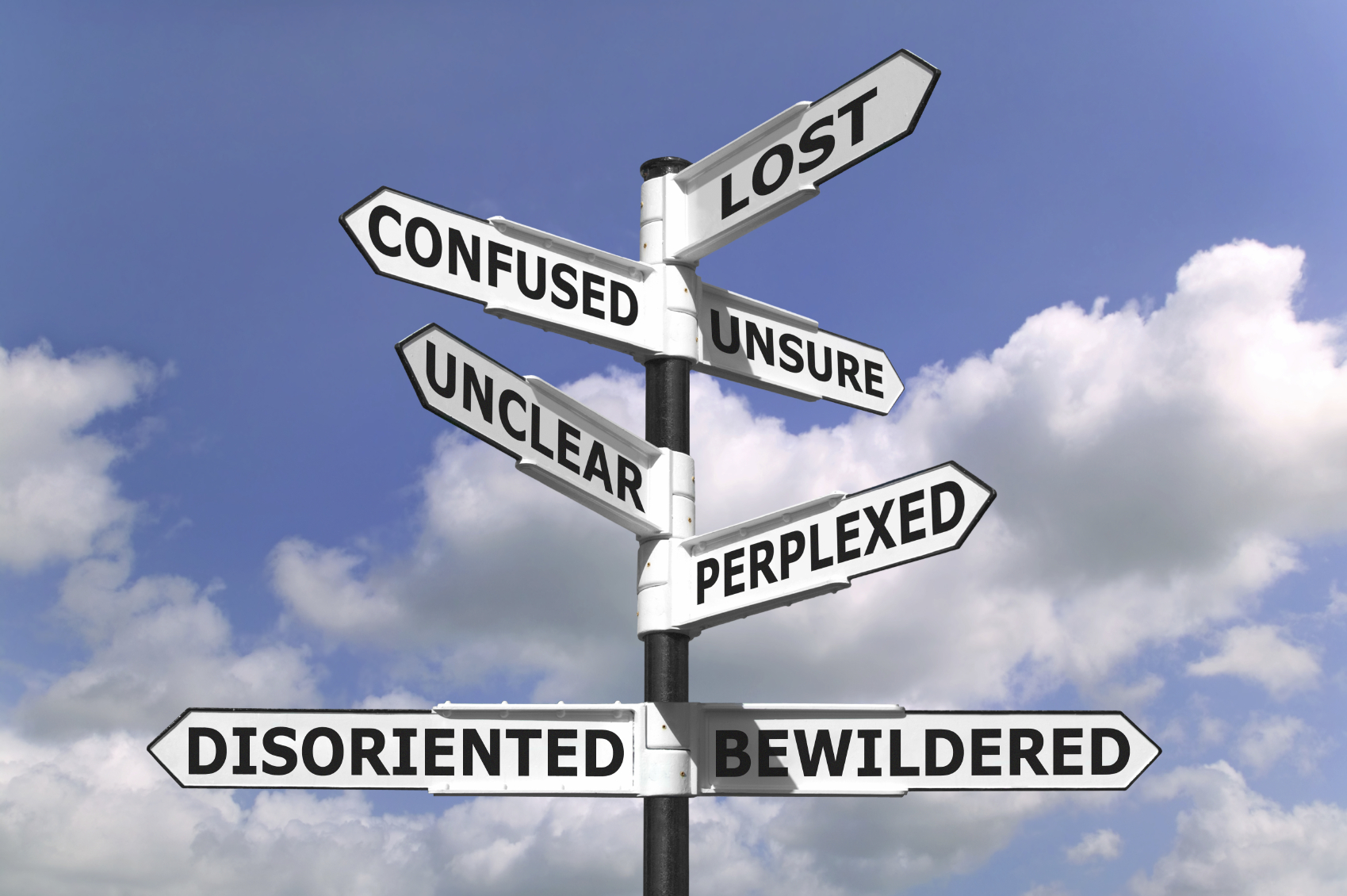
Lost and Confused Signpost

Started this week with an essay from John Hurlburt. Likewise, finishing with these thoughts from John.

Are We Confused?

Egotistically, the objective is self.
Financially, the objective is profit.
Corporately, the objective is control.

Biologically, the objective is growth.
Physically, the objective is change.
Morally, the objective is equality.

Psychologically, the objective is integrity.
Philosophically, the objective is truth.
Scientifically, the objective is fact.

Intellectually, the objective is reason.
Emotionally, the objective is balance.
Spiritually, the objective is Unity.

an old lamplighter

To see is to understand.

Something each and every one of us has to absorb – but without going in to space!

No problem can be solved from the same level of consciousness that created it.

So said Albert Einstein.  As with so many wise men from all times, what gets uttered strikes as such obvious common-sense.  But it took a wise person to utter it!

We need a change of consciousness.  About the world we live on.  This single, fragile, vulnerable rock in space that was featured in last Sunday’s post, Just a small white dot, and in yesterday’s post about Carl Sagan.

Climate Crocks, a ‘must follow’ blogsite for those that are concerned about the state of our planet, recently published a post that revealed how astronauts upon viewing the Planet Earth from Space had a profound Consciousness Change.  Take this example;

“I  think you start out with this idea of what it’s going to be like…and then when you do finally look at the Earth for the first time…you’re overwhelmed by how much more beautiful it really is, when you see it for real.

It’s just like it’s this dynamic, alive place, ..that you see glowing all the time..”

-Nicole Stott, Shuttle, ISS Astronaut

Or this from Ron Garan;

“When we look down on the Earth from space, we see this amazing, indescribably beautiful planet, ..it looks like a living, breathing organism..”

– Ron Garan, Suttle, ISS Astronaut

Wonderfully, that Climate Crocks piece quickly led to a new organisation called Planetary Collective.

Planetary Collective is a group of filmmakers, visual media creatives and thinkers who work with cosmologists, ecologists, and philosophers to explore some of the big questions facing our planet at this time.

Embracing a multidisciplinary, multi-media approach, we brings scientists, philosophers, and researchers together with designers, coders, and creatives to bring new perspectives to audiences around the world in fresh and innovative ways.

It was this group that last December released the short, but incredibly powerful film, Overview.  Here it is:

Released 7th December 2012

At the end of 2011, we filmed a short documentary called OVERVIEW about astronauts’ experiences in space, due for release in the last quarter of 2012. The film is both a stand-alone short film and a prelude to CONTINUUM, introducing many of the key ideas expanded upon in the feature documentary.

SYNOPSIS

Astronauts who have seen the Earth from space have often described the ‘overview effect’ as an experience that has transformed their perspective of the planet and mankind’s place upon it, and enabled them to perceive it as our shared home, without boundaries between nations or species.

OVERVIEW is a short film that will explore this perspective through interviews with astronauts who have experienced the overview effect. The film also features insights from commentators and thinkers on the wider implications and importance of this understanding for humanity as a whole, and especially its relevance to how we meet the tremendous challenges facing our planet at this time.

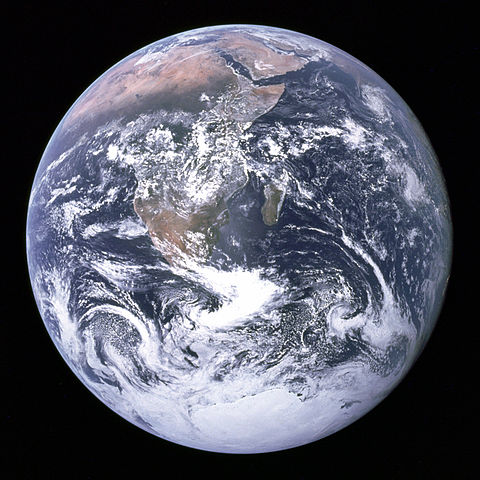
That film release date of the 7th December, 2012 was the 40th anniversary of the most famous photograph of Planet Earth taken on the 7th December, 1972: The Blue Marble.

The Earth seen from Apollo 17.

Original caption: “View of the Earth as seen by the Apollo 17 crew traveling toward the moon. This translunar coast photograph extends from the Mediterranean Sea area to the Antarctica south polar ice cap.

This is the first time the Apollo trajectory made it possible to photograph the south polar ice cap. Note the heavy cloud cover in the Southern Hemisphere. Almost the entire coastline of Africa is clearly visible. The Arabian Peninsula can be seen at the northeastern edge of Africa. The large island off the coast of Africa is Madagascar. The Asian mainland is on the horizon toward the northeast.”

From WikiPedia,

The Blue Marble is a famous photograph of the Earth, taken on December 7, 1972, by the crew of the Apollo 17 spacecraft, at a distance of about 45,000 kilometres (28,000 mi).

The snapshot — taken by astronauts on December 7, 1972, at 5:39 a.m. EST (10:39 UTC) — is one of the most widely distributed photographic images in existence.

The image is one of the few to show a fully illuminated Earth, as the astronauts had the Sun behind them when they took the image. To the astronauts, Earth had the appearance and size of a glass marble, hence the name.

Back to that Overview film.  Slightly confusing is the fact that the Planetary Collective website, where that Overview film is highlighted, is a different one to the associated Overview Institute website, from where one can read this Declaration:

A Critical Time

We live at a critical moment in human history. The challenges of climate change, food, water and energy shortages as well as the increasing disparity between the developed and developing nations are testing our will to unite, while differences in religions, cultures, and politics continue to keep us apart.

The creation of a “global village” through satellite TV and the Internet is still struggling to connect the world into one community. At this critical moment, our greatest need is for a global vision of planetary unity and purpose for humanity as a whole.

And to my mind the greatest need, the ONLY need, for that global vision is to move rapidly beyond our industrial and materialistic way of life to one where we live in harmony with our planet.

To pick up on what Ron Garan was quoted as saying, Planet Earth is a living, breathing organism.  If the species man and thousands of other non-human species are to stand a chance of remaining on this living, breathing organism then You, Me and every other person out there, has to have a change of consciousness about the one and only place we live on.

So don’t flick over from those last words to the next thing in your life.  Go back and look at the picture of our home, taken from Apollo 17.  Make sure that you ask as many as you can to watch the Overview film above.

Finally, you be a person who makes a change in your consciousness.  The rest is easy.

Back to dear old Albert E.

No problem can be solved from the same level of consciousness that created it.

Carl Sagan

How very precious, vulnerable and fragile is this precious place we call home.

Today’s consciousness perambulation is the fault of Mr. P., as I like to call him. I refer to Pendantry as he is on his blog, Wibble.

You see on Sunday he added a comment to my post Just a small, white dot! that included the beautiful and awe-inspiring film made by the late Carl Sagan called Pale Blue Dot.

carl-sagan

Like millions of others, I came to admire Carl Sagan through watching the fabulous, the truly fabulous, television series Cosmos: A Personal Voyage. (NB. All the episodes are on YouTube, Episode One is at the end of this Post, Ed.)  Here’s how WikiPedia opens their reference to Carl.

Carl Edward Sagan (November 9, 1934 – December 20, 1996) was an American astronomer, astrophysicist, cosmologist, author, science popularizer and science communicator in astronomy and natural sciences. He spent most of his career as a professor of astronomy at Cornell University where he directed the Laboratory for Planetary Studies.

He published more than 600 scientific papers and articles and was author, co-author or editor of more than 20 books. He advocated scientifically skeptical inquiry and the scientific method, pioneered exobiology and promoted the Search for Extra-Terrestrial Intelligence (SETI).

Sagan is known for his popular science books and for the award-winning 1980 television series Cosmos: A Personal Voyage, which he narrated and co-wrote.  The book Cosmos was published to accompany the series. Sagan wrote the novel Contact, the basis for a 1997 film of the same name.

He died far too young and was a tragic loss to humanity.  The Carl Sagan web portal is here.

That 3:30 minute video Pale Blue Dot has, likewise, been seen by millions.  If you or someone you know hasn’t seen it, then you must pause now …

It’s practically impossible to watch that video and not embrace the central message from Mr. Sagan.  Here’s the transcript:

Our home from 6 billion kilometres. A very tiny dot against the vastness of space.

From this distant vantage point, the Earth might not seem of any particular interest. But for us, it’s different.

Consider again that dot. That’s here. That’s home. That’s us.

On it everyone you love, everyone you know, everyone you ever heard of, every human being who ever was, lived out their lives.

The aggregate of our joy and suffering, thousands of confident religions, ideologies, and economic doctrines, every hunter and forager, every hero and coward, every creator and destroyer of civilization, every king and peasant, every young couple in love, every mother and father, hopeful child, inventor and explorer, every teacher of morals, every corrupt politician, every “superstar,” every “supreme leader,” every saint and sinner in the history of our species lived there – on a mote of dust suspended in a sunbeam.

The Earth is a very small stage in a vast cosmic arena.

Think of the rivers of blood spilled by all those generals and emperors so that in glory and triumph they could become the momentary masters of a fraction of a dot.

Think of the endless cruelties visited by the inhabitants of one corner of this pixel on the scarcely distinguishable inhabitants of some other corner. How frequent their misunderstandings, how eager they are to kill one another, how fervent their hatreds.

Our posturings, our imagined self-importance, the delusion that we have some privileged position in the universe, are challenged by this point of pale light. Our planet is a lonely speck in the great enveloping cosmic dark. In our obscurity – in all this vastness – there is no hint that help will come from elsewhere to save us from ourselves.

The Earth is the only world known, so far, to harbor life. There is nowhere else, at least in the near future, to which our species could migrate. Visit, yes. Settle, not yet. Like it or not, for the moment, the Earth is where we make our stand.

It has been said that astronomy is a humbling and character-building experience. There is perhaps no better demonstration of the folly of human conceits than this distant image of our tiny world. To me, it underscores our responsibility to deal more kindly with one another and to preserve and cherish the pale blue dot, the only home we’ve ever known.

Tomorrow, I will stay with the theme of our beautiful planet. Hope you can join me.

Now spoil yourself and watch Episode One of Cosmos.

Fear versus Faith

“Fear comes from uncertainty. When we are absolutely certain, whether of our worth or worthlessness, we are almost impervious to fear.”  William Congreve, English playwright and poet.

It’s Sunday (i.e. yesterday).  I woke around 6am to a cold morning (28 deg F/-2.2 deg C), the result of a clear, moonlit night.

Then as the night sky lightened with the coming dawn, the green, forest-cloaked valleys, visible to the East through the bedroom windows filled with a white, morning mist.  In a metaphorical sense that descending mist matched a mood of gloom that was trying to descend on me.

Early morning mist, Merlin, Oregon
Early morning mist, taken 7:15 am Sunday, 24th Feb.

As I lay back against the headboard of the bed, Jean still sleeping close to me, dogs Cleo, Hazel and Sweeny snoozing on and around me, I pondered on my mood.  It came to me that I might be picking up the growing sense of anxiety, of uncertainty, that seems to be ‘in the air’.  Me reading too many blog articles about global warming, climate change, et al.  Being three-quarters through Professor Guy McPherson’s book Walking Away from Empire: A Personal Journey wasn’t helping either!

Then I recalled a recent conversation with dear friend and colleague from our Payson, AZ. days, John Hurlburt, who said that fear is the absence of faith.  That if we trust what will be will be, then we can counter the fear of the unknown and embrace the present day, one day at a time.  Living in the now as, you’ve guessed it, that dogs do so supremely well.  Something else to learn from dogs!

I made a decision to take a stroll in the forest, emotionally speaking, for this week, so far as Learning from Dogs is concerned.  Enjoy the beauty of the world around me and offer a few essays on the meaning of life. No blog posts at all about anything that engenders fear from any quarter!

And if that doesn’t slash the readership figures, I don’t know what will! So there! You have been warned.

So let me start by offering this essay from John.  John is one of those rare people who has been through more than his fair share of ‘challenges’ over the years, yet has grown from those experiences.

Here’s John – I’m turning over and going back to sleep!

oooOOOooo

Education, Formation and Transformation

Most Americans remain comfortably complacent despite world economic brinksmanship, the escalating deterioration of our planetary environment and raging world discontent. Although we may be caring and compassionate in our personal lives, we are often reluctant to take any risk of reducing our personal comfort.

Education is a process. A process of learning how to think life through in order to become aware of whom we are, what we are, where we are, and why we exist. Education has always been the human gateway to a better future.

Knowledge does not guarantee wisdom. Education, formation and transformation are an integrated process which includes studying to gain knowledge, making natural connections based on the best information available, and experiencing the higher levels of conscious awareness we recognize as wisdom. The educational process works best when it is open minded, factual and sustained. We learn best when we learn together.

The human wisdom tradition is rich in myth, mysticism, symbols, imagination and creativity. It tells a common story of emergence through centuries of sacred writings stretching back through time to the earliest human cave scratchings roughly 17,000 years ago, and the beauty of the prayers of the Rig-Veda 12,000 years ago which all begin with an homage to the natural energy of the Sun.

We’re conscious components of a living planet. We’re surface dwellers with exposure to universal and planetary energies. Our species is only 200,000 years old. The universe is roughly 13 billion years old. Our planet is deteriorating and we’ve lost our collective moral compass. What can we do to make a local difference?

We only recently learned to hunt woolly mammoths in packs using bows, arrows and spears as tools. A perception of God in relation to our responsibility to each other and creation exists as the foundation of a human wisdom tradition which, relatively speaking, has just began.

In many ways, nothing seems to have changed as we have passed through successive cyclic waves of emergence and contraction. It becomes simultaneously increasingly more complex and exquisitely simple to understand. That is as we begin to realize how our metanexus emerges, contracts and turns inside out without breaking … like a pulse.

The next ten years are more important than the next several thousand years in respect to the choices we make about our biosphere.

There seems to be little doubt that our world problems are steadily increasing. What’s the next right thing to do?  It’s time to grow our conscious connection in God. It’s time to share the spring of human wisdom from the ground up. It’s time to develop a world economy which is gentle to the earth.

The Clearing Rests in Song and Shade

The clearing rests in song and shade.
It is a creature made
By old light held in soul and leaf.
By humans joy and grief,
By human work,
Fidelity of sight and stroke,
By rain, by water on
The parent stone.
We join our work to Heaven’s gift,
Our hope to what is left,
That field and woods at last agree
In an economy
Of widest worth.
High Heaven’s Kingdom come on earth,
Imagine Paradise
O dust, arise!

Wendell Berry; 1909

oooOOOooo

The illiterate of the future will not be the person who cannot read. It will be the person who does not know how to learn.” Alvin Toffler

Just a small, white dot!

Does rather serve to remind us of our place in the scheme of things.

This stunning image was taken by the Cassini-Huygens probe.  Many of the images taken by NASA are available for download from the DVIDS website, which is where this one was found. (But also do visit the Ciclops website.)

The title of the photograph is:

A View of Earth from Saturn

A View of Earth from Saturn: Image of the Day

Although the Earth Observatory typically reserves ”Image of the Day” space for publishing data and images acquired by Earth-observing satellites, we are sometimes so enthralled by the spectacular images acquired by spacecraft observing other parts of the solar system that we want to share these ‘otherworldy’ views with our visitors. And if you are looking for remotely sensed images of the Earth, this view is the most remotely sensed image we have ever published!

This beautiful image of Saturn and its rings looks more like an artist’s creation than a real image, but in fact, the image is a composite (layered image) made from 165 images taken by the wide-angle camera on the Cassini spacecraft over nearly three hours on September 15, 2006.

Scientists created the color in the image by digitally compositing ultraviolet, infrared, and clear-filter images and then adjusting the final image to resemble natural color. (A clear filter is one that allows in all the wavelengths of light the sensor is capable of detecting.) The bottom image [the one above. Ed.] is a closeup view of the upper left quadrant of the rings, through which Earth is visible in the far, far distance.

On this day, Saturn interceded between the Sun and Cassini, shielding Cassini from the Sun’s glare. As the spacecraft lingered in Saturn’s shadow, it viewed the planet’s rings as never before, revealing previously unknown faint rings and even glimpsing its home world. Seen from more than a billion kilometers (almost a billion miles) away, through the ice and dust particles of Saturn’s rings, Earth appears as a tiny, bright dot to the left and slightly behind Saturn.

Although it might appear that Earth is located within Saturn’s outermost rings, that positioning is just an illusion created by the enormous distance between Cassini and Earth. When Cassini took this image, the spacecraft was looking back at Saturn from a distance of about 2.2.million kilometers (about 1.3 million miles). The Sun was millions of additional miles beyond, hidden behind Saturn. On September 15, Earth’s orbit had brought our home planet to a location slightly behind and to the left of the Sun from Cassini’s perspective. The Website of the Cassini Imaging Central Laboratory for Operations (CICLOPS) provides more detailed information about this image. The Cassini-Huygens mission is a cooperative project of NASA, the European Space Agency, and the Italian Space Agency.

Trying to find that faint image of Planet Earth in the above photograph is a challenge, even for those with much younger eyes than mine.

However, with a little bit of jiggery-pokery I was able to crop and enlarge the photograph, see below:

saturn

Planet Earth is in the ’10 o’clock’ position in the photograph, about half-way from the centre of the enlarged segment towards the top-left corner of the picture, just outside the outer white ring.

That’s us. All that we have ever been. All that we ever will be. Just that small white dot.

Truth is Relative

(Reposted from The Liberated Way with the generous permission of Alex Jones)

Go beyond the appearance and the behaviour to the nature that underpins everything. 

The truth of being a cat is relative only to this cat.

Recent events got me thinking about what truth is.  I find that nobody has a monopoly on truth, that truth is relative.  Take for example the colour red, I see red as red, the bee sees red as black.  Truth is the product of self, the bee brain makes red black and my brain red as red; truth in this sense is relative to the beholder of the truth.

God.

Take the example of God, some believe in God, some reject God, some like me sit on the fence as agnostics.  Those that believe in God differ on what God is: energy, gravity, a mind, with no mind, in creation, separate from creation.  God is one of those ideas that can neither be disproved or proven with any certainty.  Truth is relative to the beholder.

Nothing is certain.

Truth then to me is never one conclusion, but can be a diversity of conclusions.  Red can be red but can also be black depending on the beholder, thus truth is relative.  It is better to say I believe the truth to be, rather than say this is the truth.  With the universe composed of visible and hidden variables, always changing and in feedback loops nothing can be claimed with any certainty.

Belief.

Since truth is relative it is better to say that I act and think according to a belief rather than a truth, the same for everyone.  When the word belief is mentioned some people choke on it, they believe that the universe is deterministic, that there is only one truth, often the one they believe it to be.  It is apparent neither Bee nor I have a monopoly on the truth of what the colour red is, we hold different beliefs of the colour red relative to ourselves.

The hubristic need to monopolise belief.

I see no harm in a world holding a diversity of beliefs.  So what if a Native American believes a tree has a spirit, a belief based on animism? Yet to the Christian missionary the Native American is a lost soul to be saved, and to the Atheist the Native American is one to be converted to the progress of modern science.  The outsider has this need to force their own beliefs onto the Native American, resulting in widespread suicide, mental illness, drug abuse and alcoholism amongst the people whose belief systems they obliterated.  The need of some to westernise Islam or Islam to convert the West sets the scene for a so-called clash of civilisations: violence, hate, fear and anger.

Black swans.

Even in my own empirical and inductive approach to truth, I know I can only draw a probability of truth.  I may count 1000 white swans on a lake and conclude the world only has white swans, then one day a black swan appears.  I have to be open to the possibility of black swans, which is a position of humility.

Hubris hates diversity of belief.

The individual or group who claims their truth is the only truth is gripped in hubris.  Truth is relative, there can be many truths. Hubris follows through to control, the individual or group needs and acts to force their belief upon other people who have a different belief of a truth relative to them.  Those inflicted with hubris hate diversity, they only want one truth, that of their own.  The horrors of Nazi Germany, or the Crusades or of Vietnam were because a group of people wanted a world based on their own beliefs with all other beliefs eliminated.

Grounding belief like roots of a tree.

A belief should be grounded like a tree has roots that anchors it into the ground, otherwise it moves into fantasy.  To ground a belief it is to be tested by asking questions, by looking for observable, experiential or demonstrable evidence of its existence.  A belief untested but accepted without question is ignorance, it is opinion.

Follow the common.

When Heraclitus suggests “follow the common”, he means to deal with things based upon their nature: it is common for all ducks to love water; it is common for all energy to flow; it is common for all things to evolve or change through strife.  Heraclitus suggests people go beyond appearances and behaviour to the underlying nature of the universe, and in this one grounds belief in the common of reality rather than in the ignorance of opinion.