Yesterday it was gliding, tomorrow it is going to be a celebration of Pharaoh’s 14th birthday and today it is about you!
Kadam Morten Clausen is a Buddhist teacher. Now I would be the first to stick up my arm and say that my understanding of Buddhism is pretty poor. But in the days many years back when I spent time exploring a number of Asian countries I found the culture surrounding Buddhism very appealing. (And I write as someone who is not a religious believer.)
Back to Morten Clausen.
The Kadampa Meditation Center in New York, where Kadam is a resident teacher, describe him as follows:
Kadam Morten met his teacher, Geshe Kelsang, while attending university in England. He taught widely throughout the UK and helped develop many Kadampa Centers in England. Kadam Morten has been teaching in the US for more than 20 years and has established centers throughout the New York area, as well as Washington DC, Virginia, and Puerto Rico. In addition to his local teaching responsibilities, he teaches and guides retreats regularly throughout the United States and Europe.
Kadam Morten is greatly admired as a meditation teacher and is especially known for his clarity, humor and inspirational presentation of Dharma. His teachings are always practical and easy to apply to everyday life. Through his gentle and joyful approach and his peaceful example, he has helped many people find true happiness in their hearts.
So what’s this all about when I say that today’s post is about you?
Evan Thompson of the University of British Columbia has verified the Buddhist belief of anatta, or not-self. Neuroscience has been interested in Buddhism since the late 1980s, when the Mind and Life Institute was created by HH Dalai Lama and a team of scientists. The science that came out of those first studies gave validation to what monks have known for years — if you train your mind, you can change your brain. As neuroscience has begun studying the mind, they have looked to those who have mastered the mind.
While Buddha didn’t teach anatta to lay people, thinking it might be too confusing, the concept is centered on the idea that there is no consistent self. The belief that we are the same one moment to the next, or one year to the next, is a delusion. Thompson says that “the brain and body is constantly in flux. There is nothing that corresponds to the sense that there’s an unchanging self.”
[W]hen there is no consistent self, it means that we don’t have to take everything so personally.
It is useful to look at a video of yourself from the past, or read something you wrote years ago. Your interests, perspective, beliefs, attachments, relationships, et al, have all changed in some way. Anatta doesn’t mean there’s no you; it just means that you are constantly changing, constantly evolving, and shape-shifting. Why is this important? Why does it matter if there’s no solid “you” or “me”?
Buddhist teacher Kadam Morten Clausen says Buddhism is a science of the mind:
Dr. Rick Hanson, author of Hardwiring Happiness and Buddha’s Brain, argues that when there is no consistent self, it means that we don’t have to take everything so personally. That is, our internal thoughts are only thoughts and don’t define us. External events are only external events and aren’t happening to us personally. Or as Tara Brach says, our thoughts are “real, but not true.”There is tremendous liberation in not identifying ourselves with thoughts, or a set idea of who we are.
It is then that we can grow and change, with the help of neuroplasticity. There is then hope that we can overcome our vices or bad habits (of mind and body), because if we aren’t stuck with the self-limiting beliefs inherent with a consistent self, we may orient ourselves toward becoming more of who we want to be.
The belief that we are the same one moment to the next, or one year to the next, is a delusion.
As science and Eastern thought continue to hang out with each other, there may be more 21st Century studies to back up 2,600-year-old thoughts. But, as HH Dalai Lama said, “Suppose that something is definitely proven through scientific investigation. … Suppose that that fact is incompatible with Buddhist theory. There is no doubt that we must accept the result of the scientific research.”Hearing a pro-science stance from a religious leader is a relief to many. In the end it seems Buddhism and neuroscience have similar goals: What is this thing we call the mind, and how can we use it to make ourselves a little less miserable and a little happier? Maybe even just 10 percent happier, as Dan Harris wrote. If there is no consistent self, it is at least my intention that my ever-changing self be equanimous and, well, 10 percent happier. No matter who I am.
—
Lori Chandler is a writer and comedian living in Brooklyn, NY, which is the most unoriginal sentence she has ever written. You can look at her silly drawings on Tumblr, Rad Drawings, or read her silly tweets @LilBoodleChild. Enough about her, she says: how are you?
PHOTO CREDIT: Chris McGrath/Getty Images
ooOOoo
So if there are times when you find yourself talking to yourself, perhaps the first thing to do is to ask if it is you! (Golly! I can feel a headache coming on!)
Apologies in advance for this being possibly of limited interest to others.
A couple of years after I left IBM UK and formed my own company, Dataview Ltd., based in Colchester, Essex, I formed both a personal and business relationship with a Roger Davis.
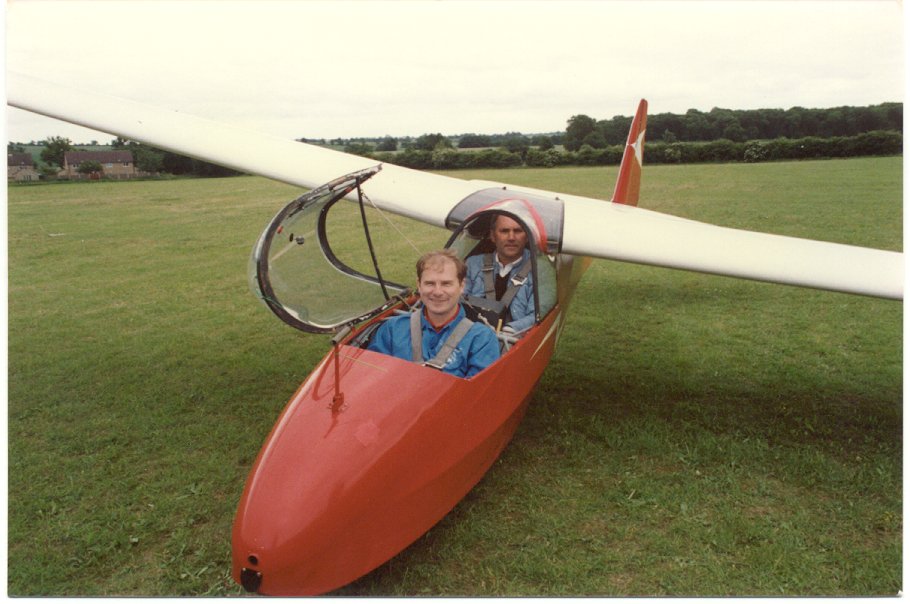
That relationship exposed me to gliding, or sail-planing in American speak, for Roger was a volunteer instructor at Rattlesden Gliding Club in Suffolk that flew from an ex-wartime aerodrome of the same name.
Thus on the 7th June, 1981, I was taken up for two air-experience circuits in a two-seater glider known as a ‘K7’. I was immediately hooked! Those experience flights leading to a 4-minute flight (flight number 46) on the 6th September, 1981 that has the remark in my pilot’s log book: Solo!
Now fast forward to October, 1984 and my log book shows me attending a gliding instructor’s course at Lasham, resulting in me being issued with a British Gliding Association (BGA) Assistant Instructor Rating on the 14th October. (105/84).
A K-7 two-seat glider.
A few days ago, Roger sent me a link to the following video.
It’s a compilation of photos, cartoons from the pen of dear Bob White, and videos. A little over eleven minutes long I do hope some of you find it of interest.
Published on May 29, 2017
Slide show produced from photos and images produced by Mark Taylor for Rattlesden Gliding Club’s 25 anniversary in 2001. Shows a collection of members involved from those early days, including some cartoons produced by Bob White whenever there was a notable event, or incident as well!
Let me close with this photograph!
Roger Davis with Sheila, his lovely wife, gliding over Lake Taupo in New Zealand.
(All those years ago, Roger and Sheila had a beautiful Old English Sheepdog. His name was Morgan and he was a wonderful, loving dog.)
So is there anyone reading this who has experienced gliding?
We all know that so many things in life have two sides to them. As in a positive and negative side. Which ‘side’ we look at has more to do with ourselves, again as you all know.
So when I republished an essay from Patrice Ayme a little over a year ago about the loss of the ice in Antarctica I was in harmony with Patrice’s gloomy stance:
I have written for years that a runaway Antarctica was certain, with half the icy continent melting rather spectacularly on an horizon of two centuries at most, and probably much less than that. This rested on the fact that half of Antarctica rests on nothing but bedrock at the bottom of the sea. At the bottom of what should naturally be the sea, in the present circumstances of significant greenhouse gas concentrations.
But Lady Luck comes into view and we have this: (Courtesy of Mother Nature Network.)
ooOOoo
Global warming is making Antarctica green again, and it’s stunning
At current rates, it’s not crazy to think that the Antarctic peninsula could eventually become forested again.
From white to green: plant life is booming in Antarctica as the climate warms. (Photo: Matt Amesbury, University of Exeter/Flickr)
When you think of Antarctica, you probably imagine a frigid, windswept, icy, inhospitable domain; the whitest, most barren canvas on Earth. That’s pretty much the way the Southern continent has been for at least the last 3 million years, since the last time atmospheric carbon dioxide levels approached their current levels. But times, they are a-changing.
The effects of global warming are beginning to radically alter the Antarctic landscape in some surprising ways. Scientists say it’s like looking back in time, to an epoch when this bleached terrain was actually green. Mossy mats are rapidly spreading across the thawed, exposed soils at unprecedented rates, transforming the land from a place of desolation, to a place of viridescence.
At the very least, we’re getting a peek at Antarctica’s future, which like its past was green and filled with plant-life, reports the Washington Post.
“This is another indicator that Antarctica is moving backward in geologic time — which makes sense, considering atmospheric CO2 levels have already risen to levels that the planet hasn’t seen since the Pliocene, 3 million years ago, when the Antarctic ice sheet was smaller, and sea-levels were higher,” said Rob DeConto, a glaciologist at the University of Massachusetts, Amherst.
“If greenhouse gas emissions continue unchecked, Antarctica will head even further back in geologic time… perhaps the peninsula will even become forested again someday, like it was during the greenhouse climates of the Cretaceous and Eocene, when the continent was ice free.”
So far, the greening of Antarctica is mostly limited to the peninsula, where two different species of mosses are fanning out at a startling clip, at four to five times the rate seen just a few decades ago. They gain a footing in the summers, when the frozen ground thaws, then freeze back over in the winter. But these layers-upon-layers are thickening, generating an increasingly detailed record of Antarctica’s warming climate.
It’s perhaps only a matter of time before grasses, bushes, perhaps even trees begin to sprout. As beautiful as a forested Antarctica might be to imagine, it’s important to remember that this isn’t necessarily a good thing. Climate change is an ambiguous beast; Antarctica might be getting greener, but deserts elsewhere in the world are expanding, sea levels are rising, and weather is becoming more severe.
“These changes, combined with increased ice-free land areas from glacier retreat, will drive large-scale alteration to the biological functioning, appearance, and landscape of the [Antarctic peninsula] over the rest of the 21st century and beyond,” wrote the authors of the study, which was published in the journal Current Biology.
Lead author Matthew Amesbury added: “Even these relatively remote ecosystems, that people might think are relatively untouched by human kind, are showing the effects of human induced climate change.”
ooOOoo
Sorry to drag out this old saw of mine, but it is so perfect: “I can predict anything except those things that involve the future”!
Because I am still staying with the Lady Luck theme but this time going from the vastness of the Southern polar regions to something a little closer to home. (Again, seen on Mother Nature Network.)
ooOOoo
Pit bull on ‘death row’ at shelter gets new life as police dog
Leonard recently became Ohio’s first ever pit bull K-9. Jenn Savedge May 19, 2017
Leonard found his forever home with Ohio’s Clay Township police force. (Photo: Union County Humane Society/Facebook)
When Leonard, a stout young pit bull, arrived on the doorstep of the Union County Humane Society in Ohio a few months ago, the staff had little hope for his prospects of being adopted. Leonard was deemed “aggressive,” and that meant he was more likely to be euthanized than sent home with a new family. But Jim Alloway, the center director, saw something different in the dog. And thanks to his observation, Leonard has a future that includes work, play and lots of belly rubs.
As luck would have it, Alloway has an extensive background of working with police dogs. He realized Leonard’s aggression was really a very strong desire to play. Whenever someone was holding something, Leonard wanted it and would try to grab it. As a pet in the average family, this may not be a desirable trait. But this strong “prey drive” made him a great candidate for training as a police dog.
So Alloway called Storm Dog K-9 training. After an initial round of testing, Mike Pennington, the owner of the training facility, agreed to take Leonard on and train him to sniff out narcotics. (Leonard wasn’t a good candidate for tracking and catching suspects because he loves people way too much.)
Before his training with Pennington, Leonard didn’t even know basic commands. But after a few weeks of hard work — which his trainers said he absolutely loved — Leonard was fully certified as a police dog, becoming Ohio’s first pit bull K-9 officer.
Leonard was paired with Terry Mitchell, Clay Township’s Chief of Police. Mitchell told the local ABC affiliate that he was unsure at first about the idea of using a pit bull as a K-9. But the pair bonded immediately.
“I scheduled a time to come down and see him, and after about 10 minutes, I knew this was the dog for us,” Mitchell said.
Leonard officially started work with the force this week. When he has his police vest on, Mitchell says the pup is all business and ready to tackle his narcotics-sniffing job. Off-duty though, Leonard is just a sweet, playful pup, hopping on Mitchell’s lap for evening naps. Oh, and according to Mitchell, he snores horribly.
Leonard — and Mitchell — couldn’t be happier.
ooOOoo
Wonder how long it will be before we have happy ex-rescue dogs frolicking through the forests of Antarctica!!
There are plenty more of those wonderful pictures and cartoons to come to come from Janet Goodbrod.
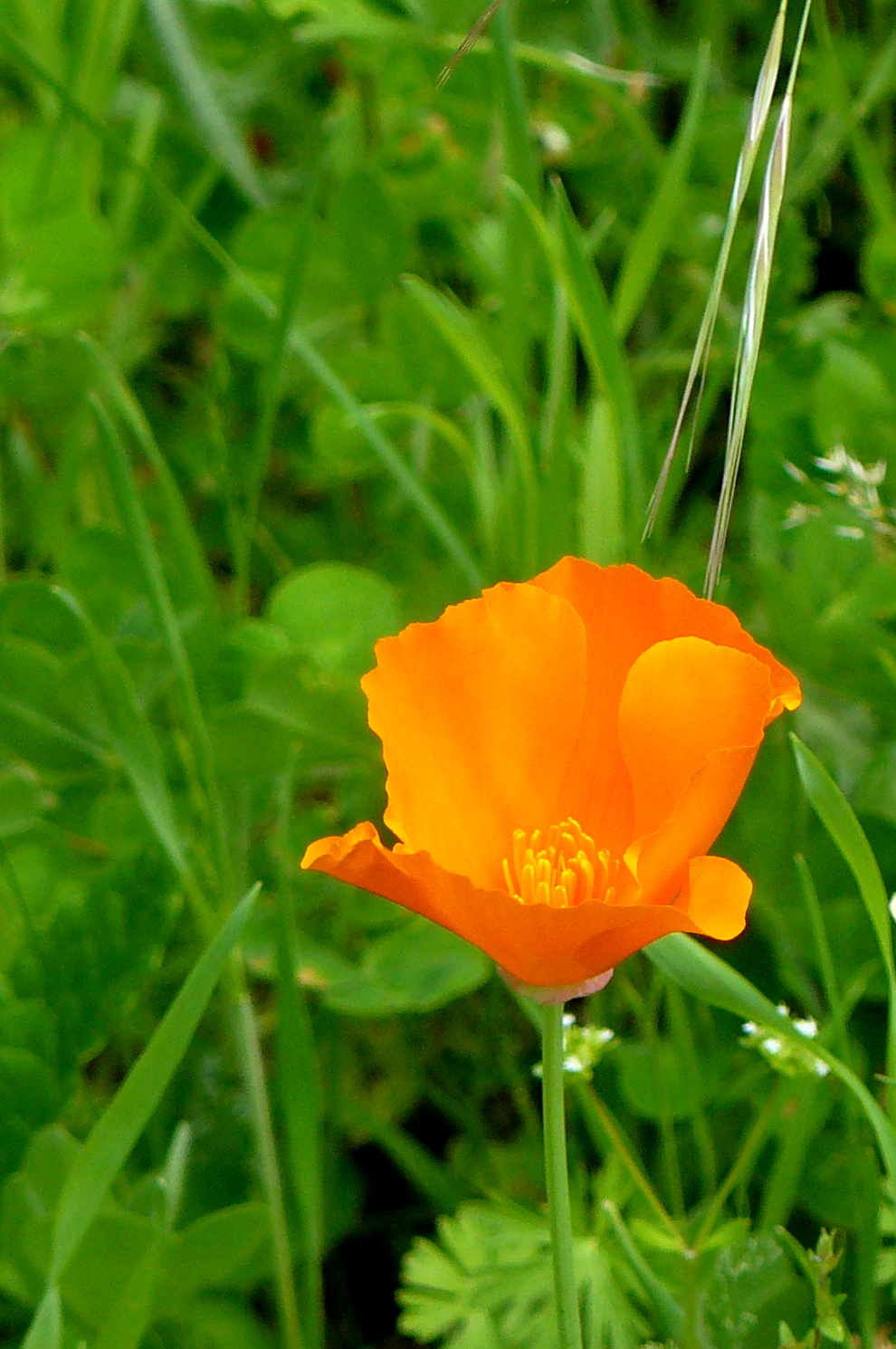
But a few days ago there were so many beautiful flowers blooming in the Spring sunshine that I couldn’t resist taking photographs of them and sharing them with you. All from home! (Apart from the young tree and the cows on our neighbour’s property for while not being flowery , nonetheless, they seemed to speak to me about springtime.)
oooo
oooo
oooo
oooo
oooo
oooo
Don’t ask me what the names of the various flowers are!
That article featured the former president of Iceland, Olafur Grimsson, and how he was encouraging new solutions to climate change. Primarily via a new organisation called RoadMap. (Did you sign up??)
There is change in the air. People are starting to make a better future. Cities across the USA (and elsewhere undoubtedly) are pledging to go 100 percent renewable. Here’s what Grist published on May 4th.
ooOOoo
Cities all over the U.S. are pledging to go 100 percent renewable.
Atlanta is the 27th city to make the pledge, according to the Sierra Club. These kinds of municipal promises have been popping up nationwide over the past few months. Here’s a recap:
Portland, Oregon, pledged in April to go 100 percent renewable by 2050. The surrounding Multnomah County got in on the plan, too.
South Lake Tahoe, California, committed to go renewable by 2032. Its initiative is, at least to begin, entirely volunteer-driven.
It’s not just the coasts: In March, Madison, Wisconsin became the biggest city in the Midwest to pledge to a community-wide switch to 100 percent renewable energy (though it hasn’t set a target date).
The tiny town of Abita Springs, Louisiana committed in March to transition to clean energy by 2030 — and its Republican mayor went to bat for it. That’s a big win in our books.
“We know that moving to clean energy will create good jobs, clean up our air and water, and lower our residents’ utility bills,” said Kwanza Hall, an Atlanta City Council member and mayoral candidate, in a statement. “We have to set an ambitious goal or we’re never going to get there.”
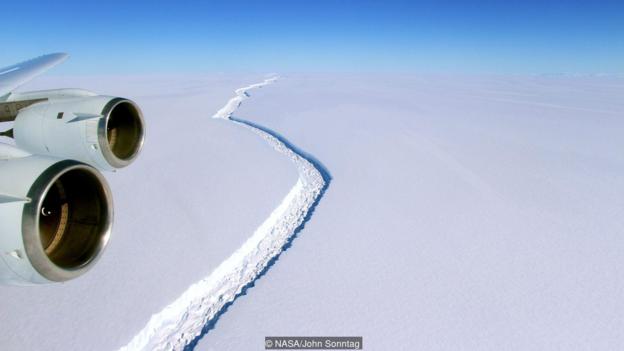
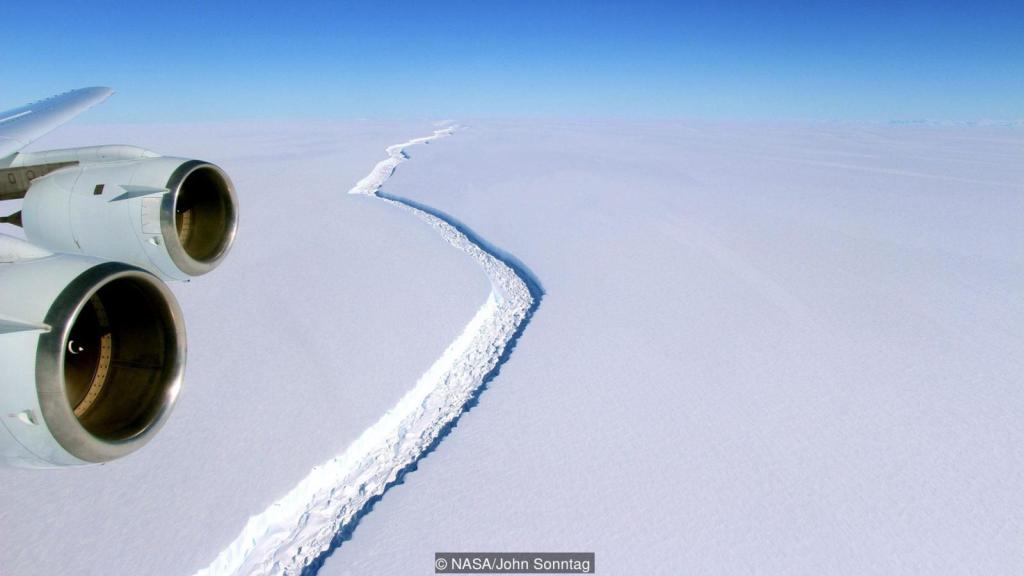
The shape of the world is hanging by a thread – or rather, according to experts, by a 110 mile-long (177km) rift. That’s the extent of a rapidly expanding crack in an enormous ice shelf in Antarctica. When the Larsen C shelf finally splits, the largest iceberg ever recorded (bigger than the US state of Rhode Island and a third the size of Wales) will snap off into the ocean. Widening each day by 3 ft (1 m), the groaning cleft is on the verge of dramatically redrawing the southern-most cartography of our planet and is likely to lead, climatologists predict, to an acceleration in the rise of sea levels globally.
An aerial photo of the frigid fissure, taken late last year when it was discovered that the pace of the icy tear was quickening, was suddenly back in the news this week with the announcement that a second rift in the shelf had been detected. The fracture leads our eye along a zig-zagging path – from the backward gaze of the plane’s right engines to the pristine polar blue of the horizon in the distance. The jaggedness of the cleft, which takes our vision on a journey whose ultimate destination is unfathomable, seems at once monumental and terrifyingly fragile. The photo intensifies our helplessness in the face of cataclysmic change. It freezes the potential destruction in the blink of a camera’s shutter, while at the same time hinting at a catastrophe that we can witness unfolding but are utterly powerless to stop.
A second rift was recently discovered in the Larsen C ice shelf on the Antarctic peninsula (Credit: NASA/John Sonntag)
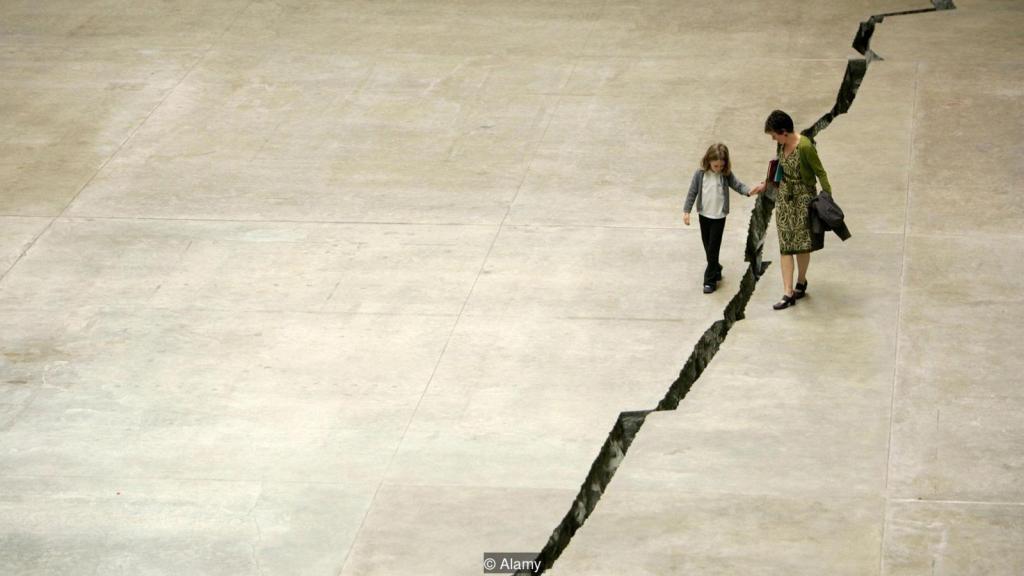
As a visual statement, the aerial photo of the Larsen C crack is, by definition, incomparable; never before has the world marked the glacial advance of such a sublime and fearsome fracture in its very fabric. Yet the reemergence of the image in the news anticipates the ten-year anniversary of one of the most intriguing and innovative large-scale works in contemporary art – a work whose power relies for its thought-provoking effect on the peculiar poetry of ruinous rifts. In October 2007, the Colombian-born artist Doris Salcedo unveiled in London an ambitious installation in the cavernous space of Tate Modern’s Turbine Hall – a piece that split reaction down the middle.
Inviting gallery-goers into the otherwise empty and austere interior of the former Bankside Power Station, Salcedo subverted expectations. Rather than offering visitors a hall of temporarily installed sculptures, she orchestrated the contemplation instead of a ragged subterranean breach that appeared to rip open the concrete floor of the structure – a crevice that extended from one end of the yawning space to the other.
For the Colombian artist Doris Salcedo’s 2007 work, Shibboleth, a giant crack was made in the concrete floor of Tate Modern’s Turbine Hall (Credit: Alamy)
Salcedo deepened the mystery of her bold and experimental conceptual work by giving to it the curious title Shibboleth – a biblical word which, when mispronounced, was said to have exposed the outsider status of individuals. Complicating matters still further, the artist insisted that her work was a comment not on the folly of material ambitions, but on racism – that deep cultural scar that tears at the foundations of humanity. Placed side-by-side, this week’s photo from Antarctica and the image captured a decade ago of Doris Salcedo’s challenging Shibboleth share both a brutal beauty and a common theme: the brittleness of being.
If you would like to comment on this story or anything else you have seen on BBC Culture, head over to our Facebook page or message us onTwitter.
And if you liked this story, sign up for the weekly bbc.com features newsletter, called “If You Only Read 6 Things This Week”. A handpicked selection of stories from BBC Future, Earth, Culture, Capital and Travel, delivered to your inbox every Friday.
ooOOoo
“the brittleness of being.”
Please, all of us, let’s make a positive difference so that we can soften the edges of that brittleness.
It takes so little good news to uplift one’s heart!
For reasons I can’t readily put my finger on it’s been feeling like a bit of a struggle recently. But that’s enough of that! For our gorgeous dogs have yet another lesson for me: How little it takes for a dog to wag it’s tail!
I so frequently share stuff that I read over on the Care 2 site and why not because as the home page declares:
40,107,687 members: the world’s largest community for good
Just three days ago there was a wonderful article shared on the Care 2 site about some dogs being rescued from a so-called backyard breeder. Better than that, it highlighted the wonderful consequence of a donation from George and Amal Clooney.
Here’s the story.
ooOOoo
9 Dogs Successfully Rescued From Backyard Breeder Thanks to George and Amal Clooney
Nine lucky dogs have just had their world turned upside down in the best way possible.
Camp Cocker Rescue, based in California, just took in the “Mojave 9″ who were being kept by a backyard breeder. They’ll be getting all the love and veterinary care they desperately need thanks to a generous donation made by George and Amal Clooney.
The nine dogs have had little human contact, and are all in need of extensive veterinary treatment for health issues ranging from mammary tumors and dental disease to skin and ear infections to ingrown toenails. The organization relies on donations, and expenses for this rescue operation were quickly rising.
“We literally didn’t know how we were even going to begin to start paying for all of these new dogs that we took in on the same day,” Camp Cocker’s founder Cathy Stanley told PEOPLE.
Now, the organization is celebrating a generous and unexpected donation of $10,000 made by George and Amal Clooney, who are parents to two adopted cocker spaniels from Camp Cocker — Einstein and Louie.
Their donation is going to help cover the cost of care for these dogs, who have never been to a vet. The Clooney’s will also be matching donations up to $10,000 for the rest of May.
“After we all did happy dances and cried with happiness for this unbelievable matching donation offer – we then asked the donors if (and only if they gave us their permission) . . . if we could reveal their names to our supporters in order to help us reach our big goal this month. They were so very gracious to give us permission to reveal their names,” Camp Cocker wrote in an update.
While this was a huge boost for them, Camp Cocker is quick to point out that no donation is too small to help.
“We have a philosophy where we want to be very inclusive of all of our supporters and it’s important to us that no matter how small of a donation, every person feels like their donation is meaningful and that we appreciate them,” Stanley added.
Hopefully news about the Mojave 9 and the attention it’s getting will help raise awareness about rescue and inspire more people to get involved … and will help find each of these precious dogs their perfect forever home.
For more on how to help, and info on how to adopt one of these dogs, check out Camp Cocker Rescue and follow updates on Facebook.
Those of you that read this blog fairly regularly know that from time to time I drift away from all things dog and potter in the garden of simply fascinating ideas.
Such is the case today.
It is an article on mathematics that was sent to me by Jim Goodbrod. He had read it in The New York Times in April.
Read it and see if you, too, find it as fascinating as I did!
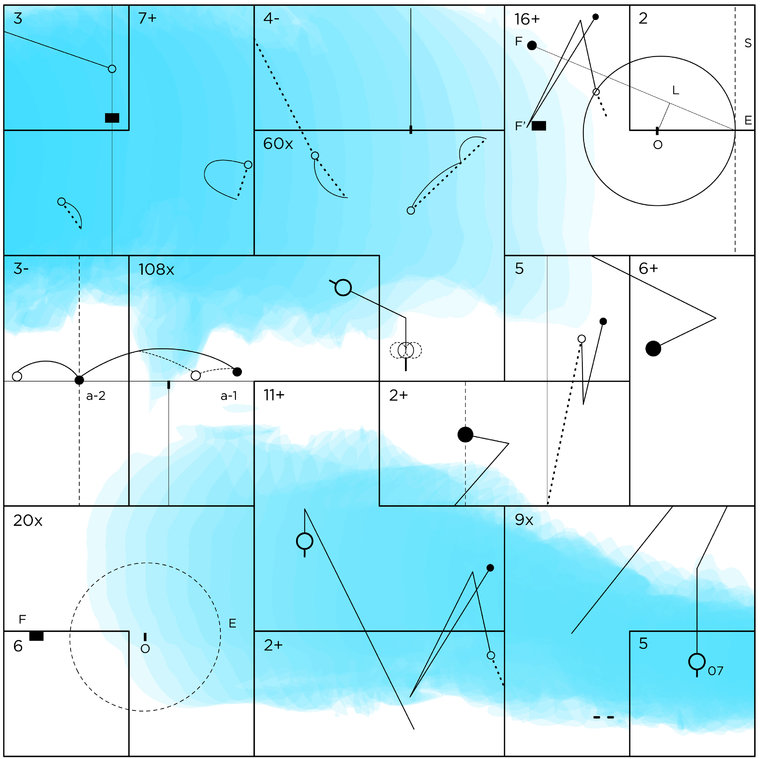
I was doing KenKen, a math puzzle, on a plane recently when a fellow passenger asked why I bothered. I said I did it for the beauty.
O.K., I’ll admit it’s a silly game: You have to make the numbers within the grid obey certain mathematical constraints, and when they do, all the pieces fit nicely together and you get this rush of harmony and order.
Still, it makes me wonder what it is about mathematical thinking that is so elegant and aesthetically appealing. Is it the internal logic? The unique mix of simplicity and explanatory power? Or perhaps just its pure intellectual beauty?
I’ve loved math since I was a kid because it felt like a big game and because it seemed like the laziest thing you could do mentally. After all, how many facts do you need to remember to do math?
Later in college, I got excited by physics, which I guess you could say is just a grand exercise in applying math to understand the universe. My roommate, a brainy math major, used to bait me, saying that I never really understood the math I was using. I would counter that he never understood what on Earth the math he studied was good for.
We were both right, but he’d be happy to know that I’ve come around to his side: Math is beautiful on a purely abstract level, quite apart from its ability to explain the world.
We all know that art, music and nature are beautiful. They command the senses and incite emotion. Their impact is swift and visceral. How can a mathematical idea inspire the same feelings?
Well, for one thing, there is something very appealing about the notion of universal truth — especially at a time when people entertain the absurd idea of alternative facts. The Pythagorean theorem still holds, and pi is a transcendental number that will describe all perfect circles for all time.
But our brains also appear to respond to mathematical beauty as they do to other beautiful experiences.
In a 2014 study, Semir Zeki, a neuroscientist at University College London, and other researchers used fM.R.I. scanners to observe the brains of 15 mathematicians while they were thinking about various equations. The subjects were shown 60 mathematical formulas two weeks before they were scanned and during and after the scan. They were also asked to rate their level of understanding of each equation and their subjective emotional response to it, from ugly to beautiful.
The researchers found a strong correlation between finding an equation beautiful and activation of the medial orbitofrontal cortex, a region of the prefrontal cortex just behind the eyes. This is the same area that has been shown to light up when people find music or art beautiful, so it seems to be a common neural signature of aesthetic experience.
Geeks, take heart: While you can’t see or hear mathematical ideas, they too are capable of arousing a sense of beauty.
No doubt you’d like to know which equation won the beauty contest. It was the so-called Euler’s identity, which is a deceptively spare but profound equation that links five fundamental mathematical constants: a mix of real and imaginary numbers that combine to make zero. And the ugliest? Ramanujan’s infinite series for the reciprocal of pi — a clunky equation, even to this non-mathematician.
While mathematicians were more likely to find formulas beautiful if they understood them well, the correlation was not perfect, so the researchers were able to show that the observed brain activation was a result of the experience of beauty apart from meaning. This makes sense, in that there were equations that subjects understood completely yet found ugly.
Now, the medial orbitofrontal cortex is also active when we find something pleasurable or rewarding, which isn’t surprising either, since you’d expect beautiful experiences to be both.
My love of math originated in the physical world. My father, an insatiably curious guy and electrical engineer, used to build things with me — crystal radios, electric generators, all kinds of exciting contraptions.
One summer evening I found him tinkering with a mysterious metal box in the garage. It was a prototype of a ruby laser. When he flicked the switch, a brilliant thin red light shot out of the laser and up into the night sky.
“How far does it go?” I asked. “To infinity,” he said and added, smiling, “or further.”
I was awe-struck. I still am.
Richard A. Friedman is a professor of clinical psychiatry and the director of the psychopharmacology clinic at the Weill Cornell Medical College, and a contributing opinion writer.
ooOOoo
While my understanding of mathematics is average, to say the best, I did identify with the idea spelt out a few paragraphs above. This one:
….. so the researchers were able to show that the observed brain activation was a result of the experience of beauty apart from meaning.
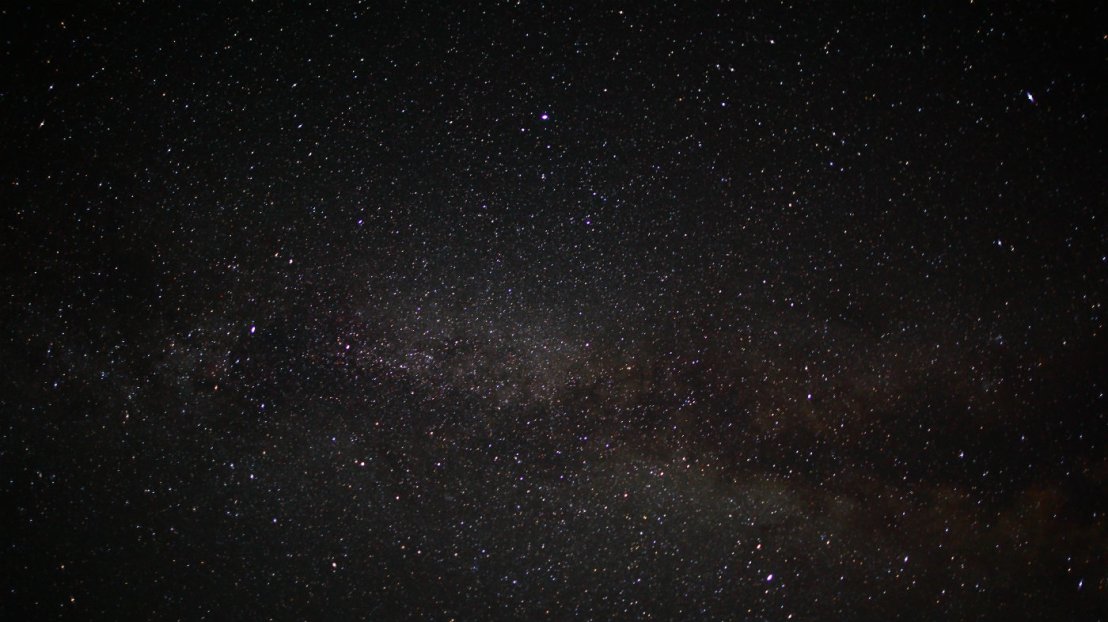
Because it took me back to looking up at the night sky out at sea well away from land.
Did I understand the meaning of what I was looking up at? Of course not! Did I experience beauty? Beyond what I could put into words!
On a clear night you can see some 4,000 stars in our universe. (Photo taken of a night sky over England – National Trust)
This is a guest post coming up today. A reflection on what any dog lover feels when their beloved dog dies. (I don’t even want to think about the end of Pharaoh that can’t be too many weeks off!) But as has been said before it is one the key lessons that we learn from our dogs.
Not too many days ago I received an email from Liz Nelson.
I wanted to submit a synopsis of how our fur babies have dealt with the loss of a friend and the addition of another one to see if you wanted to use it as a guest post.
There was no question that I wanted to publish Liz’s synopsis so it could be shared with you. Here it is.
ooOOoo
The death of Zeke
See footnote for details of this photograph.
A little over a year ago we lost our precious Rottweiler, Zeke, to bone cancer.
Zeke, a rescue who still had remnants of buckshot in his torso from his days living in the woods of Mississippi, was with our family for about 8 years. A gentler giant there never was. He and our cat were friends and Zeke frequently bathed the cat’s head and ears. Zeke and our Chow-mix (Fiona) were also very close. We joked he was in love with her because he let her collect all the toys and win at tug-a-war, despite the size difference.
Losing Zeke was a tremendous blow for our household. Both dogs and our 2 cats were visibly impacted by Zeke’s loss. Fiona took it the hardest. She became listless, fatigued, and generally out of sorts. She wasn’t interested in playing and she became an even pickier eater. She would skip several meals in a row and then eat everybody’s food at one time (including the cats’). She and the other animals refused to touch the dog bed in the living room that Zeke had used. She also refused to chew on a large rawhide we found that had once been Zeke’s. It felt like she was saving his things for when he came back to claim them. We noticed the hair under her eyes starting to go gray. She started to show and act all 9 of her years (she’s a rescue and special needs dog so we’re amazed we’ve had 9 years with her).
The vet said we could explore antidepressants but I wanted to see if we could let her try to work through it without medication. Though they remain an option if needed.
In January, my husband said he was ready to think about getting a puppy and several weeks later we adopted an adorable rescue named Pierce. The rescue told us he was part Husky and part Lab. Now that he’s older we think there’s a hefty dose of hound in there. After a few days of wariness and some growling, the older dogs decided to accept the puppy as part of the household. Fiona regained her energy and she was often seen in the yard with the puppy, teaching Pierce how to play fight or stalk birds. She would chase the puppy until they were both exhausted (which we were grateful for). Sometimes she got annoyed with the puppy but for the most part she took on a big sister role.
Fast forward a few months and the puppy is now the biggest dog in the house. While he really is a good dog, he’s still a puppy. Now when he is too energetic there is a lot more of him bouncing around a room. Fiona spends much of her time reinforcing her dominance by taking his toys and putting them under her chin where Pierce is afraid to attempt to retrieve them. She’s stopped running around the yard to play with him. Perhaps because it hurts when you collide with 45 lbs of speeding, clumsy puppy (just ask my husband)? She has gone back to spending most of her time looking pitiful. She will let me pet her though she acts as if it is an imposition.
We’re hoping that when the puppy matures a little more Fiona will regain interest in playing with him. Or at least his behavior won’t annoy her as much. I know that the puppy can never replace Zeke’s place in the family but I really hope Fiona doesn’t spend the rest of her dog life mourning Zeke and ignoring the new dog!
Liz Nelson
Footnote (re the photo above):
I have a great picture of our family with Zeke and Fiona in it (and my third dog). It’s one of our engagement photos and I’m so glad we included the pups. As you can see Zeke was super cuddly! It’s one of my favorite pictures. You can use any of the information in my about section for an introduction. I don’t have it very detailed (I only started this blog this week) so if there is any additional info you want to include please let me know. I looked around for a more recent photo of myself but all of my recent ones are from Halloweens and involve costumes. Not really an everyday look!
So I guess let’s stick with the family photo. Thank you Paul!
I am a supervisor at a small non-profit agency. I’m also in school part-time working on a doctorate. I’m a social worker so I’ve been working in non-profit agencies since I got my master’s degree around 8 years ago. I’ve been in management for around 5 years. I have had to deal with pretty intense social anxiety for as long as I can remember.
Another delightful travel account from Natalie Derham-Weston.
Albeit perhaps travels of a more inward nature.
ooOOoo
Travel Blog: Installment 3: Living on a boat.
Simple Peace
I fancied an interlude this week to share a morning I enjoyed over the weekend. It isn’t often that the chance arises to enjoy our local surroundings without time limits, overdue deadlines or inconvenient meetings. However, I had a day off Saturday; a concept becoming more and more valued having since started a new full-time job, which is quite demanding on my time. I have requested this high load of hours but after months of travelling and not having regular work, it is taking a while for me to adjust to the mental and physical demands.
Anyway, without going into the irrelevant details, I have been spending my time living on a boat in a marina in Lymington, a small sea side town in the New Forest on the South Coast of England. This means my commute to work is a 2 minute walk and although I do not know the first notion about sailing, I have quickly fallen for the lifestyle of boats and water. I have found it to be extremely sociable and relaxing and I have all I need around me. This includes a bicycle, a car, swimming facilities, work, grocery shops and a very modest yet comfortable boat.
So last Saturday, I woke up early, as I was already in the routine of being awake from my work shifts and saw the sun streaming in through the port hole windows. This immediately buoyed me and I pulled the curtains and opened the hatch to let in the fresh air. I had a few items on a to do list but I certainly didn’t intend on wasting the valuable time I had.
I did have an appointment I couldn’t shirk but made it as quick as possible and on the way back picked up some lunch items. Back on the boat, I had a quick tidy and clean as I firmly believe an orderly workspace leads to a clearer mind.
I pre-empt this by saying I am usually accompanied by my father on the boat but this specific day was the first time I had been left in solo charge and this gave me somewhat of an independent free feeling. So my next mission was to cook some eggs which I did on our very small gas camping stove. I took some cushions out on deck and had my lunch in the warm April sunshine. Our pontoon seems to be quite an active mooring site and there were people constantly wandering along it all day, carrying tools, bags and equipment back and forth. So although I was alone, I did not feel isolated.
I then left everything behind on the boat, including my phone and took my bicycle around the headland on a trail I had never been on before. The channel was extremely clear and I had a wonderful view over to the Isle of Wight and watched the bustle of boats going to and fro. I passed lots of families, dogs, bird watchers and couples but kept going at a steady pace along the gravel track headed towards Keyhaven, the next fishing village along.
There is no specific reason why I enjoyed this so much, just the whole atmosphere and surroundings made for a very encompassing uplifting day. I continued along the path, and had no care as to where I was or where I was going. I was confident enough that I knew I’d always find my way back somehow and so without that pre-conditioned feeling of panic, I cycled on along the back roads and hauled my bicycle over fences and gates.
Two hours later I cycled back in to the marina and abandoned the bike next to the boat. The boat is never locked, another aspect I really appreciate. I don’t think this would be possible everywhere, but it allows for a very open way of life. So I grabbed a cushion and headed to the bow of the boat, lying in the sun, drinking a beer, watching the world go by.
This just proved to me how easy it is to be happy sometimes. We need very little but that day will stay in my memory for a long time as a point in time where I was 100% content.
ooOOoo
I had the great fortune of living on a yacht Songbird of Kent, a Tradewind 33, for five years in the late ’80s early ’90s based out of Larnaca on the Greek side of Cyprus. I can fully vouch for the peace that Natalie has written about.
Are you a dog owner? Then here’s something else that you gain from your wonderful friend.
I was rather short on time yesterday so apologies for cutting my introduction to a minimum. But you will still love this item that appeared on the Care2 site three days ago.
ooOOoo
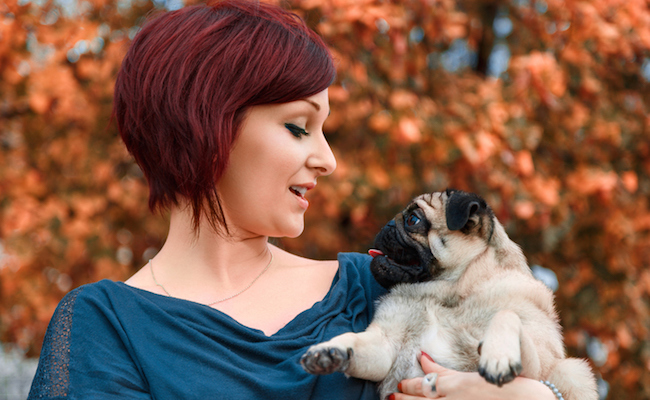
People Who Talk to Their Pets Are Actually Quite Intelligent
If you’ve ever owned a pet, you’ve probably talked to it at one point or another. And even though you may have been fully aware that your pet couldn’t talk back or even really comprehend what you were saying, you still did it anyway.
Why do we do this? Why do we talk to our pets like human friends when we know their little minds just aren’t built to think or feel the same way we do?
When we talk to our pets, we subconsciously create a human-like bond in our own minds with non-human creatures. We’re built for connection — and we feel more connected to things when we recognize that they’re just like us.
Talking to animals (and even to inanimate objects, such as house plants) is called anthropomorphism. We usually call it “cute” when kids do it, but when adults do it, we tend to view it as a little weird and immature.
According to behavioral science professor at the University of Chicago and anthropomorphism expert Nicholas Epley, talking to animals and objects is actually a sign of intelligent social cognition. Humans are very social creatures, so our brains are wired to see faces and perceive minds everywhere.
Epley explains that we anthropomorphize the things that we love as opposed to the things that we hate. The more we like something, the more likely we are to want to engage with its mind — even if it doesn’t actually have a mind.
In a 2011 study where a group of participants were shown photos of baby animals and adult animals, most admitted to liking the baby animals better and were more likely to anthropomorphize them. If the participants could own one of the baby animals, they said that they would name it, talk to it and refer to it by its appropriate gender pronoun.
The most common way we anthropomorphize animals and objects is by giving them names, but it can apply to character traits, too. For example, a person may describe their cat as “sassy” or their car as a “rickety old man.” These human-like character traits given to non-human things reflect our relationship with them and perhaps even symbolize extensions of ourselves.
Anthropomorphizing only benefits us when inanimate objects are involved, but when it comes to anthropomorphizing domesticated animals like dogs and cats, both ourselves and our pets can benefit. Since these animals evolved over thousands of years to become human companions, they are biologically designed to bond with us.
Studies have shown that when we talk to dogs, they can distinguish between the meaning of the words and the emotional cues we give them. Cats may not be as responsive to human language as dogs are, but they do have the ability to recognize their owners’ voices and they also have 16 different types of vocalizations they use to communicate.
So you can let go of the widely held belief that talking to your pet, your houseplants, your car or anything else is childish or even a little bit crazy. From a scientific viewpoint, it turns out that quite the opposite is true.
ooOOoo
Let me close by reminding all you good people of yet another wonderful aspect of the relationship between humans and dogs. In that we all know the dog evolved from the grey wolf. But had you pondered on the fact that wolves don’t bark! Yes, they howl but they do not bark.
There is good science to underpin the reason why dogs evolved barking; to have a means of communicating with us humans.
Every person who has a dog in their life will instinctively understand the meaning of most, if not all, of the barks their dog utters.