This remarkable story of a dog that was rescued some 200+ kilometres off the coast of Thailand was featured on the BBC news website.
It’s quite amazing and truly miraculous.
ooOOoo
Dog rescued 220km from Thai coast by rig workers
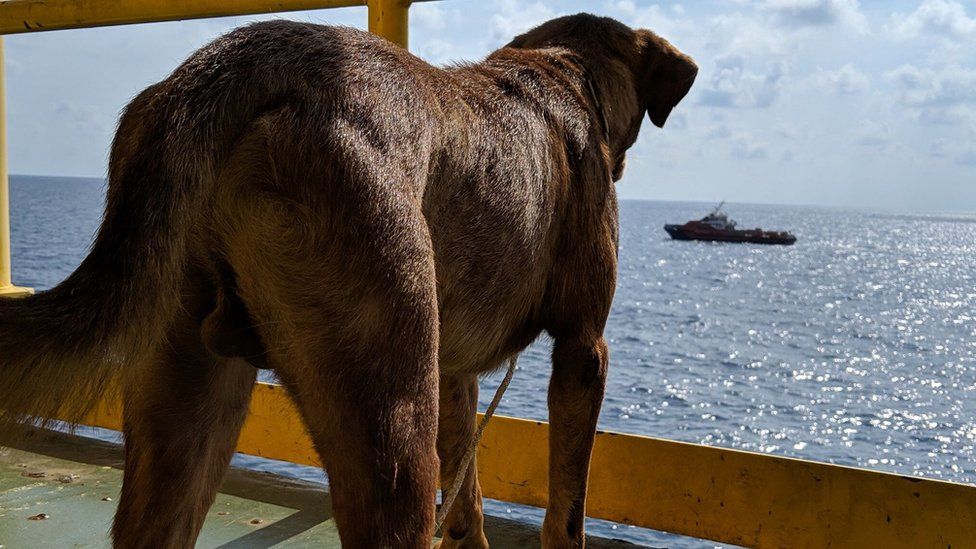
A dog discovered some 220km (135 miles) off the coast of Thailand has been rescued by a team of oil rig workers after the exhausted pooch was spotted paddling near a drilling platform.
The brown aspin swam towards the workers when they called out to him last Friday afternoon. He was then pulled to safety.
It is not clear how the dog became stranded so far out at sea. Some reports suggest he may have fallen from a fishing trawler.
The rig workers named the dog Boonrod, a Thai word that roughly translates as “the saved one” or “survivor”.
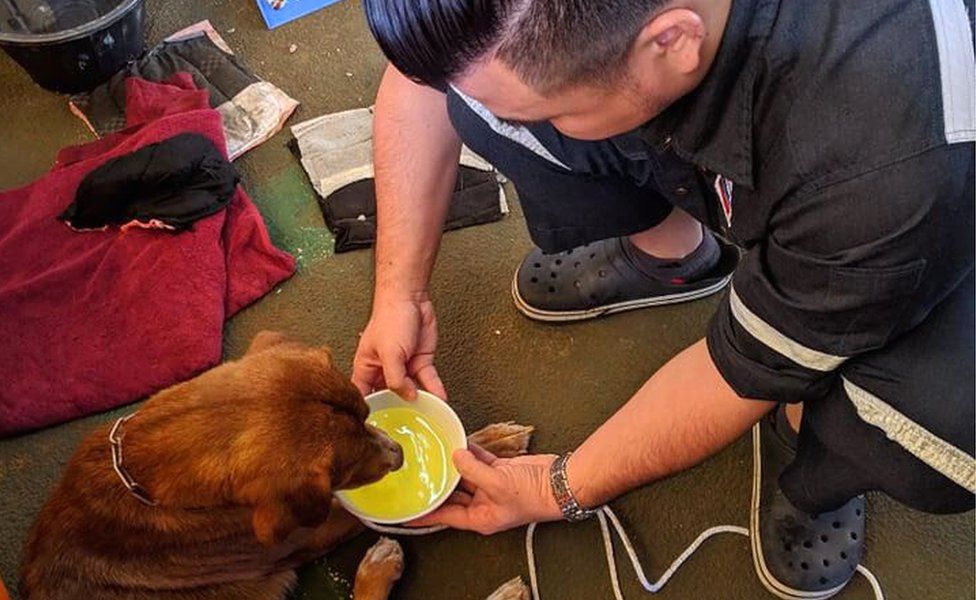
Boonrod was said to have been exhausted and in need of fresh drinking water and food.
He was nursed back to health on the rig while staff radioed for help, requesting the assistance of a tanker that was heading back to shore.
Boonrod had to have a proper wash to cleanse his fur of salt from the seawater. Afterwards, he had a nap.
The conditions were said to have been calm during the rescue, which workers said made it easier to spot Boonrod among the rusty metal bars of the rig.
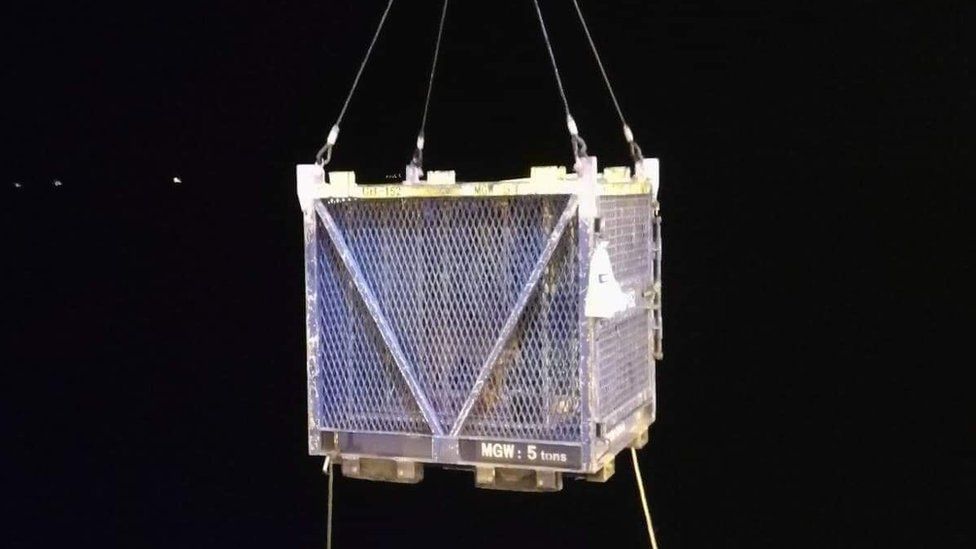
Boonrod was lifted by crane on to an oil vessel that was passing through the area on Sunday to be transported to a veterinary practice in southern Thailand.
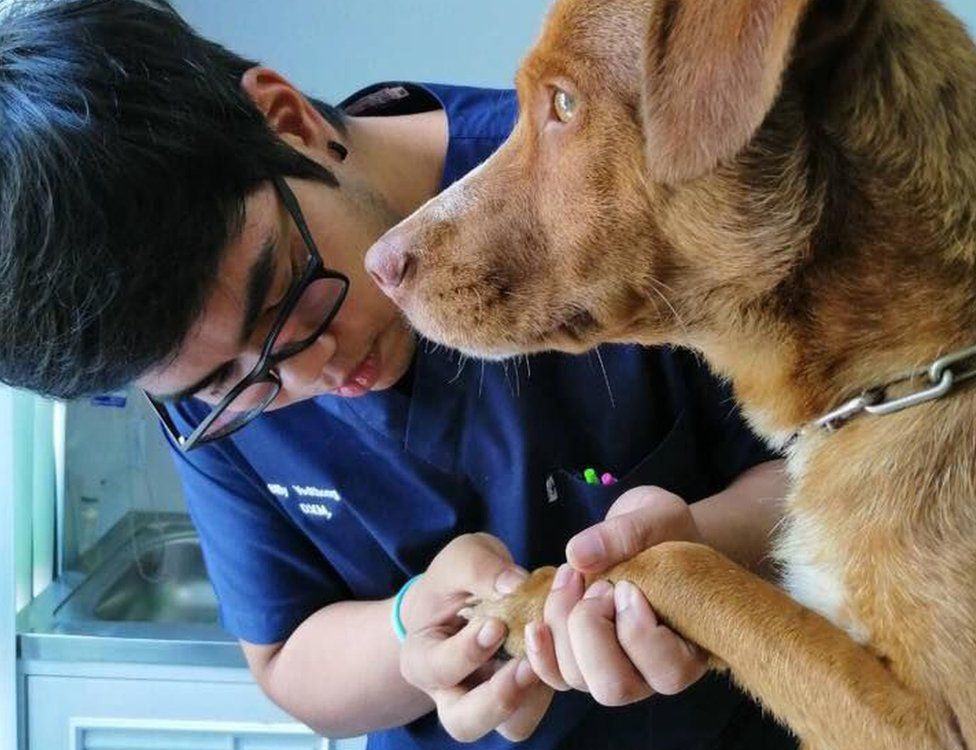
The dog was said to have been in good spirits when he arrived on land to be taken to the vet.
(All images are copyright Viralpress.)
ooOOoo
The fact that this dog was rescued so far out to sea is incredible. Clearly, the poor dog had fallen off another vessel but the details of that incident are not known and it is purely conjecture.
But what is really important was that the dog was rescued and returned to health.
For a while now I have been subscribing to The Dodo. As the website explains it’s for animal people and as you and I know that’s quite a great many people!
Until now I have been a little nervous of sharing articles from The Dodo with you. But then I noticed quite recently that there is a ‘share’ button at the end of the articles.
So I presume it’s alright to share these wonderful stories!
A family was out riding their bikes one day in South Carolina when they suddenly heard what sounded like a puppy crying. They pulled their bikes over to the side of the road and went to investigate, and were shocked to find a little puppy trapped under a pile of dirt and concrete. Not knowing how else to help, they quickly called 911, and both the police and firefighters with the North Charleston Fire Department responded in hopes that they could free the trapped puppy.
North Charleston Fire Department
“They showed us where the dog was located,” Captain Paul Bryant, of the North Charleston Fire Department, told The Dodo. “It was piles of concrete 4 foot by 4 foot, some smaller, some bigger. One of the police officers said he could see the dog so we got on our hands and knees to look and saw his nose sticking out of the pile of rubble.”
After moving the concrete slabs out of the way with a pry bar, Captain Bryant attempted to pull the puppy, later named Rocky, out from the remaining dirt and rubble, but unfortunately there just wasn’t enough room. He then took a shovel and started digging, and finally was able to create enough space to pull the confused puppy out to safety. The whole rescue only took about 11 minutes, but no one has any idea how long Rocky had been stuck under there before everyone arrived.
North Charleston Fire Department
As soon as he was free, little Rocky couldn’t stop licking Bryant’s face in gratitude. The puppy clearly had so much energy and lots of love to give, and everyone immediately fell in love with him — especially Bryant. The family who had initially found Rocky said they would take him to a nearby animal hospital to get checked for a microchip so he could hopefully be reunited with his family, but after he was gone, Bryant just couldn’t get Rocky out of his head.
“I wanted to know if his owner was found, or if the person who found him was going to keep him,” Bryant said. “Once I found out he did not have an owner and the family who found him could not keep him, I knew he was coming home with me.”
North Charleston Fire Department
Bryant felt connected to Rocky from the second he rescued him from underneath that concrete, and it was as if the pair had always been meant to be together.
“I found out I was going to be able to adopt him, and I’ve been on a high ever since,” Bryant said in a video about Rocky’s rescue.
Captain Paul Bryant
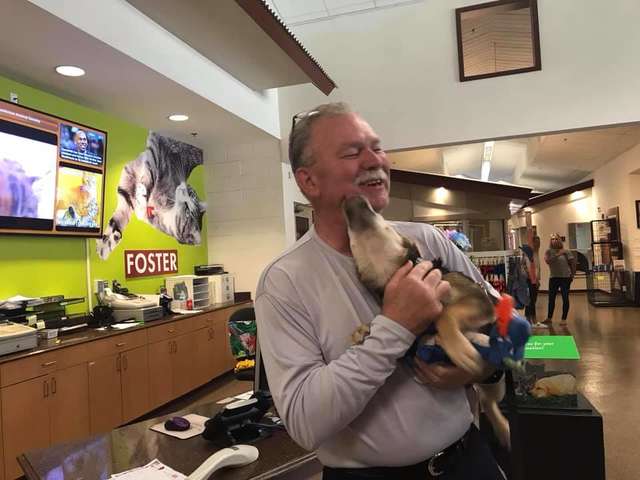
Once Rocky had been given a clean bill of health and was ready to head off to his new forever home, Bryant headed over to Charleston Animal Society to pick him up …
Facebook/Charleston Animal Society
… and as soon as Rocky saw his rescuer again, he could barely contain his excitement.
Charleston Animal Society
Rocky is now all settled into his new home and couldn’t be happier with how things turned out. He went from being trapped and alone to having the world’s best dad, and everyone involved is so thrilled that Bryant and Rocky ended up together.
Captain Paul Bryant
“He is a very energetic dog and loves to play fetch with his new toys,” Bryant said. “He is always by my side, never letting me leave the room without following me.”
ooOOoo
Time and time again people from all walks of life know something instinctively when it’s in front of them. The love that we humans give to our dogs and the love that they return to us.
Earlier yesterday I received a letter from a firm of lawyers Higbee & Associates. It was to advise me that, “Unlicensed Use Of Work Copyrighted By Paul Martinka.” and went on to detail how Paul Martinka had quite correctly was seeking compensation for my republishing a photograph without a license.
So, moving on!
It is going to change the blog quite a bit because I frequently republish material from other websites without formal permission.
So while I think through how to continue blogging there’s something you can do for me.
Let me know if I can republish your work. You can leave a comment to this blog or ask me to email you.
And offer me posts that I can use. Please!
Meantime I will ponder what to do!
P.S. That’s why you may have noticed quite a few posts have been taken down!
Dog owners spend US$240 a month caring for their pets, compared with $193 for cats, according to the 2017-2018 National Pet Owners Survey from the American Pet Products Association. The extra money goes primarily toward vet visits and kennel boarding, but dog owners also spend more lavishly on treats, grooming and toys.
And almost half of households own a dog, while just 38 percent have a cat. Generational trends suggest this divergence is likely to grow, as millennials are more likely to adopt a canine, while baby boomers tend to be cat lovers.
One reason suggested was that dog owners had stronger bonds to their pets, which prompted them to spend more on things like veterinary care.
My research uncovered a key factor indicating why dog owners feel more attached to their pets: Dogs are famously more compliant than cats. When owners feel in control of their pets, strong feelings of psychological ownership and emotional attachment develop. And pet owners want to be masters – not servants.
Like other marketing researchers, my work uses “willingness to pay” as an indicator of the economic, rather than emotional, value owners place on their pets. It shows – and compares – how much pet owners would pay to save their animal’s life.
Dog owners are willing to pay twice as much as cat owners for a life-saving surgery. AP Photo/Angie Wang
Who’s in control?
So I carried out three online experiments to explore the role of psychological ownership in these valuations.
In the first experiment, I asked dog or cat owners to write about their pet’s behavior so I could measure their feelings of control and psychological ownership. Participants then imagined their pet became ill and indicated the most they would be willing to pay for a life-saving surgery.
Dog owners, on average, said they would pay $10,689 to save the life of their pet, whereas cat owners offered less than half that. At the same time, dog owners tended to perceive more control and psychological ownership over their pets, suggesting this might be the reason for the difference in spending.
Of course, correlation is not causation. So in a second experiment, I asked participants how much they would be willing to pay to save their animal’s life after I had disturbed their sense of ownership. I did this by asking participants to imagine their pet’s behavior was a result of training it received from a previous owner.
As expected, disrupting their feelings of ownership eliminated the difference in valuation between dogs and cats.
Since pet owners like to control their animals, and since cats are less controllable than dogs, the third experiment went straight to the point: Does the owner value the dog or cat for its own sake or for its compliant behavior?
To find out, I again asked survey respondents to describe how much they’d be willing to pay to save their pet’s life, but this time I randomly assigned one of four scenarios: Participants were told they either own a dog, a cat, a dog that behaves like a cat, or a cat that behaves like a dog.
Participants reported they would pay $4,270 to save the life of their dog, but only $2,462 for their cat. However, this pattern was reversed when the pet’s behavior changed, with dog-behaving cats valued at $3,636, but cat-behaving dogs only $2,372.
These results clearly show that the animal’s behavior is what makes people willing to pay.
When cats act more like dogs, people say they’d spend more money on them. pixfix/shutterstock.com
Master or servant
These findings establish that psychological ownership is a driving factor in dog owners’ higher valuations.
People feel ownership because they perceive that they can control their pets’ behavior. This research even distinguishes the type of control that probably most stimulates ownership feelings: It’s not just physical control, such as being able to pick up an animal or drag it by a leash. Rather, it’s the animal’s voluntary compliance with its owner’s wishes.
No matter how cute and cuddly your kitties may be, they can’t compete with dogs when it comes to giving pet owners the sense of mastery they seek.
I really should have written having a pet in your life because the following story is about cats and dogs. Plus, it’s been copied from The Guardian Newspaper so I fully expect that it will be taken down fairly soon.
But here goes!
ooOOoo
Sometimes a dog can be better for a patient than hospital
Suffering patients may need to just be asked ‘tell me about your pet’
Photograph: IJdema/Getty Images/iStockphoto
‘I wonder how often doctors are cognisant of the silent distress of patients who are separated from their pets?’
An elderly patient is admitted to hospital after a fall at home. He is stunned after the fall but, thankfully, uninjured. It takes him a few days to recover but as soon as he is able, he wants to go home. The physiotherapist wants to work with him, the social worker wants to examine his support system, but all he wants to do is go home. We feel he is not yet safe. He acknowledges that a worse event could happen but still, he wants to go home. Theories are posited as to why.
Maybe the concussion is worse than we first thought. Maybe he is cognitively impaired and unable to make decisions about his safety, in which case a state-appointed guardian may be needed. Maybe he doesn’t like the other patients, in which case he could be placated by moving him to another room. It is the beginning of a month of medical rounds for me and he is the handover without a plan.
He is sitting out of bed, dressed and sipping his tea. He looks up at a new face with interest.
“I am the specialist taking over your care,” I say.
“Look, love, please just let me go home. I’m begging you.”
Something about his desperation moves me and I am struck by the imbalance of power between me and my patient twice my age.
“I really want to, but help me understand why you’re so eager.”
I expect to hear about the incessant noise in the hospital, the bad food or the lack of clear communication but instead, to my complete surprise, tears start rolling down his face.
“It’s my cat. I want to see my cat.”
The cat is a link to the years he shared with his late wife. Now it snoozes in his wife’s chair and responds to his reminiscences, as if to say it knows he is hurting. In the twilight of his life, when his children are too busy to visit and the residents in his retirement village keep falling sick, his cat is the constant in his life.
“You can’t fix an old man,” he pleads. “But send me back to my cat.”
“I am going to do just that,” I say.
Outside, his story touches a nerve. People band together, set up community services and get him home quickly. In the end, he turns out to be a simple discharge. Reuniting an old man with his cat turns out to be the best medicine, which leaves me wondering how often doctors are cognisant of the silent distress of patients who are separated from their pets. Not often, I suspect.
The very next week, the distress of another patient announces itself loudly and heartbreakingly. She is 50, her dog was 18. She was divorced and lonely. He was old and slow. When her work turned her out and her friends moved on, the dog proved her anchor.
Amid all the shifting circumstances of her life, he never stopped loving her and greeting her with delight every morning. He needed nothing more than a walk and a few biscuits to send him into raptures of delight. Suddenly he fell very ill and the vet suggested the kindest thing to do was to let him go. So she did. Then she came home and took an overdose. How could she face life without her dog?
The postman spotted her through the window and called an ambulance. She was successfully resuscitated and now she is on the medical ward, awaiting psychiatric intervention. When I meet her she is pleasant and remorseful, particularly for being a burden on the overstretched mental-healthcare system.
A psych consult won’t help her, she pleads, another dog will. In fact, she has found just the right one and even thought of a name. She just hopes it won’t be gone before she is cleared. I tell her that all my sympathies still won’t add up to a hasty discharge because she really does need to see the psychiatrist. She begins to sob.
I have an insightful resident with me.
“Tell me about your dog,” she asks brightly. “I love dogs.”
The patient pulls out a photo from under her pillow.
“He is so happy,” I remark as I start jotting some notes.
“He was all I had. I went months without talking to people.”
Her loneliness will need attention but that’s a topic for another day, easy to identify but difficult to fix.
“What was his favourite thing to do?” the resident smiles, leaning forward.
“He loved to walk, even as an old thing.”
We go back and forth, the standard questions about headache, pain and immobility replaced by an interest in a departed dog that was the life of his owner.
It feels intuitively right but somehow misplaced, as if we are breaking some established protocol that says we should be asking about the number of pills she took and whether there was alcohol involved and what she would do if her new dog got sick. We should be checking her vitals, ensuring her bloods are fine, that the drug screen is clear. And watching our every word in case something inopportune brings her grief crashing back and we are to blame.
Except, in that moment, it is clear that while the medical questions have merit, the most important thing for this patient at this time is to cast them all aside and create a common understanding to make her feel less lonely in her experience. I count 10 minutes spent at her bedside. In those 10 minutes, we watch her mood lift and fresh hope enter her tone. There are people who love dogs, she thinks. There are people who understand my grief. Why, they are even interested in my old dog.
Our time is limited, and we must move on apologetically. With dry eyes and genuine gratitude, she says, “Thank you for asking about my dog. It’s the nicest thing anyone has done.”
Really? Could it be this simple?
Amid the trappings of modern medicine, it’s hard to believe that the inexpensive 10 minutes spent at her bedside might have proved to be the most useful and cathartic treatment of all. All her tests turned out fine. A day later, she is deemed safe for discharge and is overjoyed at the reprieve.
The next time we meet an upset patient, I suspect we will be tempted to ask the same question as always, “What’s the problem?”
But with a better history and a little luck, these experiences will shape a more nuanced approach to the suffering of patients. For many of them, the best question may be a request. “Tell me about your pet.”
ooOOoo
It’s both a beautiful story and a powerful one. It explains how for many people having a pet in their lives is more than a nice thing, it’s the reason for living.
Wonderful.
Thank you Margaret for sending me the link to this news item.
Photo above: Bruce Tennant captured the March 2014 full moon rising over Santiago Peak, Alamitos Bay, Long Beach, California.
The March 20-21, 2019, full moon ushers in the first full moon of spring for the Northern Hemisphere, and the first full moon of autumn for the Southern Hemisphere. This full moon is also a supermoon, particularly close to Earth. It comes less than four hours after the arrival of the March 20 equinox.
This is the closest coincidence of a full moon with the March equinox since March 2000 – 19 years ago. The full moon and March equinox won’t happen less than one day apart again for another 11 years, or until March 2030.
March 2000 full Moon: March 20 at 4:44 UTC
March 2000 equinox: March 20 at 7:35 UTC
March 2030 full moon: March 19 at 17:56 UTC
March 2030 equinox: March 20 at 13:51 UTC
This month’s full moon also presents the third and final supermoon of 2019. Will it appear bigger in your sky? No, not unless you happen to catch the moon just after it has risen in the east, around sunset. Then its larger-than-usual size has less to do with the supermoon, but more from a psychological effect known as the moon illusion.
Supermoons don’t look bigger to the eye to most people, but they do look significantly brighter. If you’re in the suburbs or a rural area, notice the bright moonlight cast on the landscape at this full moon.
Also, supermoons have a stronger-than-usual effect on Earth’s oceans. Watch for higher-than-usual tides to follow the supermoon by a day or so, especially if a coastal storm is happening in your part of the world.
At the equinox, the sun is at zenith (straight overhead) at the Earth’s equator. Because the Earth’s atmosphere refracts (bends) sunlight, a tiny bit more than half of the globe is covered over in daylight.Generally, the first full moon of a Northern Hemisphere spring heralds the imminent coming of the Christian celebration of Easter. Since Easter Sunday – by proclamation – occurs on the first Sunday after the first full moon in spring, some of us might expect the upcoming Sunday on March 24 to be Easter Sunday. However, by ecclesiastical rules, the equinox is fixed on March 21, so that places this year’s Easter Sunday (for Western Christendom) on April 21, 2019.
By the Gregorian calendar, the last time that an ecclesiastical Easter and an astronomical Easter didn’t occur on the same date was 38 years ago, in 1981. The next time won’t be until 19 years from now, in 2038.
(Easter Sunday for Eastern or Orthodox Christendom actually falls on April 28, 2019. That’s because the Eastern Church bases Easter on the old style Julian calendar, instead of the revised Gregorian calendar used by Western Christianity and most of the world.)
For our friends in the Southern Hemisphere, this March full moon counts as your Harvest Moon. The Harvest Moon is the full moon occurring closest to the autumnal equinox. On the average, the moon rises about 50 minutes later with each passing day. But for several days around the time of the Harvest Moon, the lag time between successive moonrises is reduced to a yearly minimum. For instance, at 40 degrees south latitude, the moon now rises some 30 to 35 minutes later (instead of the average 50 minutes later) each day for the next several days.
Like Earth, Saturn has equinoxes too! The ringed planet last had an equinox in 2009, and will have its next equinox in 2025. From Earth, Saturn’s rings disappear from view at a Saturn equinox, because these rings are then edge-on from our vantage point. But this near-equinox view of Saturn’s rings is readily visible from the Cassini spacecraft, because it’s 20 degrees above the ring plane. Image via NASA.
Here in the Northern Hemisphere, where it’s the closest full moon to the spring equinox, the lag time between successive moonrises is at a yearly maximum. At 40 degrees north latitude, the moon now rises around 70 to 75 minutes later daily. In the Northern Hemisphere, we ‘ll have to wait for the September full moon to bring forth our procession of early evening moonrises.
Last but hardly least, this March 2019 full moon gives us the first of four full moons in one season (between the March equinox and June solstice). Most of the time, a season – the time period between an equinox and a solstice, or vice versa – only harbors three full moons. But since this March full moon comes very early in the season, that allows for a fourth full moon to take place before the season’s end.
March 2019 equinox: March 20 at 21:58 UTC
March 2019 full moon: March 21 at 1:43 UTC
April 2019 full moon: April 19 at 11:12 UTC
May 2019 full moon: May 18 at 21:11 UTC
June 2019 full moon: June 17 at 8:31 UTC
June 2019 solstice: June 21 at 15:54 UTC
Some people call the third of four full moons in one season a Blue Moon. So our next Blue Moon (by the seasonal definition of the term) will fall on May 18, 2019.
The next Blue Moon by the monthly definition – second of two full moons in one calendar month – will come on October 31, 2020.
Bottom line: Enjoy the equinox full moon on March 20-21, 2019. It’s the third and final full supermoon of 2019, and the first of four full moons in the upcoming season (spring for the Northern Hemisphere, autumn for the Southern Hemisphere).
Bruce McClure has served as lead writer for EarthSky’s popular Tonight pages since 2004. He’s a sundial aficionado, whose love for the heavens has taken him to Lake Titicaca in Bolivia and sailing in the North Atlantic, where he earned his celestial navigation certificate through the School of Ocean Sailing and Navigation. He also writes and hosts public astronomy programs and planetarium programs in and around his home in upstate New York.
ooOOoo
It’s not about dogs. But then again maybe it is. For I’m thinking of dogs howling at the moon.
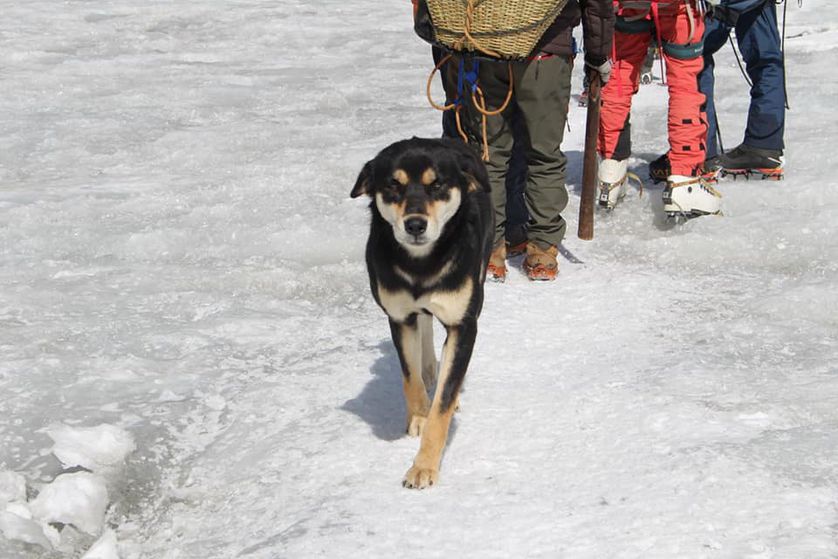
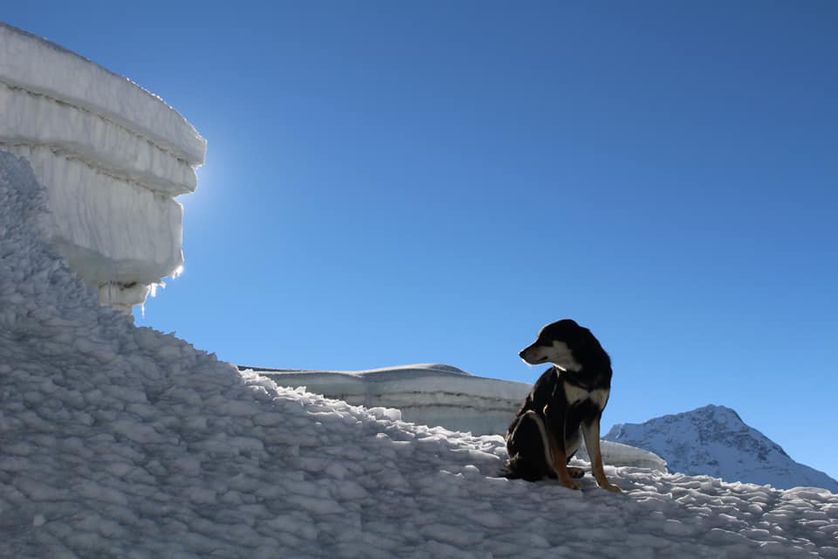
Mera seemed to have little trouble in the snow and ice. (Photo: Don Wargowsky)
When Seattle-based mountain guide Don Wargowsky was leading an expedition to Mera Peak and Baruntse in Nepal’s Himalayas last November, he picked up an extra member on his team. A stray dog noticed the climbers somewhere around 17,500 feet and decided to stick around with the group.
The climbers had just summited Mera Peak, and when they were coming down around Mera La pass, they saw the pup going up.
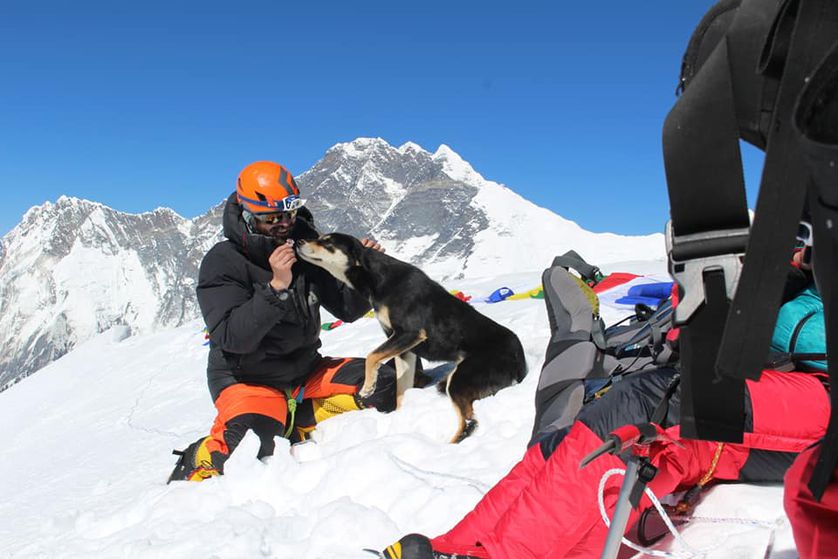
“What struck me was to get to that pass, there were a few hundred feet of fixed rope which means the terrain was so difficult that most climbers need rope to help themselves up,” Wargowsky tells MNN. “To see a dog up there just running by all these climbers in their $2,000 down suits and crampons was very unusual. When she came up to me, I gave her a bit of beef jerky and she didn’t leave for 3 1/2 weeks.”
The team dubbed their newest four-legged member “Mera” and she tagged along on the way back down the mountain. Wargowsky realized he had seen her in the town of Kare a few days earlier, but she had made no effort then to get close. He thinks that’s because street dogs aren’t treated very well in Nepal due to the fear of rabies.
“Dogs are shooed away pretty aggressively,” he says. “So, she was naturally pretty shy.”
A new climbing partner
Climbing is hard work. (Photo: Don Wargowsky)
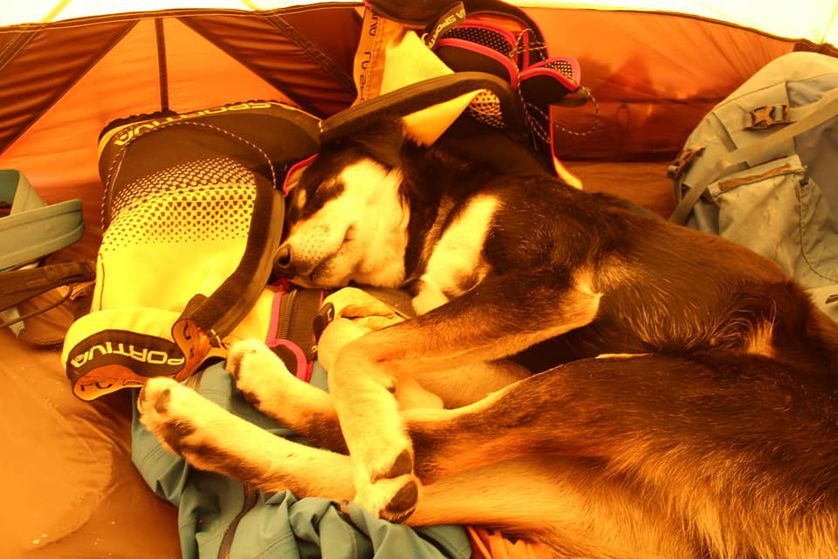
But once Mera decided to join the expedition, she gradually lowered her guard. The first night, Wargowsky tried to encourage her to sleep in his tent, but she wouldn’t come inside. The next morning, he found her curled up outside the flaps covered in a layer of snow. After that, he was able to coax her inside. He gave her one of his sleeping pads and a coat to keep her warm.
Wargowsky was in a difficult position with his uninvited guest. The elements were unforgiving, and he was worried about the dog who had no protection for her paws or her body in conditions that likely reached minus 20 or minus 30 degrees Fahrenheit at times. But he had no luck getting her to leave … and where would she go?
“Obviously my responsibility was to the group, but I was super happy to have her with us. I didn’t encourage her to come along, but I wasn’t going to have her starve, so I would feed her,” he says. “I really tried to persuade her to stay at camp as we got into steeper and more dangerous terrain. Where we were was a more remote part of Nepal. If we didn’t feed her, she was going to starve.”
Mera stuck with the expedition the entire time, never venturing far from Wargowsky’s side. Or technically, his knee.
“She would walk with her nose almost in the back of my knee when we would walk,” he says. “But she wanted to be up front. If I would drop back to hang out with a slower client, she would go up and walk with whoever was up front. She didn’t get out of sight pretty much the entire time we were there.”
‘No clue what her motivation was’
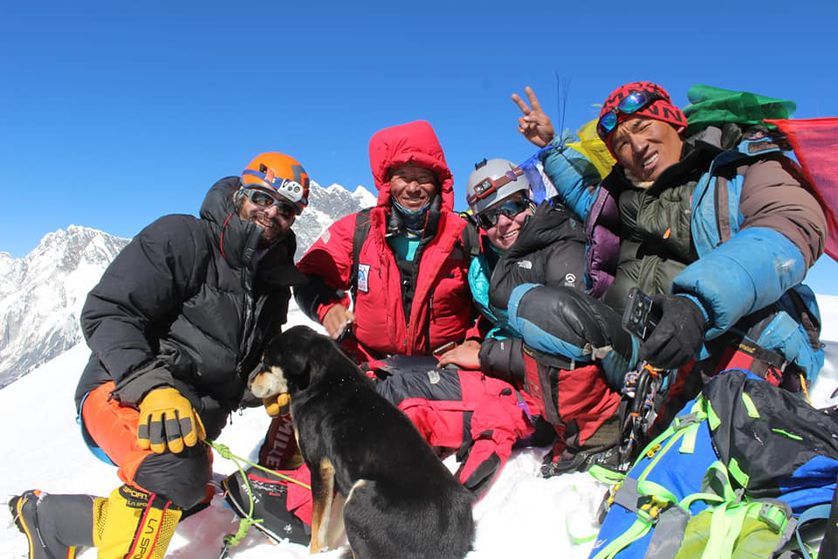
Mera celebrates with her fellow climbers. (Photo: Don Wargowsky)
There was only one time when Mera was gone for several days.
While Wargowsky was working on training with some members of the expedition, showing them how to climb the ice with rope, Mera followed the team’s sherpas instead. They were working to set up ropes to “camp one” at around 20,000 feet. She scrambled up the steep terrain but seemed afraid to go back down and wouldn’t return with them to base camp.
“She ended up spending two nights alone on a glacier at 20,000 feet. I really thought she was going to freeze to death,” Wargowsky says. The sherpas went up to continue working and she was there. But instead of going back down right away, she followed them to 22,000 feet as they continued working before going back to base camp.
The next day when the entire team went to make the climb, Wargowsky tried to keep her at base camp because he didn’t want her to make the steep climb again. He tied her up but she got out of her rope and quickly caught up with them. Wargowsky couldn’t leave his human clients to take her back, so Mera was allowed to stay with the group.
“I have no clue what her motivation was,” he says. “We were feeding her at base camp, so it wasn’t the food. It’s not like there was anything up there for her, but it was amazing to see.”
Tackling the ice and snow
Mera often trotted ahead of the climbers, waiting for them to catch up. The temperatures didn’t seem to faze her. (Photo: Don Wargowsky)
Early on, Mera started to slide and Wargowsky was able to catch her and save her from what could’ve been a dangerous fall. When the team moved to camp two at around 21,000 feet, they were sidelined there for four days because of bad weather. Mera stayed with Wargowsky, who shared his tent and his food with the pup.
“I split all my meals with her 50/50 so we both lost weight,” he says. He guesses the scruffy brown-and-tan stray weighed probably 45 pounds to start with but lost maybe five or 10 pounds during the trip. Wargowsky says Mera looked like a combination of a Tibetan mastiff and a Nepali sheepdog.
Wargowsky was impressed with how well Mera navigated the snow and ice and handled the cold.
“She did very very well like 98 percent of the time. There were certain slopes very early in the morning or late at night when the snow was very crusty and icy when it was very slippery and you could see her kind of struggle with it,” he says. “Her paws got beat up and it was hard to see her paws bleeding a little. But everything healed up that evening and it was all superficial.”
He says it was also hard to believe she didn’t go snow-blind. The humans were all wearing expensive glacier goggles while she trotted along with no protection.
The highest a dog has ever climbed
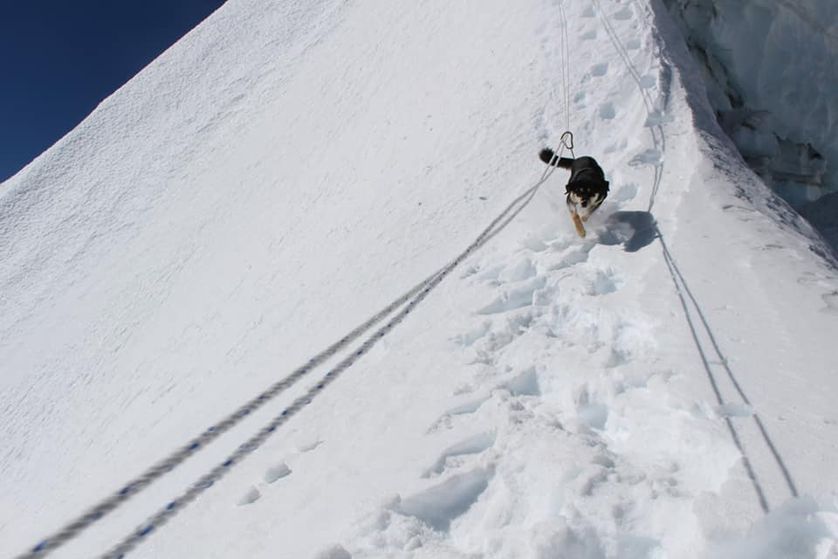
In one particularly harrowing descent, Mera was clipped to a rope to keep her safe. (Photo: Don Wargowsky)
There was only one part of the descent where she was assisted by a rope. Somehow, she had climbed the vertical 15-foot-tall section without incident but when it was time to go back down, she didn’t want to do it. The humans were rappelling, so to coax the dog down safely, they tied a rope harness to her so she could half-run, half tumble. You can see it in the photo above, but Wargowsky points out that the truly harrowing part of the mountain isn’t even visible in the shot.
In the end, when the team — along with their canine mascot — had come down from their completed 23,389-foot climb of Baruntse, Mera was hailed as a bit of a hero. Word had spread about her alleged feat and Wargowsky had to show off photos from his phone to prove she had been with them.
“She was the first dog to ever have climbed that mountain,” he says. “We can’t find anything that says a dog has ever been that high. I believe that is the highest that a dog has ever climbed ever at any point in the world.”
“I am not aware of a dog actually summiting an expedition peak in Nepal,” Billi Bierling of the Himalayan Database, an organization that documents climbing expeditions in Nepal, told Outside. “I just hope that she won’t get into trouble for having climbed Baruntse without a permit.” Bierling told Outside that there have been a few reported cases of dogs at Everest Base Camp (17,600 feet) and some who’ve trailed teams through the Khumbu Icefall up to Camp II (21,300 feet) on Mount Everest, but Mera’s adventure is perhaps the highest-recorded elevation by a dog anywhere in the world.
‘This dog wants to climb mountains’
Wargowsky shares his food with his climbing buddy. (Photo: Don Wargowsky)
After all that climbing and bonding, Wargowsky was tempted to bring his new friend home with him to the U.S.
“I really would’ve loved to adopt her. But I live in a 700-square-foot unit in Seattle and this dog wants to climb mountains. I gave it a lot of consideration. I didn’t care what it cost. Despite how much I loved this dog, I thought it would’ve been a very selfish thing to do to bring her to such a small space.”
But he didn’t want to leave what he calls “this hero of a dog” out on the streets. Fortunately, the expedition’s base camp manager was also smitten with the adventurous dog. Because dogs can’t fly, NirKaji Tamang paid someone $100 to walk three days to pick her up until they could get her on a bus and get her to his home in Kathmandu.
After what she had accomplished on Baruntse, Tamang changed the athletic dog’s name to Baru. He took her to the vet to make sure she was healthy. Her injuries quickly healed, and she gained weight.
Wargowsky, who told his remarkable Mera story online, was thrilled recently to receive photos of her. He will be back in Nepal several times this year for expeditions, and he plans on visiting his canine climbing partner.
“With what we had available, I don’t know what more I could’ve done to prevent her from climbing. She was definitely there of her own free will,” he says. “I truly loved that dog.”
ooOOoo
This is such a wonderful account of a stray dog coming into contact with a group of such loving people. Plus, the photographs are wonderful especially the fourth one; just following the Tackling the Ice and Snow sub-heading. I could look at that photograph for ever!
It’s fair to say that whilst people send me a whole range of items, as yesterday’s post demonstrated, what I am about to republish is the high-water mark for everything! Well it is for me!
But you be the judge!
ooOOoo
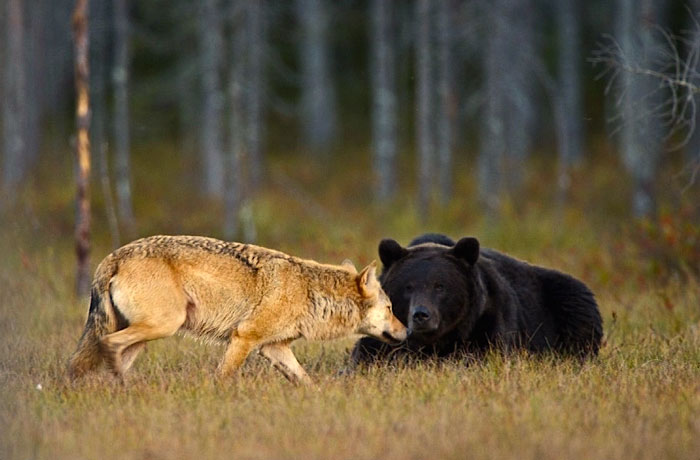
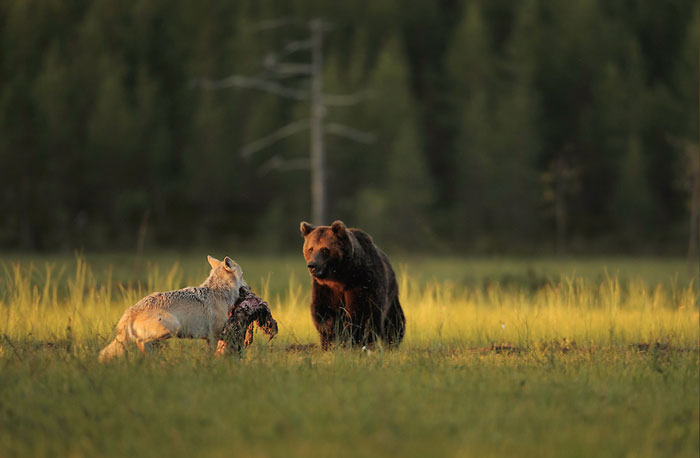
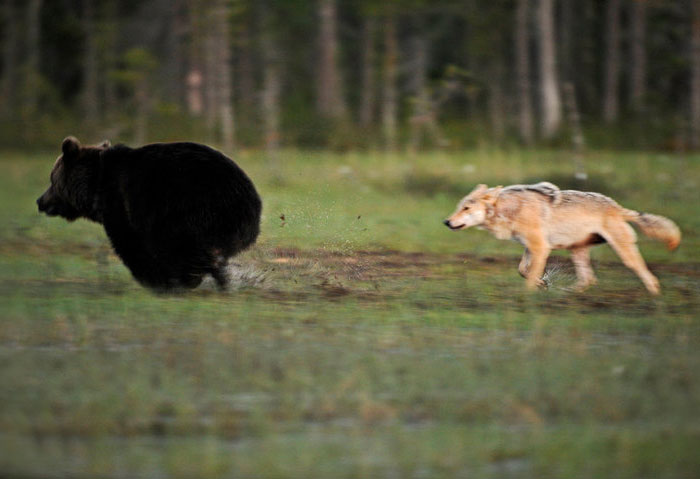
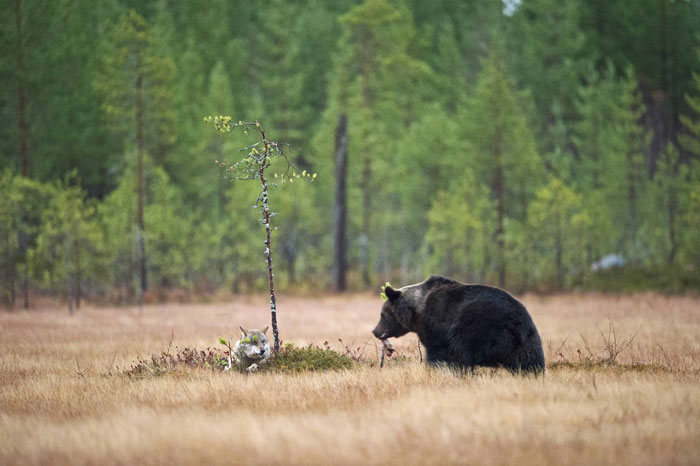
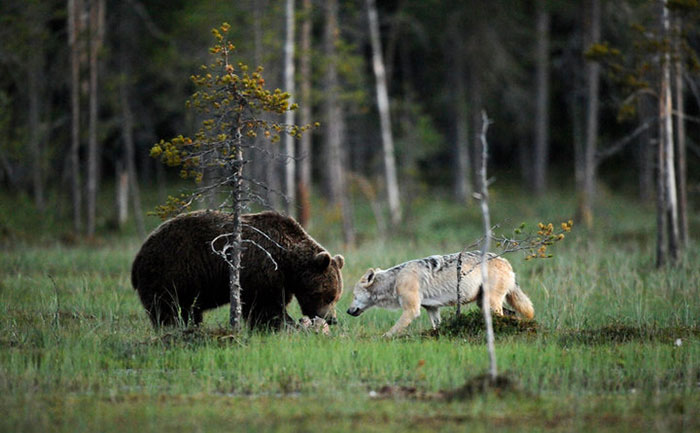
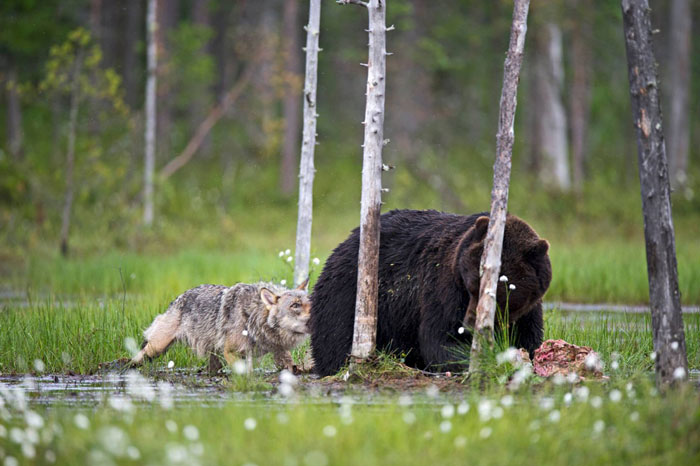
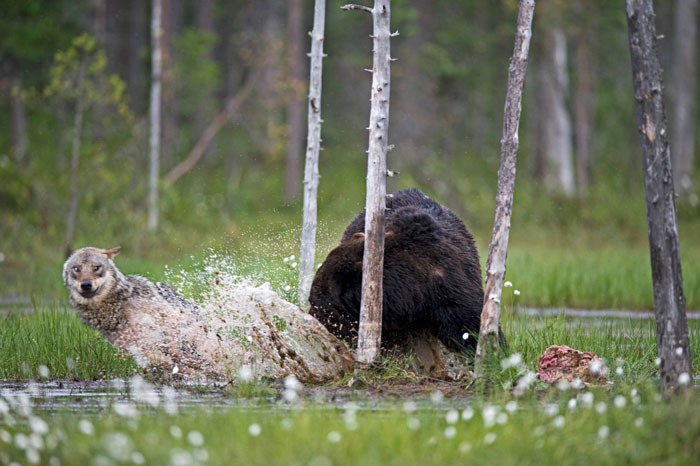
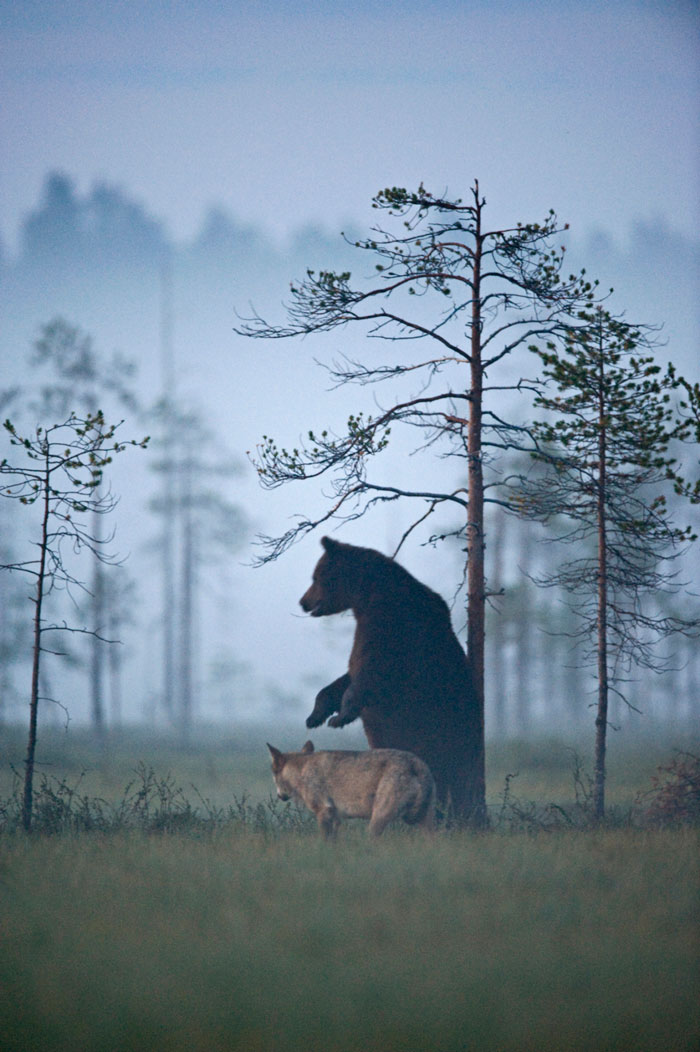
Unusual Friendship Between Wolf And Bear Documented By Finnish Photographer
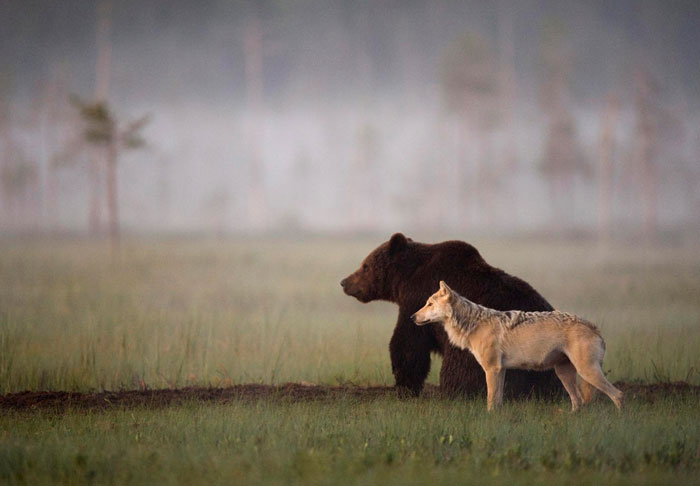
“It’s very unusual to see a bear and a wolf getting on like this” says Finnish photographer Lassi Rautiainen, 56, who took these surprising photos. The female grey wolf and male brown were spotted every night for ten days straight, spending several hours together between 8pm and 4am. They would even share food with each other.
“No-one can know exactly why or how the young wolf and bear became friends,” Lassi told the Daily Mail. “I think that perhaps they were both alone and they were young and a bit unsure of how to survive alone…It is nice to share rare events in the wild that you would never expect to see.”
“It’s very unusual to see a bear and a wolf getting on like this”
This unlikely pair was spotted by Finnish photographer Lassi Rautiainen
He photographed the female grey wolf and male brown bear every night for ten days straight
“No one had observed bears and wolves living near each other and becoming friends in Europe”
The two “friends” were even seen sharing food
“No one can know exactly why or how the young wolf and bear became friends”
“I think that perhaps they were both alone when they were young and a bit unsure of how to survive alone”
“I came across these two and knew that it made the perfect story”
oooo
“It seems to me that they feel safe being together”
ooOOoo
Taken from here but I wouldn’t have known about this beautiful story if Margaret K. hadn’t sent me the link. Thank you, Margaret!
There are so many times when a loving dog just has to do what it has to do.
ooOOoo
Camp Fire: Dog missing from Paradise wildfire found after 101 days
21 February 2019
Kingston is believed to have survived by hunting skunks
A dog called Kingston has been reunited with his owners 101 days after he went missing during the deadliest wildfire in California’s history.
The Ballejos family last saw Kingston, an Akita, during the devastating Camp Fire in November.
Kingston, who is 12 years old, had jumped out of their truck as they fled their home in Paradise.
A local animal rescue volunteer caught Kingston on Sunday, and the family believe he survived by hunting skunks.
About 18,000 homes were destroyed and 86 people killed after the Camp Fire broke out and spread rapidly on 8 November north-east of San Francisco.
“When I found out, [it] just about brought me to tears,” Gabriel Ballejos told Associated Press (AP) after being reunited with his dog. “I’m so proud of him. I can’t believe it. He’s a true survivor.”
The family posted flyers and contacted shelters in the hope Kingston would be found. He was eventually recognised by someone who saw a post online.
Over the weekend, animal rescue volunteers spotted a large dog on surveillance cameras before setting up a trap to secure Kingston.
“When I went to check [the trap] on Sunday, there he was,” local dog-trapper Ben Lepe told AP. “It was awesome to see him and know he would be fed and warm.”
Kingston, who the family say was known to hunt skunks before the fire, smelled so strongly of the pungent odour that volunteers spent several hours washing him before reuniting him with the Ballejos family.
“He still smelled even though they used stuff that neutralises the skunk smell,” Suzanne Maxwell, a local resident and volunteer for Friends of Camp Fire Cats, told the BBC.
She described a “heart-warming” reunion between Kingston and his family.