There is so much to speak about in this book, and anyone the ‘wrong’ side of 50 should consider purchasing the book. Really! I include the link to the book on Amazon. (And nothing in it for me I have to say.)
I want to concentrate on two items of note.
The first is that given the right diet, primarily a Mediterranean plant-based diet, and plenty of exercise, it is possible for the brain to rejuvenate new brain cells. Yes, that’s correct! New brain cells!
The second item of note is over on page 194. Let me quote:
Dr. Waldinger’s findings are attractive because they debunk commonly held myths about health and happiness. The findings are based on a comprehensive review of the participants’ lives and biology.
and two sentences later:
The lesson learned is that health and happiness are not about wealth, fame, or working harder. They are about good relationships.
Dr. Robert Waldinger is a psychiatrist at Massachusetts General Hospital and a professor of psychiatry at Harvard Medical School. His TED talk, “What Makes a Good Life?” has been viewed more than 36 million times. The link to the TED Talk is here.
What keeps us happy and healthy as we go through life? If you think it’s fame and money, you’re not alone – but, according to psychiatrist Robert Waldinger, you’re mistaken. As the director of a 75-year-old study on adult development, Waldinger has unprecedented access to data on true happiness and satisfaction. In this talk, he shares three important lessons learned from the study as well as some practical, old-as-the-hills wisdom on how to build a fulfilling, long life.
On page 198 among the list of tips about staying engaged is to consider adopting a pet! Yes siree!
Now I am 76 and have had 14 years of pure happiness. Because in 2007 I met Jean, and all her dogs. We fell in love!
We came up to Payson, Arizona in 2010 and were married. In 2012 we came up to our rural acres in Southern Oregon.
Jeannie, Sweeny and Cleo. Taken in April, 2012.
It is 2021 and there is no doubt that we are both ageing but we are still very much in love.
We are very happy and that is because as luck would have it we are also each other’s best friend!
For the life of me I can’t recall how the connection between Rick and me was made; sign of the times! But Rick asked for a link to his website to go onto my blogroll and then offered this guest post.
So without any further ado here it is!
ooOOoo
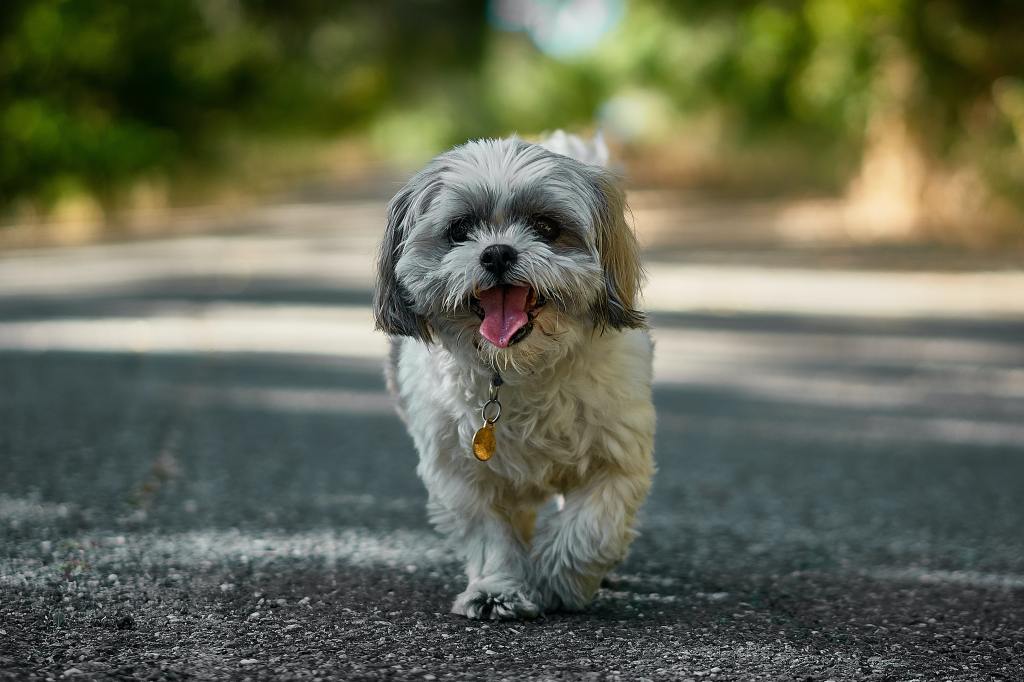
Origin of Shih Tzu Breed
The shih tzu has enjoyed a long history, starting in its country of origin, Tibet. Although the exact date of the breed being recognized is not known, what is known is that a short, rather squat dog which fits the general description of the shih tzu was first recorded around 1000 BC. This means that it is possible to record the history of the shih tzu from that point forward, although it is believed that the dog was around for centuries before that time.
Tibet & China
While the exact origin point is not known, the shih tzu does appear to be from Tibet. You can see evidence of their presence with the famous statues of Tibetan “Lion Dogs” which are part of Buddhism. It appears that the shih tzu was bred to resemble lions, albeit in small form. In fact, the very name “shih tzu” means “lion”. Of the holy dogs that were part of Tibetan culture, the shih tzu quickly became the most famous.
It was not long before the breed spread from its origin point from the mountains of Tibet and into China itself. The fierce looking dog with the gentle nature quickly became a favorite at the royal courts of Chinese rulers. However, they would not gain their current appearance until a millennium later when trade was opened to another part of the world far away from China.
Change from Europe
Contact between China and Europe dates to the Roman Empire. And from such countries as Malta, Persia, Greece, and Turkey small dogs were provided as gifts to the Chinese rulers which in turn were bred to the “lion dogs”. The Pug and Pekingese were intermixed with other breeds and the shih tzu as we know it came about.
Although a favorite in the courts of China, their original purpose was as guard dogs that would warn the Emperor of people or animals that approached their presence. When they became smaller in size, the shih tzu was adapted to becoming a companion dog. When this occurred, it became rare for a shih tzu to leave China as they were so revered.
Explosion of Popularity
The shih tzu that we see today can be credited to Dowager Empress Cixi who had a kennel that included Pugs and Pekingese as well. However, when she died in 1908, the breed was seemingly lost as the kennels were dispersed.
But in 1930, a pair of shih tzus arrived in England. Over the next three decades, more shih tzus arrived which helped expand the breeding population. As this was happening, soldiers returning from the China theater during World War II brought the dog to America where it was quickly bred. Soon, the dog became extinct in China as they were expanding around the world.
While the breed was recognized in England in 1949, it would take another two decades before being officially recognized in the US. Today, the shih tzu is one of the most famous breeds in the world. A stark contrast to its near-extinction 80 years earlier.
ooOOoo
Rick clearly knows the history of the Shih Tzus as this fascinating account reveals. Fancy the history going back to 1000 BC! But of course the history of dogs being associated with humans goes back much beyond 3,000 years ago; to at least 20,000 years ago and there are reliable accounts of dogs going back, perhaps, another 20,000 years for a total of 40,000 years ago. What beautiful creatures!
Anyway, this was a lovely guest post as I am sure you will all agree.
For as long as I live I will never stop marvelling at dogs.
Dogs are many things. In a sense they have as many likes and dislikes as us humans. But the one thing that is unique to these beautiful animals is their unconditionality. That, especially, shows through in the way that they care and love the humans and dogs around them.
This story on The Dodo emphasised that special way they care for their fellow dogs. Read it and you will see what I mean.
ooOOoo
Camera Catches Dog Bringing His Bed To His Sick Brother So He’s Comfy
“As he’s dragging it he’s looking at Roman almost to say, ‘This is for you’”
From the moment they became brothers, Spanky has always adored and looked up to his big brother Roman. He follows Roman everywhere he goes, and is always happiest whenever they’re together.
“Roman is definitely Spanky’s security blanket,” Jackie Rogers, Roman and Spanky’s aunt, told The Dodo. “Spanky will do nothing without Roman and always makes sure he is close to him and if he’s not he gets up and goes near him.”
JACKIE ROGERS
About two weeks ago, Roman’s ear started looking a little puffy and infected, so his mom took him to the vet and discovered he has a hematoma on his ear. They scheduled a surgery to take care of it, but unfortunately, while he waited for the surgery, his ear kept getting worse and poor Roman got more and more uncomfortable.
JACKIE ROGERS
At first, Spanky didn’t notice anything was different, but as Roman’s ear got worse, everyone noticed that Spanky was much more gentle and concerned about his best friend.
“We had to take him back to the vet to confirm he could wait five more days for surgery and I brought Spanky along for the ride, but due to COVID we couldn’t go inside with Roman and for 20 minutes Spanky sat in the car crying/whining/barking until Roman got back,” Rogers said.
JACKIE ROGERS
With the surgery set, all the family could do for Roman was to let him rest. During the day while everyone is at work, the family has a Ring camera set up so they can check in on the dogs, which is especially important now so they can make sure Roman is OK. Rogers was checking the camera recently when she noticed Spanky watching his brother lying on the floor, looking very concerned — and then he did the cutest thing.
“I see Spanky pacing for a minute while looking at Roman and then the bed and then I see him dragging the bed to Roman and as he’s dragging it he’s looking at Roman almost to say, ‘This is for you,’ and then the next clip is them snuggling,” Rogers said. “I had to re-watch it multiple times, I was in disbelief that he did that!”
Spanky was worried about his brother and wanted him to be as comfortable as possible, so he brought his bed to him so he wouldn’t have to move — because that’s how much he loves his big brother.
JACKIE ROGERS
Spanky brought the bed over to Roman around 10 a.m., and when Rogers got home that evening, they were still snuggled up there together. Spanky knows his brother isn’t feeling well, and he’s determined to stay by his side until he’s feeling better — and will do anything he can to make sure he’s safe and comfortable in the meantime.
ooOOoo
There’s no real way that words can explain that. It’s beautiful, loving and caring and just goes to show how the loving bond works in practice.
I wasn’t going to post anything today but then in response to Val Boyco’s comment: “Good stuff Paul. Thank you! Please do more research and share here 💛 My gut will thank you!” I did do some more research and quickly came upon another article that was published recently and is worth of a read!
ooOOoo
How to prepare and protect your gut health over Christmas and the silly season
Disclosure statement
Claus T. Christophersen receives funding from NHMRC and WA Department of Health. He is a co-author of The Gut Feeling Cookbook linked in this article – all proceeds from sales of this cookbook go directly back into supporting our research, no personal financial interest.It’s that time of year again, with Christmas parties, end-of-year get-togethers and holiday catch-ups on the horizon for many of us — all COVID-safe, of course. All that party food and takeaway, however, can have consequences for your gut health.
Gut health matters. Your gut is a crucial part your immune system. In fact, 70% of your entire immune system sits around your gut, and an important part of that is what’s known as the gut-associated lymphoid tissue (GALT), which houses a host of immune cells in your gut.
Good gut health means looking after your gut microbiome — the bacteria, fungi, viruses and tiny organisms that live inside you and help break down your food — but also the cells and function of your gastrointestinal system.
We know gut health can affect mood, thanks to what’s known as the gut-brain axis. But there’s also a gut-lung axis and a gut-liver axis, meaning what happens in your gut can affect your respiratory system or liver, too.
Here’s what you can do to bolster your gut microbiome in the coming weeks and months.
How do silly season indulgences affect our gut health?
You can change your gut microbiome within a couple of days by changing your diet. And over a longer period of time, such as the Christmas-New Year season, your diet pattern can change significantly, often without you really noticing.
That means we may be changing the organisms that make up our microbiome during this time. Whatever you put in will favour certain bacteria in your microbiome over others.
We know fatty, sugary foods promote bacteria that are not as beneficial for gut health. And if you indulge over days or weeks, you are pushing your microbiome towards an imbalance.
For many of us, Christmas is a time of indulgence. Shutterstock
Is there anything I can do to prepare my gut health for the coming onslaught?
Yes! If your gut is healthy to begin with, it will take more to knock it out of whack. Prepare yourself now by making choices that feed the beneficial organisms in your gut microbiome and enhance gut health.
That means:
eating prebiotic foods such as jerusalem artichokes, garlic, onions and a variety of grains and inulin-enhanced yoghurts (inulin is a prebiotic carbohydrate shown to have broad benefits to gut health)
eating resistant starches, which are starches that pass undigested through the small intestine and feed the bacteria in the large intestine. That includes grainy wholemeal bread, legumes such as beans and lentils, firm bananas, starchy vegetables like potatoes and some pasta and rice. The trick to increasing resistant starches in potato, pasta and rice is to cook them but eat them cold. So consider serving a cold potato or pasta salad over Christmas
choosing fresh, unprocessed fruits and vegetables
steering clear of added sugar where possible. Excessive amounts of added sugar (or fruit sugar from high consumption of fruit) flows quickly to the large intestine, where it gets gobbled up by bacteria. That can cause higher gas production, diarrhoea and potentially upset the balance of the microbiome
remembering that if you increase the amount of fibre in your diet (or via a supplement), you’ll need to drink more water — or you can get constipated.
For inspiration on how to increase resistant starch in your diet for improved gut health, you might consider checking out a cookbook I coauthored (all proceeds fund research and I have no personal interest).
Good gut health is hard won and easily lost. Shutterstock
What can I do to limit the damage?
If Christmas and New Year means a higher intake of red meat or processed meat for you, remember some studies have shown that diets higher in red meat can introduce DNA damage in the colon, which makes you more susceptible to colorectal cancer.
The good news is other research suggests if you include a certain amount of resistant starch in a higher red meat diet, you can reduce or even eliminate that damage. So consider a helping of cold potato salad along with a steak or sausage from the barbie.
Don’t forget to exercise over your Christmas break. Even going for a brisk walk can get things moving and keep your bowel movements regular, which helps improve your gut health.
Have a look at the Australian Guide to Healthy Eating and remember what foods are in the “sometimes” category. Try to keep track of whether you really are only having these foods “sometimes” or if you have slipped into a habit of having them much more frequently.
The best and easiest way to check your gut health is to use the Bristol stool chart. If you’re hitting around a 4, you should be good.
If you’re hitting around a 4, you should be good. Shutterstock
Remember, there are no quick fixes. Your gut health is like a garden or an ecosystem. If you want the good plants to grow, you need to tend to them — otherwise, the weeds can take over.
I know you’re probably sick of hearing the basics — eat fruits and vegetables, exercise and don’t make the treats too frequent — but the fact is good gut health is hard won and easily lost. It’s worth putting in the effort.
A preventative mindset helps. If you do the right thing most of the time and indulge just now and then, your gut health will be OK in the end.
ooOOoo
That book that Claus refers to, the one on the gut Gut feeling: Mindful menus for the microbiomeis here. It looks a very good book.
Well Val (and many others), did you find this interesting? It was a rhetorical question because I know that you did.
I will continue to republish these posts and, especially, the one on exercise. Because as I have often said: Diet and exercise are key!
Yesterday’s post about the loyalty of dogs brought to mind a post that I published way back in 2013. Let me take an extract from yesterday’s post:
It’s no secret that domesticated dogs are descendants of wolves. Even today, modern dogs continue to share similar genes to wolves that live in the wild. The idea of “the loyal dog” is both a cultural and biological construct, as humans have created the dog over years of selective breeding and domestication to be this way. Essentially, humans picked and chose the wolf characteristics that would best serve their own benefit, transforming a wolf’s hierarchical structure and social bond to their packs into obedience and loyalty to humans.
The fact that is key is that dog packs are hierarchical. They have three status roles and the rest of the pack are all pack members. The three roles are Alpha dog, always a female, the Beta dog, always a male, and the Omega dog that could be either male or female.
The role of the alpha dog is to have first pick of the eligible males and to move the whole pack if in her analysis the territory becomes unsuitable for the pack. The role of the beta dog is to keep the pack under control and not to let fights get out of hand. The omega dog is to keep the pack happy and playful.
So to the post that was first published on the 10th April, 2013.
ooOOoo
Yearnings for a new start!
You may wonder about the title of this post? Stay with me for a moment.
As has been written before on Learning from Dogs, when dogs were living in the wild just three animals had pack roles. The leader of the pack, always a female animal, was the alpha dog. Second in command was the beta dog, always a dominant male, and the third role was the omega or clown dog. The wild dog pack was thought to have consisted, typically, of about 50 animals.
The wisdom of thousands of years showing clearly in Pharaoh’s eyes, our very own beta dog. Beloved Pharaoh. Born: June 3rd., 2003 – Died: June 19th., 2017. A very special dog that will never be forgotten.
As leader of her pack an alpha dog had two primary functions . One was having first choice as to the male dog she was going to mate with – thus demonstrating how women always choose! 😉
Her second important duty was deciding that her pack’s home range was insufficient for the needs of her ‘family’. As wolves still do, wild dogs lived within small, well-defined territories when food was abundant. When food became less abundant then it was time to move to more fertile grounds. As an aside, research in South Africa as to the area requirements for a small pack of African wild dogs (Lycaon pictus) shows they require from 65 square kilometers (25 square miles) to 150 sq. km. (58 sq. mi.). (See footnote.)
Dogs, like all wild animals, instinctively live in harmony with nature. So the call from the alpha dog to find a new range didn’t mean they left their old one as a barren disaster area. You can see where this is heading!
Wild dogs were in contact with early man at least 50,000 years ago. (Just reflect for a moment on the length of that relationship between man and dog.) So each specie has had plenty of time to learn from the other.
Thus, as mankind is on the verge of discovering that our existing ‘territory’ is becoming unsustainable for the healthy life of the species, one fundamental learning point from dogs appears to have escaped us: Mankind doesn’t have a new range available to our species.
This preamble came to mind when I recently read a short but powerful essay on Alex Jones’ blog The Liberated Way. The essay was called A global leaky bucket. Alex has very kindly given me permission to republish it.
A global leaky bucket
Global weather extremes will force people to hard choices.
Nature will have the last word in the debate over sustainability.
I write this in despair, it is snowing again here in Colchester UK. I admit envy for those of you who live in California or Hong Kong area, I see your photographs where the seasons always seem to be warm and sunny. The northern Jet Stream refuses to move, Greenland enjoys growing strawberries as the lambs die in the fields of Britain from the winter that refuses to let go.
The extremes of weather are noted in the South of the world as well as the North. Argentina has had the worst floods in decades last week. The cause is that the systems such as the Jet Stream are paralysed in one place, thus everyone suffers flood, drought or winter in excess. Nobody is sure why this paralysis is going on with systems like the Jet Stream, some say it is climate change, the point is that we are experiencing this, and it appears to be more than a temporary issue.
My opinion is that these weather extremes are here to stay for the long duration. One is then left with a harsh reality of does one seek to control the weather or adapt to the weather? How does one control the weather, a chaotic energy system where even a small change can have great consequences? Perhaps adaptation is the better option, but does one know how huge those adaptations will have to be where drought and flood could be lasting decades?
Lets say food, water and energy are all contained in a bucket. We take a jug and scoop out from the bucket what we need. There is a tap that is constantly running filling the bucket with the food, water and energy. We waste those resources so the bucket leaks. We disrupt or destroy the renewal systems in the ecosystems so the tap is no longer running as fast as it should. We are greedy consumers so we take more than we need from the bucket with our jug. How will the bucket look now? Is this a sustainable future to you?
If our global weather extremes continue as they are it will be like a storm rocking the bucket spilling its contents, will our bucket future look even less sustainable? Extreme weather destroys harvests, kills animals, sends already distressed ecosystems into the abyss. What happens when the bucket is so empty that people can no longer enjoy their lifestyle of wasteful excess, or worse that people grow cold, hungry and thirsty? Do they sit there and do nothing but die? Will they fight? Who will fight who? As the bucket contents get ever smaller, who will win in the fighting for what is left?
Copyright (c) Alex Jones 2011-2013.
Colchester has a place in my past as I started and ran a business there between the years of 1978 to 1986. More about that some other day.
Back to Alex’s essay. It strongly resonated with a recent item on Peter Sinclair’s excellent blog Climate Denial Crock of the Week which I will refer to tomorrow.
So I will leave you with this tragic, emotional thought – where, oh where, is our alpha dog?
Footnote: The figures for the ranges of wild dogs were taken from a fascinating paper published by Lindsay, du Toit and Mills that may be read here.
ooOOoo
One thing that has become clearer over the years and with the advent of DNA analysis is that the process of wolf and man coming together, and wolf becoming dog, was in the timeframe of 25,000 to 40,000 years ago. It’s a very wide band of time but there’s no scientific method, certainly at the moment, to refine the years down to a shorter number.
But even taking the lower limit, 25,000 years ago, it is still an indescribably long time back in the past.
Despite the gloom and real stress for many people it’s not wall-to-wall pessimism.
The reason I was prompted to write about this was a couple of connections made in the last few days and the power they have to keep this elderly chap still bouncing along.
Recently on the forum Ugly Hedgehog there was a gentleman who posted some photographs of some dogs that he had seen at the dog park. It was in a post called Today at the dog park.
They were lovely and I thought what a good idea it would be if I was able to republish them for next week’s Picture Parade. So I asked!
Well I was not disappointed and indeed said gentleman emailed me with a short bio and a photograph of him and his dog by way of an introduction. This is what he wrote:
I was born on Long Island and spent the first 60 years of my life there except for my Naval service for four years during the Vietnam war. I was a Naval Aviator, and after my active duty was over I returned to Long Island and got into a career in law enforcement that lasted 31 years. I made thousands of arrests during my career and many of those who were incarcerated threatened to “get me” some day, so I would prefer that you don’t use my real name.
When I retired at age 60 I moved to Tampa, FL because my daughter lived there and I have two granddaughters and now my son lives here too. It’s great for photographing flora and fauna all year round. My love for dogs has worn off on my kids as my daughter has two of them and my son three! Photography has been a hobby of mine for over 60 years. Here is a casual photo of me and my buddy Ollie (a three year old golden doodle).
Ollie and Nimbushopper
You will have to wait until Sunday to view his photographs!
At the end of November Jean and I wanted to join the local camera club. It was clear that I had a camera, a Nikon D750, that was way more advanced than I thought and, frankly, I didn’t know my way around it.
So we joined the Caveman Camera Club in Grants Pass, Oregon. Although at the moment the pandemic puts a halt on physical meetings, twice a month ‘zoom’ meetings are held. Also mentors were available. I took advantage of the opportunity to work under a mentor and last week I went the short distance of nine miles to meet with Gene. Gene had so much knowledge and had regularly taught photography for a number of years. I came away very inspired and very motivated to become better in my photographic and composure skills. Gene’s area of interest is landscapes.
What was clear was that for my whole life, and I have been taking photographs for a very long time, I had been taking pictures and not composing photographs.
It’s going to be a long journey but one that fills me with delight
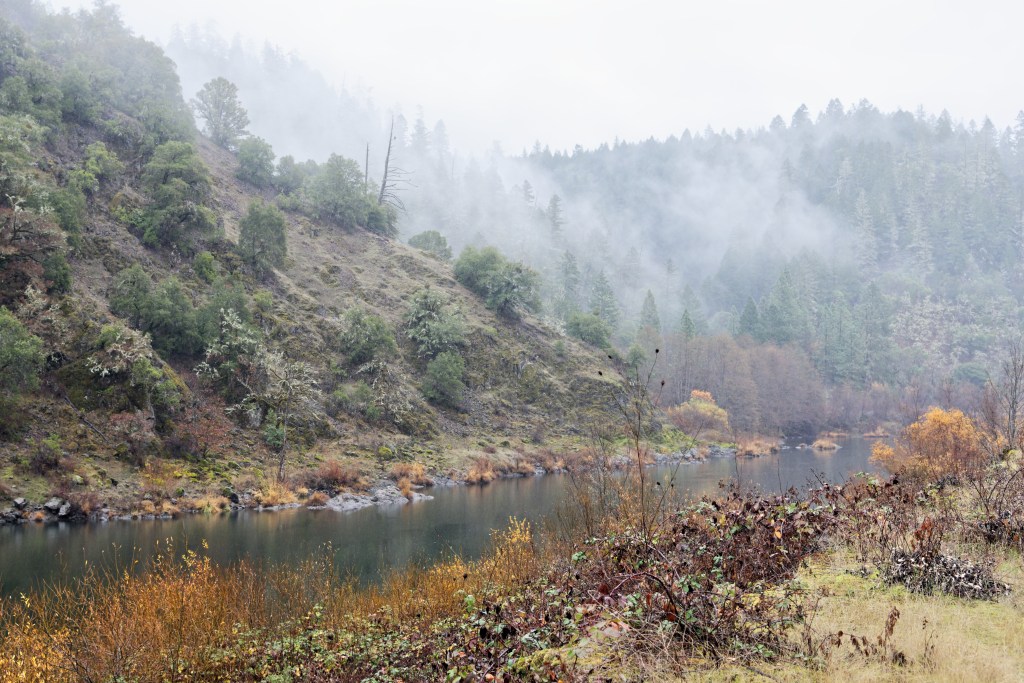
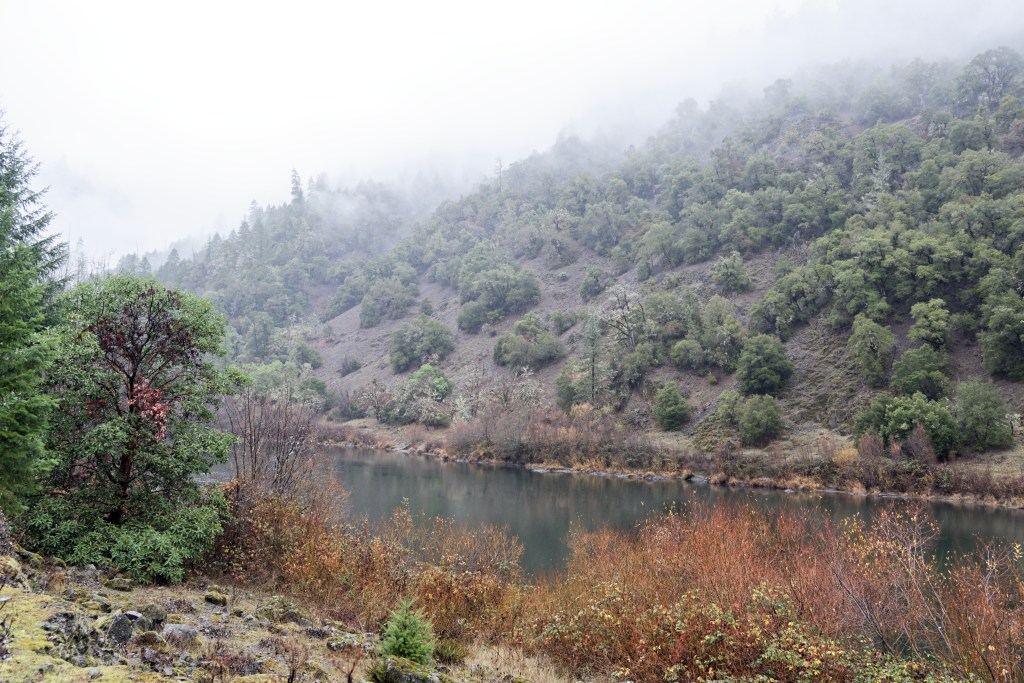
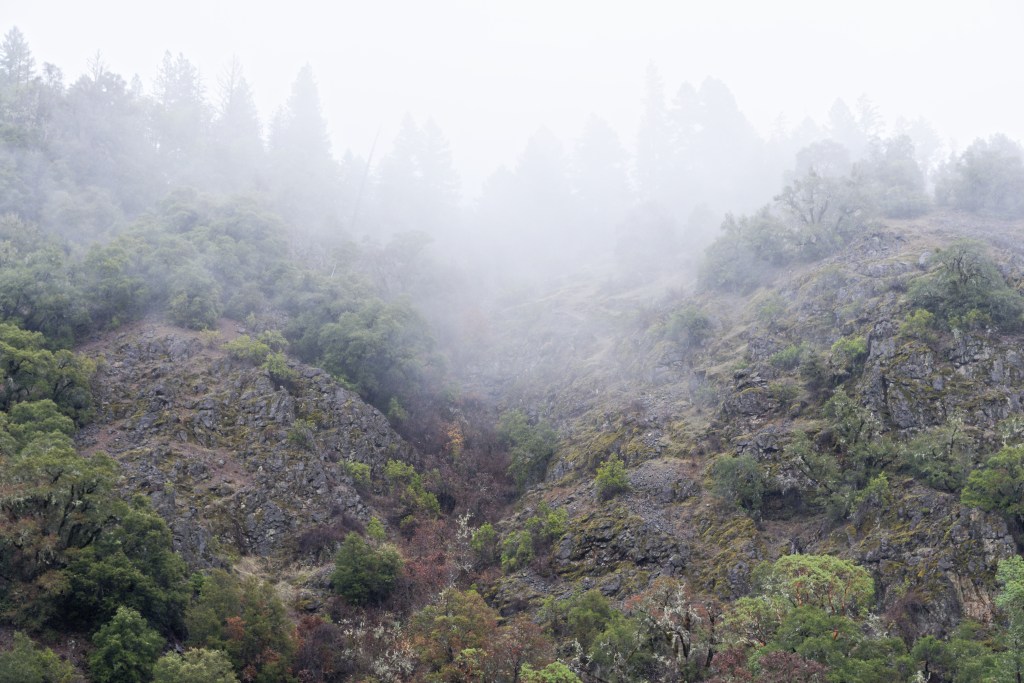
Here are some of my very first attempts, taken yesterday along the Rogue River in the rain and mist.
The Rogue River looking downstream.
oooo
The Rogue River looking upstream from the same point.
oooo
Looking towards the top of the opposite bank.
oooo
Trees in the mist.
Well it’s a start!
But I just wanted to reiterate that staying local both literally and virtually is very rewarding.
This was a story that was published by The Dodo last November 18th. It is a delightful account of an ex-rescue dog who is now in loving hands.
ooOOoo
Pregnant Rescue Dog Gets The Ultimate Maternity Shoot
“Lily Mae was born to model” 📸
By Lily Feinn
Published on the 13th November, 2020
Ryan Fant was out for a walk in a park in Little Rock, Arkansas, when he spotted a beautiful golden retriever running around without a collar. He approached the dog and started to play with her. When she began to follow him home, Fant decided to take in the lost dog and name her Lily Mae.
After a month of searching for her owner without luck, Fant decided to make Lily a permanent part of his family. But he soon noticed that the once-skinny dog’s stomach was growing … and growing.
INSTAGRAM/CAITIESFOSTERFAM
A vet confirmed that Lily Mae was pregnant, so Fant reached out to his friend Caitie Evers for help. With years of experience fostering new dog mamas and their pups, Evers was the perfect person to help Lily through this difficult time.
When Lily arrived, Evers was surprised that her growing belly didn’t seem to slow her down one bit. “She acts totally normal and makes me nervous with her running and jumping,” Evers told The Dodo. “She is a total sweetheart. She is a stage five clinger who prefers to be in my lap every moment.”
INSTAGRAM/CAITIESFOSTERFAM
With Lily’s due date just days away, Evers decided to get the word out about her puppies. And what better way to make the announcement than with an adorable maternity photo shoot?
“I have fostered a lot of pregnant dogs and new mama dogs and I have always said I wanted to do a photo shoot for them to gain attention for the foster/rescue dogs of the world,” Evers said. “So many people are amazed when they realize she is a rescue dog. I think it’s important to get the information out there that you can really truly find every single type of dog in rescue.”
SHAUNA KIELY PHOTOGRAPHY
She contacted her photographer friend and fellow rescuer Shauna Kiely, and the two set up the photo shoot for the very next day. Lily was excited to be the center of attention and get special hugs from Evers.
SHAUNA KIELY PHOTOGRAPHY
“Lily Mae was born to model,” Evers said. “She loved it and it only took like 30 minutes total!”
SHAUNA KIELY PHOTOGRAPHY
Two days later, Lily went into labor and gave birth to eight perfect puppies. Mama and the seven boys and one girl are all happy and healthy — thanks to the loving rescuer who saved them from the street and their kind foster mom.
“They are chunky babies at already almost a pound each,” Evers said. “They are doing wonderful and are healthy and active. Mom snuggles them and loves them but is also trusting me to care for them all. She allows me to change their bedding but if I take too long she’ll start putting them back on her own.”
INSTAGRAM/CAITIESFOSTERFAM
Once the babies are weaned, they will be available for adoption through the Houston-based rescue Chip N Snip, and Lily Mae will return to Arkansas to live with her dad. But, for now, the only thing Lily Mae cares about is being the best mom she can be.
To stay up-to-date on Lily Mae and her puppies’ journey, you can follow them on Instagram. If you’re interested in adopting one of Lily Mae’s puppies and live in a 3-hour radius of Houston, you can reach out to Chip N Snip here.
ooOOoo
We know totally the special joy and companionship that comes from dogs who had a rough start to their lives.
Oh how much we would like to adopt a couple of the darling puppies. But firstly we are trying to be strict in not weakening our resolve not to have more dogs and, secondly, we are thankfully more that three hours radius from Houston.
It really is delightful when someone comes along and reliably offers to submit a guest post or two, or three, or more. That person is John Brooks and he has submitted many posts; the last one being Ageing Gracefully Applies To Our Dogs As Well. It may be found here.
But before going on I would just like to say thank you to the very helpful comments about Pedi and his diabetes.
So without any further ado here is John’s latest:
ooOOoo
Pigs, Dogs, and Other Pets: Do They Get Along?
By John Brooks, December 3rd, 2020
Pigs are extremely intelligent animals, and this intelligence makes them great, loving and attentive pets. Most people opt for American miniature pigs as pets. This breed is a descendant of potbelly pigs and other small feral pig breeds. Breeders have specifically created miniature pigs to be smaller and lighter than full-sized pigs, so they can trot around the house like a dog or cat would. Most American miniature pigs will weigh between 50-75 pounds and stand 12-15-inches tall.
Ultimately however, it does not matter whether you have a full-sized or miniature pig, their ability to interact with other animals remains the same. Bringing a pig into a situation with other pets or bringing home a new pet when you already have a pet pig can be a stressful time. Pigs are prey animals. They typically react to new situations with fear.
But, you can cut down on your pet pig stress by choosing the right companion animal for them. Pigs can get along with other pets, you just need to make the introduction and relationship as safe and healthy as possible. Here we explain how to do just that.
Pigs and Dogs
Pigs and dogs living together in harmony is a big concern for most pet owners. There are plenty of photos online of pigs and dogs as best friends. But, do not count on your pig and dog getting along. Pigs are prey animals and dogs are predators. It is very easy for instinct to take over for both animals, especially if you are not there to supervise the interaction.
In addition to their instinctual behaviors, pigs and dogs have different social cues. Both are playful and intelligent animals, but their body language will be completely different. Your pig may annoy your dog and vice versa because they are unable to understand that the other animal needs a break.
These complications do not mean a pig and dog can get along. You just have to take precautions. If you do have a dog and pig together in the same household, it is essential that you supervise all of their interactions. Ultimately, if you are going to let your piggy roam free, your dog will need to be in a crate while you do so, or in another room or outside.
Pigs and Other Pets
As far as other pets are concerned, pigs will do well with almost any other prey animal. If you are searching for a friend for your piggy, here are the most common pig and pet relationships, and tips for making these relationships work:
Cats
In general, pigs and cats do well together. Despite cats being predators, the website All About Cats state that pigs have similar personality traits to cats. Additionally, cats are much less likely to hurt a pig than a dog. Even miniature pigs weigh from 50-100 pounds. It will be very hard for a common housecat to injure this size animal.
As with all animals, you will need to ensure the personalities of your cat and pig work well together. A lazy cat and playful pig will not be a good combination. However, a cat and pig with complementary personalities will likely get along just fine.
Farm Animals
Personality will come into play when introducing pigs to other farm animals. Animals that tend to buck or head-butt can hurt a pig. Similarly, pigs can bite if they feel threatened. Always test out a farm animal with a pig under supervision before putting them in a pasture together.
Farm animals that work well with pigs include sheep, goats, cows, donkeys, horses, and llamas. Obviously, you will need a lot of property to house any of these animals. Pigs work well in the same pasture as other farm animals, but it is better to give them their own living quarters in a barn or lean-to.
Conclusion
Pigs can be an amazing pet. They are trainable and affectionate. You can even teach them to walk on a harness. But, you will need to take some care in finding them a friend. Pigs can become close to many different species of animals. Some just work better than others.
Keep the personality of your pig in mind when looking for a companion. You will also want to keep early interactions short. Finally, supervision is key when it comes to successful relationships between your pig, dog, and other pets.
ooOOoo
Another brilliant essay.
Thank you to John and I write on my own behalf and, I am certain, on behalf of many, many other people.
Fences have big effects on land and wildlife around the world that are rarely measured
November 30, 2020
By Alex McInturff, Postdoctoral Researcher, University of California Santa Barbara,
and
Christine Wilkinson, Ph.D. Candidate in Environmental Science, Policy and Management, University of California, Berkeley,
and
Wenjing Xu, PhD Candidate in Environmental Science, Policy and Management, University of California, Berkeley.
What is the most common form of human infrastructure in the world? It may well be the fence. Recent estimates suggest that the total length of all fencing around the globe is 10 times greater than the total length of roads. If our planet’s fences were stretched end to end, they would likely bridge the distance from Earth to the Sun multiple times.
On every continent, from cities to rural areas and from ancient to modern times, humans have built fences. But we know almost nothing about their ecological effects. Border fences are often in the news, but other fences are so ubiquitous that they disappear into the landscape, becoming scenery rather than subject.
In a recently published study, our team sought to change this situation by offering a set of findings, frameworks and questions that can form the basis of a new discipline: fence ecology. By compiling studies from ecosystems around the world, our research shows that fences produce a complex range of ecological effects.
If fences seem like an odd thing for ecologists to study, consider that until recently no one thought much about how roads affected the places around them. Then, in a burst of research in the 1990s, scientists showed that roads – which also have been part of human civilization for millennia – had narrow footprints but produced enormous environmental effects.
Our research team became interested in fences by watching animals. In California, Kenya, China and Mongolia, we had all observed animals behaving oddly around fences – gazelles taking long detours around them, for example, or predators following “highways” along fence lines.
We reviewed a large body of academic literature looking for explanations. There were many studies of individual species, but each of them told us only a little on its own. Research had not yet connected the dots between many disparate findings. By linking all these studies together, we uncovered important new discoveries about our fenced world.
Early advertisement for barbed wire fencing, 1880-1889. The advent of barbed wire dramatically changed ranching and land use in the American West by ending the open range system. Kansas Historical Society, CC BY-ND
Remaking ecosystems
Perhaps the most striking pattern we found was that fences rarely are unambiguously good or bad for an ecosystem. Instead, they have myriad ecological effects that produce winners and losers, helping to dictate the rules of the ecosystems where they occur.
Even “good” fences that are designed to protect threatened species or restore sensitive habitats can still fragment and isolate ecosystems. For example, fences constructed in Botswana to prevent disease transmission between wildlife and livestock have stopped migrating wildebeests in their tracks, producing haunting images of injured and dead animals strewn along fencelines.
One finding that we believe is critical is that for every winner, fences typically produce multiple losers. As a result, they can create ecological “no man’s lands” where only species and ecosystems with a narrow range of traits can survive and thrive.
Altering regions and continents
Examples from around the world demonstrate fences’ powerful and often unintended consequences. The U.S.-Mexico border wall – most of which fits our definition of a fence – has genetically isolated populations of large mammals such as bighorn sheep, leading to population declines and genetic isolation. It has even had surprising effects on birds, like ferruginous pygmy owls, that fly low to the ground.
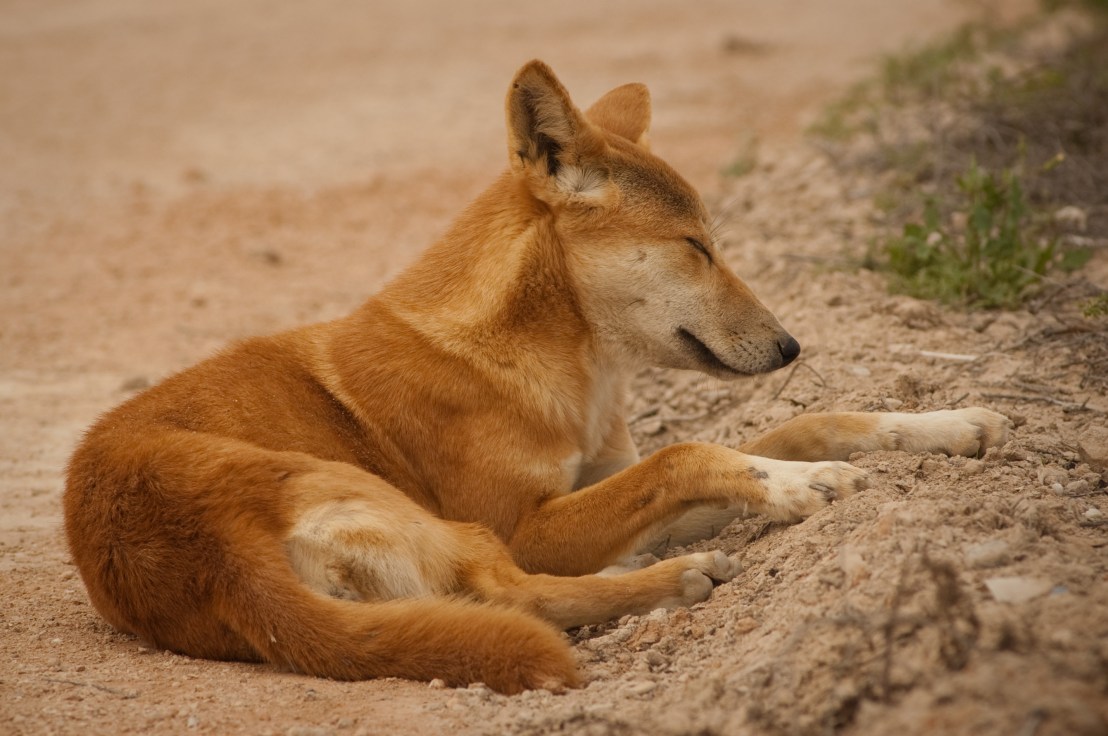
Australia’s dingo fences, built to protect livestock from the nation’s iconic canines, are among the world’s longest man-made structures, stretching thousands of kilometers each. These fences have started ecological chain reactions called trophic cascades that have affected an entire continent’s ecology.
The absence of dingoes, a top predator, from one side of the fence means that populations of prey species like kangaroos can explode, causing categorical shifts in plant composition and even depleting the soil of nutrients. On either side of the fence there now are two distinct “ecological universes.”
Our review shows that fences affect ecosystems at every scale, leading to cascades of change that may, in the worst cases, culminate in what some conservation biologists have described as total “ecological meltdown.” But this peril often is overlooked.
The authors assembled a conservative data set of potential fence lines across the U.S. West. They calculated the nearest distance to any given fence to be less than 31 miles (50 kilometers), with a mean of about 2 miles (3.1 kilometers). McInturff et al,. 2020, CC BY-ND
To demonstrate this point, we looked more closely at the western U.S., which is known for huge open spaces but also is the homeland of barbed wire fencing. Our analysis shows that vast areas viewed by researchers as relatively untrodden by the human footprint are silently entangled in dense networks of fences.
Do less harm
Fences clearly are here to stay. As fence ecology develops into a discipline, its practitioners should consider the complex roles fences play in human social, economic and political systems. Even now, however, there is enough evidence to identify actions that could reduce their harmful impacts.
There are many ways to change fence design and construction without affecting their functionality. For example, in Wyoming and Montana, federal land managers have experimented with wildlife-friendly designs that allow species like pronghorn antelope to pass through fences with fewer obstacles and injuries. This kind of modification shows great promise for wildlife and may produce broader ecological benefits.
Another option is aligning fences along natural ecological boundaries, like watercourses or topographical features. This approach can help minimize their effects on ecosystems at low cost. And land agencies or nonprofit organizations could offer incentives for land owners to remove fences that are derelict and no longer serve a purpose.
Knowing this, we believe that policymakers and landowners should be more cautious about installing fences in the first place. Instead of considering only a fence’s short-term purpose and the landscape nearby, we would like to see people view a new fence as yet another permanent link in a chain encircling the planet many times over.
ooOOoo
This is something that I hadn’t hitherto thought about. I suspect that I am not alone.
There are many aspects of the fence that warrant more careful thought. I will close by repeating what was said just a few paragraphs above:
There are many ways to change fence design and construction without affecting their functionality. For example, in Wyoming and Montana, federal land managers have experimented with wildlife-friendly designs that allow species like pronghorn antelope to pass through fences with fewer obstacles and injuries. This kind of modification shows great promise for wildlife and may produce broader ecological benefits.
Another option is aligning fences along natural ecological boundaries, like watercourses or topographical features. This approach can help minimize their effects on ecosystems at low cost. And land agencies or nonprofit organizations could offer incentives for land owners to remove fences that are derelict and no longer serve a purpose.















 Learning from Dogs