Category: Musings

Letter from Payson – The Farmers Market

A foreigner but not a foreigner!

Despite the fact that we have now been living in Payson, Arizona, since the end of February and, therefore, a degree of familiarity exists in both directions, the local Saturday Farmers Market prompted this thought.

Why do I not feel a foreigner here?

There is no question that America, in general, and Arizona, in particular, is very different to England.  In many ways the differences are far greater than, say, England and Australia, or England and New Zealand (I’m picking other English speaking countries to avoid to obvious difference between countries of different languages).

Local goats' cheese

I love Farmers Markets.  They seem to encapsulate the wholeness of locals growing meat and produce for other locals. They seem to serve as a reminder of the integrity that is needed just as much in food as in all other areas of life.

Of course, I am not so naive to think that we could wind the food revolution back to before the days of supermarket chains – food is wonderful value nowadays especially for those families on tight incomes.

But I can’t be the only one that ponders what the long term effect of all those

Local jellies (jams to Brits!)

E-numbers and other strange ingredients that one reads on most packets of most items, and whether or not fruit is sprayed with anything that we should know about, and so on and so forth.

That’s why that place in my psyche is ‘stroked’ so well by wandering around the Farmers Market.

One would expect if there was going to be any place where yours truly, dressed and sounding like the Englishman that he is, is going to feel foreign, it would be at the Payson Farmers Market.  I don’t even try to hide my origins, responding to a “Howdy folks” from the stall-holder with a quintessentially English “Good Morning!

Inevitably there are reasons why I am made to feel welcome here in Payson, my hunch is that it is much to do with this being a pioneering town for most of the last 100 years, and therefore co-operation, collaboration and a welcoming attitude were key elements of sustaining a way of life, but, in the end, analysis is pointless.

What matters is how we are made to feel, and we are made to feel very welcome.

Indeed, Payson with it’s predominance of right-wing, independent thinking, tough ‘cow-boy’ inhabitants echoing a recent past, may have an important lesson for all of us, across the globe, as the forces of disconcerting change build and build: be local, think local, preserve local.

I’m very proud to be slowly but surely turning into a Payson local.

By Paul Handover

Dealing with the fear of the Known!

Can we ever conquer fear?

In a recent article I discussed the fear of the unknown, linked to the down-turn, redundancies, etc.

Per Kurowski, a great supporter of this Blog, posed the following question.

Great advice… but how do we remove the fear of what is known?

A simple, and slightly flipant answer would be,

“Develop a different relationship with it.”

What I’m saying is that when we are facing the known, and I’m assuming that it’s something unpleasant, our choices are limited. It’s going to happen, so the only thing we can do is change the way we view it.

This brings us back full circle to developing a different relationship with it.

Let’s take the word, ‘fear’.

All fear is an illusion, walk right through“. I heard Dr David Hawkins say on a CD. Granted, a great trick if you can do it!

Here’s another description of fear: Fear= False Evidence Appearing Real

Fear is generally future-based. We tend to use the past as a learning reference to inform us of what to be afraid of in the future. So human beings live their lives trying to predict and prepare for the future, limited by their past experiences.

Unfortunately, the only way to work with fear of the known is to live in the present! [Just like dogs! Ed.]

Our whole society is geared up to look into the future. We are forever worrying about or planning something for the future.

To begin focussing on the present, try this.

Simply, to start off, become aware of the breath and sensations in the body. This will slowly start to remind us to be present, or embodied, in our own body.

Fear

Problems, fear and spiral thinking, often at 3 or 4 in the morning, are generated in the mind.

Thoughts occur randomly, although we call them, “Our thoughts”, and refer to, “Our mind”.

By dropping out of the thought processes into awareness of the breath and body, the noise stops, even if only for a moment.

So very few people in the world will have even the slightest inkling what these words mean.

If more of us got used to coming out of the mind before making an important decision, and simply sat with the question for a while, the answer would probably present itself.

This will probably raise more questions than it answers but that’s not a bad thing.

By Jon Lavin

[If you have been affected by this Post and would like to contact Jon, he would be delighted to hear from you. Ed.]

A Way Forward?

Removing the fear of the unknown

I’ve been working with most of my clients recently through painful transformations brought about by the economic downturn.

An interesting metaphor really because since the first wave of uncertainty triggered panic, first noticed in the UK banking system, I have been picking up on that uncertainty that feels like it’s stalking the globe at the moment.

Interestingly, I, too, have been aware of an underlying fear that was difficult either to name or source.

It has been rather like a deep river in that whilst the surface feels slow moving, currents are moving things powerfully below.

So this ‘fear’ has caused a few household changes.

We now are the proud owners of 9 chickens. Our youngest son, Sami, and I have dug up the back lawn and planted vegetables and built a poly-tunnel.

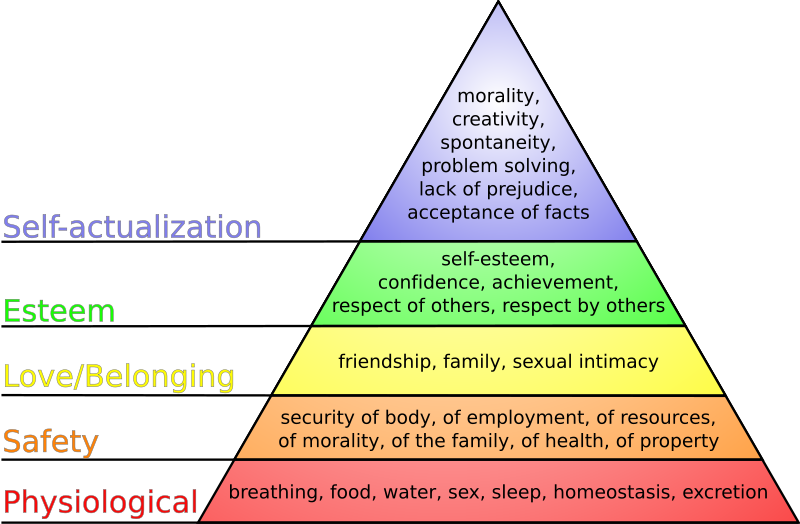
We have also installed a wood burning cooker. Right back down to the base of Maslow’s triangle really!

Maslow’s triangle of needs

These feelings have brought about such change everywhere and I wonder seriously whether we will ever return to what was; indeed would we want to?

I might not have mentioned it in previous blogs but as well as an engineering background, in latter years, I have focused on how interpersonal success in business is linked directly to relationships, integrity and vitally, self-awareness.

To inform this, some 7 years ago, I embarked on an MA in Core Process Psychotherapy, primarily to work on myself so that I could be the best I could be in my relationships, in and out of work.

The point I’m trying to make is that the same panic I notice in many of the companies I work in, and in me, is based on fear of the unknown and on a lack of trust in all its forms.  I’ve deliberately underlined that last phrase because it is so incredibly important.

The truth is that we get more of what we focus on.

So we can choose to focus on the constant news of more difficulties, hardship and redundancies, or we can focus on what is working.

In the workplace this positive focus has been pulling people together across functions and sites and pooling resources and ideas.

A farm evening

When we realise we’re not doing this alone it’s amazing how much lighter a load can feel and how much more inspired we feel.

I also notice how humour begins to flow and what a powerful antidote for doom and gloom that is.

Transformation is never easy but the rewards far exceed the effort put in ten fold.

So what is it going to be? Are we all going to bow down to the god of Doom & Gloom, fear and anxiety, heaping more and more gifts around it, or are we going to start noticing and focusing on the other neglected god – that of relationship, joy, trust, abundance and lightness?

Whatever the future holds for us all a belief in our inherent ability to adapt and change and focus on the greater good rather than fear, anxiety, greed and selfishness is the only sustainable way forward.

By Jon Lavin

[If you have been affected by this Post and would like to contact Jon, he would be delighted to hear from you. Ed.]

The Foreign Policy Handbook

An outsider’s view of the European Union

Recently Young Americans for Liberty, a libertarian organization that I write for, published the second issue of the Foreign Policy Handbook, a magazine on foreign policy written by and for students.

However, the fact that it’s “for students” does not mean that others aren’t encouraged to check it out!  (Who says you need to be in school to be a student, anyways?)

The European Union

My article in this issue, “The European Union: Eurocrats and the Eurosphere,” discusses a few problems that I see with the European Union.  The article begins:

During the 19th and early 20th centuries, European governments came under attack for their colonial policies in the African continent.  One of the primary claims made by pan-Africanists and other anti-European individuals was that such European policies denied the peoples of Africa the right of self-determination.  For example, the Declaration of Rights of the Negro Peoples of the World, drafted at a 1920 convention of the Universal Negro Improvement Association led by Marcus Garby, stated, “We believe in the self-determination of all peoples.”  Through policies ranging from direct rule via military force to indirect rule via forced economic dependency, European governments were holding African countries back from determining their own course.

While the modern “third world” certainly is not free from the tethers of traditional western powers, the situation has greatly improved from what it was a hundred years ago.  However, the modern European governments now are directly denying the right of self-determination not to the peoples of other continents, but to the peoples of Europe itself.  Considering the rhetoric surrounding the European Union, such as a commitment to “sustainable development” and the goals of “peace, prosperity and freedom” for the people of Europe, this is a sad irony indeed.

Other articles in this issue of the FPH include:

  • “The War on Terror and Sun Tzu: Is American Strategy Sound?”,
  • “Why Conservatives Should Hate Our Foreign Policy,” and
  • “Law or Hoax? Disproving Democratic Peace Theory.”

Check out an entire digital copy for free here.

By Elliot Engstrom

Basel

The Basel Committee on Banking Supervision

I suspect that you, like me, know diddly-squat about the Basel Committee.  As the Bank of International Settlements puts it:

The Basel Committee on Banking Supervision provides a forum for regular cooperation on banking supervisory matters. Its objective is to enhance understanding of key supervisory issues and improve the quality of banking supervision worldwide. It seeks to do so by exchanging information on national supervisory issues, approaches and techniques, with a view to promoting common understanding. At times, the Committee uses this common understanding to develop guidelines and supervisory standards in areas where they are considered desirable. In this regard, the Committee is best known for its international standards on capital adequacy; the Core Principles for Effective Banking Supervision; and the Concordat on cross-border banking supervision.

The Committee’s members come from Argentina, Australia, Belgium, Brazil, Canada, China, France, Germany, Hong Kong SAR, India, Indonesia, Italy, Japan, Korea, Luxembourg, Mexico, the Netherlands, Russia, Saudi Arabia, Singapore, South Africa, Spain, Sweden, Switzerland, Turkey, the United Kingdom and the United States. The present Chairman of the Committee is Mr Nout Wellink, President of the Netherlands Bank.

OK, that’s clear then!

Pers Kurowski

Well, according to a good supporter of and Guest contributor to Learning from Dogs, Pers Kurowski, we really ought to know much, much more about this ‘committee’.

Pers has a Blog called Tea with FT (as in the Financial Times) and there is much to read there that helps us understand why we are in so big a mess with the banks.  Here’s his piece from the 4th May.

Basel Committee, why don´t you just shut up!

Sir who do these Basel Committee regulators really think they are bullying us around with an arrogant “the banks should be sensible and realise that it might backfire if they protest too much”? as reported by Brooke Masters, May 4.

They themselves are the ones who thought everything would be fine and dandy if they just had some few credit rating agencies determine default risks and then gave the banks great incentives, by means of different capital requirements, to follow those credit risk opinions. They themselves are the ones who believing in the abundance of safe triple-A rated lending and investments, caused the world to stampede and fall over the subprime mortgages. They themselves should shut up, because rarely has the world seen such a gullible naive and outright stupid bunch of regulators.

Now the banks, in the midst of a crisis, need to build up the equity they do not have precisely because the Basel Committee did not require them to have; precisely when we need the most the banks to lend. The regulators, instead of bullying banks, should busy themselves day and night finding ways for severely capital stretched banks to be able to lend to those small businesses and entrepreneurs who have had to pay the cost of higher capital requirements but who had absolutely nothing to do in generating this crisis.

And just in case, for the record, I am no banker, only a citizen, very upset with the fact that in the 347 pages of the regulations known as Basel II, there is not one single word that describes the purpose of those regulations. Basel Committee why do you not start defining a purpose for what you are doing? Is that too much to ask?

By Paul Handover

Radio Caroline

A real blast from the past!

Recently we rented the film, Pirate Radio, a somewhat ‘true’ story about the days of broadcasting rock and roll from a ship moored just outside British waters.  Here’s the official trailer of the film (somewhat glitzy as is the manner of Hollywood):

Anyone of my sort of vintage living in England during the 1960s will recall the fun and excitement of Radio Caroline, the name of the radio station that started up in 1964.

Here’s a good extract from the WikiPedia entry:

Radio Caroline is an English radio station founded in 1964 by Ronan O’Rahilly, to circumvent the tight hold the record companies had on the broadcast of popular music in the UK. It originally commenced transmissions as an offshore radio station broadcasting from a ship anchored in international waters off the coast of South East England. Originally unlicensed by any government, for the majority of its early life, it was labelled as a pirate radio station.

Radio Caroline

Amazingly, at its peak Radio Caroline had an audience of 23 million listeners.  In a very real way Radio Caroline was another symbol of what became known as the Swinging Sixties, a transformation period for post-war Britain.

Tony Blackburn was just one of many famous disk jockeys who started life out on Radio Caroline, with Tony being the first presenter of the BBC’s Radio 1 station, broadcasting popular music, when it came on air on the 30th September, 1967.

Tony Blackburn, some while ago!

Anyway, if you are nostalgic towards the ‘good’ old days of the sixties, do watch the film.

By Paul Handover

Question for Elliot About Public Education

Hello Elliot!

I’d love to engage in a discussion with you — and interested others — about the appropriate role of government in education.

The Federalist Papers made it clear, to me at least, that our founding fathers believed that the government, our federal government in particular, should have nothing to do with educating the populace.

The government providing public education? How did THAT happen?

I realize it sounds a bit radical now, but I believe that any discussion of what is right and wrong about public education today must begin with a healthy debate about whether the federal government should be involved in public education at all.

Your thoughts?  Thanks!

by Sherry Jarrell

The Dust Settles

Who dares, Wins!

The new British Conservative & Liberal-Democrat Cabinet

I can’t remember a more momentous week in British politics. It seemed silly to comment as events unfolded so swiftly – one would have risked being out of date before finishing the article – but it is perhaps time to summarize what has happened:

  • The outcome was in retrospect the best possible, even if none of the parties might think of it that way.
  • We have a stable government locked into a coalition that commands a large majority in the House of Commons and a considerable majority of the popular vote. Nobody can deny this coalition “the right to govern”, whichever way you regard the statistics.
  • The country’s finances are in a terrible mess and a stable government was essential to put things right and recover confidence.
  • Yes, there will be strains and stresses in each party, but both have now invested so much in this that  neither can afford to rock the  boat and risk another general election to let Labour back in under a new and more charismatic leader.
  • Both parties have shown a spirit of compromise and both have had to ditch some of their cherished (and more wacky) policies.
  • “First Past the Post” has taken a lot of stick and it seems the time of electoral reform has arrived. The Lib-Dems have a firm commitment to a referendum on the Alternative Vote (not optimal, but an improvement) plus other essential elements – long-delayed by the previous Labour dinosaur – such as fixed term parliaments, a redistribution of votes per constituency and a reduced number of MPs.
  • The country has seemed fragmented and divided in recent years, with much bitterness and a sense of drift and failure. The coalition has brought fresh hope, though it is born in very difficult times. But as a coalition it is perhaps better-placed than one single party to make the very difficult decisions needed. A single party would have had to make the same decisions but with the risk of losing a vote in the HOC and a lurch to the other side to start all over again.
  • The wretched previous government is gone. The most pleasing aspect of this is that those architects of spin and PR, the unelected Lord Mandelson and the unelectable Alistair Campbell, have seen their stars not only wane but disappear into a black hole. Their last-ditch attempt to stagger on in a Lib-Lab coalition was effectively torpedoed by their own back-benchers and party Grandees, who found the whole process undignified. It is indeed the end of Noo Labour, and few will regret its passing.
  • Last but not least, the Labour Party survives, whereas there was a time when it seemed it might be humiliated and destroyed. The extent of the defeat could not be spun – even if Mandelson et al had a go at it – but it survives as an essential part of the British political scene. Moreover, though Brown rightly had to go, he was not humiliated either and was able to depart with grace and dignity. One is far from sad to see him retire to the back benches, but the bad feeling that anything worse might have produced has been avoided.

The change has been momentous. Politics is unpredictable, so who can tell if this bold experiment will work. But “Who dares, Wins”, and they should have the best wishes of all who love their country.

By Chris Snuggs

Elliot’s schooling – Sir Ken’s view

Sir Ken Robinson’s view

I plan to have my final post on education finished very soon.  However, with my last week of finals and papers at the undergraduate level (which is finally over!) constantly hoarding my time, I have not yet quite been able to truly decide on which side I plan to end up.

My instinct tells me that the costs of the US schooling system far outweigh its benefits, but I feel I must be sure that this is truly a case that can be supported with logic and not simply my own biases coming through.

However, while I continue to ponder, I thought that readers might find this video interesting.  It’s a different take on the nature of institutionalized schooling than is often seen.  It’s on the longer side — approximately 20 minutes long — but I definitely think it is worth a watch for anyone pursuing a clear and well thought-out perspective on education, and it’s actually quite humorous and entertaining.

The video is of a presentation by Sir Ken Robinson, an internationally recognized leader in the development of innovation and human resources.  His thesis statement is as follows:

My contention is that creativity is as important in education as literacy, and we should treat it with the same status.

I hope the Learning From Dogs community enjoys this video.  Upon my return from celebrating my college graduation in Charleston, I plan to present my final finding on whether the costs or the benefits of schooling in the United States outweighs the other.

By Elliot Engstrom

The Fourteenth Banker

What interesting times we live in.

Came across a relatively new Blog with the title The Fourteenth Banker.  Caught my eye because of the similarity to the book written by Simon Johnson and James Kwak of Baseline Scenario fame.  Here’s an extract from the ‘About’ piece of this new Blog.

In response to the comments of folks in the Congress and oversight regimes, I have created this blog as a home for bankers who need to speak out and do not have a central clearinghouse or a safe place to do so.     Big banks now treat their employees like property, bought and owned.     Typically employees must subject themselves to all sorts of potential sanctions, forfeitures of compensation, clawbacks and even lawsuits if they speak in ways we often have thought were protected speech.   I am not talking about revealing confidential customer or proprietary information, I am talking about simply commenting on a company, management philosophy, making general observations or raising concerns.     It makes one appreciate unions even if not historically supportive of unions.   At least management and labor can have a debate.    Not so in today’s large banks.    Gag orders are written in the most intimidating way, included in Codes of Ethics, attached to incentive plans, posted on the company home pages.     We should ask ourselves, what is the big secret?

Do support the Blog by calling by.  Here’s a taste of what they are writing about:

Lying at Leyman

What is a million between friends?

Read this piece from Bloomberg Businessweek How Much Did Lehman CEO Dick Fuld Really Make?

This can only be called what it is. Delusion. Delusion about self, society, morality, values and anything else you can name. These are symptoms of a grave illness which is too common among those in power. In fact, the illness may be the requisite to power.

By Paul Handover