As I write this article, the temperature in London (it’s 5pm on Tuesday 14th.) is 4 deg C/ 38 F heading down to a forecast -2 deg C/28 F overnight. Similarly cold temperatures are forecast during the rest of the week.
Here’s something that was published in October:
Coldest winter in 1,000 years on its way
04 October, 2010, 22:20
After the record heat wave this summer, Russia’s weather seems to have acquired a taste for the extreme.
Forecasters say this winter could be the coldest Europe has seen in the last 1,000 years.
The change is reportedly connected with the speed of the Gulf Stream, which has shrunk in half in just the last couple of years. Polish scientists say that it means the stream will not be able to compensate for the cold from the Arctic winds. According to them, when the stream is completely stopped, a new Ice Age will begin in Europe.
So far, the results have been lower temperatures: for example, in Central Russia, they are a couple of degrees below the norm.
“Although the forecast for the next month is only 70 percent accurate, I find the cold winter scenario quite likely,” Vadim Zavodchenkov, a leading specialist at the Fobos weather center, told RT. “We will be able to judge with more certainty come November. As for last summer’s heat, the statistical models that meteorologists use to draw up long-term forecasts aren’t able to predict an anomaly like that.”
In order to meet the harsh winter head on, Moscow authorities are drawing up measures to help Muscovites survive the extreme cold.
So why the heading for this Post, as in Basic Geometry?
Because places on the Globe are measured using Latitude and Longitude. Let’s look at the Latitude of some places:
London 51°30′N
Calgary, Alberta 51°03′N
Kiev, Ukraine 50°27′N
Krakow, Poland 50°03′N
Now let’s look at those Cities again with the current temperatures (you have to accept the local time differences):
London 51°30′N +4 deg C
Calgary, Alberta 51°03′N -9 deg C
Kiev, Ukraine 50°27′N -6 deg C
Krakow, Poland 50°03′N -12 deg C
In other words, Britain enjoys, or should enjoy, a much warmer Winter than most other places of the same or similar latitudes because of the effect of the Gulf Stream.
The glass is filled half-way. Is it half-full or half-empty?
This is a rhetorical question, of course. It is what comes to mind as I write this simply because of a small half-full/half-empty experience in the last 10 minutes. Let me explain.
I had started watching a video on TED.com. This one was entitled Jared Diamond on why societies collapse. Within a few minutes I started drifting to the comments, and read:
Jared Diamond talks of how societies choose (unwittingly) to collapse. William McDonough with his Cradle to Cradle concept also talks about choices and provides ‘Love of all children of all species for all time’ as a positive conscious choice.
With goals or missions in place (for example profit for businesses) humans have achieved amazing things.
So what would happen if all groups, families and individuals followed a mission of ‘Love of all children of all species for all time’?
I rather liked that. We always have choices. A positive conscious choice is always better.
So I stopped the Jared Diamond lecture and found the William McDonough one, also on TED.com, and conveniently shared on YouTube. It’s just 20 minutes long, so settle down somewhere, perhaps with a glass filled half-way with something!
Note: the next 10 days are pretty challenging, in the most positive and beautiful way, as Jean and I are to be married at Payson Episcopal Church on Saturday afternoon and we have guests until the 29th. There will always be a daily post from either me or Jon but do forgive us if they are not of the usual longer reflective style.
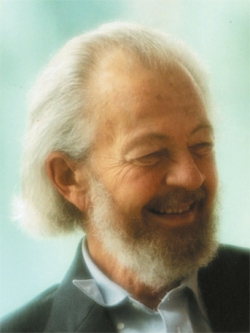
Dr. David R. Hawkins, M.D., Ph.D.
Both Jon and I have written about Dr Hawkins many times in Learning from Dogs. But there is also a plethora of valuable material available from the organisation, Veritas Publishing, that is the wrapper, so to speak, around David Hawkins work.
His monthly newsletter is free and often very interesting. For example, in the one that arrived today, there are a couple of extracts from his October lecture that resonate very closely with what Jon published about Eckhart Tolle the previous two days.
“The Self knows. The mind thinks. The thinking is just added as a thrill. Thinking is a thrill and an entertainment. Can you get along without thinking? There is a chair. I don’t think about the chair but I know it’s there. Most of real knowingness goes on without thinking. The animal knows without thinking. It just knows right off the bat who is a friend and who is a burglar.”
“Make choices instead of craving and desire and clutching. Choose to be happy instead of craving what you don’t have. Give up all cravingness. ‘I cannot be happy unless I get to do this or that.’ You are putting happiness as outside of yourself. The source of happiness is within. Winning $1 million does not make a big change in your life. Surrender all cravings to God.”
And do watch this:
Finally, I have repeated a publication today of a post written about Truth published earlier on Learning from Dogs in September. It has come out at the same time as this Post.
(A copy of the original post published earlier in September on this Blog)
Dr David Hawkins writing about truth
One of the many strange consequences of leaving the United Kingdom in 2008 leading, eventually, to settling in Arizona is that we are within a half-day’s car ride of Sedona. Sedona is where Dr. David R Hawkins is based.
Dr. David R Hawkins
Dr. David Hawkins is a life member of the American Psychiatric Association but is best known for his research into “the hidden determinants of human behavior”. That quote is taken from the front cover of Hawkins’ seminal book, Power vs. Force.
Dr. Hawkins was Knighted by the Danish Crown for this work in 1996, a worthy recognition, it seems to me.
I have been reading Power vs. Force for some weeks now. Normally I devour a book, fiction or non-fiction, if it holds my interest. But this book is different! Power vs. Force contains so many profound teachings that frequently there is more than enough to take in from a single page, or even just a couple of paragraphs. To read on before a particular proposition has had time to invade and penetrate one’s deeper senses is almost painful.
The challenge in wanting to share some of these teachings is having the patience to finish the book before putting pen to paper, so to speak. I failed!
In one of the early chapters, Hawkins writes about “the intrinsic source of power and how it operates.” There are a couple of paragraphs that just punched out from the page. Here they are, interwoven with my thoughts:
In looking for the source of power we have noted that it is associated with meaning, and this meaning has to do with the significance of life itself. Force is concrete, literal and arguable. It requires proof and support. The sources of power, however, are inarguable and are not subject to proof. The self-evident is not arguable.
Just at this point, one might have forgiven me for being slightly skeptical. How can the ‘self-evident’ or anything be above argument? Especially if one reflects on the notion that all we perceive with our senses is an illusion, a product of our minds. I clearly recall having this fleeting thought at this point in the paragraph. But the eyes continued to the next sentence and, figuratively, I was gasping for breath. Remember I had just read, “The self-evident is not arguable.” This was what came next:
That health is more important than disease, that life is more important than death, that honor is preferable to dishonor, that faith and trust are preferable to doubt and cynicism, that the constructive is preferable to the destructive – all are self-evident statements not subject to proof. Ultimately, the only thing we can say about a source of power is that it just “is”.
Wow! Those few sentences stopped me in my tracks. Think about what Hawkins is saying. He is saying that we intuitively know, without the need of intellectual argument or ‘proof’, the rightness, the beauty, the perfection of some deeply fundamental concepts.
It’s as if from the earliest moments of human awareness, gravity, sunlight, night and day, for example, were obvious despite eons of time needing to pass before science could ’explain’ these aspects of life.
In other words, there are understandings that are deeply embedded in human consciousness. Hawkins continues:
Every civilization is characterized by native principles. If the principles of a civilization are noble, it succeeds; if they are selfish, it falls. As a term, “principles” may sound abstract, but the consequences of principles are quite concrete. If we examine principles we will see that they reside in an invisible realm within consciousness itself. Although we can point out examples of honesty in the world, honesty itself as an organizing principle central to civilization is nowhere independently existent in the external world. True power, then, emanates from consciousness itself; what we see is a visible manifestation of the invisible.
Phew! True power emanates from consciousness itself!
It’s now 2 days since I read that. It still reverberates within my mind. I was compelled to share it with you. And it reverberates for me in an even clearer form – truth emanates from consciousness itself! Stay with me just a while longer.
A very well-known magical attribute of the human brain is what goes on in the sub-conscious, our ‘back-office’. Give our brain some space to process a dilemma such as deciding what to do for the best and it does come up with what is best for us. Often the best space we can provide for our brain is a good night’s sleep. It’s common folklore to ‘sleep’ on a problem.
My co-founder of Learning from Dogs, Jon Lavin, says that often in sleep we find the truth. I think the same could be said for prayer, as in a spiritual sense more than in a religious sense.
Just reflect again on the power of what comes out from those two paragraphs. Truth is not something external to us; it is within us, all the time. Our level of consciousness is the key to this truth. Our self-awareness is the tool by which we understand our level of consciousness – our mirror to our soul.
Yesterday, I wrote about Eckhart and included the extract on Manifestation. Rather than cloud what was presented yesterday with more material, I held it over until today.
All I wanted to do was to draw your attention to Eckhart’s website, which is here – do spend some time going through what’s on offer – and I wanted to include this video of Eckhart speaking about Being Yourself.
But before you click the play button for the video, just listen to the words without having any reactions to how the words are presented, the accent of the speaker or anything else. You’ll understand when the video starts running. Just close your eyes and listen deeply to what is being said.
This is not corny, this is at the heart of everything in life.
Nearly a month ago, I wrote a piece called The Power of Love. It was offered as a logical argument in favour of love – read it if you want to see what was written.
In line with the general Blog theme on here that we have much to learn from dogs and unconditional love is the BIG lesson we should take from these noble animals, here’s a lovely story that was sent to me by a dear friend.
WHOEVER DID THIS IS A VERY BEAUTIFUL PERSON
The ‘whoever’ being someone at a dead letter office within the US Postal System.
Here’s how it goes.
Our 14 year old dog, Abbey, died last month. The day after she died, my 4 year old daughter Meredith was crying and talking about how much she missed Abbey.. She asked if we could write a letter to God so that when Abbey got to heaven, God would recognize her. I told her that I thought we could so she dictated these words:
Abbey and Meredith
Dear God,
Will you please take care of my dog? She died yesterday and is with you in heaven. I miss her very much. I am happy that you let me have her as my dog even though she got sick.
I hope you will play with her.. She likes to play with balls and to swim. I am sending a picture of her so when you see her You will know that she is my dog. I really miss her.
Love, Meredith
We put the letter in an envelope with a picture of Abbey and Meredith and addressed it to God/Heaven. We put our return address on it.. Then Meredith pasted several stamps on the front of the envelope because she said it would take lots of stamps to get the letter all the way to heaven. That afternoon she dropped it into the letter box at the post office. A few days later, she asked if God had gotten the letter yet. I told her that I thought He had.
Yesterday, there was a package wrapped in gold paper on our front porch addressed, ‘To Meredith’ in an unfamiliar hand.. Meredith opened it. Inside was a book by Mr. Rogers called, ‘When a Pet Dies..’ Taped to the inside front cover was the letter we had written to God in its opened envelope. On the opposite page was the picture of Abbey &Meredith and this note:
Dear Meredith,
Abbey arrived safely in heaven.
Having the picture was a big help. I recognized Abbey right away.
Abbey isn’t sick anymore. Her spirit is here with me just like it stays in your heart. Abbey loved being your dog. Since we don’t need our bodies in heaven, I don’t have any pockets to keep your picture in, so I am sending it back to you in this little book for you to keep and have something to remember Abbey by..
Thank you for the beautiful letter and thank your mother for helping you write it and sending it to me. What a wonderful mother you have. I picked her especially for you.
I send my blessings every day and remember that I love you very much.
By the way, I’m easy to find, I am wherever there is love.
Love,
God
[The book is available on Amazon here. I have no financial interest in providing you with the link. Ed.]
Thanks Julie for sending that in – it’s a very moving example of unconditional love and generosity.
This is a guest post from an old regular (as in frequency, not age!) contributor to Learning from Dogs, Chris Snuggs. He has written in response to the guest post from Patrice himself that was published on the 31st October.
Patrice AYME – WOW!
First, an amazing post – lots to talk about. Secondly, (get the bad news out of the way first) the fact that you warmed to Brown when he became Prime Minister worries me, principally because the man was at best totally incompetent and at worst a moron, having totally messed up almost every aspect of British life one can think of but in particular the economy. It is only the fact that we started out from a better position that prevented (or prevents) us from “doing a Greece”. The waste and delusions were humungous; the basic management skills non-existent. I note that Mr Brown is going to make a speech in the House of Commons soon; I wonder if he is going to apologize for the appalling shambles he left behind or whether he is going to accuse the new government of not spending enough. His finest hour came when “saving the world” by encouraging governments everywhere to borrow vast amounts of money to save money. Had the overall consequences of his previous policies not been so disastrous this could almost have been funny. Well, it was funny for the banks, who of course were laughing all the way not only to the bank but at it.
CHINA: I’ve been to China – (wonderful people) the problem (if there is one) is not their economy per se but the fact that it is a dictatorship. There have been and indeed are worse dictatorships, but it is one nonetheless. As their economic power increases so does their sabre-rattling. Have there ever been any cases where mighty economic power has not been followed by territorial expansion? Patrice will know this; his overview of history in these matters is extraordinary. N° 1 Satan the USA may be, but without their umbrella free, democratic Taiwan would most likely already have been invaded by mainland China.
The YANKS? Humans are – in my humble opinion – often extremely conservative. Americans have been used for decades if not centuries to believing that their country is “the greatest in the world”. (they are not the only guilty ones, the French and Chinese run them close). It is going to take them some time to realize the junk value of that particular belief. While they are slowly internalising it we should be patient, remembering that they did save us from Hitler and/or Stalin. No doubt of course for their own selfish reasons, they did the same in Kosovo, too, (the Europeans – except those anti-European, Anglo-Saxon Brits of course – having done SFA) though I’m still trying to work out why – perhaps EXXON had geological surveys indicating vast oilfields around Pristina?
To save the US it will take someone with a lot more steel than Obama; that is the problem, and WHERE is this person coming from?
FRANCE: If there is any country mired in self-delusion apart from the USA it seems to me to be France ….. I am NOT anti-French – far from it. I lived and worked there for ten years ….. however, Patrice’s observation that most French people understand the need for change but most also support the strikes is revealing. This is the crux – they cannot make up their minds what they want – for too many in positions of power the status quo is too good – a bit like in the USA with the plutocrats. Thus they stagger about getting into a worse and worse situation, much like Britain did under Gordon Brownosaurus. The STATE in France is TOO BIG and SELF-IMPORTANT. Sarko realizes this, but his attempts to rein it in (forced by budget constraints) have been feeble and in any case the inertial resistance is stupendous. The phrase “reality-check” comes to mind.
THE EU: As for “STATE TOO BIG”, the EU is overreaching itself, having just committed to spending over €5 BILLION on a fatuous new diplomatic service run by a nonentity earning TWICE as much as the British and French leaders and which will give the EU FORTY-SIX “diplomats” on the island of Barbados. Nothing against the Barbadians – jolly good chaps and chapesses – but are they REALLY that important to the EU taxpayer? We’ll also have over 50 in that economic colossus of the universe, Madagascar. Meanwhile in Brussels, a new building is to be leased at a cost of a piffling £10,000,000 a year. It is said by the great and good in Brussels that this new diplomatic service is needed to “compete with the Chinese and Indians”. Absolute rubbish of course. The idea that a black-African country will trade with the EU and not the Chinese just because we have fifty odd “diplomats” in a spanking new building downtown is ludicrous. What the Africans want is good value (i.e. cheap) and reliability. Europe is getting past the stage of being able to offer much of those, bogged down as it is by 100,000 pages of European Law and mindless regulations designed à la française to improve the lot of “workers” but which in fact gradually destroy all their jobs.
I personally think the EU is doomed; destroyed by greed, arrogance and self-delusion. The British are already very anti-EU, NOT because we are anti-European; we are just anti venality, greed and overweeing self-delusion. However, in true EU spirit, we are denied the referendum we were promised on the Lisbon Treaty. Anyway, in the EU if you vote “No” in a referendum you just keep getting referenda over and over again until you say “Yes”, so what is the point?
EU TREATIES? A tremendous FARCE of course. Did you know that it is ILLEGAL for members states to bail each other out? But what happened with Greece? And now they have a NEW cunning plot to bail out the next failing economies: Spain, Italy, Portugal and Ireland must already be licking their lips at the thought of getting free German money. So, bailouts are ILLEGAL, but not apparently if we actually want to do it. So they are only illegal in THEORY then? So it seems. Now Frau Merkel and the usual stitch-up-the-rest suspects (France) have worked out their plan there remains the niggling little detail about it being ILLEGAL. So what is the solution? The humungously-overpaid and fatuous EU President (has he got his presidential jet yet?) has been asked to look at the problem and “see if he can find a way to bail the countries out legally.”
Of course, despite spending thousands of man-hours on the problem he won’t find a way that will stand up in court so the increasingly-fragile and erratic Frau Merkel is talking about “amendments to the Lisbon Treaty”. More hilarity – this took ten years to thrash out, agree and pass and yet she wants to muck about with it already. I find all this both hilarious and criminally venal, treating the European taxpayer with contempt. How do they get away with it? VOTER INERTIA – the same problem as in the USA, where they have a POOR choice of parties and lurch from one dinosaur to the other without ever seeming to explore alternatives. EUROPE? Do YOU know who your MEP is? Does he or she LISTEN to what you say? With Europe in the midst of the biggest financial crisis since WWII when EVERYONE in the real world (not Wayne Rooney of course) is cutting back, jobs are going, projects abandoned the MEPs voted for a 6% INCREASE in their budget. One wonders who their PR people are, but in truth they don’t have to bother much about PR since their accountability is about zero.
The EU initiatives are INSANE – power-mad. It is so transparent as to be laughable. As the British learned from “Yes Minister”, the bigger your budget the more important you must be and therefore the more you must pay yourself. This is the rational for EU top-brass being paid double what NATIONAL LEADERS get. (Oh, and for the “inconvenience” of living abroad of course, even though they get a whole raft of vast expenses including free schooling for their kids). Cameron knows it, but the Brits are so used to being slagged off by the Continent (especially statist France, which is always very glad to get its bills paid by someone else – will the Germans bail out France when their economy collapses?) that Cameron has to tread a tricky line. At heart, the Brits are FREE MARKETERS and NOT willing to be an outpost of The United States of Europe, which is of course what they want over the Channel. France wants that because it believes it can control it;, they could be deluding themselves – monsters one creates often become uncontrollable. And the Germans of course are kept on a leash because France still plays on German guilt for WWII, but is that ploy now looking a bit sick? It certainly can’t last for ever so milk it while you can, eh?
THE EURO: The recent EU jolly came up with a plan to “save the euro”; they were all happy as sandboys about this, but do they REALLY believe that Greece can EVER repay its debt without MORE vast donations from Germany? Do they think Germany will continue to bail out the feckless Mediterranean countries (plus Ireland …)? Some of these countries shouldn’t BE in the euro, unless of course the EU can control their economies. AHA, THERE WE HAVE IT! That is the agenda of course … more central control = more power and in particular more “harmonisation” of taxation. Don’t you just love that word; it sounds so PC. ‘harmony’ = balance, peace, contentment ….. all the right marketing vibes … but what it means of course is “harmonisation” UPWARDS to match the preposterous tax levels in Germany and France. The Germans are so efficient that they seem to get by with such high taxes, but they are crippling France. Despite their fatuous 35 hour week – introduced to create more employment (why didn’t they make it 10 hours per week – surely that would have created even MORE employment?) – their unemployment rate is still way above the average, and this for DECADES.
Well Patrice, I agree with much of your analysis of the USA, but I suspect Yanks will be up in arms. (the “greatest country in the world” syndrome). I am reminded of the importance of education; is it SO difficult to learn from the past? Apparently so – humans are so deep-rooted in the immediate present and so few take a long-term view, especially in our “democratic” systems of government where Obama has only been going for two years yet is effectively starting the next election campaign. And as we know, British politicians will do and say anything to gain power and having done so very often ignore much of what they promised. I myself do not remember the British Labour Party promising to ruin the country in 1997, yet that is what they have done in many areas.
Where I disagree is with the impression I have from your post that Europe is doing much better than the USA. I don’t think we are. I think we are in a tremendous mess and have NOT yet understood what faces us – see strikes in France for a start. One bright light? the economic performance of Germany, the only “serious country in Europe – apart from those magnificent Scandinavians of course. Another bright light? The performance so far of the British Coalition, at least having the courage not to take the easy but long-term catastrophic path of “Spend, spend, spend” so honed and perfected by the previous bunch of charlatans.
My apologies to you, dear reader, for a spot of personal indulgence. But today, at 11.30 UK time, give or take the vagaries of commercial air transport, I shall be aboard Virgin Atlantic’s flight VS007 en route for Los Angeles. This flight, and the internal flight tomorrow from LAX to Phoenix, represent the start of a wonderful new journey, literally as well as figuratively.
For in my passport will be an immigrant visa issued by the US Embassy in London allowing me the right of entry into the USA and the right to remain as a permanent resident once my Jeannie and I are married, which will be happening soon.
The United States gets a lot of stick from all quarters, indeed I would be the first to say that voters on both sides of the Atlantic have lost sight of the fundamental need for fairness in society. But in great democratic countries, the people always have the ultimate say.
So I am incredibly grateful to have been born, too many years ago!, in the great Great Britain and now have the opportunity to settle down for probably the last phase of my life in another great country, America.
I think it is appropriate to publish the words of a recent letter that was sent to the US Embassy in London if only as a reminder of the nobility of purpose of the great democratic countries of this world.
Shortly after 9am this Tuesday morning, my K1 visa application was approved and, thus, a rather long journey came to a conclusion. To have a new start in life is always wonderful. To have a new start in life at the age of nearly 66 is nothing short of a miracle.
Jean Burch, the woman that I shall be marrying in the Episcopal church in Payson, AZ on the 20th November is the woman that I have been journeying towards all my life. The ancient poet Rumi wrote, some 800 years ago, the following, “The minute I heard my first love story I started looking for you, not knowing how blind that was. Lovers don’t finally meet somewhere. They’re in each other all along.”
From those words, you will understand what it has meant to meet my Jeannie, a loyal American for nearly 30 years but, like me, born a Londoner; indeed we were born just 23 miles apart.
However the point of this letter is to say a very big ‘thank you’. Not only for representing a free country that welcomes such immigrants as me, but for the very courteous way that I was treated this morning. Please let your visa staff know that what may be for them just another day’s work is also part of a gift that is truly life-changing.
I will do my utmost to be a good and productive member of my new community in Payson and, in time, a loyal citizen of your country.
Jon’s post yesterday about how silence in more general terms is so important for good mental health got me musing about this.
The first thing that struck me was how good dogs are at doing nothing. They are naturals at being in the present, especially when being in the present means nothing more than just laying around.
Just doing - nothing!
OK, one could come up with an intellectual rebuff of that. Dogs aren’t humans, don’t have to go to work, don’t have to struggle to make one’s way in the world, etc., etc. No argument in that, is there. Or is there?
Let’s take monks. Clearly being a monk is a spiritual vocation that appeals to a very small number of people. But they prove that the ‘work, rush around, struggle with life’ scene is NOT hard-wired into mankind, ultimately it is a choice.
Just read this about a day in the life of a monk at Downside Abbey. Don’t react to what you read, just go through the text and notice how frequently words of silence, faith, reflection and prayer come up.
Now I am not suggesting that we all give up our present daily lives and become monks, but I am underlining the importance of balance, and for the sake of our private and public worlds that probably means spending more time doing nothing!
Let’s take North American Indians, in this case the Navajo. They too understood the huge importance of meditation and prayer. This video is just 3:40 long – see if you have the stillness in your mind to watch and listen to this for these few, short minutes.
How did you do?
Now let’s go back to 1966, the year when Simon & Garfunkel released the song, words written by Paul Simon, The Sound of Silence, that later became a huge, global hit. Here are the lyrics – read them slowly and reflect on the meaning in those words.
The Sound Of Silence (3:08)
P. Simon, 1964
Hello darkness, my old friend
I’ve come to talk with you again
Because a vision softly creeping
Left its seeds while I was sleeping
And the vision that was planted in my brain
Still remains
Within the sound of silence
In restless dreams I walked alone
Narrow streets of cobblestone
‘Neath the halo of a street lamp
I turn my collar to the cold and damp
When my eyes were stabbed by the flash of a neon light
That split the night
And touched the sound of silence
And in the naked light I saw
Ten thousand people maybe more
People talking without speaking
People hearing without listening
People writing songs that voices never shared
No one dared
Disturb the sound of silence
“Fools,” said I, “you do not know
Silence like a cancer grows
Hear my words that I might teach you
Take my arms that I might reach you”
But my words like silent raindrops fell
And echoed in the wells of silence
And the people bowed and prayed
To the neon god they made
And the sign flashed out its warning
In the words that it was forming
And the sign said “The words of the prophets are written on the subway walls
And tenement halls
And whispered in the sound of silence
For your sake, and therefore for the sake of all those around you – find your silence.
Like many others, I saw the first episode of the BBC2 television programme, The Big Silence. It clearly touched many people. (Useful links at the very end of this article.)
I wanted to throw a bit of light on this fascinating subject. As the five people in the TV programme all readily admit, real silence is rather scary to them.
Why would something so wished for by so many – an hour doing absolutely nothing – be sufficiently scary that, in reality, the majority will do everything in their power to avoid silence?
Let’s go to a video recorded by Abbot Christopher Jamison a couple of years ago in connection with the BBC Programme Finding Happiness. Here it is:
The points made by Abbot Jamison in that video apply just as much to the task finding peace through silence. Around the 3 minute mark, the Abbott says,
If we come to terms with our demons then we will find that we are not unhappy ….. face the unhappy demons.
We all have unhappy demons, OK some more than others. We start to hear them when we gift our bodies and minds the grace of real silence. I deliberately included the word ‘bodies’ even though silence is a ‘mind’ thing because resting our bodies with regular silence will also be very therapeutic for us.
What does coming to terms mean? It means giving space to those inner thoughts so that one can clearly hear them. You probably won’t make sense of them, indeed they may have a great unsettling effect, but they won’t hurt you.
Indeed, it’s when we try and stop those inner demons that they manifest themselves in many other ways: fidgeting, funny little unexplained aches, itchy skin, short-tempers, constant feeding of the ego, and on and on and on.
A good indication of what’s going on ‘under the bonnet’, so to speak, is to see if you can sit still in a relaxed manner for just 15 minutes.
Let’s go back to the website where you can buy the booklet on Growing into Silence. Here’s what is written there:
The Big Silence is a BBC TWO series about five men and women all of whom believed that they would benefit from finding more time for silence in their lives. They all felt that they needed to slow down and attend more to some of the deeper issues in life. They had little or no outward religious practice but all said that they were open to religious guidance. The result is a journey that took them into a deep silence and in that silence they discovered some powerful dynamics working in their own lives. – All of them were profoundly changed by the experience.
This 44-page booklet, Growing into Silence, offers you the chance to enter into that silence in your own life. You can undertake similar spiritual exercises to those which the volunteers undertook. To help you deepen some of the insights expressed in the series, there are also details of further resources, including a booklist and websites which you can explore.
Each of the exercises in this booklet is presented as a prayerful reflection. They assume that you are not alone as you reflect on your life. You carry out this process in the company of a loving God who looks over you, supports you, and who may well have something to add to your reflections. This is not a hidden way of persuading you to go to church, or sign up to any particular belief-system. Even if you have no idea about God, you can look at whatever most brings you to life or fills you with energy. That is always the most appropriate starting point.
Look at this sentence again, “The result is a journey that took them into a deep silence and in that silence they discovered some powerful dynamics working in their own lives.”
Self-awareness cannot come from outside, it has to come from inside, it has to come from what, in a spiritual sense, we call the soul. If you saw the BBC2 programme, you may recall the Abbot saying, “Silence is the route to the soul, the soul is the route to God.”
And now is not the time to have any form of reaction to the word, God. God, as it is said, works in mysterious ways and if those mysterious ways enable you to move towards your soul then don’t analyse it, just accept it as it is.
My co-author, Paul, wrote an article about Thinking about Truth on the 11th September. He wrote about Dr David Hawkins, another great-standing advocate of the importance of consciousness. Paul wrote in that article,
Think about what Hawkins is saying. He is saying that we intuitively know, without the need of intellectual argument or ‘proof’, the rightness, the beauty, the perfection of some deeply fundamental concepts.
It’s as if from the earliest moments of human awareness, gravity, sunlight, night and day, for example, were obvious despite eons of time needing to pass before science could ’explain’ these aspects of life.
In that blog article, Paul quotes Hawkins, “True power, then, emanates from consciousness itself; what we see is a visible manifestation of the invisible.”
It’s a simple step to connect what the Abbot is saying with that sentence from Hawkins. Silence is the way to hear our consciousness, and those sounds, those inner voices, are the manifestation of what, otherwise, we don’t ‘see’.
Here are the last three paragraphs from the article on truth:
A very well-known magical attribute of the human brain is what goes on in the sub-conscious, our ‘back-office’. Give the brain some space to process a dilemma such as deciding what to do for the best and it does come up with what is best for us. Often the best space we can provide for our brain is a good night’s sleep. It’s common folklore to ‘sleep’ on a problem.
My co-founder of Learning from Dogs, Paul, says that often in sleep we find the truth. I think the same could be said for meditation and prayer, as in a spiritual sense more than in a religious sense.
Just reflect again on the power of what comes out from those two paragraphs. Truth is not something external to us; it is within us, all the time. Our level of consciousness is the key to this truth. Our self-awareness is the tool by which we understand our level of consciousness – our mirror to our soul.



 Learning from Dogs