From the Hubble website. Here’s the description of the image:
“Starry Night”, Vincent van Gogh‘s famous painting, is renowned for its bold whorls of light sweeping across a raging night sky. Although this image of the heavens came only from the artist’s restless imagination, a new picture from the NASA/ESA Hubble Space Telescope bears remarkable similarities to the van Gogh work, complete with never-before-seen spirals of dust swirling across trillions of kilometres of interstellar space.
This image, obtained with the Advanced Camera for Surveys on February 8, 2004, is Hubble’s latest view of an expanding halo of light around a distant star, named V838 Monocerotis (V838 Mon).
The illumination of interstellar dust comes from the red supergiant star at the middle of the image, which gave off a flashbulb-like pulse of light two years ago. V838 Mon is located about 20,000 light-years away from Earth in the direction of the constellation Monoceros, placing the star at the outer edge of our Milky Way galaxy.
A single light-year is approximately 6 trillion miles, or 9,460,730,472,580.8 kms for the metric brigade! Thus 20,000 light-years is 120,000 trillion miles, or 120,000,000,000,000,000 miles.
It is beyond imagination – yet it is real!
It humbles one beyond measure that in this short lifetime on mine, science has reached out so far. And then one looks more closely to home and remains appalled that we have learnt so little about living in peace and with integrity on this funny third rock from the Sun.
I have long subscribed to Baseline Scenario and the latest article from James Kwak is a great example of why.
On August 23rd James published a Post with the compelling title of, “Housing in Ten Words”. Here’s a flavour:
By James Kwak
“Housing Fades as a Means to Build Wealth, Analysts Say.” That’s the title of a New York Times article by David Streitfeld. Here’s most of the lead:
“Many real estate experts now believe that home ownership will never again yield rewards like those enjoyed in the second half of the 20th century, when houses not only provided shelter but also a plump nest egg.
“The wealth generated by housing in those decades, particularly on the coasts, did more than assure the owners a comfortable retirement. It powered the economy, paying for the education of children and grandchildren, keeping the cruise ships and golf courses full and the restaurants humming.
“More than likely, that era is gone for good.”
I’ve been telling my friends for a decade that housing is a bad investment. These are real housing prices over the past century, based on data collected by Robert Shiller:
Robert Schiller is, of course, the well-known Yale University professor who wrote the book, Irrational Exuberance. From Wikipedia:
Irrational Exuberance is a March 2000 book written by Yale University professor Robert Shiller, named after Alan Greenspan‘s “irrational exuberance” quote. Published at the height of the dot-com boom, it put forth several arguments demonstrating how the stock markets were overvalued at the time. Shiller was soon proven right when the Nasdaq peaked on the very month of the book’s publication, and the stock markets collapsed right after.
The second edition of Irrational Exuberance published in 2005 is updated to cover the housing bubble, especially in the United States. Shiller writes that the real estate bubble may soon burst, and he supports his claim by showing that median home prices are now six to nine times greater than median income in some areas of the country. He also shows that home prices, when adjusted for inflation, have produced very modest returns of less than 1%/year.
Anyway, do read the full article from James on Baseline Scenario as it has plenty of messages that are still critically important for those trying to work out where it’s all still heading, economically.
For my money, I still think that slowly but steadily we are reverting to the old mean of home prices being about 2 to 2.5 times average annual salaries. With the added proviso that I think that it is more than likely that average salaries will slowly decline on both sides of the Atlantic over the next few years. Tough times indeed!
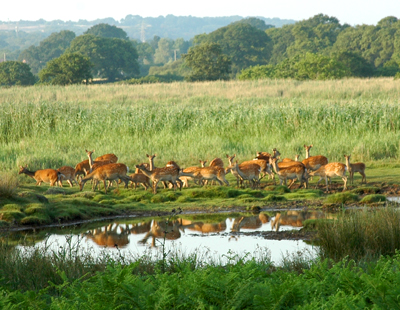
Julie has gone on ahead, but returns to tell me that the sika deer are feeding in the reed beds ahead of us. (These are one of two types of deer found at Holton Lee.) She offers to stay with Genie while I go and photograph them, so that Genie won’t frighten them off. They see me, but continue feeding whilst remaining alert.
It really is a magical sight – I am quite converted from my original anxiety about deer leaping out in front of the car!
There is something extremely primeval about deer, which is probably not surprising as their bodies have provided everything from meat and clothing to fish hooks and sinews for many indigenous people, while still remaining wild. It is hard to see why anyone would hunt them simply for sport, though, and I fear that Walt Disney has spoilt me for enjoying venison – ancient, organic, sustainable, non-farmed food source or not, it would be like eating Bambi!
Sometimes looking down the other end of the telescope reveals more, much more!
Afghanistan - where is it leading?
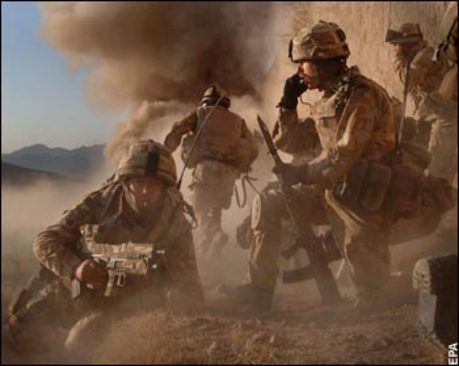
Now that coalition forces have just recently suffered their deadliest month yet in the conflict in Afghanistan, it now has become more crucial than ever to rethink the strategy of the United States and its allies in the region. Currently, the cornerstone of this strategy rests upon two key factors – winning over the local peoples of the region, and training local forces to carry the burden when, and if, coalition forces leave the region.
At least on the exterior, these goals in Afghanistan do make some sense. The only possible way to succeed via a continued military occupation of Afghanistan is to attain and bank on the support of the local peoples. Also, if western powers are ever to withdraw from the region, local forces will have to be able to maintain whatever structure these forces leave in their wake.
However, while this strategy is not completely outlandish and does show some merit on the part of military strategists in that they are leaning more towards localized models that entail comprehension of diverse local factors, the question still must be asked – is this strategy actually possible to carry out and have the sought-after effects in the region? Can the United States and its allies actually win over the peoples of Afghanistan and western Pakistan, and can these same powers possibly train forces that will remain peacekeepers in the years to come?
Despite the fact that I admire the intentions of the military’s current strategy in this region, I do not think that their plan is in fact possible. It seems to me that rather we are fighting an unwinnable war to win over a people that we do not and cannot understand, and that by funding the Afghani security forces of today, we are inevitably funding our enemy of tomorrow, just as our nation has mistakenly done so many times in the past in this very region.
I cannot foretell the future. Nor can anyone else. However, I can comment on what is likely to occur. And, in constructing such a model, two of the most important subjects to understand are history and praxeology, or human behavior.
An attempt by the United States to make Afghanistan a stable, western-friendly state is by no means a new happening. The date of the beginnings of our intervention in the region could be debated, but a decent starting point is the late 1970’s when President Carter put forth the Carter Doctrine, which stated that the United States would defend its interests in the Middle East.
This doctrine just barely preceded the Soviet invasion of Afghanistan, and it was this invasion that saw the beginnings of American forces, at this point being mostly CIA and other such agencies, which were attempting to hamper the Soviet forces by funding the Afghani resistance.
Now, there is no room here for a history of American involvement in Afghanistan. However, what must be noted is that during the 1980’s and 1990’s, a pattern developed in the Middle East – the United States would fund a group in the hope of combating some common enemy, and then in later years the group funded with American taxpayer money would inevitably end up turning against the United States.
A few prominent examples of this are Al Qaeda, who received $6 billion from the United States from 1989 to 1992, the Afghani Taliban, who was receiving US foreign aid up to the very minute American forces entered their country (and continues to receive US foreign aid through Pakistani backchannels) and Saddam Hussein, who received chemical weapons from the US during the Iraq-Iran War of the 1980’s, weapons he later used to kill American soldiers.
This, though briefly put, is the history, or the “what.” So now must come an examination of the “why,” or the element of praxeology. For obviously, our attempts to forge friendships in the region in the past have failed. Our friends have become our enemies, in fact our worst enemies.
There are several possible explanations for why this occurs. However, mine is quite simple – we do not understand these people, we do not understand this region, we do not understand Islamic culture, and, to be quite blunt, we never will. It is not a wrongdoing by the West to look at the Middle East through Western eyes. Rather, it is the only way that a westerner possibly can look at the Middle East.
On top of this extremely problematic misunderstanding of the Middle East by Western peoples then comes another layer of problems, these being the base problems of intervention in any context, amplified by the extreme foreignness and instability of the Middle East as a whole. The consequences of intervention in any scenario are so unpredictable, so many, and so far-reaching that no one can possibly intervene and successfully fulfil their objectives without in the process creating a dozen new problems. This is seen with the federal government intervening in states in their own country – how much greater then are the problems when intervening in a region like the Middle East?
All this now brings us back to the point on considering the future. As I mentioned previously, I cannot say what the future holds. However, I can make an educated guess. And, based on analyses of both history and human behavior, it is safe to say that by both indirectly and directly funding the training of a new military force in Afghanistan, we very likely are creating our enemy of tomorrow. For when these people that we are now training realize that the United States is not leaving, that they are not in fact a free state, that they have become a part of the American empire, and that if they want to live culturally independent of western influence they will have to forcibly remove Western elements within their borders, it seems extremely probable that they will do exactly that.
To say that we are creating a force that will do what we expect it to do in the future is a wish at best. The reality is that we do not and cannot understand what is truly a foreign mindset, and our best course of action would be to distance ourselves from what is and will be for many years of region of perpetual conflict.
Jon Lavin wrote a Post on the 13th June, 2010 entitled, “Dealing with the fear of the known.” I’ve been thinking about that in recent weeks including the comment to Jon’s article from Per. Here’s how Jon closed that article:
If more of us got used to coming out of the mind before making an important decision, and simply sat with the question for a while, the answer would probably present itself.
This will probably raise more questions than it answers but that’s not a bad thing.<!–
And here’s the recent comment from Per:Great advice… but how do we remove the fear of what is known?
Presumably Per was implying that we shouldn’t fear the known. However, I beg to differ here; it is actually fear of the UNKNOWN that is rather pointless (I am not afraid of aliens), while fear of the KNOWN is CRUCIAL to our survival.
But like anything else, you can have too little or too much. Too little, and you survive a very short time. Too much, and you sit cowering in your cellar afraid to go out. As with EVERYTHING in life it is a question of BALANCE.
How do we know how much fear to deploy? Instinct, intelligence, knowledge and experience. If any of these are deficient, we may apply an inappropriate fear quotient.
Let’s take “Global Warming”! How afraid of it should I be? What are my marks out of 10 for the four fear-factors above?
Instinct = 8 – I instinctively fear a situation when my environment is getting hotter, as I don’t know what that will imply. Intelligence = 8 – I am (just) intelligent enough to appreciate the dangers of a rise in temperature. Knowledge = 4 – I have no real idea exactly what is going on or how far it will go; the messages are mixed and I see no real panic among governments. Experience = 0
So, a score of just 20 out of 40, which means IGNORANCE and DOUBT and these add up to FEAR ….. so I am quite afraid.
Home grown vegetables
More apparently, than my leaders seem to be, who can’t even ban flying across the Atlantic at a cost of 60,000 tons of CO2 per day. The question is, will this considerable amount of fear push me into actually DOING something about GW? What is my inertia level and what is my tipping point? What would it take to get me to dig up my garden and plant potatoes? To sell my car and buy a horse? Sadly, humans are in general pretty inert …… it is much easier to do nothing or too little until it is (almost) too late.
So, “fear” is absolutely essential to our survival. If you’re a driver who doesn’t fear accidents then please keep out my my way until you very soon die in one.
Fear is also what pushes me to drive very carefully. People who greedily lent money to Madoff had no fear they would lose it, having lost all control of whatever ration of commonsense and/or logic they might once have had. Perhaps now people will fear rather more about losing their money and therefore invest it more wisely.
To take another topical example, any company in the future (is there one?) drilling for oil in the Gulf of Mexico will fear the lash of Obama’s tongue and stick and this fear will push them to be a bloody sight more careful and to have an effective contingency plan. Actually, why more people don’t have a lot more fear is a mystery to me.
Right, having dealt with fear, we come to our response to it, which is of course the interesting bit. The world is changing so fast that almost all of us have limited control. Even the US President has limited control. This is not comfortable.
How then can we gain more control and become more comfortable? Jon has pointed the way; we must become more self-reliant. Jon will presumably now have much less fear of starving to death, since he is producing a proportion of his own grub. Anyone installing solar-panelled heating will be much less fearful about their electricity being cut off.
I would go further. Anyone owning a horse will or would have much less fear about running out of fuel and being immobile – or more to the point, of being unable to plough and sow his fields, without which we really are stuck. (Incidentally, I am predicting a big comeback for work horses. They are slower, yes, but you can’t breed a tractor (or indeed talk to it) or produce your own fuel, which is where the horse wins out. We’ll have to move more slowly, but then speed is vastly overrated.)
Now Jon with his chickens is a special case. Is there, I wonder, a small element of “fear” in his decision to keep chickens? Humans are complex …. Another major factor pushing Jon down this road could be (and in his case probably is) social responsibility.
It seems pretty clear that if EVERYONE became more self-reliant then vast, expensive, high-consuming centres of production would be scaled down. Unfortunately, social responsibility is not exactly fasionable in today’s consumer world (or we wouldn’t use plastic bags for a start, just to take one small example). Like the vegetarians of 30 years ago, Jon might be seen as an exception if not crank; until of course the fear factor becomes higher and then everyone will try to grow their own potatoes.
So, fear of powerlessness drives us to take initiatives that will help to remove at least some of this fear; a circular but inevitable process. Nothing new about it; the only sad thing is that humans seem to need to travel quite a long way down the path of doom before they really start to react.
This of course is why we did nothing when Hitler invaded the Rheinland in 1936; wait and see seemed easier at the time. It’s also why America totally ignored Jimmy Carter’s ideas of some decades ago about reducing America’s dependence on Arab oil. It was much easier to deride him and do the easy (but totally wrong) thing, especially of course as the oil companies have loads of money and can buy off people who otherwise might see the light.
Well, we’re well past “Wait-and-see” now …… we are now entering the “Do-it-or-else ….” period. And where Jon is of course achieving a double-whammy is that his increasing self-reliance is also GOOD FOR SOCIETY. If everyone were more self-reliant in every way a vast saving in energy and everything else could be achieved. Flying exotic fruits into Britain from South Africa is insane, yet so normal that it seems … errrmmmm … normal.
All this was obvious years if not millennia ago, but the current state of the world has increased the fear factor and is pushing people like Jon down this road. But it is an interesting road. Being self-reliant has multiple advantages, though it will be pretty hard on the rich, who may have to learn how to do things they usually pay underlings to do.
But Jon is in the vanguard of this movement; there is VAST scope for increasing self-reliance. It could and should be an adventure, though it will involve enormous change. The latter of course can also be stressful, but less so when it is clearly a change for the better, as I believe it will be.
A route to be free of hate and ill-will and a guarantee of happiness – read on:
The Brahma Viharas are also known as the Four Divine Emotions or The Four Divine Abodes. They are the meditative states, thoughts, and actions to be cultivated in Buddhist meditation. They are the positive emotions and states that are productive and helpful to anyone of any religion or even to the one with no religion.
The result will be a good person, free from hate and ill-will. Those who cultivate the brahma viharas are guaranteed to happiness. Those who further cultivate equanimity, may reach insightful states and wisdom of enlightenment experiences.
The Four Divine Emotions
1. Loving-kindness (Pali: Metta)
2. Compassion (Pali:Karuna)
3. Joy with others (Pali: Mudita)
4. Equanimity (Pali: Upekkha)
The Four Divine Emotions are known in Pali (Pali is a literary and liturgical language only) as the Brahma-viharas and are also known as the divine abidings or the divine abodes. They are emotional states to be strived for. By practising and developing the divine emotions, we will have a peaceful and patient daily life practice.
Joy
Loving-kindness is a soft, affection and care for others and yourself.It is not a hard, romantic type of love and not a love that includes extreme attachment or controlling feelings.
Compassion is like an open heart that cares for everyone. It includes empathy, being able to see the other person’s position and caring for and about them.
Joy with others, sometimes is called sympathetic joy or appreciative joy. It is the ability to be happy when you see others happy. Their joy becomes your joy as you welcome less suffering and happiness of others.
Equanimity is the balanced state of mind. It is the middle way state of mind that is neither clinging nor pushing away.
The above was an excerpt from the best selling book The Complete Book of Buddha’s Lists — Explained, by David N. Snyder, Ph.D., with a Foreword by the Venerable Madewela Punnaji. The full version can be downloaded for free from here.
The greatest realisation that the last year has produced for me is that, in the end, it is our attitude to everything around us (that really means our attitude to everything within us) that is the most important thing in the world.
Yes, that’s a grand statement – everything in the world comes down to attitude.
Why? Because our attitude drives our thoughts and behaviours. Our attitudes are the manifestation of our internal energy. Think about it! Your attitude to something fuels the energy that goes into that belief. And, as so many of the great teachers in life say, “We get more of what we think about most“!
Here’s Wayne Dyer in his book, There’s A Spiritual Solution To Every Problem:
Our institutions are built and organized around the idea of facilitating, regulating, and guiding human behavior. You cannot go to schools, businesses, governments, or even churches, mosques, or synagogues to negotiate the presence of energy. These institutions exist to deal with the material world and to keep human beings in line. They vibrate to the lower energies of the material world and often are the source of, rather than the solution to, your problems.
Eventually, enough people will reach a higher state of spiritual vibration and form a critical mass. Then you will see institutions emerge that are not designed to regulate, facilitate, or guide human behavior, but to access, implement, and teach a spiritual approach to life. In short, the purpose of our institutions will shift from controlling to promoting bliss.
We can go back much further and see the same message. Here’s an extract from Galatians 5:1:
Live by the Spirit, I say, and do not gratify the desires of the flesh. For what the flesh desires is opposed to the Spirit, and what the Spirit desires is opposed to the flesh; for these are opposed to each other, to prevent you from doing what you want. But if you are led by the Spirit, you are not subject to the law.
Now the works of the flesh are obvious: fornication, impurity, licentiousness, idolatry, sorcery, enmities, strife, jealousy, anger, quarrels, dissensions, factions, envy, drunkenness, carousing, and things like these. I am warning you, as I warned you before: those who do such things will not inherit the kingdom of God.
By contrast, the fruit of the Spirit is love, joy, peace, patience, kindness, generosity, faithfulness, gentleness, and self-control. There is no law against such things.
One can explore the writings of many other great thinkers and see the same message coming over time after time.
The peoples and creatures upon the face of Planet Earth are involved in one of the greatest experiments of all time. How will we survive the next couple of hundred years?
We all truly know that our ‘institutions’ are not the answer, indeed they are part of the problem. Conversely, we also know that mankind has the ability, literally, to move mountains. The last year has shown, on a personal level, that a fundamental change in attitudes can also move emotional mountains.
It’s been an honour to publish Learning from Dogs for the last year – and I am very moved that so many of you have chosen to call by. Thank you.
Conscientiousness isn’t all it’s cracked out to be!
(Foreword from Paul.)
Jon is one of those rare individuals who not only has been committed to a path of self-awareness for more than 30 years but who has also studied incredibly hard so as to be able to help others and do so from a base of real competence, as his own Blog describes. I can speak as a current ‘client’ of Jon who is assisting me in my own journey.
But then I realised the great strength in what Jon has written. It is this.
There are many notable teachers out there who thousands upon thousands have turned to for a deeper understanding of what life is all about. As far back as time itself teachers have surfaced and given spiritual guidance to those that come in need. But it’s very difficult to read or listen to these great teachers and connect with the fact that they were born, as we are all born, with nothing. And all of them, like many of us, went through Hell on wheels to come out the other side with a greater self-awareness and a deeper understanding of the real truths in nature. Like all of us who wish to rise above our present place they first acknowledged their own frailties. It is the starting point.
So, let me get to the point. Jon has the awareness and understanding to offer real help to those that seek answers that are currently beyond reach. Jon’s article is an wonderful illustration that he experiences the same fears and feelings of helplessness that you and I feel. You and I and Jon and all of humanity are much more closely connected than we realise.
Paul H.
—————————————–
To see in is to see out!
I’ve been running my own business for about 12 years now. In the beginning it started because I had a thirst for wanting to make a difference in small business in our local area and a passion for wanting to do it through working with people directly, on their behaviours. Still have, really.
I think this came as a form of acknowledgement to the few exceptional people managers I experienced while I was employed, and the all too common, terrible ones.
I was also mentored by a group of people to whom no developmental tool was barred. My eyes were well and truly opened to how a change of view could change outcomes.
The final boot up the backside was redundancy in the late 90s. I was all ready to go and just needed a kick.
My work ethic, trained at home and then through an engineering apprenticeship, was to conscientiously work hard and try hard and to treat people the way you want to be treated. Nothing wrong with that. I assumed automatic reward would follow as long as I did those things.
Over time I wised up and became a bit less idealistic and a little more politically aware but carried on in much the same way.
Much later I found myself embarking on a whole new adventure, with a lovely wife and family, all dependent on me, with a few contacts to start getting work from!
It took a year before the first jobs came in that didn’t necessitate robbing the almost non-existent savings and redundancy payment just to keep food on the table. Then, work slowly picked up and it started to get quite good for a one-man band. We were able to go on holiday once a year, camping, but still great, and then abroad.
All the time, I beavered away, trying hard, being very conscientious, as I’d been brought up to be, but slowly getting very stressed.
Time was when it took Friday night to de-stress, then 3 days, then 10 days and recently, not at all.
So faced with this present downturn, which is likely to go on for much longer than any of the others I’ve seen and survived, I’m wondering just what new strategy to adopt. Money is already getting very tight and everything is feeling very ‘hand to mouth’. Can’t really see one month in front of the other.
I notice our local farmer who I went to school with but didn’t really know.
I’ve got degrees, lived abroad, can speak Finnish fluently, (what use is that, I hear you say!), and can turn my hand to most things, but I still feel quite dis-empowered and at a bit of a loss.
My farmer friend is always smiling, he’s got a flock of geese he’s fattening up, the same with his beef cattle, does livery for half a dozen horses or so, has fields planted with various cereal crops, and has his finger in lots of different pies – and definitely does not look stressed. He is also renting his land plus another farm.
I honestly don’t know what to make of this all except for a few really important things – the importance of diversification, relationships and appreciating what you’ve got, especially people things, here, in the now.
I have also come to the realisation that I still haven’t cracked the main thing with being self-employed, and that is replacing fear with trust.
It’s been said by various enlightened people that we see a reflection of the world we hold in mind. Going forward into this brave new world I would like to see opportunities rather than fear, I will diversify into things which make more use of my wide range of talents, and I will swap fear for trust.
The answer to whom we turn to when the times are tough.
Light your own fire!
Regular readers of Learning from Dogs will know that a few days ago, Sherry wrote a piece entitled Light My Fire? It expressed her view that lately she was finding it a problem to be inspired, finding the passion as Sherry put it.
I have been thinking about Sherry’s article for the last few days and a couple of peripheral things come to mind.
We tend to get more of what we notice and orient towards. By allowing ourselves to become absorbed in the negative, that is what we tend to notice. The fact is that the media thrive and make vast sums of money focusing on the negative. Just compare the amount of negative with the positive in any news cast.
That is not to say that we should not be aware of the negative or hide our heads in the sand. We can however change the way we view things and that has to come from within.
In fact, the answer rarely lies “out there”.
Change in how we view things, i.e. our attitude, needs to start coming from “within” ourselves.
The one thing that characterises these times is uncertainty.
A lot of us don’t even know where the next bit of money to pay the bills is coming from. In spite of the tendency to look ‘out there’ for strong direction, I still feel that the inner resolve has got to come for inside.
Another thing, I don’t believe it’s possible to think ourselves out of this one.
Although it’s a subject I go on a lot about, the sense of direction and well being has to come from us, or rather the feeling of interconnectedness that we share with everything. At a level, we are all connected.
We are all connected.
The one thing that gets us all through is a faith in some higher consciousness, that we can all tap into when we remember and ask for that miracle of clarity.
This is not thinking. The opposite in fact. This is a process of trust and ‘allowing’.
Allowing requires a power that few can sustain for long as we’re all geared to doing. ‘Allowing’ requires us to turn off the noise machine that is in our head and creating a quietness and space for awareness to surface.
Paul recently wrote an article on Living in the Present that describes this way of letting go rather well. I know for a fact that Paul is new to these ideas but already he is finding a peace and clarity emerging that shows that there’s always a good time to start – NOW!
Back to my thoughts. I am not advocating lying down and letting the world roll over us – the opposite in fact. By bringing awareness into this whole mess, we are more likely to take the right action.
I have honestly noticed that the more effort and circular thinking I have put into my present financial difficulties, and I’m a real expert in worry and circular thinking, the worse things have got.
I notice that by returning to silence and simply observing, a background is created that allows solutions and options to rise.
By asking to be shown the way forward and then letting go of the need for an instant solution, subtle options and ways forward present themselves.
Then right action follows.
An acceptance that in any moment we are all operating at our maximum level of consciousness. We are all doing the best we can. If we knew better, we would do better.
Therefore, what is going on in the world is a reflection of ourselves and is absolutely perfect for where the sum total of all of us are. (“Perfect”, does not mean we have to like it but it is, never the less, inevitable)
It follows, therefore, that the best way to help the world is to work on ourselves by striving to be the best we can, in every way. And the only way to do that is with awareness.
I think it was Abraham Maslow who coined the phrase, “Self Actualising”, meaning, being the best we can in every way, mentally and physically.
During these undoubtedly troubled times in the earth’s history, we all tend to turn to someone or something to provide a sense of direction. That someone you need to turn to is yourself.