Category: Musings

The way forward?

A big vote of thanks to Paul for plugging away for so long without any contribution from me.  Unlike Paul who is retired, well retired in the sense of a paying job, I have a family, a dog (Jess) and the usual set of household overheads to cover, so the week is very much a working week for me.  Ergo, I shall never be able to contribute to Learning from Dogs in the same manner as Paul but a regular contribution is assured. To get things rolling again, I want to re-publish an article that I wrote on my business blog the other day.

Removing the fear of the unknown

Seeing the light

I’ve been working with most of my clients recently through painful transformations brought about by the economic downturn.

An interesting metaphor really because since the first wave of uncertainty triggered panic, first noticed in the UK banking system, I have been picking up on that uncertainty that feels like it’s stalking the globe and has been for some time. Recent stock market crashes have simply exacerbated this and that, coupled with the riots taking place in major cities in the UK, make for pretty disturbing reading.

Interestingly, I, too, have been aware of an underlying fear that was difficult either to name or source.

It has been rather like a deep river in that whilst the surface feels slow-moving, currents are moving things powerfully below.

So this ‘fear’ has caused a few household changes.

1) We now are the proud owners of 12 chickens. Our youngest son and I have dug up the back lawn and planted vegetables and built a poly tunnel.

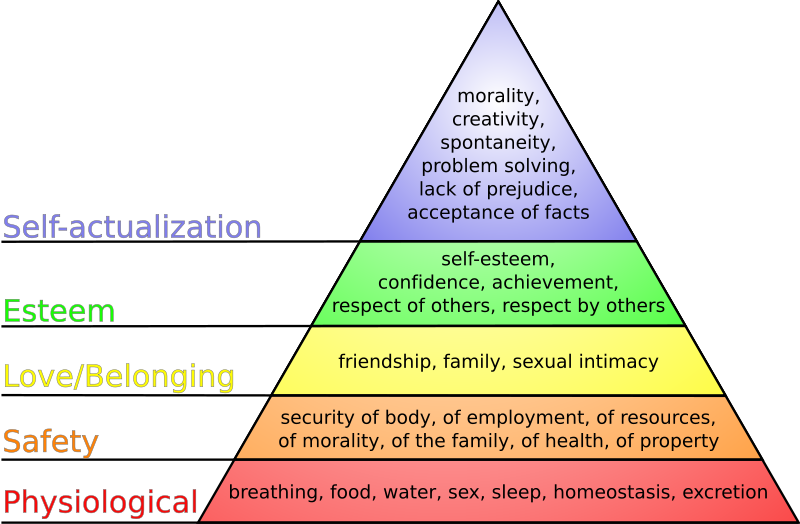
2) We have also installed a wood burning cooker. Right back down to the base of Maslow’s triangle really!

Maslow's triangle of needs

These feelings have brought about such change everywhere and I wonder seriously whether we will ever return to what was; indeed would we want to?

I might not have mentioned it in previous blogs but as well as an engineering background, in latter years, I have focused on how success in business is linked directly to aspects of relationships and how we are in our relationships with others, so things like integrity, self-awareness and the ability to see the point of view of others, and modify our approach appropriately.

To inform this, some 7 years ago, I embarked on an MA in Core Process Psychotherapy, primarily to work on myself so that I could be the best I could be in my relationships, in and out of work.

The point I’m trying to make is that the same panic I notice in many of the companies I work in, and in me, is based on fear of the unknown and on a lack of trust in all its forms.  I’ve deliberately underlined that last phrase because it is so incredibly important.

The truth is that we get more of what we focus on.

So we can choose to focus on the constant news of more difficulties, hardship and redundancies, or we can focus on what is working.

In the workplace this positive focus has been pulling people together across functions and sites and pooling resources and ideas.

When we realise we’re not doing this alone it’s amazing how much lighter a load can feel and how much more inspired we all feel.

I also notice how humour begins to flow and what a powerful antidote for doom and gloom that is.

Transformation is never easy but the rewards far exceed the effort put in ten fold.

So what is it going to be? Are we all going to bow down to the god of Doom & Gloom, fear and anxiety, heaping more and more gifts around it, or are we going to start noticing and focusing on the other neglected god – that of relationship, joy, trust, abundance and lightness?

Whatever the future holds for us all a belief in our inherent ability to adapt and change and focus on the greater good rather than fear, anxiety, greed and selfishness is the only sustainable way forward.

By Jon Lavin

Return of the voyager

My fellow author, Jon, returns from a long journey into the interior!

Fellow author, Jon.

If you look at the right-hand margin of Learning from Dogs, you will see that under the label Founding Authors there are two names!  Over the past months Jon, as many of you may have noticed, has been absent.  Indeed, Jon’s last Post on this Blog was on the 2nd January.

Jon’s absence has simply been the result of the total focus that was required to complete his Masters degree in Core Process Psychotherapy, thus adding another string to an already very professional bow.  That focus included the writing of an extremely challenging thesis, all 16,000 words, then the total re-write of that thesis!  That is now all behind Jon!

So from next week, Jon will be participating again on Learning from Dogs with his unique blend of professional and personal experiences.  Indeed, one might argue that the challenges that face our global society need, more than ever, the insight and wisdom of such people.  Am I biased?  Yes, deeply so!

In the early part of 2007 I drew heavily on Jon’s expertise as I tried to make sense of what, at the time, was a deeply traumatic period.  The testament to that relationship with Jon was a greater self-awareness and contentment than I had ever known and, subsequently in December 2007, me meeting Jeannie in Mexico and our ultimate marriage and new home in Payson, Arizona.  As outcomes go, it doesn’t get better than that!

Back to that last article from Jon.  In it he wrote,

Plus I did want to expand, just a touch, on what Paul wrote yesterday, more or less reflecting on an article by Leo Babauta.  In that post, Paul quoted Leo writing:

The thing I’ve learned, and it’s not some new truth but an old one that took me much too long to learn, is that if you learn to be content with who you are and where you are in life, it changes everything.

In a very real sense what Leo is saying is that if you don’t love yourself you can’t possibly ‘love’ the world around you.  Now this is incredibly easy to consider, too easy in fact, because the truth of loving oneself first is, for the vast majority of people, a complex, confusing and unclear journey, as in ‘self-journey’.  Read that quote from Leo again and see how he writes, ‘an old one [as in truth] that took me much too long to learn‘.

I’m sure when Leo writes ‘too long to learn‘ he is, in effect, acknowledging the very individual circumstances that lead to a person developing the awareness that is expressed in that quote ‘if you learn to be content with who you are and where you are in life, it changes everything‘.

So if 2011 is going to be a challenging year then hang on to the only rock in your life – yourself!  Embrace the reality that you, like all of us, do your best.  Be good and kind to you.

So if 2011 is going to be a challenging year then hang on to the only rock in your life – yourself!  Embrace the reality that you, like all of us, do your best.  Be good and kind to you.

So to each and every one of you reading this, be good and kind to you!

Welcome back Jon.

Back of every creation, supporting it like an arch, is faith. Enthusiasm is nothing: it comes and goes.

But if one believes, then miracles occur. Henry Miller

Spirituality and activism

A look at the film Fierce Light

For a number of reasons, both private and public, I have not been feeling as creative as normal these last 24 hours.  What I am conscious of is that events of this week, from the riots in the UK, the chaos of financial markets, right through to the death of our dog Tess have all contributed to a mental heaviness.

So I am taking a small creative short-cut, as it were, by writing about a film that we watched on Monday night; Fierce Light.

There is a trailer on YouTube.  This is how it is presented,

A Feature Documentary By Velcrow Ripper

From the Director of Scared Sacred & The Producer of The Corporation

“Fierce Light” is a feature documentary that captures the exciting movement of Spiritual Activism that is exploding around the planet, and the powerful personalities that are igniting it.

Fueled by the belief that “another world is possible,” the film portrays stories of what Martin Luther King called “Love in Action,” and Gandhi called “Soul Force”; what Ripper is calling “Fierce Light.” Acclaimed filmmaker Velcrow Ripper (Scared Sacred) takes an insightful look at change motivated by love, featuring interviews with spiritual activists Thich Nhat Hanh, Desmond Tutu, Daryl Hannah, Julia Butterfly Hill, and more.

If you would like to sink a little deeper into the film and what the motivations are behind the making of it, then do go to the web site Fierce Light.

Jean and I found the film inspiring and beautifully presented.  It came over as a film that seriously approached the topic of human consciousness and gave plenty of opportunity to reflect on some of the many forces within our societies at this present time.

Then you may like to watch this talk by the Director, Velcrow Ripper (actually born Steve Ripper in 1963), broken into two parts as follows,

The film and this talk by Mr. Ripper both date back to 2009 so, in the light of where we are in August 2011, they are proving to be extremely relevant.

Dogs, humans and hope

A new book about dogs by John Bradshaw offers a theme for today.

Yesterday, I mentioned an article from the current issue of The Economist.  Also in that issue was a review of a new book from John Bradshaw, called Dog Sense: How the New Science of Dog Behaviour Can Make You a Better Friend to Your Pet.  You can read the review here. But in terms of the theme of today’s post, read this paragraph from that review,

Dogs are not like nicely brought-up wolves, says the author, nor are they much like people despite their extraordinary ability to enter our lives and our hearts. This is not to deny that some dogs are very clever or that they are capable of feeling emotion deeply. But their intelligence is different from ours. The idea that some dogs can understand as many words as a two-year-old child is simply wrong and an inappropriate way of trying to measure canine intellect. Rather, their emotional range is more limited than ours, partly because, with little sense of time, they are trapped almost entirely in the present. Dogs can experience joy, anxiety and anger. But emotions that demand a capacity for self-reflection, such as guilt or jealousy, are almost certainly beyond them, contrary to the convictions of many dog owners.

That last sentence is key, “But emotions that demand a capacity for self-reflection, such as guilt or jealousy, are almost certainly beyond them, contrary to the convictions of many dog owners.

So in yesterday’s post, when I wrote about the terrible uncertainty that millions and millions of humans must be experiencing, there is no useful metaphor available to link this human idea to how the dogs feel; as John Bradshaw writes, this level of reflection is just beyond them.

We hug a dog (or any animal) to escape from matters complex.  As Sue Miller wrote so beautifully, “I was taken up by them [pets] and their life and energy, by what they needed and asked of me.  I let go of everything difficult or complex in my life.  As I was driving home, I thought of all this, and it seemed to me that I’d chosen work which offered me daily the presence of pure innocence, a forgiveness for all my human flaws.”

So accept the gift of pure innocence that our pets give us.

But what ‘gift’ can we humans accept that relates to the very complex world that we humans see all around us?

What about hope?  Let’s accept the gift of hope.  As I wrote recently in an email to a friend (before the London riots burst upon our consciousness),

‘Hope’ is going to be the key message over the coming weeks and months because the feeling that the ‘end of the world is nigh’ is incredibly strong, well it is to me!

Of course, the ‘end of the world’ feeling is, as you well know from me, really the end of an era.  But an era where for decades money has equalled power; ergo money has equalled control.

Now the speed of change must be terrifying to millions across the world.  So out of that terror must come a new order, a new way of understanding that how we have treated our planet is a busted model and that it is time, indeed the 11th hour as it were, to find that new order, of love and sustainability with our planet, both in earthly and spiritual ways.

We must have faith in the hope that we are living through the chaotic transition from an era of greed and destruction to one where we have a future that goes on for thousands of years.

A self-affirmation
For today, I am in charge of my life.
Today, I choose my thoughts.
Today, I choose my attitudes.
Today, I choose my actions and behaviours.
With these, I create my life and my destiny.

Why we have cats and dogs!

Author Sue Miller perfectly articulates our relationship with dogs and cats.

As a rest to the number of non-fiction books that I have been reading over the past few months, Jean recommended a novel she recently finished, While I Was Gone, by Sue Miller.  It’s featured on Oprah’s Book Club, from which I quote,

About the Book

A decade ago she put a face on every mother’s worst nightmare with her phenomenal best-seller The Good Mother. Now, Sue Miller delivers a spellbinding novel of love and betrayal that explores what it means to be a good wife.

In the summer of 1968, Jo Becker ran out on the marriage and the life her parents wanted for her, and escaped–for one beautiful, idyllic year–into a life that was bohemian and romantic, living under an assumed name in a rambling group house in Cambridge. It was a time of limitless possibility, but it ended in a single instant when Jo returned home one night to find her best friend lying dead in a pool of blood on the living room floor.

Now Jo has everything she’s ever wanted: a veterinary practice she loves, a devoted husband, three grown daughters, a beautiful Massachusetts farmhouse. And if occasionally she feels a stranger to herself and wonders what happened to the freedom she once felt, or how she came to be the wife, mother, and doctor her neighbors know and trust–if at times she feels as if her whole life is vanishing behind her as she’s living it–she need only look at her daughters or her husband, Daniel, to recall the satisfactions of family and community and marriage.

But when an old housemate settles in her small town, the fabric of Jo’s life begins to unravel: seduced again by the enticing possibility of another self and another life, she begins a dangerous flirtation that returns her to the darkest moment of her past and imperils all she loves.

While I Was Gone is an exquisitely suspenseful novel about how quickly and casually a marriage can be destroyed, how a good wife can find herself placing all she holds dear at risk. In expert strokes, Sue Miller captures the precariousness of even the strongest ties, the ease with which we abandon each other, and our need to be forgiven. An extraordinary book, her best, from a beloved American writer.

Have to say that even though there’s an obvious gender difference between me, the heroine and the author, I found the book tough reading , as in emotional, from time to time.  Especially, the euthanasia of Arthur the dog towards the end of Chapter 7 – Jo is a vet.  A few paragraphs I just couldn’t read .  But then on page 137 in Chapter 8, comes this,

Pure bliss.

I stood in the center of the yard for a moment and tilted my head back to let the soft snow touch my face.  The dogs pranced and rolled for pure joy in the pale, gray-brown light.  They chased each other wildly.  I made snowballs and threw them; the dogs leapt and bit at where they’d disappeared.  As they played, their muzzles whitened, their paws pilled up.

I left them reluctantly and came back in.  Watson trailed me around as I did my chores, watching me soberly.  I shut him out of the cat room, where we had only two boarders.  I let one of them out to roam and use the litter pan while I checked its cage.  I put more food down.  Then I went back out and worked my way through the dogs’ cages.  Two of them had had accidents, so I cleaned up and changed their bedding.  Several of them had their own food, in cans – those dishes needed to be washed.  Water refreshed, kibbles set out for the others.

I went to the cat room, put the first cat back and let the other one out.  Then I called the reluctant dogs in.  Watson greeted each one like a tiny worried mother, licking at their snow, fussing about how they smelled.  Slowly I recaged them.  I released Lucky and let him go outside for his solitary run while I refilled his food and water dishes.  Three dogs needed medications.  I put the last cat back in, called Lucky inside, locked up.

And while I did all this, I thought only of them, of the dogs and cats, of their requests for affection, of their comical or passionate relationships to one another, of the performance of their bodily functions.  I was taken up by them and their life and energy, by what they needed and asked of me.  I let go of everything difficult or complex in my life.

It reminded me of my days at Dr. Moran’s, caring for the dogs and cats he boarded and treated.  It reminded me of what a comfort it had been to me, even just physical escape into the lives of animals.  As I was driving home, I thought of all this, and it seemed to me that I’d chosen work which offered me daily the presence of pure innocence, a forgiveness for all my human flaws.

the presence of pure innocence, a forgiveness for all my human flaws Impossible to add anything; so I won’t!

Lose yourself in the night sky

Time to forget about all the ‘stuff’ in the news.

Dogs have that wonderful ability to savour the moment and just enjoy the present.  Seems to me that there is just a bit too much going on at the moment in the big wide world and we could do a lot worse than take a chair out into the garden, or wherever, and enjoy the majesty of one of the light shows that the universe can put on.

But first an acknowledgement to Mike Shedlock, more details here.  I subscribe to his daily newsletter and it was there that, rather uncharacteristically for an economic blog, I saw the reference to the Perseids meteor shower which, annually, provides vivid viewing for us earth-bound creatures this time of the year.

Mike gave the link to an article in National Geographic Daily News, from which I quote,

A Perseid meteor appears to strike the peak of Mount Rainier, Washington, in 2010. Photograph by Siddhartha Saha, Your Shot

Andrew Fazekas

for National Geographic News

Published July 25, 2011

A celestial traffic jam may be on tap this week as two meteor showers combine forces to put on a brilliant sky show.

One of the best shooting star events of the year is the annual August Perseid meteor shower. (See Perseids pictures.) However this year’s peak, on August 12, happens to coincide with a bright full moon—drastically cutting down the number of meteors visible to the naked eye.

Yet while the main event might be blocked out by the blinding moonlight, the opening act promises to be much better.

(See “Year’s Biggest Full Moon, Mars Create Sky Show [2010].”)

This year the lesser known Delta Aquarid meteor shower is expected to peak on Friday night, when the Delta Aquarids’ more productive Perseid cousin is just starting to ramp up.

Together the showers will produce anywhere between 15 and 30 shooting stars per hour under clear, dark skies.

If this tickles your fancy then go to that article and read how best to view this wonderful sky show.

We haven’t seen them from this part of the world (i.e. Payson, Arizona), but down in South-West England it was easy to get up onto the moors (Dartmoor).  Sunset at this time of the year down in Devon is around 7pm local time and by 8pm there was often a beautiful cloudless night sky.

Wikipedia has some good background information on the Perseid meteor shower including, what I didn’t realise, that,

The Perseid meteor shower has been observed for about 2000 years, with the earliest information on this meteor shower coming from the Far East.  Some Catholics refer to the Perseids as the “tears of St. Lawrence“, since 10 August is the date of that saint’s martyrdom.

I think most people are aware, again from Wikipedia, that,

The shower is visible from mid-July each year, with the peak in activity being between August 9 and 14, depending on the particular location of the stream. During the peak, the rate of meteors reaches 60 or more per hour. They can be seen all across the sky, but because of the path of Swift-Tuttle’s orbit, Perseids are primarily visible in the northern hemisphere. As with all meteor showers, the rate is greatest in the pre-dawn hours, since the side of the Earth nearest to turning into the sun scoops up more meteors as the Earth moves through space.

But to come back to the National Geographic piece, as above, this year could be better than normal.  As I wrote,

This year the lesser known Delta Aquarid meteor shower is expected to peak on Friday night, when the Delta Aquarids’ more productive Perseid cousin is just starting to ramp up.

Together the showers will produce anywhere between 15 and 30 shooting stars per hour under clear, dark skies.

So I know it could be a tough choice – politics or standing in awe under a night sky – but, go on, force yourself!

Try that night sky.

The mystery of telepathy

Just a bit more science about that sixth sense.

Yesterday, I wrote about how science was coming up with some pretty strong evidence that humans do have the ability to communicate in a way that might be called ‘telepathic’.

If (and that’s a big ‘if’) I have any understanding of the science, I believe it has much to do with quantum physics.  So I thought it fun to take a small diversion in today’s Post and give you some material on this very strange world of the very, very small.

From A Lazyman’s Guide to Quantum Physics,

What is Quantum Physics?

That’s an easy one: it’s the science of things so small that the quantum nature of reality has an effect. Quantum means ‘discrete amount’ or ‘portion’. Max Planck discovered in 1900 that you couldn’t get smaller than a certain minimum amount of anything. This minimum amount is now called the Planck unit.

Why is it weird?

Niels Bohr, the father of the orthodox ‘Copenhagen Interpretation’ of quantum physics once said, “Anyone who is not shocked by quantum theory has not understood it“.

To understand the weirdness completely, you just need to know about three experiments: Light Bulb, Two Slits, Schroedinger’s Cat.

Two Slits

The simplest experiment to demonstrate quantum weirdness involves shining a light through two parallel slits and looking at the screen. It can be shown that a single photon (particle of light) can interfere with itself, as if it travelled through both slits at once.

Light Bulb

Imagine a light bulb filament gives out a photon, seemingly in a random direction. Erwin Schroedinger came up with a nine-letter-long equation that correctly predicts the chances of finding that photon at any given point. He envisaged a kind of wave, like a ripple from a pebble dropped into a pond, spreading out from the filament. Once you look at the photon, this ‘wavefunction’ collapses into the single point at which the photon really is.

Schroedinger’s Cat

In this experiment, we take your pet cat and put it in a box with a bottle of cyanide. We rig it up so that a detector looks at an isolated electron and determines whether it is ‘spin up’ or ‘spin down’ (it can have either characteristic, seemingly at random). If it is ‘spin up’, then the bottle is opened and the cat gets it. Ten minutes later we open the box and see if the cat is alive or dead. The question is: what state is the cat in between the detector being activated and you opening the box. Nobody has actually done this experiment (to my knowledge) but it does show up a paradox that arises in certain interpretations.

To conclude I will offer this quotation reputed to be from the great master himself, Albert Einstein,

The more success the quantum theory has, the sillier it looks.

The blame game

A retrospective muse about the present global challenges.

A few days back I posted an article by Tom Engelhardt called The Great American Carbon Bomb.  It attracted a number of comments including a couple from Learning from Dogs supporter, Patrice Ayme.  Here is one of those comments,

Dear Paul: There is a gentleman leading the Tour de France, right now. He was not given a chance, especially in the mountains. However, he has been going day by day, and has now worn the Yellow Jersey for more than a week, supported by his inferior, but dedicated team. His philosophy: humility, and do the job day by day, trying his best, although he strongly doubts that he is up to the task.

We, as humankind, or, rather, our hubristic leaders are doing the exact opposite. We are not doing our best, and it’s precisely because those leaders are not humble and not honest, and so very sure we are going to pull out OK, because that’s what we do best, and have always done, and thus will always do.

Verily all indicators are that of an unfolding catastrophe. All signals are loud and clear that way. So it’s really not the moment to say:”Oh, BTW, we are very resilient and totally great, so it’s just a matter of time before we put it all together OK. So now let’s all pull together, and it’s fine.”

In truth we are on the verge of an irreversible situation, as the CO2 poisoning will turn, within a decade or so, into a political, and then military issue.
PA

Patrice is an angry man (not a criticism by the way – so many of us are angry!) and anger is a great reason to find someone, something, anything, to blame!  I suspect, wearing my cloak of an amateur psychologist, that a core reason why we feel anger is that, so often, the causes of our anger are our own errors.  Anger at one’s self is much more difficult to deal with!

Anyway, back to the plot.

Like Patrice I also feel badly let down by our ‘leaders’.  Especially with regard to the nightmare of economic and ecological issues fast approaching.

Then I read this in Paul Gilding’s book, The Great Disruption, that has been featured on this Blog a couple of times.

Our addiction to growth is a complex phenomenon, one that can’t be blamed on a single economic model or philosophy.  It is not the fault of capitalism or Western democracy, and it is not a conspiracy of the global corporate sector or of the rich.  It is not a bad idea that emerged in economics, and it is not the result of free market fundamentalism that emerged in the 1980s with globalization.  While each of those factors is involved, it is too simple and convenient to blame any of them as the main driver.  Growth goes to the core of the society we have built because it is the result of who we are and what we have decided to value. [Chapter 5, Addicted to Growth, p66]

That last half of that last sentence – ‘it is the result of who we are and what we have decided to value.‘  That strikes me as the core truth.  It is the reason why Patrice, and me, and countless thousands of others across the globe, are so angry.  At heart we all know that the circumstances we find ourselves in are, in great part and before we ‘saw the light’, the result of earlier personal values which we now know were not compatible with a sustainable relationship with the planet we all live on.

It is very good news.  That anger is fuelling change.  As Malcolm Gladwell writes in his book The Tipping Point societies change when something of the order of 18% of individuals emotionally commit to change.

Until Tuesday by Luis Carlos Montalvan

A book review

While being born an Englishman in 1944 has me slightly ahead of the so-called Baby Boomer period, which in American terms, ergo the U.S. Census Bureau, is defined as those born between January 1st, 1946 and December 31st, 1964, American and British people born in those ‘boomer’ years after WWII share many attitudes.

However, there is one stark difference between the UK and the USA regarding that period; the Vietnam War.

U.S. military advisors arrived beginning in 1950 and that U.S. involvement escalated in the early 1960s, with U.S. troop levels tripling in 1961 and tripling again in 1962.

Many good young Americans paid the ultimate price for that involvement (58,220 U.S. service members died in the conflict).

Why do I mention this?  Because just as so many Americans have no idea of the scale of enemy bombing that England suffered during WWII, just as many Brits have no idea of the scale of the ‘draft’ (i.e. conscription) that was employed by the U.S. Government as the Vietnam involvement grew.

Now keep that in mind as a means of adding context to what follows.

Until Tuesday is a book of many extremes.  It is a powerful book, a disturbing book, and a book about the beauty, dignity and, sadly, the madness of man.

I have been talking to a good friend of my life-long Californian pal, Dan Gomez.  Let me just call him Tom.  Tom saw service in Vietnam.  This is how Tom describes his early experiences.

I was young and keen for some adventure.  I had watched many war movies so I knew exactly what war was all about.  So I enlisted as a soldier and was shipped out to Vietnam.  After 60 days, I had experienced sufficient to know that things were not as they were portrayed by the media and the reality of Vietnam was very different to those movies. I had seen enough and was ready to come home.

Except that it didn’t work that way. I was there for a full tour of duty.

It became increasingly apparent by our behavior that we were not there to liberate the masses. We were there because some politicians had a theory and because of it didn’t want the locals to have a democratic election.  So good people were put into harm’s way, died or were severely injured for no other reason than some politicians had a theory – that proved to be false in the end.

Through it all, the biggest pain that I suffered was to see my Government operating under false pretences, with no integrity and no dignity.   It left me with a deep anger and mistrust of government that is still deep inside me.

Tom’s very personal and intimate sharing of his experiences of Vietnam resonates powerfully with what Captain Montalvan experienced in Iraq.  Here’s an extract from the book,

I am an American soldier.  I am an expert and I am a professional.

But at the same time, I was coming unmoored, my mind dwelling on the hand-to-hand struggle for my life, the Syrian ambush, the sandstorms, the riots, and Ali, Emad and Maher, the men left behind.

I am a guardian of freedom and the American way of life.

The wife of one of my best men from Al-Waleed had become pregnant during his midtour leave.  The foetus was fatally deformed, but Tricare, the army’s health service, doesn’t provide abortions under any circumstances, and she was forced to carry the child to term.  I will never accept defeat.  Little Layla was born without a nose and several internal organs.  Her parents had no financial resources on a soldier’s pay to provide her comfort.  I emailed everyone I knew for help – hundreds of dollars were sent to the sergeant and his family.  Nevertheless, it was heartbreaking, absolutely heartbreaking, to hold Layla in my hands.  I will never quit.  She lived eight weeks, and the difficulty of her life, and the inhumanity of forcing that existence not only from her but her parents too – I will never leave a fallen comrade – fuelled my downwards drive.

I was angry with the army. Not on the surface, but underneath, in the depth of my mind.  Why did Layla and her parents have to endure that pain, especially after everything they had already endured?  Why were they forcing our regiment back to Iraq just ten months after our return?  Why weren’t they helping us cope with our pain?  We were badly banged up.  We were undermanned and underequipped.  The army didn’t care.  They were churning us through.  They cared more about getting us back to Iraq and making the numbers than they did about our health and survival.

It was the summer of 2004.  Victory was slipping away.  Everyone could see that, but the media kept pounding the message: ‘The generals say there are enough men.  The generals say there is enough equipment.  The generals say everything is going well.’  It was a lie. The soldiers on the line knew it because we were the ones suffering.  We were the ones who endured days of enemy mortar fire when we arrived in Iraq without weapons or ammunition, as my eighty troopers had in Balad in 2003; we were the ones going back in 2005 without adequate recovery time or armour for our Humvees.  And that is the ultimate betrayal: when the commanding officers care more about the media and the bosses than about their soldiers on the ground. [Chapter 5, An American Soldier, pps 88-89]

So the first thing that most definitely comes out of the pages of Until Tuesday is the depth of disconnect between Montalvan as an active soldier in the front line and his nation.  Just like Tom in Vietnam!

It’s not until Chapter 8, The Thought of Dogs, that the author moves on from his obsessiveness about his military experiences to his future world.  Please realise that when I use the word ‘obsessiveness’, in no way is it used as a derogatory term.  One of the symptoms of mental insecurity is the ease with which we can obsess on things in our lives.

Here’s how Chapter 8 starts,

I can’t tell you how much my life changed when I read the email on 1 July 2008. (A Tuesday, I just realised.  I’ll have to add that to my list of fake reasons for Tuesday’s name.)  The Wounded Warrior Project, the veteran service organisation I went with to the Bruce Springsteen concert, forwarded the message.  They forwarded messages every day, actually, but I usually didn’t read them.  This tagline intrigued me: ‘WWP and Puppies Behind Bars’.  Puppies behind bars?

The message was almost as simple: ‘Dear Warriors, please note below.  Puppies Behind Bars has 30 dogs a year to place, free of charge, with veterans from Iraq or Afghanistan who are suffering from PTSD, traumatic brain injuries or physical injuries.  I’ve attached the Dog Tags brochure which explains the programme, as well as the Dog Tags application.’

As soon as I read the attached description, I knew the programme was for me.  I suffered from debilitating social anxiety, and the dogs were trained to understand and soothe emotional distress.  I suffered from vertigo and frequent falls, and a dog could keep me stable.  Because of my back I could barely tie my own shoes, and a dog could retrieve and pick things up for me.  I was the perfect candidate.  I was down, but I was working towards a future.  I was a leader, so I would never give up.  And I was lonely.  Terribly, terribly lonely.

From this point onwards the remaining 189 pages of Until Tuesday are about Luis Montalvan’s recovery built upon the foundation of his beautiful relationship with Tuesday, his service dog.

Of course there are ups and downs, as there are in all our lives, but the overall message is clear.  A dog loves a human in the most beautiful and purest fashion of all.  That unconditional, undemanding love for the humans in that dog’s life unlock even the most damaged souls.  Tuesday unlocked the private hell that Captain Montalvan endured for so long.

In the privacy of a deep hug of your dog lays release.  From that release comes peace, understanding and the desire to re-connect with the larger world.  There is no greater gift than that.

So standing back in terms of reviewing this book (I reviewed the UK edition) here are my thoughts.

  • It’s a deeply moving book which many, but especially dog owners, will be touched by.
  • It’s a book that offers real hope and inspiration, most certainly for those who are going through their own private hell.
  • It’s a very American book and, at times, when reading it I did wonder if some UK readers might find themselves culturally disconnected.
  • Overall, this is a book that needs to be read.

Perhaps I should close by saying this.  I didn’t have to pay for the book, it was sent to me on a complimentary basis once I had agreed to do the review.  In the UK Until Tuesday is published by Headline Publishing.  However, having read the book I realise that to have missed the opportunity of reading it would have left my life a little poorer.

Footnote

A note for all those that have been good enough to read to the end!  This post published today is the 1,000th post since Learning from Dogs first saw the light of day on July 15th, 2009.  That it has reached this point is a direct result of the number of readers and the support that so many of you give to this rather crazy enterprise!  Thank you all!

Sanity out of insanity

Dogs are such a great metaphor!

There’s no question that when one stays very still and closely watches a dog’s behaviour you see an amazing level of awareness.  Even when they appear to be deeply asleep anything sensed by their ‘being’ is registered immediately.  A small tale, by way of example.  Many years ago when Pharaoh and I lived in the Devon village of Harberton, we  frequently shopped in the town of Totnes, just 3 miles away.  Many times, I would be walking up the High Street with Pharaoh nicely to heel being passed by many people walking the opposite way on the same pavement.

Totnes High Street

Every once in a while, during the fraction of time that it took for someone to pass us by, Pharaoh would utter a low, throatal growl without even slowing his pace.  I always presumed that something, way beyond my level of consciousness, had disturbed Pharaoh during that instant of time.

Real awareness, or if you prefer, consciousness is not some touchy/feely concept but a true understanding about just what the heck is going on.

So do watch the following video of Peter Russell discussing Rediscovering Ourselves; it’s very relevant.

Then have a read of a couple of items on Peter’s website.  The first is about runaway climate change, and here’s an extract,

Runaway Climate Change

The most dangerous aspect of global warming.

Global Warming is bad enough. Over the last hundred years, average global temperatures have increased by 0.75°C, one third of that rise occurring in the last twenty years. The 2007 report by The Intergovernmental Panel of Climate Change (IPCC) forecast that, by 2090, temperatures will have risen between 2 and 6 degrees.

Even a two degree rise in temperature would be disastrous. Changes in climate will lead to more intense storms, longer periods of drought, crop failures in many developing countries, the destruction of nearly all the coral reefs, the melting of much of the polar ice, the flooding of many low-lying urban areas, the possible collapse of the Amazonian rain forest, and the extinction of 20-30% of the planet’s species. The IPCC projects that this could happen by 2050.

If the temperature were to rise by six degrees, the prognosis is extremely bleak. At this temperature, the entire planet will be ice-free. Sea levels will rise by 70 meters. Many species of tiny plankton will cease to exist, and the problem would echo up the food chain, bringing the extinction of many fish, sea mammals, and the largest whales. Much of the land will now be desert. Hurricanes of unimaginable ferocity will bring widespread ecological devastation. If, as is possible, the ozone layer were destroyed, the burning ultraviolet light could make life on land impossible. Evolution would have been set back a billion years. It would be a planetary catastrophe.

Read the rest of that essay here.  Now on to the next extract, from here,

The Under-rated Approach to Carbon Reduction

As critical as it is to reduce future carbon emissions, it is equally critical, perhaps even more critical, to get much of the CO2 that as already been released—and which is responsible for the current warming—out of the atmosphere and back into the ground where it belongs.

This approach, known as carbon capture and sequestration, has until now been largely ignored, and for several reasons. The atmosphere is so huge, it would seem to be an impossible task. There are possible technologies, but they are not nearly so well-developed as alternative energy sources. Many are still only ideas on paper. Where technologies of carbon capture have been developed they are mostly for capturing CO2 from smokestacks. Valuable as this may be, it is still dealing with the problem of future carbon emissions. What we need are technologies that will remove from the atmosphere the carbon that we already emitted, and then sequestrate it (put it away) in a stable form.

It is to this end that Sir Richard Branson announced his $25 million prize (Virgin Earth Challenge) for technologies that could capture a billion tons of carbon a year from the atmosphere (about one tenth of what we now release each year). Nor is it just Richard Branson who believes we must make this an equally important approach to the problem. His team includes Al Gore, James Lovelock, Sir Crispin Tickell (former UK ambassador to the UN), and James Hansen, the head climate scientist at NASA).

Again, the full article, a ‘must-read, in my opinion, is here.

It is really about awareness!  Dogs have so much to teach us!