A recent item on the BBC website provides a welcome reminder of the power of the relationship between dogs and mankind.
Practically no-one is unaware of the role that dogs provide, for example, as guides for humans with sight impairment. But there’s much more to the ‘service’ dog than that.
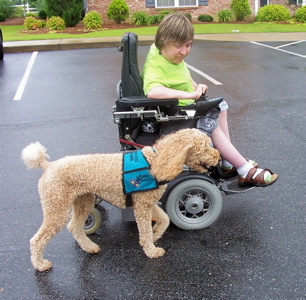
A service dog might be described as,
“any guide dog, signal dog, or other animal individually trained to do work or perform tasks for the benefit of an individual with a disability, including, but not limited to, guiding individuals with impaired vision, alerting individuals with impaired hearing to intruders or sounds, providing minimal protection or rescue work, pulling a wheelchair, or fetching dropped items.”
That definition is taken from the United States Code of Federal Regulations for the Americans with Disabilities Act of 1990!
Carrie and Lilly
But then cast your eye over this, as I mentioned, from the BBC on the 26th May, 2011.
Dogs can help reduce stress in parents of children with lifelong developmental disability autism, a study suggests.
The University of Lincoln compared 20 families with dogs with 20 without.
Daniel Mills told a Royal Society of Medicine conference early results suggested any breed could improve communication and relationships.
The veterinary behavioural medicine professor hopes to use video footage to show how dogs can improve child eating, sleeping and tantrum behaviour.
At a three-day Parents’ Autism Workshops and Support course, the families listed more than a thousand ways their dog had helped – from developing language and establishing a routine to using the pet to request action in a non-confrontational way.
Full story is here in which is included Professor Mills saying: “While there is no shortage of opinion on how dogs can help, there has been little money given to scientifically look into this.”
Autism is a challenging condition and anything that can establish a scientific underpinning for the role that dogs can have is to be welcomed whole-heartedly.
Finally, there are quite a few videos online that provide more information about the special, almost magical relationship between dogs and autistic people. Here’s one that is the first part of a series of five.
The powerful anti-democratic forces that will threaten civilisation.
In one sense this post today carries an underlying political message – and in another sense, it does not. It does in the sense that if every American voter truly understood the risks of a continued relationship with oil then the tar-sands projects wouldn’t have a prayer of a chance of being allowed.
In the other sense, it does not. Because the influence and power of ‘behind-the-scenes’ oil and money is beyond imagination and, just possibly, outside the reach of democracy.
So what’s got me so agitated?
Well first is that I have been quietly reading The Transition Handbook by Rob Hopkins, he of Transition Totnes fame. Most readers will be aware that Totnes was the first Transition Town in the world and started what is becoming the greatest social movement of the 21st century.
In Rob’s book, on page 51, there is a diagram showing the relative energy returns from the energy invested to produce that energy – hope that makes sense! Let me explain further. For example, for every unit of energy invested in building tidal-range generators, there are eighty-seven units of energy returned. I.e. this is a great investment for mankind in terms of the net benefit.
If we look at the generation of electricity from solar photo-voltaic (PV) panels then the return is about eight units from every unit invested.
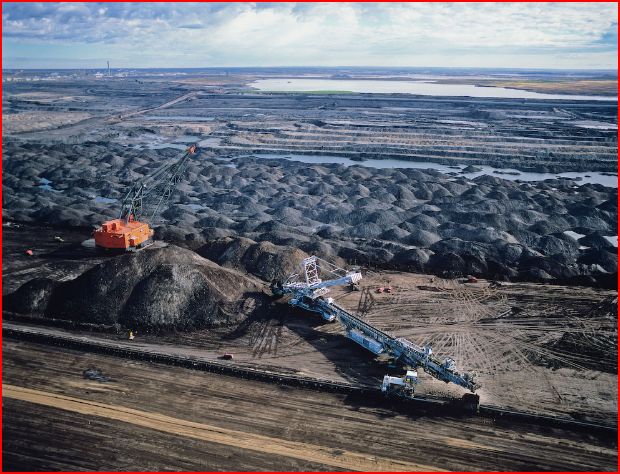
The worst return of them all is from Tar sands: just one unit returned from every unit invested. Investment and humanitarian madness!
Then next I came across this item about Tar sands on The Ecologist magazine website,
Emissions from tar sands seriously underestimated
Governments and companies making no effort to quantify the real climate impacts
Greenhouse gas emissions from tar sands operations are being significantly under-reported according to new research by Global Forest Watch Canada.
The report, ‘Bitumen and Biocarbon‘, says oil companies and governments are not accounting for emissions from deforestation. It says that when boreal forest is destroyed for tar sands development, significant amounts of greenhouse gases are emitted.
‘Governments and companies are working hard to downplay the impacts of tar sands operations, but it turns out that they don’t even know the full extent of the problem,’ said Christy Ferguson, Greenpeace climate and energy coordinator.
‘What’s worse, they’re doing nothing to find out. Denial is not a climate strategy.’
In addition, the report shows that biological carbon stored in living and decaying plants is lost when natural ecosystems are disturbed or destroyed through mining of bitumen and construction of roads, pipelines or facilities.
‘Peatlands are one of the world’s most important storehouses of soil carbon. Industrial activity in the tar sands is destroying peatlands, releasing carbon and eliminating a crucial natural mechanism.
‘Even if peatlands are reclaimed, the carbon released through industrialisation won’t be replaced for thousands of years,’ said Ferguson.
Finally, today (25th) I received in my in-box the latest TomDispatch offering. (I am indebted to Tom Engelhardt for, once again, giving me permission to reproduce in full this TomGram.)
Tom’s latest piece is written by Bill McKibben (with an introduction by Tom) and I strongly urge you to read it – the implications are global. If you read an earlier TomDispatch article by Bill re-published on Learning from Dogs on the 18th July, The Great American Carbon Bomb, today’s piece will surely make you sit up and fume; as it did me! Here it is in full.
Tomgram: Bill McKibben, Jailed Over Big Oil’s Attempt to Wreck the Planet
What might have happened if John McCain had won the presidency in 2008? One thing is certain: there would have been a lot more protest from Democrats, progressives, and the left. Take it as an irony of his election, but Barack Obama has proved remarkably effective in disarming the antiwar movement, even as the use of war in American policy in the Greater Middle East has only grown. That Obama, the supposed anti-warrior of the 2008 campaign, has paid less than no attention to his antiwar critics is no news at all. It’s now practically a cliché as well that he seems to feel no need to feed his political “base” and that, generally speaking (and explain it as you will), his base has not yet pushed back.
This has been particularly true of Obama’s wars, especially the disastrous, never-ending one in Afghanistan. Had Afghanistan been “McCain’s war,” you would surely have seen growing waves of protest, despite the way 9/11 ensured that the Afghan War, unlike the Iraq one, would long be the unassailable “good war.” Still, as American treasure surged into the ill-starred enterprise in Afghanistan, while funds for so much that mattered disappeared at home, I think the streets of Washington would have been filling. What protest there has been, as John Hanrahan of the Nieman Watchdog website reported recently, tends to be remarkably ill-covered in the mainstream media.
Obama, only two points ahead of Ron Paul in the latest Gallup Poll in the race for 2012, is a beyond-vulnerable candidate. (Somewhere there must be some Democratic pol doing the obvious math and considering a challenge, mustn’t there?) Fortunately, in another area at least as crucial as our wars, demonstrators against a Big Oil tar-sands pipeline from Canada that will help despoil the planet are now out in front of the White House — you can follow them here — and they haven’t been shy about aiming their nonviolent protests directly at Obama. Will he or won’t he act like the climate-change president that, on coming into office, he swore he would be? Time will tell. Meanwhile, let Bill McKibben, TomDispatch regular, an organizer of the protests, and just out of a jail cell, fill you in. Tom
Arrested at the White House
Acting as a Living Tribute to Martin Luther King
By Bill McKibben
I didn’t think it was possible, but my admiration for Martin Luther King, Jr., grew even stronger these past days.
As I headed to jail as part of the first wave of what is turning into the biggest civil disobedience action in the environmental movement for many years, I had the vague idea that I would write something. Not an epic like King’s “Letter from a Birmingham Jail,” but at least, you know, a blog post. Or a tweet.
Heros
But frankly, I wasn’t up to it. The police, surprised by how many people turned out on the first day of two weeks of protests at the White House, decided to teach us a lesson. As they told our legal team, they wanted to deter anyone else from coming — and so with our first crew they were… kind of harsh.
We spent three days in D.C.’s Central Cell Block, which is exactly as much fun as it sounds like it might be. You lie on a metal rack with no mattress or bedding and sweat in the high heat; the din is incessant; there’s one baloney sandwich with a cup of water every 12 hours.
I didn’t have a pencil — they wouldn’t even let me keep my wedding ring — but more important, I didn’t have the peace of mind to write something. It’s only now, out 12 hours and with a good night’s sleep under my belt, that I’m able to think straight. And so, as I said, I’ll go to this weekend’s big celebrations for the openingof the Martin Luther King Jr. National Memorial on the Washington Mall with even more respect for his calm power.
Preacher, speaker, writer under fire, but also tactician. He really understood the power of nonviolence, a power we’ve experienced in the last few days. When the police cracked down on us, the publicity it produced cemented two of the main purposes of our protest:
Eaarth
First, it made Keystone XL — the new, 1,700-mile-long pipeline we’re trying to block that will vastly increase the flow of “dirty” tar sands oil from Alberta, Canada, to the Gulf of Mexico — into a national issue. A few months ago, it was mainly people along the route of the prospective pipeline who were organizing against it. (And with good reason: tar sands mining has already wrecked huge swaths of native land in Alberta, and endangers farms, wild areas, and aquifers all along its prospective route.)
Now, however, people are coming to understand — as we hoped our demonstrations would highlight — that it poses a danger to the whole planet as well. After all, it’s the Earth’s second largest pool of carbon, and hence the second-largest potential source of global warming gases after the oil fields of Saudi Arabia. We’ve already plumbed those Saudi deserts. Now the question is: Will we do the same to the boreal forests of Canada. As NASA climatologist James Hansen has made all too clear, if we do so it’s “essentially game over for the climate.” That message is getting through. Witness the incredibly strong New York Times editorial opposing the building of the pipeline that I was handed on our release from jail.
Second, being arrested in front of the White House helped make it clearer that President Obama should be the focus of anti-pipeline activism. For once Congress isn’t in the picture. The situation couldn’t be simpler: the president, and the president alone, has the power either to sign the permit that would take the pipeline through the Midwest and down to Texas (with the usual set of disastrous oil spills to come) or block it.
Barack Obama has the power to stop it and no one in Congress or elsewhere can prevent him from doing so. That means — and again, it couldn’t be simpler — that the Keystone XL decision is the biggest environmental test for him between now and the next election. If he decides to stand up to the power of big oil, it will send a jolt through his political base, reminding the presently discouraged exactly why they were so enthused in 2008.
That’s why many of us were wearing our old campaign buttons when we went into the paddy wagon. We’d like to remember — and like the White House to remember, too — just why we knocked on all those doors.
But as Dr. King might have predicted, the message went deeper. As people gather in Washington for this weekend’s dedication of his monument, most will be talking about him as a great orator, a great moral leader. And of course he was that, but it’s easily forgotten what a great strategist he was as well, because he understood just how powerful a weapon nonviolence can be.
The police, who trust the logic of force, never quite seem to get this. When they arrested our group of 70 or so on the first day of our demonstrations, they decided to teach us a lesson by keeping us locked up extra long — strong treatment for a group of people peacefully standing on a sidewalk.
No surprise, it didn’t work. The next day an even bigger crowd showed up — and now, there are throngs of people who have signed up to be arrested every day until the protests end on September 3rd. Not only that, a judge threw out the charges against our first group, and so the police have backed off. For the moment, anyway, they’re not actually sending more protesters to jail, just booking and fining them.
And so the busload of ranchers coming from Nebraska, and the bio-fueled RV with the giant logo heading in from East Texas, and the flight of grandmothers arriving from Montana, and the tribal chiefs, and union leaders, and everyone else will keep pouring into D.C. We’ll all, I imagine, stop and pay tribute to Dr. King before or after we get arrested; it’s his lead, after all, that we’re following.
Our part in the weekend’s celebration is to act as a kind of living tribute. While people are up on the mall at the monument, we’ll be in the front of the White House, wearing handcuffs, making clear that civil disobedience is not just history in America.
We may not be facing the same dangers Dr. King did, but we’re getting some small sense of the kind of courage he and the rest of the civil rights movement had to display in their day — the courage to put your body where your beliefs are. It feels good.
So perhaps you understand why every American reading this should make sure your voice is heard. And in the last few minutes – 1.30pm MT 25th August – Reuters have just put out this news release,
Nation’s Leading Environmental NGOs Unified Against Tar Sands Pipeline
Update on Day 5 of Tar Sand Pipeline Protest at the White House
See past update and background.
275 people have been arrested so far and many have been released. Today, the largest environmental groups in the US joined to send a letter to President Obama voicing their unified opposition to the Keystone pipeline and asking him to block it.
Why is this important? “For those of us out there in front of the White House, the best thing about this ringing statement is that the administration won’t be able to play one group off against another by making small concessions here and there”; says protest organizer Bill McKibben.
“There’s only one way to demonstrate to the environmental base the rhetoric of Obama’s 2008 campaign is still meaningful – and that’s to veto this pipeline. Since he can do it without even consulting Congress, this is one case where we’ll be able to see exactly how willing he is to match the rhetoric of his 2008 campaign.”
The letter says:
Dear President Obama,
Many of the organizations we head do not engage in civil disobedience; some do. Regardless, speaking as individuals, we want to let you know that there is not an inch of daylight between our policy position on the Keystone Pipeline and those of the very civil protesters being arrested daily outside the White House.
This is a terrible project – many of the country’s leading climate scientists have explained why in their letter last month to you. It risks many of our national treasures to leaks and spills. And it reduces incentives to make the transition to job-creating clean fuels.
You have a clear shot to deny the permit, without any interference from Congress. It’s perhaps the biggest climate test you face between now and the election.
If you block it, you will trigger a surge of enthusiasm from the green base that supported you so strongly in the last election. We expect nothing less.
Sincerely,
Fred Krupp, Environmental Defense Fund
Michael Brune, Sierra Club
Frances Beinecke, Natural Resources Defense Council
Phil Radford, Greenpeace
Larry Schweiger, National Wildlife Federation Erich Pica, Friends of the Earth
Rebecca Tarbotton, Rainforest Action Network
May Boeve, 350.org
Gene Karpinski, League of Conservation Voters
Margie Alt, Environment America
New York Times Also Opposes Pipeline
In an August 21 editorial, the NY Times took a opposition against the pipeline, citing two main concerns: the risk of oil spills along the pipeline, which would traverse highly sensitive terrain, and the fact that the extraction of petroleum from tar sands creates far more greenhouse emissions than conventional production does.
Building the pipeline would clear the way for Canada to double tar sands production over the next decade to more than 1.8 million barrels a day. To do that, some 740,000 acres of boreal forest – a natural carbon reservoir – would be destroyed.
In addition to the emissions produced by tar sands extraction, would be emissions from the loss of this vast, crucial carbon sink, [editor’s note: not to mention the biodiversity it harbors.] Read the editorial:
Website: here with permission from Sustainable Business
A chance email from Dan G. opens up a whole treasure trove.
Here’s what Dan sent to me,
True Friends
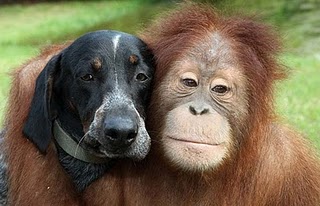
After losing his parents, this 3 year old orangutan was so depressed he wouldn’t eat and didn’t respond to any medical treatments. The veterinarians thought he would surely die from sadness. The zoo keepers found an old sick dog on the grounds in the park at the zoo where the orangutan lived and took the dog to the animal treatment center. The dog arrived at the same time the orangutan was there being treated. The 2 lost souls met and have been inseparable ever since.
The orangutan found a new reason to live and each always tries his best to be a good companion to his new found friend. They are together 24 hours a day in all their activities.
Roscoe and Surya
They live in Northern California where swimming is their favorite past time, although Roscoe (the orangutan) is a little afraid of the water and needs his friend’s help to swim.
Roscoe and SuryaRoscoe and Surya
Together they have discovered the joy and laughter in life and the value of friendship.
Roscoe and SuryaRoscoe and Surya
They have found more than a friendly shoulder to lean on.
Roscoe and SuryaLove across the species boundary
Long Live Friendship!!!!!!!
I don’t know……some say life is too short, others say it is too long, but I know that nothing that we do makes sense if we don’t touch the hearts of others…….while it lasts!
So after I had seen the pictures above, it was pretty easy to find this YouTube video.
Then if that wasn’t amazing and wonderful, try this,
Well that’s enough for today. But tomorrow, I will continue with Part Two which recounts the amazing year that Joe Hutto spent in the Florida wildlands with ….. (you’ll have to wait for tomorrow!)
Yesterday, I wrote about the fabulous success of the British otter having gone from the crumbling edge of extinction to now being found in every English county.
For something completely different, and I do mean completely, have a read of this item that appeared in the British Guardian newspaper of the 18th August.
Aliens may destroy humanity to protect other civilisations, say scientists
Rising greenhouse emissions could tip off aliens that we are a rapidly expanding threat, warns a report
It may not rank as the most compelling reason to curb greenhouse gases, but reducing our emissions might just save humanity from a pre-emptive alien attack, scientists claim.
Watching from afar, extraterrestrial beings might view changes in Earth’s atmosphere as symptomatic of a civilisation growing out of control – and take drastic action to keep us from becoming a more serious threat, the researchers explain.
This highly speculative scenario is one of several described by a Nasa-affiliated scientist and colleagues at Pennsylvania State University that, while considered unlikely, they say could play out were humans and alien life to make contact at some point in the future.
Shawn Domagal-Goldman of Nasa’s Planetary Science Division and his colleagues compiled a list of plausible outcomes that could unfold in the aftermath of a close encounter, to help humanity “prepare for actual contact”.
Beneficial encounters ranged from the mere detection of extraterrestrial intelligence (ETI), for example through the interception of alien broadcasts, to contact with cooperative organisms that help us advance our knowledge and solve global problems such as hunger, poverty and disease.
Another beneficial outcome the authors entertain sees humanity triumph over a more powerful alien aggressor, or even being saved by a second group of ETs. “In these scenarios, humanity benefits not only from the major moral victory of having defeated a daunting rival, but also from the opportunity to reverse-engineer ETI technology,” the authors write.
Other kinds of close encounter may be less rewarding and leave much of human society feeling indifferent towards alien life. The extraterrestrials may be too different from us to communicate with usefully. They might invite humanity to join the “Galactic Club” only for the entry requirements to be too bureaucratic and tedious for humans to bother with. They could even become a nuisance, like the stranded, prawn-like creatures that are kept in a refugee camp in the 2009 South African movie, District 9, the report explains.
The most unappealing outcomes would arise if extraterrestrials caused harm to humanity, even if by accident. While aliens may arrive to eat, enslave or attack us, the report adds that people might also suffer from being physically crushed or by contracting diseases carried by the visitors. In especially unfortunate incidents, humanity could be wiped out when a more advanced civilisation accidentally unleashes an unfriendly artificial intelligence, or performs a catastrophic physics experiment that renders a portion of the galaxy uninhabitable.
To bolster humanity’s chances of survival, the researchers call for caution in sending signals into space, and in particular warn against broadcasting information about our biological make-up, which could be used to manufacture weapons that target humans. Instead, any contact with ETs should be limited to mathematical discourse “until we have a better idea of the type of ETI we are dealing with.”
The authors warn that extraterrestrials may be wary of civilisations that expand very rapidly, as these may be prone to destroy other life as they grow, just as humans have pushed species to extinction on Earth. In the most extreme scenario, aliens might choose to destroy humanity to protect other civilisations.
“A preemptive strike would be particularly likely in the early phases of our expansion because a civilisation may become increasingly difficult to destroy as it continues to expand. Humanity may just now be entering the period in which its rapid civilisational expansion could be detected by an ETI because our expansion is changing the composition of the Earth’s atmosphere, via greenhouse gas emissions,” the report states.
“Green” aliens might object to the environmental damage humans have caused on Earth and wipe us out to save the planet. “These scenarios give us reason to limit our growth and reduce our impact on global ecosystems. It would be particularly important for us to limit our emissions of greenhouse gases, since atmospheric composition can be observed from other planets,” the authors write.
Even if we never make contact with extraterrestrials, the report argues that considering the potential scenarios may help to plot the future path of human civilisation, avoid collapse and achieve long-term survival.
I am bound to say that if Mr Domagal-Goldman and his colleagues believe that spending time and money on the possible outcomes of contact with extraterrestrials is a good idea in these present times then I am minded about those other visitors from outer space who passed Planet Earth by because there were no signs of intelligent life!
Stray dogs demonstrate remarkable skills at staying alive.
Before I start, a big word of thanks to Paul Gilding who passed this story to me. Apart from reading Paul’s powerful book, The Great Disruption, and exchanging a couple of emails, he doesn’t know me from Adam. But the fact that this undoubtedly busy man (his book has been a great success) not only responded to an earlier email from me and then dropped me a note to say that I might enjoy the following article, says a great deal about the integrity of the person.
The article, from the website The Dog Files, is about Moscow’s stray dogs. I’m taking the liberty of reproducing it in full.
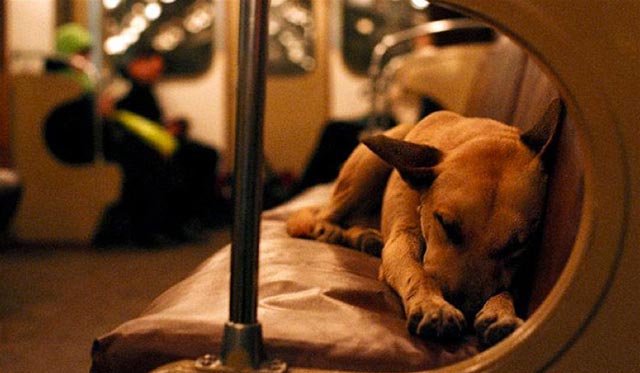
Each morning, like clockwork, they board the subway, off to begin their daily routine amidst the hustle and bustle of the city.
But these aren’t just any daily commuters. These are stray dogs who live in the outskirts of Moscow Russia and commute on the underground trains to and from the city centre in search of food scraps.
Then after a hard day scavenging and begging on the streets, they hop back on the train and return to the suburbs where they spend the night.
Experts studying the dogs, who usually choose the quietest carriages at the front and back of the train, say they even work together to make sure they get off at the right stop – after learning to judge the length of time they need to spend on the train.
Scientists believe this phenomenon began after the Soviet Union collapsed in the 1990s, and Russia’s new capitalists moved industrial complexes from the city centre to the suburbs.
Dr Andrei Poiarkov, of the Moscow Ecology and Evolution Institute, said: “These complexes were used by homeless dogs as shelters, so the dogs had to move together with their houses. Because the best scavenging for food is in the city centre, the dogs had to learn how to travel on the subway – to get to the centre in the morning, then back home in the evening, just like people.”
Dr Poiarkov told how the dogs like to play during their daily commute. He said: “They jump on the train seconds before the doors shut, risking their tails getting jammed. They do it for fun. And sometimes they fall asleep and get off at the wrong stop.”
The dogs have also amazingly learned to use traffic lights to cross the road safely, said Dr Poiarkov. And they use cunning tactics to obtain tasty morsels of shawarma, a kebab-like snack popular in Moscow.
With children the dogs “play cute” by putting their heads on youngsters’ knees and staring pleadingly into their eyes to win sympathy – and scraps.
Dr Poiarkov added: “Dogs are surprisingly good psychologists.”
Now had this been a normal day then I would have had the time to complete this story about the tenacity of dogs. But a failed wireless modem earlier today (Thursday) meant the loss of too many hours fighting technology. It was all sorted just a little before 5pm. It is now 6.15 pm and dinner is ready and, frankly, my brain is too tired to continue.
So stay with this fascinating story about stray dogs as I continue it tomorrow (Saturday, 20th.).
Being in the present is the key message that we can learn from dogs. Why is this so important?
‘Drink your tea slowly and reverently, as if it is the axis
on which the world earth revolves – slowly, evenly, without
rushing toward the future. Live the actual moment. Only this moment is life.’ ~Thich Nhat Hanh
[my blue emboldening]
Unlike Jon, I muse as an ‘amateur’ when I sense that the human psyche is attracted to fear. I use that word ‘attracted’ simply because some stimuli that touch our consciousness seem to have more force than others. Ergo, the response to the simple question of asking someone how they are, is likely to me more engaging if they come up with some form of crisis reply than by saying, “Everything’s fine, thanks!” Look at how the news media use the power of fear to capture our attention.
There is a strong biological explanation for this. From the Science daily website,
The amygdala (Latin, corpus amygdaloideum) is an almond-shape set of neurons located deep in the brain’s medial temporal lobe. Shown to play a key role in the processing of emotions, the amygdala forms part of the limbic system.
In humans and other animals, this subcortical brain structure is linked to both fear responses and pleasure. Its size is positively correlated with aggressive behaviour across species. In humans, it is the most sexually-dimorphic brain structure, and shrinks by more than 30% in males upon castration.
Conditions such as anxiety, autism, depression, post-traumatic stress disorder, and phobias are suspected of being linked to abnormal functioning of the amygdala, owing to damage, developmental problems, or neurotransmitter imbalance.
For more information about the topic Amygdala, read the full article at Wikipedia.org
I am going to get to the point of this article but stay with me a little longer. Let’s look some more at the ‘fight or flight’ aspect of our brains. From the website, How Stuff Works,
It’s dark out, and you’re home alone. The house is quiet other than the sound of the show you’re watching on TV. You see it and hear it at the same time: The front door is suddenly thrown against the door frame. Your breathing speeds up. Your heart races. Your muscles tighten.
An instant later, you know it’s the wind. No one is trying to get into your home.
For a split second, you were so afraid that you reacted as if your life were in danger, your body initiating the fight-or-flight response that is critical to any animal’s survival. But really, there was no danger at all. What happened to cause such an intense reaction? What exactly is fear? In this article, we’ll examine the psychological and physical properties of fear, find out what causes a fear response and look at some ways you can defeat it.
What is Fear?
Fear is a chain reaction in the brain that starts with a stressful stimulus and ends with the release of chemicals that cause a racing heart, fast breathing and energized muscles, among other things, also known as the fight-or-flight response. The stimulus could be a spider, a knife at your throat, an auditorium full of people waiting for you to speak or the sudden thud of your front door against the door frame.
The brain is a profoundly complex organ. More than 100 billion nerve cells comprise an intricate network of communications that is the starting point of everything we sense, think and do. Some of these communications lead to conscious thought and action, while others produce autonomic responses. The fear response is almost entirely autonomic: We don’t consciously trigger it or even know what’s going on until it has run its course.
Because cells in the brain are constantly transferring information and triggering responses, there are dozens of areas of the brain at least peripherally involved in fear. But research has discovered that certain parts of the brain play central roles in the process:
Thalamus – decides where to send incoming sensory data (from eyes, ears, mouth, skin)
Sensory cortex – interprets sensory data
Hippocampus – stores and retrieves conscious memories; processes sets of stimuli to establish context
Amygdala – decodes emotions; determines possible threat; stores fear memories
Hypothalamus – activates “fight or flight” response
Now I originally called this article Present Perfect but WordPress quickly indicated that the title had already been used. Once again, the old memory cells are failing me! In fact the post of the name Present Perfect was published on the 8th June, just a couple of months ago. Glad that I was reminded because from that article in June,
Did you see Mr. Holland’s Opus? About Glenn Holland’s lifetime of teaching music to a high school band. In one scene he is giving a private lesson to Gertrude. She is playing clarinet, making noises that can only be described as other-worldly. He is clearly frustrated. As is she. Finally Mr. Holland says, “Let me ask you a question. When you look in the mirror what do you like best about yourself?”
“My hair,” says Gertrude.
“Why?”
“Well, my father always says that it reminds him of the sunset.”
After a pause, Mr. Holland says, “Okay. Close your eyes this time. And play the sunset.”
And from her clarinet? Music. Sweet music.
Sometime today, I invite you to set aside the manual, or the list, or the prescription.
Take a Sabbath moment. . . close your eyes and play the sunset.
Mary Oliver describes such a moment this way, “. . .a seizure of happiness. Time seemed to vanish. Urgency vanished.”
Because, in such a moment, we are in, quite literally, a State of Grace. In other words, what we experience here is not as a means to anything else.
If I am to focused on evaluating, I cannot bask in the moment.
If I am measuring and weighing, I cannot marvel at little miracles.
If I am anticipating a payoff, I cannot give thanks for simple pleasures.
If I am feeling guilty about not hearing or living the music, I cannot luxuriate in the wonders of the day.
Beautiful thoughts all woven around the power of focusing on the moment (if you want to catch up on the full article it is here).
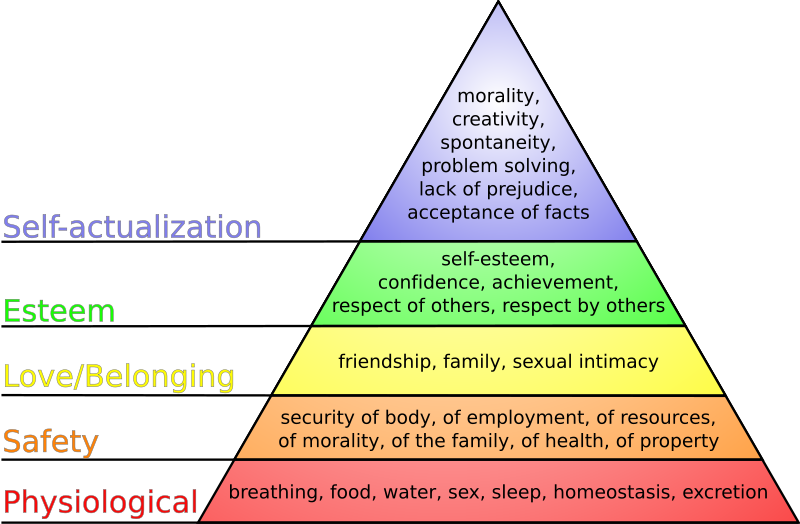
Jon’s article last Monday was all about the way forward in a positive, well-being sense. In that article Jon showed the Maslow Hierarchy of Needs pyramid. It’s reproduced again below; spend a few moments absorbing the nature and sense of each level in that hierarchy.
Now ponder on that fear – ‘fight or flight’ – response. Most likely it’s going to be initiated in the ‘Safety’ level but flick straight down one level to the ‘Physiological’ layer. All very primitive stuff and utterly out of our control! Remember from the extract above, “The fear response is almost entirely autonomic.”
Even modest amounts of these fear responses is very wearying, very unsettling. Remember Jon touched on that when he wrote,
The point I’m trying to make is that the same panic I notice in many of the companies I work in, and in me, is based on fear of the unknown and on a lack of trust in all its forms. I’ve deliberately underlined that last phrase because it is so incredibly important. The truth is that we get more of what we focus on. So we can choose to focus on the constant news of more difficulties, hardship and redundancies, or we can focus on what is working.
So because our fear response is entirely autonomic and because there is so much out there, all around us, pulling those autonomic strings we have to actively, quite deliberately, do what dogs (and many other animals) do quite naturally. We deliberately have to focus on spending time being in the present!
There was a recent piece from Leo Babauta about being in the present. While he doesn’t touch on the underlying biology of why we humans are so ‘attracted’ to fear, he does offer some excellent advice about being in the present.
No matter how out-of-control your day is, no matter how stressful your job or life becomes, the act of being present can become an oasis. It can change your life, and it’s incredibly simple.
Look at Lorraine’s website (a recent visitor to Learning from Dogs). In particular this piece, from which I quote,
3. The Serenity Prayer – all about accepting the things I cannot change and changing the things I can.
4. People are always more important than things. Things can mostly be replaced but people cannot.
5. Do it now – if there is something to be done, then what is stopping me from doing it straight away?
6. If I appreciate and look after what I have now, there will be a positive flow back to me in the future. If I am neglectful and ungrateful with what I have now, I cannot expect to be rewarded with more in the future.
7. Be quiet and keep breathing – no one will know how crazy I feel inside
8. Don’t hold on to people or things too tightly. Be open to letting go and letting be.
9. It is really important to let others know that I love them. They need to know now and often. Love isn’t just a beautiful feeling – show it by how I act and speak with those I love.
10. I can’t make anyone love me and I can’t fix anyone by loving them. I may have a script for how life should be but I have no control over other people, places or things. Go with the flow and accept what is.
(The blue emboldening is mine – highlighting the power of now.)
Grandson Morten - peace in the present
“Live the actual moment. Only this moment is life.”
A big vote of thanks to Paul for plugging away for so long without any contribution from me. Unlike Paul who is retired, well retired in the sense of a paying job, I have a family, a dog (Jess) and the usual set of household overheads to cover, so the week is very much a working week for me. Ergo, I shall never be able to contribute to Learning from Dogs in the same manner as Paul but a regular contribution is assured. To get things rolling again, I want to re-publish an article that I wrote on my business blog the other day.
Removing the fear of the unknown
Seeing the light
I’ve been working with most of my clients recently through painful transformations brought about by the economic downturn.
An interesting metaphor really because since the first wave of uncertainty triggered panic, first noticed in the UK banking system, I have been picking up on that uncertainty that feels like it’s stalking the globe and has been for some time. Recent stock market crashes have simply exacerbated this and that, coupled with the riots taking place in major cities in the UK, make for pretty disturbing reading.
Interestingly, I, too, have been aware of an underlying fear that was difficult either to name or source.
It has been rather like a deep river in that whilst the surface feels slow-moving, currents are moving things powerfully below.
So this ‘fear’ has caused a few household changes.
1) We now are the proud owners of 12 chickens. Our youngest son and I have dug up the back lawn and planted vegetables and built a poly tunnel.
2) We have also installed a wood burning cooker. Right back down to the base of Maslow’s triangle really!
Maslow's triangle of needs
These feelings have brought about such change everywhere and I wonder seriously whether we will ever return to what was; indeed would we want to?
I might not have mentioned it in previous blogs but as well as an engineering background, in latter years, I have focused on how success in business is linked directly to aspects of relationships and how we are in our relationships with others, so things like integrity, self-awareness and the ability to see the point of view of others, and modify our approach appropriately.
To inform this, some 7 years ago, I embarked on an MA in Core Process Psychotherapy, primarily to work on myself so that I could be the best I could be in my relationships, in and out of work.
The point I’m trying to make is that the same panic I notice in many of the companies I work in, and in me, is based on fear of the unknown and on a lack of trust in all its forms. I’ve deliberately underlined that last phrase because it is so incredibly important.
The truth is that we get more of what we focus on.
So we can choose to focus on the constant news of more difficulties, hardship and redundancies, or we can focus on what is working.
In the workplace this positive focus has been pulling people together across functions and sites and pooling resources and ideas.
When we realise we’re not doing this alone it’s amazing how much lighter a load can feel and how much more inspired we all feel.
I also notice how humour begins to flow and what a powerful antidote for doom and gloom that is.
Transformation is never easy but the rewards far exceed the effort put in ten fold.
So what is it going to be? Are we all going to bow down to the god of Doom & Gloom, fear and anxiety, heaping more and more gifts around it, or are we going to start noticing and focusing on the other neglected god – that of relationship, joy, trust, abundance and lightness?
Whatever the future holds for us all a belief in our inherent ability to adapt and change and focus on the greater good rather than fear, anxiety, greed and selfishness is the only sustainable way forward.
My fellow author, Jon, returns from a long journey into the interior!
Fellow author, Jon.
If you look at the right-hand margin of Learning from Dogs, you will see that under the label Founding Authors there are two names! Over the past months Jon, as many of you may have noticed, has been absent. Indeed, Jon’s last Post on this Blog was on the 2nd January.
Jon’s absence has simply been the result of the total focus that was required to complete his Masters degree in Core Process Psychotherapy, thus adding another string to an already very professional bow. That focus included the writing of an extremely challenging thesis, all 16,000 words, then the total re-write of that thesis! That is now all behind Jon!
So from next week, Jon will be participating again on Learning from Dogs with his unique blend of professional and personal experiences. Indeed, one might argue that the challenges that face our global society need, more than ever, the insight and wisdom of such people. Am I biased? Yes, deeply so!
In the early part of 2007 I drew heavily on Jon’s expertise as I tried to make sense of what, at the time, was a deeply traumatic period. The testament to that relationship with Jon was a greater self-awareness and contentment than I had ever known and, subsequently in December 2007, me meeting Jeannie in Mexico and our ultimate marriage and new home in Payson, Arizona. As outcomes go, it doesn’t get better than that!
Back to that last article from Jon. In it he wrote,
Plus I did want to expand, just a touch, on what Paul wrote yesterday, more or less reflecting on an article by Leo Babauta. In that post, Paul quoted Leo writing:
The thing I’ve learned, and it’s not some new truth but an old one that took me much too long to learn, is that if you learn to be content with who you are and where you are in life, it changes everything.
In a very real sense what Leo is saying is that if you don’t love yourself you can’t possibly ‘love’ the world around you. Now this is incredibly easy to consider, too easy in fact, because the truth of loving oneself first is, for the vast majority of people, a complex, confusing and unclear journey, as in ‘self-journey’. Read that quote from Leo again and see how he writes, ‘an old one [as in truth] that took me much too long to learn‘.
I’m sure when Leo writes ‘too long to learn‘ he is, in effect, acknowledging the very individual circumstances that lead to a person developing the awareness that is expressed in that quote ‘if you learn to be content with who you are and where you are in life, it changes everything‘.
So if 2011 is going to be a challenging year then hang on to the only rock in your life – yourself! Embrace the reality that you, like all of us, do your best. Be good and kind to you.
“So if 2011 is going to be a challenging year then hang on to the only rock in your life – yourself! Embrace the reality that you, like all of us, do your best. Be good and kind to you.”
So to each and every one of you reading this, be good and kind to you!
Welcome back Jon.
Back of every creation, supporting it like an arch, is faith. Enthusiasm is nothing: it comes and goes.
But if one believes, then miracles occur. Henry Miller
For a number of reasons, both private and public, I have not been feeling as creative as normal these last 24 hours. What I am conscious of is that events of this week, from the riots in the UK, the chaos of financial markets, right through to the death of our dog Tess have all contributed to a mental heaviness.
So I am taking a small creative short-cut, as it were, by writing about a film that we watched on Monday night; Fierce Light.
There is a trailer on YouTube. This is how it is presented,
A Feature Documentary By Velcrow Ripper
From the Director of Scared Sacred & The Producer of The Corporation
“Fierce Light” is a feature documentary that captures the exciting movement of Spiritual Activism that is exploding around the planet, and the powerful personalities that are igniting it.
Fueled by the belief that “another world is possible,” the film portrays stories of what Martin Luther King called “Love in Action,” and Gandhi called “Soul Force”; what Ripper is calling “Fierce Light.” Acclaimed filmmaker Velcrow Ripper (Scared Sacred) takes an insightful look at change motivated by love, featuring interviews with spiritual activists Thich Nhat Hanh, Desmond Tutu, Daryl Hannah, Julia Butterfly Hill, and more.
If you would like to sink a little deeper into the film and what the motivations are behind the making of it, then do go to the web site Fierce Light.
Jean and I found the film inspiring and beautifully presented. It came over as a film that seriously approached the topic of human consciousness and gave plenty of opportunity to reflect on some of the many forces within our societies at this present time.
Then you may like to watch this talk by the Director, Velcrow Ripper (actually born Steve Ripper in 1963), broken into two parts as follows,
The film and this talk by Mr. Ripper both date back to 2009 so, in the light of where we are in August 2011, they are proving to be extremely relevant.