Category: Morality

E Pluribus Unum

From Many, One.

There were a great number of ‘Likes’ for John Hurlburt’s writings which were published most recently on the 1st March, Making sense of life? and on the 25th February, Fear versus Faith.

So it is with very great pleasure that I pass the baton for today’s post once more across to John.

oooOOOooo

E Pluribus Unum

We know we’re in trouble when we no longer pay serious attention to the weather, the foundations of our economy are imaginary, our pumps don’t work because our wells are running dry.  Then how we distract ourselves and loudly complain more often than we make a honest effort to maintain our balance and understand our inclusive situation.

We know we’re in trouble when we’ve moved into the rut of a manufactured illusion and furnished it, when we consume more than we produce, when equality has become a dirty word, when we believe that more guns reduce gun violence, when contempt of Congress has become a national pastime and when our supreme court has become a corporate political tool.

We know we’re in trouble when we fund both sides of a global oil war and neglect the needs of our war veterans, when we believe that we can adapt to change by standing still, when we’ve taken the culture out of agriculture, when we wage cyber war against our planetary neighbors, when an obsessive focus on money systemically corrupts our world and when democracy has a price tag.

We know we’re in trouble when there is virulent opposition to change, when a corporate backed element of our civilization insists upon obfuscation denial and obstruction, when ignorance has become more common than common sense, when a global religious faith and a major university are fractured by inappropriate physical conduct with children in the name of God and sports respectively, and when our primary purpose appears to be to consume our planet as cost effectively as practicable.

We know we’re in trouble when our rivers run dry, when our food is laced with pesticide residues, when our air is contaminated by fuel and chemical waste products, when living species are becoming extinct from the bottom of the food chain and up at a rapidly increasing rate, when we chose to ignore the realities of our natural condition as transitory inhabitants of a living planet and when we arrogantly choose to believe that we own planet earth either as a species or as individual members of a species.

We know that we’re in trouble when free speech is thought to include an unbalanced right to be aggressively ignorant, intolerant and uncompassionate despite all facts to the contrary, when we no longer believe in simple science and arithmetic and when we concentrate on undoing social issues which have been resolved in our lifetimes rather than honestly facing the confluence of problems we all share.

We know we’re in trouble when our politics are more about posturing than policy, when prisons have become a growth industry, when levels of state secrecy exceed open disclosure, when justice has a price tag, when bigotry is stronger than progress, when education is based upon opinion rather than fact and when one nation under God, with liberty and justice for all, has become a fractured nation with a dysfunctional government.

We know we’re in trouble when our legislatures have been purchased, when faith in our financial system has been willfully damaged, when political leaders engage in childish tantrums to get their way regardless of anything or anyone else, when awareness of moral reality has become meaningless and when we fail to appreciate the depths of a looming abyss. What do we gain by purposefully destabilizing our economy, reopening settled social issues and blatantly risking our inclusive future as a species for a mess of pottage?  Who do we think we are?

We know we’re on the right track when nature is more important to us than profit, when open mindedness is stronger than private interests, when media reports facts rather than conjecture and when freedom of speech is not taken to wretched excess as a psychological tool of cultural management employed for the exclusive benefit of an affluent minority.

We know we’re on the right track when our faith in power greater than our species is more significant than short-term profit, when we create equitable employment which benefits our environment, when we repair our crumbling infrastructure, when we make an effort to improve our inclusive quality of life, when war is no longer a first remedy for misunderstanding or disagreement and when we make an effort to reverse our established patterns of self destruction.

We know we’re on the right track when we tax our world stock markets because of our need for revenue based upon the fact that market trades are the only major form of financial transaction that remains untaxed, when we cultivate our cities and towns based on biological needs for clean air, water, food, and energy and when we begin to recognize the massive burden which world population growth places on our planet and take steps to balance our birth rate accordingly.

We know we’re on the right track when we realize that algae based bio-fuel will run every diesel engine in the world without modification, when we realize that our future must be beyond the earth and when we take further steps beyond our garden cradle on a journey of exploration to the stuff of the stars from which our life on earth emerges.

Change is a constant. Today is the tomorrow we dreamed of yesterday. We know we’re growing as a consciously aware life form when our faith is stronger than our fear, when we trust each other to do the next right thing and when the nature of the energy of our spiritual being is more important to us than the immediate comforts of our transitory material being. One day at a time. In God we trust.

Happy trails,

an old lamplighter

Go on, adopt a dog!

A delightful example of a dog teaching a puppy.

(Watched over 3,100,000 times!)

Published on Dec 26, 2012

If you would like to donate to Manitoba Mutts Dog Rescue in Winnipeg, MB please go here.

Our 6 month old lab mix rescue pup taught our 8 week old foster pup (adopted now) from Manitoba Mutts Dog Rescue in Winnipeg to go down the stairs once she got up and couldn’t get down! Please adopt and do not shop. This video is hoping to spread awareness to adopt a dog rather than shop around for one.

Rescue animals are just as great, if not more!

Please search your area for local rescues if you are looking for a dog or cat. These lovely pups are from Manitoba Mutts Dog Rescue in Winnipeg, Manitoba, Canada.

Walking Away from Empire; a book review

“Once you eliminate the impossible, whatever remains, no matter how improbable, must be the truth.” Arthur Conan Doyle.

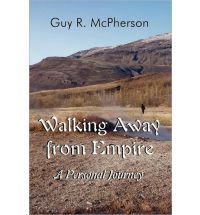
Ten days ago, I finished reading the book Walking Away from Empire: A Personal Journey. It had been sent to me by the author.

Let me explain how this came about.

A few weeks ago, I published an item under the title of Doggedly seeking the truth.  I included the video “The Twin Sides of the Fossil-Fuel Coin: Developing Durable Living Arrangements in Light of Climate Change and Energy Decline.“  That video was a presentation by Prof. Guy McPherson.

Subsequently, during an exchange of emails with Prof. McPherson there was an offer to receive a free copy of his book, Walking Away from Empire: A Personal Journey.  Naturally, I accepted.

Having finished reading the book it seemed only fair to write a review.

So far, so good!

I tried to marshal my thoughts for well over a week.   Couldn’t get started.  Strange, because when immersed in the book the messages were crystal clear.

Why the struggle to embrace Guy McPherson’s messages?  Then in a moment of insight I realised that I was struggling to understand why I was struggling!

walkingaway
Published by PublishAmerica, LLLP

Because the blunt truth of the matter is that this book spells out the bleedin’ obvious.  Humanity is between a rock and a hard place!

Look no further than the very first paragraph of the first chapter, Reason,:

At this late juncture in the era of industry, it seems safe to assume we face one of two futures. If we continue to burn fossil fuels, we face imminent environmental collapse. If we cease burning fossil fuels, the industrial economy will collapse. Industrial humans express these futures as a choice between your money or your life, and tell you that, without money, life isn’t worth living. As should be clear by now, industrial humans — or at least our “leaders” — have chosen not door number one (environmental collapse) and not door number two (economic collapse), but both of the above.

Sandy Krolick of Transition Voice wrote a review of Guy McPherson’s book in September, 2011.  His last sentence was, “This is a book you will not put down; and having read it, you’ll no longer be able to ignore its conclusions.

Again, what Sandy Krolick writes is perfectly correct. No argument.  Yet …. something about that sentence from Sandy doesn’t speak to me.  That struggle again.

Then I got it!

Let me go straight to page 177 of Prof. McPherson’s book and quote this:

It’s no longer just the living planet we should be concerned about. It’s us. The moral question, then: What are you going to do about it?

Then one paragraph later, come this:

There is simply no feeding the hollow spot in my gut and my psyche, as there was when I replaced my invisible, omnipotent friend in the sky with reason. Instead of abandoning the mirage of eternal life, I’m abandoning the mirage of globalization. Instead of giving up an everloving god, I’m giving up a comfortable life spent with my best friend. I’m taking yet another step in the path from make-believe to reality. And, as we all know, reality is a harsh, dispassionate mistress who doesn’t give a damn about the emptiness in my fragile little psyche. Fortunately, I still have the amusing memories of the absurdity of my former life, in which I believed I was saving the world by conducting and publishing mundane research and teaching irrelevant concepts to a largely disinterested audience.

I found the first step to be the most difficult. Simply recognizing the industrial economy as an omnicidal imperial beast forced me to cross a threshold most people find far too formidable to attempt.

Just reflect on those key words, “a threshold most people find far too formidable to attempt.”

Keep those words in mind as I quote the next paragraph from the book.

We’ve never been here as a species, much less as individuals. And every cultural message tells us we’re wrong, that the industrial age will last forever, that justice and goodness will prevail over every enemy (i.e., terrorist), that progress is a one-way street to industrial nirvana, that the harbinger of hope will keep the oil coming and the cars running and the planes flying so we can all soak up the sun on a sandy beach any time we need a break from our tumultuous lives in the cube farms of empire.

This, then, was the result of reading the book.  The realisation of the reality of our existence.  The immensity of the truth of where mankind is.  The here and NOW!

Sorry, let me amend those last sentences.  My realisation of the reality of my existence.  The immensity of the truth of where I am.  My here and NOW!

No wonder I struggled.

So not much of a book review, more a review of yours truly!  That is the power of this book.  Sandy Krolick was right; “This is a book you will not put down; and having read it, you’ll no longer be able to ignore its conclusions.

Be warned.  When you read this book brace yourself for what you see staring out of the mirror back at you. There will be no room left for delusion.

As Carl Sagan said, “It is far  better to grasp the universe as it really is than to persist in delusion, however satisfying and reassuring.

Soldier saviour.

This beautiful story recently sent to me from Cynthia.

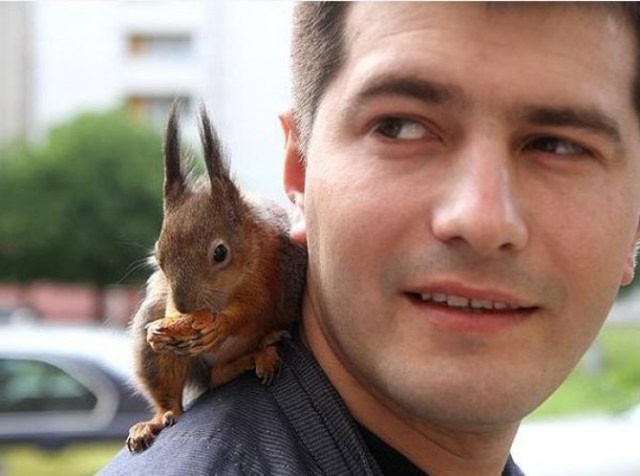
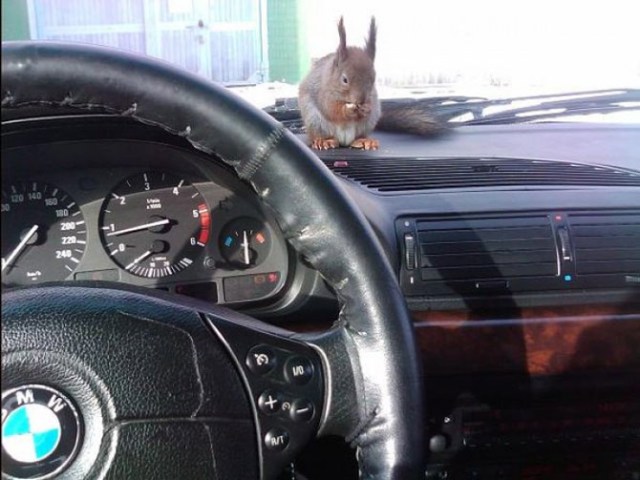
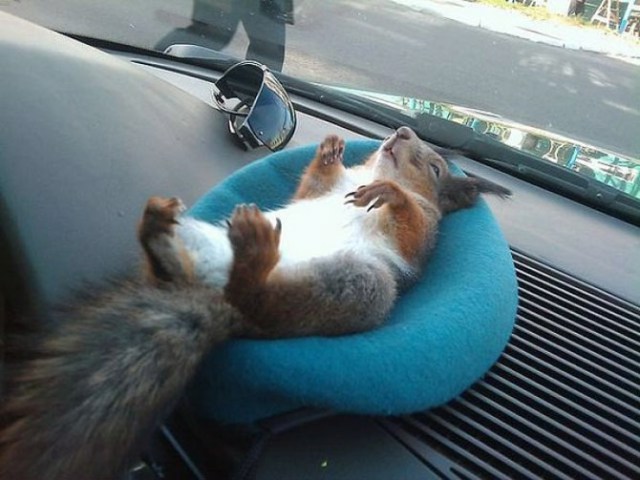
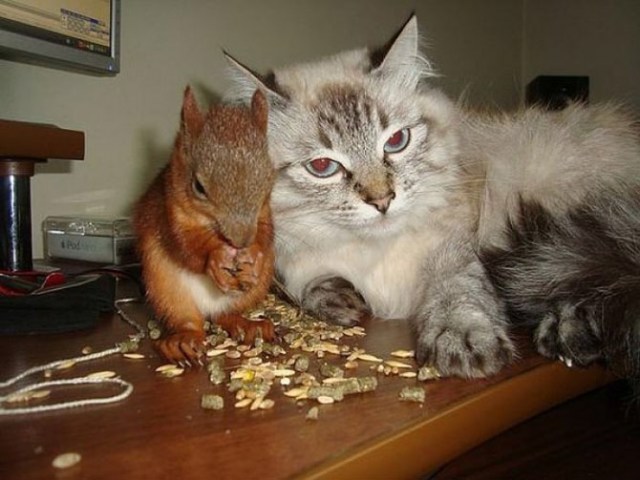
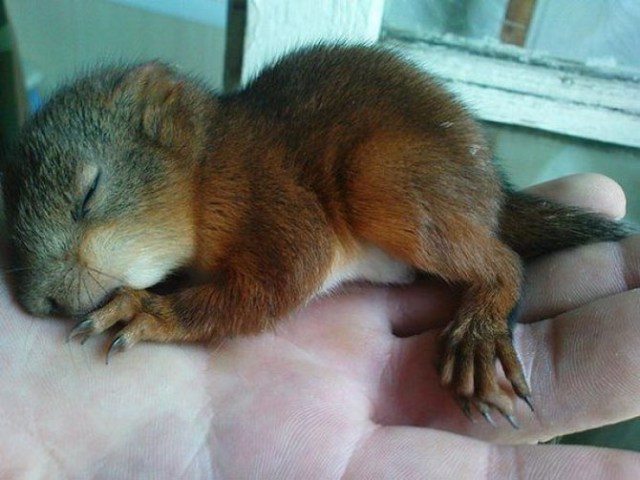
Soldiers in Belarus found a little squirrel and brought it to their Warrant Officer. The squirrel was very weak and close to death. Remarkably, the officer took care of it, feeding it like a baby every four hours.

Now he has left the army and works as a humble taxi driver.  But his reward for saving the squirrel is beyond measure, as the following sequence of photographs show so clearly.

sq1

oooo

sq2

oooo

sq3

oooo

sq4

oooo

sq5

oooo

sq6

oooo

sq7

oooo

sq8

oooo

sq9

oooOOOooo

There are some very special people out there!

The instinct of trust.

Yet another learning message from our animal kingdom.

As I wrote in Monday’s post, this week I was going to “Enjoy the beauty of the world around me and offer a few essays on the meaning of life.

Hopefully the subsequent essays on Carl Sagan and how our beautiful planet can change our consciousness, under the title of To see is to understand, have partly achieved that aim.

We hear so much that is unsettling that it is easy to lose sight of the core qualities of a sustainable society.  And one of the most fundamental requirements is that of trust.

A loving dog owner will most likely take their dog’s trust for granted.

However, think of the incredible differences, at so many levels, between man and dog.  Then reflect on how a dog learns to trust a human.

P1120189

This picture is of Dhalia taken less than a couple of months ago.  She was found by Jean in 2005 running wild in the Mexican desert with a companion dog.  As Jean explains,

With friend, Suzann, I was driving out to a fishing village to medicate and feed the many starving dogs.  The two dogs were in a very desolate part of the desert prowling the roadside for road-kill. We stopped to feed them and give them water.  One of the dogs ran off but as I put down food, I saw the smaller brown dog walking slowly towards me.

She was emaciated and full of mange. She looked up at me, ignoring the food.  I reached out with my hand and she gently nudged it with her nose.

The food was irrelevant to her at this moment. She just seemed to know that I was there to help. I scooped her up and took her home, curled up in my arms as we drove away.

No better example of a dog instinctively trusting a human, almost immediately.

OK, from dogs to elephants.

I recently became aware of Lawrence Anthony.  Here’s a brief extract from WikiPedia:

Lawrence Anthony (17 September 1950 – 7 March 2012) was an international conservationist, environmentalist, explorer, and bestselling author.

He was the long-standing head of conservation at the Thula Thula game reserve in Zululand, South Africa and the Founder of The Earth Organization, a privately registered, independent, international conservation and environmental group with a strong scientific orientation. He was an international member of the esteemed Explorers Club of New York and a member of the National Council of the Southern Africa Association for the Advancement of Science, South Africa’s oldest scientific association.

Anthony had a reputation for bold conservation initiatives, including the rescue of the Baghdad zoo at the height of the US lead Coalition 2003 invasion of Iraq, and negotiations with the infamous Lord’s Resistance rebel army in Southern Sudan, to raise awareness of the environment and protect endangered species, including the last of the Northern White Rhinoceros.

Lawrence Anthony died of a heart attack at the young age of 62.  In just a short time that will be a year ago.

In doing research for today’s post, I quickly came across this story.

elephant-Lawrence-Anthony

Lawrence Anthony, a legend in South Africa and author of 3 books including the bestseller The Elephant Whisperer, bravely rescued wildlife and rehabilitated elephants all over the globe from human atrocities, including the courageous rescue of Baghdad Zoo animals during the US invasion in 2003.

On March 7, 2012 Lawrence Anthony died. He is remembered and missed by his wife, 2 sons, 2 grandsons and numerous elephants.

Two days after his passing, a remarkable thing happened! The wild elephants showed up at his home led by two large matriarchs. Separate wild herds arrived in droves to say ”goodbye” to their beloved man-friend. A total of 20 elephants had patiently walked over 12 miles to get to his South African house. [my emphasis.]

Was this true?  A quick web search came across this video, (overlook the last few seconds!)

Françoise Malby-Anthony, wife of the late Lawrence Anthony, talks about the entire herd of elephants returning to the main house to pay their respects to their rescuer and friend ‘The Elephant Whisperer’.

lawrence-anthony-tribute

oooOOOooo

We humans have so much to learn from our animals.

To see is to understand.

Something each and every one of us has to absorb – but without going in to space!

No problem can be solved from the same level of consciousness that created it.

So said Albert Einstein.  As with so many wise men from all times, what gets uttered strikes as such obvious common-sense.  But it took a wise person to utter it!

We need a change of consciousness.  About the world we live on.  This single, fragile, vulnerable rock in space that was featured in last Sunday’s post, Just a small white dot, and in yesterday’s post about Carl Sagan.

Climate Crocks, a ‘must follow’ blogsite for those that are concerned about the state of our planet, recently published a post that revealed how astronauts upon viewing the Planet Earth from Space had a profound Consciousness Change.  Take this example;

“I  think you start out with this idea of what it’s going to be like…and then when you do finally look at the Earth for the first time…you’re overwhelmed by how much more beautiful it really is, when you see it for real.

It’s just like it’s this dynamic, alive place, ..that you see glowing all the time..”

-Nicole Stott, Shuttle, ISS Astronaut

Or this from Ron Garan;

“When we look down on the Earth from space, we see this amazing, indescribably beautiful planet, ..it looks like a living, breathing organism..”

– Ron Garan, Suttle, ISS Astronaut

Wonderfully, that Climate Crocks piece quickly led to a new organisation called Planetary Collective.

Planetary Collective is a group of filmmakers, visual media creatives and thinkers who work with cosmologists, ecologists, and philosophers to explore some of the big questions facing our planet at this time.

Embracing a multidisciplinary, multi-media approach, we brings scientists, philosophers, and researchers together with designers, coders, and creatives to bring new perspectives to audiences around the world in fresh and innovative ways.

It was this group that last December released the short, but incredibly powerful film, Overview.  Here it is:

Released 7th December 2012

At the end of 2011, we filmed a short documentary called OVERVIEW about astronauts’ experiences in space, due for release in the last quarter of 2012. The film is both a stand-alone short film and a prelude to CONTINUUM, introducing many of the key ideas expanded upon in the feature documentary.

SYNOPSIS

Astronauts who have seen the Earth from space have often described the ‘overview effect’ as an experience that has transformed their perspective of the planet and mankind’s place upon it, and enabled them to perceive it as our shared home, without boundaries between nations or species.

OVERVIEW is a short film that will explore this perspective through interviews with astronauts who have experienced the overview effect. The film also features insights from commentators and thinkers on the wider implications and importance of this understanding for humanity as a whole, and especially its relevance to how we meet the tremendous challenges facing our planet at this time.

That film release date of the 7th December, 2012 was the 40th anniversary of the most famous photograph of Planet Earth taken on the 7th December, 1972: The Blue Marble.

The Earth seen from Apollo 17.

Original caption: “View of the Earth as seen by the Apollo 17 crew traveling toward the moon. This translunar coast photograph extends from the Mediterranean Sea area to the Antarctica south polar ice cap.

This is the first time the Apollo trajectory made it possible to photograph the south polar ice cap. Note the heavy cloud cover in the Southern Hemisphere. Almost the entire coastline of Africa is clearly visible. The Arabian Peninsula can be seen at the northeastern edge of Africa. The large island off the coast of Africa is Madagascar. The Asian mainland is on the horizon toward the northeast.”

From WikiPedia,

The Blue Marble is a famous photograph of the Earth, taken on December 7, 1972, by the crew of the Apollo 17 spacecraft, at a distance of about 45,000 kilometres (28,000 mi).

The snapshot — taken by astronauts on December 7, 1972, at 5:39 a.m. EST (10:39 UTC) — is one of the most widely distributed photographic images in existence.

The image is one of the few to show a fully illuminated Earth, as the astronauts had the Sun behind them when they took the image. To the astronauts, Earth had the appearance and size of a glass marble, hence the name.

Back to that Overview film.  Slightly confusing is the fact that the Planetary Collective website, where that Overview film is highlighted, is a different one to the associated Overview Institute website, from where one can read this Declaration:

A Critical Time

We live at a critical moment in human history. The challenges of climate change, food, water and energy shortages as well as the increasing disparity between the developed and developing nations are testing our will to unite, while differences in religions, cultures, and politics continue to keep us apart.

The creation of a “global village” through satellite TV and the Internet is still struggling to connect the world into one community. At this critical moment, our greatest need is for a global vision of planetary unity and purpose for humanity as a whole.

And to my mind the greatest need, the ONLY need, for that global vision is to move rapidly beyond our industrial and materialistic way of life to one where we live in harmony with our planet.

To pick up on what Ron Garan was quoted as saying, Planet Earth is a living, breathing organism.  If the species man and thousands of other non-human species are to stand a chance of remaining on this living, breathing organism then You, Me and every other person out there, has to have a change of consciousness about the one and only place we live on.

So don’t flick over from those last words to the next thing in your life.  Go back and look at the picture of our home, taken from Apollo 17.  Make sure that you ask as many as you can to watch the Overview film above.

Finally, you be a person who makes a change in your consciousness.  The rest is easy.

Back to dear old Albert E.

No problem can be solved from the same level of consciousness that created it.

Truth is Relative

(Reposted from The Liberated Way with the generous permission of Alex Jones)

Go beyond the appearance and the behaviour to the nature that underpins everything. 

The truth of being a cat is relative only to this cat.

Recent events got me thinking about what truth is.  I find that nobody has a monopoly on truth, that truth is relative.  Take for example the colour red, I see red as red, the bee sees red as black.  Truth is the product of self, the bee brain makes red black and my brain red as red; truth in this sense is relative to the beholder of the truth.

God.

Take the example of God, some believe in God, some reject God, some like me sit on the fence as agnostics.  Those that believe in God differ on what God is: energy, gravity, a mind, with no mind, in creation, separate from creation.  God is one of those ideas that can neither be disproved or proven with any certainty.  Truth is relative to the beholder.

Nothing is certain.

Truth then to me is never one conclusion, but can be a diversity of conclusions.  Red can be red but can also be black depending on the beholder, thus truth is relative.  It is better to say I believe the truth to be, rather than say this is the truth.  With the universe composed of visible and hidden variables, always changing and in feedback loops nothing can be claimed with any certainty.

Belief.

Since truth is relative it is better to say that I act and think according to a belief rather than a truth, the same for everyone.  When the word belief is mentioned some people choke on it, they believe that the universe is deterministic, that there is only one truth, often the one they believe it to be.  It is apparent neither Bee nor I have a monopoly on the truth of what the colour red is, we hold different beliefs of the colour red relative to ourselves.

The hubristic need to monopolise belief.

I see no harm in a world holding a diversity of beliefs.  So what if a Native American believes a tree has a spirit, a belief based on animism? Yet to the Christian missionary the Native American is a lost soul to be saved, and to the Atheist the Native American is one to be converted to the progress of modern science.  The outsider has this need to force their own beliefs onto the Native American, resulting in widespread suicide, mental illness, drug abuse and alcoholism amongst the people whose belief systems they obliterated.  The need of some to westernise Islam or Islam to convert the West sets the scene for a so-called clash of civilisations: violence, hate, fear and anger.

Black swans.

Even in my own empirical and inductive approach to truth, I know I can only draw a probability of truth.  I may count 1000 white swans on a lake and conclude the world only has white swans, then one day a black swan appears.  I have to be open to the possibility of black swans, which is a position of humility.

Hubris hates diversity of belief.

The individual or group who claims their truth is the only truth is gripped in hubris.  Truth is relative, there can be many truths. Hubris follows through to control, the individual or group needs and acts to force their belief upon other people who have a different belief of a truth relative to them.  Those inflicted with hubris hate diversity, they only want one truth, that of their own.  The horrors of Nazi Germany, or the Crusades or of Vietnam were because a group of people wanted a world based on their own beliefs with all other beliefs eliminated.

Grounding belief like roots of a tree.

A belief should be grounded like a tree has roots that anchors it into the ground, otherwise it moves into fantasy.  To ground a belief it is to be tested by asking questions, by looking for observable, experiential or demonstrable evidence of its existence.  A belief untested but accepted without question is ignorance, it is opinion.

Follow the common.

When Heraclitus suggests “follow the common”, he means to deal with things based upon their nature: it is common for all ducks to love water; it is common for all energy to flow; it is common for all things to evolve or change through strife.  Heraclitus suggests people go beyond appearances and behaviour to the underlying nature of the universe, and in this one grounds belief in the common of reality rather than in the ignorance of opinion.

The power of a good person.

A superb reminder of the positives of this funny old species of ours!

The issue of what man is doing to our biosphere is all important, probably above all else.  It surely occupies much of the thinking time of me and countless others across the globe.  It seems so obvious that we are harming the planet it’s easy to forget that there are hundreds of thousands, if not millions, of people who are making a very positive difference in countless ways.

Take Erik Bendl. Not someone I had previously heard of so thanks to Lew L. who sent me the information.

Erik Bendl and Nice
Erik Bendl and Nice

As the website World Guy explains,

Erik Bendl has walked over six thousand miles for the cause of diabetes awareness. In recent years he and his dog named Nice have walked in over thirty nine states and Washington D.C. to help diabetes organizations and encourage people to get healthy with exercise to control and prevent diabetes. When you see him on the road stop to say hello, walk with him or call him @ (502) 408-5772. (This includes a link to here)

That link (this one) takes you to a place on the website of the American Diabetes Association from which one further learns,

I AM STEPPING OUT BECAUSE…

I am Stepping Out because the American Diabetes Association’s Step Out: Walk to Stop Diabetes is so much more than a fundraising event to me. It is my opportunity to change the future and make a positive impact in the lives of those who are affected by diabetes. I am committed to walk and raise money in this inspirational event not because 26 million people in the United States have diabetes, but because I personally know some of them, and I want to do something about it.

I am now inviting you to join me in my quest to prevent and cure diabetes once and for all. Chances are, you also know someone who has been affected by diabetes and you already know how important it is to stop this disease. By making a donation on my behalf, you will be helping the Association provide community-based education programs, protect the rights of people with diabetes and fund critical research for a cure.

With your help, we will fight for a future where a parent does not have to hear that their child has diabetes. A future where an adult does not have to face the uncertain times ahead after receiving a diabetes diagnosis. A future where you and I will know that we had a part in making this possible.

I truly appreciate your support. Together we can Stop Diabetes!

Easy to read, even easier to copy and paste into this post.  Far, far more difficult to undertake what Erik and Nice have been doing for so long.

Uploaded on Aug 25, 2011

FORT RIPLEY — He may have the world on a string, but Erik Bendl’s highly visible stroll along Highway 371 is hardly a walk in the park. The Louisville, Ky., carpenter and his dog, Nice, are walking along the highway shoulder with a large, inflatable, rubber globe in order to raise awareness about diabetes.

This particular walk started in Sheboygan, Wis., and has Lake Itasca as its final destination. His route took him into Iowa before heading into Minnesota.

“I’m walking until the snow flies,” he said.

Stopping to answer questions from the curious near Eagle’s Landing on Tuesday afternoon, Bendl had a few northbound miles to go until Fort Ripley, his stated goal for that day.

The 49-year-old travels about 10 to 15 miles a day and estimated he had walked about 3,000 miles in 26 states in his five trips with Nice. Asked what kind of dog his non-descript companion was, Bendl replied, “He’s a brown dog.”

But apart from the commitment to his chosen cause, Erik also writes beautifully.  Take this recent piece (which I trust Erik doesn’t mind me reposting here.)

Out of a dream

I awoke thinking I was writing about the twelve miles we had pushed against the wind. It took ten hours. Good people stopped and gave us water through the windy, hot day. Never thirsty, backpack still full at the end of the day with the bottles I started out with in the morning. Others brought food for us to eat. Dog biscuits and salad for me. Burgers and chews kept our stomachs full and my pack heavier with extra dogs treats when we stopped for the night.

We met diabetics of all shapes, ages and size. Stubborn ones who are not to be told and dedicated ones who want to grow old. I was told by all what I am doing is an inspiration, still some could not get away fast enough, lest they admit they could do more for themselves.

Everyday someone will tell me as they leave, smiling ear to ear, that I have made their day happier. A bonus which makes my day a joy.

Now I am awake from my sleepy dream. The fog has lifted from my tired senses. I hesitate to read over what I have just written. Will it make any sense? Will it matter? Or Am I still dreaming?

I think I will push the “send” button and forget, like most other dreams.

Why not send him an email to remind him of the universal power of being a good person: erikbendl (at) gmail (dot) com

Nature is in charge!

It really is an obvious statement!

I am indebted to my son for dropping me an email with a link to a recent BBC Radio programme.  It was from the long-running programme series In Our Time, presented by the consummate broadcasting professional Melvyn Bragg.

Melvyn Bragg
Melvyn Bragg

The WikiPedia entry details, The Rt. Honourable The Lord Bragg no less,

Melvyn Bragg, Baron BraggFRSFBAFRSAFRSLFRTS (born 6 October 1939), is an English broadcaster and author, best known for his work with the BBC and for ITV presenting the The South Bank Show (1978–2010). Since 1998 he has presented over 550 weekly episodes of the BBC Radio discussion programme In Our Time.

Bragg was born on 6 October 1939 in Carlisle, the son of Mary Ethel (née Park), a tailor, and Stanley Bragg, a stock keeper turned mechanic.[3]He attended the Nelson Thomlinson School in Wigton and read Modern History at Wadham College, Oxford in the late 1950s and early 1960s.

This particular episode was called Ice Ages; the link will take you to the programme page which includes the ability to listen to the 43 minutes long episode.  (Alternatively, you can go straight to the recording via the BBC iPlayer.)  The programme page explains:

ICE AGES

Jane Francis, Richard Corfield and Carrie Lear join Melvyn Bragg to discuss ice ages, periods when a reduction in the surface temperature of the Earth has resulted in ice sheets at the Poles. Although the term ‘ice age’ is commonly associated with prehistoric eras when much of northern Europe was covered in ice, we are in fact currently in an ice age which began up to 40 million years ago. Geological evidence indicates that there have been several in the Earth’s history, although their precise cause is not known. Ice ages have had profound effects on the geography and biology of our planet.

With:

Jane Francis
Professor of Paleoclimatology at the University of Leeds

Richard Corfield
Visiting Research Fellow in the Department of Earth Sciences at Oxford University

Carrie Lear
Senior Lecturer in Palaeoceanography at Cardiff University.

Producer: Thomas Morris

LINKS AND FURTHER READING

Dr Richard Corfield

Professor Jane Francis at the University of Leeds

Dr Caroline Lear at Cardiff University

Climate: Long range Investigation, Mapping, and Prediction – Wikipedia

Ice age – Wikipedia

Descent into the Icehouse

Now the programme requires careful listening as the conversation ranges rapidly about the number of ice ages, the intervening greenhouse periods and where we are at present.  It would be easy to end up thinking that we are in a cooling phase (we are not) or that it’s only a matter of time before we are back in the next ice age (in geological terms, yes).

Go to the programme blog and read this from Melvyn:

Hello

It was a close call. After the programme Jane Francis and Carrie Lear continued to talk about the climbing count of CO2 which was pumping up global warming, in their opinion, which would lead most dramatically to mass flooding. On the programme Richard Corfield did not join in very enthusiastically, pointing out that the CO2 count had been at least twice as high quite recently (geologically speaking) and even higher than that a bit before recently. The situation was beginning to develop into a relevant, contemporary conversation about climate change and the final bell was a merciful release. There was no thought of the ingenuity of men and women combating what would be a gradual increase (if it happens) of rising sea levels – we could have looked at the Dutch in the sixteenth century onwards. But I strayed from my task.

The grim conclusion of Jane Francis was never to buy or rent a house on a flood plain, always to buy or rent a house on a hill, or take a tent, or anything, as long as it’s on a hill and, I think Richard Corfield added, fortify it. Well, well. [my italics]

As I wrote yesterday, either Jane or Carrie, don’t recall whom, said on air just at the end that a CO2 level of nearly 400 ppm (January 2013: 395.55 ppm) is way above the range of levels where the Earth’s atmosphere has traditionally behaved in a stable manner.

In the end it really doesn’t matter geologically.

Our planet is approximately 4,540,000,000 years old.   As WikiPedia explains,

There have been five known ice ages in the Earth’s history, with the Earth experiencing the Quaternary Ice Age during the present time. Within ice ages, there exist periods of more severe glacial conditions and more temperate referred to as glacial periods and interglacial periods, respectively. The Earth is currently in an interglacial period of the Quaternary Ice Age, with the last glacial period of the Quaternary having ended approximately 10,000 years ago with the start of the Holocene epoch.

This graph shows the history of ice ages and the fact that we are close to turning upwards towards a hotter geological period.

Phanerozoic_Climate_Change

So we live on a planet that is 4.5 billion years old, towards the end of the current ice age that started 2.58 million years ago.

Contrast that with the age of homo sapiens.

Homo sapiens originated in Africa, where it reached anatomical modernity about 200,000 years ago and began to exhibit full behavioral modernity around 50,000 years ago.

Early man evolved from hunting and gathering into the domestication of plants and animals, in other words farming, about 10,000 years ago.  In these short years, from a geological perspective, we have lost total sight of the intimate relationship we had with the planet when our very survival depended on hunting and gathering.

In so little time!

Just reflect on the last 100 years of so-called modern agriculture.  It has been characterised by enhanced productivity, the replacement of human labour by synthetic fertilizers and pesticides, selective breeding, and mechanisation. It has been closely tied to political issues such as water pollution, biofuels, genetically modified organisms, tariffs, and farm subsidies. All of which explains the backlash against the external environmental effects of mechanised agriculture, and increasing support for the organic movement and sustainable agriculture.

One might say that we have been farming the planet in the most broadest of senses; as if the planet is nothing more than a bottomless pool of resources.

chief forgot name

Chief Jackie Thomas at the recent Forward-On-Climate rally talked about the toll that tar sands are already taking on her neighbors in Alberta, and promised that First Nations communities and their allies in Canada will never allow a pipeline to be built west to the Pacific.

Such peoples still in tune with their ancient heritage understand that humanity is first and foremost in and of the land.

But do you know what?

Nature doesn’t care!

Reflections on Integrity.

Going back to basics.

Many will know the origins of this blog; a chance comment by Jon Lavin back in England in early 2007 that dogs were integrous,  (a score of 210 as defined by Dr David Hawkins).

Way back in 2009, I wrote this:

“There is nothing to fear except the persistent refusal to find out the truth, the persistent refusal to analyse the causes of happenings.” Dorothy Thompson.

When I started Learning from Dogs I was initially rather vague but knew that the Blog should reflect the growing need for greater integrity and mindfulness in our planetary civilisation.  Here are some early musings,

Show that integrity delivers better results … integrity doesn’t require force … networking power of a group … demonstrate the power of intention … cut through the power of propaganda and media distortion …

Promulgate the idea that integrity is the glue that holds a just society together … urgent need as society under huge pressures …. want a decent world for my grandchildren … for all our grandchildren …. feels like the 11th hour….

But as the initial, rather hesitant, start to the Blog settled into a reliable, daily posting, and as the minuscule number of readers steadily grew to the present level of many hundreds each day, the clarity of the purpose of Learning from Dogs also improved.

Because, while it may sound a tad grandiose and pompous, if society doesn’t eschew the games, half-truths and selfish attitudes of the last, say, 30 years or more, then civilisation, as we know it, could be under threat.

Or, possibly, it’s more accurate to say that our civilisation is under threat and the time left to change our ways, to embrace those qualities of integrity, truth and consciousness for the very planet we all live on, is running out.

Time left to change our ways is running out.

So what’s rattled my cage, so to speak, that prompted today’s reflection?  I’ll tell you! (You knew I was going to anyway, didn’t you!)

I’m drafting these thoughts around noon Pacific Standard Time on Sunday, 17th.  At the same time, tens of thousands of ordinary good folk (40,000 plus at the latest estimate) are gathering by the Washington Monument ready to march past the White House demanding that President Obama block the Keystone XL pipeline and move forward toward climate action.

Do I trust the US Government to take this action?  On balance, no!  That hurts me terribly to write that. I really want to trust and believe what the President of my new home country says.

State of the Union speech 2013. AP photo.

Here’s a snippet of what the President did say in his State of the Union speech on February 12th.

Now, it’s true that no single event makes a trend. But the fact is, the 12 hottest years on record have all come in the last 15. Heat waves, droughts, wildfires, floods, all are now more frequent and more intense.

We can choose to believe that Superstorm Sandy, and the most severe drought in decades, and the worst wildfires some states have ever seen were all just a freak coincidence. Or we can choose to believe in the overwhelming judgment of science and act before it’s too late.

A frank admission that the climate is changing in dramatic ways; the overwhelming judgment of science – fantastic!

The evidence that burning carbon-based fuels (coal, oil, gas) is the primary cause of today’s high CO2 levels is overwhelming. As a recent BBC radio programme reveals (being featured tomorrow) huge climate changes going back millions of years are a natural part of Earth’s history.  However, as one of the scientists explains at the end of that radio programme, the present CO2 level, 395.55 ppm as of January, is now way above the safe, stable limit for the majority of life species on the planet.

But say you are reading this and are not yet convinced?

Let me borrow an old pilot’s saying from the world of aviation: If there’s any doubt, there’s no doubt!

That embracing, cautious attitude is part of the reason why commercial air transport is among the most safest forms of transport.  If you had the slightest doubt about the safety of a flight, you wouldn’t board the aircraft.

If you had the slightest doubt about the future for civilisation on this planet likewise you would do something!  Remember, that dry word civilisation means family, children, grandchildren, friends and loved ones.  The last thing you would do is to carry on as before!

Which is where my lack of trust of leaders comes from!

Back to that State of the Union speech.  Just 210 words after the spoken words “act before it’s too late”  (I counted them!) Pres. Obama says, “That’s why my administration will keep cutting red tape and speeding up new oil and gas permits.

Here’s the relevant section:

I will direct my cabinet to come up with executive actions we can take, now and in the future, to reduce pollution, prepare our communities for the consequences of climate change, and speed the transition to more sustainable sources of energy.

Now, four years ago, other countries dominated the clean-energy market and the jobs that came with it. And we’ve begun to change that. Last year, wind energy added nearly half of all new power capacity in America. So let’s generate even more. Solar energy gets cheaper by the year. Let’s drive down costs even further. As long as countries like China keep going all-in on clean energy, so must we.

Now, in the meantime, the natural gas boom has led to cleaner power and greater energy independence. We need to encourage that. That’s why my administration will keep cutting red tape and speeding up new oil and gas permits.

We don’t require any more oil to be used.  We are already using a staggering amount of it. Let me refer you to an essay on Nature Bats Last called Math. The scary kind, not the fuzzy kind.  Prof. McPherson wrote:

I performed a little rudimentary math last week. A little because even a little pushes my limit for math, these days. And rudimentary for the same reason. The outcome was staggering: We’re using oil at the rate of 5,500 cubic feet per second (cfs).

5,500 cubic feet per second” Don’t know about you but I have some trouble in visualising that flow rate.  Try this from later in the essay:

Here’s another shot of perspective: We burn a cubic mile of crude oil every year. The Empire State Building, the world’s ninth-tallest building, towers above New York at 1,250 feet. The world’s tallest building, Taipei 101, is 1,667 feet from ground to tip.

Put those buildings together, end to end, and you have one side of a cube. Do it again, and you have the second side. Once more, but this time straight up, and you have one big cube. Filling that cube with oil takes nearly 200 billion gallons … which is about one-sixth the size of the cube of oil we’re burning every year.

Burning a cubic mile every year!  Yes, Mr. President, more oil permits is a wonderful way of taking action before it’s too late!

cubic mile
Image taken from http://www.flashevap.com/bigthings.htm

So let’s see what transpires?  Let’s see if integrity is given the highest political focus.  As in “adherence to moral and ethical principles; soundness of moral character; honesty.”  Because if there’s ever been a time when all of us, from every spectrum of society need honesty about what we are doing to the planet, it’s now!

As the tag on the home page of this blog says, “Dogs are integrous animals.  We have much to learn from them.