Category: Morality

Lies, Damn lies, and ….

What is so terrible about integrity!

I don’t know if my title to today’s post is part of a saying that is well-known in the USA. But back in dear old England the expression is widely used; the full expression being, “Lies, Damn Lies, and Politicians“.

So what’s got my ‘knickers in a twist’ about the various hues of ‘truth’ that we find amongst our politicians?

Before answering that question, perhaps I should answer a more fundamental question that might be arising in the minds of those followers who are relatively new to this place. (And each and every one of you has to understand the very great privilege you offer me by being a follower.) That question being what have integrity and politicians got to do with a blog about dogs?

Easily answered in the words over at About this Blog:

The underlying theme of Learning from Dogs is about truth, integrity, honesty and trust in every way. We use the life of dogs as a metaphor.

I subscribe to the blogsite The Conversation (US arm). Back on May 18th, they published an item under the title of How many ways can politicians ‘lie’?

The article seemed to articulate, in a measured and responsible fashion, what huge numbers of us sense subjectively: truth is rare to see in the world of power and politics.

I’m not going to republish it in full, including the tables, but will offer the first half with a link to the rest of the article. The author of the article is Dr. Ellis Jones, Assistant Professor of Sociology at the College of the Holy Cross in Worcester, MA.

How many ways can politicians ‘lie’? How a class led to a ‘truth’ report card for the 2016 election.

I regularly teach a course called The Sociology of Television & Media in which my students and I critically explore newscasts, entertainment programming and (both commercial and political) advertising. The theme that I use as a touchstone throughout the class is: What happens when, as a society, we begin to mix fantasy and reality together in mass media?

We discuss how a range of troubling outcomes emerge for a public that has difficulty telling truth from fiction. Max Horkheimer, a German-Jewish sociologist, argued that this is part of what led to the rise of Nazism in Germany.

Once we lose our ability to detect lies, we become vulnerable to demagogues.

Six categories of rhetoric

About halfway through the semester, I have students deconstruct political ads, and we discuss practical resources for navigating the web of truths, half-truths and outright lies that proliferate unhindered during each election cycle.

One resource that I offer is Politifact.org’s Truth-o-Meter. Students fact-check politicians’ statements to determine how much, if any, truth is contained therein (they actually won a Pulitzer Prize for their work fact-checking the 2008 election).

The first, and perhaps most important, takeaway from their work is that modern political statements cannot accurately be rated as simply “true” or “false.” So sophisticated has the art of mixing truth and lies become that the scale Politifact currently uses includes six separate categories of political rhetoric: true, mostly true, half true, mostly false, false and “pants on fire” (for statements that aren’t just false but also completely ludicrous – and yet still stated as truth).

In essence, while there is still but one way to tell the truth, there are now at least five times as many acceptable ways to lie.

For example, John Boehner’s May 3 2015 statement on Meet The Press that “we spend more money on antacids than we do on politics” is rated simply “false.” Fact-checking reveals that in the US, we spent somewhere between US$3 billion and US$7 billion on elections in 2014 (depending on what money streams you include), while we spent less than $2 billion on antacids in the same year.

Boehner’s team was apparently trying to compare global sales of antacids (including all seven billion people on the planet) to US spending on elections (about 320 million of us) – a false comparison.

On April 23 2015, Hillary Clinton provided a good illustration of a statement that rates as a “half truth.” When addressing the Women in the World Summit in New York City, Clinton asserted that the US ranks “65th out of 142 nations” when it comes to equal pay for women. The statistic comes from the World Economic Forum’s 2014 Global Gender Gap Report.

However, the primary measure generated by this report ranks the US 20th in gender equity. The ranking of 65th is taken from a subcategory in the report that relies on a survey of perceptions of executives rather than hard numbers. So, while it is technically true, it may actually be overstating the severity of the gender pay gap comparison.

Whom can we trust?

The second takeaway, though it may not be much of a surprise, is that there are no politicians in this country that exclusively tell the truth. Every single one, to a greater or lesser extent, spins, bends, twists or breaks the truth.

Perhaps this is the price of power in our modern democracy, but we should find it at least a little troubling.

So where does this leave us? Well, knowing that every one of our politicians lies, the most important question, in my mind, becomes: Who is most often telling the truth and who is lying to us repeatedly in order to gain our support?

In other words, whom can and whom can’t we trust?

With this question in mind, I had my students add up the raw numbers for 25 major politicians (based on Politifact’s fact-checking over the past eight years) and write the results up on the board in rank order from most to least honest based on the data. The results were intriguing.

While the prototype point system was not particularly sophisticated (two points for each true statement, one point for each mostly true statement, zero for half-truths, etc.), the numbers revealed that many well-known politicians were abusing the truth far more than they were embracing it.

When I asked the class what they thought of the results, one student raised her hand and replied, “I’m not shocked.” Many of the others immediately nodded their heads in agreement.

I wondered if we’ve become so accustomed to the bending and breaking of the truth that we no longer expect truth from our leaders. Now we’re teaching the next generation not to expect it either.

After seeing these preliminary results, I was hooked.

Please do read the rest of this fascinating and hugely helpful report. It names names in terms of the ‘good, bad and ugly’!

However, the closing paragraphs of Dr. Jones’ article are so wonderful that I can’t resist republishing them!

As teachers, caught up in our own subject matter, we easily forget that our students are hungry to apply what they’re being taught in our classes to something meaningful in their own lives.

It is our obligation to offer each generation a sense of social responsibility, hope for the future and the practical tools that will allow them to build it for themselves.

Something like a yearly Honesty Report Card might serve us well at this point in our democracy’s evolution. At the very least, let’s use this idea as a starting point for some kind of political unity in this country.

Whether you are liberal or conservative, can’t we at least agree that our politicians should start telling us the truth?

At this point in preparing today’s post, I wanted, wanted so much, something to take me away into some dreamy corner of my mind. For just a few minutes to be distracted from the present day realities of life.

I chose to do it by listening to this track from Chris Rea.

Oh, nearly forgot to mention that dogs don’t lie!

We are what we eat!

Some aspects of our food that many of us would rather not know about!

Many readers will be used to me republishing the essays from George Monbiot. Admittedly, not every single one of them but especially those that seem to have a message that deserves a wider promulgation. Having Mr. Monbiot’s permission to so do is generous of him.

Yesterday, there was an essay written by him that was published both on his blog and in the UK’s Guardian Newspaper. At first reading, it seemed to apply predominantly to the United Kingdom. Then, upon a second reading, I was convinced that this was yet another ‘message’ that quite happily fits in here, on Learning from Dogs. Because it is another reminder that integrity is missing from so many aspects of our societies.

You be the judge!

ooOOoo

Fowl Deeds

19th May 2015

The astonishing, multiple crises caused by chicken farming.

By George Monbiot, published in the Guardian 20th May 2015

It’s the insouciance that baffles me. To participate in the killing of an animal: this is a significant decision. It spreads like a fungal mycelium into the heartwood of our lives. Yet many people eat meat sometimes two or three times a day, casually and hurriedly, often without even marking the fact.

I don’t mean to blame. Billions are spent, through advertising and marketing, to distract and mollify, to trivialise the weighty decisions we make, to ensure we don’t connect. Even as we search for meaning and purpose, we want to be told that our actions are inconsequential. We seek reassurance that we are significant, but that what we do is not.

It’s not blind spots we suffer from. We have vision spots, tiny illuminated patches of perception, around which everything else is blanked out. How often have I seen environmentalists gather to bemoan the state of the world, then repair to a restaurant in which they gorge on beef or salmon? The Guardian and Observer urge us to go green, then publish recipes for fish whose capture rips apart the life of the sea.

The television chefs who bravely sought to break this spell might have been talking to the furniture. Giant chicken factories are springing up throughout the west of England, the Welsh Marches and the lowlands of the east. I say factories for this is what they are: you would picture something quite different if I said farm; they are hellish places. You might retch if you entered one, yet you eat what they produce without thinking.

Two huge broiler units are now being planned to sit close to where the River Dore rises, at the head of the Golden Valley in Herefordshire, one of the most gorgeous landscapes in Britain. Each shed at Bage Court Farm – warehouses 90 metres long – is likely to house about 40,000 birds, that will be cleared out, killed and replaced every 40 days or so. It remains to be seen how high the standards of welfare, employment and environment will be.

The UK now has some 2,000 of these factories, to meet a demand for chicken that has doubled in 40 years [1]. Because everything is automated, they employ few people, and those in hideous jobs: picking up and binning the birds that drop dead every day, catching chickens for slaughter in a flurry of shit and feathers, then scraping out the warehouses before the next batch arrives.

The dust such operations raise is an exquisite compound of aerialised faeces, chicken dander, mites, bacteria, fungal spores, mycotoxins, endotoxins, veterinary medicines, pesticides, ammonia and hydrogen sulphide. It is listed as a substance hazardous to health, and helps explain why 15% of poultry workers suffer from chronic bronchitis. Yet, uniquely in Europe, the British government classifies unfiltered roof vents on poultry sheds as the “best available technology”. If this were any other industry, it would be obliged to build a factory chimney to disperse the dust and the stink. But farming, as ever, is protected by deference and vested interest, excused from the regulations, planning conditions and taxes other business must observe. Already, Herefordshire County Council has approved chicken factories close to schools, without surveying the likely extent of the dust plumes either before or after the business opens. Bage Court Farm is just upwind of the village of Dorstone.

Inside chicken factories are scenes of cruelty practised on such a scale that they almost lose their ability to shock. Bred to grow at phenomenal speeds, many birds collapse under their own weight, and lie in the ammoniacal litter, acquiring burns on their feet and legs and lesions on their breasts. After slaughter they are graded. Those classified as grade A can be sold whole. The others must have parts of the body removed, as they are disfigured by bruising, burning and necrosis. The remaining sections are cut up and sold as portions. Hungry yet?

Plagues spread fast through such factories, so broiler businesses often dose their birds with antibiotics. These require prescriptions but – amazingly – the government keeps no record of how many are issued. The profligate use of antibiotics on farms endangers human health, as it makes bacterial resistance more likely.

But Herefordshire, like other county councils in the region, scarcely seems to care. How many broiler units has it approved? Who knows? Searches by local people suggest 42 in the past 12 months. But in December the council claimed it has authorised 21 developments since 2000. [2] This week it told me it has granted permission to 31 since 2010. It admits that it “has not produced any specific strategy for managing broiler unit development” [3]. Nor has it assessed the cumulative impact of these factories. At Bage Court Farm, as elsewhere, it has decided that no environmental impact assessment is needed [4].

So how should chicken be produced? The obvious answer is free range, but this exchanges one set of problems for another. Chicken dung is rich in soluble reactive phosphate. Large outdoor flocks lay down a scorching carpet of droppings, from which phosphate can leach or flash into the nearest stream. Rivers like the Ithon, in Powys, are said to run white with chicken faeces after rainstorms. The River Wye, a special area of conservation, is blighted by algal blooms: manure stimulates the growth of green murks and green slimes that kill fish and insects when they rot. Nor does free range solve the feed problem: the birds are usually fed on soya, for which rainforests and cerrado on the other side of the world are wrecked.

There is no sensible way of producing the amount of chicken we eat. Reducing the impact means eating less meat – much less. I know that most people are not prepared to stop altogether, but is it too much to ask that we should eat meat as our grandparents did, as something rare and special, rather than as something we happen to be stuffing into our faces while reading our emails? To recognise that an animal has been sacrificed to serve our appetites, to observe the fact of its death, is this not the least we owe it?

Knowing what we do and what we induce others to do is a prerequisite for a life that is honest and meaningful. We owe something to ourselves as well: to overcome our disavowal, and connect.

http://www.monbiot.com

[1] Total purchases for household consumption (uncooked, pre-cooked and take-aways combined) rose from 126 grammes per person per week in 1974 to 259 grammes in 2013 (see the database marked UK – household purchases).

[2] BBC Hereford and Worcester, 15th December 2014

[3] Response to FoI request IAT 7856, 13th August 2014

[4] Herefordshire County Council, 22nd December 2014. Screening Determination of Bage Court Farm development, P143343/F

ooOOoo

Jean and I found a way to watch the BBC Panorama programme that was broadcast recently. It was screened under the title of Antibiotic Apocalypse. This is how the programme was introduced on the BBC website:

Panorama investigates the global advance of antibiotic-resistant superbugs and the threat they pose to modern medicine and millions of patients worldwide. Reporter Fergus Walsh travels to India and finds restricted, life-saving antibiotics on sale without prescription and talks to NHS patients whose recovery depends on them.

There is much in George Monbiot’s essay that resonates with the findings of that Panorama programme. Indeed, the Panorama programme showed the extent of the use of antibiotics in many animals over and beyond chickens.

It hardly needs to be said by me that the reason this is republished in a blog based in Southern Oregon, USA is because this is a problem that is not unique to the United Kingdom; far from it!

What a strange species we humans are!

Learning love from our dogs

Just a very beautiful true story. (And I am indebted to Suzann for sending it on to me.) One couldn’t ask for a better post to follow on from yesterday’s Picture Parade theme on parenting.

ooOOoo

The Greyhound

In 2003, police in Warwickshire, England, opened a garden shed and found a whimpering, cowering dog. The dog had been locked in the shed and abandoned. It was dirty and malnourished, and had quite clearly been abused.

In an act of kindness, the police took the dog, which was a female greyhound, to the Nuneaton Warwickshire Wildlife Sanctuary, which is run by a man named Geoff Gruecock, and known as a haven for animals abandoned, orphaned, or otherwise in need.

Geoff and the other sanctuary staff went to work with two aims: to restore the dog to full health, and to win her trust. It took several weeks, but eventually both goals were achieved. They named her Jasmine, and they started to think about finding her an adoptive home.

Jasmine
Jasmine

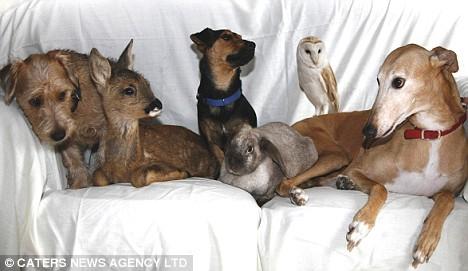
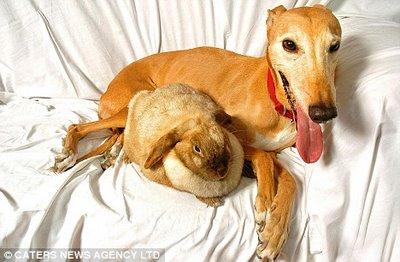
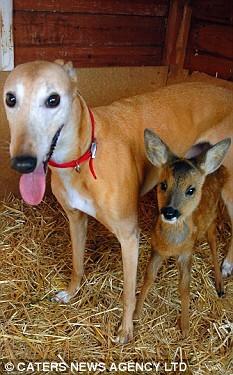
Jasmine, however, had other ideas. No one quite remembers how it came about, but Jasmine started welcoming all animal arrivals at the sanctuary. It would not matter if it were a puppy, a fox cub, a rabbit or, any other lost or hurting animal. Jasmine would just peer into the box or cage and, when and where possible, deliver a welcoming lick. MD2 Geoff relates one of the early incidents. “We had two puppies that had been abandoned by a nearby railway line. One was a Lakeland Terrier cross and another was a Jack Russell Doberman cross. They were tiny when they arrived at the centre, and Jasmine approached them and grabbed one by the scruff of the neck in her mouth and put him on the settee. Then she fetched the other one and sat down with them, cuddling them.” “But she is like that with all of our animals, even the rabbits. She takes all the stress out of them, and it helps them to not only feel close to her, but to settle into their new surroundings. She has done the same with the fox and badger cubs, she licks the rabbits and guinea pigs, and even lets the birds perch on the bridge of her nose.MD3 Jasmine, the timid, abused, deserted waif, became the animal sanctuary’s resident surrogate mother, a role for which she might have been born. The list of orphaned and abandoned youngsters she has cared for comprises five fox cubs, four badger cubs, fifteen chicks, eight guinea pigs, two stray puppies and fifteen rabbits – and one roe deer fawn. Tiny Bramble, eleven weeks old, was found semi-conscious in a field. Upon arrival at the sanctuary, Jasmine cuddled up to her to keep her warm, and then went into the full foster-mum role. Jasmine the greyhound showers Bramble the roe deer with affection, and makes sure nothing is matted. MD4They are inseparable,” says Geoff. “Bramble walks between her legs, and they keep kissing each other. They walk together round the sanctuary. It’s a real treat to see them.MD5 Jasmine will continue to care for Bramble until she is old enough to be returned to woodland life. When that happens, Jasmine will not be lonely. She will be too busy showering love and affection on the next orphan or victim of abuse. MD6 Pictured left to right are: “Toby”, a stray Lakeland dog; “Bramble”, orphaned roe deer; “Buster”, a stray Jack Russell; a dumped rabbit; “Sky”, an injured barn owl; and “Jasmine”. All told a mother’s heart doing best what a caring mother does.

ooOOoo

It was but a moment to find a video about Jasmine over on YouTube:

http://www.youtube.com/watch?v=6a57ibUayKc Finally, if you feel like translating your affection for Jasmine and the good folk over at Nuneaton & Warwickshire Wildlife Sanctuary into a donation, here’s the page to go to:

We are completely self funded. We receive no financial backing and so have to raise every single penny towards the upkeep of the sanctuary. It costs on average £360 per week to keep the sanctuary open, and a further £120 per week on food and bedding for the animals in our care. Please help us continue to rescue and rehabilitate Britain’s wildlife.

If you go to this link you can see what would be the best donation method for you. Plus, because the Sanctuary is not open for callers on Sundays I will call today (Monday) * and see if there are more details about the best way to offer support from those living outside the UK. Unconditional love is so perfectly demonstrated by our incredible dogs.

* I did call and speak with Catherine who recommended PayPal as the best means of donating to their cause, especially for those outside the UK.

Save the lives of these dogs: Please.

Johnny Depp’s dogs face death in Australia.

There was an item on the BBC News website yesterday morning that jumped out at me. The BBC headline is my sub-title for today. Here’s how the BBC opened that item:

Actor Johnny Depp has been told he has until Saturday to remove his dogs from Australia or they will be put down.

Depp and his wife Amber Heard are accused of not declaring Yorkshire Terriers Boo and Pistol to customs officials when they flew into Queensland by private jet last month.

Australia has strict animal quarantine laws to prevent importing infections.

Agriculture Minister Barnaby Joyce said he understood the dogs were being sent back to the US.

The dogs were discovered when a picture was posted of them at grooming parlour.

Later on that BBC report mentioned:

An online petition to save the “cute dogs” had received nearly 5,000 signatures by late on Thursday local time in Australia.

“Have a heart Barnaby! Don’t kill these cute puppies,” it appealed.

OK, Mr. Depp was a silly boy but his mistake must not be paid for with the lives of these wonderful dogs.

That petition is over on Change.org and here is the direct link. You will read these details.

There’s just 48 hours before Johnny Depp’s two puppies Boo & Pistol could be euthanised by Australian authorities. Please help save them!

Johnny Depp brought them to Australia with him to shoot the next Pirates of the Caribbean.

But today Agriculture Minister Barnaby Joyce has said that because he didn’t follow particular travel rules that he’ll seize and destroy them by the weekend if they’re not removed from Australia.

This seems so extreme and unnecessary. He shouldn’t kill these cute dogs simply because Depp didn’t follow particular rules.

Help me tell Barnaby Joyce not to kill or remove Johnny Depp’s dogs from Australia!

Have a heart Barnaby! Don’t kill these cute puppies.

Here’s the article: http://www.news.com.au/national/johnny-depp-amber-heard-face-death-row-wait-for-pet-dogs-after-dodging-australian-quarantine/story-e6frfkp9-1227353879412

PLEASE SIGN & SHARE!

Please sign!

OK, Time for Change!

George Monbiot’s devastating analysis of British politics.

Note to readers:

When you start reading the following introduction, ahead of George Monbiot’s essay, you may be excused for thinking I have lost the plot!  However, trust me there is a purpose. For this blog is called Learning from Dogs.

Introduction

We know that the relationship between Planet Earth and man, as in H. sapiens, goes back around 200,000 years.

We also know, indicated by DNA evidence, that the dog separated from the grey wolf about 100,000 years ago.

The relationship between dogs and man goes back thousands of years as well; “The going theory is that dogs were domesticated somewhere between 15,000 and 40,000 years ago.“[1]

Certainly, the dog was the first animal to be domesticated by man. In fact, some archaeologists speculate that without the dog man could not have been such a successful ‘hunter-gatherer’ allowing, in time, man to evolve into farming; the real start of modern man.

But what of today?

There is little doubt that many people, even with the minimum of awareness about the world that we live in, are deeply worried. On so many fronts there are forbidding and scary views. It feels as though all the certainty of past times has gone; as if all the trusted models of society are now broken. Whether we are talking politics, economics, employment or the environment, nothing seems to be working.

Why is this? What’s the cause?

It would be easy to condemn man’s drive for progress and an insatiable self-centredness as root causes. But it’s not the case, certainly not the whole case.

The root cause is clear. It is this. How mankind has developed is the result of mankind’s behaviours. All of us behave in many ways that are hugely damaging to the survival of our species upon this planet. It is likely that these behaviours are little unchanged over thousands of years.

But 2,000 years ago, the global population of man was only 300 million. It took 1,200 years for that global population to become 1 billion; in 1800. Now track the intervals as we come forward in time.

In 1927, just 127 years later, the two-billionth baby was born. In 1960, only 33 years on, the three-billionth baby. Just 16 years on, in 1974, the four-billionth baby was born. In 1987, 13 years later, five billion. Around October 1999, the sixth-billionth baby was born! It’s trending to a billion every decade. In other words, a 100-million population growth every year, or about 270,000 more persons every single day!

Combine man’s historic behaviours with this growth of population and we have the present situation. A totally unsustainable situation disconnected from the finite planet that supports us.

The only viable solution is to amend our behaviours. To tap into the powers of integrity, self-awareness and mindfulness and change our game.

We all have to work with the fundamental, primary relationships we have with each other and with the planet upon which we all depend. We need a level of consciousness with each other and with the living, breathing planet that will empower change. We need spiritual enlightenment. And we need it now!

That is why we have so much to learn from dogs. They are man’s best friend. They are man’s oldest friend. They have a relationship with us that is very special; possibly verging on the telepathic.[2]

They can show us how we need to live our lives. Now!

[1] The Origin of Dogs, Scientific American, August 20th, 2009
[2] Refer Dr Rupert Sheldrake best known for his theory of morphic fields and morphic resonance

The George Monbiot essay.

(I hope as you read his essay, you can now understand the reasoning behind my introduction.)

Republished with the very kind permission of Mr. George Monbiot.

ooOOoo

Code of Silence

Almost all the issues worth debating are left unmentioned in this election.

By George Monbiot, published in the Guardian 6th May 2015

Political coverage is never more trivial or evanescent than during an election. Where we might hope for enlightenment about the issues on which we will vote, we find gossip about the habits and style of political leaders, an obsession with statistically meaningless shifts in opinion polls and empty speculation about outcomes. (All this is now compounded by the birth of a royal baby, which means that our heads must simultaneously be dunked in a vat of sycophantic slobber). Anyone would think that the media didn’t want us to understand the choices confronting us.

While analysis of the issues dividing the political parties is often weak, coverage of those they have collectively overlooked is almost non-existent. The Conservatives, Labour, the Liberal Democrats and even the SNP might claim to be at each other’s throats, but they have often reached consensus about which issues are worthy of debate. This article will list a few of the omissions.

The first is so obvious that it should feature in every political discussion: the corrupt and broken system under which we will vote. The argument I’ve heard several Labour activists use – “vote for us because it’s the best we can hope for under first-past-the-post” – would carry more weight if Labour had any plans to change the system.

Where are the furious arguments about the UK’s unreformed political funding, that allows billionaires and corporations to buy the politics they want? Where is the debate about the use and abuse of royal prerogative by successive prime ministers? Where is there even a mention of the democratic black hole at the heart of Britain, into which hopes for financial and fiscal reform are sucked: the Corporation of the City of London, whose illegitimate powers pre-date the Magna Carta?

Here’s a fact with which politicans should be assailed every day: the poor in this country pay more tax than the rich. If you didn’t know this – and most people don’t* – it’s because you’ve been trained not to know it through relentless efforts by the corporate media. It distracts us by fixating on income tax, one of the few sources of revenue that’s unequivocally progressive. But this accounts for just 27% of total taxation. Overall, the richest tenth pay 35% of their income in tax, while the poorest tenth pay 43%, largely because of the regressive nature of VAT and council tax. The Equality Trust found that 96% of respondents to its survey would like a more progressive system. But where is the major party mobilising this desire, or even explaining the current injustice?

A comprehensive failure to tax land and property is a policy shared by the three major English parties, mansion tax notwithstanding. None of them seems to mind that this failure helps to replace the entrepreneurial society they claim to support with an economy based on rent and patrimonial capital. None of them seems to mind that their elaborate fiscal ringfencing of land and buildings clashes with their professed belief that capital should be used productively.

Nor will any of them mount an effective challenge to kleptoremuneration: executives siphoning off wealth they had no role in creating. None seek to modify a limited liability regime so generous that it allowed the multi-millionaire authors of the financial crisis, such as Fred Goodwin and Matt Ridley, to walk away from the pain they helped to inflict without forfeiting a penny.

Even these issues are trivial by comparison to the unacknowledged cloud that hangs over our politics: the impossibility of infinite growth on a finite planet. All major parties and media outlets are committed to never-ending economic growth, and use GDP as the primary measure of human progress. Even to question this is to place yourself outside the frame of rational political debate.

To service this impossible dream, we must work relentlessly, often in jobs that deliver no social utility and cause great harm. Who in politics is brave enough to propose that we work less and enjoy life more? Who will challenge working conditions characterised by ridiculous quotas and impossible demands, or reform a social security regime more draconian and intrusive than day release from prison? Who is prepared to wonder aloud what all this striving and punishment is for?

And how about some acknowledgement of the epidemic of loneliness, or the shocking rise in conditions such as self-harm, eating disorders, depression, performance anxiety and social phobia? Evidently, these are not fit and proper subjects for political discourse, which creates the impression that those who suffer them are not fit and proper electors.

How about some arguments over the loss of public space? Or a debate about what’s happening to children, confined as never before within four walls, both at school and at home? How about some recognition of the radical changes in transport demand, that are likely, in the age of peak car and peak plane, to render redundant the new roads and airports to which all the large parties are committed? Forget it.

The national and global collapse of biodiversity, the horrifying rate of soil loss, the conflict between aspirations to minimise climate change and maximise the production of fossil fuels: none of these are put before voters as issues of significant difference. All major parties tacitly agree to carry on as before.

Politicians will not break these silences voluntarily. They are enforced by a narrow and retentive public discourse, dominated by the corporate media and the BBC, that ignores or stifles new ideas, grovels to the elite and ostracises the excluded, keeping this nation in a state of arrested development.

After this election, we need to think again; to find new means of pushing neglected issues onto the political agenda. We might try to discover why the social media have so far mostly failed to fulfill their democratising promise. We might seek new ways of building political communities, using models as diverse as Podemos and evangelical Christianity. We might experiment with some of the Latin American techniques that have helped to transform politics from the bottom up. However we do it, we should never again permit democracy to be reduced to so narrow a choice.

www.monbiot.com

* 68% of respondents to the Equality Trust’s Survey believed that households in the highest 10% income group pay more of their income in tax than households in the lowest 10% income group.

ooOOoo

(Readers in other countries will easily be able to identify their country’s version of the issues that Mr. Monbiot speaks about.)

Conclusion

Sooner or later, and preferably sooner, each and every one of us must start looking at ourselves in the mirror, every morning, and say, “What behaviour will I change today to save this planet for all future generations?

The watering hole.

Seems to follow-on from yesterday so well.

This game of blogging would have no meaning at all if it were not for the networking and sharing of so many ideas, thoughts and feelings unlimited by geographical distances. The ‘Likes’ and responses to my Hope Has A Place story yesterday meant so much.

I was trawling through my folder looking for something that felt good to publish after yesterday and came across the following that was sent in by dear friend, Dan Gomez, about a month ago.

ooOOoo

oldcowboy

An old cowboy was riding his trusty horse followed by his faithful dog along an unfamiliar road. The man was enjoying the new scenery, when he suddenly remembered dying, and realized that the dog beside him had been dead for years, as had his horse. Confused, he wondered what was happening, and where the trail was leading them.

After a while, they came to a high, white stone wall that looked like fine marble. At the top of a long hill, it was broken by a tall arch topped by a golden letter “H” that glowed in the sunlight.

Standing before it, he saw a magnificent gate in the arch that looked like mother-of-pearl, and the street that led to the gate looked like gold.

He rode toward the gate and as he got closer he saw a man at a desk to one side. Parched and tired out by his journey, he called out, “Excuse me, where are we?

This is Heaven, sir,” the man answered.

Wow! Would you happen to have some water?” the old cowboy asked.

Of course, sir. Come right in, and I’ll have some ice water brought right up.

As the gate began to open, the cowboy asked, “Can I bring my partners, too?

I’m sorry; sir, but we don’t accept pets.

The cowboy thought for a moment, then turned back to the road and continued riding, his dog trotting by his side.

After another long ride, at the top of another hill, he came to a dirt road leading through a ranch gate that looked as if it had never been closed. As he approached the gate, he saw a man inside, leaning against a tree and reading a book.

Excuse me,‘ he called to the man. “Do you have any water?

Sure, there’s a pump right over there. Help yourself.

How about my friends here?” the cowboy gestured to his dog and his horse.

Of course! They look thirsty, too,” said the man.

The three of them went through the gate, and sure enough, there was an old-fashioned hand pump with buckets beside it. The cowboy filled a cup and the buckets with wonderfully cool water and took a long drink, as did his horse and dog.

pump

When they were full, he walked back to the man who was still standing by the tree. “What do you call this place?” he asked.

This is Heaven,” the man answered.

That’s confusing, the man down the road said that was Heaven, too.

Oh, you mean the place with the glitzy, gold street and fake pearly gates? That’s hell.

The cowboy retorted, “Doesn’t it make you angry when they use your name like that?

Not at all. Actually, we’re happy they screen out the folks who would leave their friends behind.

ooOOoo

Dan’s email went on to include this:

Sometimes, we wonder why friends forward things to us without writing a word. Maybe this explains it? When you’re busy, but still want to keep in touch, you can forward emails. When you have nothing to say, but still want to keep in contact, you can forward jokes. When you have something to say, but don’t know exactly how to say it, you can forward stuff.

A ‘forward’ lets you know that you’re still remembered, still important, still cared about.

So the next time you get a ‘forward’, don’t think of it as just another joke. Realize that you’ve been thought of today and that your friend on the other end just wanted to send you a smile.

PS: You’re welcome at my watering hole anytime.

Let me underline Dan’s PS by saying that all of life’s humans and creatures are welcome here!

Water jug


Rescuing has no borders!

Please, please can you help find homes for these gorgeous puppies.

Please read to the end and share this post as widely as you can! Thank you!

Pup1

Many know that I first met Jean in San Carlos, Mexico over Christmas, 2007.

I met Jean as a result of the kindest gift anyone has given me. Namely, Suzann Reeve, sister of Dan Gomez, whom I have known for 45 years, and Suzann’s husband, Don, invited me to spend Christmas with them at their home in San Carlos.

pup2

Before my arrival on the scene, Jean and Su had worked together for a long time rescuing poor feral dogs off the streets and finding homes for them in the USA.

pup3

After Jean and I moved from San Carlos, with 14 dogs I hasten to add, up to Arizona in 2010, Su has kept going rescuing street dogs and loving them until they can find real homes.

pup4

Many of the Mexican people are so poor that when a female dog has a litter of puppies they sell the puppies for a few pesos and cast the mother dog back out on to the street.

pup5

Our Hazel that we have here at home in Oregon was one such dog and, trust me, never have I experienced a more loving, loyal and affectionate dog.

The truest of love between a man and a dog!
Hazel loving up yours truly!

In the last few days, Su has been on the telephone to say that she has a litter of nine puppies and is desperate to find homes for them before too long.

pup6

In answer to my question about the background to the puppies, Su replied:

  • They are reputed to have been born on Valentine’s day, which makes them 8 weeks on April 14th.
  • They are about 6-7 lbs each today.
  • There are 4 girls and 5 boys.

pup7

  • Their mom was feral, but wags her tail ferociously when she spies me with her food bowl!
  • Mom eats steak, bone broth, rice, Kirkland Nature’s Domain canned food, Kirkland dry food. She has cared well for her pups.
  • The pups eat Blue Buffalo canned puppy food mixed in with Kirkland puppy food and some water. they have also received yogurt in their food which I weaned them off as of yesterday.

pup8

  • They will be receiving their first vaccination Monday.
  • They have been wormed twice.
  • They have been given anti-tick spray twice.

pup9

  • Several have at least one blue eye with the other being a brownish grey, some have brown eyes, and the others have light brown eyes.
  • I have their grandmother here at the casa as well, and Sofia is looking for a forever home as well. Bella, the mom of the pups, is a medium sized dog with brown, terra cota and white markings.
  • One of the dads is mostly black with a little white, and the one blue eye.

pup10

  • They were born in a small beach side fishing village in La Manga, Mexico.
  • The mom has a sweet disposition.
  • At least 2 of the pups have alpha tendencies.

pup11


So dear, dear people, if you or anyone you know might be interested in having one of these beautiful puppy dogs then leave a comment without delay.

If you have any questions or queries, likewise articulate that query as a comment to this post. Su will reply to each and every one.

Please share this post as far and wide as you can.

Don’t even hesitate in wondering how Su and all of us can get a puppy from San Carlos to wherever you are – it will be sorted!

Dogs spend their whole lives offering unconditional love to us humans.

Let’s return that love by finding homes for these nine beautiful puppies.

Thank you from the bottom of my heart.

Dogs and the inside of our souls!

The role of dogs in helping young offenders.

In these times of terrible inequality, if there is one thing that has the power to crush a young person’s chances in life it is a criminal record, even a minor one. This is well-known in the UK. For a number of years I was a mentor with what was then called the Prince’s Youth Business Trust (PYBT) and now is just simply called The Prince’s Trust.

What was discovered, courtesy of the PYBT, was that if one taught disadvantaged youngsters the principles of forming and running your own business there were two positive outcomes. The first was that the young person performed much better at job interviews, and increased his or her odds of getting a job offer, and some young persons decided to start their own business; some very successfully so.

Thus with that background it was natural that an article in the US edition of The Economist caught my eye. It was called Pups and perps.

Pups and perps

What has four legs, a wet nose and helps young thugs grow up?

Dec 6th 2014 | LOS ANGELES | From the print edition

WHEN Jordan entered juvenile detention shortly after his 17th birthday, following a conviction for assault and robbery, all he could think about was getting out. The rowdy teenager from Anaheim, California, struggled to control his temper. But when he began working with Lulu, a poodle mix, he got a new leash on life. “I was too busy taking care of the dog to get into fights,” he says.

Jordan was taking part in “Pups and Wards”, a programme that pairs shelter dogs with young inmates. The perps train the pups and, with luck, learn something about personal responsibility. Other programmes allow prisoners to train dogs to be adopted by people with disabilities, such as traumatised veterans. Such training often requires full-time care—but prisoners have plenty of time on their hands.

The Economist article later on reports:

“All the research about the human-animal bond has buoyed these programmes,” says Gennifer Furst, a professor of criminal justice. “We have discovered that prisoners often identify with rescue dogs—they have both experienced trauma—and they are eager to become their protectors.” Crystal Wood, an officer at a maximum-security prison in Lancaster, California, says that several inmates on her yard—who are in prison for life—wept after interacting with dogs. “Many of these guys haven’t seen an animal in decades. It’s been striking to see how much working with a dog has reduced their anxiety levels.”

It was easy to find more information on Professor Gennifer Furst from the William Paterson University website:

Gennifer Furst received her B.A. in psychology (with a sociology minor) from Connecticut College and her M.A. in psychology (with a concentration in evaluation methodology) from Claremont Graduate University. She received her doctorate in criminal justice (with a concentration in corrections) from CUNY Graduate Center.

Dr. Furst is the Department of Sociology’s Criminal Justice Director. Dr. Furst’s research interests focus on issues of incarceration. She published the first national survey of prison-based animal programs in the US. A book based on that work was recently published. Additionally, she is interested in race and the administration of criminal justice, the death penalty, the use of animals in the criminal justice system, and the relationship between drugs and crime.

Read the rest of the good Professor’s background here.

Imagine my pleasure in finding that there is a film Dogs on the Inside and that YouTube carries an official trailer.

As the film website states: “Everyone deserves a second chance.

So if you are motivated to get involved then don’t hesitate to return to the film’s website and read the Get Involved page.

The power of love.
The power of love.

We are what we eat.

Integrity and honesty should certainly apply to what we eat!

Published author Deborah Taylor-French has her own blog Dog Leader Mysteries. She and I follow each other’s blog and I’m very grateful for the connection, as indeed I am with so many other fellow bloggers.

Thus that was how I came to learn of a recent post from Deborah about how rabbit meat is being used for human consumption.  On the face of it, nothing wrong in eating rabbit but wait until you have read Deborah post, that is republished here with her kind permission.

ooOOoo

Tell Whole Foods: Do not sell bunnies

Tell Whole Foods, “Don’t sell bunny meat!”

Farm animals suffer greatly in the United States of America. Plus this suffering comes to us well documented. Before the U.S. Congress passes laws allowing Ag-Gag [see my footnote] states to make it illegal for people to photograph, video or report animal abuse inside or outside their meat plants.

The disturbing truth? Pet rabbits now sold for meat at Whole Foods Market come from being raised in U.S.A. Ag-gag states. What’s wrong with that? Everything.

Big farms doing business in Ag-gag states operate free from animal welfare laws.

In fact these huge meat farms have made laws against taking photographs, video recording or any reporting of animal abuse. What have they got to hide?

Enough. All too many cruel animal farming practices already hurt farm animals, enough to make most of us sick. The Humane Society of the United States and the Animal Defense Fund continue working to legally raise farm animal welfare practices. Most Americans know that farm animals do not receive acceptable room for walking nor a humane standard of care. Before we let another category of animal become victims of Ag-gag farm cruelty, we need to improve farm animals welfare.

Adopted from Rohnert Park Animal Shelter.

Rabbits die of fright.

They share the species lagomorph.

There are about eighty species of lagomorph include thirty species of pika, twenty species of rabbit and cottontail, and thirty species of hare family. Wikipedia

I learned about this issue of Whole Foods Market, selling a new category of animal for meat through a volunteer at my local shelter. Kathy, along with volunteers from Save a Bunny and a Southern California group, are working to raise awareness pet rabbits should not end up as mainstream Big Farm meat products. Why?

Whole Foods Market buys meat rabbits from Ag-gag states. If Whole Foods succeeds, farm animal suffering will fall on whole other category of animals, pet rabbits.

It comes as no secret in United States that farm animals end up being raised inhumanely. If you have ever read about the Ag-gag states and how they are able to prosecute anyone willing to go undercover and take photographs and videos to report the truth on this ongoing unnecessary torture of farm animals. What meat animals endure in the U.S.A. is nothing less than cruelty, it’s time we changed that, before adding anymore farm animals.

Nine facts hidden in Ag-gag pig farms

  1. Millions of meat pigs live, eliminate and sleep in cramped spaces.
  2. The environment these pigs endure smell rank. Their wastes drain into a central open sewer and their housing is so unclean many of them die.
  3. Meat pigs lack all exercise to the extreme point that their legs break.
  4. Pigs housed in huge warehouses with thousands of other pigs, hear others screaming day and night from pain.
  5. Female pigs, sows, live horrible lives in gestation crates.
  6. Gestation crates built for female pigs force them to stand up for 24-hours per day. Farmers do not allow pigs to walk or lie down. Gestation crates, notoriously painful for animals, need to be banned. Often the pigs’ legs break because their bones grow soft, due to not being allowed to walk.
  7. Big meat farms build bars underneath sows to brace broken legs.
  8. The meat pig lives in constant physical pain, terror, fear and unhappiness. When piglets die, often in these unsanitary conditions, their bodies get ground up and mixed into the food the sows eat. So mother pigs eat their own young.Pigs do not live as cannibals. Why should they be forced to eat their own young?
  9. What horrible animal welfare to make pigs eat their own young. It’s incomprehensible that animals must live like this so that people can eat pork barbecue, pork steak and pork ribs.

How can they call these farms? Not giving animals room to walk, sit or lie down? Meat farm animals get denied their normal and natural behaviors. They never see the light of the sun nor feel the earth nor wind.

What U.S.A. meat farms won’t let us see.

After four years of hesitation and never mentioning recordings of farm animals lack of good welfare, I break my silence.

Much of the time I avoid eating meat. From now on, I will be seeking out small sustainable and local farms. We have several nearby that do not inflict senseless cruelty on pigs, chickens and cows. After study of commercially farmed pork and chicken and beef, I have returned to my original vegetarian and fish eating ways.

My footnote. As a non-American I didn’t fully understand the phrase “Ag-gag”. Deborah kindly explained it as follows:

Several states have passed laws against anyone photographing, video recording or reporting on animal abuse inside massive meat farms. The Humane Society of the United States keeps working (under cover to film the truth of this unsanitary and cruel business) but now they can arrest anyone caught, send reporters to jail and sue anyone trying to inform the public.

ooOOoo

I know for a fact that Deborah would love that this item is shared and republished as far and wide as possible. Please help.

For spreading the word and being very careful about the meat that we eat are the only ways to put a stop to these unbelievably cruel practices, and the ‘Ag-gag’ laws.

Misery Is Optional

Another guest essay from the old lamplighter.

It seems to me that it is so incredibly easy to be influenced, even engulfed, by bad news.

Back on the 20th I posted an item that had been sent to me by John Hurlburt, who is the old lamplighter, called Interstellar News.

Here’s another essay from John that is a great reminder of that old adage: We are what we think.

ooOOoo

Lost

Misery Is Optional

There’s always been a delicate balance in the struggle between growth and stagnation. The emerging universe invariably prevails. The good news is that absolutely insisting upon the denial of reality naturally backfires in the long run. Common sense has repeatedly saved our collective bacon from the fire as our species has faced former crises. The stakes have never been higher.

There’s a natural balance that runs through our relatively brief species history. Extreme cultural alternatives include plutocracy and anarchy. There’s no question that if we’re not an active supporter of an inclusive solution we contribute to our collective dissolution.

Nero fiddled while Rome burned. There’s a current global analogy. Global media communications reflect hate, divisiveness and violence. The obvious truth is essentially ignored. A result is our present state of angst, paranoia and associated stress disorders. We compensate with bread and circuses.

Indifference doesn’t have to be a local reality. We’re all naturally connected in whatever we conceive of as God. We share a common soul. If we are wise we’ll act accordingly. We’ll accept our inherent responsibilities as stewards of Creation. The fulfilment of positive actions in according with the nature of our being is a blessing that keeps on giving.

an old lamplighter

ooOOoo

These are beautiful words and whatever one’s religious or spiritual convictions if we don’t recognise that we are all “naturally connected” then it won’t be long before we run out of bread and circuses – and deservedly so.

Going to close this post by using the following picture and quotation taken from the latest Terry Hershey newsletter.

Machado

Beyond living and dreaming
there is something more important: waking up.

Antonio Machado