Category: Morality

Factory farming.

 We truly reap what we sow!

Yesterday, I wrote about what I saw as a prelude to today’s post. It was a post about the madness of the way we ingest antibiotics, frequently without us being aware that we are so doing.

The reason I regarded it as a very appropriate prelude to today is fully spelt out by George Monbiot’s second essay on the utter insanity about how our food is grown. His first essay was called Fowl Deeds and you may read it here.

So with no further ado, here is George Monbiot’s second essay republished with his kind permission.

ooOOoo

The Abuses of Enchantment

29th May 2015

The cruelties of factory farming shelter behind a fairytale image, promoted by advertisers and children’s authors.

By George Monbiot, published on the Guardian’s website 29th May 2015

The way that meat, eggs and milk are produced is surrounded by one of our great silences, in which most people collaborate. We don’t want to know, because knowing would force anyone with a capacity for empathy to change their diet.

You break this silence at your peril. After I published an article on chicken farming last week, I had to re-read it to check that I hadn’t actually proposed the slaughter of the firstborn by terrorist devil worshippers – so outraged and vicious were some of the responses. And that was just the consumers.

The producers didn’t like it much either, though their trade associations responded in more measured tones. In letters to the Guardian on Saturday, the National Farmers’ Union and the British Poultry Council angrily defended the industry. The NFU wrote:

“In the UK 90% of all chicken is produced to Red Tractor standards and this demonstrates that the chicken has met production standards developed by experts on animal welfare, safety, hygiene and the environment. Farmers take the welfare of their birds extremely seriously, and therefore to accuse the sector of cruelty is absolutely unfounded.”

The BPC maintained that chicken “provides a wholesome, nutritious, sustainable and affordable source of protein, produced by an industry unsubsidised by government.”

Let’s spend a moment examining these claims, before raising the issue of how they get away with it.

In my view, the Red Tractor standard is a classic example of an almost meaningless label, whose purpose is to reassure customers in a vague and fuzzy way while holding producers to standards that scarcely rise above the legal minimum. That’s a long-winded way of saying bullshit.

Take the key welfare issue, stocking density. Here’s what the government recommendations say:

The maximum stocking density for chickens kept to produce meat for the table should be 34 kg/m2, which should not be exceeded at any time during the growing period.

But the standard for broiler chickens set by the Red Tractor scheme is actually worse than this:

“Planned stocking densities must not exceed 38kg/m2 for broilers”

Incidentally, this stocking density – 38kg/m2 – gives each bird an area the size of a piece of A4 paper. [Ed. 8.27 in X 11.69 in]

This meets the legal requirement only because the UK uses a cruel derogation from European law, permitting a maximum stocking density of 39kg/m2. [Ed. American units convert that to 74.8 lbs of chicken mass per square yard.] So much for the NFU’s statement about taking the welfare of chickens extremely seriously.

On almost every welfare indicator, and across all the main farm animals, including chickens, Red Tractor scored worse than any other certification scheme evaluated by Compassion in World Farming. Amazingly, the Red Tractor label imposes no restrictions on the growth rates of chickens: it allows the most overbred varieties to be stuffed with high-protein feed, with the result that the birds often suffer from painful and crippling health problems, as their hearts, lungs and legs are overloaded.

As for the British Poultry Council’s claims, if chickens fed on soya – as the great majority in this country are – are sustainable, what does unsustainable look like? Soya production is one of the major agents of the destruction of rainforests, cerrado and other threatened habitats in South America. The environmental impacts of chickenfeed are, well, anything but chickenfeed. The mass production of chickens has major consequences at the other end of the bird too: the mountains of excrement cause both water and air pollution.

Nor is the claim that this industry is unsubsidised correct. Many chicken growers barely break even on the sale of birds, and survive only as a result of the government’s renewable heat incentive. This is a remarkably generous scheme whose ostensible purpose is to reduce carbon emissions, but which really functions as another subsidy for businesses, especially farms. Most new chicken units use biomass boilers subsidised by the RHI, and it is immensely profitable.

So now to the real question: how do they get away with it? How is it that we, who regard ourselves as a nation of animal lovers, accept such terrible standards of meat production? If dogs and cats were treated as pigs and chickens are, there would be a deafening outcry: in fact there are plenty of people in Britain who campaign against the raising of dogs and cats for food in Asia. But what’s the difference? Why is it acceptable to treat some animals – even creatures as intelligent and capable of suffering as pigs – so brutally, but not others?

In part, this reflects the deep disavowal in which we tend to engage when we eat meat. But I also believe that a major part of the problem is the fairytale view of farming implanted in our minds from the very onset of consciousness.

Many of the books produced for very young children are about farms; and most tell broadly the same story. The animals – generally just one or two of each species – live in perfect harmony with the rosy-cheeked farmer, roaming around freely and talking to each other, almost as if they were members of the farmer’s family. Understandably enough, none of the uncomfortable issues – slaughter, butchery, castration, tusking, separation, battery production, farrowing crates – ever feature.

So deeply embedded is this image that I believe many people go through life unable to dismiss it from their minds. It is not easy to unlearn what we are taught when we’re very young, and even the grim realities of industrial farming cannot displace the storybook images from our minds. At a deep, subconscious level, the farm remains a place of harmony and kindness – and this suits us very well if we want to keep eating meat.

Perhaps the starkest example of this myth-making I’ve come across is a children’s book distributed with Saturday’s Guardian called The Tale of City Sue. It tells the story of a herd of cows on an Irish farm.

“This friendly, Friesian family

were free to roam and browse

and eat the freshest, greenest grass

which made them happy cows.

“They belonged to farmer Finn

Who called them by their names

And when it was their birthday

He brought party hats and games.

“He played his violin for them

inside the milking shed,

and sung them soothing lullabies

when it was time for bed.”

Only after I had unthinkingly read it to my three-year-old then turned the back cover, did I discover that it wasn’t a book at all, but an extended advertisement for Kerrygold butter.

It wasn’t billed as such. The Guardian’s website marketed this publication as “A tale from the meadow of imagination: children’s author Jeanne Willis’s latest book captures the idyllic atmosphere of rural Ireland.” Following my questions to the Guardian, this has now been changed to make its provenance clearer.

I find disguised marketing of any kind objectionable, and disguised marketing to children (aimed in this case at reaching their parents) even worse. I feel that this book misleads children about the nature of farming and milk production and sanitises the relationship between farmers and their animals, on behalf of a large corporation (Kerrygold’s parent company, Adams Foods). It exploits children’s credulity and natural sympathy with animals for corporate profits.

When I challenged the Guardian about this, its spokesperson told me:

“All branded content should be clearly labelled for the benefit of our readers in line with our guidelines. On this occasion the insert was not correctly labelled and we apologise for this error.”

I also wrote to the author, Jeanne Willis, who replied as follows: “I was commissioned by Kerrygold so it’s best they answer your questions. Xxxx Xxxx from Brazen PR will be in touch soon.”

Brazen PR. Hmmm.

I wrote back, asking her, “Do children’s authors not have a responsibility towards those they write for? Is there not an issue of conscience here for you? After all, if a children’s author is misleading children on behalf of a corporation, that’s a serious matter, surely? It has been done in your name, and promoted as your “latest book”, so simply shrugging off responsibility like this feels wrong to me. You must have a view about whether or not accepting this commission was the right thing to do, and whether you were justified in discharging it as you did.”

She responded as follows:

“… to the best of my knowledge, Kerrygold seem to be particularly strong on animal welfare so there wasn’t a question that what I created was going to be misleading. The brief was very simple: Kerrygold cows spend a lot of time outside feeding on grassy meadows so let’s tell some fun stories about our cows. I don’t feel it’s exploiting kids because the only take out is that it’s better to feed cows on grass and ensure they spend as much time outside as possible.”

“I’m very careful which brands I work with to avoid this exact situation – I wouldn’t have done this if I thought it was morally wrong. It’s a storybook for families to enjoy. There is no overt message to buy butter. It’s just about the cows. That said, it clearly says Kerrygold on the inside cover and on the back.”

It seems to me that subliminal persuasion of this kind (“the cows are happy”) can be more insidious than overt marketing (“buy our butter”). To my mind, Kerrygold is seeking to persuade people of the inherent goodness of its products at a deeper level than merely flashing up the products.

As for the issue of animal welfare, Kerrygold’s website states “We work with small co-operative farms where small herds are free to graze on lush Irish meadows.” But it does not say “We work only with small co-operative farms …”.

The parent website run by Adams puts it slightly differently: “Kerrygold is … is owned by Irish dairy farmers, many of their farms are small and family run”. Which could also mean that many of them are not. So I asked the company, “What is your milk buying policy? In other words, what specifications – on scale, feed, the treatment of animals, process etc – do you put in place that your suppliers have to adhere to?” I have not had a response.

From what I can glean, Kerrygold’s marketing seems to rely on the public perception that Irish dairy farms are small and mostly grass-fed. But they are changing fast.

Last summer, 3,000 dairy farmers visited the biggest dairy operation in the country (which has 820 milking animals) to discover how to increase the scale of their operations. This farm has made a major investment in indoor facilities, and supplements the grass they are fed with maize, barley and soya.

According to the former chair of the Irish Farmers’ Association, “scale must go up. … The dairy farm of the future is going to have to be bigger.”

Could the current Kerrygold marketing blitz be an attempt to embed in our minds a bucolic, superannuated image of an industry that is now changing beyond recognition? If so, it might be an effective way of pre-empting criticism about the changing nature of its suppliers.

Dairy cows, like chickens and pigs, get a rough deal, while the effluent from dairy farms creates major environmental problems. Imagine the response if children were exposed to such blatant sanitisation of a harsh and polluting industry in any other sector. But so prevalent is this mythologised view of farming, and so wilfully unaware do we remain of the realities of industrial agriculture, that it passes almost without challenge. My guess is that the Guardian made this error – a serious one in my view – partly because the themes Jeanne Willis and Kerrygold exploited are so familiar that they are almost background noise.

Isn’t it time that children’s authors showed a little more imagination and stopped repeatedly churning out the same basic story, even when they are not doing it on behalf of a large corporation?

Is it not time that adults weaned themselves off the fairytale version of farming and began to judge it by the same standards as we would judge other industries?

And is it not time for all of us to become a little more curious about where meat, milk and eggs come from, and how they are produced?

www.monbiot.com

ooOOoo

 Now I haven’t been a resident of the United Kingdom since 2008 so I have no personal views to add to those expressed by Mr. Monbiot. However, I do not have the slightest hesitation in saying that not only do I trust George Monbiot’s integrity in this matter but I fear that the situation here in the USA is just as terrible, if not worse.

I thought I would close today’s post by offering some pictures of broiler chicken units.  There are many images on the ‘net’.

But they were so ghastly to view that I didn’t have the heart to include a picture.

So I included this one:

free-range-chicken1

The picture was on the website of Mini Mac Farm in Long Valley, NJ.
A future apocalypse?

How many of us really, truly care about the future?

If you sense a heartfelt plea in my sub-heading then you will not be wrong.

What has happened to our instincts for our survival?

What strikes me as so tragic is that if I asked you to guess the topic of today’s post before you read on, the odds are that you would chose from any number of subjects that reveal a society hell-bent on self-extinction!

OK, let me get to the point.

A little over 10 days ago I republished a George Monbiot essay that spoke about the madness of chicken production in the UK. Mr. Monbiot’s essay was called Fowl Deeds and was within my post called We are what we eat!

Well George Monbiot has just published a sequel to Fowl Deeds that I am going to republish in this place tomorrow.

But what I am going to offer for today, as a prelude to tomorrow’s post, is a YouTube video of a BBC Panorama program that was screened earlier on in May. The program was called Antibiotic Apocalypse and was about the threat of increasing resistance to modern Antibiotics.

Why does this make such an important prelude?

Because as you will see when you watch the Panorama program much of our ‘factory’ food comes from animals that are fed antibiotics!

How to close?

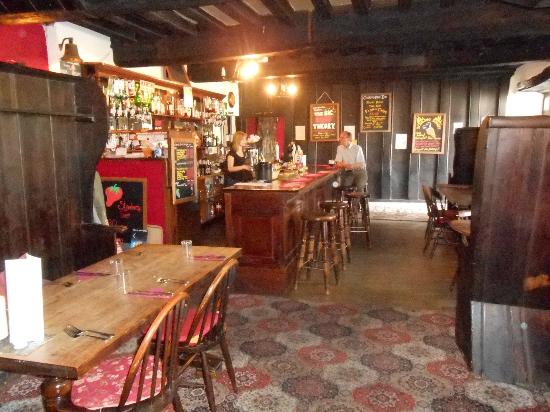
All that comes to mind is a wonderful throwaway remark from a old boy, village resident, when supping a pint of bitter in The Church House Inn; what used to be my local pub in my home village of Harberton, Devon.  This is what he said:

All the world’s a little queer except thee and me, and I ha’ me doubts about thee!

church-house-inn
Interior of The Church House Inn, Harberton, Devon.

Indeed, all the world is more than a ‘little queer’!

The rights that animals deserve.

The compelling reasons for the rights of animals.

I opened the week last Monday by publishing a post under the title of Beyond humans. That post included me writing about Michael Mountain’s talk at the Personhood Beyond the Human conference at Yale University.  That talk, that may be listened to in that post, was described in the following abstract:

Abstract: The past 50 years have seen enormous growth in the animal protection movement. But the situation for nonhuman animals in every sphere, with the exception of homeless pets, continues to deteriorate. Any small advances remain incremental. Animal rights and welfare groups find themselves at a loss to explain their inability to influence the general public. But the work of Ernest Becker (The Denial of Death) and of psychologists in the field of Terror Management Theory (TMT) offer essential insight.

In this talk, we discuss how our need, as humans, to proclaim that “I am not an animal!” and to deny personhood to other animals affects our relationship with them at a fundamental level. We argue that to be effective, the animal protection movement needs to understand TMT and take it into account. And we conclude that a new kind of relationship to the world of nature in the 21st Century is not only essential to the mitigation of the catastrophic effects of the Sixth Great Extinction, but that it also holds the key to Becker’s still-unanswered question of how we can begin to relate positively to our own terror of personal mortality — and therefore our own future as a species.

Thus I want to close the week by reinforcing Michael Mountain’s message by using an article published yesterday over at Mother Nature Network.

ooOOoo

Many Americans support equal rights for animals

Animal rights cases and films like ‘Blackfish’ are credited with influencing public opinion.

By: Tanya Lewis, LiveScience
Tue, May 26, 2015 at 11:08 AM

About 33 percent of people said they were 'very concerned' about the use of animals in research, and 21 percent were very concerned about zoo animals. (Photo: Pavel L Photo and Video/Shutterstock)
About 33 percent of people said they were ‘very concerned’ about the use of animals in research, and 21 percent were very concerned about zoo animals. (Photo: Pavel L Photo and Video/Shutterstock)

Nearly one-third of Americans believe animals should have the same rights as people, a recent poll finds.

Thirty-two percent of the people surveyed believe animals and humans should have equal rights, up from 25 percent in 2008. Another 62 percent believe animals deserve some protection from harm and exploitation, but it is “still appropriate to use them for the benefit of humans.” Only 3 percent believe animals don’t require protection from harm and exploitation “since they are just animals,” according to the poll.

Gallup interviewed a random sample of more than 1,000 people across the United States on May 6 to 10, 2015. About half of those surveyed were asked about the protection of animals, while the other half were surveyed about the treatment of animals in various settings. The poll’s margin of sampling error was 5 percentage points. [The 5 Smartest Non-Primates on the Planet]

Across all demographic groups, an increasing fraction of people support equal rights for animals, although women were more likely than men to have this view, the poll found. About 42 percent of the women polled supported full animal equality in 2015, compared with 22 percent of men. However, the percentage of men and women who support this view has increased by about the same amount since 2008 — from 35 percent to 42 percent for women, and 14 percent to 22 percent for men.

In addition, Democrats and Democratic-leaning independents were more likely than their Republican counterparts to support complete animal equality. About 39 percent of liberal-leaning people supported that view this year, compared with 23 percent of conservative-leaning people. But the number of both Democrats and Republicans who support animal equality has increased since the last poll, according to Gallup.

The poll found little difference between the views of younger and older Americans.

Gallup also asked Americans how they felt about the treatment of animals in different settings. About 33 percent of people said they were “very concerned” about the use of animals in research, compared with 21 percent who were very concerned about zoo animals. About two-thirds of people said they were “very or somewhat” concerned about animals in the circus; in competitive animal sports or contests; or in research. About 46 percent of people said they were very or somewhat concerned about the treatment of household pets.

The increasing concern for animals can be seen, for example, in the recent court case where animal-rights advocates sought personhood for chimpanzees. The Nonhuman Rights Project has argued for a writ of habeas corpus — a court order to prevent unreasonable detention — to free a pet chimpanzee named Tommy being kept in a cage in upstate New York.

Meanwhile, views on the treatment of marine or farm animals may have been influenced by popular documentaries such as “Blackfish” and “Food, Inc.,” which sought to expose truths about the treatment of whales at SeaWorld and of farm animals raised for consumption, respectively.

Concerns about the treatment of pets may reflect campaigns to stop cruelty toward these animals by organizations such as the American Society for the Prevention of Cruelty to Animals.

Follow Tanya Lewis on Twitter. Follow us @livescience, Facebook & Google+. This story was originally written for LiveScience and was republished with permission here. Copyright 2015 LiveScience, a Purch company. All rights reserved.

ooOOoo

The MMN article above included a number of links; too many on balance for me to insert in this republication.

So I recommend strongly that if this article strikes a chord of interest with you that you go to this place and check out all the many links.

The great global tragedy.

Reinforcing the need to move personhood beyond the human person.

Yesterday, I wrote about the moves to have the concept of personhood extended to chimpanzees. Here’s a small extract:

The order to show cause on the issue of habeas corpus is the first step in a process which Steven Wise and the Nonhuman Rights Project (NhRP) hope will secure Hercules and Leo’s bodily liberty and integrity. If the court were to find in their favour, the chimpanzees would no longer be kept for research and could be moved to a sanctuary in Florida.

Last Friday, George Monbiot published an essay that reinforced our need to regard our animals differently than hitherto; especially our larger animals. It is my pleasure to republish it with Mr. Monbiot’s permission.

ooOOoo

Megadeath

22nd May 2015

The destruction of some of the last of the huge animals that shaped us inflicts a great wound in our lives.

By George Monbiot, published on the Guardian’s website 22nd May 2015

When I read about the attacks on the world’s remaining elephants and rhinos, the first thought that enters my head is: “these creatures used to be everywhere”. Almost every area of land and sea, in every region of the world, had a megafauna. Elephants lived throughout Europe, Asia, Africa and America until very recently in ecological time (30,000 years ago in Europe, 14,000 years ago in the Americas). Rhinos lived across Africa, Asia and Europe. Temperate forest rhinos lived in Britain during previous interglacials, and woolly rhinos lived here in colder periods. Russia was haunted by two gigantic species: humpbacked rhinos the size of elephants, eight feet to the crest, weighing perhaps five tonnes.

Lions were everywhere except Australasia (that had a marsupial equivalent); tigers ranged to the borders of Europe; hippos wallowed in British rivers; hyaenas survived into the early Mesolithic in Britain and northern Europe. All this is easily forgotten in a world afflicted by Shifting Baseline Syndrome: our habit of conceptualising as natural and normal the ecosystems that prevailed in our own youth, unaware that they were, even then, in an extremely degraded state.

The places in which monsters remain are the last tiny redoubts of what was once a global population. Of the 42 species of terrestrial mammals weighing more than a tonne that existed on Earth when modern humans left Africa, just eight are left: the African and Asian elephants, the larger of the two hippopotamus species and the black, white, Indian, Javan and Sumatran rhinos. Seven of them are threatened and four are critically endangered.

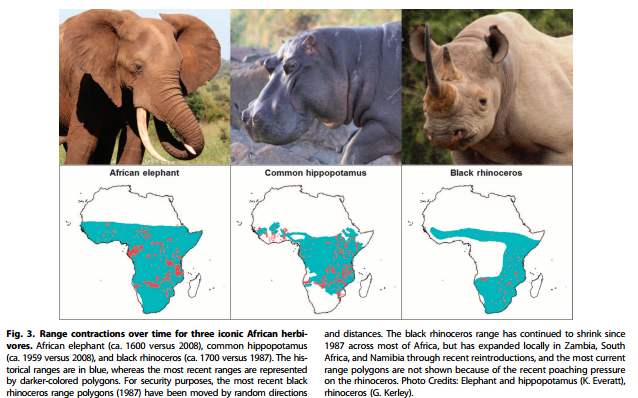
Even in the relatively recent past, the area of land over which these animals roamed has drastically declined. Maps published in a new paper in the journal Science Advances show that elephants, hippos and black rhinos occupied most of sub-Saharan Africa when their populations were first encountered by modern Europeans, but are now confined to a few tiny specks of land.

From William J. Ripple et al, 1st May 2015. Collapse of the world’s largest herbivores. Science Advances. 2015;1:e1400103

Why do the very large animals prove most susceptible to destruction? It’s partly because they reproduce slowly and partly because they require plenty of land and food for their survival, so the destruction of wild places tends to hit them sooner than it affects smaller species. But it’s also, I believe, because we have a deep-rooted urge to assert our status by killing them and owning their body parts. Even when people don’t do the killing themselves, possessing their skins, heads, tusks or horns has long been a means of acquiring bragging rights.

From the exquisite sculpture of two reindeer migrating across a river, carved from a piece of mammoth ivory 13,000 years ago and now housed in the British Museum, to the tiger skin rugs and heads of exotic beasts exhibited in stately homes today, bigging ourselves up by displaying our mastery of great beasts seems to be a fundamental human trait. Today’s aristocrats, some of whom are descendants of tribal chiefs, hang their ancestors on the wall to establish their genealogy and the heads of the animals they have killed beside them, to establish their prowess. Not much has changed in thousands of years.

Many of the world’s great sagas, tales of Ulysses, Sinbad, Sigurd, Beowulf, Cú Chulainn, St George, Arjuna, Lạc Long Quân and Glooskap, tell of struggles with megafauna real or imagined. Doubtless at least some of these stories originated in real battles with beasts whose true nature has been forgotten, as a result of their extinction. Think of Sinbad and the roc, which might be a garbled version of encounters with the elephant bird of Madagascar.

Today, some very rich people try to recreate these battles in ways that seem to me grotesque. They bid on the internet for the right to shoot a particular animal, sometimes paying tens of thousands of dollars, arrange a date, a time and a place, then fly over, in some cases with their taxidermists in tow, to bag the creature they have bought.

The animal is waiting for them – sometimes in an enclosure, sometimes just after being released from one, sometimes in the wild but already located by guides. There is no question about the outcome; otherwise the money would have to be repaid. I have heard that in some cases these people fly to a country for just a couple of days, during which they have booked the killing of several spectacular animals. Their diary secretaries arrange their schedules so that they can fit them all in. Once they have posed triumphantly with a foot on the beast they have just killed, they leave it for the taxidermist to process and move on to the next appointment with death.

This looks to me as dry and joyless as it is brutal and unsporting. Though I would struggle nowadays to bring myself to shoot a mammal or a bird (in my youth I killed and ate a few rabbits, squirrels and pigeons), I can understand the attraction of doing so in difficult circumstances, stalking and crawling and lying in wait much as a wild predator would. Canned, predetermined hunting of this kind seems empty of challenge and romance, bought rather than won. But such is the drive to establish dominion over the largest and most magnificent of beasts, and such is the obsession with conspicuous outcomes, that, for some people, none of this appears to matter.

Others are satisfied to remove themselves even further from contingency, by purchasing pieces of animals that have already been killed. My guess is that the use of rhino horn, tiger bones and other such body parts in traditional Chinese medicine, which are of course clinically useless, might be another manifestation of this deep-rooted drive, to make ourselves feel better by association with creatures larger or fiercer than ourselves.

You might have imagined that there were now plenty of alternative means of asserting our status and persuading ourselves of our own value, but traits that resonate with our evolutionary past – our ghost psyche – die hard.

So this great global tragedy continues. I know I should write about it more often. But I find it too upsetting.

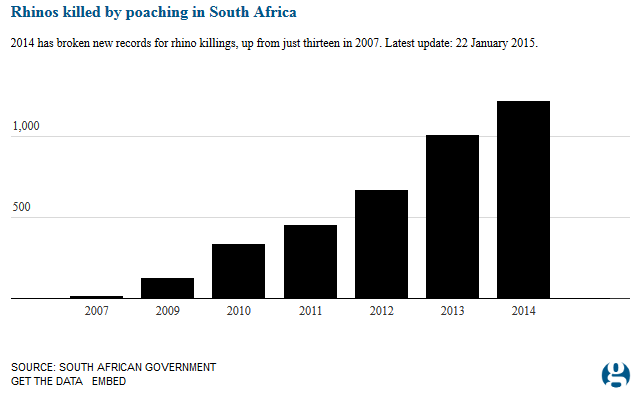
Until 2008, conservationists, in some places at least, appeared to be winning. But in that year the number of rhinos killed in South Africa rose (from 13 in 2007) to 83. By 2011, the horrible tally had risen to 448. It climbed to 668 in 2012, 1004 in 2013 and 1215 in 2014. In the first four months of this year, 393 rhinos have been killed there, which is 18% more than in the same period last year.

rhino-poaching-trend

The reasons for this acceleration in the Great Global Polishing are complex and not always easy to tease out. But they appear to be connected to rising prosperity in Vietnam, the exhaustion of illegal stocks held by Chinese doctors and, possibly, speculative investment in a scarce and tangible asset during the financial crisis. Corruption and judicial failure help to keep the trade alive.

Already, the western black rhino is extinct (the declaration was made in 2011). The northern white rhino has been reduced to five animals: a male at the end of its anticipated lifespan and four females, scattered between Kenya, the US and the Czech Republic.

Similar stories can be told about some populations of elephants – in particular the forest elephants of West and central Africa.

It’s not just these wonderful, enchanting creatures that are destroyed by poaching, but also many of the living processes of the places they inhabit. Elephants and rhinos are ecological engineers, creating conditions that hundreds of other species have evolved to exploit.

As the paper in Science Advances notes, the great beasts maintain a constantly shifting mosaic of habitats through a cycle of browsing and toppling and trampling, followed by the regrowth of the trees and the other plants they eat. They open up glades for other herbivores, and spaces in which predators can hunt. They spread the seeds of trees that have no other means of dispersal (other animals are too small to swallow the seeds whole, and grind them up). Many trees in Africa and Asia are distributed exclusively by megaherbivores.

They transport nutrients from rich places to poor ones and in some places reduce the likelihood of major bushfires, by creating firebreaks and eating twigs and leaves that would otherwise accumulate as potential fuel on the ground. Many animal species have co-evolved with them: the birds that eat their ectoparasites, the fish that feed on hippos’ fighting wounds (some of these species, I believe, are now used for fish pedicures), the wide range of life that depends on their dung for food and moisture, on their wallows for habitats, on the fissures they create in trees for nesting holes.

Who knows what ecological processes the world has already lost through the retreat of the megafauna? Everywhere on earth, living systems have been radically altered by the loss of the great beasts. (I’ll be discussing the impacts of the extinction of European elephants in next month’s edition of BBC Wildlife magazine).

The destruction of some of the last populations of the animals that shaped us, as well as the natural world, inflicts, I feel, a great wound in our lives, diminishing the wonderful planet on which we evolved, shrinking imagination, crushing experience. All of us should have an interest in supporting those who seek to save these wonderful creatures.

www.monbiot.com

ooOOoo

Dear Reader, I don’t intend to cast you in some dark mental place with the republication of this dark essay from Mr. Monbiot. Yet if you care about the world that we are leaving for the next generation, and I’m certain that the majority, the vast majority, of you readers do so care, then these terrible aspects of humanity must be highlighted. For if just one person is moved to make a difference then the mental pain is a necessary step on that journey of making a difference.

Always search for the rainbow – it’s there somewhere. If

you can’t find one, invent one.Anon.

Beyond humans

Loving the animals on this planet must be more than a romantic notion.

Before you read on, take a small break in your busy day and watch the following:

On December 8, 2013 Michael Mountain spoke on “”I Am Not an Animal” — The Signature Cry of our Species” at the Personhood Beyond the Human conference at Yale University.

Michael Mountain is Past President and one of the founders of Best Friends Animal Sanctuary, the nation’s largest sanctuary for abused and abandoned animals.

Abstract: The past 50 years have seen enormous growth in the animal protection movement. But the situation for nonhuman animals in every sphere, with the exception of homeless pets, continues to deteriorate. Any small advances remain incremental. Animal rights and welfare groups find themselves at a loss to explain their inability to influence the general public. But the work of Ernest Becker (The Denial of Death) and of psychologists in the field of Terror Management Theory (TMT) offer essential insight.

In this talk, we discuss how our need, as humans, to proclaim that “I am not an animal!” and to deny personhood to other animals affects our relationship with them at a fundamental level. We argue that to be effective, the animal protection movement needs to understand TMT and take it into account. And we conclude that a new kind of relationship to the world of nature in the 21st Century is not only essential to the mitigation of the catastrophic effects of the Sixth Great Extinction, but that it also holds the key to Becker’s still-unanswered question of how we can begin to relate positively to our own terror of personal mortality — and therefore our own future as a species.

Me spending time becoming better acquainted with the subject of rights for other animals besides us humans coincided with a recent item published over on The Conversation and republished here within their rights.

ooOOoo

May 19 2015, 4.05pm EDT

Climbing the tree: the case for chimpanzee ‘personhood’

Should primates such as chimpanzees be given rights normally reserved for humans? phil/Flickr, CC BY-NC-SA

Hercules and Leo don’t know it, but a decision about their future has made history. In granting an order to show cause on whether Hercules and Leo (who just happen to be chimpanzees) are illegally imprisoned, a Supreme Court judge in Manhattan has kept open the possibility that some nonhuman animals will be granted legal rights under common law.

The plaintiffs are currently used for biomedical research at New York’s Stony Brook University. What the lawyers running the case hope to show is that Hercules and Leo shouldn’t be treated as if they were just things or property, but should instead be given the status of persons.

Showing that any animal has what is needed for legal personhood is a difficult task. But chimpanzees seem promising candidates as there is a wealth of scientific evidence showing they possess complex cognitive abilities, like self-awareness and autonomy.

The order to show cause on the issue of habeas corpus is the first step in a process which Steven Wise and the Nonhuman Rights Project (NhRP) hope will secure Hercules and Leo’s bodily liberty and integrity.

If the court were to find in their favour, the chimpanzees would no longer be kept for research and could be moved to a sanctuary in Florida.

NhRP was founded by Wise in 2007 and after years of research it filed its first cases back in December 2013. To date it has brought three cases on behalf of chimpanzees held in captivity in the state of New York. But NhRP is ambitious, aiming to run as many cases on behalf of animals as it can fund.

If it can find suitable plaintiffs, NhPR hopes to mount cases for the personhood of elephants, whales and dolphins too.

Different perspectives on personhood for animals

Reactions to treating nonhuman animals as persons vary widely. Some people think it is ridiculous to even entertain the idea. Persons have to be human – end of story.

For philosophers, this is not very satisfactory. It tries to answer the question of whether animals can be persons by asserting a definition rather than offering an argument. It gets more interesting when people give reasons to support their view.

One approach to defending the idea that only humans are persons involves saying that persons need to participate in society. Society is founded on reciprocity; you can’t just take rights without also assuming responsibilities. And animals like chimpanzees can’t take on responsibilities, so they can’t have rights.

Another tactic is to suggest that there is a whole heap of criteria that one has to meet to be a person. And although humans meet these criteria, nonhuman animals don’t. These criteria could include things like being rational, self-aware, autonomous, having culture and being able to communicate.

The problem is neither of these kinds of arguments stand up to interrogation. There are lots of humans who get the benefit of rights without living up to reciprocal responsibilities, such as young children and people with certain physical or mental impairments.

There are similar difficulties when using a criteria based approach. Just as there are many humans who don’t meet certain criteria for personhood, there are some nonhuman animals who do.

This is known as the “problem of marginal cases”. Taking a consistent approach would mean treating some animals, but not all humans, as worthy of moral consideration.

This is known as the “problem of marginal cases”. Taking a consistent approach would mean treating some animals, but not all humans, as worthy of moral consideration.

There are other people who are sympathetic towards giving greater ethical consideration to animals, but who don’t think using personhood is the best approach. Utilitarians, for example, worry about the capacity to suffer. If a chimpanzee – or for that matter a dog, cat or rat – can experience pleasure and pain, then they matter regardless of whether they meet a test for personhood.

Implications of nonhuman animals as persons

If Wise and the NhRP win their case it will be a significant precedent and other cases will surely follow. Chimpanzees in jurisdictions where successful cases are mounted will no longer be permitted to be used in research or kept in zoos and circuses.

However, less charismatic animals – ones that don’t look like us or where it is not in our interests to grant them rights – won’t be so fortunate. Historically, there is a deep inconsistency in how we treat different types of animals that is not easily overturned, even in the face of compelling legal and ethical arguments.

The case of Hercules and Leo also has connections to Australia. Wise was inspired to practice animal law back in the 1980s after reading the work of Australian philosopher, Peter Singer. The hearing of the case in New York was actually interrupted due to Wise’s long-standing commitment to visit Australia and deliver the 2015 Voiceless Animal Law Lecture Series.

The hearing is now scheduled for 10:30am Wednesday May 27 at the New York County Supreme Court. Those interested in seeking rights for nonhuman animals keenly await the outcome.

ooOOoo

 Towards the end of that piece, one sentence stood out. This one: “Historically, there is a deep inconsistency in how we treat different types of animals that is not easily overturned, even in the face of compelling legal and ethical arguments.

Well it has to be overturned if mankind is to have any future on this planet!

Yet another aspect of our lives where taking a lesson from our dogs would do us no harm.

Remember Jasmine the greyhound?

MD6

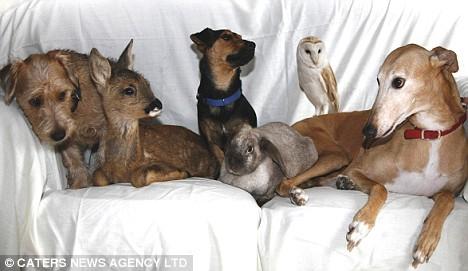
Pictured left to right are: “Toby”, a stray Lakeland dog; “Bramble”, orphaned roe deer; “Buster”, a stray Jack Russell; a dumped rabbit; “Sky”, an injured barn owl; and “Jasmine”. All told a mother’s heart doing best what a caring mother does.

Lies, Damn lies, and ….

What is so terrible about integrity!

I don’t know if my title to today’s post is part of a saying that is well-known in the USA. But back in dear old England the expression is widely used; the full expression being, “Lies, Damn Lies, and Politicians“.

So what’s got my ‘knickers in a twist’ about the various hues of ‘truth’ that we find amongst our politicians?

Before answering that question, perhaps I should answer a more fundamental question that might be arising in the minds of those followers who are relatively new to this place. (And each and every one of you has to understand the very great privilege you offer me by being a follower.) That question being what have integrity and politicians got to do with a blog about dogs?

Easily answered in the words over at About this Blog:

The underlying theme of Learning from Dogs is about truth, integrity, honesty and trust in every way. We use the life of dogs as a metaphor.

I subscribe to the blogsite The Conversation (US arm). Back on May 18th, they published an item under the title of How many ways can politicians ‘lie’?

The article seemed to articulate, in a measured and responsible fashion, what huge numbers of us sense subjectively: truth is rare to see in the world of power and politics.

I’m not going to republish it in full, including the tables, but will offer the first half with a link to the rest of the article. The author of the article is Dr. Ellis Jones, Assistant Professor of Sociology at the College of the Holy Cross in Worcester, MA.

How many ways can politicians ‘lie’? How a class led to a ‘truth’ report card for the 2016 election.

I regularly teach a course called The Sociology of Television & Media in which my students and I critically explore newscasts, entertainment programming and (both commercial and political) advertising. The theme that I use as a touchstone throughout the class is: What happens when, as a society, we begin to mix fantasy and reality together in mass media?

We discuss how a range of troubling outcomes emerge for a public that has difficulty telling truth from fiction. Max Horkheimer, a German-Jewish sociologist, argued that this is part of what led to the rise of Nazism in Germany.

Once we lose our ability to detect lies, we become vulnerable to demagogues.

Six categories of rhetoric

About halfway through the semester, I have students deconstruct political ads, and we discuss practical resources for navigating the web of truths, half-truths and outright lies that proliferate unhindered during each election cycle.

One resource that I offer is Politifact.org’s Truth-o-Meter. Students fact-check politicians’ statements to determine how much, if any, truth is contained therein (they actually won a Pulitzer Prize for their work fact-checking the 2008 election).

The first, and perhaps most important, takeaway from their work is that modern political statements cannot accurately be rated as simply “true” or “false.” So sophisticated has the art of mixing truth and lies become that the scale Politifact currently uses includes six separate categories of political rhetoric: true, mostly true, half true, mostly false, false and “pants on fire” (for statements that aren’t just false but also completely ludicrous – and yet still stated as truth).

In essence, while there is still but one way to tell the truth, there are now at least five times as many acceptable ways to lie.

For example, John Boehner’s May 3 2015 statement on Meet The Press that “we spend more money on antacids than we do on politics” is rated simply “false.” Fact-checking reveals that in the US, we spent somewhere between US$3 billion and US$7 billion on elections in 2014 (depending on what money streams you include), while we spent less than $2 billion on antacids in the same year.

Boehner’s team was apparently trying to compare global sales of antacids (including all seven billion people on the planet) to US spending on elections (about 320 million of us) – a false comparison.

On April 23 2015, Hillary Clinton provided a good illustration of a statement that rates as a “half truth.” When addressing the Women in the World Summit in New York City, Clinton asserted that the US ranks “65th out of 142 nations” when it comes to equal pay for women. The statistic comes from the World Economic Forum’s 2014 Global Gender Gap Report.

However, the primary measure generated by this report ranks the US 20th in gender equity. The ranking of 65th is taken from a subcategory in the report that relies on a survey of perceptions of executives rather than hard numbers. So, while it is technically true, it may actually be overstating the severity of the gender pay gap comparison.

Whom can we trust?

The second takeaway, though it may not be much of a surprise, is that there are no politicians in this country that exclusively tell the truth. Every single one, to a greater or lesser extent, spins, bends, twists or breaks the truth.

Perhaps this is the price of power in our modern democracy, but we should find it at least a little troubling.

So where does this leave us? Well, knowing that every one of our politicians lies, the most important question, in my mind, becomes: Who is most often telling the truth and who is lying to us repeatedly in order to gain our support?

In other words, whom can and whom can’t we trust?

With this question in mind, I had my students add up the raw numbers for 25 major politicians (based on Politifact’s fact-checking over the past eight years) and write the results up on the board in rank order from most to least honest based on the data. The results were intriguing.

While the prototype point system was not particularly sophisticated (two points for each true statement, one point for each mostly true statement, zero for half-truths, etc.), the numbers revealed that many well-known politicians were abusing the truth far more than they were embracing it.

When I asked the class what they thought of the results, one student raised her hand and replied, “I’m not shocked.” Many of the others immediately nodded their heads in agreement.

I wondered if we’ve become so accustomed to the bending and breaking of the truth that we no longer expect truth from our leaders. Now we’re teaching the next generation not to expect it either.

After seeing these preliminary results, I was hooked.

Please do read the rest of this fascinating and hugely helpful report. It names names in terms of the ‘good, bad and ugly’!

However, the closing paragraphs of Dr. Jones’ article are so wonderful that I can’t resist republishing them!

As teachers, caught up in our own subject matter, we easily forget that our students are hungry to apply what they’re being taught in our classes to something meaningful in their own lives.

It is our obligation to offer each generation a sense of social responsibility, hope for the future and the practical tools that will allow them to build it for themselves.

Something like a yearly Honesty Report Card might serve us well at this point in our democracy’s evolution. At the very least, let’s use this idea as a starting point for some kind of political unity in this country.

Whether you are liberal or conservative, can’t we at least agree that our politicians should start telling us the truth?

At this point in preparing today’s post, I wanted, wanted so much, something to take me away into some dreamy corner of my mind. For just a few minutes to be distracted from the present day realities of life.

I chose to do it by listening to this track from Chris Rea.

Oh, nearly forgot to mention that dogs don’t lie!

We are what we eat!

Some aspects of our food that many of us would rather not know about!

Many readers will be used to me republishing the essays from George Monbiot. Admittedly, not every single one of them but especially those that seem to have a message that deserves a wider promulgation. Having Mr. Monbiot’s permission to so do is generous of him.

Yesterday, there was an essay written by him that was published both on his blog and in the UK’s Guardian Newspaper. At first reading, it seemed to apply predominantly to the United Kingdom. Then, upon a second reading, I was convinced that this was yet another ‘message’ that quite happily fits in here, on Learning from Dogs. Because it is another reminder that integrity is missing from so many aspects of our societies.

You be the judge!

ooOOoo

Fowl Deeds

19th May 2015

The astonishing, multiple crises caused by chicken farming.

By George Monbiot, published in the Guardian 20th May 2015

It’s the insouciance that baffles me. To participate in the killing of an animal: this is a significant decision. It spreads like a fungal mycelium into the heartwood of our lives. Yet many people eat meat sometimes two or three times a day, casually and hurriedly, often without even marking the fact.

I don’t mean to blame. Billions are spent, through advertising and marketing, to distract and mollify, to trivialise the weighty decisions we make, to ensure we don’t connect. Even as we search for meaning and purpose, we want to be told that our actions are inconsequential. We seek reassurance that we are significant, but that what we do is not.

It’s not blind spots we suffer from. We have vision spots, tiny illuminated patches of perception, around which everything else is blanked out. How often have I seen environmentalists gather to bemoan the state of the world, then repair to a restaurant in which they gorge on beef or salmon? The Guardian and Observer urge us to go green, then publish recipes for fish whose capture rips apart the life of the sea.

The television chefs who bravely sought to break this spell might have been talking to the furniture. Giant chicken factories are springing up throughout the west of England, the Welsh Marches and the lowlands of the east. I say factories for this is what they are: you would picture something quite different if I said farm; they are hellish places. You might retch if you entered one, yet you eat what they produce without thinking.

Two huge broiler units are now being planned to sit close to where the River Dore rises, at the head of the Golden Valley in Herefordshire, one of the most gorgeous landscapes in Britain. Each shed at Bage Court Farm – warehouses 90 metres long – is likely to house about 40,000 birds, that will be cleared out, killed and replaced every 40 days or so. It remains to be seen how high the standards of welfare, employment and environment will be.

The UK now has some 2,000 of these factories, to meet a demand for chicken that has doubled in 40 years [1]. Because everything is automated, they employ few people, and those in hideous jobs: picking up and binning the birds that drop dead every day, catching chickens for slaughter in a flurry of shit and feathers, then scraping out the warehouses before the next batch arrives.

The dust such operations raise is an exquisite compound of aerialised faeces, chicken dander, mites, bacteria, fungal spores, mycotoxins, endotoxins, veterinary medicines, pesticides, ammonia and hydrogen sulphide. It is listed as a substance hazardous to health, and helps explain why 15% of poultry workers suffer from chronic bronchitis. Yet, uniquely in Europe, the British government classifies unfiltered roof vents on poultry sheds as the “best available technology”. If this were any other industry, it would be obliged to build a factory chimney to disperse the dust and the stink. But farming, as ever, is protected by deference and vested interest, excused from the regulations, planning conditions and taxes other business must observe. Already, Herefordshire County Council has approved chicken factories close to schools, without surveying the likely extent of the dust plumes either before or after the business opens. Bage Court Farm is just upwind of the village of Dorstone.

Inside chicken factories are scenes of cruelty practised on such a scale that they almost lose their ability to shock. Bred to grow at phenomenal speeds, many birds collapse under their own weight, and lie in the ammoniacal litter, acquiring burns on their feet and legs and lesions on their breasts. After slaughter they are graded. Those classified as grade A can be sold whole. The others must have parts of the body removed, as they are disfigured by bruising, burning and necrosis. The remaining sections are cut up and sold as portions. Hungry yet?

Plagues spread fast through such factories, so broiler businesses often dose their birds with antibiotics. These require prescriptions but – amazingly – the government keeps no record of how many are issued. The profligate use of antibiotics on farms endangers human health, as it makes bacterial resistance more likely.

But Herefordshire, like other county councils in the region, scarcely seems to care. How many broiler units has it approved? Who knows? Searches by local people suggest 42 in the past 12 months. But in December the council claimed it has authorised 21 developments since 2000. [2] This week it told me it has granted permission to 31 since 2010. It admits that it “has not produced any specific strategy for managing broiler unit development” [3]. Nor has it assessed the cumulative impact of these factories. At Bage Court Farm, as elsewhere, it has decided that no environmental impact assessment is needed [4].

So how should chicken be produced? The obvious answer is free range, but this exchanges one set of problems for another. Chicken dung is rich in soluble reactive phosphate. Large outdoor flocks lay down a scorching carpet of droppings, from which phosphate can leach or flash into the nearest stream. Rivers like the Ithon, in Powys, are said to run white with chicken faeces after rainstorms. The River Wye, a special area of conservation, is blighted by algal blooms: manure stimulates the growth of green murks and green slimes that kill fish and insects when they rot. Nor does free range solve the feed problem: the birds are usually fed on soya, for which rainforests and cerrado on the other side of the world are wrecked.

There is no sensible way of producing the amount of chicken we eat. Reducing the impact means eating less meat – much less. I know that most people are not prepared to stop altogether, but is it too much to ask that we should eat meat as our grandparents did, as something rare and special, rather than as something we happen to be stuffing into our faces while reading our emails? To recognise that an animal has been sacrificed to serve our appetites, to observe the fact of its death, is this not the least we owe it?

Knowing what we do and what we induce others to do is a prerequisite for a life that is honest and meaningful. We owe something to ourselves as well: to overcome our disavowal, and connect.

http://www.monbiot.com

[1] Total purchases for household consumption (uncooked, pre-cooked and take-aways combined) rose from 126 grammes per person per week in 1974 to 259 grammes in 2013 (see the database marked UK – household purchases).

[2] BBC Hereford and Worcester, 15th December 2014

[3] Response to FoI request IAT 7856, 13th August 2014

[4] Herefordshire County Council, 22nd December 2014. Screening Determination of Bage Court Farm development, P143343/F

ooOOoo

Jean and I found a way to watch the BBC Panorama programme that was broadcast recently. It was screened under the title of Antibiotic Apocalypse. This is how the programme was introduced on the BBC website:

Panorama investigates the global advance of antibiotic-resistant superbugs and the threat they pose to modern medicine and millions of patients worldwide. Reporter Fergus Walsh travels to India and finds restricted, life-saving antibiotics on sale without prescription and talks to NHS patients whose recovery depends on them.

There is much in George Monbiot’s essay that resonates with the findings of that Panorama programme. Indeed, the Panorama programme showed the extent of the use of antibiotics in many animals over and beyond chickens.

It hardly needs to be said by me that the reason this is republished in a blog based in Southern Oregon, USA is because this is a problem that is not unique to the United Kingdom; far from it!

What a strange species we humans are!

Learning love from our dogs

Just a very beautiful true story. (And I am indebted to Suzann for sending it on to me.) One couldn’t ask for a better post to follow on from yesterday’s Picture Parade theme on parenting.

ooOOoo

The Greyhound

In 2003, police in Warwickshire, England, opened a garden shed and found a whimpering, cowering dog. The dog had been locked in the shed and abandoned. It was dirty and malnourished, and had quite clearly been abused.

In an act of kindness, the police took the dog, which was a female greyhound, to the Nuneaton Warwickshire Wildlife Sanctuary, which is run by a man named Geoff Gruecock, and known as a haven for animals abandoned, orphaned, or otherwise in need.

Geoff and the other sanctuary staff went to work with two aims: to restore the dog to full health, and to win her trust. It took several weeks, but eventually both goals were achieved. They named her Jasmine, and they started to think about finding her an adoptive home.

Jasmine
Jasmine

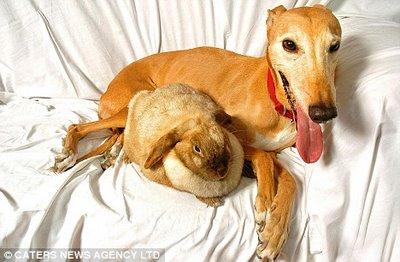
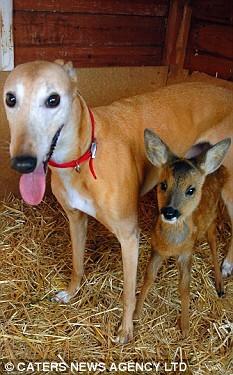
Jasmine, however, had other ideas. No one quite remembers how it came about, but Jasmine started welcoming all animal arrivals at the sanctuary. It would not matter if it were a puppy, a fox cub, a rabbit or, any other lost or hurting animal. Jasmine would just peer into the box or cage and, when and where possible, deliver a welcoming lick. MD2 Geoff relates one of the early incidents. “We had two puppies that had been abandoned by a nearby railway line. One was a Lakeland Terrier cross and another was a Jack Russell Doberman cross. They were tiny when they arrived at the centre, and Jasmine approached them and grabbed one by the scruff of the neck in her mouth and put him on the settee. Then she fetched the other one and sat down with them, cuddling them.” “But she is like that with all of our animals, even the rabbits. She takes all the stress out of them, and it helps them to not only feel close to her, but to settle into their new surroundings. She has done the same with the fox and badger cubs, she licks the rabbits and guinea pigs, and even lets the birds perch on the bridge of her nose.MD3 Jasmine, the timid, abused, deserted waif, became the animal sanctuary’s resident surrogate mother, a role for which she might have been born. The list of orphaned and abandoned youngsters she has cared for comprises five fox cubs, four badger cubs, fifteen chicks, eight guinea pigs, two stray puppies and fifteen rabbits – and one roe deer fawn. Tiny Bramble, eleven weeks old, was found semi-conscious in a field. Upon arrival at the sanctuary, Jasmine cuddled up to her to keep her warm, and then went into the full foster-mum role. Jasmine the greyhound showers Bramble the roe deer with affection, and makes sure nothing is matted. MD4They are inseparable,” says Geoff. “Bramble walks between her legs, and they keep kissing each other. They walk together round the sanctuary. It’s a real treat to see them.MD5 Jasmine will continue to care for Bramble until she is old enough to be returned to woodland life. When that happens, Jasmine will not be lonely. She will be too busy showering love and affection on the next orphan or victim of abuse. MD6 Pictured left to right are: “Toby”, a stray Lakeland dog; “Bramble”, orphaned roe deer; “Buster”, a stray Jack Russell; a dumped rabbit; “Sky”, an injured barn owl; and “Jasmine”. All told a mother’s heart doing best what a caring mother does.

ooOOoo

It was but a moment to find a video about Jasmine over on YouTube:

http://www.youtube.com/watch?v=6a57ibUayKc Finally, if you feel like translating your affection for Jasmine and the good folk over at Nuneaton & Warwickshire Wildlife Sanctuary into a donation, here’s the page to go to:

We are completely self funded. We receive no financial backing and so have to raise every single penny towards the upkeep of the sanctuary. It costs on average £360 per week to keep the sanctuary open, and a further £120 per week on food and bedding for the animals in our care. Please help us continue to rescue and rehabilitate Britain’s wildlife.

If you go to this link you can see what would be the best donation method for you. Plus, because the Sanctuary is not open for callers on Sundays I will call today (Monday) * and see if there are more details about the best way to offer support from those living outside the UK. Unconditional love is so perfectly demonstrated by our incredible dogs.

* I did call and speak with Catherine who recommended PayPal as the best means of donating to their cause, especially for those outside the UK.

Save the lives of these dogs: Please.

Johnny Depp’s dogs face death in Australia.

There was an item on the BBC News website yesterday morning that jumped out at me. The BBC headline is my sub-title for today. Here’s how the BBC opened that item:

Actor Johnny Depp has been told he has until Saturday to remove his dogs from Australia or they will be put down.

Depp and his wife Amber Heard are accused of not declaring Yorkshire Terriers Boo and Pistol to customs officials when they flew into Queensland by private jet last month.

Australia has strict animal quarantine laws to prevent importing infections.

Agriculture Minister Barnaby Joyce said he understood the dogs were being sent back to the US.

The dogs were discovered when a picture was posted of them at grooming parlour.

Later on that BBC report mentioned:

An online petition to save the “cute dogs” had received nearly 5,000 signatures by late on Thursday local time in Australia.

“Have a heart Barnaby! Don’t kill these cute puppies,” it appealed.

OK, Mr. Depp was a silly boy but his mistake must not be paid for with the lives of these wonderful dogs.

That petition is over on Change.org and here is the direct link. You will read these details.

There’s just 48 hours before Johnny Depp’s two puppies Boo & Pistol could be euthanised by Australian authorities. Please help save them!

Johnny Depp brought them to Australia with him to shoot the next Pirates of the Caribbean.

But today Agriculture Minister Barnaby Joyce has said that because he didn’t follow particular travel rules that he’ll seize and destroy them by the weekend if they’re not removed from Australia.

This seems so extreme and unnecessary. He shouldn’t kill these cute dogs simply because Depp didn’t follow particular rules.

Help me tell Barnaby Joyce not to kill or remove Johnny Depp’s dogs from Australia!

Have a heart Barnaby! Don’t kill these cute puppies.

Here’s the article: http://www.news.com.au/national/johnny-depp-amber-heard-face-death-row-wait-for-pet-dogs-after-dodging-australian-quarantine/story-e6frfkp9-1227353879412

PLEASE SIGN & SHARE!

Please sign!

OK, Time for Change!

George Monbiot’s devastating analysis of British politics.

Note to readers:

When you start reading the following introduction, ahead of George Monbiot’s essay, you may be excused for thinking I have lost the plot!  However, trust me there is a purpose. For this blog is called Learning from Dogs.

Introduction

We know that the relationship between Planet Earth and man, as in H. sapiens, goes back around 200,000 years.

We also know, indicated by DNA evidence, that the dog separated from the grey wolf about 100,000 years ago.

The relationship between dogs and man goes back thousands of years as well; “The going theory is that dogs were domesticated somewhere between 15,000 and 40,000 years ago.“[1]

Certainly, the dog was the first animal to be domesticated by man. In fact, some archaeologists speculate that without the dog man could not have been such a successful ‘hunter-gatherer’ allowing, in time, man to evolve into farming; the real start of modern man.

But what of today?

There is little doubt that many people, even with the minimum of awareness about the world that we live in, are deeply worried. On so many fronts there are forbidding and scary views. It feels as though all the certainty of past times has gone; as if all the trusted models of society are now broken. Whether we are talking politics, economics, employment or the environment, nothing seems to be working.

Why is this? What’s the cause?

It would be easy to condemn man’s drive for progress and an insatiable self-centredness as root causes. But it’s not the case, certainly not the whole case.

The root cause is clear. It is this. How mankind has developed is the result of mankind’s behaviours. All of us behave in many ways that are hugely damaging to the survival of our species upon this planet. It is likely that these behaviours are little unchanged over thousands of years.

But 2,000 years ago, the global population of man was only 300 million. It took 1,200 years for that global population to become 1 billion; in 1800. Now track the intervals as we come forward in time.

In 1927, just 127 years later, the two-billionth baby was born. In 1960, only 33 years on, the three-billionth baby. Just 16 years on, in 1974, the four-billionth baby was born. In 1987, 13 years later, five billion. Around October 1999, the sixth-billionth baby was born! It’s trending to a billion every decade. In other words, a 100-million population growth every year, or about 270,000 more persons every single day!

Combine man’s historic behaviours with this growth of population and we have the present situation. A totally unsustainable situation disconnected from the finite planet that supports us.

The only viable solution is to amend our behaviours. To tap into the powers of integrity, self-awareness and mindfulness and change our game.

We all have to work with the fundamental, primary relationships we have with each other and with the planet upon which we all depend. We need a level of consciousness with each other and with the living, breathing planet that will empower change. We need spiritual enlightenment. And we need it now!

That is why we have so much to learn from dogs. They are man’s best friend. They are man’s oldest friend. They have a relationship with us that is very special; possibly verging on the telepathic.[2]

They can show us how we need to live our lives. Now!

[1] The Origin of Dogs, Scientific American, August 20th, 2009
[2] Refer Dr Rupert Sheldrake best known for his theory of morphic fields and morphic resonance

The George Monbiot essay.

(I hope as you read his essay, you can now understand the reasoning behind my introduction.)

Republished with the very kind permission of Mr. George Monbiot.

ooOOoo

Code of Silence

Almost all the issues worth debating are left unmentioned in this election.

By George Monbiot, published in the Guardian 6th May 2015

Political coverage is never more trivial or evanescent than during an election. Where we might hope for enlightenment about the issues on which we will vote, we find gossip about the habits and style of political leaders, an obsession with statistically meaningless shifts in opinion polls and empty speculation about outcomes. (All this is now compounded by the birth of a royal baby, which means that our heads must simultaneously be dunked in a vat of sycophantic slobber). Anyone would think that the media didn’t want us to understand the choices confronting us.

While analysis of the issues dividing the political parties is often weak, coverage of those they have collectively overlooked is almost non-existent. The Conservatives, Labour, the Liberal Democrats and even the SNP might claim to be at each other’s throats, but they have often reached consensus about which issues are worthy of debate. This article will list a few of the omissions.

The first is so obvious that it should feature in every political discussion: the corrupt and broken system under which we will vote. The argument I’ve heard several Labour activists use – “vote for us because it’s the best we can hope for under first-past-the-post” – would carry more weight if Labour had any plans to change the system.

Where are the furious arguments about the UK’s unreformed political funding, that allows billionaires and corporations to buy the politics they want? Where is the debate about the use and abuse of royal prerogative by successive prime ministers? Where is there even a mention of the democratic black hole at the heart of Britain, into which hopes for financial and fiscal reform are sucked: the Corporation of the City of London, whose illegitimate powers pre-date the Magna Carta?

Here’s a fact with which politicans should be assailed every day: the poor in this country pay more tax than the rich. If you didn’t know this – and most people don’t* – it’s because you’ve been trained not to know it through relentless efforts by the corporate media. It distracts us by fixating on income tax, one of the few sources of revenue that’s unequivocally progressive. But this accounts for just 27% of total taxation. Overall, the richest tenth pay 35% of their income in tax, while the poorest tenth pay 43%, largely because of the regressive nature of VAT and council tax. The Equality Trust found that 96% of respondents to its survey would like a more progressive system. But where is the major party mobilising this desire, or even explaining the current injustice?

A comprehensive failure to tax land and property is a policy shared by the three major English parties, mansion tax notwithstanding. None of them seems to mind that this failure helps to replace the entrepreneurial society they claim to support with an economy based on rent and patrimonial capital. None of them seems to mind that their elaborate fiscal ringfencing of land and buildings clashes with their professed belief that capital should be used productively.

Nor will any of them mount an effective challenge to kleptoremuneration: executives siphoning off wealth they had no role in creating. None seek to modify a limited liability regime so generous that it allowed the multi-millionaire authors of the financial crisis, such as Fred Goodwin and Matt Ridley, to walk away from the pain they helped to inflict without forfeiting a penny.

Even these issues are trivial by comparison to the unacknowledged cloud that hangs over our politics: the impossibility of infinite growth on a finite planet. All major parties and media outlets are committed to never-ending economic growth, and use GDP as the primary measure of human progress. Even to question this is to place yourself outside the frame of rational political debate.

To service this impossible dream, we must work relentlessly, often in jobs that deliver no social utility and cause great harm. Who in politics is brave enough to propose that we work less and enjoy life more? Who will challenge working conditions characterised by ridiculous quotas and impossible demands, or reform a social security regime more draconian and intrusive than day release from prison? Who is prepared to wonder aloud what all this striving and punishment is for?

And how about some acknowledgement of the epidemic of loneliness, or the shocking rise in conditions such as self-harm, eating disorders, depression, performance anxiety and social phobia? Evidently, these are not fit and proper subjects for political discourse, which creates the impression that those who suffer them are not fit and proper electors.

How about some arguments over the loss of public space? Or a debate about what’s happening to children, confined as never before within four walls, both at school and at home? How about some recognition of the radical changes in transport demand, that are likely, in the age of peak car and peak plane, to render redundant the new roads and airports to which all the large parties are committed? Forget it.

The national and global collapse of biodiversity, the horrifying rate of soil loss, the conflict between aspirations to minimise climate change and maximise the production of fossil fuels: none of these are put before voters as issues of significant difference. All major parties tacitly agree to carry on as before.

Politicians will not break these silences voluntarily. They are enforced by a narrow and retentive public discourse, dominated by the corporate media and the BBC, that ignores or stifles new ideas, grovels to the elite and ostracises the excluded, keeping this nation in a state of arrested development.

After this election, we need to think again; to find new means of pushing neglected issues onto the political agenda. We might try to discover why the social media have so far mostly failed to fulfill their democratising promise. We might seek new ways of building political communities, using models as diverse as Podemos and evangelical Christianity. We might experiment with some of the Latin American techniques that have helped to transform politics from the bottom up. However we do it, we should never again permit democracy to be reduced to so narrow a choice.

www.monbiot.com

* 68% of respondents to the Equality Trust’s Survey believed that households in the highest 10% income group pay more of their income in tax than households in the lowest 10% income group.

ooOOoo

(Readers in other countries will easily be able to identify their country’s version of the issues that Mr. Monbiot speaks about.)

Conclusion

Sooner or later, and preferably sooner, each and every one of us must start looking at ourselves in the mirror, every morning, and say, “What behaviour will I change today to save this planet for all future generations?