Category: Morality

Why, oh why?

The obscene effects of hunting.

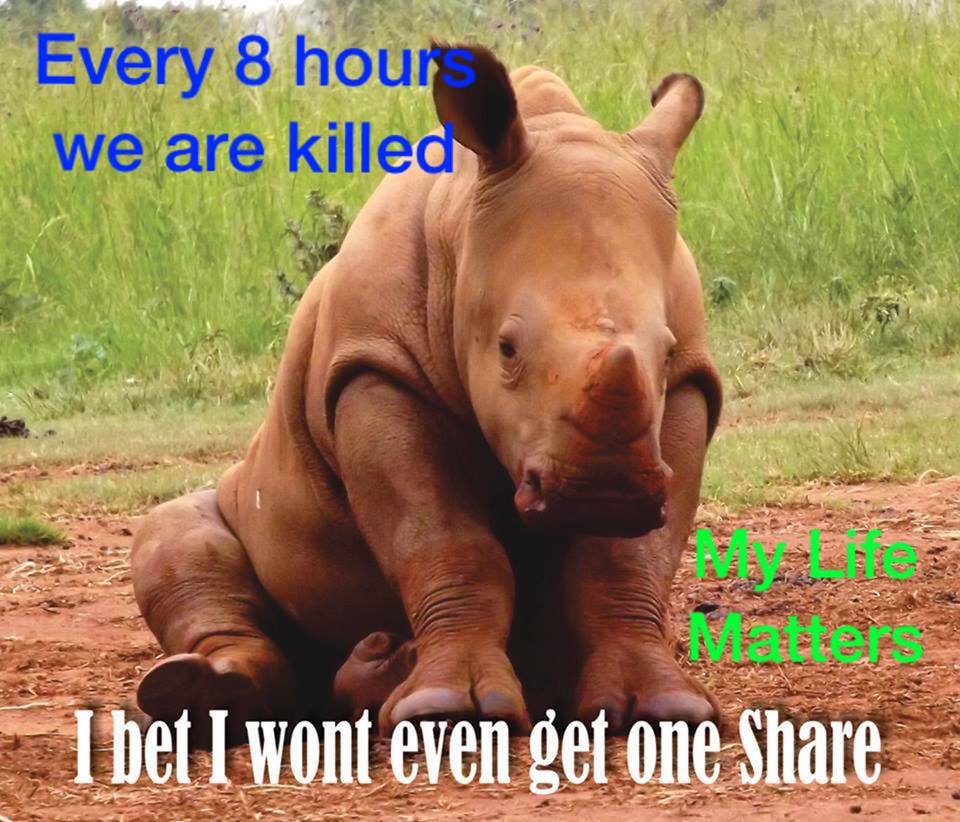
Chris Snuggs, friend from my English days, linked to an item on his Facebook page about the appalling loss of elephants and rhinos. The item included this picture:

FB rhino

The reason I am writing about this today is to give readers notice that on Saturday, October 3 from 10:30am – 3:00pm there is a march, a global march, for Elephants and Rhinos. The item on Facebook details the location as Jefferson Square, 1101 Eddy St, San Francisco, California 94109.

If we lived closer to San Francisco we would most definitely attend.

So can you be there?

If not, can you share the message!

march

Back to Chris.  His blogsite Nemo Insula has a link to this wonderful photograph:

11

Back to Chris’ Facebook entry where he subsequently wrote:

I am flattered! I thought it was just my usual bilious rant! Actually, the killing of rhinos, tigers, elephants and so on is so surreally-pointless and evil as to be almost beyond belief. You might like this photo of a rhino I saw in Senegal from about 20 metres away! Magnificent and totally innocent creatures, unlike Homo Sapiens I fear.

Jean and I feel the same way about the hunting of any animals for any purpose other than feeding oneself.

Two views of the United Kingdom

The very good and the very ugly.

Yesterday was the moment when Queen Elizabeth II became the longest-reigning UK monarch. As the BBC reported (in part) yesterday:

Queen Elizabeth II becomes longest-reigning UK monarch

The Queen has thanked well-wishers at home and overseas for their “touching messages of kindness” as she becomes Britain’s longest-reigning monarch.

Speaking in the Scottish Borders, the 89-year-old monarch said the title was “not one to which I have ever aspired”.

At 17:30 BST she had reigned for 23,226 days, 16 hours and approximately 30 minutes – surpassing the reign of her great-great-grandmother Queen Victoria.

David Cameron said the service the Queen had given was “truly humbling”.

Dressed in turquoise with her trusty black handbag at her side, the Queen spoke briefly to the gathered crowds earlier.

“Inevitably a long life can pass by many milestones – my own is no exception – but I thank you all and the many others at home and overseas for your touching messages of great kindness,” she said.

Newly released official photographs show the Queen with her official red box, containing the day's policy papers, cabinet documents, Foreign Office papers and other letters.
Newly released official photographs show the Queen with her official red box, containing the day’s policy papers, cabinet documents, Foreign Office papers and other letters.

Here’s a video that is worth viewing:

So that was the ‘good’ news.

Now here is the ‘ugly’ news; the latest essay by George Monbiot republished here with Mr. Monbiot’s kind permission.

ooOOoo

Britain’s Mafia State

8th September 2015

Where does legitimate business end and organised crime begin?

By George Monbiot, published in the Guardian 9th September 2015

Be reasonable in response to the unreasonable: this is what voters in the Labour election are told. Accommodate, moderate, triangulate, for the alternative is to isolate yourself from reality. You might be inclined to agree. If so, please take a look at the reality to which you must submit.

To an extent unknown since before the First World War, economic relations in this country are becoming set in stone. It’s not just that the very rich no longer fall while the very poor no longer rise. It’s that the system itself is protected from risk. Through bail-outs, quantitative easing and delays in interest rate rises, speculative investment has been so well cushioned that, as Larry Elliott puts it, financial markets are “one of the last bastions of socialism left on earth.”

Public services, infrastructure, the very fabric of the nation: these too are being converted into risk-free investments. Social cleansing is transforming inner London into an exclusive economic zone for property speculation. From a dozen directions, government policy converges on this objective. The benefits cap and the bedroom tax drive the poor out of their homes. The forced sale of high-value council houses creates a new asset pool. An uncapped and scarcely regulated private rental market turns these assets into gold. The freeze on council tax banding since 1991, the lifting of the inheritance tax threshold and £14 billion a year in breaks for private landlords all help to guarantee stupendous returns.

And for those who wish simply to sit on their assets, the government can help here too, by ensuring that there are no penalties for leaving buildings empty. As a result, great tracts of housing are removed from occupation. Agricultural land has proved an even better punt for City money: with the help of capital gains, inheritance and income tax exemptions, as well as farm subsidies, its price has quadrupled in 12 years.

Property in this country is a haven for the proceeds of international crime. The head of the National Crime Agency, Donald Toon, notes that “the London property market has been skewed by laundered money. Prices are being artificially driven up by overseas criminals who want to sequester their assets here in the UK.”

It’s hardly surprising, given the degree of oversight. Private Eye has produced a map of British land owned by companies registered in offshore tax havens. The holdings amount to 1.2 million acres, including much of our prime real estate. Among those it names as beneficiaries are a cast of Russian oligarchs, oil sheikhs, British aristocrats and newspaper proprietors. These are the people for whom government policy works, and the less regulated the system that enriches them, the happier they are.

The speculative property market is just one current in the great flow of cash that sluices through Britain while scarcely touching the sides. The financial sector exploits an astonishing political privilege: the City of London is the only jurisdiction in the UK not fully subject to the authority of parliament. In fact, the relationship seems to work the other way. Behind the Speaker’s chair in the House of Commons sits the Remembrancer, whose job is to ensure that the interests of the City of London are recognised by the elected members. (A campaign to rescind this privilege – Don’t Forget the Remembrancer – will be launched very soon). The City has one foot in the water: it is a semi-offshore state, a bit like the UK’s Crown dependencies and overseas territories, tax havens legitimised by the Privy Council. Britain’s financial secrecy undermines the tax base while providing a conduit into the legal economy for gangsters, kleptocrats and drug barons.

Even the more orthodox financial institutions deploy a long succession of scandalous practices: pension mis-selling, endowment mortgage fraud, the payment protection insurance con, Libor rigging. A former minister in the last government, Lord Green, ran HSBC while it engaged in money laundering for drugs gangs, systematic tax evasion and the provision of services to Saudi and Bangladeshi banks linked to the financing of terrorists. Sometimes the UK looks to me like an ever-so-civilised mafia state.

At next month’s Conservative party conference, corporate executives will pay £2,500 to sit with a minister. Doubtless, because we are assured that there is no link between funding and policy, they will spend the day discussing the weather and the films they have seen. If we noticed such arrangements overseas, we might be inclined to regard them as corruption. But that can’t be the case here, not least because the invitation explains that “fees associated with business day & dinner are considered a commercial transaction and therefore do not constitute a political donation.”

The government also insists that there is no link between political donations and seats in the House of Lords. But a study by researchers at Oxford University found that the probability of so many major donors arriving there by chance is 1.36 x 10-38: roughly “equivalent to entering the National Lottery and winning the jackpot 5 times in a row”. Why does the Lords remain unreformed? Because it permits plutocratic power to override democracy. Both rich and poor are kept in their place.

Governed either by or on behalf of the people who fleece us, we cannot be surprised to discover that all public services are being re-engineered for the benefit of private capital. Nor should we be surprised when governments help to negotiate, without public consent, treaties such as TTIP and CETA (the Comprehensive Economic and Trade Agreement), which undermine the sovereignty of both parliament and the law. Aesop’s observation that “we hang the petty thieves and appoint the great ones to public office” remains true in spirit, though hanging has been replaced by community payback.

Wherever you sniff in British public life, something stinks: I could fill this newspaper with examples. But, while every pore oozes corruption, our task, we are told, is merely to trim the nails of the body politic.

To fail to confront this system is to collaborate with it. Who on the left would wish to stand on the sidelines as this carve-up continues? Who would vote for anything but sweeping change?

www.monbiot.com

ooOOoo

Going to close with this picture:

Ma'am's best friend: The Queen has owned corgis for more than 60 years. Picture seen on in the UK's Daily Mail newspaper.
Ma’am’s best friend: The Queen has owned corgis for more than 60 years. Picture seen in the UK’s Daily Mail newspaper.

Taking the two stories together, all that comes to mind is that we could do much better if the United Kingdom, and other countries, were governed by dogs!

With power comes responsibility.

“The price of greatness is responsibility.”

So said Sir Winston Churchill. It applies equally to the price of power.

There was an essay recently written and published by Hariod Brawn over on her blog Contentedness.net that was incredibly thought-provoking and very beautiful besides. Hariod has given me permission to republish it and it follows shortly.

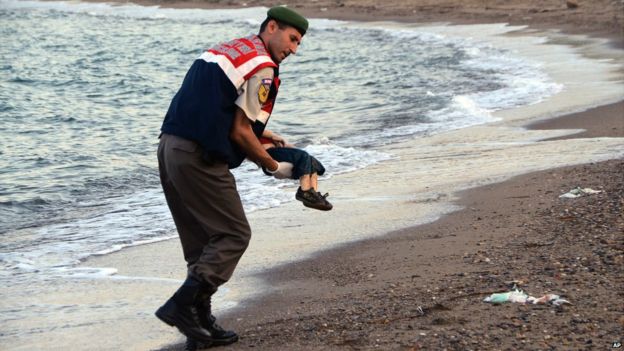
I have no doubt that Hariod’s essay was, in part, inspired by that terrible photograph that has been circulated and commented upon by thousands around the world.

_85332393_full-pic

In the words of the BBC, “The pictured boy is reported to be three-year-old Aylan, who drowned along with his five-year-old brother Galip and their mother, Rihan. Their father, Abdullah Kurdi, survived.”

The emotions created by this and other tragic photographs are disturbing, and I am no exception to having those same emotions. But as friend, Chris Snuggs, mentioned in a telephone call between us yesterday morning, what has been happening in Syria is no less terrible, perhaps even more so when one looks at the blood that is, metaphorically, on the hands of a number of western governments. The old saying of reaping what we sow comes to mind.

None of which takes away the intense beauty of Hariod’s essay: Empathetic apes.

ooOOoo

Empathic apes

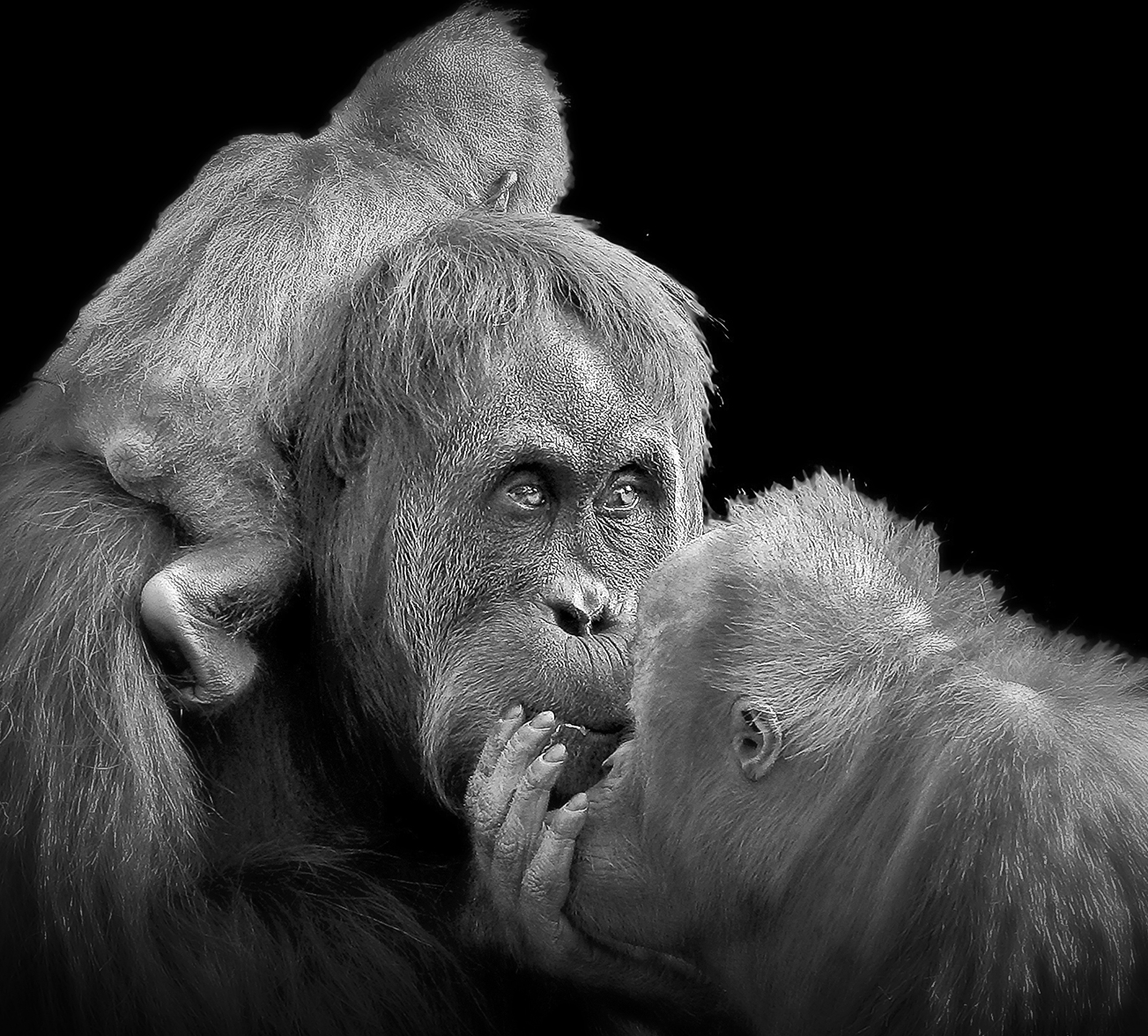
Orangutan mother and kids. By Patrick Bouquet, Chantilly.

The year is 1955, and far from the nearest village, somewhere within the Northwestern jungle region of Thailand, a 48 year-old Englishman and ordainee to the Buddhist monkhood sits quietly in studious attention. A few feet away, a female ape sits, arms carefully wrapped around some precious possession. The monk first chanced upon her the previous day, and due to the curiosity roused in observing her melancholic countenance, has remained respectfully nearby to her. A trust has developed, the ape sensing the monk’s gentle disposition and harmlessness. He really ought to be making his way to the village for alms, yet somehow senses that he should stay. A silent, palpable communication has developed between the two, and slowly, carefully and deliberately, the ape, her sadness still etched upon her face, finally unfolds her arms and offers a first sight of what she has been protecting. The monk slowly approaches to within a pace or two, sensing the invitation, only to catch sight of her lifeless and terribly deformed baby.

Two empathic apes, ancestrally and psychologically speaking, separated by little more in this moment than a distant, lineage-splitting, speciation event. Opposable thumbs, one hers and one his, in turn chase away a monk’s tear and a delicately mottled butterfly as it alights from the baby’s forehead, though cannot do the same for their conjoined feelings. Eyes meet, evincing as they do a deepening rush of sadness. Nothing can be done – is this what she is thinking in her way? In his unknowing, the saffron-robed wanderer radiates compassion, yet knows he has nothing to do with it; an offering from wisdom, not from the self. All that need be known arrives in the fullest of measures. What use now the venerable elder’s sagacity, his knowledge of emptiness, renunciation, equanimity, the void? She inhabits the void, is the void, her bleak knowing piercing its veils. Without turning, the monk slowly retreats, still reverently holding her gaze alongside a shared understanding. A slight suggestion of a bowing head betokens what passes between them.

It is the ability to empathise which in part distinguishes the psychopathic mind from its otherwise healthy state, and the primary orbit of empathy is that of feeling, not the mere gyrations of intellect. This is why many species of sentience can empathise, and we human animals are but one of them. We may erroneously presume that an ability to reflect upon others’ situations facilitates human empathic capacity; yet the state of those others and their situations need not be known as verbally abstracted objects in the mind – little stories packaged in words. We may just as well occupy others’ frames of reference by intuited means; and vitality, morbidity, distress and joy may all be recognised across species in differing ways; one need not indulge any anthropomorphisation, for clear evidence abounds. What is intuited here, or instinctively known, is the nature of the other’s felt emotional condition; and in this way, 60 years ago, the grieving mother ape and mendicant monk shared that intense experience – a wordless world of deep, primate feeling.

Engraving of Orangutan. By Willem Piso (1611-1678). Courtesy Wellcome Trust

Was the mother ape empathic? Well, she came to appreciate the monk’s amity; she felt able to extend trust; she intuited the monk’s concern for her as well as his desire for understanding as to the reasons for, and significance of, her sadness; and finally, she recognised that the monk would feel something of that sadness in revealing its causes to him. This is all to say that she significantly placed herself within the monk’s frame of reference and innately understood that emotions can be matched in shared experience – the personal does not expire at the boundary of the body. Her empathic appreciation was sophisticated, certainly moreso than any psychopathic human ape. Now, one way to cheat the system is to mimic expressions and gestures, which results in a like proprioceptive sense. This means our feelings echo the other’s, so affecting an emotional contagion of sorts, whether volitionally induced or not. Yet neither jungle dweller did so, their empathic link being forged in mind purely intuitively, and silently.

Empathy subsists in knowledge; it is in part to know the mind of the other, and whilst its currency is both cognitive (knowing) and emotional (feeling) in nature, it is the latter that strengthens the connective link to altruistic and prosocial leanings, as well as ameliorating aggressive traits. Primates’ mirror-neuron systems help forge innate empathic leanings, with research suggesting that empathy evolved in part as a survival mechanism. Right now, tens of thousands of refugees are fleeing war-torn regions of Africa and the Middle East so as to seek sanctuary, and survival, in Europe. A few hours ago, a three year-old Syrian boy, Aylan Kurdi, drowned and was washed up on the shores of the Greek island of Kos. Equally tragically, his five year-old brother met a similar fate. Whilst Europe’s politicians exhibit an ongoing empathy gap, innocent children are dying. We live, not literally, though metaphorically, in a jungle, sharing the empathic faculties of the monk and bereaved mother ape. Are we wise enough to nurture the same?

ooOOoo

We need leaders who understand the integrity that is required from them. We need leaders that accept and understand the responsibilities that they have embraced, indivisible from the power that society has lent to them. We need leaders that understand a different aspect of their power, the power of those unanticipated consequences from their actions.

Until we the people understand that electing leaders who do not embrace integrity then Aylan Kurdi and thousands of others in those ‘hot spots’ around the world will continue dying in vain.

Integrity equates to being truthful, to being honest. It doesn’t mean being right all the time, of course not, but integrity does mean accepting responsibility for all our actions, for feeling remorse and apologising when we make mistakes. Integrity means learning, being reliable, being a builder rather than a destroyer. It means being authentic. That authenticity is precisely and exactly what we see in our dogs.

The starting point for what we must learn from our dogs is integrity.

Seeing the truth in our mirror.

A sombre reflection on the killing abilities of man.

I was in two minds as to whether to post this today for it is certainly a grim reminder of the less desirable aspects of our species.

In the end, I decided to so do because it needs to be shared and if it changes the mindset of just one person it will have been worthwhile. I was originally seen by me on the EarthSky blogsite.

ooOOoo

Want to see Earth’s super predator? Look in the mirror.

Our efficient killing technologies have given rise to the human super predator. Our impacts are as extreme as our behavior, says study.

Rope trawl for midwater trawling. Photo credit: NOAA

Extreme human predatory behavior is responsible for widespread wildlife extinctions, shrinking fish sizes and disruptions to global food chains, according to research published in the August 21 edition of the journal Science these are extreme outcomes that non-human predators seldom impose, according to the article.

Lead researcher Chris Darimont is a professor of geography at the University of Victoria. Darimont said:

Our wickedly efficient killing technology, global economic systems and resource management that prioritize short-term benefits to humanity have given rise to the human super predator. Our impacts are as extreme as our behavior and the planet bears the burden of our predatory dominance.

A coastal wolf is hunting salmon in British Columbia, Canada. Photo credit: Guillaume Mazille

The team’s global analysis indicates that humans typically exploit adult fish populations at 14 times the rate than do marine predators. Humans also hunt and kill large land carnivores such as bears, wolves and lions at nine times the rate that these predatory animals kill each other in the wild.

Researchers noted that in some cases, dwindling species of predatory land carnivores are more aggressively hunted for trophies, due to the premium placed on rare prey.

The result of human activity on wildlife populations is far greater than natural predation. Research suggests that socio-political factors can explain why humans repeatedly overexploit. Technology explains how: Humans use advanced killing tools, cheap fossil fuel, and professional harvesters – like high-volume commercial fishing fleets – to overcome the defensive adaptations of prey.

Humanity also departs fundamentally from predation in nature by targeting adult quarry.Co-author Tom Reimchen is a biology professor at University of Victoria. He said:

Whereas predators primarily target the juveniles or ‘reproductive interest’ of populations, humans draw down the ‘reproductive capital’ by exploiting adult prey.

During four decades of fieldwork on Haida Gwaii, an archipelago on the northern coast of British Columbia, Reimchen looked at how human predators differ from other predators in nature. Reimchen’s predator-prey research revealed that predatory fish and diving birds overwhelmingly killed juvenile forms of freshwater fish. Collectively, 22 predator species took no more than five per cent of the adult fish each year. Nearby, Reimchen observed a stark contrast: fisheries exclusively targeted adult salmon, taking 50 per cent or more of the runs.

The authors conclude with an urgent call to reconsider the concept of “sustainable exploitation” in wildlife and fisheries management. A truly sustainable model, they argue, would mean cultivating cultural, economic and institutional change that places limits on human activities to more closely follow the behavior of natural predators. Darimont said:

We should be protecting our wildlife and marine assets as an investor would in a stock portfolio.

Enjoying EarthSky? Sign up for our free daily newsletter today!

Bottom line: According to research published in the August 21, 2015 edition of Science, extreme human predatory behavior is responsible for widespread wildlife extinctions, shrinking fish sizes and disruptions to global food chains.

Read more from the University of Victoria

ooOOoo

Chris Darimont really put his finger on the spot in my opinion when he was quoted,”We should be protecting our wildlife and marine assets as an investor would in a stock portfolio.”

Going to close today’s post by repeating what is presented on the Welcome page of Learning from Dogs, namely:

As man’s companion, protector and helper, history suggests that dogs were critically important in man achieving success as a hunter-gatherer. Dogs ‘teaching’ man to be so successful a hunter enabled evolution, some 20,000 years later, to farming, thence the long journey to modern man. But in the last, say 100 years, that farming spirit has become corrupted to the point where we see the planet’s plant and mineral resources as infinite. Mankind is close to the edge of extinction, literally and spiritually.

Dogs know better, much better! Time again for man to learn from dogs!

My argument rests!

I’ll lead, you follow Mr Goose.

Stories like this are wonderful – more please!

This needs no further introduction from me other than to say that this gorgeous story is from Mother Nature Network.

ooOOoo

‘Lost’ goose follows pickup truck 6 miles to water

After a Canada goose started following his truck, forester Andre Bachman decided to lead it to a nearby lake — and to film a video out his window as the bird flew dutifully alongside.

By: Russell McLendon
August 20, 2015

If there’s a wild Canada goose following you, it often means you’re being chased angrily from a pond or harassed for bread crumbs. But as a new viral video illustrates, the famously surly birds can be surprisingly civil — even compliant.

Andre Bachman first realized a goose was tailing him as he drove along a gravel road in rural southwest Alberta. “The goose was flying above when it saw his truck and started flying beside him,” writes Reddit user Watchboy0, who posted a video of the encounter titled “A Canada Goose was following my dad in his truck.”

Curious why a goose would spontaneously follow a pickup truck, Bachman pulled over — as did the goose. He began filming with his smartphone as he stepped out to greet the goose, which was waddling nonchalantly toward him.

“Hi,” Bachman said. “What are you doing? Are you lost?”

The goose didn’t answer, aside from quiet honking. But its behavior spoke volumes, revealing a level of comfort with humans that suggests it may have been a pet at some point. Shooing it with “off you go, off you go” didn’t work, so Bachman decided to embrace the goose’s idea. Thinking it might need help finding water, he set out for Shining Bank Lake, which the CBC reports is about 10 kilometers (6 miles) away.

“Let’s go for a flight, OK?” he offered. As Bachman filmed through his truck window, he began driving and coaching the goose to follow. It started with a brisk trot — a pretty amusing sight on its own — and then flapped into flight, letting Bachman capture an endearing view of it flying alongside to the Beatles’ “Let It Be.”

A Canada goose flies alongside a pickup truck on its way to Alberta's Shining Bank Lake. (Photo: Andre Bachman/YouTube)
A Canada goose flies alongside a pickup truck on its way to Alberta’s Shining Bank Lake. (Photo: Andre Bachman/YouTube)

Bachman stopped at least once to check on the goose, saying “I almost hit you, didn’t I?” and noting its tameness when the bird let him pet it. As goose expert Sid Andrews of Inglewood Bird Sanctuary tells Canada’s Global News, even wild Canada geese accustomed to handouts rarely tolerate that.

“I would guess that because it allowed the fellow driving the truck to get very close, that at some point in time, it must have been imprinted on human beings,” Andrews says, adding that it also may have simply mistaken its reflection in the truck’s bumper for another goose. “It somehow got lost or estranged from the group and found, just by happenstance, another goose in the reflection in the bumper.”

Either way, the goose had little trouble keeping up. “My dad would just about stop for the corners after the first one to let it turn,” Watchboy0 writes on Reddit. “Also, at one point he wanted to see how fast it could go. At around 80 km/h [50 mph], the goose started flying above his truck on the air coming off his windshield.”

Once at the lake, the goose “seems happy and stays,” Bachman writes on YouTube, where the video has been watched more than 1.5 million times in about a week. The bird was probably never in serious distress, Andrews says, but Bachman may still have done it a favor by leading it to water. “I certainly would applaud [the driver’s] instincts to head to water because it’ll have a much better chance of finding food.”

ooOOoo

Well done that man: forester Andre Bachman. Well done, indeed!

When dark shadows fall across our hearts.

One of the most important lessons we can learn from our dogs: coping with death.

In writing about the lesson of death that we can learn from our dogs I am, of course, speaking of our own death, of the inevitability of our death. That largely unspoken truth that Sharon Salzberg described in her book Faith: “What does it mean to be born in a human body, vulnerable and helpless, then to grow old, get sick and die, whether we like it or not?” [page 34.]

Anyone who has loved a dog has most likely been intimately involved in the end of that dog’s life. It is, to my mind, the ultimate lesson that dogs offer us: how to be at peace when we die and how to leave that peace blowing like a gentle breeze through the hearts of all the people who loved us.

Our beloved dogs have much shorter life spans than us, thus almost everyone who has loved a dog will have had to say goodbye to that gorgeous friend at some point in their lives. Very sadly, perhaps, saying goodbye to more than one loved dog.

All of which is my introduction to a recent essay published on The Conversation blogsite. The essay is written by Bernard Rollin, Professor of Philosophy, Animal Sciences and Biomedical Sciences at Colorado State University. The essay is called: When is it ethical to euthanise your pet?

ooOOoo

When is it ethical to euthanize your pet?

August 12, 2015 6.18am EDT

In the 1960s, I knew people who, before going on vacation, would take their dogs to a shelter to be euthanized. They reasoned that it was cheaper to have a dog euthanized – and buy a new one upon returning – than pay a kennel fee.

Two decades later, I was working at Colorado State’s veterinary hospital when a group of distraught bikers on Harley-Davidsons pulled up carrying a sick chihuahua. The dog was intractably ill, and required euthanasia to prevent further suffering. Afterwards, the hospital’s counselors felt compelled to find the bikers a motel room: their level of grief was so profound that the staff didn’t think it was safe for them to be riding their motorcycles.

These two stories illustrate the drastic change in how animals have been perceived. For thousands of years, humans have kept animals as pets. But only during the past 40 years have they come to be viewed as family.

While it’s certainly a positive development that animals are being treated humanely, one of the downsides to better treatment mirrors some of the problems the (human) health care system faces with end-of-life care.

As with humans, in many cases the lives of pets are needlessly prolonged, which can cause undue suffering for the animals and an increased financial burden for families.

The growth of veterinary medicine and ethics

In 1979, I began teaching veterinary medical ethics at Colorado State University’s veterinary school, the first such course ever taught anywhere in the world.

A year later, the veterinary school hired an oncologist to head up a new program on animal oncology. Soon, our clinic was applying human therapeutic modalities to animal cancer. The visionary head of the veterinary program also hired a number of counselors to help pet owners manage their grief – another first in veterinary circles.

I’d been under the impression that people would be reluctant to spend much money on animal treatments, so I was genuinely shocked when the following April, the Wall Street Journal reported individuals spending upwards of six figures on cancer treatments for their pets.

As a strong advocate for strengthening concern for animal welfare in society, I was delighted with this unprecedented turn of events. I soon learned that concern for treating the diseases of pets besides cancer had also spiked precipitously, evidenced by a significant increase in veterinary specialty practices.

One of the family

So what’s behind the shift in how pets are perceived and treated?

For one, surveys conducted over the last two decades indicate an increasing number of pet owners who profess to view their animals as “members of the family.” In some surveys, the number is as high as 95% of respondents, but in nearly all surveys the number is higher than 80%.

In addition, the breakdown of nuclear families and the uptick of divorce rates have contributed to singles forming tighter bonds with companion animals.

Such attitudes and trends are likely to engender profound changes in societal views of euthanasia. Whereas before, many owners didn’t think twice about putting down a pet, now many are hesitant to euthanize, often going to great lengths to keep sick animals alive.

Vets caught in the middle

However, veterinarians continue to experience extensive stress as they experience two opposite – but equally trying – dilemmas: ending an animal’s life too soon, or waiting too long.

In a paper that I published entitled Euthanasia and Moral Stress, I described the significant stress experienced by veterinarians, veterinary technicians and humane society workers. Many chose their profession out of a desire to improve the lot of animals; instead, they invariably ended up euthanizing large numbers of them, often for unethical reasons.

These ranged from “I got the dog to jog with me, and now it’s too old to run,” to “If I die, I want you to euthanize the animal because I know it can’t bear to live without me.”

In other cases, the animal is experiencing considerable suffering, but the owner is unwilling to let the animal go. With owners increasingly viewing pets as family members, this has become increasingly common, and many owners fear the guilt associated with killing an animal too soon.

Ironically this, too, can cause veterinarians undue trauma: they know the animal is suffering, but there’s nothing they can do about it unless the owner gives them permission.

The consequences are manifest. One recent study showed that one in six veterinarians has considered suicide. Another found an elevated risk of suicide in the field of veterinary medicine. Being asked to kill healthy animals for owner convenience doubtless is a major contribution.

How to manage the decision to euthanize

Here is my suggestion to anyone who is thinking about getting a pet: when you first acquire it, create a list of everything you can find that makes the animal happy (eating a treat, chasing a ball, etc). Put the list away until the animal is undergoing treatment for a terminal disease, such as cancer. At that point, return to the list: is the animal able to chase a ball? Does the animal get excited about receiving a treat?

If the animal has lost the ability to have positive experiences, it’s often easier to let go.

This strategy can be augmented by pointing out the differences between human and animal consciousness. As philosopher Martin Heidegger has pointed out, for humans much of life’s meaning is derived from balancing past experiences with future aspirations, such as wishing to see one’s children graduate or hoping to see Ireland again.

Animals, on the other hand, lack the linguistic tools to allow them to anticipate the future or create an internal narrative of the past. Instead, they live overwhelmingly in the present. So if a pet owner is reluctant to euthanize, I’ll often point out that the animal no longer experiences pleasant “nows.”

In the end, managing euthanasia represents a major complication of the augmented status of pets in society. Ideally, companion animal owners should maintain a good relationship with their general veterinary practitioner, who has often known the animal all of its life, and can serve as a partner in dialogue during the trying times when euthanasia emerges as a possible alternative to suffering.

ooOOoo

So much to learn from these beautiful creatures and so many ways to return the unlimited love we receive from them.

The happiness of wolves

Loving dogs must mean, surely, loving and protecting our wolves.

In yesterday’s post, George Dvorsky wrote:

Unlike a certain companion animal that will go unnamed, dogs lose their minds when reunited with their owners. But it’s not immediately obvious why our canine companions should grant us such an over-the-top greeting—especially considering the power imbalance that exists between the two species. We spoke to the experts to find out why.

Call of the Wild

In order to gain an appreciation for dog behavior, it’s important to understand that dogs are descended from wolves (or at least a common wolf-like ancestor). Clearly, the two species, separated by about 10,000 to 15,000 years, share a lot in common.

Like dogs, wolves greet each other with vigorous face licking (Credit: Sander van der Wel CC A-SA 2.0)

That reference to wolves seemed like as good a reason as any to write further about the wonderful wolf. Or more specifically about the wolves of Oregon.

Such as this from a recent newsletter from Oregon Wild:

Dear Oregon Wild Supporter,

It’s been a busy last few days for Oregon’s wolves and those working to protect them, with new places, new dates, and new pups!

When I wrote to you last, it was about an important Oregon Department of Fish and Wildlife (ODFW) Commission meeting in Seaside. But there’s been a change! The agenda for that meeting has moved and the ODFW Commission will now be taking comments on whether to delist gray wolves on Friday, Oct. 9th in Florence, Oregon. Please sign up to attend and testify on behalf of Oregon’s wolves. After all, they can’t testify for themselves!

I also shared with you a video of the Rogue Pack yearlings playing, caught by trail cam. These were Journey’s pups from last year, but it was also reported that he and his mate had produced another litter this year. Thanks to the US Fish and Wildlife Service, we have a look at these new pups.

Here’s that video:

Published on Jul 8, 2015
A camera captured images of three yearling wolves playing in June, providing biologists with confirmation the offspring of Oregon’s wandering wolf OR7 and his mate have survived.

I can well imagine that the majority of the readers of Learning from Dogs will not be able to attend that ODFW Commission meeting in Florence, OR, on the 9th October (as we can’t) but that doesn’t stop you from wanting to support wolf recovery here in Oregon by signing and sharing the Oregon Wild petition.

Thank you.

The male of the species, Part One

Dogs, women and men.

I did warn you, my dear reader, at the end of yesterday’s post that my introspective mood continues!

Over today and tomorrow, I want to explore why we humans can be so incredibly clever, especially in a group sense, yet the males of our species find it so difficult to express themselves, and what that means for the future of humanity (at the risk of sounding a tad pompous).

More or less at random, a dip into yesterday’s selection of blogs brought to light some deeply disturbing items.

Professor William Even, Professor of Economics at the Farmer School of Business at Miami University was reported in The Conversation saying that:

As of 2014, there were approximately 39 million people aged 16-24 in the US, and 5.4 million of them were neither employed nor in school. That’s almost 14% of the age cohort, or more than two-and-a-half times the national rate of unemployment.

In that same bulletin from The Conversation, John Shepherd, a Professorial Research Fellow in Earth System Science at the University of Southampton in England, in writing about the challenges of directly removing CO2 from the atmosphere, stated (my emphasis):

A new paper in Nature Communications shows just how big the required rates of removal actually are. Even under the IPCC’s most optimistic scenario of future CO2 emission levels (RCP2.6), in order to keep temperature rises below 2℃ we would have to remove from the atmosphere at least a few billion tons of carbon per year and maybe ten billion or more – depending on how well conventional mitigation goes.

We currently emit around eight billion tonnes of carbon per year, so the scale of the enterprise is massive: it’s comparable to the present global scale of mining and burning fossil fuels.

Then Raúl Ilargi Meijer authored an item on The Automatic Earth blog, a blog that usually writes almost exclusively about money matters. His article was called: Power and Compassion. He opens his essay:

Time to tackle a topic that’s very hard to get right, and that will get me quite a few pairs of rolling eyes. I want to argue that societies need a social fabric, a social contract, and that without those they must and will fail, descend into chaos.

Then after referring to the European Union, he goes on to write (my emphasis):

Though it may look out of far left field for those of us -and there are many- who think in economic and political terms only, we cannot do without a conscious definition of a social contract. We need to address the role of compassion, morals, even love, in our societies. If Jesus meant anything, it was that.

There have been times through history when this subject would have been much easier to breach, but we today almost seem to think they are irrelevant, that we can do without them. We can’t. But in the US, people get killed at traffic stops every day, and in Europe, they die of sheer negligence. Developments like these will lead to ‘centers that cannot hold’.

In that part of the media whirlwind that we at the Automatic Earth expose ourselves to, virtually all discussions about our modern world, and what goes wrong with it, which is obviously a whole lot, are conducted in rational terms, in financial and political terminology.

But that’s exactly what we should not be doing. Because it’s never going to get us anywhere. In the end, let alone in the beginning too, we are not rational creatures. And if and when we resort to only rational terms to define ourselves, as well as our world and the societies we create in that world, we can only fail.

For a society to succeed, before and beyond any economic and political features are defined, it must be based solidly on moral values, a moral compass, compassion, humanity and simple decency among its members. And those should never be defined by economists or lawyers or politicians, but by the people themselves. A social contract needs to be set up by everyone involved, and with everyone’s consent. Or it won’t last.

How and why that most basic principle got lost should tell us a lot about where we are today, and about how we got here. Morals seem to have become optional. The 40-hour death struggle of Cecil the lion exemplifies that pretty well. And no, his is not some rare case. The lack of morals involved in killing Cecil is our new normal.

Let me now set the stage for what I want to write about tomorrow. And I’m going to do that by referring to a TED Talk that was recorded by historian and author Yuval Noah Harari. Here’s how that TED Talk was introduced:

Seventy thousand years ago, our human ancestors were insignificant animals, just minding their own business in a corner of Africa with all the other animals. But now, few would disagree that humans dominate planet Earth; we’ve spread to every continent, and our actions determine the fate of other animals (and possibly Earth itself). How did we get from there to here? Historian Yuval Noah Harari suggests a surprising reason for the rise of humanity.

Yuval Harari’s talk is based firmly on his thesis presented in his book: Sapiens: A Brief History of Humankind. (There’s a review of his book in The Guardian newspaper.) Namely:

The book surveys the history of humankind from the evolution of archaic human species in the Stone Age up to the twenty-first century. Its main argument is that Homo sapiens dominates the world because it is the only animal that can cooperate flexibly in large numbers. The book further argues that Homo sapiens can cooperate flexibly in large numbers, because it has a unique ability to believe in things existing purely in its own imagination, such as gods, nations, money and human rights. The author claims that all large scale human cooperation systems – including religions, political structures, trade networks and legal institutions – are ultimately based on fiction.

Other salient arguments of the book are that money is a system of mutual trust; that capitalism is a religion rather than only an economic theory; that empire has been the most successful political system of the last 2000 years; that the treatment of domesticated animals is among the worst crimes in history; that people today are not significantly happier than in past eras; and that humans are currently in the process of upgrading themselves into gods.

It is my contention that humankind’s evolution, our ability to “cooperate flexibly in large numbers”, is rooted in the gender differences between man and woman. A contention that I expand upon tomorrow.

Saturday smile.

Wonderful volunteers keep a stranded Orca whale alive.

I saw this shared on Facebook by George Ball, a friend from my English days. It’s a lovely example of the compassionate side of man.

ooOOoo

From CBS News:

Stranded orca saved by volunteers who kept it cool for hours until high tide

A pump and sheets were used to keep whale alive near Hartley Bay on B.C.’s North Coast

By Maryse Zeidler, CBC News Posted: Jul 23, 2015 7:20 AM PT – Last Updated: Jul 24, 2015 5:35 AM PT

An orca that was stranded on some rocks was kept alive for eight hours by a dedicated team of whale researchers and volunteers on the North Coast of B.C.

“She cried often, which tore at our hearts, but as the tide came up there were many cheers as this whale was finally free,” said in a Facebook post from the group The Cetacean Lab.

Early Wednesday morning, the group received a call from a colleague about the beached orca, which was stuck on some rocks at low tide.

“We decided the best thing to do would be to keep her cool, that meant to put water on her body and we used blankets and sheets,” said Hermann Meuter, a co-founder of Cetacean Lab.

“It was the only thing we could do.”

Meuter said they could see the orca’s behaviour change as they began to help her.

“At first she was stressed, you could see that her breathing was getting a little faster,” said Meuter.

But after about 15 to 20 minutes, she began to calm down.

“I think she knew that we were there to help her,” said Meuter.

Around 4 p.m. PT, the tide began to rise and the orca was able to start freeing herself.

“It took her about 45 minutes to negotiate how best to get off the rocks,” said Meuter. “We all just kept our distance at that point.”

When she swam away, the orca was quickly reunited with her pod, which was nearby.

Metuer said members of the World Wildlife Fund and the Git G’at Guardians from Hartley Bay were also on the scene helping to free the animal.

“We all cared about this whale and we were just very lucky to give that whale another chance,” said Meuter.

ooOOoo

There are photographs to view on that CBS News item plus this video (wish it could have been longer) was also included in Maryse Zeidler’s report.

Well done to everyone who helped save this magnificent animal.

Another love story.

This is what happens when an animal trainer finds a bear cub.

(Today’s post has a number of very beautiful photographs. However, it is much better presented to you, dear reader, as a standalone post rather than under the umbrella of a Picture Parade.)

Thanks to Suzann for sending this on to me.

ooOOoo

A Man Found Two Bear Cubs Beside Their Dead Mother.

A naturalist named Casey Anderson stumbled across two grizzly bear cubs nestled beside their dead mother in the wild mountains of Alaska . Casey couldn’t just leave these little guys to die in the wilderness, so he made the brave decision to take them with him. He trains animals for a living, so he knew he would be able to give these cubs a real shot. That simple decision, borne out of grief, turned into one of the most unique and adorable rehabilitation stories we have ever laid eyes on.

bears1

This is Casey and the little cubs. Unfortunately, only one survived and Casey decided to adopt him.

He named him Brutus.

bears2

Brutus grew up as part of the family, albeit a very fuzzy part.

bears3

It was Casey’s job to train animals, so raising and training Brutus was normal for him.

bears4oooo

bears5

Over the years, they became close friends and brothers.

bears6

And Brutus got the run of the pool.

bears7

oooo

bears8

oooo

bears9

oooo

bears10

Brutus grew to be so close to Casey, he was even his best man (bear) at the wedding.

bears11

It may have made the bride a little nervous.

bears12

But she was probably glad Brutus wasn’t capable of taking him out to dinner (no thumbs).

bears13

Brutus also gets a place of honor at the Thanksgiving table.

bears14

Life is good for this not-so-average bear.

bears15

oooo

bears16

oooo

bears17

oooo

bears18

oooo

bears19

oooo

bears20

You’ll be hard pressed to find a situation cooler than being best friends with a killer grizzly bear. If Casey and Brutus made you smile, then you should probably spread the joy and share this.

This is a lovely story. Shame all humans aren’t this kind and understanding. Though many are and this is a lovely example of such a person.