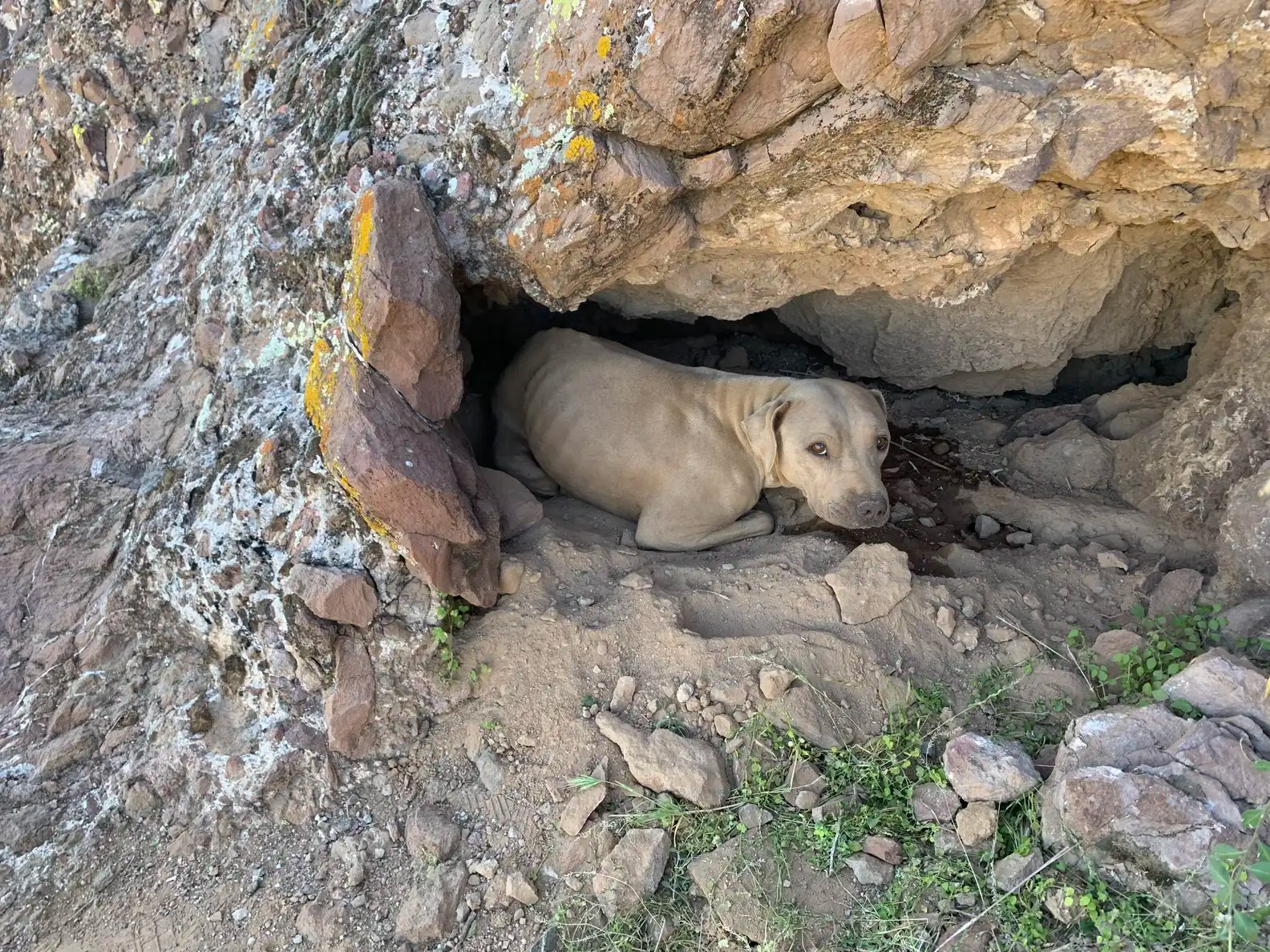
A Good Samaritan was hiking a narrow, slippery trail on Lookout Mountain in Phoenix, Arizona, and was very focused on his hike until something caught his eye. He was about half a mile up the mountain and a little off the beaten path when he caught a glimpse of light reflecting off of something — and was shocked to realize it was a pair of amber eyes.
The eyes belonged to a very scared dog huddled up in a tiny hole in the side of the mountain. She was completely blending in with her surroundings, and if she hadn’t had such piercing eyes, the hiker may not have noticed her. He had no idea how she’d managed to get up there, but it was clear that she’d been stuck for a while and might not be able to last much longer.
The Good Samaritan quickly contacted the Arizona Humane Society (AHS), who sent two emergency animal medical technicians, Tracey Miiller and Ruthie Jesus, out to help while he waited with the pup until they arrived. The dog was definitely scared but seemed open to getting help.
“This Good Samaritan waited probably almost two hours, and then we found this incredible dog, who incidentally is literally the same color as the dirt,” Jesus said in a press release. “She blends in so much, the complainant told us that he wanted to call her Bright Eyes because when he hiked past her, that was literally the only thing he saw was her amber bright eyes staring back at him.”
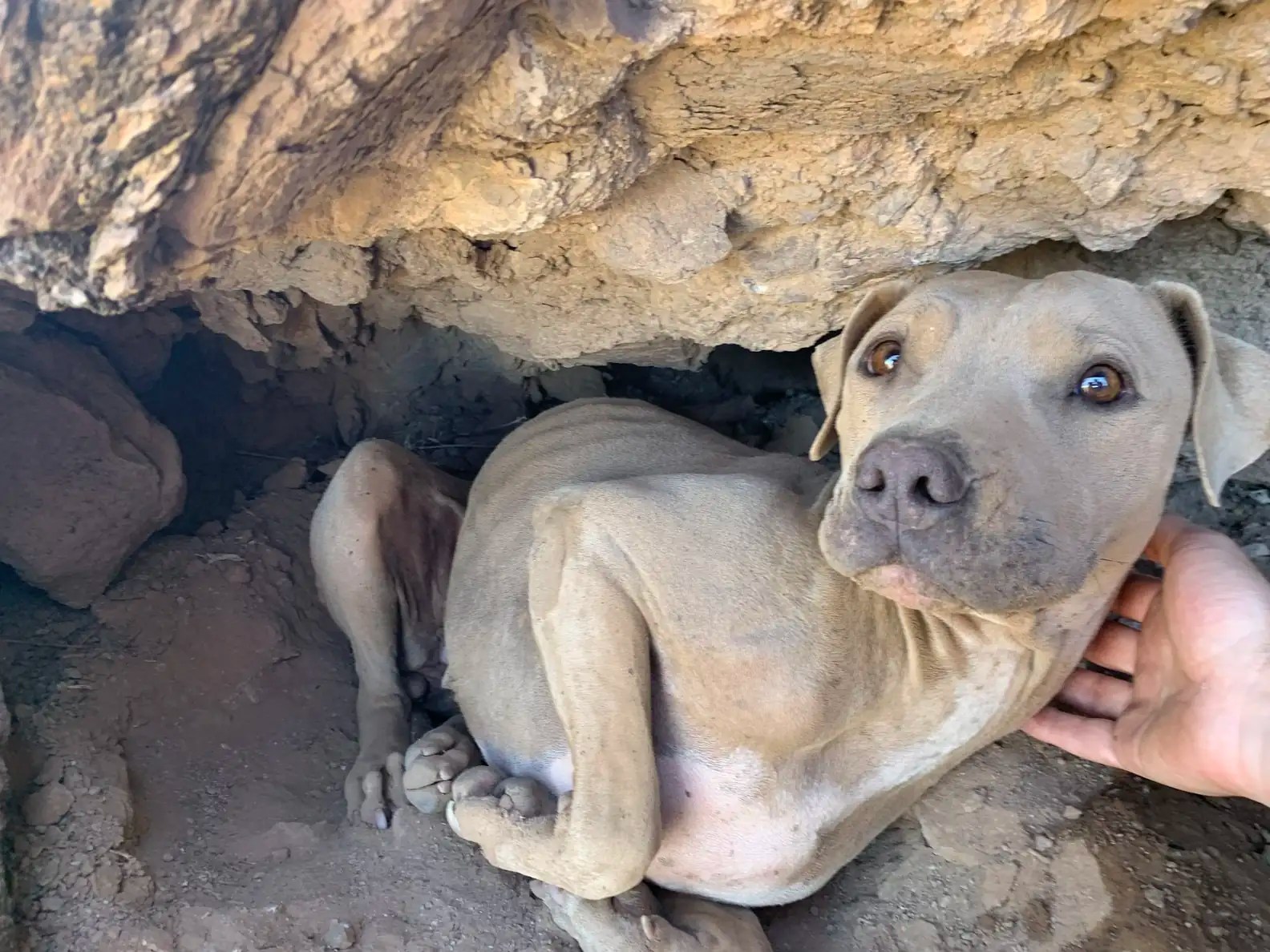
After a quick and careful assessment on the side of the mountain, the technicians determined that Bright Eyes was dangerously dehydrated with cut-up paws and a wound on her rear end.
“She was really sweet and letting me pet her head, but she absolutely did not want to come out of that den, so I kind of had to just sort of pull her out,” Jesus said.
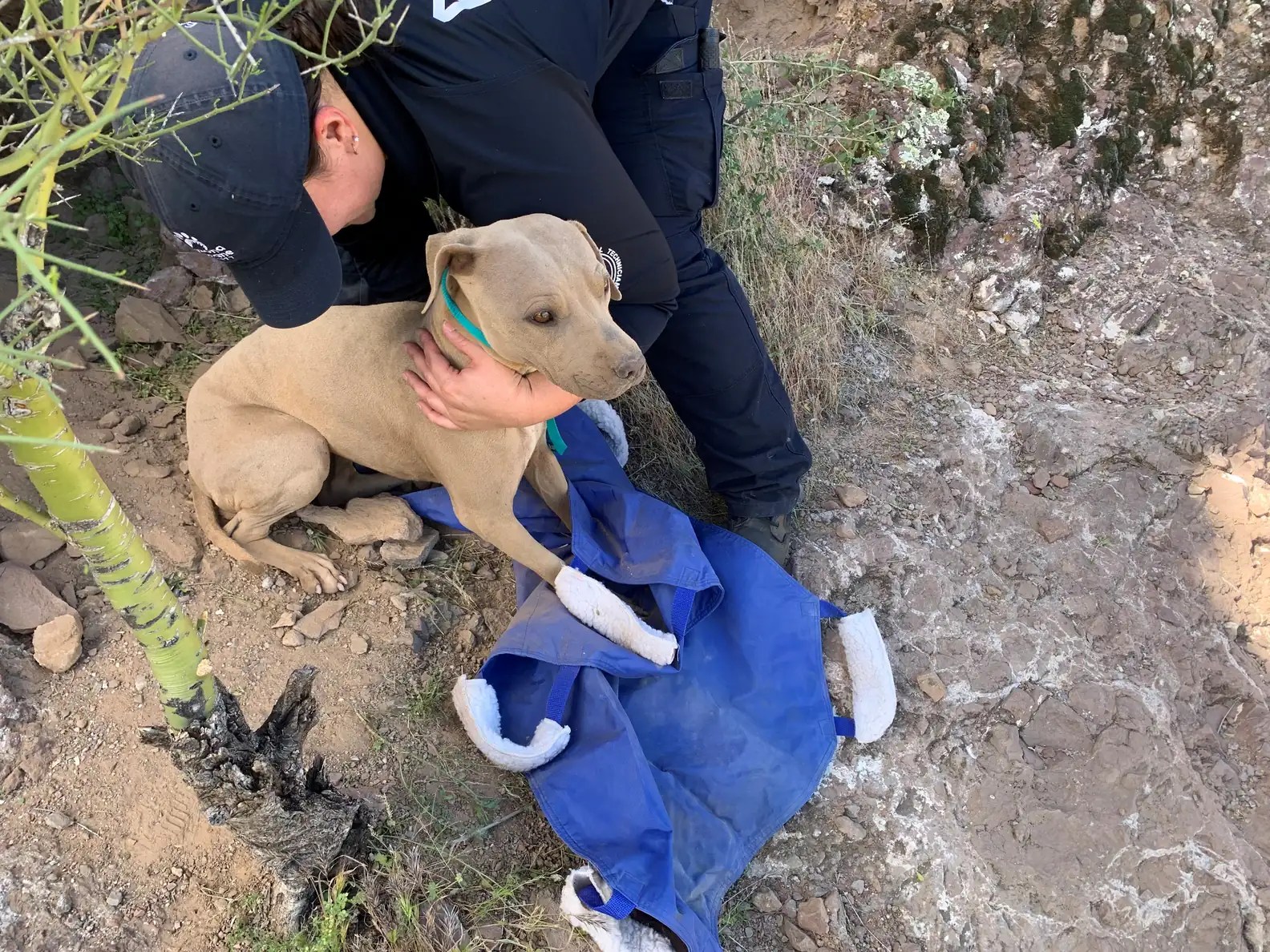
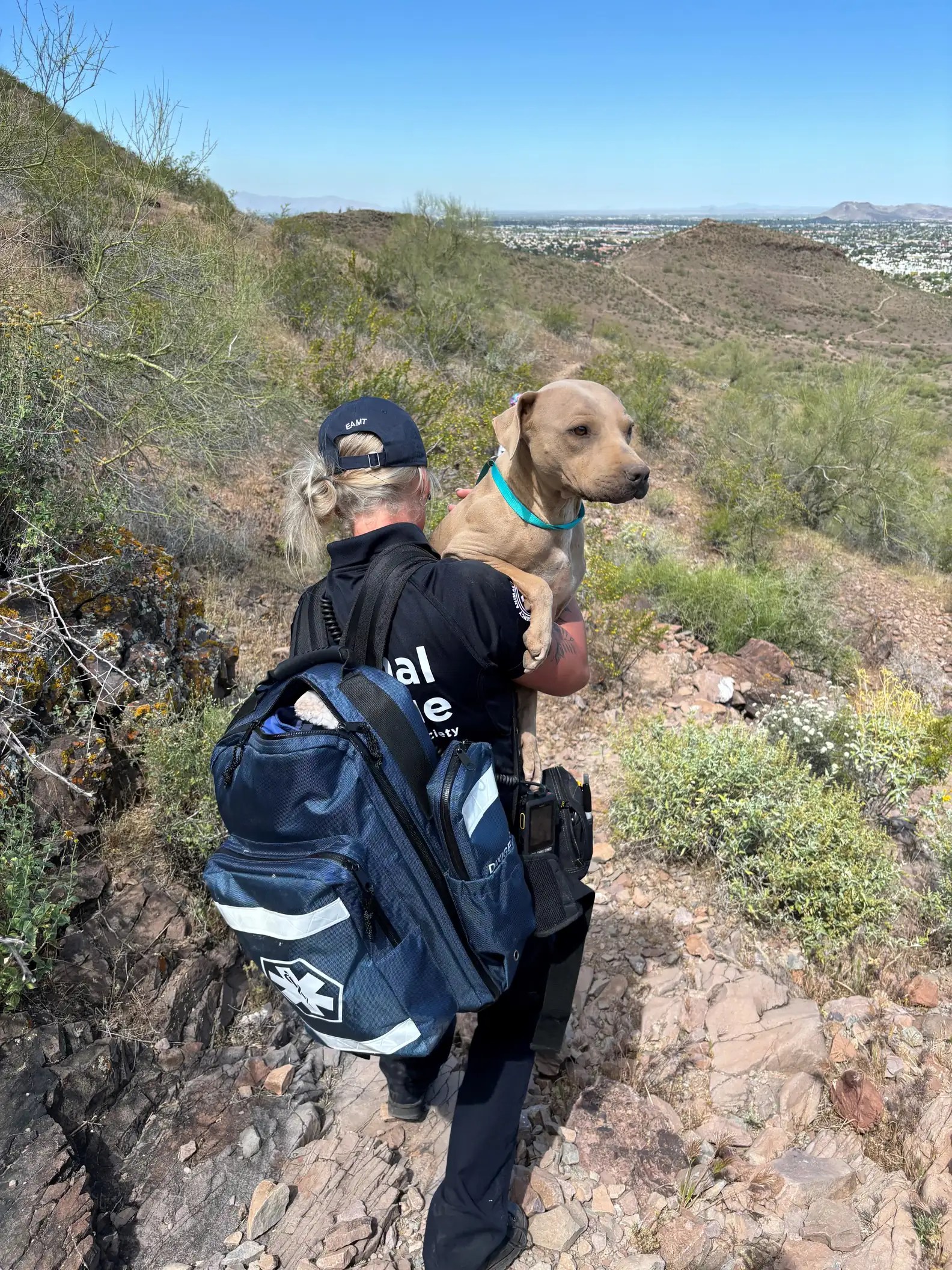
She was definitely too weak to walk with her rescuers down the mountain, so the technicians took turns carrying her until they reached the ambulance. Bright Eyes was calm the whole time, so grateful to finally be safe.
“She actually really just relaxed and seemed to enjoy being carried down the mountain,” Jesus said. “But it was a very teeny-tiny rocky trail that was pretty slick, and so Tracey and I took turns carrying her down the mountain, and she was just an absolute angel. She knew we were getting her to safety.”
It’s still a mystery as to how or why Bright Eyes ended up on the mountain in the first place, but the important thing is someone found her and now she’s getting the care she needs.
“We were so elated to be able to get her,” Jesus said. “She was just so dehydrated. I think she’d probably been up there several days and that was probably her last day, and this Good Samaritan really just saved her life.”
ooOOoo
Frankly, there’s nothing more to add to this account. For it captured all that so many people do for dogs.
Jean and I live in an ideal part of America: Merlin in Southern Oregon. We did not plan to come here but in 2012 we wanted to move from Payson, Az. and fortune brought us here. However, I started this blog in 2009 when I had seen the integrity and happiness of dogs and wanted to write about them.
However the wider world is far, far from just the integrity and happiness of dogs.
On March 17th Patrice Ayme posted yet another post on his blog about war and I felt that it was important to be read by as many followers of Learning from Dogs as is possible. (The few small typographical changes are mine.)
ooOOoo
Want No War? A Symptom That Nazism Perdures
Do not whine that war is bad. Ask instead what it is for.
Friend of a friend Manfred Krieger: Will mankind ever learn that wars do no good to anyone?
Patrice Ayme: All over the world, the vermin helping Putin claim that war does not do any good. Similarly the Nazis, after claiming for years that they were the party of peace and minorities, accused big bad France of having launched WW2. France did, indeed, but that was after the Nazis had invaded a few countries, including two democracies, and officially killed a few hundred thousands of alleged mental retards and genetically defective (including a relative of Hitler).
Vermin helping Putin vermin has been crawling around the French and German leadership for a quarter of a century. That Putin was a war criminal was obvious as early as 1999.
The Putinists claim that war never helped anyone. So the war to stop Hitler did not do good to anyone? Only an obdurate Nazi would hold that opinion.
My family was hunted by the Gestapo: I am delighted that more than five million Nazis got exterminated like the vicious vermin they were. It would have been better if the French Republic had declared war on the Nazi gangrene earlier. Destroying the vermin when it was weaker would have saved the lives of in excess of 50 million thoroughly innocent people who got killed as a result of having let the Axis fly from victory to victory, gathering alliances with nearly as equally repulsive tyrannies in the process.
This may well be happening now: the Chinese dictatorship is sitting on a fence, not trying to help the Kremlin tyrant too much. The fascist Iranian theocracy retreated a bit when threatened recently by the West after attacks in the Red Sea, the Gulf of Aden and Syria.
This hesitancy on the part of fascists also happened in World War Two; for a long time Mussolini did not dare to join Hitler, but then they militarily cooperated attacking Spain and three years later, attacking France. But ultimately, except for Franco who looked degenerate, but was smarter, fellow dictators, even Stalin, sided with the Axis.
In final analysis, WW2, and also WW1, happened because, primarily, not enough Germans fought the forces of fascist imperialistic plutocracy inside Germany.
So it is a lack of war, not an excess of it, which brought disaster.
That happened because not enough Morally Correct Germans realized in a timely manner that it would do some good to destroy the fascist imperialistic plutocratic mentality.
None of this deplorable meta-mentality is obsolete; France and Germany encouraged and empowered the Kremlin vermin in the last quarter of a century, by building its economy and financing it with advantageous trade. Now the Kremlin vermin is potentially the greatest threat against humanity and civilization, ever. And what does the German government do? Claim that one should not fight the Kremlin gangrene too much, to not aggravate matters too much.
But that appeasement in face of the unacceptable only encourages the latter. Germans still have to understand the biggest lessons of history.
‘An appeaser is one who feeds the crocodile quality food, hoping
that the ferocious creature will die of indigestion.’
As Stephen Messenger, the author of the article, says: “It was a moment of pure awe.” I am not going to waffle on in a prelude to this story, that was taken from The Dodo, so I am going straight into it.
ooOOoo
Animal Shelter Finds A Crate At The Door — And Most Touching Handwritten Note
Earlier this week, staff at North Carolina’s Fayetteville Animal Protection Society arrived to find that a crate has been placed outside their door, covered in a blanket.
In an instant, their hearts sank.
“Our first thought was, ‘Oh no, not another case of irresponsible pet ownership,’” Jackie Peery, executive director of the shelter, told The Dodo. “We were bracing for an accidental litter dumped at our doorstep due to not spaying/neutering, or someone moving and not willing to bring their pet.”
Inside the crate was indeed a litter of bouncy puppies. But there was more.
“Then we saw the note,” Peery said. “It was a moment of pure awe.”
As the note explained, this wasn’t an act of abandonment.
It was an act of love.
The letter reads as follows:
“Please help! I found these puppies sadly after noticing a local stray dog that I would often feed when I could, dead by the road. She had been hit by a car. I knew from feeding her that she had puppies somewhere and after searching where I would usually see her I found them. I’m sorry for leaving them like this but I myself am homeless and cannot afford to care for them …”
“My heart shatters for them and their mother. I just want them to be given the chance their mother, like myself, was never given. Please do not think poorly of me but it felt wrong leaving them alone in the cold waiting on a mother that would not be coming home. Sincerely, nameless man.”
He’d saved them.
Reading the note, Peery was stunned.
“This nameless man made it his mission to find these puppies to ensure their safety,” she said. “He remains a mystery — our very own nameless hero.”
Meanwhile, the puppies he rescued are now thriving, thanks to him.
“When they first arrived, you could tell they weren’t in the best shape. But now, it’s a whole different story,” Peery said. “It’s like they understand they’ve been given a second chance and are just soaking up all the love and joy.”
In time, Peery has no doubt that each of the puppies will be adopted into loving homes. But she hopes the unnamed hero will make himself known so he can be the recipient of the same sort of kindness he’s shown.
“We’re keeping our fingers crossed that he comes forward,” Peery said. “There’s a whole community here ready to support him just as I have supported these puppies. It would be wonderful to thank him in person and perhaps even help him in return.”
ooOOoo
I am almost lost for words that this event, that was written in 2024, is so beautiful.
Are there any persons who would like to adopt a puppy? Because I want to leave you with the address, email address and contact telephone number for the Fayetteville Animal Protection Society.
The challenge with writing posts, albeit not so often, about the global environment, especially when I am a non-scientist, is that one relies entirely on the words of others. In the case of a recent article, published by The Conversation, the authors are claimed to be specialists, and I do not doubt their credentials.
The three authors are René van Westen who is a Postdoctoral Researcher in Climate Physics, at Utrecht University, Henk A. Dijkstra who is a Professor of Physics, also at Utrecht University, and Michael Kliphuis, a Climate Model Specialist, again at Utrecht University.
So, here is their article:
ooOOoo
Atlantic Ocean is headed for a tipping point − once melting glaciers shut down the Gulf Stream, we would see extreme climate change within decades, study shows
Superstorms, abrupt climate shifts and New York City frozen in ice. That’s how the blockbuster Hollywood movie “The Day After Tomorrow” depicted an abrupt shutdown of the Atlantic Ocean’s circulation and the catastrophic consequences.
While Hollywood’s vision was over the top, the 2004 movie raised a serious question: If global warming shuts down the Atlantic Meridional Overturning Circulation, which is crucial for carrying heat from the tropics to the northern latitudes, how abrupt and severe would the climate changes be?
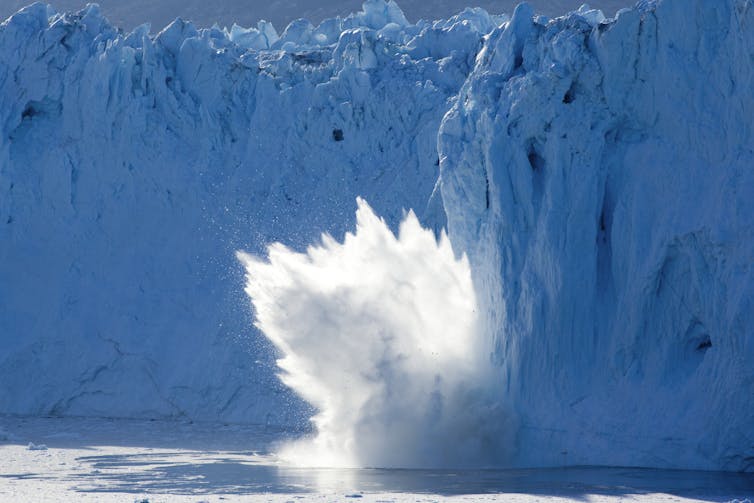
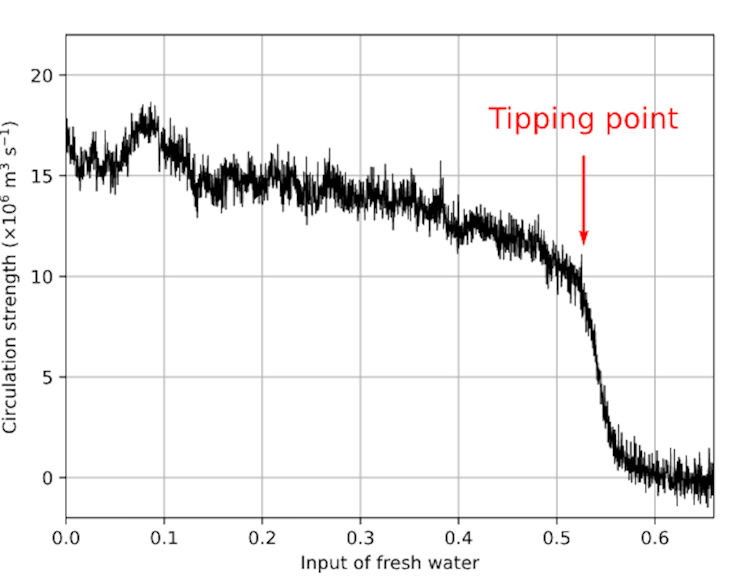
In a new study using the latest generation of Earth’s climate models, we simulated the flow of fresh water until the ocean circulation reached that tipping point.
The results showed that the circulation could fully shut down within a century of hitting the tipping point, and that it’s headed in that direction. If that happened, average temperatures would drop by several degrees in North America, parts of Asia and Europe, and people would see severe and cascading consequences around the world.
We also discovered a physics-based early warning signal that can alert the world when the Atlantic Ocean circulation is nearing its tipping point.
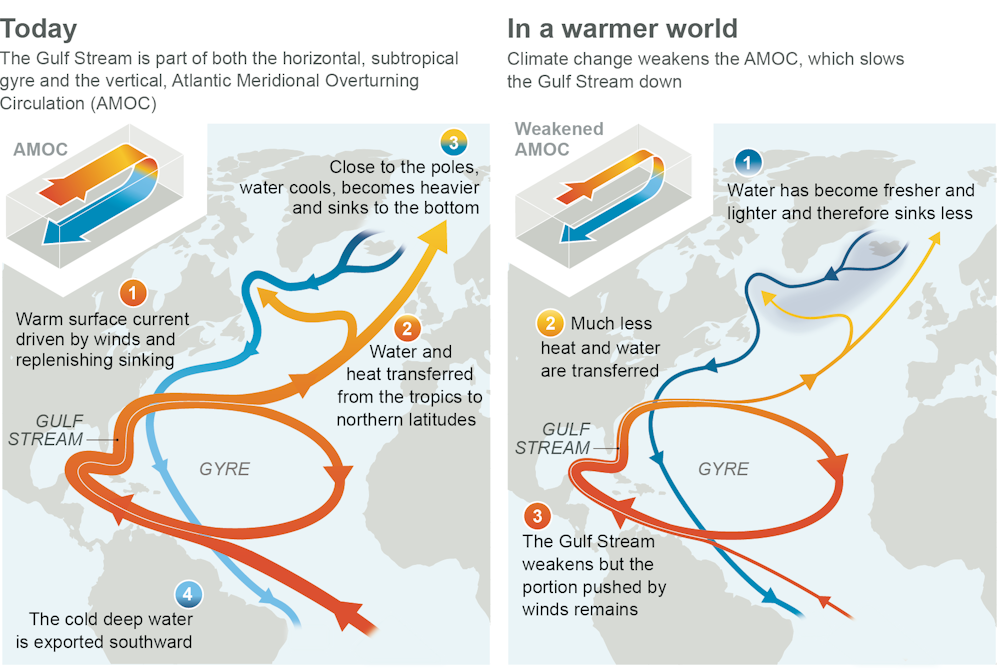
In the Atlantic Ocean circulation, the relatively warm and salty surface water near the equator flows toward Greenland. During its journey it crosses the Caribbean Sea, loops up into the Gulf of Mexico, and then flows along the U.S. East Coast before crossing the Atlantic.
This current, also known as the Gulf Stream, brings heat to Europe. As it flows northward and cools, the water mass becomes heavier. By the time it reaches Greenland, it starts to sink and flow southward. The sinking of water near Greenland pulls water from elsewhere in the Atlantic Ocean and the cycle repeats, like a conveyor belt.
This is where our study comes in. We performed an experiment with a detailed climate model to find the tipping point for an abrupt shutdown by slowly increasing the input of fresh water.
We found that once it reaches the tipping point, the conveyor belt shuts down within 100 years. The heat transport toward the north is strongly reduced, leading to abrupt climate shifts.
The result: Dangerous cold in the North
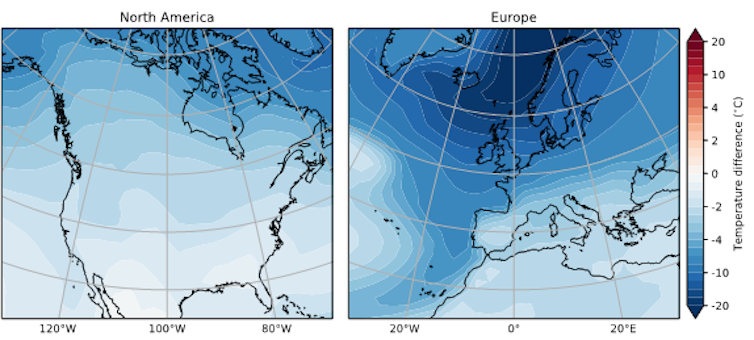
Regions that are influenced by the Gulf Stream receive substantially less heat when the circulation stops. This cools the North American and European continents by a few degrees.
The European climate is much more influenced by the Gulf Stream than other regions. In our experiment, that meant parts of the continent changed at more than 5 degrees Fahrenheit (3 degrees Celsius) per decade – far faster than today’s global warming of about 0.36 F (0.2 C) per decade. We found that parts of Norway would experience temperature drops of more than 36 F (20 C). On the other hand, regions in the Southern Hemisphere would warm by a few degrees.
The annual mean temperature changes after the conveyor belt stops reflect an extreme temperature drop in northern Europe in particular. René M. van Westen
These temperature changes develop over about 100 years. That might seem like a long time, but on typical climate time scales, it is abrupt.
The conveyor belt shutting down would also affect sea level and precipitation patterns, which can push other ecosystems closer to their tipping points. For example, the Amazon rainforest is vulnerable to declining precipitation. If its forest ecosystem turned to grassland, the transition would release carbon to the atmosphere and result in the loss of a valuable carbon sink, further accelerating climate change.
The Atlantic circulation has slowed significantly in the distant past. During glacial periods when ice sheets that covered large parts of the planet were melting, the influx of fresh water slowed the Atlantic circulation, triggering huge climate fluctuations.
So, when will we see this tipping point?
The big question – when will the Atlantic circulation reach a tipping point – remains unanswered. Observations don’t go back far enough to provide a clear result. While a recent study suggested that the conveyor belt is rapidly approaching its tipping point, possibly within a few years, these statistical analyses made several assumptions that give rise to uncertainty.
Instead, we were able to develop a physics-based and observable early warning signal involving the salinity transport at the southern boundary of the Atlantic Ocean. Once a threshold is reached, the tipping point is likely to follow in one to four decades.
A climate model experiment shows how quickly the AMOC slows once it reaches a tipping point with a threshold of fresh water entering the ocean. How soon that will happen remains an open question. René M. van Westen
The climate impacts from our study underline the severity of such an abrupt conveyor belt collapse. The temperature, sea level and precipitation changes will severely affect society, and the climate shifts are unstoppable on human time scales.
It might seem counterintuitive to worry about extreme cold as the planet warms, but if the main Atlantic Ocean circulation shuts down from too much meltwater pouring in, that’s the risk ahead.
This article was updated to Feb. 11, 2024, to fix a typo: The experiment found temperatures in parts of Europe changed by more than 5 F per decade.
I am 79! I like to think that whatever is coming down the wires, so to speak, will be after my death. But that is a cop out for a) I have a son and a daughter who are in their early fifties, b) I have a grandson, my daughter and son-in-law’s young man, who is a teenager, with his birthday next month, and c) I could possibly live for another twenty years.
The challenge is how to bring this imminent catastrophic global change in temperature to the fore. We need a global solution now enforced by a globally respected group of scientists and leaders, and, frankly, I do not see that happening.
All one can do is to hope. Hope that the global community will eschew the present-day extremes of warring behaviour and see the need for change. That is NOW!
So that the Hollywood movie, The Day After Tomorrow, remains a fictional story. And for those that have forgotten the film or who have never seen it, here is a small slice of a Wikipedia report:
I thought it very worthwhile to repeat this, plus a real treat at the end of the post!
Scamming in all its forms has only got worse in the last couple of years, since I parted with $9,000 in 2021!
As a direct result of that error, I changed my bank, installed a VPN at home (Proton), changed my email account to ProtonMail, and also changed my calendar (also to Proton).
But I still do not take it as important as it is. I guess because it is not my first thought whenever I come across an unfamiliar email.
ooOOoo
Please read this; and do not make the same mistake as me!
The Story of a Scam
(or how I lost the thick end of $10,000.)
On Friday, 6th August, 2021 at 05:51 in came the following email:
Norton Customer ,
User name:paulhandover
*we like to confim you that the NortonDesk re-newal. has been done on your request*
It is very easy to unsubscribe it,
and related to your any query, reach us at +1-(860) – (852) – (6259).
Product-Name : NortonDesk
……………………………………………………………………………………………………..
Price : $475.04
……………………………………………………………………………………………………..
Subscription ID : 8837-77942826-947192-8126
……………………………………………………………………………………………………..
Expiration Date : 3 Year from the Date of Purchase
………………………………………………………………………………………………
* If you wish to Cancel this Membership then please feel free to Contact our Billing department as soon as Possible*
……………………………………………………………………………………………………..
*Please do not write to this mail address, that will not help*
Reach us on +1 – (860) – (852) – (6259)
……………………………………………………………………………………………………..
Regards,
Billing department
Contact: +1 – (860) – (852) – (6259)
693 Amwell Rd, Hillsborough, NJ
My first mistake was not to check the incoming email address. It was mahaliashomakerxhv928@gmail.com
I telephoned the number given and told the person that I wanted to cancel this membership. Indeed that I had never subscribed for this membership in the first place.
I spoke with ‘Adam’. I was then asked to go to a webpage where I filled in a Refund Application Order form. I filled in my details including the refund amount and my bank details: Sort Code & Account Number.
I then submitted the form and imagine my surprise when a few minutes later I was informed that I had received the sum of $10,000. I quickly checked our bank account online and there was the $10,000 credit in our checking account.
My second mistake was me not examining the total in our accounts. I have the facility to show the total funds in our accounts. Why I didn’t do that I can not explain.
Then it was back on the telephone and Adam also was surprised (later I realised that this was a feigned surprise and all part of the scam) and said could I go to the bank and fill in an International Wire Transfer for the amount of $9,500. Adam also said that he would give me the details of the person in Thailand that was to receive the funds, and could I say this was for a medical operation because it would save ‘Norton’ the taxation.
My third mistake was not to discuss this with Jeannie and to assume that it was just a harmless error.
The details came through and I went to our bank in Grants Pass. I got to the bank a little after 09:00. I saw a staff member of the bank and explained what I needed to do. The bank member queried this and said that it sounded like a scam. I lied and said I knew the woman in Thailand and wanted to go ahead. That was what I had been instructed to say.
My fourth mistake was not listening to the woman at the bank. (And I still thought that the ‘Norton’ funds were in my account.)
The International Wire Transfer was completed and I signed it. I also asked the balances on our two accounts. It was about $10,000 less than I expected and I queried it but was told that there had been a transfer from my savings account to my checking account of $10,000 for Norton. I thought that this was still a little low but that I could check it carefully once I got home. I had a thirty-minute window to change my mind.
Mistake number five, a huge mistake, was while at the bank not to ask them carefully to go through all my transactions that day because that would have revealed that the receipt of $10,000 that I had seen online had mysteriously disappeared. Indeed had never been received. That would have enabled me to stop the wire transfer within the thirty-minute window.
I returned home and found out the truth. I had been scammed out of $9,500.
The strange thing was that ‘Adam’ of the billing department of so-called Norton kept ringing me throughout the day to say that the funds would be sent back to me and gave me the details of three wires and that the funds would be back in my bank account on Monday, 9th August!
Later that morning I rang Kevin Dick who manages our investments and told him the tale. He said that there was a huge amount of scamming about and that I should make three phone calls: to the bank and report the fraud; to the Sheriff’s office and report the fraud; and to my insurance company. The first two were done straight away. Kevin also told me to close my bank accounts and amend my email address. Alex, my son, said to use my Proton mail account and straight away I started to make the change.
A person from the humanists group that we belong to said also to inform The Daily Courier.
On Monday morning Ryan of ‘Norton’ called me at 07:15 and said that Adam Prescott was no longer with the firm. Ryan said that their General Manager, Ron Cooper, would call me shortly. Ron did indeed call me and said that they would return the money but that the minimum cheque they could write was $30,000. I was then told that in advance of me receiving the money I would have to pay a small amount to them. At this point I put the phone down for it was clearly a second attempt to steal more funds from me.
Finally we went back to the bank on Monday morning. We were informed that there was never a credit of $10,000 but that a clever switch of the money from one account to another made it look as though the money had been credited. The event had been reported to the bank’s fraud department.
On Tuesday morning, the 10th August, the bank said that as well as our two accounts being locked out from us and that only cheques and cash withdrawals would be honoured for the time being, the fraud department had made the decision to issue us with a ten-day notice to terminate our accounts. In other words, within ten days the bank would no longer want us as customers. Since then I have done much research and found out via the Forbes website that this was more to do with the bank being ultra conservative than anything else. Indeed Kevin said that he had spoken with his IT department and they thought that it was strange that my ex-bank had terminated us so quickly. The IT department thought that the teller at the bank realised that she had been partly culpable.
However the bank did recommend another bank to go to in Grants Pass.
I have since reset my iMac and changed my email address.
It is a most humiliating affair. I have beaten myself up several times over and have at last understood the frame of mind that I had gotten myself into.
To explain that, first of all I thought that I needed to stop the billing urgently and because it was early on a Friday morning thought that the best thing to do was to call immediately.
Secondly, during the call that scammers spoke to me in friendly tones and quietly complimented me on my integrity. I am sure that this ‘spoke’ to my psychological fear of rejection that I have had since I my father died in 1956.
Then in the morning of the 11th August I received a call from a regular contact at the English company who manage my UK SIPP. He wanted to check if I had tried to log on at 09:00 UK time and I replied that there was no way that was me for that UK time was 01:00 Pacific time. There were apparently three attempts to log on. Unsuccessfully as it turned out and my SIPP account is temporarily closed as a result.
The scammers are very thorough in their crooked craft!
Now as of Thursday, the 12th August, we are pretty much out of the grim shadow of this event. We have new accounts at The People’s Bank here in Grants Pass. I have changed my email address and yesterday afternoon I decided that the only safe way of protecting myself was to get another iMac. I was speaking to the sales department of Apple and mentioned the scam and the woman immediately said I should speak with their Technical Support and transferred me. Then I was helped via screen sharing to go through many pages deleting unnecessary files and other stuff. And the helpful woman found another item of malware that was deleted and removed. She spent 54 minutes getting me properly cleaned out and then forwarded an email with all the links for me to do the same process at a later date. It was a superb experience.
So that is it.
Now watch these two YouTube videos. The first is just 5 minutes long and is important to all who use computers and want to be protected against scammers. (NB: This first video is now not included.)
and then watch this slightly longer video from Jim
Be safe! Please!
An addendum dated Saturday, 14th August, at 7am Pacific Time.
Only to say that I also posted my scamming report on Ugly HedgeHog under their General Chit Chat forum. Of the many responses that came in I wanted to post here two of them.
The first from ‘Stanikon’:
Sorry you had to go through this. Your first clue should have been the grammar and phrasing of the original email. That would have given it away. Legitimate companies go to great lengths to make sure their grammar, phrasing and language are correct. I have avoided several scams by paying attention to that so there is some value in being slightly OCD.
and the second from ‘Red6’:
The safest thing to do in these situations is simply not to open the email. I receive on a daily basis, emails telling me that the items I ordered are being shipped, my subscription to something has been renewed etc, etc. 99.9% of these are scams and nothing bad will happen if you just delete them. Older working people often have the fear that there’s a bill out there that has not been paid and they are afraid of getting a bad credit report. So they aggressively try to send someone money for something they cannot even recognize. If it is a true debt, you will be reminded of it several times before any reports are made.
I follow several simple rules in preventing scams. There are many more but this will take care of most of them.
1. Examine the sender’s email address, if you do not recognize it then DO NOT OPEN and DELETE immediately. Most of these scammer’s email addresses will not have the company name in the email address OR it will be combined with other names. Most will not have the .com, .org, etc but will be gmail, Hotmail, or other generic URL. Many of these scammers “broadcast” their emails to everyone on a purchased email list not knowing whether some or valid or not. If you open or reply to these it verifies your email as valid and active and worthy of more attention. Also, if it is an unknown email address, it could be a carrier of a virus or some other bad computer/software infection.
2. If you do get involved with something that does not feel right and you take it to the bank – TRUST THE BANK if they tell you it is suspicious. They see these things every day and develop a feel for them. I received a cashier’s check for something I sold on craigslist. I took it to the bank to deposit and the bank rep immediately recognized the cashier’s check as a fake. She even called the bank the check was supposed to be drawn on and they checked the records and told her that it was counterfeit. You trust your bankers, credit union, etc with your money every day so trust them when they tell you something does not seem right.
3. Scammers know that many older people do NOT like to use credit cards. So a lot of their dealings involve checks, bank transfers, and other forms of older less secure payment methods that older citizens are comfortable with. I NEVER, NEVER send money for something I purchase or order online unless it is through a credit card. In fact, I rarely buy ANYTHING anymore that does not go on the credit card. They are safer, quicker, and easier. If somehow you do get something on your bill that you did not authorize, the credit card company will investigate and go after the person or company that charged you. This is one more safety step that protects the consumer. This does not always apply to debit cards. Debit cards are issued by individual banks or credit unions and some have policies in the fine print that they do NOT have the same policies as the big credit card companies and may not forgive or relieve the user for bad charges made to their debit card.
4. Just do not believe anyone or any company that says they sent you a huge refund or overpayment or some amount of money by mistake. That rarely happens. It is even rarer if they also tell you to return the money to some foreign address, email, or wire transfer. When in doubt, wait for a week or so before you do ANYTHING. If they sent you the check, transfer etc, wait to see if it clears or is valid. We are conditioned by TV and movies that we need to act immediately in situations such as this. This is rarely the case. Take time to see what happens. During this cooling-off period check them out, research the internet to see if others have experienced this scam. It is almost a sure thing that if you are being scammed, others have been also and it has been reported somewhere with law enforcement agencies or on websites on the internet. Check them out before acting. Or better yet, do nothing for a while and most likely they will just go away. Much like the telephone scammers, they make their money on volume, calling as many as possible in the least amount of time. Scammers will not waste time working on you for days, they have thousands of other emails, accounts to call. Remember, they are after the fastest, easiest targets – the low-hanging fruit.
If it is a true mistake or debt you owe then most likely you will receive some official correspondence in regards to the debt. A good example is the IRS and Social Security phone scams in the past couple of years. You get a call from the IRS or Social Security informing you that you may have committed fraud and law enforcement is on their way to arrest you. But if you arrange repayment with their representative, an arrest can be avoided. The IRS and Social Security NEVER take action without first sending several official US Postal letters to you. If you are still inclined to send money to someone in a foreign country then discuss it with your bank and listen.
Hope this helps.
ooOOoo
All very sound advice and as relevant today as it was when first published.
Finally, for something completely different; have a look at the recent Hunter’s Moon as featured on YouTube.
Today, August 14th, here in Southern Oregon we are expecting 111 degrees Fahrenheit or 43.8 degrees C. That is really hot! (And at home it reached 108 deg. F. at 3pm.)
So it seems pertinent to republish a post from The Conversation that was published on July 21st, 2023.
ooOOoo
Is it really hotter now than any time in 100,000 years?
Professor of Earth and Environmental Sciences, Northern Arizona University
As scorching heat grips large swaths of the Earth, a lot of people are trying to put the extreme temperatures into context and asking: When was it ever this hot before?
Globally, 2023 has seen some of the hottest days in modern measurements, but what about farther back, before weather stations and satellites?
Some news outlets have reported that daily temperatures hit a 100,000-year high.
As a paleoclimate scientist who studies temperatures of the past, I see where this claim comes from, but I cringe at the inexact headlines. While this claim may well be correct, there are no detailed temperature records extending back 100,000 years, so we don’t know for sure.
Here’s what we can confidently say about when Earth was last this hot.
This is a new climate state
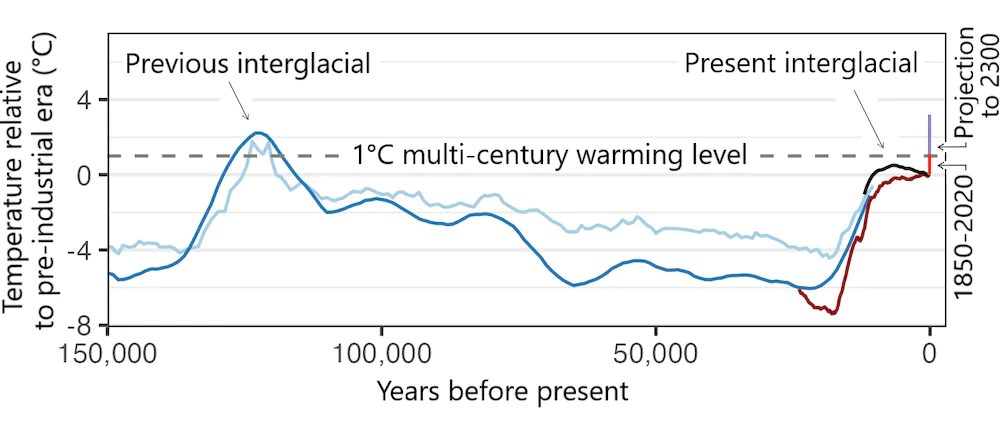
Scientists concluded a few years ago that Earth had entered a new climate state not seen in more than 100,000 years. As fellow climate scientist Nick McKay and I recently discussed in a scientific journal article, that conclusion was part of a climate assessment report published by the Intergovernmental Panel on Climate Change (IPCC) in 2021.
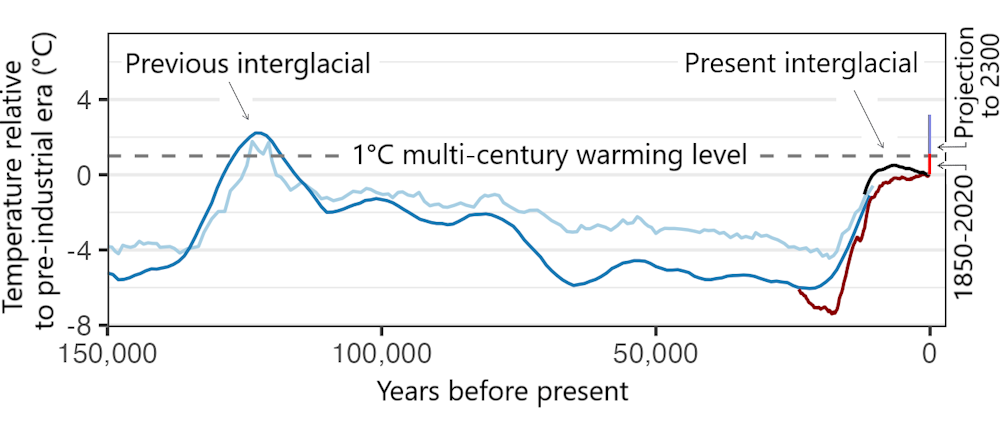
Earth was already more than 1 degree Celsius (1.8 Fahrenheit) warmer than preindustrial times, and the levels of greenhouse gases in the atmosphere were high enough to assure temperatures would stay elevated for a long time.
Earth’s average temperature has exceeded 1 degree Celsius (1.8 F) above the preindustrial baseline. This new climate state will very likely persist for centuries as the warmest period in more than 100,000 years. The chart shows different reconstructions of temperature over time, with measured temperatures since 1850 and a projection to 2300 based on an intermediate emissions scenario. D.S. Kaufman and N.P. McKay, 2022, and published datasets, Author provided
Even under the most optimistic scenarios of the future – in which humans stop burning fossil fuels and reduce other greenhouse gas emissions – average global temperature will very likely remain at least 1 C above preindustrial temperatures, and possibly much higher, for multiple centuries.
This new climate state, characterized by a multi-century global warming level of 1 C and higher, can be reliably compared with temperature reconstructions from the very distant past.
How we estimate past temperature
To reconstruct temperatures from times before thermometers, paleoclimate scientists rely on information stored in a variety of natural archives.
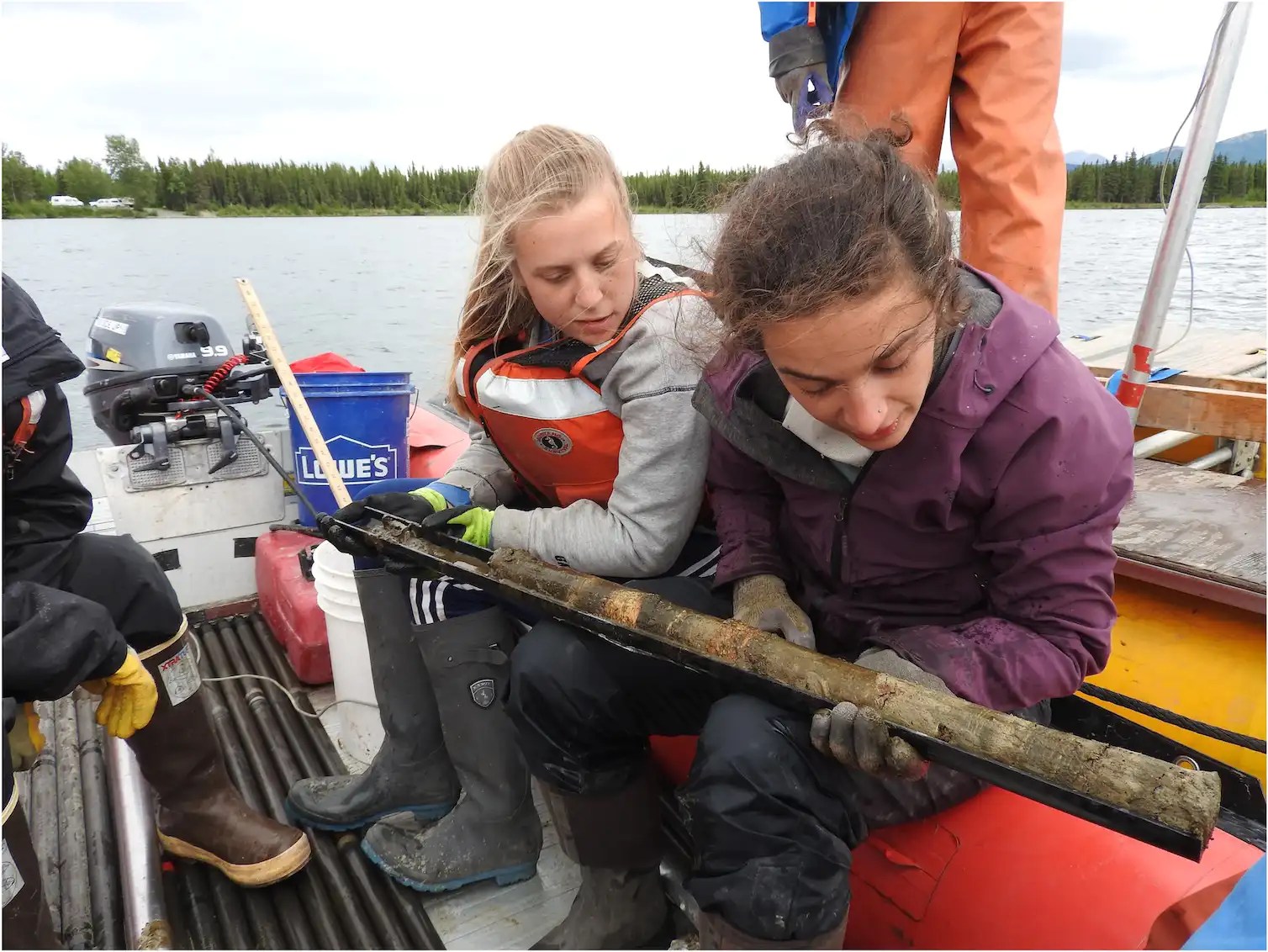
The most widespread archive going back many thousands of years is at the bottom of lakes and oceans, where an assortment of biological, chemical and physical evidence offers clues to the past. These materials build up continuously over time and can be analyzed by extracting a sediment core from the lake bed or ocean floor.
University of Arizona scientist Ellie Broadman holds a sediment core from the bottom of a lake on Alaska’s Kenai Peninsula. Emily Stone
These sediment-based records are rich sources of information that have enabled paleoclimate scientists to reconstruct past global temperatures, but they have important limitations.
For one, bottom currents and burrowing organisms can mix the sediment, blurring any short-term temperature spikes. For another, the timeline for each record is not known precisely, so when multiple records are averaged together to estimate past global temperature, fine-scale fluctuations can be canceled out.
Because of this, paleoclimate scientists are reluctant to compare the long-term record of past temperature with short-term extremes.
Looking back tens of thousands of years
Earth’s average global temperature has fluctuated between glacial and interglacial conditions in cycles lasting around 100,000 years, driven largely by slow and predictable changes in Earth’s orbit with attendant changes in greenhouse gas concentrations in the atmosphere. We are currently in an interglacial period that began around 12,000 years ago as ice sheets retreated and greenhouse gases rose.
Looking at that 12,000-year interglacial period, global temperature averaged over multiple centuries might have peaked roughly around 6,000 years ago, but probably did not exceed the 1 C global warming level at that point, according to the IPCC report. Another study found that global average temperatures continued to increase across the interglacial period. This is a topic of active research.
That means we have to look farther back to find a time that might have been as warm as today.
The last glacial episode lasted nearly 100,000 years. There is no evidence that long-term global temperatures reached the preindustrial baseline anytime during that period.
If we look even farther back, to the previous interglacial period, which peaked around 125,000 years ago, we do find evidence of warmer temperatures. The evidence suggests the long-term average temperature was probably no more than 1.5 C (2.7 F) above preindustrial levels – not much more than the current global warming level.
Now what?
Without rapid and sustained reductions in greenhouse gas emissions, the Earth is currently on course to reach temperatures of roughly 3 C (5.4 F) above preindustrial levels by the end of the century, and possibly quite a bit higher.
At that point, we would need to look back millions of years to find a climate state with temperatures as hot. That would take us back to the previous geologic epoch, the Pliocene, when the Earth’s climate was a distant relative of the one that sustained the rise of agriculture and civilization.
ooOOoo
It is difficult to know what to say other than one hopes that Governments and country leaders recognise the situation and DO SOMETHING!
As Dr. Michael Mann put it in the last issue of The Humanist: “The only obstacles aren’t the laws of physics, but the flaws in our politics.“
I have a son and a daughter in their early 50’s and a grandson who is 12. They, along with millions of other younger people, need action now.
A start to a fascinating programme on BBC Radio 4.
Yesterday morning (Oregon time) had me listening to a new series on BBC Sounds. It was Frontlines of Journalism. Here is what the Beeb had to say about it:
Released On: 27 Feb 2023
Available for over a year
In the spring of 2023, twenty years after the Americans, the British and their allies invaded to overthrow Saddam Hussein, BBC International Editor Jeremy Bowen was reporting from Iraq for the BBC. He described the invasion as ‘a catastrophe’. Taking you to some of the most difficult stories Jeremy and other journalists have covered; in this episode – why impartiality is not about trying to get perfect balance, the truth lying somewhere in the middle. Often it does not. Jeremy speaks with: journalist Rana Rahimpour who was born in Iran but left when she was 25 to work for the BBC; former BBC bureau chief Milton Nkosi, who grew up under apartheid in Soweto, South Africa; journalist and environmentalist George Monbiot, and CNN’s Chief International Anchor Christiane Amanpour.
Presenter: Jeremy Bowen Producer: Georgia Catt Assistant Producer: Sam Peach Additional research: Rob Byrne Series mixing: Jackie Margerum Series Editor: Philip Sellars.
But in wanting to present a little more to you readers, I did some research on the topic and came across this article published by the Reuters Institute at the University of Oxford. I cannot see a warning about not sharing this with you.
ooOOoo
Impartiality is still key for news audiences. Here’s how to rethink it for the digital age
Our research shows people still value the ideal of impartial news. A new report offer suggestions to adapt it to a challenging environment.
Election posters of Germany’s top candidates for chancellor. September 16, 2021. REUTERS/Fabrizio Bensch
Most people agree that news organisations and journalists should reflect all sides of an issue and not push a particular agenda – at least when asked about it in surveys. Our 2021 Digital News Report finds this to be true across countries and age groups.
However, many people feel that the media often fail to live up to this ideal. Our surveys consistently show that committed partisans believe that traditional media coverage is unfair, especially in countries where debates about politics or social justice have become deeply polarised. In recent years we’ve also seen an increase in opinion-led television formats such as Fox News/MSNBC in the United States, GB News in the UK and CNews in France, while many traditional print publications have focussed on distinctive and robust opinion as a way of standing out online.
Together with the growth of partisan websites, YouTubers and podcasters, audiences now have access to a wider range of views than ever before. Against this background, some have questioned traditional approaches to impartiality that try to represent all points of view within a single broadcast or publication. Other critics go further – arguing that impartiality has given extreme or unrepresentative views undue prominence, through its focus on balance, helping to legitimise climate change deniers and anti-vaxxers amongst others.
This all raises the question: how relevant is impartial and objective journalism to audiences today? The Reuters Institute commissioned market research company JV Consulting to carry out qualitative research in four countries – Brazil, Germany, the UK, and the US – with different news markets, traditions of public broadcasting, and systems of media regulation. They conducted a series of focus groups and in-depth interviews on our behalf in February and March 2021 with politically and ethnically diverse groups of older and younger people interested in and engaged with news (52 people in total).
These are some of the key findings of the report:
Engaged audiences in the four countries researched still care about impartiality and say it helps define news, even if some consider it an impossible ideal. They want journalists to focus on facts, objectivity and fairness, and to steer clear of opinions and bias in reporting, leaving them to decide for themselves how they feel about the news. Alongside accuracy, impartiality is a foundational value of news that underpins audiences’ trust.
People recognise the risk of giving exposure to extreme views or one side in the name of balance. However, evidence from this group of engaged users is that they are even more concerned about the suppression and silencing of viewpoints. There are particular misgivings about this in Brazil and Germany, where twentieth century history frames some people’s views.
Most participants recognise that there were some topics (e.g., science stories, natural disasters, and questions of social justice) where there were not always two or more sides to represent. Here, many felt there should be more latitude for journalists to present just one perspective or an established point of view. There are also expectations that journalists will show greater empathy and connection in their reporting than perhaps traditional interpretations of impartiality have allowed in the past.
Across countries, newer digital formats such as social media are perceived as carrying more risk of bias along with the growth of more informal and entertaining broadcast formats such as chat shows and podcasts. Impartiality is more vulnerable in these contexts, as well as when the news is emotive or controversial, because journalists’ personal views risk slipping out in the impulse to engage, although the subject and intention have a bearing on how audiences feel about this.
Younger people, who have grown up using more informal and digital sources, tend to have different expectations of impartiality, often looking for journalism that aligns with their values. But overall, their underlying attitudes and desires are remarkably similar to older people’s.
Different countries’ news traditions shape people’s experiences and expectations. Audiences in the US cannot envisage a world without partisan news outlets, but in the UK and Germany, with their public service traditions, most audiences still laud the upholding of impartiality.
Respondents also delineate between news reporting (where impartiality is expected) and opinion/commentary (where people expect that views are argued for). Importantly, many told us that they often find it difficult to distinguish between the two, especially online. Interviewees like news and they like opinion, but want them very clearly separated.
It is important to recognise that not all news organisations are committed to impartiality: indeed, some make a virtue of creating news and opinion with a clear point of view. But most will want to take note of audience desires for a range of views to be represented and to see clearer labelling of news and opinion. For news organisations that are committed to impartiality, the report highlights the increased dangers in areas where journalism is more informal or accessed in distributed environments. Public media like the BBC have already embarked on updated training and issued new guidelines on these issues. Audiences have also sent a clear signal in this report that they would like much greater transparency over why certain perspectives are included or excluded, however difficult this may be in practice.
Finally, the report notes that given the importance of social media, search and other access points, technology platforms such as Facebook, Google and Apple, will also need to develop clearer guidelines on impartiality – as their own trust levels will depend on fair implementation of policies around inclusion and exclusion, whether by algorithm or human intervention.
Now this isn’t everyone’s cup of tea but when one thinks of the enormous amount of news and information one gathers from the television, the radio, the press and a wide variety of online sources then thinking a little more about the truth of what we are being told is crucial to us making wise decisions. including voting where appropriate.
People still value the ideal of impartial news; there is no question about that!
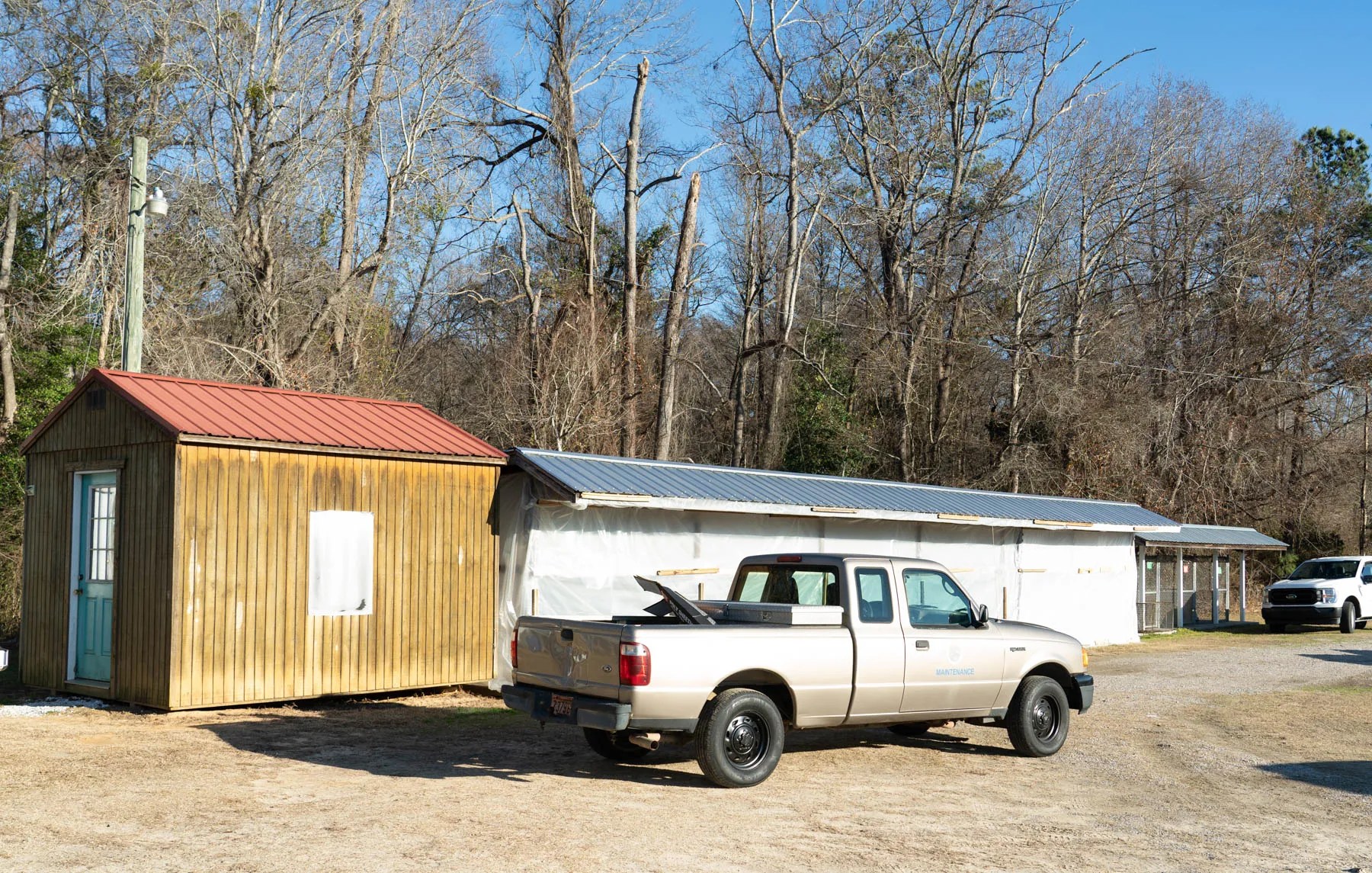
Bertie County is a small county most people pass through on their way to vacation on the Outer Banks. The county’s tiny shelter is the next to last stop on a road that ends at the regional jail. The shelter sits on a property prone to flooding, and although the county has had plans to move it, the folks we talked to were skeptical that the collection of sheds, trailers, and kennels would leave the spot it has occupied as long as anyone can remember.
Bertie County Animal Control in Windsor is a municipal, open-intake shelter comprised of ten kennels on a concrete pad with a roof, plus two quarantine kennels, and three puppy runs.
There is no heat or AC or walls, for that matter. The day we arrived, county maintenance workers were busy wrapping plastic around the kennels to try to give the dogs some protection from the cold.
The county has two full-time Animal Control officers and one part-time ACO, but the care of the dogs is done by Josh, a full-time kennel tech. The county pays for Josh (and a part-time person who comes in once on Saturday and Sunday to feed/clean), plus the ACO salaries, and the property utilities, but everything else is left up to the Bertie County Humane Society.
Beyond the $2000/year the county gives the Humane Society, they must raise the money to pay for everything else – veterinary needs, vaccinations, spay/neuter, food/treats, transport to rescues, beds, heartworm preventative, flea/tick treatment, dewormers and anything else.
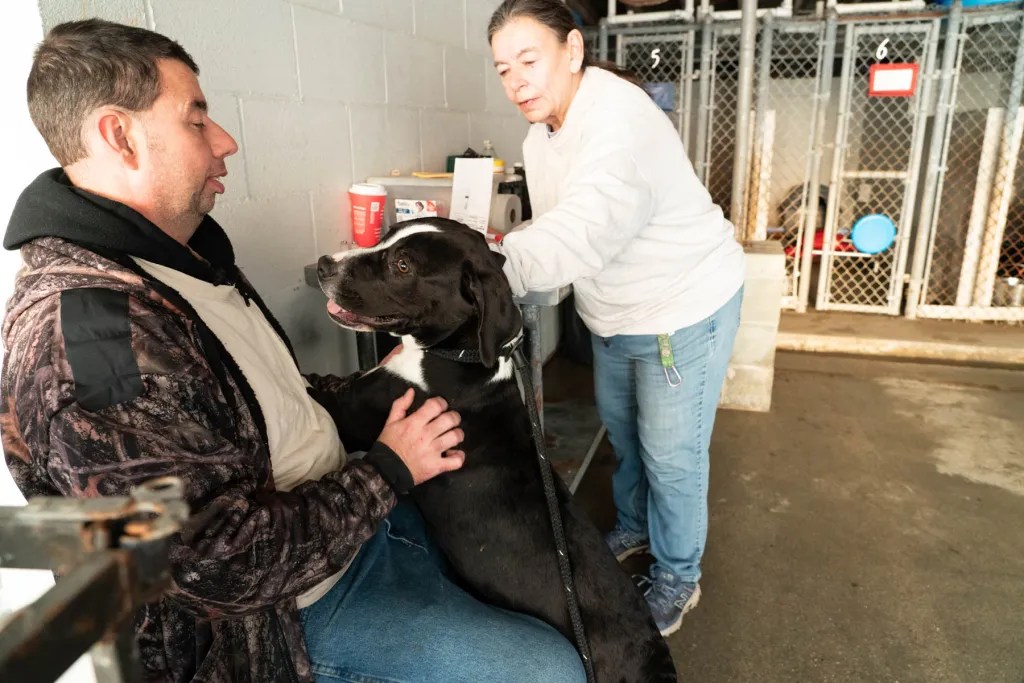
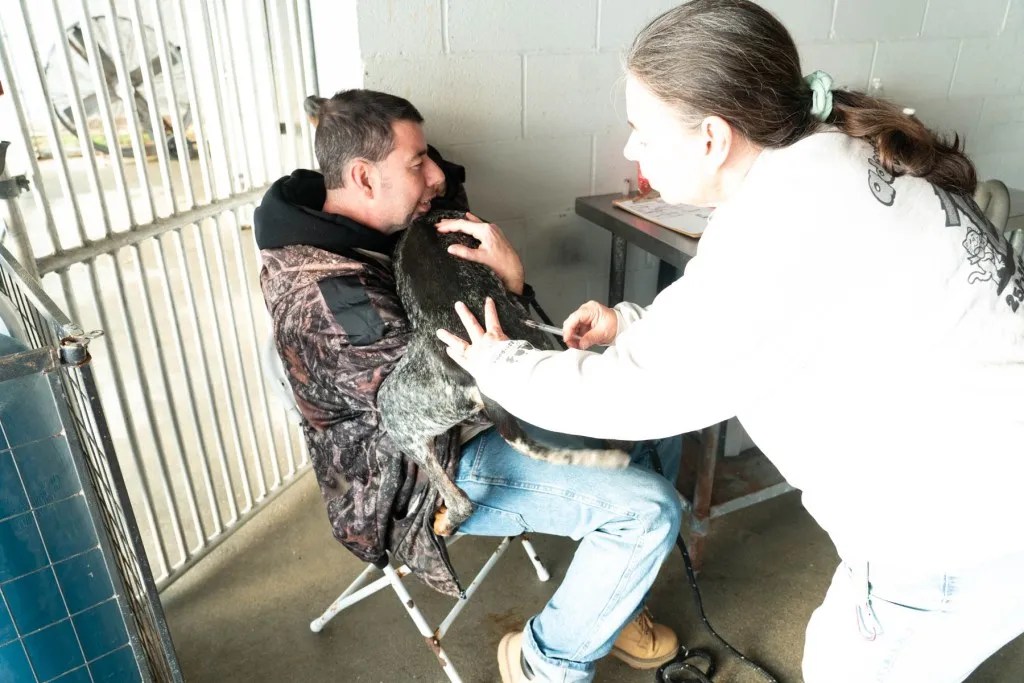
Pretty much every dog that comes in is heartworm positive. As Vicky, a volunteer who used to be the kennel manager at the shelter, told me, “If we get one that’s negative, I go buy a lottery ticket!”
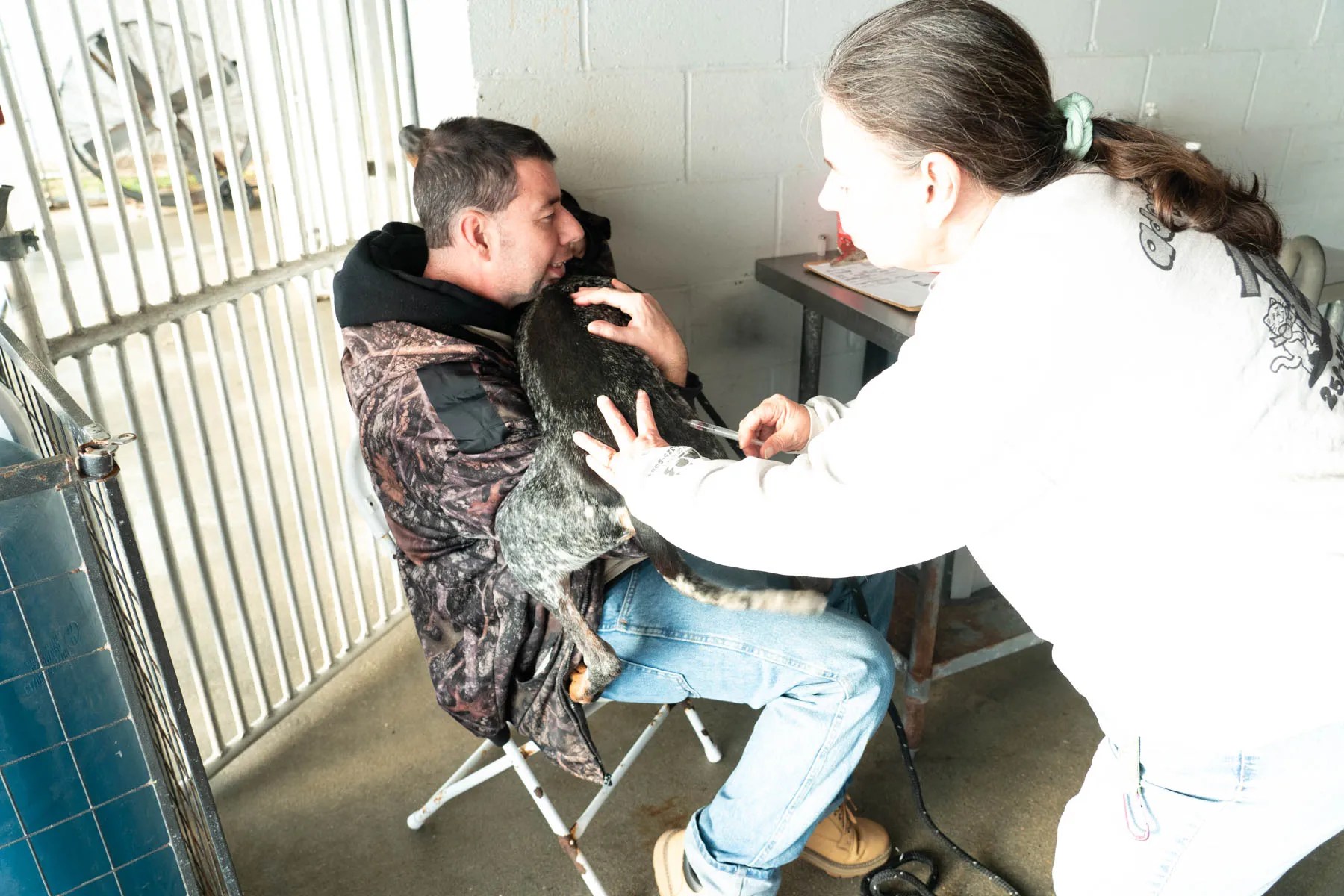
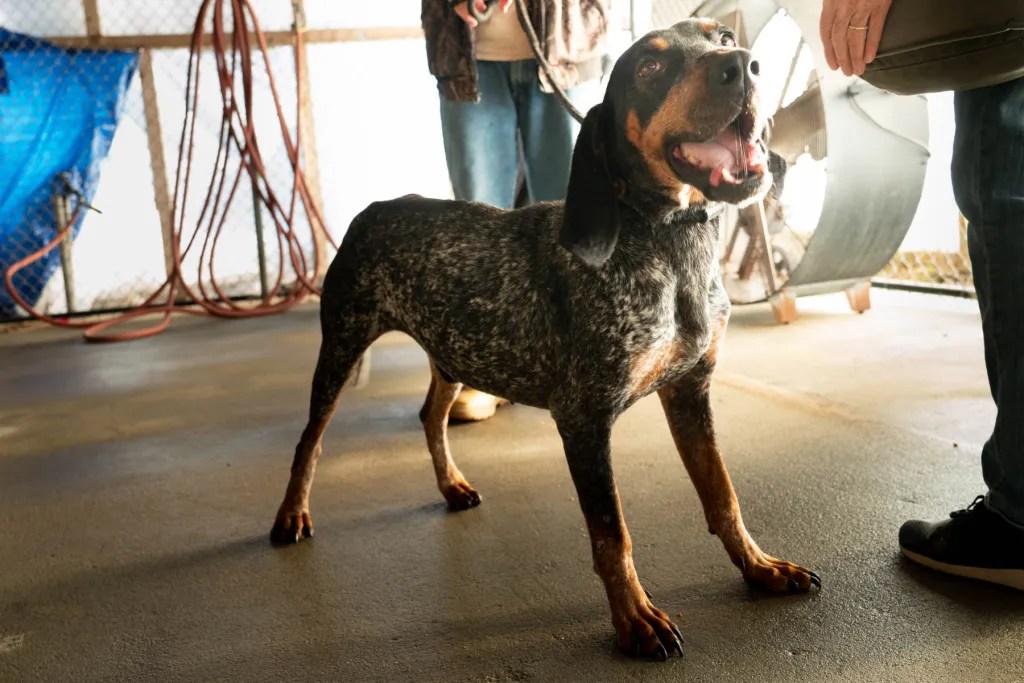
Vicky was at the shelter that day to give rabies vaccines to Cooper and Spot, two young dogs at the shelter. (NC is the first state I’ve discovered that doesn’t require that rabies vaccines be given by a veterinarian.)
oooo
oooo
We learned about Bertie County after we connected with another of their volunteers, Gina. Gina lives two hours away, but she is a tireless advocate for the dogs and the shelter. She networks the dogs to rescues, arranges for veterinarian appointments and transports, even finds donors to pay for heartworm treatment. Gina is one of those rescue warriors with a heart that just slays me. It’s inhuman how many hours and how much work she puts in to save these dogs, many she has never met.
Gina has been involved with BCHS ever since she discovered how many dogs were being killed in Bertie County. She began pulling dogs to foster within her rescue operation and eventually called on other rescues to get involved. Because she lives so far away, she depends on Diane, who lives in Bertie County and is the president of the Humane Society, and Vicky, who used to be the kennel manager at the shelter and still volunteers her time there.
There were only six dogs (and lots of cats) the day we visited thanks to Gina’s work to find rescues to empty the shelter just before the holidays and the bitter, record cold that came. The shelter normally handles about 100 dogs a year.
oooo
oooo
oooo
oooo
ooOOoo
Because of the number of photographs, beautiful photographs I would add, this is today’s Picture Parade.
But it is more pertinent today than it was when it was first released.
The video asks ‘… why we never really learnt how to talk about this’.
The video is a little less than ten minutes long so watch it now, with the family as well, if that is appropriate, and perhaps have a discussion afterwards.
Jean and I do not have any answers especially when the news is all about other things.
Yes, we know that the climate is changing but what exactly does that mean is a more difficult question to answer. Mind you there are a growing number of organisations committed to finding answers.
Yes, there are many scientists who have clear opinions on the situation but we need a global movement, NOW, to address this very urgent requirement, and there is no sign that the global community are even talking about climate change let alone doing something.














 Learning from Dogs