Setting a fabulous example of what an animal shelter should be like!
The chances are that the great majority of domestic animal lovers have an impression of the standard animal shelter. The chances are that this impression is not one of wall-to-wall approval. It is tragic that animal shelters are required but it is a fact of life that they are needed. Many of them depend heavily on volunteers and donated money.
But that’s not to say that there can’t be a shelter setting a very high example of how a shelter should be.
The words “county animal services” don’t really evoke thoughts of luxury, comfort or state of the art anything, but Miami-Dade is about to change that.
In June, the county opened its first ever “adoption mall,” an air-conditioned, high tech building where potential adopters can “shop” for their new furry best friend without even realizing they’re in a shelter.
“The old shelter was outdated and we wanted more capacity and to improve the wellness of the shelter pets,” explains Alex Muñoz, Director of the Animal Services Department about the project. “We have both cages and free roaming rooms and all areas for pets are air-conditioned.”
The Miami-Dade Animal Services Pet Adoption and Protection Center is a massive 72,000 square-foot facility that sits on five acres. Instead of sitting in kennels that don’t have much more than a small bed or sometimes just a couple of blankets on the concrete floor, adoptable dogs have plenty of space to move around and they stay stimulated in the outdoor canine exercise areas. When they’re done playing they can then retreat inside where the temperature controlled rooms keep them safe from the Florida heat.
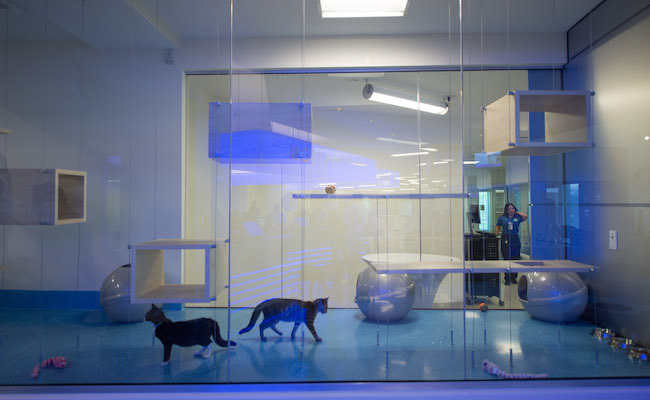
For the kitties, a lounge area filled with toys allows them to play or just communally nap–after all, they are cats.
In 2015, Miami-Dade became a no-kill county, reaching a 90 percent save rate for all animals going into its shelters. Now with the larger building, the department was also able to expand the number of animals it houses. The new facility has 25 percent more dogs and 50 percent more cats than the previous shelter.
Since disease outbreaks are not uncommon in shelters, the new facility was built to prevent the spread of viruses among the animals.
“The HVAC System includes multiple air exchanges per hour to clean the air in order to avoid air borne diseases,” says Muñoz adding that “dogs are separated in different pods to avoid cross contamination.”
With the new spiffy location, the county is also hoping to fight the association people make of shelters being depressing and its animals sad or broken.
A 2013 study done by Best Friends Animal Society found that 46 percent of people considered shelter pets second-rate compared to dogs from breeders and only 31 percent of young people were willing to consider a shelter adoption.
In addition to happier and more comfortable animals, the building also houses professionals and volunteers who will spearhead programs advocating for rescuing, fostering, caring for neonatal kittens and working with Miami-Dade County Public Schools to teach kids about responsible pet care.
This new type of shelter comes with a hefty price tag of $15 million but Muñoz says it could definitely be implemented anywhere.
And, please, if anyone who reads this is thinking of getting another cat or dog then do make a visit to your nearest shelter your first step. For if all the dogs and cats in shelters were found good homes there would be no need for shelters. An idyillic dream, I know!
My headline and sub-heading was me trying to catch your eye and persuade you stop what you are doing for eleven minutes and watch this video that was filmed earlier this year at the TEDxPSU conference. It’s all about being rational.
The presenter is Julia Galef described by WikiPedia (in part) as:
Julia Galef (born 1983) is president and co-founder of the Center for Applied Rationality. She is a writer and public speaker on the topics of rationality, science, technology and design. She serves on the board of directors of the New York City Skeptics and hosts their official podcast, Rationally Speaking, which she has done since its inception in 2010, sharing the show with co-host and philosopher Massimo Pigliucci until 2015. She also blogs with her brother Jesse on the website Measure of Doubt.
Biography
Galef received a B.A. in statistics from Columbia University. In 2010 she joined the board of directors of the New York City Skeptics. She co-founded and became president of the nonprofit Center for Applied Rationality (CFAR) in 2012. The organization also gives workshops to train people to internalize and use strategies based on the principles of rationality on a more regular basis to improve their reasoning and decision making skills and achieve goals. She was elected a fellow of the Committee for Skeptical Inquiry in 2015.
The problem I’m most interested in is how to change one’s mind. Starting from the premise that every human being is at least a little wrong about many things that matter — in our careers, or about health, science, politics, our self-image, and more — we should, in theory, be updating our views frequently as we learn more about the world. In practice, however, our opinions ossify.
So here’s that talk from Julia – I bet all of you will find it interesting! Rationally speaking, that is!
Published on Jul 11, 2016
Perspective is everything, especially when it comes to examining your beliefs. Are you a soldier, prone to defending your viewpoint at all costs — or a scout, spurred by curiosity? Julia Galef examines the motivations behind these two mindsets and how they shape the way we interpret information, interweaved with a compelling history lesson from 19th-century France. When your steadfast opinions are tested, Galef asks: “What do you most yearn for? Do you yearn to defend your own beliefs or do you yearn to see the world as clearly as you possibly can?”
If only our leaders and power-brokers across the world yearned for truth!
The great relationship that can exist between dogs and cheetahs.
Before you read on let me raise my hand in connection with this blog. Or to be clearer, next Monday Jean and I have the very great pleasure in welcoming my daughter, Maija (she of Sonic Journeys from SOUND UK), her husband, Marius, and my grandson Morten. They are staying with us until the 24th July.
Inevitably, and for all the right reasons, I will not be putting in anything like the normal time I usually spend on Learning from Dogs. It did cross my mind to stop blogging for those seven days but that seemed like a step too far.
However, what is certain is that the period from now right through to the last week in July is going to see me lowering the priority of this blog and being more random in nature in terms of if or how I respond to your comments and replies. You will also read a succession of repeats of posts from previous years. I’m hoping that because so many of you will not have been reading this place during my early years that the number of times you see something that you have previously read is kept to a minimum.
So why this note to you all today? Because the rest of this week is going to be pretty busy as we get the house all tidied up and fully prepared for our visitors.
Having got that off my chest do read the following that appeared recently over on Care2.com.
Cheetahs, the fastest land animals on Earth, have been disappearing almost as fast as they can run.
But in the African country of Namibia, the cheetah population has grown from 2,500 to 4,000 since 1994. And dogs are helping to keep those numbers rising.
Instead of trapping or shooting cheetahs that wander onto their property and kill livestock, some farmers are relying on Anatolian Shepherds and their fierce barking to scare away the predators.
“You may see in history that this dog can be responsible for saving the cheetah from extinction,” Jack Hanna, director emeritus of the Columbus Zoo, told CBS News. “That is one heck of a story right there.”
The dogs are provided to farmers and ranchers by the Cheetah Conservation Fund (CCF), the world’s leading organization dedicated to saving the lives of cheetahs in the wild.
The majority of cheetahs in the wild – over 90 percent of them, according to the CCF — live outside protected areas, surrounded by farming communities. And many of those farmers, especially poor ones, are more concerned about protecting their livelihood than an endangered species. About 10,000 cheetahs were killed during the 1980s, before CCF launched the Livestock Guarding Dog program in 1994.
Since then, the program has placed more than 500 dogs, helping to reduce the loss of livestock from 80 to almost 100 percent. The program is extremely popular — there’s a two-year wait to get in. It not only provides free Anatolian Shepherd puppies, but also training advice and free veterinary care.
“CCF research shows that the people’s attitudes towards predators are changing as a result of this and other CCF programs,” the organization said on its website.
Dogs and Cheetahs Aren’t Enemies in U.S. Zoos
As a way to promote “the life-saving role dogs play for cheetahs in the wild,” according to CBS News, some zoos in the United States are raising puppies with cheetah cubs.
“The number one question up here, this $40 million exhibit: ‘Are the dogs coming out?’” Suzi Rapp, director of the Columbus Zoo’s animal programs, told CBS News. “And I say the Columbus Zoo built the world’s most expensive Labrador retriever exhibit in the world… the biggest dog run.”
Dogs and cheetahs can also be found together at the Cincinnati Zoo. It was there, as you probably remember, where Harambe the gorilla was shot to death when a boy fell into his exhibit. His killing sparked international outrage and concern over keeping wild animals captive in zoos.
What are domesticated animals doing in these zoos? Like the Anatolian Shepherds in Africa, the zoos say, the dogs are helping to prevent cheetahs from becoming extinct. But instead of scaring cheetahs away from livestock, the zoo dogs are best buddies with the cheetahs. Their friendship, which begins when they’re about 3 months old, helps put the skittish cheetahs at ease so they can more easily be bred.
The San Diego Zoo, which has been raising dogs with cheetahs for over 30 years, gets many of its puppies from animal shelters. So in a way, the rescued dogs are paying it forward by helping save the lives of another species.
ooOOoo
That Care2 article by Laura Goldman included a short video from CBS News. However, despite me having a link to that video I couldn’t get it to play.
No problem because YouTube came up with a very good alternative.
Published on Apr 29, 2013
CCF Operations Manager Brian Badger explains how our Livestock Guarding Dog program works as part of the whole of CCF’s operations to help save the cheetah in the wild.
In fact, there was more than one interesting video and I couldn’t make up my mind which was best.
So you got two!
Published on Sep 25, 2013
In Gobabis, Namibia, these Kangal dogs guard the goats against predators, including the worlds largest population of wild cheetahs. This stops the farmers from targeting the cheetahs. Since the big dogs were introduced to Namibia, the cheetah population has reached a 30-year high ! Hurray!
First thing that must be mentioned is that it was our neighbour Larry Little who opened my eyes to the film. He sent me an email with the link to the film. Thank you, Larry.
Obviously I have no way of knowing how many of you watched the film that was the object of yesterday’s post: Words are Superfluous. But for those of you that did here is the background to that most moving film.
Shawn Welling
If one goes across to Shawn Welling’s website and clicks on the About link one reads a bio that is truly fascinating. WikiPedia also has a very good summary of Welling Films that opens thus:
Welling Films (sometimes written as WF) is an American film production company and studio based in Houston, Texas. It was launched in mid-2006 by Houston-born choreographer and photographer Shawn Welling. They have produced five feature films, along with the web series AXI: Avengers of eXtreme Illusions, and several narrative and documentary short films.
Yesterday’s post, quite deliberately, did not include all the credits and background information. Here it is:
Published on Mar 27, 2015
Hey:)
Thanks for watching my film. I really hope you share and comment as we love your feedback also feel free to email your thoughts as well. http://www.ShawnWellingVisuals.com for more info and my email.
The Director
-Shawn Welling
Full Synopsis:
A friend to share the ups and downs of life with him — and, soon, his family. “If I Could Talk” gives this dog the one chance he wants to share his thoughts.
Director: Shawn Welling AXI
Story: Mark Galvin
Screenplay: Shawn Welling
Starring:
Max Welling / The White Lab
Shawn Welling / Shawn Welling
Michelle Simmons / Michelle Welling
Grace Calabrese / Grace Welling
Kalyssa Lauer / Kalyssa Welling
Music:
Reuel
Composer:
Phillip Glass
Cinematographer
Shawn Welling
Art Giraldo
Scott Budge
To close today’s post here’s another film from Shawn Welling. (And trust me, this film is very different to yesterday’s!)
Published on Jul 24, 2014
“SALVATOR”
(Latin for ICON or statue of “THE SAVIOR”)
Another beautiful collaboration between Les Twins and Shawn Welling AXI Films.
Filmed on in front the statue of “the Savior” at the First Presbyterian Church of Houston, Houston, TX
Note: Let me declare immediately that I have a personal interest in this post. Namely that my daughter, Maija Handover, is a partner of the charitable company SOUND UK. Their most recent sound adventure is extremely interesting.
Sonic Journeys are soundtracks to specific journeys. Each commissioned piece is available as a free download for limited periods, enabling listeners to experience the music travelling through the landscape that inspired it. Or wherever they choose.
Let me allow Sonic Journeys to explain in their words what it is about:
Sonic Journeys is a series of soundtracks to specific journeys. The series commissions artists to create new works in response to journeys that inspire them. These works are recorded and available for free download for a limited period, enabling listeners to experience the music travelling through the landscape that inspired it. Previous commissions include Adrian Utley from Portishead (2012, a walk through ancient trees at National Trust’s Croft Castle & Parkland), Mica Levi (2011, a walk at Barbican Centre), Shackleton & Vengeance Tenfold (2011, two train journeys in Devon), Will Gregory from Goldfrapp (2009, a walk in Malvern Hills for Big Chill festival).
For those that would like to create and share their own Sonic Journey, we are inviting online submissions of music, or music and video, to journeys the public find personally inspiring here. Previous Your Sonic Journeys have included music to journeys in Kew Gardens in London, Bregenz in Austria, South Western Transylvania and more.
Here’s an example of one of those commissioned journeys, from my old home county of Devon. It is called Shackleton + Vengeance Tenfold – South Devon, stopping train from Starcross → Teignmouth and the Field Notes explain:
Unique British bass producer Shackleton collaborated with his original musical partner, spoken word artist Vengeance Tenfold, to present his own distinctive vision of a journey through some very special parts of Devon; the main railway line between Exeter and Totnes, and part of the Tarka railway line between Exeter and Barnstaple.
Travelling from Exeter to Newton Abbot, in South Devon the artists respond to the iconic stretch of railway as the stopping train travels through the Exe estuary from Starcross station and journeys along the sea and wonderfully dramatic scenery.
Earl Fontainelle a.k.a. Vengeance Tenfold lives on Dartmoor in Devon. He plays in the Amsterdam-based Cajun deathcountry band Earl Fontainelle and the Pearl of Great Price and has worked in many other musical and lyrical projects, including a long-term collaborative relationship with Shackleton with whom he worked together on a live performance alongside the Tom Dale Dance Company involving spoken word, live electronic music, a Siberian Jew’s harp, and a lantern.
This link will allow you to listen to the Sonic Journey. To give those unfamiliar with this part of Devon, South-West England here’s a video of that train journey.
Published on Sep 17, 2013
Here I have some footage of a famous scenic coastal main line railway route that runs from Teignmouth via Dawlish to Starcross in South Devon. It is used by both long distance and local train services currently operated by First Great Western and Cross Country that runs from Cornwall and Plymouth to all points north and east.
I know I’m biased but it still strikes me as one incredibly innovative idea! Well done, the team!
I was working outside all day yesterday and only sat down to think about today’s post after 5pm. Plus our evening meal was going to be served at 6pm.
So as I have previously done in these situations I decided to repost what was published here on Learning from Dogs one year ago to the day.
ooOOoo
Part One of a stunningly interesting essay from Professor Marc Bekoff.
As a newbie yet-to-be published author I am technically at the stage of having a completed draft that Jeannie and a close friend are proof-reading. Then after corrections, it is going to be released to some ‘beta’ readers who will give me some early feedback. (Too scary to even think of just now!)
OK, with that admission out of the way, let me move on to my ‘draft’ chapter on play; in Part Four of the book. In researching what is known about the way that dogs play and what lessons there are for us humans, I came across an essay by Marc Bekoff, Ph.D. Marc is Professor Emeritus of Ecology and Evolutionary Biology at the University of Colorado, Boulder. His essay had been published in May on the website of Psychology Today. It was incredibly interesting and full of material for the book!
Within a few minutes of me sending Professor Bekoff an email requesting permission to include quotations in my ‘draft’ chapter, he had responded in the affirmative. I had also sought his permission to publish the essay here on Learning from Dogs. Again, a very quick, positive reply.
Thus with Marc Bekoff’s generous permission, here is his essay in full. (I’ve taken the decision to split this long essay into two parts.)
Finally, Professor Bekoff includes numerous ‘html’ links within his essay to other materials. I’ve cheated by saving quite some time adding those links but have underlined the linked phrase in question, apart from the very early chapters that do have ‘html’ links. Please go to the site of the original essay to explore further those links.
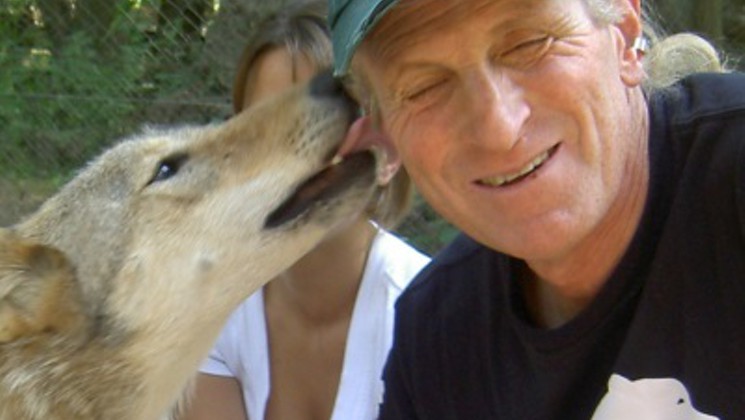
Marc Bekoff and friend.
ooOOoo
Butts and Noses: Secrets and Lessons from Dog Parks (Part One)
Dog parks are gold mines of information about the behavior of dogs and humans
I love going to dog parks. So, too, do dogs and their people. Dog parks are a fascinating recent and growing cultural phenomenon. Indeed, I go rather often to what I call my field sites, for that’s what they are, to study play behavior and other aspects of dog behavior including urination and marking patterns, greeting patterns, social interactions including how and why dogs enter, become part of, and leave short-term and long-term groups, and social relationships. I also study human-dog interactions and when I study how humans and dogs interact I also learn a lot about the humans. For example, I often hear how happy people are that their dogs are free to run here and there or free to be dogs when they’re at the dog park. Often, they say this while they’re constantly calling them back to them even when the dog is simply sniffing here or there or looking for a friend. They also call them to break up play when they think it’s gotten out of hand. You call this free?
Two works to which I often go when thinking about social dynamics at dog parks are Matthew Gilbert’s book titled Off the Leash: A Year at the Dog Park and Sonoma State University’s Patrick Jackson‘s essay called “Situated Activities in a Dog Park: Identity and Conflict in Human-Animal Space.” Linda Case writes about Dr. Jackson’s study and she is not a fan of dog parks because she feels they’re not safe and because “Dog park people frequently behave badly by not being responsible dog owners and by being inconsiderate and uncaring towards other people and their dogs.” We really need empirical studies on the safety issue. After having spent countless hours at dog parks I’ve never entertained drawing this conclusion, but there aren’t any detailed data on this topic of which I’m aware. However, on occasion, but hardly regularly, I’ve marveled at just how inconsiderate a very few people can be. But, as part of the gossip network among the other people, I often hear that a given person behaves like this even in non-dog park situations. On a few ocassions I’ve had a rather inconsiderate person ask me why their dog has bad manners and rather than get involved I call attention to some interesting dog-dog interactions.
Most people realize that “dogs are in” and countless scientific and popular essays (see also New Directions in Canine Behavior, Julie Hecht’s “Dog Spies,” and essays written for Psychology Today by writers including Mark Derr, Stanley Coren, Jessica Pierce, and yours truly) and books have been published in the past decade or so about these fascinating mammals. The bottom line is that a plethora of detailed data — and the database is rapidly increasing — clearly show that dogs are thinking, clever, and feeling sentient beings, and viewing them as sort of robotic machines is incredibly misleading and academically corrupt (please see this essay). This does not mean that they are “doggy Einsteins,” however, ample data from numerous different research groups around the world clearly show that dogs are rather complex and incredibly interesting mammals who deserve a good deal of further study. Perhaps even René Descartes would consider changing his views on nonhuman animals (animals) as unfeeling machines given the enormous amount of empirical evidence on sentience in animals.
Why do dogs do this and that? Canine confidential
“Why do dogs do this and that?” The purpose of this short essay, that can be conceived as a field guide to the extremely interesting and largely unknown world of the fascinating dogs with whom we share our lives, is to provide some lessons in dog behavior from observations and questions arising from visits to various dog parks, especially around Boulder, Colorado where I live. I see myself as “a naturalist in a dog park” and aim to show here, via a series of questions, what we know and don’t know about many different aspects of dog behavior. Dogs are often called social catalysts – icebreakers or lubricants — for social interactions with other dogs and they often open the door for pretty frank and wide-ranging conversations among familiar and unfamiliar humans. It always amazes me how dogs free up humans to talk about things they might be more reluctant to share in other venues including what they really think about their human “BFF’s — best friends forever” — and the infamous “3 p’s,” namely, pee, poop, and puke. Often when I get home and look at my notes I view them as “canine confidential.” So, what follows is a sampler of many “why” questions, including why dogs hump, why they sniff butts, genitals, and ears, why they play, and why they organize themselves the ways they do. There are also many “what” questions such as “What do they know?”, “What are they thinking?”, and “What are they feeling?” in different contexts. The list of questions is endless and I’m sure those that follow can easily mutate in many, many more.
People who are lucky enough to share their world with a dog often think they know it all. And, while they do know a good deal about what their canine buddy is thinking and feeling and what they want and need, there really are large gaps in the scientific database. As I mentioned above, there are numerous anecdotes about why dogs do this or that, and, taken together, they form their own pool of data. However, while the claim that “the plural of anecdote is data” applies in some cases, many mysteries still loom in what we actually know about the world of dogs.
Furthermore, often there is no single “right” answer to a question — even some of the most commonly asked queries — and that’s just fine. Dogs compose a highly variable group of mammals — I often say “the dog” doesn’t really exist — so it’s not surprising that just when we think we have a solid handle on what they’re thinking and feeling and why they do what they’re doing an exception or three arises. Surely, the early experience of individual dogs influences their later behavior. So, while we know a lot, people are often amazed by how little we know and that hard and fast answers can’t be given to some common questions.
Visiting dog parks can be wonderful educational experiences. Visits, some lasting hours on end each and every day, can be myth breakers and icebreakers, and also provide information about why dogs are doing this or that. People are always asking questions about why their dog is doing something and really want to know what we know. They also freely offer advice to other people about why their dog is doing something and how they can treat various problems such as shyness, aggressiveness, and why dogs ignore what their human is asking them to do. And, as I wrote above, dogs also are icebreakers – “social catalysts” the academics call them — and get people to talk with one another and to talk about things.
The questions below range from interests about basic dog behavior such as why do dogs stick their noses where they do, and why they play, bark, pee, eat turds, and roll on their back, to more lofty questions about whether dogs have a theory of mind and whether they know what they look like and if they know who they are. A good number of questions deal with dogs’ butts and noses, hence the title of this brief essay (motivated, of course, by the famous rock group, Guns N’ Roses). Butts and noses — including other “private parts” – figure into a number of the questions below. We all know dogs put their noses in places where we couldn’t imagine there would be anything of interest, and also place their active snouts, often on their first introduction, to other dogs and humans, in places that make us rather uneasy. We don’t greet friends or strangers by immediately licking their mouth or with a genital sniff or slurp. There also are many general questions that don’t center on anatomical features that figure largely in the world of the dog. I’ll answer each question briefly with what we know from various types of research, with some stories where they’re available, and note where we really need more information. It’s entirely possible that I have missed a given study (or studies) and I apologize for the oversights and look forward to hearing from readers.
While we know a lot about dogs, there are holes in the database, so the future is chock full of exciting research. Readers will discover that what we often take to be the gospel about dog behavior frequently isn’t all that well supported by published empirical research or even detailed observations. While good stories are interesting and can serve to stimulate more “controlled” research, in and of themselves they don’t constitute “data” as do detailed and more focused studies (I’ll suggest below that studies in dog parks may be more “ecologically relevant” than studies in laboratories and help to settle on-going debates among different research groups). In some ways, then, this essay is sort of a myth-buster and a fun way not only to learn about dogs but also to stimulate further research about dogs and dogs and humans. So, here we go.
(See the concluding part tomorrow.)
ooOOoo
Clearly in this last year the book was published!
For readers who haven’t read Mark Bekoff’s essay before I will repost the concluding part tomorrow.
Among the many impressive qualities of the dog is one that we humans must envy so much at times.
I’m not speaking of a dog’s ability to seek out food or, at the other end of things, the dog’s way of keeping it’s backside clean! 😉 No, I’m referring to the way a dog lives in the present. Presumably unworried as to what the future might mean.
We humans, however, as hard as we try to be rooted in the ‘here and now’ also depend on assessing the future and determining the best way to respond to that uncertainty. I’m sure that assessing and managing risk is one of the ways that have made us such a successful species.
In terms of voicing these uncertain times I really was drawn to a comment from ‘John D’ over on Richard Murphy’s Tax Research UK blogsite. I’m going to republish that comment in full before moving on to the central theme of today’s post: Into the Future.
John D says: June 10 2016 at 4:58 pm
Paul, I share your apprehension. I believe ‘the world’ has entered a cycle of almost unprecedented uncertainty. So many issues. So few solutions being articulated in the mainstream. However, shift happens and Richard is right to say that there is always opportunity for change. Gramsci, an underrated theorist, summed it up in his ‘Prison Notebooks'(1929-35) writing: “The crisis consists precisely in the fact that the old is dying and the new cannot be born; in this interregnum a great variety of morbid symptoms appear.”
The stranglehold Neo-liberalism has exercised on orthodox economics for the past 40 years is difficult to understand but, given that its major protoganists have held all the aces, it’s not really surprising. Under Reagan there was a major ‘re-education’ programme in the Universities where any heterodox economic teaching was eliminated from the ‘Economics 101’ curriculum. Acording to Richard Wolff an entire generation of students graduated from the major universities without ever having studied Marx in any context.
The good news is nothing lasts forever. The seeds of change have already been sown and will eventually blossom, possibly in unexpected locations. Sadly, as Ivan says, there has been irretrievable damage to lives and livelihoods in the US, UK and many EU countries. Michael Hudson recently spelled out its negative effects – http://www.counterpunch.org/2016/06/07/the-wages-of-neoliberalism-poverty-exile-and-early-death.
Like many, I don’t think radical change will come about until enough people are hurting enough. Maybe a real property crash will be a wake-up call. However, in or out of the EU isn’t going to trigger a change in the economic agenda any time soon. Personally I believe that a vote for Brexit (ominously a possibilty) will set-back any fundamental reforms, especially in the UK. But I don’t want to open up that can of worms again here!
The perennial question is ‘what to do?’. And the answer is always the same: ‘do something, anything, to nurture the seeds into saplings’. Every little helps! It’s going to be a rough ride, not without some collateral damage in terms of still more unnecessary deaths. Usually I’m not as optimistic as Richard but because it’s Friday afternoon and the sun is shining I feel the beginning of the end is within our grasp. I so hope so. Back to Gramsci – the immediate worry is what will fill the intervening vacuum. Happy weekend!
The seeds of change have already been sown and will eventually blossom, possibly in unexpected locations.
The perfect introduction to an email that Dan Gomez sent me on Thursday.
ooOOoo
Below is a summary by Udo Gollub of the findings at a recent futurist conference in Germany. This’s – they predict – is how the world will operate in 10 to 20 years time.
For those of us who are about to amble into the sunset on our Zimmer frames, this is simply interesting. We inhabited a world where people used cosy concepts like pension, nest egg, job security, promotion in the work place and other reassuring socio economic terms.
For those who are in mid career or are only entering the world of (non) work now, this makes for scary/exciting reading – depending on how ready you are to change in mid air — if it is at all possible.
And for the generation still in their nappies … well, it is a matter of how parents prepare them for an unimaginable world when they enter the world of ‘work’ in 20 years time.
GERT CLAASSEN Hermanus Into the future
By Udo Gollub at Messe Berlin, Germany
I just went to the Singularity University summit. Here are the key points I gathered.
Rise and Fall. In 1998, Kodak had 170,000 employees and sold 85% of all photo paper worldwide. Within just a few years, their business model disappeared and they were bankrupt. What happened to Kodak will happen in a lot of industries in the next 10 years – and most people don’t see it coming. Did you think in 1998 that 3 years later you would never take pictures on paper film again?
Yet digital cameras were invented in 1975. The first ones only had 10,000 pixels, but followed Moore’s law. So as with all exponential technologies, it was a disappointment for a long time, before it became superior and mainstream in only a few short years. This will now happen with Artificial Intelligence, health, self-driving and electric cars, education, 3D printing, agriculture and jobs. Welcome to the 4th Industrial Revolution. Welcome to the Exponential Age. Software and operating platforms will disrupt most traditional industries in the next 5-10 years.
Uber is just a software tool. They don’t own any cars, but they are now the biggest taxi company in the world. Airbnb is the biggest hotel company in the world, although they don’t own any properties.
Artificial Intelligence: Computers become exponentially better in understanding the world. This year, a computer beat the best Go player in the world, 10 years earlier than expected. In the US, young lawyers already don’t get jobs. Because of IBM Watson, you can get legal advice, (so far for more or less basic stuff), within seconds. With 90% accuracy, compared with 70% accuracy when done by humans. So if you are studying law, stop immediately. There will be 90% fewer generalist lawyers in the future; only specialists will be needed. ‘Watson’ already helps nurses diagnose cancer, four times more accurately than doctors. Facebook now has pattern recognition software that can recognize faces better than humans. By 2030, computers will have become ‘more intelligent’ than humans.
Cars: In 2018 the first self driving cars will be offered to the public. Around 2020, the complete industry will start to be disrupted. You don’t want to own a car anymore. You will call a car on your phone; it will show up at your location and drive you to your destination. You will not need to park it, you only pay for the driven distance and you can be productive whilst driving. Our kids will never get a driver’s licence and will never own a car. It will change the cities, because we will need 90-95% fewer cars for our future needs. We can transform former parking spaces into parks. At present,1.2 million people die each year in car accidents worldwide. We now have one accident every 100,000 kms. With autonomous driving, that will drop to one accident in 10 million km. That will save a million lives each year.
Electric cars will become mainstream around and after 2020. Cities will be cleaner and much less noisy because all cars will run on electricity, which will become much cheaper.
Most traditional car companies may become bankrupt by tacking the evolutionary approach and just building better cars; while tech companies (Tesla, Apple, Google) will take the revolutionary approach and build a computer on wheels. I spoke to a lot of engineers from Volkswagen and Audi. They are terrified of Tesla.
Insurance companies will have massive trouble, because without accidents, the insurance will become 100 times cheaper. Their car insurance business model will disappear.
Real estate values based on proximities to work-places, schools, etc. will change, because if you can work effectively from anywhere or be productive while you commute, people will move out of cities to live in a more rural surroundings.
Solar energy production has been on an exponential curve for 30 years, but only now is having a big impact. Last year, more solar energy was installed worldwide than fossil. The price for solar will drop so much that almost all coal mining companies will be out of business by 2025.
Water for all: With cheap electricity comes cheap and abundant water. Desalination now only needs 2kWh per cubic meter. We don’t have scarce water in most places; we only have scarce drinking water. Imagine what will be possible if everyone can have as much clean water as they want, for virtually no cost.
Health: The Tricorder X price will be announced this year – a medical device (called the “Tricorder” from Star Trek) that works with your phone, which takes your retina scan, your blood sample and your breath. It then analyses 54 biomarkers that will identify nearly any diseases. It will be cheap, so in a few years, everyone on this planet will have access to world class, low cost, medicine. 3D printing: The price of the cheapest 3D printer came down from 18,000$ to 400$ within 10 years. In the same time, it became 100 times faster. All major shoe companies started printing 3D shoes. Spare airplane parts are already 3D-printed in remote airports. The space station now has a printer that eliminates the need for the large amount of spare parts they used to need in the past.
At the end of this year, new smart phones will have 3D scanning possibilities. You can then 3D scan your feet and print your perfect shoe at home. In China, they have already 3D-printed a complete 6-storey office building. By 2027, 10% of everything that’s being produced will be 3D-printed.
Business opportunities: If you think of a niche you want to enter, ask yourself: “in the future, do you think we will have that?” And if the answer is yes, then work on how you can make that happen sooner. If it doesn’t work via your phone, forget the idea. And any idea that was designed for success in the 20th century is probably doomed to fail in the 21st century.
Work: 70-80% of jobs will disappear in the next 20 years. There will be a lot of new jobs, but it is not clear that there will be enough new jobs in such a short time.
Agriculture: There will be a 100$ agricultural robot in the future. Farmers in 3rd world countries can then become managers of their fields instead of working in them all day. Aeroponics will need much less water. The first veal produced in a petri dish is now available. It will be cheaper than cow-produced veal in 2018. Right now, 30% of all agricultural surfaces are used for rearing cattle. Imagine if we don’t need that space anymore. There are several start-ups which will bring insect protein to the market shortly. It contains more protein than meat. It will be labelled as “alternative protein source” (because most people still reject the idea of eating insects).
Apps: There is already an app called “moodies” which can tell the mood you are in. By 2020 there will be apps that can tell by your facial expressions if you are lying. Imagine a political debate where we know whether the participants are telling the truth and when not!
Currencies: Many currencies will be abandoned. Bitcoin will become mainstream this year and might even become the future default reserve currency.
Longevity: Right now, the average life span increases by 3 months per year. Four years ago, the life span was 79 years, now it is 80 years. The increase itself is increasing and by 2036, there will be more than a one-year increase per year. So we all might live for a long, long time, probably way beyond 100.
Education: The cheapest smartphones already sell at 10$ in Africa and Asia. By 2020, 70% of all humans will own a smartphone. That means everyone will have much the same access to world class education. Every child can use Khan Academy for everything he needs to learn at schools in First World countries. Further afield, the software has been launched in Indonesia and will be released in Arabic, Swahili and Chinese this summer. The English app will be offered free, so that children in Africa can become fluent in English within half-a-year.
At all levels and in so many ways it is life-giving.
Animals must see touch as a natural way of living. We humans are less natural about touch especially with people that we don’t know so well. Not everyone, of course, but as a general statement it is probably not wrong.
The topic of touch has come to me today as a result of a recent item read over on The Conversation blogsite; specifically about the importance of touch between a doctor and his or her patient. Here it is republished within the terms of The Conversation:
In contemporary health care, touch – contact between a doctor’s hand and a patient – appears to be on its way out. The expanding role of CT and MRI imaging is decreasing reliance on touch as a way of making diagnoses. Pressures to move patients through the system more quickly leave health professionals with fewer opportunities to make contact. Our experience suggests that when doctors spend fewer minutes with patients, less time is available for touch.
Yet despite the rise of scanners, robots and other new medical technologies, the physician’s hand remains one of medicine’s most valuable diagnostic tools. Touch creates a human bond that is particularly needed in this increasingly hands-off, impersonal age. Medical practice is replete with situations where touch does more than any words to comfort and reassure.
The USC psychologist Leo Buscaglia, whose habit of hugging those he met soon earned him the sobriquet “Doctor Love,” bemoaned our neglect of touch in his book, “Love,” in these terms:
Too often we underestimate the power of a touch, a smile, a kind word, a listening ear, an honest compliment, or the smallest act of caring, all of which have the potential to turn a life around.
For thousands of years, touch has been recognized as an essential part of the healing arts. Native American healers relied on touch to draw out sickness, and kings and queens were long believed to possess the “Royal Touch,” through which the mere laying on of hands could heal. The Bible contains numerous stories of the healing power of touch.
Touch is an essential part of our well-being
An indication of our need for touch can be found among our primate relatives. Psychologists have observed that many such species spend upwards of five hours of each day touching one another, partly through grooming. For many human beings, however, the daily dose of touching would be measured not in hours but minutes, perhaps even seconds.
Lack of touch can be hazardous to health. In experiments with primates some 60 years ago,
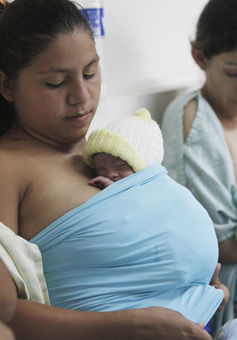
A young mother participates in a ‘Kangaroo Mother’ program at the National Maternity Hospital in El Salvador. Luis Galdamez/Reuters
researcher Harry Harlow demonstrated that young monkeys deprived of touch did not grow and develop normally. Mere food, water and shelter are not sufficient – to thrive, such creatures need to touch and be touched.
The same can be said for human beings. During the 20th century, wars landed many babies in orphanages, where their caretakers observed that no matter how well the infants were fed, they would fail to thrive unless they were held and cuddled on a frequent basis. Touch offers no vitamins or calories, yet it plays a vital role in sustaining life.
More recent studies have corroborated these findings. “Kangaroo care,” using papoose-like garments to keep babies close to their mothers, decreases the rate at which they develop blood infections. Touching also improves weight gain and decreases the amount of time that newborns need to remain in the hospital.
Touch creates a bond between doctor and patient
Novelist and physician Abraham Verghese has argued that touching is one of the most important features of the patient-physician interaction. When he examines a patient, he is not merely collecting information with which to formulate a diagnosis, but also establishing a bond that provides comfort and reassurance.
The notion that touch can reassure and comfort has a scientific basis. Ten years ago researchers used MRI scans to look at the brains of women undergoing painful stimuli. When subjects experience pain, certain areas of the brain tend to “light up.” The researchers studied subjects when they were alone, when they were holding a stranger’s hand, and when they were holding their husband’s hand.
They found the highest levels of pain activation when the women were alone. When they were holding a stranger’s hand, the pain response was decreased. And levels of activation were lowest of all when they were holding their husband’s hand. Interesting, the higher the quality of subjects’ marriages, the more pain responses were blunted.
Touch from parents helps kids in intensive care
We have been studying this phenomenon in our own institution, looking at the effect of touch not only on patients but on the parents of patients admitted to the pediatric intensive care unit.
The project, called ROSE (Reach Out, Soothe, and Embrace), sought to determine whether increasing opportunities to touch patients could promote parent well-being without compromising patient safety.
Instead of merely determining whether patients could be taken off the ventilator or fed, we also identified patients who could be safely touched and even held in their parents’ arms. When a patient was deemed safe to hold, a magnet bearing the image of a red rose embraced by two hands was placed on the door to the patient’s room.
While we are still analyzing the results and further study is needed to fully delineate the health benefits of touch, several findings are already clear.
First, increasing opportunities for touch does not compromise patient safety. Second, the subjective well-being of family members is enhanced when touching is encouraged. Third, promoting touch empowers family members to become more involved in their child’s care.
To be sure, inappropriate and unsafe touching can be harmful. But when touch is encouraged in the right ways and for the right reasons, it is good for patients, family, friends and health professionals alike. Touch is one of the most fundamental and effective ways to create a sense of connection and community among human beings.
In the words of the 20th-century theologian Henri Nouwen, who wrote in his book, “Out of Solitude”:
When we honestly ask ourselves which person in our lives means the most to us, we often find that it is those who, instead of giving advice, solutions, or cures, have chosen rather to share our pain and touch our wounds with a warm and tender hand.
So next time you find yourself confronted by a person in distress, remember the power of touch. Medicines and words both have healing power, but so does touch, and it is perhaps the most widely available, financially responsible and safest tool in the healing arts. When we touch, we connect, and when we connect, we create a healing bond for which there is simply no substitute.
ooOOoo
“When we touch, we connect, and when we connect, we create a healing bond for which there is simply no substitute.”
Jean with my mother back in July, 2014.
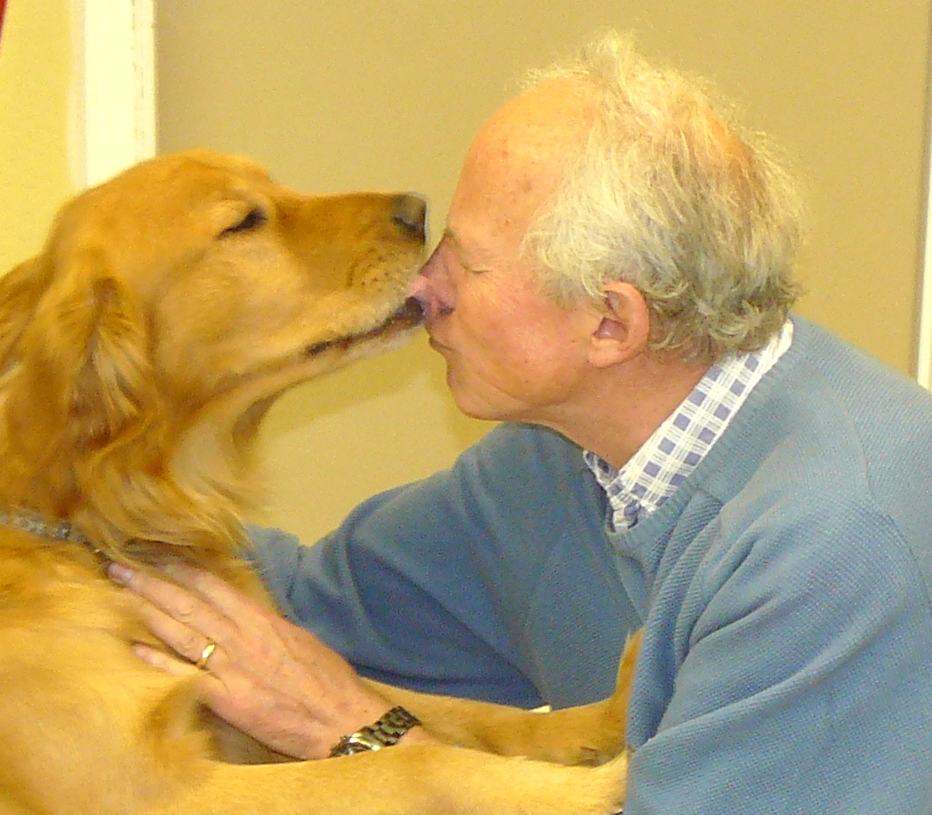
The healing touch!
Or to repeat the elegant words of Leo Buscaglia:
Too often we underestimate the power of a touch, a smile, a kind word, a listening ear, an honest compliment, or the smallest act of caring, all of which have the potential to turn a life around.
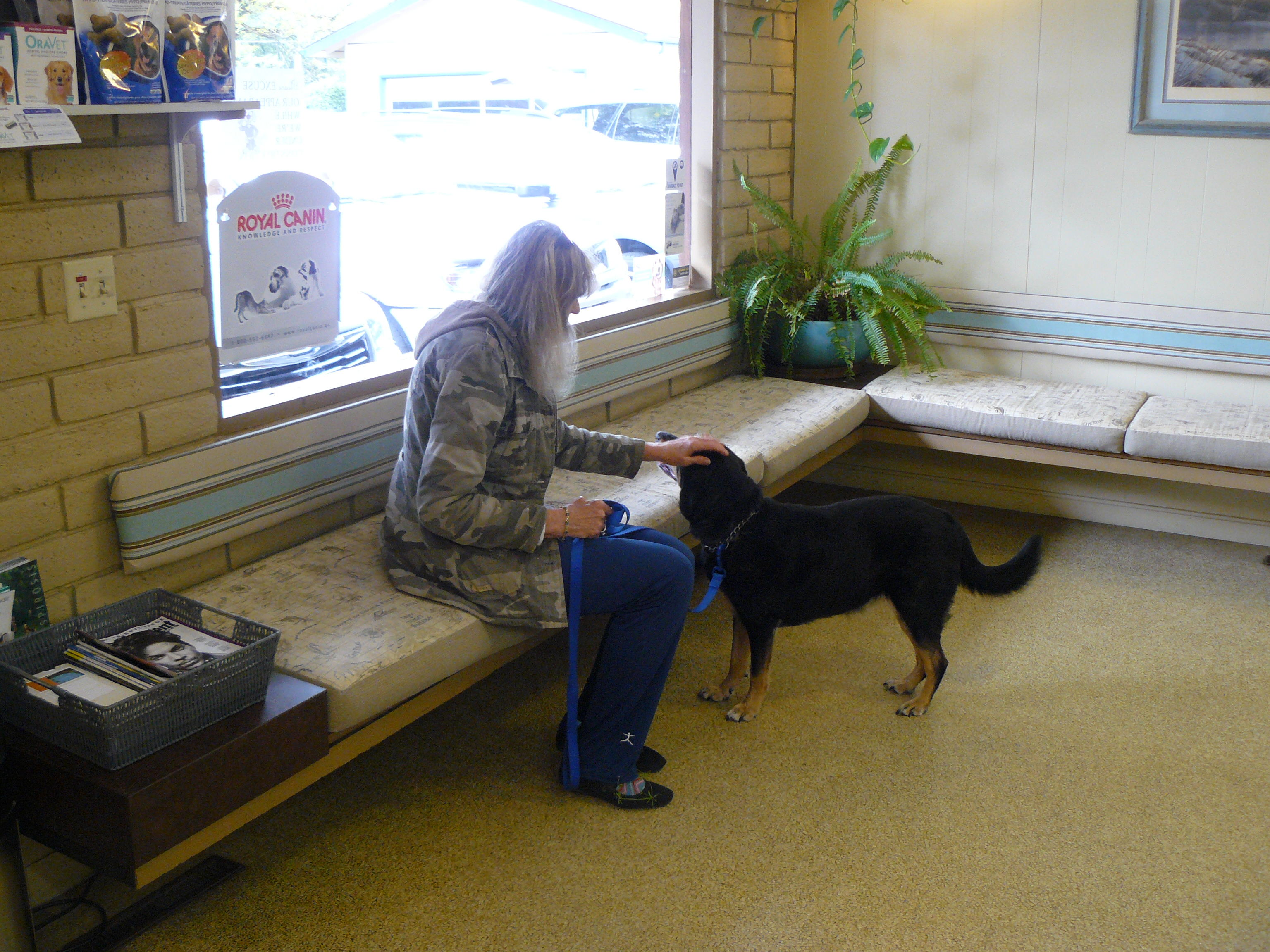
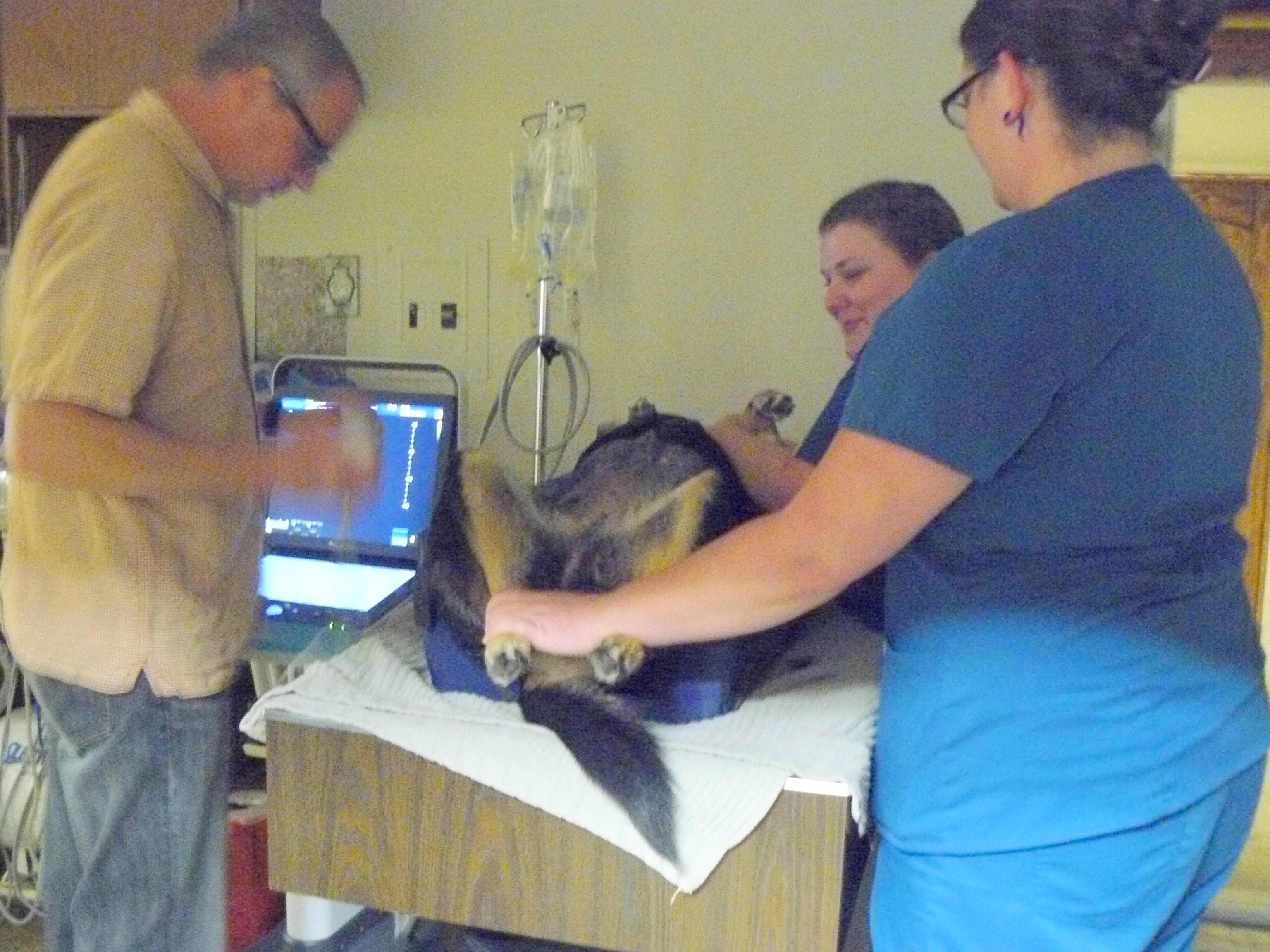
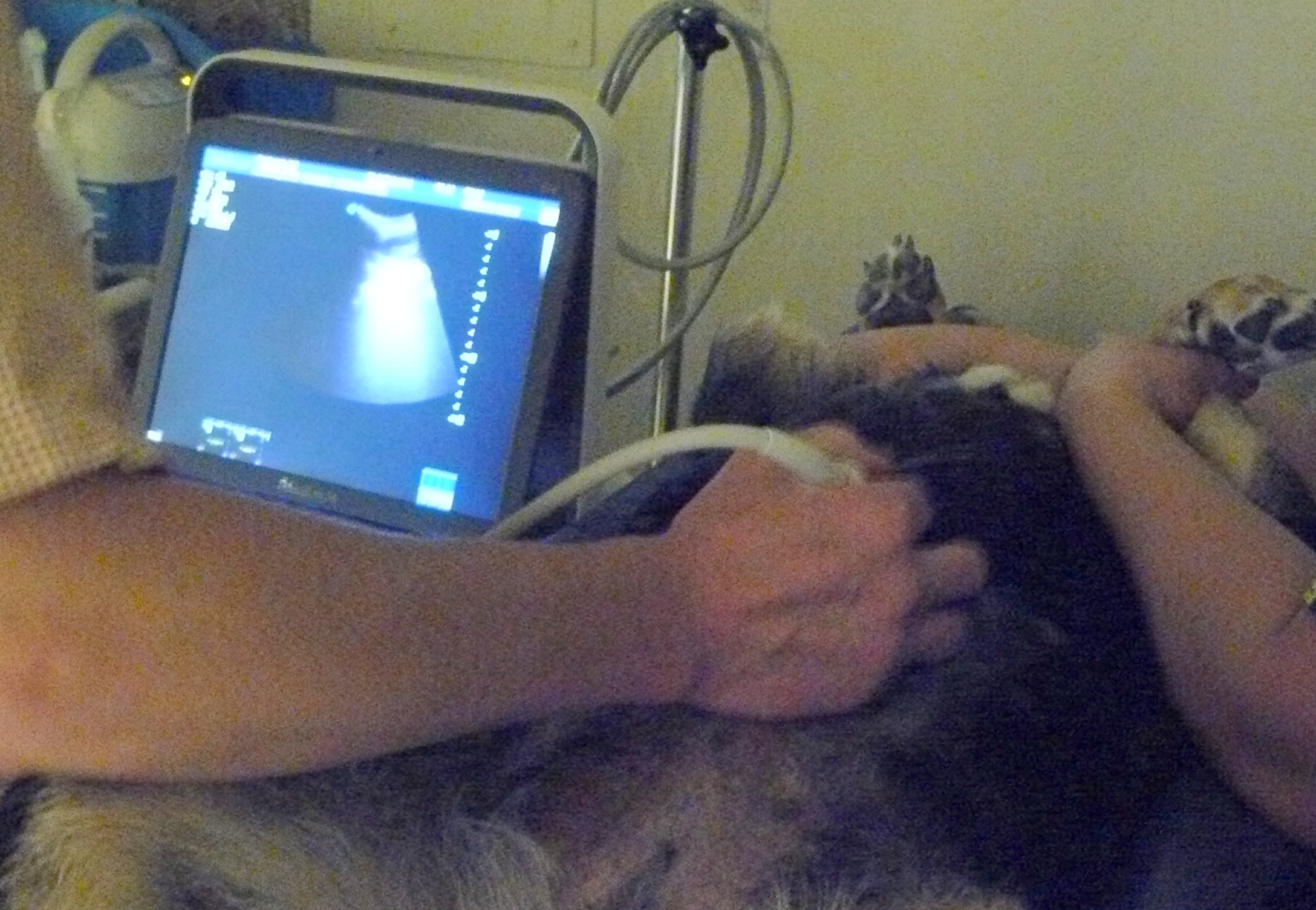
I’m writing this post at 5pm yesterday (Tuesday) shortly after we returned home from collecting Hazel from Lincoln Road Vet Clinic following her earlier examination by Dr. Parker using his mobile sonogram.
Hazel at the clinic shortly before she was taken in by the staff.
The good news is that Dr. Parker did not find any sign of trauma or life-threatening illnesses in Hazel’s body especially focusing on her abdomen.
Dr. Parker to the left being assisted by clinic staff as he examines Hazel ultra-sonically.
(I should be quick to say that I left my camera with one of the technicians and wasn’t present. Indeed, Jean and I did not get to meet Dr. Parker.)
Dr. Parker, who is a board-certified veterinarian doctor, came to the conclusion that the most likely cause of Hazel’s illness was the fungal lung infection, as Dr. Codd and the radiologist supposed.
Nothing frightening seen!
To try and narrow down the exact fungal infection a further blood sample was taken and the lab results should be known in three or four days time.
Dr. Codd, in his briefing to Jean and me when we collected Hazel late afternoon, said that his recommendation based on the lack of any notable findings from the scan could be summarised as follows:
Regard treating the fungal infection as the number one priority,
Hold off from treating the tick fever in the interim,
Dose Hazel with 100mg of Fluconazole twice a day even if she is eating hardly anything,
The measure is whether Hazel, with a very small food intake, can take that dosage without vomiting,
Add a B12 tonic to her diet with immediate effect,
Give Hazel appetite stimulant medicine,
Consider the hemp oil (as queried by me) if the proper dosage can be determined.
(Petspeopleandlife: Hazel’s current weight is 53 lbs (24 kg). Any advice?)
Back home again albeit still feeling a little drowsy!
Thus while we have not yet got to the bottom of what precisely is the nature of Hazel’s infection at least we know there isn’t anything else silently killing her.
Thank you so much, dear readers, for taking so much interest in Hazel and for sending your love and caring wishes – it’s working! 🙂
Giving back, in so many different ways, is fundamental to who we are, and to whom we must be!
I introduced yesterday’s Earth Day post with the sub-heading, “A fabulous example of how we reach out to others across the internet!” Today’s post is another fabulous example.
I just had to share this lovely post with you all from a beautiful friend. You have to explore her blog to see all the transformations she does when she gives a new lease of life to furniture. And her home.. What is even more remarkable, and I hope Lois will not mind me mentioning this is that Lois does all of this work from the confines of a wheelchair..
I hope you visit and see just how generous a nature she has ..
Love and Blessings
Sue
Curious, I went across to Lois’s blog Living in Denim and to the particular post that Sue had spoken about. Without hesitation I asked if I might republish that post here and share it with you all. Lois was delighted to offer me such permission.
Read it and you will see why I asked so quickly.
ooOOoo
Giving Back: A Yard Sale Redo for a Deserving Child
We had a beautiful weekend, if I didn’t know it was April I could have easily believed this was summer. I headed outside thinking I would finally get some work done on the exterior of the house when my phone rang.
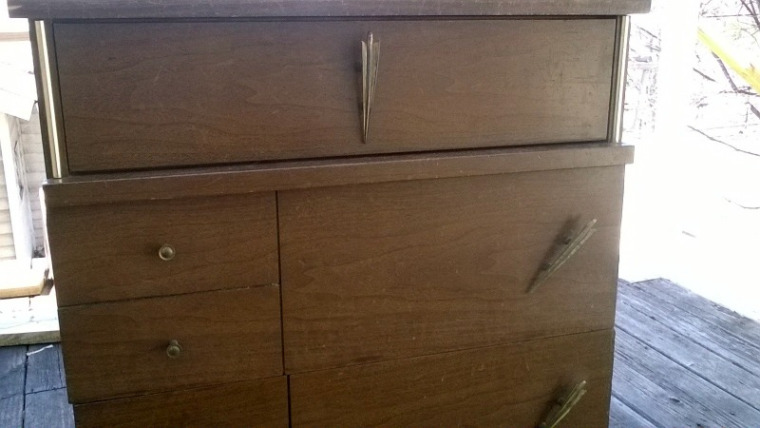
The caller wanted to know if I could redo and paint a dresser for a foster child that has been placed with her family long term. I took that to mean, can you fix then paint a dresser. My answer was probably. A few minutes later this was delivered
The family shared many of the details surrounding this little eight-year old child’s placement with them. I was informed they were trying really hard with limited funds to give her a room personalized for her so she would feel welcome and comfortable.
How could I say no?
When asked how much I would charge, I ignored the question by changing the subject and asked if the foster parent was looking for a grown-up dresser (aka Pottery Barn painted look) for the child or something more whimsical an eight-year old would like now. I was informed I could do whatever I wanted and they were concerned with giving the child a dresser she would love today not a few years down the road.
With permission I asked a few questions of the child to see what her likes were. I was careful in how I phrased my questions and took it slow to see how open she was. I began with her favorite colors. She was outgoing and friendly, happy to answer. Her favorite colors were (in order) blue, red and black. Not good, I don’t have those colors in any significant quantity on hand. Then she added white. That I had.
My next question was the most sensitive. Foster care children often are taken from their homes with nothing but the clothes on their backs but I needed to know what she liked. Instead of asking what her favorite toys were, afraid to bring up feelings of loss, I asked What she liked to do for fun.
She stumbled and admitted she didn’t know.
I decided to turn my attention to the family member who brought the dresser to me to give the child a moment to think. I asked a bit about the rest of the child’s room. Was there a theme or color scheme when suddenly the child mentioned she liked swimming pools and flowers.
Now I had something to work with.
I didn’t give my house or the work I’d planned to do a second thought, my poor house was abandoned for this dresser.
The dresser is circa 1960. It’s a cheap laminate that the family picked up for $5 at a yard sale. I shouldn’t be too judgemental the dresser has lasted for more than 50 years. The knobs and pulls had to go. The pulls were so close to the drawer faces that I couldn’t get a finger in to pull the drawers open. My fingers are rather small, being that I comfortably wear size 5 rings and when I glanced at the child’s hands I thought her fingers could have been a bit bigger than mine, I knew the pulls wouldn’t work.
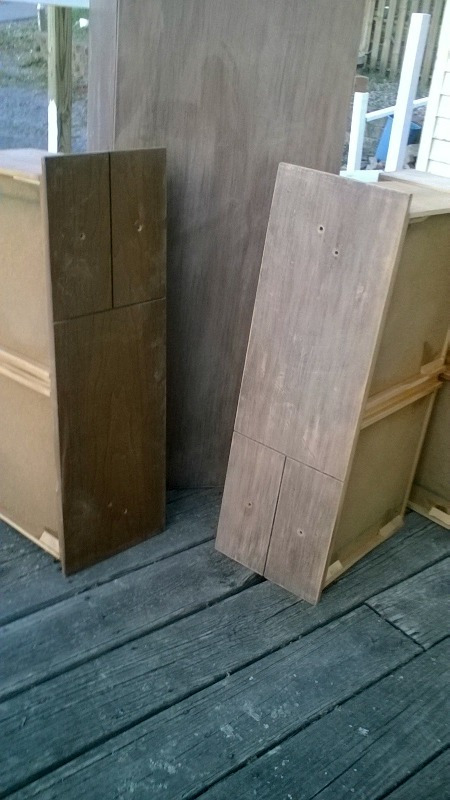
You can see here how the laminate was assembled on to a wooden frame.
I repaired a couple of the drawers by adding glue and screws to keep the sides attached. Then came the sanding. I didn’t get far when the neighbor boy stopped to ask if he could help. I explained how he would have to have a very gentle touch and then we were hard at work.
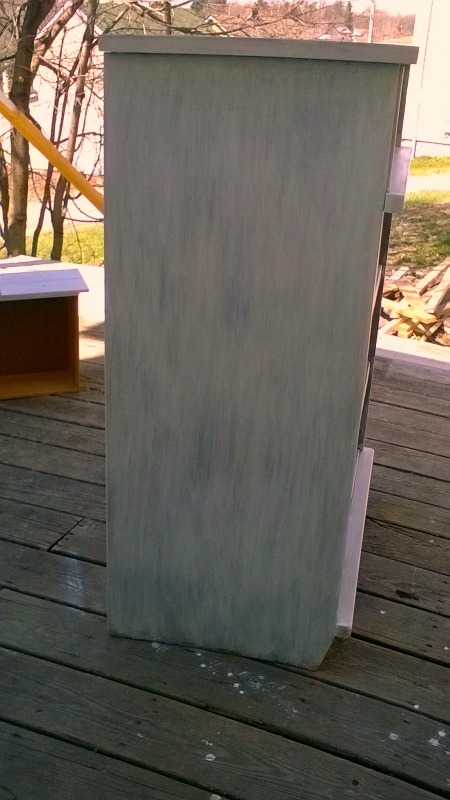
The moment I saw the dresser the first thought that crossed my mind was that I wanted to white wash it. I’ve worked on several of these types of laminate dressers from this period but never tried a white wash. When the child told me she liked swimming pools I knew a white-washed finish was perfect. It would give that beach-y, driftwood look that would become my background.
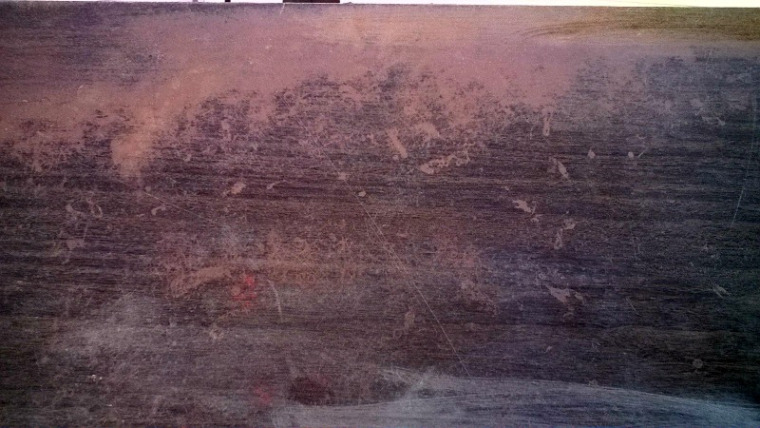
Comparison of what the finish looked like before and after a good sanding.
I mixed equal parts white satin latex paint and water, then wearing gloves soaked a rag in the paint and rubbed it on to the dresser.
You must apply the paint in the same direction, with the grain of the “wood” for the best results. It took 2-3 coats of paint to get the desired effect. When the dresser was dry I added two coats of polycrylic to seal the finish, but I’m getting ahead of myself a bit.
I was told flowers were important to this child. As I sanded the dresser down I contemplated the best way to add flowers to the piece. At first I thought maybe I’d sketch grass using green milk paint to the lower drawer then stems up the drawer fronts to use the knobs as the center of the flowers and sketch around them different colored flowers. This didn’t feel right to me but still I played with the idea.
Then I realized I didn’t have enough colors of paint to do this. I briefly considered heading to the store to purchase an assortment of different colored permanent markers, but again I dismissed this. I worked until I lost daylight on Saturday and woke with an idea.
For months now my granddaughters and I have enjoyed coloring Patricia Zapata’s Flower Nook. Patricia is a well-known blogger at A Little Hut. I’ve already removed some of the completed pages to frame for the girl’s room upstairs, now I would remove more and use them on the dresser.
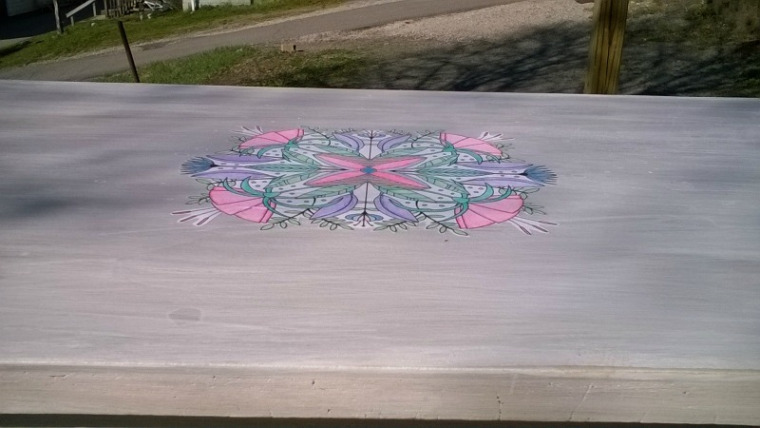
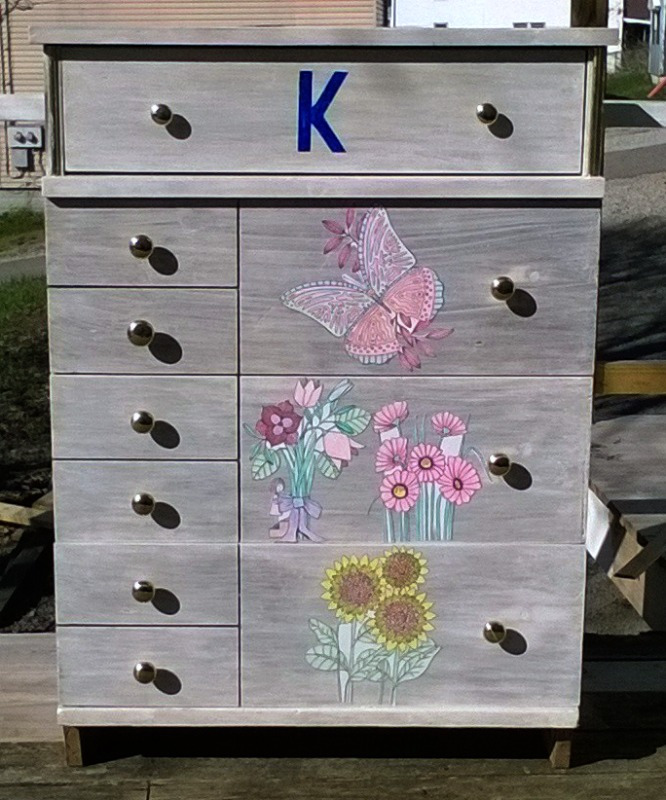
I added three designs to the drawers and one to the top of the dresser.
Top of the dresser.
These are the designs I used on the drawer fronts.
The most time consuming part of this was trimming the designs to remove the excess white paper. I laid them out and when I was happy with the placement decoupaged them on and sealed the entire drawer fronts with polycrylic.
In questioning the little girl I learned she liked gold over silver so I headed to my hardware stash and pulled out all the heavy substantial gold knobs. I toyed around with using two knobs on the left with one pull on the right, the way the drawers were to begin with. In the end I didn’t have enough gold pulls I liked and decided to use only knobs. I used wood filler to fill in the holes from the original pulls then drilled new holes. I kept the distance from the side of the drawer for the new knobs the same as the existing knobs on the other side and then centered them on the fronts.
Once I took this photo I saw that I hadn’t painted the very bottom and did go back and paint them, if you were wondering.
The top drawer I simply used a permanent marker, I have a couple in the house, and a four inch stencil to add her first initial.
By Sunday at 3pm I called to let the family know the dresser was ready to pick up. They arrived with the little girl and a friend of hers. I wish I could show you their faces, but I can’t. The girls didn’t miss a thing. They spotted the little girl on the middle drawer, they loved the heavy gold knobs and the white washed paint effect.
I know a little about this foster parent, I know she adopted a previous foster child and raised him as her own even though she has very little disposable income. She herself is on disability. She loves these children and has given this little child so much love that when the question arose again as to how much they owed me, I informed her the child’s expression was well worth the work and I wanted to make this a gift from me to them. Thankfully, the family accepted my gift as long as I promised to call if there is ever anything they can do for me.
Tonight I am tired and even sore. I did get a bit of work done outside after all but while I thought getting more accomplished on the house would perk me up, in reality it was the dresser that made the weekend a success for me.
 By: Natalia Lima August 6, 2016 About Natalia
 For the kitties, a lounge area filled with toys allows them to play or just communally nap–after all, they are cats.
 In 2015, Miami-Dade became a no-kill county, reaching a 90 percent save rate for all animals going into its shelters. Now with the larger building, the department was also able to expand the number of animals it houses. The new facility has 25 percent more dogs and 50 percent more cats than the previous shelter.
 With the new spiffy location, the county is also hoping to fight the association people make of shelters being depressing and its animals sad or broken.












 Learning from Dogs