Following on from yesterday’s post that highlighted how Switzerland is legally protecting the rights of animals.
Apologies for the brief introduction but our internet service was up and down yesterday and I didn’t know how long I had to get today’s post completed.
Abused animals in Connecticut now have a voice in court, thanks to a new law passed by the state in late 2016.
Connecticut lawmakers passed “Desmond’s Law” in response to the horrific death of a sweet shelter dog called Desmond in 2012. The man who adopted him, Alex Wullaert, reportedly rarely fed Desmond and often beat him.
Ultimately, Wullaert killed the dog by hanging him, after Desmond made the mistake of urinating on Wullaert’s leg. Then he dumped the body in a garbage bag and left it on the street.
When prosecuted for the crime, Wullaert admitted what he’d done. The prosecutor recommended that he spend time behind bars for this shocking offense. Despite this recommendation, the court gave him nothing more than Accelerated Rehabilitation. That meant upon successful completion of probation, Wullaert’s record would be wiped clean.
That result outraged the animal-loving citizens of Connecticut. And they enacted “Desmond’s Law” to ensure that court decisions offer a better measure of justice following animal-related crimes.
Seven attorneys, a law professor and her law students are part of the program statewide. The law authorizes qualified pro-bono lawyers and volunteer law students to:
[P]rovide investigative insight not readily available to the court, resulting in a more fair and efficient process and more meaningful outcomes in animal abuse cases. It is intended to shine a bright light on the full extent of crimes committed under the animal cruelty statute.
In a nutshell, these animal advocates help the prosecution or defense team with tasks it often has no time for, especially in animal cases. The volunteers investigate, research issues and conduct interviews with veterinarians and other witnesses. As official parties to the case, they also write briefs, make arguments in court and submit recommendations to the judge.
A judge has to approve the participation of the animal advocates, who must be requested by either the prosecution or defense.
“The hope [of the law] was that providing courts with an extra resource to help handle these cases, at no cost, [is] that the cases could be more thoroughly handled,” University of Connecticut law professor Jessica Rubin told the Hartford Courant.
Prosecutors in Connecticut already commend the animal advocates for helping them do a better job in these cases. Often, they barely have time to do much of this legwork for cases involving human victims. We all know that when time is precious, the human cases will take precedence over those involving animals. Now, with professionals in place solely for the animal cases, that won’t be a problem anymore.
“We hope with this law in place, we will start to see much better procedural outcomes [in animal abuse cases],” Annie Hornish, director for the Humane Society of the United States in Connecticut, told the AP. “We are very excited that judges seem to be taking advantage of it.”
This is an incredible step forward for animal victims. In particular, it helps overburdened courts provide the same level of investigation and consideration to animal victims that they give to human victims.
Connecticut has given animals a legitimate, recognized voice in the state court system. Why can’t every other state do the same thing? From Maine to California, every state has animal-loving lawyers and law students who would be grateful and eager to volunteer their time as animal advocates.
Lawmakers from other states are reaching out to Rubin to request information on how they might be able to pass a similar law. There’s interest out there, and animal activists can help fan this flame.
It’s time for every jurisdiction to pass its own version of Desmond’s Law.
Photo credit: Thinkstock
ooOOoo
Once again everyone: It’s time for every jurisdiction to pass its own version of Desmond’s Law.
As in how a primate chooses to communicate with humans.
In recent times there have been a couple of posts in this place about the science of communication between dogs and humans.
What about other animals?
What about a gorilla?
If you drop across to the YouTube site and search for Koko the Talking Gorilla you will be astounded by how many videos are to be seen.
Try this one:
A very moving account from Robin Williams.
If we then want more background information on this remarkable animal, Wikipedia is there to oblige (in part):
Hanabiko “Koko” (born July 4, 1971) is a female western lowland gorilla who is known for having learned a large number of hand signs from a modified version of American Sign Language (ASL).
Her instructor and caregiver, animal psychologist Francine “Penny” Patterson, reports that Koko is able to understand more than 1,000 signs of what Patterson calls “Gorilla Sign Language” (GSL).[2] In contrast to other experiments attempting to teach sign language to non-human primates, Patterson simultaneously exposed Koko to spoken English from an early age. Reports state that Koko understands approximately 2,000 words of spoken English, in addition to the signs.[3] Koko’s life and learning process has been described by Patterson and some of her collaborators in a number of books, peer reviewed articles, and on a website.
Koko got her birthday wish this July 4th — not only did one kitten come to visit, but a whole litter. Koko fell in love with one, and the other fell in love with her. Koko has adopted these two kittens into her family, and it has energized her world.
Not only have Koko’s maternal and play instincts kicked in, but she is signing more to her caregivers and generating new content everyday that can be used by The Gorilla Foundation to create empathy for great apes. This can have significant benefits to both endangered free-living great apes and those in captive environments, by encouraging the development of 2-way communication with their caregivers (which Koko has had since she was a baby).
The Gorilla Foundation is now working on a multimedia sequel to the classic book, “Koko’s Kitten,” which has already reached millions of children worldwide, and has the power to motivate millions more to learn how to make the world a better place for all of its conscious inhabitants.
You can support The Gorilla Foundation mission of Conservation through Communication by visiting http://www.koko.org
Thank you!
Will close with this photograph seen ‘on the web’.
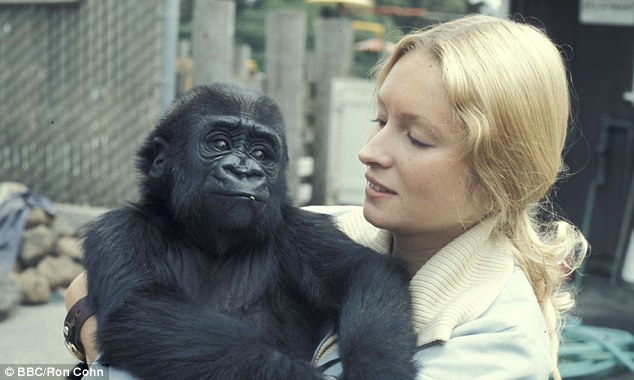
Graduate student Penny Paterson with a young Koko on her back not long after they met in 1971 in San Francisco. (The Daily Mail newspaper 2nd June, 2016.)
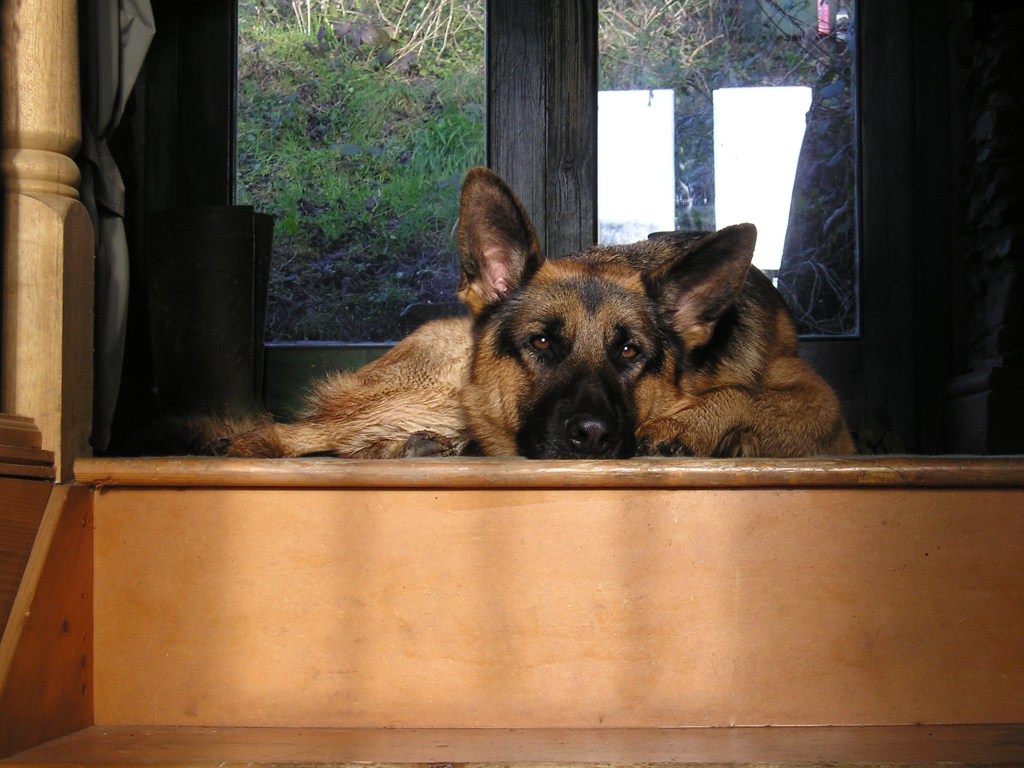
Here’s a photograph of Pharaoh taken on the 3rd December, 2005. Taken in my home in Harberton, Devon, some two years before I met Jeannie.
It’s not the world’s best photograph but I start today’s post with it simply because there is a look in Pharaoh’s eyes that spells out love to me in capital letters. Always has since the day I took that photograph.
Here’s an enlargement of the photo offering a closer look at Pharaoh’s expression in those eyes.
Right from the very first moment that I held Pharaoh I sensed the start of a loving bond. Did I choose to love Pharaoh? Well, of course I did! Was it a conscious decision? I don’t think so!
All of which is my introduction to a fascinating essay about the science of love that recently appeared on the Care2 site.
Love may often feel spontaneous and sometimes even out of control. But is it, really? Research is starting to show that you can change the intensity of love you feel towards others. Similar to emotions like fear or sadness, love can be influenced simply by how you think about a situation.
Is love under your control?
One study looked at altering love feelings in people who were either in a romantic relationship or had recently broken up from one. Each participant started by viewing pictures of their current lover or their ex-partner to bring up their current feelings towards them.
Then, researchers asked them to think about positive aspects of their partner, relationship or possible future scenarios. Their feelings towards their current or previous partners were assessed again.
The second part of the study asked participants to think of negative things about their partner, such as what’s wrong with them or their relationship.
Perhaps it’s not surprising that participants reported having greater love feelings after thinking positive thoughts. Whereas, they reported decreased lovingness after the negative thoughts. It was the same for everyone, whether they were in a relationship or had recently broken up.
Researchers felt this shows great potential for people to take more control of their emotional world, which could in turn benefit their lives and relationships.
Interestingly, thoughts also appeared to affect everyone’s overall mood and feelings about life in general. The positive thoughts improved people’s mood and disposition, whereas the negative thoughts brought everyone down.
This may highlight the importance of how positive and negative thoughts in general can affect our mental health.
How can you put this to use?
You can likely think of times in your own life when it would be helpful to either decrease or increase your love for another person.
Have you ever had an unwanted crush on someone? For instance, obsessing over a celebrity you’ll likely never meet can cause more frustration than joy in your life. Or maybe you’ve fallen for someone who’s not available, either physically or emotionally.
These are times when it’s in your best interest to end your attachment to the person and move on.
In addition, research has shown that thinking negatively about an ex-partner or your previous relationship helps you get over a break-up. The reverse is also true – if you think positively about an ex, it’s more difficult to heal and move on.
Keep this in mind if you’re going through a break-up, or need to reduce your feelings towards someone for another reason.
Try asking yourself questions like these:
What annoys me about this person?
Did we ever have a fight?
Why were we a bad match for each other?
What didn’t work in our relationship?
What could go wrong if we stayed together?
Reframing your thoughts is also a much healthier way to try to get over someone than taking self-destructive action to distract yourself, such as drinking too much.
On the other hand, the world always needs a lot more love to go around. Increasing your love towards others is often one of the best things you can do to help yourself and everyone in your life.
Unfortunately, the top reason married couples give for getting a divorce is growing apart and falling out of love. It’s true the intensity of love feelings usually fluctuates throughout a long-term relationship, but a decrease in feelings doesn’t have to mean the end.
If you’re starting to question whether or not you should stay in a long-standing relationship, take a closer look at your situation before making a final decision. Do you still respect and care for your partner? Do you still have lots in common? Is it possible you’re just in a temporary slump?
Questions like these may help to re-frame how you feel about your relationship:
What are some of your partner’s best qualities?
Why did you get together in the first place?
Are there things you’d like to do with your partner in the future?
What makes you a good match for each other?
Do you enjoy spending time with your partner?
Romantic partners who view each other in a positive light have been shown to actually have happier relationships. This is likely true for all relationships. Choosing more positive thoughts can go a long way towards creating greater harmony with all your loved ones.
Sharing your thoughts and telling others why you love them is even better.
ooOOoo
As my dearest Jeannie will confirm, I have never been the most comfortable person in terms of verbalising my love for her, despite Jean being the dream loving partnership of my life. Jean, on the other hand, expresses her love for me many times each day.
Maybe this essay offers an insight into the different ways we love?
For Jean also tells the dogs individually many times each day that she loves them. I feel the same but don’t say it anything like as often.
So is science showing us why the difference between Jean and me? I think so.
Yet another thing that we learn from dogs. Or more specifically that I have to learn from dogs!
Yesterday it was gliding, tomorrow it is going to be a celebration of Pharaoh’s 14th birthday and today it is about you!
Kadam Morten Clausen is a Buddhist teacher. Now I would be the first to stick up my arm and say that my understanding of Buddhism is pretty poor. But in the days many years back when I spent time exploring a number of Asian countries I found the culture surrounding Buddhism very appealing. (And I write as someone who is not a religious believer.)
Back to Morten Clausen.
The Kadampa Meditation Center in New York, where Kadam is a resident teacher, describe him as follows:
Kadam Morten met his teacher, Geshe Kelsang, while attending university in England. He taught widely throughout the UK and helped develop many Kadampa Centers in England. Kadam Morten has been teaching in the US for more than 20 years and has established centers throughout the New York area, as well as Washington DC, Virginia, and Puerto Rico. In addition to his local teaching responsibilities, he teaches and guides retreats regularly throughout the United States and Europe.
Kadam Morten is greatly admired as a meditation teacher and is especially known for his clarity, humor and inspirational presentation of Dharma. His teachings are always practical and easy to apply to everyday life. Through his gentle and joyful approach and his peaceful example, he has helped many people find true happiness in their hearts.
So what’s this all about when I say that today’s post is about you?
Evan Thompson of the University of British Columbia has verified the Buddhist belief of anatta, or not-self. Neuroscience has been interested in Buddhism since the late 1980s, when the Mind and Life Institute was created by HH Dalai Lama and a team of scientists. The science that came out of those first studies gave validation to what monks have known for years — if you train your mind, you can change your brain. As neuroscience has begun studying the mind, they have looked to those who have mastered the mind.
While Buddha didn’t teach anatta to lay people, thinking it might be too confusing, the concept is centered on the idea that there is no consistent self. The belief that we are the same one moment to the next, or one year to the next, is a delusion. Thompson says that “the brain and body is constantly in flux. There is nothing that corresponds to the sense that there’s an unchanging self.”
[W]hen there is no consistent self, it means that we don’t have to take everything so personally.
It is useful to look at a video of yourself from the past, or read something you wrote years ago. Your interests, perspective, beliefs, attachments, relationships, et al, have all changed in some way. Anatta doesn’t mean there’s no you; it just means that you are constantly changing, constantly evolving, and shape-shifting. Why is this important? Why does it matter if there’s no solid “you” or “me”?
Buddhist teacher Kadam Morten Clausen says Buddhism is a science of the mind:
Dr. Rick Hanson, author of Hardwiring Happiness and Buddha’s Brain, argues that when there is no consistent self, it means that we don’t have to take everything so personally. That is, our internal thoughts are only thoughts and don’t define us. External events are only external events and aren’t happening to us personally. Or as Tara Brach says, our thoughts are “real, but not true.”There is tremendous liberation in not identifying ourselves with thoughts, or a set idea of who we are.
It is then that we can grow and change, with the help of neuroplasticity. There is then hope that we can overcome our vices or bad habits (of mind and body), because if we aren’t stuck with the self-limiting beliefs inherent with a consistent self, we may orient ourselves toward becoming more of who we want to be.
The belief that we are the same one moment to the next, or one year to the next, is a delusion.
As science and Eastern thought continue to hang out with each other, there may be more 21st Century studies to back up 2,600-year-old thoughts. But, as HH Dalai Lama said, “Suppose that something is definitely proven through scientific investigation. … Suppose that that fact is incompatible with Buddhist theory. There is no doubt that we must accept the result of the scientific research.”Hearing a pro-science stance from a religious leader is a relief to many. In the end it seems Buddhism and neuroscience have similar goals: What is this thing we call the mind, and how can we use it to make ourselves a little less miserable and a little happier? Maybe even just 10 percent happier, as Dan Harris wrote. If there is no consistent self, it is at least my intention that my ever-changing self be equanimous and, well, 10 percent happier. No matter who I am.
—
Lori Chandler is a writer and comedian living in Brooklyn, NY, which is the most unoriginal sentence she has ever written. You can look at her silly drawings on Tumblr, Rad Drawings, or read her silly tweets @LilBoodleChild. Enough about her, she says: how are you?
PHOTO CREDIT: Chris McGrath/Getty Images
ooOOoo
So if there are times when you find yourself talking to yourself, perhaps the first thing to do is to ask if it is you! (Golly! I can feel a headache coming on!)
Sound UK produces extraordinary musical encounters for all
That sub-heading is the banner statement you will read if you go across to the Sound UK website. You may recall that I featured Sound UK in a post last June under the title of Sonic Journeys. I also presented the fact that my daughter is one of two directors of Sound UK. As in:
Sound UK is run by Directors Polly Eldridge and Maija Handover. We work alongside a crack team of freelancers and consultants across production, marketing, design, participation and fundraising. These include Tim Hand (production), Becky Morris Knight at Shipshape Marketing (digital marketing), Beth Fouracre (participation), John Gilsenan at IWant (design), Sarah Coop (fundraising) plus many more.
The reason I am featuring Sound UK again is because I wanted to share with you an exciting new project. I am republishing this from the Sound UK site.
ooOOoo
Tom Phillips – Irma: an opera
Sound UK is a music charity developing a major new project to mark the 80th birthday of one of Britain’s most treasured artists
We need your support to produce the first multimedia production of Royal Academy artist Tom Phillips’ Irma: an opera at South London Gallery this September.An exquisite miniature opera and audio visual installation, Irma is drawn from his masterpiece A Humument, which he recently completed after 50 years. This unique production celebrates Phillips’ extraordinary output in art and music.
Tom Phillips RA: Phillips has had major exhibitions in national galleries, painted figures such as John Gielgud and Iris Murdoch and created works for the Imperial War Museum, Westminster Abbey and Westminster Cathedral. His work can also be seen on the streets of Peckham where he has lived and worked for most of his life. You may even own one of his artworks; the Benjamin Britten 50p piece.
Tom Phillips in his Peckham studio
In the 1960s, Phillips was at the centre of the vibrant art school scene where music and art collided. He brought over key composers of that era to the UK – Morten Feldman, John Cage, performed with Cornelius Cardew – and even taught Brian Eno, who he introduced to ideas that had a great influence on Eno’s music. This landmark event recognises Phillips’ work as a composer and wider influence on the world of music.
Excerpt from Irma: an opera full score 2014
The Creative team: Sound UK is working with one of the UK’s most gifted opera designer / directors Netia Jones and her company Lightmap, with music director Anton Lukoszevieze and his leading ensemble Apartment House.
“Netia Jones is the most imaginative director of opera working in Britain today” The Observer
“One of the most innovative and exciting chamber ensembles in Europe” Royal Philharmonic Society on Apartment House
We need YOU to be part of Irma!
We have already raised the majority of our funding with the generous support of Arts Council England and Hinrichsen Foundation. We are also grateful for major in kind support from South London Gallery, where Phillips first showed his work as a student.
YOU can play a key role in Phillips’ new artwork. We need to raise £5,000 to help pay for rehearsals and the creation of the video for this extraordinary artwork.
To thank you for your invaluable support, we have put together a selection of unique rewards based on Irma characters – view by scrolling up on the right of this page – including an exclusive limited edition print created by Tom Phillips and mementos of his work.
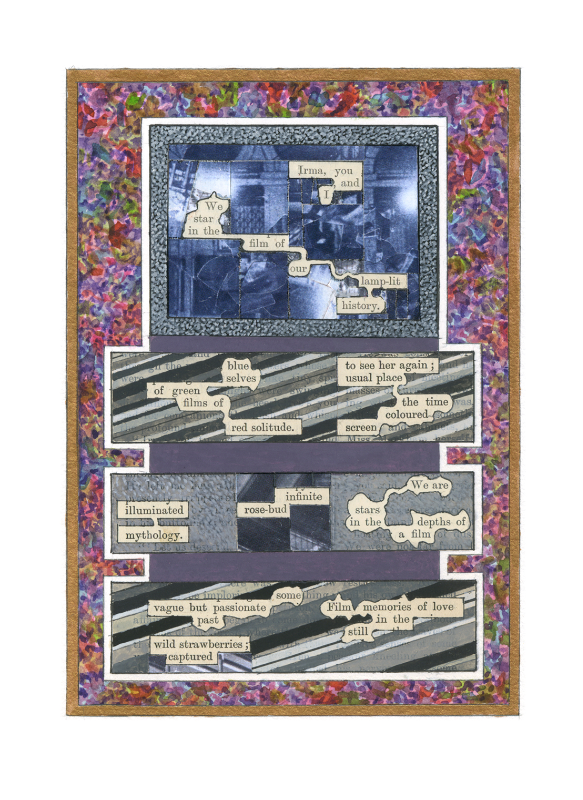
Image of Tom Phillips limited edition print – Irma: Our Lamplit History
Paper size h:28.4cm x w:21cm
Limited edition of 50
A unique print created by Tom Phillips in support of the world premiere full version of his opera Irma, at South London Gallery, September 2017, directed / designed by Netia Jones, musical direction Anton Lukoszevieze, performed by Apartment House with video by Lightmap.
Digital print with silkscreen 2017
All prints are sent signed and numbered by the artist.
The creators of “SKYGLOW,” a crowd-funded project showing the impact of urban light pollution through time-lapse videos, photos and a book, have another stunning video to share. In “Kaibab Elegy,” filmmakers Gavin Heffernan and Harun Mehmedinović visit Grand Canyon National Park and capture a rare weather event.
In the mesmerizing video, clouds build inside the canyon almost like bubbling water filling a jacuzzi as the sun rises and sets in the background, creating the pinkest sky you’ve ever seen. Those clouds roll like waves in the ocean and crash against the cliffs. This phenomenon is called full cloud inversion, and it happens when cold air is trapped in the canyon and topped by a layer of warm air, which combines with moisture and condensation.
“We were extremely lucky to be there to capture it, and it’s a collection of unique footage not found anywhere else,” Mehmedinović says.
He and Heffernan, who journeyed 150,000 miles around the globe for their new book and video series, work with the International Dark-Sky Association, a nonprofit fighting to preserve the dark skies around the world.
We all know how good are the noses of our dogs. Yet, I suspect, many do not know how truly good is that nose. The Science ABC site has a detailed account of Why Do Dogs Have Such A Great Sense of Smell?
Here’s part of that article:
Dog Nose vs. Human Nose
When we try to smell something, we inhale air with our nose and we use the same passage in our nose to exhale that air. Therefore, all the smell that we get when we are inhaling is lost when we exhale that air. However, a dog has two different air passages, one for breathing and another for smelling. This means that dogs are able to store the smell in their nose even while breathing out the air!
When dogs exhale, they send air out through the slits of their nose, but the manner in which this air is exhaled through their nose helps the dogs to draw in new odor molecules. This also helps dogs capture more smells when sniffing.
You must have noticed that dogs’ noses are always wet, but have you ever wondered why? The mucus on the dog’s nose helps it smell by capturing scent particles. A dog also has the ability to smell independently from each nostril, this helps the dog to understand from which direction the smell is coming.
The passage through which dogs smell the air contains highly specialized olfactory receptor cells, which are responsible for receiving smells. A dog contains about 225-300 million smell receptors, as compared to just 5 million of these receptors being present in a human nose.
Dog Brain vs. Human Brain
By now, we clearly know that dogs have a nose that can smell about 1,000-10,000 times better than a human, but how are dogs able to remember all the different smells that they have sensed throughout their life?
The answer lies in the difference between the brains of dogs and humans. A human brain has a larger visual cortex than dogs, whereas a dog’s brain has a much larger olfactory cortex than humans. The visual cortex is responsible for processing visual information, whereas the olfactory cortex is responsible for processing the sense of smell. A dog’s olfactory cortex is about 40 times larger than that of a human.
Working dogs are an amazing asset not only for people, but for wildlife, endangered species and even threatened habitats. Expanding on the skills dogs have for tracking down scents and guarding something important, we humans have enlisted their help in many ways for conservation.
Here are five ways dogs are contributing to environmental protection efforts.
Smell for scat
It’s amazing the amount of information that can be sussed out of an animal’s poop. We can determine diet, health, genetics — even whether or not an animal is pregnant. Scat is really important to biologists studying elusive, sensitive or endangered species. Putting dogs on the track is an ideal solution.
Take cheetahs, for example. Scientists in Africa are using dogs and their unparalleled sniffing power to find cheetah poop, all in an effort to get an accurate count on the endangered big cats. (Only 7,000 cheetahs are left in the African wild, according to estimates.) And it’s working. Two trained dogs found 27 scats in an area of 2,400 square kilometers in western Zambia, according to a study published in the Journal of Zoology. Humans, looking for cheetah tracks over the same area, found none.
Groups like Conservation Canines (a handler and dog from the program pictured above), Working Dogs for Conservation and Green Dogs Conservation specialize in this area. Conservation Canines rescues highly energetic, “last chance” dogs from shelters and trains them to track down the scat of dozens of species, from wolves to moose to owl. Even things that are nearly impossible for humans to find — the minuscule scat of endangered pocket mice or orca scat floating on the ocean surface — dogs can track down. They are able to make huge contributions to scientific studies, all without ever bothering the wildlife being studied.
Sniff out problems for wildlife
Whether it’s sniffing out invasive species like giant snails in the Galapagos or detecting disease in beehives, dogs’ noses can be put to work in searching out what shouldn’t be there so that humans can act.
Dogs are able to sniff out particular plant species, pointing ecologists to tiny patches of invasive mustard so that the plants can be removed before they take over an area.
Conversely, dogs can sniff out rare or endangered native plants so that the species can be protected. Rogue is one such dog. The Nature Conservancy writes, “The 4-year-old Belgian sheepdog is part of a Nature Conservancy collaborative project to test the efficacy of using dogs to sniff out the threatened Kincaid’s lupine. The plant is host to the endangered Fender’s blue butterfly, found only in Oregon’s Willamette Valley.”
Surveying for the plant species is difficult work for people. It can only be done when the plant is in bloom so people can visually identify it. However, dogs like Rogue can sniff out the plant even when not in bloom, which can potentially double the length of the field season.
“More refined regional mapping of Kincaid’s lupine could promote the butterfly’s recovery and delisting — and contribute to larger habitat goals and wildlife impacts.”
Track down poachers
The trade in rare or endangered wildlife is a lot tougher for traffickers thanks to wildlife detector dogs. Trained to smell anything from tiger parts to ivory to South American rosewood, dogs are used in shipping ports, airports, border crossings and other locations to sniff out smuggled products.
It doesn’t stop there. Trained dogs can lead rangers to armed poachers in the wild, tracking down the culprits over long hours through heat and rain. They can catch poachers in the act, rather than just the products.
“Canine sleuths aren’t limited to the plains of East Africa, either,” reports National Geographic. “In the Democratic Republic of the Congo, bloodhounds are assisting in the fight against poaching in forested Virunga National Park, where the world’s last remaining mountain gorillas live. In South Africa, Weimaraner and Malinois dogs are helping to find wounded animals and track poachers on foot through the reserves around Kruger National Park.”
Guard endangered species
Dogs are also useful in putting their protective nature to use for endangered species.
Livestock protection dogs are trained to keep predators like cheetahs, lions and leopards safe, which then reduces conflict between ranchers and big cats and minimizes the instances of snaring or retaliatory killing of big cats. Cheetah Conservation Fund has a successful livestock protection dog program, which places Anatolian shepherd and Kangal dogs with ranchers. That not only has significantly reduced the number of livestock killed by predators but is also improving the attitude of local people toward cheetahs.
Sometimes the dogs are put to work guarding the endangered species themselves. One such successful program uses Maremma shepherd dogs to protect colonies of little penguins from foxes.
Keep bears wild
Karelian bear dogs are trained to keep bears from becoming too comfortable around people. A program by Wind River Bear Institute named Partners-in-Life uses a technique called bear shepherding. This specialized breed of hunting dog is used to scare bears away, and are an important part of the “adverse conditioning” work that keeps bears from becoming habituated. The ultimate goal is to protect bears from becoming habituated, a problem that leads to their being relocated or euthanized.
“Our Wind River Bear Institute mission, with the effective training and use of Karelian Bear Dogs, is to reduce human-caused bear mortality and conflicts worldwide to ensure the continued survival of all species of bears for future generations,” states the program.
This list is only a handful of ways that dogs help us with environmental conservation every day. More and more, we are figuring out new ways to put their skills to work, and more and more the dogs are proving they’re ready for the task!
Editor’s note: This story was originally published in July 2016 and has been updated with more recent information.
ooOOoo
Closing words from that Science ABC piece:
A dog does not care how you look or dress, but if he gets good vibes from your smell, then a dog will love you. The world is truly a better place because of these wonderful creatures that we are lucky enough to welcome into our lives.
Why not make the world smell a bit more beautiful for them?
Belay that!
Closing picture taken from the OregonLive website. A stunning picture of the “Fender’s blue butterfly, found only in Oregon’s Willamette Valley.”
Yet despite it being so obvious it hadn’t crossed my mind before.
I’m referring to the wonderful idea of using those people, who through circumstance have found themselves homeless, to care for animals via an animal shelter.
Glenn Greenwald Unveils New Project to Build Animal Shelter in Brazil Staffed by Homeless People
Published on May 10, 2017
http://democracynow.org – Pulitzer Prize-winning journalist Glenn Greenwald unveils his plans to build an animal shelter in Brazil with his husband David Miranda, a city council member in Rio de Janeiro. The shelter will be staffed by homeless people who live on the streets with abandoned pets.
ooOOoo
If you, like me, needed to be reminded as to Mr. Greenwald’s background there’s plenty online.
Glenn Greenwald is one of three co-founding editors of The Intercept. He is a journalist, constitutional lawyer, and author of four New York Times best-selling books on politics and law. His most recent book, No Place to Hide, is about the U.S. surveillance state and his experiences reporting on the Snowden documents around the world. Prior to co-founding The Intercept, Glenn’s column was featured at The Guardian and Salon. He was the debut winner, along with Amy Goodman, of the Park Center I.F. Stone Award for Independent Journalism in 2008, and also received the 2010 Online Journalism Award for his investigative work on the abusive detention conditions of Chelsea Manning. For his 2013 NSA reporting, he received the George Polk award for National Security Reporting; the Gannett Foundation award for investigative journalism and the Gannett Foundation watchdog journalism award; the Esso Premio for Excellence in Investigative Reporting in Brazil (he was the first non-Brazilian to win), and the Electronic Frontier Foundation’s Pioneer Award. Along with Laura Poitras, Foreign Policy magazine named him one of the top 100 Global Thinkers for 2013. The NSA reporting he led for The Guardian was awarded the 2014 Pulitzer Prize for public service.
For all my life this has felt like a very special month.
And, dear friends, at the risk of repeating myself to many of you, this is why the month of May is special for me.
Simply that I was born in London during the closing months of the Second World War. Inevitably, I was unaware of the number of German bombs that were falling on London during those last few months. But there were thousands.
On May 8th. 1945, the day that WWII ended and six months to the day from when I was born, my mother looked down at me and said aloud to me: “You are going to live”. Despite the fact that I don’t recall my mother saying that, it was verified many times later when I was growing up.
Now here we are approaching May 8th. 2017 and in a very real sense it seems that we are in another war.
A war of consequence.
A war that we have been engaged in for many, many years.
A war where we are inadvertently fighting on a global battlefield.
A war where 99.99% of us don’t consciously identify the weapons we are using. Weapons that are incredibly effective. So much so that we are in sight of winning the last battle; winning the war.
Yet a war where winning is no win at all. Indeed, where winning this war, this global war, spells the end. The end of life for 99.99% of us humans (and much else besides).
Now what on earth has got me so fired up?
Two things have:
The first is that I am living in my 73rd year of life. I have no idea of when my life comes to an end. But that death is a guarantee. Indeed, if one takes note of the average life expectancy of a male today in the USA (75.6 years) , it may not be that far away.
The second thing is that before my death I truly want to know that humankind has laid down its weapons of war against our planet and that there really is an unstoppable mission, a united wave of passion, to live in peace on this planet. Perhaps better put to live in peace with this planet.
Or in the words of an organization that I now want to introduce:
A mission which will require the hard work and dedication of each and every one of us as we do everything in our power as individuals, but also as we galvanize businesses, entrepreneurs, innovators, city planners, communities, people and politicians—all those who share our purpose.
OK! Thank you if you are still reading this! (Someone give Fred in that soft arm-chair over there a nudge; I can hear his snores from here!)
In the last Smithsonian electronic newsletter that I was reading yesterday morning there was a reference to an organization that I hadn’t previously come across. Here is the link to that item on The Smithsonian website. I am republishing it in full in this place. As you read it you will understand why I am republishing it.
ooOOoo
Using a New Roadmap to Democratize Climate Change
A new tool aims to bypass governments and put the power of climate action in the people’s hands
Olafur Grimsson, who was president of Iceland from 1996 to 2016 and saw his country through the worst economic crisis in its history, making headlines all over the world as banks collapsed and the country fell into a depression, is the very picture of an urbane statesman. Collected and poised, with a striking full head of white hair, as comfortable in English as in his native Icelandic, he seems an unlikely revolutionary, not the sort of person you’d look at and immediately find yourself thinking: “Power to the People.”
But Grimsson is one of the primary architects of a quietly radical new idea whose aim is to facilitate action on climate change without any of the usual suspects—governments, countries, international bodies, negotiating parties.
He and several other veterans of the historic 2015 Paris Agreement on climate change were in Washington, D.C., last year, just before COP22, the climate meeting held in Marrakesh in 2016. They were pondering next steps when the conversation took a new and interesting turn, Grimsson says, addressing the question: “Was it possible to have the success of Paris without governments necessarily being in the leading role?”
The group included movers and shakers such as Peter Seligmann, the chairman of Conservation International; Laurene Powell Jobs, president of the philanthropic organization the Emerson Collective; and Andy Karsner, an assistant energy secretary during the administration of George W. Bush. Galvanized by their own query, they decided to try to answer it—to set about creating a new tool to aid in achieving the goals of the Paris accord.
At the Smithsonian’s Earth Optimism Summit, a gathering this past weekend of conservation-minded citizens, scientists and activists, Grimsson explained: “You get governments that are opposed or even hostile to climate action. We decided to bring together in Marrakesh a gathering of thinkers and scientists and innovators and policymakers from different countries in order to discuss a new model of securing the success of the future of the climate movement.”
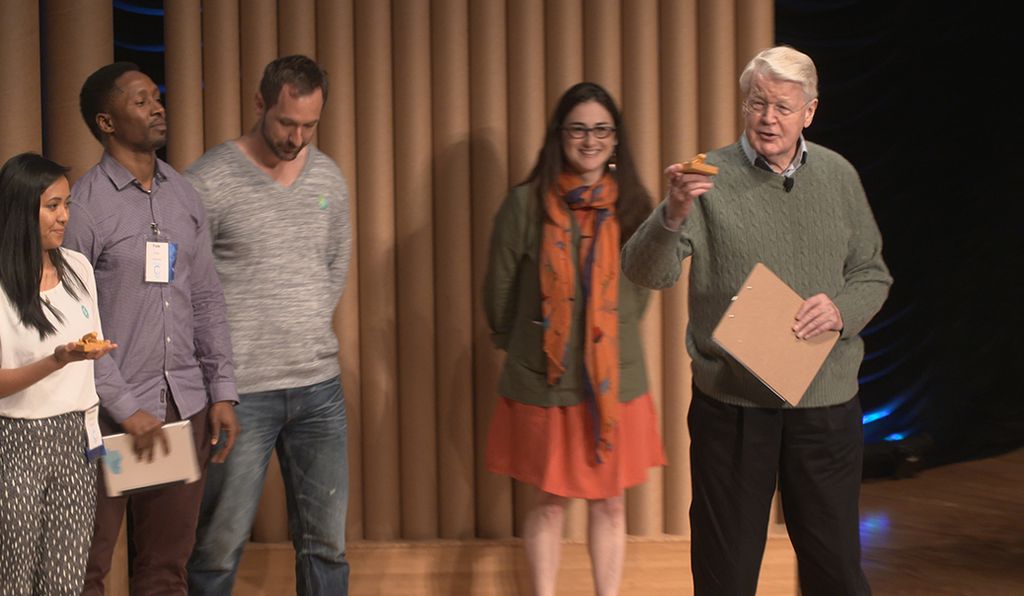
At the Smithsonian’s Earth Optimism Summit, the former president of Iceland Olafur Grimsson encouraged new solutions to climate change, awarding cash prizes to the winners of the “Make for the Planet” challenge. (The Roadmap)
Grimsson’s group felt that due to changes in information technology and social transformations, the large organizations and structures that used to be necessary to effect change were now not needed. And thus was born Roadmap, a new crowdsourcing tool for anyone and everyone interested in climate action. Still in its very early stages, Roadmap’s founders envision it as a platform for those working on climate issues—from scientist and policymaker to farmer and fisherman—to facilitate the sharing of knowledge and ideas, methods and techniques.
“A new political model is possible—where everyone can be a doer, where you no longer need big government or big enterprises to bring about success,” Grimsson says.
This new model for social change that skips the usual cumbersome channels and processes has been seen everywhere from public health, where the Bill & Melinda Gates Foundation has redefined the sector, to the hospitality industry, which is working to combat the human trafficking that plagues its businesses, to perhaps most famously the Arab Spring, where the role of social media in bringing about political change is still being debated today.
And this new model is complemented by technological changes. “The innovation in energy technology is such that we no longer have to wait for the big energy breakthrough,” Grimsson says. “We already have the available technologies. Every individual, home, village, community, town and region can execute change. The good news from the climate point of view is that, in addition to the information technology revolution, there has now also taken place an energy revolution. A house can be a power station: If the people who live in that house have extra energy, they can sell their energy through the smart grid. The notion that every house can be a power station is as revolutionary as saying that every mobile phone can be a media company.”
Grimsson admits that it may seem odd for someone in his position to be advocating that ordinary citizens take action apart from the conventional corridors of governmental power.
“For me to say that these traditional political organizations and positions are somewhat outdated is perhaps a strange statement: I was a professor of political science, I’ve been a member of parliament, I’ve been a minister of finance, I was president for 20 years,” he says.
It was during Iceland’s financial meltdown that he first experienced this new kind of social change: “I saw this very strongly through the financial crisis in my own country, which led to a big social economic uprising. All those activities were engineered by unknown people, people who were not part of a big organization, who used Facebook and the information media to bring thousands of people together in one day.”
Right now, Roadmap consists of a website and a lofty manifesto that speaks of raising the value of “moral currency” and creating a “best practices warehouse.” Visitors to the site can fill out a form if they want to become part of its community of “doers.” The practical part of the manifesto speaks of identifying the best methodologies and models; implementing a “real-time system of measurement” and a way to “gauge and understand what is working, what is not, and exactly what is being achieved.” As the platform develops, it will be interesting to see exactly what form these gauges, measurement systems, and warehouses take.
After the Paris Agreement, Grimsson says of himself and his Roadmap co-founders, “We were all optimistic, but we are all also realists.” It is his belief that if you “give people the tools, they can execute the transformation and the change—without governmental leadership.” Perhaps Roadmap will be one of those tools.
ooOOoo
Here’s a video that spells it out in ways that I find impossible to ignore. (And, yes, I signed up, as in joining, yesterday afternoon.)
Because in hundreds of years time I want others to look at the following picture of Troutbeck Valley in England and know how precious is this one and only planet we live on.
We are witnessing more storms, more unseasonal weather patterns, and I just hope that we wake up soon to the damage we are doing to our beloved Mother that has held us in her eternal arms for so long..
Photo credit: Getty Images
Enjoy the month of May wherever you are in the world!
Closing by repeating a key pronouncement in that RoadMap video above:



 taught widely throughout the UK and helped develop many Kadampa Centers in England. Kadam Morten has been teaching in the US for more than 20 years and has established centers throughout the New York area, as well as Washington DC, Virginia, and Puerto Rico. In addition to his local teaching responsibilities, he teaches and guides retreats regularly throughout the United States and Europe.








 Learning from Dogs