History repeating itself in terms of the commercial sailing ship.
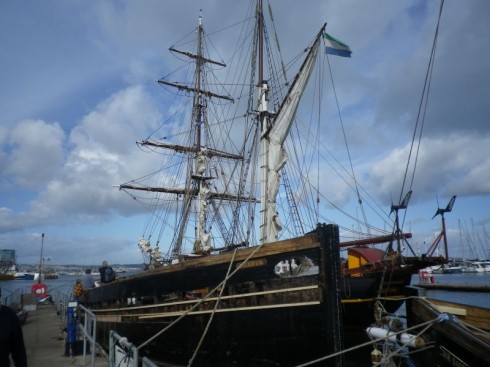
Tea clipper 'Cutty Sark'
Most Brits have heard of the tea clipper Cutty Sark. As the Cutty Sark website explains,
Cutty Sark has travelled across the world, sailing under both the Red Ensign and the Portuguese flag, visiting every major port in the world through the course of her working life. In admiration of her beauty and in recognition of her fame, she was preserved for the nation by Captain Wilfred Dowman in 1922.
Since then, the old clipper has been berthed in Falmouth and Greenhithe, finally arriving at her current resting place in Greenwich in 1954.
She is the only surviving extreme clipper, and the only tea clipper still in existence.
Most of her hull fabric survives from her original construction and she is the best example of a merchant composite construction vessel.
She has captured the imagination of millions of people, 15 million of whom have come on board to learn the stories she has to tell.
She was preserved in Greenwich partly as a memorial to the men of the merchant navy, particularly those who lost their lives in both world wars.
She is one of the great sights of London.
I mention the Cutty Sark because it seems a historic connection with something very relevant to today’s world that was the subject of a recent item on Rob Hopkin’s Transition Culture blogsite. In it Rob presents his first podcast, the topic being the sailing ship Tres Hombres, that is being used for commercial sea transport. The link to the Transition Culture story is here, and the podcast follows, (just click on the link to listen to the fascinating 14 minutes audio story about the ship Tres Hombres.)
The first Transition podcast! A visit to the Tres Hombres, tasting a revolution in shipping
Last week I did a course with the Media Trust on how to make podcasts (highly recommended). So, here, with some fanfare, is the first ‘Transition podcast’, I hope you like it. If so, do embed it in other places. It means I spent the time I would spend writing editing pieces of audio. Let me know what you think. So, the podcast is about a fascinating morning I spent visiting the sailing ship Tres Hombres which visited Brixham earlier this week. It explores the potential of sail-powered shipping as the price of oil rises and the economy tightens. It’s an exciting story.
Finally, let me close with a very well-known poem about sailing the big ships.
“Sea-Fever”
I must down to the seas again, to the lonely sea and the sky,
And all I ask is a tall ship and a star to steer her by,
And the wheel’s kick and the wind’s song and the white sail’s shaking,
And a grey mist on the sea’s face, and a grey dawn breaking.
I must down to the seas again, for the call of the running tide
Is a wild call and a clear call that may not be denied;
And all I ask is a windy day with the white clouds flying,
And the flung spray and the blown spume, and the sea-gulls crying.
I must down to the seas again, to the vagrant gypsy life,
To the gull’s way and the whale’s way where the wind’s like a whetted knife;
And all I ask is a merry yarn from a laughing fellow-rover
And quiet sleep and a sweet dream when the long trick’s over.
By John Masefield (1878-1967).
(English Poet Laureate, 1930-1967.)
Sometimes when I want to clear a space in my head I like to either listen to music or Draw… This week I had some spare time on my hands and so the Sketch pad and Pastels came out once again..
And here is the result.
I hope you enjoy the result of this German Shepherd Dog I drew in Pastels..
I wasn’t brought up with Dogs my family always had cats, But I just love German Shepherds, well all four legged Dogs and Cats and animals .. But I remember one German Shepherd which was rather special… her name was Xena who belonged to a dear friend..
Xena
She sent me this picture of her some years ago now.. Sadly Xena she is no longer with us…My earliest memory of a German Shepherd was when I was 6 or 7 years of age. I remember I had to walk past the Vicarage gates to the infant school in our village where this huge GS was usually safe behind… His bark I think was worse than his bite.. But to a young girl I was scared of him.. One day the gate was open and he bounded out as I went past, and he barked loudly at me..
My heart raced and I think I started to cry.. as I was on my own.. I remember a woman coming to my aid and saying he wouldn’t hurt me.. as she calmed me down..
The German Shepherd was ushered back behind the gate, But not before someone had let me stroke him and take away my fear.. Or I may have been afraid of dogs in the future..
Funny how when one’s mind is trying to empty itself.. It then becomes full of past memories.. That are triggered by something else..
Have a Great weekend all of you, and Sorry if I didn’t get around to visit all of you but your on my to do list.. Next week as I’m working this weekend..
I know that expression from my days as a private pilot. It makes such obvious sense, especially in a single-engined light aircraft with one pilot on board. It’s all about risk.
Frederick Herzberg, the famous American psychologist, coined the term ‘hygiene factor’. It was the second part of a two-factor approach to the management of people. According to Herzberg’s theory, people are influenced by two sets of factors, motivation factors and hygiene factors. More background on this aspect here.
To me, as I reflect on the messages offered in the Sceptical Voices article, Part One and Part Two, the concepts of risk and hygiene seem totally appropriate to the topic of AGW, Anthropogenic Global Warming.
Whether or not AGW is a valid theory behind the rapid change in global warming is utterly irrelevant. It is the risk to humanity that matters. There is absolutely no harm done from assuming that AGW is happening and that feedback processes run a grave risk of tipping planetary conditions out of control, and getting that wrong.
On the other hand, assume that AGW is such an uncertain concept that it really isn’t wise to adjust our life styles, and getting that wrong would endanger the human species.
Think of being on a commercial airline flight and you become aware that one of the two pilots in the cockpit is incapacitated through food poisoning. No doubt that you, with all your fellow passengers, would vote for an immediate diversionary landing. It’s to do with risk.
From the perspective of Herzberg, a co-ordinated program by the world’s leading governments to tackle AGW might also improve the overall motivation of their peoples in a whole manner of ways.
Yes, question all we want, yes, there are other important issues to resolve in the world, but WHAT IF “Climate Change/Global Warming“ is for real, what then?
Dan wrote also in that Part One piece,
And by “peel-back-the-onion”, I mean that any ardent, independent researcher should publish both sides of the story as a matter of course. Especially in regards to global warming.
But publishing both sides of the story is not the argument. The argument is the risk to humanity of doing nothing, and getting it wrong.
That well-respected weekly newspaper The Economist had a recent article about the melting of Arctic ice, from which is quoted,
Arctic sea ice is melting far faster than climate models predict. Why?
Sep 24th 2011 - from the print edition
ON SEPTEMBER 9th, at the height of its summertime shrinkage, ice covered 4.33m square km, or 1.67m square miles, of the Arctic Ocean, according to America’s National Snow and Ice Data Centre (NSIDC). That is not a record low—not quite. But the actual record, 4.17m square km in 2007, was the product of an unusual combination of sunny days, cloudless skies and warm currents flowing up from mid-latitudes. This year has seen no such opposite of a perfect storm, yet the summer sea-ice minimum is a mere 4% bigger than that record. Add in the fact that the thickness of the ice, which is much harder to measure, is estimated to have fallen by half since 1979, when satellite records began, and there is probably less ice floating on the Arctic Ocean now than at any time since a particularly warm period 8,000 years ago, soon after the last ice age.
That Arctic sea ice is disappearing has been known for decades. The underlying cause is believed by all but a handful of climatologists to be global warming brought about by greenhouse-gas emissions. Yet the rate the ice is vanishing confounds these climatologists’ models. These predict that if the level of carbon dioxide, methane and so on in the atmosphere continues to rise, then the Arctic Ocean will be free of floating summer ice by the end of the century. At current rates of shrinkage, by contrast, this looks likely to happen some time between 2020 and 2050.
Re-read the sentence, “The underlying cause is believed by all but a handful of climatologists to be global warming brought about by greenhouse-gas emissions.” In particular, “by all but a handful of climatologists” Think of risk.
That article, which should be read in full, concludes thus,
A warming Arctic will bring local benefits to some. The rest of the world may pay the cost.
Indeed, the rest of the world may pay the cost! As I wrote, it’s all about risk.
So whether or not one wants to believe every word of that Economist article is irrelevant. Or whether one should have believed, or not, the article in New York’s The Sun newspaper back in 2007,
By SETH BORENSTEIN, Associated Press | December 12, 2007
WASHINGTON — An already relentless melting of the Arctic greatly accelerated this summer, a warning sign that some scientists worry could mean global warming has passed an ominous tipping point. One even speculated that summer sea ice would be gone in five years.
Greenland’s ice sheet melted nearly 19 billion tons more than the previous high mark, and the volume of Arctic sea ice at summer’s end was half what it was just four years earlier, according to new NASA satellite data obtained by the Associated Press.
“The Arctic is screaming,” a senior scientist at the government’s snow and ice data center in Boulder, Colo., Mark Serreze, said.
Last year, two scientists surprised their colleagues by projecting that the Arctic sea ice was melting so fast that it could disappear entirely by the summer of 2040. This week, after reviewing his own new data, a NASA climate scientist, Jay Zwally, said: “At this rate, the Arctic Ocean could be nearly ice-free at the end of summer by 2012, much faster than previous predictions.”
So scientists in recent days have been asking themselves these questions: Was the record melt seen all over the Arctic in 2007 a blip amid relentless and steady warming? Or has everything sped up to a new climate cycle that goes beyond the worst case scenarios presented by computer models? “The Arctic is often cited as the canary in the coal mine for climate warming,” Mr. Zwally, who as a teenager hauled coal, said. “Now as a sign of climate warming, the canary has died. It is time to start getting out of the coal mines.” [My emphasis, PH]
So, in conclusion, scepticism is healthy and is an important aspect of open debate within an open society, part of determining truth, however challenging that simple concept might be.
But eventually one needs to take a position, to take a stand on the really important issues in life and in the case of climate change the risk of being too sceptical, too cautious is to put the lives of future generations at stake. For me, and I guess for tens of thousands of others, that is a risk too far.
Why should such an obvious concept, that of truth, be so very difficult to define?
Who in the world whose native tongue is English isn’t familiar with the words of the oath, “I swear to tell the truth, the whole truth and nothing but the truth,” often with the phrase, “so help me God.” It is the fundamental foundation of a working justice system. Probably the most famous of oaths is the American Presidential oath upon taking up office, “I do solemnly swear (or affirm) that I will faithfully execute the Office of President of the United States, and will to the best of my Ability, preserve, protect and defend the Constitution of the United States.”
Then just the other day I was exploring the blog Lack of Environment written by Martin Lack who made himself known to Learning from Dogs from a comment to the post Sceptical voices, part two, published on the 23rd. Martin’s blog carried an article about scientific scepticism (outcome being very little) in global warming being caused by man. There was reference to the book Climate Cover-Up written by James Hoggan and an extract from that book on the Desmogblog website, as follows,
Democracy is utterly dependent upon an electorate that is accurately informed. In promoting climate change denial (and often denying their responsibility for doing so) industry has done more than endanger the environment. It has undermined democracy. There is a vast difference between putting forth a point of view, honestly held, and intentionally sowing the seeds of confusion. Free speech does not include the right to deceive. Deception is not a point of view. And the right to disagree does not include a right to intentionally subvert the public awareness.
The sentence highlighted by me is fundamental to this essay. Perhaps the crux of why it feels so difficult to determine the truth is that the vast 24-hour output of news and information, the 24-hour fear machine as John H. calls it, carries no means of distinguishing the reliability of the source, no details of any affiliations that the person offering the information to that particular media outlet may have, and so on and so on. I wrote a piece on the 12th July called What Exactly is the Truth where I concluded that,
Despite my chest-beating on the subject of politicians and leaders deliberately lying in that recent piece about Juncker, there’s something much more fundamental. What defines lying is really not that important. It’s whether or not we trust that our leaders are doing their best for their constituents, to the best of their abilities.
Whether you support left-leaning or right-leaning policies is unimportant; indeed political differences and the ability to vote for one’s beliefs is at the heart of an open democracy.
But if we don’t trust that our leaders are doing their best for our country then that causes the destruction of faith. If we do not have faith in those that lead us then the breakdown of a civilised social order becomes a very real risk.
So examining the essence of the word ‘truth’ creates a conflict, well it does in my mind. A conflict between the idea that truth is a very simple concept and that peeling back the meaning of the word truth reveals many, many layers. Let me quote from the Stanford Encyclopaedia of Philosophy,
Truth is one of the central subjects in philosophy. It is also one of the largest. Truth has been a topic of discussion in its own right for thousands of years. Moreover, a huge variety of issues in philosophy relate to truth, either by relying on theses about truth, or implying theses about truth.
It would be impossible to survey all there is to say about truth in any coherent way. Instead, this essay will concentrate on the main themes in the study of truth in the contemporary philosophical literature. It will attempt to survey the key problems and theories of current interest, and show how they relate to one-another. A number of other entries investigate many of these topics in greater depth. Generally, discussion of the principal arguments is left to them. The goal of this essay is only to provide an overview of the current theories.
The problem of truth is in a way easy to state: what truths are, and what (if anything) makes them true. But this simple statement masks a great deal of controversy. Whether there is a metaphysical problem of truth at all, and if there is, what kind of theory might address it, are all standing issues in the theory of truth. We will see a number of distinct ways of answering these questions.
“Truth has been a topic of discussion in its own right for thousands of years.” So I’m not the first and certainly won’t be the last to ponder on how one gets to know the truth.
Do I have any answers? None! Except, perhaps, to muse that if truth can be so difficult to pin down then adopting a rigid stance based on assumptions of truth will carry risk. And, of course, to reflect that dogs don’t lie.
I’ll close with the quote from Oscar Wilde, “Truth is rarely pure and never simple.” Quite so.
Sustainable is an overused word these days. All for the right reasons, of course! But how often is the word used in the context of relationships? Of the relationships between the domesticated dog and man? I suspect rarely.
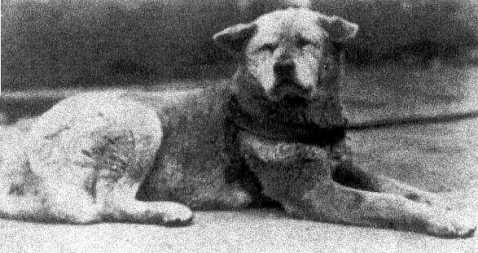
Take the example of the Japanese Akita dog called Hachi, (Hachikō in Japanese) that I wrote about almost a year ago.
In 1924, Hidesaburō Ueno, a professor in the agriculture department at theUniversity of Tokyo took in Hachikō as a pet. During his owner’s life Hachikō saw him out from the front door and greeted him at the end of the day at the nearby Shibuya Station. The pair continued their daily routine until May 1925, when Professor Ueno did not return on the usual train one evening. The professor had suffered from a cerebral hemorrhage at the university that day. He died and never returned to the train station where his friend was waiting. Hachikō was loyal and every day for the next nine years he waited sitting there amongst the town’s folk.
Hachikō 1925
“…. every day for the next nine years he waited sitting there amongst the town’s folk” Truly a sustainable relationship.
Now to something closer to home; literally.
The Payson Roundup is our local newspaper. Last Tuesday’s edition had the following story which Tom Brossart, Editor, has kindly given me written permission to reproduce here on Learning from Dogs. Thank you, Tom.
Best friends help save man’s life
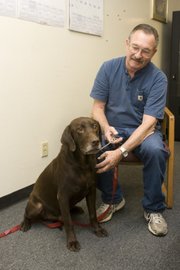
Both Logger and Harold Green are a little gray around the muzzle, but they have lots of good days ahead after Logger helped save Green’s life back on July 1.Photo by Andy Towle
Logger is Harold Green’s best friend. Logger isn’t a flannel-wearing, tattooed burly woodsman; he is a sweet-tempered chocolate Labrador retriever. And this best friend saved Green’s life.
Green makes his home up in Happy Jack. Recently he and Logger drove into the woods and went for a walk, and then Green had a heart attack. He didn’t have a history of heart disease, but all of a sudden his chest became tight. He collapsed and on his way to the ground, he hit a fallen log and wound up hitting his forehead and nose, tearing his bottom lip away from his gums, cutting his chin and breaking a rib.
“Right before I had the heart attack I had a page there was a fire, and that’s the last thing I remember,” he said. Green is an emergency medical technician with the Blue Ridge Fire Department.
He said the next thing he remembers was waking up and trying to call 911. “There was so much blood in my eyes I couldn’t see at first, but Logger licked the blood away.”
Green was conscious long enough to dial 911 and try to explain where he was. He heard the sirens go past him and with that information; the emergency responders had a place to start looking for him.
At that point, Logger left Green’s side to go to the rescue personnel.
“From what they told me, he was like Lassie. He came running to them, barking, and started running back to me, stopped and made sure they were following,” Green said.
The first person on the scene with him was a law enforcement officer with the Forest Service. Green said he told him his nose was bleeding so much he thought it was broken.
Next to arrive was a deputy sheriff. Green said he later learned the guy was off duty, but came to help anyway.
The Blue Ridge ambulance crew arrived next.
“Logger did the same with all of them as he had with the first one on the scene. They told me, without Logger’s help they would have had to search for me a lot longer.”
Green said when they first reached him his heart rate was in the mid-40s and he had no blood pressure. The rescue team stabilized him and carried him out to the ambulance to take him to the fire station where a helicopter could land.
“They said Logger tried to get into the ambulance with me,” Green said.
He said he has little or no memory of everything that took place, when he woke up he was in the hospital in Flagstaff.
Logger couldn’t ride in the ambulance with Green and couldn’t come see him in the hospital, but since he has been out, the dog has not been more than three feet from him for three weeks.
“It is really humbling to have so many friends there to help you out,” Green said.
The people who came to his rescue were all friends and, just like Logger, they did what best friends do, except it was something they do every day, for friends and strangers alike.
Logger has been part of Green’s family for seven years, joining it when he was just a puppy.
Green is the son of longtime Rim Country Realtor Bea Baxter, who has been in the community for around 40 years.
So dear, lovely Logger also demonstrated the same, deep sustainability of relationship that Hachikō did back in 1925. There is so much that we can learn from dogs. Think about sustainability, as it relates to the relationship between dogs and man. It goes back at least 30,000 years. It’s an unimaginable length of time.
In this context, sustainability is an underused word!
“Everyone thinks of changing the world, but no one thinks of changing himself.” Leo Tolstoy
I am going to refer to some ideas before explaining from whom they came, and when.
Try this: the term “future shock” is defined as a certain psychological state of individuals and entire societies. The shortest definition for the term is a personal perception of “too much change in too short a period of time”.
Or try this: society is undergoing an enormous structural change, a revolution from an industrial society to a “super-industrial society”. This change will overwhelm people, the accelerated rate of technological and social change leaving them disconnected and suffering from “shattering stress and disorientation” – future shocked. It was stated that the majority of social problems were symptoms of the future shock.
Stay with me a little longer as I pose a few questions. How do you feel at the moment? Slightly unsure of where the world is going right now? Feeling a little unsettled?
Why those questions? With the Dow Jones index heading down through 11,130 (at the time of writing on the 8th) and ‘chaos across markets’ headlines all over the place these are very unsettling times
Last week’s edition of The Economist had five pages about the present uncertain times in the USA.
The numbers keep being revised inexorably downwards
The rough news did not end there. The Bureau of Economic Analysis (BEA) revised its numbers back through the recession, revealing a downturn more serious than previously understood. The BEA’s first estimate of output in the fourth quarter of 2008, published in January of 2009, showed a contraction of 3.8%, later revised to a 6.8% drop. The new numbers change the figure yet again, to a shocking 8.9% fall in GDP. For 2009 as a whole, the American economy shrank by 3.5% rather than the previously reported 2.6%. American output has yet to reattain its 2007 peak. On a per-person basis, inflation-adjusted GDP stands at virtually the same level as in the second quarter of 2005. America is six years into a lost decade. [my emphasis]
So back to those comments about ‘future shock’. They come from a gentleman known across the world for his writings as a futurist, Alvin Toffler. His website is here and there is a good review of the man and his works on Wikipedia.
Alvin Toffler, born 1928
Toffler’s book, Future Shock, from 1970 was prescient in forecasting …. well here’s how it is written on Wikipedia,
Toffler argues that society is undergoing an enormous structural change, a revolution from an industrial society to a “super-industrial society“. This change will overwhelm people, the accelerated rate of technological and social change leaving them disconnected and suffering from “shattering stress and disorientation” – future shocked. Toffler stated that the majority of social problems were symptoms of the future shock. In his discussion of the components of such shock, he also popularized the term “information overload.”
But there’s an aspect that wasn’t even on the horizon when Toffler was writing that book in the late 60s – the end of growth. That is creating a whole new level of change and ‘information overload’, in my opinion.
Just a few days ago, I reviewed the Paul Gilding book The Great Disruption. I quoted this extract from the very start of the book,
This means things are going to change. Not because we will choose change out of philosophical or political preference, but because if we don’t transform our society and economy, we risk social and economic collapse and the descent into chaos. The science on this is now clear and accepted by any rational observer. While an initial look at the public debate may suggest controversy, any serious examination of the peer-reviewed conclusions of leading science bodies shows the core direction we are heading in is now clear. Things do not look good.
These challenges and the facts behind them are well-known by experts and leaders around the world, and have been for decades. But despite this understanding, that we would at some point pass the limits to growth, it has been continually filed away to the back of our mind and the back of our drawers, with the label “Interesting – For Consideration Later” prominently attached. Well, later has arrived.
Indeed, ‘later’ has arrived. The ‘future’ is now here!
Watch the first 10 minutes of the Future Shock film made back in 1972 and ponder.
The following four parts are easily found on YouTube.
God grant me the serenity to accept the things I cannot change, the courage to change the things I can, and the wisdom to know the difference. Reinhold Niebuhr
A passing visit to the American biologist, E. O. Wilson
E O Wilson
Edward Osborne Wilson was born in June 1929 thus making him, at this time of writing, just into his 82 year. His biological specialty is myrmecology. Got that? Myrmecology. And if you, like me, didn’t have a clue as to what myrmecology is and had to look it up, it is the study of ants. Blow me down, there is even a myrmecology blogsite!
So where is this all heading?
One of the things that we do know about dogs, especially if we go way back into the dim and distant times when they behaved more like the grey wolf, from which the species ‘dog’ genetically originates 100,000 years ago, is that their social order, their pack behaviour, was highly stable. As an aside, when Jean was rescuing dogs in San Carlos, Mexico during the years that she lived there with her late husband she readily observed that the stray dogs, of which there were too many, had a natural propensity to group up into their historic pack formations. (And as an aside to my aside, Jean’s close friend of many years, Dan’s sister Suzann, today carries on the splendid work of looking after stray dogs from her San Carlos house!)
OK, back to the plot!
E O Wilson’s study of ants has revealed much about social order and organisation. The following YouTube video was from a PBS programme, aired in May, 2008, from which I quote (that is the PBS website),
Program Description
At age 78, E.O. Wilson is still going through his “little savage” phase of boyhood exploration of the natural world. In “Lord of the Ants,” NOVA profiles this soft-spoken Southerner and Harvard professor, who is an acclaimed advocate for ants, biological diversity, and the controversial extension of Darwinian ideas to human society.
Actor and environmentalist Harrison Ford narrates this engaging portrait of a ceaselessly active scientist and eloquent writer, who has accumulated two Pulitzer Prizes among his many other honors. Says fellow naturalist David Attenborough: “He will go down as the man who opened the eyes of millions ’round the world to the glories, the values, the importance of—to use his term—biodiversity.”
It’s a fascinating film, truly engaging, so do settle down for a relaxing 53 minutes and watch,
Now there’s more to this and I do want to continue with the theme of this Post tomorrow.
So for now, look in on the E O Wilson Biodiversity Foundation’s website and I’ll see you tomorrow.
Dogs have that wonderful ability to savour the moment and just enjoy the present. Seems to me that there is just a bit too much going on at the moment in the big wide world and we could do a lot worse than take a chair out into the garden, or wherever, and enjoy the majesty of one of the light shows that the universe can put on.
But first an acknowledgement to Mike Shedlock, more details here. I subscribe to his daily newsletter and it was there that, rather uncharacteristically for an economic blog, I saw the reference to the Perseids meteor shower which, annually, provides vivid viewing for us earth-bound creatures this time of the year.
A celestial traffic jam may be on tap this week as two meteor showers combine forces to put on a brilliant sky show.
One of the best shooting star events of the year is the annual August Perseid meteor shower. (See Perseids pictures.) However this year’s peak, on August 12, happens to coincide with a bright full moon—drastically cutting down the number of meteors visible to the naked eye.
Yet while the main event might be blocked out by the blinding moonlight, the opening act promises to be much better.
This year the lesser known Delta Aquarid meteor shower is expected to peak on Friday night, when the Delta Aquarids’ more productive Perseid cousin is just starting to ramp up.
Together the showers will produce anywhere between 15 and 30 shooting stars per hour under clear, dark skies.
If this tickles your fancy then go to that article and read how best to view this wonderful sky show.
We haven’t seen them from this part of the world (i.e. Payson, Arizona), but down in South-West England it was easy to get up onto the moors (Dartmoor). Sunset at this time of the year down in Devon is around 7pm local time and by 8pm there was often a beautiful cloudless night sky.
Wikipedia has some good background information on the Perseid meteor shower including, what I didn’t realise, that,
The Perseid meteor shower has been observed for about 2000 years, with the earliest information on this meteor shower coming from the Far East. Some Catholics refer to the Perseids as the “tears of St. Lawrence“, since 10 August is the date of that saint’s martyrdom.
I think most people are aware, again from Wikipedia, that,
The shower is visible from mid-July each year, with the peak in activity being between August 9 and 14, depending on the particular location of the stream. During the peak, the rate of meteors reaches 60 or more per hour. They can be seen all across the sky, but because of the path of Swift-Tuttle’s orbit, Perseids are primarily visible in the northern hemisphere. As with all meteor showers, the rate is greatest in the pre-dawn hours, since the side of the Earth nearest to turning into the sun scoops up more meteors as the Earth moves through space.
But to come back to the National Geographic piece, as above, this year could be better than normal. As I wrote,
This year the lesser known Delta Aquarid meteor shower is expected to peak on Friday night, when the Delta Aquarids’ more productive Perseid cousin is just starting to ramp up.
Together the showers will produce anywhere between 15 and 30 shooting stars per hour under clear, dark skies.
So I know it could be a tough choice – politics or standing in awe under a night sky – but, go on, force yourself!
Unlike my recent review of Capt. Luis Montalvan’s book Until Tuesday which came about as a result of an invitation from the UK publishers, Headline Publishing, this review of Mr. Gilding’s book is totally off my own bat. I should also declare that I have recently been in email contact with Paul Gilding with some pleasant outcomes. To the review.
The way ahead.
Regular readers of Learning from Dogs will know that I have been making recent references to this book, which I have now finished reading. On the 25th I quoted from the book in a post that I called The blame game. I used a quote from Chapter 5, Addicted to Growth, namely “Growth goes to the core of the society we have built because it is the result of who we are and what we have decided to value.”
Then the next day again when writing about Tim Bennett’s movie, What a Way To Go, when I reflected on Paul Gilding’s opinion that, ” the quicker that mankind recognises the massive levels of denial presently in place, the quicker that mankind will commit to the scale of change that is required“.
Now if mankind’s efforts to change to a sustainable way of life were proportional to the number of books, films and essays written about the subject then, frankly, the task would be complete. There’s an awful lot out there! Here’s a list of the books that I have read in the last few years:
The Human Side of Enterprise – Douglas McGregor
Motivation and Personality – Abraham Maslow
The Power of Pause – Terry Hershey
Earth in the Balance – Al Gore
The Spectrum of Consciousness – Ken Wilber
Politics Lost – Joe Klein
Why America Doesn’t Work – Chuck Colson & Jack Eckerd
The Art of Happiness – HH Dalai Lama & Howard C Cutler
Eaarth – Bill McKibben
Stabilizing an Unstable Economy – Hyman P. Minsky
The Next 100 Years – George Friedman
World of the Edge – Lester Brown
and finally
The Great Disruption – Paul Gilding
And, of course, this doesn’t even scratch the number of online journals, essays and articles that have been read in conjunction with writing hundreds of posts on this Blog.
So what’s the point?
On p.260, Chapter 20 Guess Who’s in Charge?, Paul Gilding writes,
We need to fully acknowledge the challenging times and inevitable suffering ahead but stay focused and determined to move forward and past this. Easy to say, harder to do.
So yes, it is challenging to know how to respond to all this and what to do personally. It is easy to see what the world should do, but what should you do?
but what should you do? Talk about a thump on the back of the head!
This is about me!
Of all the books that have influenced how I see the world and my opinions, the one book that has rammed home to me that this is about me, about my attitudes and behaviours, is The Great Disruption. For a long time I haven’t needed convincing that man is screwing up the planet. For ages, I’ve been sure that our greed and materialism were fundamentally incompatible with the planet. I have been so good at ‘talking the talk’ ….. but ….
But the way that Mr. Gilding has so comprehensively approached every aspect of how my past behaviours have been incompatible with the future needs of my little grandson, Morten, (and all the grandchildren in the world) is powerfully inspiring. I now totally and utterly believe that only I am in charge of making a difference.
Why The Great Disruption touched me in this way when so many other books and articles haven’t done so isn’t clear. Perhaps it was in the opening paragraphs?
The earth is full.
[skip one paragraph]
This means things are going to change. Not because we will choose change out of philosophical or political preference, but because if we don’t transform our society and economy, we risk social and economic collapse and the descent into chaos. The science on this is now clear and accepted by any rational observer. While an initial look at the public debate may suggest controversy, any serious examination of the peer-reviewed conclusions of leading science bodies shows the core direction we are heading in is now clear. Things do not look good.
These challenges and the facts behind them are well-known by experts and leaders around the world, and have been for decades. But despite this understanding, that we would at some point pass the limits to growth, it has been continually filed away to the back of our mind and the back of our drawers, with the label “Interesting – For Consideration Later” prominently attached. Well, later has arrived.
I nodded silently in agreement when reading that.
Was it the opening paragraph to Chapter 4, Beyond the Limits – The Great Disruption?
The plans we have been making for our economies, our companies, and our lives have all been based on a key assumption that is clearly wrong. This assumption is that our current economic model will carry on unless we choose to change it – in other words, no action means more of the same.
This resonated strongly with me because I happen to believe, without any specialist economic skills to my name – just a gut sense, that the economic situation now afflicting so many economies across the world is not cyclical but the start of a breakdown of the policies and behaviours of the last 20 years or more. In other words, the Great Disruption was in my face already! As is written on p. 87 in Chapter 6, Global Foreshock – The Year That Growth Stopped,
My view, firmly held at the time and since, is that 2008 was the year that growth stopped. It was the year, as Thomas Friedman said, “when Mother Nature and Father Greed hit the wall at once”.
The Power of a New Future
But, in the end, the real power that I found in this book was the strength of Gilding’s argument that we will change, that seeing the future as hopeless is wrong, that man has the ability to commit to huge change when there is no alternative. Ergo, p121 Chapter 9 When the Dam of Denial Breaks,
To argue we are naturally greedy and competitive and can’t change is like arguing that we engage naturally in murder and infanticide as our forebears the chimps do and therefore as we did. We have certain tendencies in our genes, but unlike other creatures we have the proven capacity to make conscious decisions to overcome them and also the proven ability to build a society with laws and values to enshrine and, critically, to enforce such changes when these tendencies come to the surface.
So don’t underestimate how profoundly we can change. We are still capable of evolution, including conscious evolution. This coming crisis is perhaps the greatest opportunity in millennia for a step change in human society.
This quote is towards the end of the last chapter that spells out, as so many other books have done, that our global society Has a Very Big Problem. Thus from page 123 onwards, slightly less than half-way through the book, Paul Gilding devotes huge detail to describing how we will change. Frequently, the comparison used is World War II,
British poster from 1940
When Great Britain went to war in World War II, do you think they had clarity on all the details of transitioning into a war economy before they made the decision to act? Of course they considered it, as we must, but it wasn’t a determining issue because there was no choice. Do you think President Roosevelt calculated the United States could win the war by increasing military spending to 37 percent of U.S. GDP and producing a nuclear bomb before he decided to enter the war? Of course not: he just knew they had to succeed and so they would. He had confidence in human ingenuity delivering under pressure, when it’s given defined parameters and political support, and so must we.
From p. 164, Chapter 12 Creative Destruction on Steroids.
That’s what ended up being the real inspiration for me. That it’s not about the complex problems looming large; as so many that Jean and I chat to here in Payson, AZ, readily admit to being worried. It’s not news! The majority of the world’s citizens know the trends are not good.
No, what really socked me between the eyes was reading all the many and varied ways that we are changing (note present tense), that the Great Disruption is, in fact, mankind moving to a new era. One where we will have less inequality, less poverty, be happier, have extended life-spans and a future that goes on for thousand of years.
The Future is Here.
The phrase ‘life-changing’ is often used but this book is truly life-changing. The book will motivate you in ways that you can’t imagine. It will inspire you but, above all, it will show you the way ahead. Read it.