William Rees discussing the disconnect between economics and ecology.
Yesterday, I wrote about Paul Gilding’s book The Great Disruption. In a sense today’s article continues the theme; the idea that the future is going to be very different to the past, indeed has to be if mankind is to have a viable future.
Dr. Bill Rees
Dr. William Rees is Professor at the University of British Columbia’s School of Community and Regional Planning. More details of Dr. Rees here.
The world economy is depleting the earth’s natural resources, and economists cling to models that make no reference whatsoever to the biophysical basis that underpins the economy. That’s why ecological economics is needed, says William Rees in this INET interview.
Standard economics portrays the economy as a circular flow: households pay money to firms in exchange for goods and services, and firms pay wages to households in exchange for labor. Textbooks describe this circular flow as self-perpetuating, capable of infinite expansion. William Rees argues that the textbooks get it wrong; he says the production of our goods and services depends on the extraction of material from ecosystems, causing resource depletion on the one hand, and excess pollution on the other.
William Rees, best known in ecological economics as the originator and co-developer of ‘ecological footprint analysis’, says the United States is using four or five times its fair share of the world’s total bio-capacity. In order to bring just the present world population up to the material standards enjoyed by North Americans, we would need the biophysical equivalent of about three additional planet earths.
There has been no time in history where income growth hasn’t been accompanied by increased material and energy consumption, Rees cautions. He says technologies exist that would enable us to enjoy our current lifestyles with perhaps as little as 20 percent of our current energy and material consumption, but we do not have the incentives in place to force that decoupling to take place.
Rees is as pessimistic on current culture and politics as he is optimistic on the technology. The global culture remains in denial, and people with vested interests in the status quo wield enormous power.
Want more from Dr. Rees? Over at the website West Coast Climate Equity is an eight-part series where Dr. Rees sets out the proposition that humanity’s survival depends on an 80% reduction in energy use.
Finally, on the Post Carbon Institute website there’s a link to an audio speech given by Dr. Rees summarised as follows.
Bill Rees speech to Vancouver World Federalist meeting on Radio Ecoshock Show
This is a speech by Dr. Bill Rees delivered April 15th at the World Federalist meeting in Vancouver. It goes a long way to explaining why we fail to act, even as the facts become clear and indisputable. He covers the three brain theory, the limits of evolution, memes, Peak Oil, and cultural myths, plus some thoughts on solutions – mostly contraction and convergence. Rees is one of the few academics more or less calling for a planned economic collapse.
The 53 minute speech is featured in this week’s Radio Ecoshock show, broadcast by 20 college and community radio stations in the U.S. and Canada, plus Green 960 AM in San Francisco.
Learning from Dogs first saw the light of day two years ago.
It all started on July 15th, 2009, during a very hot summer down in San Carlos, Mexico where I was first living with Jean.
Now, some 1,000 posts later life is very different. Jean and I are now married and living incredibly happily, with our twelve dogs and six cats, in Payson, Arizona, some 80 miles NE of Phoenix, up at 5,000 feet on the fringe of the world’s largest Ponderosa Pine forest.
Ponderosa pine forest
So apologies if today’s Post is partly reflective on the last two years. It also seems appropriate to revisit the reasons why so many articles on the Blog aren’t about dogs.
I feel the need to do that because the number of new readers now is just staggering.
The first full month was August 2009. Wordpress stats reveal that there were 1,172 unique viewers of the Blog. The last full month was, of course, June 2011. Wordpress figures were 31,664 unique viewers! That’s over a 1,000 viewers a day, and the trend is still upwards!
I am, of course, deeply moved by this response. Thank you, one and all!
In writing Learning from Dogs, I have tried to stay close to the theme that dogs are a metaphor for change for mankind. But that doesn’t mean that this is a doggy Blog.
As I wrote on the Welcome page, “Dogs live in the present – they just are! Dogs make the best of each moment uncluttered by the sorts of complex fears and feelings that we humans have. They don’t judge, they simply take the world around them at face value.”
Learning from Dogs is a Blog about the fundamental truths that we need to be reminded of, for our long-term survival. Dogs teach us the importance of integrity, of faith and loyalty and of unconditional love.
But just as importantly, dogs are a reminder that our evolution to Neolithic man may have been an evolutionary mistake. Stay with me for just a while.
Dogs were domesticated a mind-numbing number of years ago. There is good evidence that dogs were co-operating with man 30,000 years ago. However, one might speculate why the DNA of the dog separated from the grey wolf approximately 100,000 years ago. Was it because they evolved even that far back as domesticated companions to man? Science can’t tell us that yet.
But 30,000 years ago man was most definitely a hunter-gatherer. Archaeologists have pondered whether the domesticated dog allowed man to be so successful as a hunter-gatherer that, in time, man was able to evolve into farming which, of course, we describe more accurately as the Neolithic Revolution.
The “Neolithic” Revolution is the first agricultural revolution—the transition from hunting and gathering to agriculture and settlement. Archaeological data indicate that various forms of domestication of plants and animals arose independently in six separate locales worldwide ca. 10,000–7000 years BP (8,000–5000 BC), with the earliest known evidence found throughout the tropical and subtropical areas of southwestern and southern Asia, northern and central Africa and Central America.
However, the Neolithic Revolution involved far more than the adoption of a limited set of food-producing techniques. During the next millennia it would transform the small and mobile groups of hunter-gatherers that had hitherto dominated human history, into sedentary societies based in built-up villages and towns, which radically modified their natural environment by means of specialized food-crop cultivation (e.g., irrigation and food storage technologies) that allowed extensive surplus food production.
These developments provided the basis for concentrated high population densities settlements, specialized and complex labor diversification, trading economies, the development of non-portable art, architecture, and culture, centralized administrations and political structures, hierarchical ideologies and depersonalized systems of knowledge (e.g., property regimes and writing).
There’s one sentence that just jumps off the ‘page’. It’s this one. “During the next millennia it would transform the small and mobile groups of hunter-gatherers that had hitherto dominated human history”
Here’s a quick bit of history about Homo Sapiens, from here,
Neanderthal man: from 230,000 years ago
Around 250,000 years ago Homo erectus disappears from the fossil record, to be followed in the Middle Palaeolithic period by humans with brains which again have increased in size. They are the first to be placed within the same genus as ourselves, as Homo sapiens(‘knowing man’).
By far the best known of them is Neanderthal man — named from the first fossil remains to be discovered, in 1856, in the Neander valley near Dusseldorf, in Germany. The scientific name of this subspecies is Homo sapiens neanderthalensis. The Neanderthals are widely spread through Europe and the Middle East, and they thrive for an extremely long period (from about 230,000 to 35,000 years ago). Bones of animals of all sizes, up to bison and mammoth, and sophisticated stone tools are found with their remains.
Thus as a species we, as in H. sapiens, survived for approximately 200,000 years as hunter-gatherers!
Now after just 12,000 years, give or take, as ‘farmers’ we are facing the real risk of extinction. Go back to that WikiPedia extract above and re-read “concentrated high population densities settlements, specialized and complex labor diversification, trading economies, the development of non-portable art, architecture, and culture, centralized administrations and political structures, hierarchical ideologies and depersonalized systems of knowledge (e.g., property regimes and writing)“.
If you want to fully comprehend the mess we, as in man, have got ourselves into, then watch the stunning movie What a Way To Go: life at the end of the empire. That movie website is here or you can watch it from here. (I will be reviewing the film on Learning from Dogs in the next couple of weeks.)
The filmmakers, Tim Bennett and Sally Erickson, towards the end of the film muse if mankind must go back to some form of hunter-gatherer society, not literally, of course, but ‘back’ to a form of society that is fundamentally sustainable with the world upon which we live. As successful as Neanderthal man. Here’s where dogs may have critically important lessons for mankind.
Dogs form small packs, up to a maximum of 50 animals
They have a simple hierarchy within the pack; the alpha female (who has first choice of breeding male and makes the very big decisions about whether the pack should move to a better territory), the beta male (always a dominant male that teaches the young pups their social skills and breaks up fights within the pack – my Pharaoh, as seen on the home page, is a beta GSD), and the omega dog (the clown dog, male or female. whose role is to keep the pack happy through play).
They survive through an extraordinary relationship with humans but if they have to revert to the ‘wild’ they survive as hunter-gatherers.
Maybe humans, at heart, also share certain similar characteristics:
We are happiest in social groups of less than 50
We much prefer simple methods of group order, where rules and discipline are managed within the group. (Think about how easily we form all sorts of local clubs and groups.)
A ‘local’ approach to survival through deep and extensive group co-operation would be so much more effective than what most of us presently experience in our societies.
That’s why so many of the articles that appear on Learning from Dogs focus on the madness of what we experience so often in our present enormous, faceless, distant societies.
Back to Sally Erickson, one of the film makers mentioned earlier. Here’s what she wrote in her Blog
Our world is in need of healing at every level. We as a species aren’t going to survive, the way we are going. If we don’t heal ourselves, evolve a new consciousness, and fundamentally change the way we live, human beings won’t make it.
Where’s it all heading? Who knows? I am reminded of that wonderful quote attributed to Niels Bohr but, more likely, from an unknown author (although Mark Twain is often suggested), “Prediction is very difficult, especially about the future.”
Happy Birthday, Learning from Dogs. Thank you to all of you that have supported this venture over the last two years.
[Note: Part Two of The Trap is available to watch in my post of the 7th where one can also link back to Part One. Ed.]
This is another brilliant Adam Curtis documentary originally produced for the BBC. It talks about the modern political realities, where the policies came from and the massive failures of those ideals and how they have ended up exactly where they did not want to be. What is discussed in this episode is the alternative idea to freedom that currently exists and traps the western societies in which we live.
Part One of The Trap is available to watch in my Post of the 4th, US Independence Day. It also provides some background thoughts. It really is a most powerful set of programmes so, if you haven’t already done so, best to watch Part One first.
This is Part 2 of the brilliant Adam Curtis documentary originally produced for the BBC. It talks about the modern political realities, where the policies came from and the massive failures of those ideals and how they have ended up exactly where they did not want to be. This episode focuses on the 1990’s and how the politicians decided to apply the model of a free market economy to the rest of society and consequences of these actions being felt all over the world in western democracies.
As a US resident since just mid-April, perhaps no better day than July 4th to pose this question.
As a British citizen, born in London towards the end of WWII, I am well aware that Britain has had a long tradition of ‘owning’ colonies. In 1770 explorer James Cook charted the East coast of Australia and returned to Britain recommending colonisation in the area that became known as Botany Bay, now part of Sydney. Britain’s response was to set up a penal colony in 1778.
In 1617 the British East India Company was given permission by an Indian rajah to trade in India. Via lots of convolutions that I don’t understand, that led to the British Crown taking over in 1857.
So far as America is concerned, the British ended up with 13 colonies along the Eastern seaboard during the period 1607 to 1733. Then we had the British West Indies and Canada and …… well, you get the message!
Wikipedia has a summary of the US independence timetable,
The second day of July, 1776, will be the most memorable epoch in the history of America. I am apt to believe that it will be celebrated by succeeding generations as the great anniversary festival. It ought to be commemorated as the day of deliverance, by solemn acts of devotion to God Almighty. It ought to be solemnized with pomp and parade, with shows, games, sports, guns, bells, bonfires, and illuminations, from one end of this continent to the other, from this time forward forever more.
Adams’s prediction was off by two days. From the outset, Americans celebrated independence on July 4, the date shown on the much-publicized Declaration of Independence, rather than on July 2, the date the resolution of independence was approved in a closed session of Congress.
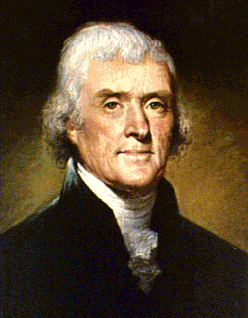
Thomas Jefferson April 13, 1743 – July 4, 1826
Thomas Jefferson became the third President of the United States of America. As one of the founding fathers, Jefferson envisioned America as an “Empire of Liberty”.
So it came to pass that Independence Day is annually celebrated on July 4. The celebrations have deep roots in the American tradition of political freedom.
Reflect then on that notion of liberty and freedom as you watch the first episode from a most compelling series from Adam Curtis that was broadcast by the BBC in 2007. The series is called The Trap, the first programme entitled “F**k You Buddy” (11 March 2007)
Individual freedom is the dream of our age. It’s what our leaders promise to give us, it defines how we think of ourselves and, repeatedly, we have gone to war to impose freedom around the world. But if you step back and look at what freedom actually means for us today, it’s a strange and limited kind of freedom.
Politicians promised to liberate us from the old dead hand of bureaucracy, but they have created an evermore controlling system of social management, driven by targets and numbers. Governments committed to freedom of choice have presided over a rise in inequality and a dramatic collapse in social mobility. And abroad, in Iraq and Afghanistan, the attempt to enforce freedom has led to bloody mayhem and the rise of an authoritarian anti-democratic Islamism. This, in turn, has helped inspire terrorist attacks in Britain. In response, the Government has dismantled long-standing laws designed to protect our freedom.
The Trap is a series of three films by Bafta-winning producer Adam Curtis that explains the origins of our contemporary, narrow idea of freedom. It shows how a simplistic model of human beings as self-seeking, almost robotic, creatures led to today’s idea of freedom. This model was derived from ideas and techniques developed by nuclear strategists during the Cold War to control the behavior of the Soviet enemy.
Part Two of this article is being published on the 7th, next Thursday, and Part Three next Monday, the 11th.
More on the many and varied approaches to this complex subject. Again, a long piece which, dear reader, I hope you will stay with.
As I wrote in response to Per Kurowski’s comment on yesterday’s Part One of this article, ” I am reminded of the saying that in war the first casualty is truth. It ‘feels’a lot like that in this scenario.”
Part Two isn’t attempting to indicate the truth, just the many opinions out there.
First, let me quote an email that Patrice sent to me late last night,
Hi Paul!
I think that the propaganda from the fossil fuel and other feudal plutocracies have confused the issue. The primary problem is not “climate change” (aka planetary heating/broiling).I am not confused, because it’s NOT about climate change. Climate change is a second order effect. It may, or may not happen, short term.
The gist of my essay is that climate change will NOT happen, short term, if the sun cools down spectacularly, as it did TWICE in the last five centuries (~ Little Ice Age).
The way to look at things correctly, thus, is CO2 POISONING. Even if the sun cooled down spectacularly, as I emphasized, the ACIDIFICATION of the oceans would proceed unabated. After killing the oceans, if the sun goes back to normal, the greenhouse would rebound enormously.
Although I did not speak of it in that particular essay, we now know the rate of CO2 in the atmosphere, through shell formation in the ocean, for at least 20 million years (and soon at least 100 million; the method should work for half a billion years!). Thus we know the level of CO2 equivalent is the highest in 20 million years (although some have claimed that transitory fluxes much higher than that have occured, from volcanoes; that would not be a problem, as a high flux does not allow storage in the oceans!)
Feel free to quote from this, I just thought of this formulation now, and it may help clarify matters (and it is clearly the idea of the essay). BTW, let me emphasize that my essay explains why FLOODING, by no means certain on a proxymal massive scale, is, however a clear possibility. London under water seems even a near certainty on the scale of a century (but for enormous works, requiring huge energy!)
Patrice
OK, a useful footnote to yesterday’s piece. But then if one goes back to Patrice’s original article on his Blog on 31st May, 2009 and reads the comments, you find this, (and I’m going to quote entirely from Mr Day’s comments).
Barry Day says
(QUOTE)What does this mean? We should be cooling down, because the sun’s output has been going down as much as an astounding 6% in some frequencies. But, nevertheless, the lower troposphere has been warming up (END QUOTE)
Ever heard of lag?
“New data show that the balance between the airborne and the absorbed fraction of carbon dioxide has stayed approximately constant since 1850, despite emissions of carbon dioxide having risen from about 2 billion tons a year in 1850 to 35 billion tons a year now.”
“This suggests that terrestrial ecosystems and the oceans have a much greater capacity to absorb CO2 than had been previously expected.” From Pysorg.com of November 10th, 2009.
“Apart from the “long-term” trends shown above, which show an ongoing persistent increase, it is perhaps more stark to record that earthquakes across the planet show a marked increase in activity since 1997. There are more major earthquakes occurring now, and this on an ever more frequent basis.”
“A total of 1,085 earthquakes measuring magnitude 6 or greater occurred between 1980 to 1989, averaging 109 per year over the decade. In the 1990s the decadal total increased to 1,492 averaging at 149 major earthquake per year over the period.
Since January 1, 2000 [ see table below for the date and time] a total of 1,438 major earthquakes have so far occurred worldwide raising the annual total over the last 9 years to 160 with more than 12 and a half months to go to the decade’s end.
The increase from 109 to 160 major earthquakes per year in the 1980 to 2008 period translates to a rise of 47 percent in just under three decades.” [This reference is dated December 13th, 2008, before the Japanese earthquake, Ed.]
The Barry Day goes on to highlight these references,
Abstract
The United Nations Intergovernmental Panel on Climate Change (IPCC) released its Fourth Assessment Report (AR4) in 2007. Here we show that the accurate value for climate sensitivity is 0.277 K/(W/m^2), which is 3 times smaller than the generally accepted value of 0.8 K/(W/m^2). Thus the climate change on doubling CO2 from 300 ppm to 600 ppm will be 1.0 degree, not 3 degrees. Because the IPCC data show that doubling CO2 will not double absorption of infrared radiation, the Beer-Lambert law is not being followed, because of diminishing returns after more-than-50% absorption.
[This is an extremely difficult essay for a non-scientist to follow. All I can do is to include the source of the article, as below, Ed.]
This article by Roger Taguchi, 234 Knox Crescent, Ottawa, Ontario, Canada K1G 0K8, e-mail address rtaguchi@sympatico.ca, was posted on Monday Aug. 31, 2009.
Then just a small selection from other items posted by Barry (to see the full extent of Barry’s comments, do go to Patrice’s original post here).
Scientists stumble across huge underwater mountain 29 May 09 – Marine scientists have discovered a massive underwater volcano off Indonesia’s western coast. The 4,600m (15,000ft) mountain spans 30 miles at its base, with its summit some 1,300 meters below the surface. Its discovery was “completely unexpected.”
————–
Galapagos volcano erupts – lava flowing into the ocean 12 Apr 09 – Again, we have 2,150-degree lava pouring into the ocean – ten times the boiling point – and we keep blaming humans for heating the seas.
————–
Underwater volcano building new mountain 7 May 09 – “An active underwater volcano near the island of Guam erupts so frequently that it has built a new cone 131ft high (13 stories) and 984ft wide in just three years.
————–
Undersea volcanic eruption in Tonga heating the water? 19 Mar 09 – Sea Surface Temperature (SST) maps show a warm anomaly in the Tonga that extends off to the east. Is that a result of the underwater volcano, or just a coincidence?
————–
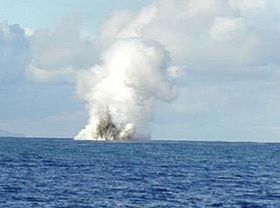
Underwater volcano erupts off Tonga 19 Mar 09 – Spectacular columns of steam and smoke spewed out of the seaabout 6 miles (10 km) from the main island of Tongatapu – an area where up to36 undersea volcanoes are clustered. Large
amounts of pumice from the volcanowill likely clog beaches on the southern coast of nearby Fiji islands shortly.
————–
Global warming may be caused by underwater volcanoes (Which I’ve been saying for years) 8 Dec 08 – A new study shows that the rise in land temperatures can be tied directly to increased heat and humidity coming from warmer oceans, which in turn may be caused solely by natural forces, including underwater volcanoes.
————–
Ocean Floor Geysers Warming The Seas (And we wonder why the oceans are warming) 22 Sep 08 – “It’s like finding Old Faithful in Illinois. When we went out to try to get a feel for how much heat was coming from the ocean floor and
how much sea water might be moving through it, we found that there was much more heat than we expected at the outcrops.”
————–
Geothermal heat may be melting the Greenland glaciers Nov 2007 – “Hansen’s model is wrong! In reality, the Greenland and Antarctic ice sheets occupy deep basins, and cannot slide down a plane. Furthermore glacial flow depends on stress as well as temperature, and much of the ice sheets are well below melting point.
————–
World’s deepest chain of undersea volcanoes to be explored 1 Sep 08 — Scientists at the National Oceanography Centre are set to explore the world’s deepest undersea volcanoes five kilometers beneath the Caribbean.
————–
‘Black smokers’ found in Arctic Ocean 4 Aug 08 – Jets of searingly hot water spewing up from the sea floor have been discovered in a far-northern zone of the Arctic Ocean, Swiss-based scientists announced Monday.
————–
Boiling Hot Water Found in Frigid Arctic Sea 24 Jul 08 – “Many miles inside the Arctic Circle, scientists have found
vents of scalding liquid rising out of the seafloor at temperatures that are more than twice the boiling point of water.
————–
Undersea volcanic activity blamed for mass extinction 93 million years ago 16 Jul 08 – Researchers from the University of Alberta, Canada, find evidence of underwater volcanism in rocks dating to a mass extinction 93 million years ago.
————–
Huge Underwater Volcanoes in the Arctic Ocean, but scientists see no significant connection to melting ice? 27 Jun 08 – The eruptions discharge large amounts of carbon dioxide, helium, trace metals and heat into the water over long distances, but scientists see no significant connection to melting ice.
————–
Giant Undersea Volcano Found Off Iceland (And we wonder why the oceans are warming) 22 Apr 08 – It’s an active volcano that rises about 3,300 feet (1,000 meters) above the surrounding sections, coming within 1,300 feet (400 meters) of the surface.
————–
Hawaiian volcano pumping more lava than usual into the ocean 5 Jul 08 – The Hawaiian Volcano Observatory said Saturday that Hawaii’s Kilauea volcano is pumping more lava than usual into the ocean.
————–
Magma May Be Melting Greenland Ice
18 Dec 07 – I added another article to this posting
13 Dec 07 – Scientists have found at least one natural-magma hotspot under the Greenland Ice Sheet where heat from Earth’s insides could seep through,
————–
Arctic seabed afire with lava-spewing volcanoes 25 Jun 08 – Red-hot magma has been rising from deep inside the earth
and blown the tops off dozens of submarine volcanoes, four kilometers below the ice. And we wonder what is melting the ice.
————–
Underwater Volcanic Eruptions, Not Meteor, May Have Killed Dinosaurs New discovery validates theories in Not by Fire but by Ice 30 Oct 07 – “A series of monumental volcanic eruptions in India may have killed the dinosaurs 65 million years ago, not a meteor impact in the Gulf of Mexico.
Then Barry adds another comment,
We’ve forgotten that this isn’t the first time our seas have warmed. Sea temperatures also shot upward 10º to 18ºF just prior to the last ice age.
As the oceans warmed, evaporation increased. The excess moisture then fell to the ground as giant blizzards, giant storms and floods (Noah’s Deluge type floods), and a new ice age began.
The same thing is happening today.
It’s not global warming, it’s ocean warming, and humans have nothing to do with it. Our seas are being heated, I believe, by underwater volcanism. Here’s why:
We are living in a period of vastly increased volcanism, said Dixy Lee Ray in her 1993 book Environmental Overkill, the greatest in 500 years. Eighty percent of all volcanism (say experts at NOAA) occurs underwater. Therefore, underwater volcanism should also be the greatest in 500 years.
Our seas, heated by underwater volcanism, are leading us directly into the next ice age . . . and we don’t even know it.
That’s what El Niño is all about. Warmer seas send excess moisture into the sky, leading to increased precipitation.
Worldwide flood activity is the worst since before Christopher Columbus. In Poland, it’s the worst in several thousand years. In the U.S., precipitation has increased 20 percent just since 1970. This is no coincidence.
When that precipitation begins falling in the winter, you have the makings of an ice age.
South America’s oldest trees give up the ghost of climate past.
They’ve been dead for over 50,000 years, but South America’s longest-living trees still have a few tales to tell. A new study of the growth rings of partially fossilized trees in southern Chile hints that the global climate before the last ice age was rather like today’s.
Barry mentions Kavachi Island and I did a quick search and came up with this.
From Wikipedia,
Kavachi is one of the most active submarine volcanoes in the south-west Pacific Ocean.Located south of Vangunu Island in the Solomon Islands, it is named after a sea god of the New Georgia Group islanders, and is also referred to locally as Rejo te Kavachi (“Kavachi’s oven’). The volcano has become emergent and then been eroded back into the sea at least eight times since its first recorded eruption in 1939.
In May 2000, an international research team aboard the CSIRO research vessel FRANKLIN fixed the position of the volcano at 8° 59.65’S, 157° 58.23’E. At that time the vent of the volcano was below sea level, however frequent eruptions were ejecting molten lava up to 70m above sea level, and sulfurous steam plumes up to 500m. The team mapped a roughly conical feature rising from 1,100 m water depth, with the volcano having a basal diameter of about 8 km.
When the volcano erupted in 2003, a 15-meter-high island formed above the surface, but it disappeared soon after. Additional eruptive activity was observed and reported in March 2004 and April 2007.
Kavachi erupting May 14th, 2000.
Barry then looks as CO2 levels, he writes,
Carbon dioxide
If today’s rising carbon dioxide are caused by humans, what caused the dramatic rise in CO2 levels at the dinosaur extinction?
It was a matter of a moment’s search to find this, from Ice Age Now, Home Page here
If today’s rising carbon dioxide are caused by humans, then what caused the dramatic rise in CO2 levels at the dinosaur extinction?
Research shows that there was “a sudden and dramatic rise” in carbon dioxide in the Earth’s atmosphere at the dinosaur extinction of 65 million years ago. A recent report attributes the rise in CO2 levels to an asteroid impact.
See http://news.bbc.co.uk/1/hi/sci/tech/2038599.stm
I disagree. I think today’s rise in CO2 levels can be attributed to our warming oceans. After all, the oceans are known as a carbon dioxide “sink,” especially when the water is cold.
But as the water warms up, it releases CO2 into the atmosphere. This happens in much the same way that a warm bottle of home-brewed root beer will release CO2. And if you give that CO2 no way to escape, the bottle will explode.
We’ve got it backwards. We’ve got cause and effect in reverse.
The CO2 is not causing global warming. Instead, our warming oceans are releasing CO2 into the atmosphere.
It’s not global warming, it’s ocean warming, and it’s leading us into an ice age.
Finally, Barry offers this,
No Global Warming
“Even with needed corrections, data still don’t show the expected signature of global warming,” says Dr. Roy Spencer, Senior Scientist for Climate Studies NASA/Marshall Space Flight Center.
Unfortunately, the URL that Barry included didn’t function. But a quick search on the NASA website came up with this,
Scientists are working to understand why the lower atmosphere isn’t heating up as fast as some global warming models predict.
July 21, 2000 — The question sounds like a Zen koan: How could the globe be warming and not warming at the same time?
That’s the riddle posed to climatologists by satellite and radiosonde data which show that while the Earth’s surface has been warming over the past decades, the lowest layer of the atmosphere shows a weaker warming trend.
The measurements are surprising, because computer simulations of the world’s climate predict that the two lowest layers of the atmosphere — which together form the “troposphere” — should be warming faster than the Earth’s surface.
Read the full article here. It’s well worth reading and concludes with these closing paragraphs,
Current models suffer from several shortcomings.
For example, clouds are not well represented by the models. The resolution of current models is too coarse for features as small as clouds, Spencer said. Yet clouds clearly play a crucial role in climate due to their influence on humidity, precipitation and albedo (the percentage of solar energy reflected back into space as light).
“The role of clouds is still regarded as one of the biggest uncertainties in global warming predictions,” Spencer said.
The ability of plants to remove carbon dioxide from the atmosphere and the role of soils have only recently been added to the models, and scientists aren’t confident yet of how the models portray these factors, Spencer said.
“While we know that vegetation takes up some of the carbon dioxide we generate from burning of fossil fuels, how that sink of carbon will change in the future is still pretty uncertain,” Spencer said.
Climate models are also limited by the computing power available.
“The global models would be much better if computers were much faster,” Spencer said. “Instead, a lot of approximations are made to make the models simple enough to do climate simulations over the whole globe.
“Unfortunately,” Spencer continued, “we know that many of the processes that are crudely represented are quite non-linear, and so have the potential to respond in unexpected ways.”
The Global Hydrology and Climate Center is a joint venture between government and academia to study the global water cycle and its effect on Earth’s climate. Jointly funded by NASA and its academic partners, and jointly operated by NASA’s Marshall Space Flight Center in Huntsville, Ala., and the University of Alabama in Huntsville, the Center conducts research in a number of critical areas.
Web Links
Global Hydrology and Climate Center — a joint venture between government and academia to study the global water cycle and its effect on Earth’s climate
OK, that’s enough from me for today. Clearly it would take a great time for a layman, such as yours truly, to go through all this material, and more, to determine the truth of it all, to the very best abilities of science. For the verdict on whether man’s increased generation of CO2 in the atmosphere is having a global effect on the global climate should be in the hands of scientists.
Once science has shown cause and effect then, and only then, should politicians endeavour to offer the way forward for society.
Having said that, there is no reason at all for mankind to maintain the present disconnect from Planet Earth. Even if the jury is still well and truly out in terms of the effect of CO2 on the atmosphere, the number of other issues that are just as important for our long-term survival are still prodigious. There’s an old saying in aviation, “If there’s any doubt, there’s no doubt.”
Travelling the 5,200 miles, give or take, between Payson (AZ) and London (UK)
Apologies for a slightly reduced service over the next 10 days but Monday 6th June finds me travelling from Phoenix to Dallas, and then Dallas to London Heathrow. This as a result of the U.S. Citizenship and Immigration Service (USCIS) granting me permanent residence (the Green Card) in April and thus me being able to travel back to England to see my new grandson for the first time.
So just a few thoughts, courtesy of Terry Hershey. I subscribe to his weekly Sabbath Moment and they always contain some beautiful sayings and other gems. Take these for example, from his Sabbath Moment of the 30th May.
Anything I’ve ever done that ultimately was worthwhile. . .initially scared me to death. Betty Bender
Betty Bender
Or what about this?
To dare is to lose one’s footing momentarily. To not dare is to lose oneself. Soren Kierkegaard
Søren Aabye Kierkegaard (b. 1813, d. 1855) was a profound and prolific writer in the Danish “golden age” of intellectual and artistic activity. His work crosses the boundaries of philosophy, theology, psychology, literary criticism, devotional literature and fiction. Kierkegaard brought this potent mixture of discourses to bear as social critique and for the purpose of renewing Christian faith within Christendom. At the same time he made many original conceptual contributions to each of the disciplines he employed. He is known as the “father of existentialism”, but at least as important are his critiques of Hegel and of the German romantics, his contributions to the development of modernism, his literary experimentation, his vivid re-presentation of biblical figures to bring out their modern relevance, his invention of key concepts which have been explored and redeployed by thinkers ever since, his interventions in contemporary Danish church politics, and his fervent attempts to analyse and revitalise Christian faith.
OK, dear readers, from somewhere over who knows where!
We really may be on the verge of a new geological period.
Just a couple of weeks ago, on the 16th May, I wrote an article called The Anthropocene period. It was based on both a BBC radio programme and a conference called “The Anthropocene: A New Epoch of Geological Time?”
So imagine my surprise when I collected this week’s copy of The Economist from my mail-box last Saturday. The cover page boldly illustrated a lead article within, as this picture shows.
US edition, May 28th
The leader is headlined, ‘Humans have changed the way the world works. Now they have to change the way they think about it, too.’ The first two paragraphs of that leader explain,
THE Earth is a big thing; if you divided it up evenly among its 7 billion inhabitants, they would get almost 1 trillion tonnes each. To think that the workings of so vast an entity could be lastingly changed by a species that has been scampering across its surface for less than 1% of 1% of its history seems, on the face of it, absurd. But it is not. Humans have become a force of nature reshaping the planet on a geological scale—but at a far-faster-than-geological speed.
A single engineering project, the Syncrude mine in the Athabasca tar sands, involves moving 30 billion tonnes of earth—twice the amount of sediment that flows down all the rivers in the world in a year. That sediment flow itself, meanwhile, is shrinking; almost 50,000 large dams have over the past half- century cut the flow by nearly a fifth. That is one reason why the Earth’s deltas, home to hundreds of millions of people, are eroding away faster than they can be replenished.
There’s also a video on The Economist website of an interview with Dr. Erle Ellis, associate professor of geography and environmental systems at the University of Maryland. That video link is here.
That Economist lead article concludes,
Recycling the planet
How frightened should people be about this? It would be odd not to be worried. The planet’s history contains many less stable and clement eras than the Holocene. Who is to say that human action might not tip the planet into new instability?
Some will want simply to put the clock back. But returning to the way things were is neither realistic nor morally tenable. A planet that could soon be supporting as many as 10 billion human beings has to work differently from the one that held 1 billion people, mostly peasants, 200 years ago. The challenge of the Anthropocene is to use human ingenuity to set things up so that the planet can accomplish its 21st-century task.
Increasing the planet’s resilience will probably involve a few dramatic changes and a lot of fiddling. An example of the former could be geoengineering. Today the copious carbon dioxide emitted to the atmosphere is left for nature to pick up, which it cannot do fast enough. Although the technologies are still nascent, the idea that humans might help remove carbon from the skies as well as put it there is a reasonable Anthropocene expectation; it wouldn’t stop climate change any time soon, but it might shorten its lease, and reduce the changes in ocean chemistry that excess carbon brings about.
More often the answer will be fiddling—finding ways to apply human muscle with the grain of nature, rather than against it, and help it in its inbuilt tendency to recycle things. Human interference in the nitrogen cycle has made far more nitrogen available to plants and animals; it has done much less to help the planet deal with all that nitrogen when they have finished with it. Instead we suffer ever more coastal “dead zones” overrun by nitrogen-fed algal blooms. Quite small things, such as smarter farming and better sewage treatment, could help a lot.
For humans to be intimately involved in many interconnected processes at a planetary scale carries huge risks. But it is possible to add to the planet’s resilience, often through simple and piecemeal actions, if they are well thought through. And one of the messages of the Anthropocene is that piecemeal actions can quickly add up to planetary change.
We are living in interesting times!
Finally, more of Dr. Ellis may be watched on the following YouTube video.
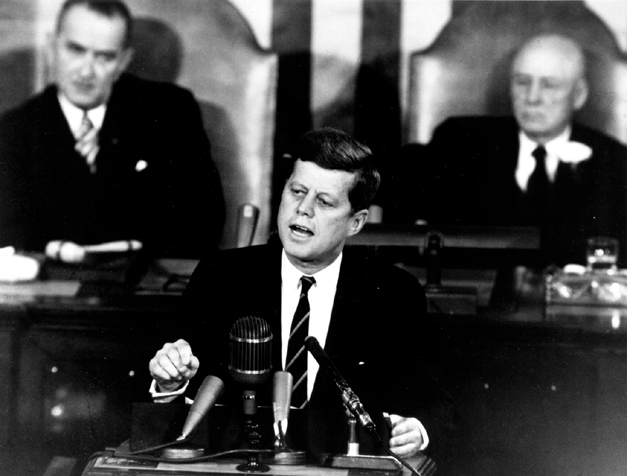
President John F. Kennedy's May 25, 1961 Speech before a Joint Session of Congress
On the 25th May, 1961, President John Kennedy summoned a joint session of Congress and asked America to commit itself to a goal – that of landing a man on the moon and returning him safely to Earth before the decade was out.
There’s a good link on the NASA site to the speech.
MY print column this week notes that it is half a century next week since John Kennedy called for sending a man to the moon and returning him safely to Earth. The bottom line, I think:
If we can send a man to the moon, people ask, why can’t we [fill in the blank]? Lyndon Johnson tried to build a “great society”, but America is better at aeronautical engineering than social engineering. Mr Obama, pointing to competition from China, invokes a new “Sputnik moment” to justify bigger public investment in technology and infrastructure. It should not be a surprise that his appeals have gone unheeded. Putting a man on the moon was a brilliant achievement. But in some ways it was peculiarly un-American—almost, you might say, an aberration born out of the unique circumstances of the cold war. It is a reason to look back with pride, but not a pointer to the future.
Before moving to the thrust of this article, let me say that of the few things that I miss now living in Arizona, British draft beer and BBC Radio 4 are top of the list. Radio 4 have long broadcast a splendid 30-minute summary of science matters under the banner of Material World. It was the broadcast on May 12th that had a very powerful except that I will present here. The programme is available to listen online. This is how the BBC wrote up the summary,
Researchers from all over the world and various disciplines gathered together in London for a conference called “The Anthropocene: A New Epoch of Geological Time?” The term “Anthropocene” was coined by Professor Paul Crutzen of the Max Planck Institute in 2002 to suggest human activity has had such an irreversible affect on our planet, that we have entered into a new geological period, influenced by humans. The conference aimed to discuss the various research projects studying the Anthropocene, as well as to discuss whether or not it should be formalised as a geological “Epoch”. What actually is the Anthropocene, why are so many disciplines researching it and what difference will it make if it is formalized? Quentin finds out from Leicester University geologist Dr. Jan Zalasiewicz, and ecologist Professor Erle Ellis from the University of Maryland, Baltimore County.
Elsewhere on the BBC website, a fuller summary of the conference was written up by Howard Falcon-Lang, Royal Holloway, University of London. I have taken the liberty of publishing that summary, minus the photographs, below, simply because it’s so important a read.
Anthropocene: Have humans created a new geological age?
By Howard Falcon-Lang Royal Holloway, University of London, 10th May 2011
Human civilisation developed in a cosy cradle.
Over the last 11,700 years – an epoch that geologists call the Holocene – climate has remained remarkably stable. This allowed humans to plan ahead, inventing agriculture, cities, communication networks and new forms of energy.
Some geologists now believe that human activity has so irrevocably altered our planet that we have entered a new geological age.
This proposed new epoch – dubbed the Anthropocene – was discussed at a major conference held at the Geological Society in London on Wednesday. Yet some experts say that defining this “human age” is much more than about understanding our place in history. Instead, our whole future may depend on it.
The term, the Anthropocene, was coined over a decade ago by Nobel Laureate chemist, Paul Crutzen. Professor Crutzen recalls: “I was at a conference where someone said something about the Holocene. I suddenly thought this was wrong. The world has changed too much. No, we are in the Anthropocene. I just made up the word on the spur of the moment. Everyone was shocked. But it seems to have stuck.”
But is Professor Crutzen correct? Has the Earth really flipped into a new geological epoch – and if so, why is this important?
Back to the beginning
Dr Jan Zalasiewicz of the University of Leicester is one of the leading proponents of the Anthropocene theory. He told BBC News: “Simply put, our planet no longer functions in the way that it once did. Atmosphere, climate, oceans, ecosystems… they’re all now operating outside Holocene norms. This strongly suggests we’ve crossed an epoch boundary.” Dr Zalasiewicz added: “There are three ideas about when the Anthropocene began. Some people think it kicked off thousands of years ago with the rise of agriculture, but really those first farmers didn’t change the planet much. Others put the boundary around 1800. That was the year that human population hit one billion and carbon dioxide started to significantly rise due to the burning of fossil fuels in the Industrial Revolution,” he explained. Dr Zalasiewicz continued, “However, the really big changes didn’t get going until the end of the Second World War – and that’s another candidate for the boundary.”
To formally define a new epoch, geologists must show how it can be recognised in the layers of mud that will eventually form rocks. As it turns out, there is enormous practical advantage in fixing 1945 as the beginning of the Anthropocene.
“1945 was the dawn of the nuclear age,” explained Dr Zalasiewicz. “Sediments deposited worldwide that year contain a tell-tale radioactive signature from the first atom bomb tests in the States”. So, thousands of years from now, geologists (if any still exist) will be able to place their finger on that very layer of mud.
Extraordinary times?
Nonetheless, the choice of 1945 for start of the Anthropocene is much more than just convenient. It coincides with an event that Professor Will Steffen of the Australian National University describes as the “Great Acceleration”. Professor Steffen told the BBC: “A few years ago, I plotted graphs to track the growth of human society from 1800 to the present day. What I saw was quite unexpected – a remarkable speeding up after the Second World War”.
In that time, the human population has more than doubled to an astounding 6.9 billion. However, much more significantly, Professor Steffen believes, the global economy has increased ten-fold over the same period.
“Population growth is not the big issue here. The real problem is that we’re becoming wealthier and consuming exponentially more resources,” he explained.
This insatiable consumption has placed enormous stresses on our planet. Writing in the prestigious journal Nature, Professor Steffen and colleagues recently identified nine “life support systems” essential for human life on Earth. They warned that two of these – climate and the nitrogen cycle – are in danger of failing, while a third – biodiversity – is already in meltdown.
“One of the most worrying features of the Great Acceleration is biodiversity loss,” Professor Steffen said. “Species extinction is currently running 100 to 1000 times faster than background levels, and will increase further this century. When humans look back… the Anthropocene will probably represent one of the six biggest extinctions in our planet’s history.” This would put it on a par with the event that wiped out the dinosaurs.
But perhaps more alarming is the possibility that the pronounced global warming seen at the start of the proposed Anthropocene epoch could be irreversible. “Will climate change prove to be a short-term spike that quickly returns to normal, or are we seeing a long term move to a new stable state?” asked Professor Steffen. “That’s the million dollar question.”
If the Anthropocene does develop into a long-lived period of much warmer climate, then there may be one very small consolation: the fossil record of modern human society is likely to be preserved in amazing detail.
Dr Mike Ellis of the British Geological Survey told BBC News: “As a result of rising sea level, scientists of the future will be able to explore the relics of whole cities buried in mud”.
Preserved buildings
In New Orleans, large areas of the city are already below sea level. The disastrous combination of rising sea level and subsidence of the Mississippi Delta on which it is built suggest that it will succumb at some point in the future. Although the Intergovernmental Panel on Climate Change (IPCC) predicts less than a metre of sea level rise over the next 90 years, more than five metres of sea level rise is possible over the coming centuries as the Greenland and West Antarctic ice caps melt.
Sea level rise of this magnitude will mean that the lower storeys of buildings will be preserved intact. Such “urban strata will be a unique, widespread and easily recognisable feature of the sedimentary deposits of the human age”, Dr Ellis commented.
Geologists of the future may also hunt for other, more unusual, “markers” of the Anthropocene epoch, such as the traces of plastic packaging in sediments.
But geologists like Dr Mark Williams from the University of Leicester hold much more serious concerns: “One of the main reasons we developed the Anthropocene concept was to quantify present-day change and compare it with the geological record,” he explained. “Only when we do so, can we critically assess the pace and degree of change that we’re currently experiencing.”
Dr Williams added that while the Anthropocene has yet to run its course, “all the signs are that the human age will be a stand-out event in the 4.5 billion year history of the Earth”.