Here’s a very delightful guest post coming up. But first to my introduction.
Speke’s Monument, Kensington Gardens
Whatever one feels about London, the city of my birth (Acton; North-West London, to be more precise), there’s no denying that it has some glorious parks.
One of those wonderful parks is Kensington Gardens that is located not that far from the Royal Albert Hall. Or as Wikipedia puts it:
Kensington Gardens, once the private gardens of Kensington Palace, are one of the Royal Parks of London, lying immediately to the west of Hyde Park.
So keep that image in your mind as we turn to today’s guest post.
ooOOoo
A Victorian Dog Story
If you are ever in the UK, wander through Kensington Gardens (past the palace where Princess Diana resided) and go Northeast, behind Victoria Lodge; you will find a pet cemetery. Mentioned by Peter Pan author, J.M. Barrie, in his work The Little White Bird, over 200 dogs, cats and birds have been laid to rest here. All of its inhabitants were once beloved pets.
The cemetery was started by the lodge keeper around 1881; the first dog to be buried in Kensington was her “Cherry”, a Maltese terrier who died of old age. The second dog was “Prince”, once belonging to the Duke of Cambridge (no relation to the present Duchess of Cambridge, Kate Middleton!). Struck by a carriage, this dog’s simple gravestone reads: “Poor Prince.” Though the cemetery is no longer active, contemporary guests can take pictures of the tiny tombstones and read such sentiments as “Maudie, An Old Friend”, “Darling Dolly My Sunbeam, My Consolation”; and “In Loving Memory of Our Faithful Little Friend Wobbles.”
Keeping dogs as pets gained popularity in the 19th century. As sanitation conditions started to be regulated, animals such as pigs, cows and sheep were banned from the streets. So dogs that were once kept outside were now invited by the fire. The dog changed from being a worker to being a member of the family. In 1837 there were about 140 dog nappers; they stole lap dogs from the wealthy and charged hefty ransoms for their return. A Temporary Home for Lost and Starving Dogs opened in 1860; ultimately this became The Battersea Dogs Home, where strays could be adopted. For more information on the Victorian cult of the dog, I would recommend At Home and Astray by Philip Howell. Meanwhile, if you are searching for a name for your new pet puppy, you might want to consider Dandie, Dash or Eos, pronounced ee-oohs–if they were good enough for Queen Victoria’s pooches, they may be good enough for yours!
ooOOoo
Let me close with the words of the author: Annabelle Troy
An American who loves UK culture, I alternate my time between New York City and London. I’m the author of four books available on Amazon: Jane Eyre Gets Real, A Cure for Cecily, The Grace of the Hunchback, and Hansel and Gretel Inside the House of Candy. Inspiration comes to me through literature, history and magic.
Here’s the cover of that first-named book.
I don’t know about Jane Eyre but Annabelle Troy comes over as real enough!
Normal service may not be possible for the next few weeks!
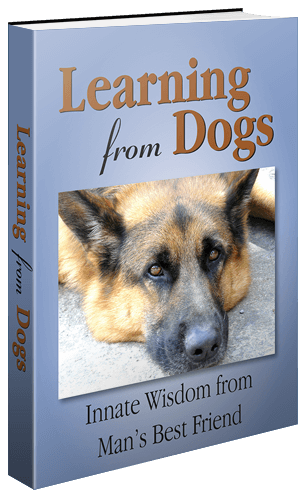
As many of you know last December I published my first book Learning from Dogs.
That book had been the result of me getting my head down in the Novembers of 2013 and 2014. Why November? Because that is the month of NaNoWriMo, or to use the long-form: National Novel Writing Month.
Having brought book number one the light of the day, it was only natural that my mind started to turn to a sequel. At first, I thought of another book about dogs; perhaps Learning About Dogs? But for a variety of reasons I just couldn’t get started and it all came to a head last Wednesday during one of our regular group cycle rides. As follows:
Jim Goodbrod, he who wrote the foreword to my first book, asked how book number two was coming along.
“Oh Jim,” I replied, “I have left it far too late to contact the many academics that I have come across, to seek permission to quote their works and to find out if they have more scientific information of potential interest.”
“I have this terrible feeling that I’m setting myself up to fail!”
Jim then opened a wonderful window for me; metaphorically speaking. But before describing what Jim went on to say I should explain to you, dear reader, the connection between Jim and Janet, his wife, and Jean and me. Jim and Janet live about half-a-mile from us in Merlin, Southern Oregon, and right from the moment when we moved into our home back in 2012 they have been very good friends indeed. That friendship built upon Jim and Janet sharing very many similar outlooks on life to Jeannie and me. Plus Jim is a professional veterinarian doctor at a vet’s practice in Grants Pass, our local town some 12 miles from home, but has frequently given us advice ‘out of hours’ when one of our pets at home has gone down with something beyond Jean’s extensive experience.
So the four of us have spent much time together socially and I am embarrassed to admit that quite a few of my stories from past years have been told by me.
Back to that conversation during that bike ride. “Paul, Janet and I were only saying the other day that we would really love to see your next book being something autobiographical. You have had so many interesting experiences in so many parts of the world that we truly believe that they would be of interest to many others.”
It felt slightly uncomfortable to hear that. Uncomfortable in the sense that immediately responding by saying what a good idea that was carried too much egotism, was too self-indulgent. But at the same time I knew that Jim and Janet would offer a genuine recommendation and that it would most certainly get me out of my present difficult situation. I thanked Jim profusely. Jim then went on the describe the style that he and Janet would enjoy: “Janet and I have long loved reading books where each chapter was a self-contained story. In other words, a book that one could pick up and dip into and still feel that it was a good read.”
When I returned home and spoke about this to Jeannie she immediately said that it was something that she had been urging me to consider. An hour later I was speaking on the phone to my sister Eleanor and she, too, encouraged me to go down this route.
So that’s how it has come about that book number two is going to be semi-autobiographical, and it already has a name: Four Dogs On My Bed.
Or as the byline reads: On Life; On Love; and On Dogs.
All of which is a rather wordy way of saying that from now until the end of November my first priority is going to be book writing. How that will impact my attention to this blog and all you wonderful readers is uncertain. But if you see a string of re-posts from earlier times, if I don’t provide the most fulsome introduction to a guest author that they deserve, if my replies to comments are not as quick as I normally try to be, then you will know the reason why.
The power of forgiveness displayed by our animals.
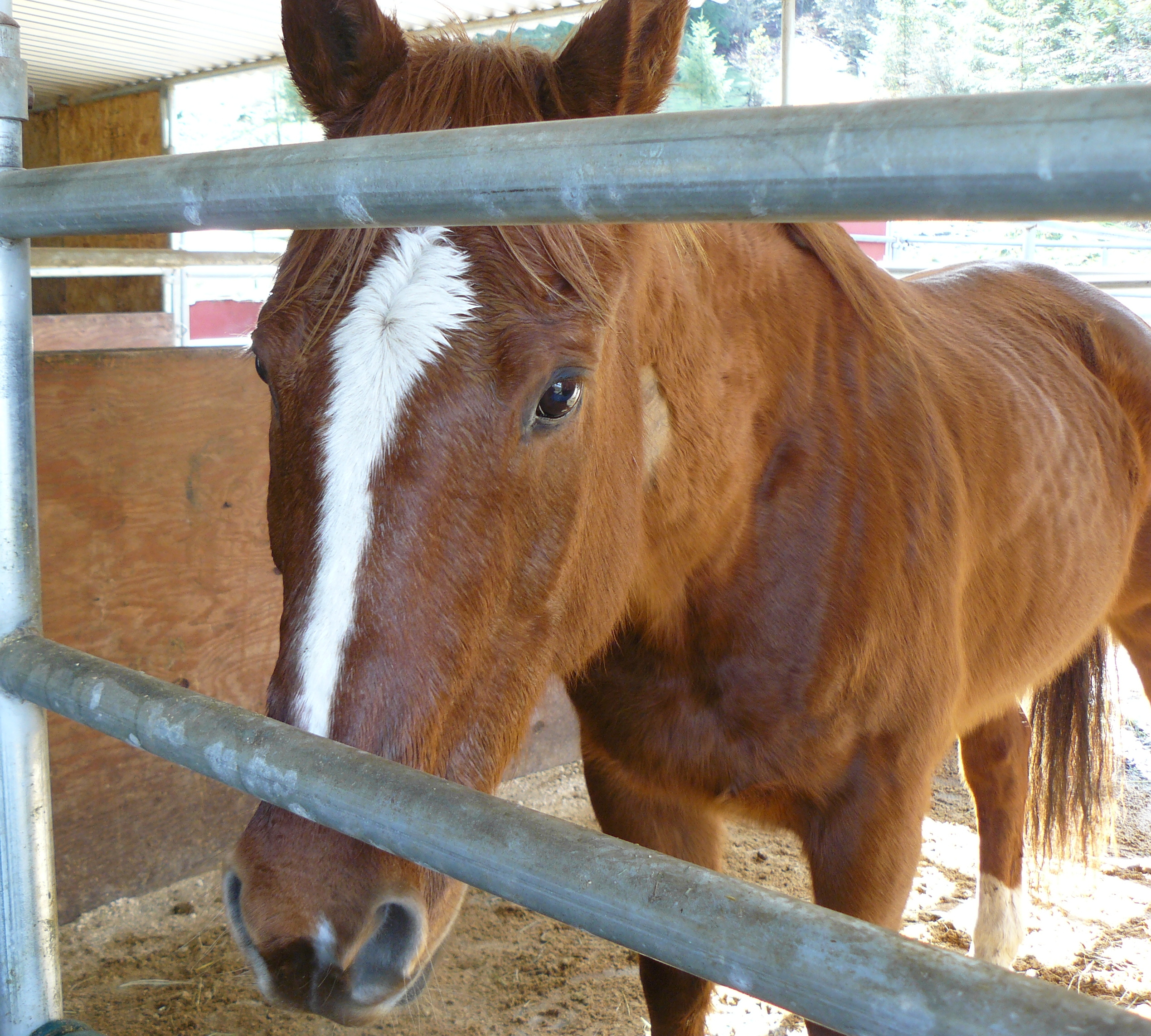
Last Sunday’s Picture Parade was mainly photographs of Jean out with our ex-rescue horses Ben and Ranger. Let me share the one of Ben as it is relevant to what follows.
A regular reader, Susan Leighton, the author of the blog Woman on the Ledge, commented (in part):
Ben and Ranger are handsome! They are known as roans, correct? I have always loved horses.
I didn’t know but said that I would ask Jeannie (and they are Chestnuts, not Roans!). It then struck me that republishing the post that was first presented back in March, 2014 might be of interest to others beyond Susan.
First, understand, for it is not specifically spelled out in this post, that Ben was removed by the Sheriff because he was being starved, being beaten and having air-gun bullets fired into his chest (the scars are still visible)!
Here’s that post from 2014:
ooOOoo
Welcome Ranger – and Ben!
Our new boys- the story of two horses!
Regular readers of Learning from Dogs will remember a post just over a month ago The lone Ranger. Essentially, that explained that we had visited Strawberry Mountain Mustangs in Roseburg, Oregon and, subject to their approval, had decided to adopt Ranger, a 15-year-old gelding.
Ranger, when first seen in February.
Thus it proceeded to the point where two-days ago Darla, of Strawberry Mountain, ably assisted by Cody, brought Ranger and Ben to us here in Merlin. It’s been a wonderful twenty-four hours (at the time of writing this). Why Ben? Please read on.
Destination!
Darla and Cody making a safe and timely arrival a little before 10am last Tuesday.
Ben, our new foster, being coaxed out by Darla on the lead-line and Cody behind him.
Why did we take the two? Last October, Ben had been found starved and showing the signs of a great lack of confidence. He was ‘rescued’ on orders of Darla’s local sheriff because of Ben’s condition despite being in private ownership. Darla was certain that Ben had been physically beaten in recent times, hence him being very wary of strangers. Thus his relationship with Ranger was part of his journey of returning to a healthy, confident horse. Darla offered us the opportunity of fostering Ben because Ranger had become a good companion for him. Darla explained that Ben was a very wary horse, especially of sudden movements from men.
Jean leading Ranger; Darla leading Ben.
Another 100 yards and the start of a new life for these two gorgeous animals.
Hey Ranger, is this for real!!
In the those first few minutes after Jean and Darla led the horses to the grass paddock, Ben seemed to have an expression on his face that suggested it was all too difficult to believe! Ranger just got stuck into munching! But not to the extent of not enjoying a back-rub!
“I think I’m going to like this, Ben!”
In the afternoon, it was time to bring Ben and Ranger for an overnight in the top area where the stables, food and water were. Ben was very nervous at coming through the open gate and for a while there seemed to be a complication in that Ranger kept thrusting at Ben as if to keep him away from the fence line separating the horses from Allegra and Dancer, our miniature horses.
But in the morning, yesterday, things seemed much more relaxed. To the point that when Ben and Ranger went back out to the grass, Ben was much more relaxed towards Jean and me, as the following pictures reveal.
Jean offering Ben some treats.
oooo
Yours truly doing likewise.
OK, want to turn back to Darla.
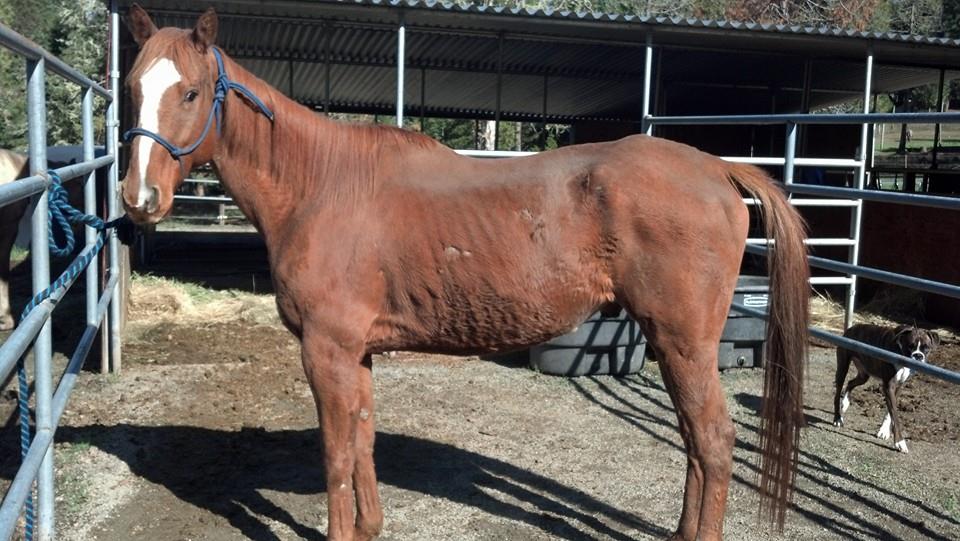
To give an insight into the awe-inspiring work of Darla and her team (and many others across the Nation) and to recognise the need of the authorities to have such outlets as Strawberry Mountain, here are two photographs of Ben shortly after he was removed from the people who had stopped loving and caring for him.
Ben as seen last October.
oooo
Ben close to starving.
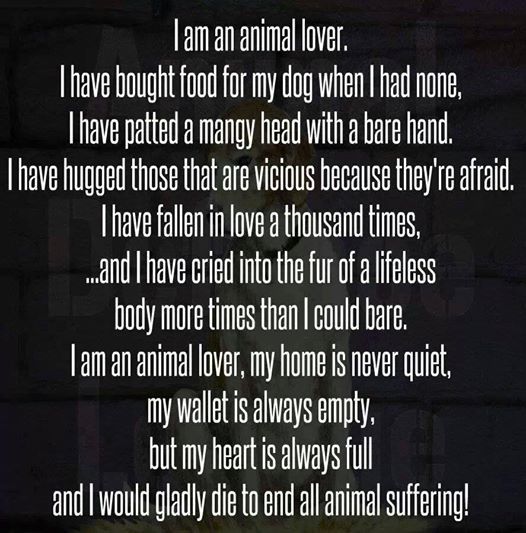
Strikes me as only one way to end this post is with the following as seen on Darla’s Facebook page.
Author unknown.
Thus this post is offered in dedication to the good people all over the world who know the value of the unconditional love we receive from animals and do not hesitate to return the same.
Darla, Cleo and Cody setting a wonderful example of unconditional love.
How about giving the nearest animal, or human, a big hug telling them at the same time how much you love them!
NB: Regular readers will find that today’s post is rather different to my usual run of things. But I do hope that you end up sharing my feelings of mystery; sharing what seems to me utterly incomprehensible. I am speaking of The Infinite.
Let me start with this quotation:
The infinite has always stirred the emotions of mankind more deeply than any other question.
The infinite has stimulated and fertilised reason as few other ideas have. But also the infinite, more than another other notion, is in need of clarification.
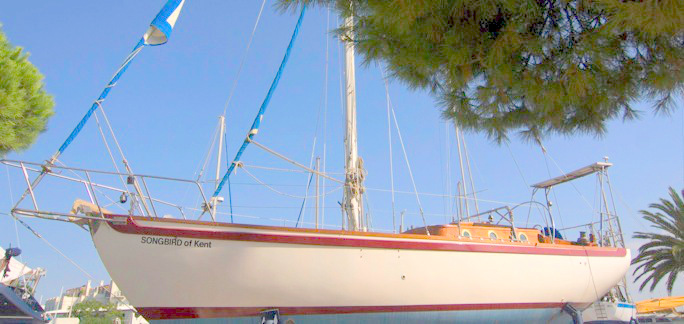
Let me now take you back many years, back to the Autumn of 1969 when I left Gibraltar bound for The Azores on my yacht Songbird of Kent. I was sailing solo.
My home for five years – Songbird of Kent; a Tradewind 33.
Despite me being very familiar with my boat, and with sailing in general, there was nonetheless a deep sense of trepidation as I headed out into a vast unfamiliar ocean.
On the third or fourth night, I forget which, when some four hundred miles into the Atlantic and therefore far from the light pollution from the land, I came on deck and was emotionally moved in a way that has never ever been surpassed.
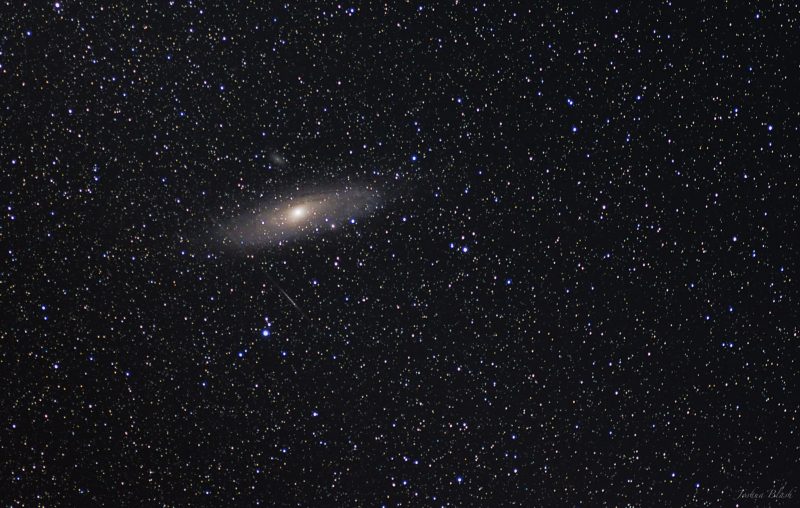
For way up in the heavens above me was the Andromeda galaxy, clearly visible with the naked eye.
Josh Blash captured this image of the Andromeda galaxy.
Although a couple of dozen minor galaxies lie closer to our Milky Way, the Andromeda galaxy is the closest major galaxy to ours. Excluding the Large and Small Magellanic Clouds, which can’t be seen from northerly latitudes, the Andromeda galaxy – also known as M31 – is the brightest galaxy in all the heavens. It’s the most distant thing you can see with your unaided eye, at 2.3 million light-years. To the eye, it appears as a smudge of light larger than a full moon.
Not only could I not take my mind off seeing the Andromeda galaxy, I couldn’t easily comprehend seeing the stars come all the way down to the horizon; all 360 degrees about me. Right down to the edge of my ocean horizon; a swirling blackness out to where it kissed that glorious night sky.
That image of that dome of stars would be forever burnt into my memory. An image that both made no sense, yet made every sense
Fast forward forty-seven years to now!
Recently we have had some beautiful clear nights here in Southern Oregon. Just the other night, before the moon had risen, there up in the night sky just a short distance from the constellation Cassiopeia was Andromeda. Immediately, my memory of that dark night sky out in the Atlantic came rushing back at me
The Andromeda galaxy is 2.3 million light-years away. But how can one possibly comprehend the distance? The fact that light travels at 186,000 miles per second or 671 million miles per hour (the exact value is 299,792,458 metres per second (approximately 3.00×10⁸ m/s) has no meaning whatsoever. Think about it! Light is traveling at the equivalent speed of going around our planet 7.46 times every second!
But if you can’t fathom the distance to the Andromeda galaxy try this!
Back in March, 2016 a new galaxy that has been named GN-z11 was spotted by the Hubble space telescope 13.4 billion light years away. That’s approximately 5,830 times more distant than the Andromeda galaxy!
Now it is starting to become very difficult to comprehend.
But it was episode eight that made me lose my mind. Just like that night so many years ago on Songbird of Kent.
For that episode was called The Cosmos. You can listen to it here. Please, please do so! This is how that episode is presented:
Does space go on for ever? Are there infinitely many stars? These are some of the questions Adrian Moore explores in the eighth episode in his series about philosophical thought concerning the infinite.
With the help of the theories of the Ancient Greeks through to those of modern cosmologists, Adrian examines the central question of whether our universe is finite or infinite.
For most of us, looking up at the stars gives us a sense of infinity but, as Adrian discovers, there is a strong body of opinion which suggests that space is finite, albeit unbounded. This is a difficult idea to grasp, but by inviting us to think of ourselves as ants, astrophysics professor Jo Dunkley attempts to explain it.
Adrian also tackles the idea of the expanding universe and the logic that leads cosmologists to argue that it all started with a big bang, and may all end with a big crunch.
Finally, we discover from cosmologist John Barrow how the appearance of an infinity in scientists’ calculations sends them straight back to the drawing board. The infinite, which the Ancient Greeks found so troubling, has lost none of its power to disturb.
A Juniper production for BBC Radio 4.
If you find that episode compelling beyond belief then all the episodes are available on the BBC iPlayer and may be found here.
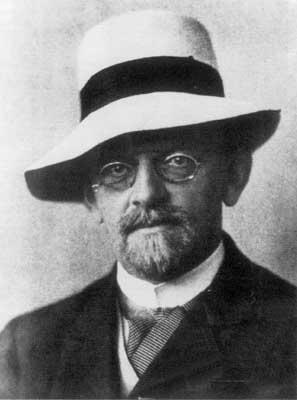
I started with a quotation that is the opening of the final episode. It is a quotation from the German mathematician David Hilbert. As Wikipedia explains, in part:
David Hilbert (German: [ˈdaːvɪt ˈhɪlbɐt]; 23 January 1862 – 14 February 1943) was a German mathematician. He is recognized as one of the most influential and universal mathematicians of the 19th and early 20th centuries.
I will return to that first sentence in Hilbert’s quotation:
The infinite has always stirred the emotions of mankind more deeply than any other question.
For me that sight of the Andromeda galaxy and the stars back in 1969 was in every meaning of the word a sight of the infinite and it has forever stirred my emotions very deeply indeed!
Yes, nature can be cruel but in ways that we understand. Animals, to the best of my knowledge, do not hunt for sport. Animals do not lie. They don’t seek political power (sorry; couldn’t resist that!).
All of which is my short introduction to an item that Dan sent me yesterday.
ooOOoo
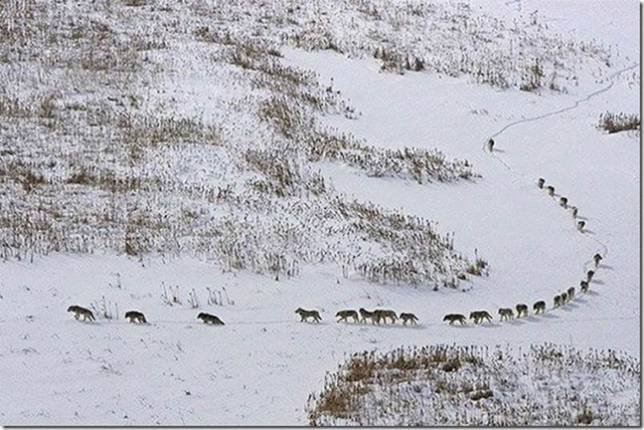
Cesare Brai’s photo.
A wolf pack: the first 3 are the old or sick, they give the pace to the entire pack.
If it was the other way round, they would be left behind, losing contact with the pack. In case of an ambush they would be sacrificed.
Then come 5 strong ones, the front line. In the center are the rest of the pack members, then the 5 strongest following. Last is alone, the alpha. He controls everything from the rear.
In that position he can see everything, decide the direction. He sees all of the pack. The pack moves according to the elders pace and help each other, watch each other.
For once I am speechless, I knew that wolves are different, but didn’t realize how much we could learn from them…
ooOOoo
Compelling, eh! But factually correct?
No!
In this case Nature is not guiding us. It is man misguiding us.
That makes for a compelling and inspirational story about teamwork — but it’s not true.
David Attenborough took the photo in question for the BBC’s “Frozen Planet” Series in 2011. It shows 25 timber wolves hunting bison in Wood Buffalo National Park in Canada. The female alpha wolf led the pack, and the others followed in a single file line to save energy as they made their way through deep snow, according to the environmental website Benvironment.
Wolf packs are typically about half the size of the pack pictured in the photo from 2011. Most packs don’t hunt prey the size of bison (which is 10 times the size of a wolf), but the larger pack is able to. And the wolves walking in a single file line through deep snow is a classic example of how they’re able to use weather conditions to their advantage while hunting prey that’s much larger than them.
Also, the idea that wolves have to be on the lookout for “ambushes” or attacks isn’t true, either. Wolves are at the top of the food chain and have no natural predators. Aside from turf battles with other wolves (which wouldn’t start in an ambush) bears are the only threat to wolves in Canada. Even so, experts say that bears are only able to prey on wolf pups because grown wolves are too fast, swift and clever to get caught by them.
I will close with this quotation from Andre Gide:
Believe those who are seeking the truth. Doubt those who find it.
Just recently, on the 20th to be precise, I added a comment to the ‘About’ page of the blog: Beyond The Flow.
This is what I wrote”
Hi Rowena, I’m the author of the blog Learning from Dogs and recently one of my followers “RoughseasintheMed” recommended one of your posts: https://beyondtheflow.wordpress.com/2016/09/19/a-different-type-of-rescue-dog/Apart from the pleasure in making the connection, I would love to have your permission to republish your post over on LfD.Look forward to hearing from you.
Paul H.
Rowena is a blogger, mother and wife and explains a little about her blog, thus:
Beyond the Flow documents our journey through life’s ups and downs from a fairly philosophical and hopefully humourous perspective so hopefully you’ll laugh, cry and think a bit as you share in our adventures.
Based on the Australian East-Coast just North of Sydney, this motley cast and crew features:
Myself-Rowena
Anyway, Rowena very promptly offered me permission and it is my pleasure to republish this wonderful account of a Newfoundland (the dog that is not the country).
ooOOoo
A Different Type of Rescue Dog.
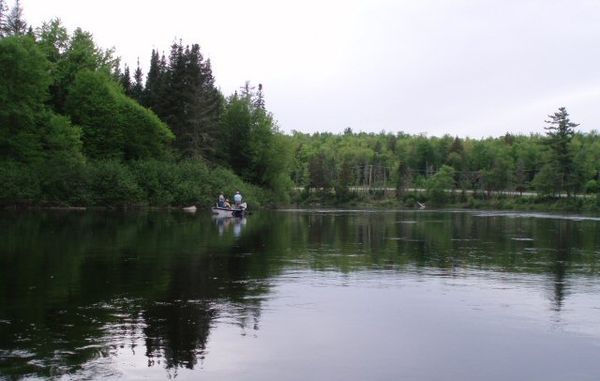
Welcome to Rumford, Maine where we’re chatting with ferry master Jerry Putnam and his dog, Major beside the Androscoggin River. Major is a New Foundland or “Newfie” and while I’m used to big dogs, Major is more like a bear crossed with a tank and yet he’s very friendly.
Androscoggin River, New Hampshire, sadly renowned for its poor water quality.
Please be advised that you’ll be needing to set you watch back more than just a couple of hours to join me on this trip. You see, we’re traveling back to 1885 or thereabouts to hear this tale. By the way, I apologise if the details get a little sketchy on this trip. You see, I’ve never been to America and I’ve never seen a Newfoundland dog beyond Googles images. However, I’ve never let that stop me from spinning a yarn before and it won’t stop me now. I stumbled across this story online in a small Australian country newspaper from 1885. I have no idea how it found its way there but it seems that after all these years, I’ll be sending the story all the way back to Rumford, Maine where I hope it finds a new home.
As you might be aware Newfoundlands are excellent and enthusiastic swimmers and are famed as the lifesavers of the sea. Indeed, there have even been some famous and very impressive rescues carried out by Newfoundlands:
In 1881 in Melbourne, Australia, a Newfoundland named Nelson helped rescue Thomas Brown, a cab driver who was swept away by flood waters in Swanston Street on the night of 15 November. While little is known about what became of Nelson, a copper dog collar engraved with his name has survived and 130 years after the rescue it was acquired by the National Museum of Australia and is now part of the National Historical Collection.
In the early 20th century, a dog that is thought to have been a Newfoundland saved 92 people who were on the SS Ethie which was wrecked off the Northern Peninsula of Newfoundland during a blizzard. The dog retrieved a rope thrown out into the turbulent waters by those on deck, and brought the rope to shore to people waiting on the beach. A breeches buoy was attached to the rope, and all those aboard the ship were able to get across to the shore including an infant in a mailbag. Wreckage of the ship can still be seen in Gros Morne National Park. E. J. Pratt‘s poem, “Carlo”, in the November 1920 issue of The Canadian Forum commemorates this dog.
In 1995, a 10-month-old Newfoundland named Boo saved a hearing-impaired man from drowning in the Yuba River in Northern California. The man fell into the river while dredging for gold. Boo noticed the struggling man as he and his owner were walking along the river. The Newfoundland instinctively dove into the river, took the drowning man by the arm, and brought him to safety. According to Janice Anderson, the Newfoundland’s breeder, Boo had received no formal training in water rescue.
You can watch some Newfoundlands going through their rescue paces here:
By now, I’m sure I’ve whetted your appetites sufficiently and you’re all just longing to find out what Major did. What act of great heroism plucked this ordinary dog out of obscurity and onto the pages of a distant Australian newspaper?
However, there’s an exception to every rule. Just because some dog’s profiles read like a brochure from the Kennel Club, there’s always an exception. Just as people don’t like being categorized, stereotyped or told how they should conform to type, dogs can be much the same.Not that Major almost drowned but he did have a different interpretation of what constitutes a “rescue”.
Or, did he?
After all, what constitutes a rescue? Is it just about saving that drowning person from the surging waters? Or, is it also about encouraging someone to overcome their fear of drowning, let go of the edge and finally learn to swim? What if that person doesn’t respond to “encouragement”? Is it okay to add a bit of persuasion? A nudge? A tug or even the proverbial cattle prod?
Well, you don’t need to ask Major. When it came to helping his canine counterpart overcome his fear, he was a Dog of Action with no time for philosophising, desensitization or phoning a friend. When a brindle hound was too scared to swim out to its owner on the ferry and was howling on the shore, Major grabbed it by the scruff and threw it in the water so it either had to sink or swim.
You’ve got to laugh and who hasn’t been tempted to do that to someone we know, but a bit of compassion doesn’t go astray either.
So, even if another dog is having a full blown panic attack about getting their precious paws wet, you don’t grab him by the scruff and throw him in the drink. After all, most breeds of dog don’t have a Newfoundland’s webbed paws, innate love of swimming and other special design features. They chase sheep.
I’m not putting my paws in there!
Of course, this includes the Border Collie. While our last Border Collie loves chasing sticks through the surf, Bilbo rarely gets his paws wet and it’s taken a lot of angst for him to get to the point where he sometimes now retrieves his ball out of the wash on the beach.
Indeed, Bilbo has had a few newsworthy water avoidances and he could well have been cast as that miserable mutt Major threw into the river.
Finally some assistance. Miss puts Bilbo out of his misery!
A few years ago, when Bilbo saw us all kayaking from the backyard at Palm Beach, he also started howling and fretting just like that other poor hound. Bilbo chewed through the back gate, jumped the back fence and we were about a kilometre from home when we looked out and kids said: “Someone else has a Border Collie”. As we paddled closer, our fears were confirmed. It was our freaked out mutt, giving us the paw: “What do you think you’re doing going out there on that crazy contraption? OMG!!!! You could fall in. Drown!!!! Then, who’s going to feed me?” His heart was racing. He was puffing. The dog was a wreck…so was the gate!
I would never have thrown Bilbo into the water to get him used to it. Yet, over time, he accidentally fell in the pool chasing his ball. He also fell out of the kayak and took our son into the water with him. That could’ve been nasty because he tried grabbing on to Mister which could’ve pulled him under. However, through all of this knockabout exposure and by being part of our family, Bilbo isn’t quite so anxious anymore. He’s stepped out and started filling out those paws, becoming a brave dog.
Meanwhile, here’s the original newspaper story about Major:
A Dog Story.
When Jerry Putnam had charge of the ferry at Rumford, Me., over the Androscoggin River, he owned one of the handsomest Newfoundland dogs I ever saw, and the dog was as intelligent as he was handsome. Like all of his kind, he was fond of the water, and further than that, he manifested an absolute contempt for those of his species who shrank from the aqueous element, and it is of one of those contemptuous manifestations that I wish to tell, for I was there and saw.
The ferryboats, of various sizes, to accommodate different burdens, were impelled by means of a stout cable stretched from shore to shore, as that was the only device by which the heavy boats could be kept to their course in times of strong currents, and during seasons of freshet I have seen a current there that was wonderful.
One warm summer day, while a few of us were sitting in the shade of an old apple tree, between Jerry’s house and the river, two gentlemen, with implements for hunting and fishing, came down to be set across, and straightway one of the boys went to answer the call. He selected a light gondola, the two gentlemen stepped onboard, and very soon they were off ; but before they had got far away from the shore a common brindle house dog came rushing down upon the landing, where he stood and barked and howled furiously— furiously at first, and then piteously.
The boat was stopped, and from the signs made we judged that the strange dog belonged to one of the passengers. Yes, the owner was calling to him to come.
‘Come Ponto! Come !Come! ‘
But Ponto didn’t seem inclined to obey. Instead of taking to the water, he stood there, on the edge of the landing, and howled and yelped louder than before.
Presently old Major — our Newfoundland; who had been lying at our feet, got up and took a survey of the scene. Jerry said only this—’What is it, Major! What dy’e think of it?”
The dog looked around at his master, and seemed to answer that he was thoroughly disgusted. And then he started for the boat-landing — started just as the boy in the boat, at the earnest solicitation of his passenger, had begun to pull back. With dignified step, Major made his way down upon the landing, proceeded directly to the yelping cur, took him by the nape of the neck; and threw him — he did not drop him — but gave him a vigorous, hearty throw, far out into the water ; and when he had done that he stood his ground as though to prevent the noisy, cowardly animal from landing. He stood there until he had seen the cur turn and swim towards the boat — until he had been taken on board by his master— after which he faced about, with military dignity and precision, and came back to his place beneath the apple tree.
— N. Y. Ledger.
The Burrowa News (NSW : 1874 – 1951)Friday 13 March 1885 p 3 Article
Have you ever been to Rumford, Maine or had any experiences with Newfoundlander Dogs? We’d love to hear your tales!
xx Rowena
ooOOoo
Let me add to Rowena’s wish to hear your experiences with Newfoundland Dog’s, or any other dogs!
Returning to the fascinating topic of how dogs understand us humans.
At the beginning of the month I published a post called Be Careful What You Say. It featured an item on BBC Radio Four regarding the science report from a team in Hungary seeking better to understand how dogs process human vocal sounds, as in speech. (The science report was rapidly featured in many other media outlets.)
Anyway, I am delighted to say that the Rights & Permissions Department of the AAAS pointed out that:
Virginia’s article is freely available on our open news website (http://www.sciencemag.org/news) so rather than post, please link to it (http://www.sciencemag.org/news/2016/08/video-your-dog-understands-more-you-think). Your site visitors will encounter no barriers to viewing the article on our website. We welcome hyperlinks to Science articles provided a plain text link is used and providing our content is not framed. We also ask that the text surrounding the hyperlink not imply any endorsement of your website, products or services by AAAS/Science.
The article, written by Virginia Morell, primarily features a video (see below) but I will just republish Virginia’s opening paragraphs.
It’s the eternal question for pet owners: Does your dog understand what you’re saying? Even if Fido doesn’t “get” your words, surely he gets your tone when you let loose about another accident on the carpet. But a new imaging study shows that dogs’ brains respond to actual words, not just the tone in which they’re said. The study will likely shake up research into the origins of language, scientists say, as well as gratify dog lovers.
“It’s an important study that shows that basic aspects of speech perception can be shared with quite distant relatives,” says Tecumseh Fitch, a cognitive biologist at the University of Vienna, who was not involved in the work.
The new results add to scientists’ knowledge of how canine brains process human speech. Dogs have brain areas dedicated to interpreting voices, distinguishing sounds (in the left hemisphere), and analyzing the sounds that convey emotions (in the right hemisphere).
The finding “doesn’t mean that dogs understand everything we say,” says Julie Hecht, who studies canine behavior and cognition at City University of New York in New York City and who was not involved in the study. “But our words and intonations are not meaningless to dogs.” Fitch hopes that similar studies will be done on other domestic animals and on human-raised wolves to see how much of this ability is hardwired in dogs and how much is due to growing up among talking humans.
What a wonderful relationship dogs and humans have with each other!
This is no sinecure – the future of mankind is at risk.
Very often I find a topic for Saturday that is easy on the mind. But I make no apologies for republishing, with Jennifer’s permission, a post that she published over on Transition Times yesterday. When you read it you will see clearly that promoting this today is right. For many readers may well be able to join thousands of others in showing their support for the Standing Rock Sioux tribe.
Thousands of Native Americans, members of a whole host of tribes, have gathered at Standing Rock, North Dakota, to protest the North Dakota Access Pipeline (#NoDAPL), which was sited by the Army Corps of Engineers to run dangerously close to the Missouri River and the Standing Rock Reservation.
If there is anyone to look back at this turbulent period in human history on Earth—now coming to be known as the Anthropocene—they will surely wonder at the suicidal tendency of human civilization in the 20th and early 21st centuries.
Why, they will ask, would such an intelligent species willingly—even enthusiastically—engage in the poisoning of its waterways and underground water resources; the destruction of its forests; the chemical contamination of its soils and oceans; the overheating of its precious atmosphere by relentless burning of fossil fuels? Why would humans put so much of their intelligence and technological prowess into developing ever more lethal weapons of mass destruction, used to bludgeon each other? Why would they preside blithely over the extinction of millions of other species, the vicious ripping of the great ecological web of life on Earth?
Why indeed?
I know it’s hard for any of us to escape the clutter of our everyday lives, with the constant pressures and worries that beset us on the personal level. But this is precisely what is being asked of us now.
The courageous defenders out at Standing Rock dropped their ordinary lives to be part of the historic encampment protesting the stranglehold of the oil companies on our waterways and our lands. They are fighting in the courts, through the media, and most importantly with their physical presence, standing up to the bulldozers, the attack dogs and the pepper spray.
Image source: Democracy Now!
This is what McKibben’s World War Three looks like—it’s already begun. It will be fought locally, as communities and individuals wake up to the implications of the destruction and decide that hell no, they won’t take it any more.
In my own corner of the world, we are under assault from General Electric, wanting to create toxic waste dumps right in the middle of our small rural towns. We have a gas pipeline being constructed, despite vehement protests, through a pristine old-growth state forest. We have oil tanker trains running constantly right through our communities. Despite a thriving organic and biodynamic farm renaissance, we still have far too many pesticides, herbicides and fungicides being used locally, and too many trees being cut down.
I have been thinking and writing for some time now about how important it is to align the personal, political and planetary in our own lives and in the way we relate to the world around us. On all three of these levels, 21st century American life is way out of balance.
It is time to focus, each one of us, on using our brief lifetimes to create balance and harmony on Earth. Sometimes the way to harmony leads through protest and discord, as is happening now in Standing Rock. Sometimes it can be as simple as choosing to support local, low-impact agriculture rather than industrial agriculture. Leaning on our political representatives to move faster on policy that will shift our society to renewable energy is key.
There are so many ways to get involved in this War for the Planet, many of them quite peaceful. The important thing is to get off the sidelines. Get involved. Feel the potential of this moment—it’s literally a make or break period for the future of humanity on Earth, and many other living beings too.
The brave defenders at Standing Rock are reminding us that we are all “natives” of this Earth, and we all have a stake in protecting her. Which side are you on?
ooOOoo
Yes, we are all natives of this world and that includes our dear animals and our wonderful animal companions.
Make a promise to yourself to make a difference; even one small difference. With that in mind, if you want to find an event close to you then the Sierra Club have a page where you can look up which event you would like to attend.
By chance a work colleague in my workplace in Sydney introduced me to an organization called Rostrum. They still exist today and as their ‘About’ page on their website explains:
The History of Rostrum
Rostrum Australia is an association of public speaking clubs, founded on 21 July 1930. The original Rostrum club (“The Rostrum”) was founded in Manchester, England, on 21 July 1923 and its first meeting was held under a yew tree at Greendale Farm near Manchester. The first meeting in Australia was held under an Angophora tree in 1930.
This makes Rostrum the longest-running public speaking organisation in the world.
General Information
Rostrum clubs aim to help their members improve their speaking and meeting skills. They do this primarily through regular club meetings and less frequent competitions. The main national competition for members is the Sidney Wicks Speaking Competition, held about every 6 years. State and territory competitions are held throughout the year.
It was a marvelous connection for me for later on in life I was required to give many public speeches.
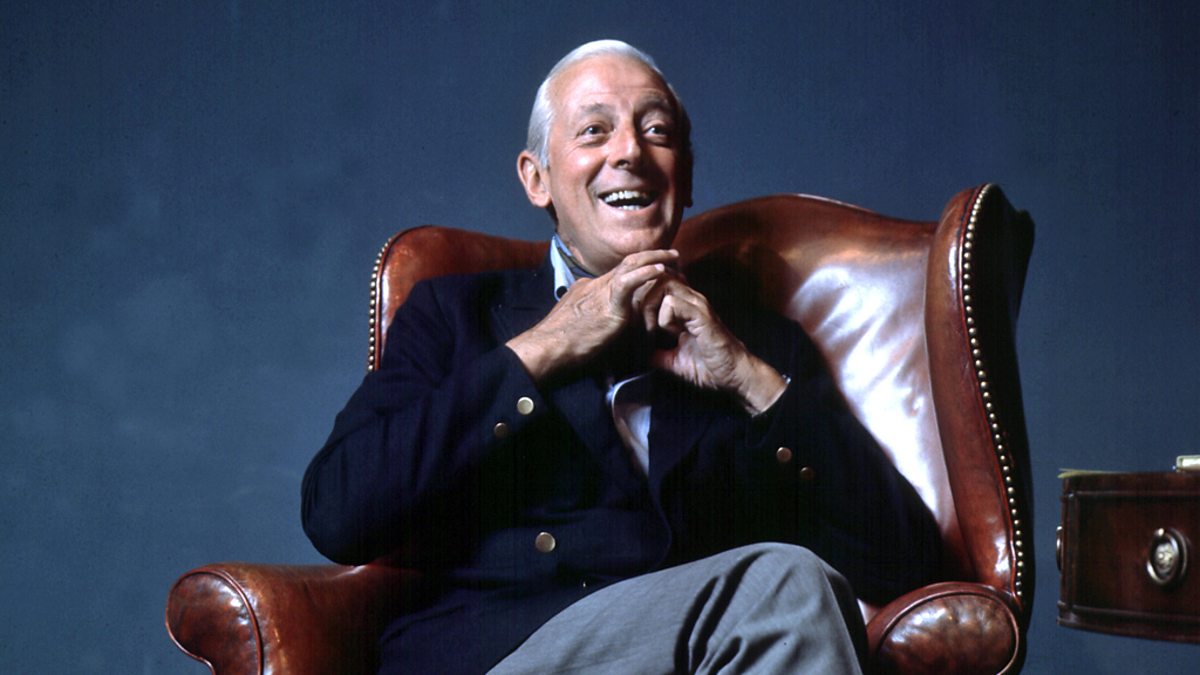
Anyway, back to those days in Sydney. I still recall how one meeting was devoted to listening to and understanding one of the most eloquent and masterful speakers ever: Alistair Cooke. Listening to Alistair Cooke’s Letter from America on BBC radio was a passion for me until the day he died.
Alistair Cooke, KBE (20 November 1908 – 30 March 2004) was a British journalist, television personality and broadcaster.[1] Outside his journalistic output, which included Letter from America and Alistair Cooke’s America, he was well known in the United States as the host of PBS Masterpiece Theatre from 1971 to 1992. After holding the job for 22 years, and having worked in television for 42 years, Cooke retired in 1992, although he continued to present Letter from America until shortly before his death. He was the father of author and folk singer John Byrne Cooke.
It was a great pleasure to discover that the BBC still holds archives of many of the broadcasts of Letter from America but, in addition, some of Alistair Cooke’s broadcasts are on YouTube.
Please settle down for 15 minutes and listen to one of best writers and speakers to have graced this world.
Broadcast on Fri 12 Dec 1980, BBC Radio
The shooting of John Lennon on the 8th December 1980 sparks a debate over the need for national gun control law in America.
Thomas Merton was an author who was born January 31st, 1915 and died on December 10th, 1968.
As part of the process of slowing down the progress of Parkinson’s Disease Jean is participating in three therapy sessions each week at the Outpatient’s Clinic at our local Three Rivers Hospital. One of the those sessions is physical therapy. I sat in on the initial introductory session and was fascinated by how much emphasis was placed on Jean’s ability to balance properly (and she was very good – better than me at times). Apparently a decline in one’s balance is an indicator of the brain not functioning as it should.
Psychologically and emotionally maintaining “an even keel” is vital to dealing with the countless ‘events’ that come our way every day.
I have been a follower of Val Boyco’s blog Find Your Middle Ground for some time and frequently read posts that reach out to me way beyond the words on the screen. As it was with a post published last Thursday: Steps to Find your Middle Ground.
It is republished here with Val’s very kind permission.
ooOOoo
Steps to Find your Middle Ground
Posted on August 18, 2016 by Val Boyko
This list is for all the list people out there. Enjoy the steps I have discovered in finding my own middle ground and living life in balance 💛
Notice! Take time to pause and be aware of the incredible gift of life that you share with others and with nature. Wake up to the little things. Wake up to your self. Wake up to it all. This is called living mindfully. Become a keen observer.
Accept that life has ups and downs. Really! Some one told us when were little that life should be a breeze. This is called wishful thinking. Be grateful for the highs and graceful in the lows. This is called living life well.
Become present. Stop lamenting the past or worrying about tomorrow. Living is in each moment. Now. Take a deep breath. Then another. Notice you are still here… not there.
Get to know yourself. Take that first scary step of self-discovery. Turn off the tv. Sit for a while. Journal about what comes up. Have a meaningful conversation. Listen more to others. Listen more to yourself.
Let go of judgments. We think that judging others or ourselves makes us feel strong. Judgments come from fear of not being in control and having things go our way. Our way is not the way. There is nothing wrong, so stop trying to be right. Stop comparing, criticizing and start letting others be. Let yourself be.
Realize that you are not your thinking. You are the one who is aware of your thoughts. You are awareness within a physical body, with an imaginative and fearful ego-mind that creates stories. Your thinking is not the truth about who you are or the world around you.
Find the peace within. Beyond the next breath and the next thought there is a deep reservoir of peace waiting to be stepped into. This cool refreshing stillness has always been there and will always be there for us to access. To connect to this wondrous pool becomes our practice… whether it’s in mindfulness meditation, yoga, sitting in nature, or while commuting on the train, realize that you too can find your own middle ground.
This blog is my way of helping people get their feet wet.
Photo by Larry Hobbell
ooOOoo
Now go and read that quote again by Thomas Merton.


 I don’t know about Jane Eyre but Annabelle Troy comes over as real enough!