A closer look at the excellent work undertaken by Dr. Krista Varady.
Back on the 16th I wrote a post that was a follow-up to the previous day’s post about living a long life. My follow-up was called, hardly surprisingly, Postscript to Long Life post.
In that follow-up post, I wrote this,
Over on the Healthy Fellow blogsite, there’s an interview with Dr. Varady. The web link of that interview is here and crossing over and reading the full interview is much recommended. Here’s a taste, pardon the pun, of that interview:
JP: Can you help explain the distinctions between alternate day fasting and caloric restriction?
Dr. Varady: Caloric restriction is basically daily calorie restriction where an individual would restrict themselves by about 15% to 40% of their energy needs daily. So basically every single day you’re undergoing the same amount of restriction, whereas alternate day fasting involves a fast day wherein the individual would only eat 25% of their energy needs. So about 500 calories or so and that’s alternated with something called a “feed day” where the individual would eat ad libitum – so as much as they want. However in our studies we show that people end up losing weight because they can’t fully make up for the lack of food on the fast day on the feed day.
I’ve been in touch with JP wondering if I might have permission to republish the full interview. Unfortunately that wasn’t possible. However JP did say that republishing a couple of paragraphs would be fine and I’m going to be cheeky in adding a couple to the one I already published above!
Anyway, before inserting those paragraphs, let me set the scene. A very quick web search comes across the fact that Dr. Varady is an Assistant Professor at the UIC College of Applied Health Sciences. Her research work is described thus,
Research Interests
Dr. Varady, PhD
My research investigates the ability of novel dietary restriction strategies to facilitate weight loss and decrease cardiovascular risk in obese subjects. The most common dietary restriction protocol implemented is daily calorie restriction (CR), which involves reducing energy intake by 15 to 40% of needs daily. Another dietary restriction regimen employed, although far less commonly, is alternate day fasting (ADF). ADF regimens include a “feed day” where food is consumed ad-libitum over 24-h, alternated with a “fast day”, where food intake is partially or completely reduced for 24-h. ADF regimens were created to increase adherence to dietary restriction protocols since these regimens only require energy restriction every other day, rather than every day, as with CR. Recent findings from our lab demonstrate that ADF is an effective means of facilitating weight loss and improving several indicators of cardiovascular disease risk in overweight and obese subjects. Our findings also show that changes in adipose tissue physiology during weight loss may mediate these improvements in vascular health.
Current research activities
Developing novel diet and exercise regimens to facilitate weight loss and decrease cardiovascular disease risk in humans; Examining the intermediate role of adipose tissue in mediating the cardio-protective effects of diet and exercise; Investigating the behavioral factors that influence adherence to dietary restriction strategies.
So this is one lady that ought to understand the effects of what we shovel down our mouths. OK, on to that interview. From Part One, I selected this exchange,
JP: How long does it generally take for people to adapt to this new way of eating?
Dr. Varady: A lot of the subjects were saying that for the first two weeks it was pretty tough to basically change from a 3 meal a day eating pattern to just eating 1 meal a day and then 3 slightly bigger meals the next day. But they said that about after two weeks they totally got used to it and weren’t that hungry on the fast day anymore. They could undergo these really long periods of fasting without really feeling deprived. The other interesting thing that they were telling us was with regard to the feed day. The people didn’t binge. They only ate about 100% to 110% of their calorie needs.
Then from the second part of the interview, JP underlines an important point, “The truth of the matter is that research into ADF is still in its infancy and Dr. Varady is the first person to admit it. ” I then went on to select this exchange between JP and Dr. Varady,
JP: It seems as though ADF provides a very broad array of health benefits. Do you have a theory about why this is possible?
Dr. Varady: In the human data the main thing you see is weight loss. Even if it’s done in normal weight people. The minute you start losing weight you all of a sudden see an improvement in the majority of these factors. A lot of the effects of alternate day fasting are mediated through weight loss. Losing weight is so tightly correlated with your blood pressure, your cholesterol levels and heart rate, etc.
Fasting May Reduce Age-Related Disease Risk Factors
So this is not something of trivial interest, it’s serious research that could have a remarkable effect on the huge problems of obesity and poor diet that affect millions. Do yourself a favour and read the interview now. Part One and Part Two.
Finally, in that post on the 16th, I owned up to having got my weight down to 161.6 lbs (73.30 kgs). Now here we are having completed my third week of 5:2 fasting and last Saturday morning my weight was 159.0 lbs (72.12 kgs). The routine is very comfortable and as Dr. Varady mentioned, there is no sense of wanting to binge after the two days of fasting.
Just about the most fundamental requirement in life!
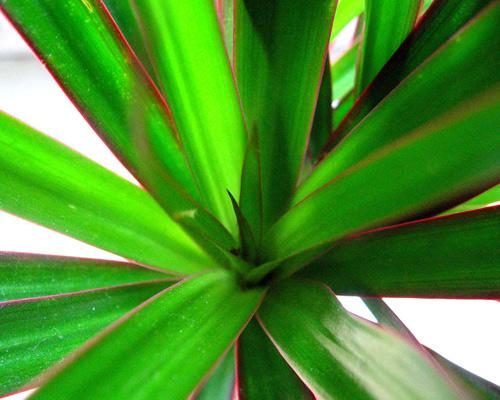
I subscribe to the Mother Nature Network website and recently in their ’round robin’ was this item, A Breath of Fresh Air. It’s all about the role of plants inside the home for improving the quality of the air we breathe. Thought, dear reader, that you would enjoy this.
15 houseplants for improving indoor air quality
Photo: ivama/Flickr
A breath of fresh air
In the late ’80s, NASA and the Associated Landscape Contractors of America studied houseplants as a way to purify the air in space facilities. They found several plants that filter out common volatile organic compounds (VOCs). Lucky for us the plants can also help clean indoor air on Earth, which is typically far more polluted than outdoor air. Other studies have since been published in the Journal of American Society of Horticultural Science furtherproving the science. Want to see the best flowers? Just click through the buttons above to see all 15 plants. (Text: Julie Knapp)<
The image above is just one of 17, each with details of how they contribute to cleaner, less toxic, air. So don’t delay, click here and read all about them yourself. Here’s an example of the presentation from picture number 16.
Peace lily (Spathiphyllum)
Shade and weekly watering are all the peace lily needs to survive and produce blooms. It topped NASA’s list for removing all three of most common VOCs — formaldehyde, benzeneand trichloroethylene. It can also combat toluene and xylene.
Remaining with the theme of love, love lost and new love.
John Hurlburt sent me the following last week and it is so perfect as a sequel to the writings of the last two days. That was John’s poetry last Saturday on Learning from Dogs, by the way.
oooOOOooo
Two lost souls
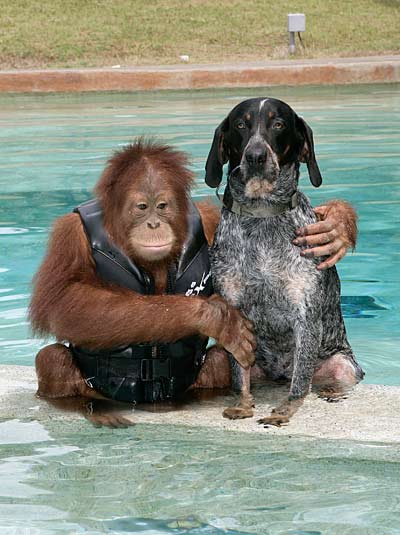
After losing his parents, this three year old orangutan was so depressed he wouldn’t eat and didn’t respond to any medical treatments. The veterinarians thought he would surely die from sadness.
The zoo keepers found an old sick dog on the grounds in the park at the zoo where the orangutan lived and took the dog to the animal treatment center. The dog arrived at the same time the orangutan was there being treated.
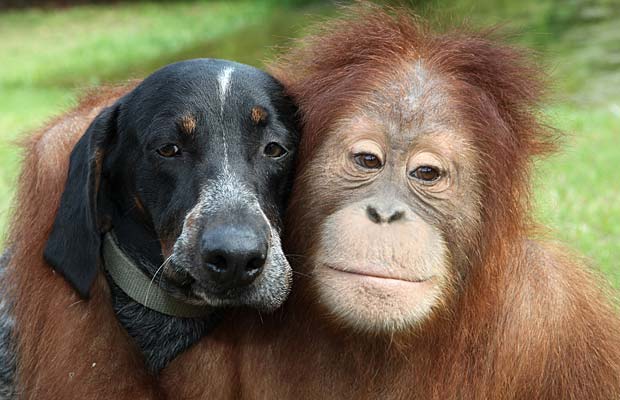
The two lost souls met and have been inseparable ever since. The orangutan found a new reason to live and each always tries his best to be a good companion to his new found friend. They are together 24 hours a day in all their activities.
They live in Northern California where swimming is their favorite past-time, although Roscoe (the orangutan) is a little afraid of the water and needs his friend’s help to swim.
Together they have discovered the joy and laughter in life and the value of friendship.
They have found more than a friendly shoulder to lean on.
Long Live Friendship!
I don’t know, but some say life is too short, others say it is too long, but I know that nothing that we do makes sense if we don’t touch the hearts of others. While it lasts!
May you always have love to share, health to spare, and friends who care…..even if they are a little hairy at times.
oooOOOooo
I must say that the generosity of so many of my readers in sending me these beautiful examples of what is really important in this world of ours touches me deeply. Thank you, John. Thank you, one and all.
How the relationship that we have with domesticated animals taught us the meaning of love.
This exploration into the most fundamental emotion of all, love, was stimulated by me just finishing Pat Shipman’s book The Animal Connection. Sturdy followers of Learning from Dogs (what a hardy lot you are!) will recall that about 5 weeks ago I wrote a post entitled The Woof at the Door which included an essay from Pat, republished with her permission, that set out how “Dogs may have been man’s best friend for thousands of years longer than we realized“.
The following day, I wrote a further piece introducing the book and then commenced reading it myself. Please go there and read about the praise that the book has received.
What I want to do is to take a personal journey through love. I should add immediately that I have no specialist or professional background with regard to ‘love’ just, like millions of others, a collection of experiences that have tapped me on the shoulder these last 67 years.
I would imagine that there are almost as many ideas about the meaning of love as there are people on this planet. Dictionary.com produces this in answer to the search on the word ‘love’.
love
[luhv] noun, verb, loved, lov·ing. noun
a profoundly tender, passionate affection for another person.
a feeling of warm personal attachment or deep affection, as for a parent, child, or friend.
sexual passion or desire.
a person toward whom love is felt; beloved person;sweetheart.
(used in direct address as a term of endearment, affection,or the like): Would you like to see a movie, love?
But, I don’t know about you, those definitions leave something missing for me. Here’s my take on what love is, and it’s only by having so many dogs in my life that I have found this clarity of thought.
Love is trust, love is pure openness, love is knowing that you offer yourself without any barriers. Think how you dream of giving yourself outwardly in the total surrender of love. Reflect on that surrender that you experience when deeply connecting, nay loving, with your dog.
Here’s how Pat Shipman expressed it in her book:
Clearly, part of the basis of our intimacy with tame or domesticated animals involves physical contact. People who work with animals touch them. It doesn’t matter if you are a horse breeder, a farmer raising pigs, a pet owner, a zoo keeper, or a veterinarian, we touch them, stroke them, hug them. Many of us kiss our animals and many allow them to sleep with us. We touch animals because this is a crucial aspect of the nonverbal communication that we have evolved over millennia. We touch animals because it raises our oxytocin levels – and the animal’s oxytocin levels. We touch animals because we and they enjoy it. (p.274)
Pat soon after writes,
From the first stone tool to the origin of language and the most recent living tools, our involvement with animals has directed our course.
Thus it is not beyond reason to presume that tens of thousands of years of physical and emotional closeness between humans and their animals have developed the emotion of love in us humans, so eloquently expressed in art and life.
There’s another aspect of what we may have learned from dogs. In Alexandra Horowitz’s book Inside of a Dog, she writes of the way that dogs look at us,
Having been folded into the world of humans, dogs no longer needed some of the skills that they would to survive on their own. As we’ll see, what dogs lack in physical skills, they make up for in people skills.
AND THEN OUR EYES MET ….
There is one final, seemingly minor difference between the two species. This one small behavioral variation between wolves and dogs has remarkable consequences. The difference is this: dogs look at our eyes.
Dogs make eye contact and look to us for information – about the location of food, about our emotions, about what is happening. Wolves avoid eye contact. In both species, eye contact can be a threat: to stare is to assert authority. So too is it with humans. In one of my undergraduate psychology classes, I have my students do a simple field experiment wherein they try to make and hold eye contact with everyone they pass on campus. Both they and those on the receiving end of their stares behave remarkably consistently: everyone can’t wait to break eye contact. It’s stressful for the students, a great number of whom suddenly claim to be shy: they report their hearts begin to race and they start sweating when simply holding someone’s gaze for a few seconds. They concoct elaborate stories on the spot to explain why someone looked away, or held their gaze for a half second longer. For the most part, their staring is met with deflected gazes from those they eyeball.
Then a few sentences later, Alexandra continues to write,
Dogs look, too. Though they have inherited some aversion to staring too long at eyes, dogs seem to be predisposed to inspect our faces for information, for reassurance, for guidance. Not only is this pleasing to us – there is a certain satisfaction in gazing deep into a dog’s eyes gazing back at you – it is also perfectly suited to getting along with humans. (pps 45-46)
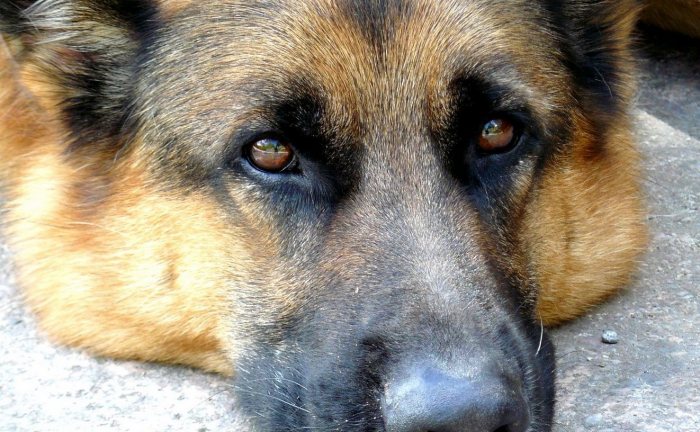
No apologies for now inserting the photograph of Pharaoh that adorns the Welcome page of Learning from Dogs. Underlines what Alexandra wrote above in spades.
Now that is a gaze!
OK, time to start bringing this to a close.
The Toronto Star ran a great review of Pat Shipman’s book from which I will just take this snippet,
“But understanding animals and empathizing with them also triggered other changes in humanity’s evolution, Shipman said.
All those things allow people to live with people. Once people have domesticated animals, they start to live in stable groups. They have fields, crops and more permanent dwellings.”
In other words, we can see that living with animals took us from nomadic hunter-gatherers to living with other people in stable groups; the birth of farming. It is my contention that the evolution of communities and the resulting more stable relationships elevated love leading to love becoming a higher order emotion than just associated with the ‘grunt’ of reproduction.
I started by saying that it was Pat Shipman’s book that stimulated me to wander through my own consciousness and realise that when I bury my face in the side of one of the dogs, say on the bed, it resonates with the most ancient memories in my human consciousness. Indeed, I am of no doubt that my openness and emotional surrender to that dog enables me to be a better, as in more loving, person for Jean.
So let me close this essay by asking you to return here and read the guest post tomorrow from author Eleanore MacDonald, where Eleanore writes of the loss of their dog Djuna. You will read the most precious and heart-rending words about love. Thank you.
More information about fasting, not about being female!
In yesterday’s post on Learning from Dogs, I wrote that there are two important aspects of living a longer life. The first one was be a female and the second one was about fasting. I propose to expand a little on that second aspect because of the number of people who found the topic so interesting.
Valter D. Longo and students.
In yesterday’s post there was reference to the work that Professor Valter D. Longo of the University of Southern California (USC) has been undertaking. As the USC web reference explains, Valter Longo is the Director of the Longevity Institute, a Professor of Gerontology and Biological Sciences and the Edna Jones Chair of Biogerontology, so if anyone understands how humans tick, it’s likely to be this man! As his research overview states,
He is interested in understanding the mechanisms of aging in organisms ranging from yeast to humans. The focus is on the conserved nutrient signaling pathways that can be modulated to protect against age-dependent oxidative damage and delay or prevent diseases of aging including cancer, diabetes and neurodegenerative diseases.
(Any questions, ask Prof. Longo not me!)
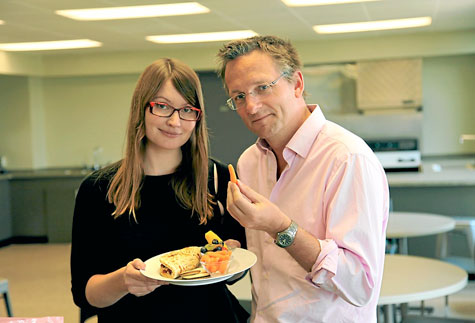
BBC Presenter Michael Mosley with Dr Krista Varady
The other learned person referred to in yesterday’s post was Dr. Krista Varady. This is what was written,
Dr Krista Varady of the University of Illinois at Chicago carried out an eight-week trial comparing two groups of overweight patients on ADF. (ADF = Alternative Day Fasting)
Over on the Healthy Fellow blogsite, there’s an interview with Dr. Varady. The web link of that interview is here and crossing over and reading the full interview is much recommended. Here’s a taste, pardon the pun, of that interview:
JP: Can you help explain the distinctions between alternate day fasting and caloric restriction?
Dr. Varady: Caloric restriction is basically daily calorie restriction where an individual would restrict themselves by about 15% to 40% of their energy needs daily. So basically every single day you’re undergoing the same amount of restriction, whereas alternate day fasting involves a fast day wherein the individual would only eat 25% of their energy needs. So about 500 calories or so and that’s alternated with something called a “feed day” where the individual would eat ad libitum – so as much as they want. However in our studies we show that people end up losing weight because they can’t fully make up for the lack of food on the fast day on the feed day.
Let me add a personal perspective on this. On the morning of the first day after our two-day fast, my weight was 162.5 lbs (73.71 kg), on the morning of the second day after our fasting days my weight was 161.8 lbs (73.39 kgs) and on the morning of the third day after our fasting, my weight was 161.6 lbs (73.30 kgs). Ergo even though we were back to eating normally for three days after our two days of fasting, I continued to lose 0.9 lbs (0.4 kgs).
So if you have any concerns over cardiovascular health or want to explore a realistic way of losing excess weight, then do read the interview. Part One of that interview is here and Part two here.
As is said, we are what we eat and I shall close this postscript with a link to an article on the Mother Nature Network website that was published a little over a year ago: 18 foods that fight common ailments – Try healthy eats that help fight diabetes, heart disease, migraines and more.
OK, a change to the theme of the last few days, to a topic that must cross the minds of practically every single human being at some point; what is our lifespan going to be? Who doesn’t want to live a long and healthy life, and I don’t wish to be insensitive to those who labour under mental and physical troubles, of course.
So a recent couple of fascinating stories have given an insight into just how to live that longer and healthier life.
The first one is easy – be a woman!
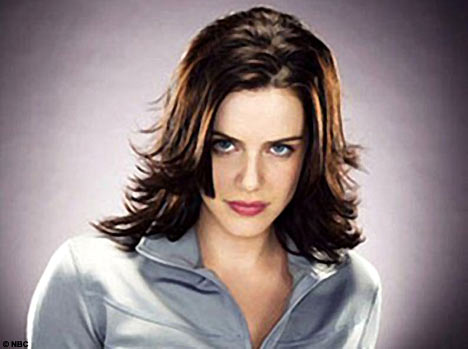
Actress Michelle Ryan as the Bionic Woman was destined to live even longer!
OK, a bit of an issue if you are a man like me but did you realise, because I didn’t, that being the female of many species offers a significant advantage. This came from a BBC item published on the 2nd August, from which I quote,
Scientists believe they have discovered a clue to why women tend to live longer than men – by studying fruit flies.
Writing in Current Biology, they focus on mutations in mitochondrial DNA – the power source of cells.
Mitochondria are inherited only from mothers, never from fathers, so there is no way to weed out mutations that damage a male’s prospects.
Then came an extraordinary fact [my italics below],
By the age of 85, there are approximately six women for every four men in the UK, and by 100 the ratio is more than two to one.
And females outlive males in many other species.
If you are of the scientific bent and/or a woman! you can read a fuller account of the research findings on the Science Daily website. As well as that link you can also read the Monash University press release on those research findings.
As a fella’ I think I’m moving on!
The second one is almost as easy – Fasting
Again, this news came from the BBC website, the news about the power of fasting. In an article promoting the showing of a BBC Horizon programme, Michael Mosley wrote this,
Scientists are uncovering evidence that short periods of fasting, if properly controlled, could achieve a number of health benefits, as well as potentially helping the overweight, as Michael Mosley discovered.
I’d always thought of fasting as something unpleasant, with no obvious long term benefits. So when I was asked to make a documentary that would involve me going without food, I was not keen as I was sure I would not enjoy it.
But the Horizon editor assured me there was great new science and that I might see some dramatic improvements to my body. So, of course, I said, “yes”.
I am not strong-willed enough to diet over the long term, but I am extremely interested in the reasons why eating less might lead to increased life span, particularly as scientists think it may be possible to get the benefits without the pain.
For obvious reasons I can’t republish the full BBC article but I encourage you to read it here. And stay with me for some more research links that are most interesting.
But I will just include this part from the BBC item,
The IGF-1 hormone (insulin-like growth factor) is one of the drivers which keep our bodies in go-go mode, with cells driven to reproduce. This is fine when you are growing, but not so good later in life.
There is now evidence suggesting that IGF-1 levels can be lowered by what you eat. Studies on calorie restrictors suggest that eating less helps, but it is not enough.
As well as cutting calories you have to cut your protein intake. Not entirely – that would be a very bad idea. It’s about sticking to recommended guidelines, something most of us fail to do.
The reason seems to be that when our bodies no longer have access to food they switch from “growth mode” to “repair mode”.
As levels of the IGF-1 hormone drop, a number of repair genes appear to get switched on according to ongoing research by Professor Valter Longo of the University of Southern California.
Intermittent fasting
One area of current research into diet is Alternate Day fasting (ADF), involving eating what you want one day, then a very restricted diet (fewer than 600 calories) the next, and most surprisingly, it does not seem to matter that much what you eat on non-fast days.
Dr Krista Varady of the University of Illinois at Chicago carried out an eight-week trial comparing two groups of overweight patients on ADF.
“If you were sticking to your fast days, then in terms of cardiovascular disease risk, it didn’t seem to matter if you were eating a high-fat or low-fat diet on your feed (non-fast) days,” she said.
Michael Mosley explains how he couldn’t manage Alternate Day Fasting and found it was just too impractical.
Instead I did an easier version, the so-called 5:2 diet. As the name implies you eat normally 5 days a week, then two days a week you eat 500 calories if you are a woman, or 600 calories, if you are a man.
The BBC Horizon programme was screened on the 6th August but is available on the BBC iPlayer for UK viewers. Here’s how it was promoted on the BBC website,
Michael Mosley has set himself a truly ambitious goal: he wants to live longer, stay younger and lose weight in the bargain. And he wants to make as few changes to his life as possible along the way. He discovers the powerful new science behind the ancient idea of fasting, and he thinks he’s found a way of doing it that still allows him to enjoy his food. Michael tests out the science of fasting on himself – with life-changing results.
This programme clip will also attract your attention, trust me!
and if you would prefer a more inspiring antidote then here’s another clip from the programme,
Tomorrow, I’m going to link to the scientists behind these new findings because this is very significant research that could revolutionize the future health for millions.
Finally, I’m here to tell you that Jean and I have ‘signed up’ to the 5:2 pattern and had our fast days last Thursday and Friday. They were much easier than I expected and, frankly, will be fun to maintain. Leave a comment if you would like details of the food and calorific values of what Jean served those two days.
Normally my week-end posts are lighthearted. But I do hope you will forgive the departure for today.
Regular readers of Learning from Dogs will recall that on the 2nd August I published a piece under the title of Changing the person: Me. It offered several examples of how personal change or transition is tough but that the rewards that come from understanding the personal and emotional consequences of big life changes are immense. As I wrote then,
The most important thing to note, and this is why so many ‘change’ ambitions fail, is that change is deeply unsettling at first. When change happens for the majority of us, often ‘forced’ on us as a result of unplanned life events, we are left deeply unsettled; a strong feeling of being lost, of being in unfamiliar surroundings. Think divorce or, worse, the death of a partner or child, reflect on how many sign up for bereavement counselling in such circumstances. Big-time change is big-time tough (apologies for the grammar!).
Then I came across the story of how Eric Clapton coped when his four-year-old son fell from the window of the 53rd-floor window of his mother’s friend’s New York City apartment. Here’s an extract from the WikiPedia entry:
The years following 1990 were extremely turbulent for Clapton. In August 1990, his manager and two of his roadies (along with fellow musician Stevie Ray Vaughan) were killed in a helicopter accident. Seven months later, on March 20, 1991, Clapton’s four-year-old son Conor died after falling from the 53rd-floor window of his mother’s friend’s New York City apartment. He landed on the roof of an adjacent four-story building. After isolating himself for a period, Clapton began working again, writing music for a movie about drug addiction called Rush. Clapton dealt with the grief of his son’s death by co-writing “Tears in Heaven” with Will Jennings.
Here’s Tears in Heaven. Please stop whatever you are doing now and play this video. In under 5 minutes it demonstrates the power of the saying from Henry David Thoreau, the American author and poet – “Not until we are lost do we begin to understand ourselves”.
In an interview with Daphne Barak, Clapton stated, “I almost subconsciously used music for myself as a healing agent, and lo and behold, it worked… I have got a great deal of happiness and a great deal of healing from music“.
Eric Clapton
Let me close with another saying, this time from George Moore, the novelist, “A man travels the world over in search of what he needs and returns home to find it.”
Nature, once again, shows the value of loving contact during those crucial early years.
I’m writing this at 7.45am on the 30th. Coincidentally, Jean and I were chatting in bed about an hour ago about this ‘touchy – feely’ stuff. This was a bed having four dogs on it! One of those, Hazel, was laying alongside my left leg just sucking up me stroking her head and tummy. Jean and I were musing that for animals and humans, how we are touched by our parents, especially our mother, during those first few years of growing up has profound implications for how we as adults respond to being touched and hugged.
So then I opened up my mail box and there was this sent by Cynthia Gomez serving as a wonderful reminder of the power of touch. Thanks Cynthia, great timing!
oooOOOooo
Some pictures just don’t need captions.
There is nothing like Mom’s lap no matter who you are. This is precious !!!!
This is a newborn offspring of Taskin, a Gypsy Stallionowned by
Villa Vanners of Oregon ..
These pictures were taken immediately after his birth on April 6.
The mare laid down, and then he trotted around and
The cumulative effect of millions of decisions brings about change!
Yesterday’s Post was about personal change. It came on the back of a short series that was triggered by the Bill McKibben essay in Rolling Stone magazine that I republished on 31st July. If you haven’t read it, do yourself a favour and read it soon.
The essay highlighted the challenge of how we change our ways, that is at a personal level, which is why I decided to devote a complete Post to the subject of change. There was no doubt that the McKibben essay opened our eyes to the need for change, if they weren’t open already. So being clear about the need for change and how, initially, it can make us feel less sure of ourselves, where do we go from here? As John Fisher explains, within the change process, there is the stage where things start to happen. This is what he writes about that stage,
Moving forward
In this stage we are starting to exert more control, make more things happen in a positive sense and are getting our sense of self back. We know who we are again and are starting to feel comfortable that we are acting in line with our convictions, beliefs, etc. and making the right choices. In this phase we are, again, experimenting within our environment more actively and effectively.
Keep this stage in mind as you journey along your individual path towards reducing your impact on the planet. It really does act as a beacon for you, as a candle in the darkness.
OK, there’s an old saying in business ‘if you can’t measure it you can’t manage it!‘ So let’s start off by calculating the CO2 we are presently responsible for.
There are a number of CO2 calculators available on the Web but this one from The Resurgence Trust website seems as good as any. Easy to use and it provides a starting point from which to plan your attack! Make a promise to calculate your present CO2 output, soon!
Then to the plan of action! A web search on reducing CO2 produces a huge number of results and I recommend that you undertake your own trawl to find the information that ‘rocks your boat’. But on the Brave New Climate website there’s a summary that caught my eye, especially how it was introduced:
Top 10 ways to reduce your CO2 emissions footprint
Solving climate change is a huge international challenge. Only a concerted global effort, involving the governments of all nations, will be enough to avert dangerous consequences. But that said, the individual actions of everyday people are still crucial. Large and complex issues, like climate change, are usually best tackled by breaking down the problem into manageable bits.
For carbon emissions, this means reducing the CO2 contribution of each and every one of the six and a half billion people on the planet. But what can you, as an individual person or family, do that will most make a difference to the big picture? Here are my top ten action items, which are both simple to achieve and have a real effect. They are ranked by how much impact they make to ‘kicking the CO2 habit’.
Then follows ten solid recommendations:
Make climate-conscious political decisions.
Eat less red meat.
Purchase “green electricity“.
Make your home and household energy efficient.
Buy energy and water efficient appliances.
Walk, cycle or take public transport.
Recycle, re-use and avoid useless purchases.
Telecommute and teleconference.
Buy local produce.
Offset what you can’t save.
Each of these recommendations is supported by great web links and plenty of advice. So don’t just skip through those 10 options, go here and commit to doing something!
And when you are ready to involve others beyond your family, 350.org has a great selection of resources for potential organizers.
It is better to light a candle than curse the darkness. – Chinese Proverb
Yesterday, in a post that picked up on the deep implications of Bill McKibben’s chilling essay on where the world is heading if we don’t change, I set out my understanding of what holds us back from that change. I wrote, “ … the process of change cannot start until we truly want to change; a total emotional commitment. And the formation of those emotions, that realisation, requires a new understanding of the world around us, who we are and who we want to be.”
Previously on Learning from Dogs I have quoted Jon Lavin, “The best way to save the world is to work on our selves.” I remember decades ago when working as a humble office-products salesman for IBM UK the well-worn saying, “Selling is 90% me and 10% the customer.” Sort of reminds me of Woody Allen’s: “Eighty percent of success in life is showing up.”
OK, enough of these mental perambulations. Let’s get on with the task of looking at change. Because make no bones about it, if we rely on ‘them’, on others, to turn mankind back from where we are heading then it’s all over! It comes down to each and every one of us deciding to change.
Think this is all melodramatic nonsense? Go and read the first paragraph of Bill McKibben’s article where he states, “June broke or tied 3,215 high-temperature records across the United States. That followed the warmest May on record for the Northern Hemisphere – the 327th consecutive month in which the temperature of the entire globe exceeded the 20th-century average..”
Some poet invented the name “Arab Spring” as a label for the tsunami of public desperation that last year took down the governments of Tunisia, Egypt and Libya. Poets and Pollyannas saw the events as an upwelling of love for democracy. Realists related them to the spike in world food prices that threatened the survival of whole populations and made them desperate for change — any change. Now, thanks in large part to events unfolding in the American heartland, get ready for another, worse, spike.
We are running out of superlatives with which to describe the Mid- and Southwestern drought and its effect on this year’s corn and soybean crops. According to this week’s USDA crop update the situation during the previous seven days went from “critical” to, um, worse than that. The drought is the worst in half a century. Of the largest US acreage ever planted in corn (industrial agriculture was crowing about that just a couple of months ago), only one-quarter is still in good condition. (Modest rainfall in drought-stricken areas early this week provided mostly emotional relief; the drought is forecast to continue unabated through October.)
Change really does seem like a ‘no-brainer’!
Here’s a lovely cartoon that summarises the steps of change, the process of transition, for you and me.
That diagram is from John Fisher’s model of personal change, full details of which are here. It includes a link to the process of transition diagram, show above, here.
The most important thing to note, and this is why so many ‘change’ ambitions fail, is that change is deeply unsettling at first. When change happens for the majority of us, often ‘forced’ on us as a result of unplanned life events, we are left deeply unsettled; a strong feeling of being lost, of being in unfamiliar surroundings. Think divorce or, worse, the death of a partner or child, reflect on how many sign up for bereavement counselling in such circumstances. Big-time change is big-time tough (apologies for the grammar!).
Stay with me for a short while while I reinforce this from my own experiences.
My previous ex-wife announced in December, 2006 that she was leaving me for a younger model! It came as a complete surprise. Subsequently, I was invited to spend Christmas 2007 out in San Carlos, Mexico with Suzann and her husband, Don. Suzann is the sister of my dear, close friend of many years, Dan Gomez, hence the connection. There I met Jean, a long-term friend of Suzann living in San Carlos and, coincidentally as I am, another Londoner by birth. Jean and I fell deeply in love with each other and a year later I moved out from SW England with Pharaoh to Mexico.
Throughout 2008 I suffered from what was eventually diagnosed as vestibular migraine. It involved partial loss of vision, vertigo, headaches and significant short-term memory disturbances; let me tell you it was pretty frightening!
Eventually, in 2012 well after we moved from San Carlos up to Payson, Arizona, I got so worried that I went to see a neurologist, convinced that I was heading down the road of dementia. Dr. Goodell examined me thoroughly and said that there were no signs of dementia or early-onset Alzheimer’s disease. His conclusion: I was showing the normal signs of forgetfulness that any person of my age (now 67) would show having been through similar life changes. Dr. Goodell went on to explain that back in England 98% of my life was constant and familiar and therefore adjusting to a 2% change was unremarkable. However, on moving my life out to Mexico and then on to Arizona, it was all reversed: 2% of my life was constant and 98% was change and that was a huge psychological hill to climb with all the associated mental stresses that I had been experiencing.
Interestingly, that diagnosis rapidly set me on the path of feeling so much better!
So, apologies for that personal diversion but I hope it underlined that life-change is a big deal!
In my trawl across the Web looking for change references, I came across a software engineer by the name of Dave Cheong. Dave writes a blog. In Dave’s blog was a piece about change. Change as a result of a merger of his employer. This is what Dave wrote:
As a result of the merger, lots of change is happening. Some folks are questioning where things are headed, what management have planned, how their lives will change, etc. Most certainly, there will be job losses as the two companies consolidate things, in particular administrative positions.
With the chaos that’s been unfolding, I’ve thought a bit about “change” in general. What is it? Why do people resist it? Is it always a good thing? What should I do?
And later he writes after referring to the Satir Change Process model, named after Virginia Satir, an American author and psychotherapist:
The diagram depicts several stages of accepting change. The first stage is known as Status Quo (Gray Zone), a state where everyone is generally comfortable with the way things are. The second stage is a point in time a Foreign Element, trigger or change agent is introduced. What follows is a period of Resistance and Chaos (Red Zone), personified as a result of people being scared of the uncertainties the change has brought about and how their lives will be impacted.
The level of performance generally drops off and fluctuates more greatly between the Gray and Red Zones. There are various reasons for this – people may reject the change to protect the status quo; are confused with the change and are unsure of what to do; or simply become less competent with the new tools and processes introduced.
This describes why people by nature resist change. They don’t want to become less useful than they already are.
Just reflect on that. Dave calls it being ‘less useful’ but that downplays the emotional significance of partially losing one’s self-image, one’s self-identity, the undermining of who we think we are. As I wrote earlier, life-change is a big deal!
Here’s my final example of how dealing with change is all about the self. It’s from the Best Self Help website, and opens,
Self help, personal development and self-improvement are topics of considerable interest to pretty much everyone on the planet.
In 1975 my life was a total mess. I was depressed, unemployed and my 5 year marriage was ending.
I’m not going to quote it all but it really is worth a read. However, I do want to quote the conclusion,
Finally, I Got It!!!
In the Western world, we are educated to look outside ourselves for validation. We want more money to acquire “things” with the mistaken belief this is the source of happiness.
The true source of love, health, happiness and financial success cannot be found outside of ourselves – each of these is already within us. The key is learning how to access and activate that which we already possess.
“True wisdom comes to each of us when we realize how little we understand about life, ourselves, and the world around us.” ~Socrates~
So that’s enough for today. If you haven’t got the message about change coming from within, then not sure what else I can offer! However, if you do want to explore changing the way you impact this beautiful planet (and it applies equally to me) then drop in tomorrow.













 Learning from Dogs