Category: Health

A new word for love – Kabang!

The story of the Philippine dog, Kabang.

This has been very widely reported but nevertheless it’s a great story about the devotion of dogs to humans, and in return, the way that so many people recognised the need for help for the badly injured dog.

Readers will recall that the dog, Kabang, suffered massive injuries back in December 2011 when she jumped into the path of a motorcycle, stopping it from running over her owner’s daughter and niece in Zamboanga, a city in the Southern Philippines.

Here’s a video that was published back in October last year that explores the circumstances of the dog’s actions and the public’s response.

“A dog who became an international cause celebre after her snout was sliced off saving two young girls in the Philippines was examined by veterinarians Thursday at UC Davis, a milestone event in a remarkable humanitarian effort to help a canine heroine.

The mixed-breed dog, named Kabang, became an unlikely star in the Philippines after she reportedly threw herself into the path of a speeding motorcycle just as it was about to hit two young girls crossing a roadway in Zamboanga City.

The lunge, by all accounts, saved the lives of the daughter and niece of Kabang’s owner, but cost the dog her snout and upper jaw, which was sheared off when she got tangled in the motorcycle’s spokes. The gruesome injury puts her in grave danger of developing an infection. At minimum, the gaping wound must be closed, a delicate procedure that is beyond the capability of veterinarians in the Philippines.”* Would you prolong your dog’s life even if it were that costly? Ana Kasparian, John Iadarola, and Jayar Jackson break it down.

Then on June 3rd, CBS Sacramento News reported:

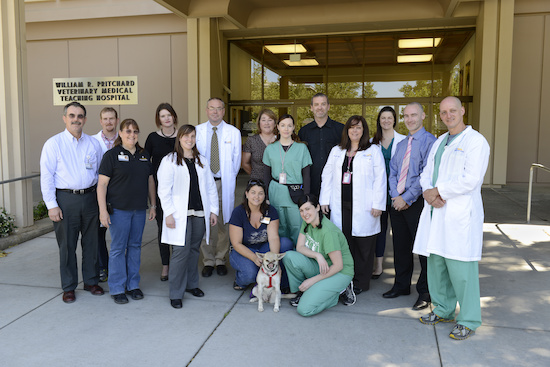
The clinicians, staff and caregivers that treated and cared for Kabang, the snoutless mutt from the Philippines credited with saving the lives of two young girls last year. Kabang has been treated and will be heading back to the Philippines in the near future. Kabang arrived at the UC Davis Veterinary Medical Teaching Hospital on October 11, 2012 after a long journey from her native Philippines. She presented with pre-existing health conditions that significantly delayed her dental and facial surgeries. As the treatments for those conditions were successfully completed in February 2013, she proceeded on to her dental and facial surgeries in March 2013. Kabang came through both of those surgeries successfully and is currently recovering under the watchful eye of the UC Davis VMTH faculty and staff. Photo by Don Preisler/UCDavis © 2013 UC Regents
The clinicians, staff and caregivers that treated and cared for Kabang, the snoutless mutt from the Philippines credited with saving the lives of two young girls last year. Kabang has been treated and will be heading back to the Philippines in the near future.
Kabang arrived at the UC Davis Veterinary Medical Teaching Hospital on October 11, 2012 after a long journey from her native Philippines. She presented with pre-existing health conditions that significantly delayed her dental and facial surgeries. As the treatments for those conditions were successfully completed in February 2013, she proceeded on to her dental and facial surgeries in March 2013. Kabang came through both of those surgeries successfully and is currently recovering under the watchful eye of the UC Davis VMTH faculty and staff.
Photo by Don Preisler/UCDavis
© 2013 UC Regents

DAVIS (CBS13) – Kabang, the Philippine dog that suffered a severely injured snout and upper-jaw while saving two girls from being hit by a motorcycle, has been released from the hospital.

The dog was brought to the veterinary medicine teaching hospital at UC Davis in October 2012 to be treated for the injury that left her with a gaping wound where her snout had been. But veterinarians found she had heartworm disease and a type of infectious cancer. A team of UC Davis veterinarians specializing in oncology; infectious diseases; dental, oral and soft-tissue surgery; internal medicine; and outpatient care was assembled to treat Kabang, according to the UC Davis News Service.

“We were able to treat all of the complications that arose with the best specialists available,” Verstraete said Professor Frank Verstraete, chief of the hospital’s dentistry and oral surgery service.

Finally, a video of Kabang’s return home.

Common-sense from HRH The Prince of Wales

Reinforcing my long-time respect for Prince Charles.

HRH The Prince of Wales, more familiarly known as Prince Charles, is a man I have longed admired and respected.

Many years ago, I worked as a volunteer teacher/mentor with what was then known as The Prince’s Youth Business Trust (PYBT).  Later, it became incorporated into The Prince’s Trust.  The PYBT enjoyed passionate and active support from HRH, and with good cause.  Essentially, the PYBT offered socially-disadvantaged youngsters, who had very little chance of getting a job, the opportunity to be mentored on the skills of being an entrepreneur.  Many of those youngsters went on to get decent jobs and many others started their own businesses, some with considerable success.  Simply because thinking like an entrepreneur is impossible if you don’t have faith in your own abilities.  That self-confidence shows in so many walks of life, especially when one is going through a job interview!

The Prince has also long been known for his concerns over the way we treat our planet, going right back to the days when it was regarded rather quaint by the mainstream media.  But as Wikipedia reveals, “He has long championed organic farming and sought to raise world awareness of the dangers facing the natural environment, such as climate change. As an environmentalist, he has received numerous awards and recognition from environmental groups around the world.”

So it was lovely, but no great surprise, to see how well a recent speech was received on the subject of Regional Food Security given at Langenburg Castle in Baden-Wurttenberg, Germany.  The full text is available on The Prince of Wales website.  Let me give you a taste (whoops, pun unintended!) of what The Prince said,

Prinz Charles Langenburg

Ladies and Gentlemen, if I may say so, this is a very important conference. I am sure what you have heard so far about the problems we face and the obstacles to tackling them has given you a clear context in which to be able to consider what comes next this afternoon.

The aim here is to think through how we might create a much more local model of food production and distribution. But also, how that might fit with producing healthy food using far more sustainable methods and how we might do all of this without damaging business. Indeed, how this could improve business.

As you have heard, the urgency for this comes from the fact that there is not sufficient resilience in the system as it currently stands. It may appear that things are well. Big global corporations may appear to be prospering out of operating on a global monocultural scale but, as I hope you have seen, if you drill down into what is actually happening, things are not so healthy. Our present approach is rapidly mining resilience out of our food system and threatening to leave it ever more vulnerable to the various external shocks that are becoming more varied, extreme and frequent.

Some of the stories about food that have been making the news are simply disgraceful, if not downright madness.  Take this one: Meat scrap leftovers now being reprocessed into ice cream: The dismal future of food!

Or try this one: GMO feed turns pig stomachs to mush! Shocking photos reveal severe damage caused by GM soy and corn.

So see the relevance of The Prince’s speech as he continued:

The drive to make food cheaper for consumers and to earn companies bigger profits is sucking real value out of the food production system – value that is critical to its sustainability. I am talking here about obvious things like the vitality of the soil and local eco-systems, the quality and availability of fresh water and so on, but also about less obvious things, like local employment and people’s health. It is, as I fear you know only too well, a complex business.

The aggressive search for cheaper food has been described as a “drive to the bottom”, which I am afraid is taking the farmers with it. They are being driven into the ground by the prices they are forced to expect for their produce and this has led to some very worrying short cuts. The recent horsemeat scandals are surely just one example, revealing a disturbing situation where even the biggest retailers seem not to know where their supplies are coming from. And it has also led to a very destructive effect on farming. We are losing farmers fast. Young people do not want to go into such an unrewarding profession. In the U.K., I have been warning of this for some time and recently set up apprenticeship schemes to try to alleviate the problem; but the fact remains that at the moment the average age of British farmers is fifty-eight, and rising.

One more extract from the speech:

In the U.K., as elsewhere – but particularly I think in the U.S. – the consequences of this are ever more apparent in the deteriorating state of our public health. We all know that Type 2 Diabetes and other obesity-related conditions are rapidly on the increase. The public bill for dealing with these is already massive and I am told it could become completely unaffordable if we do not see a shift in emphasis. And, of course, it will be cities that carry the heaviest part of that burden. It is a peculiar trend.

Am I alone, ladies and gentlemen, in wondering how it is that those who are farming according to organic, or agro-ecological principles – in other words, sustainably, for the long-term, by operating in a way that reduces pollution and contamination of the natural environment to a minimum and maximizes the health of soil, biodiverse ecosystems and humanity – are then penalized? They find that their produce is considered too expensive and too “niche market” to be available to everyone. How is it, then, that systems of farming which do precisely the opposite – with increasingly dire and damaging effects on both the terrestrial and marine environments, not to mention long-term human health – are able to sell their products in mass markets at prices that in no way reflect the immense and damaging cost to the environment and human health? A cost that then has to be paid for over and over again elsewhere – chiefly, in all probability, by our unfortunate children and grandchildren, whose welfare I happen to care about. Surely this is a truly perverse situation which, you would have thought, could be turned on its head to make genuinely sustainably-produced food accessible to everyone, and the polluter to pay the real costs for the side effects of industrialized food? It is to be wondered at how this state of affairs persists – and yet to suggest standing it on its head and transforming the situation is to invite the predictable chorus of vitriolic accusations that you are anti-science, anti-progress, out of touch with commercial pressures and not living in the “real world.”

The full speech may be read here, and please do!

Well done, Sir!  As someone once said, “We are what we eat!

Dealing with madness!

“No excellent soul is exempt from a mixture of madness.”

So wrote Aristotle .

But it offers little comfort in response to some recent essays that I have been reading.  I closed yesterday’s essay from ‘Our unsustainable way of life‘ with the comment, “If it strikes you as utter, complete madness trust me, you are not alone.”  The madness is still coming!  Stay with me!

I have referred to George Monbiot before; most recently in a republication of his essay The Great Unmentionable.

Feral

George has a new book being published by Allen Lane today under the title of Feral: searching for enchantment on the frontiers of rewilding. I would offer you the link to the book on the Allen Lane website but at the time of writing this post that link is not functioning.  It’s certainly a book I want to read.  You may learn more here.

Anyway, some recent Monbiot essays in the UK Guardian newspaper have been setting the scene for his new book.

On the 22nd May, there was an essay published under the heading of What’s Missing from this Picture? (the link is to George Monbiot’s website).  The essay starts, thus:

Somehow almost all of us have missed the real story behind the disappearance of our wildlife.

By George Monbiot, published on the Guardian’s website, 22nd May 2013

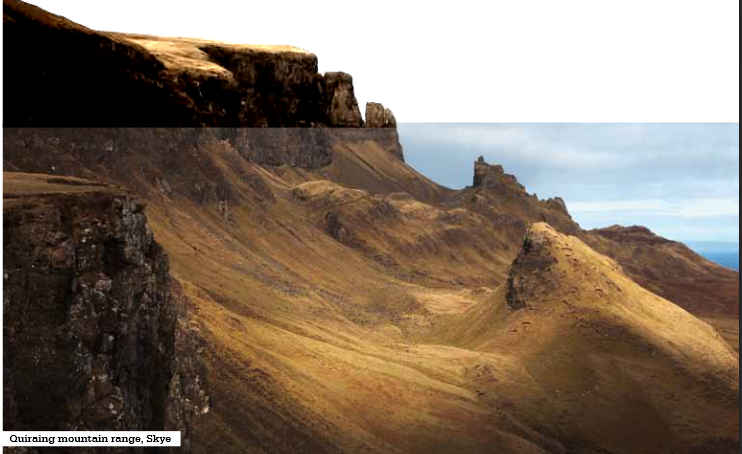
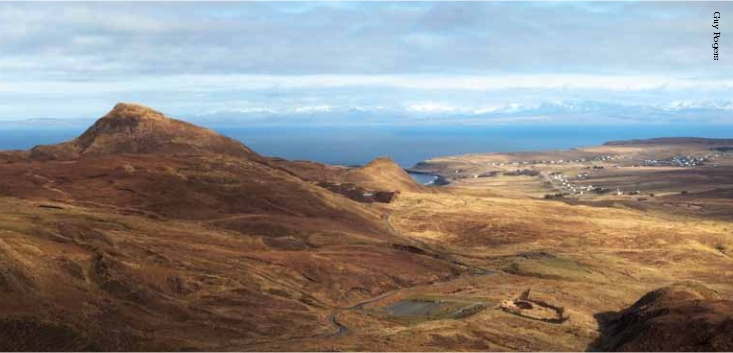
Even before you start reading the devastating State of Nature report, you get an inkling of where the problem lies. It’s illustrated in the opening pages with two dramatic photographs of upland Britain. They are supposed to represent the natural glories we’re losing. In neither of them (with the exception of some distant specks of scrub and leylandii in the second) is there a tree to be seen. The many square miles they cover contain nothing but grass and dead bracken. They could scarcely provide a better illustration of our uncanny ability to miss the big picture:

State of Nature - pic 1

State of Nature - pic 2

The majority of wildlife requires cover: places in which it can shelter from predators or ambush prey, places in which it can take refuge from extremes of heat and cold, or find the constant humidity that fragile roots and sensitive invertebrates require. Yet, in the very regions in which you might expect to find such cover (trees, scrub, other dense foliage) there is almost none. I’m talking about the infertile parts of Britain, in which farming is so unproductive that it survives only as a result of public money. Here, in the places commonly described as Britain’s “wildernesses”, almost nothing remains. And the “almost” has become radically smaller over the past 20 years.

Then a few paragraphs later, comes this:

The uplands of Britain are astonishingly unproductive. For example, 76% of the land in Wales is devoted to livestock farming, mostly to produce meat. But, astonishingly, by value Wales imports seven times as much meat as it exports. Six thousand years of nutrient stripping and erosion have left our hills so infertile that their productivity is miniscule. Even relatively small numbers of livestock can now keep the hills denuded.

Without subsidies, almost all hill-farming would cease. That’s not something I’m calling for, but I do believe it’s time we began to challenge the system and its outcomes. Among them is a policy that’s almost comically irrational and destructive.

So what was it that came at me as utter madness?

It was this:

The major funding that farmers receive is called the single farm payment, which is money given by European taxpayers to people who own land. These people receive a certain amount (usually around £200 or £300), for every hectare they own. To receive it, they must keep the land in what is called “Good Agricultural and Environmental Condition” (GAEC). It’s a term straight out of 1984.

Among the compulsory standards in the GAEC rules is “avoiding the encroachment of unwanted vegetation on agricultural land”. What this means is that if farmers want their money they must stop wild plants from returning. They don’t have to produce anything: to keep animals or to grow crops there. They merely have to prevent more than a handful of trees or shrubs from surviving, which they can do by towing cutting gear over the land.

Oh, and then we learn:

The government of Northern Ireland has been fined £64 million for (among other such offences) giving subsidy money to farms whose traditional hedgerows are too wide. The effect of these rules has been to promote the frenzied clearance of habitats. The system ensures that farmers seek out the remaining corners of land where wildlife still resides, and destroy them.

Leading to the bizarre (and that’s putting it kindly) situation where:

A farmer can graze his land to the roots, run his sheep in the woods, grub up the last lone trees, poison the rivers with sheep dip and still get his money. Some of the farms close to where I lived in mid-Wales do all of those things and never have their grants stopped. But one thing he is not allowed to do is what these rules call “land abandonment”, and what I call rewilding. For no good reason, public money is used both to engineer the mass destruction of habitats through grazing and clearing, and to prevent any significant recovery.

There’s nothing I can add.  Except this.  I am collecting ideas and essays that are going to focus on the positive aspects of this ‘new world order’. I’m going to offer some examples of the power of positive change because as Rebecca Solnit wrote recently there is a case for hope!

Hope and love

Rebecca Solnit, What Comes After Hope

Many of you will be aware that I follow Tom Engelhardt over at TomDispatch.  Tom has been very generous in granting Learning from Dogs blanket permission to republish essays that appear on TomDispatch.  From time to time I do just that; the last one being TomGram: William deBuys, Exodus from Phoenix just a couple of months ago.

Today is another republication of an incredibly powerful essay by Rebecca Solnit, with the usual introduction from Tom.  When you read it you will easily see why it was a must for this week’s focus on love.

To offer a small inducement to read Rebecca’s essay, here is a taste of her words:

If you take the long view, you’ll see how startlingly, how unexpectedly but regularly things change. Not by magic, but by the incremental effect of countless acts of courage, love, and commitment, the small drops that wear away stones and carve new landscapes, and sometimes by torrents of popular will that change the world suddenly. To say that is not to say that it will all come out fine in the end regardless. I’m just telling you that everything is in motion, and sometimes we are ourselves that movement.

Wow!

… the incremental effect of countless acts of courage, love, and commitment, the small drops

that wear away stones and carve new landscapes …

Read and be moved by the words that people write.

oooOOOooo

Rebecca Solnit, What Comes After Hope

I worked for years as an editor at Pantheon Books. Its publisher, maybe the most adventurous in the business, was André Schiffrin. Among his many accomplishments, he “discovered” Studs Terkel (already a well-known Chicago radio personality), published his first oral history (Division Street: America), and made him a bestseller.  Sometime after I arrived at Pantheon in the mid-1970s, he asked me to take a last look at a new manuscript by Studs. It was the equivalent of sending the second team onto the field, but it began my own long relationship with the famed oral historian. He was an experience — a small man who, when he wasn’t listening professionally in a fashion beyond compare, never stopped talking. In doing so, he had an almost magical way of making those around him feel larger than life. Later, I would be the editor for two of his oral histories, one on death and the other on hope (in that splendid order and the second with the Studs-appropriate title Hope Dies Last).

Last October, Bill Moyers interviewed me about the dismal state of American politics.  As our conversation was ending, he suddenly asked: “What keeps you going against all the evidence?” At that moment, Studs came to mind. I mentioned editing “one of the greats of our world” and responded this way: “It turned out that when he wrote his book about hope, it was all about activists and the basic point he made was: in good times you could just be hopeful about your life. You didn’t have to be an activist. You didn’t have to be an anything.  In bad times, if you want to be hopeful, you have to take a step. You’ve got to take some step to do something in the world. And in that sense, TomDispatch is my medicine against despair.  So what makes me hopeful is doing TomDispatch.”

All true. But I realize now that it wasn’t quite a full response. I had left out one crucial figure in my life: Rebecca Solnit, who taught me how to hope in a world that seemed dismal indeed.  She was the one who — I’ve written about it before — slipped through the barely ajar door of my life in May 2003, at a moment as grim and dreary as any in my political experience. The largest antiwar movement ever to protest a war that had yet to happen had just packed its tents and gone home in despair, while Baghdad was occupied by American troops and George W. Bush and his top officials were in their “mission accomplished” triumphalist mode.  Many activists then feared that they would remain so forever and would have dismissed out of hand someone who suggested that their Pax Americana dreams of domination would begin unraveling in mere weeks (as happened), not decades or centuries.

Ten years ago, exactly to the day, I published Rebecca’s miraculous piece “Acts of Hope,” which she would later expand into her book Hope in the Dark. It was written to welcome that “darkness” which seemed already to be enveloping us.  It was written with a sense of how the expectable unravels, of how the future surprises us, often enough with offerings not of horror but of hope.

With few people can you ever say, she (or he) changed my life, changed the very way I understand our world. For me, she’s one of the few — and she’s still doing it with her miraculous new book (out in June), The Faraway Nearby.  She taught me how to look into that future darkness with hope. Like Studs, she taught me that acting, even while not knowing, is a powerful antidote to despair. So it means the world to me that she’s returned to the subject of hope to celebrate the tenth anniversary of her arrival in my life and at TomDispatch. Tom

Too Soon to Tell
The Case for Hope, Continued
By Rebecca Solnit

Ten years ago, my part of the world was full of valiant opposition to the new wars being launched far away and at home — and of despair. And like despairing people everywhere, whether in a personal depression or a political tailspin, these activists believed the future would look more or less like the present.  If there was nothing else they were confident about, at least they were confident about that. Ten years ago, as a contrarian and a person who prefers not to see others suffer, I tried to undermine despair with the case for hope.

A decade later, the present is still contaminated by the crimes of that era, but so much has changed. Not necessarily for the better — a decade ago, most spoke of climate change as a distant problem, and then it caught up with us in 10,000 ways. But not entirely for the worse either — the vigorous climate movement we needed arose in that decade and is growing now. If there is one thing we can draw from where we are now and where we were then, it’s that the unimaginable is ordinary, and the way forward is almost never a straight path you can glance down, but a labyrinth of surprises, gifts, and afflictions you prepare for by accepting your blind spots as well as your intuitions.

The despairing of May 2003 were convinced of one true thing, that we had not stopped the invasion of Iraq, but they extrapolated from that a series of false assumptions about our failures and our powerlessness across time and space. They assumed — like the neoconservatives themselves — that those neocons would be atop the world for a long time to come. Instead, the neocon and neoliberal ideologies have been widely reviled and renounced around the world; the Republicans’ demographic hemorrhage has weakened them in this country; the failures of their wars are evident to everyone; and though they still grasp fearsome power, everything has indeed changed. Everything changes: there lies most of our hope and some of our fear.

I’ve seen extraordinary change in my lifetime, some of it in the last decade. I was born in a country that had been galvanized and unsettled by the civil rights movement, but still lacked a meaningful environmental movement, women’s movement, or queer rights movement (beyond a couple of small organizations founded in California in the 1950s). Half a century ago, to be gay or lesbian was to live in hiding or be treated as mentally ill or criminal. That 12 states and several countries would legalize same-sex marriage was beyond imaginable then. It wasn’t even on the table in 2003.  San Francisco’s spring run of same-sex weddings in 2004 flung open the doors through which so many have passed since.

If you take the long view, you’ll see how startlingly, how unexpectedly but regularly things change. Not by magic, but by the incremental effect of countless acts of courage, love, and commitment, the small drops that wear away stones and carve new landscapes, and sometimes by torrents of popular will that change the world suddenly. To say that is not to say that it will all come out fine in the end regardless. I’m just telling you that everything is in motion, and sometimes we are ourselves that movement.

Unstoppabilities

Hope and history are sisters: one looks forward and one looks back, and they make the world spacious enough to move through freely. Obliviousness to the past and to the mutability of all things imprisons you in a shrunken present. Hopelessness often comes out of that amnesia, out of forgetting that everything is in motion, everything changes. We have a great deal of history of defeat, suffering, cruelty, and loss, and everyone should know it. But that’s not all we have.

There’s the people’s history, the counterhistory that you didn’t necessarily get in school and don’t usually get on the news: the history of the battles we’ve won, of the rights we’ve gained, of the differences between then and now that those who live in forgetfulness lack. This is often the history of how individuals came together to produce that behemoth civil society, which stands astride nations and topples regimes — and mostly does it without weapons or armies. It’s a history that undermines most of what you’ve been told about authority and violence and your own powerlessness.

Civil society is our power, our joy, and our possibility, and it has written a lot of the history in the last few years, as well as the last half century. If you doubt our power, see how it terrifies those at the top, and remember that they fight it best by convincing us it doesn’t exist. It does exist, though, like lava beneath the earth, and when it erupts, the surface of the earth is remade.

Things change. And people sometimes have the power to make that happen, if and when they come together and act (and occasionally act alone, as did writers Rachel Carson and Harriet Beecher Stowe — or Mohammed Bouazizi, the young man whose suicide triggered the Arab Spring).

If you fix your eye on where we started out, you’ll see that we’ve come a long way by those means. If you look forward, you’ll see that we have a long way to go — and that sometimes we go backward when we forget that we fought for the eight-hour workday or workplace safety or women’s rights or voting rights or affordable education, forget that we won them, that they’re precious, and that we can lose them again. There’s much to be proud of, there’s much to mourn, there’s much yet to do, and the job of doing it is ours, a heavy gift to carry. And it’s made to be carried, by people who are unstoppable, who are movements, who are change itself.

Too Soon to Tell

Ten years ago I began writing about hope and speaking about it. My online essay “Acts of Hope,” posted on May 19, 2003, was my first encounter with Tomdispatch.com, which would change my work and my life. It gave me room for another kind of voice and another kind of writing. It showed me how the Internet could give wings to words. What I wrote then and subsequently for the site spread around the world in remarkable ways, putting me in touch with people and movements, and deeper into conversations about the possible and the impossible (and into a cherished friendship with the site’s founder and editor, Tom Engelhardt).

For a few years, I spoke about hope around this country and in Europe. I repeatedly ran into comfortably situated people who were hostile to the idea of hope: they thought that hope somehow betrayed the desperate and downtrodden, as if the desperate wanted the solidarity of misery from the privileged, rather than action. Hopelessness for people in extreme situations means resignation to one’s own deprivation or destruction. Hope can be a survival strategy. For comfortably situated people, hopelessness means cynicism and letting oneself off the hook. If everything is doomed, then nothing is required (and vice versa).

Despair is often premature: it’s a form of impatience as well as certainty. My favorite comment about political change comes from Zhou En-Lai, the premier of the People’s Republic of China under Chairman Mao. Asked in the early 1970s about his opinion of the French Revolution, he reportedly answered, “Too soon to tell.” Some say that he was talking about the revolutions of 1968, not 1789, but even then it provides a generous and expansive perspective. To hold onto uncertainty and possibility and a sense that even four years later, no less nearly two centuries after the fact, the verdict still isn’t in is more than most people I know are prepared to offer. A lot of them will hardly give an event a month to complete its effects, and many movements and endeavors are ruled failures well before they’re over.

Not long ago, I ran into a guy who’d been involved in the Occupy Wall Street movement, that great upwelling in southern Manhattan in the fall of 2011 that catalyzed a global conversation and a series of actions and occupations nationwide and globally. He offered a tailspin of a description of how Occupy was over and had failed.

But I wonder: How could he possibly know? It really is too soon to tell. First of all, maybe the kid who will lead the movement that will save the world was catalyzed by what she lived through or stumbled upon in Occupy Fresno or Occupy Memphis, and we won’t reap what she sows until 2023 or 2043. Maybe the seeds of something more were sown, as they were in Czechoslovakia during the Prague Spring of 1968 and Charter 77, for the great and unforeseen harvest that was the Velvet Revolution of 1989, the nonviolent overthrow of the Soviet totalitarian state in that country.

Second, Occupy began to say what needed to be said about greed and capitalism, exposing a brutality that had long been hushed up, revealing both the victims of debt and the rigged economy that created it. This country changed because those things were said out loud. I can’t say exactly how, but I know it mattered. So much that matters is immeasurable, unquantifiable, and beyond price. Laws around banking, foreclosure, and student loans are changing — not enough, not everywhere, but some people will benefit, and they matter.  Occupy didn’t cause those changes directly, but it did much to make the voice of the people audible and the sheer wrongness of our debt system visible — and gave momentum to the ongoing endeavors to overturn Citizens United and abolish corporate personhood.

Third, I only know a little of what the thousands of local gatherings and networks we mean by “Occupy” are now doing, but I know that Occupy Sandy is still doing vital work in the destruction zone of that hurricane and was about the best grassroots disaster relief endeavor this nation has ever seen. I know that Strike Debt, a direct offshoot of Occupy Wall Street, has relieved millions of dollars in medical debt, not with the sense that we can fix all debt this way, but that we can demonstrate the malleability, the artifice, and the immorality of the student, medical, and housing debt that is destroying so many lives. I know that the Occupy Homes foreclosure defenders have been doing amazing things, often one home at a time, from Atlanta to Minneapolis. (Last Friday, Occupy Our Homes organized a “showdown at the Department of Justice” in Washington, D.C.; that Saturday, Strike Debt Bay Area held their second Debtors’ Assembly: undead from coast to coast.)

Fourth, I know people personally whose lives were changed, and who are doing work they never imagined they would be involved in, and I’m friends with remarkable people who, but for Occupy, I would not know existed. People connected across class, racial, and cultural lines in the flowering of that movement.  Like Freedom Summer, whose consequences were to be felt so far beyond Mississippi in 1964, this will have reach beyond the moment in which I write and you read.

Finally, there was great joy at the time , the joy of liberation and of solidarity, and joy is worth something in itself. In a sense, it’s worth everything, even if it’s always fleeting, though not always as scarce as we imagine.

Climates of Hope and Fear

I had lunch with Middle East and nonviolence scholar Stephen Zunes the other day and asked him what he would say about the Arab Spring now. He had, he told me, been in Egypt several months ago watching television with an activist. Formerly, the news was always about what the leaders did, decided, ordained, inflicted. But the news they were watching was surprisingly focused on civil society, on what ordinary people initiated or resisted, on how they responded, what they thought. He spoke of how so many in the Middle East had lost their fatalism and sense of powerlessness and awoken to their own collective power.

This civil society remains awake in Egypt and the other countries.  What will it achieve? Maybe it’s too soon to tell. Syria is a turbulent version of hell now, but it could be leaving the dynasty of the Assads in the past; its future remains to be written.  Perhaps its people will indeed write the next chapter in its story, and not only with explosives.

You can tell the arc of the past few years as, first, the Arab Spring, then extraordinary civil society actions in Chile, Quebec, Spain, and elsewhere, followed by Occupy. But don’t stop there.

After Occupy came Idle No More, the Canada-based explosion of indigenous power and resistance (to a Canadian government that has gone over to the far right and to environmental destruction on a grand scale). It was founded by four women in November of 2012 and it’s spread across North America, sparking new environmental actions and new coalitions around environmental and climate issues, with flash-mob-style powwows in shopping malls and other places, with a thousand-mile walk (and snowshoe) by seven Cree youth this winter. (There were 400 people with them by the time they arrived at Canada’s Parliament in Ottawa.)

Idle No More activists have vowed to block the construction of any pipeline that tries to transport the particularly dirty crude oil from the Alberta tar sands, whether it heads north, east, or west from northern Alberta. Each of those directions takes it over native land. This is part of the reason why tar sands supporters are pushing so hard to build the Keystone XL pipeline from Alberta to the U.S. Gulf Coast.

Thankfully, the push back is also strong. Our fate may depend on it. As climate scientist James Hansen wrote a year ago, “Canada’s tar sands, deposits of sand saturated with bitumen, contain twice the amount of carbon dioxide emitted by global oil use in our entire history. If we were to fully exploit this new oil source, and continue to burn our conventional oil, gas, and coal supplies, concentrations of carbon dioxide in the atmosphere eventually would reach levels higher than in the Pliocene era, more than 2.5 million years ago, when sea level was at least 50 feet higher than it is now.”

The news just came in that we reached 400 parts per million of carbon dioxide in our atmosphere, the highest level in more than five million years. This is terrible news on a scale that eclipses everything else, because it encompasses everything else. We are wrecking our world, for everyone for all time, or at least the next several thousand years. But “we” is a tricky word here. Some of the people I most love and admire are doing extraordinary things to save the world, for you, for us, for generations unborn, for species yet to be named, for the oceans and sub-Saharan Africans and Arctic dwellers and everyone in-between, for the whole unbearably beautiful symphony of life on Earth that is imperiled.

Part of what sustains me in the face of this potential cataclysm is remembering that, in 2003, there hardly was a climate movement. It was small, polite, mostly believed the troubles were decades away, and was populated with people who thought that lifestyle changes could save the planet — rather than that you have to get out there and fight the power. And they were the good ones.  Too many of us didn’t think about it at all.

Only a few years later, things have changed. There’s a vibrant climate movement in North America.  If you haven’t quite taken that in, it might be because it’s working on so many disparate fronts that are often treated separately: mountaintop coal removal, coal-fired power plants (closing 145 existing ones to date and preventing more than 150 planned ones from opening), fracking, oil exploration in the Arctic, the Tar Sands pipeline, and 350.org’s juggernaut of a campus campaign to promote disinvestment from oil, gas, and coal companies.  Only started in November 2012, there are already divestment movements underway on more than 380 college and university campuses, and now cities are getting on board.  It has significant victories; it will have more.

Some countries — notably Germany, with Denmark not far behind — have done remarkable things when it comes to promoting non-fossil-fuel renewable energy. Copenhagen, for example, in the cold gray north, is on track to become a carbon-neutral city by 2025 (and in the meantime reduced its carbon emissions 25% between 2005 and 2011). The United States has a host of promising smaller projects.  To offer just two examples, Los Angeles has committed to being coal-free by 2025, while San Francisco will offer its citizens electricity from 100% renewable and carbon-neutral sources and its supervisors just voted to divest the city’s fossil-fuel stocks.

There are so many pieces of the potential solution to this puzzle, and some of them are for you to put together. Whether they will multiply or ever add up to enough we don’t yet know. We need more: more people, more transformations, more ways to conquer and dismantle the oil companies, more of a vision of what is at stake, more of the great force that is civil society. Will we get it? I don’t know. Neither do you. Anything could happen.

But here’s what I’m saying: you should wake up amazed every day of your life, because if I had told you in 1988 that, within three years, the Soviet satellite states would liberate themselves nonviolently and the Soviet Union would cease to exist, you would have thought I was crazy. If I had told you in 1990 that South America was on its way to liberating itself and becoming a continent of progressive and democratic experiments, you would have considered me delusional.  If, in November 2010, I had told you that, within months, the autocrat Hosni Mubarak, who had dominated Egypt since 1981, would be overthrown by 18 days of popular uprisings, or that the dictators of Tunisia and Libya would be ousted, all in the same year, you would have institutionalized me.  If I told you on September 16, 2011, that a bunch of kids sitting in a park in lower Manhattan would rock the country, you’d say I was beyond delusional.  You would have, if you believed as the despairing do, that the future is invariably going to look like the present, only more so.  It won’t.

I still value hope, but I see it as only part of what’s required, a starting point.  Think of it as the match but not the tinder or the blaze.  To matter, to change the world, you also need devotion and will and you need to act. Hope is only where it begins, though I’ve also seen people toil on without regard to hope, to what they believe is possible. They live on principle and they gamble, and sometimes they even win, or sometimes the goal they were aiming for is reached long after their deaths.  Still, it’s action that gets you there. When what was once hoped for is realized, it falls into the background, becomes the new normal; and we hope for or carp about something else.

The future is bigger than our imaginations. It’s unimaginable, and then it comes anyway. To meet it we need to keep going, to walk past what we can imagine. We need to be unstoppable. And here’s what it takes: you don’t stop walking to congratulate yourself; you don’t stop walking to wallow in despair; you don’t stop because your own life got too comfortable or too rough; you don’t stop because you won; you don’t stop because you lost. There’s more to win, more to lose, others who need you.

You don’t stop walking because there is no way forward. Of course there is no way. You walk the path into being, you make the way, and if you do it well, others can follow the route. You look backward to grasp the long history you’re moving forward from, the paths others have made, the road you came in on. You look forward to possibility.  That’s what we mean by hope, and you look past it into the impossible and that doesn’t stop you either. But mostly you just walk, right foot, left foot, right foot, left foot. That’s what makes you unstoppable.

Rebecca Solnit’s first essay for Tomdispatch.com turned into the book Hope in the Dark: Untold Histories, Wild Possibilities, since translated into eight languages. Portions of this essay began life as the keynote speech at the National Lawyers’ Guild gala in honor of attorney and human rights activist Walter Riley, whose own life is a beautiful example of unstoppability. Solnit’s latest book, The Faraway Nearby, will be published in June. 

Copyright 2013 Rebecca Solnit

Change of tack!

Moving on to happiness.

Whatever one’s view is about the significance of CO2 levels in the Earth’s atmosphere, this blog is about integrity.  As the byline states, “Dogs are integrous animals. We have much to learn from them.” Regular readers (and thank you for being one) know that this blog ranges far and wide in pursuit of stories, essays and examples of integrity, all the more better when they involve a dog!

All dog owners know that one of the prime things we can learn from our dogs is the ability to remain in the present.  No, more than that! To value and cherish the present. Dogs manage this in an effortless manner, in a way that humans can only dream of achieving.

This came to me as a result of a recent post on Damn the Matrix, Mike Stasse’s fascinating blog.  The post was about what we humans regret at the end of our days, which I will come to in a moment.

Mike had taken the theme from a recent book by Australian author Bronnie Ware. Her website is here from where one learns:

Picture from The Sunday Mail (Qld)

Bronnie Ware is an inspiring and creative soul from Australia.

Through her work Bronnie weaves delightful tales of real life observations and experience. Using gentleness, honesty, and humour, Bronnie celebrates both the strength and vulnerability of human nature. Her message is a positive and inspiring one.

Bronnie is the author of the full-length memoir, The Top Five Regrets of the Dying – A Life Transformed by the Dearly Departing, released worldwide, with translations in 27 languages. She also runs an online personal growth and songwriting course, has released two albums of original songs, and writes a well-loved blog called Inspiration and Chai.

A quick visit to that blog site reveals:

Every challenge brings its own gifts. Sometimes though it is not always easy to see those gifts at first. Suffering and wounds can blind us. We have all been there. It is at times like these that Inspiration and Chai is needed. Inspiration to soothe the heart. Chai to soothe the body.

Even during happier cruising chapters, being inspired is still a beautiful thing. It keeps us going. It reminds us of what we already know.

Inspiration and Chai is an ongoing journey. The aim of this site is to share inspirational stories and motivational thoughts and for it to reach more and more people in need, seekers on their path. It is a positive environment to revisit whenever you feel it calling. It is also somewhere for me to share my love of story telling and to share memories of life.

Jean is no stranger to the death of a dog. Over her many years of rescuing dogs Jean has seen far too many deaths.  I have been living with Jean since 2008.  In that short time five of our dogs have died.

Of course, we have no idea of what goes through a dog’s mind in those last stages of life. Dogs appear to embrace death in an uncomplicated way but we will never know for sure.

What about humans? On Bronnie’s blogsite there is a post under the title of Regrets of the dying.  Whatever age you are, read what Bonnie wrote and ponder:

REGRETS OF THE DYING

For many years I worked in palliative care. My patients were those who had gone home to die. Some incredibly special times were shared. I was with them for the last three to twelve weeks of their lives.

People grow a lot when they are faced with their own mortality. I learnt never to underestimate someone’s capacity for growth. Some changes were phenomenal. Each experienced a variety of emotions, as expected, denial, fear, anger, remorse, more denial and eventually acceptance. Every single patient found their peace before they departed though, every one of them.

When questioned about any regrets they had or anything they would do differently, common themes surfaced again and again. Here are the most common five:

1. I wish I’d had the courage to live a life true to myself, not the life others expected of me.

This was the most common regret of all. When people realise that their life is almost over and look back clearly on it, it is easy to see how many dreams have gone unfulfilled. Most people had not honoured even a half of their dreams and had to die knowing that it was due to choices they had made, or not made.

It is very important to try and honour at least some of your dreams along the way. From the moment that you lose your health, it is too late. Health brings a freedom very few realise, until they no longer have it.

2. I wish I didn’t work so hard.

This came from every male patient that I nursed. They missed their children’s youth and their partner’s companionship. Women also spoke of this regret. But as most were from an older generation, many of the female patients had not been breadwinners. All of the men I nursed deeply regretted spending so much of their lives on the treadmill of a work existence.

By simplifying your lifestyle and making conscious choices along the way, it is possible to not need the income that you think you do. And by creating more space in your life, you become happier and more open to new opportunities, ones more suited to your new lifestyle.

3. I wish I’d had the courage to express my feelings.

Many people suppressed their feelings in order to keep peace with others. As a result, they settled for a mediocre existence and never became who they were truly capable of becoming. Many developed illnesses relating to the bitterness and resentment they carried as a result.

We cannot control the reactions of others. However, although people may initially react when you change the way you are by speaking honestly, in the end it raises the relationship to a whole new and healthier level. Either that or it releases the unhealthy relationship from your life. Either way, you win.

4. I wish I had stayed in touch with my friends.

Often they would not truly realise the full benefits of old friends until their dying weeks and it was not always possible to track them down. Many had become so caught up in their own lives that they had let golden friendships slip by over the years. There were many deep regrets about not giving friendships the time and effort that they deserved. Everyone misses their friends when they are dying.

It is common for anyone in a busy lifestyle to let friendships slip. But when you are faced with your approaching death, the physical details of life fall away. People do want to get their financial affairs in order if possible. But it is not money or status that holds the true importance for them. They want to get things in order more for the benefit of those they love. Usually though, they are too ill and weary to ever manage this task. It is all comes down to love and relationships in the end. That is all that remains in the final weeks, love and relationships.

5. I wish that I had let myself be happier.

This is a surprisingly common one. Many did not realise until the end that happiness is a choice. They had stayed stuck in old patterns and habits. The so-called ‘comfort’ of familiarity overflowed into their emotions, as well as their physical lives. Fear of change had them pretending to others, and to their selves, that they were content. When deep within, they longed to laugh properly and have silliness in their life again.

When you are on your deathbed, what others think of you is a long way from your mind. How wonderful to be able to let go and smile again, long before you are dying.

Life is a choice. It is YOUR life. Choose consciously, choose wisely, choose honestly. Choose happiness.

I hesitated to write anything more because that last sentence should be the one that continues to resonate.

So just a reflection on how easy it is for a dog to wag its tail – dogs so easily choose happiness.

The counter-intuitive aspect of liberty.

How libertarian ideology is holding back our liberty to change.

Martin Lack, he of the popular blog Lack of Environment is taking a small break from his writings.  In his own words,

I am afraid this may be the last post on this blog for a while because – what with the all the willful blindness and ideological prejudice that seems to stop people from recognising what an Eff-ing mess humanity is in – and my as yet unresolved employment situation – I am feeling somewhat emotionally drained. However, please don’t cancel your subscription (as who knows how quickly I may recover).

So what a pleasant surprise when less than a day after those words in came an email that read, “Since I have told readers of my blog that I am taking a rest, I offer you the text appended below to post on your blog instead (or not – as you see fit).

On reading the text I most certainly ‘saw fit‘ to publish it!

It is a very interesting approach to climate science denialism resulting from an analysis of conspiracy theories.

So over to Martin.

oooOOOooo

Professor Stephan Lewandowsky.

Libertarian ideology is the real road block

I have recently been catching up on a bit of reading – focusing on the recent work of Professor Stephan Lewandowsky (and others).  Following in the wake of James Hansen, Ben Santer and Michael Mann, Lewandowsky has recently been the target of hate-mail campaigns by climate change sceptics.  Unlike all the others, however, Lewandowsky (formerly at the University of Western Australia but now at Bristol University in the UK) is not a climate scientist.  This is how Bristol University announced his recent appointment.

Steve is an internationally renowned cognitive scientist who has joined us from the University of Western Australia. His research has already revolutionised our understanding of human memory and cognition, and he now stands poised to build upon his impressive body of work with a project as ambitious as it is timely. In particular, Steve’s intention to improve our understanding of how people choose to acquire information, and to use this understanding to help create a more informed populace, is a unique and much needed undertaking. Thus, this research offers enormous benefits in the fields of experimental psychology, climate research and the wider public engagement with and understanding of scientific research.

I must admit that, until recently, I had not sat down to read either of the papers by Lewandowsky et al (  ‘Motivated Rejection of Science’ [PDF]  or ‘Recursive Fury: Conspiracy Ideation in the Blogosphere’ [PDF] ) – I had only read about them.

However, now that I have read them, the thing that strikes me most forcefully is not the stupidity of conspiracy “ideation”, the invocation of conspiracy theories, it is the fact that, as Lewandowsky et al acknowledge, their work confirms the findings of many previous studies; that climate change scepticism is associated with prejudicial adherence to libertarian ideology.  Also key is that climate change scepticism can be predicted by that prejudicial adherence to libertarian ideology.

Amongst many other things, this explains why EU sceptics are climate sceptics and why the United Kingdom Independence Party (UKIP) do not like Wind Farms.  I had understood this for some time.  However, I had not fully realised its importance; it was just one theme among others.  Anyone who has read my blog recently will probably have noticed my post about New World Order (NWO) conspiracy theory, in which I acknowledged that I had not realised just how significant such thinking is, and how subliminal and subconscious it may be.

Although adherence to free-market economics and libertarian ideology were themes I highlighted in my MA dissertation and in my subsequent book, and mentioned on my blog numerous times, everything I have read in the last few days points to one conclusion:  We will not succeed in communicating the urgency of the need for radical changes in energy policy until we can convince people that climate scientists are not trying to perpetuate their research funding or halt human progress.

Professor Lewandowsky’s research shows that little can be achieved by simply telling people they are wrong.  Far better is pointing out to people that Limits to Growth and Peak Oil have already halted the progress of globalised Capitalism, as recent times prove dramatically. In other words conveying facts to people rather than ideology.

I must admit that this has been a tough pill to swallow.  I am not naturally progressive and certainly not naturally “liberal”.  On the contrary, I am socially and politically conservative.  However, the reality of anthropogenic climate disruption is a game-changer. Therefore, unlike members of the Flat Earth Society or Young Earth Creationists (YECs), I do not refuse to accept what scientists tell me simply because I don’t like the message.

We cannot defeat such obscurantism by telling people they are irrational; we can only defeat it by focusing on the evidence that suggests strongly that they are mistaken.  To this end, I think the words of St Augustine of Hippo are an important consideration; words going back over 1,400 years before anyone started to question the Age of the Earth or the Origin of Species!  Words echoed by Thomas Aquinas, (often quoted to those YECs):

“… since Holy Scripture can be explained in a multiplicity of senses, one should adhere to a particular explanation only in such measure as to be ready to abandon it if it be proved with certainty to be false, lest Holy Scripture be exposed to the ridicule of unbelievers, and obstacles be placed to their believing.”
– Thomas Aquinas, Summa Theologica (1273).

In the last 150 years or so, most Christians have now come to reject conspiracy theory explanations for fossils, for example, and have realised that it is inappropriate to treat the Bible as a scientific text book.  Regretably, the main source of ideological blindness today is not conventional religion; it is adherence to free-market economics.

Therefore, it is important that we acknowledge the ideological nature of the communication problem we face. That is that the research by Prof Lewandowsky and others has discovered a tendency for libertarians to prefer conspiracy theories to reality.  Perhaps, therefore, not surprising that he has been attacked; no-one likes to be told they are deluded.

Roadblocks to policy change will not be cleared by social and political scientists telling libertarians that they are deluded.  All that will do is confirm their suspicions and reinforce their prejudices!  No, what is needed is for climate scientists to be bolder in stating the facts.

The majority of climate scientists seem content to continue to soft-soap the issue; afraid of “telling it to people straight” because it may induce despair.

No, it is not too late to prevent an ecological catastrophe but I am certain that we are now very short of time and, as everyone from the International Energy Agency, the Pentagon and the IMF agree, further delay will not be cost-effective.

At the same time, I think social and political scientists need to focus on debunking the ‘New World Order’ conspiracy myth and pointing out the logical fallacy in the idea that all Greens are Communists in disguise (the so-called ‘Watermelons’).

The environment has become a political football when it is nothing of the kind.  It is our life support system and we have pushed it near to the point of collapse, as E.F. Schumacher once said, by mistaking Nature’s capital for a form of income.  Therefore, if we do not change course, bankruptcy would seem inevitable.

oooOOOooo

Having read and reflected on Martin’s essay, a couple of recollections surface.  The first is Guy McPherson’s book Walking Away from Empire that I reviewed earlier this year then referred to in a recent republication of a George Monbiot essay:

So very difficult to pick out the sentence that carried the most power, for the essay is powerful from start to end.  But this one did hit me in the face, “The impossibility of sustaining this system of endless, pointless consumption without the continued erosion of the living planet and the future prospects of humankind, is the conversation we will not have.

Finally, I can’t resist reminding you, dear reader, of the point made by Prof. Guy McPherson in his book Walking Away from Empire, which I reviewed on March 6th.  particularly in the first paragraph of the first chapter; Reason:

At this late juncture in the era of industry, it seems safe to assume we face one of two futures. If we continue to burn fossil fuels, we face imminent environmental collapse. If we cease burning fossil fuels, the industrial economy will collapse. Industrial humans express these futures as a choice between your money or your life, and tell you that, without money, life isn’t worth living. As should be clear by now, industrial humans — or at least our “leaders” — have chosen not door number one (environmental collapse) and not door number two (economic collapse), but both of the above.

The second recollection comes most recently; from yesterday’s The story of carbon. A story that showed the power of academic, peer-reviewed, properly conducted, rational science!

I will close with a repeat of the closing words from yesterday:

“By my calculation, we have a 5–10 year window to avoid the catastrophe. It won’t be easy — we’re past the point where any transition will be smooth — but we can make the transition and survive as a civilized species, humans in a recognizable world.”

Nothing counter-intuitive about that!

A small island called Utila.

Something inspirational and encouraging (for a change!)

As regular readers of Learning from Dogs will know, I subscribe to news items from The Permaculture Institute of Australia.  It is much recommended.

Well just the other day, this item came up:

Permaculture Recycled

Off the coast of Honduras, on a small island called Utila, lives a guy called Shane. Shane has broken away from all the social restraints and has built his own house. He is now building his own garden. However, he is doing it slightly different from most people — he uses cardboard boxes! This short film by Serena Aurora talks about Shane’s key concepts and tips on permaculture.

It’s a deeply moving film.

I’m sorry but I forget!

I can remember everything, except the things I forget!

Today’s post is about something that at it’s heart is no laughing matter; loss of memory.  But the opportunity to open in a slightly frivolous manner is simply too tempting!

Because I admit to not remembering when I started to lose my memory! 🙂

But somewhere along the way during the last 5 or 6 years others around me, especially Jeannie, started noticing that my mental recall wasn’t so good.  In November, I shall be 69 and have been told (I forget by whom!) that the sort of life changes that these last few years have delivered would be classic causes of declining memory in a person in their sixties.

OK, on with the show.

Some time ago, I received an email from a Daniel Strauss.  This is what Daniel wrote:

Hi,

I’’m a contributor to an education improvement resource and I recently published an article providing many tips about improving your memory I think you’ would be interested in. I found your site and your item, Let’s do nothing, during my research and would like to invite you to take a look at my published piece.

Please let me know if you woul’d be interested in taking a look and possibly sharing with your readers.

Thanks,

Daniel

My reply was to query Daniel’s motivation before saying ‘yeah’ or ‘nay’.  A further email subsequently arrived:

I am one of many contributors on a research project and recently completed work on resource that provides quick and easy tips to keep your mind sharp and be able to remember things you’ve learned. I reached out because I thought you and your readers would be interested in my resource. Here is the link to the resource. Take a look and let me know if you would consider including it among the other resource links that you’ve provided on your site.

Look forward to hearing from you.

Thanks for your help.

I was happy to feature these memory tips.

The 75 tips are on a website that is called the Open Education Database, from which one learnsWe’ve compiled the Open Education Database (OEDb) to help ambitious or prospective students find the most convenient, valuable, and relevant education programs to fulfill their academic and career objectives.

Not entirely sure why a feature on memory is part of the OEdb website, but so what!  The tips strike me as fabulous advice.

The memory feature is called The Memory Toolbox: 75 Tips and Resources to Go from Amnesic to Elephantic, and is introduced, thus:

Many people expect increasing memory loss as they age, but this memory loss can be reduced or stalled with some simple memorization techniques, physical exercise, and a reduction of stress. In fact, impaired memory has more to do with chemicals that are released in the brain when an individual suffers from chronic stress. But, you can reduce the obstacles and increase your memory capacity with the seventy-five tips and resources listed below. In fact, you can go from amnesic to elephantic within a few short weeks.

Some of the tips you may already know, but we’ve repeated them because they may have slipped your mind. Other tips are from recent news stories that contained information you may not have heard. The links will take you to those news items and to other resources that you can use to increase your capacity to remember anything you deem important.

The 75 tips and resources are sorted into 10 groupings; here are some of the recommendations:

Be in the Moment

You can’t remember something if you’ve never learned it, so focus on learning.

It only takes about eight seconds to process data through your hippocampus into the appropriate memory center, so it doesn’t take long to absorb information.

To learn how to stay in the moment, don’t focus on the past or worry about the future while you’re learning.

Don’t multitask, as you create a “brain drain” when you focus on more than one activity.

Create a Learning Environment

Create a learning environment at home. This is crucial for adult learners who will be taking online courses, while balancing work, family, and other factors.

Use All Your Senses

If you’re learning something, involve as many senses as possible to help retain the experience.

Drawing and writing includes the use of motor skills that help you to remember information as you stimulate motor pathways.

If you utilize these motor skills in a task, don’t try something new for a few days. Instead, repeat some of the exercises listed immediately below a few times during the first week so that they become ingrained with your learning habits.

Talk with another person about the information you’ve gathered. This action will incorporate more than one sense and it will help you to categorize information as well.

Attach your ideas to an inert object for your learning process. For instance, connect the introduction of a speech to the entrance of the house, move on to the next room to connect the introduction to the next idea, and so on throughout a building.

Use Mnemonic Devices

Mnemonic (the initial “m” is silent) devices can provide clues to help you remember things. For instance, you can use visual images to memorize names, places, and events. If you wanted to remember Tom’s name, think of a tom cat and connect that person to that image. Or, use something more obvious, like Queen Victoria for Victoria. Just place an imaginary crown on Victoria’s head and you might remember that person’s name the next time you meet them.

“Every Good Boy Does Fine” is a sentence that many musicians use to remember the lines in a treble staff (E, G, B, D, and F). Medical students use silly sentences to remember anatomical features. Try this tool when you need to memorize a sequence of difficult words or a series like the biological taxonomy (Kingdom, Phylum, Class, Order, Family, Genus, Species): “Kids Played Cards On Furry Gray Skins.”

Connect new data to information you already know. For example, if you already know how to cook a turkey, use that information to relate to how you might cook a goose. You’re merely building on information you’ve already retained and relating it to a new recipe. The new recipe will be easier to remember.

Organize

Disorganized people report more memory problems than those individuals who are accustomed to organization. This ability to organize is external as well as internal…External organization can free your brain up for more creative endeavors. Internal organization requires a less stressful lifestyle.

Write things down, but write them down in appropriate places. For instance, write addresses in address books, and write grocery lists in a special notebook that you’ve designated for that list. Accordingly, use specific places in the house for certain items. For instance, if you hang the keys on a hook by the door when you enter, you won’t need to sap your time or brain power to find those keys.

Use online or paper calendars to remember important dates. This will help you to be more social, on time, and employed. Plus, you can free up your mind for more creative endeavors.

Keep a pad, pencil and small flashlight by your bed to write down ideas that you have at night. If you forget these tools, just move something out of place so that you’ll remember that idea in the morning (just throw a tissue or book on the floor so you see it in the morning – those items will trigger memories of the previous evening).

Increase your scholarly productivity with tools that will help you stay organized online.

Overlearn

Spend some time with new material a few hours after you’ve been introduced to it. Review notes and try to consolidate the notes into a broad concept or idea.

Review notes and other information at intervals throughout the next few days. This is called “Spaced Rehearsal” or “Spaced Repetition,” and it’s a more effective method for learning than cramming.

When you use overlearning, you improve recall speed.

Retain a Positive Attitude

Tell yourself that you want to learn and that you can learn and remember the information at hand.

A positive outlook and positive mental feedback sets up an expectation for success.

Exercise Regularly

Exercise increases oxygen to the brain, and oxygen is important for brain function.

Physical exercise reduces the risk for many disorders that relate to memory loss, such as dementia and cardiovascular disease.

The hippocampus is especially vulnerable to age-related deterioration that can affect how well you retain information, so it’s important to maintain an exercise routine as you age.

Walking is not strenuous (unless you power walk), so your leg muscles don’t take up extra oxygen and glucose like they do during other forms of exercise. If you find yourself stressed, take a few minutes to oxygenate your brain with a leisurely walk.

Manage stress

Cortisol, the stress hormone secreted under stress by the human adrenal gland, near the kidneys, can damage the hippocampus if stress is unrelieved.

Physical exercise can help to relieve stress. Even a simple walk can help to clear the mind.

Jokes, soothing music, and even a short nap can help to break the stress.

On the other hand, arousing, exciting, momentous occasions, including stressful ones, get filed away very readily. If you can remember your first date, your first job, 9/11, or when Kennedy was shot, these examples prove that some stressful occasions can create vivid memories.

Other Good habits

A good night’s sleep is necessary for memory consolidation. Sleep disorders (especially in aging women) can leave you tired and unable to concentrate during the day.

Quit smoking – smoking constricts arteries that deliver oxygen to the brain. Research has proven this memory loss in smokers.

Relaxation through meditation, tai chi, yoga, or other techniques that slow respiration, slow metabolism, and release muscle tension can make a huge difference in your overall health and stress levels. Invest about ten to fifteen minutes per day with these techniques.

Staying properly hydrated can do more for your body and mind than eating, at times. Drink your recommended 8-10 glasses per day.

So if you, like me, find the loss of one’s memory to be frustrating, or worse, make a note of the Memory Toolbox website and work your way through all 75 excellent tips and recommendations. It’s a fabulous resource.

I’ll shall be adding the link to my ‘blogroll’ – so long as I don’t forget! 😉

Finding one’s true self.

A personal journey

In some ways, it is surprising that I haven’t written about my own counselling experiences before.  Perhaps it has never felt like the right moment.

But the guest post from Peter Bloch that I had the honour of publishing yesterday so strongly resonated with the ‘Fergus’ inside me that I was compelled to offer my own journey.  So if you are not into bouts of personal introspection, look away and come back tomorrow! 😉

The fickle finger of fate

I was born in Acton, North London, just 6 months before the end of World War II.  Nothing remarkable about that.  Just another one of the millions of soon-to-be post-war babies.  My father was an architect; my mother a teacher.  Indeed, at the age of 93 my mother is still teaching music!

In 1956 when my father was 55 years-old he developed lung cancer.  I and my sister were blissfully unaware of our father’s terminal condition until the evening of December 19th, 1956.  That evening Mum came into my bedroom and said that father was very ill and may not live for very much longer.  To be honest, it didn’t really register and off I went to sleep.  I was 12 and looking forward to Christmas in 5 days time.

My father died in the night hours of December 19th/20th.  I had slept through not even wakening when his body was removed from the house.  On the morning of the 20th he was just gone!

It was felt by the family doctor, who had been attending my father, that it would be too upsetting for me and my younger sister to attend the funeral.  That funeral was a cremation and therefore no grave.

The good and the not so good.

The only obvious effect of the trauma of my father’s death was that I bombed out at school.  I had passed my ’11+’ exams at my primary school and in September, 1956, become a pupil at Preston Manor County Grammar School near Preston Road, Wembley where we were living; Wembley Stadium could be seen from the back windows of the 2nd floor of our house.

I struggled with schooling, the victim of much bullying as I recall, sat 8 ‘O-level’ exams, passed 2, struggled to get another couple of ‘O-levels’ but it was clear that a University place was not going to be for me.

From then on, in stark contrast, I enjoyed a wonderfully varied life, working as a business salesman, freelance journalist and ending up starting my own company in Colchester in 1978 which became surprisingly successful.

But when it came to relationships, that wasn’t so successful.  If I tell you that Jeannie is my 4th wife, you will get the message!

A little more background.

When running my own business back in the 1980s I had a network of overseas distributors.  My US West Coast distributor was Cimarron, a company owned and run by Daniel Gomez out of Los Angeles.  Dan and I became good friends and still are some 35 years later.  I’ll come back to this highly relevant relationship with Dan.

I sold my business in 1986 and went overseas for 5 years, actually living on a boat based in Larnaca, Cyprus.  (The boat was a Tradewind 33 named ‘Songbird of Kent‘.)

In the early 1990s upon returning to England I chose to live in the South Hams area of South Devon, ending up in the small village of Harberton, pop. 300, near Totnes.  Once settled I took up business mentoring.  In previous years, I had gained Chartered Membership of the Institute of Marketing.  In addition, I became a youth mentor with the Prince’s Youth Business Trust, a really fabulous organisation that does so much good for young people.

One of my personal mentees was Jon Lavin, the founder of The People Workshop.  (Yes, and Jon is aware that his website is a tad out-of-date!)

Out of sight, but not out of mind.

In time I became married to wife number three.  Seemingly happy living in a tranquil part of rural Devon, keeping busy, not thinking too much about life.

Pharaoh became an important part of my life in 2003.  At the time, I had no idea how important!

Pharaoh, relaxing in a Devon garden.

On the evening of December 20th, 2006, 50 years to the day that my father died, my wife announced that she had met another man. The implications of this casually delivered bombshell were obvious and catastrophically painful.

I will spare you the details but, trust me, the next few weeks were tough!

High on my priorities were letting close friends know what was happening.  Dan, in characteristic Daniel fashion, said over the phone, “Hey, Handover, you get your arse over to Southern California pronto! Like now!”  I replied that it was much too difficult to do that now but maybe later on in 2007.

Realising that I might need some psychological support, I spoke with Jon Lavin.  However, Jon made it clear that as we already had a working relationship with me as his mentor, he couldn’t now, in turn, be my psychotherapist.  I pleaded with Jon.  He said he would only work with me on the strict understanding that he would terminate the counselling relationship if our past workings interfered.  Of course, I agreed. [See footnote.]

Finding one’s true self after 50 years!

Jon, quite naturally, started into understanding my past experiences. Right back to that fateful day in 1956 when my father died.  And, guess what!

Unbeknownst to me, the lack of time to adjust to my father’s cancer, his sudden death, being unable to ‘say goodbye‘; all had been emotionally interpreted as acute and profound emotional rejection.  Buried deep within me with both strong positive and negative emotional consequences.  Negatively, making me very vulnerable to emotional rejection; positively, causing me to strive for outward success in so many ways.  Those sessions with Jon brought it all to the surface bringing with it deep and peaceful calm.

Yet, the true implications of finding myself were still to come.

In the Summer of 2007, I took up Dan’s offer to ‘get my arse to Southern California!‘  I had a fabulous time with Dan and his dear wife, Cynthia.  It also included a visit to Dan’s sister, Suzann, and her husband, Don, in their home in Los Osos, California.  Su fussed over me restoring my sense of self-worth as Dan and Cynthia had been doing.

One morning over breakfast Suzann said, “Hey Paul, what are you doing for Christmas?

I replied, “Oh, give me a break, Suzann, it’s the middle of June.  Long time before I have to think about dealing with Christmas!

Su then made the offer that was to change my life irrevocably.  “Don and I have a house down in San Carlos, Mexico where we shall be at Christmas.  Why don’t you come and have Christmas with us in Mexico?

And I did.  And it was in San Carlos, Mexico that I met Jean.  Suzann and Jean were great buddies. Jean had been living there since she and her late husband, Ben, had moved there many years ago.  Ben, an American, and Jean had been married for 26 years with Ben, sadly, having died in 2005.

Jean and I spent hundreds of hours chatting and getting to know each other, including the fact that she and I had both been born Londoners within 23 miles of each other.  Jean had been rescuing Mexican feral dogs for years and there were 14 dogs in her house in San Carlos.  So many of those dogs loved me from the start.  It seemed like the most beautiful Christmas I could have wished for.  In such stark contrast to just a year ago.

Mexican sunset! San Carlos, 2nd January, 2008.

In September, 2008 after selling the house in Devon, I moved out to San Carlos, Mexico.  Just me and Pharaoh who had been such a devoted friend, companion and confidant over the previous months.

In 2010, we moved to Payson in Arizona, some 80 miles NE of Phoenix. On November 20th, 2010 Jean and I were married.

The marriage of Jean and Paul wonderfully supported by Diane, maid of honour, and best man, Dan Gomez.

Releasing the Fergus in me and all of us.

What Peter Bloch wrote yesterday was so true.  A dog can only be a happy, fulfilled dog, if allowed to be the true dog that is in him or her.  Despite the fact that humans are primates and dogs are canids like wolves, coyotes, and foxes, it still holds as true for us humans as it did for Fergus.

We can only be happy, to put it in the words of Fergus, “happy, energised, purposeful and fulfilled in every way.” if we are given the freedom to be our self.

So if you find that you, like Fergus, suffer from digestive problems, possibly have skin disorders and sometimes behave a little strangely take note – you need to find your healer!

oooOOOooo

Footnote

Back in 2008 when Jon Lavin was working with me, I would take Pharaoh and he would lay on the floor behind my seat.  On one occasion Jon was talking about the findings of Dr. David Hawkins and his Scale of Consciousness; from falsehood to truthfulness. (See here and here for more details.)

Anyway that fateful day, Jon mentioned that Dr. Hawkins had measured dogs as being integrous animals.  That notion stayed with me and later I registered the domain name learningfromdogs (dot) com leading to – yes, you guessed it – this blog.  Funny old world.

What I have learned about health and happiness from my dog.

I’m clearly not the only one to believe we really can learn from dogs!

Last Friday, I published a post under the title of The healing power of dogs.  This is how that post opened:

How dogs offer us humans health and happiness.

Many months ago, I was contacted by a Peter Bloch offering to write a guest post on the subject of the healing power of dogs.  Peter had read a post that I had published in July last year which prompted the email dialogue between us.

Not going to say much more at this stage except that today I am republishing that post from last July.  On Monday, I will introduce Peter and his guest post.  Then on Tuesday, I will speak of my own experiences both as entrepreneurial mentor and as a ‘customer’ of a wonderful psychotherapist back in Devon during 2007.

So, as promised, here is that guest post from Peter.

oooOOOooo

Fergus, the Healing Dog.  A sketch by Mrs. Peter Bloch
Fergus, the Healing Dog. A sketch by Mrs. Peter Bloch

My dog Fergus is a philosopher, and the nature of health and happiness is his area of special expertise. When he learned about Paul’s blog he became very excited because he has always been convinced that dogs have so much to teach humans about life. As much as anything to have a little peace from his continual philosophical musings, I agreed to set out his theories here for the benefit of everyone who loves dogs.

Fergus would like it to be known that when he is free to pursue the activities to which his particular breed is most naturally attracted then, as a dog, he feels happy, energised, purposeful and fulfilled in every way. Fergus has also observed that when he is able to participate as a co-operating member of his ‘pack’, he feels safe and secure, is clear about how to proceed with his life, and at night he sleeps like a dog.

But Fergus says that when these conditions do not apply, he can be quite remarkably miserable. As a Greyhound, he loves to run very fast, and he is not at all interested in things like retrieving balls, or wallowing in water.

Fergus doing what he loves - running very fast!
Fergus doing what he loves – running very fast!

However once he was in the care of someone who Fergus thinks we should just call ‘Sarah’.  Sarah has a Labrador and thinks that all dogs really ought to be like her dog, resulting in Fergus being put under considerable pressure to enjoy activities that he could not understand.

That lead to Sarah telling Fergus’ owners that he was a difficult dog when in fact he was just a misunderstood dog. He was amazed how, in just one day, he went from sleeping ‘like a dog‘ to ‘living in the doghouse‘!

Indeed, within a week he was suffering from digestive problems and skin disorders, despite an identical diet, and was found to be engaging in several bizarre neurotic behaviours. Fortunately, when more congenial conditions were restored, Fergus returned to feeling safe and secure.

Fergus often expresses surprise that people often do not understand that the freedom to be himself, the true dog that he is, including living in unifying solidarity with his pack, is a fundamental requirement for his health; in all meanings of the word.

For instance, Fergus noticed that Sarah has a son called Henry, who really wanted to be a designer. But his mother thought that it would be better for him to be a lawyer. In fact, Sarah was so certain that in the end Henry became a lawyer. Fergus observes that Henry is always suffering from digestive problems and skin disorders and sometimes behaves a little strangely.  Doctors have not been able to find out what is wrong with him, despite all sorts of diets and medicines being tried.

But here’s the rub. When Henry goes out for a walk with Fergus, Fergus always runs as fast as he can and his resulting happiness always makes Henry feel so much better.

Henry is convinced that Fergus is a healer! Who could argue with that?

Fergus, the healing dog.

oooOOOooo

Trust me, when I’m feeling a little down the dogs all know.  All of them allow me to come and bury my face in their fur, or rest my face alongside their face.  Perhaps one of the most powerful gifts from our dogs is their wonderful, unconditional love for us funny humans.

I have no connection with Peter other than being delighted to have this guest post from him (or was it from Fergus??).  Peter offered this brief summary of his work, which I am pleased to include:

Peter Bloch has developed a form of existential and person-centred psychotherapy through touch. In this therapeutic model, health is defined as the ability to be true to oneself and open to genuine relationships with others – qualities that he finds in abundance in his dog.