I thought after yesterday’s rather gloomy post, the republication of an essay from Patrice Ayme under the heading of Runaway Antarctica, we should be reminded of the goodness that is very much alive within humanity.
It was prompted by a comment left by Marg to that post. Here is a part of her comment:
It’s easy to get very despondent. However, I must say that probably the main thing in my life which lifts my spirits and gives me joy on a daily basis, even more than my family, are my pets, especially my No. 1 buddy, my Jack Russell cross.
That reminder came in the form of an item on yesterday’s Care2 selection, and is republished in full, as follows:
ooOOoo
Dog Gets Trapped in a Giant Tree Trunk, Firefighters Rescue Her.
We’ll never know exactly what species of animal “Jane Dog” was chasing through the woods when she got her head wedged inside the trunk of a tree, but for the sake of her pride, let’s just pretend it was a panther.
Credit: Port Orange Police Department/ Facebook
Last week a Port Orange, Fla., family was walking their own dog when they heard Jane Dog’s whimpers. They tracked the sound and were surprised to see a full-grown dog stuck in an opening at the base of a very large tree trunk.
Port Orange police and firefighters were called to the scene and were joined by Dr. Malensek from Ravenwood Veterinary Clinic.
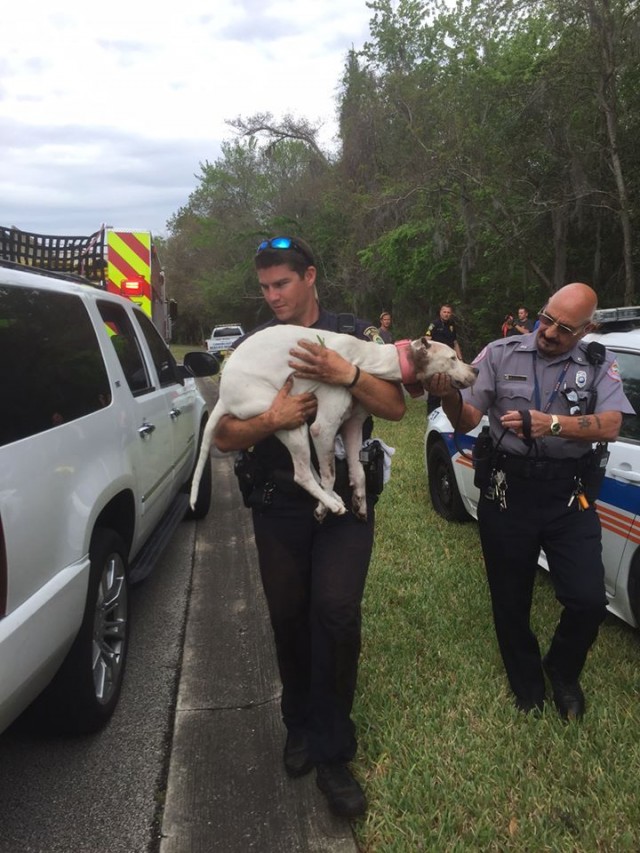
An on-site health check immediately following the rescue does not reveal any serious health concerns.
Fortunately, Jane Dog is doing just fine and has been reunited with her family who, while amused by her temporary name, have gone back to calling her Sailor.
Police officers carry Jane Dog who’s true identity was later revealed to be Sailor.
Photos courtesy of Port Orange Police Department Facebook page.
Yesterday, a visitor to this place left a comment to a post published in September, 2012. Simply, he wrote, “Some food for thought midst all the drivel and crap.” The post was under the heading of The Charles Schulz Philosophy. I had forgotten about it. I thought it would be nice to republish it today (or rather the essence of that post).
ooOOoo
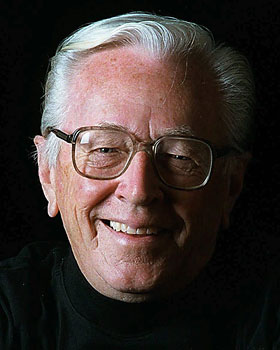
Charles Schulz
The following is the philosophy of Charles Schulz, the creator of the ‘Peanuts’ comic strip.
You don’t have to actually answer the questions. Just ponder on them. It will make very good sense!
Here’s A Little Quiz
You don’t have to actually answer the questions. Just read them straight through, ponder a tad, and you’ll get the point.
Name the five wealthiest people in the world.
Name the last five Heisman trophy winners.
Name the last five winners of the Miss America pageant.
Name ten people who have won the Nobel or Pulitzer Prize.
Name the last half dozen Academy Award winners for best actor and actress.
Name the last decade’s worth of World Series Winners.
How did you do?
The point is, none of us remember the headliners of yesterday. These are no second-rate achievers. They were the best in their fields.
But the applause dies. Awards tarnish over time. Achievements are forgotten and accolades and certificates are buried with their owners.
Here’s another quiz. See how you do on this one:
List a few teachers who aided your journey through school.
Name three friends who have helped you through a difficult time.
Name five people who have taught you something worthwhile.
Think of a few people who have made you feel appreciated and special!
Think of five people you enjoy spending time with.
Did you find that Easier? Of course you did!
So here’s the lesson!
The people who make a difference in your life are not the ones with the most credentials, or the most money…or the most awards…they simply are the ones who care the most.
It was after 3pm yesterday when I turned on my computer and wondered what today’s post was going to be; I wasn’t feeling especially creative!
But sitting in my ‘in-box’ was a link to the latest newsletter from The Smithsonian and within that newsletter was a perfect sequel to yesterday’s post What’s In A Name?
I’ll go straight to that article. (Apologies if you notice that there is a fair degree of overlap between the two articles.)
ooOOoo
Call a Dog a Pit Bull and He May Have Trouble Finding a Home
Dogs labeled as pit bulls at shelters may wait three times longer to be adopted—even when they aren’t actually pit bulls
An adorable shelter dog shouldn’t have a difficult time finding a home—but it might if it comes with the label “pit bull.” (LeticiaRose / iStock)
Regardless of a canine’s actual breed, simply labeling a dog a “pit bull” can condemn it to a significantly longer stay in a shelter and make it less attractive to potential adopters, concludes a new study in PLOS One.
Pit bulls are often stereotyped as aggressive and dangerous toward humans, though there is little evidence that those characteristics are inherent to the breed. The breed is popular among the dog fighting crowd, however, which contributes to its reputation for aggressiveness. To complicate matters, when attacks do occur, dogs may be labeled as pit bulls even when they are not. Indeed, in the United States, “pit bull” often serves as a catchall for a handful of breeds ranging from English bulldogs to American Staffordshire terriers; one person’s pit bull is another’s American bulldog mix.
This reputation follows the canines when they land in shelters. When potential adopters look at available dogs, they “don’t rate pit bulls any differently than look-alike dogs,” says the study’s lead author, Lisa Gunter, a graduate student in psychology at Arizona State University. “It’s only when we start attaching labels that people begin to perceive them more negatively.”
Most shelter dogs are of unknown origin, so employees often have to guess at an animal’s breed. Over a 10-year career working in shelters, Gunter noticed that she and her co-workers frequently arrived at different conclusions about a dog’s breed. And genetic studies have found significant discrepancies between descriptions of shelter dogs and their actual breed. One study found, for example, that half of the dogs that had been labeled as pit bulls at four Florida shelters had no pit bull ancestry in their DNA.
Gunter and her colleagues undertook a series of studies to find out how those potentially flawed labels might impact an animal’s chance of finding a home. They started by showing college students in California and users of the website Reddit photos of three dogs—a Labrador retriever, a pit bull-like dog and a border collie—without attached breed labels and asked questions about each, such as whether the dog looked smart or if the person would feel comfortable approaching it. The team found that participants ranked the pit bull-type dog as lowest on intelligence, friendliness, approachability and adoptability, and highest on aggressiveness and difficulty to train. When the pit bull appeared in a photo with an elderly woman or a child, however, it was rated more favorably.
Next, the researchers asked potential adopters at an Arizona shelter to rank dogs that appeared in photos and short videos on the animals’ approachability, intelligence, aggressiveness, friendliness, difficulty to train and adoptability. These scores were then summed to create an “attractiveness” composite for each pooch. To get around possible biases, such as apartment rules about animal sizes or bans on certain breeds, the team used phrases such as, “If circumstances allowed, I would consider adopting this dog,” to assess willingness to take a canine home.
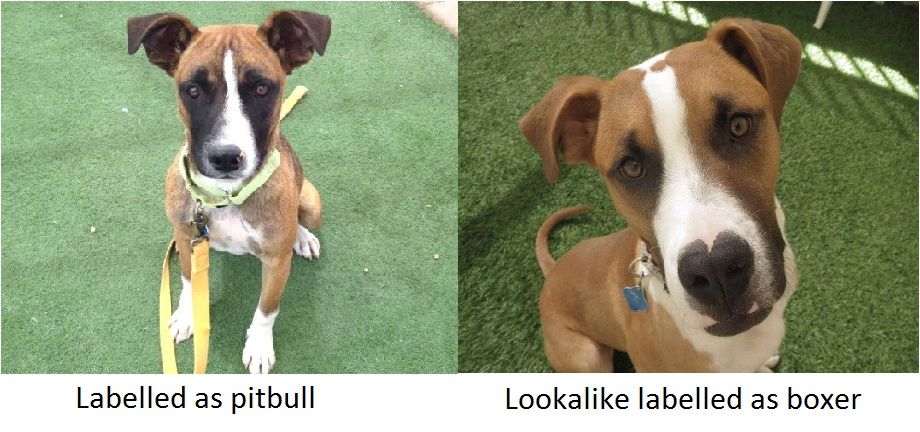
These two dogs may look similar, but the pit bull label could mean that the one on the left may wait a lot longer to find a home. (Arizona Animal Welfare League)
When the dogs were not labeled as any particular breed, participants ranked pit bulls and look-alikes (dogs that were the same size and color as the pit bulls) as equally attractive. Potential adopters even ranked the pit bulls in video recordings as more attractive than the non-pit bull matches. When the researchers introduced breed labels, however, that trend reversed, with participants ranking the same dog as significantly less attractive than similar dogs without the label.
The researchers also found that pit bulls at that shelter waited over three times as long to find a home as their matched counterparts.
Finally, the team analyzed a set of data from an animal shelter in Florida that recently removed breed descriptions altogether. When freed from the loaded label, pit bull-like dogs were much more likely to find a home. Adoptions of these dogs increased by more than 70 percent, compared with the prior year, and the shelter’s euthanasia rate for the same group dropped by 12 percent, probably because more of them were finding homes.
Taken together, these results “are very convincing that breed labels negatively impact any dog that is labeled as ‘pit bull,’” says Erica Feuerbacher, who studies dogs at Carroll College in Montana and was not involved in the study. “Furthermore, we know from other studies that humans are quite bad at correctly labeling breeds, so many dogs could be erroneously labeled pit bull—even though they are not—and by that label they become less adoptable.”
Eliminating breed labels, which people seem to be using as poor proxies for stereotyped traits, may be the key to banishing a significant amount of dog discrimination—and getting more dogs into homes, Feuerbacher and the other researchers argue. There is also a need to devise better means of measuring dogs’ true personalities, including their potential for aggression, and of ensuring those assessments are valid not just in the shelter environment but also in homes, Gunter notes.
“We want to drive the adoption conversation toward evaluating whether an individual dog, regardless of the breed, is a suitable candidate for adoption,” she says. “Then we can match-make between the personality of the dog and that of the person, instead of just relying on labels.”
ooOOoo
You can see why it so perfectly followed on from yesterday!
Not just my post but yesterday’s comments. Such as this from Tony:
Another example of form over substance. When will we learn?
So I know you will all cheer Erica Feuerbacher who is quoted towards the end of that Smithsonian essay and I will close with her words, in part: “We want to drive the adoption conversation toward evaluating whether an individual dog, regardless of the breed, is a suitable candidate for adoption. Then we can match-make between the personality of the dog and that of the person, instead of just relying on labels.”
“What’s in a name? That which we call a rose by any other name would smell as sweet”.
That very well-known quotation from Wm. Shakespeare was the obvious sub-title to today’s post.
You will be aware that I have written several times previously about Pit Bull dogs. But I would like to draw your attention to a post that was published here back in 2013. It was called In praise of Pit Bull dogs and featured a guest post from Noella Schink, in Portland, Maine, where she then lived and played with her 3-year-old pit bull mix, Addie, 8-year old shih-tzu, Brutus, and 2-year old hound, Lula. Apart from all of them being a little older I trust nothing else has changed.
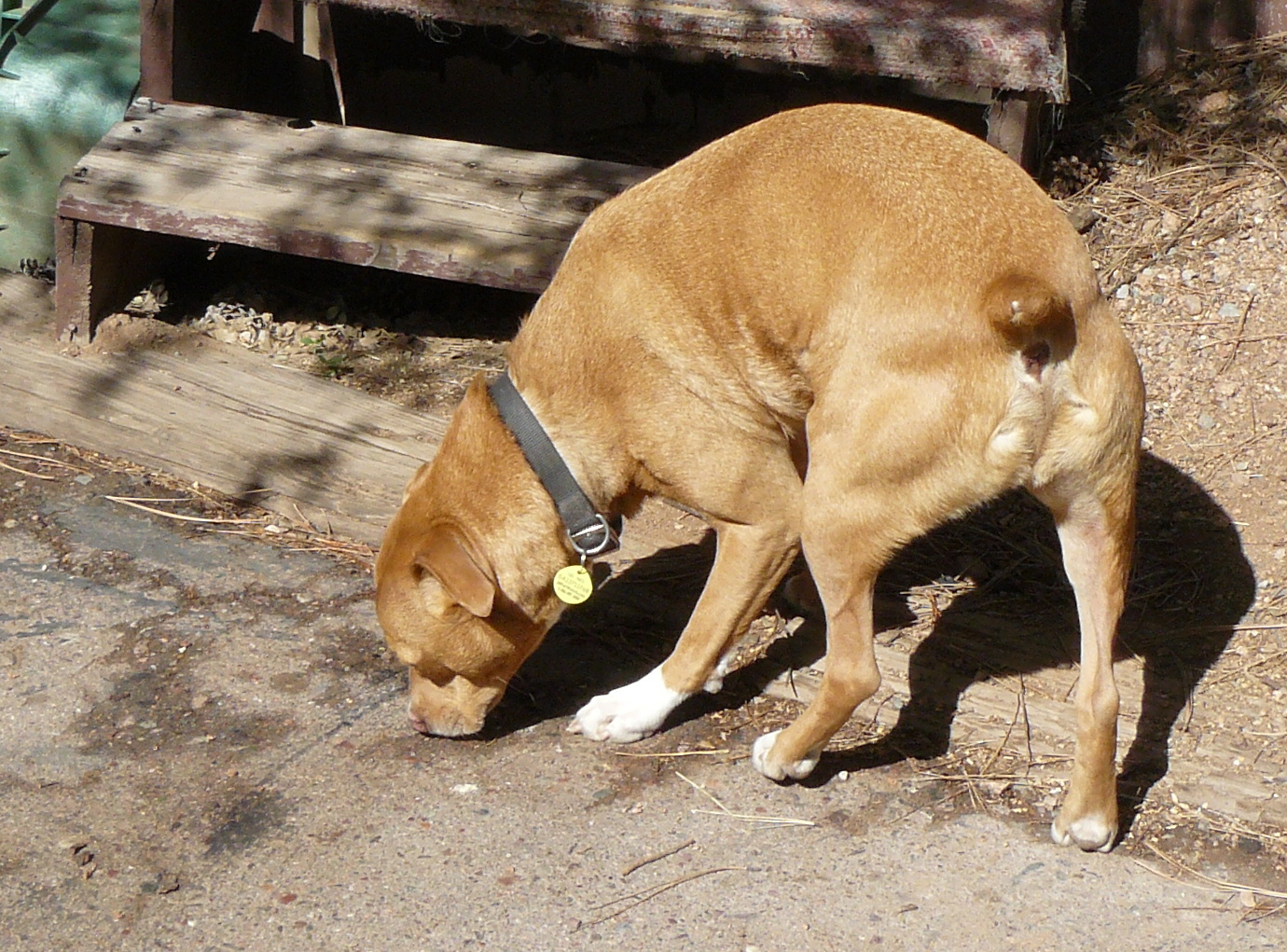
That post in 2013 also included a picture of our gorgeous Casey, as follows.
Casey doing what dogs do so well – picking up scents around his home.
Over on the Care2 petition site there was a compelling case being made for Pit Bulls to be given a different name. Read it and see if you are convinced of the need.
ooOOoo
How We Could Save More Dogs From Death Row by Changing One Thing
Whether we like it or not, labels matter — even for dogs. New research from Arizona State University published in PLOS ONE, suggests labels could even lead to a potential death sentence, if you’re a pit bull.
Pit Bulls Wait 3 Times as Long to be Adopted
The pit bull went from America’s darling dog to one of the most feared (and misunderstood) dogs today. Their fall from grace is evident in stories like Olive’s. Olive the Pit Bull was brought in as a stray and stayed in the shelter for approximately 11 years. Olive was lucky enough to find her forever home, but so many dogs like her aren’t — and our arbitrary labels aren’t helping their cause.
According to Science Daily, researchers from Arizona State University wanted to know if breed identification influences adoption. The researchers found that dogs labeled as “pit bulls” could wait three times as long to be adopted from shelters into their forever homes compared to their lookalikes without the label or labelled as another breed.
Compared to other breeds, like Labradors, pits were perceived as less friendly and more aggressive. They also were considered less “attractive” than their lookalikes. Weird, right?
Even the researchers were surprised by how much the pit bull label influences perception and, ultimately, adoption. As researcher Lisa Gunter from Arizona State University explains, “We were surprised how very similar looking dogs sometimes get labelled ‘pit bull’ and other times as something completely different. These dogs may look and act the same, but the pit bull label damns them to a much longer wait to adoption,” reports Science Daily.
Ultimately, the researchers recommend losing the pit bull label to stop inadvertently penalizing these dogs in the shelter setting.
Heartbreaking Pit Bull Statistics
If you thought that Olive’s story was sad, she’s actually one of the lucky ones — not only for getting adopted, but for staying in the shelter system for the 11 years that she did.
According to Pit Bull Rescue Central (PBCR) 200 pit bulls are euthanized in Los Angeles County animal shelters every single day.
PBCR emphasizes that “for homeless pit bulls the death sentence is almost always automatic.”
Villalobos Rescue Center (made popular by the TV show Pit Bulls and Parolees) had this to say about the pit bull plight in Los Angeles: “The pit bull population has now risen to 40% of all the dogs in 12 shelters in Los Angeles. That means that almost half of the entire Los Angeles dog population is pits or pit mixes! Most are strays, tossed out like dirty laundry. It’s heartbreaking.”
Sadly, the plight of pit bulls is not limited to Los Angeles County. A 2013 Nat Geo Wild infographic reveals that:
60 percent of the total dogs euthanized in U.S. shelters are pit bulls
30 percent of the total dogs admitted to shelters are labeled pit bulls
86.7 percent of pit bulls admitted to open admission shelters are euthanized
Do you know what the worst part of this sad situation is? There’s no such thing as a pit bull.
As Bark Post explains, the pit bull label is just “an umbrella term that most people use to refer to different types of dogs – the American Pit Bull Terrier, the American Staffordshire Terrier, the Staffordshire Bull Terrier, any mixes thereof, and any dog that vaguely resembles these dogs.”
The breed isn’t real, but the stigma has real consequences. And time and again pit bulls prove that they can be great dogs with the correct guidance and training when they get a second chance. Remember how Jericho the Pit Bull went from death row to being an amazing service dog?
Take Action!
Sign and share this petition urging animal rescuers to lose the stigmatizing pit bull label that unnecessarily penalizes innocent dogs. It’s a matter of life and death.
Only idiots believe that pit bulls are bad! When are some morons going to finally wake up and realize bad owners are responsible for bad dogs! BSL should be banned everywhere. We must never stop fighting to end the senseless killing of this breed.
Smallbatch Pets has announced it is voluntarily recalling a select lot of its Duckbatch Sliders frozen dog food because it may be contaminated with Salmonella and Listeria.
Smallbatch Pets Dog Food Recall of March 2016
March 26, 2016 — Smallbatch Pets Inc. is voluntarily recalling one lot of frozen dog Duckbatch Sliders due to their potential to be contaminated with Salmonella and Listeria monocytogenes.
The following image was copied in good faith by The Dog Food Advisor from Smallbatch Pets’ website and may not be a true representation of the recalled product.
What’s Recalled?
The affected products are sold frozen in 3 pound bags and can be identified with the following manufacturing codes:
Lot #: CO27
Best By Date: 01/27/2017
UPC: 713757339001
The “Best By” date is located on the back of the package below the seal.
Where Was the Product Sold?
Eighty cases of the affected lot of dog Duckbatch Sliders were sold between the dates of February 23, 2016 and March 10, 2016.
They were distributed to retail pet food stores in the following states:
California
Colorado
Oregon
Washington
About Salmonella and Listeria
Salmonella and Listeria can affect animals eating the products and there is risk to humans from handling contaminated pet products, especially if they have not thoroughly washed their hands after having contact with the products or any surfaces exposed to these products.
Healthy people infected with Salmonella and Listeria monocytogenes should monitor themselves for some or all of the following symptoms: nausea, vomiting, diarrhea or bloody diarrhea, abdominal cramping and fever.
Rarely, Salmonella and Listeria monocytogenes can result in more serious ailments, including arterial infections, endocarditis, arthritis, muscle pain, eye irritation, and urinary tract symptoms.
Consumers exhibiting these signs after having contact with this product should contact their healthcare providers.
Pets with Salmonella and Listeria monocytogenes infections may be lethargic and have diarrhea or bloody diarrhea, fever, and vomiting.
Some pets will have only decreased appetite, fever and abdominal pain.
Infected but otherwise healthy pets can be carriers and infect other animals or humans.
If your pet has consumed the recalled product and has these symptoms, please contact your veterinarian.
No pet or consumer illnesses from this product have been reported to date.
However, because of their commitment to safety and quality, Smallbatch Pets is conducting a voluntary recall of this product.
Consumers should also follow the Simple Handling Tips published on the Smallbatch Pets package, when disposing of the affected product.
What Caused the Recall?
This recall was initiated after routine testing by the Food and Drug Administration of a 3 pound bag of dog Duckbatch Sliders that was collected at a distributor revealed the presence of Salmonella and Listeria monocytogenes.
This recall is being made with the knowledge of the U.S. Food and Drug Administration.
What to Do?
Consumers who have purchased the above lots of dog duck sliders are urged to stop feeding them and return product to place of purchase for a full refund or dispose of them immediately.
Those with questions may call Smallbatch Pets at 888-507-2712, Monday through Friday, 9:00 AM to 4:00 PM PT. Or email the company at info@smallbatchpets.com
U.S. citizens can report complaints about FDA-regulated pet food products by calling the consumer complaint coordinator in your area.
Our delivery of trees arrived yesterday from the Arbor Day Foundation and that means that much of today will be spent in getting those trees planted.
Plus the recent wet spell has stopped me taking that first cut of the grass from around the house. So there’s another task for this relatively decent weekend coming up. And the vegetable garden needs some attention. And so on!
All of which is my way of saying that I won’t be paying my normal level of attention to Learning from Dogs for the next few days.
Rather aptly comes this item that was recently published over on The Conversation and is republished here within their kind terms.
ooOOoo
Hug a tree – the evidence shows it really will make you feel better
March 18, 2014.
Author
Shelby Gull Lair, Lecturer, School of Environmental Sciences, Charles Sturt University.
We know that trees have many benefits. In forests they provide habitat, wood, biodiversity and ecosystem services. In cities, they can mitigate the urban heat island effect by cooling the air and reducing greenhouse gases.
But, perhaps surprisingly, there is increasing evidence that trees are also good for our mental health.
Are we all tree-huggers?
The idea that humans are intimately connected to the earth has persisted throughout human history and across cultures. In the western world, this connection was most recently described by eminent biogeographer E.O. Wilson in his 1984 book Biophilia. Wilson notes that humans naturally like to be around other living things.
This hypothesis was the basis of “connection to nature”. Psychologists have now developed multiple scales used by researchers to determine how connected a person is, and how we might be able to increase our connection to our benefit.
Connection to nature research is still developing, but early results seem to indicate that how connected to nature you are is related to your environmental behaviours, such as participation in recycling programs and an increase in overall well-being and happiness.
Because it is still a new line of research, the relative connection to nature of folks who live in urban areas and cities versus those of us living in rural places has yet to be established. But many researchers and environmental educators have come to suspect that we are becoming disconnected from nature.
Nature-deficit disorder
This disconnect from nature was set out in 2005 by American writer Richard Louv in his book The Last Child in the Woods. Louv coined the term “nature-deficit disorder” which means that modern humans have become disconnected from nature through our daily activities and this disconnect has had negative consequences in terms of mental and physical health. Proof of this hypothesis so far lies in studies that show how people with “modern” ailments, such as ADHD, anxiety or depression feel better with exposure to nature.
Based in North America, the Children & Nature Network has pages and pages of summarised research from academics around the world that seems to indicate a strong likelihood this disconnect is a real phenomenon. The sheer number of studies and their results showing the miracle cure of nature can be overwhelming at times.
There are studies represented such as:
Living in urban areas with more tree canopy cover had increased the likeliness of a better birth outcome.
Inner city girls with a greater view of green from their high-rise public housing buildings had more self-discipline than their peers who look at other buildings.
Children with ADHD receive the greatest relief of symptoms through participation in green outdoor activities versus other activities without nature.
Do yourself a favour, skim the pages of research summarised in short abstract form on the Children & Nature Network website. You may start to wonder why we’re not hearing more about getting our children and ourselves back outside.
This research also clearly highlights the important role that urban trees play in cities: their enormous social and psychological benefits may be even greater than ecological benefits.
Stressed at work? Your office might benefit from some folliage. srv007/Flickr, CC BY-NC
Reconnecting with the natural world
So what are our next steps? As I see it, there are two things that must be done.
First, as researchers we really need to directly test the idea of a disconnect particularly between urban/built up areas and more rural areas with plentiful trees. We need to know if people living in areas with fewer trees and natural environments are more disconnected from nature than those living in places where there are abundant trees and wildlife. Deeper still, we could also ask what interventions seem to connect folks to nature in a meaningful way?
Second and most importantly, if we are disconnected from nature, what can we do about it? Fortunately the above studies and resources show us many different activities and ideas we can use to increase our nature exposure.
Just a few ideas to try:
Bring a plant into your office.
Ask council to plant a street tree outside your office window or better yet all around town.
When walking, choose the path through the park instead of around it.
Take your children to the park, to the natural sections as well as the play equipment.
Practise the art of gardening or even veggie gardening.
Plant a tree.
Spend some time sitting under a tree. And if you’re so inclined, maybe even give it a cuddle.
ooOOoo
Setting a fine example!
You all have a lovely weekend hugging as many trees as you can!
Oh, and let me give you that full silly verse that started out in the sub-title.
I have so much admiration for the rescuers, like Jean was in Mexico. They have the biggest hearts, and see the absolute worst of things.
Then a few moments later, a further reply from John:
And to rescue the abused ones. To find them, then live in that lag time before they are freed. I wouldn’t be able to sleep. I don’t have the disposition for it. I’d be physically ill.
Thus the minimum that I can do is to promote the incredible work done by the Rogue Valley Humane Society; just one among many.
For example, by republishing what they present on their About page.
ooOOoo
About The Rogue Valley Humane Society
Our Vision
The Rogue Valley Humane Society envisions a community where every healthy adoptable companion animal has a lifetime, loving home and all homeless animals receive the care and compassion they deserve until they are adopted by their forever family.
Our Story
Fifty years ago homeless animals in the Rogue Valley faced a death sentence if no one adopted them within a few days. In 1965 a small group of animal lovers decided to try to change that, and they started a rescue to give homeless, abused, and abandoned pets in Josephine County a safe haven without a time limit. The Rogue Valley Humane Society grew out of this grassroots effort. RVHS was incorporated in 1965 as a non-profit public benefit corporation dedicated to providing love, food, shelter, and medical attention to these animals until they can find new lifetime homes.
Thirty-five years later the current facility opened with the capacity to house 14 dogs and 80 cats plus litters of puppies and kittens. Our main building houses all of the cats plus the office, laundry and medical room. The separate kennel building has indoor/outdoor runs. The Robert E. and Jennifer Murphy Canine Care Building was built in 2013 to house newborn puppies and any dog needing a quiet place to heal.
Throughout the years we’ve had one singular goal: to improve the lives of animals. We are proud to show RVHS to visitors so they can see first-hand the standard of care we give to every homeless companion animal, from an elderly, blind dog to a day old kitten.
The Rogue Valley Humane Society is a 501(c)(3) non-profit corporation. We provide shelter, food, medical care and personal attention for hundreds of homeless dogs and cats every year. We are here for the young and cuddly, the old, sick and neglected, and everything in between.
We receive no county, state or federal funds and rely solely on individual and foundation grants to carry out our mission.
Our Mission
The Rogue Valley Humane Society provides compassionate care for stray, unwanted, displaced, and abandoned animals and works toward ending pet overpopulation so that there will be no more homeless pets. We are committed to placing every healthy, adoptable animal in a loving lifetime home, teaching responsible pet guardianship, and maintaining community spay-neuter programs.
Our Core Values
We believe that every animal’s life has value and is worthy of respect and protection.
We believe that euthanizing healthy, adoptable animals is not acceptable.
We believe that animals contribute to the health, happiness and quality of human life.
We believe that we must manage our resources to assure the long-term future of our organization.
We believe in providing quality medical and shelter care by following evidence-based animal welfare practices.
We believe that through humane education we can help foster compassion, protection and guardianship for companion animals.
We believe that we should treat everyone with dignity and respect. Community members, staff, and volunteers are partners in improving the welfare of animals and helping us fulfill our Mission.
We believe that we can end pet overpopulation by adhering to our commitment to spay/neuter all of our animals before adoption and by providing community-assistance spay-neuter programs.
We believe that we best serve our community by placing healthy companion animals in responsible, loving homes.
ooOOoo
By promoting their Facebook page (look them up).
By enjoying some of the pictures on their website of dogs looking for homes:
My name is Rudy. I WAS extremely shy and nervous in the beginning. After a little love and patience, as you can see in the video I have come out of my shell. I love to hang out with both my human and furry friends and to be kept busy. I cherish my daily walks and because I’m a thinking I have a great fondness for brain toys.
Border Collie
Spayed/Neutered
Up-to-date with routine shots
Spayed/Neutered
And …
Labrador Retriever, American Staffordshire Terrier
My name is Margo. I am sweet girl looking for a new lease on life. I promise to give you lots of love and attention, if you promise me the same thing. I’m sure we can come to an agreement and live happily ever after! Sounds good to me!
Yesterday morning Jean and I travelled the short distance into Grants Pass to visit Margaret and the rest of the team at Rogue Valley Humane Society, RVHS. As their website proclaims: Helping Our Community, Four Paws at a Time.
Here’s why we went to meet the team.
If you drop across to my page where I offer my book for sale you will read that:
Please do find your way to supporting our pets in need. For 50% of the net proceeds from the sale of my book are being donated to our local Rogue Valley Humane Society. Every cent makes a positive difference!
Well many of you, dear people, have made a positive difference, as the following pictures illustrate.
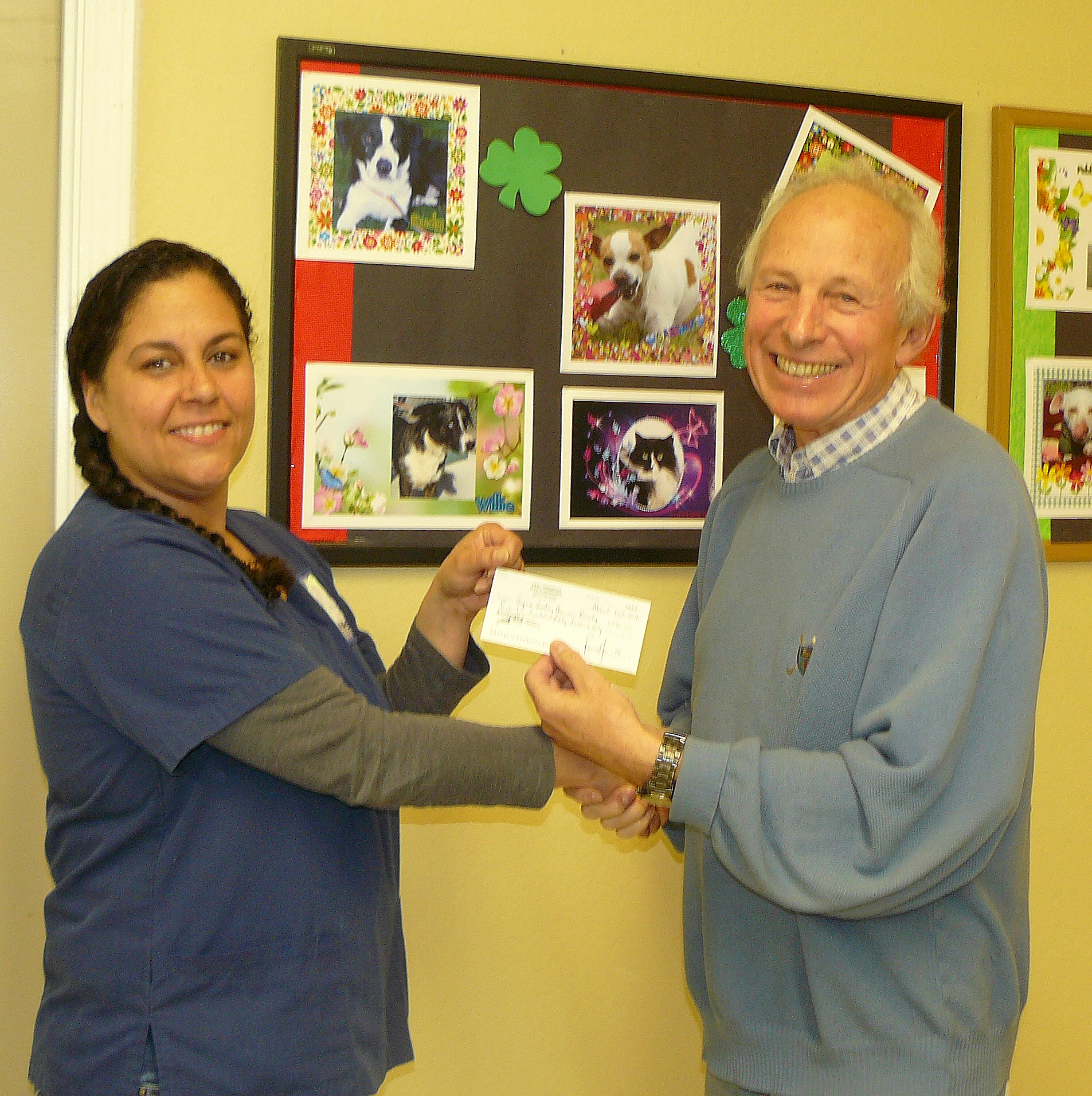
Yours truly passing a cheque to the value of $750 to Margaret Varner, Director of Facility Operations at RVHS.
oooo
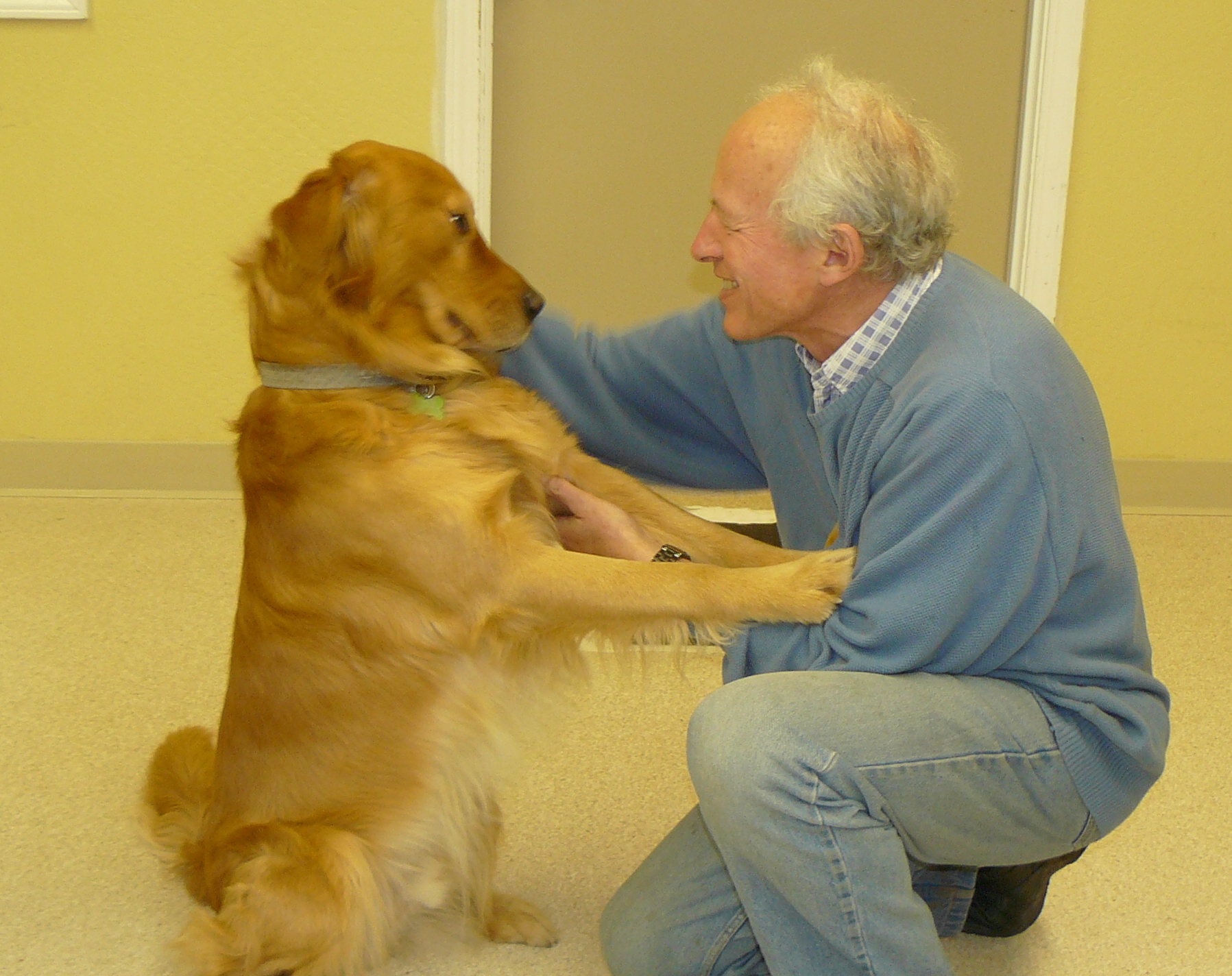
Explaining to Authentic the dog in the office of RVHS what has just been donated.Being thanked in the only way that dogs can properly thank someone!
oooo
Gorgeous shot of Jeannie and Authentic.
So a tremendous vote of thanks to everyone that has purchased my book for this is what your generosity delivers!
Going to write a little more about the Humane Society tomorrow.
Happy Birthday to grandson Morten who is five today!
Indirectly there is a connection between my sub-title, above, and today’s post about squeezing cute creatures. For Morten will already have enjoyed many hugs and, hopefully, will grow up feeling very comfortable at giving and receiving hugs.
Thankfully, Jean is a great hugger and has opened my eyes to the power of giving in to a hug. Not suprising when one thinks of Jean’s years of hugging dogs way before she and I met back in 2007.
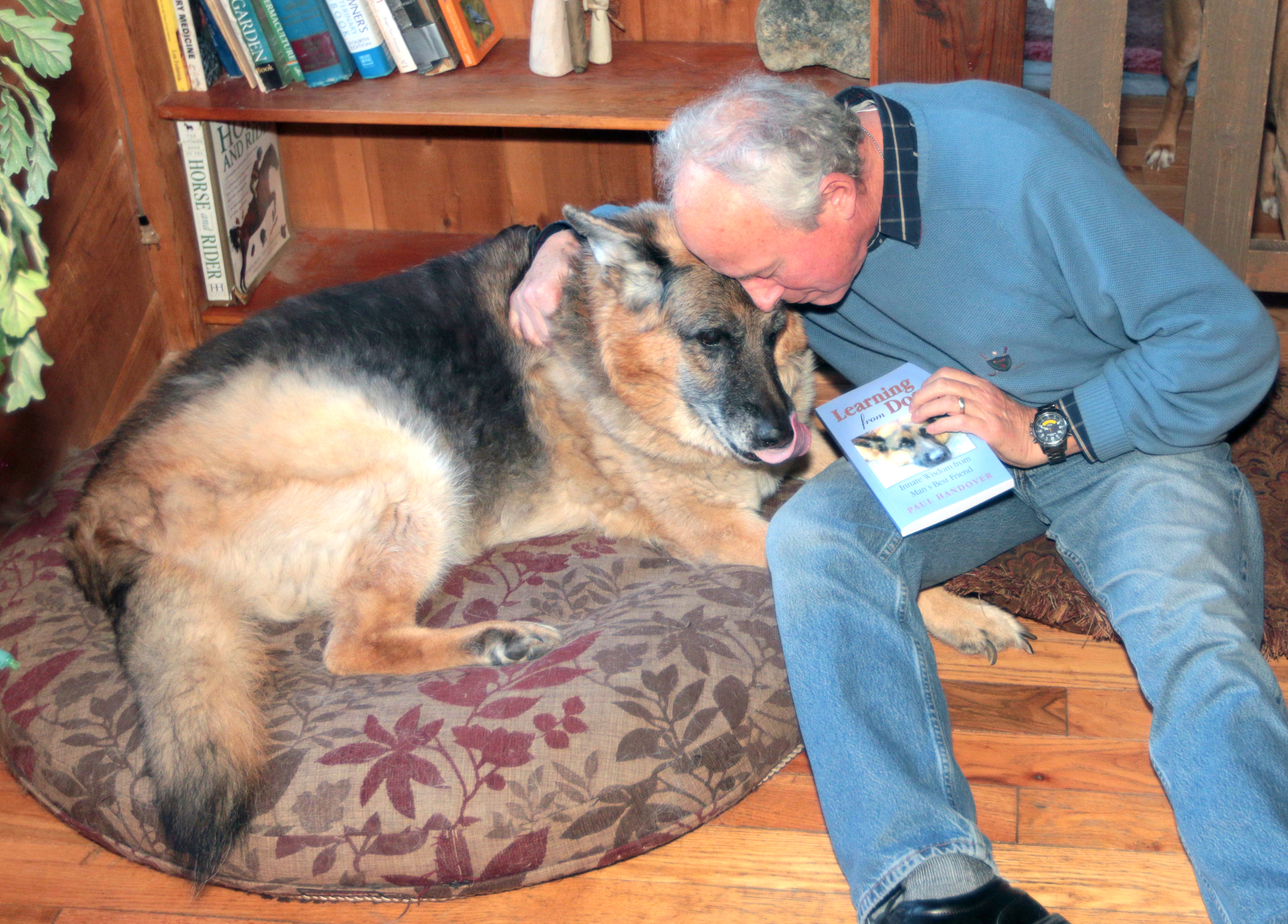
Dear old Pharaoh, as he has aged, (he will be 13 this coming June) clearly enjoys more hugs than when he was a more active, fitter German Shepherd and always on the go.
When The Daily Courier, our local newspaper, came to the house last December Timothy Bullard, the paper’s photographer, took the following photograph of Pharaoh and me having a ‘love in’.
TIMOTHY BULLARD/Daily Courier – Paul Handover with Pharaoh, a 12year-old German Shepard that he uses on the cover of his new book about man’s best friend.
So this recent article from the Care2 website seems an appropriate follow-on to my introductory remarks.
If any of the collected photographs you see here cause you to emit high-pitched noises or ache to cradle the pictured animal tight in your arms, you might be experiencing a bout of “cute aggression.”
The phrase refers to a phenomenon during which we catch sight of a living thing deemed “cute,” usually a baby or an animal or — double-whammy — a baby animal, and feel an overwhelming desire to play with the subject’s features; a compulsion to tickle its feet; the need to tease its rumples or bulges of fat; the want to bury our faces into its belly.
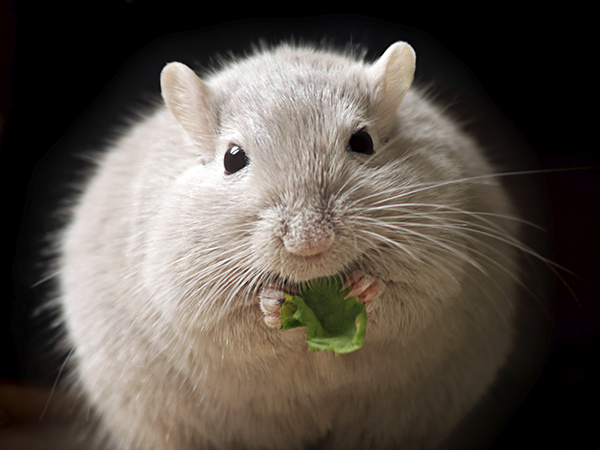
fluffy mouse ball
Granted, not all voiceless lifeforms enjoy being tugged at or played with in an intrusive manner, which is why this behavior is referred to, in part, as “aggressive.” While we might mean absolutely no harm to the creature we long to hold and hug, our near-hyperactive responses to its presence often seem beyond our control, what some have called the “squee” effect.
Yale researchers studied this “dimorphous expression” — the need to manhandle living creatures for which we feel only positive emotions — in 2014. Part of the experimental regimen involved asking some participants to pop bubble wrap while viewing images of “cute baby animals;” others did the same while looking at images of adult species. The results: Those who viewed the infants popped more bubbles by far.
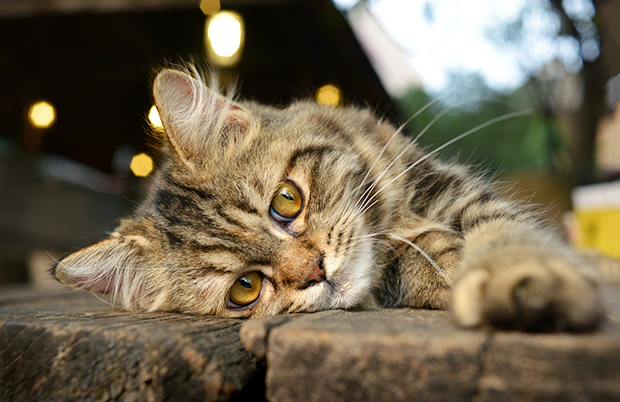
baby maine coon cat feeling
One of the researchers, psychologist Oriana Aragón, said that participants would have likely squeezed whatever they had in their hands or arms while viewing images of the “cute” animals, be it a purse or a pillow. Had something alive, however, actually been in those arms, the strength with which the participants freed their fuzzy feelings might have been worrisome to the researchers.
But Aragón says that strong human emotions are often balanced by “an expression of what one would think is an opposing feeling.” This is similar to what happens when we cry while angry or laugh while nervous. Our actual expressions “scramble and temper” whatever feeling got us into such a tizzy in the first place, helping to restore our emotional equilibrium, “tamping down or venting” feelings that cause us to become too excited.
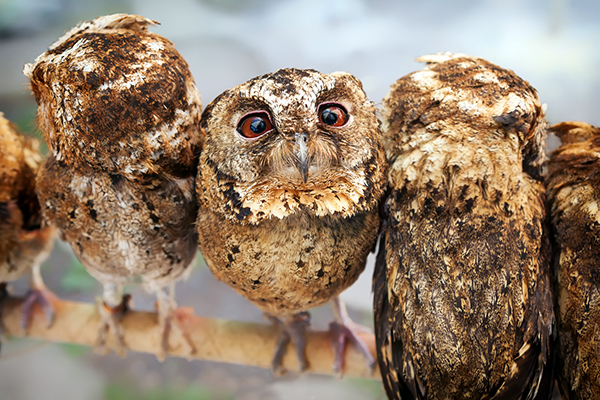
Funny portrait of curious baby owl
While wanting to squish what could be one’s own offspring might seem an evolutionary misfire, a 2012 study in the journal PLOS ONE indicates that cuteness creates a powerful “approach motivation,” the very thing that drives us to scoop up puppies and kittens in adoption kennels and squeeze them close to our chests and nuzzle them against our faces. It seems the need to be touchy-feely toward cuteness provokes precisely the kind of nurturing that keeps helpless creatures alive.
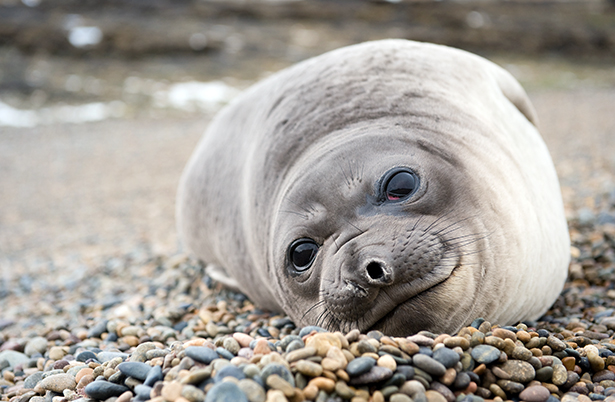
As for animals, those worthy of this treatment, appealing to us as “cute,” mimic physical characteristics of human babies — “a large head; rounded, soft, and elastic features; big eyes relative to the face; protruding cheeks and forehead; and fuzziness.” The same, in fact, seems to be true for Great Apes, as has been documented with Koko the gorilla and an Internet celebrity orangutan shown interacting with tiger cubs, though the scene remains controversial.
And so it seems the power of cuteness is made all the more apparent when humans (or elevated primates) respond to a rabbit or a duckling the way they might respond to their own kin. Our desire to squeeze is so powerful, in fact, that it “spills over” into interactions with other species. Thus, we have Web sites like Cute Overload that exist only for the compelling pull to exercise that need to feed our “cute aggression,” be the temptation a pleasure or a pain.
ooOOoo
Demonstrating that cuteness can come in all sizes, let me close today’s post with this photograph.
Ben and Jeannie having a quiet one-to-one moment.
Don’t go too long without giving or receiving a hug!
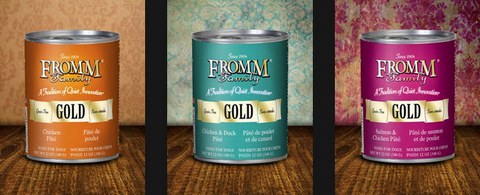
March 18, 2016 — Fromm Family Foods of Mequon, Wisconsin, has announced it is voluntarily recalling three of its canned dog foods because they may contain elevated levels of vitamin D.
What’s Being Recalled?
The company is recalling all lots of the following three Fromm Gold canned dog foods:
Fromm Gold Chicken Pate Dog Food
12 ounce cans
Can case code: #11893
Individual can UPC: 72705 11892
Fromm Gold Chicken & Duck
Can case code: #11895
Individual can UPC: 72705 11894
Fromm Gold Salmon & Chicken Pate
Can case code: #11891
Individual UPC: 72705 11890
The affected products were shipped to distributors between December 2015 and February 2016.
About the Recall
Fromm has discovered through its own analysis that the affected canned dog foods do not contain recommended levels of vitamins and minerals.
These products may contain elevated levels of Vitamin D.
According to the company…
The recall is being implemented in an abundance of caution as symptoms should only be noted in situations where dogs have eaten the affected products as their only meal for an extended period of time and leading to depression of appetite.
While there have been no reports of any health problems, Fromm is recommending the affected products not be fed.
The company has notified the FDA and has also invited distributors as well as The Dog Food Advisor to share the details of this event with consumers.
What to Do?
Recalled product may be returned to authorized Fromm retailers for a full refund.
Consumers with questions may call Fromm Customer Service at 800-325-6331. The company has added additional hours to assist dog owners during the recall.
U.S. citizens can report complaints about FDA-regulated pet food products by calling the consumer complaint coordinator in your area.
 By: Laura S. April 3, 2016 About Laura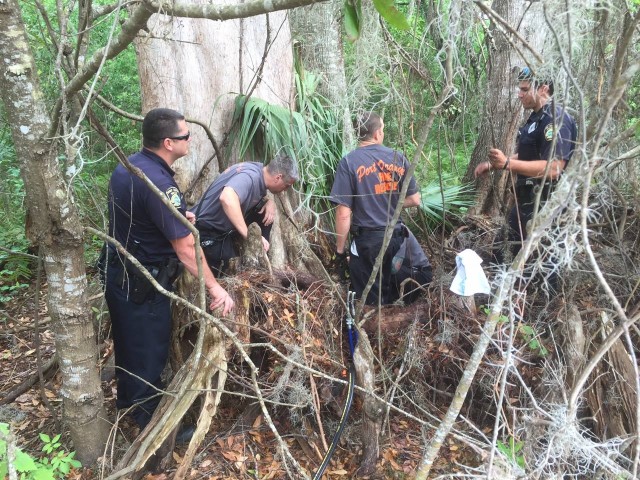









 Learning from Dogs