Humanity’s safe and viable future depends on seeing things very differently.
Next Tuesday is the 62nd anniversary of the death of Albert Einstein, the famous German theoretical physicist who died on the 18th April, 1955. He delivered many innovative ways of seeing our world way beyond his theory of relativity, one of the two pillars of modern physics (alongside quantum mechanics) (Ref: Wikipedia)
Why do I introduce today’s post with that reference to Mr. Einstein?
Because I wanted to share with you a recent essay from George Monbiot and an Einstein quotation seemed so apt an introduction.
We shall require a substantially new manner of thinking if mankind is to survive.
That essay from George Monbiot was published yesterday and is shared with you all with Mr. Monbiot’s full permission.
It is an essay that deserves being read slowly and carefully. Please take time aside to so do because it really does offer a new manner of thinking.
ooOOoo
Circle of Life
13th April 2017
By reframing the economy, Kate Raworth’s Doughnut Economics changes our view of who we are and where we stand.
By George Monbiot, published in the Guardian 12th April 2017
So what are we going to do about it? This is the only question worth asking. But the answers appear elusive. Faced with a multifaceted crisis – the capture of governments by billionaires and their lobbyists, extreme inequality, the rise of demagogues, above all the collapse of the living world – those to whom we look for leadership appear stunned, voiceless, clueless. Even if they had the courage to act, they have no idea what to do.
The most they tend to offer is more economic growth: the fairy dust supposed to make all the bad stuff disappear. Never mind that it drives ecological destruction, that it has failed to relieve structural unemployment or soaring inequality, that, in some recent years, almost all the increment in incomes has been harvested by the top 1%. As values, principles and moral purpose are lost, the promise of growth is all that’s left.
You can see the effects in a leaked memo from the UK’s foreign office: “Trade and growth are now priorities for all posts … work like climate change and illegal wildlife trade will be scaled down.” All that counts is the rate at which we turn natural wealth into cash. If this destroys our prosperity and the wonders that surround us, who cares?
We cannot hope to address our predicament without a new worldview. We cannot use the models that caused our crises to solve them. We need to reframe the problem. This is what the most inspiring book published so far this year has done.
In Doughnut Economics: seven ways to think like a 21st-century economist, Kate Raworth reminds us that economic growth was not, at first, intended as a measurement of well-being. Simon Kuznets, who standardised the measurement of growth, warned: “the welfare of a nation can scarcely be inferred from a measure of national income.” Economic growth, he pointed out, measures only annual flow, rather than stocks of wealth and their distribution.
Raworth points out that economics in the 20th Century “lost the desire to articulate its goals.” It aspired to be a science of human behaviour: a science based on a deeply flawed portrait of humanity. The dominant model – “rational economic man”, self-interested, isolated, calculating – says more about the nature of economists than it does about other humans. The loss of an explicit objective allowed the discipline to be captured by a proxy goal: endless growth.
The aim of economic activity, she argues, should be “meeting the needs of all within the means of the planet.” Instead of economies that need to grow, whether or not they make us thrive, we need economies that “make us thrive, whether or not they grow.” This means changing our picture of what the economy is and how it works.
The central image in mainstream economics is the circular flow diagram. It depicts a closed flow of income cycling between households, businesses, banks, government and trade, operating in a social and ecological vacuum. Energy, materials, the natural world, human society, power, the wealth we hold in common: all are missing from the model. The unpaid work of carers – principally women – is ignored, though no economy could function without them. Like rational economic man, this representation of economic activity bears little relationship to reality.
So Raworth begins by redrawing the economy. She embeds it in the Earth’s systems and in society, showing how it depends on the flow of materials and energy, and reminding us that we are more than just workers, consumers and owners of capital.
The Embedded Economy. Graphic by Kate Raworth and Marcia Mihotich
This recognition of inconvenient realities then leads to her breakthrough: a graphic representation of the world we want to create. Like all the best ideas, her Doughnut model seems so simple and obvious that you wonder why you didn’t think of it yourself. But achieving this clarity and concision requires years of thought: a great decluttering of the myths and misrepresentations in which we have been schooled.
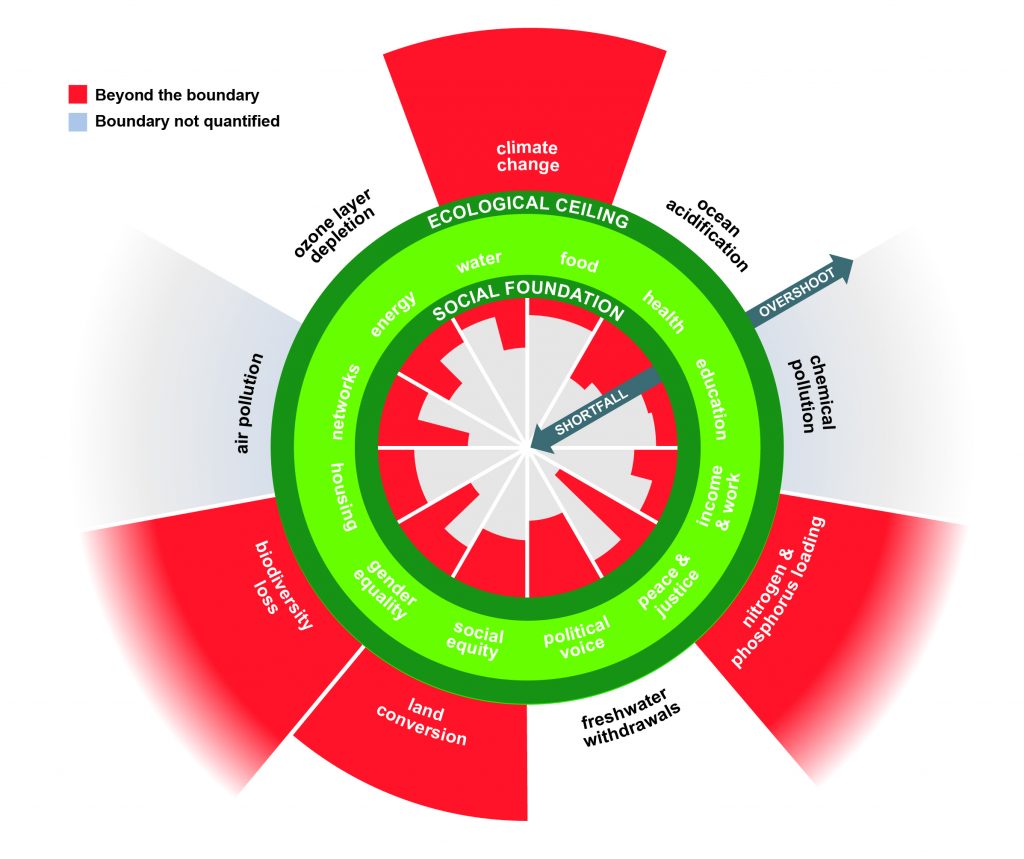
The diagram consists of two rings. The inner ring of the doughnut represents a sufficiency of the resources we need to lead a good life: food, clean water, housing, sanitation, energy, education, healthcare, democracy … . Anyone living below that line, in the hole in the middle of the doughnut, is in a state of deprivation.
The Doughnut. Graphic by Kate Raworth and Christian Guthier/The Lancet Planetary Health
The outer ring of the doughnut consists of the Earth’s environmental limits, beyond which we inflict dangerous levels of climate change, ozone depletion, water pollution, loss of species and other assaults on the living world. The area between the two rings – the doughnut – is the “ecologically safe and socially just space” in which humanity should strive to live. The purpose of economics should be to help us enter that space and stay there.
As well as describing a better world, the doughnut model allows us to see, in immediate and comprehensible terms, the state in which we now find ourselves. At the moment we transgress both lines. Billions of people still live in the hole in the middle. We have breached the outer boundary in several places.
Where we are now. Graphic by Kate Raworth and Christian Guthier/The Lancet Planetary Health
An economics that helps us to live within the doughnut would seek to reduce inequalities in wealth and income. Wealth arising from the gifts of nature would be widely shared. Money, markets, taxation and public investment would be designed to conserve and regenerate resources rather than squander them. State-owned banks would invest in projects that transform our relationship with the living world, such as zero-carbon public transport and community energy schemes. New metrics would measure genuine prosperity, rather than the speed with which we degrade our long-term prospects.
Such proposals are familiar, but without a new framework of thought, piecemeal solutions are unlikely to succeed. By rethinking economics from first principles, Raworth allows us to integrate our specific propositions into a coherent programme, and then to measure the extent to which it is realised. I see her as the John Maynard Keynes of the 21st-Century: by reframing the economy, she allows us to change our view of who we are, where we stand, and what we want to be.
Now we need to turn her ideas into policy. Read her book, then demand that those who wield power start working towards its objectives: human prosperity within a thriving living world.
I wish I understood where my fascination with the night sky came from. Not that I am anything other than an amateur gazer (of the night sky, I should hasten to add!). I have never taken the trouble to gain any real knowledge.
Yet, some of the most serene moments of my life have been when I have been alone at sea under a night sky.
OK, that’s enough wallowing for anyone!
The last week has been an important one for those that take an interest in the planets in our solar system, or to be specific, take an interest in Jupiter.
Today – April 8, 2017 – the planet Jupiter is closest to Earth for this year.
Yet yesterday was Jupiter’s opposition, when Earth flew between Jupiter and the sun, placing Jupiter opposite the sun in our sky. You’d think Jupiter was closest to Earth for 2017 yesterday as well … and yet it wasn’t. It’s closest to Earth for 2017 today, April 8, coming to within 414 million miles (666 million km).
EarthSky also included this image:
Jupiter at its April 7, 2017 opposition with the Great Red Spot and moons Io, Europa, and Ganymede (L to R). Photo by Rob Pettengill in Austin, Texas.
During the month of April, Jupiter will be in opposition, meaning the planet is at its closest point to Earth. Thanks to the sun, it’s during this window that astronomers can enjoy a particularly close-up photo session that can help reveal how the planet’s atmosphere has changed over time by comparing it with previous such photos of the gas giant.
This photo of Jupiter was taken on April 3 by the Hubble Space Telescope when the enormous planet was 670 million kilometers (or about 416 million miles) from Earth. The photo shows the Great Red Spot, but it also shows something new: a weather feature called the Great Cold Spot, which is almost as large as its more well-known cousin.
“The Great Cold Spot is much more volatile than the slowly changing Great Red Spot, changing dramatically in shape and size over only a few days and weeks, but it has reappeared for as long as we have data to search for it, for over 15 years,” Tom Stallard, a planetary astronomer at the University of Leicester in the U.K. and lead author of the study, said in a statement.
The cold spot is nearly 15,000 miles by about 7,500 miles in size, and it’s dubbed the “cold” spot because it’s 200 degrees Kelvin (about 400 degrees Fahrenheit) cooler than the surrounding atmosphere.
The article included this stunning image of Jupiter.
Photo: A. Simon (GSFC)/NASA, ESA
Jaymi went on to write:
Here’s what some of the other details in the image mean:
The NASA/ESA Hubble Space Telescope reveals the intricate, detailed beauty of Jupiter’s clouds as arranged into bands of different latitudes. These bands are produced by air flowing in different directions at various latitudes. Lighter coloured areas, called zones, are high-pressure where the atmosphere rises. Darker low-pressure regions where air falls are called belts. Constantly stormy weather occurs where these opposing east-to-west and west-to-east flows interact. The planet’s trademark, the Great Red Spot, is a long-lived storm roughly the diameter of Earth. Much smaller storms appear as white or brown-coloured ovals. Such storms can last as little as a few hours or stretch on for centuries.
The Great Red Spot is an anticyclonic storm that is so large that Earth would fit inside it. That stormy spot — which is actually shrinking, though astronomers don’t know why — gives us a great perspective for understanding just how huge Jupiter is compared to our own blue dot in the solar system.
It’s been 27 years since the Hubble Space Telescope went into orbit, and the geriatric observatory is still going strong. When the telescope recently trained its sights on the solar system’s largest planet, the results were spectacular—proof that for the stellar spectator, age is but a number.
The image above is the latest picture of Jupiter. The snapshot was taken by Hubble on April 3 with the help of the telescope’s Wide Field Camera 3, a high-res instrument that lets the telescope observe using different wavelengths. It combines light on the visible, ultraviolet, and infrared spectrum to create an image of a massive planet in constant atmospheric flux.
In a press release, the European Space Agency, which co-runs Hubble with NASA, said that Hubble was able to take advantage of the planet’s current opposition with Earth to take the close-up. At the moment, Jupiter is lined up perfectly with the sun, and Earth is lined up with both the sun and Jupiter. Think of it as a truly heavenly photographic opportunity—a chance to look at the planet head-on. Better yet, Jupiter’s position relative to the sun means that it’s brighter than at any other time of year, which lets telescopes trained on the gigantic planet see even more detail than usual.
AsThe Washington Post’s Amy B. Wang notes, there were no new discoveries in the picture per se, but that doesn’t mean there’s nothing to look at. As ESA explains, scientists will compare the photo to previous views of the planet to hopefully learn more about the atmosphere. And for the rest of us, there’s a strangely soothing view of Jupiter’s layered cloud bands and impressive vortices.
The gas giant is thought to have sucked up most of the space debris left over after the sun formed, grabbing dust and gas with gravity. Scientists think it has two times as much debris as all of the other bodies in the solar system combined—and all of that material swirls through cloud layers in its quickly-rotating atmosphere.
Since Jupiter doesn’t exactly have a surface, it has nothing to slow the spots and vortices that appear in its atmosphere. The most famous, the Great Red Spot, is thought to have been swirling around for more than 150 years, and even though it’s unclear which gases give it that red hue, it’s the planet’s most recognizable feature. As NASA writes, the cloudiness of Jupiter’s atmosphere makes it hard to understand what might be contributing to it. But that doesn’t decrease its allure.
Want to delve even further into the mesmerizing bands of a huge planet’s atmosphere? A high-res version of the snapshot is available online. And if you prefer seeing things live, it’s a great time to check out Jupiter through in the night sky. You can find Jupiter in the east right after the sun goes down—a massive mystery that’s brighter than any star.
Namely, that the universe came into existence some 13.82 billion years ago. The power of natural evolution that came with that event eventually brought along homo sapiens some 200,000 years ago. 200,000 is 0.0000145 of 13.82 billion.
Or to put it another way, we humans have only been a part of this universe for 1/10th of 1% of the life of said universe! (Oh, and dogs came along 100,000 years ago!)
Last Tuesday, I published a guest post that had been sent to me by my sister, Eleanor, who lives in Johannesburg in South Africa.
Then a day later I read on the Care2 site about a therapy dog that alerted a group of schoolchildren to potentially very unsafe drinking water. I must share that with you as well.
ooOOoo
Therapy Dog Helps Alert School District to Lead in Water
A therapy dog belonging to a San Diego elementary school teacher proved to be a potential lifesaver – but not for what you might think.
When the teacher filled his bowl with water from the classroom sink on Jan. 26, the dog refused to drink it. The teacher took a good look at the water in his bowl and noticed a sheen on its surface. Concerned, she notified school officials.
After testing samples from around Emerson-Bandini Elementary and the San Diego Co-Operative Charter School 2, which share a campus, results showed the water was contaminated with lead, exceeding the allowable level in the state of California.
School officials contacted the City of San Diego Public Utilities Department, which supplies the water. Because that therapy dog that refused to drink it, the city is now testing the water at each of the school district’s 187 campuses.
The tests, however, won’t begin until April 4, San Diego Unified Chief Operations Officer Drew Rowlands announced last week. In the meantime, students are getting bottled drinking water.
A notice sent to the schools’ staff and parents said the water is safe for handwashing. Since cafeteria meals aren’t prepared on campus, they’re not affected by the contaminants in the water, according to the notice.
The testing of the water, which is expected to be completed by the end of the school year in June, will take place early in the morning, before school starts. At each campus, up to five samples will be taken from water fountains and cafeterias where food is prepared. The test results will be posted online.
If excessive lead is discovered, the contamination source will be determined and school district staff will take “appropriate action on a case-by-case basis,” said San Diego Unified Chief Operations Officer Drew Rowlands. Those appropriate actions could include replacing plumbing fixtures and making repairs.
Making Drinking Water Safe for Schoolchildren
Coincidentally, just one month before the therapy dog refused to drink the San Diego school’s water, the State Water Resources Control Board (SWRCB) Division of Drinking Water launched a program that requires water providers to test for lead in the drinking water at all K-12 schools in California.
“Recent events in the United States have shown that lead in drinking water remains an ongoing public health concern, particularly for children,” the SWRCB stated on its website.
How does lead end up in school water fountains? Although lead rarely occurs naturally in California’s drinking water sources, it can contaminate water that flows through old plumbing fixtures or the solder connecting them. It’s less likely that the water came from a contaminated source, as was the case in Flint, Mich.
Children younger than six are especially susceptible to the effects of lead poisoning. According to the Centers for Disease Control (CDC), about half a million children between the ages of one and five have blood lead levels above 5 micrograms per deciliter, the level at which the CDC recommends the initiation of public health actions – although no “safe” blood lead level in children has been identified.
A problem with lead poisoning is that there are no obvious symptoms. By the time children show the signs, such as weight loss, irritability and lack of appetite, dangerous amounts of lead may have accumulated in their bodies.
This is a compelling reason for more states to follow California’s lead and require water to be tested in schools. Thanks to a teacher’s therapy dog, students at two San Diego schools got a jump start on having safer water available.
As is the way of the Internet and Blogging it is inevitable that connections are made in all four corners of the globe. Some connections are transient, others become long-term. The connection between author John Zande and this blog fits the latter description.
If, dear reader, you have read my posts of the last two days, then that connection between John and me will be clear.
Now despite the fact that I awarded the book five stars on Amazon I can’t tell you that it is an easy read. Nor, to that fact, is it a comfortable read.
For John’s book played around with my head in so many ways that I am still far from returning to a settled mind. Indeed, I have a sneaky suspicion that On the Problem of Good represents another one of those turnstiles in life where once through the ‘gate’ there is no returning to the past way of seeing things.
It played with my mind in the sense of forcing me, albeit with a very small ‘f’, to truly comprehend the consequences of unanticipated outcomes. You know that old saying: “Never underestimate the power of unanticipated consequences“.
Here’s an example.
In 1889 a total of 26 road deaths were recorded in the United States. By 2013 that number had exploded to approximately 35,500. Globally, the number stands at 1.24 million and the World Health Organisation predicts the body of carnage will grow to 1.9 million by 2020. (p.44)
That is just one of the many examples that John uses to support his premise that “good simply does not exist”.
But it goes deeper than that. For John reveals the incalculable, unstoppable force of evolution. Going right back to the very origins of matter. How hydrogen fused into the more complex helium that, in turn, fused into the still heavier and more complex carbon, then along came the fusing of helium and carbon to make oxygen. Then the journey of evolution of atoms. From single atoms to simple compounds, binding to produce double compounds and on to molecules. Then the marriage between molecules to produce amino acids, and on and on to proteins and enzymes and … well, you get the idea!
That continuum from simple to complex organisms and on and on to air-breathing animals (including wolves and then dogs!) and all the way to the likes of yours truly sitting in front of a modern computer writing the review of another person’s book.
All the time, since 13.82 billion years ago, the evolutionary force being a one-way street. A one-way street where John, with some degree of persuasiveness, demonstrates that everything that might, at that time, be seen as a good is not fundamentally a good because it is inextricably connected to a resulting evil.
The Problem of Good is a word problem. It is a lexical glitch, a squabble in temporal, fleshy definitions, and nothing more.
There is no disagreement or antipathy because there is no problem.
Good does not exist. (p.29)
See what I mean about this not being a comfortable book to read!
Nevertheless, you are waiting to hear from me as to whether or not you should read this book?
In answer, here’s a part of what I wrote for my review of the book on Amazon:
If you ever pause for a moment and wonder about the meaning of life, better written as The Meaning of LIFE, then this book is for you. More than that. For if you never ponder about the meaning of life then this really, really is the book for you.
Because for most of us, for most of the time, we live in the land of the blind.
So, thank goodness, that from time to time along comes a person who is the one-eyed King.
A republication of my review of John Zande’s book back in October, 2015.
More than a book review,
a whole new way of looking at you and me, and the rest of humanity.
Back on September 16th, I published the post Of paradoxes, and headaches! It included the fact that I was about 20% of the way through John Zande’s book The Owner of All Infernal Names.
On Tuesday evening of this week, I finished the book and, without doubt, I shall be publishing a review on Amazon books by the end of the week. First, I wanted to share a longer reflection of Zande’s book with all of you dear readers.
ooOOoo
One of the many five-star reviews of this book that has been published on the relevant Amazon page opens simply: “This is a beautifully written, terribly uncomfortable book to read.” I couldn’t better that summary. This is, indeed, a beautifully written book. Yet it is also a book that will forever change the way you think about species: Homo sapiens.
Zande offers a powerful argument that, “Following then the Principle of Sufficient Reason, the observer concludes with a level of argued certainty that a Creator must exist.” Then sets out to demonstrate that this Creator, far from being an expression of universal love, is fundamentally an expression of universal suffering. Reminding the reader that, “This world was never good. It was never peaceful, and never without suffering.”
For the first time in my life, Zande’s words had cause for me to reflect on something that, hitherto, had never dawned on me. That if there is a God, why have I, and countless others, assumed that this God be necessarily benevolent. The evidence presented in Zande’s book is comprehensive: that there was an evil origin to the universe and, more directly, that the deep, and growing, suffering of the pinnacle of evolution, us humans, can be traced back to that evil origin. Better than that, frequently the book is almost scientific. And in the best of scientific traditions, Zande adopts the position of a neutral witness.
Whether or not you are relaxed about that previous paragraph, and I suspect many readers will not, it is impossible not to be in awe of the beauty, the power, and the eloquence of Zande’s words. Take this opening paragraph of Zande’s chapter titled A SIGHTLESS CREATION.
It is a basal vagary, a question that screams for attention and if left unresolved – if left problematic – could invalidate all practicalities of a functioning Creation lorded by a maximally wicked Creator: Would sentient, attentive, self-respecting life choose to live in a world underwritten by evil? Could self-aware life endure a thoroughly hopeless reality?
Whether one is a believer in a religious god or not, it will also be impossible not to have one’s deepest emotions and beliefs about the nature of humankind stirred very deeply around. No-one who reads this book will be left unchanged.
If you have ever pondered about the way the world is heading, or more accurately put, about the way that we humans are managing our existence on Planet Earth, then you need to read this book. Period!
ooOOoo
So my review of John Zande’s latest book is being published tomorrow.
The village of Chalhuani in Peru has a horrific annual tradition where a dog is tied to the back of a bull at a bullfight as punishment for “bad” behavior. Both of the animals are then painfully killed during the fight.
Video posted by the Mirror exposed this cruel Virgen de la Asuncion tradition in action, sparking global outrage. The video shows a dog being forced onto the back of a bull while it yelps and barks in fear. The terrified dog is tied spread-eagle to the bull, with the ropes so tight it cannot move.
The bull then enters the ring, where it is viciously killed. All the while, the dog is trapped on the bull’s back, unable to save itself from an excruciating death.
One villager tried to justify the cruelty in an interview with a local news station:
“We pick a dog that was disobedient over the past 12 months and has caused trouble,” the villager said. “As a community we see this as a fitting punishment for the dog’s bad behavior.”
But “bad” behavior is no excuse for animal cruelty. No dog deserves this horror.
These bullfights are barbaric and must be stopped. Sign this petition to urge the Peruvian ambassador to the United States to end this terrible practice, so no more animals suffer this horrific fate.
This petition will be delivered to: Ambassador Miguel Castilla
ooOOoo
Good people!
This is the letter to be delivered to the Ambassador:
Letter to Ambassador Miguel Castilla
Stop Tying Dogs to Bulls’ Backs in Cruel Bullfighting ‘Punishment’
The village of Chalhuani in Peru has a horrific annual tradition where a dog is tied to the back of a bull at a bullfight as punishment for “bad” behavior. Both of the animals are then painfully killed during the fight.
These bullfights are barbaric and must be stopped. Not only is animal cruelty an unacceptable form of punishment for dogs, but bulls do not deserve to be forced into fights, where they are tortured and killed for entertainment.
I urge the Peruvian government to ban this horrific practice at once, so no more animals must suffer for this cruel “tradition.”
I am really sorry folks but both today and tomorrow I am adding my tiny shoulder to a very large and heavy wheel. Endeavouring to make a very small difference before I leave this land of the living.
But before going on to share something that was sent to me by Scott Beckstead, the Senior Oregon and Rural Outreach Director of The Humane Society, I want to repeat something that I wrote in response to a comment left to yesterday’s Picture Parade. Because it may be seen as utterly irrelevant to today’s complex world but, nonetheless, it does explain where my love of this planet comes from.
In yesterday’s post, Yvonne of the blog Pets, People and Life left the following comment:
Those beautiful dog’s spirit lives on in the air you breathe, the green of the trees, the beating wings of a hummingbird, the house where they lived and where ever they ran and played. I hope you and Jean feel their presence when things are rough and in the quiet of the night.
I was so moved by those words that almost without any further thought I replied, thus:
Wow! Wow! And Wow!
There is something wondrous about the nature of the human consciousness that still escapes science. Neither me nor Jean are believers in a ‘God’ or subscribe to religious ‘factions’ for so much pain, war and suffering may be laid at the feet of religions (excuse my rant!), but ….
But there is something magical in “the air you breathe, the green of the trees, the beating wings of a hummingbird,” that defies definition. I like to think of it as a deep, connection with the planet that is our womb and sustains us.
This really smacked into me in back in the early 90’s; something that forever changed me. That something I experienced roughly about 4 days out in a solo sailing passage from the Azores to Plymouth. I came up on deck, clipped on, and looked around me. Primarily on the lookout for steaming lights that might indicate a ship in the same patch of ocean. It was after midnight. Having checked there wasn’t a ship in sight, I looked up at what was a totally cloud-free night sky.
What I saw were stars in that night sky that were visible 360 degrees around me. Not only visible in every single direction but visible right down to the edge of that black, ocean horizon. A huge celestial dome centered over this tiny me on my tiny boat. (A Tradewind 33: Songbird of Kent.)
It put into perspective, emotionally, visibly, intellectually and spiritually, how irrelevant one human being is and yet, how each of us is, or should be, the custodian of something immeasurably precious and beautiful: Planet Earth.
(Whoops! Sorry about that! Rather wandered off topic!)
OK, here’s what Scott sent me:
In the past two weeks, USDA Wildlife Services has:
1. Killed an Idaho family’s beloved pet dog;
2. Sent the family’s 14 year-old to the hospital with suspected cyanide poisoning;
3. Killed a Wyoming family’s two beloved pet dogs; and
4. Killed a protected Oregon wolf.
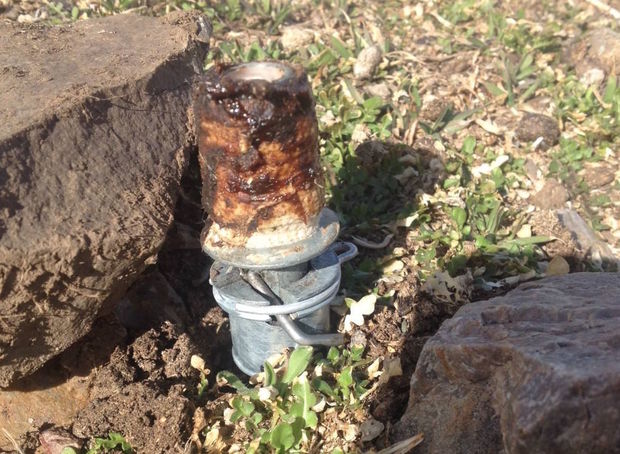
All of these incidents were caused by the M-44, a device used by Wildlife Services that fires a cyanide pellet into an animal’s mouth, causing a slow and agonizing death.
Wildlife Services’ greatest regret in all of these incidents is that they brought the agency more negative press – and given their history, they will probably use all of the incidents as “teaching moments” to instruct their agents to “shoot, shovel, and shut up.”
PLEASE CONTACT YOUR SENATORS AND U.S. REP AND URGE THEM TO ELIMINATE FUNDING FOR USDA WILDLIFE SERVICES.
A three-year-old Labrador retriever died and a 14-year boy was knocked to the ground when a cyanide device deployed by the federal government exploded in Pocatello, Idaho.
The Idaho State Journal reported the boy, who had been on a walk with his dog Thursday on a ridge near their home, watched his dog die. According to the Bannock County Sheriff’s Office, the boy was also “covered in an unknown substance” when the device known as an M-44 detonated. He was evaluated at a hospital and released.
“That little boy is lucky,” Sheriff Lorin Nielsen told the Pocatello newspaper. “His guardian angel was protecting him.”
The Idaho incident comes a few weeks after a gray wolf was accidentally killed by an M-44 on private land in Oregon’s Wallowa County. The controversial type of trap is used by the U.S. Department of Agriculture’s Wildlife Services crews around the country primarily to kill coyotes and other predators.
U.S. Rep. Peter DeFazio, D-Ore., introduced legislation as recently as 2012 to ban the trap.
DeFazio has said he would reintroduce a similar bill in Congress.
The wolf death was the first documented “incidental take” of its kind in Oregon involving the protected animal and the M-44, fish and wildlife officials said.
Federal Wildlife Services officials said there were 96 M-44 devices dispersed across Oregon as of last week and the agency was looking to remove devices that were near known wolf habitat. Oregon fish and wildlife officials have said the devices were not allowed in areas of known wolf activity.
Oregon has long paid Wildlife Services to kill invasive species and specific predators. But Gov. Kate Brown’s’ recommended budget doesn’t include $460,000 typically set aside to pay the federal agency to kill animals in Oregon.
Bannock County officials described the device as “extremely dangerous to animals and humans.”
The department circulated photos of the trap. “If a device such as this is ever located please do not touch or go near the device and contact your local law enforcement agency,” officials said.
Government officials have said the number of deaths of domestic animals and non-target animals each year is low, and officials say they are conducting an “internal review” of the wolf death.
Wildlife Services killed 121 coyotes in Oregon in 2016 with M-44 devices, along with three red foxes, according to the government’s figures. No gray wolf was killed in the U.S. last year with the cyanide capsules, according to the government.
A Eugene nonprofit says the government isn’t being truthful about the number of pets and non-target animals – such as wolves – killed each year.
“Yesterday’s Idaho poisoning of a dog and the near poisoning of a child is yet another example of what we’ve been saying for decades: M-44s are really nothing more than land mines waiting to go off, no matter if it’s a child, a dog, or a wolf,” Brooks Fahy, executive director of Predator Defense, said in a statement.
“It’s time to ban these notoriously dangerous devices on all lands across the United States.”
— Andrew Theen
atheen@oregonian.com
503-294-4026
@andrewtheen
ooOOoo
I will be writing about another terrible example of cruelty to animals tomorrow. One where you have the opportunity to add your name to a petition trying to have this cruel ‘tradition’ stopped.
Because as Anna Sewell (1820-1878), the English author who was the author of many books including Black Beauty is recorded as saying:
My doctrine is this, that if we see cruelty or wrong that we have the power to stop, and do nothing, we make ourselves sharers in the guilt.
Resolving the falsehoods may not be so straightforward as one thinks.
I’m going straight into this last post of my mini-series looking at the state of things. Namely a recent essay published by Professor Ronald Pies:
Professor of Psychiatry, Lecturer on Bioethics & Humanities at SUNY Upstate Medical University; and Clinical Professor of Psychiatry, Tufts University School of Medicine, Tufts University
I am a psychiatrist and ethicist affiliated with SUNY Upstate Medical University, Syracuse, NY; and Tufts University School of Medicine in Boston. I write on a variety of cross-disciplinary topics, ranging from mental health to philosophy of mind to spirituality. Most recently, I have authored the novella, “The Late Life Bloom of Rose Rabinowitz;” and the poetry chapbook, “The Myeloma Year.”
Here is that post, republished within the terms of The Conversation.
ooOOoo
‘Alternative facts’: A psychiatrist’s guide to twisted relationships to truth
March 1, 2017
The phrase “alternative facts” has recently made the news in a political context, but psychiatrists like me are already intimately acquainted with the concept – indeed, we hear various forms of alternate reality expressed almost every day.
All of us need to parse perceived from actual reality every day, in nearly every aspect of our lives. So how can we sort out claims and beliefs that strike most people as odd, unfounded, fantastical or just plain delusional?
Untruths aren’t always lies
First, we need to make a distinction often emphasized by ethicists and philosophers: that between a lie and a falsehood. Thus, someone who deliberately misrepresents what he or she knows to be true is lying – typically, to secure some personal advantage. In contrast, someone who voices a mistaken claim without any intent to deceive is not lying. That person may simply be unaware of the facts, or may refuse to believe the best available evidence. Rather than lying, he’s stating a falsehood.
Some people who voice falsehoods appear incapable of distinguishing real from unreal, or truth from fiction, yet are sincerely convinced their worldview is absolutely correct. And this is our entree into the psychiatric literature.
In clinical psychiatry, we see patients with a broad spectrum of ideas that many people would find eccentric, exaggerated or blatantly at odds with reality. The clinician’s job is, first, to listen empathically and try to understand these beliefs from the patient’s point of view, carefully taking into account the person’s cultural, ethnic and religious background.
Sometimes, clinicians can be wildly mistaken in their first impressions. A colleague of mine once described a severely agitated patient who was hospitalized because he insisted he was being stalked and harassed by the FBI. A few days into his hospitalization, FBI agents showed up on the unit to arrest the patient. As the old joke goes, just because you’re paranoid doesn’t mean they aren’t after you!
We can think of distortions of reality as falling along a continuum, ranging from mild to severe, based on how rigidly the belief is held and how impervious it is to factual information. On the milder end, we have what psychiatrists call over-valued ideas. These are very strongly held convictions that are at odds with what most people in the person’s culture believe, but which are not bizarre, incomprehensible or patently impossible. A passionately held belief that vaccinations cause autism might qualify as an over-valued idea: it’s not scientifically correct, but it’s not utterly beyond the realm of possibility.
On the severe end of the continuum are delusions. These are strongly held, completely inflexible beliefs that are not altered at all by factual information, and which are clearly false or impossible. Importantly, delusions are not explained by the person’s culture, religious beliefs or ethnicity. A patient who inflexibly believes that Vladimir Putin has personally implanted an electrode in his brain in order to control his thoughts would qualify as delusional. When the patient expresses this belief, he or she is not lying or trying to deceive the listener. It is a sincerely held belief, but still a falsehood.
Falsehoods of various kinds can be voiced by people with various neuropsychiatric disorders, but also by those who are perfectly “normal.” Within the range of normal falsehood are so-called false memories, which many of us experience quite often. For example, you are absolutely certain you sent that check to the power company, but in fact, you never did.
As social scientist Julia Shaw observes, false memories “have the same properties as any other memories, and are indistinguishable from memories of events that actually happened.” So when you insist to your spouse, “Of course I paid that electric bill!” you’re not lying – you are merely deceived by your own brain.
A much more serious type of false memory involves a process called confabulation: the spontaneous production of false memories, often of a very detailed nature. Some confabulated memories are mundane; others, quite bizarre. For example, the person may insist – and sincerely believe – that he had eggs Benedict at the Ritz for breakfast, even though this clearly wasn’t the case. Or, the person may insist she was abducted by terrorists and present a fairly elaborate account of the (fictional) ordeal. Confabulation is usually seen in the context of severe brain damage, such as may follow a stroke or the rupture of a blood vessel in the brain.
Lying as a default
Finally, there is falsification that many people would call pathological lying, and which goes by the extravagant scientific name of pseudologia fantastica (PF). Writing in the Psychiatric Annals, Drs. Rama Rao Gogeneni and Thomas Newmark list the following features of PF:
A marked tendency to lie, often as a defensive attempt to avoid consequences. The person may experience a “high” from this imaginative story-telling.
The lies are quite dazzling or fantastical, though they may contain truthful elements. Often, the lies may capture considerable public attention.
The lies tend to present the person in a positive light, and may be an expression of an underlying character trait, such as pathological narcissism. However, the lies in PF usually go beyond the more “believable” stories of persons with narcissistic traits.
Although the precise cause or causes of PF are not known, some data suggest abnormalities in the white matter of the brain – bundles of nerve fibers surrounded by an insulating sheath called myelin. On the other hand, the psychoanalyst Helene Deutsch argued that PF stems from psychological factors, such as the need to enhance one’s self-esteem, secure the admiration of others or to portray oneself as either a hero or a victim.
Who cares about facts anyway?
Of course, all of this presumes something like a consensus on what constitutes “reality” and “facts” and that most people have an interest in establishing the truth. But this presumption is looking increasingly doubtful, in the midst of what has come to be known as the “post-truth era.” Charles Lewis, the founder of the Center for Public Integrity, described ours as a period in which “up is down and down is up and everything is in question and nothing is real.”
Are lies becoming our rose-colored glasses? Christian Bucad, CC BY-NC-ND
Even more worrisome, the general public seems to have an appetite for falsehood. As writer Adam Kirsch recently argued, “more and more, people seem to want to be lied to.” The lie, Kirsch argues, is seductive: “It allows the liar and his audience to cooperate in changing the nature of reality itself, in a way that can appear almost magical.”
Psychiatrists are not in a position to comment on the mental health of public figures they have not personally evaluated or on the nature of falsehoods sometimes voiced by our political leaders. Indeed, the “Goldwater Rule” prohibits us from doing so. Nevertheless, psychiatrists are keenly aware of the all-too-human need to avoid or distort unpleasant truths. Many would likely nod in agreement with an observation often attributed to the psychoanalyst Carl Jung: “People cannot stand too much reality.”
ooOOoo
With Carl Jung’s words echoing in one’s mind the reaction that does come to me and, undoubtedly, to many others, is that the time for limiting what degree of reality we can take on board is rapidly coming to a close.
Or so much more elegantly conveyed by Maya Angelou.
Back to more gentle and soft ideas tomorrow – and that’s the Truth!
James Ephraim Lovelock CHCBEFRS[2] (born 26 July 1919) is an independent scientist, environmentalist and futurist who lives in Devon, England. He is best known for proposing the Gaia hypothesis, which postulates that the Earth functions as a self-regulating system.[5]
Moving on.
These times in this fine country, The United States of America, are troubling as Rebecca Gordon set out so compellingly in yesterday’s post.
But what is so terrible about these times is the failure to put integrity at the heart of every pronouncement that comes from a Government. And it would be grossly unfair to pick on the present US Government as the only example of this failure.
Because just a few mouse clicks can inform millions of us as to the real issues. Such as the effect that Climate Change is having on our health, as this recent Grist article so aptly put it in the opening paragraphs:
Here are 4 ways climate change is messing with our brains — for the worse.
We might think of climate change as purely physical: wildfires blazing through forests, rising seas lapping at the doors of coastal homes.
But those brutal conditions also affect our mental health, changing how we think and act. Mental health professionals are paying attention to the link between climate change and emotional health — and health insurance companies are, too.
Or take the issue of the state of America’s water. Recently the subject of an important essay just presented by Naked Capitalism:
Yves here. Grist has been doing an admirable job of keeping on top of this important yet oddly still-under-the-radar story. In the US, the big driver of rising water costs is the need to invest in aging, neglected water works. But water is going to become an issue in many places for differing reasons. As we have been saying for years, the natural resource that is projected to come under pressure first is potable water. And please don’t push desalination as a magic bullet. That costs money (both the plants and new transportation infrastructure, uses energy, plus has the not-trivial problem of how to dispose of the salt residues.
By Ciara O’Rourke, a freelance writer and 2015-16 Ted Scripps Fellow in Environmental Journalism at the University of Colorado Boulder. Originally published by Fusion and reproduced at Grist as part of the Climate Desk collaboration
When Elizabeth Mack wondered about a future in which Americans wouldn’t be able to pay for water, a couple of colleagues waved her off. “Don’t be ridiculous,” they said. But the idea niggled at Mack, an assistant professor at the Department of Geography, Environment, and Spatial Sciences at Michigan State University. And in January, in an article published in the science journal PLOS ONE, she asked a new question: Is there a burgeoning water affordability crisis in the United States?
Mack, along with research assistant Sarah Wrase, determined that if water rates increase at projected amounts over the next five years, the percentage of households that can’t pay their water bills could triple from 11.9 percent to more than a third. Nearly 14 million households nationwide already struggle to afford water services. An additional 27.18 million — or 8.5 percent of the country’s population — could soon face the same challenges.
Yes, integrity in politics is more, so much more, than a nice idea from this silly old Brit now living in Oregon. Here’s a post I published some four years ago that says it as clearly as it needs to be said.
ooOOoo
Reflections on Integrity.
Going back to basics.
Many will know the origins of this blog; a chance comment by Jon Lavin back in England in early 2007 that dogs were integrous, (a score of 210 as defined by Dr David Hawkins).
“There is nothing to fear except the persistent refusal to find out the truth, the persistent refusal to analyse the causes of happenings.” Dorothy Thompson.
When I started Learning from Dogs I was initially rather vague but knew that the Blog should reflect the growing need for greater integrity and mindfulness in our planetary civilisation. Here are some early musings,
Show that integrity delivers better results … integrity doesn’t require force … networking power of a group … demonstrate the power of intention … cut through the power of propaganda and media distortion …
Promulgate the idea that integrity is the glue that holds a just society together … urgent need as society under huge pressures …. want a decent world for my grandchildren … for all our grandchildren …. feels like the 11th hour….
But as the initial, rather hesitant, start to the Blog settled into a reliable, daily posting, and as the minuscule number of readers steadily grew to the present level of many hundreds each day, the clarity of the purpose of Learning from Dogs also improved.
Because, while it may sound a tad grandiose and pompous, if society doesn’t eschew the games, half-truths and selfish attitudes of the last, say, 30 years or more, then civilisation, as we know it, could be under threat.
Or, possibly, it’s more accurate to say that our civilisation is under threat and the time left to change our ways, to embrace those qualities of integrity, truth and consciousness for the very planet we all live on, is running out.
“Time left to change our ways is running out.”
So what’s rattled my cage, so to speak, that prompted today’s reflection? I’ll tell you! (You knew I was going to anyway, didn’t you!)
I’m drafting these thoughts around noon Pacific Standard Time on Sunday, 17th. At the same time, tens of thousands of ordinary good folk (40,000 plus at the latest estimate) are gathering by the Washington Monument ready to march past the White House demanding that President Obama block the Keystone XL pipeline and move forward toward climate action.
Do I trust the US Government to take this action? On balance, no! That hurts me terribly to write that. I really want to trust and believe what the President of my new home country says.
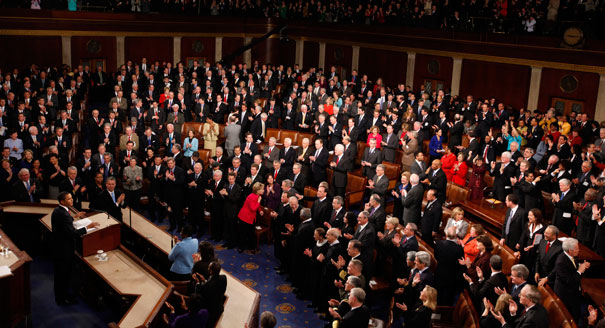
State of the Union speech 2013. AP photo.
Here’s a snippet of what the President did say in his State of the Union speech on February 12th.
Now, it’s true that no single event makes a trend. But the fact is, the 12 hottest years on record have all come in the last 15. Heat waves, droughts, wildfires, floods, all are now more frequent and more intense.
We can choose to believe that Superstorm Sandy, and the most severe drought in decades, and the worst wildfires some states have ever seen were all just a freak coincidence. Or we can choose to believe in the overwhelming judgment of science and act before it’s too late.
A frank admission that the climate is changing in dramatic ways; the overwhelming judgment of science – fantastic!
The evidence that burning carbon-based fuels (coal, oil, gas) is the primary cause of today’s high CO2 levels is overwhelming. As a recent BBC radio programme reveals (being featured tomorrow) huge climate changes going back millions of years are a natural part of Earth’s history. However, as one of the scientists explains at the end of that radio programme, the present CO2 level, 395.55 ppm as of January, is now way above the safe, stable limit for the majority of life species on the planet.
But say you are reading this and are not yet convinced?
Let me borrow an old pilot’s saying from the world of aviation: If there’s any doubt, there’s no doubt!
That embracing, cautious attitude is part of the reason why commercial air transport is among the most safest forms of transport. If you had the slightest doubt about the safety of a flight, you wouldn’t board the aircraft.
If you had the slightest doubt about the future for civilisation on this planet likewise you would do something! Remember, that dry word civilisation means family, children, grandchildren, friends and loved ones. The last thing you would do is to carry on as before!
Which is where my lack of trust of leaders comes from!
Back to that State of the Union speech. Just 210 words after the spoken words “act before it’s too late” (I counted them!) Pres. Obama says, “That’s why my administration will keep cutting red tape and speeding up new oil and gas permits.”
Here’s the relevant section:
I will direct my cabinet to come up with executive actions we can take, now and in the future, to reduce pollution, prepare our communities for the consequences of climate change, and speed the transition to more sustainable sources of energy.
Now, four years ago, other countries dominated the clean-energy market and the jobs that came with it. And we’ve begun to change that. Last year, wind energy added nearly half of all new power capacity in America. So let’s generate even more. Solar energy gets cheaper by the year. Let’s drive down costs even further. As long as countries like China keep going all-in on clean energy, so must we.
Now, in the meantime, the natural gas boom has led to cleaner power and greater energy independence. We need to encourage that. That’s why my administration will keep cutting red tape and speeding up new oil and gas permits.
We don’t require any more oil to be used. We are already using a staggering amount of it. Let me refer you to an essay on Nature Bats Last called Math. The scary kind, not the fuzzy kind. Prof. McPherson wrote:
I performed a little rudimentary math last week. A little because even a little pushes my limit for math, these days. And rudimentary for the same reason. The outcome was staggering: We’re using oil at the rate of 5,500 cubic feet per second (cfs).
“5,500 cubic feet per second” Don’t know about you but I have some trouble in visualising that flow rate. Try this from later in the essay:
Here’s another shot of perspective: We burn a cubic mile of crude oil every year. The Empire State Building, the world’s ninth-tallest building, towers above New York at 1,250 feet. The world’s tallest building, Taipei 101, is 1,667 feet from ground to tip.
Put those buildings together, end to end, and you have one side of a cube. Do it again, and you have the second side. Once more, but this time straight up, and you have one big cube. Filling that cube with oil takes nearly 200 billion gallons … which is about one-sixth the size of the cube of oil we’re burning every year.
Burning a cubic mile every year! Yes, Mr. President, more oil permits is a wonderful way of taking action before it’s too late!
So let’s see what transpires? Let’s see if integrity is given the highest political focus. As in “adherence to moral and ethical principles; soundness of moral character; honesty.” Because if there’s ever been a time when all of us, from every spectrum of society need honesty about what we are doing to the planet, it’s now!
As the tag on the home page of this blog says, “Dogs are integrous animals. We have much to learn from them.”
ooOOoo
Going to close with two more quotations from Mr. Lovelock.
The first:
You never know with politicians what they are really saying. And I don’t say that in a negative way-they have an appalling job.
And the second one to close today’s post:
If you start any large theory, such as quantum mechanics, plate tectonics, evolution, it takes about 40 years for mainstream science to come around. Gaia has been going for only 30 years or so.
As you all know, my world is dominated by love. My love for my Jeannie and all the wonderful creatures that inhabit this home and these few acres here in Southern Oregon. Time and time again I share with you stories and articles that I come across that underpin that loving umbrella. Time and time again I am deeply moved by your interest in my scribbles. As I said, my world is dominated by love, and your friendship across this blogging world added to Jean’s love for and attachment to me, has created a little paradise for me.
But! (And you may have sensed there was a ‘But’ coming up.)
But that doesn’t mean that I am immune to being deeply affected by other, more worldly issues, that are as far away from love as one could imagine; more accurately, as far away from love for this wonderful planet as one could imagine.
So for today and the next two days I am going to share with you the pain and angst that I do feel, and feel all too easily, at what we, as in the collective global ‘we’, are up to. Madness doesn’t even seem to touch it!
Today, I am going to republish a recent TomDispatch essay, with Tom’s very kind permission. Tomorrow, I am going to contrast what fellow Brit James Lovelock has been predicting for years with where we really are heading in terms of the future of Planet Earth. Then on Friday, I will finish up with an essay by Professor Ronald Pies regarding the “twisted relationships to truth”.
Donald Trump, now preparing to lead the country into the latest version of our endless wars, recently offered this look back at American military prowess: “We have to start winning wars again. I have to say, when I was young, in high school and college, everybody used to say we never lost a war. We never lost a war, remember?… And now we never win a war. We never win. And don’t fight to win.”
It was a curious bit of “history.” Logically, his memories should have been of victory-less wars, given the ones of his growing up years: Korea and Vietnam (which he evidently avoided thanks to a trumped-up medical condition and whose massive oppositional movement he seems to have ignored).
Born in July 1944, [Ed: I’m a November 1944 baby.] I’m two years older than President Trump and so understand just where he’s coming from: the movies. In those years of his youth and mine, sitting in the darkness catching Hollywood’s vivid version of reality, we both watched Americans win wars ad infinitum. In fact, this is hardly the first time I’ve thought about the on-screen wars of my childhood, actual war, and an American president. Here’s what I wrote back in January 2006, while considering the experiences of George W. Bush and Dick Cheney:
“In the 1940s and 1950s, when the generation of men now ruling over us were growing up, boys could disappear into a form of war play — barely noticed by adults and hardly recorded anywhere — that was already perhaps a couple of hundred years old. In this kind of play, there was no need to enact the complicated present by recreating a junior version of an anxiety-ridden Cold War garrison state… For children in those years, there was still a sacramental, triumphalist version of American history, a spectacle of slaughter in which they invariably fell before our guns. This spectacle could be experienced in any movie theater, and then played out in backyards and on floors with toy six guns (or sticks) or little toy bluecoats, Indians, and cowboys, or green, inch-high plastic sets of World War II soldiers. As play, for those who grew up in that time, it was sunshine itself, pure pleasure. The Western (as well as its modern successor, the war film) was on screen everywhere then.
“When those children grew up (barely), some of them went off to Vietnam, dreaming of John Wayne-like feats as they entered what they came to call ‘Indian country,’ while others sallied off to demonstrate against the war dressed either in the cast-off World War II garb of their fathers or in the movie-inspired get-ups of the former enemy of another age — headbands and moccasins, painted faces, love beads… as well as peace (now drug) pipes. Sometimes, they even formed themselves into ‘tribes.’
“As it turns out, though, there was a third category of young men in those years: those who essentially steered clear of the Vietnam experience, who, as our vice president put it inelegantly but accurately, had ‘other priorities in the sixties.’ Critics have sometimes spoken of such Bush administration figures as ‘chickenhawks’ for their lack of war experience. But this is actually inaccurate. They were warriors of a sort — screen warriors. They had an abundance of combat experience because, unlike their peers, they never left the confines of those movie theaters, where American war was always glorious, our military men always out on some frontier, and the Indians, or their modern equivalents, always falling by their scores before our might as the cavalry bugle sounded or the Marine Hymn welled up. By avoiding becoming either the warriors or the anti-warriors of the Vietnam era, they managed to remain quite deeply embedded in centuries of triumphalist frontier mythology. They were, in a sense, the Peter Pans of American war play.
“…From that same childhood undoubtedly came President Bush’s repeated urge to dress up in an assortment of ‘commander-in-chief’ military outfits, much in the style of a G.I. Joe ‘action figure.’ (Think: doll). It’s visibly clear that our president has long found delight — actual pleasure — in his war-making role, as he did in his Top Gun, ‘mission accomplished’ landing on that aircraft carrier back in 2003…”
Only the other day, Donald Trump made his own landing on an aircraft carrier and strode its deck togged out in a USS Gerald R. Ford green bomber jacket and baseball cap, showing similar pleasure in the experience. It should have had an eerie resonance for us all as we pondered just where our next movie commander-in-chief might lead us. Who could have imagined that, so many decades after the onscreen childhood that The Donald and I shared, we’d all still be at the movies and, as TomDispatch regular and American Nuremberg author Rebecca Gordon points out today, in an American world of forever war as well? Tom American Carnage Fighting the Forever War
By Rebecca Gordon
In his inaugural address, President Trump described a dark and dismal United States, a country overrun by criminal gangs and drugs, a nation stained with the blood seeping from bullet-ridden corpses left at scenes of “American carnage.” It was more than a little jarring.
Certainly, drug gangs and universally accessible semi-automatic weapons do not contribute to a better life for most people in this country. When I hear the words “American carnage,” however, the first thing I think of is not an endless string of murders taking place in those mysterious “inner cities” that exist only in the fevered mind of Donald Trump. The phrase instead evokes the non-imaginary deaths of hundreds of thousands of people in real cities and rural areas outside the United States. It evokes the conversion of millions of ordinary people into homeless refugees. It reminds me of the places where American wars seem never to end, where new conflicts seem to take up just as the old ones are in danger of petering out. These sites of carnage are the cities and towns, mountains and deserts of Iraq, Afghanistan, Yemen, Libya, and other places that we don’t even find out about unless we go looking. They are the places where the United States fights its endless wars.
During the 2016 election campaign, Donald Trump often sounded like a pre-World War II-style America First isolationist, someone who thought the United States should avoid foreign military entanglements. Today, he seems more like a man with a uniform fetish. He’s referred to his latest efforts to round up undocumented immigrants in this country as “a military operation.” He’s similarly stocked his cabinet with one general still on active duty, various retired generals, and other military veterans. His pick for secretary of the interior, Montana Congressman Ryan Zinke, served 23 years as a Navy SEAL.
Clearly, these days Trump enjoys the company of military men. He’s more ambivalent about what the military actually does. On the campaign trail, he railed against the folly that was — and is — the (second) Iraq War, maintaining with questionable accuracy that he was “totally against” it from the beginning. It’s not clear, however, just where Trump thinks the folly lies — in invading Iraq in the first place or in failing to “keep” Iraq’s oil afterward. It was a criticism he reprised when he introduced Mike Pompeo as his choice to run the CIA. “Mike,” he explained, “if we kept the oil, you probably wouldn’t have ISIS because that’s where they made their money in the first place.” Not to worry, however, since as he also suggested to Pompeo, “Maybe we’ll have another chance.” Maybe the wrong people had just fought the wrong Iraq war, and Donald Trump’s version will be bigger, better, and even more full of win!
Perhaps Trump’s objection is simply to wars we don’t win. As February ended, he invited the National Governors Association to share his nostalgia for the good old days when “everybody used to say ‘we haven’t lost a war’ — we never lost a war — you remember.” Now, according to the president, “We never win a war. We never win. And we don’t fight to win. We don’t fight to win. So we either got to win, or don’t fight it at all.”
The question is, which would Trump prefer: Winning or not fighting at all? There’s probably more than a hint of an answer in his oft-repeated campaign promise that we’re “going to win so much” we’ll “get tired of winning.” If his fetish for winning — whether it’s trade wars or shooting wars — makes you feel a little too exposed to his sexual imagination, you’re probably right. In one of his riffs on the subject, he told his audience that they would soon be pleading they had “a headache” to get him to stop winning so much — as if they were 1950s housewives trying to avoid their bedroom duty. But daddy Trump knows best:
“And I’m going to say, ‘No, we have to make America great again.’ You’re gonna say, ‘Please.’ I said, ‘Nope, nope. We’re gonna keep winning.’”
There’s more than a hint of where we’re headed in Trump’s recent announcement that he’ll be asking Congress for a nearly 10% increase in military spending, an additional annual $54 billion for the Pentagon as part of what he calls his “public safety and national security budget.” You don’t spend that kind of money on toys unless you intend to play with them.
Trump explained his reasoning, in his trademark idiolect, his unique mangling of syntax and diction:
“This is a landmark event, a message to the world, in these dangerous times of American strength, security, and resolve. We must ensure that our courageous servicemen and women have the tools they need to deter war and when called upon to fight in our name only do one thing, win. We have to win.”
So it does look like the new president intends to keep on making war into the eternal future. But it’s worth remembering that our forever wars didn’t begin with Donald J. Trump, not by a long shot.
The Forever Wars
Joe Haldeman’s 1974 novel, The Forever War, which won the three major science fiction prizes, a Hugo, a Nebula, and a Locus, was about a soldier involved in a war between human beings and the Taurans, an alien race. Because of the stretching of time when traveling at near light-speed (as Einstein predicted), while soldiers like Haldeman’s hero passed a few years at a time at a front many light-years from home, the Earth they’d left behind experienced the conflict as lasting centuries. Published just after the end of the Vietnam War — fought for what seemed to many Americans like centuries in a land light-years away — The Forever War was clearly a reflection of Haldeman’s own experience in Vietnam and his return to an unrecognizable United States, all transposed to space.
In 1965, Haldeman had been drafted into that brutal conflict, probably one of those that Donald Trump thinks we didn’t “fight to win.” It certainly seemed like a forever war while it lasted, especially if you included the French colonial war that preceded it. But it did finally end, decisively, with an American loss (although, in a sense, it’s still being fought out by the thousands of Vietnam veterans who live on the streets of our country).
After the attacks of 9/11 and George W. Bush’s declaration of a Global War on Terror, some people found the title of Haldeman’s novel a useful shorthand for what seemed to be an era of permanent war. It gave us a way of describing then-Secretary of Defense Donald Rumsfeld’s vision of a new kind of war against an enemy located, as he told NBC’s Meet the Press on September 30, 2001, “not just in Afghanistan. It is in 50 or 60 countries and it simply has to be liquidated. It has to end. It has to go out of business.”
More than 15 years later, after a decade and a half of forever war in the Greater Middle East and parts of Africa, al-Qaeda and the Taliban are still in business, along with a set of new enemies, including Boko Haram in Nigeria, Chad, Niger, and Cameroon; al-Shabaab in Somalia; and ISIS, which, if we are to believe the president and his cronies, is pretty much everywhere, including Mexico. In a war against a tactic (terrorism) or an emotion (terror), it’s hardly surprising that our enemies have just kept proliferating, and with them, the wars. It’s as if Washington were constantly bringing jets, drones, artillery, and firepower of every sort to bear on a new set of Taurans in another galaxy.
Decades before Haldeman’s Forever War, George Orwell gave us an unforgettable portrait of a society controlled by stoking permanent hatred for a rotating cast of enemies. In 1984, the countries of the world have coalesced into three super-nations — Oceania, Eurasia, and Eastasia. Winston Smith, the novel’s protagonist, recalls that, since his childhood, “war had been literally continuous, though strictly speaking it had not always been the same war.” Smith joins thousands of other citizens of Oceania in their celebration of Hate Week and observes the slick substitution of one enemy for another on the sixth day of that week:
“…when the great orgasm was quivering to its climax and the general hatred of Eurasia had boiled up into such delirium that if the crowd could have got their hands on the two thousand Eurasian war-criminals who were to be publicly hanged on the last day of the proceedings, they would unquestionably have torn them to pieces — at just this moment it had been announced that Oceania was not after all at war with Eurasia. Oceania was at war with Eastasia. Eurasia was an ally.”
Except that there is no actual announcement. Rather, the Party spokesman makes the substitution in mid-oration:
“The speech had been proceeding for perhaps twenty minutes when a messenger hurried onto the platform and a scrap of paper was slipped into the speaker’s hand. He unrolled and read it without pausing in his speech. Nothing altered in his voice or manner, or in the content of what he was saying, but suddenly the names were different. Without words said, a wave of understanding rippled through the crowd. Oceania was at war with Eastasia!
And it had always been thus. “Oceania was at war with Eastasia. Oceania had always been at war with Eastasia.”
1984 is, of course, a novel. In our perfectly real country, human memories work better than they do in Orwell’s Oceania. Or do they? The United States is at war with Iraq. The United States has always been at war with Iraq. Except, of course, when the United States sided with Iraq in its vicious, generation-destroying conflict with Iran in the 1980s. Who today remembers Ronald Reagan’s “tilt toward Iraq” and against Iran? They’re so confusing, those two four-letter countries that start with “I.” Who can keep them straight, even now that we’ve tilted back toward what’s left of Iraq — Trump has even removed it from his latest version of his Muslim ban list — and threateningly against Iran?
Many Americans do seem to adapt to a revolving enemies list as easily as the citizens of Oceania. Every few years, I ask my college students where the terrorists who flew the planes on 9/11 came from. At the height of the (second and still unfinished) Iraq War, when many of them had brothers, sisters, lovers, even fathers fighting there, my students were certain the attackers had all been Iraqis. A few years later, when the “real men” were trying to gin up a new opportunity to “go to Tehran,” my students were just as sure the terrorists had been from Iran. I haven’t asked in a couple of years now. I wonder whether today I’d hear that they were from Syria, or maybe that new country, the Islamic State?
I don’t blame my students for not knowing that the 9/11 attackers included 15 Saudis, two men from the United Arab Emirates (UAE), one Egyptian, and one Lebanese. It’s not a fact that’s much trumpeted anymore. You certainly wouldn’t guess it from where our military aid and American-made weaponry goes. After Afghanistan ($3.67 billion) and Israel ($3.1 billion), Egypt is the next largest recipient of that aid at $1.31 billion in 2015.
Of course, military aid to other countries is a windfall for U.S. arms manufacturers. Like food money and other forms of foreign aid from Washington, the countries receiving it are often obligated to spend it on American products. In other words, much military “aid” is actually a back-door subsidy to companies like Boeing and Lockheed Martin. Being wealthy oil states, the Saudis and the UAE, of course, don’t need subsidies. They buy their U.S. arms with their own money — $3.3 billion and $1.3 billion worth of purchases respectively in 2015. And they’re putting that weaponry to use, with U.S. connivance and — yes, it should make your head spin in an Orwellian fashion — occasional support from al-Qaeda in the Arabian Peninsula, by taking sides in a civil war in Yemen. U.S.-made fighter planes and cluster bombs have put more than seven million Yemenis in imminent danger of starvation.
War Without End, When Did You Begin?
When did our forever war begin? When did we start to think of the president as commander-in-chief first, and executor of the laws passed by Congress only a distant second?
Was it after 9/11? Was it during that first Iraq war that spanned a few months of 1990 and 1991? Or was it even earlier, during the glorious invasion of the tiny Caribbean island of Grenada in 1983, codenamed Operation Urgent Fury? That was the first time the military intentionally — and successfully — kept the press sequestered from the action for the first 48 hours of that short-lived war. They did the same thing in 1989, with the under-reported invasion of Panama, when somewhere between 500 and 3,500 Panamanians died so that the United States could kidnap and try an erstwhile ally and CIA asset, the unsavory dictator of that country, Manuel Noriega.
Or was it even earlier? The Cold War was certainly a kind of forever war, one that began before World War II ended, as the United States used its atomic attacks on Hiroshima and Nagasaki to, as we now say, “send a message” to the Soviet Union. And it didn’t end until that empire imploded in 1991.
Maybe it began when Congress first abdicated its constitutional right and authority to declare war and allowed the executive branch to usurp that power. The Korean War (1950-1953) was never declared. Nor were the Vietnam War, the Grenada invasion, the Panama invasion, the Afghan War, the first and second Iraq wars, the Libyan war, or any of the wars we’re presently involved in. Instead of outright declarations, we’ve had weasely, after-the-fact congressional approvals, or Authorizations for the Use of Military Force, that fall short of actual declarations of war.
The framers of the Constitution understood how important it was to place the awesome responsibility for declaring war in the hands of the legislative branch — of, that is, a deliberative body elected by the people — leaving the decision on war neither to the president nor the military. Indeed, one of the charges listed against King George III in the Declaration of Independence was: “He has affected to render the Military independent of and superior to the Civil power.”
Thomas Jefferson, John Adams, and the others who met in the stifling heat of that 1776 Philadelphia summer, close enough to battle to hear the boom of British cannons, decided they could no longer abide a king who allowed the military to dominate a duly constituted civil government. For all their many faults, they were brave men who, even with war upon them, recognized the danger of a government controlled by those whose sole business is war.
Since 9/11, this country has experienced at least 15 years of permanent war in distant lands. Washington is now a war capital. The president is, first and foremost, the commander-in-chief. The power of the expanding military (as well as paramilitary intelligence services and drone assassination forces, not to mention for-profit military contractors of all sorts) is emphatically in presidential hands. Those hands, much discussed in the 2016 election campaign, are now Donald Trump’s and, as he indicated in his recent address to Congress, he seems hell-bent on restoring the military to the superiority it enjoyed under King George. That is a danger of the first order.











 Learning from Dogs