Category: Government

Reflections on the future

Father’s Day ….

….. was OK in the morning but for some reason I was in a dark mood in the afternoon.

(And if you want to skip today’s post I don’t blame you at all. This is not my usual style albeit it is important.)

I was reflecting on the state of the world. Global population was well in excess of seven billion people. The longevity of those people was increasing. That’s good news. The health standards were increasing. That’s also good news.

However, the pressure on farming is intense. More and more land is required. The natural world is under supreme pressure. Extinction rates of many natural species are soaring.

Planet Earth has far too many people!

OK, maybe in time the population level will come down but right now it is too high.

Then in came Tom Engelhardt’s latest essay. I read it and reflected. Is it too dark to post? Then Jeannie said that if you really want to share it then publish it.

Here it is, published with Tom’s kind permission.

ooOOoo

Tomgram: Engelhardt, Trump Change

Posted by Tom Engelhardt at 4:23pm, June 16, 2019.
Follow TomDispatch on Twitter @TomDispatch.

If Donald Trump Is the Symptom…
Then What’s the Disease?

By Tom Engelhardt
Don’t try to deny it! The political temperature of this country is rising fast. Call it Trump change or Trump warming, if you want, but grasp one thing: increasingly, you’re in a different land and, whatever happens to Donald Trump, the results down the line are likely to be ever less pretty. Trump change isn’t just an American phenomenon, it’s distinctly global. After all, from Australia to India, the Philippines to Hungary, Donald Trumps and their supporters keep getting elected or reelected and, according to a recent CNN poll, a majority of Americans think Trump himself will win again in 2020 (though, at the moment, battleground-state polls look grim for him).

Still, whether or not he gets a second term in the White House, he only seems like the problem, partially because no president, no politician, no one in history has ever gotten such 24/7 media coverage of every twitch, tweet, bizarre statement, falsehood, or fantasy he expresses (or even the clothes he wears). Think of it this way: we’re in a moment in which the only thing the media can’t imagine saying about Donald Trump is: “You’re fired!” And believe me, that’s just one sign of a media — and a country — with a temperature that’s anything but 98.6.

Since you-know-who is always there, always being discussed, always @(un)realdonaldtrump, it’s easy enough to imagine that everything that’s going wrong — or, if you happen to be part of his famed base, right (even if that right isn’t so damned hot for you) — is due to him. When we’re gripped by such thinking and the temperature’s rising, it hardly matters that just about everything he’s “done” actually preceded him. That includes favoring the 1%, deporting record numbers of illegal immigrants, and making war (unsuccessfully) or threatening to do so across significant parts of the planet.

Here, then, is the question of the day, the sort you’d ask about any patient with a rising temperature: If Donald Trump is only the symptom, what’s the disease?

Blowback Central

Let me say that the late Chalmers Johnson would have understood President Trump perfectly. The Donald clearly arrived on the scene as blowback — the CIA term of tradecraft Johnson first put into our everyday vocabulary — from at least two things: an American imperium gone wrong with its never-ending wars, ever-rising military budgets, and ever-expanding national security state, and a new “gilded age” in which three men (Bill Gates, Jeff Bezos, and Warren Buffett) have more wealth than the bottom half of society and the .01% have one of their own, a billionaire, in the Oval Office. (If you want to add a third blowback factor, try a media turned upside down by new ways of communicating and increasingly desperate to glue eyes to screens as ad revenues, budgets, and staffs shrank and the talking heads of cable news multiplied.)

Now, I don’t mean to sell Donald Trump short in any way. Give that former reality TV star credit. Unlike either Hillary Clinton or any of his Republican opponents in the 2016 election campaign, he sensed that there were voters in profusion in the American heartland who felt that things were not going well and were eager for a candidate just like the one he was ready to become. (There were, of course, other natural audiences for a disruptive, self-promoting billionaire as well, including various millionaires and billionaires ready to support him, the Russians, the Saudis… well, you know the list). His skill, however, never lay in what he could actually do (mainly, in these years, cut taxes for the wealthy, impose tariffs, and tweet his head off). It lay in his ability to catch the blowback mood of that moment in a single slogan — Make America Great Again, or MAGA — that he trademarked in November 2012, only days after Mitt Romney lost his bid for the presidency to Barack Obama.

Yes, four years later in the 2016 election, others began to notice the impact of that slogan. You couldn’t miss the multiplying MAGA hats, after all. Hillary Clinton’s advisers even briefly came up with the lamest response imaginable to it: Make America Whole Again, or MAWA. But what few at the time really noted was the crucial word in that phrase: “again.” Politically speaking, that single blowback word might then have been the most daring in the English language. In 2016, Donald Trump functionally said what no other candidate or politician of any significance in America dared to say: that the United States was no longer the greatest, most indispensable, most exceptionable nation or superpower or hyper-power ever to exist on Planet Earth.

That represented a groundbreaking recognition of reality. At the time, it didn’t matter whether you were Barack Obama, Hillary Clinton, or Marco Rubio, you had to acknowledge some version of that formula of exceptionalism. Trump didn’t and, believe me, that rang a bell in the American heartland, where lots of people had felt, however indirectly, the blowback from all those years of taxpayer-funded fruitless war, while not benefitting from infrastructure building or much of anything else. They experienced blowback from a country in which new billionaires were constantly being created, while the financial distance between CEO salaries and those of workers grew exponentially vaster by the year, and the financing of the political system became a 1% affair.

With that slogan, The Donald caught the spirit of a moment in which both imperial and economic decline, however unacknowledged by the Washington political elite, had indeed begun. In the process, as I wrote at that time, he crossed a psychologically taboo line and became America’s first declinist candidate for president. MAGA captured a feeling already at large that tomorrow would be worse than today, which was already worse than yesterday. As it turned out, it mattered not at all that the billionaire conman spouting that trademarked phrase had long been part of the problem, not the solution.

He caught the essence of the moment, in other words, but certainly didn’t faintly cause it in the years when he financed Trump Tower, watched his five Atlantic City casinos go bankrupt, and hosted The Apprentice. In that election campaign, he captured a previously forbidden reality of the twenty-first century. For example, I was already writing this in June 2016, five months before he was elected president:

“In its halcyon days, Washington could overthrow governments, install Shahs or other rulers, do more or less what it wanted across significant parts of the globe and reap rewards, while (as in the case of Iran) not paying any price, blowback-style, for decades, if at all. That was imperial power in the blaze of the noonday sun. These days, in case you hadn’t noticed, blowback for our imperial actions seems to arrive as if by high-speed rail (of which by the way, the greatest power on the planet has yet to build a single mile, if you want a quick measure of decline).

“Despite having a more massive, technologically advanced, and better funded military than any other power or even group of powers on the planet, in the last decade and a half of constant war across the Greater Middle East and parts of Africa, the U.S. has won nothing, nada, zilch. Its unending wars have, in fact, led nowhere in a world growing more chaotic by the second.”

Mind you, three years later the United States remains a staggeringly powerful imperial force, with hundreds of military bases still scattered across the globe, while its economic clout — its corporations control about half the planet’s wealth — similarly remains beyond compare. Yet, even in 2016, it shouldn’t have been hard to see that the American Century was indeed ending well before its 100 years were up. It shouldn’t have been hard to grasp, as Donald Trump intuitively did, that this country, however powerful, was already both a declining empire — thank you, George W. Bush for invading Iraq! Mission Accomplished! — and a declining economic system (both of which still looked great indeed, if you happened to be profiting from them). That intuition and that slogan gave Trump his moment in… well, dare I call it “the afternoon sun”? They made him president.

MTPGA

In a sense, all of this should have been expectable enough. Despite the oddity of Donald Trump himself, there was little new in it, even for the imperial power that its enthusiasts once thought stood at “the end of history.” You don’t need to look far, after all, for evidence of the decline of empires. You don’t even have to think back to the implosion of the Soviet Union in 1991, almost three decades ago in what now seems like the Stone Age. (Admittedly, Russian President Vladimir Putin, a brilliant imagineer, has brought back a facsimile of the old Soviet Union, even if, in reality, Russia is now a rickety, fraying petro-state.)

Just take a glance across the Atlantic at Great Britain at this moment. And imagine that three-quarters of a century ago, that modest-sized island nation still controlled all of India, colonies across the planet, and an impressive military and colonial service. Go back even further and you’ll find yourself in a time when it was the true superpower of planet Earth. What a force it was — industrially, militarily, colonially — until, of course, it wasn’t.

If you happen to be looking for imperial lessons, you could perhaps say that some empires end not with a bang but with a Brexit. Despite all the pomp and circumstance (tweeting and insults) during the visit of the Trump royal family (Donald, Melania, Ivanka, Jared, Donald Jr., Eric, and Tiffany) to the British royals, led by a queen who, at 93, can remember better days, here’s something hard to deny: with Brexit (no matter how it turns out), the Earth’s former superpower has landed in the sub-basement of history. Great Britain? Obviously that adjective has to change.

In the meantime, across the planet, China, another once great imperial power, perhaps the greatest in the long history of this planet, is clearly on the rise again from another kind of sub-basement. That, in turn, is deeply worrying the leadership, civilian and military, of the planet’s “lone superpower.” Its president, in response, is wielding his weapon of choice — tariffs — while the U.S. military prepares for an almost unimaginable future war with that upstart nation, possibly starting in the South China Sea.

Meanwhile, the still-dominant power on the planet is, however incrementally, heading down. It’s nowhere near that sub-basement, of course — anything but. It’s still a rich, immensely powerful land. Its unsuccessful wars, however, go on without surcease, the political temperature rises, and democratic institutions continue to fray — all of which began well before Donald Trump entered the Oval Office and, in fact, helped ensure that he would make it there in the first place.

And yet none of this, not even imperial decline itself, quite captures the “disease” of which The Donald is now such an obvious symptom. After all, while the rise and fall of imperial powers has been an essential part of history, the planetary context for that process is now changing in an unprecedented way. And that’s not just because, since the 1945 atomic bombings of Hiroshima and Nagasaki, growing numbers of countries have come to possess the power to take the planet down in a cataclysm of fire and ice (as in nuclear winter). It’s also because history, as we’ve known it, including the rise and fall of empires, is now, in a sense, melting away.

Trump change, the rising political temperature stirred by the growing populist right, is taking place in the context of (and, worse yet, aiding and abetting) record global temperatures, the melting of ice across the planet, the rise of sea levels and the future drowning of coastlines (and cities), the creation of yet more refugees, the increasing fierceness of fires and droughts, and the intensification of storms. In the midst of it all, an almost unimaginable wave of extinctions is occurring, with a possible million plant and animal species, some crucial to human existence, already on the verge of departure.

Never before in history has the rise and decline of imperial powers taken place in the context of the decline of the planet itself. Try, for instance, to imagine what a “risen” China will look like in an age in which one of its most populous regions, the north China plain, may by century’s end be next to uninhabitable, given the killing heat waves of the future.

In the context of both Trump change and climate change, we’re obviously still awaiting our true transformative president, the one who is not a symptom of decline, but a factor in trying to right this country and the Earth before it’s too late. You know, the one who will take as his or her slogan, MTPGA (Make The Planet Great Again).

Tom Engelhardt is a co-founder of the American Empire Project and the author of a history of the Cold War, The End of Victory Culture. He runs TomDispatch.com and is a fellow of the Type Media Center. His sixth and latest book is A Nation Unmade by War (Dispatch Books).

Follow TomDispatch on Twitter and join us on Facebook. Check out the newest Dispatch Books, John Feffer’s new dystopian novel (the second in the Splinterlands series) Frostlands,Beverly Gologorsky’s novel Every Body Has a Story, and Tom Engelhardt’s A Nation Unmade by War, as well as Alfred McCoy’s In the Shadows of the American Century: The Rise and Decline of U.S. Global Power and John Dower’s The Violent American Century: War and Terror Since World War II.

Copyright 2019 Tom Engelhardt

ooOOoo

I’m 74. I don’t know how long I’ve got.

Part of me wants to live for a long time. That’s why I am vegan and trying to stay as fit as I can. (I’m also aware that Jeannie’s Parkinson’s Disease is a terminal disease and that in the latter stages she will need me to look after her.)

But then again I’m not sure I want to live in a world that continues to degrade especially continues to degrade in natural ways.

What’s the answer?

What do others who are on or around my age think about it?

What is the disease?

More on meteorites.

I saw this story very late yesterday.

This was read quickly towards the end of the day, as in yesterday, but I thought it well worthwhile rescheduling my doggie article until Saturday and putting this in for today.

Later on yesterday it was read more thoroughly and it is full of fascinating information such as the weight of meteorites that fall onto Planet Earth each day. I wasn’t aware of that.

Anyway, hope you too find it of interest.

ooOOoo

The tell-tale clue to how meteorites were made, at the birth of the solar system

By

Professor of Astronomy, Wesleyan University

and

Assistant Professor of Earth and Environmental Sciences, Wesleyan University

June 6th, 2019.

April 26, 1803 was an unusual day in the small town of L’Aigle in Normandy, France – it rained rocks.

Over 3,000 of them fell out of the sky. Fortunately no one was injured. The French Academy of Sciences investigated and proclaimed, based on many eyewitness stories and the unusual look of the rocks, that they had come from space.

The Earth is pummeled with rocks incessantly as it orbits the Sun, adding around 50 tons to our planet’s mass every day. Meteorites, as these rocks are called, are easy to find in deserts and on the ice plains of Antarctica, where they stick out like a sore thumb. They can even land in backyards, treasures hidden among ordinary terrestrial rocks. Amateurs and professionals collect meteorites, and the more interesting ones make it to museums and laboratories around the world for display and study. They are also bought and sold on eBay.

Despite decades of intense study by thousands of scientists, there is no general consensus on how most meteorites formed. As an astronomer and a geologist, we have recently developed a new theory of what happened during the formation of the solar system to create these valuable relics of our past. Since planets form out of collisions of these first rocks, this is an important part of the history of the Earth.

This meteor crater in Arizona was created 50,000 years ago when an iron meteorite struck the Earth. It is about one mile across. W. Herbst, CC BY-SA

The mysterious chondrules

Drew Barringer (left), owner of Arizona meteor crater, his wife, Clare Schneider, and author William Herbst in the Van Vleck Observatory Library of Wesleyan University, where an iron meteorite from the crater is on display. W. Herbst

About 10% of meteorites are pure iron. These form through a multi-step process in which a large molten asteroid has enough gravity to cause iron to sink to its center. This builds an iron core just like the Earth’s. After this asteroid solidifies, it can be shattered into meteorites by collisions with other objects. Iron meteorites are as old as the solar system itself, proving that large asteroids formed quickly and fully molten ones were once abundant.

The other 90% of meteorites are called “chondrites” because they are full of mysterious, tiny spheres of rock known as “chondrules.” No terrestrial rock has anything like a chondrule inside it. It is clear that chondrules formed in space during a brief period of intense heating when temperatures reached the melting point of rock, around 3,000 degrees Fahrenheit, for less than an hour. What could possibly account for that?

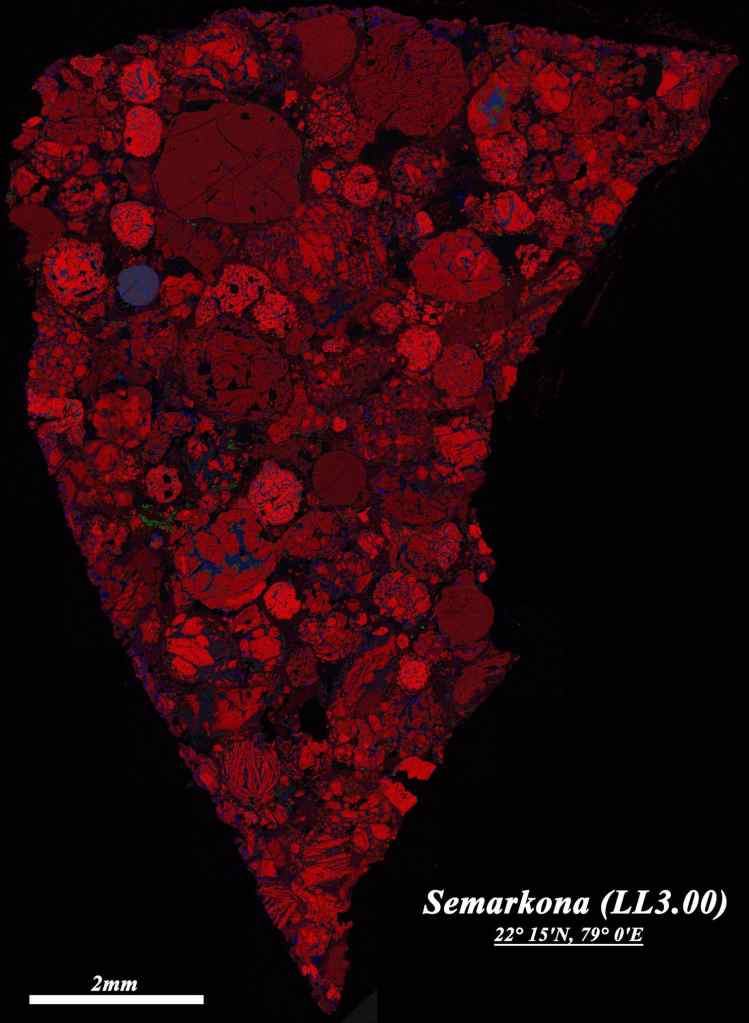
A closeup of the Semarkona meteorite showing dozens of chondrules. Kenichi Abe

Researchers have come up with many hypotheses through the last 40 years. But no consensus has been reached on how this brief flash of heating happened.

The chondrule problem is so famously difficult and contentious that when we announced to colleagues a few years ago that we were working on it, their reaction was to smile, shake their heads and offer their condolences. Now that we have proposed a solution we are preparing for a more critical response, which is fine, because that’s the way science advances.

The flyby model

Our idea is quite simple. Radioactive dating of hundreds of chondrules shows that they formed between 1.8 and 4 million years after the beginning of the solar system – some 4.6 billion years ago. During this time, fully molten asteroids, the parent bodies of the iron meteorites, were abundant. Volcanic eruptions on these asteroids released tremendous amounts of heat into the space around them. Any smaller objects passing by during an eruption would experience a short, intense blast of heat.

To test our hypothesis, we split up the challenge. The astronomer, Herbst, crunched the numbers to determine how much heating was necessary and for how long to create chondrules. Then the geologist, Greenwood, used a furnace in our lab at Wesleyan to recreate the predicted conditions and see if we could make our own chondrules.

Laboratory technician Jim Zareski (top) loads a programmable furnace as co-author Jim Greenwood looks on, in his laboratory at Wesleyan University. This is where the synthetic chondrules are made. W. Herbst

The experiments turned out to be quite successful.

We put some fine dust from Earth rocks with compositions resembling space dust into a small capsule, placed it in our furnace and cycled the temperature through the predicted range. Out came a nice-looking synthetic chondrule. Case closed? Not so fast.

Two problems emerged with our model. In the first place, we had ignored the bigger issue of how chondrules came to be part of the whole meteorite. What is their relationship to the stuff between chondrules – called matrix? In addition, our model seemed a bit too chancy to us. Only a small fraction of primitive matter will be heated in the way we proposed. Would it be enough to account for all those chondrule-packed meteorites hitting the Earth?

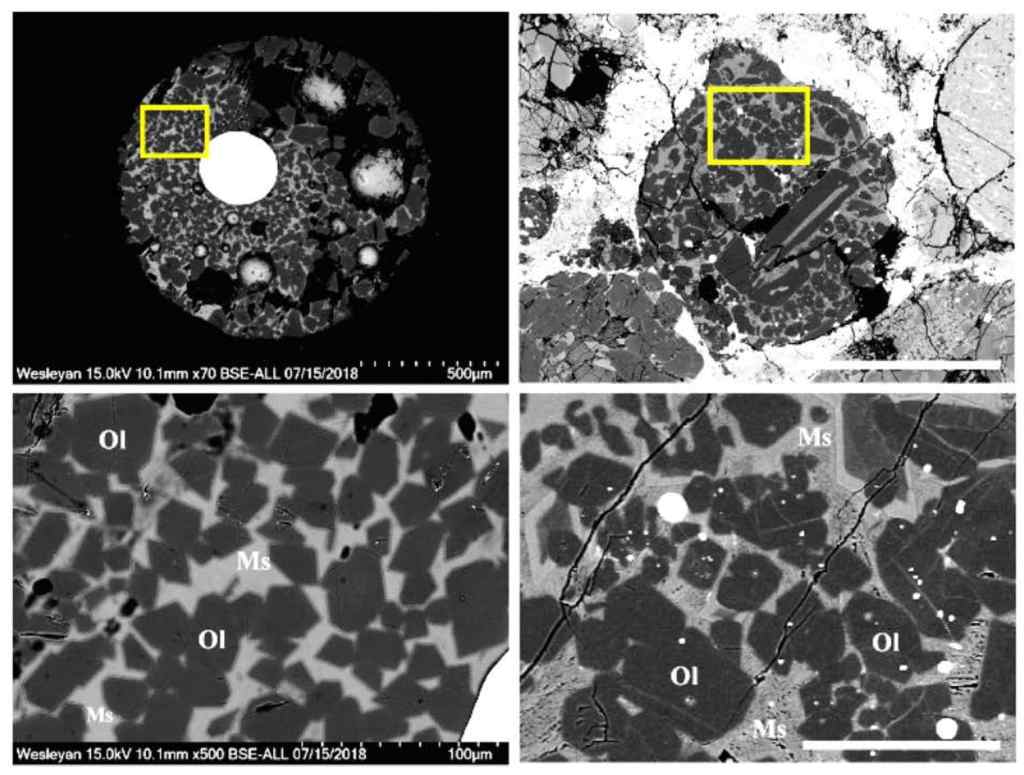
A comparison of a synthetic chondrule (left) made in the Wesleyan lab with a heating curve from the flyby model, with an actual chondrule (right) from the Semarkona meteorite. The crystal structure is quite similar, as shown in the enlargements (bottom row). J. Greenwood

Making whole meteorites

To address these issues, we extended our initial model to consider flyby heating of a larger object, up to a few miles across. As this material approaches a hot asteroid, parts of it will vaporize like a comet, resulting in an atmosphere rich in oxygen and other volatile elements. This turns out to be just the kind of atmosphere in which chondrules form, based on previous detailed chemical studies.

We also expect the heat and gas pressure to harden the flyby object into a whole meteorite through a process known as hot isostatic pressing, which is used commercially to make metal alloys. As the chondrules melt into little spheres, they will release gas to the matrix, which traps those elements as the meteorite hardens. If chondrules and chondrites form together in this manner, we expect the matrix to be enhanced in exactly the same elements that the chondrules are depleted. This phenomenon, known as complementarity, has, in fact, been observed for decades, and our model provides a plausible explanation for it.

The authors’ model for forming chondrules. A small piece of rock (right) — a few miles across or less — swings close to a large hot asteroid erupting lava at its surface. Infrared radiation from the hot lava briefly raises the temperature on the small piece of rock high enough to form chondrules and harden part of that object into a meteorite. W. Herbst/Icarus

Perhaps the most novel feature of our model is that it links chondrule formation directly to the hardening of meteorites. Since only well-hardened objects from space can make it through the Earth’s atmosphere, we would expect the meteorites in our museums to be full of chondrules, as they are. But hardened meteorites full of chondrules would be the exception, not the rule, in space, since they form by a relatively chancy process – the hot flyby. We should know soon enough if this idea holds water, since it predicts that chondrules will be rare on asteroids. Both Japan and the United States have ongoing missions to nearby asteroids that will return samples over the next few years.

If those asteroids are full of chondrules, like the hardened meteorites that make it to the Earth’s surface, then our model can be discarded and the search for a solution to the famous chondrule problem can go on. If, on the other hand, chondrules are rare on asteroids, then the flyby model will have passed an important test.

ooOOoo

Perfect timing!

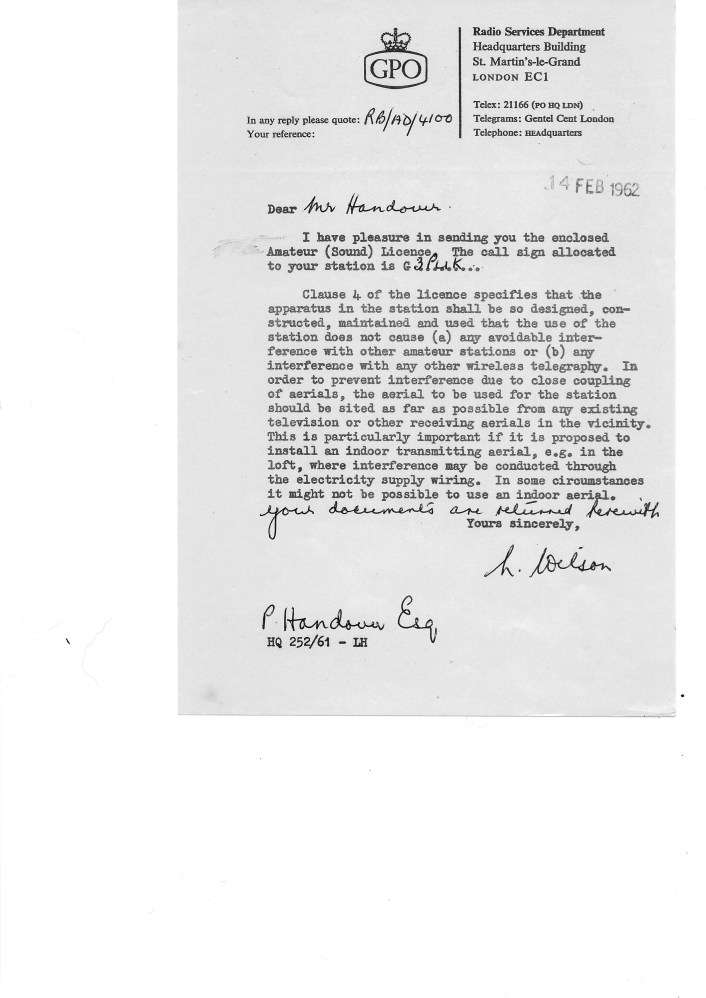
G3PUK!

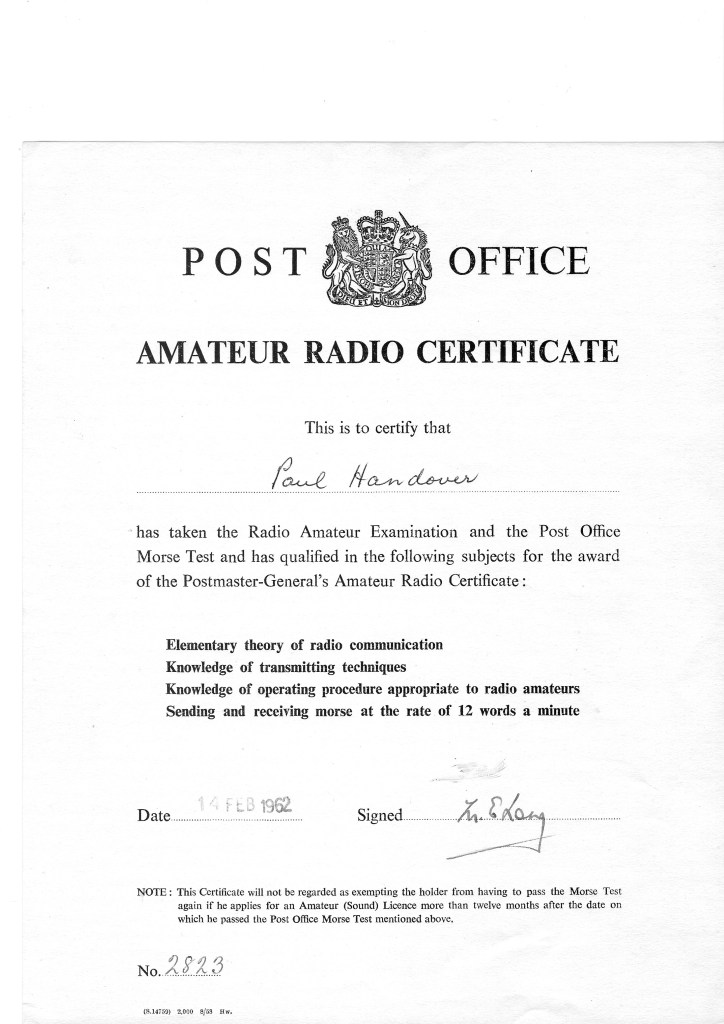
The story of me gaining my radio amateur licence.

As I spoke about yesterday in my introduction, when my mother remarried my sister and I had a new man about the house, so to speak. He was Richard Mills.

I was 13 or thereabouts and already struggling with my school work (the result of my father’s sudden death). And ‘Dad’ as we called him was finding his feet in the strange world of going from having no children to instantly having two step children!

Anyway, Dad found a theme with me that I enjoyed: building a shortwave radio receiver. It was full of learning for me and over the years I became hooked on listening to radio stations both near and far transmitting in morse code. I also joined the Harrow Radio Society and went across to their weekly meetings by tube and bus. (Despite the Society no longer being at the Harrow address it is amazing that they are still going strong.)

It was also a time when there was a great deal of ‘radio surplus’ equipment going for next to nothing and I ‘upgraded’ to an R-1152 receiver.

War surplus R-1152 receiver.

In time I became sufficiently old to take driving lessons and pass my driving licence. I then got a secondhand car. It helped because then I could drive up to Bushey and spend Sunday mornings at the house of Ron Ray. Ron was a keen amateur. On Sunday mornings Ron had a small group of people who wanted to pass the morse code test and apply for a licence.

I was already a member of the RSGB, the Radio Society of Great Britain, and that surely encouraged me further to study for my amateur licence.

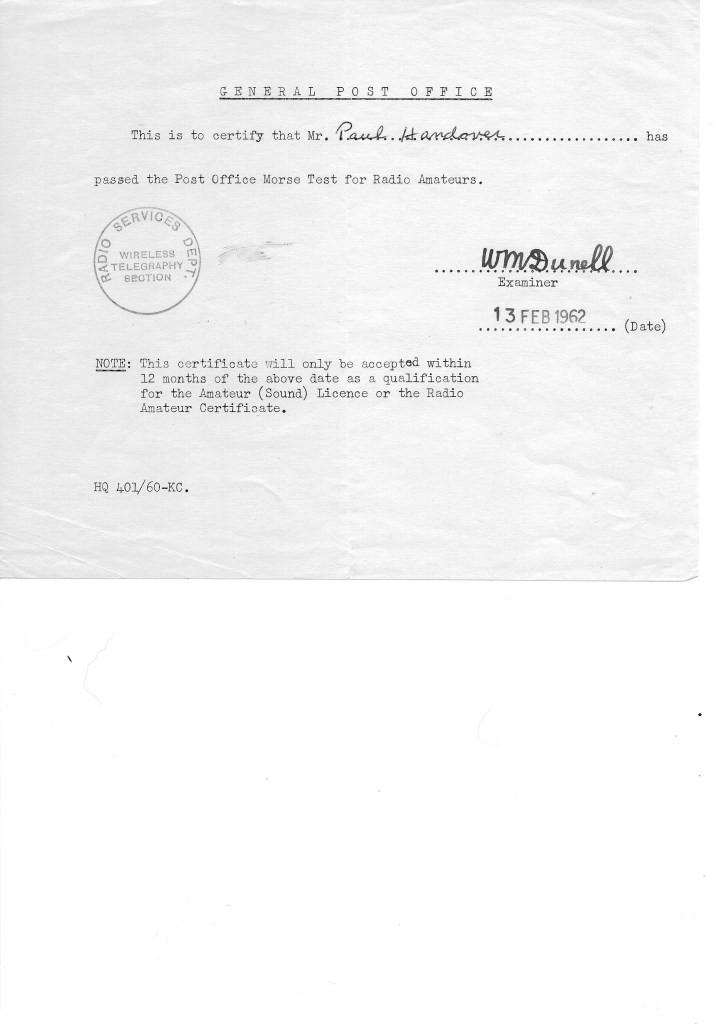
In time, I sat the exam and much to my amazement passed!

oooo

oooo


So that is the story of me and amateur radio.

Well, almost the full story.

In 1963 I volunteered for the Royal Naval Reserve, London Division. In time I was accepted and chose the join the radio branch, my G3PUK status coming in useful, because I reckoned that when we went to sea, on flat-bottomed minesweepers, it was better to be sick into a bucket between the knees than be sick on deck!

So there you are – G3PUK!

The Morse Code is 175 years old!

Two days of nostalgia follow! (You have been warned!)

As many of you already know, my father died fairly suddenly on December 20th, 1956. I had turned 12 some six weeks previously.

After about a year my mother remarried. His name was Richard Mills. Richard came to live at the house in Toley Avenue and had the unenviable task of taking on a new ‘son’ and ‘daughter’. (My sister, Elizabeth, some four years younger than I.)

Richard was a technical author in the newly-arrived electronics industry and one day he asked me if I would like to build a short-wave receiver. He coached me in the strange art of soldering wires and radio valves and other components and in the end I had a working receiver. That led, in turn, to me studying for an amateur radio licence. More of that tomorrow.

But the point of the introduction is to relay that The Morse Code is 175 years old on the 24th May.

Read more:

ooOOoo

Simply elegant, Morse code marks 175 years and counting

The elegantly simple code works whether flashing a spotlight or blinking your eyes—or even tapping on a smartphone touchscreen

There’s still plenty of reason to know how to use this Morse telegraph key. (Jason Salmon/Shutterstock.com)

By
Ph.D. Student in Electrical Engineering, University of South Carolina

May 21st, 2019

The first message sent by Morse code’s dots and dashes across a long distance traveled from Washington, D.C., to Baltimore on Friday, May 24, 1844 – 175 years ago. It signaled the first time in human history that complex thoughts could be communicated at long distances almost instantaneously. Until then, people had to have face-to-face conversations; send coded messages through drums, smoke signals and semaphore systems; or read printed words.

Thanks to Samuel F.B. Morse, communication changed rapidly, and has been changing ever faster since. He invented the electric telegraph in 1832. It took six more years for him to standardize a code for communicating over telegraph wires. In 1843, Congress gave him US$30,000 to string wires between the nation’s capital and nearby Baltimore. When the line was completed, he conducted a public demonstration of long-distance communication.

Morse wasn’t the only one working to develop a means of communicating over the telegraph, but his is the one that has survived. The wires, magnets and keys used in the initial demonstration have given way to smartphones’ on-screen keyboards, but Morse code has remained fundamentally the same, and is still – perhaps surprisingly – relevant in the 21st century. Although I have learned, and relearned, it many times as a Boy Scout, an amateur radio operator and a pilot, I continue to admire it and strive to master it.

Samuel F.B. Morse’s own handwritten record of the first Morse code message ever sent, on May 24, 1844. Library of Congress

Easy sending

Morse’s key insight in constructing the code was considering how frequently each letter is used in English. The most commonly used letters have shorter symbols: “E,” which appears most often, is signified by a single “dot.” By contrast, “Z,” the least used letter in English, was signified by the much longer and more complex “dot-dot-dot (pause) dot.”

In 1865, the International Telecommunications Union changed the code to account for different character frequencies in other languages. There have been other tweaks since, but “E” is still “dot,” though “Z” is now “dash-dash-dot-dot.”

The reference to letter frequency makes for extremely efficient communications: Simple words with common letters can be transmitted very quickly. Longer words can still be sent, but they take more time.

Going wireless

The communications system that Morse code was designed for – analogue connections over metal wires that carried a lot of interference and needed a clear on-off type signal to be heard – has evolved significantly.

The first big change came just a few decades after Morse’s demonstration. In the late 19th century, Guglielmo Marconi invented radio-telegraph equipment, which could send Morse code over radio waves, rather than wires.

The shipping industry loved this new way to communicate with ships at sea, either from ship to ship or to shore-based stations. By 1910, U.S. law required many passenger ships in U.S. waters to carry wireless sets for sending and receiving messages.

After the Titanic sank in 1912, an international agreement required some ships to assign a person to listen for radio distress signals at all times. That same agreement designated “SOS” – “dot-dot-dot dash-dash-dash dot-dot-dot” – as the international distress signal, not as an abbreviation for anything but because it was a simple pattern that was easy to remember and transmit. The Coast Guard discontinued monitoring in 1995. The requirement that ships monitor for distress signals was removed in 1999, though the U.S. Navy still teaches at least some sailors to read, send and receive Morse code.

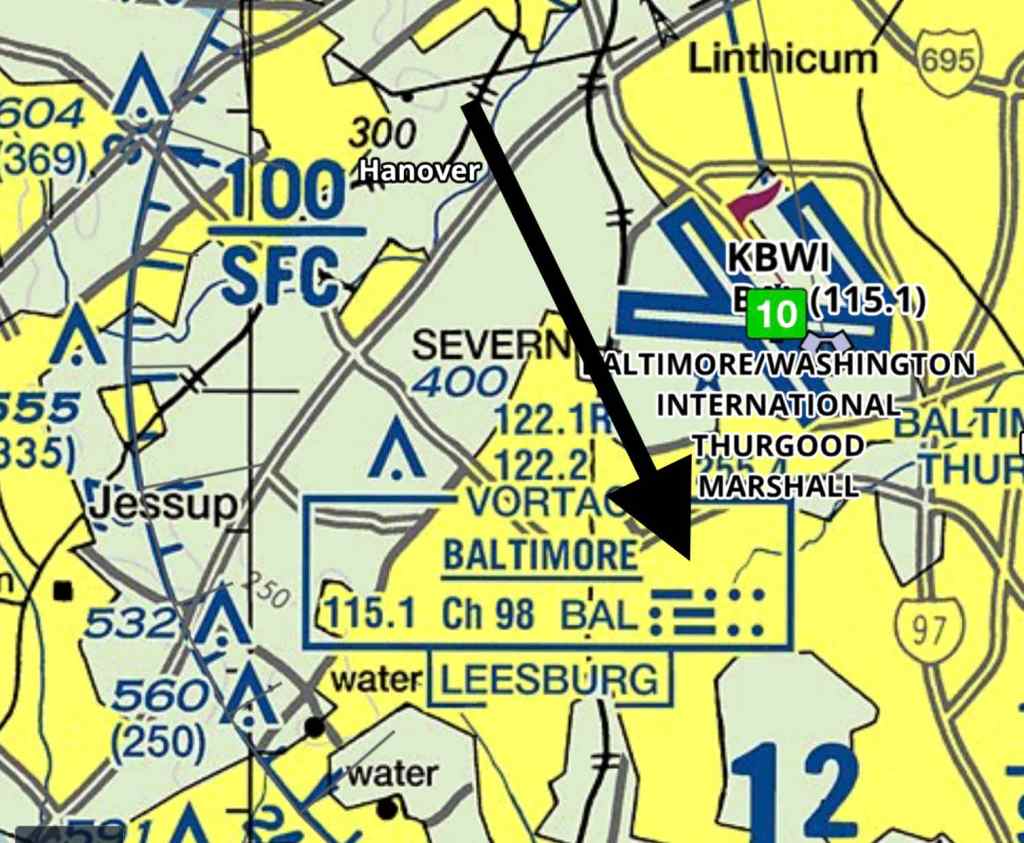
The arrow points at the chart label indicating the Morse code equivalent to the ‘BAL’ signal for a radio beacon near Baltimore. Edited screenshot of an FAA map, CC BY-ND

Aviators also use Morse code to identify automated navigational aids. These are radio beacons that help pilots follow routes, traveling from one transmitter to the next on aeronautical charts. They transmit their identifiers – such as “BAL” for Baltimore – in Morse code. Pilots often learn to recognize familiar-sounding patterns of beacons in areas they fly frequently.

There is a thriving community of amateur radio operators who treasure Morse code, too. Among amateur radio operators, Morse code is a cherished tradition tracing back to the earliest days of radio. Some of them may have begun in the Boy Scouts, which has made learning Morse variably optional or required over the years. The Federal Communications Commission used to require all licensed amateur radio operators to demonstrate proficiency in Morse code, but that ended in 2007. The FCC does still issue commercial licenses that require Morse proficiency, but no jobs require it anymore.

Blinking Morse

Because its signals are so simple – on or off, long or short – Morse code can also be used by flashing lights. Many navies around the world use blinker lights to communicate from ship to ship when they don’t want to use radios or when radio equipment breaks down. The U.S. Navy is actually testing a system that would let a user type words and convert it to blinker light. A receiver would read the flashes and convert it back to text.

Skills learned in the military helped an injured man communicate with his wife across a rocky beach using only his flashlight in 2017.

Other Morse messages

Perhaps the most notable modern use of Morse code was by Navy pilot Jeremiah Denton, while he was a prisoner of war in Vietnam. In 1966, about one year into a nearly eight-year imprisonment, Denton was forced by his North Vietnamese captors to participate in a video interview about his treatment. While the camera focused on his face, he blinked the Morse code symbols for “torture,” confirming for the first time U.S. fears about the treatment of service members held captive in North Vietnam.

Navy pilot Jeremiah Denton, a prisoner of war, blinks Morse code spelling out ‘torture’ during a forced interview with his captors.

Blinking Morse code is slow, but has also helped people with medical conditions that prevent them from speaking or communicating in other ways. A number of devices – including iPhones and Android smartphones – can be set up to accept Morse code input from people with limited motor skills.

There are still many ways people can learn Morse code, and practice using it, even online. In emergency situations, it can be the only mode of communications that will get through. Beyond that, there is an art to Morse code, a rhythmic, musical fluidity to the sound. Sending and receiving it can have a soothing or meditative feeling, too, as the person focuses on the flow of individual characters, words and sentences. Overall, sometimes the simplest tool is all that’s needed to accomplish the task.

ooOOoo

I do hope you read this article in full because it contains much interesting information. Many people will not have a clue about The Morse Code and, as you can see above, it is still relevant.

Finally, I can still remember the The Morse Code after all these years!

Coyote puppies

An obvious follow-on to yesterday’s post.

We all know about how wolves habituated themselves to human all those thousand of years ago but the same is happening to coyotes today.

There was an article on EarthSky on March 28th, 2019 that I want to share with you, and here it is:

ooOOoo

How coyote pups get used to humans

Posted by in | March 28, 2019

Across North America, coyotes are moving into urban environments. While human residents are having to get used to the new animal neighbors, coyotes are also habituating to people.

Seven-week-old coyote pups walk through the research facility in Utah as the mother follows. The first pup carries a bone in its mouth. Image via USDA National Wildlife Research Center/Steve Guymon.

As coyotes are moving into urban environments across North America, many human residents – whether they like it or not – are having to get used to them. Meanwhile, how are coyotes habituating to people?

A new study, published December 2018 in the peer-reviewed journal Ecology and Evolution, suggests that coyotes can habituate to humans quickly and that habituated parents pass this fearlessness on to their offspring.

Image via Connar L’Ecuyer via National Park Service/Flickr.

Until the 20th century, coyotes lived mostly in the U.S. Great Plains. But when wolves were hunted almost to extinction in the early 1900s, coyotes lost their major predator, and their range began to expand.

With continuing landscape changes, coyotes are now increasingly making their way into suburban and urban environments — including New York City, Los Angeles and cities in the Pacific Northwest — where they live, mainly off rodents and small mammals, without fear of hunters.

The aim of the new study, was to understand how a skittish, rural coyote can sometimes transform into a bold, urban one — a shift that can exacerbate negative interactions among humans and coyotes. University of Washington biologist Christopher Schell is the first author of the study, Schell said in a statement:

Instead of asking, ‘Does this pattern exist?’ we’re now asking, ‘How does this pattern emerge?’.

A key factor, the researchers suggest, might be parental influence. Coyotes pair for life, and both parents contribute equally to raising the offspring. This may be because of the major parental investment required to raise coyote pups, and the evolutionary pressure to guard them from larger carnivores.

The new study observed eight coyote families at the U.S. Department of Agriculture’s Predator Research Facility in Utah during their first and second breeding seasons. These coyotes are raised in a fairly wild setting, with minimal human contact and food scattered across large enclosures.

Five-week-old coyote pups eat food rations during the experiment. These second-litter pups were born in 2013 to more-experienced parents, and were more likely to approach a human. Image via USDA National Wildlife Research Center/Christopher Schell.

But during the experiment researchers occasionally placed all the food near the entrance of the enclosure and had a human researcher sit just outside, watching any approaching coyotes, from five weeks to 15 weeks after the birth of the litter. Then they documented how soon the coyotes would venture toward the food. Schell said:

For the first season, there were certain individuals that were bolder than others, but on the whole they were pretty wary, and their puppies followed. But when we came back and did the same experiment with the second litter, the adults would immediately eat the food – they wouldn’t even wait for us to leave the pen in some instances.

Parents became way more fearless, and in the second litter, so, too, were the puppies.

In fact, the most cautious pup from the second-year litter ventured out more than the boldest pup from the first-year litter. Schell said:

The discovery that this habituation happens in only two to three years has been corroborated, anecdotally, by evidence from wild sites across the nation. We found that parental effect plays a major role.

He added:

Even if it’s only 0.001 percent of the time, when a coyote threatens or attacks a person or a pet, it’s national news, and wildlife management gets called in. We want to understand the mechanisms that contribute to habituation and fearlessness, to prevent these situations from occurring.

Bottom line: A new study suggests coyotes puppies learn from their parents how to habituate to humans.

Source: Parental habituation to human disturbance over time reduces fear of humans in coyote offspring

Via University of Washington

ooOOoo

I love the fact that coyotes pair for life and take an equal measure of responsibility in bringing up their pups.

Once again, we humans can learn from our natural cousins.

Burn Baby, Burn.

A rather depressing essay from Tom Englehardt.

The world is getting hotter. That’s a fact!

And no amount of stuffing one’s head under the pillow is going to change that fact.

We must take note of all the many articles and stories about the warming of the planet. Because we need to change the way we are responding. Not from climate change but to climate crisis.

I’m republishing a recent essay from Tom Engelhardt, with his permission, because he articulates perfectly where we are heading.

ooOOoo

Suicide Watch on Planet Earth

As the Flames Began to Rise, the Arsonists Appeared
By Tom Engelhardt, April 25th, 2019

As Notre Dame burned, as the flames leapt from its roof of ancient timbers, many of us watched in grim horror. Hour after hour, on screen after screen, channel after channel, you could see that 850-year-old cathedral, a visiting spot for 13 million people annually, being gutted, its roof timbers flaring into the evening sky, its steeple collapsing in a ball of fire. It was dramatic and deeply disturbing — and, of course, unwilling to be left out of any headline-making event, President Trump promptly tweeted his advice to the French authorities: “Perhaps flying water tankers could be used to put it out. Must act quickly!” No matter that water from such planes would probably have taken the cathedral’s towers down and endangered lives as well — “the equivalent,” according to a French fire chief, “of dropping three tons of concrete at 250 kilometers per hour [on] the ancient monument.”

Still, who could doubt that watching such a monument to the human endeavor being transformed into a shell of its former self was a reminder that everything human is mortal; that, whether in a single lifetime or 850 years, even the most ancient of our artifacts, like those in Iraq and Syria recently, will sooner or later be scourged by the equivalent of (or even quite literally by) fire and sword; that nothing truly lasts, even the most seemingly permanent of things like, until now, Notre Dame?
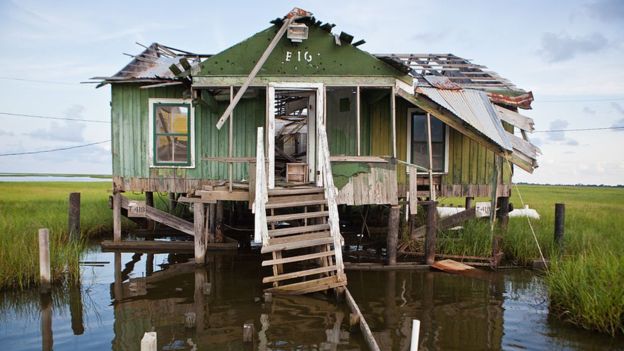
That cathedral in flames, unlike so much else in our moment (including you-know-who in his every waking moment), deserved the front-and-center media attention it got. Historically speaking, it was a burning event of the first order. Still, it’s strange that the most unnerving, deeply terrifying burning underway today, not of that ancient place of worship that lived with humanity for so many tumultuous centuries but of the planet itself, remains largely in the background.

When the cathedral in which Napoleon briefly crowned himself emperor seemed likely to collapse, it was certifiably an event of headline importance. When, however, the cathedral (if you care to think of it that way) in which humanity has been nurtured all these tens of thousands of years, on which we spread, developed, and became what we are today — I mean, of course, the planet itself — is in danger of an unprecedented sort from fires we continue to set, that’s hardly news at all. It’s largely relegated to the back pages of our attention, lost any day of the week to headlines about a disturbed, suicidal young woman obsessed with the Columbine school massacre or an attorney general obsessed with protecting the president.

And let’s not kid ourselves, this planet of ours is beginning to burn — and not just last week or month either. It’s been smoldering for decades now. Last summer, for instance, amid global heat records (Ouargla, Algeria, 124 degrees Fahrenheit; Hong Kong, over 91 degrees Fahrenheit for 16 straight days; Nawabsha, Pakistan, 122 degrees Fahrenheit; Oslo, Norway, over 86 degrees Fahrenheit for 16 consecutive days; Los Angeles, 108 degrees Fahrenheit), wildfires raged inside the Arctic Circle. This March, in case you hadn’t noticed — and why would you, since it’s gotten so little attention? — the temperature in Alaska was, on average, 20 degrees (yes, that is not a misprint) above normal and typical ice roads between villages and towns across parts of that state were melting and collapsing with deaths ensuing.

Meanwhile, in the Antarctic, ice is melting at a rate startling to scientists. If the process accelerates, global sea levels could rise far faster than expected, beginning to drown coastal cities like Miami, New York, and Shanghai more quickly than previously imagined. Meanwhile, globally, the wildfire season is lengthening. Fearsome fires are on the rise, as are droughts, and that’s just to begin to paint a picture of a heating planet and its ever more extreme weather systems and storms, of (if you care to think of it that way) a Whole Earth version of Notre Dame.

The Arsonists Arrive

As was true with Notre Dame, when it comes to the planet, there were fire alarms before an actual blaze was fully noted. Take, for example, the advisory panel of scientists reporting to President Lyndon Johnson on the phenomenon of global warming back in 1965. They would, in fact, predict with remarkable accuracy how our world was going to change for the worse by this twenty-first-century moment. (And Johnson, in turn, would bring the subject up officially for perhaps the first time in a Special Message to Congress on February 5, 1965, 54 years before Alexandria Ocasio-Cortez’s Green New Deal proposal.) As that panel wrote at the time, “Through his worldwide industrial civilization, Man is unwittingly conducting a vast geophysical experiment. Within a few generations he is burning the fossil fuels that slowly accumulated in the earth over the past 500 million years…” In other words, the alarm was first sounded more than half a century ago.

When it comes to climate change, however, as the smoke began to appear and, in our own moment, the first flames began to leap — after all, the last four years have been the hottest on record and, despite the growth of ever less expensive alternative energy sources, carbon dioxide emissions into the atmosphere are still rising, not falling — no firemen arrived (just children). There were essentially no adults to put out the blaze. Yes, there was the Paris climate accord but it was largely an agreement in principle without enforcement power of any genuine sort.

In fact, across significant parts of the planet, those who appeared weren’t firefighters at all, but fire feeders who will likely prove to be the ultimate arsonists of human history. In a way, it’s been an extraordinary performance. Leaders who vied for, or actually gained, power not only refused to recognize the existence of climate change but were quite literally eager to aid and abet the phenomenon. This is true, for instance, of the new president of Brazil, Jair Bolsonaro, who came to power prepared to turn the already endangered carbon sink of the Amazon rain forest into a playground for corporate and agricultural destroyers. It is similarly true in Europe, where right-wing populist movements have begun to successfully oppose gestures toward dealing with climate change, gaining both attention and votes in the process. In Poland, for instance, just such a party led by President Andrzej Duda has come to power and the promotion of coal production has become the order of the day.

And none of that compared to developments in the richest, most powerful country of all, the one that historically has put more greenhouse gas emissions into the atmosphere than any other. On taking office, Donald Trump appointed more climate-change deniers to his cabinet than might have previously seemed possible and swore fealty to “American energy dominance,” while working to kneecap the development of alternative energy systems.  He and his men tried to open new areas to oil and gas drilling, while in every way imaginable striving to remove what limits there had been on Big Energy, so that it could release its carbon emissions into the atmosphere unimpeded. And as the planetary cathedral began to burn, the president set the mood for the moment (at least for his vaunted “base”) by tweeting such things as “It’s really cold outside, they are calling it a major freeze, weeks ahead of normal. Man, we could use a big fat dose of global warming!” or, on alternative energy, “You would be doing wind, windmills, and if it doesn’t if it doesn’t blow you can forget about television for that night… Darling, I want to watch television. I’m sorry, the wind isn’t blowing.”

Among those who will someday be considered the greatest criminals in history, don’t forget the Big Energy CEOs who, knowing the truth about climate change from their own hired scientists, did everything they could to increase global doubts by funding climate-denying groups, while continuing to be among the most profitable companies around. They even hedged their bets by, among other things, investing in alternative energy and using it to more effectively drill for oil and natural gas.

Meanwhile, of course, the planet that had proven such a comfortable home for humanity was visibly going down. No, climate change won’t actually destroy the Earth itself, just the conditions under which humanity (and so many other species) thrived on it. Sooner or later, if the global temperature is indeed allowed to rise a catastrophic seven degrees Fahrenheit or four degrees Celsius, as an environmental impact statement from the Trump administration suggested it would by 2100, parts of the planet could become uninhabitable, hundreds of millions of human beings could be set in desperate motion, and the weather could intensify in ways that might be nearly unbearable for human habitation. Just read David Wallace-Wells’s The Uninhabitable Earth, if you doubt me.

This isn’t even contestable information anymore and yet it’s perfectly possible that Donald Trump could be elected to a second term in 2020. It’s perfectly possible that more right-wing populist movements could sweep into power in Europe. It’s perfectly possible that Vladimir Putin’s version of great powerdom — a sagging Russian petro-state — could continue on its present globally warming path well into the future.

Understand this: Trump, Bolsonaro, Duda, Putin, and the others are just part of human history. Sooner or later, they will be gone. Climate change, however, is not part of human history (whatever it may do to civilization as we know it). Its effects could, in human terms, last for almost unimaginable periods of time. It operates on a different time scale entirely, which means that, unlike the tragedies and nightmares of human history, it is not just a passing matter.

Of course, the planet will survive, as will some life forms (as would be true even if humanity were to succumb to that other possible path to an apocalypse, a nuclear holocaust resulting in “nuclear winter”).  But that should be considered small consolation indeed.

Putting the Planet on a Suicide Watch

Consider global warming a story for the ages, one that should put Notre Dame’s near-destruction after almost nine centuries in grim perspective. And yet the planetary version of burning, which should be humanity’s crisis of all crises, has been met with a general lack of media attention, reflecting a lack of just about every other kind of attention in our world (except by those outraged children who know that they are going to inherit a degraded world and are increasingly making their displeasure about it felt).

To take just one example of that lack of obvious attention, the response of the mega-wealthy to the burning of Notre Dame was an almost instantaneous burst of giving. The euro equivalent of nearly a billion dollars was raised more or less overnight from the wealthiest of French families and other .01%ers. Remind me of the equivalent for climate change as the planet’s spire threatens to come down?

As for arsonists like Donald Trump and the matter of collusion, there’s not even a question mark on the subject. In the United States, such collusion with the destroyers of human life on Planet Earth is written all over their actions. It’s beyond evident in the appointment of former oil and gas lobbyists and fellow travelers to positions of power. Will there, however, be the equivalent of a Mueller investigation? Will the president be howling “witch hunt” again? Not a chance. When it comes to Donald Trump and climate change, there will be neither a Mueller Report, nor the need for a classic Barr defense. And yet collusion — hell, yeah! The evidence is beyond overwhelming.

We are, of course, talking about nothing short of the ultimate crime, but on any given day of our lives, you’d hardly notice that it was underway. Even for an old man like me, it’s a terrifying thing to watch humanity make a decision, however inchoate, to essentially commit suicide. In effect, there is now a suicide watch on Planet Earth. Let’s hope the kids can make a difference.

Tom Engelhardt is a co-founder of the American Empire Project and the author of a history of the Cold War, The End of Victory Culture. He runs TomDispatch.com and is a fellow of the Type Media Center. His sixth and latest book is A Nation Unmade by War (Dispatch Books).

Follow TomDispatch on Twitter and join us on Facebook. Check out the newest Dispatch Books, John Feffer’s new dystopian novel (the second in the Splinterlands series) Frostlands,Beverly Gologorsky’s novel Every Body Has a Story, and Tom Engelhardt’s A Nation Unmade by War, as well as Alfred McCoy’s In the Shadows of the American Century: The Rise and Decline of U.S. Global Power and John Dower’s The Violent American Century: War and Terror Since World War II.

Copyright 2019 Tom Engelhardt

ooOOoo

Tom and I are of the same age, give or take a year or two, and I have long been worried about the state of things. Part of me thinks that I won’t live long enough to experience the worst of this climate crisis and that my grandchild will have to sort it out. But then another part of me thinks that this is accelerating and we are already experiencing weather and climate that is strange and …..

I don’t know!

Sir David Attenborough.

A very great man!

For someone born on May 8th, 1926 he, perhaps, should be slowing down. But none of it. He is passionate about how we are endangering our planet. And having a public profile he is the right position to do something about it, albeit a warning statement.

Plus, he is not the only one doing something about it. For Extinction Rebellion are protesting in the London streets.

But back to Sir David.

I’m assuming that it is OK to republish in full an item that appeared on BBC News yesterday. And according to their terms it is OK.

ooOOoo

Climate change: Sir David Attenborough warns of ‘catastrophe’

By Matt McGrath, Environment correspondent

(There is a video on the webpage that I am unable to copy across. Please go here to watch it. Update: I think I have got it.)

Sir David Attenborough has issued his strongest statement yet on the threat posed to the world by climate change.

In the BBC programme Climate Change – The Facts, the veteran broadcaster outlines the scale of the crisis facing the planet.

Sir David says we face “irreversible damage to the natural world and the collapse of our societies”.

But there is still hope, he says, if dramatic action to limit the effects is taken over the next decade.

Sir David’s new programme lays out the science behind climate change, the impact it is having right now and the steps that can be taken to fight it.

“In the 20 years since I first started talking about the impact of climate change on our world, conditions have changed far faster than I ever imagined,” Sir David states in the film.

“It may sound frightening, but the scientific evidence is that if we have not taken dramatic action within the next decade, we could face irreversible damage to the natural world and the collapse of our societies.”

Speaking to a range of scientists, the programme highlights that temperatures are rising quickly, with the world now around 1C warmer than before the industrial revolution.

“There are dips and troughs and there are some years that are not as warm as other years,” says Dr Peter Stott from the Met Office.

“But what we have seen is the steady and unremitting temperature trend. Twenty of the warmest years on record have all occurred in the last 22 years.”

The programme shows dramatic scenes of people escaping from wildfires in the US, as a father and son narrowly escape with their lives when they drive into an inferno.

Scientists say that the dry conditions that make wildfires so deadly are increasing as the planet heats up.

Greenland is losing ice five times as fast as it was 25 years ago – Getty Images.

Some of the other impacts highlighted by scientists are irreversible.

“In the last year we’ve had a global assessment of ice losses from Antarctica and Greenland and they tell us that things are worse than we’d expected,” says Prof Andrew Shepherd from the University of Leeds.

“The Greenland ice sheet is melting, it’s lost four trillion tonnes of ice and it’s losing five times as much ice today as it was 25 years ago.”

These losses are driving up sea levels around the world. The programme highlights the threat posed by rising waters to people living on the Isle de Jean Charles in Louisiana, forcing them from their homes.

“In the US, Louisiana is on the front line of this climate crisis. It’s losing land at one of the fastest rates on the planet – at the rate of of a football field every 45 minutes,” says Colette Pichon Battle, a director of the Gulf Coast Center for Law & Policy.

People are moving from parts of Louisiana in the US as a result of rising waters. – Julie Dermansky

“The impact on families is going to be something I don’t think we could ever prepare for.”

Hope rising

Sir David’s concern over the impacts of climate change has become a major focus for the naturalist in recent years.

This has also been a theme of his One Planet series on Netflix.

His new BBC programme has a strong emphasis on hope.

Sir David argues that if dramatic action is taken over the next decade then the world can keep temperatures from rising more than 1.5C this century. This would limit the scale of the damage.

“We are running out of time, but there is still hope,” says Sir David.

“I believe that if we better understand the threat we face the more likely it is we can avoid such a catastrophic future.”

The programme says that rapid progress is being made in renewable energy, with wind now as cheap as fossil fuels in many cases. It shows how technologies to remove and bury carbon dioxide under the ground are now becoming more viable.

But politicians will need to act decisively and rapidly.

“This is the brave political decision that needs to be taken,” says Chris Stark from the UK’s Committee on Climate Change.

Teenage campaigner Greta Thunberg has helped spark school strikes all over the world. – Getty Images.

“Do we incur a small but not insignificant cost now, or do we wait and see the need to adapt. The economics are really clear on this, the costs of action are dwarfed by the costs of inaction.”

The programme also highlights the rising generation of young people who are deeply concerned about what’s happening to the planet.

Swedish teenager Greta Thunberg explains that things can change quickly, despite the scale of the challenge on climate change.

“The first day I sat all alone,” she says, speaking of her decision to go on strike from school and sit outside the Swedish parliament to highlight the climate crisis.

“But on the second day, people started joining me… I wouldn’t have imagined in my wildest dreams that this would have happened so fast.”

“Change is coming whether you like it or not.”

Follow Matt on Twitter@mattmcgrathbbc

Climate Change – The Facts is on BBC One on Thursday 18 April at 9pm

ooOOoo

There are so many quotes in this item that one can hardly pick out the most pertinent one.

Change is coming whether you like it or not.

The impact on families is going to be something I don’t think we could ever prepare for.

… irreversible damage to the natural world and the collapse of our societies“.

But this is the most powerful one! “We are running out of time, but there is still hope,” says Sir David.

A dog food advisory.

This came in late yesterday.

ooOOoo

Dear Fellow Dog Lover,

Because you signed up on our website and asked to be notified, I’m sending you this special recall alert. If you no longer wish to receive these emails, please click the “unsubscribe” link at the bottom of this message.

Hill’s Pet Nutrition is expanding its recall of specific lots of its Prescription Diet and Science Diet dog foods due to elevated levels of vitamin D.

Very high levels of vitamin D can lead to serious health issues in dogs, including kidney dysfunction.

To learn which products are affected, please visit the following link:

Hill’s Prescription Diet and Science Diet Dog Food Recall Expands

Please share the news of this alert with other pet owners.

Mike Sagman, Editor
The Dog Food Advisor

If one then follows up that link then you will see this:

Hill’s Prescription Diet and Science Diet Dog Food Recall Expands

March 20, 2019 — Hill’s Pet Nutrition is expanding its voluntary recall of canned dog food products due to elevated levels of vitamin D.

This recall expansion relates to the same vitamin premix that led to the January 31 voluntary recall previously announced on The Dog Food Advisor website.

Vitamin D, when consumed at very high levels, can lead to serious health issues in dogs including kidney dysfunction.

What’s Recalled?

The following products and lot numbers are affected by the recall.

Items marked in blue are new SKUs that were added to the list on March 20, 2019.

About Excessive Levels of Vitamin D

While vitamin D is an essential nutrient for dogs, ingestion of elevated levels can lead to potential health issues depending on the level of vitamin D and the length of exposure.

Dogs may exhibit symptoms such as vomiting, loss of appetite, increased thirst, increased urination, excessive drooling, and weight loss.

Pet parents with dogs who have consumed any of the products listed and are exhibiting any of these signs should contact their veterinarian.

In most cases, complete recovery is expected after discontinuation of feeding.

What to Do?

If your SKU, Date and Lot codes are found in the list above, you have an affected product.

You should stop feeding it and should return to the place of purchase for a full refund.

If you have questions, you may contact Hill’s Consumer Affairs at 800-445-5777.

U.S. citizens can report complaints about FDA-regulated pet food products by calling the consumer complaint coordinator in your area.

Or go to https://www.fda.gov/petfoodcomplaints.

Canadians can report any health or safety incidents related to the use of this product by filling out the Consumer Product Incident Report Form.

Get Dog Food Recall Alerts by Email

Get free dog food recall alerts sent to you by email. Subscribe to The Dog Food Advisor’s emergency recall notification system.

ooOOoo

Hopefully, there are not people that are affected by this alert. But, nonetheless, it needs promulgating.

I have US Citizenship!

Apologies for the absence over the last two days!

Dear friends,

Yesterday, I attended a Naturalisation Test at Portland at 08:25!

I passed. What I wasn’t expecting was to be offered a Swearing In Ceremony at 13:30 the same day.

Clearly it made sense to stay on for that!

So that’s it!

I am now a Naturalised Citizen of the United States of America!


Wow! This is some story!

Incredible!

There are so many stories and articles about dogs that it’s easy to overlook some of them.

Take this recent story from BBC News, back on February 11th.

ooOOoo

‘Brain tumour’ dog in Beauly had 7cm needle in neck

Toby the Yorkshire terrier had seizure symptoms before owners knew he had a needle lodged in his neck.

A dog that showed signs of a brain tumour was found to have a 7cm (3in) needle lodged in its neck.

Toby, a 13-year-old Yorkshire terrier, was taken to a vet in Nairn in the Highlands after he suffered neck pain, struggled to walk and showed seizure symptoms.

X-rays later showed the needle had pierced his spinal cord.

But surgeons in Edinburgh were able to extract it and Toby went on to make a full recovery.

X-rays revealed the 7cm metal sewing needle piercing Toby’s spinal cord

Owner Alexander Jamieson, from Beauly, near Inverness, said: “We feel that without the help of the experts in Edinburgh, Toby would not be here today.

“The care and attention he got was out of this world and we are delighted to see him back to his old self.”

Toby was referred to the specialist surgical clinic at the University of Edinburgh’s Hospital for Small Animals at the Royal (Dick) School for Veterinary Studies where vets performed a CT scan to assess any major damage to his spinal cord in August 2018.

They found that the sewing needle – which still had thread attached – was dangerously close to his brain.

Toby has now recovered to the point where he is able to walk and run normally.

Vets are delighted with Toby’s recovery

It is not known how the needle ended up in Toby’s neck but vets suspect that he could have eaten it or laid his head on it.

Samantha Woods, senior lecturer, and Jessica McCarthy, senior clinical training scholar in small animal surgery, said they were delighted with Toby’s progress.

Ms Woods added: “We are really pleased to see Toby back to full health, thanks to the combined efforts of his vets and our specialist teams here in Edinburgh.”

ooOOoo

That was fantastic! All kudos to the whole team that swung into action.