Category: Environment

Climate Change and Humanity: Postscript.

A personal viewpoint after reading Tom’s essay Is Climate Change a Crime Against Humanity?

Last Thursday, July 3rd, I republished a post, what Tom calls a Tomgram, from TomDispatch comparing the USA’s attitude to the very small risk of a country exploding a weapon of mass destruction, WMD, over American soil to the 95% risk of the USA being harmed from the effects of climate change.  Here’s an extract from the central part of Tom’s essay:

So here’s a question I’d like any of you living in or visiting Wyoming to ask the former vice president, should you run into him in a state that’s notoriously thin on population: How would he feel about acting preventively, if instead of a 1% chance that some country with weapons of mass destruction might use them against us, there was at least a 95% — and likely as not a 100% — chance of them being set off on our soil? Let’s be conservative, since the question is being posed to a well-known neoconservative. Ask him whether he would be in favor of pursuing the 95% doctrine the way he was the 1% version.

After all, thanks to a grim report in 2013 from the Intergovernmental Panel on Climate Change, we know that there is now a 95% -100% likelihood that “human influence has been the dominant cause of the observed warming [of the planet] since the mid-20th century.” We know as well that the warming of the planet — thanks to the fossil fuel system we live by and the greenhouse gases it deposits in the atmosphere — is already doing real damage to our world and specifically to the United States, as a recent scientific report released by the White House made clear. We also know, with grimly reasonable certainty, what kinds of damage those 95% -100% odds are likely to translate into in the decades, and even centuries, to come if nothing changes radically: a temperature rise by century’s end that could exceed 10 degrees Fahrenheit, cascading species extinctions, staggeringly severe droughts across larger parts of the planet (as in the present long-term drought in the American West and Southwest), far more severe rainfall across other areas, more intense storms causing far greater damage, devastating heat waves on a scale no one in human history has ever experienced, masses of refugees, rising global food prices, and among other catastrophes on the human agenda, rising sea levels that will drown coastal areas of the planet.
Tom’s essays had many great links to background research papers and other supporting material.  The penultimate link was embedded (my italics) in this sentence: “In the case of a major exchange of such weapons, we would be talking about “the sixth extinction” of planetary history.”  That linked to the Amazon page describing the book, released earlier this year, of the same name written by Elizabeth Kolbert, as follows:

A major book about the future of the world, blending intellectual and natural history and field reporting into a powerful account of the mass extinction unfolding before our eyes

Over the last half a billion years, there have been five mass extinctions, when the diversity of life on earth suddenly and dramatically contracted. Scientists around the world are currently monitoring the sixth extinction, predicted to be the most devastating extinction event since the asteroid impact that wiped out the dinosaurs. This time around, the cataclysm is us. In The Sixth Extinction, two-time winner of the National Magazine Award and New Yorker writer Elizabeth Kolbert draws on the work of scores of researchers in half a dozen disciplines, accompanying many of them into the field: geologists who study deep ocean cores, botanists who follow the tree line as it climbs up the Andes, marine biologists who dive off the Great Barrier Reef. She introduces us to a dozen species, some already gone, others facing extinction, including the Panamian golden frog, staghorn coral, the great auk, and the Sumatran rhino. Through these stories, Kolbert provides a moving account of the disappearances occurring all around us and traces the evolution of extinction as concept, from its first articulation by Georges Cuvier in revolutionary Paris up through the present day. The sixth extinction is likely to be mankind’s most lasting legacy; as Kolbert observes, it compels us to rethink the fundamental question of what it means to be human.

Here’s an interview of Elizabeth Kolbert taken from the Democracy Now programme. It’s a tad under 20 minutes so easy to put aside a little of your time to watch it.

PLEASE DO!

Published on Feb 11, 2014
February 2014 on Democracy Now!

In the history of the planet, there have been five known mass extinction events. The last came 65 million years ago, when an asteroid about half the size of Manhattan collided with the Earth, wiping out the dinosaurs and bringing the Cretaceous period to an end. Scientists say we are now experiencing the sixth extinction, with up to 50 percent of all living species in danger of disappearing by the end of the century. But unlike previous extinctions, the direct cause this time is us — human-driven climate change. In “The Sixth Extinction: An Unnatural History,” journalist Elizabeth Kolbert visits four continents to document the massive “die-offs” that came millions of years ago and those now unfolding before our eyes. Kolbert explores how human activity — fossil fuel consumption, ocean acidification, pollution, deforestation, forced migration — threatens life forms of all kinds. “It is estimated that one-third of all reef-building corals, a third of all fresh-water mollusks, a third of sharks and rays, a quarter of all mammals, a fifth of all reptiles, and a sixth of all birds are headed toward oblivion,” Kolbert writes. “The losses are occurring all over: in the South Pacific and in the North Atlantic, in the Arctic and the Sahel, in lakes and on islands, on mountaintops and in valleys.”

Elizabeth Kolbert, is well known for her reporting on global warming as a staff writer at The New Yorker magazine, which led her to investigate climate species extinction. Her new book is The Sixth Extinction: An Unnatural History. In 2006, she wrote Field Notes from a Catastrophe: Man, Nature, and Climate Change.

Make no mistake, that short video interview doesn’t pull any punches.  Just as Kolbert’s book.  It is very tempting to want to hide, to close one’s ears and eyes and pretend it’s all a bad dream and, soon, we will awaken to a bright, new dawn.

(Now for something really lovely! It’s 1:40pm on Sunday, 6th)

I took a quick break to think about my next sentence.  I was looking for some words that would encourage us all to do something!  Because as John Hurlburt recently wrote: “Failure to act condemns us to death as a species of fools.”

In that short break I saw that someone else had signed up to follow Learning from Dogs.  That person describes herself as Elsie Bowen-Dodoo.  Her blog is called BowenDiaries. On her About page, Elsie writes:

Elsie Bowen-Dodoo. Living life with a purpose. Persevering to inspire all races.

I write to inspire people hoping that they reading my articles and stuff will be touched to do something positive in their lives.

We really can all make this world a better place to live in.

Talent should not be wasted.

This is the picture on Elsie’s home page.

Positive inspiration!

So here’s my take on where we, as in all mankind, are at.

  • We have to turn our backs on growth, greed and materialism.
  • Each of us must place caring for our planet our highest priority in life.
  • Each of us must be alive to making a positive difference.
  • Being true to what we know is right will set us free.
  • This will also create ripples of positive energy that will set others free.
  • That is the only sustainable way to go.

Let me close by returning to dogs.  After all this blog is called Learning from Dogs! By recognising, of course, that these are challenging times. As we are incessantly reminded by the drumbeat of the doom-and-gloom news industry every hour, frequently every half-hour, throughout the day. A symphony of negative energy.

Yet right next to us is a world of positive energy. The world of dogs. A canine world full of love and trust, playfulness and relaxation. A way of living that is both clear and straightforward; albeit far from being simple. As anyone will know who has seen the way dogs interact with each other and with us humans.

In other words, dogs offer endless examples of positive behaviours. The wonderful power of compassion for self, and others, and of loving joy. The way to live that we humans crave for. A life full of hope and positive energy that keeps the power of negativity at bay.

That is the only way forward!

Oliver, Cleo and Hazel playing together.
Oliver, Cleo and Hazel joyfully playing together.

Climate Change and Humanity

A powerful essay by Tom Engelhardt from his blogsite TomDispatch.

Regular readers of Learning from Dogs know that essays from TomDispatch often find their way onto these pages.  They are republished with the generous permission of Tom and I endeavour to select those essays that shine a new light on a current issue.   No less so than with today’s essay, first published over on TomDispatch on May 22nd, 2014.

Just a note before you start reading Tom’s very important essay.  That there are many links to papers, articles and other references throughout the essay.  (I know, they took me a couple of hours to set up!)  Could I recommend strongly that you ‘click’ on each link and make a note of the references you wish to read at a later time.  I shall be referring to some of them next week when I comment more generally on this fabulous essay.

ooOOoo

Tomgram: Engelhardt, Is Climate Change a Crime Against Humanity?

The 95% Doctrine

Climate Change as a Weapon of Mass Destruction 

By Tom Engelhardt

Who could forget? At the time, in the fall of 2002, there was such a drumbeat of “information” from top figures in the Bush administration about the secret Iraqi program to develop weapons of mass destruction (WMD) and so endanger the United States. And who — other than a few suckers — could have doubted that Saddam Hussein was eventually going to get a nuclear weapon? The only question, as our vice president suggested on “Meet the Press,” was: Would it take one year or five? And he wasn’t alone in his fears, since there was plenty of proof of what was going on. For starters, there were those “specially designed aluminum tubes” that the Iraqi autocrat had ordered as components for centrifuges to enrich uranium in his thriving nuclear weapons program. Reporters Judith Miller and Michael Gordon hit the front page of the New York Times with that story on September 8, 2002.

Then there were those “mushroom clouds” that Condoleezza Rice, our national security advisor, was so publicly worried about — the ones destined to rise over American cities if we didn’t do something to stop Saddam. As she fretted in a CNN interview with Wolf Blitzer on that same September 8th, “[W]e don’t want the smoking gun to be a mushroom cloud.” No, indeed, and nor, it turned out, did Congress!

And just in case you weren’t anxious enough about the looming Iraqi threat, there were those unmanned aerial vehicles — Saddam’s drones! — that could be armed with chemical or biological WMD from his arsenal and flown over America’s East Coast cities with unimaginable results. President George W. Bush went on TV to talk about them and congressional votes were changed in favor of war thanks to hair-raising secret administration briefings about them on Capitol Hill.

In the end, it turned out that Saddam had no weapons program, no nuclear bomb in the offing, no centrifuges for those aluminum pipes, no biological or chemical weapons caches, and no drone aircraft to deliver his nonexistent weapons of mass destruction (nor any ships capable of putting those nonexistent robotic planes in the vicinity of the U.S. coast). But what if he had? Who wanted to take that chance? Not Vice President Dick Cheney, certainly. Inside the Bush administration he propounded something that journalist Ron Suskind later dubbed the “one percent doctrine.” Its essence was this: if there was even a 1% chance of an attack on the United States, especially involving weapons of mass destruction, it must be dealt with as if it were a 95%-100% certainty.

Here’s the curious thing: if you look back on America’s apocalyptic fears of destruction during the first 14 years of this century, they largely involved three city-busting weapons that were fantasies of Washington’s fertile imperial imagination. There was that “bomb” of Saddam’s, which provided part of the pretext for a much-desired invasion of Iraq. There was the “bomb” of the mullahs, the Iranian fundamentalist regime that we’ve just loved to hate ever since they repaid us, in 1979, for the CIA’s overthrow of an elected government in 1953 and the installation of the Shah by taking the staff of the U.S. embassy in Tehran hostage. If you believed the news from Washington and Tel Aviv, the Iranians, too, were perilously close to producing a nuclear weapon or at least repeatedly on the verge of the verge of doing so. The production of that “Iranian bomb” has, for years, been a focus of American policy in the Middle East, the “brink” beyond which war has endlessly loomed. And yet there was and is no Iranian bomb, nor evidence that the Iranians were or are on the verge of producing one.

Finally, of course, there was al-Qaeda’s bomb, the “dirty bomb” that organization might somehow assemble, transport to the U.S., and set off in an American city, or the “loose nuke,” maybe from the Pakistani arsenal, with which it might do the same. This is the third fantasy bomb that has riveted American attention in these last years, even though there is less evidence for or likelihood of its imminent existence than of the Iraqi and Iranian ones.

To sum up, the strange thing about end-of-the-world-as-we’ve-known-it scenarios from Washington, post-9/11, is this: with a single exception, they involved only non-existent weapons of mass destruction. A fourth weapon — one that existed but played a more modest role in Washington’s fantasies — was North Korea’s perfectly real bomb, which in these years the North Koreans were incapable of delivering to American shores.

The “Good News” About Climate Change

In a world in which nuclear weapons remain a crucial coin of the realm when it comes to global power, none of these examples could quite be classified as 0% dangers. Saddam had once had a nuclear program, just not in 2002-2003, and also chemical weapons, which he used against Iranian troops in his 1980s war with their country (with the help of targeting information from the U.S. military) and against his own Kurdish population. The Iranians might (or might not) have been preparing their nuclear program for a possible weapons breakout capability, and al-Qaeda certainly would not have rejected a loose nuke, if one were available (though that organization’s ability to use it would still have been questionable).

In the meantime, the giant arsenals of WMD in existence, the American, Russian, Chinese, Israeli, Pakistani, and Indian ones that might actually have left a crippled or devastated planet behind, remained largely off the American radar screen. In the case of the Indian arsenal, the Bush administration actually lent an indirect hand to its expansion. So it was twenty-first-century typical when President Obama, trying to put Russia’s recent actions in the Ukraine in perspective, said, “Russia is a regional power that is threatening some of its immediate neighbors. I continue to be much more concerned when it comes to our security with the prospect of a nuclear weapon going off in Manhattan.”

Once again, an American president was focused on a bomb that would raise a mushroom cloud over Manhattan. And which bomb, exactly, was that, Mr. President?

Of course, there was a weapon of mass destruction that could indeed do staggering damage to or someday simply drown New York City, Washington D.C., Miami, and other East coast cities. It had its own efficient delivery systems — no nonexistent drones or Islamic fanatics needed. And unlike the Iraqi, Iranian, or al-Qaeda bombs, it was guaranteed to be delivered to our shores unless preventive action was taken soon. No one needed to hunt for its secret facilities. It was a weapons system whose production plants sat in full view right here in the United States, as well as in Europe, China, and India, as well as in Russia, Saudi Arabia, Iran, Venezuela, and other energy states.

So here’s a question I’d like any of you living in or visiting Wyoming to ask the former vice president, should you run into him in a state that’s notoriously thin on population: How would he feel about acting preventively, if instead of a 1% chance that some country with weapons of mass destruction might use them against us, there was at least a 95% — and likely as not a 100% — chance of them being set off on our soil? Let’s be conservative, since the question is being posed to a well-known neoconservative. Ask him whether he would be in favor of pursuing the 95% doctrine the way he was the 1% version.

After all, thanks to a grim report in 2013 from the Intergovernmental Panel on Climate Change, we know that there is now a 95%-100% likelihood that “human influence has been the dominant cause of the observed warming [of the planet] since the mid-20th century.” We know as well that the warming of the planet — thanks to the fossil fuel system we live by and the greenhouse gases it deposits in the atmosphere — is already doing real damage to our world and specifically to the United States, as a recent scientific report released by the White House made clear. We also know, with grimly reasonable certainty, what kinds of damage those 95%-100% odds are likely to translate into in the decades, and even centuries, to come if nothing changes radically: a temperature rise by century’s end that could exceed 10 degrees Fahrenheit, cascading species extinctions, staggeringly severe droughts across larger parts of the planet (as in the present long-term drought in the American West and Southwest), far more severe rainfall across other areas, more intense storms causing far greater damage, devastating heat waves on a scale no one in human history has ever experienced, masses of refugees, rising global food prices, and among other catastrophes on the human agenda, rising sea levels that will drown coastal areas of the planet.

Buy the Book

From two scientific studies just released, for example, comes the news that the West Antarctic ice sheet, one of the great ice accumulations on the planet, has now begun a process of melting and collapse that could, centuries from now, raise world sea levels by a nightmarish 10 to 13 feet. That mass of ice is, according to the lead authors of one of the studies, already in “irreversible retreat,” which means — no matter what acts are taken from now on — a future death sentence for some of the world’s great cities. (And that’s without even the melting of the Greenland ice shield, not to speak of the rest of the ice in Antarctica.)

All of this, of course, will happen mainly because we humans continue to burn fossil fuels at an unprecedented rate and so annually deposit carbon dioxide in the atmosphere at record levels. In other words, we’re talking about weapons of mass destruction of a new kind. While some of their effects are already in play, the planetary destruction that nuclear weapons could cause almost instantaneously, or at least (given “nuclear winter” scenarios) within months, will, with climate change, take decades, if not centuries, to deliver its full, devastating planetary impact.

When we speak of WMD, we usually think of weapons — nuclear, biological, or chemical — that are delivered in a measurable moment in time. Consider climate change, then, a WMD on a particularly long fuse, already lit and there for any of us to see. Unlike the feared Iranian bomb or the Pakistani arsenal, you don’t need the CIA or the NSA to ferret such “weaponry” out. From oil wells to fracking structures, deep sea drilling rigs to platforms in the Gulf of Mexico, the machinery that produces this kind of WMD and ensures that it is continuously delivered to its planetary targets is in plain sight. Powerful as it may be, destructive as it will be, those who control it have faith that, being so long developing, it can remain in the open without panicking populations or calling any kind of destruction down on them.

The companies and energy states that produce such WMD remain remarkably open about what they’re doing. Generally speaking, they don’t hesitate to make public, or even boast about, their plans for the wholesale destruction of the planet, though of course they are never described that way. Nonetheless, if an Iraqi autocrat or Iranian mullahs spoke in similar fashion about producing nuclear weapons and how they were to be used, they would be toast.

Take ExxonMobil, one of the most profitable corporations in history. In early April, it released two reports that focused on how the company, as Bill McKibben has written, “planned to deal with the fact that [it] and other oil giants have many times more carbon in their collective reserves than scientists say we can safely burn.” He went on:

The company said that government restrictions that would force it to keep its [fossil fuel] reserves in the ground were ‘highly unlikely,’ and that they would not only dig them all up and burn them, but would continue to search for more gas and oil — a search that currently consumes about $100 million of its investors’ money every single day. ‘Based on this analysis, we are confident that none of our hydrocarbon reserves are now or will become “stranded.”‘

In other words, Exxon plans to exploit whatever fossil fuel reserves it possesses to their fullest extent. Government leaders involved in supporting the production of such weapons of mass destruction and their use are often similarly open about it, even while also discussing steps to mitigate their destructive effects. Take the White House, for instance. Here was a statement President Obama proudly made in Oklahoma in March 2012 on his energy policy:

Now, under my administration, America is producing more oil today than at any time in the last eight years. That’s important to know. Over the last three years, I’ve directed my administration to open up millions of acres for gas and oil exploration across 23 different states. We’re opening up more than 75% of our potential oil resources offshore. We’ve quadrupled the number of operating rigs to a record high. We’ve added enough new oil and gas pipeline to encircle the Earth and then some.

Similarly, on May 5th, just before the White House was to reveal that grim report on climate change in America, and with a Congress incapable of passing even the most rudimentary climate legislation aimed at making the country modestly more energy efficient, senior Obama adviser John Podesta appeared in the White House briefing room to brag about the administration’s “green” energy policy. “The United States,” he said, “is now the largest producer of natural gas in the world and the largest producer of gas and oil in the world. It’s projected that the United States will continue to be the largest producer of natural gas through 2030. For six straight months now, we’ve produced more oil here at home than we’ve imported from overseas. So that’s all a good-news story.”

Good news indeed, and from Vladmir Putin’s Russia, which just expanded its vast oil and gas holdings by a Maine-sized chunk of the Black Sea off Crimea, to Chinese “carbon bombs,” to Saudi Arabian production guarantees, similar “good-news stories” are similarly promoted. In essence, the creation of ever more greenhouse gases — of, that is, the engine of our future destruction — remains a “good news” story for ruling elites on planet Earth.

Weapons of Planetary Destruction

We know exactly what Dick Cheney — ready to go to war on a 1% possibility that some country might mean us harm — would answer, if asked about acting on the 95% doctrine. Who can doubt that his response would be similar to those of the giant energy companies, which have funded so much climate-change denialism and false science over the years? He would claim that the science simply isn’t “certain” enough (though “uncertainty” can, in fact, cut two ways), that before we commit vast sums to taking on the phenomenon, we need to know far more, and that, in any case, climate-change science is driven by a political agenda.

For Cheney & Co., it seemed obvious that acting on a 1% possibility was a sensible way to go in America’s “defense” and it’s no less gospel for them that acting on at least a 95% possibility isn’t. For the Republican Party as a whole, climate-change denial is by now nothing less than a litmus test of loyalty, and so even a 101% doctrine wouldn’t do when it comes to fossil fuels and this planet.

No point, of course, in blaming this on fossil fuels or even the carbon dioxide they give off when burned. These are no more weapons of mass destruction than are uranium-235 and plutonium-239. In this case, the weaponry is the production system that’s been set up to find, extract, sell at staggering profits, and burn those fossil fuels, and so create a greenhouse-gas planet. With climate change, there is no “Little Boy” or “Fat Man” equivalent, no simple weapon to focus on. In this sense, fracking is the weapons system, as is deep-sea drilling, as are those pipelines, and the gas stations, and the coal-fueled power plants, and the millions of cars filling global roads, and the accountants of the most profitable corporations in history.

All of it — everything that brings endless fossil fuels to market, makes those fuels eminently burnable, and helps suppress the development of non-fossil fuel alternatives — is the WMD. The CEOs of the planet’s giant energy corporations are the dangerous mullahs, the true fundamentalists, of planet Earth, since they are promoting a faith in fossil fuels which is guaranteed to lead us to some version of End Times.

Perhaps we need a new category of weapons with a new acronym to focus us on the nature of our present 95%-100% circumstances. Call them weapons of planetary destruction (WPD) or weapons of planetary harm (WPH). Only two weapons systems would clearly fit such categories. One would be nuclear weapons which, even in a localized war between Pakistan and India, could create some version of “nuclear winter” in which the planet was cut off from the sun by so much smoke and soot that it would grow colder fast, experience a massive loss of crops, of growing seasons, and of life. In the case of a major exchange of such weapons, we would be talking about “the sixth extinction” of planetary history.

Though on a different and harder to grasp time-scale, the burning of fossil fuels could end in a similar fashion — with a series of “irreversible” disasters that could essentially burn us and much other life off the Earth. This system of destruction on a planetary scale, facilitated by most of the ruling and corporate elites on the planet, is becoming (to bring into play another category not usually used in connection with climate change) the ultimate “crime against humanity” and, in fact, against most living things. It is becoming a “terracide.”

Tom Engelhardt is a co-founder of the American Empire Project and author of The United States of Fear as well as a history of the Cold War, The End of Victory Culture (from which some of this essay has been adapted). He runs the Nation Institute’s TomDispatch.com. His latest book, co-authored with Nick Turse, is Terminator Planet: The First History of Drone Warfare, 2001-2050.

Copyright 2014 Tom Engelhardt

ooOOoo

There are so many strong and fundamental points raised in this essay from Tom that I am going to return to them next week.  (Will give it a rest for July 4th!)

Where water runs through rock!

A delightful coincidence to last Saturday’s post.

Last Saturday, I published a post under the title of Slotting right in!  It was an introduction to ten of the most beautiful slot canyons featured on Mother Nature Network.

Then less than a day later, Rob from Transition Town Payson, sent me a link to the following essay.  Regulars will recall that Jean and I lived in Payson for a while before moving to Oregon; indeed were married in Payson.

ooOOoo

The Place Where Water Runs Through Rock

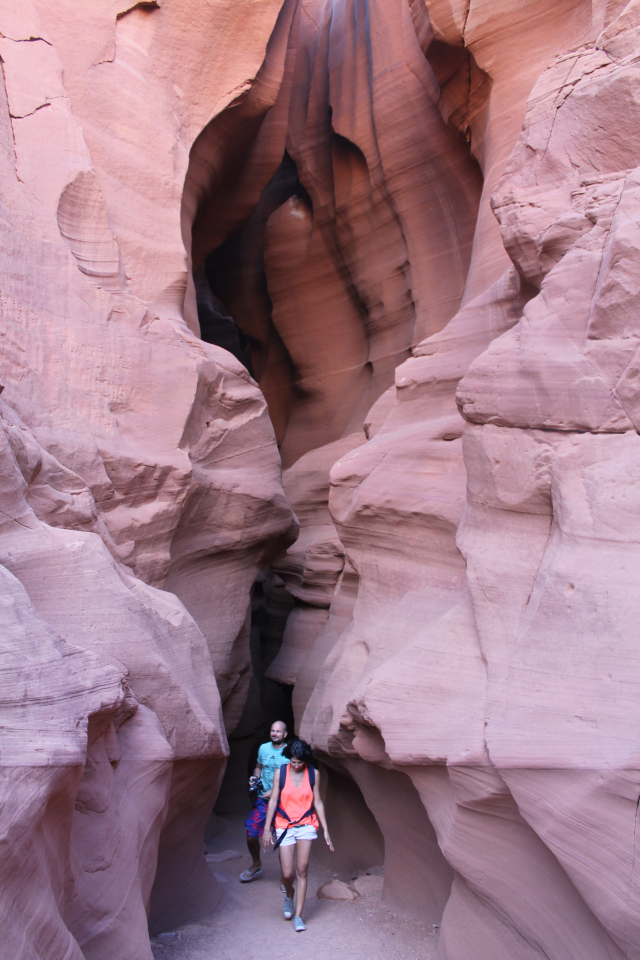
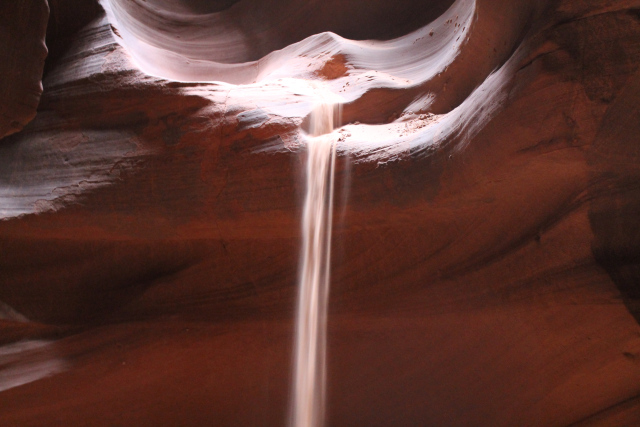
Antelope Canyon located in Northern Arizona is well known around the world!

Antelope Canyon lies just outside of Page, Arizona.

Just outside of Page, Arizona lies Antelope Canyon. Located on the Navajo Indian Reservation. The Dine (The People as the Navajos call themselves), manage the use of the canyon as a Navajo Nation National Park. Antelope Canyon is broken into two sections, Upper Antelope is known as Tse bighanilini which means “The place where water runs through rocks” (aka The Crack), and lower Antelope Canyon is Hasdestwazi or “spiral rock arches” (aka The Corkscrew). Both of these canyons are an awesome display of natural forces at work. Carved by flash floods that are common to the area, this Navajo National Park has been accessible only by Navajo Permits since 1997. The permit system came after 11 tourists from around the world were killed by a flash flood in Lower Antelope Canyon!

For more information on these Canyons go to the following links;

http://navajonationparks.org/

http://en.wikipedia.org/wiki/Antelope_Canyon

Navajo is a Descriptive Language

The Navajo language is very descriptive and their words often describe things that they see in the natural world. Hence the name for Upper Antelope Canyon “The Place Where Water Runs Through Rocks”. The language was one that was used by a few heroic Navajo veterans to help win World War II. For example, a Battleship was translated into the Navajo word Lo-Tso which means “Whale”, while a Cruiser was Lo-Tso-Yazzie which meant “Small Whale”.

See the following link for the dictionary they used;

http://www.history.navy.mil/faqs/faq61-4.htm

The use of Code Talkers was kept secret for many years!

The Code Talkers were kept secret for 23 years after the end of WWII. President Ronald Reagan gave them a Certificate of Recognition and made August 14, 1982, National Code Talkers Day. On December 21, 2000, President Bill Clinton awarded the surviving Code Talkers Congressional Gold Medals and Silver Medals to the approximate 329 surviving heroes.

http://www.navajocodetalkers.org/

Where Water Enters Upper Antelope Canyon.

oooo

The Canyon is 140 feet deep at it’s deepest point!

oooo

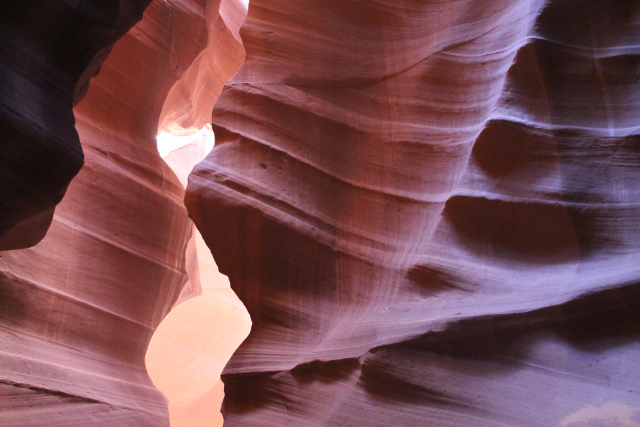
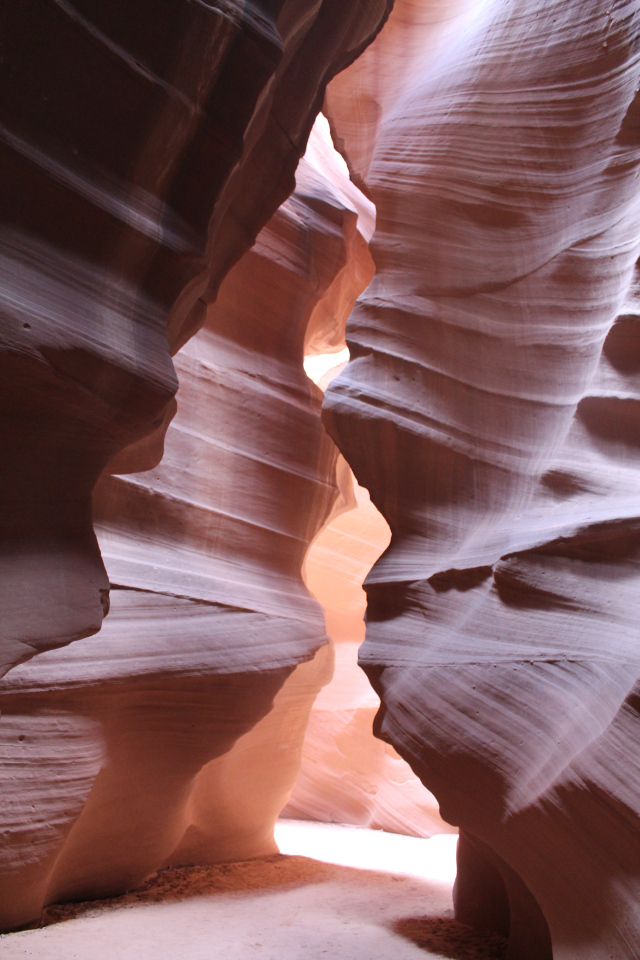
The Sandstone Walls are Cut into Mysterious Shapes.

oooo

The Canyon is so Narrow in places only two people can walk side by side.

oooo

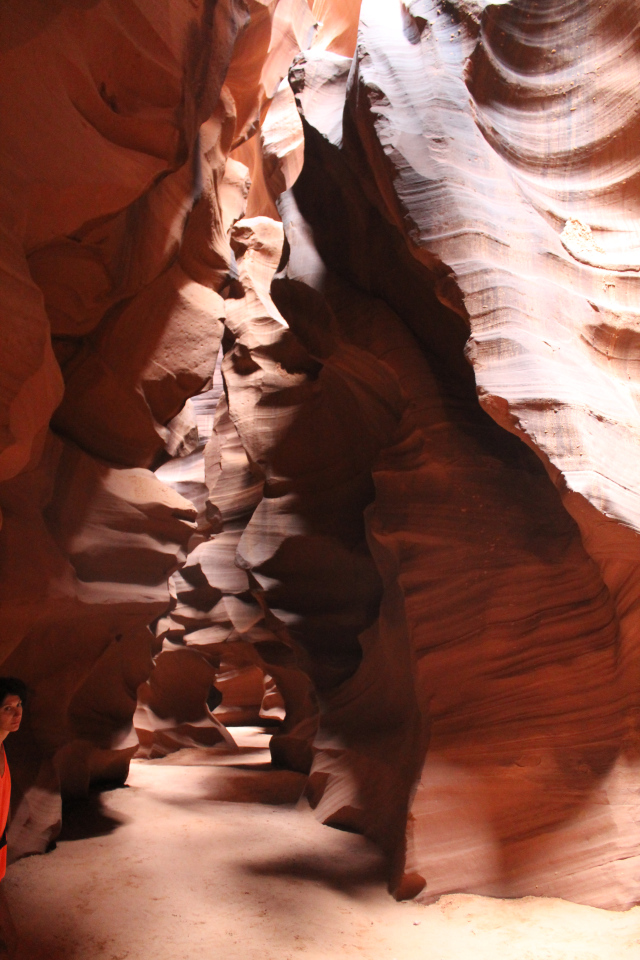
The Heart of the Canyon.

oooo

The Sands of Time.
The Sands of Time.

oooo

Sunlight lights the exit.

ooOOoo

Just a magnificent set of pictures.  If you ever find yourself in Northern Arizona then don’t hesitate to visit the canyon.  The address is: Antelope Canyon, 5975 Hwy 98, Page, AZ 86040.

Thanks Rob!

Human arrogance – a guest post.

A powerful and compelling post from friend and follower: John Hurlburt.

Anyone who can compose phrases such as “an enlightened interest in the quality of the harvest of our transitory lives” deserves to be listened to! Our friend, John, from our Payson, AZ, days, is a regular author of essays that arrive here in Hugo Road via the mail.  It’s always a pleasure to read John’s words and frequently I feel the need to share them with you, dear reader.  So it was with John’s latest.

I’ll say no more except to promise you that you will be enthralled.

ooOOoo

Arrogance ‘R Us

We hear the drumbeat of steadily increasing global, national, state, regional and local problems every day. When common-sense solutions are offered for any of these problems, the solutions are immediately demonized as actions which would aggravate the problems they would logically solve. This sort of nonsensical circular argument is both a paralyzing paradox and a guaranteed death spiral for our relatively young biological species.

We imagine that we know far more than we do. The Earth doesn’t need living species in order to regenerate life. Human beings continue to need the Earth from which we are made and which sustains our consciously aware being. Some of us believe that having money is the answer to all our problems. Actually, the imaginary power of human “money” is killing life on Earth from the bottom of the food chain up.

Every government in the world competes with every other government in the world for power and control to one degree or another. The richer the nation, the greater it’s illusion of power. We’ve forgotten about responsibility, morality and faith in the power of Nature. Change is a constant. Failure to adapt to change is a death knell for living beings.

We live to learn. Why? Is death a finality or a new beginning? Both classic and quantum physics recognize Conservation of Information and the exchange of energy and matter at the level of fundamental forces. How much of the energy of our lives is absorbed by the cosmos and how much is recycled as life energy? We have no earthly idea of the answer.

Aye, there’s the rub.

We do know that everything fits together. Otherwise, we’d be random atoms. We also know that the cosmos does not exist for the pleasure of human beings. To the contrary, if the cosmos were even minimally different, life as we know it would not exist. We are an infinitesimally small part of Reality.

Statistically, we’re not alone as consciously aware life forms in our universe. When we release ourselves from the bondage of our biological limitations, we connect with the living energy of our planet in harmony with the geo-magnetic network of our planet, our living galaxy, and our living universe. We realize that other life on Earth shares conscious awareness in varying degrees.

Don’t believe it? That’s a matter of choice. Consider that denying the facts of reality is a foundation for ignorance. Letting go is a gateway to enlightenment.

Those who do not accept change profess to believe that the immensity of a universe beyond our inclusive comprehension has existed since the beginning of time solely for their personal benefit. Their corporate slogan is “Arrogance ‘R Us”.

More precisely, the statistical probability of human conscious awareness being unique in the universe is so infinitesimal that it would be laughable if it weren’t for our present species peril.

Not only have we amassed enough fire power to turn the earth into a burning sphere overnight, we are now proceeding to systematically and efficiently eliminate the natural resources we need to live.

We can’t eat computers or opinions. Clean air, clean water, clean food and clean energy are more than slogans. They’re essential for human life. Are we a swarm of predatory locusts or are we stewards of the blessings of a life we don’t fully understand?

Money has dissolved the human contract with Nature which began about 14 million years ago on a planet that’s been around in one form or another for roughly the last 14 billion years. Preservation, sustainability and natural efficiency are enemies of our present delusional global economic system. No living species on Earth is safe from the ecocide being committed by human insanity. We’re experiencing a systemic failure and treating it as a side-show.

We’re suffering from a fatally immoral addiction to what we may personally consider to be the good life. It’s time for our conscious awareness to transcend self and species. We need to combine our spiritual awareness, our natural awareness, our moral awareness, our cultural awareness, our social awareness and our common sense for the immediate purpose of preserving, sustaining and accepting the natural efficiency of our pale blue dot in a universally remote solar system.

So, where do we begin? We begin wherever we are. Today is the tomorrow we dreamed of yesterday. What is our vision of tomorrow? Is it an Earth that is unchanging in the midst of constant change? Is it an Earth that is scorched and barren? Perhaps it can become an Earth that continues to grow and nurture our existence.

The choice is made by our daily actions. Time is not currently in our favor. Freedom is not the exclusive privilege of wealth. Freedom is everyone’s responsibility. Poverty is the deadliest form of violence. Seven trillion dollars of worthless derivatives tick like a time-bomb in dank Wall Street sub-basements. Environmental bankruptcy threatens all life on Earth. It’s more than past half-time to face our shared Reality. There’s no place to hide.

We grieve our former lives. We begin with the suppressed anger we have self-generated through fear until it has become a traumatic syndrome. The antidote for fear is faith. What do we believe? What are our values? Are we moral, semi-moral, immoral or amoral? Do we believe we are the purpose of the Cosmos or a relatively young animal living on a garden planet far from the heart of an emerging universe? Is our immediate gratification more important than any long-term purpose?

Global recovery depends upon inclusive personal recovery and the ability to recognize the urgency of our common purpose. Personal and cultural recovery begin by surrendering the illusionary cocoon of “self”. Stepping stones include daily humility, hope, study, acceptance, inventory, amends, sharing and compassionate service. The result is a new lease on life.

We surrender our politics. We learn to think for ourselves. We question authority. We test our ideas and follow the evidence. Science belongs to all of us. We reserve judgment. We realize that our imagination is nothing in comparison to the majesty of the truth of our shared Reality. We become creative rather than destructive.

We build a global resource management system based on the concepts of common well-being, strategic preservation and strategic efficiency. Our objective is to maintain, grow and recycle natural resources utilizing our technology as a constructive tool rather than as a weapon.

The concept of ownership needs to be replaced by the idea of strategic access to what we need as opposed to what we may superficially believe or think we want. We stop competing and start co-operating as the result of an enlightened interest in the quality of the harvest of our transitory lives.

As we live and learn together, we realize that love is as important to life as air, food, water and shelter.

Peace beyond all understanding,

an old lamplighter

ooOOoo

Fabulous essay! Breathtakingly so! Making it clear that there is so much for us humans to learn! Yet offering a clear pathway to that learning. Starting with unconditional love and openness! Now where’s a dog to learn from!

Hazel offering such openness and love in her eyes.
Hazel teaching us openness and love through her eyes.

More down to earth!

Further information on the subject of being grounded.

Just to set the scene, so to speak, last Saturday week I published a post on our reaction to the book called Earthing authored by Ober, Sinatra and Zucker. I said that we had been sufficiently convinced to order the half-sheet kit.  Then on the 23rd., I wrote of our experiences after having spent 5 nights on the earthing sheet.

The half-sheet kit.
The half-sheet kit.

I promised to provide more information today. We have now been sleeping on the earthing sheet for eight nights.  All the positive effects written about on Monday continue and, frankly, strengthen.

The website GoingBarefoot.org has much information, including real-life experiences from customers.  That website suggests it is the work of Martin Zucker, one of the authors of the book.  It also offers this testimonial video:

There is another website Earthing.com that offers much the same information as the GoingBarefoot site.  (Indeed, I just called the Earthing company and they confirmed that there was no difference in service between the two websites.)

One of the items in the kit, as shown in the photograph, was a 74-minute, professionally-made film that was fascinating.  Guess what!  That film is available as a YouTube video.

The film was the product of Kroschel Films and their website is wonderful.  You must go there. These two pictures came from there.

Isis, January 2013 - Photo courtesy Dr.Vic Walker
Isis, January 2013 – Photo courtesy Dr.Vic Walker

oooo

Steve Kroschel spends some quality time with Lennox the Lynx, Nov.3, 2013

Then a web search brought to light a company with the name of Mercola.  Their website has a page with earthing products even including, towards the end of the webpage, instructions on making your own earthing mat.  The following video comes from that website.

So I do hope this is of interest and, please, if you have any thoughts or experiences, do please offer them as comments to the post.

(Oh, I guess I should mention that I am not affiliated with any of these companies and stand to gain no advantage if you choose to purchase a product mentioned on Learning from Dogs. Please verify for yourself the potential advantages in using any earthing product.)

How to close?

This seems as good a way as any.

Standing Bear.
Standing Bear.

There is a road in the hearts of all of us, hidden and seldom traveled, which leads to an unknown, secret place.

The old people came literally to love the soil, and they sat or reclined on the ground with a feeling of being close to a mothering power. Their teepees were built upon the earth and their altars were made of earth. The soul was soothing, strengthening, cleansing, and healing.

That is why the old Indian still sits upon the earth instead of propping himself up and away from its life giving forces. For him, to sit or lie upon the ground is to be able to think more deeply and to feel more keenly.

He can see more clearly into the mysteries of life and come closer in kinship to other lives about him.

Helping a pair of young birds.

Hoping that this story of rescuing some young birds may be of help to others.

Last Saturday afternoon we were sitting outside under the shade with the ‘kitchen’ group of dogs enjoying themselves.

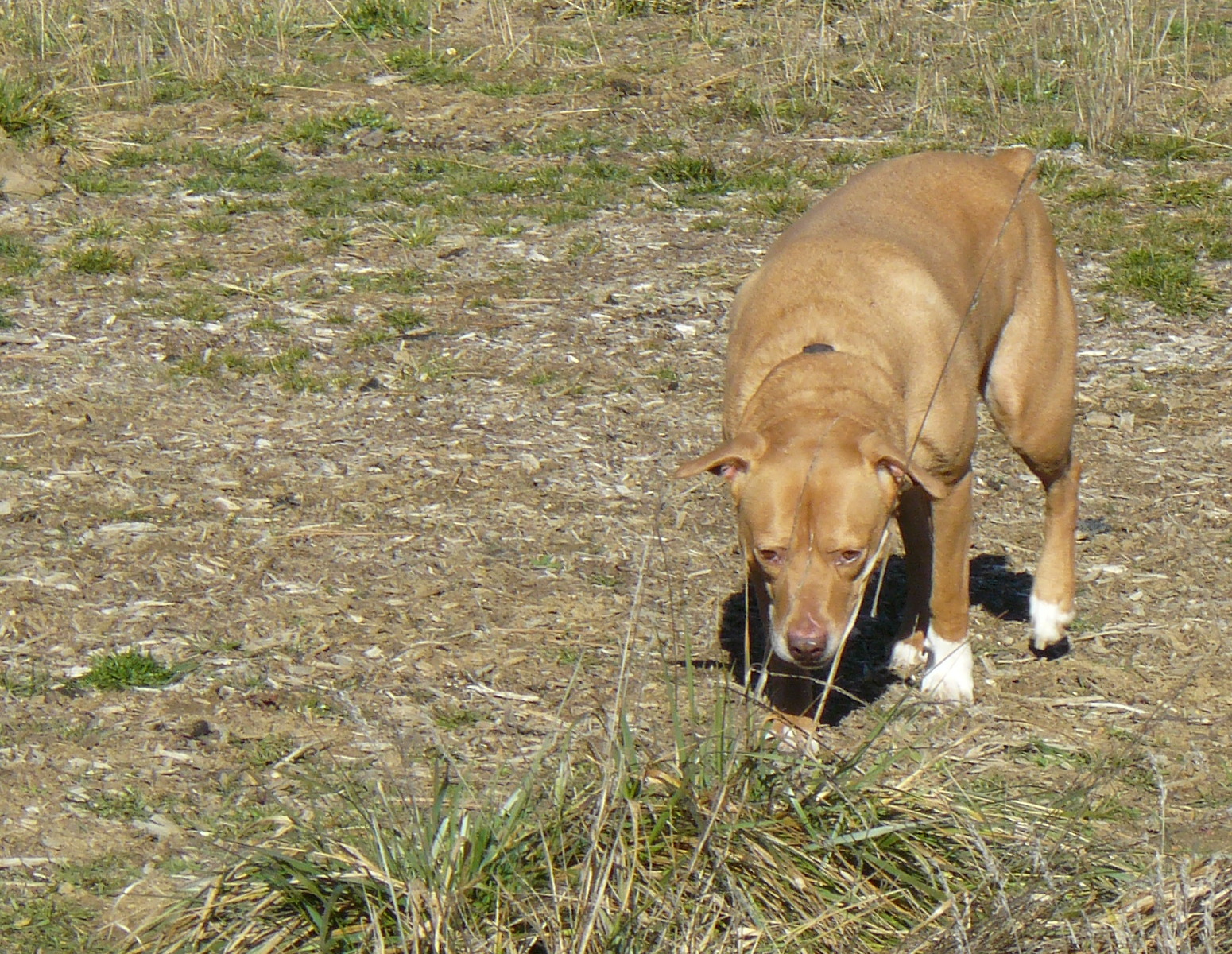
Jean and I noticed Casey taking a great interest in something on the ground.  Casey is a keen explorer as this photograph from earlier in the year demonstrates.

Casey demonstrating a dog's focussing skills!
Casey demonstrating a dog’s focussing skills!

The something that had caught Casey’s attention was a small baby bird that had fallen from a nearby nest.  We called Casey away and went across to see the tiny creature whereupon Jean picked up the baby bird.

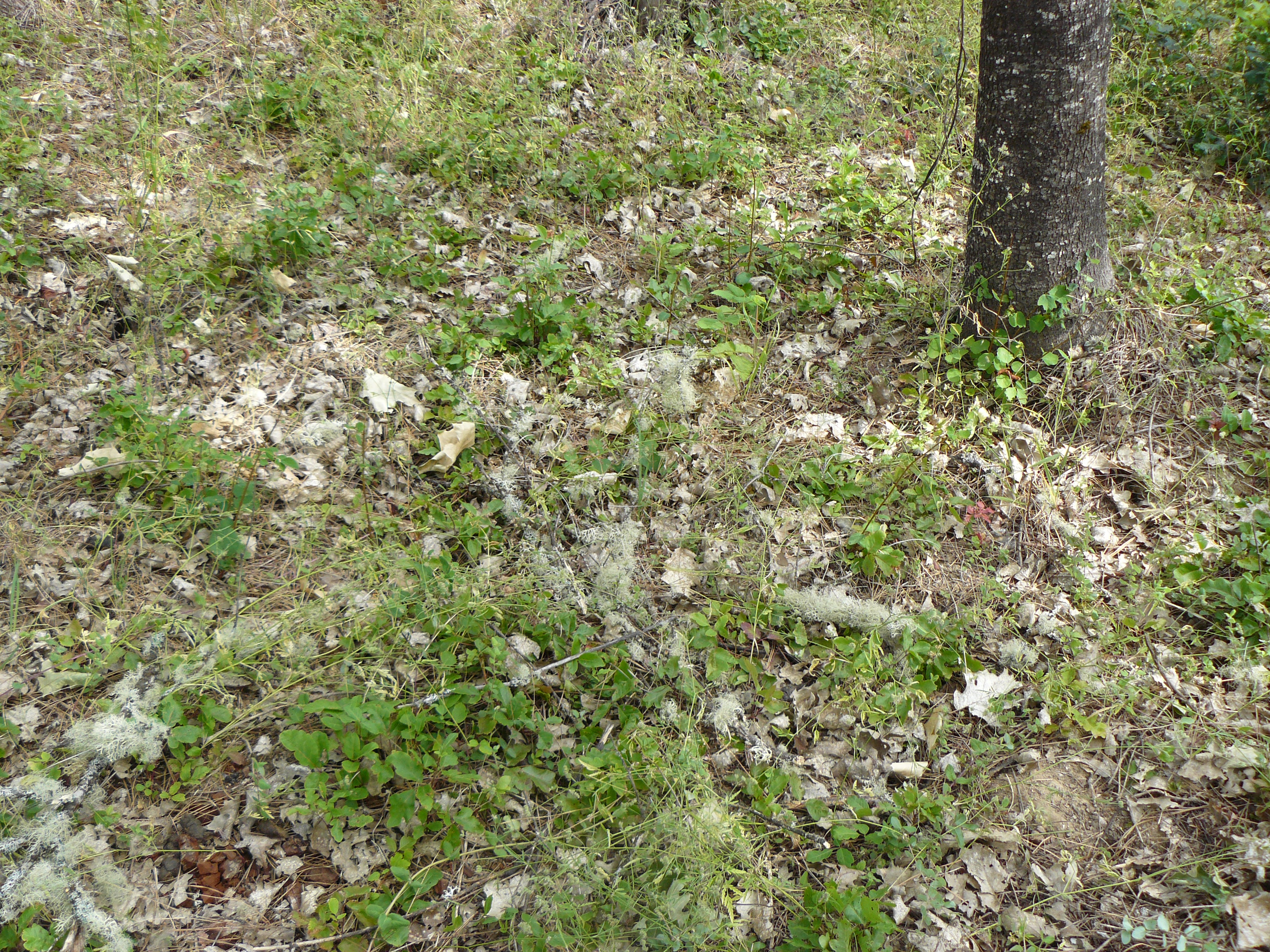
The patch of ground where the birds were found.

Frankly, we didn’t have a clue as to what to do but called Wildlife Images, just a few miles away from where we live.  As the Wildlife Images website explains:

Our guiding principles are the foundation for “why” we do what we do. These principles guide us in our work, our relationships with each other, our guests, supporters, sponsors, and vendors.

PURPOSE
Saving Wildlife

VISION
Wildlife Images Rehabilitation and Education Center is the educational leader of a healthy co-existence with our wildlife neighbors by rehabilitation sick, injured, and orphaned animals.

MISSION
Involve – people to share in our vision.
Educate – children and adults about the personal benefits of taking care of wildlife entrusted to our care.
Inspire – the public to engage in our rehabilitation and education efforts.

Jean and I had previously visited the centre and been impressed with their dedication to saving wildlife.

Over the phone we were told that the best thing to do was try and find the old nest and replace the baby bird within the nest.  If all else failed then bring the bird across to Wildlife Images.

Frankly, we struggled to find the nest but at least got a ladder up against the likely tree from where the bird had fallen.

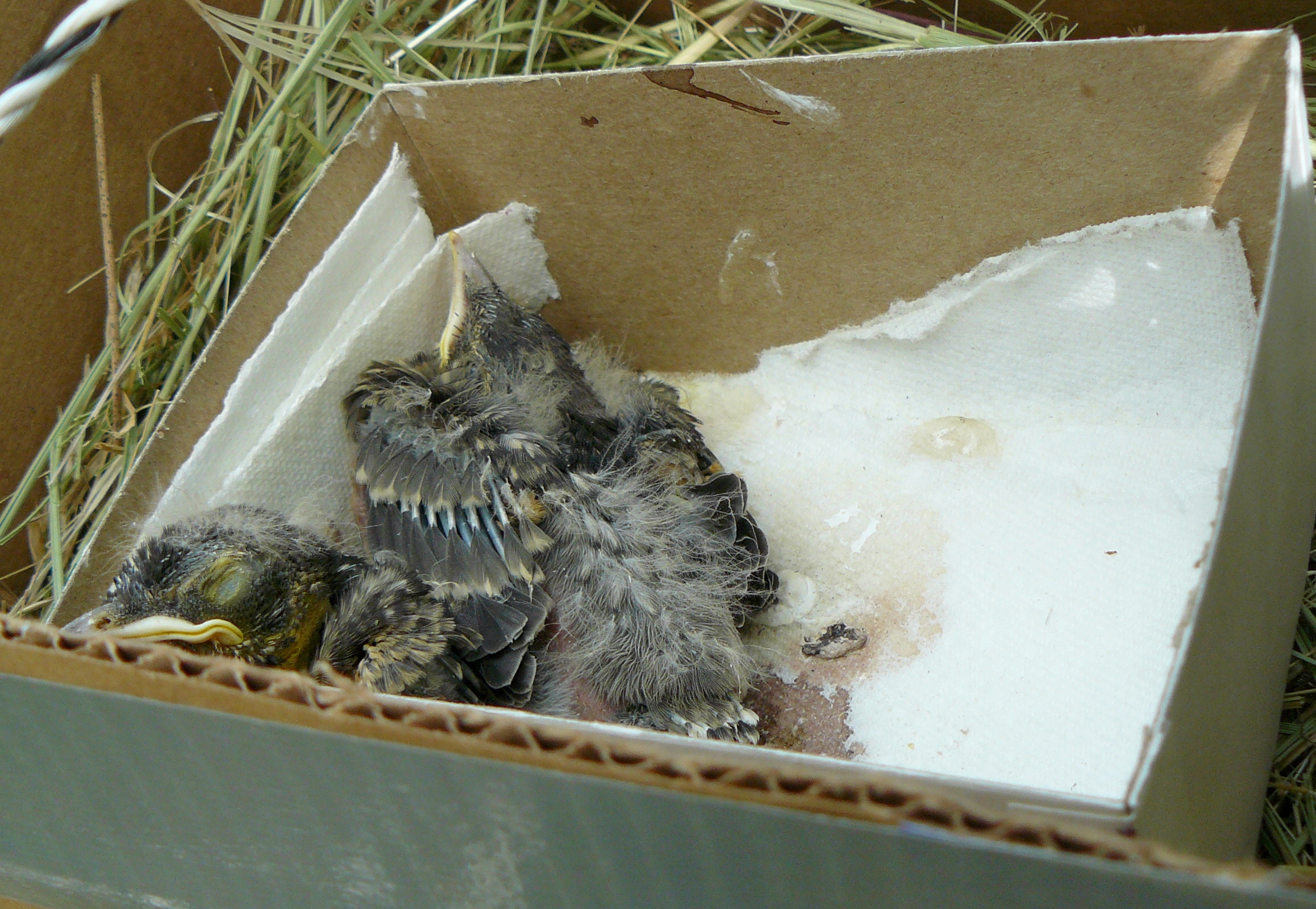
It was as we were getting the ladder in place that we discovered another tiny bird on the ground in amongst the dead leaves and ground cover.  Now we had two birds and knew we were struggling to do the right thing for these vulnerable creatures.

We drove across to Wildlife Images and they advised us to build an artificial nest and hang that up in the tree.  The call of the baby birds would attract the mother and, with a bit of luck, the mother would return to feeding the chicks again.  We were also told to speak quietly around the baby birds so that they wouldn’t imprint on our voice.  Apparently that was the greater risk of them being rejected rather than the smell of humans on their little bodies.

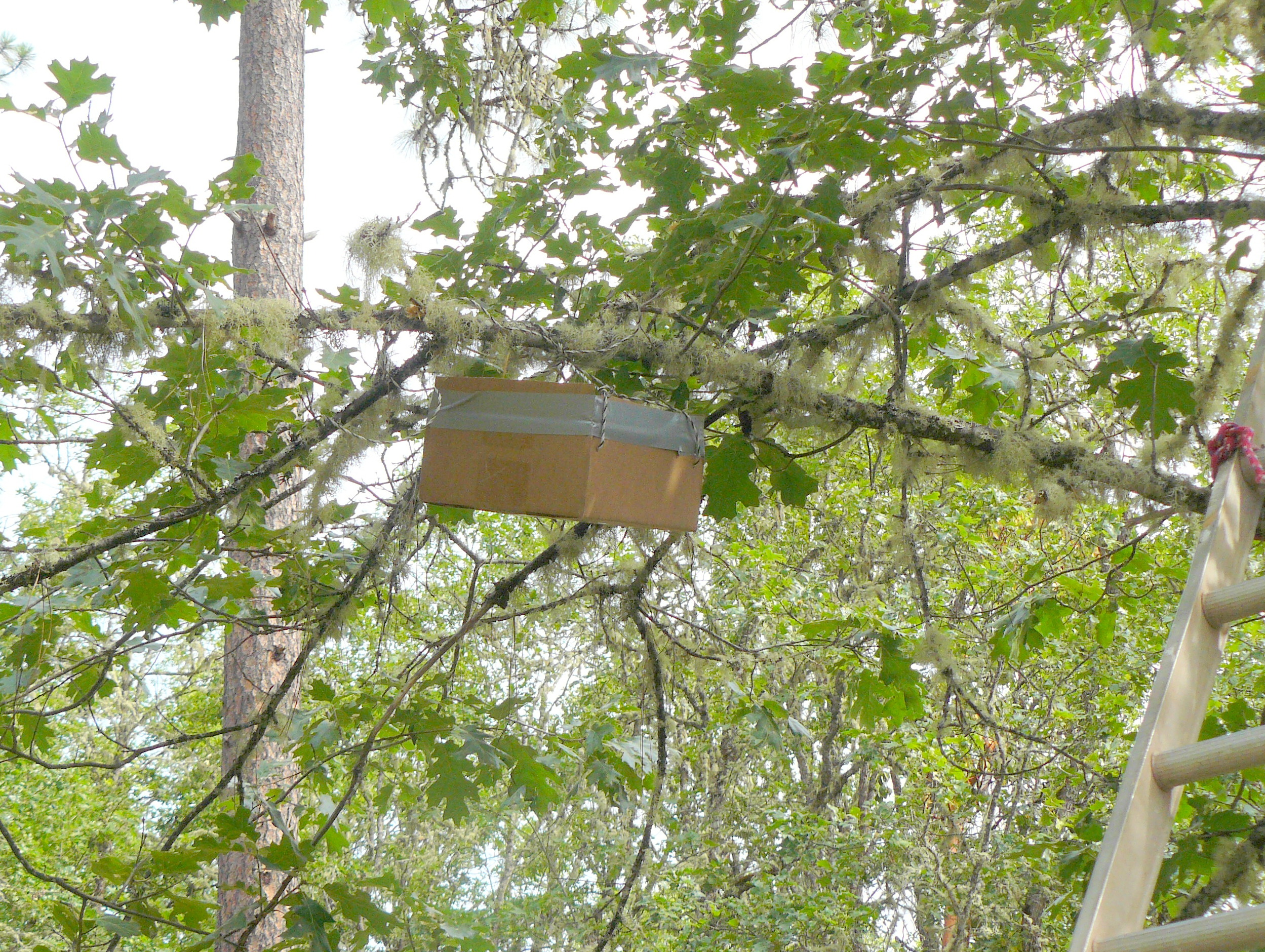
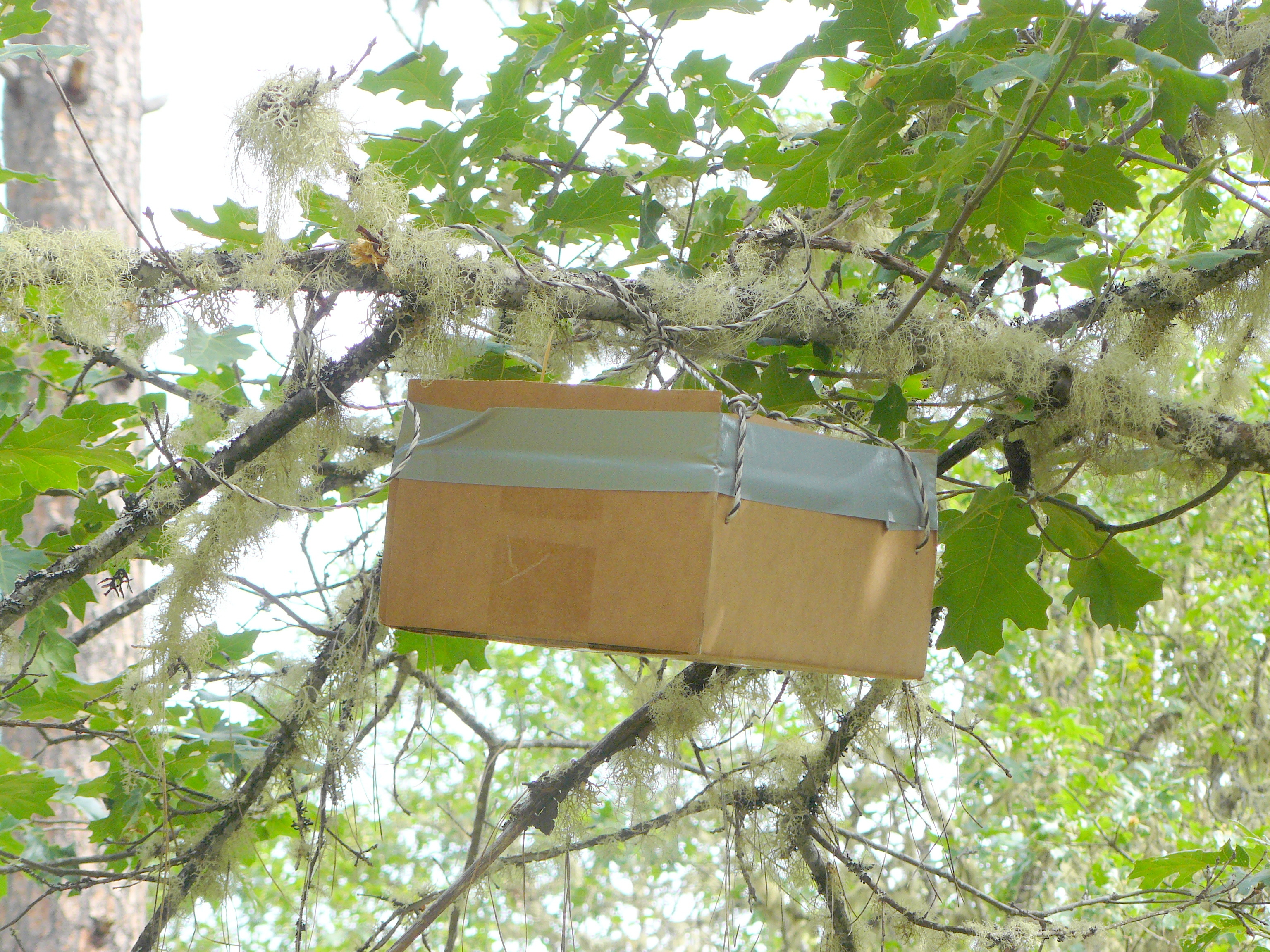
So back home we went and soon had a makeshift ‘nest’ in place.

Would it work?
Would it work?

Once the ‘nest box’ was in place, it was time to place the youngsters in their new home.

Good luck, my little things.

We left the birds in peace and went inside for a while.  Our fear was that they might try leaping out.

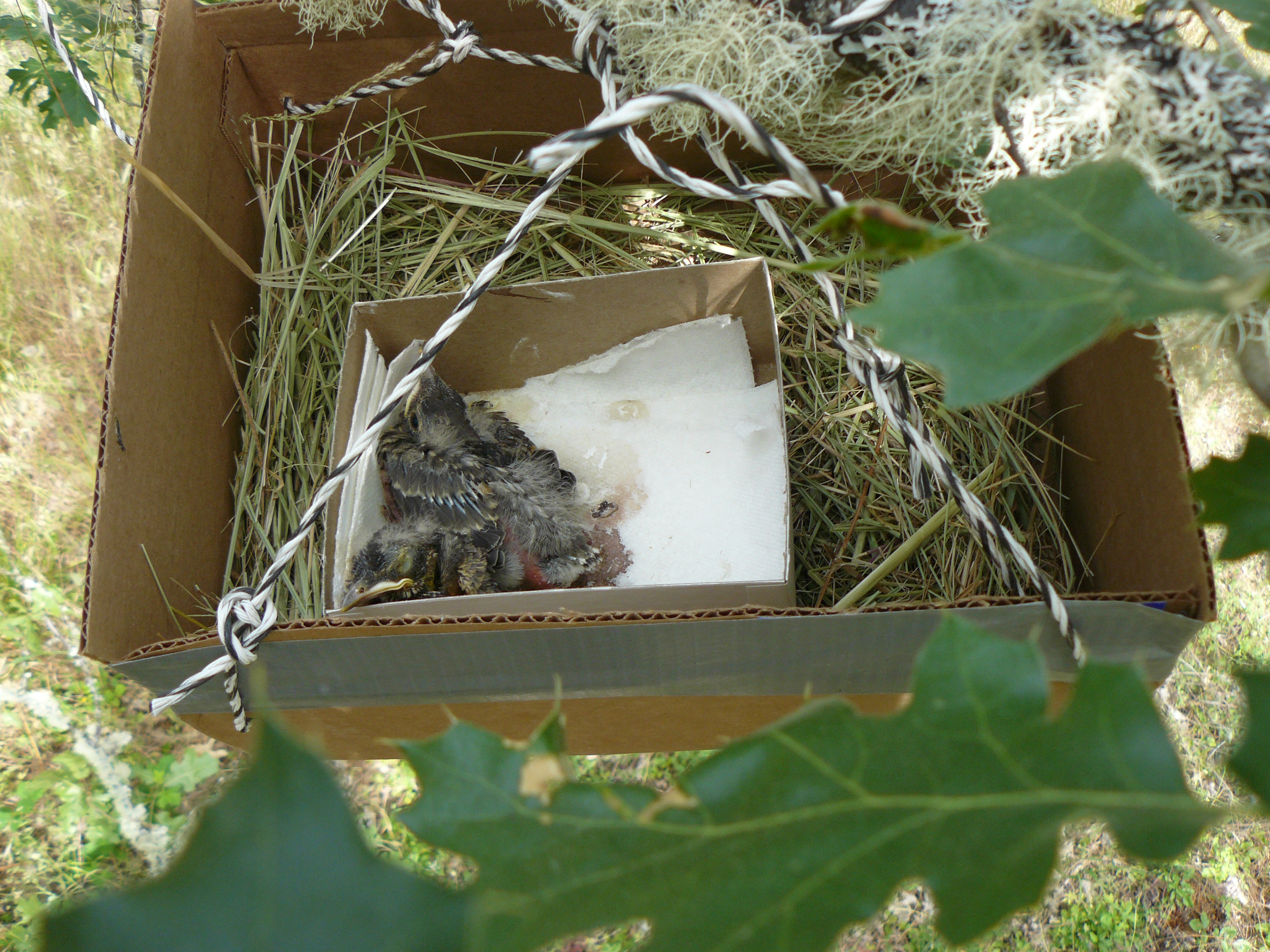
Then curiosity got the better of us and we needed to see if they were still alright.  So a couple of hours later, I took the following photograph.

Against all odds!
Against all odds!

The evening approached and we feared for their fate.

Then miracle of miracles we saw the mother come to them and start feeding her offspring.

We retired for the day content that we had done all we could.

Then on Sunday morning, bright and early, we went outside again.  Had they survived the night?  Had the mother returned to feed them this second day?

We heard nothing: saw nothing. Feared the worst.

It was no good, I had to climb the ladder and take a peek.

Still alive!
Still alive!

They were still in the land of the living!

Yet, there was still no sign of the mother.

Jean and I sat under our nearby gazebo and tried hard not to fear the worst.  My camera was on my lap.

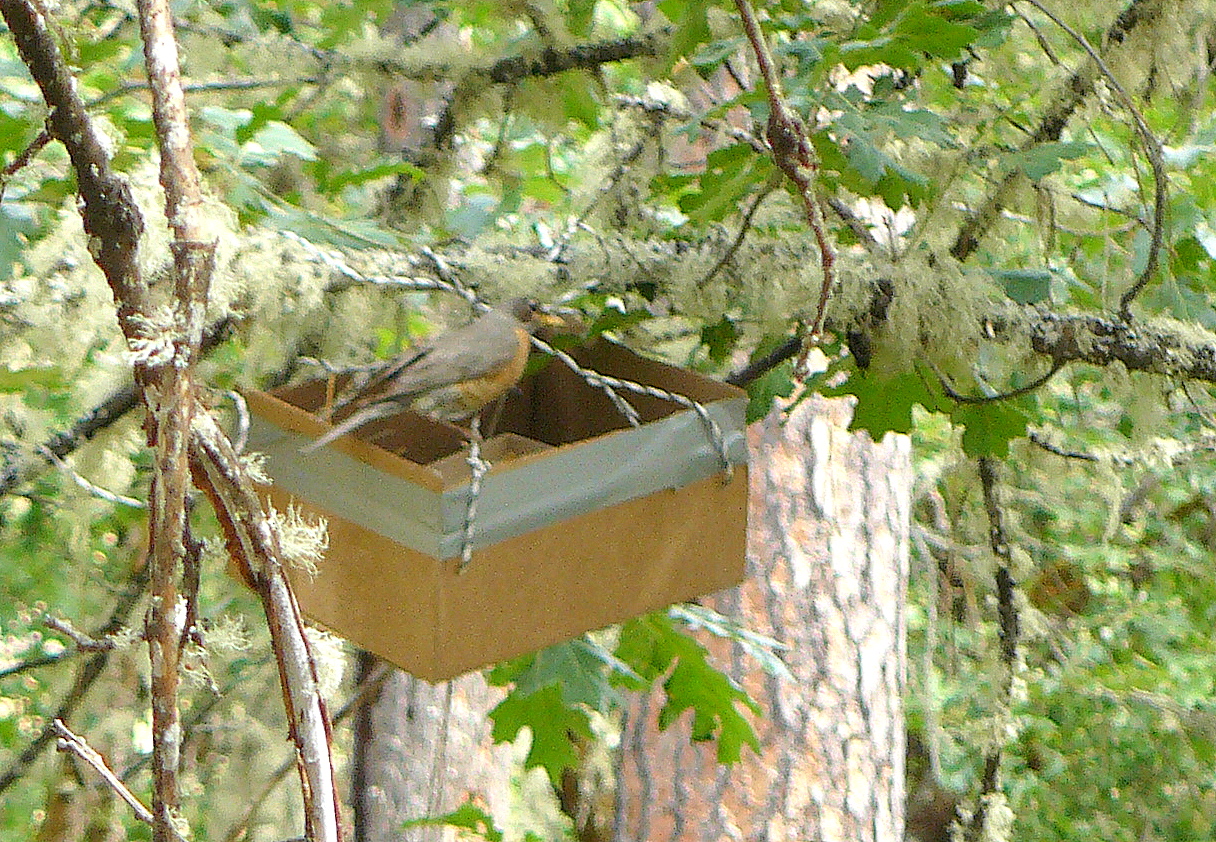
Then Jean saw a flash of feathers.  It was the mother arriving to feed her young.

I was able to take the following picture.

Not the best quality picture but so what!  It's proof the birds are being cared for by their mother.
Not the best quality picture but so what! It’s proof the birds are being cared for by their mother.

In the scheme of things, rescuing a couple of small birds doesn’t add up to much.  But I’ll tell you! When Jean and I saw the mother feeding her young both of us were a little wet around the eyes!

Our Earthing experiences.

This is really starting to open our eyes!

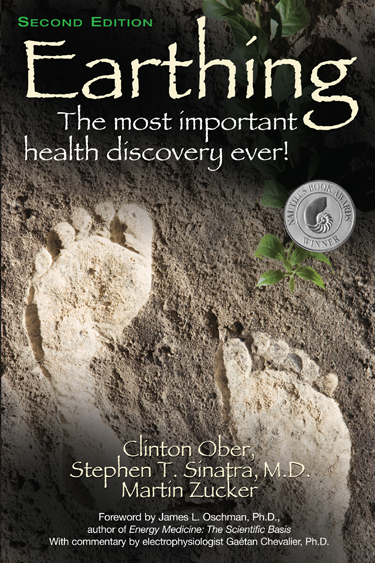
On Saturday, the 14th June, I published a post Are you grounded?  That post was a reaction to this book that Jean and I had recently read.

english2ndbkcover
I also explained that we had ordered an earthing sheet for the bed and that I would report further upon our findings.

Today’s post is that further report.

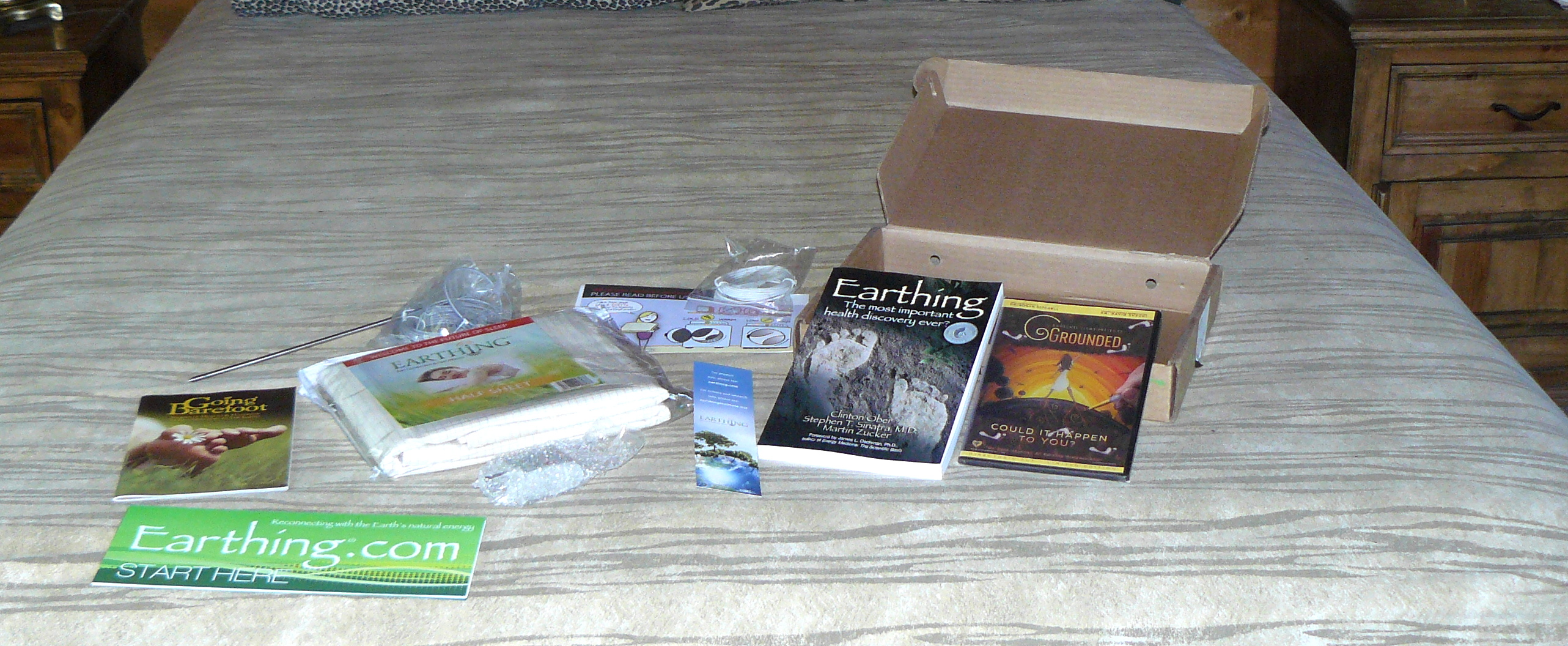
The slim box containing the half-sheet kit was delivered on the 18th June, five days ago at the time of writing this.

P1140851

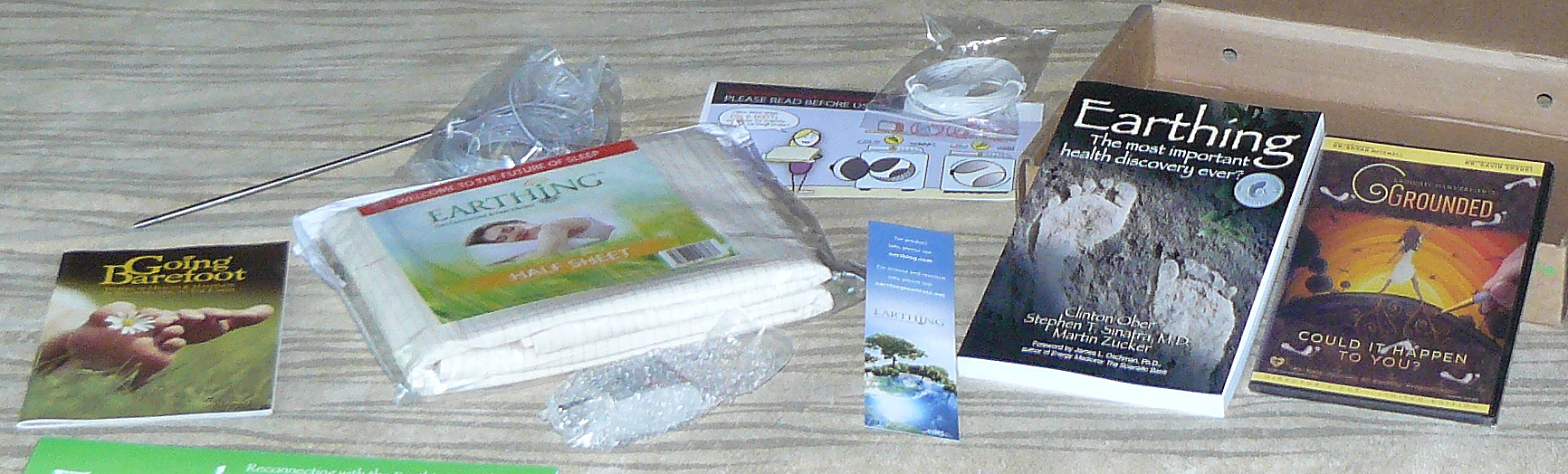
The next photograph shows more clearly what was included in the kit.

P1140853

From left to right: Case histories from users, an earthing rod above, the earthing half-sheet, and below the sheet, an outlet ground checker, the earthing connection cord, the book, and a full-length DVD of a film on the subject of grounding.

It was then a case of laying the sheet on the bed as recommended in the instruction guide.

P1140854

Then upon testing that we had a safe earthing connection via the ground pin on our nearby outlet, it was a case of connecting the earthing sheet to ground, as may be observed in the next photograph.

P1140855

I’m writing this yesterday.  We have both slept on the earthing sheet for four nights now.

So what are the results so far?

Jean

Jean has had leg muscle cramps each night for months and months.  Often just enough to waken her but frequently sufficiently severe to require her getting out of bed and walking around the room.  I can vouch for the latter!

Jean has had those four nights totally free from cramps!

Plus Jean has reported sleeping more soundly.

Me – Prostate

In recent months my bladder has been showing ‘old man’s bladder control’!  Certainly, over the last year I have been getting up for a pee two times, frequently three times, during the night.

During the day, I could hardly take a hot drink without the need to pee within minutes.  It had got to the stage where I would avoid having a drink before Jean and I went out unless I was certain that there would be public restrooms available.  I was taking a natural prostate medicine, morning and evening, but still starting to think that it wouldn’t be long before I would need to see a medical specialist.

Since sleeping on the earthing sheet, I have gone down to getting up just once during the night.  But it’s better than that!

I have stopped the prostate tablets.  During the day, my bladder control is hugely improved.  I hold my breath that this is going to continue.

Me – Memory

Like many of my age (I’m 70 in November), my short-term memory is not what it used to be.  I have not noticed any improvements in this area.

But I am sleeping much more soundly, which is never a bad thing.

But get this!

Being an old Englishman with a sense of connection to the ancient customs of Stonehenge, especially observing the sun’s dawn on the morning of Mid-Summer’s Day, I had looked up the exact local time equivalent of the moment of the Solstice here in Oregon.

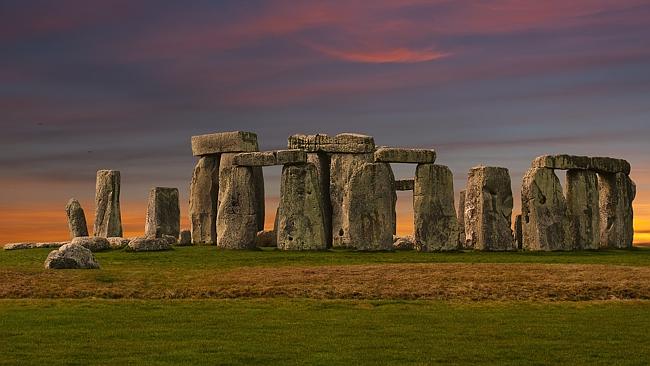
Stonehenge at Dawn.  On the morning of Mid-Summer's Day the sun rises exactly over the heel stone.
Stonehenge at Dawn. On the morning of Mid-Summer’s Day the sun rises exactly over the heel stone.

Early in the hours of the morning of June 21st, ergo Mid-Summer’s Day, I woke unexpectedly.  I lay there wondering what had awoken me.  It wasn’t to jump out of bed and have a pee.  How strange!

I lay there for what felt like ten minutes and then curious as to the hour reached across and pressed the illuminate button on my bedside clock.  It read 3:48 am.

3:48 am!! How could that be! I could hardly believe it!

Let me explain.

The previous afternoon, I had been curious as to the exact time of the 2014 Summer Solstice.  Had looked it up online.  In the United Kingdom that precise moment was 10:41 am.  The equivalent time of the Summer Solstice in Oregon’s local Pacific Daylight Time (PDT) was 3:41 am.

I knew that was when I had woken up.

Now that’s what I call being grounded to the Planet!

OK, that’s enough for today but there is much more information about the whole business of being grounded to the planet. I shall return to the subject in Wednesday’s post.

Way to go!
Way to go!

Neat solution!

First of all a Very Happy Summer Solstice wherever you are (in the Northern Hemisphere!)
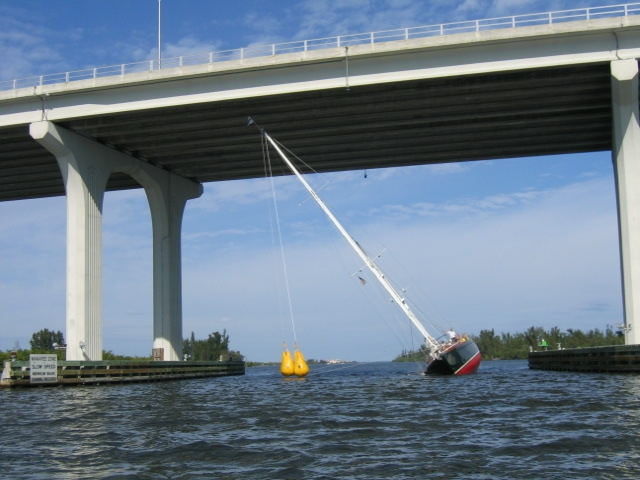
Neighbour Larry sent me a link to a delightful story about solving the problem of a yacht, with a mainmast stretching 85 feet above the water level, passing under a bridge that had a clearance of 65 feet above that same water level.

Here’s a picture to whet your interest. (Notice I wrote ‘whet’ not ‘wet’!)

A case of lateral thinking!

The story was reported in UK’s The Daily Mail newspaper nearly three years ago.  So I shall take a chance and republish it for you.

Beats going the long way round! How sailors got their 80ft mast under 65ft bridge

By DAILY MAIL REPORTER
UPDATED: 11:04 EST, 20 September 2011

It may not look like an entirely safe practice – but it sure beats going the long way round.

These sailors came up with an ingenious way to get their boat – complete with 80ft mast – under a 65ft bridge on the Intracoastal Waterway. A video posted on YouTube shows how the sailors keeled the boat over by dangling containers filled with two tons of water from the mast.

But it is not a solution for the faint hearted.

Any miscalculation with the weight has the potential to send the whole boat crashing into the water.

The sailor ‘hunterparrot’ who posted the video said he initiates the roll by fixing the containers to the mast and slowly turning to port. The severity of the roll is then controlled by letting the ropes affixed to the mast out gradually with a cockpit winch.

The intracoastal waterway is a 3000-mile network of waterways that run up the Gulf and Atlantic coasts of the U.S. It runs from New Jersey, around Florida to Texas.

Follow us: @MailOnline on Twitter | DailyMail on Facebook

The photographs in that Daily Mail article may be viewed here.

Then across on the forums of the Wooden Boat Magazine was this:

Really? If the bridge clearance is 65 feet and the mast height is 80 feet, then the cosine of the heel angle would be 65 / 80. This corresponds to a heel angle of about 36 degrees; the mast is 54 degrees above the horizontal. Still, a pretty impressive maneuver.

If the bags are full of water, then his setup is self-limiting. As the bags start to immerse, the pull on the halyard is reduced. This means he would be nearly unable to capsize unless he winches the bags WAY too high. I think he has done this trick before.

I think the reason he is sitting on the high side is twofold: He can see the masthead more easily and it is more comfortable

The weight of one person really doesn’t make much difference when you are trying to heel that big a boat that far.

If someone had to do this sort of trick a lot, would it be worth putting a small video camera on the top of the mainmast? This would make it easier to judge clearance.

God bless!
Wayne

The link to that forum discussion  is here.

Finally, watch the video!

You all have a wonderful Mid-Summer’s Day and …. duck your head when passing under that low bridge! 😉

Picture parade forty-eight.

Concluding set of nanosecond pictures!

Courtesy of John H.

nano9

oooo

nano10

oooo

nano11

oooo

nano12

oooo

nano13

oooo

nano14

oooo

nano15

oooo

nano16

oooo

Incredible!

You all have a good week.

Are you grounded?

Or just away with the fairies!

Sorry, just kidding: Couldn’t resist!

I have just finished reading a book with the title of Earthing.

english2ndbkcover

It has been an absolutely fascinating read and one, I’m bound to say, that seems entirely plausible.

That is that our modern lifestyle that has us disconnected from Mother Earth for much of our time is the cause of many ailments. As the associated website explains:

CONNECT TO THE EARTH AND FEEL BETTER!

Just as the sun gives us warmth and vitamin D, the Earth underfoot gives us food and water, a surface to walk, sit, stand, play, and build on, and something you never, ever thought about—an eternal, natural, and gentle energy. Think of it perhaps as vitamin G: G for ground. What does that mean to you? Maybe the difference between feeling good and not so good, of having little or a lot of energy, or sleeping well or not so well.

You can’t see the Earth’s energy but some people can feel it as a warm, tingling, and pleasant sensation when they are out walking barefoot along the water’s edge at the beach or on a stretch of dew-moistened grass.

Throughout history humans walked barefoot and slept on the ground. But modern lifestyle, including the widespread use of insulative rubber, or plastic-soled shoes, has disconnected us from the Earth’s energy and, of course, we no longer sleep on the ground. Fascinating new research has raised the possibility that this disconnect may actually contribute to chronic pain, fatigue, and poor sleep that plague so many people.

The remedy for the disconnect is simple. Walk barefoot outdoors whenever possible and/or sleep, work, or relax indoors in contact with conductive sheets or mats that transfer the energy to your body. People who do so on a regular basis say they sleep better, feel better, and have more energy during the day. This simple practice is called Earthing, also known as grounding, and it is both a technology and a movement which is transforming lives across the planet.

Were you aware, for example, that the sole of our foot has more nerve endings per square inch than any other part of our body! And more sweat glands! All from thousands of years of being connected to the Earth.

Curious?

Then watch Part One of a conference video by Dr. Stephen Sinatra, one of the authors of the book:

(The remaining parts of Dr. Sinatra’s talk will be presented in a post on Monday!)

Jean and I have just ordered the half-sheet and I shall be delighted to write more of our experiences over the coming weeks.

And I don’t need to remind you that dogs have been in bare-foot contact with Planet Earth for some time now!

Stay healthy!