The reason I am choosing to write about Ellesmere Island is because of a recent BBC film: Snow Wolf Family and Me.
This video offers a great insight into the film:
Published on Dec 29, 2014
A new BBC film, Snow Wolf Family and Me, explores the lives and habits of arctic wolves, revealing the family secrets of one of our most feared predators. Ellesmere Island is one of the most remote and beautiful places on Earth. This is the only place in the world where wolves are naive to man and have no fear. It allowed wildlife cameraman Gordon Buchanan and scientists an unparalleled opportunity to form bonds with a wild wolf family, revealing the remarkable story of their relationships and behaviour.
Here series producer Ted Oakes talks about some of the highlights and challenges of being accepted by a wild wolf pack.
Snow Wolf Family and Me will be broadcast on 29th and 30th December 2014 at 21:00 on BBC Two.
Music by Jean-Marc Petsas. Photofilm produced by Dualtagh Herr.
Family members back in England who did watch both episodes of the film said it was breath-taking, especially the scenes in the second episode where the wolves were filmed coming right up close to Gordon.
Gordon Buchanan and White wolf.
What captivated me, seeing how quickly the wolves acclimatised to Gordon and his two colleagues, was imagining that this must have been what it was like when, thousands of years ago, wild wolves bonded with early man providing the start of the glorious and beautiful relationship between canines and humans. A wonderful relationship experienced by millions of us around the world today.
The next short video illustrates that the ancient lineage, from wolf to dog, still resonates between both species.
Ellesmere Island Expedition 2008 – Howling Good Time
Bronwen is a UKCP-accredited psychotherapist with nine years experience and a practice in Cambridge, Suffolk and Hungary. She is trained in the Karuna Institute in Devon in core process psychotherapy, which was the first mindfulness-based therapy in the UK. She adds to this her unique understanding of western and eastern spiritual traditions, combined with findings in new science – to find ways of helping individuals align with their true destiny. She runs retreats and workshops and group work at different times of the year.
I was vaguely aware of the name. Perhaps unsurprisingly as I was familiar with the work of the Karuna Institute at their beautiful location at Widecombe-in-the-Moor, Dartmoor, Devon, some eighteen miles from where I used to live in Harberton, Devon.
Widecombe-in-the-Moor
Anyway, back to the theme of today’s post. Back to Jon Lavin’s email with the link. This is how that essay from Dr. Rees opened:
by Bronwen Rees on January 1, 2015
In the face of the on-going and now undeniable social, economic, environmental and political crises, there are plenty of seeds of ‘emergence’ that point to a new way forward. These are flowering in the area of sustainability, spirituality, and the reworking of ancient systems of wisdom. They point to a new way of being and relating where, it is implied, one can manifest at will one’s desires.
Whilst there is a distinct truth in much of this, and many examples where this can obviously work (vis the outpouring of new technological companies providing ever more zany products), they are very early developments fostering to individual satisfaction rather than being consciously channeled into the benefits of the collective. The scale of change in terms of consciousness has largely not yet been realized. One of the main reasons for this is the as yet imbalance in the relationship between the collective and the individual, and the lack of a conscious ethical foundation.
I sort of understood the central message but the words were getting in the way. Take this later paragraph, for instance:
Humanity is at a bifurcation point – a point of irreversible change – where conscious choice determines the future that is created. Neo-Darwinian theorists would argue that this is merely a point of survival, and given the current scientific data about the material conditions – peak oil, energy, economic chaos, severe mental health issues, the conditions would suggest that we are as a species heading for disaster. Balanced between over-population and yet greater and greater individualization with more and more apparent choice – how can the two perspectives be reconciled on this seemingly increasingly small planet?
Indeed, my email reply to Jon, having struggled through the full essay said: “Good day to you, Jon, Yes, what a fascinating essay albeit written in a manner that makes it a very tough read! Nevertheless, I have no doubt that the good Dr. is spot on in her analysis.”
The very next item opened in my email inbox was notification of a new post from Sue Dreamwalker: My Dream ∼ Translated I just had to share. Let me, in turn, share Sue’s post with you; with her kind permission, I should add.
ooOOoo
My Dream ∼ Translated I just had to share
“Don’t only practice your art, but force your way into its secrets, for it and knowledge can raise men to the divine.” ― Ludwig van Beethoven
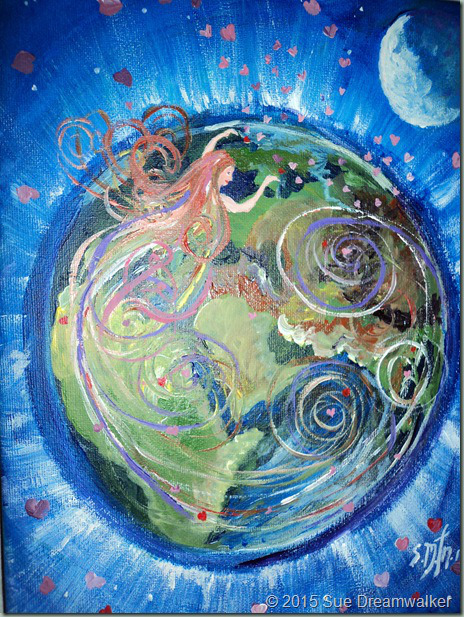
On Jan 3rd I had a Dream.. Please click on the music video below so you can get a sense of some of my experience.. .. Sunday I tried to capture some of the images I had in the dream… So I painted.. But I saw Oh so so much more………
In the beginning of the dream.. She was Me.. As I began to sing.. but then I became the observer.. This has to be the best Dream experience ever… .. So I had to share.. I heard the Music… Music like I have never heard upon this earth… the video music is about as close as I can get to that feeling of being exalted to a higher place.. I am still so excited I cannot tell you the Love I felt within this experience.. If this is the beginning of 2015.. Whoooooh… Let it roll……..
My Dream..
“She stood in a gown that was a rich golden brown. Its fabric shimmered catching the light that reflected from the crystals of natural quartz that sprang up around her. The gown was long and flowing not only did it reach the floor, but it spiralled out around her in a never ending dance as it became one with the sphere of the Earth.
Sue’s painting.
She took a deep breath; here she stood in the centre of the globe called Gaia.
Her hair was so long the wind picked it up to billow out behind her in long tresses. Birds flew in and amongst her strands of hair, Insects and butterflies danced within making it their home.
With breath still poised, she raised her arms like a conductor of an orchestra. She expanded her lungs and she began to Sing…. Her Soprano voice was pure. The moment her voice vibration raised higher the spiral of her gown buried deeper into the Earth. The Grass became part of her gown. Trees sprang forth from the folds of it swaying to her melody of love; Flowers opened their blooms, each petal giving separate notes in a wonderful exotic dance of harmonic ripples.. Love notes rippled like the keys of the piano. The buds on the trees open their leaves their notes sounded deeper like a million cello’s. Birds sang their flute like songs and the butterflies wings danced lighter than bell chimes.
Water trickled into streams, clear and sparking like the strings of the violin.. They swelled in a crescendo in waves that beat the rocks crashing in like kettle drums smashing like symbols into glistening spray..
The Whales joined in her song a mournful lament, while deep in the jungle the elephants gave a low rumble to acknowledge they had heard.. The roar of the Big Cats were heard above the cries of the orangutan’s
As the Thunderous machines of man cut swaths leaving deep scars that screeched like vultures circling over head, to give way to silence………. as they circled over the corpses of everything left dying in its wake..
She paused……………. ready to continue…….. Her arms raised high above her head, she Sang.. her voice becoming a crescendo with the Earth, her breath became the Spiral.. Her Hair became the Wind.. The notes she sang sprang forth from her mouth forming hearts and stars.. Every living creature now joined in her song…
She knew her Song of love was being joined by so many more.. She was ONE with ALL.. She was part of our Earth Mother..”
~~~~
I hope you enjoyed reading about this Dream and I hope you enjoyed listening to the wonderful music of the PianoGuys
See you all very soon…
~Sue~
ooOOoo
In a very strange way, I read the same messages from Dr. Rees and from Sue but presented in such opposite ways: one way so complex and one way to clear. So strongly reinforced by their respective closing words. Here’s Dr. Rees:
Whilst there is real potential for the expansion of consciousness, this does not by any means suggest that this will arise without individual effort and struggle. All the enlightened masters of the past needed to move through this gateway – the difference between then and now is that the conditions are far riper for more individuals to undergo this – and indeed can be seen as a biological necessity for the survival of the human species. Thus as individuals, we cannot avoid this, but what we can do, and indeed as a biological and spiritual imperative, we can support one another and help organize ourselves in dedication of this purpose, in a mutual recognition of each individual uniqueness yet shared destiny.
Here are Sue’s closing words: “She knew her Song of love was being joined by so many more.. She was ONE with ALL.. She was part of our Earth Mother..”
However, there is one uniting theme I read from both of them: Hope!
A reflection of the future year; this last day of 2014
I struggled for some time, wondering what to write for this day: December 31st, 2014. Part of me wanted to be light and cheerful. Yet, nothing came to mind in terms of what to write that wouldn’t be pointless or inane. Then dear Colin who writes the blog Wibble – just another glitch in the matrix posted yesterday: Are we ready for 2015? Here’s that post:
Are we ready for 2015?
I’m not sorry for sounding somewhat melodramatic, here: what we face is nothing less than the archetypical existential threat. You may well
Graph (hand-drawn in 2008) showing that carbon emissions must peak by 2015 to keep global warming to the internationally agreed upper limit of 2°C (the point beyond which we risk runaway climate change).
dismiss me as ‘alarmist’: but if you were in a crowded theatre and you were to hear me shout “FIRE!” — what would you do then?
When, in late 2009, I first saw The Age of Stupid, I was struck by one scene in which ‘a man in a shed’ stated, quite categorically, that humanity’s carbon emissions had to peak by around 2015 in order for us to avoid the risks of passing beyond 2°C above the average pre-industrial global temperature. Almost everyone agrees that two degrees centigrade of warming is the threshold beyond which we will face serious risk of uncontrollable planet-wide climate change effects of potentially catastrophic proportions. And I do mean ‘civilisation-ending’.
This is not histrionics; it’s based upon very solid science. The ‘man in the shed’ is Mark Lynas, author of ‘Six Degrees: Our Future on a Hotter Planet,’ which won the Royal Society’s science book of the year award in 2008. In the short video clip below he speaks from that same year, and his message is blunt: he says we have “seven years” to stabilise global carbon emissions to avoid the risk of climate change accelerating beyond our ability to control it.
The problem is that 2008 + 7 = 2015. Those seven years are up: we’ve squandered them.
Now, I don’t know if you’ve been paying attention — perhaps you’re more focused upon the fortunes of your favourite football team, or the latest antics on ‘Strictly’ or Eastenders; maybe your mind is firmly on your house or job move, or where your children are going to school next year, or any one of the myriad of (relative) trivia such as the ‘immigrant problem’, or the ‘war on terror’ — so in case you’re not familiar with the current situation:
Global carbon emissions are not slowing towards a peak in this coming year. On the contrary, emissions are soaring beyond anything humans have ever previously managed. I’m talking BIG numbers. Yay, us: we’re beating all records.
So… What are your new year resolutions?
On reading the blog post I found myself leaving a comment that seemed to encapsulate my inner fears, explaining why I was struggling to find a light and cheerful tone for today’s post. Here is that comment that I left for Colin:
I hesitate to offer a view. Not because I don’t agree with your article, agree totally, but because I’m afraid that I can’t offer any original thoughts. There is a growing awareness of the need to change, even some quasi-political ambitions that the world ‘needs to talk about climate change’, but no sign that we are anywhere close to a global response of emergency proportions.
Despite being a person with a naturally positive view of life, for reasons I can’t articulate, I have a profound sense of gloom about the New Year. Maybe a result of recently becoming aware of my own mortality. Maybe, an unspoken fear of some huge global catastrophe, natural or otherwise, just around the corner. I hope that I am wrong. Then if I am wrong, it is suggesting that 2015 will be more of the same and, as you so acutely point out, more of the same is the last thing this natural world of ours requires.
So make of that what you will! (And apologies for rambling on a tad!)
Happy New Year to you and all your loved ones.
Then something struck me. It’s no good just giving up and having a moan. Each and every one of us has to find a motivation for changing. Or, if the scale of global change required is just too overwhelming a prospect, then embrace these times as just one of the planet’s natural thresholds; global changes that have been going on for billions of years.
As we come to the end of 2014, it’s natural to reflect on the year that has gone by, as well as to look forward to the new year ahead. This is a time for “kind sight”.
Below are two journalling exercises to explore, now that the rush of the Holidays is over. I like to think of this as a Middle Ground pause. A time for being present, reflecting and allowing your inner wisdom to inspire you for whatever comes next.
Take a few moments to let yourself get settled and comfortable. Start by reflecting with “kind sight” on the past year. “Kind sight” means being kind to yourself, instead of being critical or judging. With “kind sight” we are able to see mistakes as lessons, and life’s challenges as times of resiliency and personal growth.
Ask yourself the following questions and write down your answers:
What happened during 2014…
What was a highlight?
What was a lowlight?
What was a surprise?
What do I feel proud of?
What do I feel grateful for?
What did I learn (or am still learning) from either the highlights or lowlights?
Some people do a month by month reflection, while others evaluate important areas in their lives. (For example – career, family, health, hobbies, learning, contribution, spirituality, travel, environment, self-care, personal growth).
Once you’ve reflected on 2014, write a Future Gratitude Letter:
This is a letter to yourself written a year in advance, describing all the things that you are grateful for during the year. Start with the date December 31st, 2015 and address it to yourself.
Include who you’ve become and what you now have or are moving towards. Be careful not to include anything that feels like a “have to” goal or something that you “should” achieve.
This is a letter of “kind sight” for the year ahead. The key is in the energy. If your energy feels uplifted when you think about the things you’re grateful for in a year’s time, then you are tapping into your own passion and inner wisdom.
This can be a revealing and inspiring process, letting the creative juices and intention begin it’s journey.
ooOOoo
Val’s recommendation is fabulous. Maybe, just maybe, I’ll have a go myself. And if I do write the letter, it will be published in this place.
So!
However you feel about yourself and about the future, whether you are gloomy and downcast, or upbeat and hopeful, never forget that you are a valid human being, a unique individual, and capable of amazing things.
So go and hug a dog and wish yourself the very best for 2015!
A Happy New Year to all – and thank you for your wonderful support of this blog these past years!
(Apologies if these are not widely appreciated but with all our families living thousands of miles away, this seemed like a convenient way of sharing a few pictures from our Christmas day.)
There was no point in getting all dressed up before we had completed our ‘house’ duties, that included mucking out the stables.
Our ‘country’ look seemed to warrant a photograph! Taken in front of the well-house.
The morning forecast had rain and declining temperatures with the snow-line expected to be around 2,500 feet. This picture was taken on Highway I5 as it heads South for the Siskiyou Mountain pass; where we pulled over being about 3,000 feet.
Together with our neighbours, Dordie and Bill, we had all decided to have a Christmas Lunch at Callahan’s Mountain Lodge on Old Highway 99 just off I5 Exit 6.
Callahan’s Mountain Lodge
oooo
Looking out from the deck of Callahan’s Lodge showing clearly that we were above the snow-line.
From L-R: Jean, yours truly, Dordie & Bill.
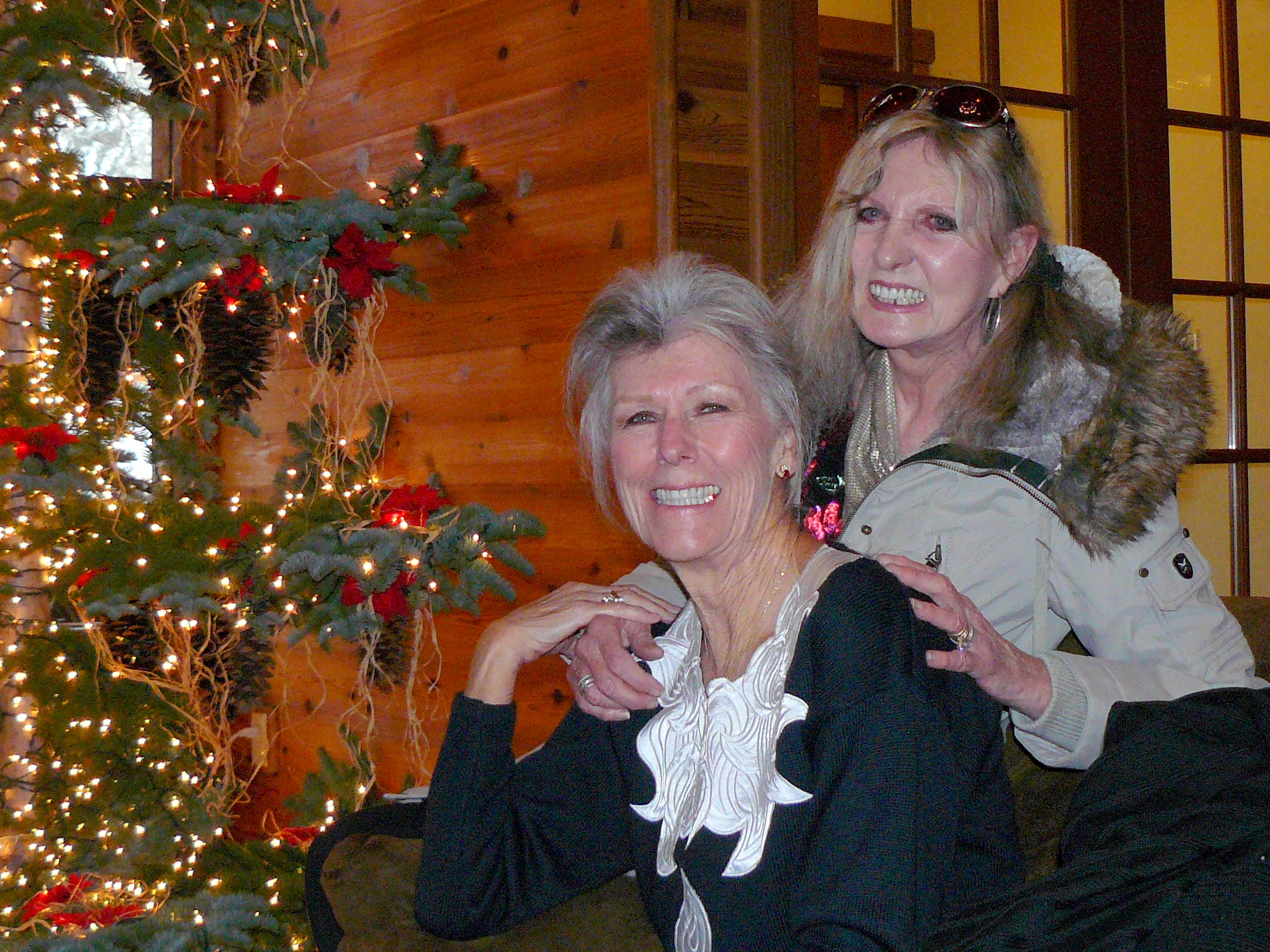
Two lovely ladies!
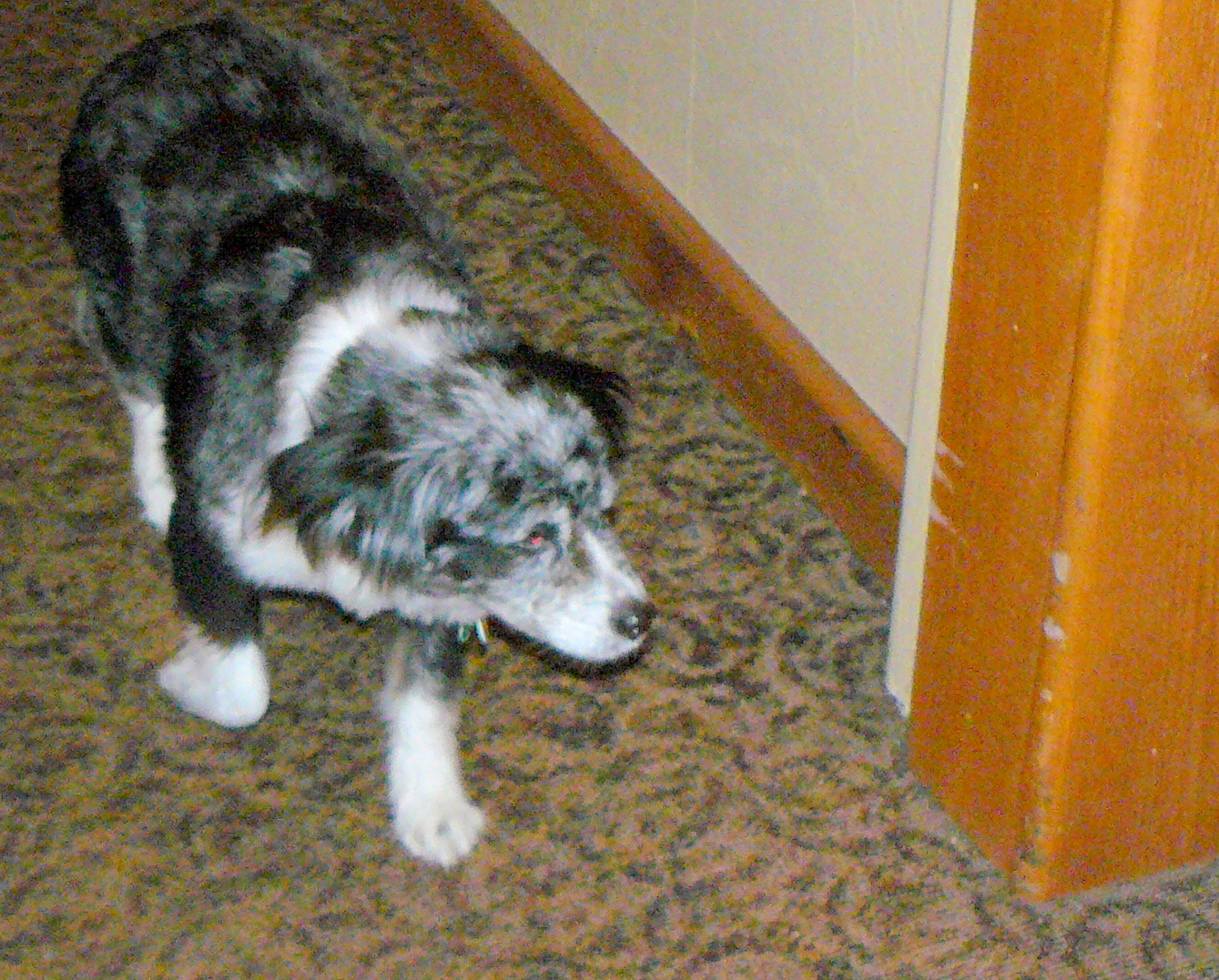
The Lodge’s dog, Blue, that happily wandered all about the place including among the diners!
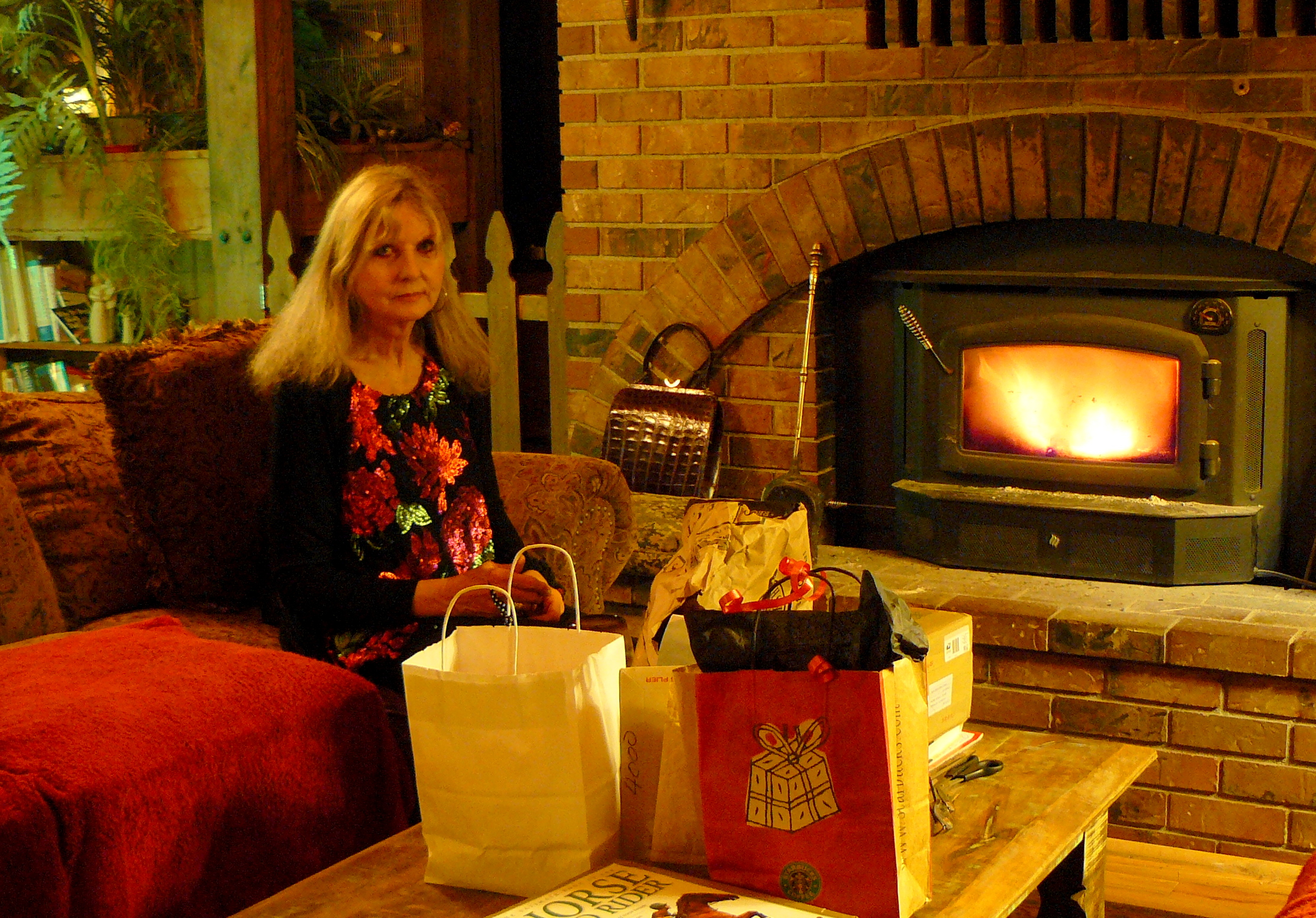
Later on in the afternoon, when Jean and I had returned home, it was time to open a few Christmas presents.
I trust that every one of you dear readers had as happy and pleasant a day as did Jean and me. Because, for us, it was wall-to-wall smiles from the moment we awoke …..
The many joys of a connected world. As I wrote that sub-heading above, it struck me that the virtual world of blogging partially mimics the real world of life, as in that in nature everything is connected. To say that everything is connected in the world of blogging is rather far-fetched, but (and you knew there was a ‘but’ coming, didn’t you) there is no question that bloggers tend to gravitate towards other bloggers where there is some sense of resonance. All of which could have been said in far fewer than the eighty-one words above! Try like-minded tend to be drawn to each other! So whether it’s in ten words or eighty-one words, it’s a preamble to the wonderful words of another blogger. I’m referring to the blog Wibble that is authored by Pendantry. Mr. P (and I’m assuming it is a ‘he’) wrote a post for the recent Earth Hug Day on December 12th. I thought it would make a nice republication this last Friday before the Winter solstice in the Northern Hemisphere this coming Sunday.
who has supported you all your life without asking for anything in return?fresh air, clear water, food, stability and unconditional love…the earth provides. the earth cares. the earth loves!
it’s about time we love her back again…every day – every moment…and with a huge collective earth hug right around the planet!
throw yourself on the ground and hug the earth!run to a tree and hug the earth!put your arms around each other and hug the earth!
I wonder at times why the most obvious things about us humans can be so easily overlooked. I have in mind that we humans are a product of a natural world, that we cannot survive without nature; however we examine our lives.
Take, for example, this picture of a city spread, in this case Chicago, where one might expect the natural world to be practically out of sight, reduced to a single point, metaphorically speaking. Yet nature is still hanging on, albeit courtesy of some local gardeners, I don’t doubt.
All of which is my introduction to yet another powerful essay from George Monbiot, republished here with his very kind permission.
ooOOoo
Civilisation is Boring
December 9, 2014
We are pre-tuned to the natural world; wired to respond to nature.
This is the first of BBC Earth’s longform essays about our relationship with the natural world.
“One of the penalties of an ecological education is that one lives alone in a world of wounds,” the pioneering conservationist Aldo Leopold wrote. “An ecologist must either harden his shell and make believe that the consequences of science are none of his business, or he must be the doctor who sees the marks of death in a community that believes itself well and does not want to be told otherwise.”(1)
I remembered that when I read the news that the world has lost 52% of its vertebrate wildlife over the past 40 years(2). It’s a figure from which I’m still reeling. To love the natural world is to suffer a series of griefs, each compounding the last. It is to be overtaken by disbelief that we could treat it in this fashion. And, in the darkest moments, it is to succumb to helplessness, to the conviction that we will keep eroding our world of wonders until almost nothing of it remains. There is hope – real hope – as I will explain later, but at times like this it seems remote.
These wounds are inflicted not only on the world’s wildlife but also on ourselves. Civilisation is but a flimsy dust sheet that we have thrown over a psyche rich in emotion and instinct, shaped by the living planet. The hominims from whom we evolved inhabited a fascinating, terrifying world, in which survival depended on constant observation and interpretation. They contended not only with lions and leopards, but with sabretooths and false sabretooths, giant hyaenas and bear dogs (monstrous creatures with a huge bite radius).
As the work of Professor Blaire van Valkenburgh at UCLA suggests, predators in the pre-human past lived at much greater densities than they do today(3). The wear and breakage of their teeth show that competition was so intense that they were forced to consume the entire carcasses of the animals they killed, bones and all, rather than just the prime cuts, as top carnivores tend to do today. In other words, the animals with which we evolved were not just bigger than today’s predators; they were also hungrier.
Navigating this world required astonishing skills. Our ancestors, in the boom-and-bust savannahs, had to travel great distances to find food, through a landscape shimmering with surprise and hazard. Their survival depended upon reacting to the barest signals: the flicker of a tail in the grass, the scent of honey, a change in humidity, tracks in the dust. We still possess these capacities. We carry with us a ghost psyche, adapted to a world we no longer inhabit, which contains – though it remains locked down for much of the time – a boundless capacity for fear and wonder, curiousity and enchantment. We are pre-tuned to the natural world; wired to respond to nature.
In computer games and fantasy novels, we still grapple the monsters of the mind. In the film of Lord of the Rings: the Two Towers, the orcs rode on giant hyaenas(4). In the first Hunger Games film, bear dogs were released into the forest to prey on the contestants(5). I don’t believe these re-creations were accidental: the directors appear to have known enough of our evolutionary history to revive the ancestral terror these animals provoke. The heroic tales that have survived – tales of Ulysses, Sinbad, Sigurd, Beowulf, Cú Chulainn, St George, Arjuna, Lạc Long Quân and Glooskap – are those that resonate with the genetic memories lodged in our minds. I suspect that their essential form has remained unchanged for hundreds of thousands of years; that the encounters with monsters recorded in writing were a consolidation of stories we have been telling since we acquired the capacity to use the past tense.
You can see how such tales might have originated in a remarkable sequence in the BBC’s Human Planet series(6). Three men in southern Kenya, described by the programme as Dorobo people (though this is not a designation many ethnographers accept) stalk to within about 50 metres of a lion kill. Fifteen lions, blood dripping from their jaws, are eating the carcass of a wildebeest. The men suddenly stand and walk towards the pride. Rattled by their astonishing confidence, the lions flee. They watch from the bushes, puzzled and indecisive, as the three men walk up to the carcass, hack off one of the hind legs, then saunter away. That night, the adventurers roast the meat in their cave. “We really robbed those lions”, one of them boasts. “How many do you think there were?”, another asks. “Fifteen, but there might have been more.”
This, surely, is how sagas begin. Those men, led by a veteran of such ruses, are heroes of the old stamp. They outwitted a party of monsters, using guile and audacity, much as Ulysses did. A few hours later, they tell the first version of a story that might echo down the generations, every time with new flourishes and embellishments. Now imagine that, thousand of years hence, lions are long extinct, and the descendants of the Dorobo have only the haziest notion of what they were. They have become monsters even bigger and more dangerous than they were in life, and the feat becomes even more outrageous and unlikely. The saga remains true to its core, but the details have changed. We are those people, still telling the old stories, of encounters with the beasts that shaped us.
The world lives within us, we live within the world. By damaging the living planet we have diminished our existence.
We have been able to do this partly as a result of our ability to compartmentalise. This is another remarkable capacity we have developed, which perhaps reflects the demands of survival in the ever more complex human world we have created. By carving up the world in our minds we have learnt to shut ourselves out of it.
One of the tasks that parents set themselves is to train their children in linearity. Very young children don’t do linearity. Their inner life is discursive, contingent, impulsive. They don’t want to walk in a straight line down the pavement, but to wander off in the direction of whatever attracts their attention. They don’t begin a task with a view to its conclusion. They throw themselves into it, engage for as long as it’s exciting, then suddenly divert to something else.
This is how all animals except adult humans behave. Optimal foraging, the term biologists use to describe the way animals lock onto the best food supply, involves pursuing a task only for as long as it remains rewarding. Our own hunting and gathering would have followed a similar pattern, though it was complicated by our ability to plan and coordinate and to speculate about imagined outcomes. Broadly speaking, ours was a rambling and responsive existence, in which, by comparison to the way we live today, we had little capacity or inclination to impose our will on the world, to lay out a course of action and to follow it without deviation or distraction.
Only with the development of farming did we have to discipline ourselves to think linearly: following a plan from one point to another across weeks or months. Before long we were ploughing in straight lines, making hedges and ditches and tracks in straight lines, building houses and then towns in straight lines. Now almost every aspect of our lives is lived within grids, either concrete or abstract. Linearity, control and management dominate our lives. We fetishise progress: a continuous movement in the same direction. We impose our lines on the messy, contradictory and meandering realities of the human world, because otherwise we would be completely lost in it. We make compartments simple enough, amid the labyrinths we have created, to navigate and understand.
Thus we box ourselves out of the natural world. We become resistant to the experiences that nature has to offer; its spontaneity and serendipity, its unscripted delights, its capacity to shake us out of the frustrations and humiliations which are an inevitable product of the controlled and ordered world we have sought to create. We bully the living world into the grids we impose on ourselves. Even the areas we claim to have set aside for nature are often subjected to rigid management plans, in which the type and the height of the vegetation is precisely ordained and, through grazing or cutting or burning, nature is kept in a state of arrested development to favour an arbitrary assemblage of life over other possible outcomes. Nothing is allowed to change, to enter or leave. We preserve these places as if they were jars of pickles.
The language we use to describe them is also rigid and compartmentalised. In the UK we protect “sites of special scientific interest”, as if the wildlife they contain is of interest only to scientists. The few parts of the seabed which are not ripped up by industrial trawling are described as “reference areas”, as if their only value is as a baseline with which to compare destruction elsewhere. And is there a more alienating term than “reserve”? When we talk about reserve in people, we mean that they seem cold and remote. It reminds me of the old Native American joke: “we used to like the white man, but now we have our reservations.” Even “the environment” is an austere and technical term, which creates no pictures in the mind.
It’s not that we have banished our vestigial psychological equipment from our minds, or lost our instinct for engagement with wildlife. The tremendous popularity of nature programmes testifies to its persistence. I remember sitting in a café listening to a group of bus drivers talking, with great excitement and knowledge, about the spiders they had seen on television the night before, and thinking that, for all our technological sophistication, for all the clever means by which we shield ourselves from our emotions, we remain the people we have always been.
But we have suppressed these traits, and see the world through our fingers, shutting out anything that might spoil the view. We eat meat without even remembering that it has come from an animal, let alone picturing the conditions of its rearing and slaughter. We make no connection in our compartmentalised minds between the beef on our plates and the destruction of rainforests to grow the soya that fed the cattle; between the miles we drive and the oil wells drilled in rare and precious places, and the spills that then pollute them.
In our minds we have sanitised the world. WH Auden’s poem Et in Arcadia Ego describes how “Her jungle growths / Are abated, Her exorbitant monsters abashed, / Her soil mumbled,” while “the autobahn / Thwarts the landscape / In godless Roman arrogance”(7). But the old gods, the old fears, the old knowledge, have not departed. We simply choose not to see. “The farmer’s children / Tiptoe past the shed / Where the gelding knife is kept.”
Civilisation is boring. It has many virtues, but it leaves large parts of our minds unstimulated. It uses just a fraction of our mental and physical capacities. To know what comes next has been perhaps the dominant aim of materially-complex societies. Yet, having achieved it, or almost achieved it, we have been rewarded with a new collection of unmet needs. Many of us, I believe, need something that our planned and ordered lives don’t offer.
I found that something once in Cardigan Bay, on the west coast of Wales. I had stupidly launched my kayak into a ten-foot swell to fish a couple of miles from the shore. As I returned to land, I saw that the tide had risen, and ugly, jumbled breakers were smashing on the seawall. From where I sat, two hundred metres from the shore, I could see that the waves were stained brown by the shingle they flung up. I could hear them cracking and soughing against the wall. It was terrifying.
Behind me I heard a monstrous hiss: a freak wave was about to break over my head. I ducked and braced the paddle against the water. But nothing happened. Then a hooked grey fin, scarred and pitted, rose and skimmed just under the shaft of my paddle. I knew what it was, but the shock of it enhanced my rising fear. I glanced around, almost believing that I was under attack.
Then, from the stern, I heard a different sound: a crash and a rush of water. A gigantic bull dolphin soared into the air and almost over my head. As he flew past, he fixed his eye on mine. I stared at the sea into which he had disappeared, willing him to emerge again, filled with a wild exaltation, and a yearning of the kind that used to afflict me when I woke from that perennial pre-adolescent dream of floating down the stairs, my feet a few inches above the carpet. I realised at that moment that I had been suffering from a drought of sensation which I had come to accept as a condition of middle age, like the loss of the upper reaches of hearing.
I found that missing element again in the Białowieża Forest in eastern Poland. I was walking down a sandy path between oak and lime trees that rose for perhaps one hundred feet without branching. Around them the forest floor frothed with ramsons, celandines, spring peas and May lilies. I had seen boar with their piglets, red squirrels, hazel grouse, a huge bird that might have been an eagle owl, a black woodpecker. As I walked, every nerve seemed stretched, tuned like a string to the forest I was exploring. I rounded a curve in the path and found myself face to face with an animal that looked more like a Christian depiction of the Devil than any other creature I have seen.
I was close enough to see the mucus in her tear ducts. She had small, hooked black horns, heavy brows and eyes so dark that I could not distinguish the irises from the pupils. She wore a neat brown beard and an oddly human fringe between her horns. Her back rose to a crest then tapered away to a narrow rump, from which a black tail, slim as a whip, now twitched. She flared her nostrils and raised her chin. I fancied I could smell her sweet, beery breath. We watched each other for several minutes. I stayed so still that I could feel the blood pounding in my neck. Eventually the bison tossed her head, danced a couple of steps then turned, trotted back down the path then cantered away through the trees.
Experiences like these are the benchmarks of my life, moments in which dormant emotions were rekindled, in which my world was re-enchanted. But such unexpected encounters have been far too rare. Most of the lands in which I walk and the seas in which I swim or paddle my kayak are devoid of almost all large wildlife. I see deer, the occasional fox or badger, seals, but little else. It does not have to be like this. We can recharge the world with wonder, reverse much of the terrible harm we have done to it.
Over the past centuries, farming has expanded onto ever less suitable land. Even places of extremely low fertility have been cultivated or grazed, and the result has been a great disproportion between damage and productivity: the production of a tiny amount of food destroys the vegetation, the wild animals, the soil and the watersheds of entire mountain ranges. In the face of global trade, farming in such areas is becoming ever less viable: it cannot compete with production in fertile parts of the world. This has caused a loss of cultural diversity, which is another source of sadness.
But at the same time it means that the devastated land could be restored. In Europe, according to one forecast, 30 million hectares – an area the size of Poland – will be vacated by farmers by 2030(8). In the United States, two thirds of those parts of the land which were once forested, then cleared, have become forested again(9), as farming and logging have retreated, especially from the eastern half of the country. Rewilding, the mass restoration of ecosystems, which involves pulling down the redundant fences, blocking the drainage ditches, planting trees where necessary, re-establishing missing wildlife and then leaving the land to find its own way, could reverse much of the damage done to these areas. Already, animals like lynx, wolves, bears and moose, on both continents, are moving back into their former ranges.
There are also possibilities of restoring large parts of the sea. Public disgust at a fishing industry that has trashed almost every square metre of seabed on the continental shelves is now generating worldwide demands for marine parks. These are places in which commercial extraction is forbidden and the wildlife of the seas can recover. Even fishing companies can be persuaded to support them, when they discover that the fish migrating out of these places greatly boost their overall catches, a phenomenon known as the spillover effect. Such underwater parks are quickly recolonised by sessile life forms. Fish and crustacea proliferate, breeding freely and growing to great sizes once more. Dolphins, sharks and whales move in.
In these places we can leave our linearity and confinement behind, surrender to the unplanned and emergent world of nature, be surprised once more by joy, as surprise encounters with great beasts (almost all of which, despite our fears, are harmless to us) become possible again. We can rediscover those buried emotions that otherwise remain unexercised. Why should we not have such places on our doorsteps, to escape into when we feel the need?
Rewilding offers something else, even rarer than lynx and wolves and dolphins and whales. Hope. It offers the possibility that our silent spring could be followed by a raucous summer. In seeking to persuade people to honour and protect the living planet, an ounce of hope is worth a ton of despair. We could, perhaps, begin to heal some of the great wounds we have inflicted on the world and on ourselves.
George Monbiot is the author of Feral: rewilding the land, sea and human life. There’s an archive of his articles at http://www.monbiot.com
References:
1. Aldo Leopold, 1949. A Sand County Almanac. Oxford University Press.
I’m sure that you will agree with me that this is a wonderful essay from Mr. Monbiot, an essay that speaks to us in ways that we all intuitively know makes huge sense.
Over the years, I have collected well over a hundred ‘draft’ posts. In the main, these are simply things that have caught my eye that could perhaps be a blog post sometime in the future.
Recently, I have been wandering through these drafts, throwing away those topics that were clearly dated, and endeavouring to find the gems that really do need to be shared with you.
This post most definitely falls into the ‘must share’ category.
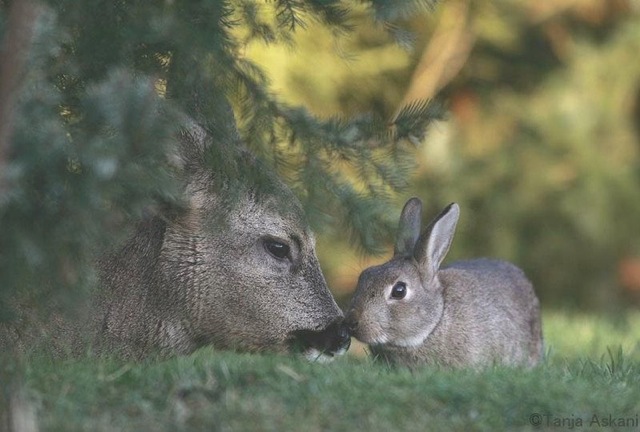
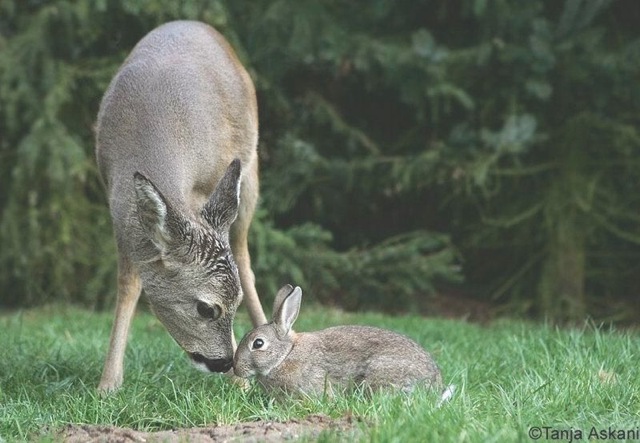
It is just a photograph. A photograph that I regret I can no longer recall it’s source.
But trust me, this is one of those photographs that …….
Among my subscription feeds is one to EarthSky News. Thus it was courtesy of yesterday’s update that I saw the link to the following video. It was promoted as follows: “High plains storms. The opening is brilliant … the end is awesome. (You’ll like the rest too.) By Nicolaus Wegner.” Nicolaus Wegner’s own website was easily found here; on which the following photograph was seen. (This actual image was taken from a web search – the full size, breathtaking version, may be seen here.)
So back to the video. (Just note that when I watched it, it seemed unable to spool past the 8-second mark. If this happens to you, just manually drag the progress bar along to 10 seconds, or just past that. It’s worth it!)
High plains storms are some of the most beautiful and wild in the world. I spent May – September 2014 photographing all types of severe weather in Wyoming, Montana, South Dakota, Nebraska, and Colorado. This time lapse project is a result of that effort. From rainbows to tornadoes, there is a little bit of everything in here.








 This is a letter to yourself written a year in advance, describing all the things that you are grateful for during the year. Start with the date December 31st, 2015 and address it to yourself.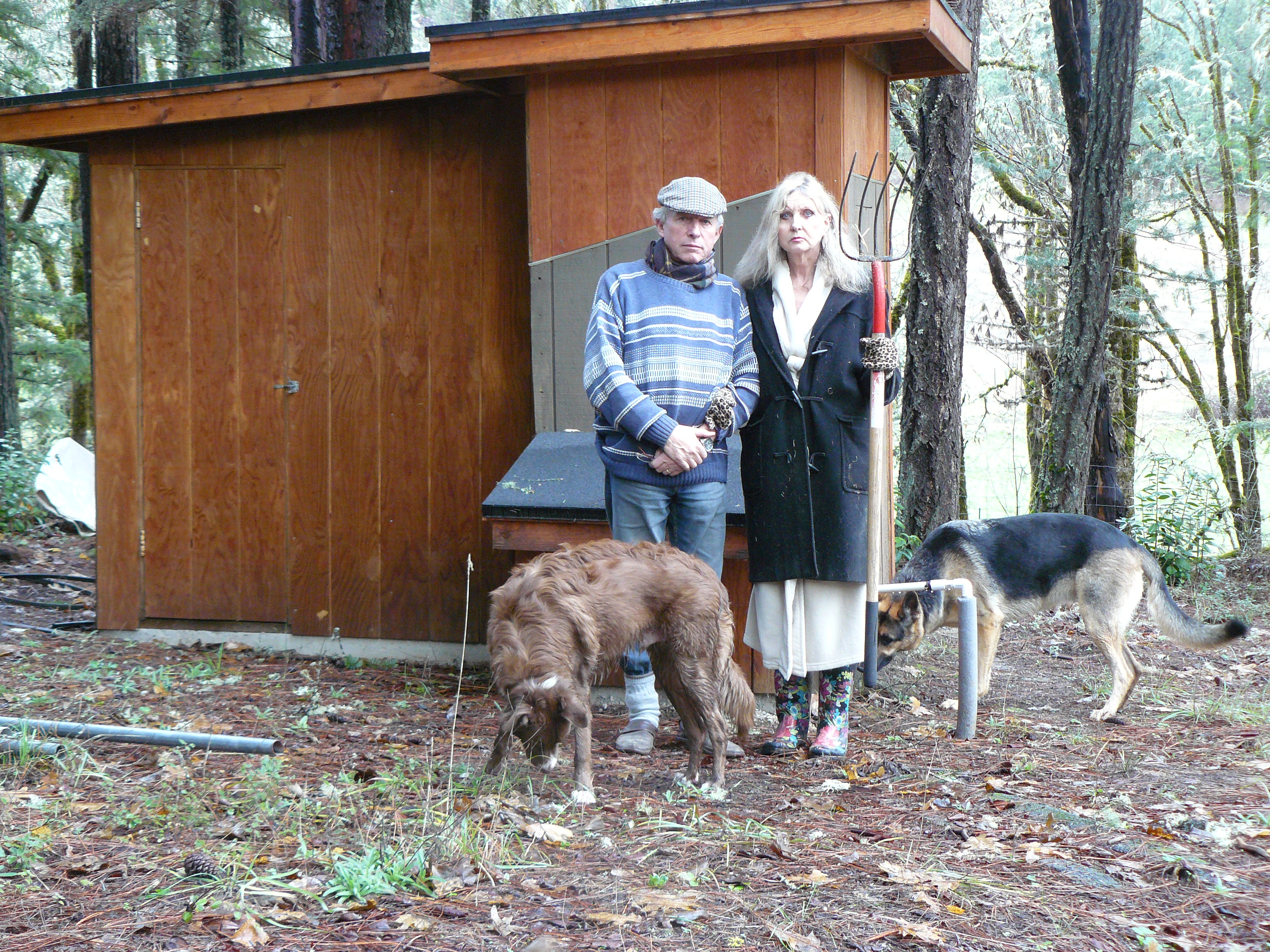







 Learning from Dogs